




Abstract
Personality traits influence our outlook and choices in life, and may also influence how we evaluate and respond to an extreme event such as the COVID-19 pandemic in 2020. Here we combined big five personality measures from a large nationally representative sample taken before the onset of the pandemic with measures of perceived risk and compliance four months into the pandemic. We predicted that low extraversion, low openness, and high neuroticism would predict higher perceived risk. We further predicted that high conscientiousness, low extraversion, high agreeableness, high openness, and high neuroticism would predict higher compliance. To control for flexibility in the analysis and reporting of the many possible associations, the hypotheses and analysis plans were reviewed and approved before aligning the two datasets (a registered report format). Our results supported that conscientiousness and agreeableness was associated with compliance. Low extraversion was associated with compliance to instructions to avoid social interactions (a variant of a registered hypothesis). Neuroticism was associated with seeing the pandemic as a larger risk. Thus, associations between personality and health behaviour frequently seen in past research predicted risk and compliance in a pandemic setting, while associations with less support in the literature were less reliable.
Introduction
Personality and pandemic outcomes
The extent to which an individual sees a pandemic to constitute a risk for them, and the extent to which they comply with the health authority's infection control measures, is crucial for the individual’s mental and physical health, and for society’s management of the pandemic. Several possible relationships between personality traits, risk, and compliance have been suggested in the literature (Aschwanden et al., 2020).
Our dataset allows us to compare personality measures from half a year before the onset of the pandemic with measures of perceived risk and compliance during the pandemic. By stating a number of hypotheses derived from the literature in advance, we can test which relationships are and are not supported in the dataset. This can inform which personality traits are associated with seeing the risk of a given pandemic situation to be particularly high or particularly low. It can also inform us about which personality traits are associated with higher or lower compliance with infection control measures. Knowledge about how personality traits and other individual differences determine risk perception and compliance may be relevant for designing public health interventions. In particular, information campaigns may be adjusted in attempts to influence individuals that may otherwise be resistant to seeing the risk or complying with infection control measures.
Pandemic outcomes
Perceived risk
In the context of an ongoing pandemic, “perceived risk” would constitute the subjective likelihood of being infected (or of being affected by other direct or indirect effects of the pandemic), and the subjective evaluation of how negative this event would be. How people see risks during a pandemic may be shaped by various psychological mechanisms. Individuals may rely on their past experiences with infectious diseases, information from various news sources, and their prior beliefs to evaluate risk. Personality traits, level of trust in authorities, and cultural beliefs may influence how people perceive and respond to risk. For example, someone with a higher tolerance for risk might perceive the threat of the virus differently than someone who is more risk averse. Similarly, individuals who trust government advice may be more likely to trust reported infection rates and take precautions compared to those who are sceptical of government information (Ebrahimi et al., 2021; van der Weerd et al., 2011). It has previously been argued that perceived risk could have a major contribution to the extent to which individuals comply with infection control measures (Bish & Michie, 2010; van der Pligt, 1998; van der Weerd et al., 2011; Witte & Allen, 2000). However, a previous analysis of other data from the current panel (measured in March 2020) did not show substantial association between perceived risk and compliance (Sætrevik & Bjørkheim, 2022). Hansen et al. (2023) also found mixed evidence for the association between perceived risk and compliance with infection control measures in an American sample. These conflicting findings could be due to individual factors (such as personality traits) causing the factors to correlate in some settings, but not others.
Compliance with infection control measures
Around March 2020 most countries implemented various public health measures to gain control over the COVID-19 infection. In Norway these measures mostly took the form of recommendations for regulating various behaviours that at the time were assumed to increase infections. In the late summer of 2020, the measures in Norway constituted close testing and tracing, quarantine and isolation measures for infected persons, crowd limitation on recreational activities such as going to bars and restaurants, restrictions on international travel, and restrictions on cultural events such as sports, art, and theatre events (Ministry of Health Services, 2020). Additionally, the health authorities recommended people to work from home, limit the use of public transportation, keep physical distance to strangers, and avoid crowds. “Compliance” can be thought of as the extent to which individuals’ actual behaviour is in accordance with the measures. Compliance is typically measured as the self-reported intention to comply, past or typical compliance behaviour. Our analyses of compliance from previous time-points of the current panel dataset have shown that compliance was very high among Norwegians in March 2020 (Sætrevik, 2021), decreased somewhat over the summer as infection rates fell, but rose again in the early fall when the rates increased (Bjørkheim et al., 2024; Sætrevik & Bjørkheim, 2020).
Impact of personality on pandemic behaviour
The big five personality model
The “big five” model (or five-factor model; Costa & McCrae, 1992) is the dominant model for describing individual differences in personality. The model was developed primarily based on lexical and statistical approaches, and has later been replicated in a range of cultures and supported by empirical correlates corresponding with the conceptualisations of the traits (Costa & McCrae, 1992). The fundamental assumptions in the model are that traits represent important differences between individuals and that such traits are relatively stable across time and situations (Larsen et al., 2021). We should mention that alternative models have also been suggested, such as the HEXACO model (Lee & Ashton, 2008) and the dark triad model (Paulhus & Williams, 2002).
Personality impact on pandemic behaviour
Individuals’ personality traits may influence how they gather and evaluate information about risk, and make decisions about protective behaviour during a pandemic. The “trait activation theory” posits that personality traits predict behaviour when the situation is relevant to the expression of those traits (Tett et al., 2021). In a pandemic, where following health guidelines is crucial, one would expect personality traits to be associated with compliance behaviours. Personality traits have been shown to influence both which information individuals notice and how they respond to the information (Costa & McCrae, 1992). For instance, neuroticism has been linked to a stronger tendency to notice negative social stimuli (e.g., signs of social exclusion) and to experience more negative affect in response to such stimuli (Abdellaoui et al., 2019; Montag & Panksepp, 2017). It has been suggested that differences in risk perceptions have evolutionary underpinnings in which different levels of risk sensitivity have been advantageous in different settings (Buss & Penke, 2015). Further, personality traits have been suggested to influence safety-relevant behaviour (Beus et al., 2015).
Two types of mechanisms have been suggested to explain relationships between personality and compliance: First, personality traits may have a direct effect on pandemic compliance by affecting the individual’s willingness and capacity for complying. This proposed mechanism is supported by theory and research on health behaviour, in which pandemic compliance could be considered as a form of health protective behaviour (Weinstein, 2000). Personality traits influence health behaviour by influencing the individual’s motivation and capacity for both avoiding negative health behaviours and committing to positive health behaviours (Strickhouser et al., 2017; Willroth et al., 2021). A second possible mechanism through which personality traits can influence compliance is through norm adherence. Adhering to norms may affect an individual’s likelihood of being aware of, agreeing with, and being motivated to comply with what is seen as the socially expected behaviour (Bogg & Roberts, 2004; Tate et al., 2022). It has been suggested that norm adherence is an important mechanism in the possible relationship between personality traits and compliance with pandemic norms (Bogg & Milad, 2020). Thus, once social norms for compliance with infection control measures are established in the person’s environment, compliance would be subject to the personality mechanisms that influences norm-following in general.
There have been a number of studies and a few reviews on how personality traits may impact assessment and decision-making during pandemic situations. These are mostly based on data collections done during the COVID-19 pandemic, and some studies during the 2009 H1N1 (“swine flu”) pandemic. All the big five personality traits have been indicated to be involved, but the indications are clearer for some traits than for others, and some of the associations have little or contradictory support. There are more studies about the association personality traits have to compliance than about the association they have to pandemic risk perceptions. Below we will review the theoretical reasoning and empirical support that each of the personality traits should influence risk and compliance. We will discuss the traits in decreasing order based on how central they appear to be for the current research questions. Other relationships between personality traits and pandemic outcomes than those discussed here may have been suggested, but we will limit our discussion to relationships we see as having a certain amount of theoretical or empirical support.
Effects of conscientiousness on compliance
The big five trait of “Conscientiousness” refers to a tendency to hold and comply with high standards for orderliness and self-discipline (Roberts et al., 2014). Individuals with higher levels of conscientiousness are typically viewed as neat, reliable, and ambitious. Conscientiousness may be particularly relevant to pandemic behaviour, since compliance to infection control measures requires motivation and diligence over time.
Across the literature, conscientiousness appears to be the most reliable and robust personality trait that predicts general health behaviour and adhering to medical advice (Hampson & Friedman, 2008; Hill & Roberts, 2011). Conscientiousness tends to be positively related to health-beneficial behaviours and inversely related to risky health-related behaviours and (Bogg & Roberts, 2004). This may work through a mechanism in which conscientious individuals are rule-abiding and prioritize long-term over short-term gains (Roberts et al., 2014). Conscientiousness could also work through increasing compliance with what is seen as the dominant or desirable social norms as conscientious individuals are known to be norm abiding (Roberts et al., 2014).
This association is likely to also generalize to health-behaviour during a pandemic, as argued by (Zajenkowski et al., 2020). Accordingly, research during the COVID-19 pandemic has indicated that conscientiousness is associated with taking health precautions against infection (Aschwanden et al., 2020), give health recommendations to others (Clark et al., 2020), physical distancing and handwashing (Carvalho et al., 2020; Ebrahimi et al., 2021; Ludeke et al., 2021; Zettler et al., 2022), physical distancing among older adults (Airaksinen et al., 2021), more shelter-in-place (Götz et al., 2021), less often going to bars/restaurants or touching their face (Bogg & Milad, 2020), getting vaccinated (Adamus et al., 2022), and in general more compliance and more changed behaviour (Brouard et al., 2020; Horwood et al., 2023; Schmeisser et al., 2021; Willroth et al., 2021; Zettler et al., 2022).
To our knowledge, there is no empirical or theoretical reason to expect an association between conscientiousness and risk perception.
Effects of agreeableness on compliance
“Agreeableness” is associated with behavioural tendencies for cooperation, compassion, and willingness to help others (Costa & McCrae, 1992). Individuals with higher levels of agreeableness are often viewed as kind, modest, and honest. In a pandemic, agreeableness may lead to pro-social motivation to comply with infection control measures in order to protect other members of the community.
At the time of measurement there was a strong social norm for compliance with infection control measures in Norway (Sætrevik et al., 2021). Since agreeableness reflects social compliance, it is likely that higher agreeableness is positively associated with the socially dominant pattern of complying. This would also constitute compliance with what was seen as socially desirable values. The public discourse in Norway at the time often argued that general compliance with infection control measures was important to protect at-risk populations. Thus, another mechanism for the association between agreeableness and compliance may be through compassion and concern for others’ well-being (Lauriola & Weller, 2018).
In line with these assumptions, it has been shown that agreeableness is associated with taking pandemic health-precautions during, and to give health recommendations to others (Clark et al., 2020). More specifically, agreeableness has been shown to be associated with more shelter-in-place (Götz et al., 2021), more physical distancing (Ludeke et al., 2021; Nofal et al., 2020), more handwashing (Asselmann et al., 2020; Nofal et al., 2020), avoiding public transport, crowds, and social situations (Asselmann et al., 2020), with being less mobile (Chan et al., 2021), and less risky behaviour (sample 1 in Panish et al., 2023). One study (Willroth et al., 2021) found agreeableness to have a larger contribution to compliance than any other traits. On the other hand, a study of older adults found an inverse relationship between agreeableness and limiting in-person contact (Airaksinen et al., 2021).
To our knowledge, there is no empirical or theoretical reason to expect an association between Agreeableness and Risk perception.
Effects of extraversion on risk perception
“Extraversion” is associated with engagement with the external world across a wide range of activities (Costa & McCrae, 1992). Extraverted individuals tend to get enjoyment from and are invigorated by social interactions. They are often seen as energetic, enthusiastic, and dominating in social situations.
Extraversion may influence how people assess risk during a pandemic. Extraversion has been associated with some types of risk-taking (Lauriola & Weller, 2018). This tendency is often attributed to increased levels of “sensation seeking” (Nettle, 2005), which has been suggested to be a specific facet of extraversion (Zuckerman & Kuhlman, 2000). Extraversion is also associated with optimism and perceiving risks to be lower (Sharpe et al., 2011). It is also associated with being more attentive to positive information and less attentive to negative information (Noguchi et al., 2006). This risk-tolerance may lead extraverted individuals to see the risk for infection and other pandemic risks to be lower than more introverted individuals.
Effects of extraversion on compliance
In addition to the effects on how risk information is processed, extraversion may also have an effect on compliance with infection control measures. Extraverted people have stronger social drive and get more enjoyment from social activities, and extraversion has been found to predict increased loneliness during the pandemic (Entringer & Gosling, 2022). This may make it more difficult for extraverted people to comply with infection control measures that call for limiting social activities, such as keeping physical distance, avoiding private social events, or limiting shopping, restaurant visits, and nightlife. Stronger motivation to socialize may lead to less compliance with the infection control measures, independently of how the pandemic risk is perceived (see Zajenkowski et al., 2020, for a similar argument). Conversely, individuals with lower levels of extraversion might be better equipped to cope with the pandemic, as they may find solace in quieter, more introspective activities. It has been showed that extraverted individuals showed less physical distancing during the COVID-19 pandemic (Carvalho et al., 2020; Ebrahimi et al., 2021; Ludeke et al., 2021), less shelter-in-place (Götz et al., 2021), less mask-wearing (Barceló & Sheen, 2020), more hesitation about vaccines (Panish et al., 2023), and telemetry data showed them to be more mobile during lockdown (Chan et al., 2021). In more general terms, it was indicated that extraverted people changed their behaviour less in response to the infection control measures (Brouard et al., 2020). However, note that some studies have also indicated a positive or absent association between extraversion and compliance (Airaksinen et al., 2021; Willroth et al., 2021; Zettler et al., 2022).
Effects of openness on risk perception
The personality trait “Openness to experience” reflects orientations towards aesthetics and novelty, and may be related to need for cognition and flexibility (Costa & McCrae, 1992). Open individuals are often perceived as unconventional, intellectual, and artistic. Individuals with higher levels of openness may be more adaptable, creative, and more welcoming to new ideas.
Openness to experience is associated with unconventional thinking. This could lead to individuals higher on openness to be less willing to accept the official message that the pandemic is a threat, and could thus lead to perceiving the risk as lower. Openness to experience is also associated with “sensation seeking” (Zuckerman & Kuhlman, 2000), along with extraversion, as discussed above. The higher risk tolerance that this entails might also transfer to a pandemic setting. On the other hand, openness to experience is associated with the ability to imagine dramatic changes in their everyday life (Eldesouky, 2012). This could lead open individuals to more easily acknowledge that the pandemic is a radically changed situation that implies a higher risk. Although effects in either direction are theoretically conceivable, we find an inverse association to be more likely given the established connection between openness and sensation seeking. We are not aware of any previous research that has shown associations between openness to experience and perceived infection risk.
Effects of openness on compliance
Individuals higher in openness may be more accepting towards engaging in new activities and may more easily change their routines. As most of the infection control measures requested people to make radical changes to their lives, it is possible that individuals higher on openness were more willing to comply with them (see similar argument e.g., in Webster et al., 2023). Accordingly, previous research has shown that openness was positively associated with handwashing and physical distancing (Airaksinen et al., 2021; Nofal et al., 2020), shelter-in-place (Götz et al., 2021), vaccination (Panish et al., 2023; Webster et al., 2023), and less risky behaviour (Panish et al., 2023). Others have found indications of positive associations between openness and compliance to infection control measures (Willroth et al., 2021; Zettler et al., 2022), and indirect association through trust in government (Schmeisser et al., 2021). On the other hand, openness is characterised by non-conventionality (Costa & McCrae, 1992), which may lead to less compliance in settings where most others are compliant. Hence, while most previous research has indicated that openness is positively associated with pandemic compliance (perhaps due to being adaptable to new settings), mechanisms such as impulses for non-conventionality could also lead to an inverse relationship between openness and compliance.
Effects of neuroticism on risk perception
“Neuroticism” is associated with behavioural tendencies for emotional instability, anxiety, and a predisposition to experience negative emotions. Individuals with higher levels of neuroticism may be perceived as emotional labile, self-conscious, and vulnerable. Neuroticism has been shown to predict the extent to which individuals perceive themselves to be vulnerable to infectious diseases (Duncan et al., 2009). In a pandemic, neuroticism could generalize to fear of being infected, and to taking action to avoid infection.
Since neuroticism is associated with increased attention to negative information and a tendency to worry (Abdellaoui et al., 2019; Montag & Panksepp, 2017), we may assume that individuals higher in neuroticism may perceive the risk of the pandemic to be higher. This expectation is also in line with the findings from a previous study (Zettler et al., 2022). Neuroticism has been found to be associated with seeing COVID-19 to constitute a higher risk and being more pessimistic about the outcomes of the COVID-19 pandemic (Horwood et al., 2023).
Effects of neuroticism on compliance
In addition to the effect on perceived risk, neuroticism could have an independent effect on compliance with pandemic measures. Neuroticism has been shown to be associated with fear of disease and with germ avoidance behaviour (Duncan et al., 2009). More specifically anxiety about pandemics have predicted compliance with infection control measures (Bults et al., 2011). Neuroticism has been shown to have a positive association with shelter-in-place behaviour (Götz et al., 2021), physical distancing (Ludeke et al., 2021), limiting in-person contact among older adults (Airaksinen et al., 2021), and reducing use of public transport (Asselmann et al., 2020). It has been indicated that the effects of neuroticism may work through emotions (Brouard et al., 2020) and trust in government (Schmeisser et al., 2021). It should be noted that some studies have indicated an inverse association between neuroticism and taking precautions (Aschwanden et al., 2020) or getting vaccinated (Adamus et al., 2022).
Knowledge gap
As reviewed above, several studies have found associations between personality traits and either perceived risk or compliance, or studies have argued for psychological mechanisms that could produce such effects. As we have seen, stronger predictions can be made for some of the associations than others. Some associations, such as the effect of personality on COVID-19 vaccination, have shown only weak or mixed results (Halstead et al., 2022; Lin & Wang, 2020; Murphy et al., 2021).
Most of the relevant research on this matter is cross-sectional, where personality was measured during a health crisis and while also measuring protective behaviour. This context may have provided normative influences on how individuals respond to questions about both personality and compliance (social-desirability bias, Edwards, 1953). Such influences may lead individuals to report higher values for extraversion, conscientiousness, agreeableness, openness, and emotional stability, and also to report seeing the pandemic risk to be substantial and that one intends to comply with the infection control measures.
The respondent’s current mood or emotional state may influence both reports of personality (Kokkonen & Pulkkinen, 2001; Lewis et al., 1995) and of health status (Croyle & Uretsky, 1987). For example, a person in a positive mood may report to be agreeable and to be optimistic about pandemic outcomes, while a person in a negative mood reports the opposite pattern. A related challenge is that responses to one type of question may influence how subsequent questions in the same survey are answered (Braverman & Slater, 1996; Krosnick et al., 1996; Moore, 2002). After stating that one is a conscientious person, it may be more consistent to also report higher levels of compliance. Such artefacts may provide false positive findings about the relationship between personality and pandemic behaviour, or to conceal real relationships.
Relatively few of the reviewed studies on how personality may influence pandemic behaviour have separate procedures to distinguish hypothesis statement from hypothesis testing. Although understandable for research initiated during an ongoing health crisis, it may make it difficult to say how robust the findings are and what predictive value they have (Simmons et al., 2021). When measuring a number of personality traits along with a number of pandemic outcomes (attitudes, beliefs, or behaviours, which may be indexed in different ways) there is a high number of potential relationships that can be discovered. An approach where the planned hypotheses are registered in advance of the analysis can make stronger claims about whether a priori predictions are supported (as opposed to false positives findings that may emerge from multiple comparisons and undisclosed analytic flexibility, Munafò et al., 2017; Nelson et al., 2018).
Most of the reviewed studies report effects of some of the big five traits against a specific outcome, but not for other traits. Some data-exploration approaches to big datasets have found that most of the personality traits may play a role (e.g., Han, 2021). Given that a high number of possible associations between personality traits and pandemic outcomes have been suggested in the literature, it could have value to test all the relevant associations in a single study, and state which of the associations from the literature are and are not supported. As the majority of the relevant literature has focused on the association between personality and compliance, it could also have value to include the association between personality and perceived risk.
Hypotheses and approach
A Schematic Presentation of the Current Study’s Hypotheses and Their Apparent Support in The Literature
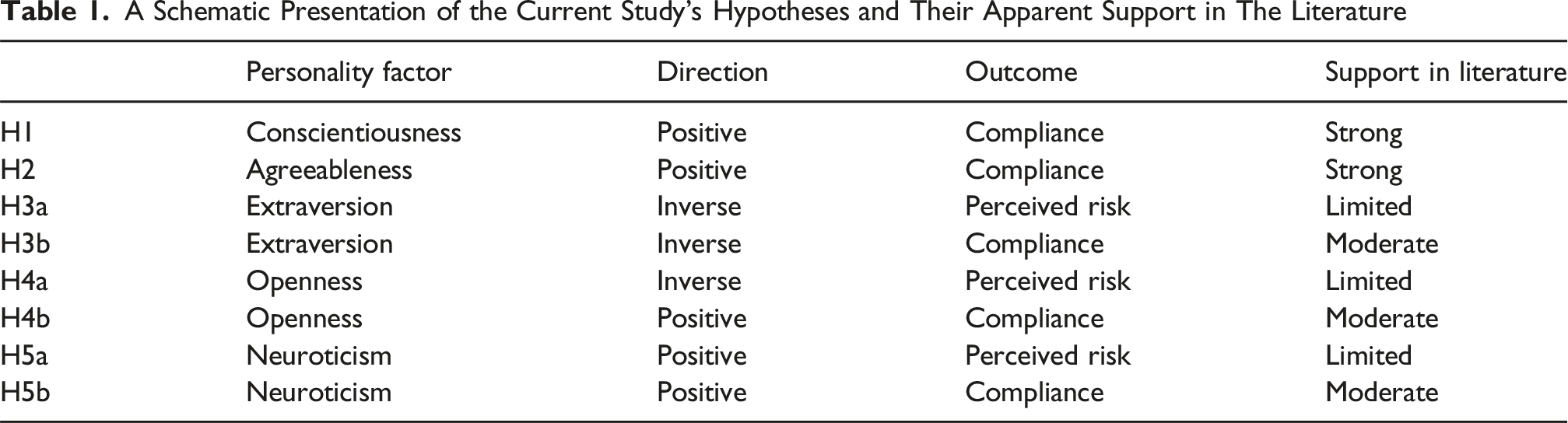
The registered reports approach (Chambers & Tzavella, 2022) entails that we first (Stage 1) preregister our assumptions and analytic approach, and have this reviewed by experts in the field (available at https://osf.io/5ygcp). We had some prior knowledge of the dataset before Stage 1 submission, in terms of having examined the response distributions of the pandemic variables (Perceived risk and Compliance). However, we had no knowledge about the personality variables, and the data from the two data-collection time-points had not been combined before Stage 1 submission. After “in-principle acceptance” of the Stage 1 manuscript, we combined the datasets and performed the planned analyses (Stage 2).
Methods
Data collection
All data in the current analysis are from the Norwegian Citizen Panel. Recruitment is done through random selection among all Norwegian citizens above the age of 18. Initial recruitment to the panel was done in 2013, with yearly supplemental recruitment. Researchers at the University of Bergen are responsible for planning and measurement design for the panel, while the company Ideas2Evidence manages the recruitment, data collection, and survey methodology reports. The dataset with personality measures and the dataset with pandemic measures were not merged before Stage 2, in order to prevent preliminary analyses from affecting the hypothesis formation.
Personality data collection
The survey that measured big five personality traits was collected between May 21st and June 7th, 2019. Initial invitations were sent out to the email accounts of the then 18,090 panel members, with subsequent reminders sent out on the 29th of May, 3rd of June and 7th of June. The data collection yielded a response rate of 74.4%. In total 8105 panel members answered the big five questions.
Pandemic data collection
The survey that measured perceived risk from the pandemic and compliance with infection control measures was collected between August 26th and September 2nd, 2020. Invitations were sent out by email to a subset of the panel which consisted of 6776 panel members, with subsequent reminders sent out on the 28th and 31st of August. The data collection had a response rate of 81.8%, which yielded an n of 5531 (see methodology report: https://osf.io/5h2sb/). Of these, 3223 panel members could be matched between the personality and the pandemic data collection.
At the time the pandemic data was collected, the infection rates in Norway were increasing following a summer of low and stable infection rates. There were a number of infection control measures in place, including restrictions on public gatherings, quarantine requirements for travellers, and widespread testing and tracing. Additionally, Norwegians were advised by the health authorities to adopt a number of personal hygiene measures such as handwashing, avoiding touching public surfaces, and keeping physical distance from strangers (no encouragement to wear masks at that time). The more intrusive measure from the outbreak in March and April of the same year had been lifted, including re-opening international borders and schools. The pandemic was very much a part of the public debate, although there were fewer cases in Norway than a number of other Western countries at the time. A number of vaccine candidates were being examined at the time, but no conclusive successes had been reported, and it was projected that distribution of vaccines would not happen for at least another six months.
Respondents
Members of the Norwegian Citizen Panel have participated in online surveys about diverse social matters three to four times a year since 2013. The panel aim to be representative for the adult Norwegian population (aged 18 or older). There are slight deviations from perfect representativity in terms of age, education level, and place of residence. The dataset is provided with weighting variables that can be used to adjust for the deviations in representativity (see methodology report, https://osf.io/g57sf).
Materials and variables
All item text (in original Norwegian and English translation), with variable classification and response options are shown in an Online Supplemental File (https://osf.io/ksvh3). Measurement of the Personality, Perceived risk and Compliance are described in more detail below.
Personality measure
We measured personality traits by adopting the Big Five Inventory-10 (BFI-10) scale from Rammstedt and John (2007). The BFI-10 offers a viable option for quick and efficient assessment of the big five personality dimensions, making it particularly useful in research settings with time or space limitations. While it incurs some loss in psychometric properties when compared to the 44 item version that it is adapted from, its reliability and validity remain robust, demonstrating its utility as a brief and effective personality measurement tool (Rammstedt & John, 2007). The BFI-10 was created by selecting two items for each of the big five personality dimensions, ensuring representation of both poles (high and low) of each factor. The selection process aimed to retain core aspects of each dimension while minimizing redundancy. The scale comprises a series of statements that are intended to assess a respondent’s self-perception of various personality traits. Respondents were prompted to evaluate the extent to which each statement aligns with their self-concept. Each statement begins with an introductory phrase such as “I see myself as someone who” and is then followed by the key trait such as “… is reserved”. Responses are made on a five-point Likert scale, where respondents indicate their level of agreement with the characterizations on a scale ranging from “disagree strongly” (1) to “agree strongly” (5). For each personality trait, we will calculate an arithmetic average of the two items.
Perceived risk measure
Four items were used to assess perceived risk related to the coronavirus, all using a five-point Likert-type scale ranging from “very low” (1) to “very high” (5). These items were designed to measure the extent to which respondents saw various aspects of the ongoing pandemic as a threat to their health, to their established lives, or indirectly by threatening their society. The first item, “Perceived risk for being infected,” asked how high or low respondents perceived the risk for themselves to be infected by the coronavirus. The second item, “Perceived risk for the average adult to be infected,” asked how respondents perceived the risk of an average adult in Norway to be infected by the coronavirus. The third item, “Perceived risk of serious illness,” asked how likely the respondents perceived it io be that they themselves would become seriously ill due to the coronavirus. The fourth item, “Perceived risk of impact on everyday life,” asked how the respondents perceived the risk for their everyday life to be significantly changed as a result of the pandemic. We calculated an arithmetic average of the four items to represent the variable Perceived risk.
Compliance measure
Compliance was measured with four items that indicated how engaged the respondents were in preventive actions and how much they adhered to the recommended health precautions. All responses were recorded on Likert-type scales that asked the respondents to indicate their intention to adhere to pandemic measures. The first item, “General compliance,” involved a five-point scale ranging from “strongly disagree” (1) to “strongly agree” (5). It asked about the extent the respondent agreed to doing their best to follow advice from health authorities, and gave the following examples of practices in parentheses: frequent handwashing, limiting travel, maintaining physical distance to others, and avoid touching surfaces. The subsequent three items asked how frequently the respondent had adhered to three prominent behavioural recommendations in the last two weeks and used a seven-point Likert-type scale from “never” (1) to “always” (7). “Handwashing” asked how much of the time they washed their hands carefully after being outside. “Physical distancing compliance” asked how much of the time they maintained at least a 1-m distance from strangers. Lastly, “Avoidance of social situations” asked how much of the time they avoided interactions with strangers during this period. To represent the variable Compliance, we calculated an arithmetic average of the four items.
Analyses
Study design Overview, Showing Research Question, Hypothesis, Sampling and Plan, Sensitivity, Interpretation and Theory Implications. Asterisks in Rightmost Column Shows Associations that Were Significant. See Table 5 for more Results
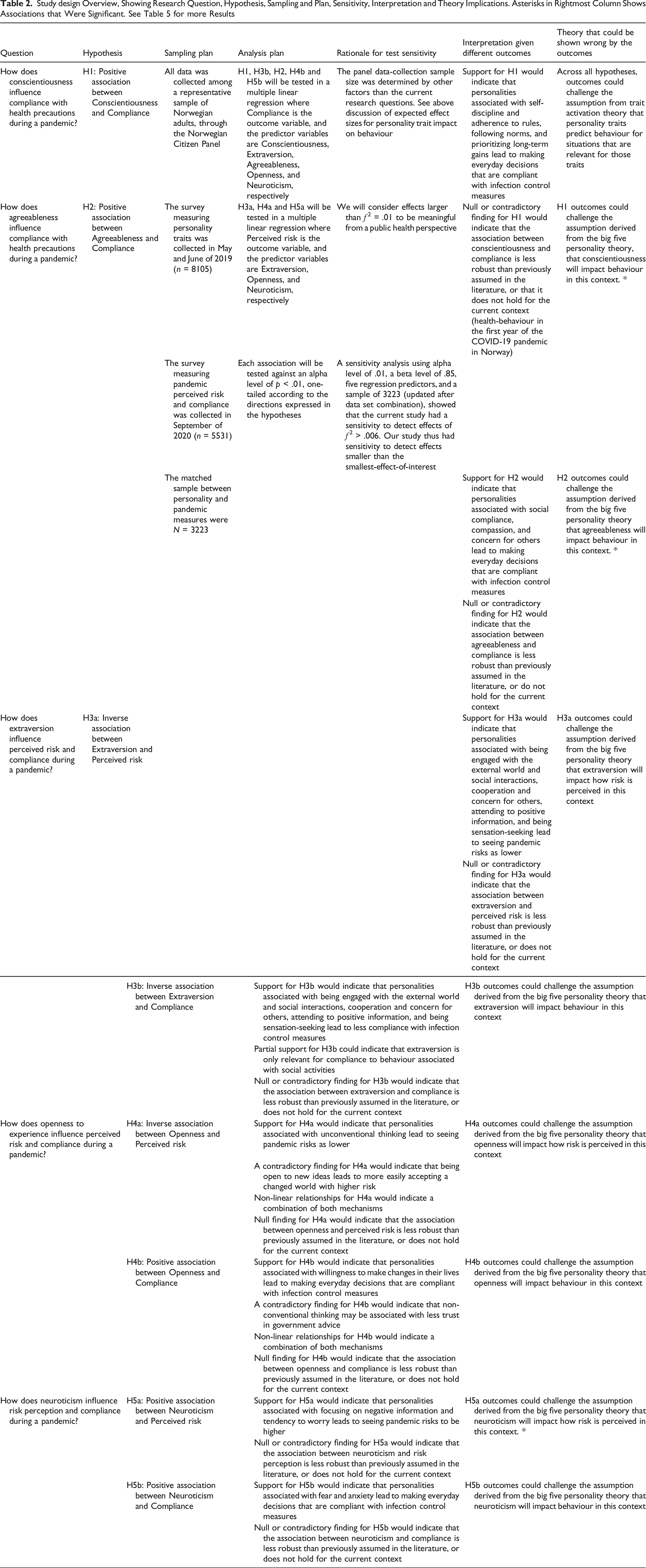
We reported effect sizes of the relationships between the traits and the outcomes as Cohen’s ƒ2, where effects of .02, .15, and .35 are conventionally interpreted to small, moderate, and large effect sizes (Cohen, 2013). Personality has had relatively small effects on behaviour in previous studies (Gignac & Szodorai, 2016). Many other factors besides personality will also contribute to complex everyday decision-making about pandemic behaviour. Nevertheless, under a pandemic with exponential infection rates, small effects that changes the behaviour of a few people can have a large impact on the pandemic’s development in the population. This may influence how many are infected, and thus impact health outcomes for people at-risk. On the other hand, we should also be aware that arbitrary variation may produce significant effects in large sample sizes. We therefore placed the “smallest-effect-of-interest” at ƒ2 = .01.
We used McDonald’s omega for internal consistency of the items. We reported descriptive statistics and a correlation table between all seven variables in the model. Bivariate correlations were reported and investigated in order to describe the data and to test for multicollinearity. Correlations above .7 between independent variables were interpreted as multicollinearity, as recommended in Pallant (2020). In addition, the tolerance and variance inflation factors was investigated to check for multicollinearity in which tolerance factors below .10 or variance inflation factors above 10 will be interpreted to suggest issues with multicollinearity (Pallant, 2020). Analyses and dataset are available online (https://osf.io/g57sf/).
Results
Descriptive analyses
After matching respondents between personality and COVID-19 datasets, our analysis resulted in a total sample of N = 3223. This is substantially more than the sample size needed to detect our conservative estimate of the smallest-effect-of-interest.
Descriptive Statistics for Personality and Pandemic Outcome Variables
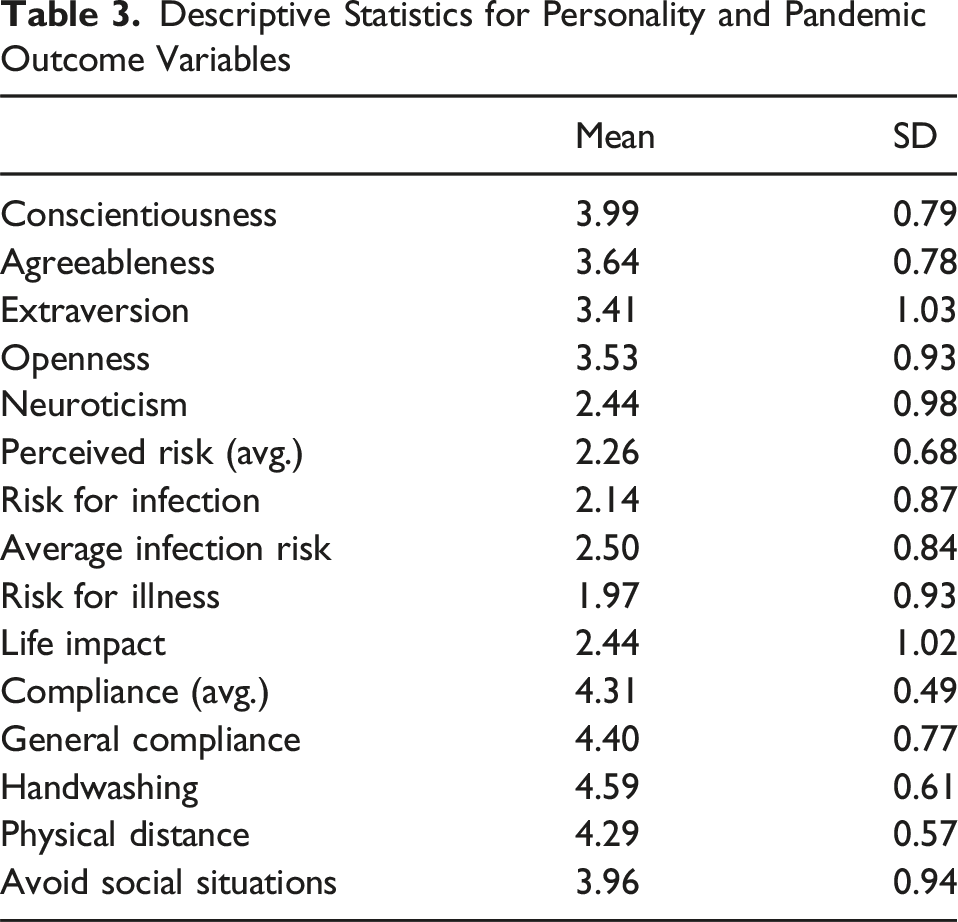
The Compliance measure shows that most people agreed to statements about following the infection control measures. Agreement was somewhat higher on items about handwashing than on items about keeping physical distance to others and avoiding social situations. This could indicate that there was less compliance to restrictions on social interaction. For the compliance items, McDonalds Omega total was .61, which is low, but an acceptable level of internal consistency. Similarly, the Omega hierarchical for compliance was .61, reflecting that the general factor accounts for a significant portion of the variance in these items. Compared to an overlapping sample in March 2020 (Sætrevik, 2021), the current measures from August and September 2020 show somewhat lower compliance. The perceived risk and compliance measures from the current panel are discussed in more detail elsewhere (Bjørkheim et al., 2024; Sætrevik, 2021; Sætrevik & Bjørkheim, 2022).
Correlation Table of the Seven Measures Used in the Confirmatory Analyses

Confirmatory analyses
Results From Two Preregistered Multiple Regression Analyses of the Impact of Personality Factors on Perceived Risk and Compliance. P-values are Shown One-Tailed for the Eight Associations With Directed Hypotheses

Associations between personality factors and perceived risk
A linear multiple regression model was conducted to examine the relationship between perceived risk and five personality traits: agreeableness, extraversion, conscientiousness, neuroticism, and openness. The overall model was statistically significant, and explained a small proportion of the variance in perceived risk, F(5,3222) = 13.62, p < .001, adjusted R 2 = 0.02.
The hypothesis (H3a) that Extraversion would have an inverse association with Perceived risk was not supported. In fact, averages were in the opposite direction, but exploratory testing shows that a counterfactual prediction of a positive association did not have a significant effect (p = .080). This indicates that we did not find that more outgoing and enthusiastic respondents described the COVID-19 pandemic as less threatening.
The hypothesis (H4a) that Openness would have an inverse association with Perceived risk was not supported. In fact, averages were in the opposite direction, and exploratory testing shows that counterfactual predictions of a non-directional or a positive association would have been supported (p = .013 and p = .006, respectively), with a Cohen’s f 2 = .002 (very small). This indicates that respondents in our sample that were more open-minded and adaptable tended to describe the COVID-19 pandemic as less of a threat.
The hypothesis (H5a) that Neuroticism would have a positive association with Perceived risk was supported. The effect size of Cohen’s f 2 = .009 is in the region of our preregistered smallest-effect-of-interest. This supports the prediction from theory and past studies that people more likely to perceive threat stimuli, prone to stress and emotional reactivity, are more likely to see the risks related to a pandemic to be high.
Associations between personality factors and compliance
A linear multiple regression model was conducted to examine the relationship between compliance and five personality traits: agreeableness, extraversion, conscientiousness, neuroticism, and openness. The overall model was statistically significant and explained a small proportion of the variance in compliance, F (5,3223) = 17.11, p < .001, adjusted R 2 = 0.02.
The hypothesis (H1) that Conscientiousness would have a positive association with Compliance was supported. The effect size of Cohen’s f 2 = .009 is in the region of our preregistered smallest-effect-of-interest. This supports the prediction from theory and past studies that people who are more likely to be disciplined, goal-oriented, and diligent in their tasks are more likely to comply with health protective behaviour during a health crisis.
The hypothesis (H2) that Agreeableness would have a positive association with Compliance was supported. The effect size f 2 = .006 is below our preregistered smallest-effect-of-interest. This supports the prediction from theory and past studies that people more likely to be trusting, altruistic, and have a desire to maintain good relationships are more likely to comply with health protective behaviour during a health crisis.
The hypothesis (H3b) that Extraversion would have an inverse association with Compliance was not supported. In fact, averages were in the opposite direction, and exploratory testing shows that counterfactual predictions of a non-directional or a positive association would have been supported (p = .021 and p = .01, respectively), with an f 2 = .001 (very small) sized effect. This indicates that respondents in our sample that were more outgoing and enthusiastic intended to comply with the COVID-19 infection control measures recommended in Norway at the time.
The hypothesis (H4b) that Openness would have a positive association with Compliance was not supported. Thus, there was no support in our study for the prediction from theory and past studies that people with higher degree of open-mindedness and adaptability are more likely to comply with health protective behaviour during a health crisis.
The hypothesis (H5b) that Neuroticism would have a positive association with Compliance was not supported. Thus, there was no support in our study for the prediction from theory and past studies that people who are more prone to stress and emotional reactivity are more likely to comply with health protective behaviour during a health crisis.
Exploratory analyses
Due to no clear tendency emerging from the literature, we did not formulate hypotheses for the relationship between the traits Conscientiousness and Agreeableness, and how people perceived risk of COVID-19. According to the preregistered plan, these tests were nevertheless included in our multiple regressions testing for the effect of all five traits on both outcome variables.
The results show that a two-tailed hypothesis test of the relationship between Conscientiousness and Perceived risk would not have been significant. A two-tailed hypothesis test of the relationship between Agreeableness and Perceived risk would have been significant and inverse, with a very small effect size. This indicates that respondents in our sample who were more be trusting, altruistic, and have a desire to maintain good relationships tended to describe the COVID-19 pandemic as less of a threat.
In the Introduction we brought up the possibility that the hypothesized effect of Extraversion may be clearer for outcome measures related to social activities. Motivated by this, we re-ran the multiple regression using only an item about “avoiding social interactions in the last two weeks” as the indicator for Compliance. This resulted in a negative association, with a very small effect size (p = .026, two-tailed, f 2 = .001).
In the analyses described so far, the outcome variable Compliance was operationalized as the average score of four items assessing people’s overall intention to comply with infection control measures, maintaining physical distance from others, avoiding social gatherings, and practicing hand hygiene. While multi-item indicators are often preferred in order to reduce measurement noise, it could also be argued that the four items may include other psychological components than compliance. In an attempt to test the effects of personality on a more distilled measure of compliance, we re-ran the multiple regression using as an indicator only the item about “general compliance”. This resulted in also supporting the positive association between Extraversion and Compliance (H3b, t = 0.04, one-tailed p = .006, f 2 = .002), while the other hypotheses had unchanged significance evaluations.
Similarly, in the confirmatory analyses the outcome variable Perceived risk was operationalized as the average of four items about the risk for being infected yourself, the risk for an average person to be infected, for the risk of disruption of their everyday life, and for risk of becoming seriously ill. It could be argued that the four items may include other psychological components than risk perception. In an attempt to test the effects of personality on a more distilled measure of Perceived risk, we re-ran the multiple regression using only the item about risk for becoming infected as an indicator. This led to the unpredicted negative association between Conscientiousness to turn significant (t = −2.07, p = .039, f 2 = .001), while it did not change whether the other associations were evaluated as significant or not.
Discussion
Summary of results
Theoretical work and empirical studies on personality traits and pandemics form the basis for several hypotheses about possible relationships between personality traits, perceived pandemic risk, and intention to comply with infection control measures. We reviewed this evidence above, and specified eight hypotheses for these relationships, with varying degree of support in the literature. In the current study we combined personality measures taken one year before the onset of the COVID-19 pandemic, with pandemic outcome measures taken five months into the pandemic. We found clear support for three of the hypotheses, and an additional hypothesis was supported when using an outcome variable that more precisely captured the specific aspects relevant to the underlying hypothesis. On the other hand, we did not find support for four of the hypotheses. In addition to the tested hypotheses, we discovered one non-hypothesized effect. These findings are discussed in detail below.
Relationships between personality and pandemic outcomes
Association between conscientiousness and compliance
Our hypothesis H1 predicted a positive association between Conscientiousness and Compliance. The assumed mechanism was that preferring orderliness and having high capacity for self-discipline (Roberts et al., 2014) would motivate for and uphold compliance to infection control measures. An additional mechanism for this effect could be related to conscientiousness having a positive association to general rule-following (Roberts et al., 2014), as more norm-abiding people might be more likely to follow norms about compliance as well. This association was significant, with a small effect size (in the region of the smallest-effect-of-interest).
At the time of data-collection, the infection control measures in Norway included widespread testing and contact tracing to identify and isolate cases, along with a quarantine requirement for those who have had close contact with confirmed cases or had travelled from high-risk countries. The public was also advised to keep physical distance from others, avoid social gatherings, and maintain proper hand hygiene. Complying to these guidelines would have constituted an inconvenience for most people, and challenging to persevere with over time. More conscientious people may have been more willing to adapt their lifestyle, and to adhere and persevere to these adjustments over time. Further, the infection control measures were widely understood as being a strong recommendation from the Norwegian health authorities. A more indirect effect of personality may thus be that conscientious people in general are more willing to adhere to official rules and guidelines.
The hypothesis of a positive association between Conscientiousness and Compliance was based on similar findings in a number of previous studies (Adamus et al., 2022; Airaksinen et al., 2021; Aschwanden et al., 2020; Bogg & Milad, 2020; Bogg & Roberts, 2004; Brouard et al., 2020; Carvalho et al., 2020; Clark et al., 2020; Ebrahimi et al., 2021; Götz et al., 2021; Hampson & Friedman, 2008; Hill & Roberts, 2011; Horwood et al., 2023; Ludeke et al., 2021; Schmeisser et al., 2021; Willroth et al., 2021; Zajenkowski et al., 2020; Zettler et al., 2022). In this light, our confirmed prediction of a similar pattern the first half year of the COVID-19 pandemic in Norway indicates that this association can be stated with some certainty. Thus, people who are seen as neat, reliable, and ambitious are more compliant with official guidelines for health behaviour during a health crisis.
Association between agreeableness and compliance
Our hypothesis H2 predicted a positive association between Agreeableness and Compliance. Such an association could be due compliance representing a tendency for cooperation and compassion, or of social compliance in terms of wanting to support the majority view of the issue. This association was significant, but with a very small effect size.
In the public discussion of infection control measures at the time, it was often emphasized that healthy adults would not be at particular risk from the disease, and that compliance was mainly important in order to protect the elderly or infirm (Giubilini et al., 2020). This may have led pro-social motivation to be important for compliance, which would correspond with an association between Agreeableness and Compliance. This aligns with previous research on prosocial motivation in the COVID-19 pandemic (Böhm & Betsch, 2022; Campos-Mercade et al., 2021; Franzen & Wöhner, 2021; Jordan et al., 2020; Pfattheicher et al., 2020; Sætrevik, 2021). Further, compliance was the dominant social norm in Norway at the time (Sætrevik, 2021), so agreeable people may have been motivated by wanting to “go along” with what they perceived to be the majority view, in addition to wanting to limit risk for themselves.
A number of studies have found similar associations between agreeableness and compliance to COVID-19 infection control measures (Asselmann et al., 2020; Chan et al., 2021; Clark et al., 2020; Götz et al., 2021; Ludeke et al., 2021; Nofal et al., 2020; Panish et al., 2023; Willroth et al., 2021). Confirming this in the current registered report prediction (although with a small effect size) indicates that for future health crises one may expect that people who are seen as cooperative, compassionate, and are willing to help others will comply somewhat more with recommended health behaviour.
No association between extraversion and perceived risk
Our hypothesis H3a predicted an inverse association between Extraversion and Perceived risk due to its association with risk-taking (Lauriola & Weller, 2018), “sensation seeking” (Nettle, 2005), optimism (Sharpe et al., 2011), and attentional bias to positive information (Noguchi et al., 2006) in previous studies.
Our results did not support that people who are more outgoing and accepting of risk saw the COVID-19 risk as lower than other people did. The failure to support this hypothesis is perhaps not surprising, given that there are few previous studies that have shown an association between extraversion and health protective behaviours during health crises. This was noted in the Introduction, and our hypothesis was therefore derived from theoretical reasoning based on the trait description, that turned out not to be supported in the data. As mentioned elsewhere, it could be that the social needs of extroverted people made them perceive the pandemic and the infection control measures as more severe. This may have influenced how they perceived risk, and made the inverse relationship between extraversion and risk less pronounced in this setting compared to in other settings. Not finding support for the hypothesis in the current study may indicate that we cannot reliably expect extraverted people to see less risks from pandemics under comparable settings.
Extraversion only associated with compliance to social restrictions
Our hypothesis H3b predicted an inverse association between Extraversion and Compliance. The mechanism behind such an association could be that individual differences in social drive and motivation cause individuals with higher scores on extraversion to have more difficulty in following pandemic restrictions on socialization (Entringer & Gosling, 2022; Zajenkowski et al., 2020). This hypothesis was not supported in our study.
The failure to support this hypothesis is somewhat surprising, as the association between extraversion and compliance to COVID-19 infection control measures have been indicated several times in previous literature (Barceló & Sheen, 2020; Brouard et al., 2020; Carvalho et al., 2020; Chan et al., 2021; Ebrahimi et al., 2021; Götz et al., 2021; Ludeke et al., 2021; Panish et al., 2023). However, as mentioned in the Introduction, the inverse association in other studies may to some extent be due to extraverted people being less likely to comply with measures that limited their social interaction. Our index of Compliance asked about a number of behaviours, some of which were not associated with social interaction (e.g., handwashing). An exploratory analysis found that Extraversion did indeed have an inverse relationship with compliance to restriction on social interactions. This is in line with our hypothesis H3b, and thus converges with previous research on measures limiting social interaction. This indicates that such measures may be more challenging to comply with for extraverted compared to more introverted people.
No association between openness and perceived risk
Our hypothesis H4a predicted an inverse association between Openness and Perceived risk, due to the trait’s association with sensation seeking (Zuckerman & Kuhlman, 2000). This hypothesis was not supported in our study.
As noted in the Introduction, there are few previous studies to indicate this hypothesis, and we thus had limited confidence in it being supported. The Introduction also mentioned a possible opposing mechanism, that openness may be associated with the imagining potential dramatic life changes caused by the pandemic, which could lead to seeing the risk as higher (Eldesouky, 2012). The failure to support hypothesis H4a indicates that that the proposed mechanism of sensation seeking did not influence pandemic risk perception in the current setting, or that it may have been confounded by other mechanisms.
No association between openness and compliance
Our hypothesis H4b predicted a positive association between Openness and Compliance due to being more willing to change their daily routines and adapt to a changed context. This hypothesis was not supported in our study.
The failure to support this hypothesis is somewhat surprising, as there is moderate support for such a mechanism in the previous literature. However, compliance was high in Norway at the time, and compliance may have been the “mainstream” behavioural response to the pandemic. It could thus be that reduced compliance is an expression of non-conventionalism, which is associated with openness. Thus, a confound between several simultaneous mechanism may have resulted in no significant overall effect. Previous research has also indicated that openness may be associated with different kinds of professional employment (John & Thomsen, 2014; Mongey et al., 2021). People in different life situations may have interpreted items such as “doing your best to follow the measures” and “always following measures” differently. Given the same behaviour, a person able to work flexibility may say that they could have done more to follow the measures than a person with less flexibility. This may have made some aspects of compliance easier to achieve for those high in openness, which may have diminished a potential effect.
Association between neuroticism and perceived risk
Our hypothesis H5a predicted a positive association between Neuroticism and Perceived risk, through mechanisms of concern and worry. This association was significant, with a small effect size (in the region of our preregistered smallest-effect-of-interest). This may be an important contribution, as there are relatively few previous studies that have shown similar associations between neuroticism and feeling threatened by a pandemic (Horwood et al., 2023; Zettler et al., 2022). The sparsity of previous supporting findings might in part be explained by the fact that there are few studies on the relationship between personality traits and pandemic risk perception.
This finding indicates that more neurotic people may be predisposed to perceive the pandemic as more of a risk. It appears reasonable that the effect of neuroticism to worry, ruminate and attend to threatening stimuli also extends to evaluations of the pandemic situation, which dominated public life at the time of data collection. Support for this hypothesis indicates that the degree of neuroticism had a small but reliable effect on how people respond to public health crises.
No association between neuroticism and compliance
H5b predicted a positive association between Neuroticism and Compliance, based on previous research on a number of different infection control measures (Airaksinen et al., 2021; Asselmann et al., 2020; Brouard et al., 2020; Bults et al., 2011; Götz et al., 2021; Schmeisser et al., 2021). This hypothesis was not supported in our study.
The failure to support this hypothesis is somewhat surprising, a moderate number of previous studies indicate this hypothesis. We should note that some studies (Adamus et al., 2022; Aschwanden et al., 2020) have also indicated that neuroticism may have inverse relationships to some types of infection control measures. Contextual factors specific to Norway during the COVID-19 pandemic might help explain why we did not find the expected positive association between Neuroticism and Compliance in our sample. Norway implemented relatively clear, consistent, and trust-based communication strategies during the pandemic. Clear guidelines, high levels of trust in health authorities, and a low infection rate may have reduced the effect of neuroticism leading to anxiety-driven compliance behaviours compared to other settings. Furthermore, high levels of social cohesion and collective responsibility within Norwegian society could have uniformly encouraged compliance across various personality types, thus overshadowing individual differences associated with neuroticism.
Inverse association between agreeableness and perceived risk
No hypothesis was registered for the relationship between Agreeableness and Perceived risk, due to not finding clear indications of such a relationship in the literature. Nevertheless, exploratory two-tailed testing showed an inverse relationship between these factors in our study. This relationship indicates that those higher in compassion, modesty, and willingness to help indicated that the risks from the pandemic was lower. A speculative explanation for this unpredicted effect could be that more agreeable people may be more used to downplaying the risks in order to keep personal interactions convivial. It is noteworthy that this effect coincided with the trait having a small positive association with Compliance.
Personality’s role in explaining pandemic outcomes
A number of associations between personality factors and health behaviour have been suggested in the previous literature, leading to many potential relationships to test in a study such as this. In order to perform confirmatory tests of all relevant associations while avoiding questionable research practices, we preregistered eight hypotheses for these associations in a registered report format. In the registration we declared various degrees of support for the hypotheses in past literature, ranging from strong, to moderate, to limited.
The two hypotheses that were based on strong support in previous literature (Conscientiousness (H1) and Agreeableness (H2) to have positive association to Compliance) were both supported in our study (although H2 had a smaller effect size). This can be taken to indicate that the scientific knowledge about the influence of personality on pandemic outcomes that has been shown most consistently, can be considered to be fairly reliable. The hypothesis of a positive association between Neuroticism and Compliance (H5a) was deemed to only have limited support in the literature, but was nevertheless supported in our study.
However, the three associations we deemed to be moderately supported in the previous literature, that Extraversion (H3b), Openness (H4b) and Neuroticism (H5b) were associated with Compliance, were not supported in our dataset (although H3b was significant in a follow-up analysis). Neither did we find support for Extraversion (H3a) and Openness (H4a) to be associated with Perceived Risk (which we had deemed to have some limited support in the literature). In fact, two small effects were seen in the opposite direction of the previous studies: The literature has moderate support for an inverse relationship between Extraversion and general Compliance (H3b), and limited support for an inverse relationship between Openness and Perceived risk (H4a), yet both had positive associations in our study. This may indicate that some of the past assumptions about how personality influence pandemic behaviour may be difficult to reproduce when following predetermined hypotheses and research plans.
Our impression of the previous literature led us to have stronger confidence in predictions for Compliance than for Perceived risk. However, our results indicated the same number and magnitude of effects for both outcome measures. Thus, in addition to contributing to determine behaviour, personality may have a comparable contribution to people’s evaluation of health crisis threats. This aspect may thus have been understudied in the past literature.
We should note that our pandemic measures were taken about half a year into the pandemic in Norway. At this time, most people had not experienced infections among their closest contacts, and the infection control measures were mostly limited to keeping physical distance from strangers, avoiding social gatherings, and maintaining hand hygiene. As the pandemic progressed, more people were infected, infection control measures changed nature (towards face-masks and vaccinations), and people may have experienced fatigue and more contradictory information during an extended health crisis. It is quite possible that the relationships between personality traits and pandemic outcomes changed over the timespan of the pandemic. This could be explored in future studies (the current datasets may be expanded to examine this).
Previous research has indicated that personality plays a larger role in “weaker” situations, with less social cohesion (Ludeke et al., 2021). The early COVID-19 pandemic in Norway may be characterised as a context with strong situational constraints. Much of public life and discussion was oriented towards the pandemic, and there was strong consensus about the seriousness of the pandemic and the need to comply with infection control measures (Sætrevik, 2021; Sætrevik & Bjørkheim, 2022). This may have left relatively little room for personality to influence behaviour. The current study may deviate from previous studies of health behaviour in this matter, and possibly also from studies of the COVID-19 pandemic in other settings. Similar arguments have been raised before (see e.g., Zajenkowski et al., 2020).
Limits on interpretation
Using longitudinal data to investigate the relationship between personality traits and pandemic risk perception and compliance has some advantages. One advantage could be to avoid that the current situation (e.g., being strongly affected by the pandemic) influences how personality traits are reported, which could confound the associations. A longitudinal approach may also involve some challenges, as personality researchers are increasingly recognizing that personality traits may drift somewhat over time (Bleidorn et al., 2021). Further, it could be argued that dramatic life events could involve personality changes (Rudolph & Zacher, 2023). In our study, it is possible the time that passed between the personality measure and the pandemic measure could change personalities in ways that confound potential associations. However, personality traits have been found to be rather stable over time, and research has suggested that most isolated life events result in no or minimal personality change (Bleidorn et al., 2021; Bühler et al., 2024). Thus, the impact of personality change is likely to be limited in our study, especially since the timeframe between the two measures were not that long (around one year). We thus consider a longitudinal approach preferable to measuring personality during an ongoing health crisis. Nevertheless, the potential shortcomings of both cross-sectional and longitudinal studies should be controlled for with triangulation through other approaches.
The current study used BFI-10 to indicate the five personality traits. This was chosen to fit the personality measure into a panel survey along with a number of other measures. The BFI-10 scale has been argued to be a valid approach for assessing the big five traits in large surveys in western countries (Rammstedt & John, 2007; Steyn & Ndofirepi, 2022). However, it has also been argued that short scales may affect the obtained results as they are unlikely to capture all components of a trait (Bakker & Lelkes, 2018). Further, the BFI-10 scale consists of adjectives describing different traits, as opposed to other scales that use statements. Adjective-based scales may lead responses towards how respondents are perceived by others, while statements-based scales may lead responses towards the respondent’s inner experiences (Erevik et al., 2023). Using an adjective-based scale is not a limitation in itself, but it may have influenced the result. The current findings should be supported by other studies using other personality measures.
The current study used the big five personality theory as a framework. It is possible that an alternative framework, such as HEXACO (Costantini et al., 2022), could have more explanatory power in the current setting. The “sixth personality factor” in HEXACO, honesty-humility, might be particularly relevant for compliance as the trait is related to prosocial behaviour and refraining from taking advantages of others or of society. Not complying could be regarded as a type of exploitative behaviour (Costantini et al., 2022; Lee & Ashton, 2008).
It is important to note that the associations we found between personality traits and the pandemic outcomes were small. Only two of the associations were in the region that we had preregistered as considering a meaningful effect size from a public health perspective (H1, Conscientiousness and Compliance, and H5a, Neuroticism and Perceived risk). The modest effect sizes suggest that personality traits contribute only minimally to explaining differences in compliance and perceived risk in the current context. Other factors, such as situational influences or personal beliefs, may have played a larger role. It may thus be difficult to argue from the current results that public health authorities need to make allowances for personality when anticipating how people behave or perceive risk during a health crisis.
Our results showed optimism bias, in terms of personal risk being reported as lower than the average risk. Since both questions went into the Perceived risk variable used in our main analysis, optimism bias may have confounded some potential personality effects (e.g., if neuroticism influenced personal risk more than average risk). However, one of our exploratory analyses tested the hypotheses against a single-item measure consisting of only personal risk. The fact that this did not significantly impact the results indicates that effects of personality were not hidden by optimism bias.
Finally, we should note that the current study measured intentions to comply to infection control measures, instead of measuring actual behaviour. Similarly, perceived risk was indicated on a rating scale, rather than inferring risk sensitivity from displayed behaviour. Observation of actual behaviour would provide more direct measures of the relationships of interest (Camerer et al., 2018; Doliński, 2020; Falco & Zaccagni, 2021). However, self-report approaches are typical for most of the research in this field, partly due to the resource cost in collecting behaviour observations at scale.
Implications
To our knowledge this is the largest study to date to examine associations between personality traits and pandemic outcomes. The study’s sample is representative for an adult national population. While many possible associations could emerge from the current study design, the registered report format allows us to delineate confirmatory from exploratory testing.
The current results support the overall idea that personality influences how individuals perceive and respond to health crises such as a pandemic. In particular, we see that conscientiousness was associated with higher compliance, and neuroticism was associated perceived risk, both to an extent around our threshold for being an interesting effect size. This may be relevant for understanding the diversity in how people react to a health crisis, and what may motivate them to take precautions. Public health management may benefit from taking findings regarding personality traits, risk perceptions and compliance into consideration when planning for messaging and measures to be suitable for the full breath of the population (Juchem et al., 2024). For example, public health campaigns could enhance their effectiveness by adapting messages to specific personality traits. Individuals lower in conscientiousness may comply more if campaigns emphasize the benefits of structured planning, clear goal-setting, and personal accountability in maintaining preventive health behaviours. Additionally, individuals higher in neuroticism may be less affected by anxiety if campaigns provide reassurance and actionable guidance that channel heightened perceived risk into protective health practices. The amount of variation explained by personality traits was fairly small in this study. Nevertheless, if minor effects can be reliably predicted, this could justify further work to identify and test targeted interventions that might contribute to more accurate risk perception and to influence health protective behaviour during a health crisis. If such interventions can be effectively applied for large populations, small effect sizes may lead to considerable public health-gains.
The study also provides conceptual replication of a number of studies of personality, and indicates the reliability of previous studies of impact of personality traits on health behaviour. In particular, the associations that have previously been reliably shown in the literature were also supported in the current study. However, it is also noteworthy that the current study did not support some of the hypotheses that have been shown in fewer past studies. This could indicate that while some aspects of the knowledge about how personality influence public health can be considered reliable and should be taken into consideration for applications, other aspects of the knowledge may be considered premature to act on (see also IJzerman et al., 2020).
Supplemental Material
Supplemental Material - Personality traits predict perception of pandemic risk and compliance with infection control measures
Supplemental Material for Personality traits predict perception of pandemic risk and compliance with infection control measures by Bjørn Sætrevik, Eilin K. Erevik, Sebastian B. Bjørkheim in Personality Science
Footnotes
Author note
This paper was prepared as a registered report, and went through stage 1 and stage 2 peer review at “Peer Community in Registered Reports”. Alex Jones served as the recommender for the registered report, and Jaap Denissen served as the action editor at “Personality Science”.
To fit the formatting requirements of the journal, the final sentences of the abstract have been somewhat shortened compared to the version that was peer-reviewed for the registered report. The end of the reviewed abstract is as follows: “Neuroticism was associated with seeing the pandemic as a larger risk. In addition, there was an unpredicted effect of agreeableness having an inverse association with perceived risk. Only conscientiousness and neuroticism had effect sizes that met our criteria for being of interest. This indicates that personality traits that have repeatedly been shown to be associated with health behaviour in past research can be expected to predict compliance to pandemic infection control measures. Associations with less support in the literature may have less reliable predictions”.
Acknowledgements
We thank members of the PANDRISK research project for discussing the survey design and interpretation of the results. We thank all the respondents who took time to respond to the surveys. We thank Xiaowen Xu and an anonymous reviewer who served as peer reviewers in stage 1, and Anna Powell and Corina Logan who served as peer reviewers in stage 2 of the registered report. No AI was used in the writing or analysis process leading to this paper.
Author contributions
Funding
The authors disclosed receipt of the following financial support for the research, authorship, and/or publication of this article: This paper was prepared as part of the PANDRISK research project funded by the Trond Mohn Foundation (project number TMS2020TMT08). The foundation has not reviewed the current publication and is not responsible for the statements made in the paper.
Declaration of conflicting interests
The authors declared the following potential conflicts of interest with respect to the research, authorship, and/or publication of this article: All three authors worked on this paper as part of their professional responsibilities as university researchers. The authors will have no financial gain from the statements made in this article. The current paper does not directly support or contradict previous work by the authors.
Data Availability Statement
The stage 1 report, describing the theoretical background, hypotheses, materials and analysis plan is available online at https://osf.io/5ygcp. The full datasets and analyses scripts are available at  .
.
Supplemental Material
Supplemental material for this article is available online.
Note
References
Supplementary Material
Please find the following supplemental material available below.
For Open Access articles published under a Creative Commons License, all supplemental material carries the same license as the article it is associated with.
For non-Open Access articles published, all supplemental material carries a non-exclusive license, and permission requests for re-use of supplemental material or any part of supplemental material shall be sent directly to the copyright owner as specified in the copyright notice associated with the article.
