



Abstract
At the beginning of the COVID-19 pandemic, organizations around the world rapidly transitioned to enforced remote work. We examined the relationship between personality and within-person changes in five job outcomes (self-reported performance, engagement, job satisfaction, burnout, and turnover intentions) during this transition. We conducted a four-wave longitudinal study, from May to August 2020, of employees working from home due to COVID-19, N = 974. On average, self-reported performance decreased over the course of the study, whereas the other outcomes remained stable. There was also significant between-person variability in job outcomes. Extroversion and conscientiousness, two traits traditionally associated with desirable outcomes, were associated with deteriorating outcomes over time. Extroverted employees and conscientious employees became less productive, less engaged, and less satisfied with their jobs; and extroverted employees reported increasing burnout. These results add to our understanding of how personality predicts within-person changes in performance, well-being, and turnover intentions during the pandemic.
At the beginning of the COVID-19 pandemic, organizations around the world were forced to rapidly transition to remote work. Before the pandemic, remote workers accounted for a small portion of the workforce (e.g., less than 10% in 2010; Mateyka et al., 2012). In 2020, after the onset of the pandemic, remote workers accounted for over 40% of the U.S. workforce (Bloom, 2020). This shift has generated debate about the advantages and disadvantages of remote work and how employees were affected by the transition to enforced remote working (Larson et al., 2020). We examine within-person changes in five key job outcomes during the transition to enforced remote work: self-reported performance (Griffin et al., 2007), engagement (Schaufeli et al., 2019), job satisfaction (Dolbier et al., 2005), burnout (A. B. Bakker et al., 2000), and turnover intentions (Golden et al., 2008). We report a four-wave longitudinal study of remote workers during the first wave of the COVID-19 pandemic (from May to August 2020).
Public discussion surrounding enforced remote work during COVID-19 has focused on how this transition has affected employees on average, without considering the role of individual differences (Larson et al., 2020). Building on prior work highlighting that personality traits may influence how individuals cope with and adjust to stressors (Carver & Connor-Smith, 2010), we examine personality traits as factors predicting between-person differences in patterns of change. Prior research focused on associations between traits and job outcomes at one specific time point (Hurtz & Donovan, 2000). The present study advances the literature on individual differences in job outcomes by examining traits as predictors of adjustment trajectories, highlighting how personality shapes employee reactions to impactful workplace events. These insights, in turn, will motivate changes to practice and research. For example, our study may provide insight into which employees are best suited for future remote work arrangements, and which employees are most likely to require additional support when organizations are faced with extended periods of enforced remote work. Likewise, as (enforced) remote work arrangements might remain prevalent in the postpandemic world, our results will inform the field about whether the traits that were considered critical for job performance in traditional work settings will remain so in the future.
Personality and Job Outcomes
Personality traits are important predictors of job outcomes such as well-being, performance, and turnover (Barrick & Mount, 1991; He et al., 2019). These traits are often conceptualized in terms of the Big Five or the HEXACO model (Ashton et al., 2014), which consists of six traits: honesty-humility, emotionality, extroversion, agreeableness, conscientiousness, and openness to experience (Ashton et al., 2014).
Relationships between personality and job outcomes are based on three key assumptions: First, stable traits predispose workers to certain perceptions of, thoughts about, and behaviors at work (Bowling et al., 2005; Judge et al., 2002). Second, traits influence the situations or occupations that workers self-select into (Emmons et al., 1985; Judge & Larsen, 2001). Third, personality traits influence how individuals adjust or respond to changes in their work conditions (Judge & Larsen, 2001; O’Brien & DeLongis, 1996).
We investigate the relationship between personality traits and job outcomes in the context of remote work, referred to as work “away from a central place of business or physical organizational location” (Gajendran & Harrison, 2007, p. 1524). 1 Even though organizations have shown a consistent interest in remote work arrangements since the 1980s (Gajendran & Harrison, 2007), few prepandemic studies examined the relationship between personality and job outcomes in remote workers (for two exceptions, see O’Neill et al., 2014; O’Neill et al., 2009). During the first wave of the pandemic, remote work was adopted at an unprecedented scale (Bloom, 2020); and, in contrast to prepandemic remote work arrangements, the 2020 transition was enforced and rapid. In this transition, many employees struggled with suboptimal work conditions, difficulties balancing work with home schooling and caregiving responsibilities, anxieties related to the economy and the spread of the pandemic, and the loss of social connection and camaraderie with colleagues (Larson et al., 2020).
In line with the view of personality traits as predictors of individuals’ capacities to adjust to change (Judge & Larsen, 2001; O’Brien & DeLongis, 1996), we test the effects of personality on within-person changes in five job outcomes: self-reported job performance (Griffin et al., 2007), engagement (Schaufeli et al., 2019), job satisfaction (Dolbier et al., 2005), burnout (A. B. Bakker et al., 2000), and turnover intentions (Golden et al., 2008). We selected performance because public discussion around enforced remote work during COVID-19 has focused on whether the pandemic has increased (or decreased) job performance (Bloom, 2020; Larson et al., 2020). Engagement, job satisfaction, and burnout were selected to encompass three distinct dimensions of worker well-being, reflecting different combinations of pleasure and arousal as described in the circumplex model of well-being in organizations (A. B. Bakker & Oerlemans, 2011): engagement (reflecting high pleasure/high arousal), job satisfaction (high pleasure/low arousal), and burnout (low pleasure/low arousal). Finally, we included turnover intentions as the strongest predictor of actual worker turnover. Understanding how workers have adjusted to enforced remote work is one of the most salient challenges in human resource management (Carnevale & Hatak, 2020; Shockley et al., 2020; Vaziri et al., 2020).
We had no a priori hypotheses about how personality would predict worker adjustment. Prior work often supported conflicting predictions about how traits would affect job outcomes over time. For example, consider extroversion: One possibility is that extroversion predicts positive adjustment over time. Extroverted individuals may be more likely to experience improvements in performance and well-being, as greater positive affect helps them to cope with work-related stress (Lucas et al., 2008). Some evidence suggests that extroversion is positively associated with adaptive responses to COVID-19, such as less worrying and anxiety (Branovački et al., 2020). Other research suggests that extroverted individuals may be more likely to be negatively affected by the transition to remote work. That is, loss of social contact and feelings of loneliness are major drawbacks of remote work (Mann & Holdsworth, 2003). Given that sociability is one of the fundamental features of extroversion (Lucas et al., 2000), highly extroverted individuals may find it difficult to lose the regular contact of in-office working. Extroverted individuals are more likely to seek social support from colleagues (Swickert et al., 2002), which may be difficult in the context of remote work. In sum, extroversion may have positive (or negative) effects on worker trajectories; and similar arguments may be made for other traits.
The present study adds to our understanding of how personality shaped responses to COVID-19 in two ways: First, we focus on the relationship between personality and job outcomes during the transition to enforced remote work. Many studies have considered the effects of personality on job outcomes (Wilmot & Ones, 2019; Wilmot et al., 2019), but less is known about how personality is related to responses during crisis situations. Second, we examine the longitudinal relationship between personality and within-person changes in job outcomes over time. While some studies used cross-sectional designs to identify the effects of personality at specific time points during the pandemic, traits may have dynamic effects that can only be observed longitudinally.
Method
Design and Participants
We conducted a four-wave longitudinal study of employees forced to work from home during the first wave of the COVID-19 pandemic, from 13 May to 24 August 2020. The time lag between each wave was 1 month, and each wave of the study was available to participants for a period of 7 days. The use of a 1-month time lag is in line with research demonstrating that there are short-term fluctuations in our central outcome variables, most notably performance (Deadrick & Madigan, 1990) and engagement (A. B. Bakker & Bal, 2010).
Our sample primarily consisted of UK remote workers (see below). The UK entered lockdown on 15 March and remote work was enforced whenever possible (GOV.uk, 2021). At the beginning of our study (on May 13), the UK was in the middle of the first wave of the pandemic, with 214,310 total confirmed cases and 3,500 new cases per day. At the end of our study (on August 20), there were 325,646 total confirmed cases and about 812 new cases per day (WHO, 2020). Most public businesses remained closed throughout our study, though some restrictions were gradually eased during the summer months (GOV.uk, 2021). Nevertheless, the general advice to work remotely, unless unavoidable, did not change.
Participants were recruited using Prolific Academic. We used the “COVID-19 Working From Home” prescreening criteria to limit our study to participants who were sometimes (or always) working from home due to COVID-19. We recruited a total of 1,008 participants in the first wave. Our planned sample size was based on the number of participants we could afford to recruit for four waves of data collection. We excluded 29 participants who indicated during the survey that they were not actually working from home, leaving 974 participants. These participants were then invited to complete each of the follow-up waves: 636 participants completed all four waves of the study, 158 completed only three waves, 81 completed only two waves, and 99 completed only the first wave. There were 377 men, 595 women, and two nonbinary participants; and the average age was 34.66 years, SD = 10.09. The majority of participants (n = 872) were living and working in the UK, with 79 participants living and working in the United States and 23 participants living and working in other countries. 2 Participants, on average, worked 33.54 hours per week (Mdn = 36.75, SD = 12.48), and most participants (60.37%) worked 30 or more hours per week. 3
At the start of the study, participants indicated the percentages of time that they were working from home due to COVID-19: M = 91.15%, SD = 20.75%, with the majority of participants (n = 709) indicating they were working at home 100% of the time. The average time spent working from home decreased gradually in later waves, but remained high (Wave 2: M = 87.48%, SD = 26.19%; Wave 3 M = 82.28%, SD = 31.69%; Wave 4: M = 77.24%, SD = 35.48%). Participants had limited prior experience with remote work prior to the pandemic (M = 22.5% of working hours; Mdn = 8%, SD = 31.6%). Additional demographic information is reported in our Supplemental Materials (Table A1).
Measures
Study materials, data, and syntax are available at https://osf.io/fvmq2/?view_only=70e685cadcce4b44aba1b90484594b73. Correlation matrices of study variables are included in the Supplemental Materials (Tables A2 and A3).
Brief HEXACO inventory
In the first wave of the study, participants completed the 24-item Brief HEXACO Inventory (BHI; De Vries, 2013). The six HEXACO traits were measured with four-items each, α’s from .45 to .61, mean α = .52. 4 Although the BHI measures are less reliable than full-length HEXACO measures, previous studies found that they are temporally consistent, with test–retest reliabilities from .71 to .79 over a 2-month interval; show consistent self-other agreement, r’s from .39 to .59; and are strongly correlated with full-length HEXACO measures, r’s from .72 to .83 (De Vries, 2013).
Job outcomes
In each wave, we measured five outcomes: self-reported performance (nine items, α = .86–.88, sample item: “Carried out the core parts of your job well”; Griffin et al., 2007), work engagement (three items, α = .81–.87, sample item: “When I’m working, I feel bursting with energy”; Schaufeli et al., 2019), job satisfaction (one item, “Taking everything into consideration, how do you feel about your job as a whole?” Dolbier et al., 2005), burnout (five items, α = .92–.95, sample item: “I feel mentally drained from my work”; A. B. Bakker et al., 2000), and turnover intentions (four items, α = .90–.91, sample item: “How likely is it that you will be working at this same company next year?” Moore, 2000). Items for performance, engagement, and burnout asked participants to respond to items based on their experiences over the preceding month. The remaining measures, job satisfaction and turnover intentions, asked participants how they felt in the moment.
Attention check
Each wave included a three-item attention check. Participants were presented with three items (e.g., “I prefer to get bonuses over steady income”) along with top-of-the-page instructions to ignore the items and respond with the values of 3, 5, and 5. Participants passed the check if they provided all three correct responses, and about two thirds of participants in each wave passed the check (Wave 1 = 65.3%, Wave 2 = 63.6%, Wave 3 = 67.1%, and Wave 4 = 64.5%). Our main analyses included all participants, and we conducted supplemental analyses using only participants who passed these attention checks (Table A8).
Procedure
The different elements of the survey were presented to participants in a randomized order, with demographics measured at the end of each wave. In our Supplemental Materials, we report analyses examining the effects of gender, age, marital status, childcaring responsibilities, and previous experience with remote work on job outcomes (Table A5).
Analysis Plan
We used the lme4 package in R (Bates et al., 2015) to estimate growth curve models. We followed the mixed effects approach to growth curve modeling: We estimated models with waves nested within participants and included random slopes of the linear effects of time. 5 We estimated to what extent HEXACO traits were associated with initial differences in employee outcomes during the first wave of the study, as well as changes in employee outcomes over time (Trait × Time interactions).
We estimated two sets of models: First, we estimated models including only the effects of time. The purpose of these analyses was to assess whether employee outcomes, on average, changed linearly over time and whether there was between-person variability in how outcomes changed over time (i.e., within-person changes). Second, we estimated models including the effects of time, the effects of the six HEXACO traits, and six Trait × Time interaction terms. The HEXACO traits and outcome variables were grand-mean centered and standardized, and time was coded as a linear contrast (Wave 1 = 0, Wave 2 = 1/3, Wave 3 = 2/3, and Wave 4 = 1).
Given the exploratory nature of the research and the large number of tests (13) in each model, we adjusted the p values from each model for false-positive discoveries using the method introduced in Benjamini and Hochberg (1995). This procedure corrects p values based on the expected number of false discoveries given the total number of statistical tests, and it allows for greater statistical power than the traditional Bonferroni adjustment (Benjamini & Hochberg, 1995). Specifically, we used the “BH” method in the multtest package (Pollard et al., 2005).
Missing values
Not all participants completed all waves (636 of 974 participants completed all four waves). However, when participants completed waves, they tended to have almost no missing values (there were a total of six of 16,400 missing values for individual outcome measures). We used the Maximum Likelihood approach to handle missing values. We relied on individuals’ responses to the waves and measures that were available. Importantly, there were no significant correlations between the HEXACO traits (measured during the first wave) and the number of waves completed: rs < .02, ps > .56; and our results did not significantly differ for participants who completed more (vs. fewer) waves (Tables A9 and A10).
Sensitivity analyses
We conducted simulations using the simr package to estimate our study’s power to detect Trait × Time interactions (Green & MacLeod, 2016). We had at least 80% power to detect interaction effect sizes of standardized b = .14 or greater (at α = .05).
Results
First, we estimated a series of growth curve models to test the effects of time. These models included a fixed effect of time, random intercepts, and random slopes to estimate between-person variability in the effects of time. The results are reported in Table 1 and illustrated in Figure 1. On average, participants reported slightly lower levels of performance in later (compared to earlier) waves of the study. However, there were no significant changes in time for the other four outcomes. Critically, there was also substantial between-person variability in the effects of time.
The Linear Effects of Time on Employee Outcomes.
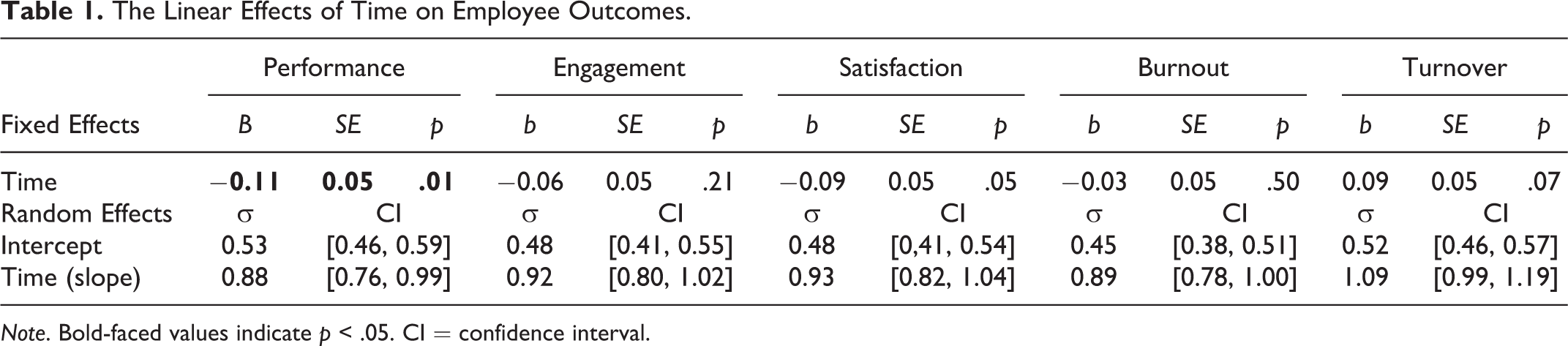
Note. Bold-faced values indicate p < .05. CI = confidence interval.
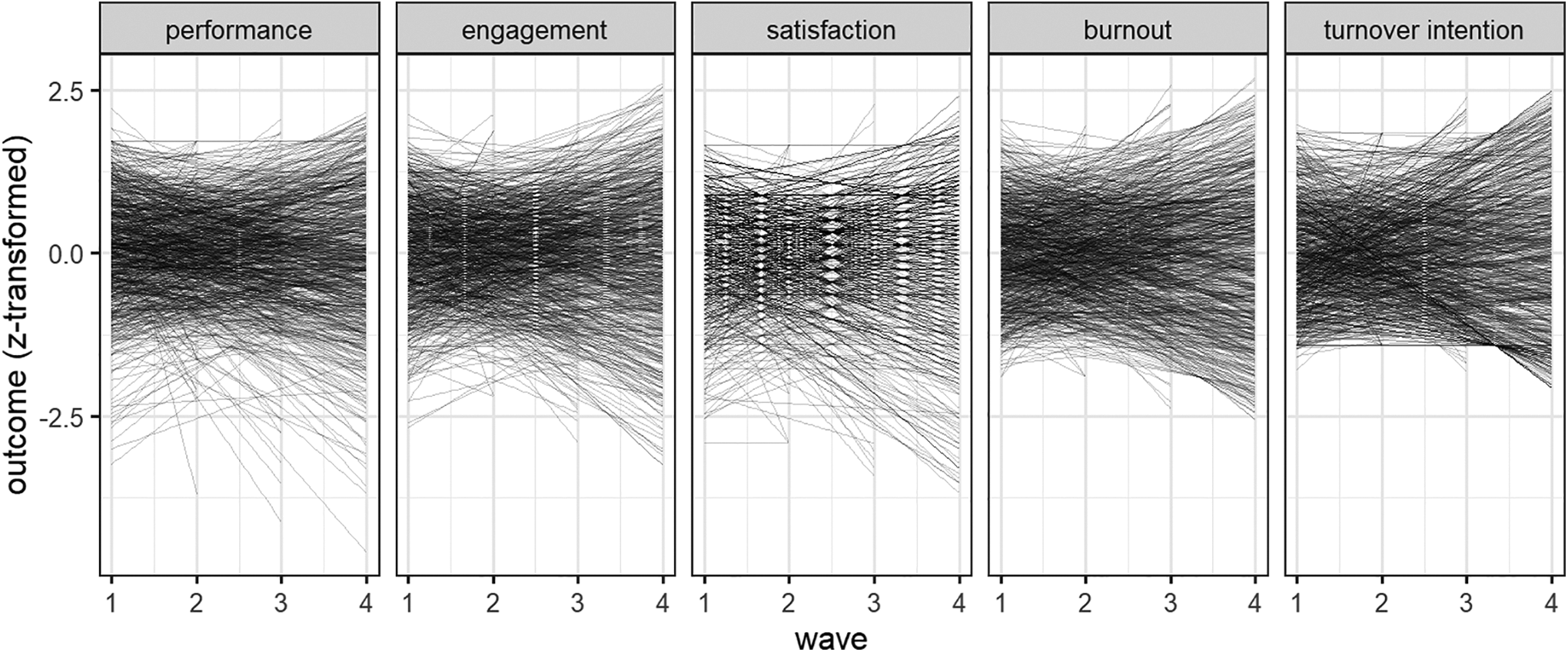
Individual changes in employee outcomes over time.
Our next analyses tested to what extent the HEXACO traits were associated with initial differences in employee outcomes and changes in those outcomes over time by adding the main effects of the six HEXACO traits and six Trait × Time interaction terms. The full results of the models are reported in Table 2.
The Interactive Effects of Time and Personality Traits on Job Outcomes.
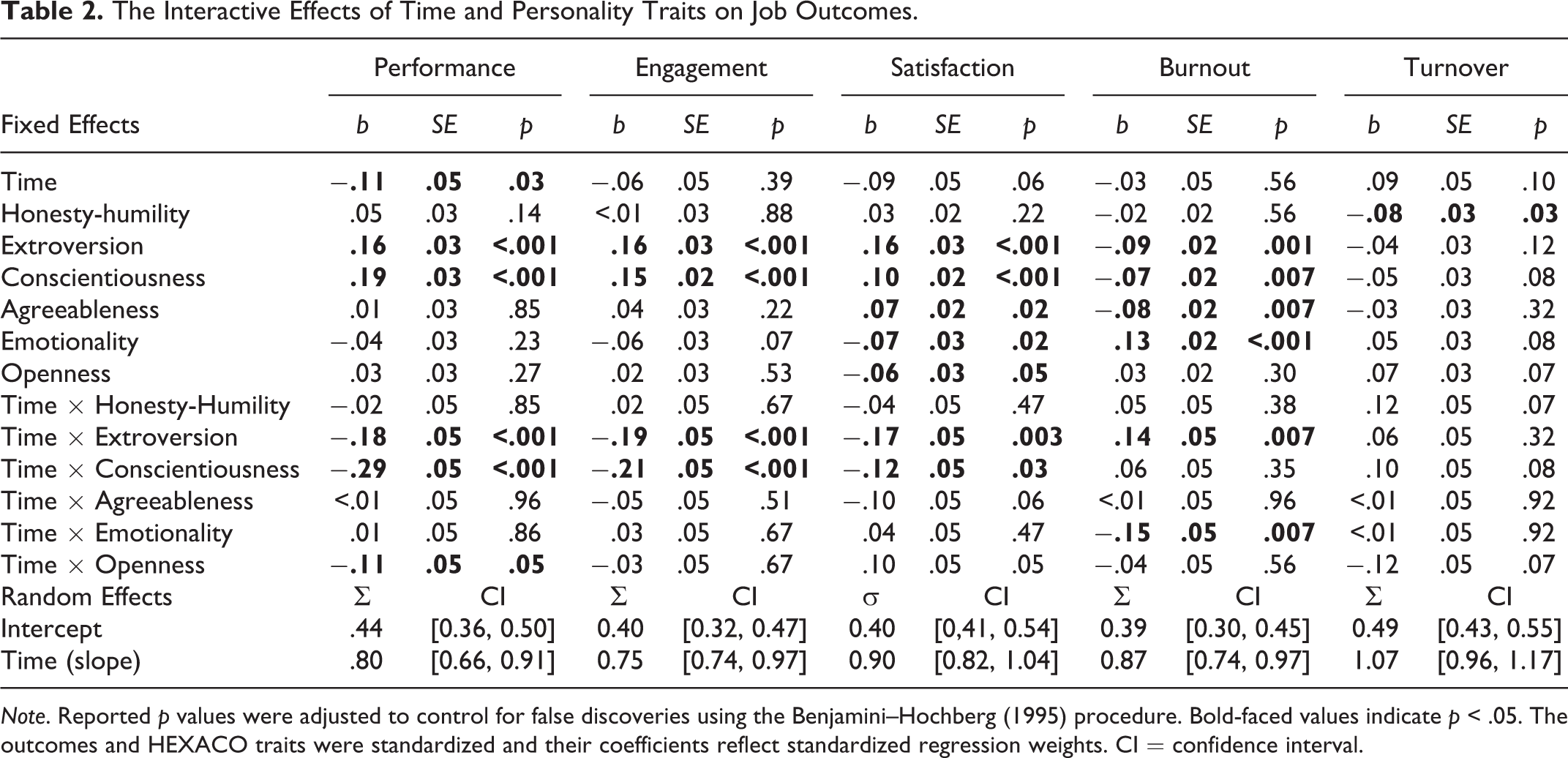
Note. Reported p values were adjusted to control for false discoveries using the Benjamini–Hochberg (1995) procedure. Bold-faced values indicate p < .05. The outcomes and HEXACO traits were standardized and their coefficients reflect standardized regression weights. CI = confidence interval.
We observed two overarching patterns of results: First, at the beginning of the study, extroversion and conscientiousness were associated with positive outcomes. During the first wave of the study, more extroverted and more conscientious employees were higher performing, more engaged in work, more satisfied with their jobs, and less likely to experience burnout. Second, both traits interacted with time such that individuals scoring high on extroversion and individuals scoring high on conscientiousness experienced deteriorating outcomes over time (lower performance, lower work engagement, and lower job satisfaction), and high-extroversion individuals reported higher levels of burnout. The estimated Time × Trait interactions are illustrated in Figure 2.
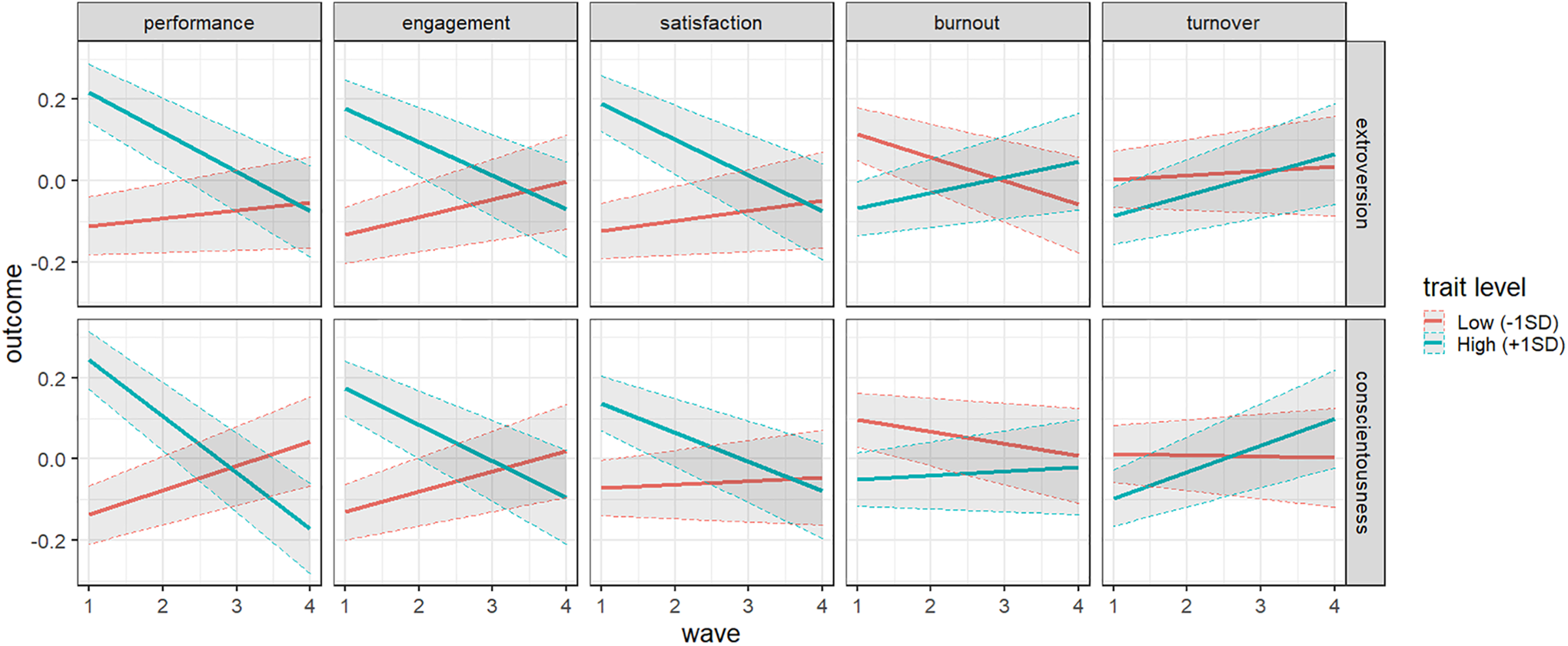
The estimated effects of time, extroversion, and conscientiousness on employee outcomes.
To provide further context for these interaction effects, we estimated Johnson–Neyman regions of significance for each interaction using the interactions R package (Long, 2019). We estimated the ranges of trait values (i.e., standardized extroversion and conscientiousness scores) where the predicted effects of time on job outcomes were significantly positive and significantly negative. The results are reported in Table 3. Workers with average and above-average trait scores (e.g., standardized scores greater than 0) experienced deteriorating outcomes over time. Workers with scores slightly below average did not experience significant changes over time, while workers with lower scores in extroversion and conscientiousness (e.g., standardized scores less than −1) significantly improved over time.
Johnson–Neyman (J-N) Regions of Significance for the Effects of Time on Job Outcomes.
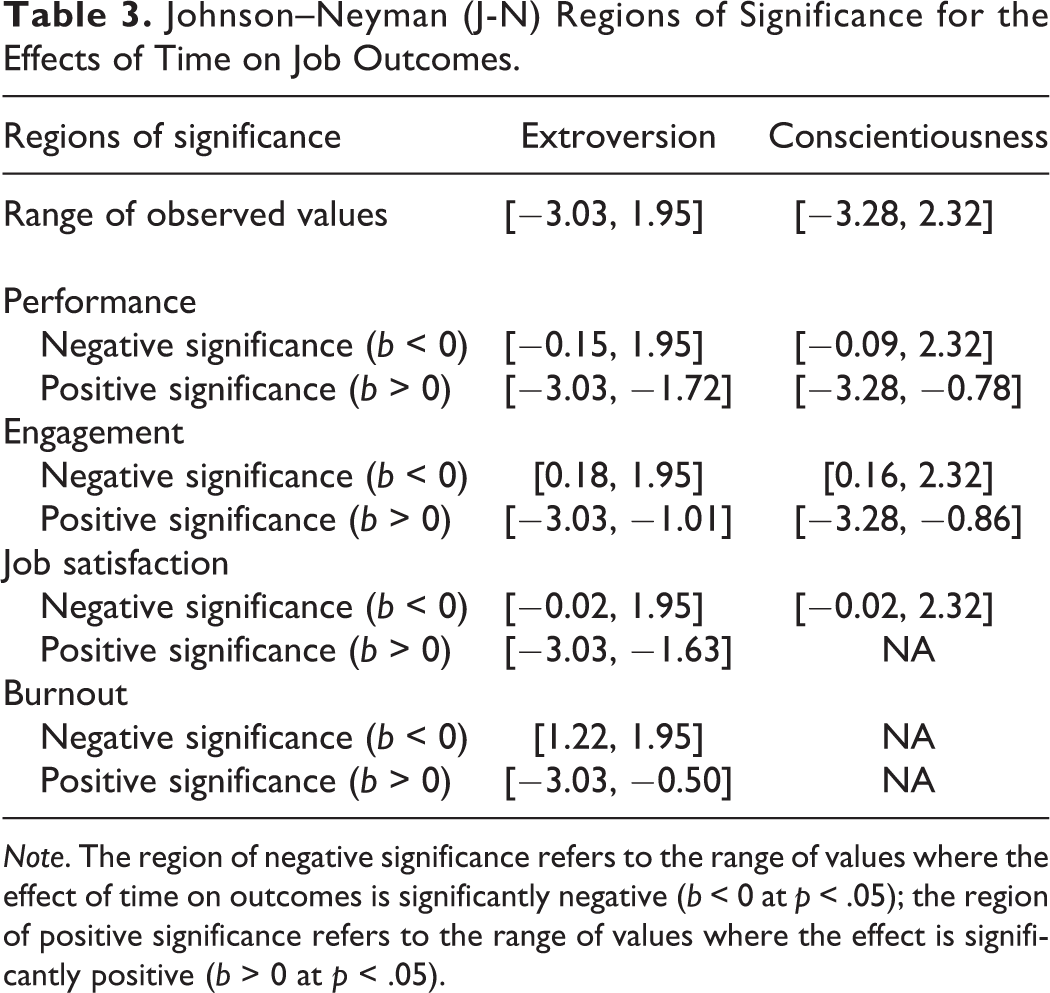
Note. The region of negative significance refers to the range of values where the effect of time on outcomes is significantly negative (b < 0 at p < .05); the region of positive significance refers to the range of values where the effect is significantly positive (b > 0 at p < .05).
In addition to the effects of extroversion and conscientiousness, we observed two further Trait× Time interactions (see Figure 3): Individuals scoring high in openness-to-experience became less productive over time; and high-emotionality individuals reported lower levels of burnout over time. No other Time × Trait interactions were detected.
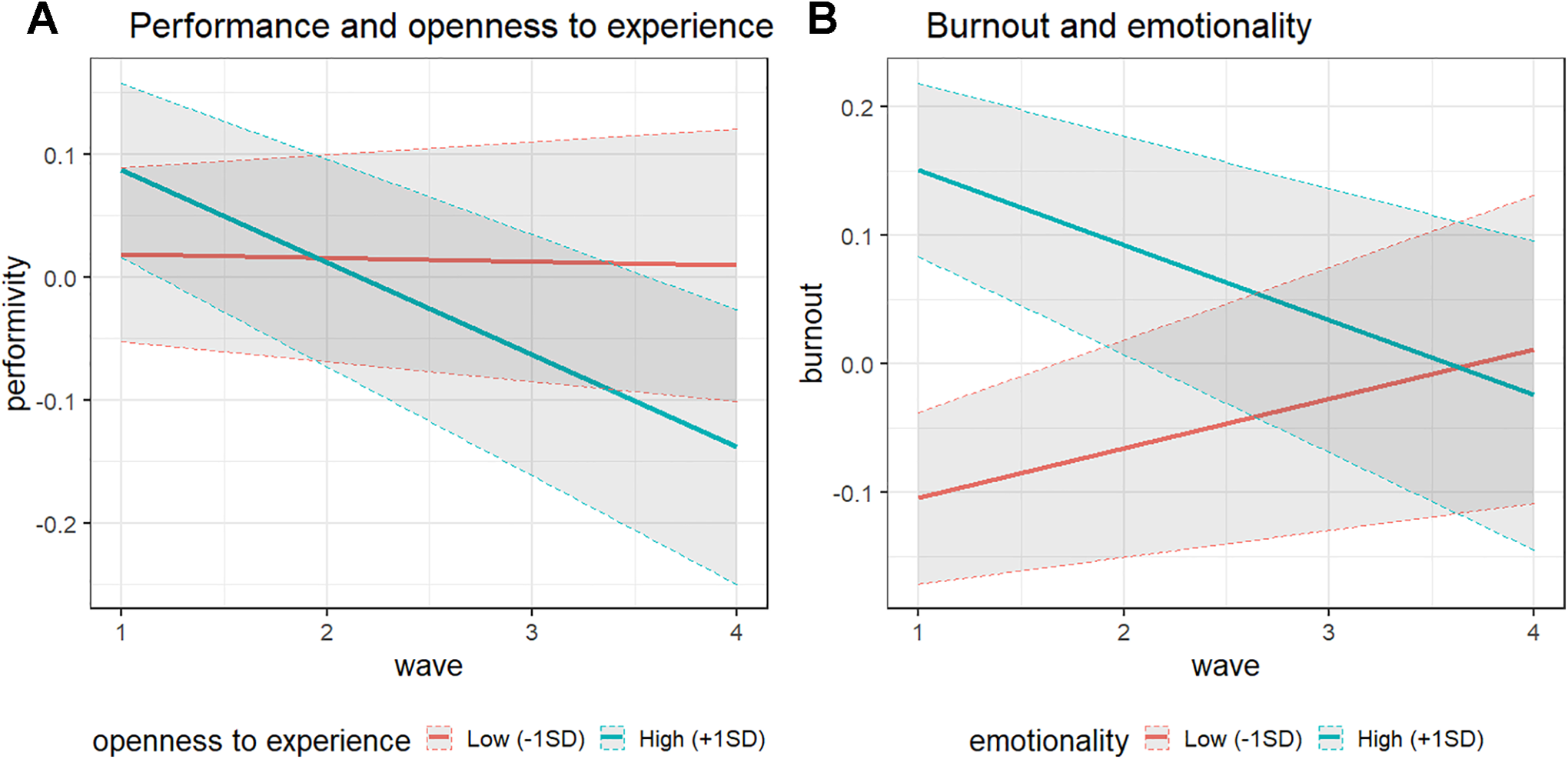
The estimated effects of openness to experience on changes in performance (A) and emotionality on changes in burnout (B).
We also conducted a series of robustness checks for our main analyses, fully reported in our Supplemental Materials. First, we estimated models where we tested the effects of the six HEXACO traits individually, rather than simultaneously (Table A4). Second, we estimated models including gender, age, marital status, parental responsibilities, and prior remote work experience as covariates (Table A5); and whether prior remote work experience moderated the effects of personality on job outcomes (Tables A6 and A7). Third, we tested whether excluding participants who failed the attention check influenced our results (Table A8). Finally, we tested whether our results differed for participants who completed more (vs. fewer) waves (Tables A9 and A10). The pattern of results was consistent across these different specifications, though when we excluded inattentive participants two of the seven interactions involving extroversion and conscientiousness were no longer significant; and the openness by time interaction (predicting decreased performance) was no longer significant.
Discussion
In the spring of 2020, organization around the world transitioned to enforced remote work. We examined how this transition affected employee performance, well-being, and turnover intentions and what individual differences represented protective and risk factors during this period. On average, levels of self-reported performance decreased over the course of 3 months, while levels of the other outcomes remained stable. However, there was significant between-person variability in workers’ trajectories: At the beginning of the study, more extroverted and more conscientious individuals reported better outcomes; by the end of the study, they lost these advantages. Extroverted employees and conscientious employees became less productive, less engaged, and less satisfied with their jobs; and extroverted employees reported greater feelings of burnout. On the other hand, workers scoring low on extroversion and conscientiousness improved on these same outcomes.
Extroversion and Conscientiousness
Why did employees scoring high in extroversion and conscientiousness experience deteriorating outcomes during the transition to enforced remote work? First, we consider extroversion: Sociability is one of the fundamental features of extroversion (Lucas et al., 2000), and loss of social contact is a major drawback of remote work (Mann & Holdsworth, 2003). In turn, high-extroversion individuals may be more likely to be negatively affected by this aspect of enforced remote work, whereas introverted workers may benefit from the decrease in day-to-day social interactions. Prepandemic studies showed that compared to extroverts, introverts are more effective in environments that discourage social interactions (e.g., in closed-office plans; Bos et al., 2017). Consistent with these findings, public discussions about worker reactions to the pandemic have highlighted the different responses of introverts and extroverts (McConnon, 2021).
Next, consider conscientiousness: Conscientious individuals may be more likely to struggle with the lack of structure and uncertainty associated with enforced remote work, whereas unconscientious workers may be more likely to thrive under these conditions. Conscientious individuals have a stronger need for structure (Neuberg & Newsom, 1993), and people with a stronger need for structure expect themselves to benefit less from remote work (Wörtler et al., 2020). Some prior work supports this notion: Diligence, a facet of conscientiousness that reflects persistence and hard work, is associated with better job outcomes in traditional work settings. However, diligence may not be beneficial in the context of remote work (O’Neill et al., 2009). The relationship between conscientiousness and positive job outcomes is attenuated in complex and unpredictable environments (Wilmot & Ones, 2019). The forced transition to enforced remote work could represent such an unstructured and anxiety-provoking situation (Kachanoff et al., 2020). For example, prepandemic research has shown unconscientious workers’ performance to be unaffected by job insecurity (Liu et al., 2013) and work–family conflict (Witt & Carlson, 2006)—two major obstacles during the pandemic.
Although extroversion and conscientiousness were generally associated with deteriorating performance and well-being, they were not associated with changes in turnover intentions. More generally, none of the HEXACO dimensions predicted changes in turnover intentions. Employees may have recognized that their feelings of dissatisfaction at work were due to factors outside of their employer’s control. Alternatively, employees may have been reluctant to consider career changes due to the general economic uncertainty and rising unemployment caused by the pandemic. Importantly, not all of our findings remained significant when excluding participants who failed the attention check (Table A8). Although the general pattern of effects remained consistent (extroverted and conscientiousness employees experienced deteriorating outcomes), two of the seven interaction terms were no longer significant.
Additional Findings
In addition to the above results, there were two further Trait × Time interactions: First, emotionality predicted decreased burnout over time. Interestingly, other research on emotionality in the pandemic found that high-emotionality individuals experience more variability in their emotional experiences over time (Kroencke et al., 2020). While high-emotionality workers experienced more burnout in the early stages of COVID-19, they may also have been faster to rebound from these initial negative feelings.
Second, workers scoring high on openness to experience showed deteriorating performance over time. At first glance, this is surprising. The early months of the pandemic often required creative problem-solving (Bloom, 2020) and open workers often perform better in tasks requiring creativity (George & Zhou, 2001). However, prepandemic studies often failed to find the expected positive effect of openness on job outcomes in digital environments (Cogliser et al., 2012; Colquitt et al., 2002; Zaharie, 2021). The absence of positive feedback may have contributed to the declining performance of open workers, who perform best when they receive regular positive feedback from supervisors (George & Zhou, 2001). Arguably, enforced remote work may limit the opportunities for positive feedback, leading to declining performance. Note, however, that the Openness × Time interaction was no longer significant when excluding participants who failed the attention check, suggesting that any effects of openness on changes in job outcomes may be less robust than other effects observed in our study.
We also observed a number of nonsignificant results. Agreeableness and honesty-humility were not associated with changes in worker outcomes, and the effects of emotionality and openness were inconsistent across different measures. We advise caution in interpreting these null findings. Sensitivity analyses suggest that our study did not have high enough power to reliably detect small interactions effects (e.g., standardized b < 0.14), and our use of short-form personality measures may have further diluted our ability to predict changes in outcomes over time (B. N. Bakker & Lelkes, 2018). Personality may also predict changes in outcomes that were not measured in the present study. For example, honesty-humility is relevant for cyberloafing (i.e., off-task computer use during work hours, Blanchard & Henle, 2008) and agreeableness affects how workers resolve work–family conflicts (Kinnunen et al., 2003).
We also conducted supplementary analyses examining the effects of worker demographics. Older workers reported lower levels of burnout, and workers with children at home reported lower turnover intentions. The negative correlation between age and burnout is consistent with prepandemic research; older employees experience slightly less emotional exhaustion (Brewer & Shapard, 2004). In contrast, the negative relationship between children at home and turnover intentions may be unique to the pandemic, as previous studies found little evidence for this association (Peltokorpi et al., 2015). It is possible that remote workers with children at home were more reluctant to take on the uncertainty of a job search and career transition.
Theoretical Implications
The present results add to our understanding of how individual differences are associated with job outcomes. Our findings suggest that whether a certain personality trait is beneficial or detrimental for job outcomes changes rapidly in the face of external events. Consistent with the prepandemic literature, extroversion and conscientiousness predicted better initial job outcomes (Wilmot & Ones, 2019; Wilmot et al., 2019). However, both traits were also correlated with deteriorating outcomes over time, demonstrating how important it is to consider the generalizability of studies that rely on data collected at one time point. In our study, both extroversion and conscientiousness turned from protective factors into risk factors. This implies that organizations should be cautious in applying prepandemic findings, or findings based on cross-sectional data, to anticipate employee outcomes during remote work. It also implies that organizations should provide tailor-made (individualized) support to employees when they face disruptive external events.
Our results also suggest that employee experiences during the pandemic were not uniformly negative. Of the five measured outcomes, only performance decreased significantly over time. Importantly, we found two traits—extroversion and conscientiousness—that were associated with deteriorating outcomes over time; however, our findings cannot rule out the possibility that some subfacets of these traits may be associated with positive adjustment during the pandemic. For example, some aspects of extroversion (such as sociability) may be associated with deteriorating outcomes, while other aspects (such as positive affect) may help workers.
Limitations
When evaluating the results of our study, it is important to consider the time frame for data collection: We examined changes in employee outcomes from May to August 2020. We did not include a prepandemic baseline measure of employee outcomes; the first wave of the study was conducted approximately two months after the beginning of the pandemic in the UK. Results from this first wave were largely consistent with prepandemic studies of personality and job outcomes showing that extroversion and conscientiousness are associated with desirable outcomes (Wilmot & Ones, 2019; Wilmot et al., 2019). Arguably, workers experienced a honeymoon period (i.e., temporary positive experiences following change) during the first months of the pandemic (March and April), and only began to experience changes in outcomes during the later months of the first wave (Chong et al., 2020). We also cannot rule out that mean-level changes in performance were related to seasonal variation, though previous studies found performance is most likely to decrease during the winter, rather than the summer, season (Harrison & Shaffer, 1994; Mason & Griffin, 2003).
The longitudinal design of our study represents an improvement relative to pandemic studies relying on cross-sectional data. Nevertheless, our 3-month observation period offers a relatively limited time window and begs the question of whether the changes observed in our study are long lasting. Conscientious employees may find working at home more satisfying once organizations develop clear guidelines to help support employees (Wang et al., 2012). Relatedly, it is not clear whether the present results are explained by the transition to remote work specifically or if they are driven by other pandemic-specific uncertainties (e.g., job insecurities and health concerns). Longitudinal studies are needed to obtain a more complete picture of how personality has affected worker adjustment to COVID-19.
Conclusion
The first wave of COVID-19 caused rapid transition to enforced remote work. Our results suggest that individual differences in extroversion and conscientiousness played roles in how employees adapted to this transition. Under normal circumstances, extroversion and conscientiousness are associated with a range of advantages at work. However, our results suggest that these advantages disappear over the course of a forced (pandemic-related) transition to remote work.
Supplemental Material
Supplemental Material, sj-docx-1-spp-10.1177_19485506211039092 - Extroversion and Conscientiousness Predict Deteriorating Job Outcomes During the COVID-19 Transition to Enforced Remote Work
Supplemental Material, sj-docx-1-spp-10.1177_19485506211039092 for Extroversion and Conscientiousness Predict Deteriorating Job Outcomes During the COVID-19 Transition to Enforced Remote Work by Anthony M. Evans, M. Christina Meyers, Philippe P. F. M. Van De Calseyde and Olga Stavrova in Social Psychological and Personality Science
Footnotes
Acknowledgments
We would like to thank Anthony Nyberg, Evangelia Demerouti, and the department of Social Psychology at Tilburg University for providing us with helpful comments on the manuscript.
Declaration of Conflicting Interests
The author(s) declared no potential conflicts of interest with respect to the research, authorship, and/or publication of this article.
Funding
The author(s) received no financial support for the research, authorship, and/or publication of this article.

Supplemental Material
The supplemental material is available in the online version of the article.
Notes
References
Supplementary Material
Please find the following supplemental material available below.
For Open Access articles published under a Creative Commons License, all supplemental material carries the same license as the article it is associated with.
For non-Open Access articles published, all supplemental material carries a non-exclusive license, and permission requests for re-use of supplemental material or any part of supplemental material shall be sent directly to the copyright owner as specified in the copyright notice associated with the article.
