



Abstract
The COVID-19 pandemic has had immense impact on people’s lives, potentially leading individuals to reevaluate what they prioritize in life (i.e., their values). We report longitudinal data from Australians 3 years prior to the pandemic, at pandemic onset (April 2020, N = 2,321), and in November–December 2020 (n = 1,442). While all higher order values were stable prior to the pandemic, conservation values, emphasizing order and stability, became more important during the pandemic. In contrast, openness to change values, emphasizing self-direction and stimulation, showed a decrease during the pandemic, which was reversed in late 2020. Self-transcendence values, emphasizing care for close others, society, and nature, decreased by late 2020. These changes were amplified among individuals worrying about the pandemic. The results support psychological theory of values as usually stable, but also an adaptive system that responds to significant changes in environmental conditions. They also test a new mechanism for value change, worry.
Keywords
The COVID-19 pandemic is a major global event, affecting the health and prosperity of people worldwide. Although the true extent is not yet known, the pandemic is likely to affect the long-term health and well-being of infected individuals as well as the mental health and well-being of those affected by social restrictions and economic fallout (Brooks et al., 2020; Couzin-Frankel, 2020; Mahase, 2020; Müller et al., 2011). A potentially even more wide-ranging effect of this pandemic is how it may shape human motivation and behavior at a large scale. We demonstrate how human values, as core motivational constructs that tend toward stability (see Schuster et al., 2019), have nevertheless changed from before to after the onset and during this major global event. The current research is the first robust and large longitudinal study examining how a major global event is accompanied by a change in core individual characteristics, namely personal values.
Personal values are broad motivational goals, reflecting what a person judges to be worthy and desirable (e.g., Schwartz, 1992). Personal values correlate with important social variables such as political attitudes and orientations (Boer & Fischer, 2013; Caprara et al., 2017), cooperation (Sagiv et al., 2011), and health behaviors (Nieh et al., 2018; Piko, 2005). As a result, values have far-reaching consequences for social functioning across domains. For example, the association between values and voting can shape political power structures, influencing social policies like welfare and public spending.
Worldwide research has demonstrated a near universal set of personal values (Schwartz et al., 2012), organized by an underlying motivational continuum (Schwartz, 1992, 2017; see Online Supplemental Material [OSM] Tables S3C and S3D for information on value types). The order of values in Figure 1 depicts the motivational conflicts and compatibilities, which are summarized by two basic dimensions: conservation values (the motivation to maintain order and safety, resistance to change) versus openness to change values (the motivation to promote creativity, independence, novelty and excitement) and self-transcendence values (the motivation to promote concern for the welfare of others) versus self-enhancement values (the motivation to promote self-interest, success, and dominance).
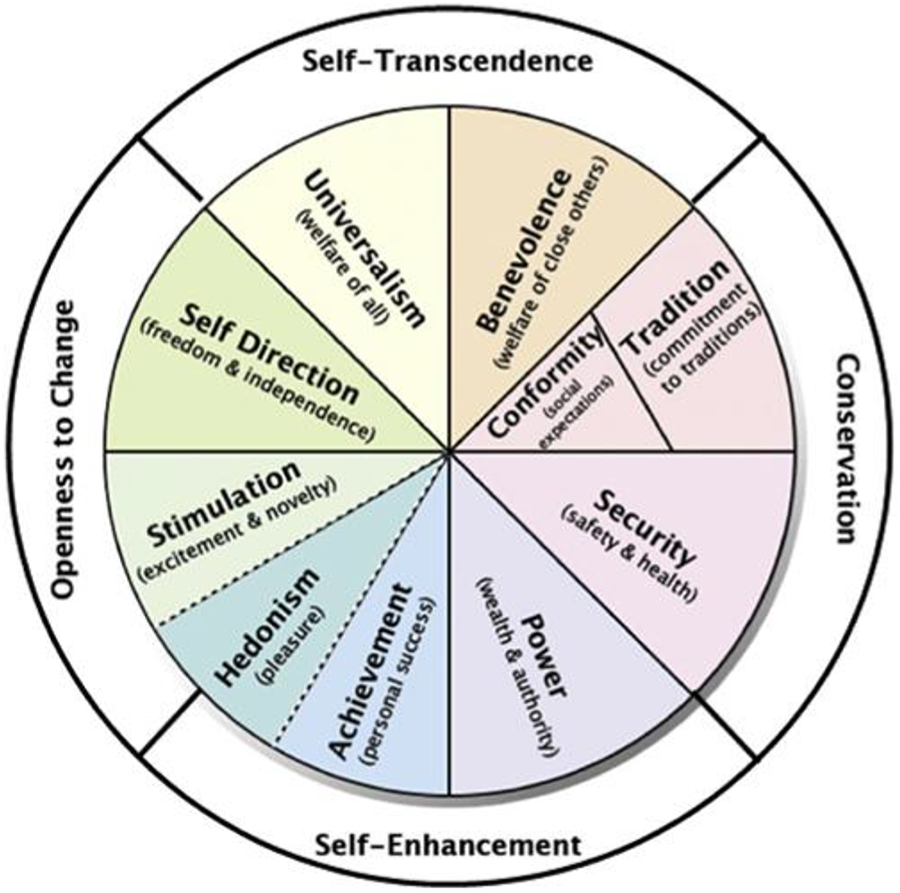
A model of circular structure of relations among 10 basic human values and four higher order values. Source. Adapted with permission from Schwartz (1992).
Values tend to stay relatively stable (Schuster et al., 2019), even during significant life transitions such as starting university life or occupational change (Bardi et al., 2014). However, they were found to adapt following life events affecting multiple life domains, such as migration (Bardi et al., 2014; Lönnqvist et al., 2013).
Systematic population-wide value change has been reported after major existential threats, such as the 2008 financial crisis (Sortheix et al., 2019), exposure to war (Daniel et al., 2013), and the terror attacks of 9/11 (Verkasalo et al., 2006), especially for the conservation versus openness to change dimension. In each of these cases, security values increased in importance and tradition values tended to increase. In contrast, there was a decrease in motivationally opposing values including self-direction, stimulation, and hedonism (Daniel et al., 2013; Sortheix et al., 2019).
Previous studies varied in the changes documented in the orthogonal self-transcendence versus self-enhancement dimension. Some cross-sectional studies documented an increase in altruistic value importance following a threatening situation (Sortheix et al., 2019) or no change (Verkasalo et al., 2006), while a small longitudinal sample (N = 39) even displayed a decrease (Daniel et al., 2013).
We found only one longitudinal study that investigated changes in value importance following a personal health event—diagnosis of a life-threatening illness (Bleidorn et al., 2020). Unfortunately, this study investigated only four value items that map onto the self-transcendence versus self-enhancement dimension. They found that diagnosed individuals reported immediate decreased importance of the value item “sense of accomplishment” and overtime decreased importance of the value items “mature love” and “social recognition.”
Evolutionary theory suggests infectious disease may have an especially high likelihood to induce behavioral, and thus value, adaptation (Thornhill & Fincher, 2014). Such disease is likely to induce collective behavioral reactions that reduce disease spread by activating behavioral avoidance systems that are compatible with conservation values (e.g., Woltin & Bardi, 2018). This activation decreases out-group contact, openness to novel experiences, and self-directed thought and action (Schaller, 2015). Similarly, the existential threat induced through a pandemic is likely to increase mortality salience (Pyszczynski et al., 2020), which has been shown to increase conservative attitudes (Burke et al., 2013).
The restriction of mobility may also reduce opportunities to engage in some value-expressive behaviors. Schwartz and Bardi (1997) argued that values whose pursuit is blocked are likely to become less important, with the exception of values that are based on deficit needs (like conservation values). Indeed, some value change has been found to follow behavior change (Benish-Weisman, 2015; Vecchione, Döring, et al., 2016).
Therefore, we hypothesize that the COVID-19 pandemic will be accompanied by increased conservation values and decreased openness to change values. We also expect that the value priorities of those who worry more about the disease will tend to change more in the expected direction. Indeed, past studies have shown that even subtle contextual reminders of infection risk can increase conservative moral attitudes (Helzer & Pizarro, 2011). This is the first empirical testing of the mechanism of worry as potentially underlying value change.
We also explore the effects on the orthogonal self-transcendence versus self-enhancement dimension. Terror management theory (Courtney et al., 2020; Pyszczynski et al., 2020) implies conflicting predictions. Increased mortality salience is likely to increase defense of one’s cultural worldview (Burke et al., 2013), thereby decreasing the universalism aspect of self-transcendence. However, increased mortality salience is also likely to increase the connection to close others (Heine et al., 2006; Mikulincer et al., 2003), thereby increasing the importance of the benevolence aspect of self-transcendence. We will explore these effects.
There is also mixed evidence on the duration of value change. Cross-sectional research documented value change returning to original levels immediately and 11 days to 5 months after the 9/11 terrorist attacks (Verkasalo et al., 2006), but value change due to war exposure was maintained over 3 months in a small longitudinal sample (Daniel et al., 2013). The longevity of the changes in value importance may depend on the continuation of the new life conditions.
In this study, we track value changes over 3.5 years, including 3 time points annually before the pandemic (2017–2019) and 2 during the pandemic (after the onset in April 2020 and in November–December 2020). In a large and demographically diverse sample in Australia, we test whether there are value changes associated with time and the pandemic and whether worry about infection contributes to these changes. We control for age and gender effects that have been related to differences in value priorities (Schwartz & Rubel, 2005; Vecchione, Schwartz, et al., 2016). This natural experiment and unique sample allows us to gain novel insights on value change at a scale unseen before.
Materials and Methods
Participants and Procedures
To assess value change prior to and following the onset of the pandemic, we used data from 2,321 Australian adults who completed the pandemic onset wave (April 2020; mean age = 56 years, SD = 13.37; 860 males) of the Values Project (https://osf.io/w6uen/). These respondents had completed at least two prior values survey waves in 2018 and 2019. Of these, 65% (n = 1,498) had also completed an initial wave in 2017 (mean age = 55 years, SD = 13.20; 605 males). To assess the persistence of value change into late 2020, we used data from a subsample (n = 1,442) of respondents from the pandemic onset wave who completed an additional fifth wave (November–December 2020; mean age = 59, SD = 12.82; 557 males). We report the results from the five-wave subsample that includes all assessed variables. Results for the larger four-wave sample are reported in OSM Section 4.
The Values Project is a large online panel survey distributed through a commercial panel provider in Australia. Time 1 sample, in 2017, was designed to elicit a cross-sequential sample, with 500 respondents in each of 14 four-year age groups (from 18 to 75 years of age). Thus, the sample was intentionally drawn to be older than the national average but was close to representative on gender, income, marital status, and the state or territory of residence (see OSM Table S1A for respondent characteristics in this study by wave). This research was approved by the University of Western Australia Ethics Office.
The Values Project includes a series of short surveys. In April 2020 (Time 4), 14% of participants did not complete the fifth survey in the series, which included the worry items. In late 2020 (Time 5), all respondents completed the worry items. To assess the potential impact of missing data, we first compared values at 2018 between the participants who completed the 2017 assessment and those who did not. The only difference found was in self-enhancement (Mean T 1 and T2 participants = 2.40, SD = 1.49; Mean T 2-only participants = 2.29, SD = 1.52 t(1,497) = 4.09, p < .01). We also compared values and worry in April 2020 between the participants who took part in the November–December 2020 assessment and those who did not. The only difference found was again in self-enhancement (Mean T 4 and T5 participants = 2.29, SD = 1.52; Mean T 4-only participants = 2.41, SD = 1.52 t(2319) = −1.97, p = .049). Little’s missing completely at random (MCAR) test for all variables between Times 1–5 for the full sample was significant as well, χ2(121) = 297.01, p < .001. These tests indicated that the variables were not MCAR, enabling the use of the full information maximum likelihood method to account for missing data using Mplus 8.4 (Muthén & Muthén, 2017).
Measures
Personal values were measured with the Schwartz refined values best worst survey (BWVr; Lee et al., 2016), the only instrument that fully confirmed the theoretical order of refined values around the circle (see Schwartz et al., 2012; OSM S1B for justification). The BVWr asks participants to choose the most and the least important values from 21 value subsets derived from a balanced incomplete Yuden block experimental design. Across all subsets, each value item appears five times and every pair of items appears together once.
We computed relative importance scores for each value item for each respondent by subtracting the number of times an item was chosen as least important from the number of times the item was chosen as most important (Marley & Louviere, 2005). We then recoded the 11-point scores to 0–10 for ease of interpretation. Reliability was assessed by the consistency (i.e., frequency) of choices. Respondents were considered highly consistent when at least one value was chosen as most important four or five of the five times it appeared across all sets (Collins et al., 2017). In all five waves, more than 90% of respondents were found to be highly consistent in their value choices, with only 2% being inconsistent in any wave. No participant was excluded from the analyses reported here.
Frequency and intensity of worry over the COVID-19 pandemic was measured at Times 4 and 5 with an adapted form of the McCaul Brief Worry Scale (McCaul et al., 1996). We asked respondents the following questions: During the past week, how often have you worried about getting COVID-19? (never, rarely, sometimes, and all of the time), How bothered are you by thinking about getting COVID-19? (not at all, somewhat, moderately, a great deal, and extremely), and How worried are you about getting COVID-19? (not at all, somewhat, moderately, a great deal, and extremely). Reliability was high, Cronbach’s α T 4 = .90; Cronbach’s α T 5 = .91.
Analysis Details
The model estimated was a two-level random model of value change over time, allowing for residual variation in value importance at the occasion and individual levels (Mplus 8.4; Muthén & Muthén, 2017). Model details, including formulas, are in OSM S3A. All models were first estimated in the four-wave sample (N = 2,321), with results reported in the OSM Section 4, as they replicated almost perfectly in the following analysis.
The models reported below were estimated for the five-wave sample (n = 1,442) by respondents who completed values at Time 5 (November–December 2021). We first estimated a model with no predictors to partition the variance between the individual and time level. We then estimated a model including three predictors: the linear value change prior to the pandemic (2017–2019), the COVID onset effect (April 2020 compared to other waves), and the COVID effect in late 2020 (November–December 2020 compared to other waves). The model included correlations at the individual level between the intercept, slope of linear value change, COVID onset, and late 2020 COVID effects.
Analysis was conducted for each of the four values separately, with and without controlling for gender and age. The results were identical, but the estimation of standard errors was not reliable with the inclusion of control variables. Thus, we report the results with no control variables.
In a second set of analyses we predicted Time 4 value importance, in a bootstrapped multiple regression analysis. We regressed values at the pandemic onset (April 2020) on values prior to the pandemic (2019) to capture change in values at pandemic onset. We controlled for gender and age, prior to testing the effects of worry over COVID-19 on value change (OSM Table S3I presents results with no control variables). The same set of analyses was conducted to predict Time 5 value importance (November–December 2020) based on Time 4 value importance (April 2020). Data and script to reproduce the analysis are available at https://osf.io/w6uen/.
Results
Correlations between the study variables are presented in the OSM Tables S2D and S2E. Means and standard deviations and repeated measures ANOVA of values across times are presented in the OSM Tables S2A and S2B. Test–retest correlations of value importance across time points are presented in the OSM Table S2C. These test–retest correlations range from .59 to .79 and suggest a moderate-high rank-order stability in values. The intraclass correlation for the baseline model indicated that 64% (for conservation and openness to change) to 75% (for self-enhancement) of the variance was due to individual differences, with the rest due to temporal effects. Thus, individuals showed relative stability in values, with more than half of the variability between reported value scores overall stemming from between-individual value differences, but a sizeable fraction of the variability stemming from individual fluctuations over time. The multilevel model results are presented in OSM Table S3B and Figure 2. OSM Tables S3E and S3F present the results for the 10 value model estimates and description.
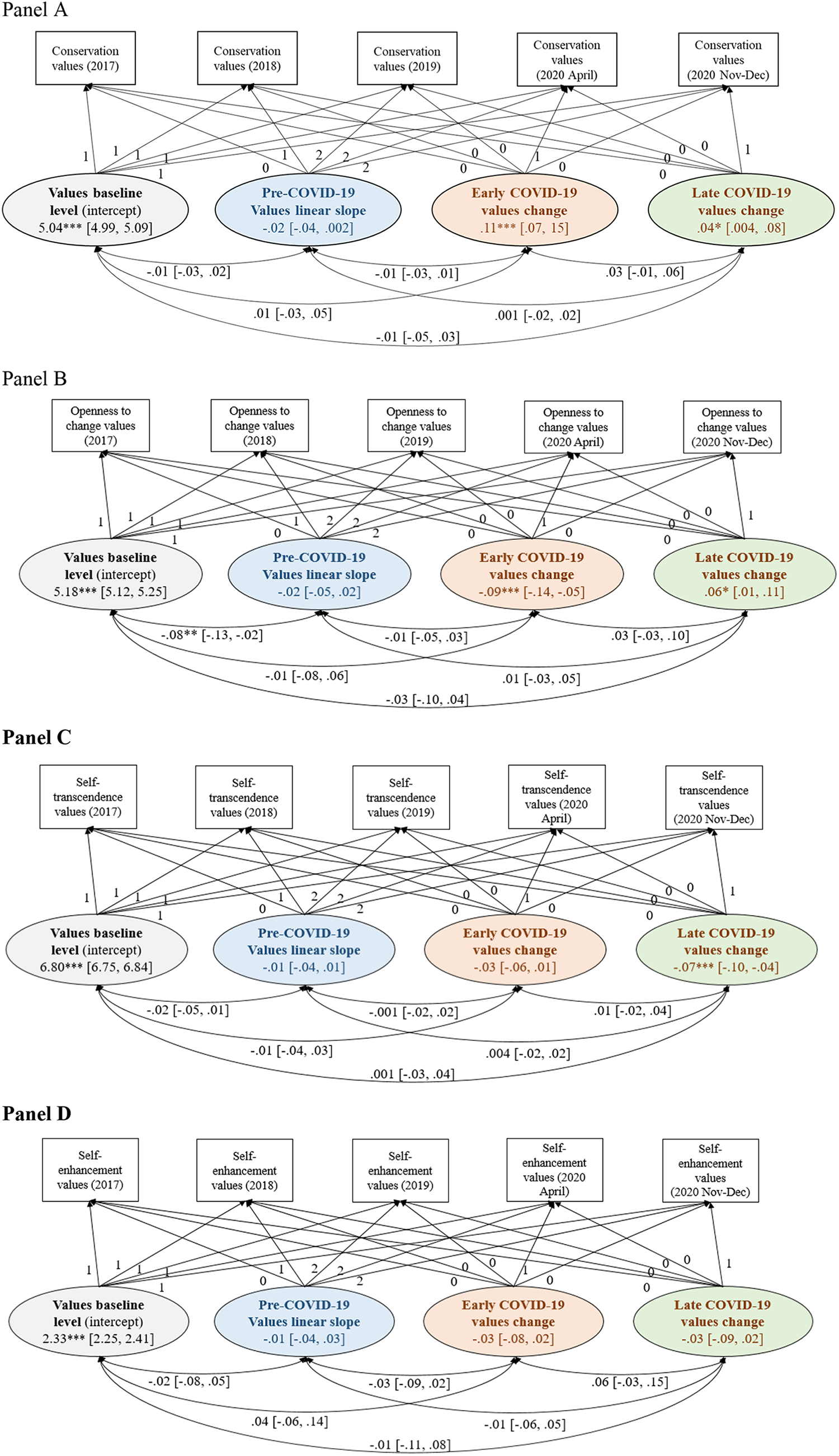
Two-level random effect model for each value type (Time 1–5). Note. n = 1,442. Confidence intervals 95% are in square brackets. Panel A: openness to change values. Panel B: conservation values. Panel C: self-transcendence values. Panel D: self-enhancement values. *p < .05. **p < .01. ***p < .001.
Conservation Values
Despite the overall moderate-high intra-individual stability in values (OSM Table S2C), there was a significant mean level change in conservation value priorities throughout time (Partial μ2=.007 for T1–T5, OSM Tables S2A and S2B). These values were stable before the pandemic, became more important at its onset, and slightly decreased in importance by the end of 2020.
In the multilevel model, conservation values were stable within individuals until the pandemic (linear slope b= −.02, p = .08, −.04, .00]), although a moderate decrease was found prior to the pandemic in the full four-wave sample (linear slope b= −.03, p = .007, CI [−.04, −.01]). As expected, conservation values increased in importance within individuals following the onset of the COVID-19 pandemic (b = .11, p < .001, CI [.07, .14]). In November–December 2020, these values remained higher in importance relative to previous time points (b = .04, p = .03, CI [.004, .08]).
Based on the multiple regression analysis, worry over COVID-19 was positively associated with pandemic onset conservation values, controlling for prior values (Table 1). Thus, conservation values tended to increase in importance for individuals reporting greater worry about the pandemic. Panel B of Figure 3 compares the residualized Time 4 pandemic onset values controlling for values at Time 3, among individuals with different levels of worry. Results show individuals with moderate or high levels of worry about the pandemic were more likely to experience an increase in prioritizing conservation values compared with individuals with low levels of worry. No association with worry over COVID-19 was found in the regression predicting November–December 2020 values from Time 4 pandemic onset values. Therefore, the importance of conservation remained high at the later time relative to previous time points, regardless of how worried individuals were.
Prediction of Values in a Regression Analysis, Controlling for Previous Values.
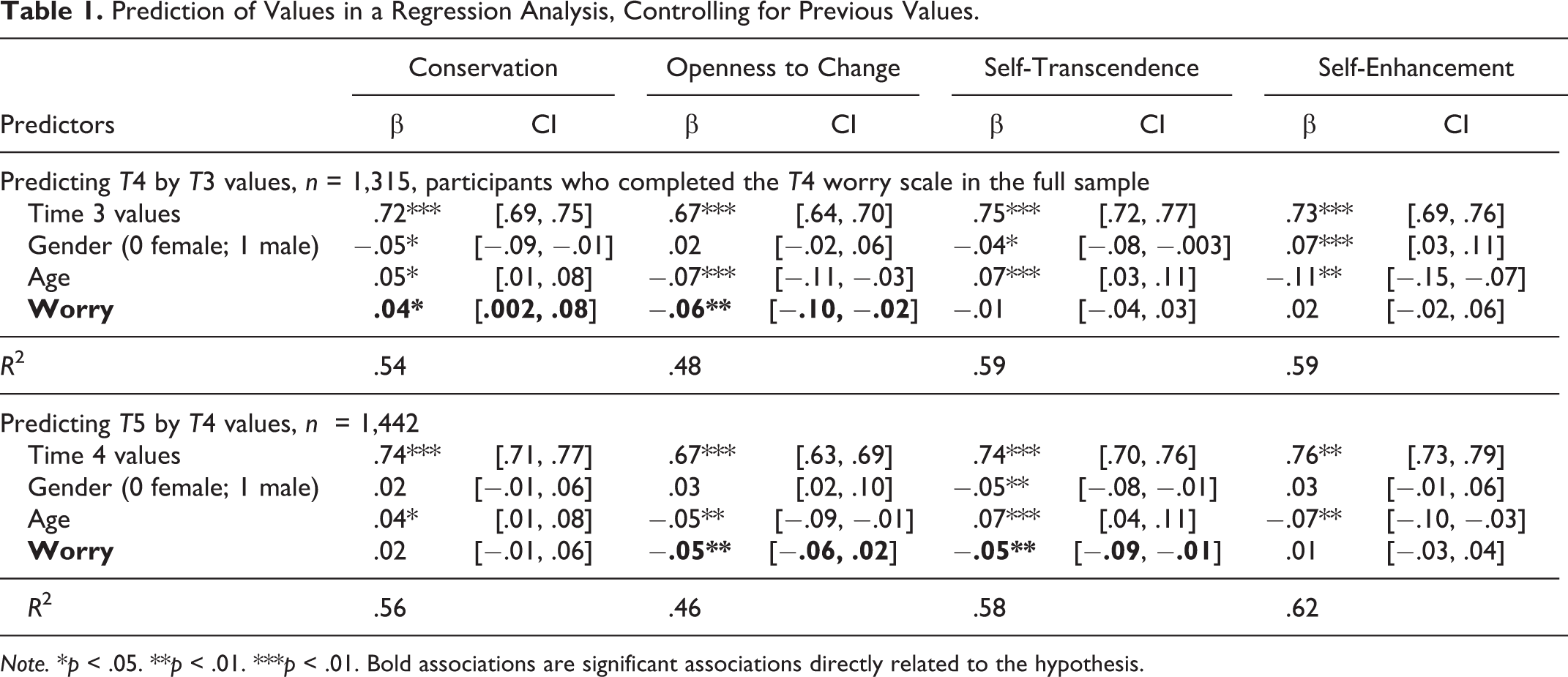
Note. *p < .05. **p < .01. ***p < .01. Bold associations are significant associations directly related to the hypothesis.
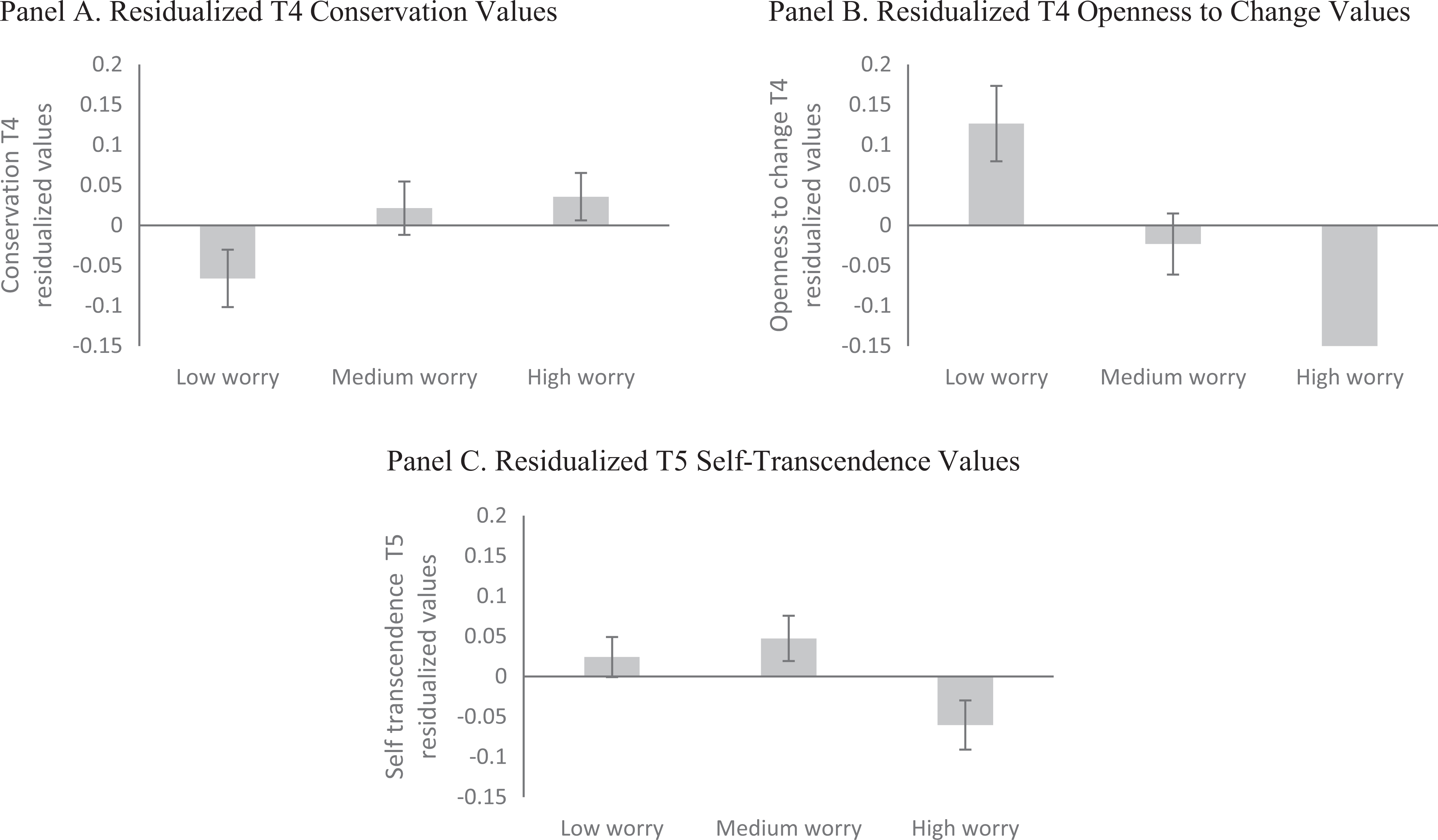
Residualized values, controlling for previous values, among individuals reporting high, medium, and low worry over the pandemic (0–33, 34–66, 67–100 percentiles, respectively). Note. Panel A: openness to change values T4, controlling for T3. Panel B: conservation values T4, controlling for T3. Panel C: self-transcendence values T5, controlling for T4.
Openness to Change Values
Alongside the intra-individual stability in openness to change values (OSM Table S2C), the mean level of openness to change value priorities varied significantly throughout time (Time 1–Time 5, Partial μ2=.004, see OSM Tables S2A and S2B). The value means were stable before the pandemic, decreased shortly after its onset, and bounced back to their initial level by the end of 2020.
In the multilevel model, openness to change values were stable within individual until the pandemic (linear slope b= −.02, p = .32, CI [−.05, .02]), but, as expected, decreased in importance within individuals following the onset of the COVID-19 pandemic (b = −.09, p < .001, CI [−.14, −.05]). In November–December 2020, openness to change values increased in importance (b = .06, p = .03, CI [.01, .11]), thereby reversing their previous decline. However, this pattern of changes can be clarified by examining the basic values, comprising openness to change (see OSM Table S3E). Prior to the pandemic, stimulation values were decreasing in importance, and this decrease accelerated during the pandemic onset. The level of importance following the pandemic onset was maintained during 2020. In contrast, self-direction values were increasing prior to the pandemic but did not change during the pandemic onset. By late 2020, self-direction values resumed and accelerated their prior pattern of increase.
Based on the multiple regression analysis, worry over COVID-19 was negatively associated with pandemic onset openness to change values, controlling for prior values (Table 1). Thus, openness to change values tended to decrease in importance for individuals reporting greater worry about the pandemic. Panel A of Figure 3 compares the residualized Time 4 pandemic onset values controlling for values at Time 3, among individuals with different levels of worry. Results show individuals with high levels of worry about the pandemic were more likely to experience a reduction in prioritizing openness to change values compared with individuals with low levels of worry. No association with worry over COVID-19 was found in the regression predicting November–December 2020 values by Time 4 pandemic onset values. Therefore, the importance of openness to change increased regardless of how worried individuals were.
Self-Transcendence Values
The sample means of self-transcendence value priorities varied significantly throughout time (T1–T5, Partial μ2 =.007, see OSM Tables S2A and S2B). The value means were stable prior to the pandemic, became slightly lower shortly after its onset, and decreased further in importance by the end of 2020.
As can be seen in Figure 2 (see also OSM Table S3B), in the multilevel model, self-transcendence values were stable within individuals until the pandemic (linear slope b= −.01, p = .19, CI [−.04, .01]) and shortly after the pandemic onset (b = −.03, p = .11, CI [−.06,.01]), although universalism values decreased in importance at that time (b = −.05, p = .03, CI [−.09, −.004]). In November–December 2020, self-transcendence values decreased in importance (b = −.07, p < .001, CI [−.10, −.04]), as participants tended to prioritize less both benevolence and universalism values compared to their other values.
Based on the multiple regression analysis, worry over COVID-19 was not associated with pandemic onset self-transcendence values, controlling for prior values (Table 1), indicating that value change was not associated with the level of worrying. However, worry over COVID-19 was negatively associated with late 2020 self-transcendence values, controlling for pandemic onset values. Thus, the more individuals worried about the pandemic the more self-transcendence values decreased in importance over time. Panel C of Figure 3 compares the residualized Time 5 pandemic onset values controlling for values at Time 4, among individuals with different levels of worry. Results show individuals with high levels of worry about the pandemic were more likely to experience reduction in the priority they gave to self-transcendence values compared with individuals with medium or low levels of worry.
Self-Enhancement Values
The mean levels of self-enhancement values did not differ significantly across T1–T5, prior or during the pandemic (see OSM Tables S2A and S2B). The multilevel analysis (Figure 2; OSM Table S3B) indicated that self-enhancement values were stable until the pandemic (linear slope b= −.01, p = .64, CI [−.04, .03]), at pandemic onset (b = −.03, p = .29, CI [−.08, .02]), and in November–December 2020 (b = −.03, p = .22, CI [−.09, .02]). The multiple regression analyses indicated no association of worry over COVID-19 with Time 4 or Time 5 self-enhancement values (Table 1).
Discussion
Values are usually quite stable (reviewed in Schuster et al., 2019) over time. However, in the face of threats posed by the COVID-19 pandemic, we found that people’s values changed in a direction that implies adjustment to the new life situation, in line with values theory and evolutionary predictions.
Following the pandemic’s onset, we found an increase in conservation and decrease in openness to change values, especially among worried individuals. Due to their fundamental nature, shifts in values may have far-reaching consequences for societal future. Conservation versus openness to change value importance has been associated with social phenomena such as resistance to change (Sverdlik & Oreg, 2015), immigration (Davidov et al., 2020), and voting for conservative parties (Caprara et al., 2017). These changes can result from a behavioral immune system (Schaller, 2015), enhancing group divisions to reduce the exposure to life-threatening organisms. Although this mechanism may have been adaptive, it may become counterproductive as it limits exchange of vital information and marginalizes groups in increasingly cosmopolitan societies.
Further contributing to the observed effects, environmental changes such as lockdowns restrict behavioral choices and reduce opportunities to engage in some value-expressive behaviors. Specifically, the pandemic situation encourages expressing conservation values through security-enhancing behavior, while restricting the expression of some openness to change values through adventurous and explorative behavior. It may also restrict behavior that expresses self-transcendence values due to the reduction in social interaction. Nevertheless, in line with predictions of self-perception theory (Bem, 1972), both behavioral and neuroscience evidence suggest that although values predict later expressive behavior more than behavior predicts later values (Vecchione et al., 2019), behavior expression sometimes also leads to increases in the importance of the expressed values (Benish-Weisman, 2015; Fischer, 2017; Vecchione, Döring, et al., 2016). It is thus possible that lockdown restrictions on behavior trigger or exacerbate some of the later changes in values found here.
An important question left open by past studies concerns the persistence of value changes over time. Preliminary evidence suggested that value changes may be maintained for a short period of time (Daniel et al., 2013) or return to original levels (Verkasalo et al., 2006) as life returns to its previous conditions. The current study provides the first evidence of distinct value-change patterns within individuals over time across value types. Toward the end of 2020, conservation values remained elevated over prepandemic levels, suggesting that at least as long as the pandemic conditions are maintained, the population may endorse conservative values to a greater extent. Unlike early in the pandemic, conservation value changes were no longer predicted by health-related worry. Thus, a different factor is probably responsible for their continued elevated levels. It is possible that the economic downturn (see Sortheix et al., 2019; Welzel, 2013), as well as behavioral restrictions due to lockdowns, played a role.
Openness to change values showed a different pattern of change, marked by a bounce back over time. Interestingly, we have identified differing change patterns within this higher order value. Specifically, the decreased value importance at pandemic onset stemmed mainly from a decrease in stimulation but not self-direction values, when adventures and exploration were difficult to pursue. Toward the end of 2020, value increases stemmed mainly from an increase in self-direction. A possible mechanism driving self-direction increase may be critical thinking required to understand and assess the wealth of highly complex health information and to evaluate implemented governmental policies within the highly politicized environment (Pyszczynski et al., 2020). In addition, creativity and exploration may have been applied to maintain interest within restricted spaces, often channeled to artistic and intellectual pursuits.
Finally, self-transcendence values decreased significantly in November–December 2020. At pandemic onset, we found a significant decrease in universalism values (see OSM Table S3C), suggesting an immediate decrease in concern for distant others, the wider society and nature. Over time, this effect persisted and also spread to benevolence values, which are focused on close others. Further, in November–December 2020, individuals who were worried about the health consequences of the pandemic reported a stronger decrease in their overall care for others. The results may arise from a decrease in social interaction during the extended lockdown. Alternatively, this may arise from shifts toward self-preservation and personal safety, at the expense of concern for others, which is in line with research on learned helplessness (Seligman, 1972; Weiner, 1986), suggesting that extended worry may lead to withdrawal in some individuals.
In the past, longitudinal studies of value change have assumed that feeling less safe led to increased conservation values (e.g., Schwartz & Bardi, 1997; Sortheix et al., 2019). Our study is the first to establish empirically that worry played a role in such value change. Future studies should aim to replicate this result. More broadly, values are only weakly associated with emotions (Sagiv et al., 2015), but we have now shown that emotions still have an important role in value processes.
Values are usually found to be largely stable (Schuster et al., 2019), and this pattern was evident in our study as well. The rank order stability of values was quite high throughout the study (see OSM Table S2C). This means that even in these turbulent times, those who prioritized a particular value highly compared to others in the sample, still prioritized this value highly in the sample 3 years later.
The results presented here should be framed within the context of Australia, which experienced a relatively mild pandemic outbreak by world standards. However, during the early stages, COVID-19 cases in Australia increased rapidly, and the government applied extensive lockdowns prior to and during the 2020 surveys in various parts of Australia (see OSM Section 5 for details and time line in Australia). Thus, there is reason to believe that the population experienced subjective worry of the health consequences of COVID-19 at the onset of the pandemic and subjective worry of the social- and economic-related consequences throughout the pandemic, possibly leading to the results documented here. Other countries have experienced more severe and sustained infection and mortality rates, which may suggest that the effects found in our study are an underestimation of value changes occurring during the pandemic compared to many other places in the world.
Future research may examine societal changes in values using additional methods. Personal values are typically measured using self-reports, as values are subjective constructs, best reported by the individual. Nevertheless, societal values may be measured by lexical analysis of text in newspapers (Bardi et al., 2008) or social media (Garcia & Rimé, 2019), or by reports of societal, and not individual values (Fischer, 2006). Applying such methods across cultures might be especially useful in understanding the timing and persistence of value change in different social situations.
The study has additional limitations. The attitude change literature shows that it is easier to change attitudes when they are already in the direction of the sought change (e.g., Petty et al., 2000), suggesting that countries already high on conservation may experience even greater increases. Second, the Values Project at Time 1 intentionally oversampled older people in comparison to the census population (see Method for details and OSM Table S1A). Finally, we adopted a short version of the worry scale due to survey space constraints. Measuring a more comprehensive set of worries might further explain value change. We have also speculated on behavior change as driving changes in values, but we did not examine empirically such possibilities. Future research is needed to address these limitations.
Overall, our results suggest that during a continuous crisis event that affects many areas in life, value changes are complex, responsive to environmental conditions, and have possible long-term implications. We found that in contrast to a stable prepandemic pattern, the COVID-19 pandemic quickly led to substantive value change that continued in multiple directions during the pandemic. The results have far-reaching consequences for the nature of future society. These value trends, of increased conservation and reduced self-transcendence, provide fertile ground for authoritarian policies, as individuals strive for increased order and care less for close others and society. The outcomes presented here represent a concrete advancement in our understanding of psychological and social implications of the COVID-19 pandemic as well as processes of value change.
Supplemental Material
Supplemental Material, sj-docx-1-spp-10.1177_19485506211024026 - Changes in Personal Values in Pandemic Times
Supplemental Material, sj-docx-1-spp-10.1177_19485506211024026 for Changes in Personal Values in Pandemic Times by Ella Daniel, Anat Bardi, Ronald Fischer, Maya Benish-Weisman and Julie A. Lee in Social Psychological and Personality Science
Footnotes
Authors’ Note

Declaration of Conflicting Interests
The author(s) declared no potential conflicts of interest with respect to the research, authorship, and/or publication of this article.
Funding
The author(s) disclosed receipt of the following financial support for the research, authorship, and/or publication of this article: This research was funded by an Australian Research Council Linkage grant in partnership with Pureprofile (Project LP150100434).
Supplemental Material
The supplemental material is available in the online version of the article.
References
Supplementary Material
Please find the following supplemental material available below.
For Open Access articles published under a Creative Commons License, all supplemental material carries the same license as the article it is associated with.
For non-Open Access articles published, all supplemental material carries a non-exclusive license, and permission requests for re-use of supplemental material or any part of supplemental material shall be sent directly to the copyright owner as specified in the copyright notice associated with the article.
