



Abstract
People exhibit impaired recall for highly self-threatening information that describes them, a phenomenon called the mnemic neglect effect (MNE). We hypothesized that the MNE extends to recall for information that highly threatens an individual’s important in-group identity. We tested our hypothesis in two experiments in which participants read behaviors depicted as enacted by either in-group members (Experiment 1 = American and Experiment 2 = British) or out-group members (Andorrans). Participants recalled identity-threatening behaviors poorly when enacted by in-group members but not when enacted by out-group members. Additional results evinced in-group favoritism in (1) evaluations of the two groups and (2) trait judgments made from the behaviors, but only on traits central to the self. Finally, mediational analyses suggested that the group-driven memory differences are plausibly due to the global between-group evaluation differences but not the perceived between-group trait judgment differences.
Research on the mnemic neglect effect (MNE; Sedikides et al., 2016) shows that, when one is threatened by information implying important (or central) personal shortcomings, this information is later recalled poorly. The MNE does not reflect a general tendency toward poor recall for negative information: No recall deficit emerges when (1) central information describes another and unknown person or (2) negative information is not particularly self-threatening (e.g., is peripheral). Thus, in the MNE, self-threat, and not simply negativity, prompts poor recall.
The MNE presumably occurs because self-threat posed by central negative information induces (1) shallow information processing and (2) separation in memory of the negative information from the (mostly positive) self-concept. These mechanisms impair incorporation of self-threatening information into an individual’s corpus of self-knowledge. In theory, the impairment renders the threatening information hard to find in a memory search, culminating in poor recall (but not in poor recognition) for that information (Cheston et al., 2018; Green et al., 2008; Pinter et al., 2011; Saunders, 2011; Sedikides & Green, 2004; Zengel et al., 2015, 2018).
The literature has so far been concerned with the MNE in the context of personal memories. We wondered whether the MNE is also present in memories for behaviors enacted by others. Social identity theory (Abrams et al., 2005; Tajfel & Turner, 1986) suggests that this might occur. The theory proposes that some in-groups are particularly important to how people think about themselves. These self-important in-groups are typically evaluated positively and prompt a positive self-view. Thus, when information threatens a self-important in-group, people may also experience a self-threat (Petriglieri, 2011; Schmitt et al., 2000).
Linking these ideas to MNE, we hypothesized that, when others are members of a self-important in-group, an individual will evince poor recall for the others’ negative behaviors. However, as per the MNE, this recall deficit (1) will occur only for self-central negative behaviors, and not unimportant (peripheral) behaviors, and (2) will not be observed for the self-central behaviors when enacted by members of groups that are not self-important.
Results from existing studies fit our hypothesis but do not unequivocally support it. Sahdra and Ross (2007) found that individuals exhibited impaired recall for real-world in-group member behaviors. However, the behaviors used in their research were participants’ own personal memories. As such, their studies could not exert control over the characteristics of the memories recalled. Given these potential confounds, it is unclear whether self-threat from the negative in-group behaviors per se, and not other behavior characteristics, impaired recall. In contrast, the experimental paradigm used by Rotella and Richeson (2013) pointed to self-threat prompted by others’ behaviors as a recall-impairing mechanism. When experimental scenarios, which described the negative behaviors of others, were said to refer to in-group member behavior, reader scenario recall was impaired. No such effect was observed when scenarios were said to refer to out-group member behaviors. However, these authors did not examine whether recall varied by the self-threateningness of individual behaviors, as would be expected from our application of the MNE to the intergroup recall context.
Thus, additional research is needed to clarify why and when deficits in recall for negative behaviors enacted by others will emerge. We took a step toward meeting this need in two experiments. Experiment 1 received ethical approval from Northern Illinois University and Experiment 2 from the University of Southampton. We provide the research protocol in Supplementary Material. The data and code for the main analyses are available at OSF (https://doi.org/10.17605/osf.io/ypr9z).
Experiment 1
Our first experiment modified the typical mnemic neglect paradigm (Sedikides & Green, 2000, 2009) in which participants read the descriptions of many behaviors, then later attempt to recall each behavior. The modification involved manipulating the nationality of behavior enactors. Some participants read behaviors describing enactors who shared the participants’ American nationality. For other participants, the enactors’ nationality differed from participants’ nationality.
We used national identity as the self-important reference group because nationalities can both produce robust in-group favoritism effects (Koomen & Bähler, 1996) and alter memory (Rotella & Richeson, 2013). Additionally, this in-group choice allowed use of a self-neutral referent group (“Andorrans”) analogous to the neutral-other control condition in the standard MNE paradigm (“Chris”). A targeted question within Experiment 1 confirmed that most participants had never heard of Andorra (89.10%) or had heard of it but lacked knowledge of Andorrans (i.e., had never met an Andorran; 8.70%).
Method
Participants
Native U.S. undergraduates, aged 18–26 years (M = 19.75, SD = 1.84), participated for course credit. We determined sample size a priori from the results of previous mnemic neglect experiments (Zengel et al., 2018). We ceased data collection once we reached 100 participants.
We excluded from analyses data from two participants who exhibited no behavior recall (routine in MNE experiments). Of the remaining 98 participants (51 men, 46 women, and 1 undeclared), most identified as Caucasian (49.0%, African American: 18.4%, Hispanic American: 18.4%, Asian American: 3.1%, mixed ethnicity: 8.2%, and undeclared: 3.1%).
Materials and Procedure
On laboratory arrival, participants confirmed they were native U.S. citizens, a practice intended to strengthen the accessibility of their American identity. We randomly assigned the 98 participants to the in-group (American: n = 52) or out-group (Andorran: n = 46) condition.
Our procedure mirrored the typical mnemic neglect paradigm (Green et al., 2008; Sedikides & Green, 2000), with two exceptions. First, the behavior feedback referred either to “Americans” or “Andorrans” rather than the MNE-typical “I/Me” or “Chris.” Second, in our distractor task (see below), to avoid activating nationality participants generated names of birds instead of names of U.S. states (the task often used in MNE experiments).
Participation occurred via a computer-administered Qualtrics Survey. In-group (and out-group) condition participants were instructed to “consider the following description of AMERICANS (for out-group: ANDORRANS). Think of the descriptions as being based on actual knowledge of people who know AMERICANS (for out-group: ANDORRANS) well. Think of the descriptions as real.”
Participants then read 32 trait-implying sentences that depicted behaviors enacted by individuals from the participant’s assigned group (Americans or Andorrans). The behaviors and the traits that these behaviors implied duplicated most MNE experiments (for pretest data, see Sedikides & Green, 2000). Some behaviors had implications for one of two (trustworthy, kind) central (e.g., self-important) traits, whereas other behaviors had implications for one of two (modest, uncomplaining) peripheral (e.g., not self-important) traits. Half the behaviors were positive (e.g., Andorrans would help a handicapped neighbor paint his house) and half were negative (e.g., Americans would be unfaithful when in an intimate relationship). Thus, of 32 behaviors viewed by each participant, four were positive/trustworthy, four negative/trustworthy, four positive/kind, four negative/kind, four positive/modest, four negative/modest, four positive/uncomplaining, and four negative/uncomplaining. Behaviors appeared in an order randomized separately for each participant. Each behavior remained visible for 8 s before switching to the next one (Sedikides & Green, 2000, Experiment 3).
Following a 2.5-min distractor task, participants were unexpectedly asked to recall as many of the previously displayed sentences as possible, report them one at a time in any order they came to mind, and be as accurate in reporting as possible without worrying about verbatim recollection. Using a textbox, participants recorded their memory for a single behavior and then prompted the computer to present a new blank textbox (for nuances of memory assessments in regard to timing and reporting behaviors one at a time vs. in culmination, see Newman et al., 2014).
Consistent with its theorized roots in memory search difficulties (i.e., shallow information processing, memorial separation of the negative information from the predominantly positive self-concept), the MNE generally emerges when memory is probed via free recall and not when probed via recognition (Green et al., 2008). In an attempt to replicate this distinction, participants next completed a sentence recognition task. Half of the sentences (old) had been presented earlier in the experiment, and half were new (i.e., foils adapted from Green et al., 2008). We displayed all sentences in a separate random order for each participant. On seeing the 64 sentences, participants selected different checkboxes to indicate whether they believed each sentence to be either old or new. Both here and in Experiment 2, the session concluded by soliciting each participant’s demographic information, knowledge about Andorra, and response to a mood-enhancing item (i.e., for what participants were most grateful for in their lives).
Results and Discussion
Free Recall
Following standard MNE-paradigm procedures, recalled behavior sentences were coded independently by two raters using a gist criterion. 1 Coders agreed on 94.42% of cases, resolving discrepancies through discussion.
We then calculated recall proportions, counting behaviors recalled per within-subjects cell of the design (central/positive, central/negative, peripheral/positive, and peripheral/negative) and dividing that number by eight. For this tally, we collapsed across the two traits that comprised each cell of the Trait Type × Behavior Valence matrix. Next, we entered the proportions into a 2 (referent group: American, Andorran) × 2 (trait type: central, peripheral) × 2 (behavior valence: positive, negative) mixed-model analysis of variance (ANOVA). Referent group was the sole between-subjects variable. We provided means and standard deviations (SDs) in Table 1.
Means (Standard Deviations) [95% CI] for Recall Proportions in Experiment 1.
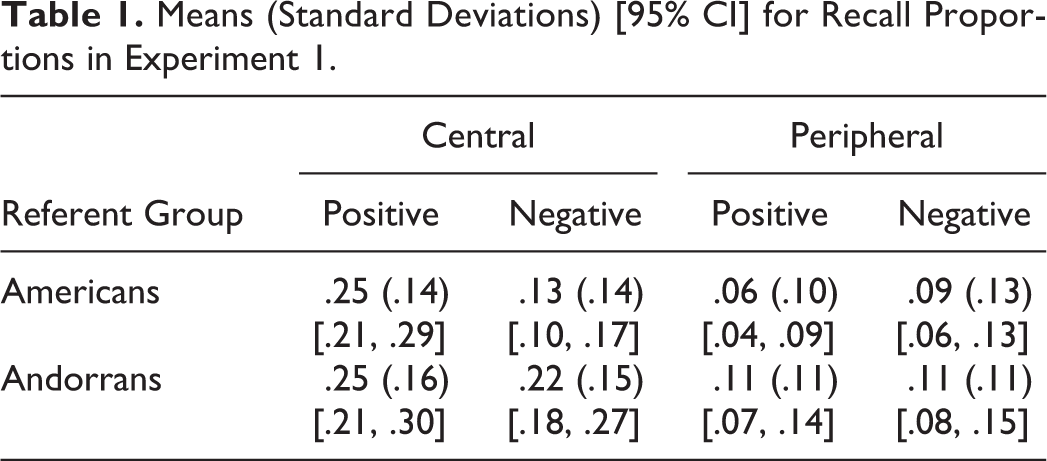
The typical signature of the MNE, the Referent Group × Trait Type × Behavior Valence interaction, emerged, F(1, 96) = 5.89, p = .017,
Recognition
One participant eschewed the recognition task, leaving 97 in the sample. Using procedures derived from signal detection theory (Green et al., 2008), we calculated behavior recognition accuracy values (δ) by averaging mean rates of correctly identified old behavior sentences (hits) with mean rates of correctly identified new behavior sentences (correct rejections). We calculated these accuracy recognition values separately for each cell of the within-subjects design and entered the values as dependent variables into a 2 (referent group) × 2 (trait type) × 2 (behavior valence) mixed-model ANOVA. We display means and SDs in Table 2.
Mean (Standard Deviations) for Recognition Accuracy (δ) in Experiment 1.
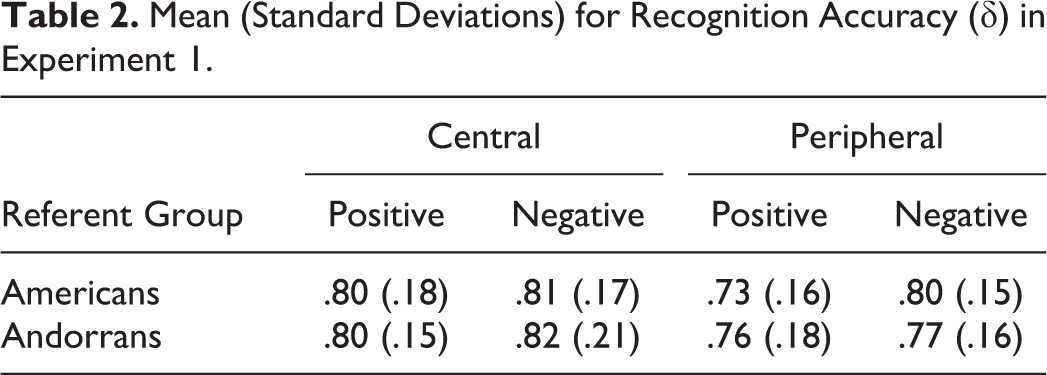
As expected (Cheston et al., 2018; Green et al., 2008; Zengel et al., 2018), the MNE-evident three-way interaction that was significant in free recall was not significant in recognition accuracy, F(1, 95) = 1.33, p = .251,
Experiment 2
In Experiment 2, we examined the replicability of Experiment 1 findings, testing participants who identified with a British national identity. In a between-subjects design, the sentences referred either to British enactors or Andorran enactors. A targeted question verified that most (61.10%) of the British participants had not heard of Andorra or that a substantial minority of them (35.10%) had heard of Andorra but lacked knowledge of Andorrans. We expected the MNE results produced by Experiment 2 to replicate those observed in Experiment 1. Moreover, we sought evidence that the MNE was driven by in-group favoritism (Pinter & Greenwald, 2011; Vignoles & Moncaster, 2007; Wildschut et al., 2014). We measured in-group favoritism via both a group global evaluative judgment and judgments about various traits that the group was perceived to possess.
On the global evaluation measure, we expected that the British group would be judged as more positive than the Andorran group. We anticipated a different pattern on trait measures. Prior work has shown that in-group positivity effects are especially likely on features perceived to be highly important (or relevant) to the in-group (Mullen et al., 1992; also see Marques et al., 1988). This finding suggests that British participants would favor the British group over the Andorran group in judgments about the central trait dimensions (trustworthiness, kindness), but less so in judgments about the peripheral trait dimensions (modesty, uncomplaining). In mediational analyses, we then tested whether either these evaluative judgments or these trait judgments (or both) could plausibly mediate the expected referent group-driven MNE in recall.
Method
Participants
British university undergraduates (N = 166), aged 18–45 years (M = 20.24, SD = 3.36), participated for course credit. Data collection started 3 months after the Brexit referendum that occurred on June 23, 2016. We aimed to test at least 150 participants 3 and stopped data collection at the end of the designated academic semester.
We excluded data from two participants who exhibited no recall. Of the remaining 164 participants (137 women, 21 men, and six unreported), most identified as White or British White (64.0%, British Black: 3.7%, British Asian: 4.9%, British or English without further distinction: 17.7%, mixed ethnicity: 5.5%, other: 1.9%, and undeclared 2.4%). We randomly assigned participants to the in-group (British: n = 82) or out-group (Andorran: n = 82) condition.
Materials and Procedure
Materials and procedures duplicated Experiment 1, with two exceptions. First, in one condition, we changed the nationality label used in the behavior sentences from “American” to “British.” Second, we added a judgment task to the procedure, placing it between recall and recognition.
In this added task, we instructed participants to judge the group of British or Andorran enactors (depending on condition), based exclusively on the behaviors that they had just read (for a similar procedure, see Gramzow et al., 2001; Otten & Moskowitz, 2000). Participants first provided global evaluative judgments of their assigned group (−3 = very bad, 0 = neither good nor bad, and +3 = very good). Participants next rated how much their assigned group exemplified the traits trustworthy, kind, modest, and uncomplaining (e.g., −3 = very untrustworthy, 0 = neither trustworthy nor untrustworthy, and +3 = very trustworthy). To conceal the experiment’s purpose, we embedded these trait judgments among other trait judgments (e.g., intelligent, polite, creative). All trait ratings were made on 7-point bipolar scales structured and labeled as in the example above, but appropriate to the trait being rated.
Results and Discussion
Free Recall
Two independent raters coded the recalled behaviors based on a gist criterion. 4 Their ratings matched in 93.01% of the cases; discrepancies were resolved via discussion. As in Experiment 1, we tallied the recalled behavior counts and converted them into proportions. We entered these proportions into a 2 (referent group: British, Andorran) × 2 (trait type: central, peripheral) × 2 (behavior valence: positive, negative) mixed-model ANOVA. Means and SDs appear in Table 3.
Means (Standard Deviations) [95% CI] for Recall Proportions in Experiment 2.
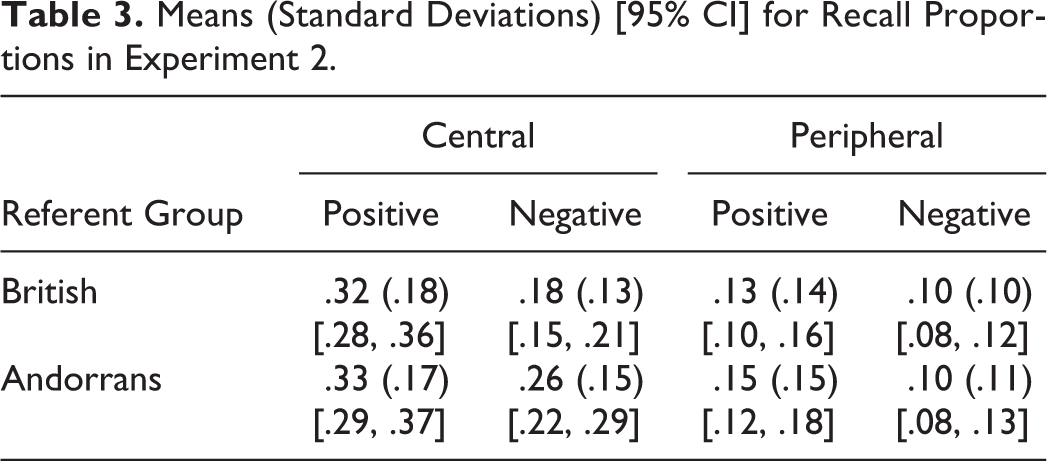
The expected, MNE-indicative, Referent Group × Trait Type × Behavior Valence interaction was significant, F(1, 162) = 4.38, p = .038,
In-Group Favoritism
Evaluative judgments
Three participants eschewed the evaluative judgment task. We examined the evaluative judgments from the remaining participants via a between-subjects ANOVA (British vs. Andorrans). As expected from social identity theory, participants judged their in-group (British; M = 0.26, SD = 1.15) as better than the out-group (Andorrans: M = −0.29, SD = 1.18), F(1, 159) = 8.87, p = .003,
We used these judgments to test the idea that the MNE might be driven by in-group favoritism. To do so, we devised a mediation model (Figure 1) using Model 4 of the PROCESS macro for SPSS (Hayes, 2009). We included reference group as a predictor of memory in this model. We derived the memory outcome variable for each participant from a calculated ratio of the recall frequency for central negative behaviors to the tally of memory for all behaviors recalled (recall ratio). We chose this ratio so that it could provide a single-measure representation of the entire memory pattern observed in the MNE. (Results from models using one of the several other memory measures as outcomes all converged with the results based on the recall ratio; see Supplementary Material).
The model, depicted in Figure 1, included global evaluative judgments as a mediator of the referent group–recall ratio relation. All effects in the model are bootstrapped estimates based on 10,000 trials. As expected, more positive evaluative judgments were made for the British than the Andorrans, b = .547, t(159) = 2.979, p = .003, and these evaluative judgments were negatively related to the recall ratio, b = −.036, t(159) = 2.988, p = .003. More importantly, an indirect effect emerged (indirect = −.020, SE = .011, 95% CI [−.046, −.003]), showing that the significant relationship between referent group and the recall ratio was plausibly explained by evaluative judgments. Indeed, accounting for the mediated pathway, the direct effect of referent group on the recall ratio was rendered nonsignificant: direct = −.055, SE = .028, 95% CI [−.111, −.001].
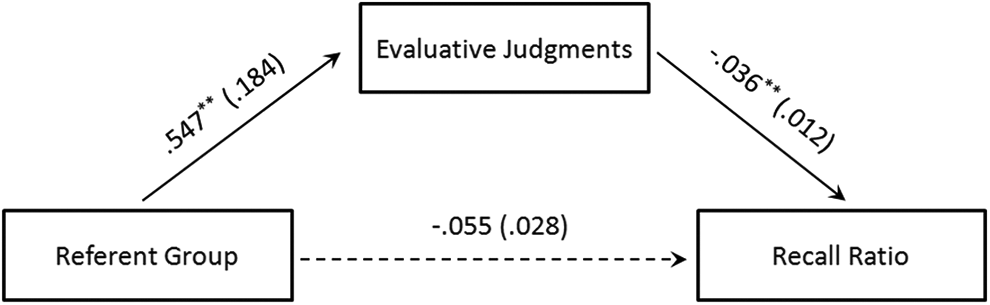
In-group favoritism (evaluative judgments) as a mediator of the relationship between referent group and recall ratio.
Trait judgments
We next tested whether participants favored the in-group over the out-group in judgments, especially for the central traits of trustworthiness and kindness (as opposed to the peripheral traits of modesty and uncomplaining). To do so, we averaged separately judgments for the two central traits (i.e., kind and trustworthy), r(161) = .27, p = .001, and the two peripheral traits (i.e., modest and uncomplaining), r(161) = .19, p = .017. 5 We then entered these two averages into a mixed ANOVA, with referent group (British vs. Andorran) as a between-subjects variable and trait type (central, peripheral) as a within-subjects variable.
The expected Referent Group × Trait Type interaction was significant, F(1, 159) = 4.33, p = .039,
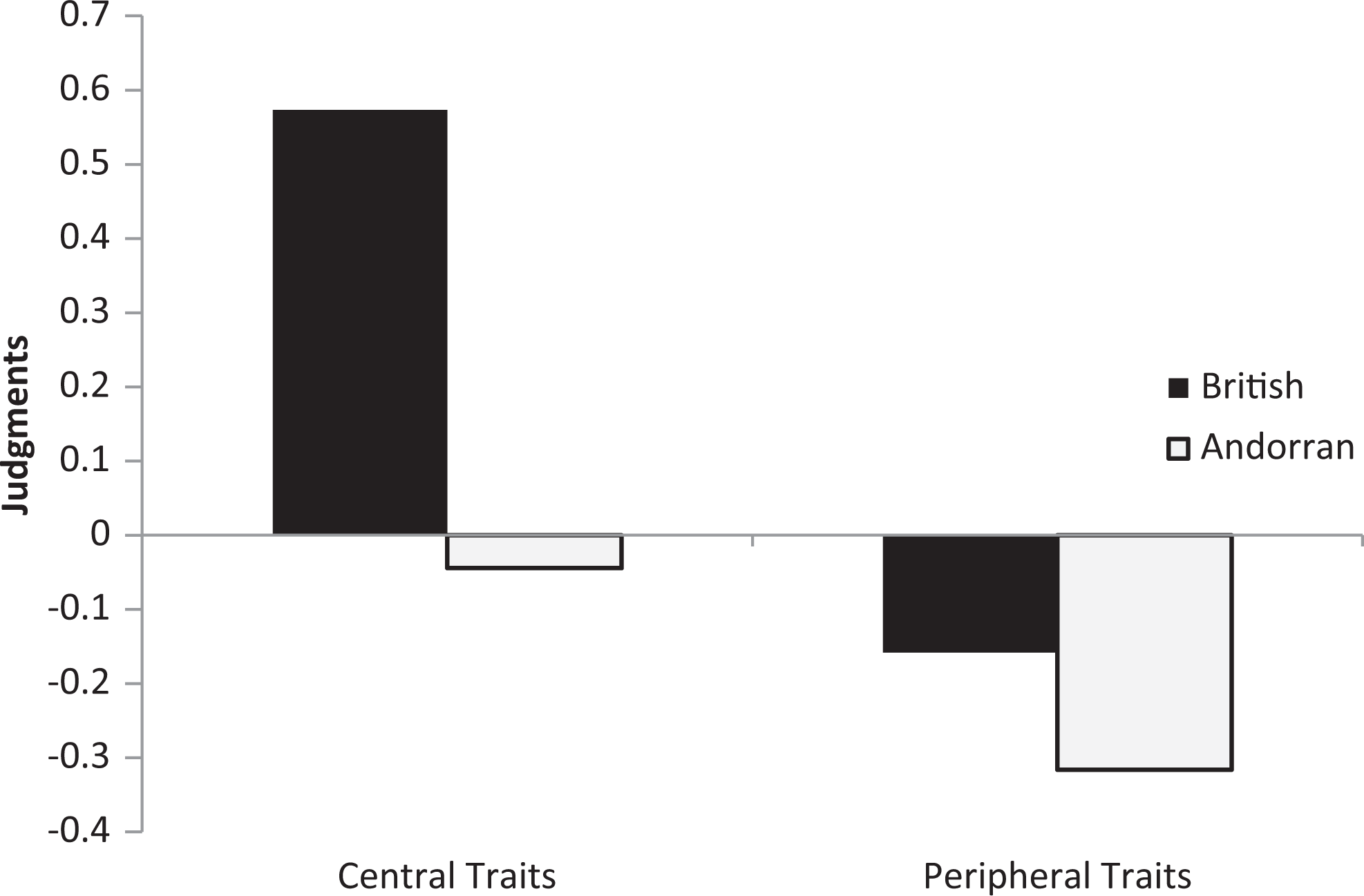
Trait judgments as a function of referent group and trait type in Experiment 2.
Two additional main effects (interpretations qualified by the interaction) emerged from the ANOVA: (a) Participants judged the groups more positively on central (M = 0.27, SD = 1.19) than on peripheral (M = −0.24, SD = 1.23) traits, F(1, 159) = 20.66, p < .001,
We also used these judgments to test again the idea that behavior recall might be driven by in-group favoritism. This should be more likely for central (than peripheral) trait judgments. We devised two mediation models, each similar to that depicted in Figure 1. One model used the central trait index as the mediator of the referent group–recall ratio relation and the other used the peripheral trait index as the mediator. Results from these mediation models suggested, in contrast to results from the mediation model using evaluative judgments, that trait judgments were not a plausible mediator of the referent group–recall ratio relation: central judgments: indirect = −.014, SE=.011, 95% CI [−.036, .003]; peripheral judgments: indirect = −.0001, SE = .003, 95% CI [−.007, .006].
Recognition
Three participants bypassed the recognition task, so the analyses of the data from this task included responses only from the remaining 161 participants. For this analysis, as in Experiment 1, we calculated a separate recognition accuracy index (i.e., the average of mean hit rates and mean correct rejection rates) for each cell of the within-subjects design. Subsequently, we entered the averages into a 2 (referent group) × 2 (trait type) × 2 (behavior valence) mixed-model ANOVA. We present means and SDs in Table 4.
Mean (Standard Deviations) for Recognition Accuracy in Experiment 2.
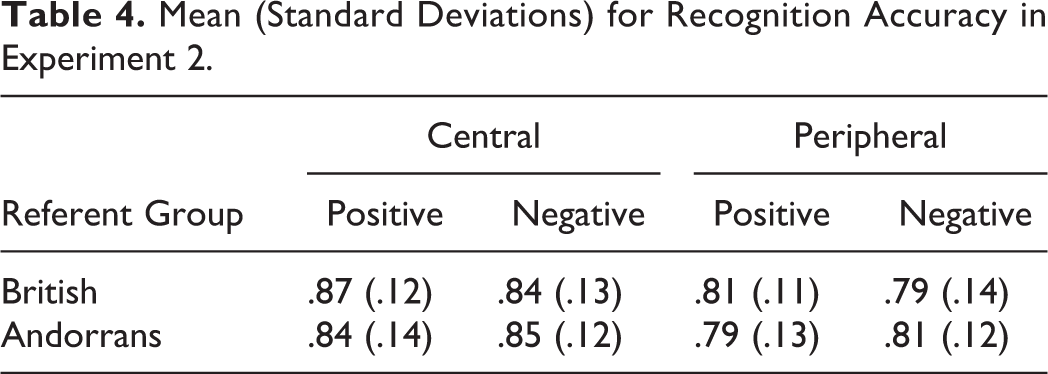
Prior research has not found MNE on recognition tasks. Congruently, the three-way interaction for the recognition data in Experiment 2 was not significant, F(1, 159) = 0.02, p = .891,
However, two significant effects emerged. Participants manifested higher recognition accuracy for central (M = 0.84, SD = 0.11) than peripheral (M = 0.80, SD = 0.11) behaviors, F(1, 159) = 37.86, p < .001,
General Discussion
In two experiments, we found that participant recall for self-central negative behaviors enacted by others can be impaired when the behaviors emanate from those who share a participant’s nationality. To illustrate the strength of this effect, in one additional ANOVA, we combined the recall data from Experiments 1 and 2. The MNE-indicative three-way interaction emerged for the combined data set and was robust: Referent Group × Trait Type × Behavior Valence interaction, F(1, 260) = 9.64, p = .002,
However, follow-up investigations are needed to delineate the boundaries of these findings and understand better their theoretical underpinnings. For example, we assumed that the same cognitive mechanisms (i.e., shallow encoding of threatening behaviors, memorial separation of threatening behaviors from the self-concept) thought to drive the MNE for self-behavior recall also apply to the social-identity driven MNE. This conclusion is supported by our Experiment 1 finding, where, as in the typical MNE paradigm, no identity-driven memory recognition deficits emerged despite the emergence of such effects in the free recall data.
However, collapsing across trait type, identity-driven recognition deficits did appear in Experiment 2. Given that this latter interaction did not emerge in Experiment 1, we suggest that it should be viewed with caution. Nonetheless, we also note that similar effects have appeared elsewhere. For example, Dalton and Huang (2013) found that social identity threat (i.e., negative identity-related feedback) impaired recognition memory for identity-relevant advertisements. For example, students who read a newspaper article about how their university was underperforming were less likely to recognize an ad offering a discount at the campus bookstore than students who read an unrelated (nonthreatening) article. Although often explained by the use of general terms such as “motivated forgetting,” such effects could reflect any of numerous specific mechanisms.
One such mechanism is grounded in the difficulties of encoding the meaning of expectancy-inconsistent behaviors: It is hard for a person to understand things that do not fit their existing knowledge. This understanding difficulty could yield an especially weak memory trace for negative in-group behaviors, which should lead both to low recognition rates and poor free recall. Another mechanism is grounded in guessing tendencies on recognition tasks. In the absence of actual recognition, people often use their expectancies to make plausible expectancy-consistent recognition guesses. Thus, if one expects a group to be positive, in the absence of any recognition memory, one might still guess that the group behaves positively. So, in the absence of recognition memory, when choosing from an array of possible reference group behaviors where one of the foils is positive, people may make a guess and choose that positive foil instead of the correct negative behavior. This choice would produce a low recognition rate for negative in-group behaviors.
These considerations point to several courses of action. First, it is important to attempt to replicate the recognition interaction effect that emerged from Experiment 2. Doing so would indicate an interesting phenomenon: The mechanisms that operate when processing information about in-group and out-group behaviors (where impairment effects on both recall and recognition measures are observed) might differ from the mechanisms that operate when processing information about the behaviors of individuals (self vs. neutral other, where an impairment effect is observed on recognition measures, but not on recall measures). If such a group target versus individual target difference occurs, then the next step would be to document mental processes operative in the intergroup case that might be absent in the single actor case. For example, signal detection tasks and analyses are designed to assess the extent to which recognition responding is affected by guessing tendencies. Hence, such tasks and analyses can be used to find out whether guessing is involved in the recognition effect observed in the intergroup case.
A second focus of new research could target the assumption that the MNE we obtained was ultimately grounded in the extent to which an individual is positive toward their nationality (as opposed to a different nationality). The assumption about high own-nationality positivity is strongly supported by prior research (Dimitriadou et al., 2019; Koomen & Bähler, 1996; Rotella & Richeson, 2013). Moreover, the hypothesis that in-group positivity could mediate the social-identity-based MNE was supported in our mediational modeling that measured group positivity via an evaluative measure. However, the mediational idea was not supported by modeling that examined whether in-group positivity as assessed via trait judgments could mediate the social-identity-based MNE. This difference may have emerged because the trait judgments are a less pure or powerful measure of in-group positivity than global evaluative judgments. Regardless, follow-up research would do well to replicate the mediational effect produced by the global evaluations and to understand better why the in-group positivity mediation effect occurred for the global evaluation judgment measure and not for the trait judgment measure.
Third and last, future work could provide convergent validity for the idea that nationality-driven identification and positivity caused the recall impairments that we found. For example, an experiment could compare the MNE effect observed in individuals who strongly identify with a positive in-group to the effect observed in those who only weakly identify with the same positive in-group. Such research could also directly measure the amount of threat posed by negative in-group behaviors, presumably showing that strong in-group identification produces both high threat from negative in-group behavior and poor memory for that behavior.
Supplemental Material
Supplemental Material, sj-docx-1-spp-10.1177_19485506211021245 - Mnemic Neglect for Behaviors Enacted by Members of One’s Nationality Group
Supplemental Material, sj-docx-1-spp-10.1177_19485506211021245 for Mnemic Neglect for Behaviors Enacted by Members of One’s Nationality Group by Bettina Zengel, John J. Skowronski, Tim Wildschut and Constantine Sedikides in Social Psychological and Personality Science
Footnotes
Declaration of Conflicting Interests
The author(s) declared no potential conflicts of interest with respect to the research, authorship, and/or publication of this article.
Funding
The author(s) received no financial support for the research, authorship, and/or publication of this article.

Supplemental Material
The supplemental material is available in the online version of the article.
Notes
References
Supplementary Material
Please find the following supplemental material available below.
For Open Access articles published under a Creative Commons License, all supplemental material carries the same license as the article it is associated with.
For non-Open Access articles published, all supplemental material carries a non-exclusive license, and permission requests for re-use of supplemental material or any part of supplemental material shall be sent directly to the copyright owner as specified in the copyright notice associated with the article.
