




Abstract
We examined whether an expected future activity (exercise vs. relaxation) impacts a present behavior (performance on an intellectual task) that occurs prior to this activity. Across two experiments (n = 320 and n = 466), the influence of expected exercise compared to relaxation on present intellectual performance was moderated by general self-efficacy (GSE)—a core personality trait that determines people’s confidence that they can surmount physically or intellectually challenging activities. Participants high in GSE had better intellectual performance when they were expecting to exercise versus relax, whereas the effect reversed under low GSE. Moderated mediation analyses suggested that task-focused attention (i.e., participants’ level of focus while solving the intellectual task) accounted for a significant proportion of variance between the future activity (exercise vs. relaxation) and present intellectual performance across different GSE levels. These findings document a previously unexplored channel through which future expectations shape present outcomes.
People spend a significant portion of their time thinking about the future, and anticipation of future actions can interfere with their present endeavors (Smallwood & Schooler, 2015). Very little, however, is known about how expectations of future activities shape seemingly unrelated present actions that are not undertaken in the service of preparing for these activities (Krpan et al., 2019). In this research, we therefore investigated whether an expected future activity impacts a present behavior that occurs prior to it. For the expected future activity, we manipulated physical exercise versus a state at the opposite end of the spectrum in terms of energetic requirements (relaxation), both because of their broad relevance and because they can serve as proxies for behaviors of varying degrees of effort (Shiraev & Barclay, 2012; Wright, 2008). For the present behavior, we focused on intellectual performance since it is representative of many everyday tasks one may pursue at work or elsewhere.
The Influence of Future Expectations on Present Actions
Although various studies examined how expected future pursuits (e.g., exercise) shape present actions undertaken in the service of these pursuits (e.g., making exercise plans; Carraro & Gaudreau, 2013), few studies tested whether anticipated future actions impact present endeavors not directly relevant to them. Krpan et al. (2019) labeled such behavioral effects “spillunders” and identified only eight research articles that examined them. For example, expecting to engage in an anxiety-inducing behavior—giving a speech—compared to control increased cookie consumption, but only for restrained eaters (Polivy et al., 1994). Despite little evidence of spillunder effects documented in the literature, Krpan et al. (2019) discussed several theoretical models (e.g., motivational intensity; Brehm & Self, 1989) based on which it is possible to speculate that such effects are more common than thought. Below, we overview these and additional theoretical accounts that, even if they do not directly tackle spillunders regarding physical activity versus relaxation, allow making predictions in this regard. As will be clarified, these accounts generate mixed predictions: Some of them suggest people will perform better on a current intellectual task if they expect to exercise versus relax, and some indicate the opposite.
For example, Brehm and Self’s (1989) motivational intensity model indicates that people’s intellectual performance may be better if they anticipate exercising (vs. relaxing) thereafter. According to this model, undertaking a challenging but feasible activity (e.g., physical exercise) should increase people’s levels of physiological energization compared to a nonchallenging task (e.g., relaxation) to allow meeting the demands of this activity (Wright, 2008). Elevated energization, however, does not occur only while people are pursuing challenging activities but also when they merely anticipate undertaking them (Wright et al., 1986). For example, when people expected undertaking a memory task, their energization levels—measured via systolic blood pressure—increased if the task was difficult versus easy (Contrada et al., 1984; Wright et al., 1986). In line with these findings, people expecting to exercise (vs. relax) may experience increased energization at present, which may in turn boost their intellectual functioning, considering that energization is linked to enhanced performance on various intellectual activities (e.g., Sevincer et al., 2014; Wright, 2008).
Several other lines of theorizing, however, indicate that intellectual performance may decrease when people anticipate exercising rather than relaxing. According to the conservation hypothesis, people have limited self-regulatory resources and therefore need to conserve these resources depending on activities they undertake throughout the day (Janssen et al., 2010; Muraven et al., 2006; Tyler & Burns, 2009). For example, expecting an effortful activity in the future (e.g., a performance test that requires remembering numbers) impaired people’s present cognitive performance (Muraven et al., 2006). In line with this rationale, when people anticipate exercising versus relaxing in the future, they may enter the resource conservation mode—a state in which their intellectual functioning is less optimal.
In another line of research, Macrae et al. (2014) showed that imagining an effortful activity (e.g., resisting appealing snacks at a party) in the near versus distant future impaired people’s present self-control in a different domain (e.g., resisting purchasing desirable products). Because activities that require exerting effort soon (vs. later) may appear more effortful given that people tend to focus on their feasibility (Trope & Liberman, 2010), this finding suggests that people anticipating an effortful (e.g., exercise) versus low-effort activity (e.g., relaxation) may experience weakened intellectual capacity. Indeed, although impaired self-control itself may not be directly relevant to intellectual performance because its primary role is resisting temptations, self-control is one of the core executive functions that is determined by the same pool of cognitive resources as directed (i.e., task-focused) attention—a process that shapes intellectual functioning (Diamond, 2013; Kaplan & Berman, 2010).
A final account that would predict lowered intellectual performance under expected exercise versus relaxation is cognitive interference (Sarason, 1984; Sarason et al., 2014). According to this account, demanding (vs. easy) physical or intellectual tasks may interfere with people’s present cognitive processing (i.e., with key executive functions that shape intellectual functioning, such as task-focused attention), which may manifest as reduced performance on intellectual tasks (Ashcraft & Kirk, 2001; Diamond, 2013; Sarason et al., 2014).
The Role of Personality: General Self-Efficacy (GSE)
Overall, the competing theoretical accounts allow mixed predictions regarding the effect of anticipating exercise versus relaxation on current intellectual performance. We therefore posit that, to postulate a hypothesis, it is necessary to identify a moderator variable that determines when intellectual functioning may be better under expected exercise and when under expected relaxation. As the most relevant moderator that may reconcile the overviewed conflicting predictions, we propose GSE—a core personality trait that determines how confident people are that they can surmount challenging tasks, from intellectual to physical (Bandura, 1982; Chen et al., 2001; Scholz et al., 2002).
GSE is associated with many psychological processes that may shape both how people perceive various physical and intellectual activities and respond to them, including optimism, self-esteem, being more emotionally stable and less susceptible to negative emotional states, believing that one can accomplish difficult tasks and face challenges, and so on (e.g., Ackerman & Wolman, 2007; Chen et al., 2001; Ebstrup et al., 2011; Judge et al., 2002, Luszczynska et al., 2005). High GSE, which is inherently compatible with difficult and challenging activities (Scholz et al., 2002), such as exercise (vs. relaxation), may therefore constitute a general propensity that makes people receptive to any potential positive effects of these activities on cognition, as anticipated by theories such as the motivational intensity model (Wright, 2008). In contrast, low GSE is incompatible with demanding tasks (Chen et al., 2001) and may thus constitute a general propensity for such tasks to activate adverse psychological processes detrimental to intellectual performance, in line with models such as cognitive interference, the resource conservation hypothesis, or the impaired self-control account (Janssen et al., 2010; Macrae et al., 2014; Sarason et al., 2014). We therefore predict the following:
We posit that GSE may be a more important moderator than specific forms of self-efficacy directed at exercise (e.g., people’s confidence to complete challenging exercises despite potential obstacles; Marcus et al., 1992) for several reasons. First, because GSE comprises positive beliefs that spread across a variety of domains rather than just one activity (e.g., exercise), being high in this trait may allow any potential positive outcomes of exercise on cognitive functioning to “spill-under” into other domains (e.g., intellectual performance). Moreover, even if people have low exercise self-efficacy for some reason (e.g., because they generally do not exercise), physical activity should not have negative consequences for their cognitive functioning if their GSE is high and they are comfortable facing challenges.
Finally, it is necessary to posit an overarching mechanism that would explain the effect of expected exercise versus relaxation on present intellectual performance as moderated by GSE. Theories we have reviewed proposed various mechanisms that may underlie this effect, from energization (Wright, 2008) to resource conservation (Tyler & Burns, 2009). The question is, however, whether there is a common denominator that underpins these and related processes and serves as the core mechanism. We propose that this mechanism is task-focused attention (i.e., the ability to focus on a task at hand and block irrelevant information), which has been identified as one of the key cognitive processes that determine intellectual performance (De Dreu et al., 2012; Engle, 2002; Shipstead et al., 2016). Importantly, all theoretical models discussed concerning Hypothesis 1 indicate that factors such as energization, resource conservation or self-regulation more generally, and cognitive interference may be associated with a change in task-focused attention (Diamond, 2013; Krpan et al., 2019). For example, whereas energization may make the person more attentive to a task (Wright, 2008), energy conservation or cognitive interference may impair their attentional capacity (Diamond, 2013; Muraven et al., 2006). In line with this rationale, any psychological benefits experienced by high self-efficacy individuals expecting to exercise (vs. relax) should be summed up in their increased ability to focus that enhances intellectual performance. In contrast, any adverse psychological effects experienced by low self-efficacy individuals expecting to exercise (vs. relax) should be reflected in their reduced ability to focus that undermines the performance. We thus predict the following:
Overview of Studies
We tested the hypotheses in two experiments where we randomly assigned people to the expected exercise versus relaxation conditions and assessed their present performance on reasoning items (Mensa, 2015). As exercise, we used high-intensity interval training (HIIT) because it is a popular and brief physical activity suitable for various contexts, including the experimental setting (Shiraev & Barclay, 2012). The experiments had identical design apart from several mediator and moderator variables (Table 1) important for understanding the mechanism behind the effects of exercise (vs. relaxation) on intellectual performance. In this regard, beyond testing Hypothesis 2, we undertook additional steps to clarify the mechanism.
First, because we speculated that GSE should be a more important moderator than domain-specific self-efficacy, in Experiment 2, we assessed situational and ordinary exercise self-efficacy (Table 1) to evaluate this assumption. To establish GSE as the core moderator, in this experiment, we also assessed other traits that are, alongside GSE, known as core self-evaluations and are closely linked to it: self-esteem, neuroticism, locus of control, and self-concept clarity (Campbell et al., 1996; Judge et al., 2002). Second, we tested additional mediators (Table 1). Although we hypothesized that task-focused attention would be the core overarching mechanism, we also examined more specific processes that were either informed by the theories we overviewed (e.g., motivational intensity; Wright, 2008) or that we found relevant concerning our research (Table 1). If the effects predicted for task-focused attention (Hypothesis 2) also apply to these processes, this would warrant a further examination to understand whether they specifically guide the attention. If, however, this is not the case, it may be plausible that expected exercise versus relaxation shapes task-focused attention via an “umbrella” of different psychological underpinnings rather than one or few dominant processes.
Key Variables Measured in Experiments (Exp.) 1 and 2.
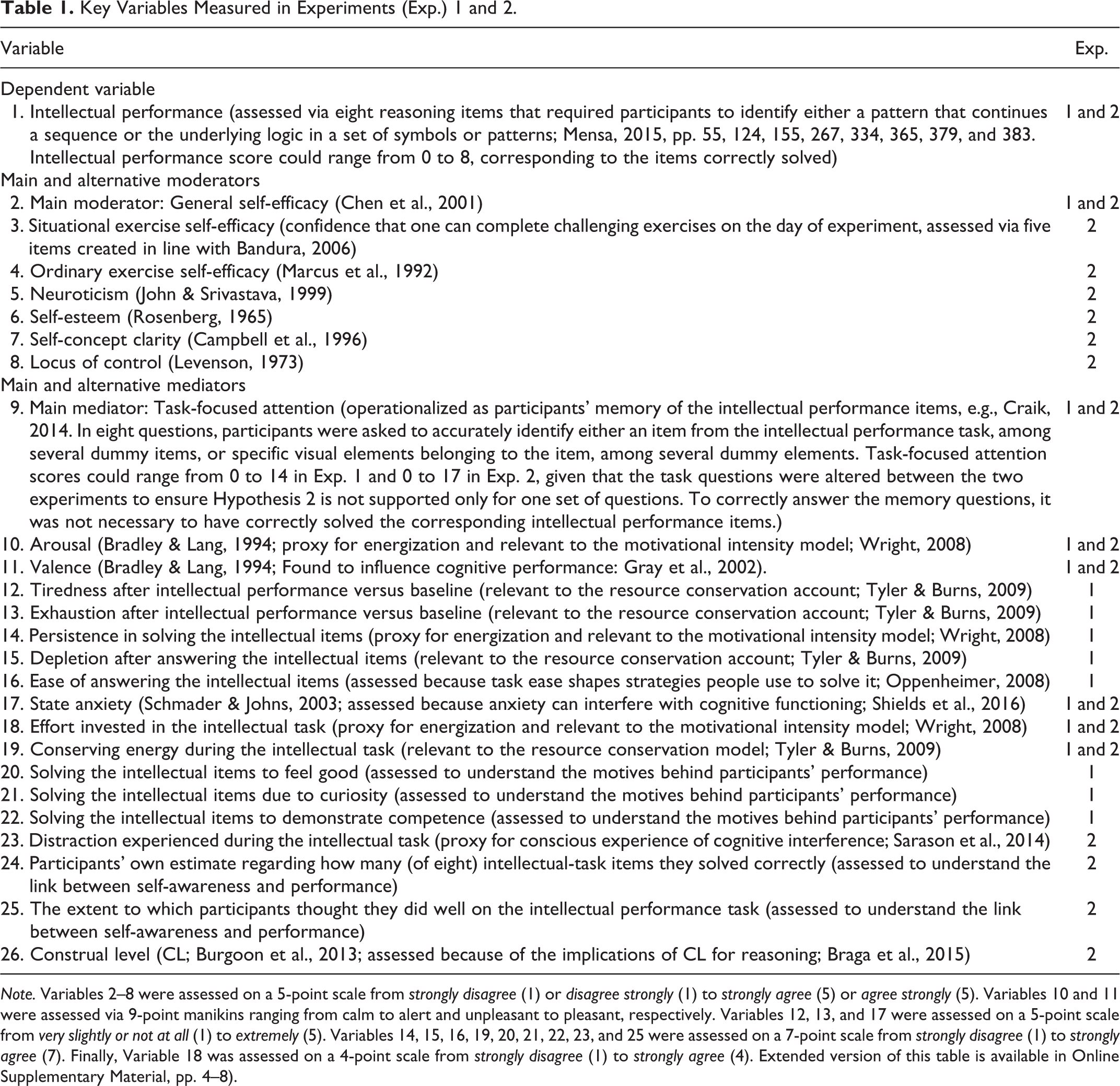
Note. Variables 2–8 were assessed on a 5-point scale from strongly disagree (1) or disagree strongly (1) to strongly agree (5) or agree strongly (5). Variables 10 and 11 were assessed via 9-point manikins ranging from calm to alert and unpleasant to pleasant, respectively. Variables 12, 13, and 17 were assessed on a 5-point scale from very slightly or not at all (1) to extremely (5). Variables 14, 15, 16, 19, 20, 21, 22, 23, and 25 were assessed on a 7-point scale from strongly disagree (1) to strongly agree (7). Finally, Variable 18 was assessed on a 4-point scale from strongly disagree (1) to strongly agree (4). Extended version of this table is available in Online Supplementary Material, pp. 4–8).
Method
Participants and Power Analyses
In Experiments 1 and 2, 334 (female = 234, male = 100, and other = 0) and 467 (female = 291, male = 176, and other = 0) participants took part, respectively. In Experiment 1, 14 participants were excluded due to a technical malfunction that prevented them from answering all critical measures (included participants: exercise, n = 161 and relaxation, n = 159). In Experiment 2, one participant was excluded from analyses because of not completing any questions measuring the dependent and mediator variables (included participants: exercise, n = 233 and relaxation, n = 233). Given that age may shape physical fitness (Hall et al., 2017), it was restricted to 18–32 years (Experiment 1) and 18–35 years (Experiment 2). In Experiment 2, the age range was slightly larger because we aimed to recruit more participants in that experiment (Supplementary Material [SM], p. 116). In both experiments, the data were analyzed only after we stopped data collection; a detailed rationale behind sample sizes is explained in SM (pp. 35, 116). Sensitivity power analyses (Faul et al., 2009) showed that, concerning the moderation predicted by Hypothesis 1, both experiments were sufficiently powered (1 – β = .80; α = .05) to capture relatively small Cohen’s f2 effects (Experiment 1 = .025; Experiment 2 = .017), assuming the cutoff of .02 (Cohen, 1988).
Procedure and Measures
The procedure and measures from both experiments are detailed in SM (pp. 9–31, 91–112). Table 1 summarizes all key variables and provides a brief rationale behind additional mediators. Covariates are presented only in SM (pp. 20–25, 102–104) due to space limitations. All experiments were conducted at the London School of Economics (LSE) Behavioral Lab. Before coming to the lab, participants were informed that the experiment might involve exercising and they would need to bring exercise gear to be eligible to participate, but only during the experiment, they would be informed whether they would need to exercise. For each participant, the experiment was conducted during a single session.
At the start of each experiment, all moderators (Table 1) and covariates (SM, pp. 4–8) were measured. Then, participants completed the consent form and were randomly allocated to either the exercise or relaxation condition and received the corresponding instructions regarding the activities (HIIT or relaxation) they would undertake at the end of experiment. For HIIT, they were told they would engage in a 7-min workout (Mattar et al., 2017) consisting of 12 intense exercises, 30 s each, with 10-s rest periods in-between. For relaxation, they were told they would relax by watching YouTube videos they find fun and easy to watch. Thereafter, we measured two alternative mediators—arousal and valence—and subsequently the dependent variable—intellectual performance (Table 1). Next, several alternative mediators were assessed. In Experiment 1, these mediators were tiredness after intellectual performance versus baseline; exhaustion after intellectual performance versus baseline; and persistence, depletion, and ease regarding solving the intellectual items; in Experiment 2, only distraction experienced during the intellectual task was assessed at this stage (Table 1). Thereafter, the main mediator—task-focused attention—was measured as outlined in Table 1.
In the end, participants received the questions probing the remaining mediators. More specifically, in both experiments, state anxiety, effort invested in the intellectual task, and conserving energy during the intellectual task were assessed. Mediators specific to Experiment 1 were solving the intellectual items due to curiosity, to feel good, and to demonstrate competence (Table 1). Mediators specific to Experiment 2 were participants’ estimate of their intellectual performance, self-perception of the intellectual task performance, and construal level (Table 1). Finally, participants undertook either HIIT or relaxation, after which they were debriefed and reimbursed.
Results
The data and analysis codes are available from the Open Science Framework: https://osf.io/zgq3h/. Zero-order correlations between all variables are available in SM (pp. 34, 115). Descriptive statistics can also be found in SM (pp. 32, 33, 113, and 114). All variables were used in the analyses in their raw format.
Main Effects
Before probing the hypotheses, we first examined the impact of condition (exercise vs. relaxation) on intellectual performance using independent samples t tests. These analyses showed that HIIT (M Experiment 1 = 4.043, M Experiment 2 = 4.039, SD Experiment 1 = 1.489, SD Experiment 2 = 1.753) and relaxation condition (M Experiment 1 = 4.126, M Experiment 2 = 4.030, SD Experiment 1 = 1.492, SD Experiment 2 = 1.820) did not differ regarding intellectual performance in either Experiment 1, t(318) = .494, p = .622, d = .055, or Experiment 2, t(464) = −.052, p = .959, d = .005.
Hypothesis 1
In each experiment, the hypothesized interactions between condition (exercise vs. relaxation) and GSE were computed using multiple linear regressions and their patterns further probed via the Johnson–Neyman technique (Hayes, 2018; Johnson & Fay, 1950; Long, 2019). As the significance criterion, α = .05 was used. Table 2 contains the output of these regressions and the Johnson–Neyman intervals for all interaction terms. This interval corresponds to the levels of the moderator below (above) which the effect of exercise (vs. relaxation) on intellectual performance was significantly negative (positive). The interactions are also depicted in Figure 1. In line with Hypothesis 1, GSE was a significant moderator in both experiments: People expecting to exercise (vs. relax) performed better (worse) on the intellectual performance task at high (low) levels of the moderator, as indicated by the Johnson–Neyman intervals (Table 2).
The Influence of the Interactions Between the Exercise Versus Relaxation Condition and General Self Efficacy (GSE) on Intellectual Performance in Experiments 1 and 2.
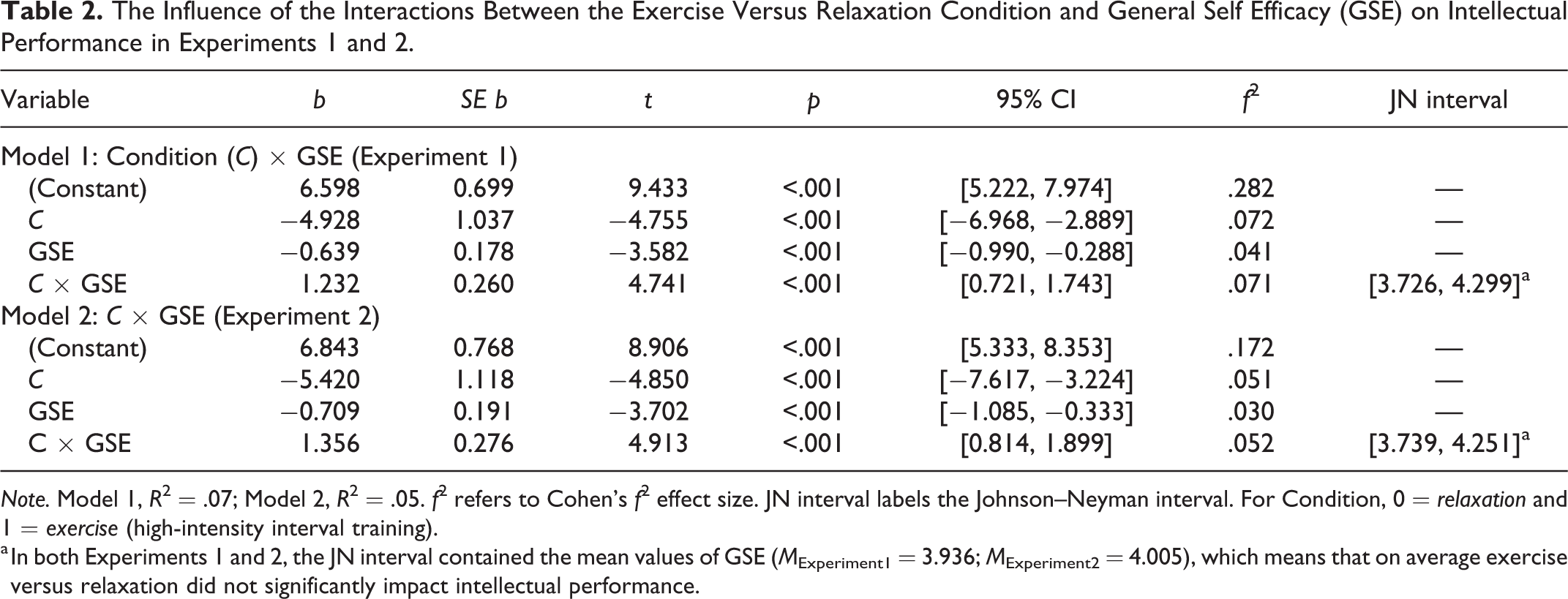
Note. Model 1, R 2 = .07; Model 2, R 2 = .05. f 2 refers to Cohen’s f 2 effect size. JN interval labels the Johnson–Neyman interval. For Condition, 0 = relaxation and 1 = exercise (high-intensity interval training).
a In both Experiments 1 and 2, the JN interval contained the mean values of GSE (M Experiment1 = 3.936; M Experiment2 = 4.005), which means that on average exercise versus relaxation did not significantly impact intellectual performance.
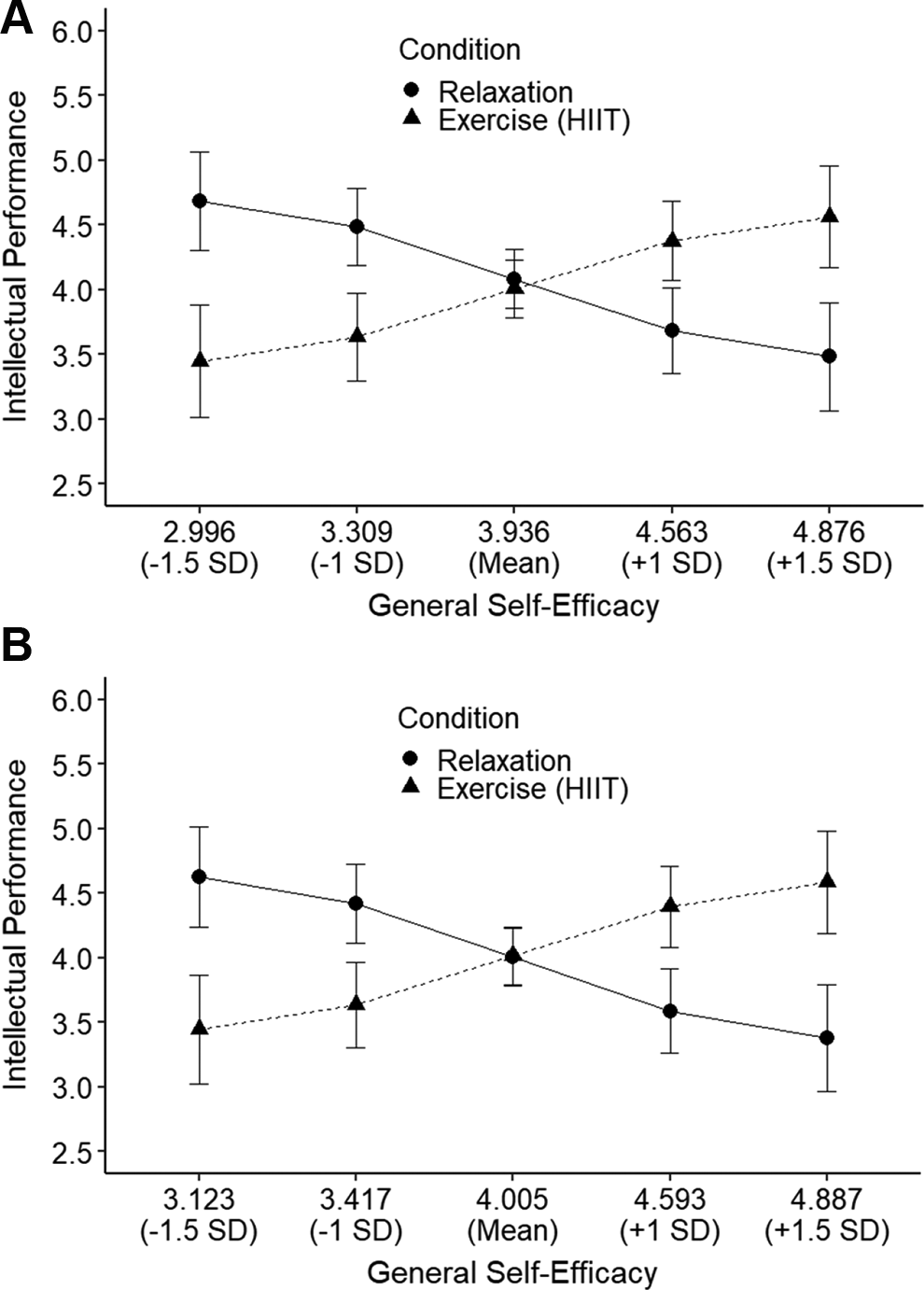
The influence of anticipated high-intensity interval training (HIIT) versus relaxation on intellectual performance at different levels of general self-efficacy (GSE) in Experiment 1 (Panel A) and Experiment 2 (Panel B). The moderator levels were selected arbitrarily for effective visualization; more detailed graphs comprising a full range of moderator values are available in Online Supplementary Material (pp. 36, 120). Y-axis corresponds to the number of intellectual performance items correctly solved (of eight). Error bars denote the 95% confidence intervals (CIs). As indicated in the figure, GSE was positively related to intellectual performance under HIIT (Experiment 1: b = .593, p = .002; 95% CI [0.221, 0.965], f 2 = .031; Experiment 2: b = .647, p = .001; 95% CI [0.257, 1.038], f 2 = .023), but negatively under relaxation (Experiment 1: b = −.639, p < .001; 95% CI [−0.990, −0.288], f 2 = .041; Experiment 2: b = −.709, p < .001; 95% CI [−1.085, −0.333], f 2 = .030). Across the entire sample, GSE was therefore not related to intellectual performance (Experiment 1: b = −.023, p = .861; 95% CI [−0.278, 0.233], f 2 < .001; Experiment 2: b = −.031, p = .824; 95% CI [−0.302, 0.240], f 2 < .001).
To probe robustness of these findings and examine whether GSE was the most important moderator, we first tested the interactions between the additional moderators (Table 1) and condition. Situational exercise self-efficacy, ordinary exercise self-efficacy, neuroticism, self-esteem, and self-concept clarity yielded significant interaction effects (all ps ≤ .016; SM, pp. 117–119). We therefore examined the interactions between condition and the additional moderators that yielded significant effects in the same regression models as the interactions between condition and GSE for comparison (SM, pp. 130–132). In all cases, the interactions involving GSE remained significant (all ps < .001), whereas the interactions involving the alternative moderators stopped being significant (all ps ≥ .114). We conducted similar analyses for covariates that were correlated with GSE—that is, the interactions between condition and these covariates were tested alongside the interactions between condition and GSE (SM, pp. 41–49, 133–136). Again, GSE remained a significant moderator in all cases (all ps < .001), whereas the interaction terms for the covariates were not significant (all ps ≥ .071). To additionally ascertain robustness of the findings, we also tested the interactions between condition and GSE while controlling for all covariates simultaneously—these interactions remained similar as in the main analyses (SM, pp. 37–40, 127–129).
Overall, Hypothesis 1 was robustly supported and GSE established as the most important moderator. Although we did not consider this in our theorizing, it is important to point out that condition changed the relationship between GSE and intellectual performance (for details, see Figure 1): In the exercise (relaxation) condition, this relationship was positive (negative).
Hypothesis 2
Hypothesis 2 was tested using a moderated mediation, computed via the Process package (Model 8; Hayes, 2018) and percentile-bootstrapped with 20,000 samples. To support the hypothesis, the analysis had to yield three effects (at p < .01 or 99% CI to minimize type I error, given that each moderated mediation involves multiple significance tests): (1) In the first multiple linear regression that constitutes the analysis and includes condition (exercise vs. relaxation), the moderator (GSE), and their interaction as predictors (Model 1), the interaction term had to significantly impact the mediator (task-focused attention); (2) in the second regression that includes the moderator, condition, their interaction, and the mediator as predictors (Model 2), the mediator had to positively predict intellectual performance; and (3) the overall index of moderated mediation that indicates whether including the mediator in Model 2 absorbs a significant portion of the variance between the Condition × Moderator interaction and intellectual performance had to be significant. Effects (1) and (2) were significant in both experiments (Table 3). Finally, the overall index of moderated mediation was significant in Experiment 1, (a 3i bi )δ = .56, 99% CI [0.24, 0.94], and Experiment 2, (a 3i bi )δ = .65, 99% CI [0.32, 1.03]. Therefore, Hypothesis 2 was supported for both experiments, and this was the case even after controlling for covariates (SM, pp. 52–55, 139–141). No other mediator variables measured in Experiments 1 and 2 were significant (SM, pp. 57–86, 142–161), thus establishing task-focused attention as the main mediator among the ones we have considered. In this regard, however, it is important to point out that the direct effect of Condition × GSE interaction on intellectual performance remained significant in both experiments (Table 3, Models 2), thus suggesting there may be additional important variables that were not identified contributing to the mechanism.
Linear Regression Models for Moderated Mediation Analyses in Experiments 1 and 2.
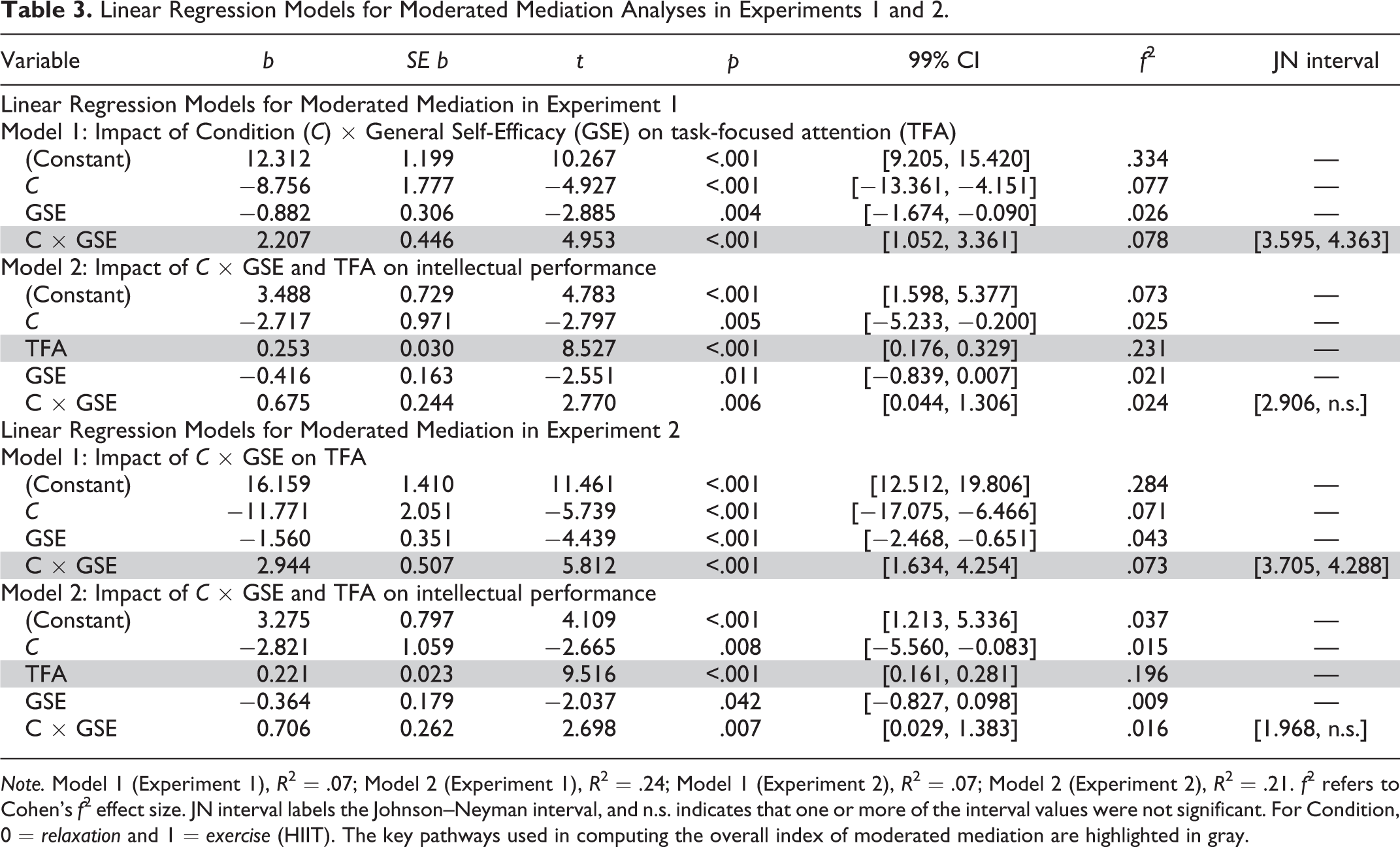
Note. Model 1 (Experiment 1), R 2 = .07; Model 2 (Experiment 1), R 2 = .24; Model 1 (Experiment 2), R 2 = .07; Model 2 (Experiment 2), R 2 = .21. f 2 refers to Cohen’s f 2 effect size. JN interval labels the Johnson–Neyman interval, and n.s. indicates that one or more of the interval values were not significant. For Condition, 0 = relaxation and 1 = exercise (HIIT). The key pathways used in computing the overall index of moderated mediation are highlighted in gray.
Given that one of the main limitations of mediation analysis in determining psychological mechanisms is that the link between a mediator and dependent variable is not causal (Fiedler et al., 2018), which implies that several different models can be fit using the same variables, we compared the main moderated mediation model in which task-focused attention was a mediator of intellectual performance with a “reverse” model in which intellectual performance was a mediator of task-focused attention. Although the overall index of moderated mediation for the main model was larger in magnitude, the alternative model also produced a significant effect (SM, pp. 86–90, 162–166). Whereas this finding is consistent with Hypothesis 2, it indicates that alternative models that can explain the mechanism also remain probable.
Discussion
In two experiments, we examined whether a high- (exercise) versus low-effort (relaxation) expected future activity influences an unrelated behavior that occurs prior to it (intellectual task performance), depending on participants’ GSE. At higher GSE levels, people solved more reasoning problems when expecting to engage in HIIT versus relaxation, whereas the effect reversed under low GSE (Hypothesis 1). Moreover, moderated mediation analyses provided insights into the mechanism behind this influence by showing that task-focused attention absorbed a significant portion of the variance between condition (HIIT vs. relaxation) × GSE interaction and intellectual performance when tested in the same regression model (Hypothesis 2). This is because high (low) GSE participants were more (less) attentive when solving the intellectual task in the HIIT versus relaxation condition and because task-focused attention positively predicted intellectual performance.
Next to the main analyses, we undertook several steps to further clarify psychological processes at play in this research. Concerning GSE, we argued that this would be the main moderator, more important than specific forms of self-efficacy or other closely linked but narrower constructs, given that GSE is associated with many processes relevant to intellectual and physical functioning (e.g., Luszczynska et al., 2005). This overarching nature of GSE may therefore make people susceptible to numerous beneficial or adverse cognitive states, depending on their score on this trait and the demands of the anticipated future activity. We indeed demonstrated that GSE was the most important moderator by analyzing it alongside exercise self-efficacy, other closely linked personality constructs such as self-esteem (Judge et al., 2002), and several covariates. To further understand psychological consequences of GSE, we also examined its correlations with various alternative moderators and covariates measured in the present research (for details, see SM, pp. 34, 115): Higher GSE was linked to a range of outcomes, including higher situational and ordinary exercise self-efficacy, increased self-esteem and self-concept clarity, higher locus of control, lower neuroticism, increased exercise motivation, positive mood, perseverance in accomplishing tasks, not being easily distracted, liking of challenges, perceiving oneself as more physically fit, or preference for challenging intellectual activities. Therefore, our assumption about GSE as a trait associated with many constructs relevant to mental and physical functioning was supported, and our findings suggest that the role of GSE in determining the effects of expected future activity on intellectual performance cannot be reduced to only one or few of these constructs.
Concerning task-focused attention, we argued that this would be the core mediator because it may comprise various psychological processes proposed by theories we used to develop Hypothesis 1 (e.g., Janssen et al., 2010; Macrae et al., 2014; Wright, 2008) and is also known to guide intellectual functioning (Diamond, 2013). In this regard, we considered two possibilities. First, the moderated effect of exercise (vs. relaxation) on intellectual performance may be mediated by both task-focused attention and more specific theoretically relevant processes, which would warrant further investigation into whether these few specific processes underpin changes in task-focused attention that alter intellectual performance. The second possibility was that expecting to exercise versus relax shapes task-focused attention via an “umbrella” of psychological underpinnings rather than one or few dominant processes. Our findings support the second explanation. Task-focused attention was the only robust mediator. Moreover, it was correlated with several alternative mediators we assessed (for details, see SM, pp. 34, 115). For example, increased task-focused attention was linked to investing more effort and conserving less energy when solving the intellectual task, feeling less anxious and being more persistent when solving the task, or feeling less distracted when solving the task. It is therefore plausible that task-focused attention comprises a range of psychological processes, none of which are dominant in accounting for its link to intellectual performance.
Contributions and Implications
The present research makes several main contributions. Most importantly, it constitutes one of the few studies that examined spillunders (Krpan et al., 2019) and offers arguably the most comprehensive and nuanced examination of the mechanisms behind such effects to date. Whereas previous research focused on domains such as food consumption or morality and generally did not provide an in-depth examination of the mechanism (Krpan et al., 2019), our focus was on the domains of physical activity and intellectual performance, and we systematically examined 18 theoretically relevant mediators and seven moderators (Table 1) to establish the most important ones. Although we conducted our studies in relation to specific activities (intense exercise, relaxation, and solving reasoning items), these activities are representative of numerous everyday behaviors. For example, exercise (relaxation) is broadly representative of any activities that involve considerable (little) effort (Wright, 2008), whereas many endeavors in which people engage concerning their work, education, or other pursuits require some form of reasoning and problem-solving (Diamond, 2013). Our research therefore suggests that low GSE individuals may be better off engaging in challenging intellectual tasks at present when the activities they expect to undertake thereafter require low rather than high effort, whereas high GSE individuals may excel under the opposite circumstances. Future research will need to examine to which specific activities this model applies and establish its boundary conditions.
Limitations
The main limitation of the present research (for additional limitations, see SM, pp. 167, 168) concerns several unresolved questions regarding the mechanism behind the spillunder effects we obtained. Our analyses indicated both that more than one mediation models were supported and that a significant proportion of the mechanism remained unexplained by task-focused attention. Future research will therefore need to probe the mechanism using a more convincing causal technique (e.g., experimental-causal-chain; Spencer et al., 2005) and explore whether there are additional important mediators next to task-focused attention we failed to identify. Moreover, although this was not considered in our theorizing, we found that, under expected exercise, GSE was positively related to intellectual performance, whereas the relationship reversed under expected relaxation. Given that literature typically links GSE with various cognitive processes that may benefit cognitive functioning (e.g., Ackerman & Wolman, 2007), it remains unclear why the relationship between GSE and intellectual performance changed depending on the expected future activity. This may be a fruitful area to explore in future research because it may provide new insights into how situational circumstances shape the relationship between GSE and behavior.
Supplemental Material
Supplemental Material, sj-docx-1-spp-10.1177_19485506211018367 - When the Future “Spills Under”: General Self-Efficacy Moderates the Influence of Expected Exercise on Present Intellectual Performance
Supplemental Material, sj-docx-1-spp-10.1177_19485506211018367 for When the Future “Spills Under”: General Self-Efficacy Moderates the Influence of Expected Exercise on Present Intellectual Performance by Dario Krpan, Matteo M. Galizzi and Paul Dolan in Social Psychological and Personality Science
Footnotes
Authors’ Note
This research has benefited from a grant by London School of Economics STICERD awarded to Paul Dolan and Dario Krpan.
Declaration of Conflicting Interests
The author(s) declared no potential conflicts of interest with respect to the research, authorship, and/or publication of this article.
Funding
The author(s) disclosed receipt of the following financial support for the research and/or authorship of this article: This work was supported by the Suntory and Toyota International Centres for Economics and Related Disciplines (STICERD), London School of Economics and Political Science.

Supplemental Material
The supplemental material is available in the online version of the article.
References
Supplementary Material
Please find the following supplemental material available below.
For Open Access articles published under a Creative Commons License, all supplemental material carries the same license as the article it is associated with.
For non-Open Access articles published, all supplemental material carries a non-exclusive license, and permission requests for re-use of supplemental material or any part of supplemental material shall be sent directly to the copyright owner as specified in the copyright notice associated with the article.
