




Abstract
Some people tend to be especially accurate about the personality impressions they make, but is meta-accuracy a consistent tendency that spans levels of acquaintanceship, or is it only observed within levels of acquaintanceship? Three studies suggested that meta-accuracy is consistent among close others but not across new acquaintances and close others. This pattern was observed for observable and unobservable traits and when accounting for people who made more consistent impressions on others (i.e., high consensus). Overall, meta-accuracy seems to be circumscribed within levels of acquaintanceship. The major implication of these results is that the mechanisms for meta-accuracy and the attributes of good meta-perceivers likely differ across levels of acquaintanceship.
An important component of interpersonal perception is understanding how other people perceive our personality (Kenny, 2019). The beliefs people have about the impressions they make, which are called meta-perceptions, tend to be somewhat accurate (Carlson & Kenny, 2012), and this accuracy tends to foster liking in new and established relationships (Carlson, 2016b; Tissera et al., 2020). But how does meta-accuracy between two people arise? Traditionally, this question has been answered by identifying cues that foster accuracy, but recent work suggests that people bring their unique tendency to be accurate with them to a given interaction (Elsaadawy et al., 2020; Mosch & Borkenau, 2016). Using the example of Morgan, who aims to figure out how Taylor sees them, Morgan’s accuracy for Taylor is partially due to how accurate they tend to be about the impressions they make on people in general. Importantly, there is meaningful variability in people’s tendencies to know the impressions they make, suggesting there are “good meta-perceivers” (Elsaadawy & Carlson, 2019). Individual differences in meta-accuracy have been observed for new acquaintances (Elsaadawy et al., 2020) and known acquaintances (Mosch & Borkenau, 2016), but the path to meta-accuracy in these contexts might differ, which begs the question: Do good meta-perceivers have a general or circumscribed tendency to be accurate? The current research aims to answer this question by testing if meta-accuracy is consistent across, or circumscribed within, the levels of acquaintanceship.
There are reasons to predict either possibility. On the one hand, it might be easier for some meta-perceivers to be consistently accurate across levels of acquaintanceship because they possess attributes that enhance meta-accuracy more generally, such as the ability to successfully monitor one’s own behavior (Elsaadawy & Carlson, 2019). It is unclear if self-knowledge of behavior is a general skill, but people with greater self-knowledge of behavior tend to be liked more (Tenney et al., 2013), an insight that might explain the robust link between meta-accuracy and being liked at various levels of acquaintanceship (Carlson, 2016b). On the other hand, the links between meta-accuracy and adjustment are inconsistent across levels of acquaintanceship, suggesting who is accurate might be contextual. Social anxiety predicts lower meta-accuracy for new acquaintances (Tissera et al., 2020), lower self-esteem and more self-reported personality problems predict higher meta-accuracy for known others (Mosch & Borkenau, 2016), and interpersonal adjustment is linked to meta-accuracy with a close other, but not a new acquaintance (Carlson, 2016a). Taken together, it is unclear if the people who are meta-accurate are the same across levels of acquaintanceship.
In the current work, we focus on a first impression and a close others context not only because past work has identified individual differences in these contexts but also because the path to meta-accuracy likely differs between them in pronounced ways. These contexts differ in level of acquaintanceship or the quantity and quality of information perceivers have when forming impressions (Funder, 1995), which in turn can shape how meta-accuracy unfolds. People have fewer opportunities to detect reliable cues with new acquaintances compared with close others. Take the example of Taylor, who has just met Morgan, versus Toni, a friend who has known Morgan for years. Taylor’s first impression is likely based on observable behaviors (e.g., talkativeness), but they do not know if this is what Morgan is generally like, and the situation might prevent them from observing cues about less visible traits (e.g., creativity). As such, Taylor fills in the gaps in their knowledge with general or personal stereotypes (e.g., positivity; Rau et al., 2019). In contrast, Toni has observed Morgan over time and, in various situations, so they have a broader range of cues about Morgan’s personality and likely rely less on stereotypes. This might explain why impressions tend to be more accurate for well-known than new acquaintances (Human et al., 2020). Given that Taylor and Toni use different cues and have different impressions of Morgan, Morgan’s path to meta-accuracy will differ for Taylor than for Toni. Morgan can safely assume that Toni sees them as they see themself or they can think back to their many interactions with Toni, but with Taylor, Morgan has to pay special attention to their behavior in a specific moment and infer what stereotypes Taylor might employ. Thus, meta-accuracy likely requires a different combination of cues across levels of acquaintanceship, suggesting a good meta-perceiver must flexibly use different strategies across a first impression and close others context.
Of course, meta-accuracy might unfold differently no matter the context because people find themselves in different situations with different people, which gives rise to unique behavior and information and, thus, unique impressions (Carlson & Furr, 2009; Funder et al., 1995). Clearly, meeting someone for the first time differs greatly from spending time with a close friend (e.g., different settings, activities, and topics of conversation). That said, these differences also emerge among close others because people have unique dynamics with different friends and families. Indeed, situations are more variable across close others than the first impressions that take place in the lab. As such, we also test the consistency of meta-accuracy across two close others, which reflects unique situations within the same context.
Being consistently accurate across two people, regardless of the level of acquaintanceship, might be especially difficult because the unique dynamic between two people influences accuracy as much as a person’s general tendency to be accurate does (Elsaadawy et al., 2020). That is, Morgan might have a general tendency to be accurate about others’ impressions of them, but something unique about Morgan’s interaction with Taylor can influence accuracy with Taylor just as much as Morgan’s general tendency can. Such an effect might make it difficult to observe consistency across a first impression and close others context if both contexts are strongly influenced by dyadic factors. 1 Further, people seem to be much more aware of their reputation in a context than of the unique impressions they make on specific people (Carlson & Kenny, 2012). This insight might be one of the reasons why people’s overall accuracy in a context predicts their accuracy with a specific person—good meta-perceivers might just know their reputation. To rule out the possibility that the consistency of meta-accuracy across levels of acquaintanceship is overshadowed by dyadic effects, we also test if people who are aware of their reputation among new acquaintances are aware of their reputation among close others.
Does Trait Observability Influence the Consistency of Meta-Accuracy?
Meta-accuracy might be consistent across levels of acquaintanceship for only certain types of traits. According to the Realistic Accuracy Model, the traits that people tend to be more accurate about are the ones that are more available, easier to detect, or easier to interpret (Funder, 1995). In general, traits higher in observability (e.g., extroversion) are easier for perceivers to judge than internal traits that are lower in observability (e.g., neuroticism; Funder & Dobroth, 1987). Likewise, impressions of observable traits seem to be easier for meta-perceivers to detect, potentially because one of the routes to meta-accuracy is self-perception of behavior (Carlson & Kenny, 2012). For example, Taylor is accurate about Morgan’s observable traits and Morgan knows what Taylor thinks about their observable traits because both individuals are using similar cues (Morgan’s behavior). This difference in accuracy between observable and unobservable traits is more pronounced among new acquaintances than well-known others. For example, first impression accuracy is often limited to observable traits due to the dearth of information about internal traits (Colvin & Funder, 1991), but people form accurate impressions about well-known others for a wider range of traits (Biesanz et al., 2007), likely because well-known others make more cues available for both observable and unobservable traits. Similarly, the difference in meta-accuracy for observable versus unobservable traits is larger with new acquaintances than with close others (Carlson & Kenny, 2012). Given that people tend to be more consistently transparent across levels of acquaintanceship for observable than unobservable traits (Human et al., 2020), meta-perceivers might be consistently accurate about observable traits across levels of acquaintanceship because they can use the same strategy (e.g., paying attention to their behavior). In contrast, it might be more difficult for meta-perceivers to be consistently accurate about unobservable traits across levels of acquaintanceship because they might have to employ different strategies with new acquaintances versus close others. As such, we test if the consistency of meta-accuracy across and within levels of acquaintanceship is limited to, or is stronger for, observable traits.
Are Good Meta-Perceivers Seen in Consistent Ways?
So far, we have assumed that the paths to meta-accuracy differ with new acquaintances and close others, such that a general good meta-perceiver must successfully navigate different paths to accuracy. However, some good meta-perceivers might be consistently accurate because they make and realize they make consistent impressions across levels of acquaintanceship. In general, people have a tendency to think they are seen in consistent ways (Kenny & DePaulo, 1993); thus, people who are actually seen in consistent ways might be consistently more meta-accurate across levels of acquaintanceship. This tendency might also result in people being more consistently meta-accurate within one level of acquaintanceship where they are seen in more consistent ways compared to across levels of acquaintanceship. As such, we test if consensus, or the consistency of the impressions someone has made on others, influences the consistency of meta-accuracy across new acquaintances and close others, and among close others.
One way that consensus might explain the good meta-perceiver is that some people are seen as they see themselves more than others are by new and close acquaintances (Human et al., 2020); that is, the impressions that some people make across levels of acquaintanceship might be especially consistent because they align with the meta-perceiver’s self-views. Given that people tend to rely heavily on their self-perceptions to form meta-perceptions (Kenny & DePaulo, 1993), the people who are actually seen as they see themselves across levels of acquaintanceship should be more meta-accurate across levels of acquaintanceship. To test the degree to which self-perceptions explain consistency in meta-accuracy, we examine the degree to which people’s insight into how they are seen independently from how they see themselves (i.e., meta-insight; Carlson et al., 2011) is consistent across levels of acquaintanceship. If meta-accuracy but not meta-insight is consistent across levels of acquaintanceship, then good meta-perceivers are consistently more accurate across levels of acquaintanceship because they are consistently seen more in line with their self-perceptions. We also test if meta-insight is consistent among close others given that people are seen in line with how they see themselves among close others (Vazire & Carlson, 2010). Taken together, we test if people are consistently more (or less) aware of the impressions they make across levels of acquaintanceship and among their close others because they accurately rely on their self-perceptions.
Research Overview
Are good meta-perceivers consistently more aware than others are of the impressions they make across levels of acquaintanceship? Using data from three studies, we tested (a) the consistency of meta-accuracy across new acquaintances and close others, (b) the consistency of meta-accuracy among close others, (c) if consistency is influenced by trait observability, and (d) if consistency is explained by consensus or self-other agreement.
All analyses were exploratory, and the current samples were collected with other research questions in mind. See https://osf.io/dg4w6/ for data, R code, study materials, and supplemental results. Correlations larger than r = .21 will be considered meaningful, which is a conservative effect size of interest based on the typical effect size in social and personality psychology (Funder et al., 2014). For the interaction model proposed for the role of consensus, we assumed a small to medium effect (f 2 = .08) would be meaningful.
Methods
Participants
Main participants 2 (Sample 1, N = 199; Sample 2, N = 192; Sample 3, N = 207; 61% female; M age = 19.74, SD = 1.16; 62% White, 24% Asian American, 11% Black or African American, 2% Latin American or Hispanic, 1% “other”) were undergraduate students at a Mid-western university and were paid $20 or received course credit. Close others were not paid for their participation: Sample 1, N = 505 (M per participant = 2.20; 57% friends, 31% family members, 9% romantic partners, 3% other); Sample 2, N = 1,176 (M per participant = 2.78; 49% friends, 22% family members, 7% romantic partners, 22% other); Sample 3, N = 619 (M per participant = 2.95; 74% friends, 8% family members, 7% romantic partners, 11% other).
Measures
Participants reported impressions, meta-perceptions, and self-perceptions for the 44-item Big Five Inventory (BFI; John & Srivastava, 1999) on a 1 (strongly disagree) to 7 (strongly agree) scale in Sample 1, for a subset of 17 items of the BFI on a 1 (strongly disagree) to 15 (strongly agree) scale in Sample 2, and for the Ten-Item Personality Inventory (TIPI; Gosling et al., 2003) on a 1 (strongly disagree) to 15 (strongly agree) scale in Sample 3. In Samples 1 and 2, participants provided meta-perceptions for specific people, but in Sample 3, participants provided beliefs about their reputation (i.e., meta-reputation).
Procedures
In Samples 1 and 2, participants came to the lab in unacquainted pairs, completed a battery of questionnaires, one of which was a self-report of the BFI, and then engaged in a 5-min, unstructured interaction with their new acquaintance. Participants discussed whatever topics they wished, afterward, rated each other’s personality, and provided meta-perceptions on the BFI in separate rooms. In Sample 3, participants had a leaderless group discussion with five to six unacquainted others (M group size = 3.35) and, afterward, rated each member’s personality and reported their meta-reputation for the group on the TIPI.
In all three samples, following the first impression activity, participants nominated close others to describe their personality. In Samples 1 and 2, participants guessed how each close other would rate them, and in Sample 3, participants reported their meta-reputation among people who know them well. Close others provided their impressions of the participant using an online questionnaire.
Analyses
We utilized a profile-based approach to meta-accuracy, which indexes the association between an individual’s meta-perception across the big five (e.g., Morgan’s beliefs about how Taylor sees them) and the impression that person made across the same traits (e.g., Taylor’s impression of Morgan). This reveals the degree to which an individual knows how someone perceived their characteristic pattern of traits (e.g., Does Morgan know that Taylor sees Morgan as more kind than outgoing or creative?). Profile-based meta-accuracy was indexed using multilevel modeling, specifically the lme4 package (Bates & Sarker, 2007) in R version 3.5.0. Level 1 was profile items, and Level 2 slopes indexed accuracy effects for the typical person. In the first impression contexts of Samples 1 and 2, effects were nested within dyads to account for the dyadic nature of the ratings.
Agreement between any two personality profiles is often above chance because both contain information about the average person (i.e., normative agreement), which is comprised of an unknown combination of genuine insight into the normative impression and a statistical artifact (Wood & Furr, 2016). To ensure our index of meta-accuracy reflects genuine insight into the impression one makes, we focus on distinctive meta-accuracy or the degree to which people know how they are seen distinctly from the average person. To do so, a given person’s meta-perception on an item was predicted by the average impression across all perceivers on that item (i.e., the normative impression) and a given perceiver’s distinctive impression (i.e., impression centered on the average impression). Both predictors were grand-mean centered. This approach statistically disentangled normativity (i.e., accuracy due to agreement about the typical person) from distinctive meta-accuracy (i.e., accuracy about what makes the self distinctive from the average person in a perceiver’s eyes). For simplicity, we refer to distinctive meta-accuracy as meta-accuracy. Meta-insight was modeled in a separate model by adding meta-perceivers’ grand-mean centered self-perception profiles as a third predictor. The association between meta-perception and distinctive impression profiles indexes distinctive meta-insight, or the degree to which a meta-perceiver is aware of how a perceiver sees their distinctive characteristics differently from how they see themselves. We refer to this index as meta-insight.
Consistency across and within levels of acquaintanceship
To obtain meta-accuracy scores for each participant in each context, we exported the Empirical Bayes estimates of the Level 2 slopes from the above models. We then correlated these scores across new acquaintances and close others or across close others. For the New Acquaintance × Close Others test, only participants who interacted with a new acquaintance in the lab and had at least one close other were included (Sample 1, N = 190; Sample 2, N = 141; Sample 3, N = 186), and for the Close Other × Close Other test, only participants who had at least two close others were included (Sample 1, N = 188; Sample 2, N = 147). In Samples 1 and 2, most participants had more than one close other which made it unclear which close other to include. Thus, correlations in these samples were the average of 10,000 samples of randomly chosen close others for each participant. Notably, all reported effects showed the same pattern when we limited close others to specific types (e.g., family, friends; see Table S1 in Supplemental Online Material [SOM]).
Trait observability
Using Samples 1 and 2, 12 independent coders (ICC2 = .85) rated the observability of each BFI item on a scale of 1(not observable) to 7 (observable). We split the coders’ mean observability ratings into quartiles and categorized items that fell into the top 25% of ratings as high in observability and items that fell into the bottom 25% of ratings as low in observability. As shown in the SOM (Table S2), the low observability items were largely neuroticism and openness, and the high observability items were largely extraversion. Indeed, reported effects were the same when we limited low observability to just openness and neuroticism and high observability to just extroversion (see Table S3 in SOM). Next, we ran the meta-accuracy and meta-insight models on the items labeled as high or low observability independently and exported the scores from those models (e.g., Human et al., 2020). To test if the consistency of meta-accuracy varied based on trait observability, we correlated meta-perceivers’ meta-accuracy scores across new acquaintances and close others, as well as among close others, separately for high observability and low observability traits. We were unable to use this approach in Sample 3 because it included 10 items and there would be too few items in the top or bottom 25% for a reliable profile analysis.
Consensus
To test whether people who made more consistent distinctive impressions had more consistent meta-accuracy, we computed consensus scores for each person and included these scores as moderators of consistency. We set up two multilevel models in which the distinctive impressions participants made on a close other were a predictor of the distinctive impressions they made on (1) the new lab acquaintance and (2) another close other. We exported the Empirical Bayes estimates of the Level 2 slopes from these models to obtain a New Acquaintance × Close Other or Close Other × Close Other consensus score for each participant, respectively. Then, we conducted a hierarchical multiple regression analysis that included, in Step 1, grand-mean centered close other meta-accuracy and New Acquaintance × Close Other (or Close Other × Close Other) consensus as predictors of first impression meta-accuracy (or close other meta-accuracy) and in Step 2, the interaction term between the two predictors.
Results
Table 1 shows the overall levels of meta-accuracy and meta-insight in each sample. In Samples 1 and 2, participants were aware of the distinct impressions they made and of how they were seen differently from how they saw themselves with new acquaintances and with close others on the full range of traits and for traits high and low in observability. In Sample 3, participants were aware of their distinct reputations and how their reputations differed from their self-perceptions with new acquaintances and with close others on the full range of traits and for traits high or low in observability. Meta-accuracy was descriptively higher in Sample 3 than in Samples 1 and 2, which is in line with the expectation that it is easier to perceive one’s reputation than the unique way in which one is seen by an individual. Meta-accuracy was also higher for close others than for first impressions, which is in line with past work (e.g., Carlson, 2016b).
Meta-Accuracy and Meta-Insight Among New Acquaintances and Close Others.
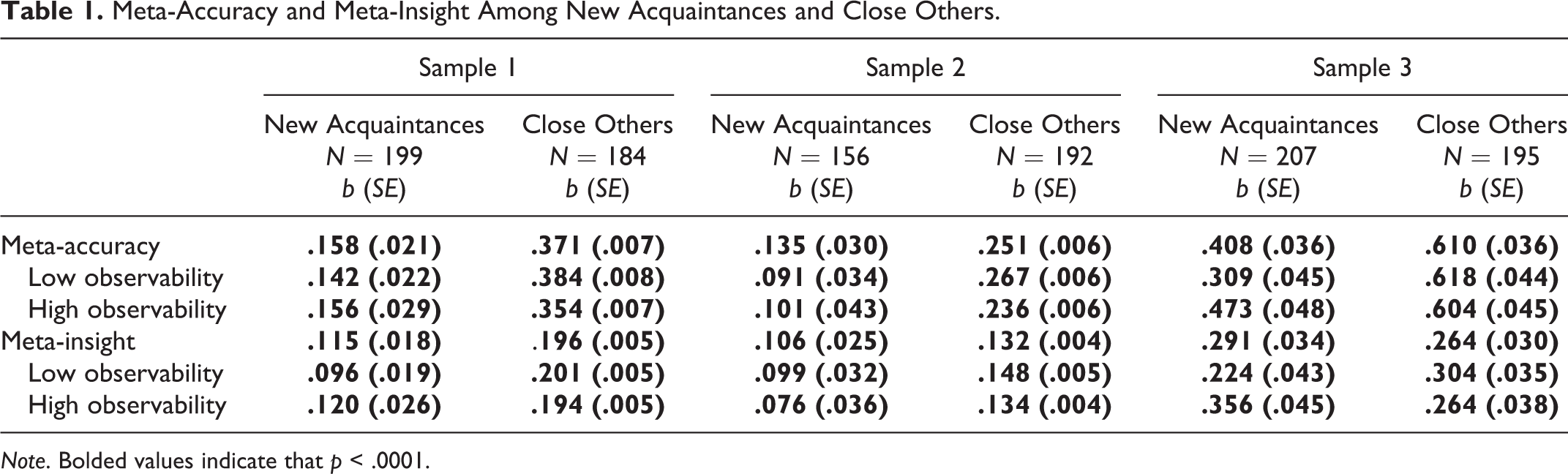
Note. Bolded values indicate that p < .0001.
We explored the distribution of meta-accuracy scores to rule out the possibility that the meta-accuracy correlation between levels of acquaintanceship is attenuated by different distributions (e.g., positive and negative skew). The meta-accuracy and meta-insight scores were largely normally distributed for new acquaintances. For close others, there were a few deviations from normality, but none were extreme (|skew| < 1). See Table S4 in the SOM for distribution figures. Conceptually, these distributions also mean that it was not the case that in a first impression, only a few people were especially accurate, or that among close others, most people were very accurate and only a few outliers were especially inaccurate.
Consistency Across Levels of Acquaintanceship
In all three samples, participants who were more accurate about a new acquaintance were not necessarily more accurate about a close other, demonstrated by the small, nonsignificant meta-accuracy correlations (Table 2). The only exception was for Sample 1, but the correlation was weak (r = .074). This lack of consistency was observed when we limited accuracy to traits high or low in observability (Table 2). Thus, people who were more aware of the impression they made on observable traits with a new acquaintance were not necessarily more aware of the impression they made on observable traits with a close other, and the same was true for traits low in observability.
Meta-Accuracy and Meta-Insight Correlations Across New Acquaintances and Close Others, and Among Close Others.
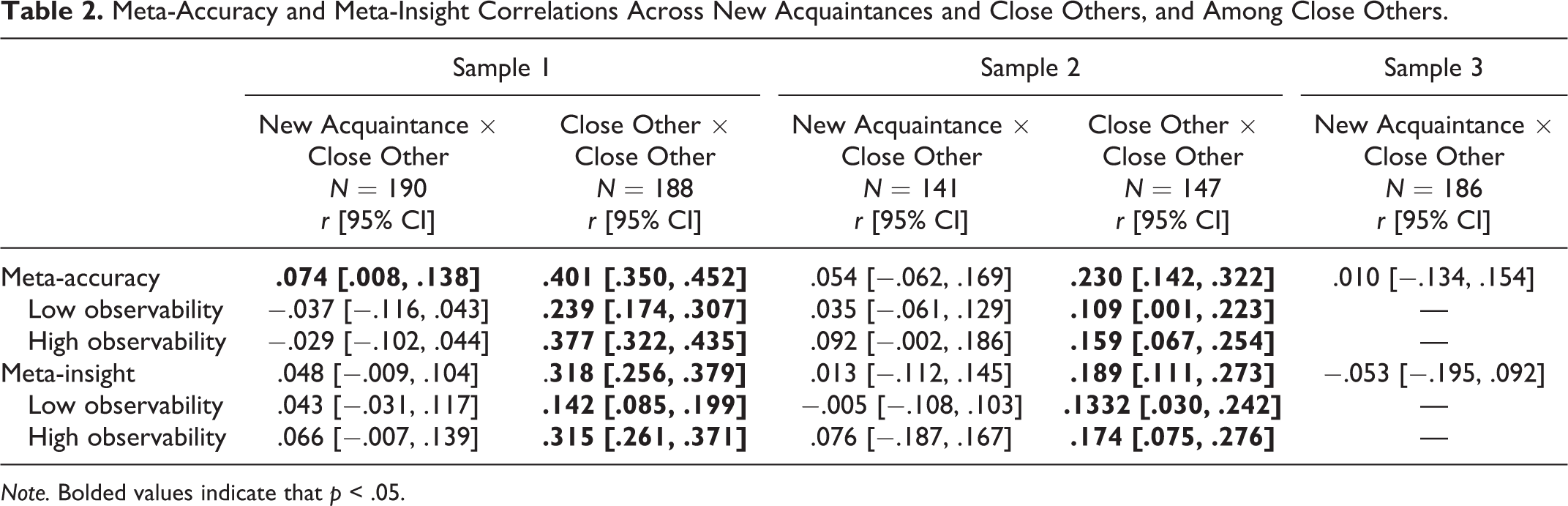
Note. Bolded values indicate that p < .05.
Likewise, meta-accuracy was not consistent even for people with higher levels of consensus across new acquaintances and close others. Consensus between new acquaintances and close others was weak in all three samples (M consensus: Sample 1 = .079, Sample 2 = .038, Sample 3=.127) and did not moderate consistency across levels of acquaintanceship (Sample 1: b = .031, SE = .466, p = .948; Sample 2: b = .198, SE = .293, p = .500; Sample 3: b = .773, SE = .502, p = .125), suggesting that people with higher consensus between a new and a close other did not necessarily have stronger meta-accuracy consistency. Given that consistency in meta-accuracy was not observed, we do not interpret meta-insight effects, but as shown in Table 2, meta-insight effects mirrored the null effects for meta-accuracy.
Consistency Among Close Others
Participants who were more accurate about one close other tended to be more accurate about another close other (Table 2). These effects were moderate (r = .10–.21) to meaningful (r > .21) in size and were observed for the full range of traits, as well as for traits high and low in observability, suggesting that there were good meta-perceivers who were consistently accurate among close others.
There was consensus among close others (M consensus: Sample 1 = .336; Sample 2 = .245), suggesting that people made somewhat consistent impressions on different close others. However, consensus did not moderate the consistency of meta-accuracy (Sample 1: b = .518, SE = .292, p = .079; Sample 2: b = .378, SE = .670, p = .575), suggesting that meta-perceivers tended to be consistently accurate among close others for reasons other than making consistent impressions or relying on their reputation.
The consistency of meta-insight for close others was also moderate to meaningful in size for the full range of traits and for traits high and low in observability (Table 2), suggesting that participants knew how they were seen distinctly from their self-perceptions by different close others to a consistent degree.
Normativity and Transparency
Although not the focus of the current work, we found that unlike meta-accuracy, normativity and transparency were consistent among close others and across levels of acquaintanceship, suggesting that perhaps the way people form meta-perceptions for new acquaintances and close others is consistent even though their accuracy is not (see Tables S5 and S6 in SOM). Participants who tended to assume that they were seen more similar to the average person (normativity) with a new acquaintance tended to do the same with close others (r = .287–.514), an effect that was also observed among close others (r = .216–.623). Likewise, participants who tended to assume that they were seen similar to how they see themselves (transparency) with new acquaintances tended to assume the same with close others (r = .012–.210), an effect that was also observed among close others (r = .477–.497).
General Discussion
Meta-accuracy seems to be an individual difference that spans individuals within a close other context but not necessarily levels of acquaintanceship. People who tended to be more accurate about one close other tended to be more accurate about another close other, but the same was not observed between a new acquaintance and a close other. This boundary condition suggests that meta-accuracy unfolds differently across levels of acquaintanceship, and different attributes, skills, and abilities are required to discern the impressions we make with new acquaintances versus close others. Indeed, this boundary suggests that meta-accuracy effects likely will not generalize across levels of acquaintanceship and might explain the inconsistent psychological correlates of meta-accuracy.
Why was meta-accuracy not consistent across levels of acquaintanceship? We were unable to identify the specific mechanism for null effects, but we were able to rule out four possibilities. First, perhaps it was unreasonable to expect meta-accuracy beyond observable traits in first impression. Indeed, meta-perceivers might only be accurate about observable traits with new acquaintances but accurate about the full range of traits with close others. If so, meta-accuracy across levels of acquaintanceship might reflect different constructs. We ruled out this possibility by demonstrating that (a) meta-accuracy was observed for both high and low observable traits with new acquaintances and (b) meta-accuracy for only observable (and unobservable) traits was not associated across levels of acquaintanceship. Second, given that people tend to think that they are seen in consistent ways (Kenny & DePaulo, 1993), perhaps only people who actually make consistent impressions are consistently meta-accurate across levels of acquaintanceship. However, consensus did not moderate consistency in meta-accuracy, suggesting that even the people who made more consistent impressions were not more consistently accurate. Third, meta-accuracy might be largely dyadic which would make it difficult for any two accuracy scores to correlate. We ruled out this possibility by demonstrating that accuracy about one’s reputation, which is not a dyadic process, was also not consistent across levels of acquaintanceship. We also analyzed 10,000 iterations of pairings between meta-accuracy with a new acquaintance and meta-accuracy with different close others, ruling out the possibility that we got unlucky with certain pairings across levels of acquaintanceship. Finally, meta-accuracy was consistent among close others, suggesting that an individual’s meta-accuracy for one person can predict their meta-accuracy for a different person, it just depends on who that person is. Fourth, it was possible that the distributions of meta-accuracy scores were quite different across levels of acquaintanceship such that the distribution was skewed for new acquaintances (e.g., most people were inaccurate with few exceptions) but normal for close others. We ruled out this possibility that the null correlations were due to extreme skewness because, on average, people had insight into the impressions they made, and the distributions were largely normal for new acquaintances and close others. Taken together, it is unlikely that the null correlations observed across levels of acquaintanceship in the current work reflect false negatives.
Future research is needed to identify where the boundary for consistency in meta-accuracy begins. For example, consistency might be high between any liked acquaintances (e.g., across friends and family) but low between liked and neutral or disliked acquaintances (e.g., across friends and coworkers). Notably, people who were more accurate about one close other were more accurate about another close other using information other than their self-perception, positivity, or reputation. This suggests that good meta-perceivers of close others did not simply have an easier task because they made consistent or good impressions on others; rather, they effectively used feedback or self-observation of behavior to infer how others saw them. Thus, the boundary for meta-accuracy consistency might be found by studying these two processes.
Our conclusion that meta-accuracy is circumscribed might mean that the processes that give rise to meta-accuracy are context-specific and, thus, the attributes, skills, or abilities that foster meta-accuracy likely differ across levels of acquaintanceship. As such, researchers should focus on identifying the context-specific attributes that influence meta-accuracy. For example, it is possible that being a good meta-perceiver with new acquaintances requires having insight into one’s interaction-specific behavior. In contrast, being a good meta-perceiver with close others might require awareness and acceptance of feedback from close others. Such differences might explain existing mixed results for the correlates of meta-accuracy across levels of acquaintanceship. One way to shed light on which attributes, skills, or abilities might foster meta-accuracy in each context would be to examine the nomological networks of meta-accuracy in each context.
Finally, we focused on level of acquaintanceship and trait observability and believe that these are among the most relevant factors in meta-accuracy, but there are certainly other factors in acquaintanceship (e.g., liking vs. knowing) and traits (e.g., desirability, centrality) that we have not addressed. As such, our conclusions are specific to these factors, and future work is needed to explore the consistency of meta-accuracy across other contextual factors and whether the consistency of meta-accuracy is influenced by other trait factors.
Footnotes
Declaration of Conflicting Interests
The author(s) declared no potential conflicts of interest with respect to the research, authorship, and/or publication of this article.
Funding
The author(s) disclosed receipt of the following financial support for the research, authorship, and/or publication of this article: This research was supported by a grant from the Wake Forest University Character Project funded by The John Templeton Foundation and a National Science Foundation grant (#BCS-1125553). Preparation of this manuscript was supported in part by a Social Sciences and Humanities Research Council (SSHRC) Insight Grant (#435150611) to Erika N. Carlson and by a Joseph-Armand Bombardier CGS-D scholarship to Norhan Elsaadawy.

Notes
Author Biographies
Handling Editor: Peter Rentfrow