




Abstract
In the Western world, gender/sex is traditionally viewed as binary, with people falling into one of two categories: male or female. This view of gender/sex has started to change, triggering some resistance. This research investigates psychological mechanisms underlying that resistance. Study 1 (N = 489, UK) explored the role of individual gender identification in defense of, and attempts to reinforce, the gender/sex binary. Study 2 (N = 415, Sweden) further considered the role of individual differences in need for closure. Both gender identification and need for closure were associated with binary views of gender/sex, prejudice against nonbinary people, and opposition to the use of gender-neutral pronouns. Policies that aim to abolish gender/sex categories, but not policies that advocate for a third gender/sex category, were seen as particularly unfair among people high in gender identification. These findings are an important step in understanding the psychology of resistance to change around binary systems of gender/sex.
In the Western world, gender is traditionally viewed as binary and following from biological sex. This system of belief is referred to as the gender/sex 1 binary. Recently, these views have been challenged by a variety of individual and cultural changes including the implementation of gender-inclusive language and gender-neutral pronouns such as “they” (Boylan, 2018), official state policies recognizing a third sex (e.g., in Germany; Eddy & Bennett, 2017), and visibility of individuals with expressions of gender/sex that fall outside the binary (Steinmetz, 2014). At the same time, these changes have been met with strong resistance (Korolczuk & Graff, 2018; Milan, 2016; Vergoossen et al., 2020). In this article, we investigate some of the psychological mechanisms underlying this resistance.
The Gender/Sex Binary
The gender/sex binary refers to the belief that sex is binary and directly determines gender (Hyde et al., 2019). In this context, “sex” refers to the biological makeup of an individual (e.g., chromosomes, anatomy), while “gender” can refer to associated roles (i.e., what it means to be a woman or a man in a specific culture) or self-identity (i.e., self-categorization into “women” and “men”; American Psychological Association, 2018; Wood & Eagly, 2015). Importantly, these binary views are socially consequential. The gender/sex binary is not only descriptive (i.e., describing what sexes and genders exist and how these two concepts are related) but also prescriptive and proscriptive (i.e., dictating which genders and sexes should or should not exist and how they should or should not be related). In other words, binary thinking about gender/sex enforces a social system in which individuals with two X chromosomes are expected to develop female bodies, identify as women, and act in line with feminine stereotypes, while individuals with an X and a Y chromosome develop male bodies, identify as men, and act in line with masculine stereotypes (see Butler, 1990; Morgenroth & Ryan, 2020). Individuals who violate these expectations, such as lesbian, gay, bisexual, transgender and queer (LGBTQ+) individuals as well as and men and women who violate gender norms, are often harshly punished (Katz-Wise & Hyde, 2012; Moss-Racusin et al., 2010; Rudman et al., 2012).
Different strategies have been suggested to combat these harmful effects. Among these are suggestions to implement policies and practices that actively challenge binary views of gender/sex through either de-gendering or multi-gendering (Morgenroth & Ryan, 2020). De-gendering refers to policies and practices that aim to remove or minimize the gender/sex division and salience of gender/sex (e.g., the removal of gender/sex on official documents or replacing “he or she” with “they”). Multi-gendering strategies aim to draw attention to the fact that gender/sex is not binary (e.g., legally recognizing a third gender/sex or introducing new pronouns such as “ze” to refer to nonbinary individuals). It is unclear which strategy may be more effective in changing binary views of gender/sex and which may trigger stronger resistance. On the one hand, removing gendered cues (i.e., de-gendering) may prompt individuals to think less about gender/sex and thus not question its binary nature; multi-gendering forces individuals to confront their binary views and may thus prompt more resistance. On the other hand, multi-gendering provides another category without necessarily changing the meaning of existing categories (women and men), thus perhaps being less threatening.
No research to date has examined reactions to these opposing strategies, but research on related constructs such as gender-fair language compared to androcentric language suggests that attempts to alter language are often controversial (Vergoossen et al., 2020) and that such resistance is motivated by the wish to keep current gendered power structures intact (e.g., Douglas & Sutton, 2014; Parks, & Roberton, 2005).
In the current research, we expand on this work and explore resistance to both de-gendering and multi-gendering strategies arguing that individuals defend the gender/sex binary because it helps to fulfill specific social and psychological needs: It provides individuals with meaningful group identities and gives structure to the complexity of the social context.
Gender Identification and the Defense of the Gender/Sex Binary
In a theoretical paper outlining the psychological mechanisms underlying the perpetuation of the gender/sex binary, we (Morgenroth & Ryan, 2020) argue that one of the reasons why people react negatively to challenges to the gender/sex binary lies in their own psychological investment in gender as a self-defining category. Drawing on social identity theorizing (Tajfel & Turner, 1979; Turner et al., 1987), we argue that challenges to the gender/sex binary threaten the clear distinction between the groups “women” and “men” (Branscombe et al., 1999).
The social identity approach assumes that individuals derive a sense of identity from their membership in social groups. Because group memberships are consequential for people’s sense of self, individuals become motivated to perceive self-defining groups as positive and distinct from relevant comparison groups. In the context of gender/sex, women and men who identify strongly with their gender/sex should be motivated to also see women as clearly different from men.
The gender/sex binary serves this need well as it constructs women and men as possessing oppositional and complementary identities, each with its own positive attributes (e.g., “men are strong” but “women are caring”). Thus, individuals who strongly identify with their gender/sex should be more likely to oppose policies and practices that challenge rigid distinctions between individuals based on gender/sex, including inclusive language reforms and individuals who cross between gender categories (Morgenroth & Ryan, 2020). Importantly, the strength of such opposition may depend on the exact form that challenges to the gender/sex binary take. More specifically, de-gendering strategies may pose a more direct threat to group boundaries as they directly attempt to abolish gender/sex categorization. In contrast, multi-gendering strategies keep gender/sex groups intact with the addition of new groups. As such, highly identified women and men may be particularly likely to oppose de-gendering.
In addition to affecting reactions to de-gendering and multi-gendering policies and practices, gender identification is likely associated with ideologies that work together to support the gender/sex binary such as gender essentialism (i.e., the belief that women and men are two distinct, informative, and “natural” categories; Haslam et al., 2000) and the endorsement of gender/sex stereotypes, especially among men (as the socially advantaged group), and especially when distinctiveness is threatened (Bosson & Michniewicz, 2013; Falomir-Pichastor & Hegarty, 2014; Lemaster et al., 2015; Morton et al., 2009; for work on the link between gender identification and sexism see Becker & Barreto, 2014).
These ideologies, in turn, can affect attitudes toward challenges to the gender/sex binary more generally, including those coming from individuals who do not fit with binary conceptions of gender/sex or with the prescriptions and proscriptions that come with such views. In line with this argument, gender essentialism is related to increased prejudice against gender-role violating targets, including female managers motivated by power (Skewes et al., 2018), effeminate gay men (Kiebel et al., 2019), and transgender individuals (Wilton et al., 2019). Similarly, gender/sex stereotypes are also implicated in the devaluation of women and men who behave in counter-stereotypical ways (Moss-Racusin et al., 2010; Rudman et al., 2012).
In summary, gender identification may play an important role in the defense of the gender/sex binary in two important ways. First, it may moderate reactions to different types of policies and practices that challenge the gender/sex binary, and second, it may be associated with gender/sex binary maintaining ideologies more generally.
Need for Closure and the Defense of the Gender/Sex Binary
In addition to providing a sense of identity, the gender/sex binary provides the benefit of structuring the complex social world into two clear categories that provide information about its members, thus making the social world easier to navigate. As such, it might be particularly appealing to individuals with high levels of need for closure.
Need for closure is the individual need to find a clear answer and avoid ambiguity and is associated with pressures to uniformity and resistance to change (Kruglanski et al., 2006). In the context of challenges to the gender/sex binary, need for closure has also been shown to be associated with system maintaining ideologies such as essentialistic thinking about social categories (Roets & Van Heil, 2011), including gender (Keller, 2005), and with prejudice against those who cross gender boundaries (i.e., anti-trans prejudice; Tebbe & Moradi, 2012) or violate binary conceptions of sexuality (Burke et al., 2017). Similar to our expectations for gender identification, the need for closure should be related to particularly strong opposition to attempts at de-gendering, given that the absence of any form of categorization should be more threatening than a change in existing categories by adding a third category.
The Current Project
In this project, we investigate some potential psychological mechanisms underlying the defense of gender/sex binary. More specifically, we present participants with one of three gender-related policies (a de-gendering policy, a multi-gendering policy, or a control policy) and investigate the role of strength of gender identification and need for closure as (a) constructs that moderate the reaction to these policies and (b) predictors of ideologies and, in turn, attitudes that reinforce the gender/sex binary. Across two studies, we test the following hypotheses:
Study 1 is an exploratory study with a UK sample where we investigate reactions to de-gendering and multi-gendering policies as well as the association between gender identification and a wide range of gender/sex binary reinforcing ideologies and attitudes (Hypotheses 1a and 2). Study 2 replicates findings regarding gender identification (Hypotheses 1a and 2) in a Swedish sample and also investigates the need for closure in these processes (Hypotheses 1b and 3). This sample also allowed us to investigate opposition to a controversial attempt at de-gendering—the introduction of the Swedish gender-neutral pronoun hen. Together, these two studies fill an important gap in the literature by investigating the maintenance of the gender/sex binary through two psychological, but very distinct mechanisms—one that highlights the importance of gender/sex for one’s sense of self and one that highlights its importance in fulfilling more basic cognitive needs. The data files and full materials for both studies can be found in the following link: https://osf.io/dw782/?view_only=893b2fcd279746efbe787494b51a6047.
Study 1
In this exploratory study, we test whether de-gendering or multi-gendering policies are perceived as more unfair and whether gender identification plays a role in these reactions. 2 We also examine whether higher gender identification is associated with stronger endorsement of ideologies that maintain the gender/sex binary, namely, binary views of gender/sex, higher levels of gender/sex essentialism, gender/sex stereotyping, and, in turn, prejudice against nonbinary people.
Method
Participants
A power analysis using G*Power (Faul et al., 2009) indicated that we would need a sample of 432 to detect a medium effect size (f = .15) for the main effect of condition with 80% power (α = .05). To account for exclusion of participants, we collected data from 500 heterosexual British women and men through the Prolific website. We excluded 11 participants who did not meet these criteria, resulting in a final sample size of 489 (72.89% women; M age = 39.49; SD age = 11.79).
Procedure and Measures
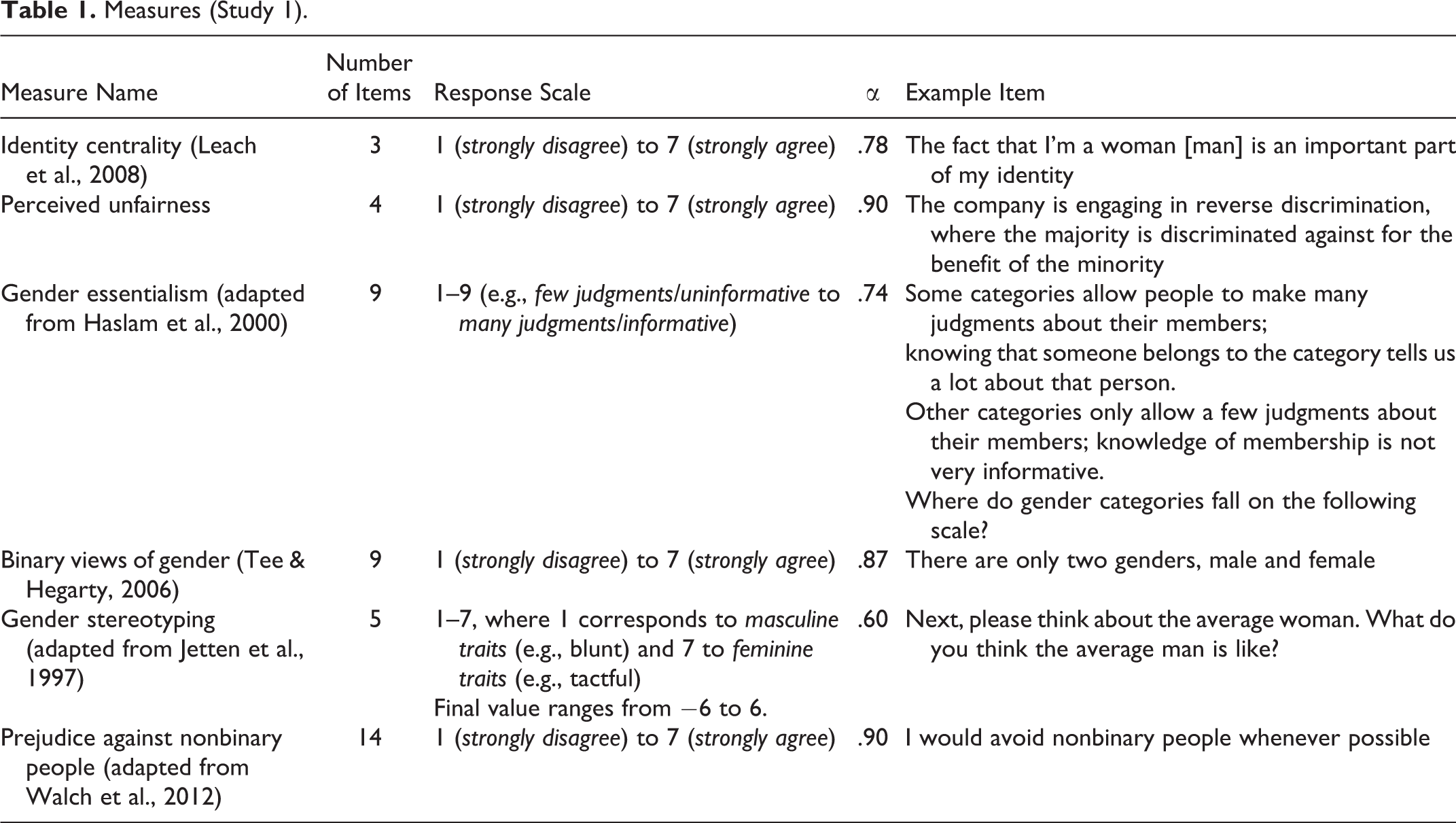
We advertised the study as a survey about reactions to different company policies. Participants first indicated their gender/sex followed by a measure of gender/sex identity centrality (see Table 1 for more information regarding the measures). To obfuscate the aim of our study we also asked about the centrality of participants’ national and religious identity.
Measures (Study 1).
Next, participants were randomly assigned to read one of three fictitious newspaper articles (describing a de-gendering policy, a multi-gendering policy, or a control article). All articles described actions taken by a well-known clothing retail company. The de-gendering article described a new policy that would remove gender/sex labels and sections in the retailer’s stores and instead provide all clothes in cuts and sizes that fit all body types. The multi-gendering article explained that the retailer was introducing a nonbinary label and adding a nonbinary section in their stores. The control article said that the company’s spring and summer collection would feature new designers.
Participants then responded to a range of questions about the company. Mixed in with some filler questions and manipulation checks, we measured perceived unfairness. This was followed by measures of gender essentialism, binary views of gender, and gender stereotyping. Participants thought about the average man and woman and indicated the extent to which five attributes applied to this person. We subtracted the rating of the average man from the rating of the average woman and calculated the mean. Higher numbers indicate stronger endorsement of gender stereotypes. Participants then completed a measure of prejudice toward nonbinary people before providing demographic information. 3
Results
First, we investigated the extent to which attempts to de-gender or multigender were seen as unfair and the role of gender identification in these reactions. Results from a univariate analysis of variance (ANOVA) with type of policy (de-gendering vs. multi-gendering vs. control) as the independent variable showed that unfairness perceptions varied between the different conditions, F(2, 484) = 25.59, p < .001,
Using the PROCESS macro (Version 3.2, Model 1), we then tested whether unfairness perceptions of the different policies differed at different levels of gender identification (Hypothesis 1a), entering type of policy as the predictor and gender identification as the moderator. Type of policy was dummy-coded with the control condition as the reference category. However, entering the two interaction terms into the model did not explain more of the variance, ΔR 2 < .01, F(2, 478) = 0.98, p = .376, and neither of the two interaction terms was significant (both ps > .212).
Next, we tested whether gender identification was associated with the endorsement of ideologies that maintain the gender/sex binary and, in turn, prejudice against nonbinary people (Hypothesis 2). Descriptive statistics and bivariate correlations are displayed in Table 2. Gender identification was indeed positively associated with gender/sex essentialism and binary views of gender/sex, but not with gender/sex stereotyping or prejudice against nonbinary people. Gender/sex essentialism and binary beliefs were associated with more prejudice.
Descriptive Statistics and Correlations (Study 1).
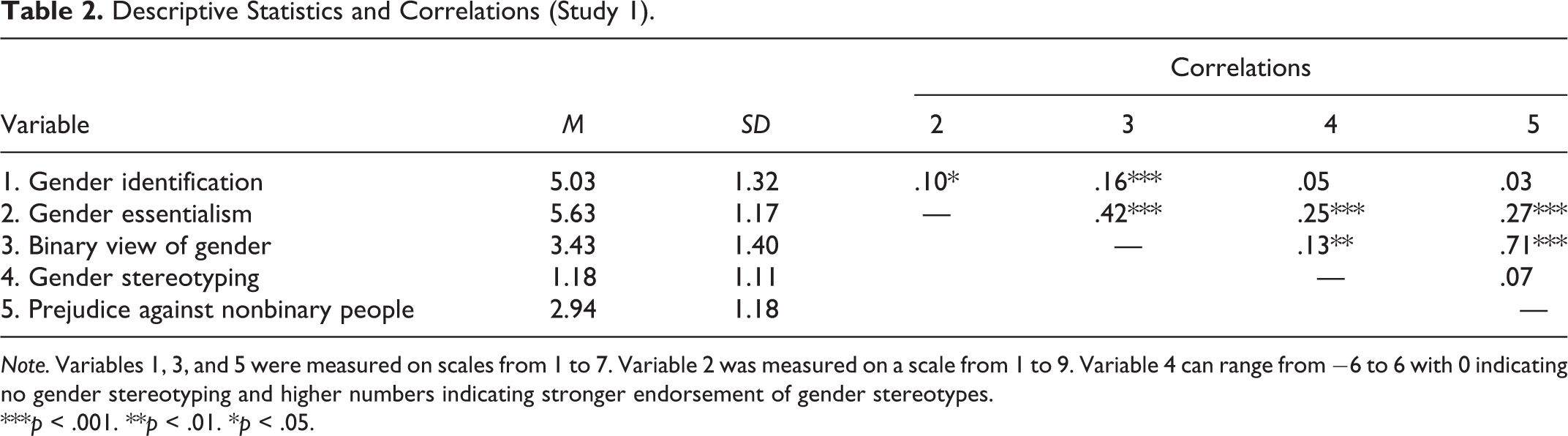
Note. Variables 1, 3, and 5 were measured on scales from 1 to 7. Variable 2 was measured on a scale from 1 to 9. Variable 4 can range from −6 to 6 with 0 indicating no gender stereotyping and higher numbers indicating stronger endorsement of gender stereotypes.
***p < .001. **p < .01. *p < .05.
To test Hypothesis 2, we used the PROCESS macro for SPSS (Version 3.2, Model 4; Hayes, 2018) entering gender identification as the predictor, gender/sex essentialism, binary views of gender/sex, and gender/sex stereotyping as parallel mediators, 4 and prejudice against nonbinary people as the outcome. Only the indirect effect through binary views of gender/sex was significant, B = .11 [0.05, 0.17] 5 (see Figure 1).
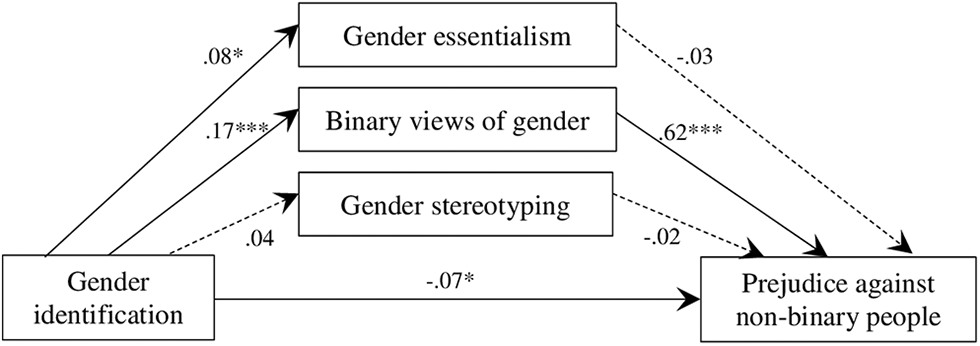
Indirect effect of gender identification on prejudice against nonbinary people (Study 1).
Discussion
Attempts to dismantle the binary, via either de-gendering or multi-gendering, were both seen as somewhat—and equally—unfair, but values were still below the midpoint and were the same regardless of levels of gender identification. One reason for the somewhat muted effects observed in this study could be that our manipulation was fairly inconsequential to our participants: It described the policies of only one company, a company that targeted youth fashion. Among our on-average older sample, the practices of this company might not have been seen as self-relevant and any potential offense easy to avoid. Moreover, the fact that the majority of our participants were female could also be a contributing factor to this null effect. Men are generally more concerned with a strong distinction between male and female (Bosson & Michniewicz, 2013) and may thus show stronger reactions to de-gendering policies, particularly when they are highly identified with their gender group. We further found that gender identification was indirectly associated with prejudice against nonbinary people specifically via binary views of gender/sex.
Study 2
In this study, we aimed to replicate our findings using a representative Swedish sample. We also investigate the role of need for closure. Sweden is an interesting context to study these dynamics as it is generally very progressive and ranks high in gender equality (e.g., World Economic Forum, 2018). Sweden also recently introduced the gender-neutral pronoun hen, in addition to hon (she) and han (he; Gustafsson Sendén et al., 2015). Hen is used both to denote nonbinary people and generically when gender is not known or irrelevant. Although Swedes, in general, perceive themselves as highly egalitarian, the introduction of hen provoked a long debate and was met with resistance (Gustafsson Sendén et al., 2015; Vergoossen et al., 2020). This debate also made Swedes highly familiar with this word, irrespective of their own position on it. Thus, this sample enables us to expand our research and investigate reactions to real contextual challenges to the gender binary—the new pronoun hen. We predict that the indirect effect of gender identification and need for closure through ideologies that maintain the gender/sex binary will not only be present for prejudice against nonbinary people but also attitudes toward hen.
Method
Participants
We aimed for the same sample size as in Study 1 and recruited participants through a Swedish polling firm, Enkätfabriken, that provides a representative sample. After excluding 73 nonheterosexual participants and one whose gender was unknown, we retained a sample of 415 heterosexual Swedish women (48.67%) and men (51.33%). The average age of the sample was 50.64 (SD = 17.74).
Procedure and Measures
The study was advertised as a survey about how media messages on legal proposals are perceived in different countries. Participants responded to a similar gender identification measure as in Study 1 (α = .68) as well as a measure of national identification to obscure the purpose of our study. Next, participants responded to 7 items assessing their need for closure (Roets & Van Hiel, 2011; e.g., “I don’t like situations that are uncertain”) on a 7-point scale from 1 (strongly disagree) to 7 (strongly agree; α = .81).
We then presented participants with one of three fictitious news articles about a proposal for a new law regarding children’s clothing. The de-gendering law would make it illegal to sell and market children’s clothing in separate sections for girls and boys or to sell clothes that explicitly target girls or boys. The multi-gendering law would make all children’s clothing stores add a section for nonbinary children and illustrated clothing would need to depict genders outside the binary. The control proposal would enforce stronger restrictions on chemical substances in children’s clothing.
Participants indicated how unfair they perceived the law to be (α = .93) using the same items as in Study 1. Next, participants responded to 10 items measuring binary views of gender/sex (α = .90) and 5 items measuring prejudice against nonbinary people (α = .82), taken from the same scales as the items in Study 1. In addition, we asked participants about their views of the gender-neutral pronoun hen. More specifically, we asked participants how they felt about hen in general, about hen as a pronoun for someone who neither identifies as male nor female, and about hen when used to refer to someone of unknown gender or when gender is irrelevant on a scale from 1 (very negative) to 7 (very positive; α = .92). Finally, participants responded to demographic questions and were debriefed in full. All materials were presented in Swedish.
Results
First, we investigated the perceived unfairness of the different policies and the role of gender identification and need for closure in these reactions (Hypothesis 1). Results of a univariate ANOVA with type of proposed law (de-gendering vs. multi-gendering vs. control) as the independent variable showed that perceived unfairness varied across conditions, F(2, 392) = 24.30, p < .001,
Using PROCESS (Version 3.2, Model 2), we then tested whether gender identification and need for closure moderated the effect of condition on perceptions of unfairness (see Figure 2). 6 Type of proposal was dummy-coded with the control condition as the reference category (i.e., D1 compares the control proposal to the multi-gendering proposal and D2 compares the control proposal to the de-gendering proposal). 7
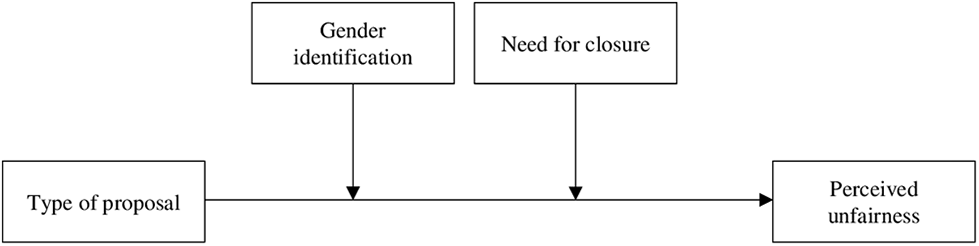
Moderation model predicting perceived unfairness of policy.
For need for closure, neither of the two interaction terms was significant (both ps > .810), and inclusion of the two interaction terms in the model did not increase variance explained, ΔR 2 < .01, F(2, 383) = 0.04, p = .965. However, we did find support for moderation by gender identification since inclusion of the interaction terms significantly increased variance explained, ΔR 2 = .01, F(2, 383) = 3.38, p = .035. In line with predictions, higher gender identification was associated with more perceived unfairness of the de-gendering proposal (see Table 3). Indeed, using the Johnson–Neyman technique, we determined that participants who scored 4.76 or higher on gender identification saw the de-gendering proposal as more unfair than the control proposal, B = 1.78 [0.00, 3.56]. Figure 3 illustrates the relationship in a model without need for closure. Note that in this simpler model, participants who scored 2.89 or higher on gender identification viewed the de-gender proposal as more unfair than the control proposal, B = 0.75 [0.00, 1.49].
Results of Moderation Analysis.
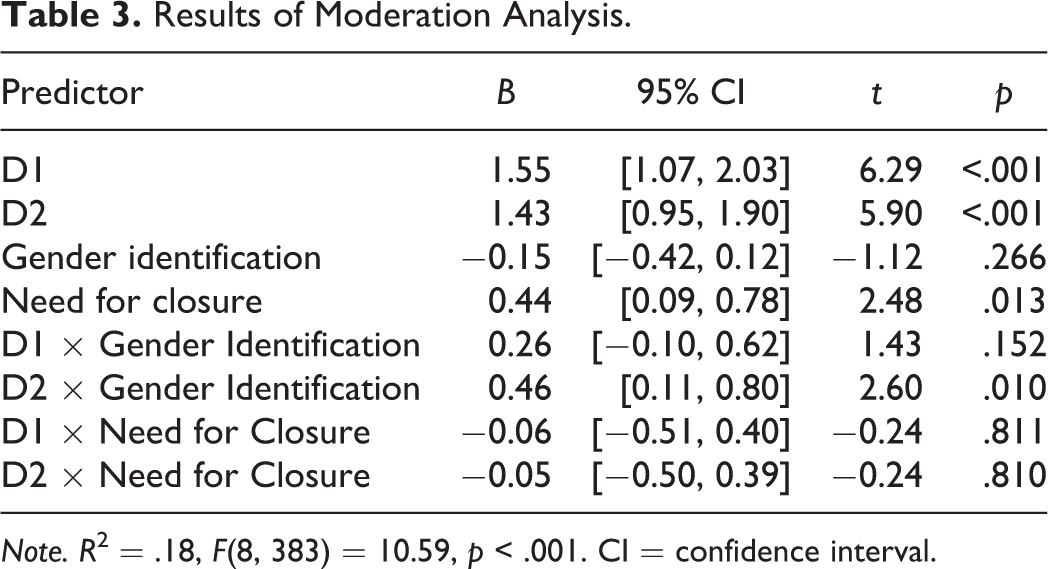
Note. R 2 = .18, F(8, 383) = 10.59, p < .001. CI = confidence interval.
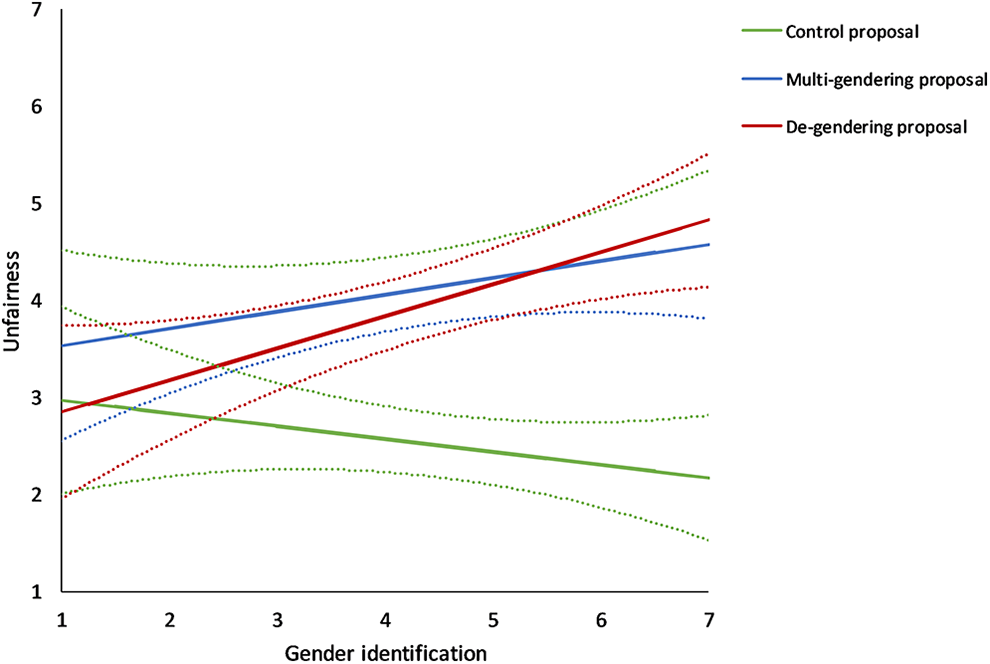
Association between gender identification and unfairness perceptions for the different proposals. Note. This figure depicts the relationship not controlling for need for closure. Dotted lines indicate 95% confidence intervals.
Next, we tested Hypotheses 2 and 3 (see Table 4 for descriptive statistics and correlations). Both gender identification and need for closure were positively related to binary views of gender/sex and prejudice against nonbinary people but not to support for the pronoun hen. Binary views of gender were associated with nonbinary prejudice and opposition to hen.
Descriptive Statistics and Correlations (Study 2).
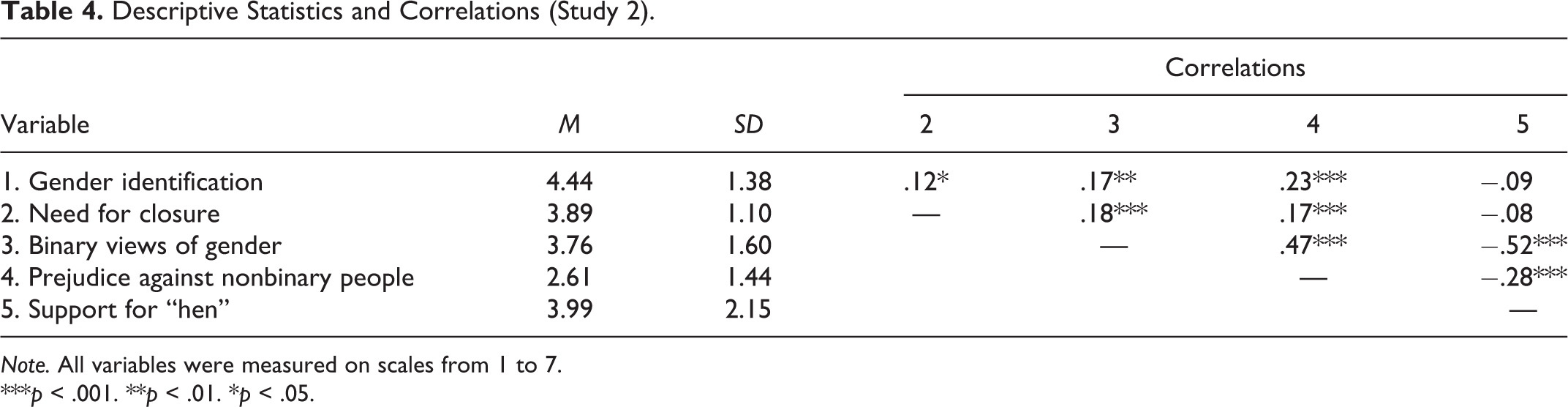
Note. All variables were measured on scales from 1 to 7.
***p < .001. **p < .01. *p < .05.
To formally test Hypotheses 2 and 3, we ran four mediation analyses using PROCESS (Model 4) with gender identification or need for closure as the predictor (and the other variable as a four control variable), binary views of gender/sex as the mediator, and prejudice against nonbinary people or support for hen as the outcome.
Replicating findings from Study 1, the indirect effect through binary views of gender/sex on prejudice against nonbinary people was significant B = .07 [0.02, 0.12] (see Figure 4). Similarly, the indirect effect of gender identification on support for hen was significant and negative, B = −.11 [−0.20, −0.03] (see Figure 5). These patterns support Hypothesis 2.
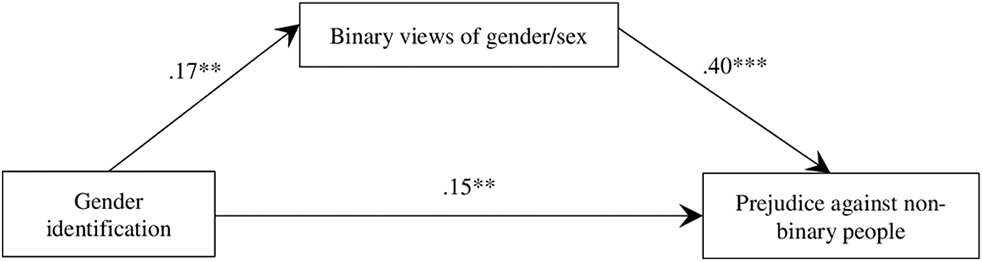
Indirect effect of gender identification on prejudice against nonbinary people (Study 2).
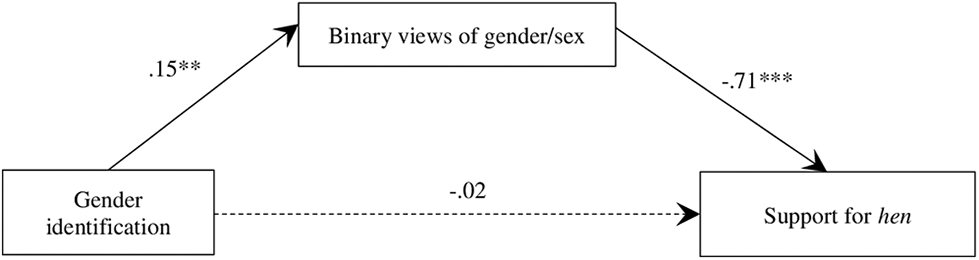
Indirect effect of gender identification on support for hen.
Results for need for closure were very similar. We found a positive indirect effect on prejudice against nonbinary people, B = .10 [0.04, 0.17] (see Figure 6), and a negative indirect effect on support for hen, B = −.18 [−0.30, −0.07] (see Figure 7). These patterns support Hypothesis 3.
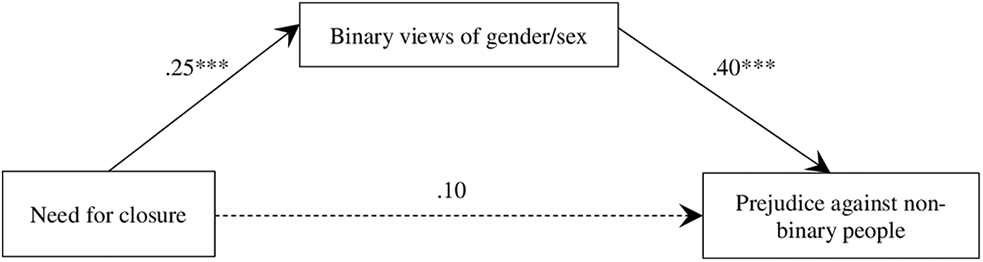
Indirect effect of need for closure on prejudice against nonbinary people.
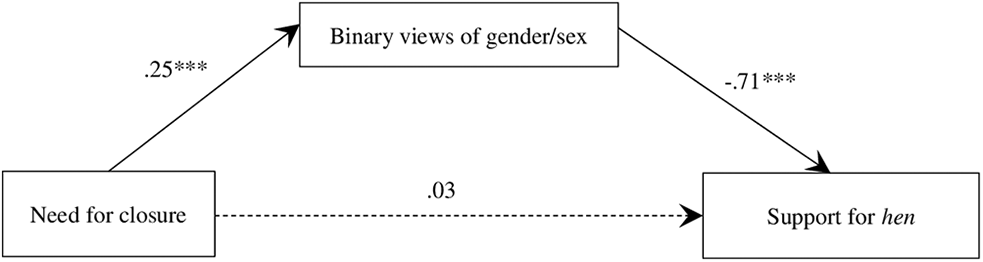
Indirect effect of need for closure on support for hen.
Discussion
In this study, gender identification was associated with different reactions to specific attempts to dismantle the gender/sex binary. Both multi-gendering and de-gendering law proposals were seen as more unfair than the law proposal that did not threaten the gender/sex binary. However, the de-gendering proposal in particular was seen as more unfair compared to the control proposal among highly identified women and men. We did not find this effect in Study 1. This may be due to the difference in samples; however, we believe it is more likely that the strengthening of our manipulation could explain this inconsistency. Need for closure did not moderate reactions to different gender-related policies.
We replicated findings from Study 1 showing that higher levels of gender identification were associated with more binary views of gender/sex and, in turn, with prejudice against nonbinary people. This effect generalized to another means to defend the gender/sex binary—opposition to the gender-neutral pronoun hen. We also found the same pattern for need for closure.
General Discussion
We investigated mechanisms underlying the defense of the gender/sex binary, exemplified by opposition to policies that attempt to disrupt the gender/sex binary as well as prejudice toward nonbinary people. In line with predictions from the social identity approach (Branscombe et al., 1999; Turner et al., 1987) and recent theorizing by Morgenroth and Ryan (2020), as well as empirical work (Bosson & Michniewicz, 2013; Falomir-Pichastor & Hegarty, 2014; Morton et al., 2009), we show that gender identification can be associated with ideologies that reinforce the current gender/sex system, such as gender essentialism and binary views of gender. We expand on previous research by showing that these ideologies not only harm women and men who violate gender roles (Kiebel et al., 2019; Skewes et al., 2018) but also those who fall outside of these roles altogether. Similarly, we demonstrate that the association of need for closure with gender essentialism (Keller, 2005) and with prejudice against bisexual or trans individuals (Burke et al., 2017; Tebbe & Moradi, 2012) extends to binary views of gender, prejudice against nonbinary people, and to opposition to language which challenges the gender/sex binary.
The insights gained in our studies have the potential to form the basis of future research. We have alluded to the fact that de-gendering policies and practices in particular may lead to distinctiveness threat. Similarly, policies and practices that challenge the gender binary may lead to system threats or threaten men’s status and masculinity (see Morgenroth & Ryan, 2020). Indeed, there is some evidence suggesting that threat is associated with differing reactions to multi-gendering versus de-gendering policies, for example, in the context of gendered bathrooms (Outten et al., 2019). Future research should investigate the role of threat as a mediating factor of the observed effects in different contexts.
Similarly, our research could spark novel research directions in the field of psycholinguistics. Here, research has primarily focused on androcentric versus gender-fair language (e.g., replacing the generic masculine “he” with “he or she”) without distinguishing between multi-gendering and de-gendering languages. Findings from this literature show that language has powerful effects both on who comes to mind when using differently gendered terms (Lindqvist et al., 2019) and also how individuals described in gender-fair language are perceived (Budziszewska et al., 2014). It would be interesting to examine such effects by focusing on de-gendering (e.g., replacing “he or she” with “they”) and multi-gendering (e.g., replacing “he or she” with “he, she, or ze”) strategies to make language more gender-fair. Indeed, we argue that language is not truly “gender-fair” as long as it marginalizes genders that fall outside of the gender/sex binary.
Our findings contribute to the understanding of opposition to changing views of gender, a timely but not well-understood issue. However, our studies have a number of limitations that should be taken into account when interpreting these findings. First, the relationships between gender identification as well as need for closure with gender/sex binary maintaining ideologies and attitudes are correlational, making causal claims impossible. Future studies should therefore experimentally manipulate these constructs. Second, demographic factors that we did not measure in this study, such as educational attainment or identities intersecting with gender (e.g., race or sexual orientation), may affect the processes studied here. Finally, in Study 1 we only found support for an indirect effect of identification on nonbinary prejudice through binary views of gender but not through gender essentialism or gender stereotyping, as predicted by Morgenroth and Ryan (2020). More research is needed to understand when and how individuals draw on these different forms of ideologies to defend the gender/sex binary.
Conclusion
Views of gender/sex are changing, and policies and practices are beginning to reflect these changes. At the same time, there is documented resistance. It is important to understand this opposition to find solutions that protect the rights of those who challenge the gender/sex binary. Our findings contribute to this understanding and provide important insights for those who design and implement policies that aim to enable more diverse expressions of gender/sex.
Supplemental Material
Defending_the_gender_binary_-_online_supplement_final - Defending the Sex/Gender Binary: The Role of Gender Identification and Need for Closure
Defending_the_gender_binary_-_online_supplement_final for Defending the Sex/Gender Binary: The Role of Gender Identification and Need for Closure by Thekla Morgenroth, M. Gustafsson Sendén, A. Lindqvist, E. A. Renström, M. K. Ryan and T. A. Morton in Social Psychological and Personality Science
Footnotes
Authors’ Note
The first author of this article uses they/them/their pronouns. The second, third, fourth, and fifth author use she/her/hers pronouns. The last author uses he/him/his pronouns.
Declaration of Conflicting Interests
The author(s) declared no potential conflicts of interest with respect to the research, authorship, and/or publication of this article.
Funding
The author(s) disclosed receipt of the following financial support for the research, authorship, and/or publication of this article: This work was funded, in part, by a European Commission Grant (725128) awarded to the fifth author and in part by the Swedish Research Council for Health, Working Life and Welfare (Grant 2017–00414) awarded to the third author.

Supplemental Material
The supplemental material is available in the online version of the article.
Notes
References
Supplementary Material
Please find the following supplemental material available below.
For Open Access articles published under a Creative Commons License, all supplemental material carries the same license as the article it is associated with.
For non-Open Access articles published, all supplemental material carries a non-exclusive license, and permission requests for re-use of supplemental material or any part of supplemental material shall be sent directly to the copyright owner as specified in the copyright notice associated with the article.
