




Abstract
For feminists, a core goal is to promote the interests of women as a group. Across three studies, we examined whether the pursuit of such goals can lead feminists to use more divergent thinking styles. We measured identification with feminists, identification with women, and manipulated the extent to which a divergent thinking task was congruent with the goal of promoting women’s interests. Results showed that—when given the opportunity to promote the interests of women—feminist identification was associated with greater divergent thinking. This effect was observed only in feminists who identified less strongly with women as a group (“distinctive feminists”). We conclude that distinctive feminists draw on divergent thinking to promote the interests of women as a group.
Creativity is desirable across a range of contexts, from the world of work, through industry and the arts, to education. Across these domains, creativity not only leads to novel and useful commercial products (Amabile, 1996) but it can also build a fairer and more equal society. Indeed, oppression can be a source of creativity, and some theorists have argued that social inequality and disadvantage go hand in hand with creativity (Morley, 1995). This process can be seen, for instance, in the use of art as a form of protest. Here, we build on the notion that creativity can help people cope with low social status or disadvantaged group memberships (Jackson et al., 1996). We integrate insights from social identity theory and creativity psychology to investigate whether members of a low-status group use more creative approaches when acting on behalf of their low-status in-group. We focus on the context of gender, specifically on feminist women, and argue that some feminist women deploy creativity when promoting women’s interests.
Creativity relies heavily on divergent thinking—the generation of multiple alternative solutions to open-ended problems (Gocłowska et al., 2014). Divergent thinking includes the ability to switch between various approaches to problems (Nijstad et al., 2010) and a tendency to deviate from established rules and norms (Adarves-Yorno et al., 2007). Divergent thinking is impeded by stereotypic thinking (Sassenberg & Moskowitz, 2005), and conversely, divergent thinking increases when stereotypes and cognitive schemata are violated (Gocłowska et al., 2014; Ritter et al., 2012). In other words, divergent thinking requires the ability to diverge from established social norms and expectations, and to imagine alternative realities. As such, divergent thinking is a particularly powerful tool for those looking to challenge social inequalities.
Social Creativity
The link between creativity and social inequality described above is central to the literature on “social creativity.” This research describes how members of disadvantaged groups use creativity to address the low status position of the groups to which they belong (Jackson et al., 1996; Tajfel & Turner, 1979). For instance, older gay men, having felt rejected by a “youth oriented” gay culture, can positively reappraise their age as “maturity” (Hajek, 2016). In this way, they divert attention away from the negative connotations of their age and reinterpret it more positively (Douglas et al., 2005). Although this does not involve creating novel solutions at the task level, it is creative in the sense that people think about their identities in ways that diverge from societal consensus. In sum, social creativity research recognizes that divergent thinking can be used to manage low social status. However, until now, this literature has explored only one way in which this happens: by reinterpreting or redefining identities. Here, we draw on the “functional creativity” literature to explore another way in which members of disadvantaged groups may use divergent thinking to empower their in-group.
Functional Creativity
Divergent thinking involves “defying the crowd” (Sternberg & Lubart, 2002) and seeing problems from new perspectives (de Dreu et al., 2011). As such, divergent thinking can help people to overcome obstacles and challenges when pursuing important goals (Roskes et al., 2012). Sligte et al. (2011) examined divergent thinking in pursuit of goals related to social power. Their work showed that when power relations are unstable, individuals in low power positions generate ideas in a more divergent way, especially on tasks that allow them to demonstrate their own suitability for positions of power. These findings are of especial interest for the current work, as they demonstrate that people use divergent thinking to address unequal social relationships. Here, we examine whether increases in divergent thinking can similarly arise from the desire to empower one’s in-group. Specifically, we examine whether feminists draw on divergent thinking when pursuing the goal of empowering women.
Identification With Feminists and Women
The reasoning above suggests that feminists are motivated to empower women, and when they are presented with a task that can achieve this goal, that motivation translates to more divergent task approaches. This is consistent with previous evidence that feminists value goals related to empowering women (e.g., Liss et al., 2004). Further, feminist identification predicts tendencies to think about gender in nonnormative ways (Henderson-King & Stewart, 1994; Mahalik et al., 2005). As these nonnormative tendencies are related to increased divergent thinking (Adarves-Yorno et al., 2007; Sassenberg & Moskowitz, 2005), we expect a positive association between feminist identification and divergent thinking on tasks that empower women as a group.
However, feminist identification is not the only form of gender identification that may have a bearing on divergent thinking. The consequences of feminist identification must be analyzed in light of another identification dimension: identification with women (van Breen et al., 2017). Women who are strongly identified with women are more likely to use gender stereotypes to describe themselves as individuals (van Breen et al., 2017). As noted above, such adherence to social norms and stereotypes impedes divergent thinking (Adarves-Yorno et al., 2007). Based on this reasoning, we propose that when the task offers the opportunity to empower women, divergent thinking is strongest among women who are strongly identified with feminists but who are less strongly identified with women—whom previous research has called “distinctive feminists” (van Breen et al., 2017). “Distinctive feminists” are characterized by a certain freedom from essentialist concerns about gender (associated with low identification with women) as well as a strong motivation to empower women (associated with high feminist identification). We argue that this translates to greater divergent thinking on tasks that promote women’s interests.
Overview of Current Research
Across three studies, we tested the hypothesis that feminist identification is associated with greater divergent thinking on tasks that promote a positive image of women, and that this effect occurs specifically among those who report relatively low identification with women. In all studies, divergent thinking was the dependent variable, and identification with feminists and women were continuous predictors. In Studies 1 and 2, we also manipulated the goal of the task as either promoting women or promoting the self. Study 2 further examined an alternative explanation for the central findings based on the stereotype threat literature (Kaiser & Hagiwara, 2011). In Study 3, we adapted the manipulation, so that both conditions promote a positive image of women as a group but in either a stereotypical or counter-stereotypical domain. Motivation and gender essentialism were explored as possible mediators. All study materials are included as part of Supplemental Materials. Data and code are available upon request from the first author.
Study 1
Method
Design
The independent variables in Study 1 were identification with women, identification with feminists, and a between-participants manipulation with two levels. The manipulated factor reflected framing of the instructions for the divergent thinking task as either promoting a positive image of women as a group or promoting a positive image of the self. The dependent variable was divergent thinking.
Statistical Power and Participants
We aimed for a sample that would allow us to detect a small-to-medium effect (d ≈ .35) at 80% power, given α = .05. Power analysis using G*Power (Faul et al., 2007) suggested a sample size of 264 participants. Accordingly, 264 female participants were recruited. Age ranged from 18 to 67 years old (M = 29.6, SD = 10.1). Twelve participants who participated twice were excluded as well as eight participants who failed an attention check. We also excluded three multivariate outliers (Draper & John, 1981; Gocłowska et al., 2019). Details on how the outliers were identified are given in the Supplemental Materials. Excluding these participants left a final sample of 241 women. Sensitivity analysis showed that given, α = .05 and 80% power, our sample of N = 241 was able to detect effects with an effect size of d ≈ .36 or larger.
Independent Variables
Identification with women and feminists
Identification with women was measured with 4 items (M = 4.84, SD = 0.95, α = .85). The first item was Postmes et al.’s (2013) single-item identification measure (“I identify with women”). The other 3 items were taken from the centrality subscale of Leach et al.’s (2008) Identification Scale. These items were rated on a 6-point Likert-type scale. Identification with feminists was measured with the same 4 items (M = 4.01, SD = 1.43, α = .97) with the word “feminists” replacing “women.” The correlation between the two measures was r = .31.
Manipulation: Group promotion versus self-promotion
We manipulated the instructions for the divergent thinking task. Participants were introduced to a problem-solving task, without mention of the term “creativity.” Half of our participants read that good performance on the task would reflect positively on them as individuals (self-promoting condition). The other half of our participants read that good performance would reflect positively on women as a group (group-promoting condition).
Dependent Variable: Divergent Thinking
The divergent thinking task (Guilford, 1971) asked participants to list different uses for a brick within 4 minutes. The second author and a second coder coded a subset of 584 (18%) ideas into categories. Examples of categories include using the brick as a construction material (“build a bridge”) or as a weapon (“smash a window”). Agreement between the coders was good (Cohen’s κ = .78), and any disagreements were resolved through discussion. The remaining responses were then coded by the second coder. The task yielded three indices: flexibility, infrequency, and fluency. Flexibility (M = 6.88, SD = 2.74) reflects the number of different categories a person draws on in their answers. A person who draws on many different categories scores higher on flexibility than a person whose answers all cluster within a single category. Infrequency (M = 0.88, SD = 0.04) reflects the originality of one’s ideas. For each category a participant used, we calculated how often it occurred in the data set. Categories that occur less frequently were assigned higher infrequency scores. The infrequency scores of all the participants’ answers were averaged to give a single infrequency score per participant. Finally, fluency (M = 12.14, SD = 5.12) reflects the total number of ideas generated.
In line with previous research (Gocłowska et al., 2014; Gocłowska et al., 2019), the indices were checked for violations of normality. Fluency and flexibility were positively skewed, and infrequency was negatively skewed (see Supplemental Materials); this was corrected through transformations. We then standardized the resulting scores, so that they are represented on the same scale (Z-scores) to facilitate their combination into a single divergent thinking score. We derived the divergent thinking score by averaging the standardized scores for flexibility and infrequency (r = .70, p < .001). High scores on this variable reflect the generation of varied and original ideas across a range of categories. Fluency was used as a covariate. The more ideas one generates, the more likely it is that there will be divergent ideas among them (Simonton, 1997). As such, controlling for fluency allowed us to examine divergent thinking while controlling for the volume of responses generated (Ritter et al., 2012). Further details are given in the Supplemental Materials.
Exploratory Variables
This study also included several exploratory variables to explore possible mediators of the hypothesized effects. These are described in the Supplemental Materials.
Procedure
Participants accessed the study through the Prolific platform. After reading the study information and providing informed consent participants completed two personality measures. The presentation of the identification measures was counter-balanced, so that half of the participants completed the measures of women’s and feminist identification before proceeding to the divergent thinking task. The other half of the participants went straight to the divergent thinking task and completed the identification measures toward the end of the procedure. All participants read the manipulated instructions for the divergent thinking task 1 before starting the task. After completing the divergent thinking task, all participants filled in exploratory measures and manipulation checks. At the end of the study, those participants who had not done so already completed the identification measures. Participants then provided demographic information before being debriefed and redirected to the Prolific platform.
Results
We hypothesized that when identification with women is (relatively) low, stronger feminist identification predicts greater divergent thinking on tasks that are relevant to women as a group. Indeed, the manipulation interacted with the identification variables to affect divergent thinking, F(1, 241) = 4.19, p = .042, d = .27. Please see Table 1 for parameter estimates. The breakdown of this three-way interaction showed that when identification with women was (relatively) low, stronger identification with feminists predicted increased divergent thinking in the group-promoting condition, β = .15, F(1, 241) = 4.09, p = .044, d = .26, but not in the self-promoting condition, F < 1, ns. These effects are illustrated in Figure 1.
Parameter Estimates for the Full Model in Study 1.
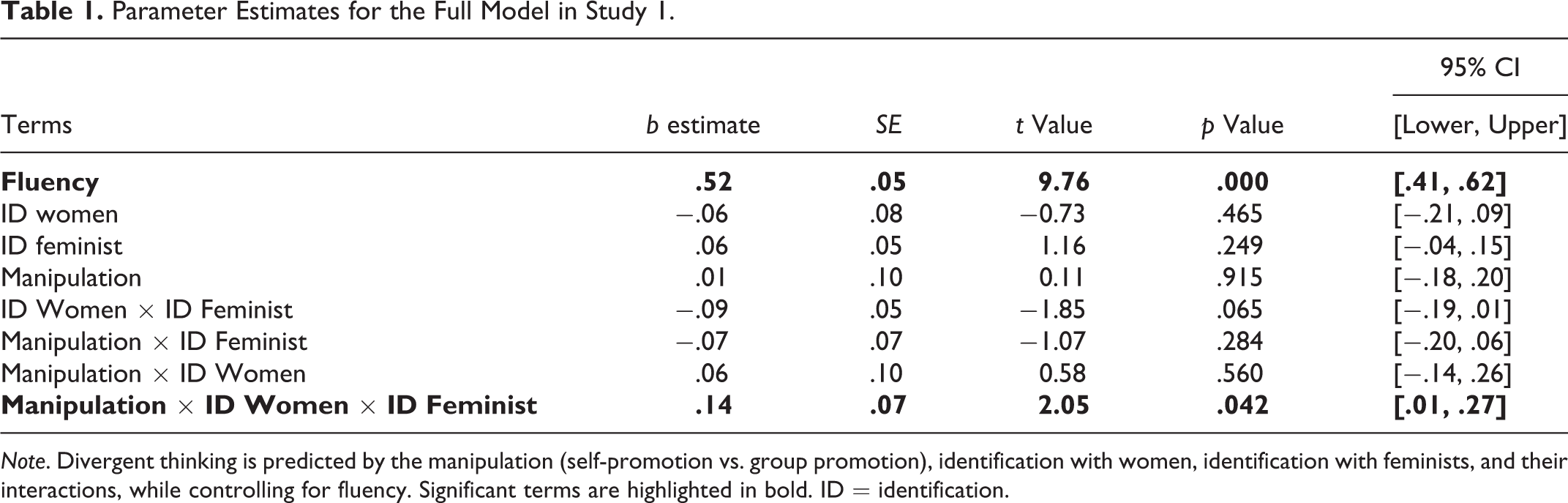
Note. Divergent thinking is predicted by the manipulation (self-promotion vs. group promotion), identification with women, identification with feminists, and their interactions, while controlling for fluency. Significant terms are highlighted in bold. ID = identification.
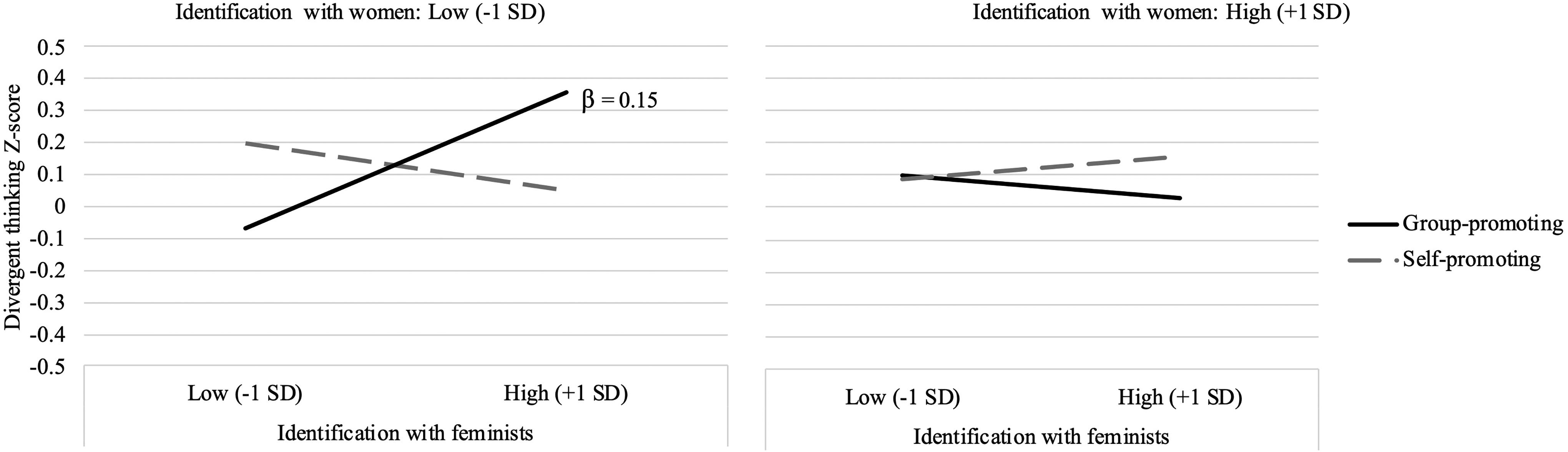
The effect of identification with women, identification with feminists, and the manipulation on divergent thinking in Study 1. Note. Divergent thinking scores (on the y-axis) are shown on a transformed and standardized scale and the mean values should not be interpreted literally. Low and high identification are plotted at ±1 standard deviation from the mean. The β estimate is given for the simple slope described in the text.
There was no evidence that motivation or gender essentialism mediate this effect (see Supplemental Materials).
Discussion of Study 1 and Introduction to Study 2
Study 1 showed that when participants are given the opportunity to promote women’s interests, stronger feminist identification was associated with greater divergent thinking. This pattern arose specifically when identification with women was relatively low.
Given that the size of the central effect was smaller than anticipated, we conducted a preregistered replication study (www.osf.io/r689p). We expected that when identification with women is (relatively) low, stronger feminist identification predicts greater divergent thinking on tasks that are relevant to women as a group. We also explored an alternative explanation of our findings, based on the stereotype threat literature. When divergent thinking impacts women as a group, this might produce anxiety-driven decreases in divergent thinking performance among other subgroups of women, rather than increased divergent thinking among distinctive feminists (e.g., Kaiser & Hagiwara, 2011). To address this possibility, we included a measure of performance anxiety. We also included motivation and gender essentialism as exploratory variables (see Supplemental Materials).
Method
Design
Study 2 was a direct replication of Study 1—the independent variables, dependent variable, and design were the same as in Study 1. The correlation between feminist identification (α = .95, M = 3.55, SD = 1.35) and women’s identification (α = .80, M = 4.98, SD = 0.83) was r = .44.
Statistical Power and Participants
A priori power analysis showed that, given α = .05 and 80% power, a minimum sample of N = 467 is needed to detect an effect of the size identified in Study 1 (d = .26). A total of 512 women participated through the Prolific.ac platform. Age ranged from 18 to 76 years old (M = 37.4, SD = 12.9). Exclusions were applied in line with the preregistration. We excluded one participant who identified as a man, as well as eight participants for whom English was not among their native languages, and 13 participants who failed the attention check. We also excluded four multivariate outliers (see Supplemental Materials). This left a final sample of 486 women.
Dependent Variable: Divergent Thinking
To arrive at the divergent thinking scores, the first author and a second coder coded a subset of 574 (10%) of all ideas. Interrater agreement was satisfactory (Cohen’s κ = .73). The second coder then coded the rest of the ideas. We extracted scores for infrequency (M = 0.87, SD = 0.04), flexibility (M = 6.00, SD = 2.46), and fluency (M = 10.18, SD = 4.75). These indices were treated the same way as in Study 1, in line with established procedures (Gocłowska et al., 2014; Gocłowska et al., 2019). As before, fluency and flexibility were positively skewed and infrequency was negatively skewed (see Supplemental Materials), and transformations were applied. The indices where then standardized, and a total divergent score calculated. Further details are given in the Supplemental Materials.
Exploratory Variables
Motivation and gender essentialism were measured in the same way as in Study 1. We also included a measure of performance anxiety. Participants were asked whether they experienced performance anxiety during the divergent thinking task (4 items, α = .69), by responding to statements such as “I felt worried about what my performance on the task might mean.” These items were rated on a 6-point Likert-type scale.
Procedure
Participants accessed the study through the Prolific platform. Participants read the study information and provided informed consent. The presentation of the identification measures was counter-balanced, so that half of the participants completed the measures of women’s and feminist identification before going on to the divergent thinking task. The other half of the participants went straight on to the divergent thinking task and completed the identification measures toward the end of the procedure. All participants read the manipulated instructions for the divergent thinking task before starting the task. After completing the divergent thinking task, participants filled out the exploratory measures. Participants who had not done so already then completed the identification measures. At the end of the study, participants completed an attention check and provided demographic information. Finally, participants were debriefed and redirected to the Prolific platform.
Results
We hypothesized that when identification with women is (relatively) low, stronger feminist identification predicts greater divergent thinking on tasks that are relevant to women as a group. Indeed, there was a significant three-way interaction between the manipulation and the identification variables, F(1, 486) = 4.89, p = .028, d = .20, as well as a number of significant lower order terms, as shown in Table 2. Breakdown of this three-way interaction showed that, when identification with women was (relatively) low, stronger identification with feminists predicted increased divergent thinking in the group-promoting condition, β = .16, F(1, 486) = 9.01, p = .003, d = .28, but not the self-promoting condition, F < 1, ns (see Figure 2). These findings support our preregistered hypothesis.
Parameter Estimates for the Full Model in Study 2.
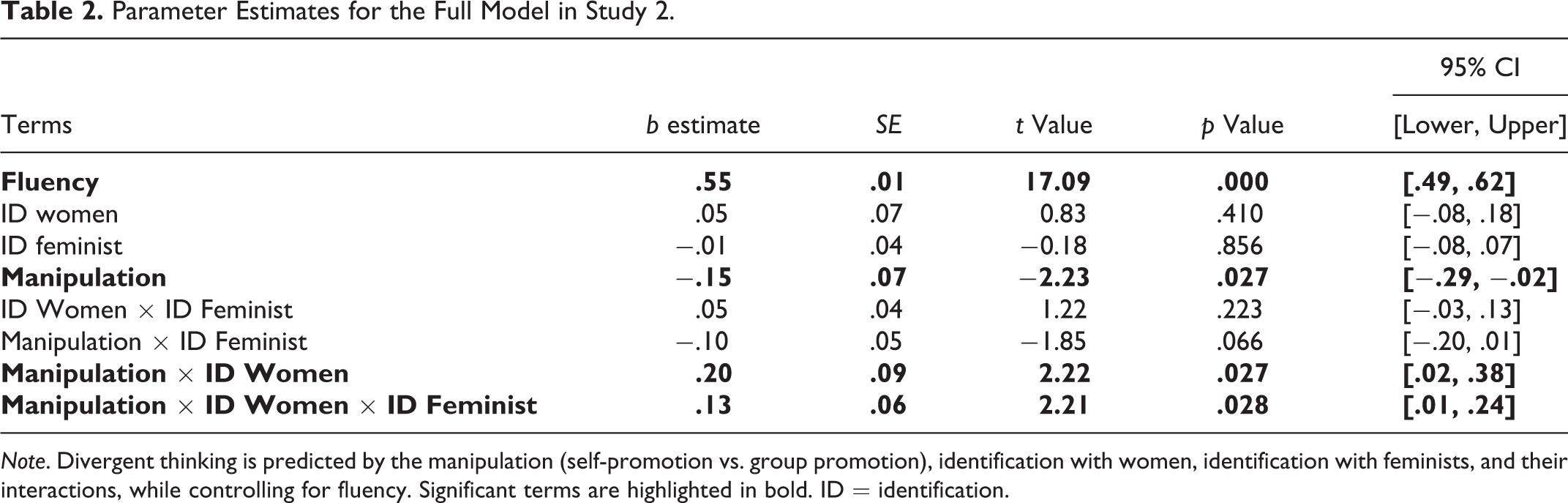
Note. Divergent thinking is predicted by the manipulation (self-promotion vs. group promotion), identification with women, identification with feminists, and their interactions, while controlling for fluency. Significant terms are highlighted in bold. ID = identification.
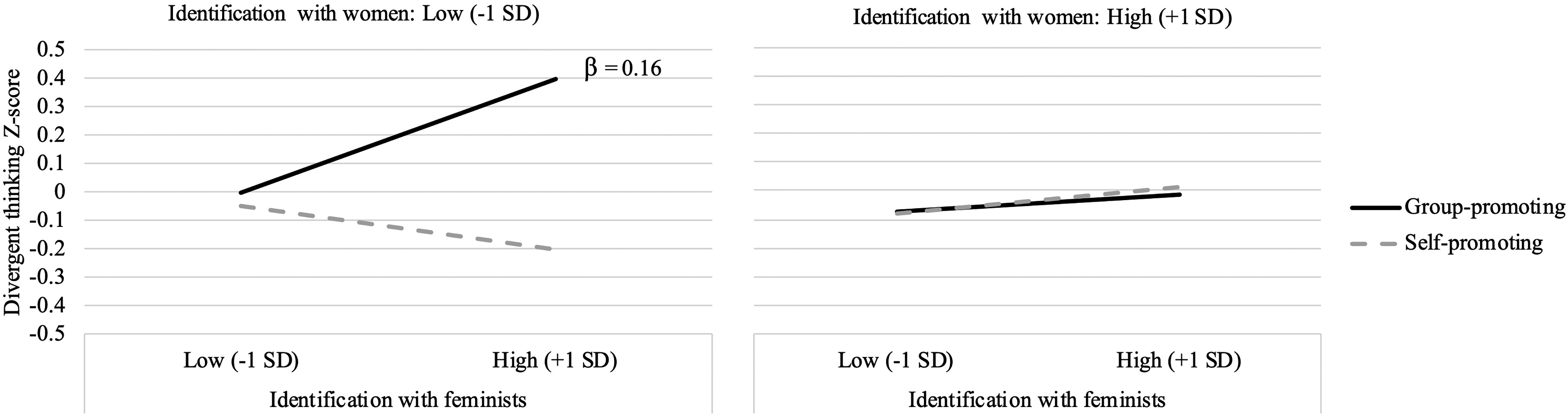
The effect of identification with women, identification with feminists, and the manipulation on divergent thinking in Study 2. Note. Divergent thinking scores (on the y-axis) are shown on a transformed and standardized scale and the mean values should not be interpreted literally. Low and high identification are plotted at ±1 standard deviation from the mean. The β estimate is given for the simple slope described in the text.
Exploratory Analyses
The identification variables did not affect performance anxiety (all terms F < 1, ns), but there was a marginal main effect of the manipulation, F(1, 486) = 3.32, p = .069, such that the group-promoting condition elicited somewhat higher performance anxiety than the self-promoting condition. Therefore, we created a mediation model (Hayes’s PROCESS Model 19; Hayes & Preacher, 2013) where the manipulation predicts performance anxiety, which subsequently interacts with feminist identification and women’s identification to affect divergent thinking. There was no evidence for this model: The indirect effect did not reach significance, t < 1, and the direct effect of the interaction described above remained significant, t(486)= 2.25, p = .025.
There was no evidence that motivation or gender essentialism mediated the central findings (see Supplemental Materials for details).
Discussion of Study 2 and Introduction to Study 3
Study 2 replicated the findings of Study 1. In the group-promoting condition, stronger feminist identification predicted greater divergent thinking, among women who were less strongly identified with women. This study additionally explored performance anxiety as an alternative explanation for our findings but no evidence for this alternative was found.
We conducted Study 3 to provide a conceptual replication of Studies 1 and 2. Study 3 also explored an additional factor that may contribute to these findings, which is the domain that a task refers to. The divergent thinking task refers to a brick, which has masculine connotations of building and construction. Therefore, the task may be interpreted as presenting women positively in a counter-stereotypic domain—which might be particularly appealing to distinctive feminists. To explore this issue, we created a manipulation that consisted of two conditions, which both promoted a positive image of women, either in a gender-stereotypic domain or in a counter-stereotypic domain.
Given that both conditions present a positive image of women, we expected that—across conditions—stronger feminist identification should predict greater divergent thinking, particularly when identification with women is (relatively) low. Additionally, we explore whether this effect is stronger when the task is framed as counter-stereotypic.
Method
Design
The independent variables in this study were identification with women, identification with feminists and a between-participants manipulation with two conditions. The manipulated factor reflected framing of the instructions for the divergent thinking task in a counter-stereotypical versus stereotypical way. Unlike in Studies 1 and 2, in both conditions, the task was relevant to the goal of promoting women. The dependent variable was divergent thinking.
Statistical Power and Participants
In Studies 1 and 2, the central effect arose from a three-way interaction between the group- versus self-relevance manipulation, identification with women, and identification with feminists. In this study, however, both levels of the manipulation framed the task as promoting women, and therefore, the effect of central interest should now arise from the two-way interaction between the identification variables. Power analysis indicated that, given α = .05, 366 participants were needed to detect an effect of d = .26 with 80% power. Moreover, we were interested in a possible three-way interaction involving the new manipulation (stereotypical vs. counter-stereotypical framing) but the size of this effect was not known. Therefore, we kept our intended sample size at N = 366; which allowed us to detect a three-way interaction if the effect size were at least d = .29.
Unfortunately, the intended sample size (N = 366) was not reached due to practical constraints. A total of 303 female participants participated in this study. Age ranged from 18 to 72 years old (M = 37.6, SD = 12.8). As in Studies 1 and 2, we excluded five people who did not list English among their native languages. Three participants were excluded because they failed the attention check. Another two were excluded as multivariate outliers. For more information on the outliers, please refer to Supplemental Materials. The final sample consisted of 293 participants. This sample can detect an effect size of d = .33 with 80% power.
Independent variables
Identification with women and feminists
Identification with women (α = .86, M = 4.60, SD = 0.95) and identification with feminists (α = .95, M = 3.22, SD = 1.35) were measured as before (r = .30).
Manipulation
The key difference between this Study and Studies 1 and 2 lies in the manipulation. We dropped the self-promoting condition and created two conditions that both allowed women to promote a positive image of the group. However, the conditions differed in the framing the divergent thinking task, the task was described as either gender stereotypic or counter-stereotypic. In the stereotypic condition, participants read that good performance would demonstrate women’s suitability for “social professions, which are generally considered feminine.” In the counter-stereotypic condition, participants read that good performance would demonstrate women’s suitability for “technical professions, which are generally considered masculine.” This manipulation aimed to provide insight into whether or not divergent thinking is triggered specifically when the task conveys competence in a counter-stereotypical domain.
Dependent Variable: Divergent Thinking
Divergent thinking scores were calculated as before, in line with past research (Gocłowska et al., 2014; Gocłowska et al., 2019). Two coders assigned a random subset of 300 (10%) of all the ideas to categories. Interrater agreement was very good (Cohen’s κ = .96), any disagreements were resolved through discussion. We extracted three indices: fluency (M = 9.96, SD = 4.46), flexibility (M = 6.15, SD = 2.39), and infrequency (M = 0.88, SD = .03). As before, fluency and flexibility were positively skewed, and infrequency was negatively skewed (see Supplemental Materials), and transformations were applied. The indices were standardized, and a total divergent thinking score was derived using the same procedure as in Studies 1 and 2.
Exploratory Variables
As in Study 2, participants were asked to indicate whether they experienced performance anxiety during the divergent thinking task (4 items, α = .76). We also include motivation, gender essentialism, and personal need for structure as exploratory variables, these are described in the Supplemental Materials.
Procedure
Participants accessed the study through the Prolific platform, read the study information, and provided informed consent. They then provided demographic information. Subsequently, participants read the manipulated instructions for the divergent thinking task. After completing the divergent thinking task, participants completed the attention checks and the exploratory measures (see Supplemental Materials). Subsequently, participants indicated their identification with women and their identification with feminists. Finally, participants were debriefed and redirected to Prolific.
Results
We hypothesized that distinctive feminists rely on divergent thinking more than other women do. Indeed, the interaction between identification with women and identification with feminists predicted divergent thinking scores, t(293) = −2.20, p = .029, d = .38. More specifically, when identification with women was (relatively) low, stronger identification with feminists predicted greater divergent thinking, β = .12, t(293) = 2.29, p = .023, d = .27. This effect is represented in Figure 3. Table 3 gives the parameter estimates for the full model.
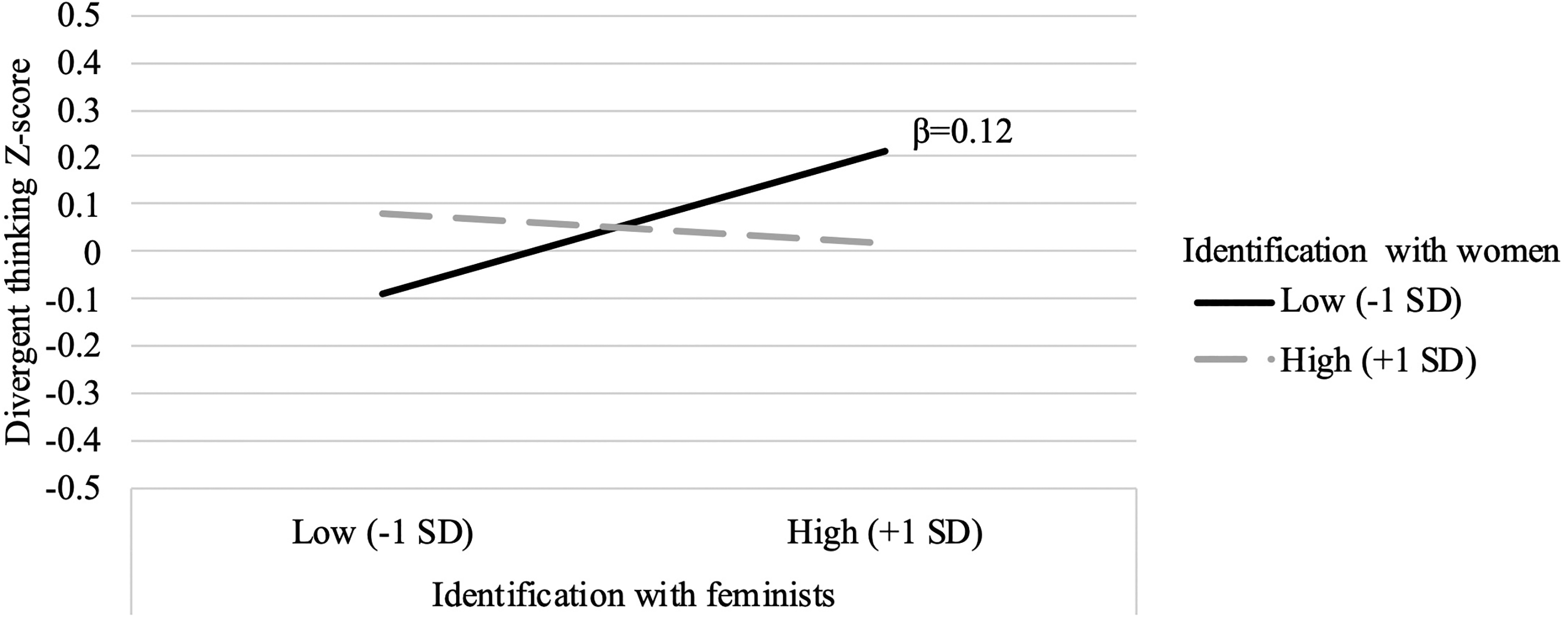
The effect of identification with women and identification with feminists in Study 3. Note. When interpreting the figure, please note that divergent thinking scores (on the y-axis) are shown on a transformed and standardized scale and the mean values should not be interpreted literally. Low and high identification are plotted at ±1 standard deviation from the mean. The β estimate is given for the simple slope described in the text.
Parameter Estimates for the Full Model in Study 3.
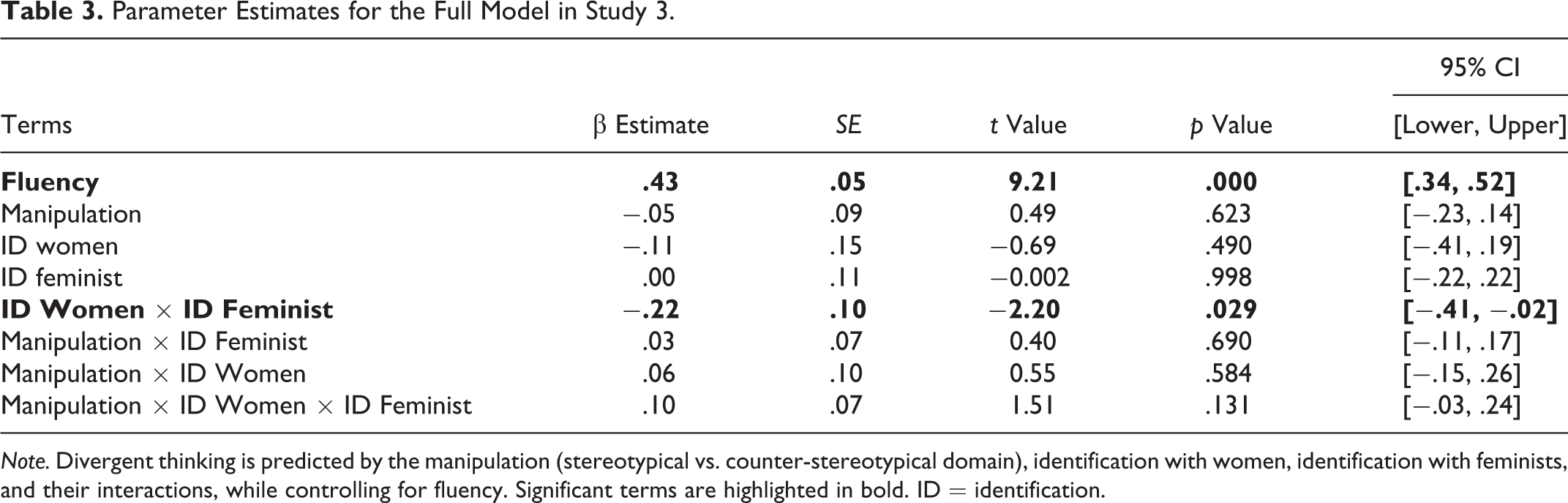
Note. Divergent thinking is predicted by the manipulation (stereotypical vs. counter-stereotypical domain), identification with women, identification with feminists, and their interactions, while controlling for fluency. Significant terms are highlighted in bold. ID = identification.
In addition, we examined the effect of the (new) manipulation, which described the divergent thinking task as conveying either stereotypical or counter-stereotypical attributes. The central effect did not seem to be qualified by the manipulation, t(293) = 1.51, p = .131. That is, there was no evidence that the stereotypic versus counter-stereotypic framing of the task impacted the results.
Exploratory Analyses
There were no effects of the identification variables or the manipulation on performance anxiety, either as main effects or in interaction, Fs < 1, ns. Similarly, there was no evidence that motivation or gender essentialism mediated these effects (see Supplemental Materials).
Discussion
Study 3 replicated Studies 1 and 2, showing that distinctive feminists draw on divergent thinking more than other groups of women do (when good performance reflected positively on women as a group). Although power in this study fell short of 80%, we are confident in the robustness of this finding given its replication across studies, and the similarity of the effect size in each case. Additionally, the three studies reported here are the only research we have conducted on the link between feminist identification and divergent thinking. Similar to Study 2, Study 3 found no evidence that the effect of the identification variables on divergent thinking was due to performance anxiety. Finally, this study found no support for the possibility that the perceived counter-stereotypical (vs. stereotypical) nature of creativity explains the observed effect. This suggests, perhaps, that distinctive feminists are motivated by a general desire to present a positive image of the group, rather than specifically pursuing counter-stereotypic attributes. However, it is difficult to interpret null effects, especially given power concerns, and as such this issue requires further research.
General Discussion
Across three studies, we demonstrated that distinctive feminists engage in greater divergent thinking when good task performance reflects positively on women as a group. This work integrates insights from the functional creativity and social creativity literatures and makes an interesting contribution to each of these literatures. First, social creativity research has long recognized that people use divergent thinking to challenge low social status (Tajfel & Turner, 1979). However, until now, this literature has explored only one way in which this happens—by reinterpreting or redefining identities. Here, we identify another way in which creativity can be used to address identity concerns, namely by facilitating the pursuit of group-related goals. Second, these findings extend research on divergent thinking. Previous studies demonstrated that the pursuit of important goals prompts greater divergent thinking (e.g., Roskes et al., 2012; Sligte et al., 2011). Here, we show that divergent thinking is similarly triggered by the pursuit of group-relevant goals.
Note that we do not argue that distinctive feminists performed better on the task. The instructions for the divergent thinking task asked participants to generate as many uses as possible for a brick. So, from the participant’s perspective, high fluency would be the desired outcome. As such, the crucial difference does not lie in what participants do but rather in how they do it. Distinctive feminists, more than other women, employed a divergent thinking style to achieve the aim of the task. Because we focus on task approaches rather than task performance, these findings provide novel insights that complement previous studies examining the effects of gender identity on performance (e.g., Bry et al., 2008; Inzlicht et al., 2006).
It is worth considering the mechanism underlying these effects. Above, we argued that the desire to empower women is an important goal among feminists (relative to nonfeminists), which suggests a role for motivation in the underlying mechanism. Aside from the motivation to engage with the task, the underlying mechanism is likely to also include an aspect of how people engage with the task. There is evidence that feminists—and particularly feminists who are not strongly committed to women as a group—are less concerned about gendered norms and prescriptions (Henderson-King & Stewart, 1994; Mahalik et al., 2005) or indeed want to confound them, and as such are more free to draw on unconventional and creative strategies. Based on this reasoning, we considered motivation and gender essentialism as mediators of the central effects, but there was no consistent evidence for this. The reasons for this may be in part methodological. For instance, we conceptualized motivation as “motivation to do well on the task” but it is possible that distinctive feminists’ motivation is not a general motivation to do well but a more specific kind of motivation, for instance, to demonstrate traits associated with power and status. In other words, perhaps our measure of motivation was not specific enough. We might also consider possible mediators aside from motivation and gender essentialism. One possibility is that among distinctive feminists, situations that promote women activate a “feminist norm” that encourages the rejection of stereotypic and schematic thinking. The rejection of stereotypic and schematic thinking is associated with more divergent thinking (Goclowska et al., 2014; Sassenberg & Moskowitz, 2005). In other words, perhaps distinctive feminists show greater creativity on behalf of women because they adhere to a certain “feminist norm” that encourages nonnormative behavior.
Conclusion
Across three studies, we demonstrated that the opportunity to promote a positive image of women as a group drives creativity. Specifically, when identification with women is low, identification with feminism is associated with greater creativity on behalf of women. These findings extend our knowledge of the strategies that members of disadvantaged groups use to empower their in-group. Further, these findings support the observation—from popular culture and social–psychological theory—that identity and creativity are closely linked.
Supplemental Material
Supplementary_material_vanBreenetal_R2 - Creativity for the Group: Distinctive Feminists Engage in Divergent Thinking When Acting on Behalf of Women
Supplementary_material_vanBreenetal_R2 for Creativity for the Group: Distinctive Feminists Engage in Divergent Thinking When Acting on Behalf of Women by J. A. van Breen, M. A. Gocłowska, S. de Lemus, M. Baas, B. Kelleci and R. Spears in Social Psychological and Personality Science
Supplemental Material
Supplemental Material, vanBreenetal_Study1_allmaterials - Creativity for the Group: Distinctive Feminists Engage in Divergent Thinking When Acting on Behalf of Women
Supplemental Material, vanBreenetal_Study1_allmaterials for Creativity for the Group: Distinctive Feminists Engage in Divergent Thinking When Acting on Behalf of Women by J. A. van Breen, M. A. Gocłowska, S. de Lemus, M. Baas, B. Kelleci and R. Spears in Social Psychological and Personality Science
Supplemental Material
Supplemental Material, vanBreenetal_Study2_allmaterials - Creativity for the Group: Distinctive Feminists Engage in Divergent Thinking When Acting on Behalf of Women
Supplemental Material, vanBreenetal_Study2_allmaterials for Creativity for the Group: Distinctive Feminists Engage in Divergent Thinking When Acting on Behalf of Women by J. A. van Breen, M. A. Gocłowska, S. de Lemus, M. Baas, B. Kelleci and R. Spears in Social Psychological and Personality Science
Supplemental Material
Supplemental Material, vanBreenetal_Study3_allmaterials - Creativity for the Group: Distinctive Feminists Engage in Divergent Thinking When Acting on Behalf of Women
Supplemental Material, vanBreenetal_Study3_allmaterials for Creativity for the Group: Distinctive Feminists Engage in Divergent Thinking When Acting on Behalf of Women by J. A. van Breen, M. A. Gocłowska, S. de Lemus, M. Baas, B. Kelleci and R. Spears in Social Psychological and Personality Science
Footnotes
Acknowledgment
We would like to thank Elisabeth Koch for assistance with data collection and analysis.
Declaration of Conflicting Interests
The author(s) declared no potential conflicts of interest with respect to the research, authorship, and/or publication of this article.
Funding
The author(s) disclosed receipt of the following financial support for the research, authorship, and/or publication of this article: This work was supported by a grant from the Spanish Ministry of Science and Technology (AEI/FEDER, UE; grant no. PSI2016-79971-P) and by a Marie-Curie fellowship from the European Commission (FP7-PEOPLE-2013-IOF, 622331, CREA.TA).

Supplemental Material
The supplemental material is available in the online version of the article.
Note
References
Supplementary Material
Please find the following supplemental material available below.
For Open Access articles published under a Creative Commons License, all supplemental material carries the same license as the article it is associated with.
For non-Open Access articles published, all supplemental material carries a non-exclusive license, and permission requests for re-use of supplemental material or any part of supplemental material shall be sent directly to the copyright owner as specified in the copyright notice associated with the article.
