




Abstract
In Western samples, individuals differ systematically in the importance they assign to matters of justice and injustice, and dispositional Justice Sensitivity can be differentiated according to the perspectives of victim, observer, beneficiary, and perpetrator. In a cross-cultural comparison between the Philippines, Germany, and Australia (N = 677 students), we investigated whether Justice Sensitivity can be equivalently described by these four perspectives, whether measurement instruments have invariant psychometric properties, and whether the psychological relevance of the Justice Sensitivity perspectives for cooperation behavior differs between these cultural contexts. The results of multigroup confirmatory factor analyses support weak measurement invariance and invariant associations between Justice Sensitivity perspectives and trust game decisions. Across cultures, victim sensitivity predicted reluctance to cooperate under threat of exploitation, and observer, beneficiary, and perpetrator sensitivities predicted cooperation under temptation. Our study extends insight into Justice Sensitivity to underresearched cultural contexts of urban and rural Philippines.
Justice is a fundamental concern in human social interaction. Nonetheless, in Western samples, systematic interindividual differences have been observed in the subjective importance of justice, as indicated by the strength of cognitive, emotional, and behavioral reactions to injustice (Schmitt et al., 1995). These individual differences in dispositional sensitivities to (in)justice (Justice Sensitivity) have been found to be powerful predictors of cooperation behavior in American and Western European samples. However, it remains unknown whether, in other cultural contexts, individual differences in the subjective importance of justice concerns can be meaningfully assessed and whether dispositional Justice Sensitivity involves the same behavioral relevance. This lacuna is critical because cross-cultural research has established fundamental differences between cultures in the principles used to subjectively define what is just or unjust (e.g. Fischer & Smith, 2003) but has neglected individual differences in the subjective importance of justice or injustice, independent of its subjective definition.
Some studies have investigated dispositional Justice Sensitivity in samples from non-Western backgrounds (e.g., Magraw-Mickelson & Gollwitzer, 2018, in Japan; Wu et al., 2014, in Russia and China). Wu and colleagues focused on cross-cultural differences in mean levels of this disposition. However, we lack evidence that our measurement tools work equivalently between populations, which is a crucial prerequisite for meaningful comparison. In the present research, we (a) sought to establish measurement invariance of self-report scales for Justice Sensitivity, across language and cultural divides and (b) tested associations between Justice Sensitivity and cooperation behavior, and whether they generalize across different cultural backgrounds. We collected data from two participant samples from the Philippines, which is a collectivist cultural context underrepresented in social and personality research (Church, 1987). By comparing these with samples from Germany and Australia, we were able to gain insight into cultural and language invariance of the measurement of Justice Sensitivity and its psychological functioning.
Dispositional Justice Sensitivity and Cooperative Behavior
Studies in Western cultures have indicated that individual differences in Justice Sensitivity are relatively stable across time and consistent across types of injustices (Schmitt et al., 2010; for a review, see Baumert & Schmitt, 2016). People high (compared to low) in Justice Sensitivity perceive more situations as unjust, show stronger emotions and ruminate longer when perceiving injustice, and are more strongly motivated to act against perceived injustice (Schmitt et al., 1995). Importantly, Justice Sensitivity has been differentiated into four facets, each corresponding to a perspective that one can adopt toward injustice. Self-report scales for these Justice Sensitivity perspectives assess emotional and cognitive responses when feeling unfairly disadvantaged oneself (victim sensitivity), when seeing unfairness between others (observer sensitivity), or when passively benefiting from (beneficiary sensitivity), or actively committing unfairness (perpetrator sensitivity). In Western samples, mainly from Germany, these Justice Sensitivity perspectives have been shown to be relevant predictors of justice-related emotion and behavior, over and above dispositions such as trait anger, empathy, or social trust (e.g., Gollwitzer et al., 2005). Specifically, heightened victim sensitivity has been shown to predict antisocial tendencies and to reflect rather self-related concerns for justice (Gollwitzer et al., 2005). In contrast, observer sensitivity, beneficiary sensitivity, and perpetrator sensitivity appear to indicate a genuine other-related concern for justice and have been found to positively correlate with prosocial attitudes and behavior (e.g., Lotz et al., 2013).
To study the association between Justice Sensitivity and cooperation behavior, scholars have used the so-called trust game (Berg et al., 1995), a paradigm designed to reveal the degree to which people exhibit cooperation behavior under two conditions, namely, under threat of exploitation and under temptation. In the version employed by Gollwitzer and Rothmund (2011), participants were faced with two financial decisions in interdependence with an anonymous interaction partner. Assigned at random to the role of Person A or B, they received a fixed amount of money from the experimenter. Person A was free to invest any amount of their money by transferring it to Person B, with the investment being tripled by the experimenter. Person B then had two options: keep the tripled investment or transfer half of this amount to Person A such that both persons had the same beneficial outcome. The decision by Person A reveals this individual’s willingness to cooperate despite the possibility that the other person may exploit such cooperation (i.e., cooperation under threat of exploitation). In contrast, the decision to share in the role of Person B can be taken as an indicator of cooperativeness despite financial incentives to behave otherwise (i.e., cooperation under temptation).
Gollwitzer and Rothmund (2011) found that persons high in victim sensitivity withdrew their cooperation, as evidenced by transferring less money to Person B, when they had been treated unfairly before. Theoretically, victim sensitivity is thought to involve a fear of being exploited (Gollwitzer et al., 2013). In line with this notion, Maltese et al. (2016) found a negative effect of heightened victim sensitivity—mediated by expectations of injustice—on cooperation behavior under threat of exploitation in the trust game. Relatedly, in a Japanese sample, victim sensitivity was linked to anger about the expectation of being exploited which in turn predicted reduced prosocial behavior in a different game setting (Tham et al., 2019).
As yet, there are no published studies that report associations between observer, beneficiary, or perpetrator sensitivities and choices in the trust game. However, on theoretical grounds, it seems plausible that heightened Justice Sensitivity from these prosocial perspectives should be positively related to such cooperation behavior, under both threat of exploitation and under temptation.
Cross-Cultural Comparisons of Justice Concerns
Cross-cultural researchers have long been interested in social justice (Fischer & Smith, 2003; Huppert et al., 2019). Nevertheless, researchers have neglected to investigate potential cultural differences in the subjective importance of justice or injustice. Consequently, it is unknown whether meaningful individual differences in Justice Sensitivity are invariant across cultural contexts, 1 and whether we can invariantly differentiate these sensitivities according to the perspective that an individual adopts toward a subjective injustice.
The assumption that the construct of Justice Sensitivity and its psychological connection with cooperation is culturally invariant might be challenged by evidence of fundamental cultural differences in construals of self (Hofstede, 2001; Markus & Kitayama, 1991) and morality (Graham et al., 2016). In Western cultures, individuals tend to be perceived as, and construe themselves as, independent units characterized by a set of attributes that are responsible for how they relate and react to others. By contrast, in many Asian and African countries, interdependent self-construals prevail, which means that the individual experience is fundamentally based on relations to others (Markus & Kitayama, 1991). Relatedly, what is considered morally relevant or not tends to center around individual rights in Western countries but around communal social duties in non-Western countries (Vauclair & Fischer, 2011). Even at the neural level, correlates of moral decision-making have been found to differ between cultures (Han et al., 2014). Accordingly, cultural differences may fundamentally shape the way that injustice is perceived and responded to. In non-Western cultural contexts, distinctions between the perspectives of victim, observer, beneficiary, and perpetrator of potential injustice might be blurred (Shteynberg et al., 2017). In summary, the structure of individual differences in Justice Sensitivity and the relevance of the different Justice Sensitivity perspectives for cooperation might differ between Western and non-Western cultural contexts.
As a first step toward scrutinizing Justice Sensitivity in non-Western cultures, Wu and colleagues (2014) employed translated Justice Sensitivity scales and measures of individualism–collectivism in Russia and China, comparing mean levels to a German sample. Unfortunately, they did not test for measurement invariance in the Justice Sensitivity scales across countries. This compromises interpretation of comparisons involving mean levels and correlations across countries. In cross-cultural research, differences in mean levels or correlations with other measures can emerge due to cultural differences in the measurement properties of an assessment instrument rather than due to true differences in the underlying construct (van de Vijver & Tanzer, 2004). To rule out such biases, confirmatory factor analyses can serve to establish equivalence of measurement regarding (i) the general structure of the assessed construct (configural invariance), (ii) the degree to which differences in responses to each item reflect individual differences in the underlying construct (metric invariance), and (iii) whether manifest scores correspond to the same scores on the latent construct dimension (scalar invariance). Commonly in cross-cultural research, the third level of equivalence (scalar invariance) cannot be assumed, presumably because the interpretation of items or response tendencies may differ between cultures. As a consequence, individuals with the same score on the latent construct dimension may respond differently depending on their cultural background (He & van de Vijver, 2012). If this is the case, mean-level differences between cultures cannot be taken to reflect true differences in the underlying construct. For the meaningful comparison of correlations among different measures between groups, the second level of equivalence (metric invariance) is sufficient.
Present Research
In the present study, we first aimed to establish measurement invariance of the Justice Sensitivity scales across two samples from the Philippines, an Australian, and a German sample. As English is the national language of education in the Philippines, we employed English translations of the Justice Sensitivity items. Thus, with regard to measurement properties, comparison of these four samples is particularly enlightening because we can establish equivalence across language differences (by comparing Australian and German samples) and examine cultural differences within the same language (by comparing Filipino and Australian samples).
Second, we scrutinized associations between Justice Sensitivities and cooperation behavior in the trust game and tested whether those associations were equivalent across populations from different cultural backgrounds. For this purpose, we chose to collect data from two samples in the Philippines, one from the capital and one from a provincial region (see Online Supplement Material for description of national characteristics).
Comparison between these Filipino samples, and samples from Germany and Australia, will provide insight into cultural invariance of the measurement of Justice Sensitivity and its psychological functioning. We employed a trust game to assess behavioral cooperation under threat of exploitation and under temptation. Based on the assumption that victim sensitivity involves fear of exploitation, we expected negative correlations between victim sensitivity and cooperation under threat of exploitation (Hypothesis 1). Extending previous empirical studies on the prosocial Justice Sensitivity perspectives, for observer, beneficiary, and perpetrator sensitivities, we expected positive correlations with cooperation both under threat of exploitation (Hypothesis 2a) and under temptation (Hypothesis 2b).
Method
Here, we report those measures relevant to the issues under present scrutiny, but all materials, analyzed data, and script are provided (https://osf.io/6yck4/). Below, we report data exclusions and how we determined sample sizes.
Samples
Using convenience sampling, we aimed for n > 100 in each sample. Incomplete responses to the Justice Sensitivity scales were excluded from analyses, resulting in a total N = 677. Our first sample (n = 145) comprised Filipino students from Silliman University in Dumaguete, a middle-class town in a provincial region (henceforth Philippines I). The second sample (n = 175) comprised Filipino students from De La Salle University in the capital Manila (henceforth Philippines II). Our third sample comprised students from German universities (n = 211), and the fourth sample (n = 146) comprised Australian students from the University of Western Australia. Post hoc power analyses (G*Power [3.1.9.2]; Erdfelder et al., 1996) showed that the size of each sample provided sufficient power (1 − β > .79) to reveal a correlation of r = .20 (with critical α level set to .05 using a one-tailed test).
Descriptive statistics of demographic and cultural variables are reported in Table 1. There were significant differences between the samples in age, F(3, 672) = 81.35, p < .001, η2 = .27, and self-rated socioeconomic status, F(3, 673) = 67.42, p < .001, η2 = .23, but not gender, χ2 = 2.24, p = .53. Similar to findings by Hofstede (https://www.hofstede-insights.com/country-comparison/australia,germany,the-philippines/), the Philippine I sample scored lower in nation-level individualism than both the German and Australian sample.
Means for Demographic Characteristics, Individualism–Collectivism, Justice Sensitivity Perspectives, and Trust Game Decisions, Separately for Each Culture.
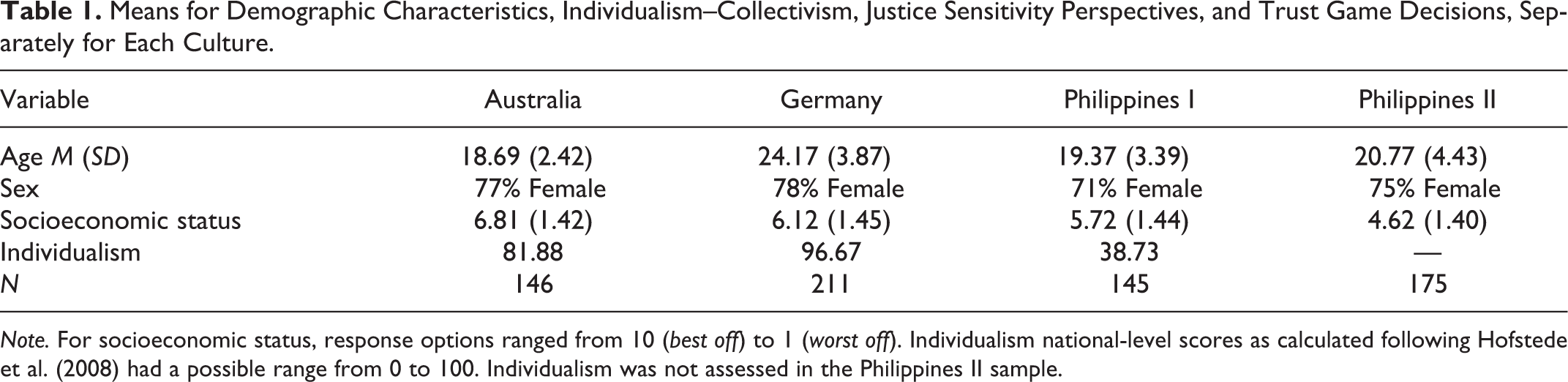
Note. For socioeconomic status, response options ranged from 10 (best off) to 1 (worst off). Individualism national-level scores as calculated following Hofstede et al. (2008) had a possible range from 0 to 100. Individualism was not assessed in the Philippines II sample.
Procedure
Data were collected using an online questionnaire (Leiner, 2014; LimeSurvey, 2015), as students in all three countries were well acquainted with use of computers. Students were recruited via e-mail and social media (Germany, Philippines), class announcements (Philippines), and an electronic research participation system (Australia) and received course credit or book vouchers for their participation. They provided demographic information (age, sex, first language, and socioeconomic status). To describe our samples along broad cultural dimensions, we assessed the Values Survey Module (Hofstede et al., 2008). Due to time constraint, this module was skipped for the Philippines II sample. All participants responded to the Justice Sensitivity scales (Schmitt et al., 2010) and indicated their behavioral decisions in both roles of the trust game, Person A (cooperation under threat of exploitation) and Person B (cooperation under temptation), before being debriefed. The study was administered in the participants’ national language of education (German in Germany, English in Australia and the Philippines). Instructions were piloted locally, to avoid potential construct bias and method bias (e.g., van de Vijver & Tanzer, 2004).
Materials
Socioeconomic status
The item assessing self-rated socioeconomic status relative to other people in the country had response options from 10 (top rung/best off in your country) to 1 (bottom rung/worst off in your country).
Justice sensitivity
The Justice Sensitivity Inventory (Schmitt et al., 2010) was used to measure victim sensitivity (e.g., “It makes me angry when others are undeservingly better off than me”; .84 < α < .91), beneficiary sensitivity (e.g., “I feel guilty when I am better off than others for no reason”; .84 < α < .90), observer sensitivity (e.g., “I get upset when someone is undeservingly worse off than others”; .85 < α < .90), and perpetrator sensitivity (e.g., “I feel guilty when I enrich myself at the cost of others”; .88 < α < .93) with 10 items each. The response scales ranged from 0 = totally disagree to 5 = totally agree.
Cultural characteristics
Hofstede’s cultural dimensions were assessed using the Values Survey Module (Hofstede et al., 2008). Following the formula provided in the manual, a nation-level score for individualism–collectivism with a possible range of 0–100 was calculated on the basis of 4 items (e.g., “In choosing an ideal job, how important would it be to you to have security of employment”; response options from 1 = of utmost importance to 5 = of very little or no importance).
Trust game
We used a modified trust game (Gollwitzer & Rothmund, 2011) to assess behavioral cooperation. Participants were told that they would interact with another anonymous, randomly chosen person, in the roles of Persons A and B. They knew that Persons A and B would each received 10 Euro (10 Australian Dollar, 100 Filipino Pesos) 2 ; that Person A would be free to invest any amount to Person B, with this investment tripled by the experimenter; and that Person B would have two options: to keep the tripled investment of Person A or to share it with Person A such that both receive the same outcome. Every participant indicated their decision as Person A (cooperation under threat of exploitation) and as Person B (cooperation under temptation), without knowing their respective partner’s decisions. These decisions were financially relevant as for randomly chosen participants the sum they ended up with at the conclusion of the game would be paid to them. 3
Results
Manifest means of the Justice Sensitivity perspectives (Online Supplement Table S1) and manifest bivariate correlations with trust game decisions (Online Supplement Table S2) are provided in the Online Supplement Material.
Measurement Invariance of the Justice Sensitivity Scales
As a preparatory step, we conducted exploratory factor analyses of the 40 Justice Sensitivity items, separately for each sample (principal axis factoring with oblimin rotation). Inspecting the scree plots suggested a four-factor solution in the German sample and two- or five-factor solutions in each of the other samples. Factor loadings did not allow a clear interpretation of a fifth factor. For this reason, we extracted four factors that captured a substantial share of variance in item responses (44.7–50.6% explained variance). Item loadings largely corresponded to the four Justice Sensitivity perspectives in all samples. However, across samples, the first 4 items of beneficiary sensitivity had substantial cross-loadings on the perpetrator factor.
We tested for measurement invariance of the Justice Sensitivity perspectives across cultures by conducting multigroup confirmatory factor analyses, using the lavaan R package (Version 0.6-5; Rosseel, 2012). We specified a baseline model with victim, observer, beneficiary, and perpetrator sensitivities as four correlated latent factors. We used three parcels per factor as indicators. Parcels were constructed following the item-to-construct balancing approach (Little et al., 2002), based on factor loadings obtained in the exploratory factor analysis with the German sample because the Justice Sensitivity Inventory was originally developed in German.
In a first step, we tested configural invariance, with the basic factor structure constrained to equality across cultures. Second, we restricted factor loadings to equality across cultures, testing for weak (metric) invariance. Third, we restricted intercepts to equality across cultures, testing for strong (scalar) invariance (Milfont & Fischer, 2010). We evaluated model fit by means of root mean square error of approximation (RMSEA; acceptable fit < .08; Browne & Cudeck, 1993), standardized root mean square residual (SRMR; acceptable fit < .08), and comparative fit index (CFI; acceptable fit > .95; Hu & Bentler, 1999). For comparing fits of alternative models, we followed the recommendations of Chen (2007), who proposed that a change ≤ −.010 in CFI, supplemented by a change of ≥.015 in RMSEA or a change of ≥.030 in SRMR would indicate a violation of weak invariance, whereas a change of ≤ −.010 in CFI supplemented by a change of ≥.015 in RMSEA or a change of ≥.010 in SRMR would indicate a violation of strong invariance.
Results are provided in Table 2 (upper part). We found an acceptable fit for the model assuming configural invariance. Comparisons of the models indicated no need to reject weak invariance. However, the decline in fit (CFI and RMSEA) indicated that strong invariance should not be assumed. We wanted to explore whether the violation of strong invariance was more likely the result of language, cultural differences, or both. Hence, we repeated the model comparisons using only the Western samples (German and Australian) and using only the English-speaking samples (Philippines I and II and Australian). Results are displayed in the middle and lower parts of Table 2. Strong measurement invariance could be assumed between the English-speaking samples, but not between the two Western samples.
Measurement Invariance for JS Across Samples.
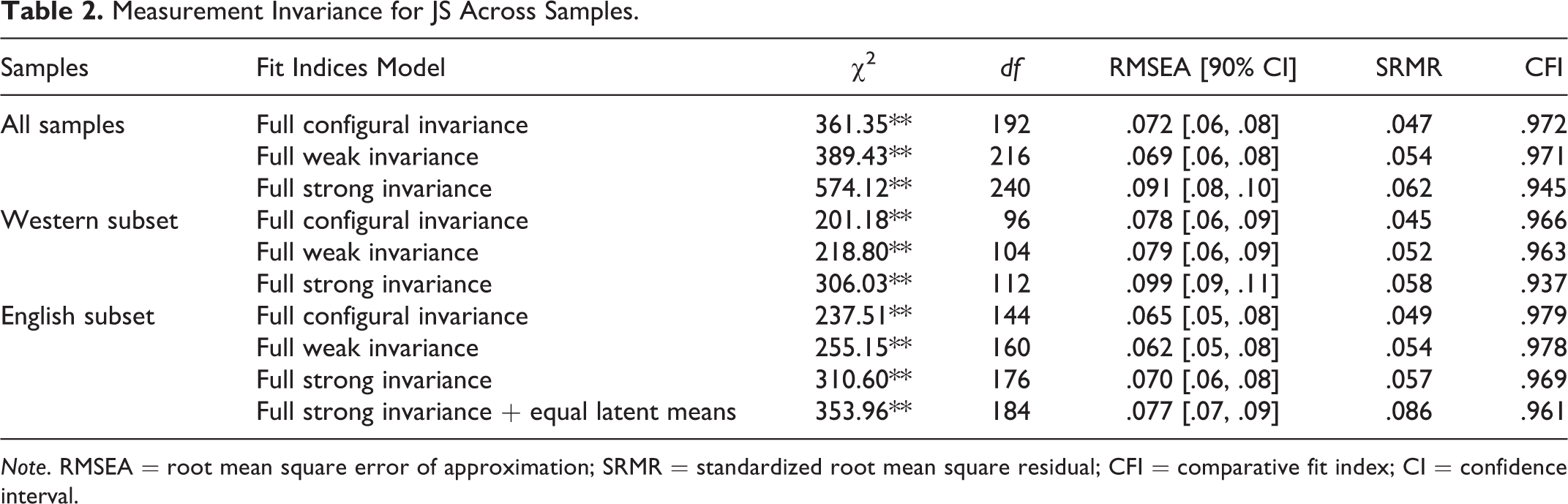
Note. RMSEA = root mean square error of approximation; SRMR = standardized root mean square residual; CFI = comparative fit index; CI = confidence interval.
Strong measurement invariance between the English-speaking samples allowed for meaningful comparison of latent means between these groups (see Online Supplement Table S3 for estimated latent means). We explored differences in latent factor means between our Filipino and Australian samples by restricting them to equality. The model continued to yield an acceptable fit to the data (see lower part of Table 2), suggesting that latent means did not differ significantly between the English-speaking samples.
Cooperation Behavior in the Trust Game
For each trust game decision, we only had a single manifest indicator. Therefore, measurement invariance at the latent level could not be tested. We tested for differences in manifest mean levels between our samples (Table 3). There were no significant differences in cooperation under threat of exploitation, F(3, 628) = 0.84, p = .47, η2 = .004, or cooperation under temptation, χ2(3, 628) = 0.31.
Trust Game Decisions, Separately for Each Sample.
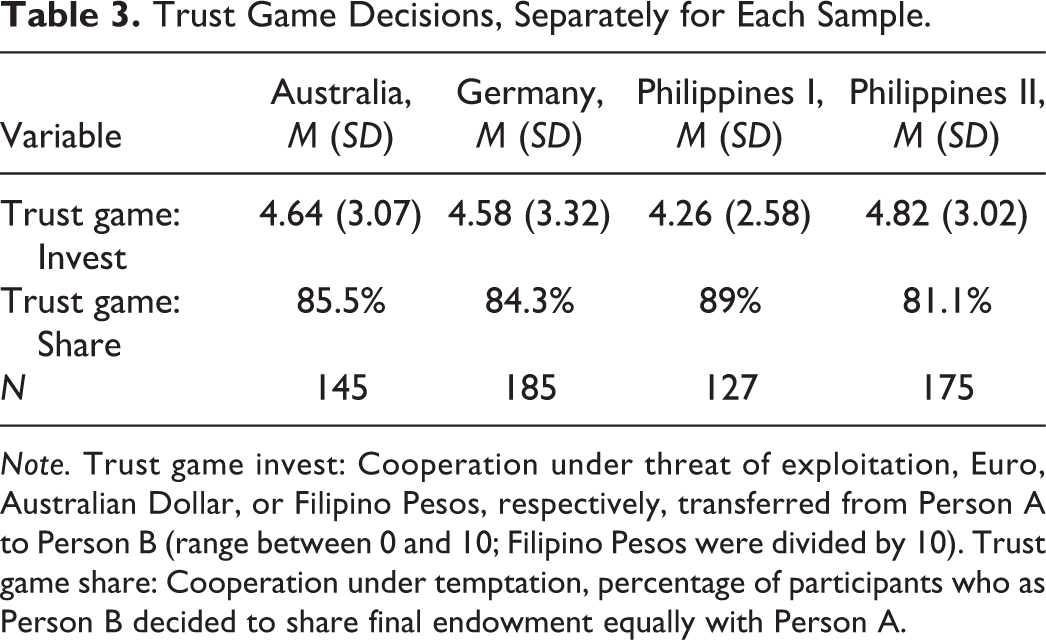
Note. Trust game invest: Cooperation under threat of exploitation, Euro, Australian Dollar, or Filipino Pesos, respectively, transferred from Person A to Person B (range between 0 and 10; Filipino Pesos were divided by 10). Trust game share: Cooperation under temptation, percentage of participants who as Person B decided to share final endowment equally with Person A.
Next, we tested whether the Justice Sensitivity perspectives predicted trust game decisions as hypothesized, and whether they did so invariantly across groups. (Manifest bivariate correlations per country are provided in the Online Supplement Material, Table S2.) For the Justice Sensitivity perspectives, we used the latent measurement model with weak measurement invariance. In separate bivariate regression analyses, we regressed each manifest trust game decision on each latent Justice Sensitivity perspective. For all models, restricting regression coefficients to equality across samples yielded an acceptable fit to the data (see Online Supplement Material, Table S4 for fit indices of all models, without and with regression coefficients constraint to equality across samples). This indicated that the association between the Justice Sensitivity perspectives and behavioral cooperation in the trust game did not differ significantly between samples.
We tested our hypotheses by inspecting latent regression weights. In line with Hypothesis 1, there was a significant negative association between victim sensitivity and cooperation under threat of exploitation, B = −.56, SE = .13, z = −4.13, p < .001, −.13 > β > −.24. Victim sensitivity was not significantly correlated with cooperation under temptation, B = −.05, SE = .08, z = −0.61, p = .54. Contrary to Hypothesis 2a, cooperation under threat of exploitation was not significantly predicted by observer sensitivity, B = −.24, SE = .18, z = −1.33, p = .18, beneficiary sensitivity, B = −.16, SE = .15, z = −1.06, p = .29, or perpetrator sensitivity, B = −.02, SE = .16, z = −0.13, p = .90. However, in line with Hypothesis 2b, cooperation under temptation was positively predicted by observer sensitivity, B = .26, SE = .09, z = 2.74, p = .006, .17 < β < .20, beneficiary sensitivity, B = .33, SE = .08, z = 4.30, p < .001, .24 < β < .31, and perpetrator sensitivity, B = .38, SE = .08, z = 4.81, p < .001, .27 < β < .30.
Discussion
The present research had two central aims. First, we sought to establish whether the Justice Sensitivity scales exhibit measurement invariance across samples from the Philippines, Germany, and Australia. Second, we investigated the capacity of the Justice Sensitivity perspectives to predict cooperation behavior in a trust game, extending our understanding of links between the prosocial Justice Sensitivity perspectives (observer, beneficiary, and perpetrator sensitivities) and cooperation under two conditions, namely, threat of exploitation and temptation. By comparing these links across cultures, we scrutinized the cross-cultural invariance of the psychological functioning of Justice Sensitivity.
Measurement Invariance of Justice Sensitivity Scales and Mean-Level Differences
Across all four samples, it was necessary to reject strong (scalar) measurement invariance in the Justice Sensitivity scales. Therefore, across samples, manifest scores in item responses likely do not correspond to the same scores on the latent construct. Exploring different subsets of our samples suggested that violations of strong measurement invariance may have been due to the different languages in which items were presented, being evident when comparing Australia and Germany, rather than to cultural differences, not being evident when comparing the two English-speaking countries (Philippines vs. Australia). Potentially, improving the translations of the Justice Sensitivity scales could serve to strengthen measurement invariance and increase the prospect of meeting the prerequisite for meaningful mean-level comparisons (Grimm & Church, 1999; He & van de Vijver, 2012).
Our results are cautionary with regard to the interpretation of previous cross-cultural mean-level comparisons, where measurement invariance was not scrutinized (Wu et al., 2014). As long as strong measurement invariance is not established in those samples, the reported results remain ambiguous as to whether mean differences reflect true differences in the latent construct or rather differences in meanings assigned to items or response tendencies (He & van de Vijver, 2012). Among the present English-speaking samples, for which strong measurement invariance could be assumed, we did not observe any significant differences in mean levels of the latent Justice Sensitivity perspectives. This observation is inconsistent with the speculation that more collectivist cultures may score higher on prosocial Justice Sensitivity perspectives (cf. Wu et al., 2014). Of course, large-scale comparisons among samples from many countries are necessary to draw firm conclusions regarding associations between cultural characteristics and national Justice Sensitivity mean levels. Such comparisons could take into account further cultural dimensions that should be particularly relevant for individual differences in justice concerns and their behavioral consequences. For example, contextualism, a facet of collectivism, might be distinctly relevant for whether advantages acquired through social status or relational ties are seen as deserved (Owe et al., 2013), presumably going along with lower individual levels in beneficiary sensitivity. As a further cultural dimension, societies differ with regard to the strength of social norms and intolerance toward deviance (“tightness–looseness”; Gelfand et al., 2011). Potentially, we would observe less variance in cooperative behavior and less predictive power of individual-level Justice Sensitivity, in tight (vs. loose) societies where social pressures are high.
Invariance of Psychological Functioning of Justice Sensitivity for Cooperation
Past research using Western samples has suggested that Justice Sensitivity perspectives predict cooperative decisions (e.g., Gollwitzer et al., 2005), but these effects have not previously been compared across cultures. Addressing our second aim, we found evidence that associations between Justice Sensitivity perspectives and cooperation behavior generalize to cultural contexts of rural and urban Philippines. Although on a manifest level, bivariate correlations were not identical, we did not find significant differences in these associations across our four samples. Consequently, it seems reasonable to assume that the Justice Sensitivity perspectives have similar psychological function with respect to cooperation behavior across the investigated cultures.
Overall, there was a small negative correlation between victim sensitivity and cooperation under threat of exploitation. As proposed previously, victim sensitivity appears to involve a fear of being exploited, leading to uncooperative behavior to prevent future exploitation (Gollwitzer et al., 2013). Contrary to our expectation, we found no significant correlations between observer, beneficiary, or perpetrator sensitivities and cooperation under threat of exploitation. These findings seem to contradict positive correlations previously reported between the prosocial Justice Sensitivity perspectives and self-reported trust (Schmitt et al., 2005). Yet we can speculate that the decision whether to invest money as Person A in the trust game might not be seen generally as a requirement of justice but rather as a way to maximize personal outcomes coupled with uncertainty about the trustworthiness of the interaction partner. By contrast, when playing the trust game in the role of Person B, individuals high in the prosocial Justice Sensitivity perspectives were particularly reluctant to commit injustice by keeping all the money for themselves. This supports the theoretical proposal that people who exhibit heightened Justice Sensitivity from these prosocial perspectives are inclined to overcome selfish temptation because of their concern to ensure justice for others.
Limitations
Several limitations should be taken into account when drawing conclusions from our findings. First, the Justice Sensitivity Inventory was not translated into local Filipino dialects. Although English is the language of education, this does not rule out the possibility that responses may differ to questionnaires presented in one’s mother tongue and in the English language (Church, 1987). Based on our findings suggesting that measurement invariance might arise due to translations of items, utmost care should be invested when translating the Justice Sensitivity scales into Filipino and Cebuano, for delivery to samples from the Philippines. Second, our samples comprised only students. Consequently, we cannot be certain that our findings will prove to be representative of all social sectors within the sampled cultures. Third, while we tested measurement invariance for the Justice Sensitivity scales, we were not able to do so for the trust game decisions because we only had a single indicator per decision. The decisions were incentivized in all samples, and incentives were comparable relative to the national average income. Nevertheless, how the game setting is subjectively construed might be different between individuals and cultures. Finally, in future studies, it will be desirable to conduct comparisons across a wider variety of different cultures. While the present findings have particular value because Philippines represent a greatly underresearched population for personality and social psychology, we cannot generalize our findings to other Asian or collectivist cultures. Illuminating the association between cultural dimensions and JS perspectives will be best achieved by on comparisons involving a large number of countries.
Conclusions
This study makes an important contribution to cross-cultural research regarding Justice Sensitivity and its behavioral concomitants. Whereas previous work on individual differences in the subjective importance of matters of justice and injustice has been limited to Western samples, we tested the generalizability of findings by comparing Western samples to samples from the underrepresented collectivist cultural context of urban and rural Philippines.
Importantly, we found the basic structure of the construct of Justice Sensitivity to be invariant, best described by four latent factors representing sensitivities for injustice from the different perspectives of victim, observer, beneficiary, and perpetrator. The German and English versions of the Justice Sensitivity scales served to equivalently capture individual differences in these Justice Sensitivity perspectives (metric invariance), satisfying the prerequisite necessary to compare correlations between Justice Sensitivity perspectives and cooperation behavior in the trust game. Invariantly across the cultural contexts studied here, victim sensitivity predicted reluctance to cooperate under threat of exploitation, whereas observer, beneficiary, and perpetrator sensitivities predicted increased cooperation under temptation. These results support the notion that victim sensitivity involves a fear of being exploited, whereas the prosocial Justice Sensitivity perspectives involve a genuine concern to ensure justice, even when there is temptation to behave selfishly.
Supplemental Material
Supplemental Material, Supplemental_material_JS_cross-cultural_revision - A Cross-Cultural Study of Justice Sensitivity and Its Consequences for Cooperation
Supplemental Material, Supplemental_material_JS_cross-cultural_revision for A Cross-Cultural Study of Justice Sensitivity and Its Consequences for Cooperation by Anna Baumert, Simona Maltese, Dorota Reis, Colin MacLeod, Roseann Tan-Mansukhani, Adrianne John R. Galang, Maria Guadalupe C. Salanga and Manfred Schmitt in Social Psychological and Personality Science
Footnotes
Authors’ Note
Anna Baumert and Simona Maltese shared first authorship.
Declaration of Conflicting Interests
The author(s) declared no potential conflicts of interest with respect to the research, authorship, and/or publication of this article.
Funding
The author(s) disclosed receipt of the following financial support for the research, authorship, and/or publication of this article: This research was supported by Grants from the German Research Foundation (SCHM1092-10/3 and BA3883/4-1) and from the Australian Research Council (FL170100167), by a grant awarded to Simona Maltese from the German Academic Exchange Service, and by a grant awarded to Adrianne John R. Galang (Postdoc@MUNI no. CZ.02.2.69/0.0/0.0/16_027/0008360) funded by the European Structural and Investment Funds, Operational Programme Research, Development and Research, through the Czech Ministry of Education, Youth, and Sports.

Supplemental Material
The supplemental material is available in the online version of the article.
Notes
References
Supplementary Material
Please find the following supplemental material available below.
For Open Access articles published under a Creative Commons License, all supplemental material carries the same license as the article it is associated with.
For non-Open Access articles published, all supplemental material carries a non-exclusive license, and permission requests for re-use of supplemental material or any part of supplemental material shall be sent directly to the copyright owner as specified in the copyright notice associated with the article.
