



Abstract
The current research dealt with the stereotype that only children are more narcissistic than people with siblings. We first investigated the prevalence of this stereotype. In an online study (Study 1, N = 556), laypeople rated a typical only child and a typical person with siblings on narcissistic admiration and narcissistic rivalry, the two subdimensions of the Narcissistic Admiration and Rivalry Questionnaire. They ascribed both higher admiration and higher rivalry to the only child. We then tested the accuracy of this stereotype by analyzing data from a large and representative panel study (Study 2, N = 1,810). The scores of only children on the two narcissism dimensions did not exceed those of people with siblings, and this result held when major potentially confounding covariates were controlled for. Taken together, the results indicate that the stereotype that only children are narcissistic is prevalent but inaccurate.
People high in grandiose trait narcissism are egocentric, feel entitled to special treatment, lack regard for other people, and put themselves above others (Krizan & Herlache, 2017; Morf & Rhodewalt, 2001). To pursue their egoistic goals, grandiose narcissists do not shy away from socially disruptive behaviors such as aggression (Bushman & Baumeister, 1998), bullying (Fanti & Henrich, 2015), sexual coerciveness (Holtzman & Strube, 2011), or workplace deviance (Judge, LePine, & Rich, 2006).
In order to curb the social costs associated with narcissism, it is imperative to understand the ontogenetic origins of narcissism in the first place. But what determines a person’s level of narcissism? As for most personality traits, genes are an important factor. Results from family studies indicate that genetic factors account for approximately 50% of the variance in grandiose narcissism (Luo, Cai, Sedikides, & Song, 2014). In addition, upbringing plays a relevant role. A number of parenting practices might affect children’s narcissism (Otway & Vignoles, 2006; Wetzel & Robins, 2016), and two of them that seem particularly relevant are parental overvaluation and inflated parental expectations (Brummelman et al., 2015; Thomaes & Brummelman, 2018). The basic assumption is that children internalize their parents’ praise and expectations and develop narcissistic features such as feelings of grandiosity and entitlement.
From this background, it is conceivable that only children, who do not have to share their parents’ attention with any siblings, develop higher narcissism levels than individuals who grow up with a sibling or several of them (i.e., non-only children). In fact, the proposition that people’s personality is shaped by whether or not they have siblings (e.g., Adler, 1930; Taylor, 1945) and, if they do, by their birth order position (e.g., Adler, 1928; Sulloway, 1996) is widespread in the literature. The specific claim that only children are higher in narcissism than non-only children has repeatedly been made both by researchers (e.g., Kernberg, 1975; Kohut, 1977; Millon, 1981) and in media reports (e.g., Marie, 2017; Sorensen, 2015).
But is this claim valid? The evidence is inconclusive. Some studies have reported higher narcissism levels among only children than among non-only children (Cai, Kwan, & Sedikides, 2012; Curtis & Cowell, 1993), whereas others have reported no significant difference between the two groups (Eyring & Sobelman, 1996; Watson & Biderman, 1989).
A potential explanation for these inconsistent results is that previous studies have suffered from at least one of the following three methodological limitations. First, in many studies, the sample size was too small to reliably detect small- to medium-sized effects. Second, none of the studies used a representative sample, which would be necessary to draw general conclusions about the respective population. Third, potential confounding covariates have often been neglected in previous studies. Such confounding variables would affect whether or not people are only children while simultaneously influencing their narcissism levels. If neglected, such confounding variables might artificially inflate, or suppress, the difference between only children and non-only children in narcissism. There are some variables that are known to correlate either with narcissism or with only child status and are thus potential confounders. High levels of narcissism are associated with male gender (Grijalva et al., 2015), young age (Foster, Campbell, & Twenge, 2003), high socioeconomic status (Piff, 2014), and the tendency to live in urban (rather than rural) areas (Cai et al., 2012). Only children, on the other hand, are more common in rural areas (Blake, 1981), often grew up with only one parent (Grall, 2018) and, at least in Germany, are underrepresented among persons with a migration background (Mayer & Riphahn, 2000).
Beyond these methodological limitations, past research has also not distinguished between different subdimensions of grandiose narcissism. According to the Narcissistic Admiration and Rivalry Concept (Back et al., 2013), the two major subdimensions of grandiose narcissism are narcissistic admiration, which describes a propensity for agentic self-enhancement, and narcissistic rivalry, which describes a self-protective tendency toward interpersonal antagonism. Even though the two subdimensions are positively linked, they often have strikingly different, sometimes even divergent, correlations with third variables (Back, 2018; Back et al., 2013). If excessive parental praise and attention indeed raise narcissism levels among only children, this should primarily affect the admiration dimension. Concerning the rivalry dimension, the prediction is less clear. It is even conceivable that it might be attenuated among only children because these children do not have to compete with siblings for their parents’ attention. In any case, it seems necessary to study the subdimensions separately.
The goal of the current research was to study both (a) the stereotype about differences between only children and non-only children in narcissism and (b) actual differences between the two groups. In Study 1, we addressed the stereotype and investigated whether the negative view on only children which is maintained by some authors is also shared by laypeople in general. In Study 2, we tested the accuracy of this view. Overcoming all four limitations of prior research, we analyzed a large and representative data set, considered potential confounders as covariates, and tested narcissistic admiration and rivalry separately.
Study 1
In Study 1, we investigated the prevalence of the stereotype that only children are higher in narcissism than non-only children. We examined whether, due to claims from the scientific literature, popular science publications, and media reports, laypeople may have adopted the belief that only children are higher in narcissism than non-only children. We also took into account the possibility that the effect might be qualified by the only child status of the rater. Stereotypes are often more pronounced if raters judge targets who belong to an out-group rather than the raters’ in-group (Hogg, 2016; Tajfel & Turner, 1986). Accordingly, we tested whether the stereotype that only children are higher in narcissism than non-only children is attenuated in raters who are non-only children and whether it is comparatively weaker, or even absent, in raters who are only children themselves.
Method
The data and analysis script can be downloaded here: https://osf.io/q65fa/?view_only=4ad35860c1eb49519f538b1523116d79
Sample
Participants were registered on the online panel Psyweb (https://psyweb.uni-muenster.de), which allows the recruitment of a large and heterogeneous sample. Seven hundred eighty-four individuals began completing the online questionnaire, and our final sample (consisting of cases that had no missing values on any of the key variables, who indicated that they answered the questions seriously, and who agreed that their data could be analyzed) consisted of 556 participants. The sample size was sufficient for detecting small effect sizes (d = 0.20) in a paired samples t test with a probability of 99.0% (two-tailed test, α level = .05, correlations between repeated measurements derived from the current data: r = .40; Faul, Erdfelder, Lang, & Buchner, 2007). Participants’ mean age was 46.3 years (SD = 14.4), and 63.7% were women (36.2% were men, and 0.2% indicated “none or both”). One hundred five participants (18.9%) were only children. Of the non-only children, 46.3% had one sibling, 29.7% had two siblings, 15.5% had three siblings, 4.9% had four siblings, and 3.5% had more than four siblings. To obtain an indicator of participants’ own only child status, we computed a binary dummy variable (0 = no siblings, 1 = at least one sibling).
Procedure and Measures
The study had been advertised as an investigation of how certain groups of people are perceived by the general population. Participants were told that their task was to estimate the extent to which only children differ from non-only children in terms of their personality. They were presented with the 6 items from the short form of the Narcissistic Admiration and Rivalry Questionnaire–Short Scale (NARQ-S; Back et al., 2013; Leckelt et al., 2018) and requested to indicate the extent to which the respective statement applied to a typical only child and then separately to a typical person with at least one sibling (1 = does not apply at all to 6 = fully applies). Ratings for the typical only child were always made first. Reliabilities for estimates for only children were α = .76 for narcissistic admiration and α = .70 for narcissistic rivalry, and reliabilities for estimates for non-only children were α = .74 for narcissistic admiration and α = .64 for narcissistic rivalry. The study also contained the following variables that were not analyzed for the current research question: self-reported narcissism, 1 level of education, occupation, marital status, and number of own children (all variables are contained in the data file that is available online).
Results
We first tested whether participants provided different narcissism judgments for only children and non-only children. Participants indeed ascribed higher narcissistic admiration, t(555) = 8.96, p < .001, d = 0.42, CI [.33, .51], and higher narcissistic rivalry, t(555) = 9.41, p < .001, d = 0.44, CI [.35, .53], to only children than to non-only children (see Figure 1, top panel). 2 Thus, only children were judged higher than non-only children on both dimensions of narcissism.
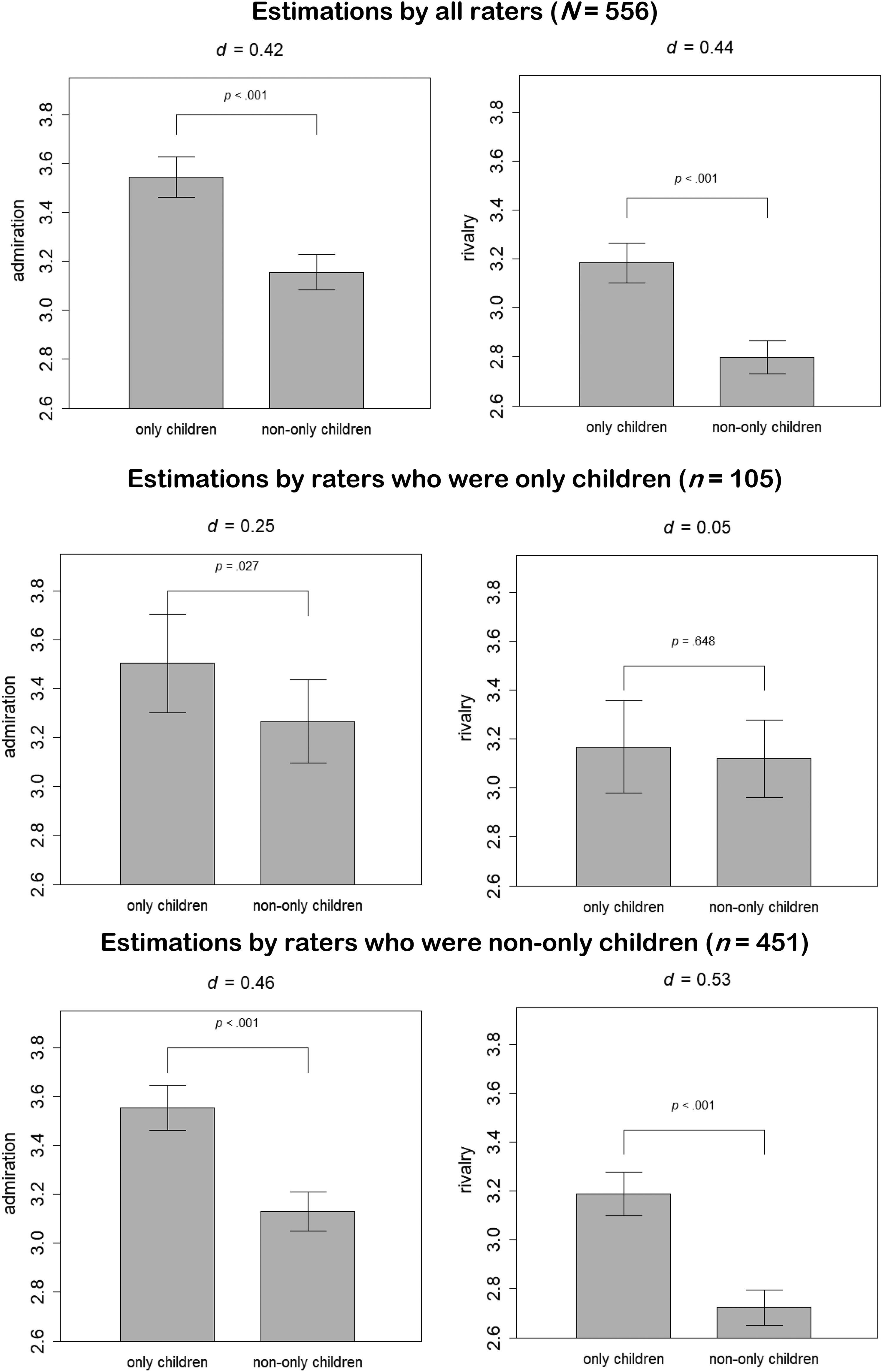
Estimations of only children and non-only children with regard to narcissistic admiration and narcissistic rivalry made by all raters (top panel), by raters who were only children (middle panel), and by raters who were non-only children (bottom panel). Error bars represent 95% confidence intervals.
We then took the only child status of the rater into account. When we focused on judgments of raters who were only children, we found that they judged only children higher in admiration than non-only children, t(104) = 2.24, p = 0 .027, d = 0.25, CI [.03, .47], but not in rivalry, t(104) = .46, p = .648, d = .05, CI [−.18, .28] (see Figure 1, middle panel). When we analyzed judgments of raters who were non-only children, we found that they judged only children higher in both admiration, t(450) = 8.95, p < .001, d = 0.46, CI [.36, .56], and rivalry, t(450) = 10.65, p < .001, d = 0.53, CI [.44, .63] (see Figure 1, bottom panel). Thus, raters who were non-only children descriptively had a stronger tendency to ascribe higher levels of both admiration and rivalry to only children than to non-only children.
To test whether these differences were statistically significant, we computed two analyses of variance (one for ratings of admiration and one for ratings of rivalry as the outcome variable), including the only child status of the target as a within-subjects factor (with two levels: target is an only child vs. target is a non-only child) and the only child status of the rater as a between-subjects factor (again with two levels: rater is an only child vs. rater is a non-only child). For ratings of admiration, the interaction was not significant, F(1, 554) = 2.84, p = .092, ηp 2 = .005, 95% CI: [.000, .023], which means we found no evidence that raters who were non-only children differentiated more between only children and non-only children in their judgments than raters who were only children (although the contrast was descriptively stronger). For ratings of rivalry, however, the interaction was significant, F(1, 554) = 16.26, p < .001, ηp 2 = .029, 95% CI: [.008, .061], which indicates that the tendency to differentiate between only children and non-only children in terms of rivalry was stronger among evaluators who were non-only children. Mean scores and standard deviations for all judgments can be found in Online Table S1 of the Supplemental Material available online.
Discussion
Study 1 indicates that laypeople indeed ascribed both higher admiration and higher rivalry to only children than to non-only children. For admiration, this tendency was present both among raters who were only children themselves and among raters who were non-only children, and the nonsignificant interaction effect indicates that the tendency was not substantially stronger among one of the groups. For rivalry, however, the tendency to ascribe higher levels to only children was present only among raters who were non-only children and also significantly stronger for this group of raters. Thus, laypeople believe that only children have higher levels of narcissism than non-only children, yet with regard to narcissistic rivalry, this is the case only among raters who are non-only children themselves.
Study 2
In Study 2, our aim was to provide a thorough test of potential differences between only children and non-only children in terms of narcissism. We did so by analyzing data from a large-scale investigation that had four major advantages. First, the sample size was large enough to detect effect sizes of the magnitude of the stereotype and even effects sizes that are considerably smaller with high power (see below). Second, the sample was representative of the German population, which allowed for a comparison of the typical only child with the typical non-only child. Third, the sample contained the most important potentially confounding demographic variables, which could be used as covariates for a robustness check. Fourth, the study included separate assessments of the two major subdimensions of grandiose narcissism: admiration and rivalry.
Method
Due to the German data protection law, we could not make the data publicly available. However, the data can be requested from the German Institute for Economic Research/German Socio-economic Panel Study (e-mail:
Sample and Measures
We analyzed data from the Innovation Sample of the Socio-Economic Panel (SOEP-IS; Richter & Schupp, 2012). The SOEP-IS is a nationally representative longitudinal study of private households in Germany which incorporates a set of core questions and innovative content that varies annually. The data were collected via computer-assisted personal interviewing by a fieldwork organization (TNS Infratest Social Research, Munich, Germany; http://www.tns-infratest.com).
We analyzed data from participants for whom data were available for only child status as well as for all narcissism items. The resulting sample size was N = 1,810 (52.3% women, 47.7% men; age: M = 52.1, SD = 18.0), including 233 only children and 1,577 non-only children. In Study 1, participants reported the belief that only children are higher in admiration than non-only children, and the magnitude of this effect was d = 0.42. Participants also reported the belief that only children are higher in rivalry than non-only children, and the magnitude of this effect was d = 0.44. The sample size in Study 2 was sufficient for detecting effects of the magnitude of d = 0.42 in an independent samples t test with a probability of more than 99.9% (one-tailed test, α level = .05; Faul et al., 2007). The sample size was also sufficient for detecting effect sizes that are considered small by conventional standards (d = 0.20) with a probability of 88.6% (one-tailed test, α level = .05; Faul et al., 2007).
Of the non-only children, 39.7% had one sibling, 27.9% had two siblings, 15.2% had three siblings, 8.8% had four siblings, and 8.4% had more than four siblings. To obtain an indicator of participants’ only child status, we computed a binary dummy variable (0 = no siblings, 1 = at least one sibling). Narcissism was assessed in 2013 with the NARQ-S (1 = do not agree at all to 6 = agree completely). Reliabilities were α = .82 for admiration and α = .60 for rivalry.
As covariates, we used age, sex, socioeconomic status, place of residence during childhood (0 = rural, 1 = urban), presence versus absence of both parents during childhood (0 = spent less than 15 years in one household with both parents, 1 = spent at least 15 years in one household with both parents), and migration background (0 = both parents German, 1 = at least one parent non-German). Rather than the participant’s own socioeconomic status, we used parental socioeconomic status because the variable could then be guaranteed to be only a potential cause and not a consequence of narcissism. Parental socioeconomic status was indicated by parents’ level of education (0 = no school degree, 1 = basic level of secondary education [Hauptschulabschluss], 2 = intermediate level of secondary education [mittlere Reife], 3 = highest level of secondary education [Fachabitur/Abitur]) and by their occupational prestige (Treiman, 1977). Because having one parent with high education or a prestigious occupation might suffice to increase children’s narcissism levels, we coded the maximum score that one of the parents obtained for both variables.
Results
We first used one-tailed t tests to examine whether the only children were more narcissistic than the non-only children. This was not the case for admiration, t(1808) = −1.43, p = .923, d = −0.10, 95% CI: [−.24, .04], or for rivalry, t(1808) = −0.46, p = .678, d = −0.03, 95% CI: [−.17, .11]. 3 Descriptively, the only children even scored lower on admiration and rivalry than the non-only children—which ran counter to the directed hypothesis that the only children would score higher on narcissism. Therefore, we also computed two-tailed p values to test whether there were significant differences between the only and non-only children in any direction, which was not the case for admiration (p = .153) or for rivalry (p = .644). These results are displayed in the top panel of Figure 2, and mean scores and standard deviations for all ratings can be found in Online Table S2. Thus, we found no evidence for the claim that only children are more narcissistic than non-only children.
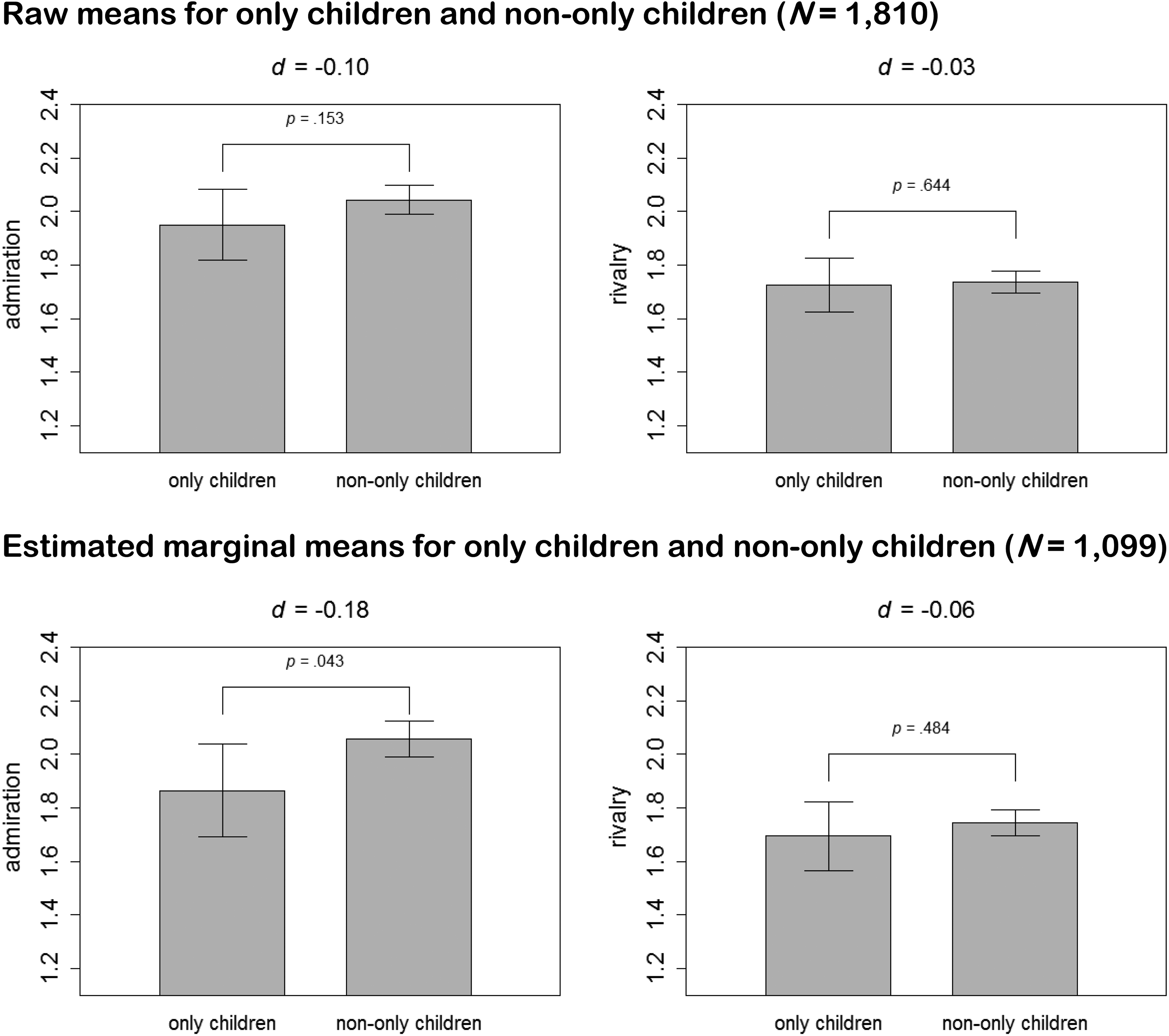
Narcissistic admiration and narcissistic rivalry in the only children and non-only children. Raw means are depicted in the top panel, and adjusted means (covariates: age, sex, parental occupational prestige, parents’ education, location of upbringing, migration background, and presence of both parents during childhood) are depicted in the bottom panel. Error bars represent 95% confidence intervals, and p values are two-sided.
We then tested whether the only children were higher in narcissism than the non-only children when covariates were controlled for (sex, age, parental socioeconomic status, location of upbringing, migration background, and the presence of both parents during childhood). Online Table S3 shows descriptive statistics for all study variables as well as their intercorrelations. The results indicated that also when the covariates were controlled for, there was no evidence for higher narcissism in the only children for admiration, F(1, 1090) = 4.11, one-tailed p = .979, two-tailed p = .043, ηp 2 = .004, CI: [.000, .014], or for rivalry, F(1, 1090) = .49, one-tailed p = .471, two-tailed p = .484, ηp 2 = .000, CI: [.000, .006]. 3 The bottom panel of Figure 2 displays the estimated marginal means when we controlled for the covariates, showing that similar to the analysis without covariates, the only children even scored lower on admiration and rivalry than the non-only children (the numerical values are shown in Online Table S2; complete results for both analyses of covariance are shown in Online Tables S4 and S5). As noted above, this difference, which is in the opposite direction than hypothesized, was even slightly below the significance threshold in a two-tailed test for admiration, but not for rivalry. Thus, once again, we found no evidence for the claim that only children are more narcissistic than non-only children.
Finally, we conducted a Bayesian t test using the JASP computer program Version 0.10 (JASP team, 2019) to examine whether the data would be more likely under the alternative hypothesis, which states that only children are higher in narcissism than non-only children, than under the null hypothesis, which states that only children are not higher in narcissism. We used the information on the stereotypes that we gained from Study 1 to specify the priors for our directed alternative hypotheses. That is, we formulated the alternative hypotheses by using a half-Cauchy prior centered on zero with a scale factor of 0.42 for admiration and 0.44 for rivalry (Lakens, McLatchie, Isager, Scheel, & Dienes, 2018). For admiration, the Bayes factor BF+0 was 0.056, which means that the data were more than 17 times less likely under the alternative hypothesis than under the null hypothesis. For rivalry, the Bayes factor BF+0 was 0.094, which means that the data were more than 10 times less likely under the alternative hypothesis than under the null hypothesis. Given the magnitude of the Bayes factors, the results strongly indicated that for both admiration and rivalry, the data were less likely under the alternative hypothesis than under the null hypothesis (Jeffreys, 1961). As Figures S1 and S2 show, most other prior values would have led to the same conclusions.
Discussion
By analyzing a large comprehensive data set, taking major covariates into account, and using a two-dimensional assessment approach in Study 2, we provided a thorough test of potential differences in narcissism between only children and non-only children. Yet, only children did not exceed non-only children on either of the two narcissism dimensions no matter whether we controlled for the covariates or not. When we controlled for the covariates, only children even scored lower in narcissistic admiration. Whereas we would abstain from putting too much weight on this small difference, particularly because it showed up only in the analyses with control variables, it clearly contradicts the common stereotype of the narcissistic only child. In fact, results of Bayesian analyses indicate that the hypothesis that only children are more narcissistic than non-only children is more than 10 times less likely to be true than the null hypothesis.
General Discussion
The results of Study 1 indicate that the general population embraces the stereotype that only children are narcissistic. These findings match well with earlier research showing that people on average have a rather negative view of only children (Mancillas, 2006), a view that is even shared by many clinical experts (Stewart, 2004). With regard to narcissistic admiration, the stereotype was present both in raters who were only children and in raters who were non-only children, and we found no evidence that the stereotype was substantially stronger in any of the groups. It seems likely that both groups of people adopted beliefs that have been propagated by scientists and journalists alike. With regard to narcissistic rivalry, the stereotype was exclusively maintained by raters who were non-only children themselves. Because rivalry is the more undesirable of the two narcissism dimensions (Back et al., 2013), this result hints that in-group bias (Hogg, 2016; Tajfel & Turner, 1986) might at least partly drive the effect. That is, it is possible that non-only children see only children as members of a distinct social group and evaluate them more negatively than members of their in-group.
The evidence from Study 2, however, indicates that this stereotype is false. We analyzed a large and representative data set, took potential confounds into account, and distinguished between admiration and rivalry as two major dimensions of grandiose narcissism. Yet, the results indicate that only children are not more narcissistic than non-only children on either of the two dimensions and regardless of whether or not we controlled for covariates. Previous research has indicated that neither only child status (Falbo, 2012; Falbo & Polit, 1986) nor birth order position (Damian & Roberts, 2015; Rohrer, Egloff, & Schmukle, 2015, 2017) has a substantial effect on most broad personality traits. The current results align with this general pattern. It contributes to the accumulating evidence demonstrating that only children and non-only children are not so different after in terms of their personality. Thus, laypeople’s beliefs concerning narcissistic only children are flawed.
The gap between people’s stereotypes and objective assessments has important implications. Narcissism is considered a “dark” (i.e., socially maladaptive) personality trait (Paulhus & Williams, 2002), and peers dislike individuals to whom they attribute narcissistic characteristics (Dufner et al., 2013; Hoorens, Pandelaere, Oldersma, & Sedikides, 2012). Thus, being perceived as high in narcissism on unjustified grounds is a liability that might cause discrimination against only children across life domains. Given this downside, researchers and journalists should refrain from portraying only children as narcissistic.
Furthermore, when sociologists, economists, or policy makers discuss the downsides of low fertility rates, they should let go of the idea that growing up without siblings leads to increased narcissism. There might of course be economic or societal costs associated with low birth rates (Uhlenberg, 2009), but increasing narcissism in the upcoming generation does not seem to be a factor that is relevant to the discussion.
Finally, when interpreting the current results, two caveats should be kept in mind. First, because the research was conducted exclusively in Germany, it is not clear whether our conclusions also generalize to other cultures, especially ones that are higher in collectivism. Second, our research exclusively dealt with grandiose narcissism and not with vulnerable narcissism or narcissistic personality disorder. Although existing stereotypes emphasize the grandiose aspects of narcissism, future research should test whether only children differ from non-only children in these more maladaptive forms of narcissism. In conclusion, this research suggests that the belief that only children are higher in grandiose narcissism than non-only children is widespread but inaccurate.
Supplemental Material
Supplemental Material, Supplemental_Material_SPPS_revision_final - The End of a Stereotype: Only Children Are Not More Narcissistic Than People With Siblings
Supplemental Material, Supplemental_Material_SPPS_revision_final for The End of a Stereotype: Only Children Are Not More Narcissistic Than People With Siblings by Michael Dufner, Mitja D. Back, Franz F. Oehme and Stefan C. Schmukle in Social Psychological and Personality Science
Footnotes
Author’s Note
All dependent variables or measures that were analyzed for this article’s target research question have been reported in the Method sections; all levels of all independent variables or all predictors or manipulations, whether successful or failed, have been reported in the Method sections; and the total number of excluded observations and the reasons behind their exclusion have been reported in the Method sections. Study 1 codebook, data, analysis scripts, and output are available at  . Study 2 data are available only from the German SOEP project due to third-party restrictions (for requests, please contact
Acknowledgments
The data from the German Socio-Economic Panel (SOEP) were made available to us by the German Institute for Economic Research. We are grateful to this institution for providing these data sets; however, the institution bears no responsibility for our analysis or interpretation of these data. We thank Jana Pförtner for her support in programming Study 1.
Declaration of Conflicting Interests
The author(s) declared no potential conflicts of interest with respect to the research, authorship, and/or publication of this article.
Funding
The author(s) received no financial support for the research, authorship, and/or publication of this article.
Supplemental Material
The supplemental material is available in the online version of the article.
Notes
References
Supplementary Material
Please find the following supplemental material available below.
For Open Access articles published under a Creative Commons License, all supplemental material carries the same license as the article it is associated with.
For non-Open Access articles published, all supplemental material carries a non-exclusive license, and permission requests for re-use of supplemental material or any part of supplemental material shall be sent directly to the copyright owner as specified in the copyright notice associated with the article.
