




Abstract
People often vote against the political establishment, as underscored by “Brexit” and the Trump election. The current contribution proposes that overclaiming one’s own knowledge predicts anti-establishment voting. We tested this idea in the context of a Dutch referendum on a European Union treaty with a clear pro- versus anti-establishment voting option. In a first wave (6 weeks before the referendum), Dutch citizens indicated their self-perceived understanding of the treaty, after which we tested their actual knowledge. We also measured participants’ general tendency to overclaim knowledge by assessing their familiarity with nonexisting stimuli. In a second wave shortly after the referendum, we asked participants what they had voted. Results revealed that increased self-perceived understanding yet decreased actual knowledge of the treaty, and general knowledge overclaiming, predicted an anti-establishment vote. Furthermore, these effects were most pronounced among right-wing extremists. We conclude that knowledge overclaiming predicts anti-establishment voting, particularly at the radical right.
Recent elections in representative democracies have underscored that many citizens vote against the political establishment—that is, “mainstream” parties and politicians that have dominated the political arena for decades. One example of such anti-establishment voting was the 2016 presidential election of Donald Trump, who blamed “the Washington-elite” for many wrongs in society and beat all establishment candidates during the Republican Party primaries. In the same year, relatively radical politicians within the United Kingdom (e.g., UKIP [UK Independence Party]) campaigned in favor of “Brexit,” whereas relatively moderate and mainstream politicians—and all major parties—largely campaigned in favor of “Remain”—and 52% of UK citizens voted against the establishment. What drives such anti-establishment voting? In the present contribution, we propose that one important psychological factor to consider is people’s tendency to overestimate, and overclaim, their own knowledge.
The present line of reasoning draws from the insight that anti-establishment sentiments constitute a core aspect of populism, radical politics, and protectionism (Judis, 2016; Müller, 2016; Oliver & Rahn, 2016). Although anti-establishment sentiments may occur across the political spectrum, it is most pronounced at the left and right extremes (e.g., Mudde & Kaltwasser, 2017; Schumacher & Rooduijn, 2013). We specifically assume that the psychological processes underlying relatively radical political beliefs fuel anti-establishment sentiments. Notably, distressing societal developments contribute to a polarizing political climate (Midlarsky, 2011), and studies indeed found a relationship between experiencing fear and support for relatively radical ideologies, at both extremes (Burke, Kosloff, & Landau, 2013; Castano et al., 2011; Van Prooijen, Krouwel, Boiten, & Eendebak, 2015) or at the radical right (Jost, Stern, Rule, & Sterling, 2017). Such feelings of distress induce a need for epistemic clarity, prompting a preference for radical leaders who give immediate and straightforward solutions for the problems that society faces (Hogg, Meehan, & Farquharson, 2010; Van Prooijen & Krouwel, 2019). We propose that anti-establishment sentiments also offer such epistemic clarity by blaming complex societal problems simply on the immorality or incompetence of the political establishment. Consistent with this argument, extremist or populist rhetoric is often characterized by catchy yet simplistic one-liners that blame the establishment for all the wrongs in society (Greenberg & Jonas, 2003; Hardin, 2002), decreased integrative complexity (Conway et al., 2016; Tetlock, Armor, & Peterson, 1994), conspiracy theories that implicate the political establishment (Inglehart, 1987; Van Prooijen, Krouwel, & Pollet, 2015), and a tendency to classify political stimuli into relatively simple categories (Lammers, Koch, Conway, & Brandt, 2017).
If anti-establishment sentiments increase people’s epistemic clarity of complex political issues and situations, it follows that anti-establishment voting is likely to be associated with high confidence in one’s own political views. After all, people generally feel confident about judgment domains that appear simple. This assertion is consistent with research showing that people who adhere to radical ideologies pursue their ideals with zeal and conviction (McGregor, 2006). Moreover, such high confidence occurs among both left- and right-wing extremists. As compared to moderates, both political extremes experience their beliefs on policy issues as superior (Toner, Leary, Asher, & Jongman-Sereno, 2013) and have more confidence in their domain-specific knowledge of geopolitical events (Van Prooijen, Krouwel, & Emmer, 2018). Likewise, political extremists at both sides of the spectrum tend to be less tolerant of people with different viewpoints than moderates (Crawford & Pilanski, 2014; Van Prooijen & Krouwel, 2017). Political extremists even display more confidence in nonpolitical numeric estimation tasks as compared to moderates (Brandt, Evans, & Crawford, 2015). While none of these studies examined anti-establishment sentiments nor voting behavior, they provide indirect support for the underlying assumption that radical political beliefs are associated with judgmental confidence.
An important question, then, is whether such high confidence is justified or exaggerated. Do people with radical, anti-establishment political views actually possess the knowledge to warrant such confidence? While studies conducted in the 1980s offer some support for this idea (Sidanius, 1988), a recent study suggests that radical political views are associated with more confidence but not with more knowledge (i.e., about the refugee crisis; see Van Prooijen et al., 2018). Relatedly, belief superiority predicts a large gap between self-perceived and actual knowledge (Hall & Raimi, 2018). Finally, moral conviction predicts caring about political issues (Skitka & Morgan, 2014), which in turn leads people to overrate the quality of their political argumentation (Fisher & Keil, 2014). More generally, the Dunning–Kruger effect stipulates that people who are relatively incompetent have the strongest tendency to overestimate their own competence (Kruger & Dunning, 1999). Combining these arguments would suggest that anti-establishment sentiments are associated with a tendency to overclaim knowledge—that is, a self-serving discrepancy between people’s self-perceived understanding, versus their actual knowledge, of political and societal issues. Whether such knowledge overclaiming increases the likelihood of anti-establishment voting, hence shaping election outcomes, has not yet been examined. The present research was designed to fill this void.
The Present Research
The present study took place during a national referendum with a clear pro- versus anti-establishment voting option. Specifically, on April 6, 2016, Dutch voters were asked whether they supported or opposed a European Union (EU) treaty designed to establish stronger political and economic connections between the EU and Ukraine. A vote in favor of the treaty is pro-establishment given that (a) all the Dutch mainstream political parties—ranging from the moderate left to the moderate right—campaigned in favor of the treaty and (b) support for the treaty was conceived of as support for existing EU institutions and EU integration. Moreover, voting against the treaty is anti-establishment given that (a) only anti-establishment parties at the extreme left (the Socialist Party; the Party for Animals) and extreme right (PVV [Partij voor de Vrijheid]; FvD [Forum voor Democratie]) campaigned against the treaty and (b) a vote against the treaty was conceived of as EU skeptic. Mirroring Brexit (although with less impactful consequences), Dutch voters rejected the treaty.
We sent e-mail links with questionnaires to a research panel in two waves. 1 The first wave started more than 6 weeks before the referendum, and the second wave started 2 days after the referendum. In the first wave, we asked participants to rate their self-perceived understanding of the treaty, which we conceptualize as a composite construct including the extent to which people experience self-efficacy to evaluate the treaty, and believe to have sophisticated knowledge of the treaty. Subsequently, we tested participants’ actual knowledge of the treaty. Based on our line of reasoning, we hypothesized that increased self-perceived understanding yet decreased actual knowledge of the treaty would predict anti-establishment voting 6 weeks later. In addition, we explored whether a general tendency to overclaim knowledge independent of politics (as indicated by familiarity ratings of nonexisting stimuli; Paulhus, Harms, Bruce, & Lysy, 2003) would predict anti-establishment voting.
Method
Procedure
We e-mailed a link with an online questionnaire (in Dutch) to a large research panel in the Netherlands in two waves. The panel is coordinated by Election Compass (“Kieskompas”), a Dutch political research organization that is affiliated with VU Amsterdam. Election Compass acts in line with the strict regulations of the Dutch Authority for the Protection of Personal Information (“Autoriteit Persoonsgegevens”; registration number m1457347) and with the ethical norms of VU Amsterdam. The first wave was about 6 weeks before a referendum in which the Dutch population voted about an association treaty between Ukraine and the EU. The second wave took place as of 2 days after the referendum. This short time span between the referendum and the last wave prevents the problem of voting overreporting, which is largely attributable to memory failure over a longer period of time (Belli, Traugott, Young, & McGonagle, 1999).
Participants
Wave 1 was sent to 53,733 e-mail address, which generated 13,323 complete responses (24.8%; 9,982 men, 3,341 women, Mage = 55.77, SD = 15.20). Education level in the sample was moderately high (median = higher vocational education or bachelor degree), and almost half of the sample reported being nonreligious (6,435 participants). Sample size was determined by stopping when no further responses came in. The link was open from February 18 to April 1, 2016 (i.e., up until 5 days before the referendum), although 97.1% of the sample responded in the first 12 days. The second wave was sent to 28,194 e-mails that included participants who had started Wave 1 (completed or uncompleted), plus panelist newly recruited during the referendum. The wave was open from April 8 to 19, 2016, generating 12,481 full responses (44.3%). Of them, 5,568 respondents also filled out the measures of the first wave that are relevant here and indicated to have voted in the referendum (3,255 in favor of the treaty and 2,313 against the treaty; sample varies per measure due to attrition and missing values). This sample forms the basis for our main analyses. An additional 2,044 participants that were in both waves had abstained from voting, and we analyze their responses in the Supplemental Materials. Together this yields 57.13% of complete Wave 1 responses that reported proestablishment voting, anti-establishment voting, or no voting in Wave 2. In the Supplemental Materials, we analyze what Wave 1 variables predict participation in Wave 2.
Wave 1
Measures
The full scales (including original Dutch wordings and English translations) are in the Supplemental Materials. Participants first completed a questionnaire of self-perceived understanding of the treaty. This included 3 items referring to participants’ self-efficacy in this judgment domain (e.g., “I consider myself sufficiently qualified to judge the association treaty between Ukraine and the EU”) and 2 items referring to their self-perceived knowledge (e.g., “I am well-informed about the contents of the association treaty between Ukraine and the EU”). Responses were on a scale ranging from 1 (strongly disagree) to 5 (strongly agree); there was also a sixth category (6 = no opinion), which was treated as missing value in the analyses. Together these 5 items had good reliability, suggesting that self-efficacy and self-perceived knowledge were closely associated and together formed the overarching construct self-perceived understanding (α = .85).
After filling out the self-perceived knowledge questionnaire (and without the option of backtracking), participants were presented with eight statements to test their actual knowledge of the treaty and the referendum. An example item was “This treaty ensures that Ukrainian citizens eventually can travel to all EU member states without a Visa.” Each statement could be answered with either “true,” “false,” or “do not know.” Participants received 1 point for a correct answer, 0 points for a “do not know,” and 1 point subtraction for an incorrect answer (note that we had to score incorrect answers more negatively than the “do not know” option to balance for a 50% chance of guessing correctly). We then calculated participants’ actual knowledge score. 5,476 participants who voted also filled out the actual knowledge test; of them, only 42 participants (less than 1%) had a perfect score of 8, and 67 participants (1.2%) had an almost perfect score of 7. This suggests that it is unlikely that many participants cheated on the test.
To measure anti-establishment sentiments, participants responded to 4 items (e.g., “Voting is useless, political parties do what they want anyway”). Responses again ranged from 1 (strongly disagree) to 5 (strongly agree). A sixth response option (6 = do not know/no opinion) was coded as missing in the analyses. 2 This scale had good reliability (α = .87).
We also assessed a measure of general knowledge overclaiming (cf. Paulhus et al., 2003). Participants were asked how familiar they were with 25 persons, objects, ideas, or places (e.g., “Houdini”; “Bay of Pigs”; “Euphemism”; 1 = never heard of, 5 = very familiar). Of the 25 terms, however, 8 were actually “foils” of nonexisting persons, objects, ideas, or places (e.g., “Meta-toxides”; “Queen Shattuck”). Following the procedure by Bing, Kluemper, Davison, Taylor, and Novicevic (2011), we calculated participants’ average familiarity ratings for these foils as measure of general overclaiming (α = .75; for an alternative, signal-detection approach, see Paulhus et al., 2003). Finally, participants placed themselves on a political left–right political dimension (1 = left wing, 11 = right wing).
Wave 2
As part of a larger questionnaire, participants indicated whether they had voted in the referendum. Among participants who had voted, we asked whether they voted in favor (establishment vote) or against (anti-establishment vote) the association treaty. The measure of voting behavior is our main dependent variable.
Results
The means, standard deviations, and intercorrelations of the variables are displayed in Table 1. Self-perceived understanding and actual knowledge of the treaty were positively correlated, which is consistent with previous research (Atir, Rosenzweig, & Dunning, 2015). This correlation does not preclude discrepancies between self-perceived understanding and actual knowledge of the treaty, however, and our prediction entails that this discrepancy is particularly large among citizens who vote against the establishment. To test this idea, we assessed to what extent self-perceived understanding and actual knowledge of the treaty would predict anti-establishment voting more than 6 weeks later in a logistic regression analysis. The large sample provides more than 99% power for even very small effect sizes, and therefore, we set α level of significance at .001 for all analyses.
Means, Standard Deviations, and Inter-Correlations Between the Measured Variables.
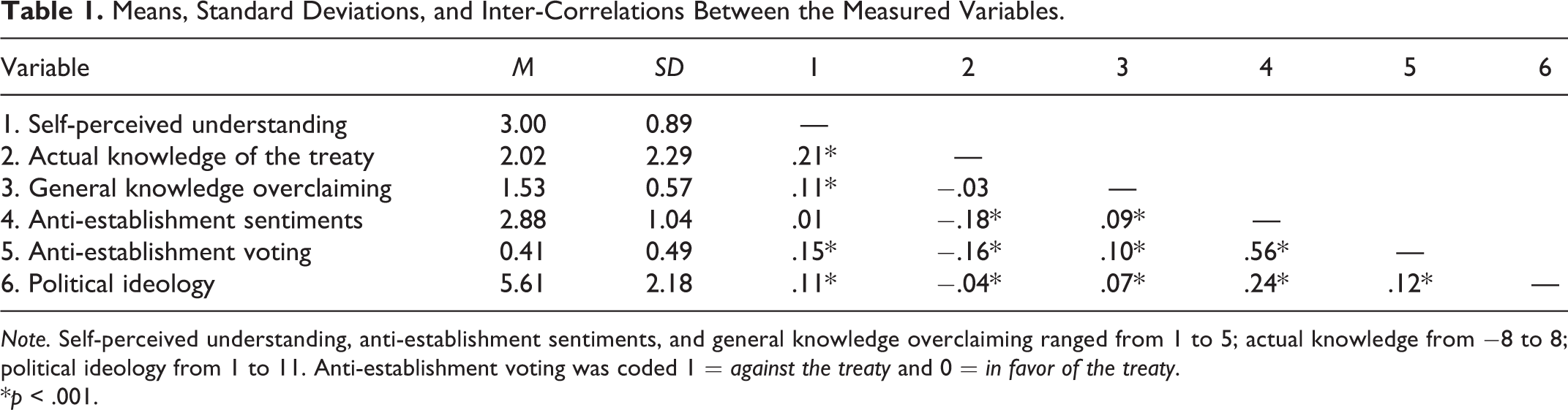
Note. Self-perceived understanding, anti-establishment sentiments, and general knowledge overclaiming ranged from 1 to 5; actual knowledge from −8 to 8; political ideology from 1 to 11. Anti-establishment voting was coded 1 = against the treaty and 0 = in favor of the treaty.
*p < .001.
Anti-establishment Sentiments
First, we assessed if our assumption that a vote against the treaty represented an anti-establishment vote is reasonable. In a logistic regression analysis, we entered age and gender (1 = man, 2 = woman) as control variables in Step 1; moreover, we also entered education as control variable (1 = no education to 7 = completed university education) to exclude the possibility that differences in anti-establishment sentiments or voting are due to educational differences. We entered anti-establishment sentiments in Step 2 of the model, and the dependent variable was anti-establishment voting (coded as 1 = voted against the treaty and 0 = voted in favor of the treaty). Step 1 was significant, χ2(3) = 475.16, p < .001 (Nagelkerke R2 = .12), revealing significant effects of all three control variables. Anti-establishment voting was less frequent among women, B = −0.30, SE = .07; Wald = 18.57; p < .001; Exp(B) = 0.74, and was less likely among people of older age, B = −0.01, SE = .002; Wald = 26.13; p < .001; Exp(B) = 0.99, and higher education levels, B = −0.48, SE = .02; Wald = 410.25; p < .001; Exp(B) = 0.62. Step 2 added significantly to the model, χ2(1) = 1506.99, p < .001; total model χ2(4) = 1982.15, p < .001 (Nagelkerke R2 = .42). Anti-establishment sentiments were stronger among people who voted against (M = 3.66, SD = 0.95) as opposed to in favor of the treaty (M = 2.43, SD = 0.87), B = 1.27, SE = .04; Wald = 1,089.28; p < .001; Exp(B) = 3.55. The odds ratio indicates that for each point increase in anti-establishment sentiments, an anti-establishment vote becomes 3.55 times more likely. These findings indicate that a vote against the treaty indeed was strongly associated with anti-establishment sentiments.
We also analyzed anti-establishment sentiments among participants who did not vote during the referendum. These analyses reveal that participants who voted against the treaty had stronger anti-establishment sentiments than participants who abstained from voting (see Supplemental Materials for statistical details). Figure 1 displays the distributions of anti-establishment sentiments as a function of self-reported voting behavior and shows that high anti-establishment sentiments are concentrated particularly among anti-establishment voters.
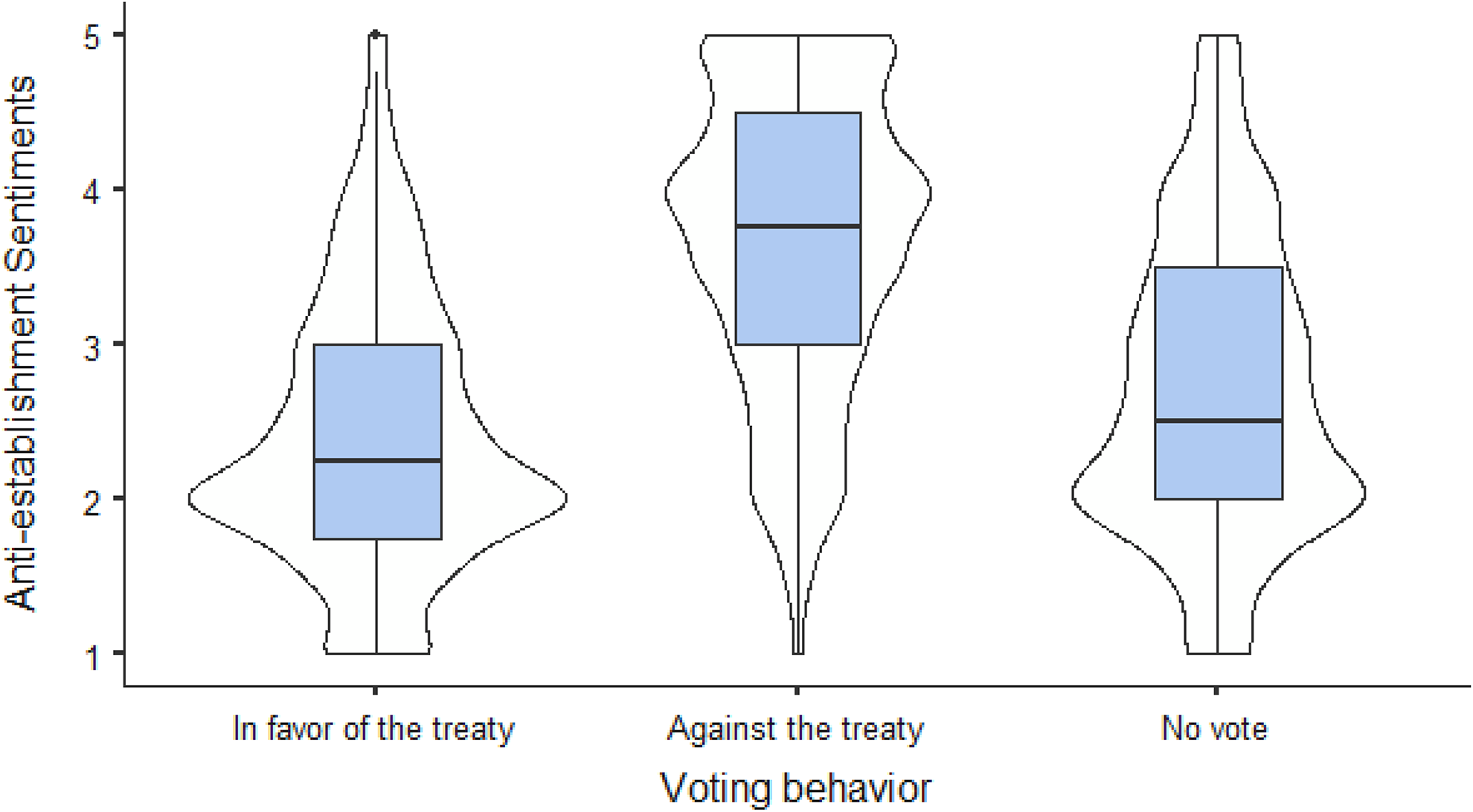
Distributions of anti-establishment sentiments as a function of voting behavior.
Finally, we conducted a hierarchical linear regression analysis with anti-establishment sentiments as dependent variable, entering the control variables in Step 1 and self-perceived understanding, actual knowledge, and general overclaiming in Step 2. Step 2 added significantly to the regression model, F(3, 13131) = 120.45, p < .001. Anti-establishment sentiments were associated with decreased actual knowledge of the treaty (β = −.13, p < .001) and increased general overclaiming (β = .09, p < .001), but not with self-perceived understanding (β = .02, p = .051).
Knowledge Overclaiming and Anti-establishment Voting
For our main analysis, we conducted a binary logistic regression analysis in which we again entered the control variables in Step 1 and added self-perceived understanding of the treaty, actual knowledge of the treaty, and general overclaiming in Step 2. Self-reported anti-establishment voting was the dependent variable. Step 1 containing the control variables was again significant, χ2(3) = 473.94, p < .001 (Nagelkerke R2 = .12). Step 2 added significantly to the regression model, χ2(3) = 304.92, p < .001; total model χ2(6) = 778.86, p < .001 (Nagelkerke R2 = .18). All three predictors were significant: Self-perceived understanding of the treaty predicted an increased likelihood of an anti-establishment vote, B = 0.48, SE = .04; Wald = 161.02; p < .001; Exp(B) = 1.62 (pro-establishment vote M = 3.07, SD = 0.82; anti-establishment vote M = 3.33, SD = 0.90). Actual knowledge of the treaty, however, predicted a decreased likelihood of an anti-establishment vote, B = −0.16, SE = .01; Wald = 128.47; p < .001; Exp(B) = 0.85 (pro-establishment vote M = 2.44, SD = 2.21; anti-establishment vote M = 1.67, SD = 2.36). Finally, general overclaiming predicted an increased likelihood of an anti-establishment vote, B = 0.24, SE = .06; Wald = 19.06; p < .001; Exp(B) = 1.27 (pro-establishment vote M = 1.47, SD = 0.52; anti-establishment vote M = 1.57, SD = 0.57) (See Figure 2). The odds ratios indicate that per measurement point, the chance for an anti-establishment vote becomes 1.62 times more likely for self-perceived understanding of the treaty and 1.27 times more likely for general overclaiming. For actual knowledge of the treaty, the odds ratio is smaller than 1, indicating that per measurement point increase the chance for an anti-establishment vote becomes less likely (i.e., by 0.85 times).
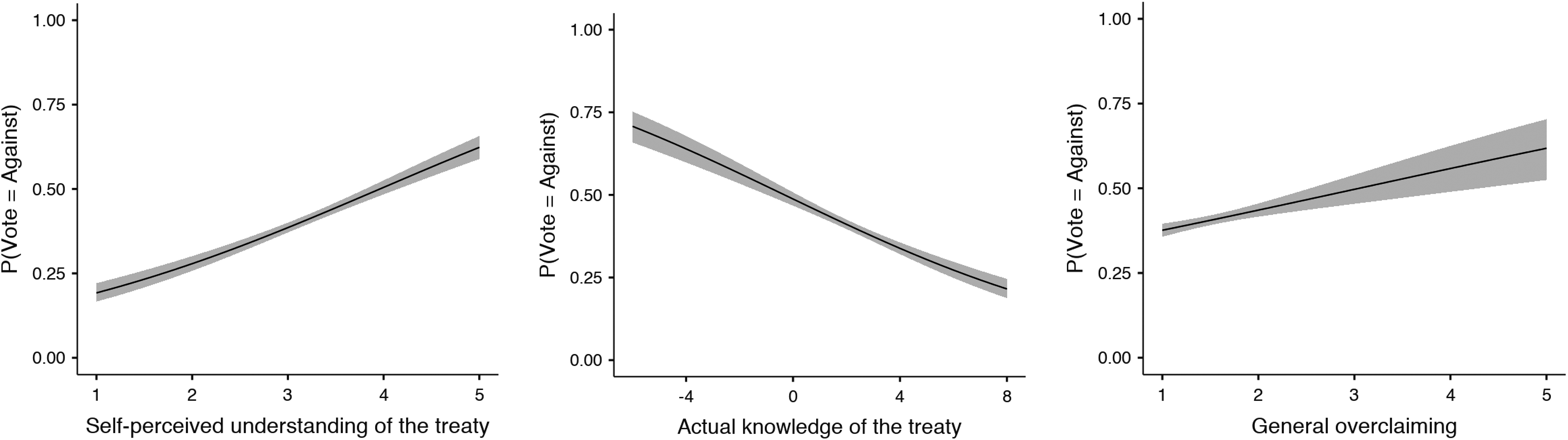
Logistic regression slopes and 95% confidence intervals of anti-establishment voting as function of self-perceived understanding of the treaty, actual knowledge of the treaty, and general overclaiming.
In sum, these findings indicate that increased self-perceived understanding yet decreased actual knowledge of the treaty predicted an anti-establishment vote. 3 Moreover, anti-establishment voting was associated with general knowledge overclaiming independent of politics. In the Supplemental Materials, we also report analyses of a difference score between self-perceived understanding and actual knowledge of the treaty, which yielded consistent results.
Confidence in Knowledge of the Treaty
We then constructed a measure of confidence in knowledge of the treaty by adding how often participants answered with “true” or “false” instead of “don’t know” to the knowledge test, independent of whether the answer was correct. This allowed us to (a) further validate the measures of self-perceived understanding and general overclaiming, which theoretically should be associated with confidence in knowledge and (b) test whether confidence in knowledge of the treaty would predict an anti-establishment vote. As to the first goal, we found that confidence in knowledge was significantly correlated with both self-perceived understanding of the treaty (r = .51, p < .001) and with general overclaiming (r = .11, p < .001), further supporting the validity of these measures.
As to the second goal, after again including the control variables in Step 1, we added the measures of confidence in knowledge and actual knowledge of the treaty in Step 2. This step added significantly to the regression model, χ2(2) = 195.23, p < .001; total model χ2(5) = 670.15, p < .001 (Nagelkerke R2 = .16). Independent of actual knowledge, confidence in knowledge predicted an increased likelihood of an anti-establishment vote (with an anti-establishment vote becoming 1.16 times more likely per measurement point of confidence in knowledge), B = 0.14, SE = .02; Wald = 97.25; p < .001; Exp(B) = 1.16 (anti-establishment vote M = 6.16, SD = 2.16; pro-establishment vote M = 5.74, SD = 2.19).
The Role of Political Ideology
Our line of reasoning was based on arguments that anti-establishment sentiments and voting are most common at the left and right extremes (e.g., Mudde & Kaltwasser, 2017; Schumacher & Rooduijn, 2013). In a more exploratory fashion, we therefore examined the U-shaped relationship between political ideology (self-placement on a left/right scale) and the indices of self-perceived understanding of the treaty, actual knowledge of the treaty, and general overclaiming. Furthermore, we examined the relationship between political ideology and anti-establishment sentiments and voting. For these purposes, we used the two-lines test, which computes two interrupted regression lines separated by a break point set through the Robin Hood algorithm that maximizes fit (Simonsohn, 2018). In this procedure, two significant slopes of opposing sign indicate that the data are U shaped. In all analyses, we entered the centered political ideology scale as independent variable and statistically controlled for gender, age, and education. We report the results of these analyses in Table 2. The corresponding figures are in the Supplemental Materials (Figures S1–S5).
Results of the Two-Lines Tests for the U-Shaped Relationship Between Political Ideology and the Dependent Variable in Question.
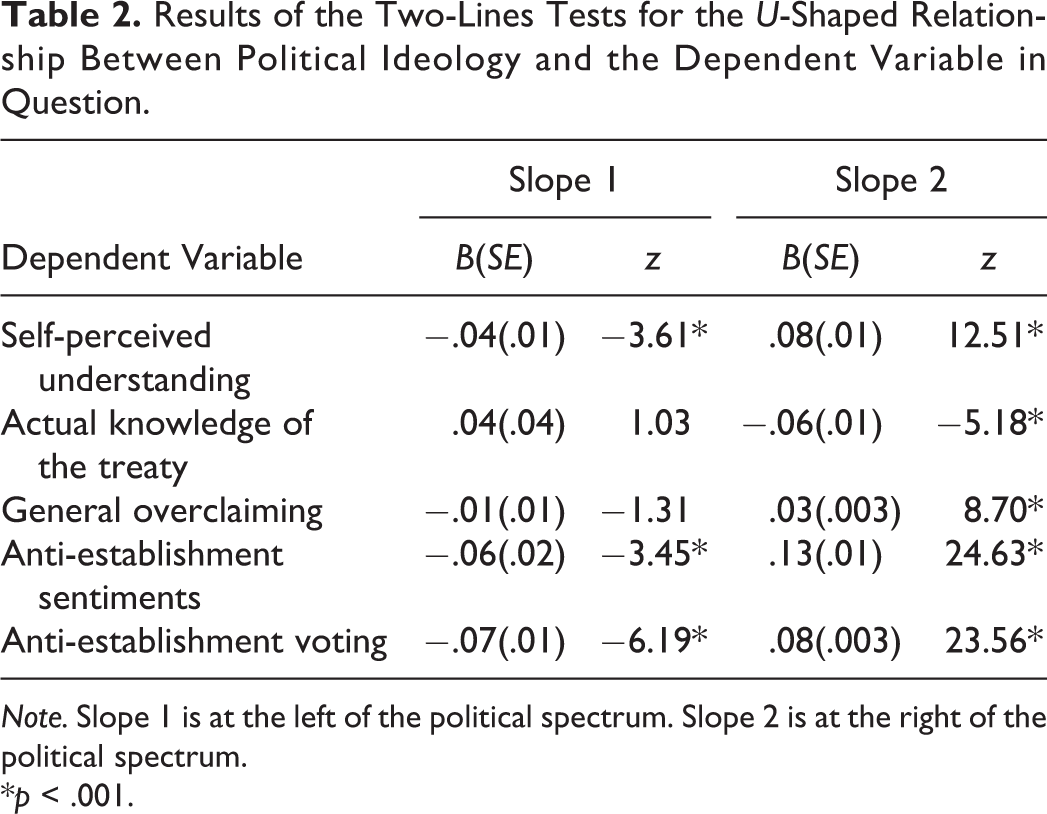
Note. Slope 1 is at the left of the political spectrum. Slope 2 is at the right of the political spectrum.
*p < .001.
These results reveal that as participants scored more strongly toward the political right extreme they believed to have increased understanding of the treaty, yet they possessed less actual knowledge of the treaty. At the left extreme, we also observed an overclaiming effect but it was less pronounced: As participants scored more strongly toward the left extreme they believed to have increased understanding of the treaty, but their actual knowledge did not differ from moderates. Also, general knowledge overclaiming increased as people were more strongly right extreme, but not as participants were more strongly left extreme. Results did indicate increased anti-establishment sentiments and voting among both left- and right-wing extremists, although the z values suggested stronger effects at the right than at the left extreme. These findings suggest that overclaiming knowledge of the treaty, and anti-establishment sentiments and voting, did occur at the left extreme but was stronger at the right extreme.
Discussion
The present findings provide insights into the question why citizens vote against the establishment during elections. Relatively simplistic mental models of political and societal issues enable people to pursue radical, anti-establishment ideologies with zeal and conviction (Van Prooijen & Krouwel, 2019). Such confidence is often actually overconfidence, however: The simple mental models that drive anti-establishment convictions also disable perceivers from appreciating the true complexities of political decision-making (Kruger & Dunning, 1999; see also Hall & Raimi, 2018). Citizens who vote against the establishment, therefore, are particularly likely to overestimate and overclaim their own knowledge. In the current study, we more specifically found that higher self-perceived understanding yet lower actual knowledge of a political treaty predicted an anti-establishment vote in a referendum. Additionally, our findings suggest a stronger tendency to overrecognize unfamiliar stimuli (independent from political or societal issues) among anti-establishment voters.
The political ideology findings are relevant for a debate within political psychology that pits the effects of ideological orientation (left vs. right) against the effects of political extremism (extremes vs. moderates). Specifically, the “rigidity of the right” perspective posits that right-wing political orientation predicts closed-mindedness (Jost, Glaser, Kruglanski, & Sulloway, 2003). As such, voters at the political right are less likely to think analytically about social policy (Yilmaz & Saribay, 2017). The political extremism perspective, however, proposes that particularly the political extremes entertain their ideas with confidence (e.g., Brandt et al., 2015; Toner et al., 2013; Van Prooijen & Krouwel, 2019; Van Prooijen et al., 2018), which is at the basis of knowledge overclaiming. A substantial body of research supports both perspectives. It is hence plausible that both ideological orientation and political extremism jointly contribute to people’s responses to political and societal issues. These insights dovetail with the present findings: A discrepancy between self-perceived understanding and actual knowledge of the treaty did occur at the left extreme but appeared stronger at the right extreme; moreover, the relationships of political ideology with both anti-establishment sentiments and voting appeared stronger at the far right than at the far left.
Strengths, Limitations, and Future Research
The present research has a number of noteworthy strengths and limitations. The strengths are that we assessed self-reported voting behavior in a referendum, using a high-powered sample, and a two-wave measurement design. The focus on voting underscores the societal relevance of the present findings: While ideological differences may predict a range of psychological outcomes, what matters for election outcomes is what people actually do when given the opportunity to vote. Assessing anti-establishment voting is therefore a useful extension of many studies that only focus on ideological (left vs. right) differences or party preferences. Furthermore, the high-powered sample suggests that the findings presented here are robust and likely to replicate in follow-up studies. Finally, the two-wave measurement design underscores that our overclaiming indices have prospective predictive power for citizens’ self-reported voting behavior 6 weeks later.
One limitation of the present study is that we assessed an opt-in sample, not a sample that was representative for the Dutch voting population. Relatedly, the present study took place in a relatively specific political context, raising questions how well these findings generalize to other settings. For instance, while we found that anti-establishment sentiments were stronger at the radical right, we also should note that a radical right-wing societal movement initiated this particular referendum. At present, we cannot conclude with confidence whether similar findings emerge in a societal context where anti-establishment sentiments are particularly strong at the political left (e.g., the “Occupy Wall Street” movement). This suggests that more research is needed examining these dynamics in a range of societal and political contexts.
The main analyses of anti-establishment voting focused on participants who had voted in the election. We also assessed participants who had abstained from voting, however, and an important question for future research is what drives people to not vote during elections. In our analyses, we found stronger anti-establishment sentiments, and stronger overclaiming, among anti-establishment voters than among nonvoters; however, we should note that due to context-specific circumstances, we cannot be sure whether this particular finding will generalize to different settings. Specifically (and contrary to “Brexit” or Trump’s victory in the U.S. presidential elections), the polls predicted a solid victory for “against” (i.e., the anti-establishment vote) shortly before the referendum. It was highly uncertain, however, whether voter turnout would be sufficient to validate the referendum result (in the Netherlands, political referenda results are valid only if at least 30% of the eligible population cast their vote). Hence, many citizens in favor of the treaty may have decided to abstain from voting for strategic reasons. In many other elections, such strategic considerations do not play a role, however, and a fruitful direction for further research is to establish why many citizens choose not to vote during elections.
An additional important avenue for future research is to establish whether anti-establishment voters are uninformed, or rather, misinformed. Online media offer an unprecedented platform for fake news, and people differ in how susceptible they are to such misinformation campaigns. Moreover, people also differ in their tendency toward knowledge overclaiming, which is reliably associated with stable personality traits (Dunlop et al., 2017). Interestingly, a recent study suggests that knowledge overclaiming and susceptibility to fake news are empirically related and that both are rooted in a general tendency to accept weak claims (Pennycook & Rand, in press). This is consistent with a basic assumption of the current project, namely that the relationship between anti-establishment sentiments and knowledge overclaiming is attributable to a need for epistemic clarity. Future research may more extensively assess these issues.
Concluding Remarks
In a polarizing political climate, citizens often express a deep-rooted distrust of the incumbent political establishment. It is important for scientists, practitioners, and policy makers to take such anti-establishment sentiments seriously, as they can influence election outcomes and thus shape society and economy. One core feature of populist and anti-establishment rhetoric is excessive confidence in the correctness of the underlying views. The present research suggests that such high confidence often reflects overconfidence. We conclude that anti-establishment voting increases to the extent that citizens believe to have sophisticated understanding of political decision-making, yet it is lower to the extent that citizens actually possess the knowledge necessary for such understanding.
Supplemental Material
Supplemental Material, SupplementalMaterials_Overclaiming_2ndrevision - Overclaiming Knowledge Predicts Anti-establishment Voting
Supplemental Material, SupplementalMaterials_Overclaiming_2ndrevision for Overclaiming Knowledge Predicts Anti-establishment Voting by Jan-Willem van Prooijen and André P. M. Krouwel in Social Psychological and Personality Science
Footnotes
Declaration of Conflicting Interests
The author(s) declared no potential conflicts of interest with respect to the research, authorship, and/or publication of this article.
Funding
The author(s) received no financial support for the research, authorship, and/or publication of this article.
Supplemental Material
The supplemental material is available in the online version of the article.
Notes
References
Supplementary Material
Please find the following supplemental material available below.
For Open Access articles published under a Creative Commons License, all supplemental material carries the same license as the article it is associated with.
For non-Open Access articles published, all supplemental material carries a non-exclusive license, and permission requests for re-use of supplemental material or any part of supplemental material shall be sent directly to the copyright owner as specified in the copyright notice associated with the article.
