



Abstract
We examined cognitive biases that underlie individual differences in supernatural beliefs in nationally representative samples from the Czech Republic and Slovakia (total N = 2,022). These countries were chosen because of their differing levels of religious belief despite their cultural similarity. Replicating a previous study with North American samples, we found that anthropomorphism was unrelated to belief in God but was consistently related to paranormal beliefs. Living in a highly religious area was related to a lower tendency to anthropomorphize. We examined this relationship further to find that anthropomorphism was related to belief in God for nonreligious participants, was inversely related to belief in God among religious Slovaks, and not related for religious Czechs. These findings suggest that anthropomorphism predicts belief in God for people who are unaffiliated, but this relationship disappears or is reversed for religious believers participating in a Christian religious tradition.
Religion is a central part of the identity and social life of the great majority of people around the world (Hackett, et al., 2015). As such, research on the psychological roots of religious belief has proliferated over the last several decades. Recently, this growth has spurred calls for scrutinizing the conclusions of psychology of religion research just as for many other core topics within psychology (e.g., Nosek et al., 2015). Work has begun that evaluates meta-analytic conclusions (e.g., Shariff, Willard, Anderson, & Norenzayan, 2016; van Elk et al., 2015), replication efforts (e.g., Sanchez, Sundermeier, Gray, & Calin-Jageman, 2017), and the cross-cultural generalizability of findings (e.g., Gervais et al., 2018; Purzycki et al., 2016). Still, rigorous testing of the evidentiary value of findings remains relatively rare in the psychology and cognitive science of religion, with many of the core findings remaining un-replicated.
With this in mind, this article has two aims: (1) to replicate the relationship between cognitive biases and different types of supernatural beliefs found in Willard and Norenzayan (2013) in a new sample and (2) to further examine some of the unexpected findings from that paper, namely, the surprising lack of a relationship between anthropomorphism and belief in God, and the inverse relationship between living in a religious area and anthropomorphism.
The Cognitive Foundations of Religious Belief
We focus on one of the key insights from psychological research into the origins of religious belief. This is the proposal that the roots of religious belief might be found in interrelated cognitive biases, specifically, mind–body dualism, teleology, and anthropomorphism (Atran & Norenzayan, 2004; Barrett, 2007; Boyer, 2001). Mind–body dualism is the intuitive tendency to see the mind as separate from, and irreducible to, the body (Bloom, 2005; Damasio, 1994; Jack et al., 2013). Teleology is the tendency to see natural objects as though they are artifacts and intentionally made for a purpose (Kelemen, 1999; 2004). Anthropomorphism is the tendency to see nonhuman objects and entities as having humanlike traits, particularly as pertaining to human psychological states such as consciousness, emotions, and memory (Epley, 2014; Waytz, Cacioppo, & Epley, 2010; Waytz, Morewedge et al., 2010). These core cognitive biases, which are rooted in the everyday workings of human minds, may partly explain why mental representations of supernatural agents are found so frequently across societies.
Research has begun to look at exactly how these cognitive biases work together to prompt religious and other types of supernatural beliefs (e.g., Andersen, 2017; Banerjee & Bloom, 2014; Järnefelt, Canfield, & Kelemen, 2015; Lindeman, Svedholm-Häkkinen, & Lipsanen, 2015). Of particular relevance to this article, Willard and Norenzayan (2013; henceforth W&N) ran path models connecting mentalizing tendencies to religious, paranormal, and life’s purpose beliefs through these three cognitive biases—mind–body dualism, teleology, and anthropomorphism. The two samples W&N used for the analyses were drawn from North American populations and thus the generalizability of these findings outside of this population remains an open question. To expand these findings, we examine these path models in two new samples drawn from different populations in Central Europe with similar cultural histories but differing religiosity levels. Moreover, some of the key findings in W&N were unexpected—not derived from a priori predictions based on existing theories. Therefore, we focus our efforts on this article particularly on these findings that were not originally predicted from theory to examine their reliability in these new samples.
Anthropomorphism and Religion
One key unexpected result from W&N’s models was a lack of a relationship between anthropomorphism and belief in God and a modest but negative relationship between living in a highly religious area and anthropomorphism. These effects are notable because anthropomorphism has been a central focus of the cognitive science of religion (e.g., Barrett, 2004; Guthrie, 1993) and an influential cognitive hypothesis about the origin of supernatural belief dating all the way back to Hume (1779/1981). One line of theorizing in the cognitive science of religion suggests that humans possess an overzealous tendency to project humanlike traits unto the world at large, sometimes called hyperactive agency detection. This has led to the propensity to perceive supernatural agents everywhere and forms a cognitive foundation for religion (Barrett, 2000; Barrett & Lanman, 2008). Although some work has criticized the idea of anthropomorphism as based in a hyperactive agency detection (Andersen, 2017; Bulbulia, 2004; Lisdorf, 2007), anthropomorphism itself remains central to theories of the origin of religious beliefs.
An alternate view within the cognitive science of religion is that anthropomorphism is deployed because it is inferentially rich and facilitates explanation in situations when other causal frameworks are lacking (Andersen, 2017; Boyer, 2001; Epley, Akalis, Waytz, & Cacioppo, 2008; Willard, 2017). Phenomena like weather patterns, or even life events, are often causally opaque; they are not easily understood using our intuitive processes of causal reasoning. Projecting minds, either directly or through a deity, onto these events gives some sense of understanding and feeling of control over these otherwise unknowable systems (Kay, Gaucher, McGregor, & Nash, 2010; Kay, Whitson, Gaucher, & Galinsky, 2009; Laurin & Kay, 2017). This latter perspective on anthropomorphism conceptualizes it as the motivated use of mental state reasoning to make sense of the world (Epley, Waytz, Akalis, & Cacioppo, 2008; Waytz, Morewedge et al., 2010). In this conception, people use humanlike mental states as explanations of otherwise unexplainable actions, behaviors, or events, such as a sudden, devastating storm.
When we apply this perspective of motivated reasoning to the Christian God, it suggests that belief in an all-powerful anthropomorphic God that controls the world might remove the motivation to anthropomorphize other parts of the world. For example, if the explanation for a devastating storm can be explained by the will of God, then there is no need to attribute anthropomorphic traits to the storm directly. Still, the lack of a relationship between anthropomorphism and belief in God in W&N does not clearly support the idea that belief in God removes the need for general anthropomorphism. If this were the case, we should expect this relationship to be negative, not null. People who believe in God should be less likely to anthropomorphize the world at large. The null effect suggests that anthropomorphism simply is not related to this specific belief.
Additionally, this null finding does not undermine the idea that anthropomorphism is a foundational cognitive bias underlying religious belief. W&N also found anthropomorphism was in fact positively related to paranormal beliefs (also see Elk, 2013; Willard & Norenzayan, 2017) and more weakly and inconsistently to belief in life’s purpose. This suggests that even if anthropomorphism is not related to belief in God, it may still be an important predictor of other supernatural beliefs and an underlying feature of why humans have supernatural beliefs more generally.
Beyond cognitive biases, religion is also clearly influenced by cultural learning (Gervais, Willard, Norenzayan, & Henrich, 2011). As cultural learners, people adopt specific religious beliefs from their families and communities. Although cognitive biases serve as a template for religious beliefs and explain why there is a human propensity for religious belief, it is cultural learning that explains why people believe in the specific set of beliefs that make up a specific religious tradition (e.g. Christianity) and not another (Gervais & Henrich, 2010; Willard & Cingl, 2017).
W&N assessed the contribution of cultural learning to religious belief by measuring the prevalence of church membership in the participants’ geographic region and found that it has a small but reliable effect belief in God. W&N also found an unpredicted negative relationship between the rate of church membership in each participant’s local area and anthropomorphism. This suggests that a Christian cultural context suppresses anthropomorphism. Anthropomorphizing the world is counternormative in a Christian context, which may explain this negative relationship. Together, these findings suggest that the cultural context of belief, as well as the type of supernatural belief itself (i.e., God or paranormal beliefs), can change how anthropomorphism relates to a supernatural belief.
To investigate these relationships more closely, we sought to replicate and extend the findings of W&N using nationally representative data collected in the Czech Republic and Slovakia. These two countries have similar histories, cultures, languages, and geographic location but strikingly different levels of religious commitment. The Czech Republic is currently one of the least religious countries in Europe, with only 18% of the population claiming to be religious. Slovakia on the other hand has a Christian religious majority of 76% (Willard & Cingl, 2017). The diversity in belief across these two countries gives us more variance in the religiosity of the participants’ local area. Specifically, there is a much larger proportion of people living in largely nonreligious areas. This increased variance should make a relationship between anthropomorphism and living in a religious area easier to detect, if one exists.
The large difference in religiosity also allows us to test if the null relationship between anthropomorphism and belief in God is about the religious context or the belief in a deity more specifically. If anthropomorphism simply does not predict belief in deities, then this effect should be found among both the religious and the nonreligious (i.e., people who do not affiliate with a religious tradition) who still believe in a God. If, on the other hand, Christianity is suppressing the tendency to anthropomorphize, then anthropomorphism should still predict God beliefs among the nonreligious.
Current Research
We focus our replication efforts on the final model from W&N (figure 4 in that paper), which included district-level church affiliation (how many people hold active membership in a church in each participants’ local district) as the measure of adherents. Specifically, we wanted to see whether we could replicate the finding that cultural exposure to religion in one’s community was related to higher levels of belief in God but lower levels of anthropomorphism in a sample with greater variance in belief. We ran the model a second time using country as a proxy for adherents to test for country-level differences in these effects as an additional test of the robustness of these effects.
Additionally, we took a closer look at the relationship between anthropomorphism and belief in God by examining the differences between religious and nonreligious participants within each country. The relationship between anthropomorphism and other supernatural beliefs in W&N leaves open the possibility that this null effect between anthropomorphism and belief in God was specific to religious participants (in this case, Christians) and may not be about belief in a deity more generally. If it is the cultural context of Christian belief that suppresses the tendency to anthropomorphize rather than the belief in any sort of God, then we should still find a relationship between anthropomorphism and belief in God among nonreligious participants. Furthermore, we should find a stronger relationship in the less religious country (Czech Republic) than in the more religious one (Slovakia) because the cultural influence of Christianity will be weaker in the less religious country.
Method
Data from both samples were collected as self-report questionnaires on behalf of the researchers by the Czech branch of Ipsos market research firm and has been used in a previous study (Willard & Cingl, 2017). The questionnaire was translated into Czech and Slovak by a bilingual researcher familiar with the theories and scales aided by a professional translator and back translated into English. Demographics were collected by Ipsos separately. Quality checks were conducted by Ipsos and no participants were excluded by the researchers.
Participants
Both the Czech (N = 1,010) and Slovak (N = 1,012) samples were demographically and geographically representative and consist of 50% females with a mean age of 40.6 years (SD = 13.23) and 41.3 years (SD = 13.22), respectively. A sample size of 1,000 per country was similar to the sample size of W&N (N = 920). Power analysis for this type of structural equation model is not reliable, but our sample is well above any recommended minimum sample (Wolf, Harrington, Clark, & Miller, 2013).
Materials
Measures
All measures except adherents (see below) were the same as those used in W&N. The adherents measure used here was collected as rates of church membership in each participant’s district collected from census data. W&N’s measure was attendance reported by churches in each participant’s county.
Anthropomorphism
The individual differences in anthropomorphism quotient (IDAQ) was used (Waytz, Cacioppo et al., 2010; To what extent does the ocean have consciousness? To what extent does the average computer have a mind of its own? α = .87).
Dualism
Stanovich’s (1989) Dualism Scale was used (e.g., The mind is not part of the brain, but it affects the brain; Mental processes are the result of activity in my nervous system; α = .77).
Teleology
We used a series of statements created by Kelemen and Rosset (2009) with levels of agreement on a 7-point Likert-type scale (e.g., Earthworms tunnel underground to aerate the soil; The sun makes light so that plants can photosynthesize; α = .92).
Mentalizing
The Empathy Quotient (EQ) to measure mentalizing as used (Baron-Cohen & Wheelwright, 2004; e.g., I often find it difficult to judge if someone is rude or polite; I am good at predicting how someone will feel; α = .87).
Belief in God
Belief in God was measured with a three-question scale (I believe in God; I believe in a divine being who is involved in my life; There is no God or higher power in the universe; α = .71).
Paranormal belief
The Revised Paranormal Belief Scale was used (Tobacyk, 2004). The religiosity and mystical animals subscales were removed because of overlapping with the other belief measures and cultural specificity, respectively (Some individuals are able to levitate [lift] objects through mental forces; Astrology is a way to accurately predict the future; α = .94).
Life’s purpose
Life’s purpose was measured using a three-question scale (Things in my life happen for a reason; There is a discernible purpose to the events of my life; Many things that happen to me are random or coincidental; α = .69).
Adherents
The proportion of adherents by district measure came from the Czech and Slovak census data (self-report church membership). This was matched to each participant’s local district.
We additionally asked participants if they considered themselves religious, spiritual but not religious, or not religious (forced-choice answer). We transformed this variable to religious and nonreligious (combining “spiritual but not religious” and “not religious”) for the final analysis.
Materials, 1 data, and analysis scripts are available at https://osf.io/p5k6w/?view_only=557cfa6af6ce44bbb58e6923da08c786.
Results
Population Differences in Belief
The Slovak sample had higher ratings of belief in God than the Czech sample (all scales 1–7; Czech: M = 3.65, SD = 1.48; Slovak: M = 4.73, SD = 1.58; d = 0.71, 95% CI [0.61, 0.80]). Conversely, average anthropomorphism was higher in the Czech sample (M = 2.87, SD = 1.15) than Slovak (M = 2.60, SD = 1.17; d = −0.23, 95% CI [−0.32, −0.15]). Both samples had similar ratings of paranormal beliefs (Czech: M = 3.32, SD = 1.16; Slovak: M = 3.24, SD = 1.13; d = −0.07, 95% CI [−0.16, 0.02]) and life’s purpose (Czech: M = 4.30, SD = 0.95; Slovak: M = 4.36, SD = 0.93; d = 0.07, 95% CI [−0.02, 0.16]).
Replicating Willard and Norenzayan’s Path Model
The model was fit with the lavaan package in R (Rosseel, 2012) 2 using a full information maximum likelihood (FIML) to deal with a small amount of missing data (Figure 1). The model shows only modest fit, Yuan–Bentler χ2(9, N = 2,022) = 102.43 p < .001; CFI = 0.94; RMSEA = 0.08 90% CI [0.06, 0.09]; Figure 1. After looking for additional unspecified variance, we found an unspecified relationship between mentalizing and purpose and added a correlation between the errors of these variables (λ = .16, 95% CI [0.11, 0.20], p < .001). Including this path brings us to a more acceptable level of fit, Yuan–Bentler χ2(8, N = 2,022) = 64.20, p < .001; CFI = 0.97; RMSEA = 0.06, 90% CI [0.05, 0.08].
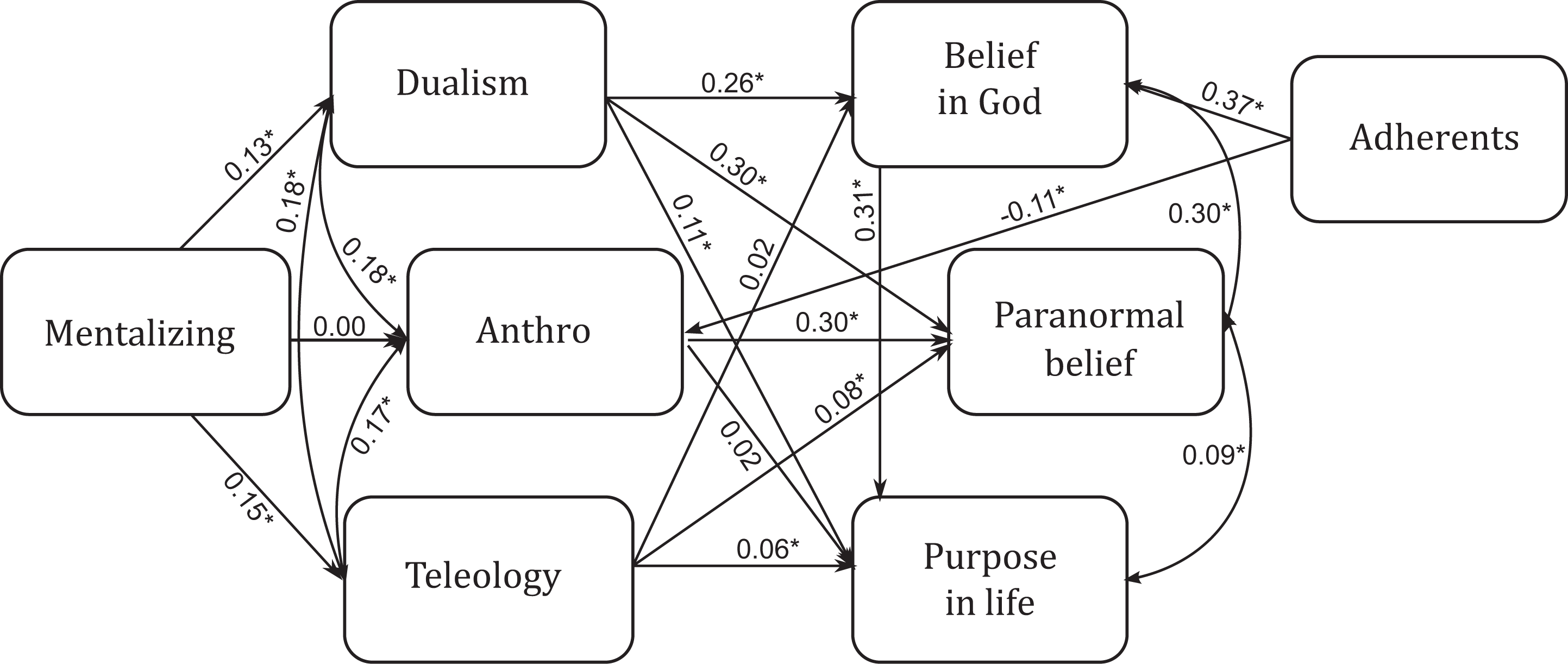
The path model across both countries. Yuan–Bentler χ2(9, N = 2,012) = 100.32, p < .001; CFI = 0.95; RMSEA = 0.07, 90% CI [0.06, 0.09]. This is a modest fit. When an additional relationship is included between mentalizing and purpose (λ = .16, z = 6.86, p < .001), it improves the fit: Yuan–Bentler χ2(8, N = 2,012) = 58.48, p < .001; CFI = 0.97; RMSEA = 0.06, 90% CI [0.05, 0.07]. *p < .05.
The χ2 value remains significant suggesting our model fits less well than the model in the original paper. The χ2 test of fit is less likely to fit with increases in samples size (the sample size is doubled here), making it a highly conservative test of fit and the model presented here is a good fit by both the RMSEA and the CFI (Hu & Bentler, 1999; Kline, 2011). We do find marginally better fit if we include a path directly from anthropomorphism to belief in God, χ2(1) = 4.04, p = .04, but this path is exceedingly small (λ = .04, 95% CI [0.00, 0.08], p = .05).
All coefficients and their confidence intervals can be found in Table 1. Significance was determined by confidence intervals. Exact p values were not included because the vast majority of coefficients were significant at a p < .001 level. Coefficients that did not meet this level of significance are clearly marked.
Regression Equations in Structural Equation Models.
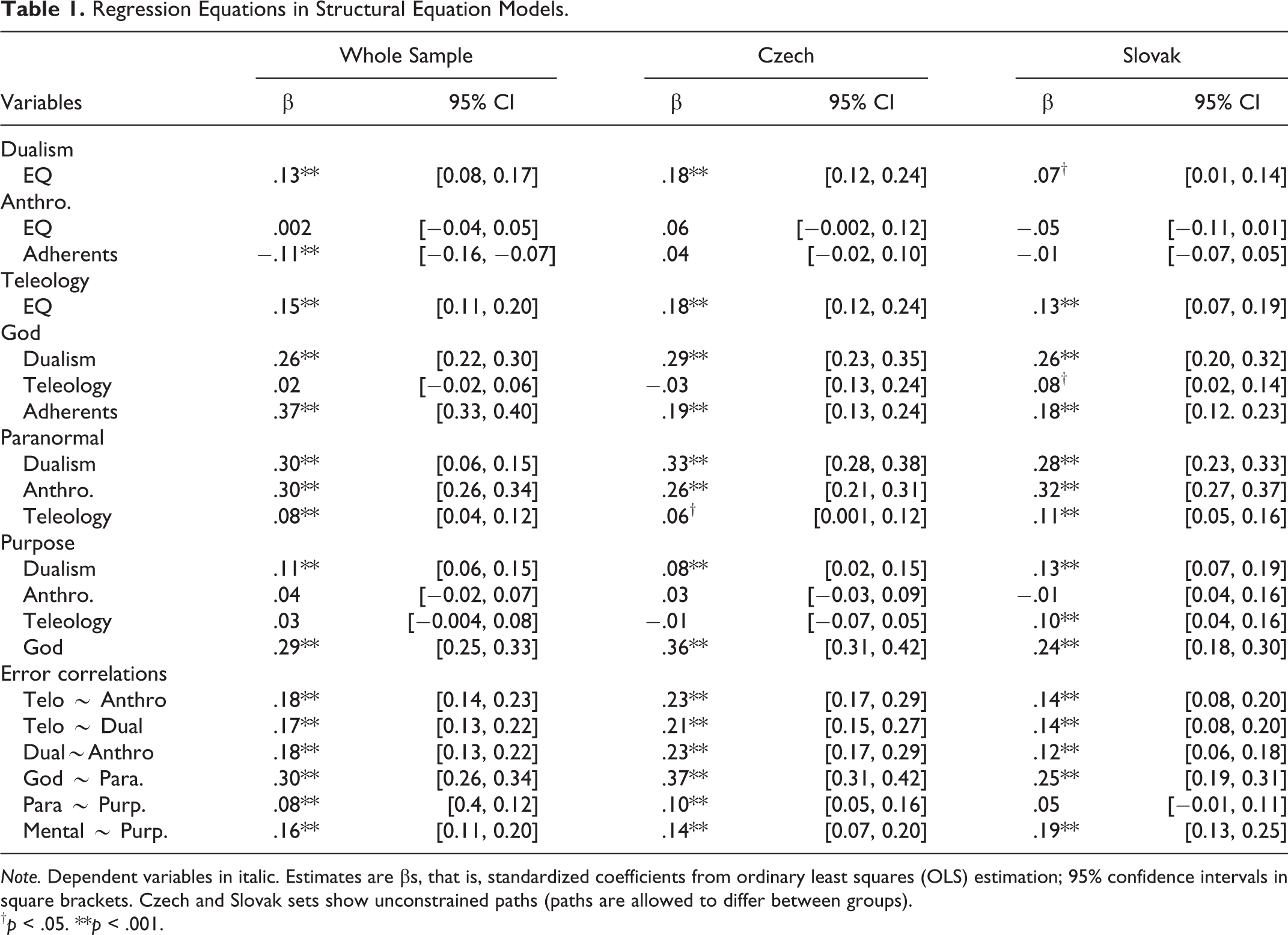
Note. Dependent variables in italic. Estimates are βs, that is, standardized coefficients from ordinary least squares (OLS) estimation; 95% confidence intervals in square brackets. Czech and Slovak sets show unconstrained paths (paths are allowed to differ between groups).
† p < .05. **p < .001.
The finding that living in an area with high religious affiliation is related to higher religiosity, but lower anthropomorphism was replicated in this sample. This effect was also found by replacing the affiliation measure with a dummy code representing country (Czech = 0, Slovakia = 1) with a similar level of fit, Yuan–Bentler χ2(8, N = 2,022) = 59.59, p < .001; CFI = 0.97; RMSEA = 0.06, 90% CI [0.04, 0.07]. This is unsurprising given the distribution of our adherents measure within these two countries (Figure 2). Participants living in Slovakia are more likely to believe in God (λ = .33, z = 16.64, p < .001) and less likely to anthropomorphize (λ = −.12, z = −5.50, p < .001) when compared to people in the Czech Republic.
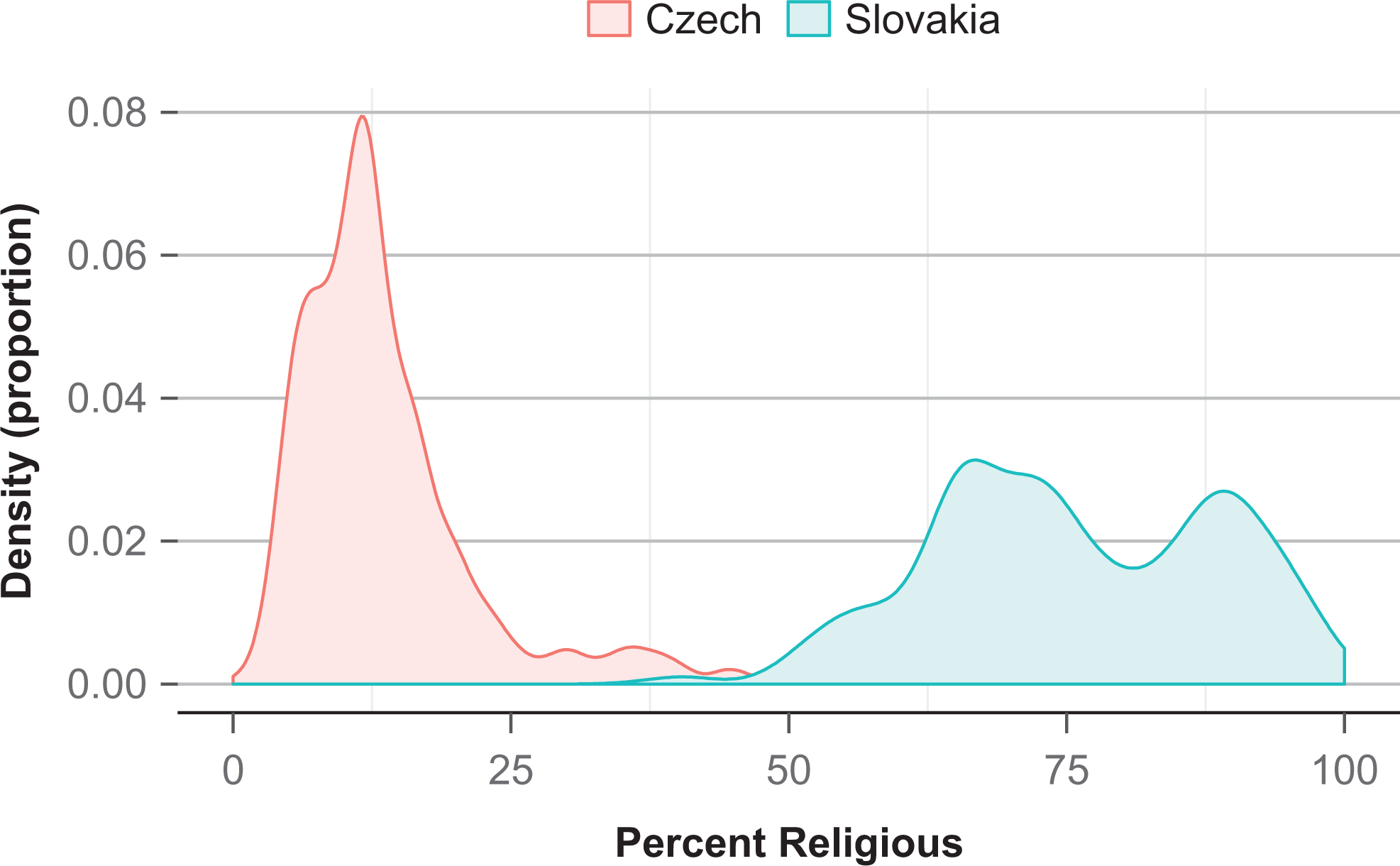
Density of participants’ local districts by percentage people who are religiously affiliated in that district (adherents).
Within Country Models
We ran the Czech and Slovak samples as a two-group model to see if these effects are found within the countries independently (Figure 3). Similar levels of fit were found when all paths are constrained to be equal in both groups, Yuan–Bentler χ2(16, N = 2,022) = 87.40, p < .001; CFI = 0.94; RMSEA = 0.06, 90% CI [0.05, 0.07], and when paths were allowed to differ, Yuan–Bentler χ2(30, N = 2,022) = 122.57, p < .001; CFI = 0.96; RMSEA = 0.07, 90% CI [0.05, 0.08]. The positive relationship between adherents and belief in God was replicated in both models but not the negative effect on anthropomorphism. This may be due to the lack of within-country variance for the adherents measure (see Figure 2; shows unconstrained paths in both groups). If we add in the path between anthropomorphism and belief in God, we find no increase in fit for Slovakia, χ2(1) = 0.73, p = .40; λ = −.03, 95% CI [−0.09, 0.04], p = .40, but a significant increase in fit in the Czech Republic, χ2(1) = 12.56, p < .001; λ = .12, 95% CI [0.05, 0.18], p < .001. This effect, and potential reasons for it in the Czech sample, is broken down further in the following section. Correlations and standard deviations can be found in Tables 2 and 3.
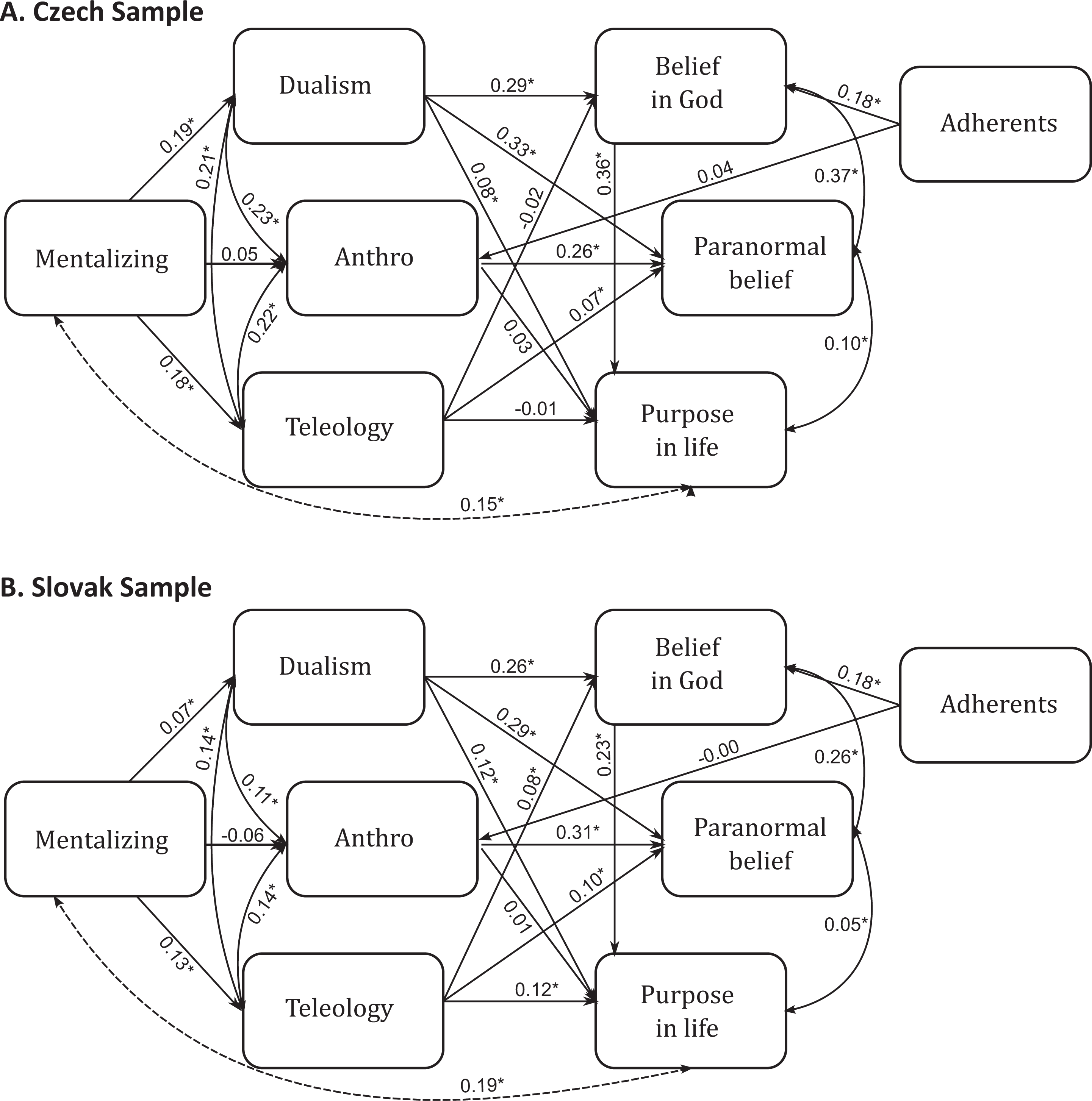
Models run in country samples separately, including the additional direct relationship between mentalizing and purpose in life (dotted line). *p < .05.
Correlation Table for the Whole Sample (Both Countries).
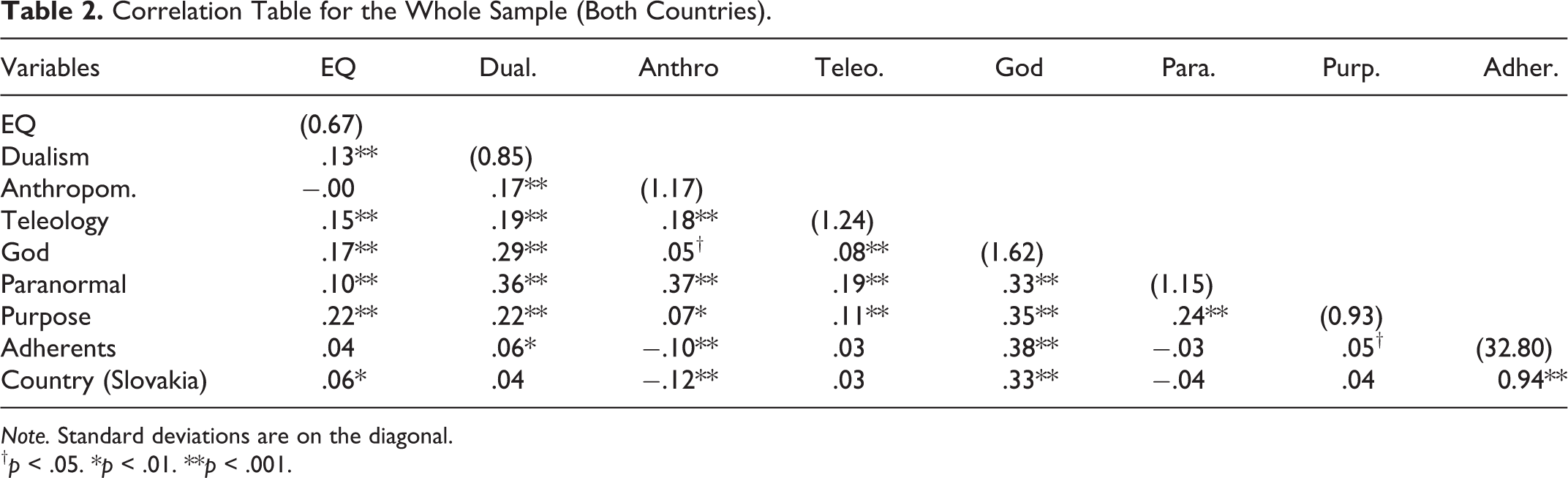
Note. Standard deviations are on the diagonal.
† p < .05. *p < .01. **p < .001.
Correlations Within Each Country (Bottom Is Czech Republic, Top Is Slovakia).
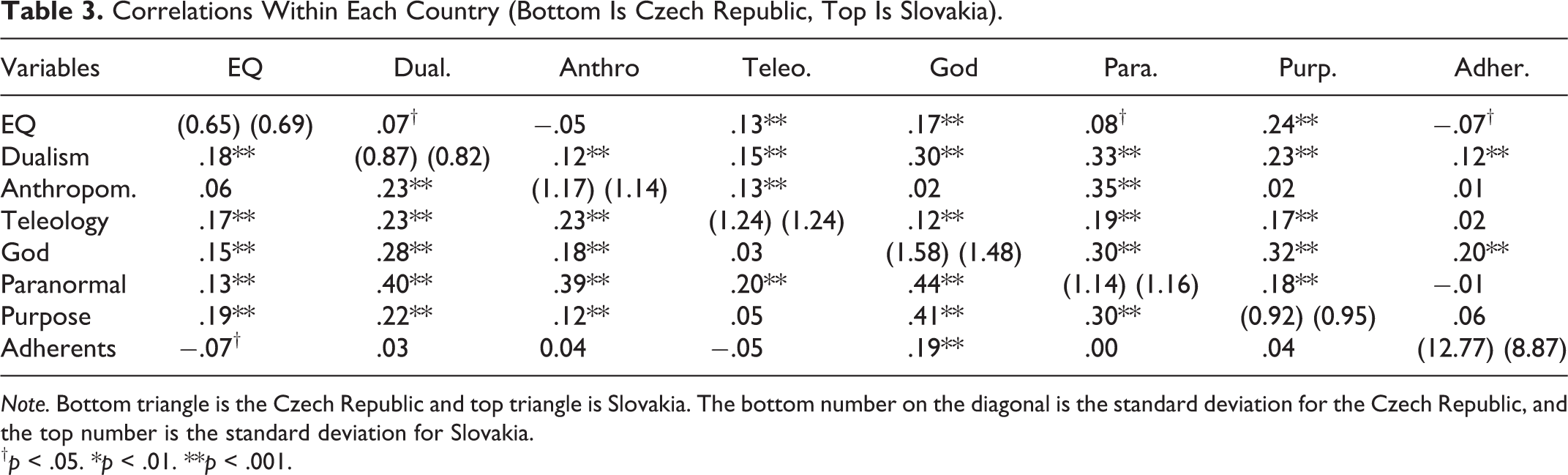
Note. Bottom triangle is the Czech Republic and top triangle is Slovakia. The bottom number on the diagonal is the standard deviation for the Czech Republic, and the top number is the standard deviation for Slovakia.
† p < .05. *p < .01. **p < .001.
Anthropomorphism
To examine these findings further, we regressed anthropomorphism on belief in God in each sample independently. Again, we found a significant relationship between anthropomorphism and belief in God in the Czech sample but not in the Slovak sample (Table 4). This relationship was broken down further to investigate religious and nonreligious participants separately. 3 Participants were split into religious and nonreligious groups based on self-categorization. We found that those who self-described themselves as nonreligious (including spiritual but not religious) in the Czech Republic drove the overall relationship between anthropomorphism and belief in God. There was no effect for religious participants. In the Slovak sample, there was a negative relationship for religious participants and a positive relationship for nonreligious participants. These opposing effects created the lack of relationship in the sample as a whole.
Relationship Between Anthropomorphism and Belief in God for Religious and Nonreligious Participants.
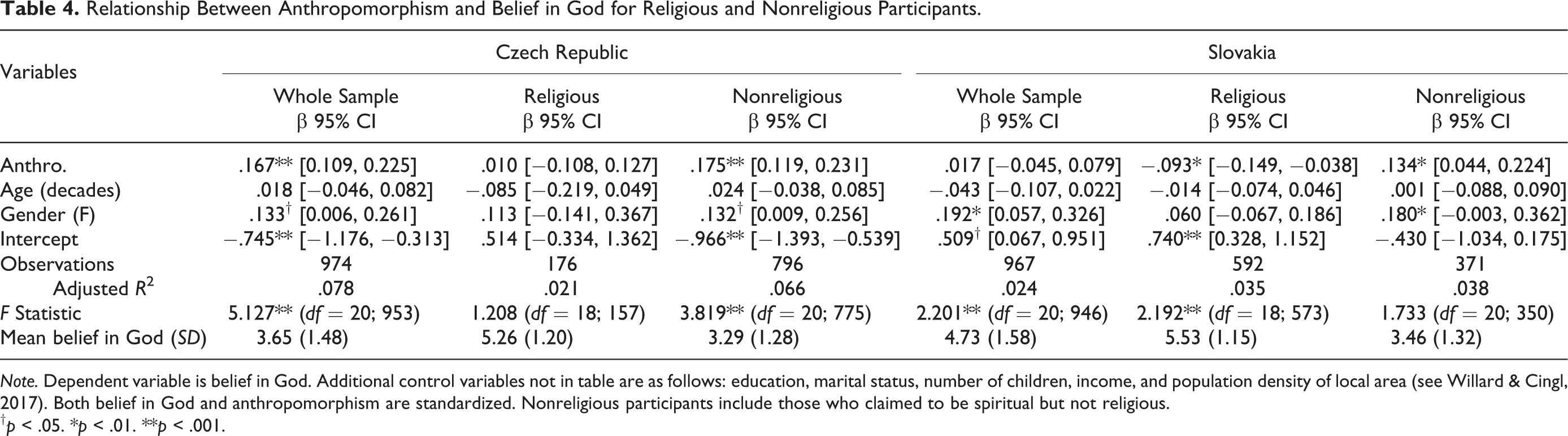
Note. Dependent variable is belief in God. Additional control variables not in table are as follows: education, marital status, number of children, income, and population density of local area (see Willard & Cingl, 2017). Both belief in God and anthropomorphism are standardized. Nonreligious participants include those who claimed to be spiritual but not religious.
† p < .05. *p < .01. **p < .001.
Discussion
The path model from W&N was, for the most part, replicated in this sample. We did find some differences, most notably the additional direct relationship between mentalizing and life’s purpose. We had no a priori predictions why this might be the case, so we caution against any strong interpretations of this effect without further research. Other differences are expanded upon below.
Mentalizing
Similar to the student sample—but not the adult sample—in W&N, we found no relationship between mentalizing and anthropomorphism in our path models. Given this finding in 3 of the 4 samples in which this model has been run, we suggest that there is currently no strong evidence of a direct link between mentalizing and anthropomorphism with the currently used measures. In contrast, the relationships between mentalizing and both dualism and teleology are small but robust across all four samples.
Other evidence has suggested the direct link between mentalizing and supernatural belief is small (Lindeman et al., 2015; Maij et al., 2017; Vonk & Pitzen, 2017). The indirectness of this relationship may explain why. If mentalizing is primarily related to these beliefs through intervening cognitive biases such as dualism and teleology, then the direct relationship may not emerge as reliably. Nevertheless, at its most basic, the ability to reason about mental states should be a core process involved in attributing mental states to nonhuman entities and objects. Given this, an absence of a positive relationship between mentalizing and anthropomorphism is an interesting puzzle for future research. One possibility is that mentalizing, measured as the ability to use mental states appropriately to understand other people, and anthropomorphism, measured as the promiscuous projection of mental states to the world at large, are more distinct from each other than previously thought (see Willard & Norenzayan, 2017). Overall, the EQ has its limitations, as it conflates accuracy and propensity in mental state reasoning (the latter being the most relevant aspect of mentalizing as it relates to supernatural belief). This in itself may attenuate some of these effects, making them smaller than they actually are.
Beyond W&N, other research has suggested different cognitive tendencies are related to religious belief using similar methods. Lindeman, Svedholm-Häkkinen, and Lipsanen et al. (2015) paired mentalizing with ontological confusion—or the tendency to confuse attributes of core knowledge, such as attributing biological or psychological states to inanimate objects—to predict different types of supernatural beliefs. This construct is similar to what Atran and Norenzayan (2004) refer to as “ontological violations” that are an important feature of supernatural beliefs. Lindeman and colleagues’ work uses statements with misattributed causes, similar to the methods employed by Kelemen’s (2009) studies on teleological reasoning but extends this work beyond purpose-based statements to include anthropomorphic traits. Lindeman et al. (2015) found a consistent direct relationship between mentalizing and supernatural belief, even with the inclusion of ontological confusion. Across all their models, a small positive relationship of mentalizing remained, suggesting that ontological confusion is a distinct construct and does not account for the contribution of mentalizing.
Anthropomorphism
The link between anthropomorphism and paranormal beliefs was replicated, supporting theories that give anthropomorphism a central role in supernatural beliefs. The relationship between anthropomorphism and belief in God is more complex. The two hypotheses put forward in the introduction suggest that (1) Christians, and people living among Christians, are less likely to anthropomorphize generally because it is counternormative within a Christian belief system and (2) Christian belief in an anthropomorphic God gives people a cognitive framework with which to explain the unexplained behavior of nature, animals, and objects, replacing the need to give them humanlike psychological qualities directly.
The finding that living in a highly religious area was related to reduced anthropomorphism is more compatible with the counternormative explanation, but the negative effect of being religious on anthropomorphism among Slovak believers does provide some evidence for an anthropomorphic God as replacing the need for general anthropomorphism. These hypotheses are not mutually exclusive and both may apply. This negative effect of anthropomorphism on belief in God was not found among the religious in the Czech sample. This may be due to the impact of being religious in a nonreligious and more generally anthropomorphizing society or to random fluctuation due to the smaller sample. Further research is needed to increase confidence in these effects.
Both of these explanations lend themselves to the perspective of anthropomorphism as motivated reasoning and the use of agency to make sense of the world because it is inferentially rich (see Boyer, 2001). This view is consistent with views of magic and a plethora of other supernatural beliefs studied within anthropology, which further suggests people engage in supernatural causal explanations even when they understand the natural causal pathways to attain more ultimate questions of meaning and personal relevance (Evans-Pritchard, 1937; Legare & Gelman, 2008; Malinowski, 1954).
Recent research that has looked at anthropomorphism among Indian Hindus has found a similar lack of relationship between anthropomorphism and belief in God (Baimel, McNamara, Purzycki, Willard & Norenzayan, n.d.). Although this work did not look at the density of religious believers in a given area, it does suggest that this lack of relationship may not be limited to Christians. Regardless, these results suggest that the cultural prevalence of a supernatural belief itself can moderate the effects of the cognitive biases underlying supernatural beliefs.
Conclusion
In two high-powered, nationally representative samples in the Czech and the Slovak Republics that vary on religiosity levels, we replicate and extend previous findings connecting individual differences in cognitive biases to various types of supernatural beliefs. We also report new evidence that the cultural milieu matters in how cognitive biases, specifically anthropomorphism, relate to supernatural beliefs. We conclude that both cognitive tendencies and the cultural context, and their interactions, are important to get a complete picture of how supernatural beliefs are formed.
Footnotes
Declaration of Conflicting Interests
The author(s) declared no potential conflicts of interest with respect to the research, authorship, and/or publication of this article.
Funding
The author(s) disclosed receipt of the following financial support for the research, authorship, and/or publication of this article: This research was funded by SSHRC Insight Grant (435-2014-0456) “The Cognitive Origins of Religious Belief and Disbelief” to A. N. A.W. received financial support from the Templeton World Charity Foundation (TWCF0164). L.C. received financial support from research grand GA15-03488S from the Grant Agency for the Czech Republic (GACR).