



Abstract
This study investigated the degree to which cognitive bias mediated the relationship between thinking style and belief in the paranormal. A sample of 496 participants completed the Revised Paranormal Belief Scale (RPBS), the Belief in Science Scale (BISS), the Cognitive Biases Questionnaire for Psychosis, and the reality testing subscale of the Inventory of Personality Organization (IPO-RT). The BISS and IPO-RT served as proxy indices of preferred thinking style; the BISS assessed rational-analytical (objective) processing, and the IPO-RT intuitive-experiential (subjective) processing. Cognitive biases (Jumping to Conclusions, Intentionalising, Catastrophising, Emotional Reasoning, and dichotomous thinking) correlated positively with belief in the paranormal. Mediation using path analysis indicated that Emotional Reasoning and Catastrophising exerted indirect effects in relation to BISS, IPO-RT and RPBS. Direct relationships existed between IPO-RT and RPBS, and BISS and RPBS. Of the biases, only Emotional Reasoning and Catastrophising predicted RPBS. The contribution of Emotional Reasoning and Catastrophising to belief in the paranormal were consistent with previous research and the cognitive model of psychosis, which asserts that there are strong relationships between defective reality testing, emotional reasoning and delusional beliefs.
Opinion polls (Ipsos MORI, 1998, 2003; Moore, 2005; Newport & Strausberg, 2001) indicate that belief in the existence of paranormal phenomena prevails within contemporary Western societies. Illustratively, Moore (2005) reported that three in four Americans possess at least one paranormal belief. Although endorsement rates vary as a function of phenomena assessed and sample used, survey results establish unequivocally that belief in the paranormal is a relatively common feature of modern life. Marks (2021) places the typical incidence of belief at around 50% of the population. Concomitantly, approximately 40% of UK respondents believe they have had at least one paranormal experience (Castro et al., 2014; N. Dagnall et al., 2016).
Despite prevalence, based on current scientific understanding, there is limited empirical evidence to support the validity of paranormal beliefs and experiences. Moreover, when research provides academic support for the existence of paranormal phenomena (e.g., Bem, 2011) critics typically refute the reliability or interpretation of findings (see Wagenmakers et al., 2011). Thus, regardless of the existence or not of paranormal forces and powers, advocacy does not presently derive from a robust, widely accepted scientific foundation. Noting this, from a cognitive/clinical perspective, theorists interpret ratification of unsubstantiated paranormality in the general population as delusional. That is, delusions located on the same continuum as those observed in clinical populations (e.g., Unterrassner et al., 2017; van Os, 2003). Consistent with this notion, paranormal beliefs and experiences represent personal reification of odd beliefs/behaviours and anomalous perceptions. These two categories are subsumed within the general classification of sub-clinical psychosis. Accordingly, indices of paranormality are comparable with the delusions and hallucinations of full-blown psychosis (Unterrassner et al., 2017). Hence, the study of paranormal credence is necessary because it informs understanding of both belief and delusion formation (Brugger & Mohr, 2008; Irwin, 2015).
Commensurate with this view, contemporary clinicians propose that a key element of psychosis is deficient reality testing (e.g., Shepherd, 2014). This concurs with the observation that clinically defined delusions are formed without due consideration of alternatives and lack rigorous, rational scrutiny of the evidence from which they derive (Diagnostic and Statistical Manual of Mental Disorders, Fifth Edition, DSM-5; American Psychiatric Association, 2013). Specifically, that delusions are fixed beliefs that are not amenable to change in light of conflicting evidence.
Likewise, investigators propose that belief in the paranormal, in the absence of specific clinical disorder, represents a fundamental failure of reality testing (e.g., Alcock, 1981; Vyse, 1997; Zusne & Jones, 1982). Kernberg (1996) conceptualises this as the capacity to differentiate self from non-self, intrapsychic from external stimuli, and to maintain empathy with ordinary social criteria of reality. Subsequent studies with general, non-clinical samples support this notion by reporting a relationship between general weakness in reality testing processes and paranormal beliefs (e.g., N. Dagnall et al., 2010; Irwin, 2003) and experiences (K. G. Drinkwater et al., 2020).
Believers in paranormal phenomena are susceptible also to specific types of cognitive error (for a review see French & Wilson, 2007). For example, faulty probabilistic reasoning (e.g., N. Dagnall et al., 2007, 2014, 2016a, 2016b; Denovan et al., 2018) and biases in cognitive processing (Irwin et al., 2012b). The latter are closely associated with psychotic symptoms, such as diagnosed delusions. This is demonstrated by the fact that psychological testing (e.g., Bristow et al., 2014; Peters et al., 2014) and inferential measures (i.e., Beckian cognitive behaviour therapy, Beck & Rector, 2002; Beck et al., 2008) reveal the existence of cognitive biases in delusional patients (e.g., schizophrenics). Moreover, research reports that biases exist in association with delusions or delusion-like beliefs within the non-clinical population (e.g., Gawęda & Prochwicz, 2015).
Specific cognitive biases connected to the formation of delusions are jumping to conclusions, intentionalising, catastrophising, Emotional Reasoning, and dichotomous thinking (see the Cognitive Biases Questionnaire; Peters et al., 2014). Bastiaens et al. (2013) provides a clear delineation of these terms. Dichotomous thinking denotes the tendency to reason in ‘black or white’, precisely to evaluate self and others in terms of binary opposites (polar extremes). Emotional Reasoning indexes the inclination to ascribe meaning to personal thoughts and feelings based on a particular moment. This manifests as the propensity to opt for inferences that are emotionally appealing rather than logically derived (Irwin et al., 2012a). In some circumstances this expresses as the inclination to attribute threatening meaning to feelings (Bastiaens et al., 2013). Jumping to conclusions refers to consideration of inadequate information prior to decision making. Intentionalizing involves interpreting events or behaviours as purposeful and deliberate. Catastrophising denotes thinking about scenarios from the perspective of the worst possible outcome.
Each of these biases correlate positively with intensity of paranormal belief in community samples (Irwin et al., 2012a, 2014). However, it is unclear why some individuals form beliefs, whereas others do not. One factor, which potentially provides insight into this conundrum, is belief in science. This refers generally to the degree to which individuals accept science as a reliable, objective source of knowledge about the world. Explicitly, the notion that science is of singular, central value because it provides exclusive comprehension of reality (Farias et al., 2013; Haught, 2005; Sorell, 1991 ). In this context, belief in science places an emphasis on the critical consideration of fact based, objective evidence.
Academic reports document the importance of attitudes to science and technology within general populations (e.g., USA, National Science Board, 2016; UK, Castell et al., 2014). These reveal that perhaps as much as 80% of the adult population profess to have faith in science, and think it is important to be aware of technical advances. Moreover, a majority acknowledge also that science and technology have made substantial contributions to the quality of life and the national economy. Conversely, a significant minority of individuals distrust science, and are concerned about the dangers (actual or potential) of science and technology to society (e.g., ecological and climatic impacts). Concomitant with this, Castell et al. (2014) observed that barely 55% of the UK population believe the benefits of science outweigh its harmful effects. These negative attitudes derive typically from moral values regarding self vs. global interest and people’s worldview (Bender et al., 2016; Rutjens et al., 2018; Sutton et al., 2018). Concerning morality, the more central nonviolence was to an individual’s self-concept, the more positively they appraised a scientific study that confirmed the harmfulness of violent video games (Bender et al., 2016). For worldview, science acceptance and rejection have different ideological roots, depending on the topic of investigation (Rutjens et al., 2018).
Across various samples, research evidences that paranormal believers (vs. sceptics) acknowledge the values of science less strongly. For instance, Clobert and Saroglou (2015) found that the intensity of belief in the paranormal related positively to distrust of science. Correspondingly, Irwin et al. (2015, 2016) reported a negative correlation between belief in the paranormal and acceptance of the scientific values. Similarly, Fasce and Picó (2019) observed that higher levels of paranormal belief were associated with lower trust in science and knowledge of major scientific theories. Furthermore, Prichard (2011) noted a negative trend between belief in the paranormal and students’ motivation to learn science or undertake courses in which they could learn scientific material. Relatedly, the strength of paranormal beliefs correlated negatively with scientific literacy; comprehension of scientific processes, basic facts and concepts (Majima, 2015).
The Present Study
This study investigated the degree to which thinking style, indexed by proneness to reality testing deficits and belief in science, influenced propensity to cognitive biases and belief in the paranormal. This conceptualisation of thinking style derives from the dual processing approach (Sloman, 1996), which proposes that decision-making is guided by two distinct, but interrelated systems (emotions vs. cognitive evaluations) (Loewenstein et al., 2001). In this context, inclination to reality testing deficits indexes a preference for intuitive-experiential (subjective) based processing, whereas higher levels of belief in science represents partiality for reasoned-fact based (objective) information. Although these systems operate in parallel, thinking styles draw on different cognitive resources. Critical evaluations, since they apply established rules of logic to the critical consideration of empirical evidence, are intentional and attentionally demanding, while emotion processing utilises general cognitive heuristics, and is automatic and affect driven.
Recognizing differences within specific dual processing theories, and that reality testing deficits and belief in science function only as proxy measures of opposing thinking styles, the researchers presented anticipated outcomes within a generalised, dual influence framework (Denovan et al., 2017). Particularly, predictions about the extent to which cognitive biases mediated relationships between thinking style and belief in the paranormal.
Correspondingly, the researchers predicted that proneness to reality testing deficits would produce a stronger indirect effect through Emotional Reasoning. This hypothesis derived from two sources. Firstly, the American Psychiatric Association (2013) conceptualisation of delusions as unchanging fixed beliefs that persist in the presence of conflicting evidence. Secondly, the observation that delusions often directly represent emotional concerns. It is well established within the academic literature that emotion contributes to delusion formation and maintenance (Freeman & Garety, 2003). Collectively, these features align with Irwin et al. (2012b) delineation of delusions as persistent ideas based on emotional appeal, which persevere without empirical support and maintain despite the existence of conflicting evidence. This characterisation suggests that the interaction between reality testing deficits and affect is an important feature of delusions.
The definition is germane to the study of paranormal beliefs since it omits reference to falsity. Falseness was a central feature of delusions within preceding versions of the Diagnostic and Statistical Manual of Mental Disorders (DSM) (American Psychiatric Association, 1980, 1994, 2000). Explicitly, the notion that delusions were false beliefs that arose from incorrect inferences about external reality. Previously, belief in the paranormal was outside inclusion because it is not entirely possible to refute the existence of all supernatural phenomena (e.g., ESP; Irwin et al., 2017).
Congruent with the revised delineation, Irwin (Irwin et al., 2012b, 2014) noted that paranormal beliefs are generated largely in response to emotional needs and not subjected to rational assessment. This interpretation concurs with the clinically informed notions of delusions as beliefs arising from faulty interpretation of anomalous experiences (Garety & Freeman, 1999) and/or inadequate evidence (Coltheart et al., 2011; Irwin et al., 2012b).
Although, research with delusional patients has confirmed that emotional reasoning plays an important role in delusion formation and maintenance (e.g., Beck et al., 2008), it is important to acknowledge that emotional significance in paranormal beliefs is typically lower than with psychotic delusions (Cella et al., 2012). Nonetheless, the relationship between emotional reasoning and belief in the paranormal is well established (Irwin et al., 2012b; Sappington, 1990).
While, there is little previous research examining relationships between belief in the paranormal and Cognitive Bias Questionnaire subscales, there is evidence to suggest that Catastrophising may also act as a mediating factor (Irwin et al., 2012a, 2012b). Irwin et al. (2012a) observed that Catastrophising alongside Emotional Reasoning was the only bias that significantly correlated with all Revised Paranormal Belief Scale (RPBS; Tobacyk, 1988, 2004; Tobacyk & Milford, 1983) subfactors, this was true for both the traditional seven and revised two-factor solutions. Tentatively, a reason for this relationship may be that since Catastrophising signifies thinking about scenarios from the perspective of the worst possible outcome, the bias may indirectly reflect both failures in reality testing and inclination to emotion-based processing.
Noting previous academic work in this area, this paper’s intention was to produce a coherent integrated predictive model of belief in the paranormal, which incorporated both thinking style and cognitive biases. Specifically, those pertaining to delusion-like experiences in the general (non-clinical) population. Although, subsequent research has isolated specific cognitive factors in the formation of paranormal beliefs (e.g., Irwin et al., 2012a, 2012b) prior to the present paper relatively few theorists had extended models to include indirect mediational effects.
Method
Respondents
An opportunity sample of 496 participants (202 male and 294 female) completed the study. Mean participant age was M = 26.90, SD = 11.04; age ranges from 18–69 years. Male mean age was M = 28.15, SD = 11.16, range 18–69 years. Female mean age was M = 26.04, SD = 10.89, range 18–69 years. For the path analysis, a minimum sample of 270 was necessary when using the recommended N:q rule of 10:1 sample size-to-parameters ratio (Jackson, 2003). The final sample comfortably exceeds this figure, and is therefore suitable when examining the statistical model.
The sample comprised students from Manchester Metropolitan University (MMU) and members of the wider community. Respondent recruitment was via University’s online Participation Pool, and emails to students (undergraduate and postgraduate), local vocational/sports clubs, leisure classes and businesses in the Northwest. Participation was voluntary, and respondents could terminate participation at any time during the study. The only exclusion criteria were that participants must be at least 18 years of age and had not participated in similar research projects examining cognitive bias.
Materials
Revised Paranormal Belief Scale
The Revised Paranormal Belief Scale (RPBS) (Tobacyk, 1988, 2004; Tobacyk & Milford, 1983) is the most widely used measure of belief in the paranormal (K. Drinkwater et al., 2017; Goulding & Parker, 2001). The 26-item self‐report measure comprises items from seven paranormal subscales: Spiritualism, Psi, Traditional Religious Belief, Witchcraft, Precognition, Superstition, and Extraordinary Life Forms. Items appear as statements (e.g., ‘If you break a mirror, you will have bad luck’), and respondents indicate level of endorsement via a seven-point Likert scale. Responses range from ‘0 = strongly disagree’ to ‘6 = strongly agree’. The RPBS can provide scores corresponding to the subscales and summation produces an overall indication of level of belief in the paranormal (α = .94). RPBS subscales and the measure overall demonstrate adequate validity and reliability (K. Drinkwater et al., 2017; Tobacyk, 2004).
Belief in Science Scale
The Belief in Science Scale (BISS) (Farias et al., 2013) consists of 10-items commending the merits of science. Items appear in the form of statements and respondents indicate their level of agreement using a six-point Likert scale, ranging from ‘1 = strongly disagree’ to ‘6 = strongly agree’. Examples of such items include ‘We can only rationally believe in what is scientifically provable’ and ‘All the tasks human beings face are soluble by science’. Scores on the BISS range from 10 to 60 with higher scores indicating greater belief in science. Previous work reports that the BISS is a psychometrically satisfactory measure (N. Dagnall et al., 2019). Specifically, the scale is valid and possesses high internal reliability (α = .91) (Farias et al., 2013; Irwin et al., 2015).
Cognitive Bias Questionnaire for Psychosis
The Cognitive Biases Questionnaire for Psychosis (CBQp) (Peters et al., 2010) is a 30-item self-report instrument, which measures psychosis-prone reasoning and thinking biases. The CBQp has five subscales: Intentionalising, Catastrophizing, Dichotomous Thinking, Jumping to Conclusions, and Emotional Reasoning. There are six-items per bias. Respondents complete psychosis-relevant vignettes, measuring susceptibility to each of these biases, and complete forced-choice responses. These denote absence of bias (score of 1), possible presence of bias (score of 2), and likely presence of bias (score of 3). Total scores range from 30–90 (6–18 for individual biases). Higher scores indicate the presence of greater levels of cognitive bias. Peters et al. (2010) report the CBQp possesses good psychometric properties. Studies have used the scale to measure cognitive bias within non-clinical populations (Irwin et al., 2012; Prochwicz et al., 2017).
Reality Testing
Researchers frequently use the reality testing subscale of The Inventory of Personality Organization (IPO-RT) (Lenzenweger et al., 2001) as a unidimensional measure of proneness to reality testing deficits (N. A. Dagnall et al., 2017; Irwin, 2003). The IPO-RT emphasises information processing style rather than psychotic symptomatology (e.g., ‘I have heard or seen things when there is no apparent reason for it’). Specifically, the scale assesses the capacity to differentiate self from non-self, intrapsychic from external stimuli, and to maintain empathy with ordinary social criteria of reality (Kernberg, 1996). This conceptualization, consistent with Langdon and Coltheart (2000) account of belief generation, emphasizes information-processing style rather than psychotic symptomology (Irwin, 2003).
The IPO-RT comprises 20-items presented as statements (e.g., ‘I can see things or hear things that nobody else can see or hear’). Respondents record answers via a five-point Likert scale (1 = never true to 5 = always true). Summation of items produces scores ranging from 20–100. Higher scores indicate propensity to reality testing deficits (α = .90). The IPO-RT is a psychometrically sound measure; the scale has demonstrated construct validity, good internal consistency, test–retest reliability, and temporal stability with non-clinical populations (Lenzenweger et al., 2001). Descriptive statistics for all variables are displayed in Table 1.
Descriptive Statistics for All Study Variables.
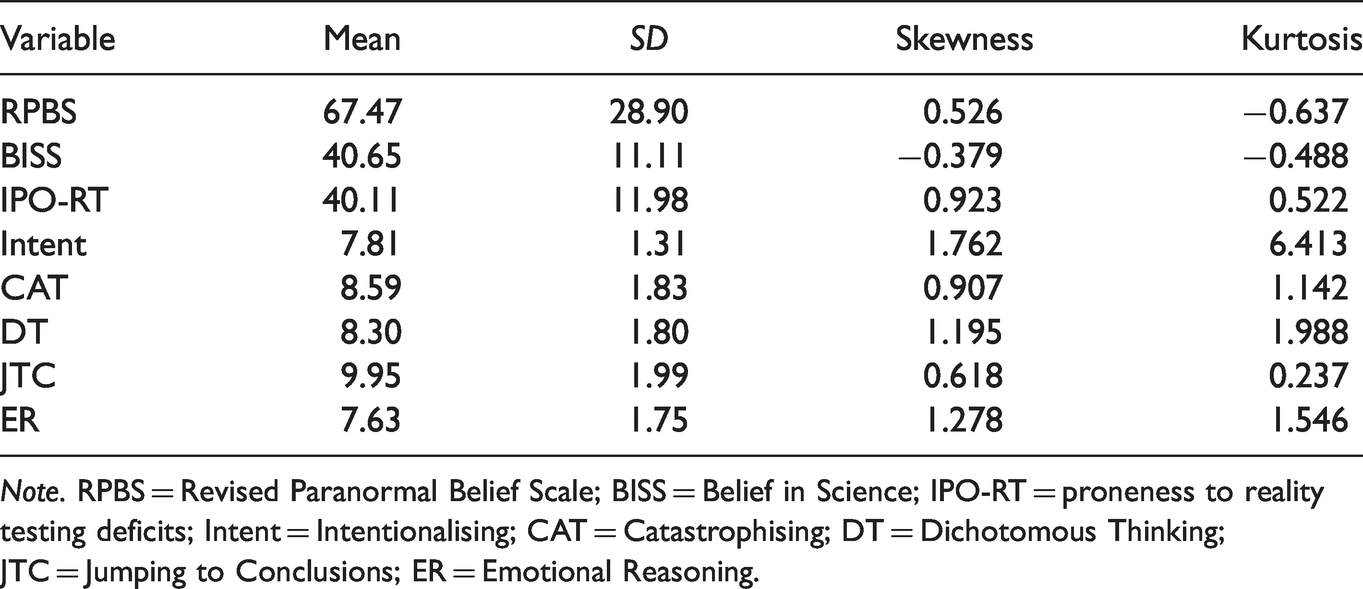
Note. RPBS = Revised Paranormal Belief Scale; BISS = Belief in Science; IPO-RT = proneness to reality testing deficits; Intent = Intentionalising; CAT = Catastrophising; DT = Dichotomous Thinking; JTC = Jumping to Conclusions; ER = Emotional Reasoning.
Procedure
Potential respondents clicked on a web link, which accessed the study materials, hosted by the Qualtrics web-based survey tool. Prior to accessing the measures respondents received a detailed brief. This outlined the nature of the study and explained ethical procedures. If respondents agreed to participate, they registered informed consent and progressed to the measures. Procedural instructions then asked respondents to consider questions carefully; work through the items systematically, at their own pace; respond to all questions; and answer in an honest and open manner. Questionnaire section order rotated in order to prevent order effects. Alongside item endorsement respondents forwarded basic demographic information (preferred gender, age, etc.).
The present study used a cross-sectional design, where data was collected at one time point. A frequently cited criticism of this approach is that it can produce common method variance (CMV) (Spector, 2019). This occurs when the measurement instruments influence responses and create bias. To counter CMV, this study employed procedural countermeasures (Krishnaveni & Deepa, 2013). Explicitly, in order to create psychological distance between constructs, study instructions stated that each scale was independent. This is an established, recommended strategy for reducing CMV (Podsakoff et al., 2003). Also, the study instructions limited evaluation apprehension and social desirability effects by stating that there were no correct answers and that honesty was essential.
Results
Descriptive Statistics
Data screening occurred prior to analysis. All skewness and kurtosis values, aside from Intentionalising (kurtosis = 6.413), fell within the recommended interval of −2.0 to +2.0 (Byrne, 2013; Table 1). No issues existed with multicollinearity, as VIF values <3.0 and tolerance values >0.10 (Tabachnick & Fidell, 2013).
Bivariate correlations (Table 2) revealed negative associations between RPBS and BISS. Correspondingly, RPBS correlated positively with IPO-RT and all cognitive biases, whereas BISS correlated negatively with IPO-RT, Catastrophising, Jumping to Conclusions, and Emotional Reasoning. BISS demonstrated non-significant associations with Intentionalising and Dichotomous Thinking. IPO-RT correlated positively with all cognitive biases.
Zero Order Correlations Among All Study Variables.
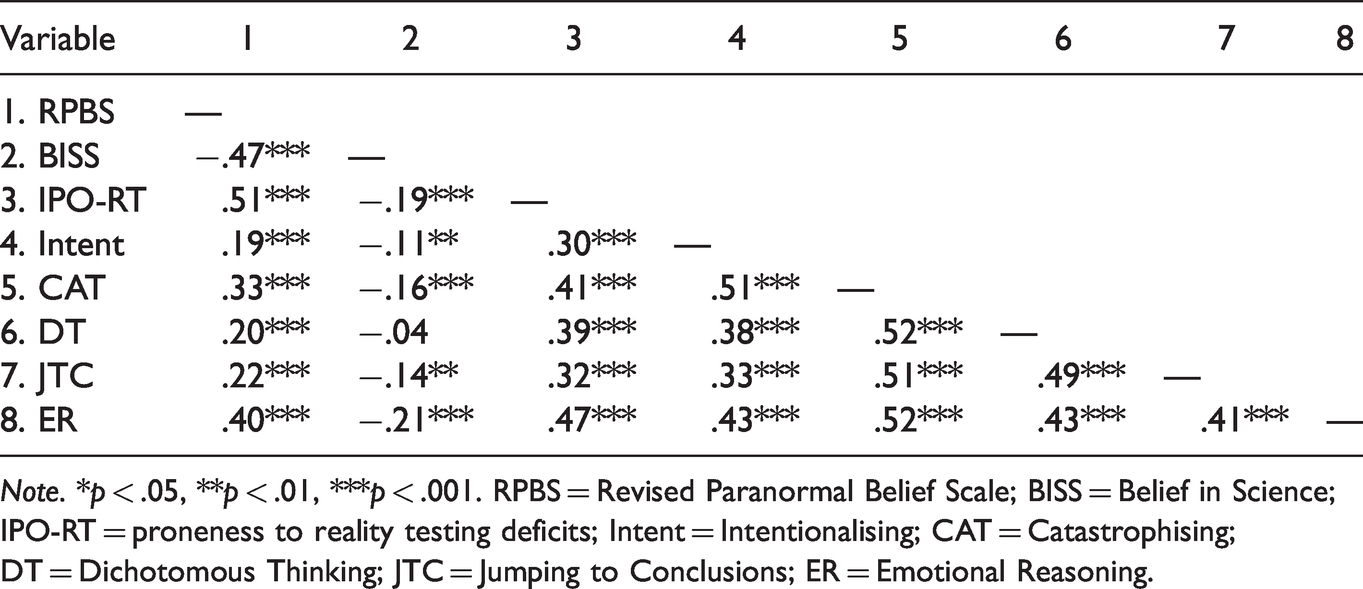
Note. *p < .05, **p < .01, ***p < .001. RPBS = Revised Paranormal Belief Scale; BISS = Belief in Science; IPO-RT = proneness to reality testing deficits; Intent = Intentionalising; CAT = Catastrophising; DT = Dichotomous Thinking; JTC = Jumping to Conclusions; ER = Emotional Reasoning.
Mediation Analysis
Mediation analysis using path analysis (via AMOS26) assessed direct and indirect relationships between BISS, IPO-RT, cognitive biases, and RPBS. Multiple fit indices assessed model fit, including the Root-Mean-Square Error of Approximation (RMSEA), the Standardised Root-Mean-Square Residual (SRMR) and the Comparative Fit Index (CFI). RMSEA utilises a non-centrality parameter, which functions as a measure of the discrepancy between the population covariance and the hypothesised model; the value increases as difference increases (Browne & Cudeck, 1993). RMSEA is an absolute fit index, which measures the extent to the hypothesized model deviates from a perfect model (Xia & Yang, 2019). SRMR compares the standardised differences between observed and predicted correlations, resulting in a mean correlation residual (Hu & Bentler, 1995). CFI examines fit by determining the discrepancy between observed data and the hypothesized model. CFI adjusts for sample size avoiding the inherent limitations of the chi-square test and the normed fit index (Miles & Shevlin, 2007).
Based on the correlation results (i.e., non-significant findings), removal of the BISS and both Dichotomous Thinking and Intentionalising paths occurred. The mediation model (Figure 1) demonstrated acceptable fit on all indices, χ2 (2, N = 496) = 3.357, p = .187, CFI = .999, RMSEA = .037 (90% of CI of .000 to .104), SRMR = .0120. Significant direct relationships existed between IPO-RT and RPBS (β = .37, p < .001), and BISS and RPBS (β = −.36, p < .001). Of the cognitive biases, only Emotional Reasoning (β = .15, p < .001) and Catastrophising (β = .12, p = .013) demonstrated significant positive relationships with RPBS.
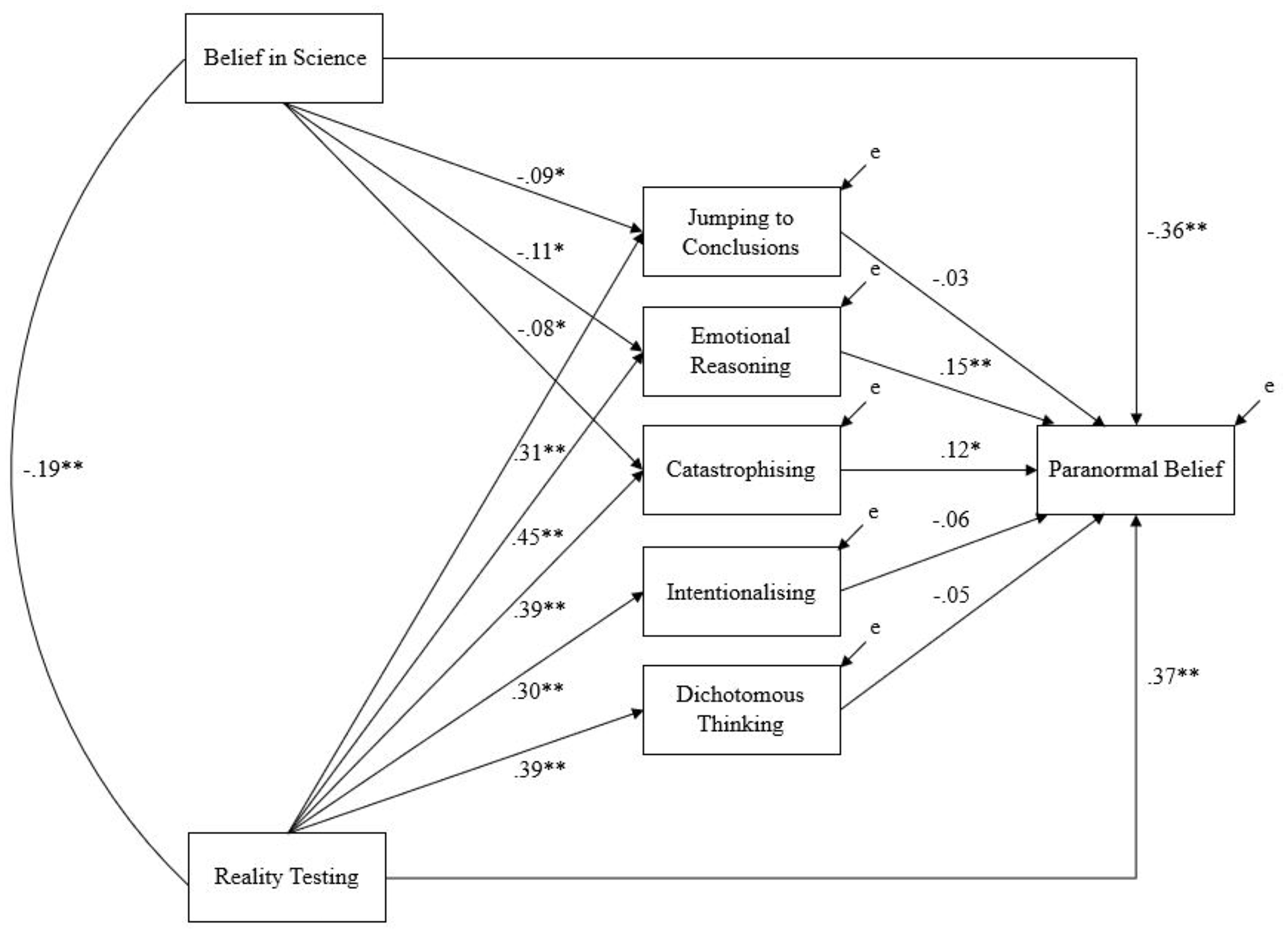
Mediation Model Depicting Putative Relationships Between Reality Testing, Belief in Science, Cognitive Biases, and Paranormal Belief. Note. Measured variables are depicted by rectangles; error is depicted by ‘e’. Correlations among error terms for the cognitive biases are not shown but were permitted in the analyses. *p < .05; **p < .001.
Bootstrapping estimates (resampled 1000 times) tested indirect effects using 95% confidence intervals across bias-corrected percentile point estimates. IPO-RT had a significant positive indirect effect upon RPBS of .068, p = .003, 95% Cl = .023 to .111. BISS demonstrated a significant negative indirect effect on RPBS of −.024, p = .005, 95% Cl = −.049 to −.008.
Scrutiny of specific indirect effects indicated that IPO-RT had a positive effect on RPBS through Emotional Reasoning (indirect effect = .159, p = .002, 95% CI = .061 to .262), and Catastrophising (indirect effect = .112, p = .026, 95% CI = .009 to .209). Contrastingly, BISS also had a significant negative effect through Emotional Reasoning (indirect effect = −.043, p <.001, 95% CI = −.090 to −.015,), and Catastrophising (indirect effect = −.024, p = .024, 95% CI = −.062 to −.002). These results indicate that Emotional Reasoning and Catastrophising demonstrated indirect effects in relation to BISS, IPO-RT and RPBS.
Discussion
Belief in the Paranormal correlated positively with Proneness to Reality Testing Deficits (IPO-RT) (r = .51) and negatively with Belief in Science (BISS) (r = −.47). These associations were in the moderate range as defined by Cohen (1988) and consistent with preceding research. In the case of the relationship between Belief in the Paranormal (RPBS) and Proneness to Reality Testing Deficits (IPO-RT), several studies have observed similar sized correlations (N. Dagnall et al., 2010, 2014; K. Drinkwater et al., 2012). Although the relationship between paranormal and scientific belief is less well researched, the correlation reported in this study concurred with Irwin et al. (2015, 2016).
A negative relationship (r = −.19) was observed between indices of preferential thinking style, Proneness to Reality Testing Deficits (IPQ-RT) and Belief in Science (BISS). This association was consistent with that reported by N. Dagnall et al. (2019). Although, the relationship was small (Cohen, 1988), it is more meaningful when interpreted using the guidelines of Gignac and Szodorai (2016). Their recommendations derive from meta-analysis of individual difference research, which indicates that Cohen’s perimeters are too stringent when applied to real-world study data.
Overall, the pattern of zero-correlations concurred with prior work and supported the notion that Proneness to Reality Testing Deficits (IPQ-RT) and Belief in Science Scale (BISS) assess different processing preferences. Specifically, that they serve as proxy measures of inclination to personal (intra-psychic) and external (fact-based) data respectively. This interpretation is consistent with recent articles that have used the IPO-RT as an index of the tendency to engage in intuitive thinking (Denovan et al., 2017, 2020). Although researchers have not widely used the BISS to assess analytical thinking, the measure’s content is commensurate with a predilection to critically appraise information in an unbiased externally validated manner (see N. Dagnall et al., 2019). This interpretation corresponds with Farias et al. (2013) assertion that higher levels of belief in science reflect a preference for rational-analytical thinking.
The use of BISS as an indirect measure accords with preceding studies that have examined preference for analytical thinking and belief in the paranormal via constructs such as the Need for Cognition subscale of the Rational-Experiential Inventory (Epstein et al., 1996) (see Rogers et al., 2018), and performance on Cognitive Reflection Tests (CRT; Frederick, 2005; Thomson & Oppenheimer, 2016; see Ross et al., 2017). Similarly, researchers have used indirect measures to investigate the extent to which analytical thinking influences endorsement of other scientifically unsubstantiated beliefs (e.g., conspiracies, Swami et al., 2014) and health attitudes (e.g., smoking behavior, Brown & Bond, 2015).
Analysis examining the indirect effects of intuitive and analytical processing on Belief in the Paranormal (RPBS) through Cognitive Biases Questionnaire for Psychosis (CBQp) subscales revealed that Emotional Reasoning and Catastrophising mediated thinking style. Specifically, IPO-RT had a positive indirect effect on Belief in the Paranormal (RPBS) through Emotional Reasoning and Catastrophising, whereas BISS had a significant negative effect lessened by the presence of Emotional Reasoning and Catastrophising. These outcomes indicate that the cognitive biases of Emotional Reasoning and Catastrophising influence level of paranormal belief.
Regarding Emotional Reasoning, direct and indirect effects supported earlier work indicating that the attraction of paranormal beliefs stems from their emotional appeal; belief declines when components are evaluated rationally (Irwin et al., 2012). Regarding this outcome, it is important to note that while IPO-RT scores correlated positively with Emotional Reasoning, these constructs shared only approximately 22% variance. Conceptually, this finding supports the notion that the constructs are related but discrete.
The IPO-RT, from an information‐processing perspective, indexes a broad range of phenomena related to the ability to differentiate self from non‐self, intra‐psychic from external stimuli, and the capacity to maintain empathy with social reality (Kernberg, 1996). Hence, factorially the IPO-RT encompasses a general intra-psychic dimension comprising four distinct subfactors (Auditory and Visual Hallucinations, Delusional Thinking, Social Deficits and Confusion) (N. Dagnall et al., 2018). Collectively, these subfactors reference perceptual, cognitive, social, and emotional elements of internal/self‐orientation (N. Dagnall et al., 2018). The breadth of the IPO-RT compared to alternative narrow constructs such as Faith in Intuition, which focuses on individual trust in intuitions and instincts (Pennycook et al., 2012), is advantageous because it samples a broader range of internal cognitions. Similarly, Emotional Reasoning indexes only a specific facet of intra-psychic activity, the inclination to ascribe meaning to personal thoughts and feelings based on a moment.
The observation that Proneness to Reality Testing Deficits and Emotional Reasoning are related but independent constructs accords with contemporary definitions of pathological beliefs or delusions (American Psychiatric Association, 2013; N. A. Dagnall et al., 2017). Explicitly, the classification of delusions as persistent ideas based on emotional appeal, which persevere without empirical support and maintain despite the existence of conflicting evidence (Irwin et al., 2012b). In this context, the tendency to ascribe meaning based on self-generated, affective data and its intrinsic appeal increases levels of belief in the paranormal, whereas the inclination to seek external validation in the form of science (external, objective information) reduces belief.
The authors are aware that these conclusions are predicated on the continuum conceptualization of delusion. (e.g., Unterrassner et al., 2017; van Os, 2003). They are also cognizant of the fact that there is considerable debate about continuity (see Peters, 2010). Peters (2010) in his examination of the relationship between delusional and religious beliefs concluded that the body of work in this area supported the notion of a continuum between normality and psychosis. Given that the RPBS contains items measuring traditional religious beliefs (e.g., “There is a heaven and a hell”) and spiritualism (e.g., “It is possible to communicate with the dead”) there is no reason to assume that this is not also true of belief in the paranormal. Acknowledging continuum disagreements subsequent research should examine the question further. This, as Peters (2010) points out, could also consider the multidimensionality of delusional beliefs and the consequences rather than the content of beliefs.
Catastrophising correlated with Emotional Reasoning and correspondingly demonstrated a similar pattern of relationships across study variables. Explicitly, Catastrophising was associated positively with Belief in the Paranormal (RPBS), IPO-RT, and the other cognitive biases, and negatively correlated with BISS. This was true also of Jumping to Conclusions, however, in line with Irwin et al. (2012a) the observed relationships were less pronounced. Furthermore, the identification of Emotional Reasoning and Catastrophising as the cognitive biases most strongly associated with belief in the paranormal aligned with the zero-order correlations reported by Irwin et al. (2012a).
The importance of Catastrophising stems possibly from the fact that the subscale indirectly samples both Proneness to Reality Testing Deficits and Emotional Reasoning. This supposition corresponds with the definition of Catastrophising as the unrealistic inclination to think about scenarios from the perspective of the worst potential outcome. Specifically, a negative affective response arising from a lack of self-efficacy and external locus of control. This extends to the perception of possible outcomes as unbearable rather than simply uncomfortable (Irwin et al., 2012a). To date, this relationship has received only limited attention. The authors therefore suggest that the conclusions regarding Catastrophising and Belief in the Paranormal are treated with caution. Clearly, this is an area that subsequent research should examine in greater depth.
Overall, the contributions of Emotional Reasoning and Catastrophising to Belief in the Paranormal are consistent with the cognitive model of psychosis, which postulates that there are strong links between reality testing deficits, emotions, and delusional beliefs (Ishikawa et al., 2017). This comparison was not previously possible due to the inclusion of falsity within the definition of delusions. Falsity excludes beliefs about the existence of supernatural phenomena because, unlike psychotic delusions, they cannot be definitively disproved. In this context, the American Psychiatric Association (2013) delineation of delusions extends well to paranormal belief. Specifically, that belief in the paranormal is driven by internal emotional states (Garety & Hemsley, 1997); faulty interpretation of anomalous experiences (Garety & Freeman, 1999) and inadequate evidence (Coltheart et al., 2011).
The findings concerning Jumping to Conclusions merit further consideration because they differ with those of Prike et al. (2018). Prike et al. (2018) observed significant correlations between scientifically unsubstantiated beliefs (paranormal and anomalous) and bias against disconfirmatory evidence (BADE), bias against confirmatory evidence (BACE), and liberal acceptance (i.e., lowered decision threshold and greater receptivity to improbable outcomes). Jumping to conclusions (JTC), however, did not correlate with either type of scientifically unsubstantiated belief. This finding contrasts with Irwin et al. (2014), who reported a relationship between JTC and belief in the paranormal. Although, effect sizes were small, and the observed correlations varied as a function of belief type and measure of JTC. Irwin et al. (2014) used three different indices to assess JTC: subscales from the Cognitive Biases Questionnaire (CBQ; Peters et al., 2010) and the Davos Assessment of Cognitive Biases Scale (DACOBS; van der Gaag et al., 2013), which are established, psychometrically validated self-report instruments, and the Beads Task (Phillips & Edwards, 1966).
Irwin et al. (2014) reported that scores of the Traditional Paranormal Belief subscale of the Revised Paranormal Belief Scale (RPBS; Tobacyk, 2004) were negatively correlated with performance on the Beads Task and positively related to CBQ, whereas the New Age Philosophy RBPS subscale was positively associated with DACOBS. These variances reflect the complexity and breadth of JTC and the fact that these measures index different construct content. The CBQ assesses concrete decision-making and emphasises inclination to form unfounded, potentially schizotypal and often paranoid, inferences (Irwin et al., 2014), while DACOBS focuses on general cognitive style (i.e., cognitive distortions related to psychosis). In contrast to awareness orientated measures such as the CBQ and DACOBS, the Beads Task draws on probabilistic, performance-based decision-making.
These differing relationships also indicate that paranormal-related JTC is domain specific. Explicitly, that associations vary as a function of belief type. This may in part explain differences between the findings of Prike et al. (2018), who used the Australian Sheep-Goat Scale (ASGS; Thalbourne and Delin, 1993), and the Irwin et al. (2012a, 2014) studies which employed the RPBS. Although, the ASGS and RPBS have common content, the ASGS by focusing on core parapsychological phenomena (Life After Death, Extrasensory Perception, and Psychokinesis) is restricted in comparison to the RPBS (K. Drinkwater et al., 2018).
Moreover, JTC is possibly mediated by other variables such as paranoia (see Irwin et al., 2014; Prike et al., 2018). This conclusion is consistent with related research examining factors predicting conspiracy theory endorsement. Explicitly, Pytlik et al. (2020) reported that belief in conspiracies was associated with a predilection for intuitive thinking style, concomitant with the tendency to jump to conclusions. This finding suggested that belief in conspiracy theories, like aspects of belief in the paranormal, is associated with the same cognitive processes as paranoid ideation or delusions (Pytlik et al., 2020).
The extended analysis of Prike et al. (2018) demonstrated the importance of delusion proneness. When the authors entered the biases (BADE, BACE, liberal acceptance, and JTC) into a series of multiple regressions, only liberal acceptance was a significant predictor of anomalistic belief. However, when analysis controlled for delusion proneness the relationship was no longer significant. These findings indicated that either the relationship between liberal acceptance and scientifically unsubstantiated beliefs was attributable to delusion proneness, or that delusion proneness mediates the liberal acceptance and anomalistic belief relationship. Generally, outcomes were consistent with Moritz et al. (2017), who proposed that liberal acceptance plays a causal role in the formation of delusions.
Though the findings reported in this study correspond with previous work and are theoretically coherent, it is important to note limitations and potential ideas for future research. A general area of concern was the degree to which the IPQ-RT and BISS assessed preference for intuitive-experiential (subjective) vs. rational-fact based (objective) processing. Research has traditionally used indirect indices, such as self-report scales, to assess cognitive style. Since these measures require personal, subjective evaluation of thinking style they may not provide accurate insights. Indeed, common criticisms of metacognitive evaluation are that individuals lack conscious awareness of automatic processes, and/or impartial insight into high order cognitions. Thus, subsequent studies may wish to establish whether the findings from this paper are reproduced using objective performance-based measures (see Pennycook et al., 2012). This is especially important, because the relationship between self-perceived ability and actual outcome(s) is often weak (Denovan et al., 2020).
Another limitation was the use of a cross-sectional design. This restricted data collection to one point in time. For this reason, findings require cautious interpretation. Despite this, the paper furthered research by considering the mediating effects that cognitive biases have on the relationship between thinking styles and belief in the paranormal. This is an important advance because prior research has generally focused on direct effects and failed to consider the potentially important role that mediating cognitive factors play on belief formation (see Barron et al., 2018; N. Dagnall et al., 2016; Denovan et al., 2020; Swami et al., 2014).
This approach by considering the role of direct and indirect effects provides sophisticated insights into the formation and maintenance of paranormal belief. From both theoretical and practical perspectives this has important implication. Specifically, consideration of complex relationships deepens understanding and suggests approaches for reducing paranormal convictions. This is necessary because, although belief in the paranormal is typically benign, other scientifically unsubstantiated beliefs (i.e., pseudoscience and conspiracies) can have profound social effects such as weakening political involvement and public health messages (e.g., vaccination campaigns) (Jolley & Douglas, 2014a, 2014b; Teovanović et al., 2021). One way to look at dynamic changes in individuals over time and overcome the limitations of cross-sectional design is to test respondents over multiple time intervals.
Future studies could also examine the extent to which interactions between thinking styles effect susceptibility to cognitive biases and belief in the paranormal. Brown and Bond (2015) successfully used this approach to investigate how cognitive style influenced smoking behavior. This involved creation of profiles by combining scores from the two dimensions of the Rational-Experiential Inventory (Pacini & Epstein, 1999). This produced four clusters: low on both factors, low on Rational and high Experiential; low on Experiential and high Rational, and high on both. The application of cluster analysis to thinking styles offers an alternative approach to assessing the importance of intuitive and analytical processing. This method has the advantage of facilitating direct comparisons between thinking profiles on factors of conceptual interest, such as proclivity to endorse scientifically unsubstantiated beliefs. Indeed, using a related approach to cluster analysis (latent profile analysis), Denovan et al. (2018) demonstrated how establishing a series of latent homogeneous groups furthered understanding of the role of schizotypy and paranormal belief in relation to cognitive biases (probabilistic reasoning performance).
Footnotes
Declaration of Conflicting Interests
The authors declared no potential conflicts of interest with respect to the research, authorship, and/or publication of this article.
Funding
The authors received no financial support for the research, authorship, and/or publication of this article.
