




Abstract
Members of extreme political groups are usually perceived as more homogeneous than moderates. We investigated whether members of the general public who share the same political ideology would exhibit different levels of heterogeneity in terms of human values across 20 European countries and Israel. We directly compared the variability across moderate-, left-, and right-wing groups. Our findings suggest that the values of more extreme (left-wing or right-wing) supporters are usually more heterogeneous than those with more moderate views. We replicated this finding for politics-related variables such as attitudes toward immigrants and trust in (inter)national institutions. We also found that country-level variables (income, religiosity, and parasite stress level) did not moderate the pattern of value variability. Overall, our results suggest that endorsing the same political ideology is not necessarily associated with sharing the same values, especially in the case of common citizens holding extreme political attitudes.
Human dignity, freedom, democracy, equality, the rule of law and respect for human rights: these are the core values of the EU.
As noted in the quote above, shared core values are considered to be fundamental to the European Union (EU). However, while these core values are endorsed by most people across all European countries on average (Schwartz & Bardi, 2001), it has been found that within-country value variability is substantial (Fischer & Schwartz, 2011), suggesting that the values are not endorsed by everyone equally. In the present research, we extend this line of inquiry in a novel way by investigating whether two groups that are usually perceived as homogeneous, extreme political left- and right-wing supporters, are indeed homogeneous with respect to their core values.
While values have been found to significantly predict identification with ideological groups and voting behavior (Barnea & Schwartz, 1998; Caprara, Schwartz, Capanna, Vecchione, & Barbaranelli, 2006; Schwartz, 1996), we are aware of no studies that have directly explored within- and between-country value variability in the context of nonpolitically active individuals residing in European countries. In considering value variability in the political context, we believe that it is important to study values differences among the general public, not only those of elected politicians or active party members. This is because heterogeneity within active political party members might be underestimated, a result of group processes that tend to increase perceived homogeneity among group members (see Mason, 2006). We propose that value differences are derived from country membership, which in turn is associated with a range of variables, such as historical context, religious denominations, or income (Fischer, 2017; van Herk & Poortinga, 2012; Welzel, 2013).
There is a popular belief that individuals within political left- and right-wing extremist groups share very similar values and attitudes in contrast to more moderate activists who are seen as more heterogeneous. Likewise, some even argue that all extremists, across the political left and right, in fact, support similar policies, in a view known as “horseshoe theory” (see Choat, 2017). However, not only do recent studies fail to support such beliefs, they also contradict them. For example, van Hiel (2012) analyzed variability in values and anti-immigration attitudes among political party activists who reported affiliation with left-, right-wing, and moderate groups. Analyzing European Social Survey data (2002–2008) collected from Western European political activists, van Hiel found a substantial amount of heterogeneity of values within left- and right-wing party members, and greater homogeneity reported among members with moderate views. However, he did not directly compare the variability across groups of individuals who identified themselves with the political left, right, or center. Van Hiel also found that left-wing respondents reported significantly lower endorsement of values associated with conservation, self-enhancement, and anti-immigration attitudes compared to both moderate and right-wing activists, with individuals on the right reporting greater endorsement of such values and attitudes. In a subsequent study, he corroborated the above findings for values and ethnic prejudice for Belgian activists. Overall, van Hiel (2012) provided evidence demonstrating that Western European extremist groups are far from being homogenous and left- and right-wing groups represent distinct ideologies.
However, one limitation of van Hiel’s (2012) article is that he focused on value variability only among political activists from Western European states (Study 1) and Belgium (Study 2). Further, as noted above, he did not directly compare the variability across groups of individuals that identified themselves with the political left-, right-wing, or center. Therefore, in the current article, we extended van Hiel’s research questions by exploring whether value endorsement and sociopolitical attitudes differ more among extreme political supporters than moderates (not limited to political activists) and how much of such variability can be explained by country membership within the European context across 20 European states and Israel, separately for each of the three groups.
Generally, in terms of between-country differences in values, Fischer and Schwartz (2011) found that across 66 countries, values vary most between individuals, with smaller differences between countries. However, specific to the European context, a study by Schwartz and Bardi (1997) on values within Eastern versus Western European countries revealed substantial differences in value priorities. Specifically, citizens of countries that were more deeply penetrated by the communist regime were more likely to adopt values associated with such ideology. That is, they endorsed conservatism, conformity, and had lower interpersonal trust in comparison to people in Western countries.
In a later study on cross-country value differences in the context of politics, Duriez, van Hiel, and Kossowska (2005) explored value endorsement among politically interested supporters and found stronger evidence of variability across two European countries—Poland and Belgium. They studied the relationship between right-wing authoritarianism (RWA) and social dominance orientation (SDO). RWA is usually related to openness to change and conservation values,=while SDO is linked to self-enhancement and self-transcendence values (Duckitt, 2001). As both RWA and SDO correspond to the right-wing ideology (Altemeyer, 1998), such personality dimensions should be positively correlated. Indeed, a significant positive relationship between RWA and SDO was detected among Belgian participants (r = .24). Yet the same was not true for the Polish participants (r = −.03), indicating that having authoritarian values did not predict preferences for a social structure based on inequality. Aside from between-country differences, Duriez et al. (2005) reported intracultural variability in the RWA-SDO relationship, which depended on the degree of people’s political involvement, such that greater involvement was linked with a more pronounced relation between RWA and SDO. Duriez et al. (2005) suggested that within Western European countries (e.g., Belgium), political groups were historically positioned on the left–right dimension, with neither side being dominant. However, in Eastern European countries (e.g., Poland), there was substantial asymmetry in the dominance of different political groups (e.g., strong dominance of the socialist left or conservative right); therefore, the left-right dimension might capture different values in Eastern countries than in Western ones. This implies that left- and right-wing ideologies may have different meanings on account of variability in the sociopolitical and historical context (see Piurko, Schwartz, & Davidov, 2011) corroborating Schwartz and Bardi’s (1997) findings.
However, value and attitude variability at a supranational level (i.e., relevant to our article, as we investigate 21 countries) might differ when compared to variability studied at a small-scale level, for example, when considering local activist political groups. Indeed, Ondish and Stern (2017) studied in-group consensus levels among U.S.-American liberals, conservatives, and moderates in the context of political attitudes (e.g., welfare, gun control). They reported that although conservatives were relatively cohesive in terms of political attitudes in local/self-selected network groups, they were more heterogeneous than liberals when their opinions were investigated at a national level. Indeed, more consensus on a local level has been found to be related to less cohesion on a broader (national) scale (Newson, Richerson, & Boyd, 2007). Interestingly, there was more in-group consensus among conservatives and liberals than moderates. Taken together, such results provide an argument that endorsing the same ideology might not necessary lead to sharing similar attitudes at a broader level. Also, having moderate views is not always associated with greater homogeneity, especially in the U.S.-American context and political attitudes, which contradicts findings obtained in the European context (Duriez et al., 2005; van Hiel, 2012).
Altogether, it appears that extreme political activists, politicians, and political supporters in Europe demonstrate more variability in terms of attitudes and values than moderates (Duriez et al., 2005; van Hiel, 2012). Yet such findings are based on studies that investigated limited and specific European contexts, such as using solely activists from Western European countries (van Hiel, 2012) or comparing two European countries (Belgium and Poland; Duriez et al., 2005). The only study that examined attitude variability at a broader level among general population was confined to the United States (Ondish & Stern, 2017), which is not necessarily applicable to Europe. Therefore, in the present study, we investigated how much value and attitude variability country membership explains within left-/right-wing and moderate supporters and which of the three groups is most homogeneous within and across countries.
The Present Research
We propose that the high-value heterogeneity found in groups endorsing more extreme ideologies, as found by van Hiel (2012) within activist groups, and Duriez et al. (2005) within both activist and supporter groups, will exist among citizens from a wide range of European countries. Such heterogeneity could be partly explained by country membership. We predict a higher proportion of variance in value endorsement to be explained by country membership among more extreme political supporters compared to individuals with moderate views. Further, as pointed out by Duriez et al. (2005), understanding of the left-/right-wing political principles varies across countries within Europe (also see Piurko et al., 2011). Hence, it is likely that left-/right-wing politicians and political supporters understand the meaning of ideologies and their underlying values differently as a consequence of cross-country variability.
We used data from the most recent European Social Survey (2014–2015). The survey measured all value types and political attitudes on the left-/right-wing political spectrum in the general population. We selected 20 European countries and Israel within the survey, and we divided the survey participants into three ideological groups according to their self-reported political attitude (extreme left, extreme right, and center). As noted earlier, the left-right dimension might have different meanings across different countries; however, we suggest that such variability is underpinned by differences in value endorsement (Piurko et al., 2011), which is the focus of our investigation.
Based on the reviewed literature (Duriez et al., 2005; Fischer & Schwartz, 2011; Ondish & Stern 2017; van Hiel, 2012), we hypothesized that country membership would explain more variance in endorsement of values within supporters of political extremes (left- and right-wing) than those with more moderate political views. We also predicted a lower level of within-country value agreement in the case of more politically extreme individuals compared to individuals in the political center. Finally, based on Fischer and Schwartz (2011), we expected that country membership would explain less than 15% of the variance overall, as European countries are less culturally diverse.
In addition, we tested whether extreme left- and right political supporters are more heterogeneous across other politics-related variables that are linked to values: attitudes toward immigrants and trust in (inter)national institutions than those in the center. For exploratory purposes, we also included well-being. This is to explore whether the findings from values also hold for other important psychological constructs (attitudes and well-being). We expected a similar pattern of results as in the case of values. 1
Method
Participants
The sample was representative and contained 40,185 participants (53.0% female) from 20 European countries and Israel. The mean age of the sample was 49.28 years (SD = 18.74, range = 14–114). The 21 countries are Austria, Belgium, Switzerland, Czech Republic, Germany, Denmark, Estonia, Spain, Finland, France, Hungary, Ireland, Israel, Lithuania, the Netherlands, Norway, Poland, Portugal, Sweden, Slovenia, and the United Kingdom. The data were collected in 2014 and 2015 and were obtained from the European Social Survey (seventh round; http://europeansocialsurvey.org/).
Materials and Procedure
To measure the 10 value types of Schwartz’s (1992) model of values, we used all 21 items of the short Portrait Value Questionnaire (PVQ; Schwartz et al., 2001). Using a scale from 1 (very much like me) to 6 (not like me at all), participants indicated how similar they were to a fictitious person who shows a positive attitude toward a prototypical behavior for 1 of the 10 value types. Sample items include: “Thinking up new ideas and being creative is important to her or him. She or he likes to do things in her/his own original way” (self-direction) and “It is important to her or him to be rich. She or he wants to have a lot of money and expensive things” (power). The internal consistencies were acceptable (median α = .59). In other research, this short version of the PVQ was found to be invariant across 20 European countries, allowing us to compare the relations between values and political attitudes across countries (Davidov, Schmidt, & Schwartz, 2008; see also Zercher, Schmidt, Cieciuch, & Davidov, 2015).
Respondents’ political attitudes were measured on scale ranging from 0 (left wing), 5 (center), to 10 (right wing). We operationalized left-wing individuals as those who responded 0 or 1; moderates as those who responded 4, 5, or 6; and right-wing individuals as those who responded 9 or 10.
As stated above, we analyzed data from three additional variables associated with attitudes. The data set of the European Social Survey (ESS) is rich and contains various variables. However, because the main focus of this article is values, we limited the number of additional variables to three. We selected attitudes toward immigrants and trust in (inter)national institutions as they are related to politics, whereas the third variable, well-being, was included for exploratory purposes. Attitudes toward immigrants were measured with 7 items. Participants were asked whether various immigrant groups (e.g., immigrants from poorer European countries) should be allowed to enter their country and whether immigrants were enriching their country (α = .90). The items were standardized before being averaged because lengths of the response scales varied across items. Trust in (inter)national institutions was measured with 7 items which asked about the amount of trust participants had in institutions such as the legal system, the police, and the European parliament (α = .90). Answers were given on a scale ranging from 0 (no trust at all) to 10 (complete trust). Well-being was measured with 6 items which assessed how often in the past week respondents experienced negative emotions such as feeling depressed, lonely, or sad (α = .80). Answers were given on a scale ranging from 1 (none or almost none of the time) to 4 (all or almost all of the time).
Data Analysis
We computed intraclass correlations (ICC[1]; Bliese, 2000), the agreement index awg (Brown & Hauenstein, 2005), and standard deviations (SDs) as relevant measures. The ICC[1] indicates the proportion of between-group to within-group variance and ranges from 0 to 1. Thus, the higher the ICC[1], the higher the proportion of variance is explained by group (i.e., country) membership. The awg denotes the ratio amount of consensus on the maximum possible disagreement and ranges from −1 (complete disagreement) to 1 (complete agreement). While the ICC[1] and awg are independent of the scale length, SDs are not but can be easily compared with the Levene test. Further, the ICC[1] measures variance explained by country membership, the awg and the SD measure variability within groups, both within and across countries. While our choice of dispersion measures was guided in terms of practicality and comparability with previous research (Fischer & Schwartz, 2011), they are all highly correlated among each other: The SD correlates highly (|rs| > .94) with the interrater agreement rwg, normed-coefficient of variation V′, and the awg (Roberson, Sturman, & Simons, 2007). The R code that allows reproduction of analyses can be found on the Open Science Framework (OSF; https://osf.io/nhsp3/?view_only=fd8f342306774694a5c536d6f118af7b).
Results
Across all 21 countries, 2,264 participants identified themselves as left wing (M = 107.81 per country, SD = 58.27), 18,705 as center (M = 890.71, SD = 278.26), and 2,262 as right wing (M = 107.71, SD = 88.41). 2
ICC[1]
First, we report the results of the ICC(1). As expected, the variance in values explained by country was, with one exception, below .16 (see Table 1 and Figure 1). As predicted, left- and right-wing respondents were more heterogeneous across countries than individuals in the political center. Figure 1 displays the ICC[1]s for all 10 value types and the three groups (left, center, and right). As just one example, the ICC[1] of achievement was smaller for people in the center (.09) than for those on the extreme left and right (.16 and .15), indicating that between-country differences explained more variance for left- and right-wingers than for those with moderate political views. As noted at the bottom of Table 1, the ICCs for attitudes toward immigrants, trust in (inter)national institutions, and well-being were approximately the same for all three groups except attitudes toward immigrants, which differed across countries more for left-wingers than the other two groups.
Intraclass Correlation (ICC[1]).
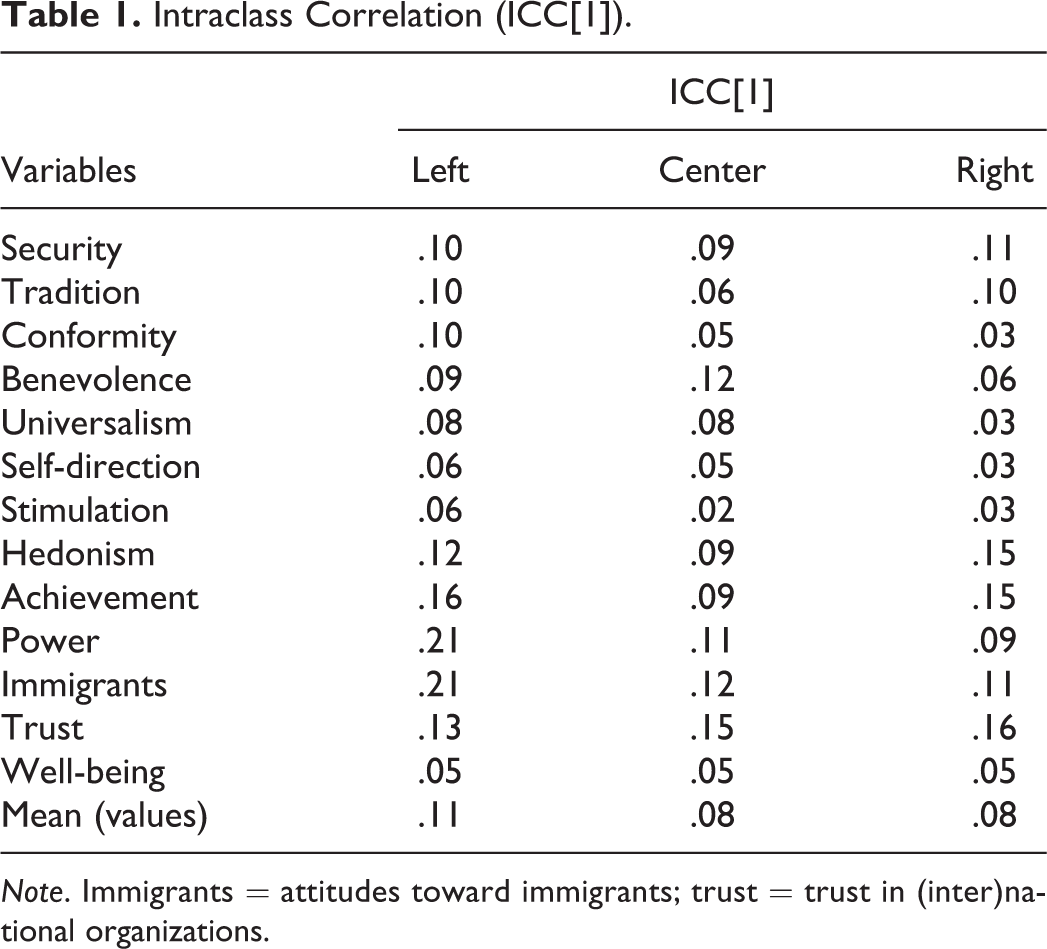
Note. Immigrants = attitudes toward immigrants; trust = trust in (inter)national organizations.
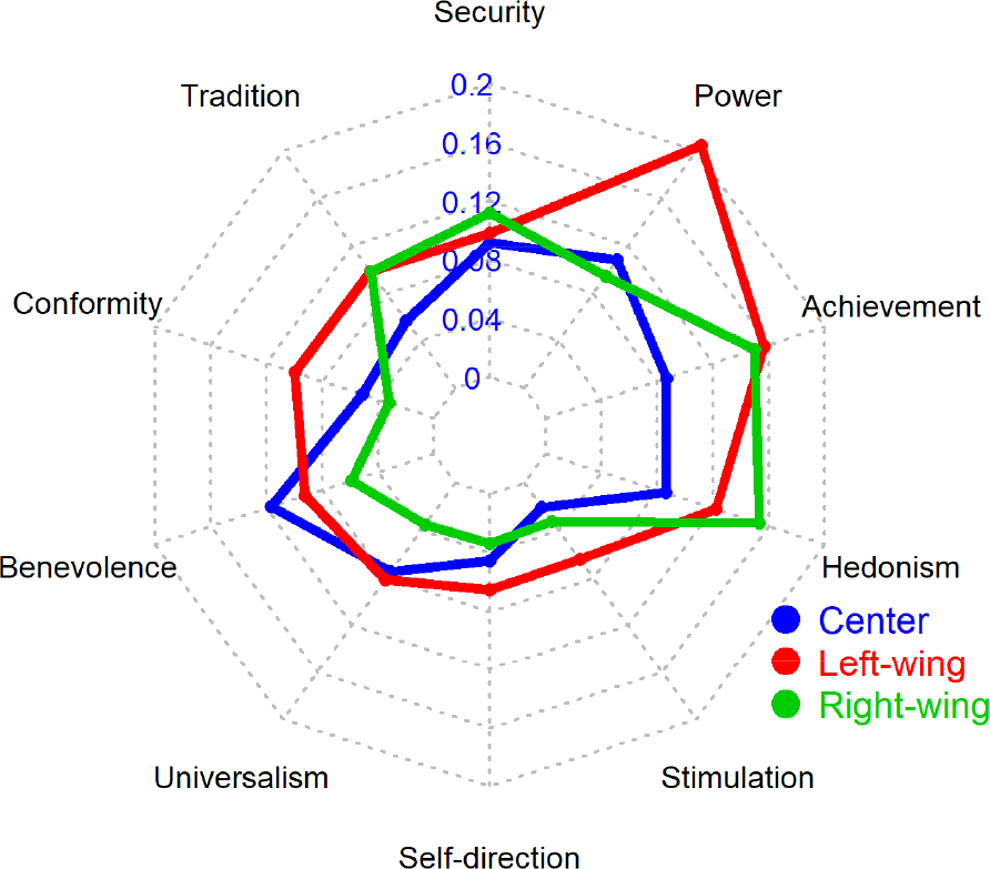
Intraclass correlations for all 10 value types across 21 European countries separated by political ideology.
Heterogeneity and Agreement Across Countries
Next, we compared the heterogeneity of all three groups across all 21 countries. Specifically, we tested whether the values of left- and right-wingers are more diverse than the values of those in the center across all European countries, using a series of Levene tests for variance homogeneity. The results showed that left-wingers were significantly more heterogeneous than those in the center for all 10 values (see Table 2), 3 supporting the view that extreme left-wingers form a less homogeneous mass. Also, right-wingers were significantly more heterogeneous than those in the center for all values except for conformity. Left-wingers tended to be more heterogeneous than right-wingers. For attitudes toward immigrants, trust in (inter)national institutions, and well-being, the same pattern was observed. The agreement index awg supported the findings: The amount of agreement was higher across almost all variables for the people in the center.
Heterogeneity Across Left-Wingers, Centers, and Right-Wingers.
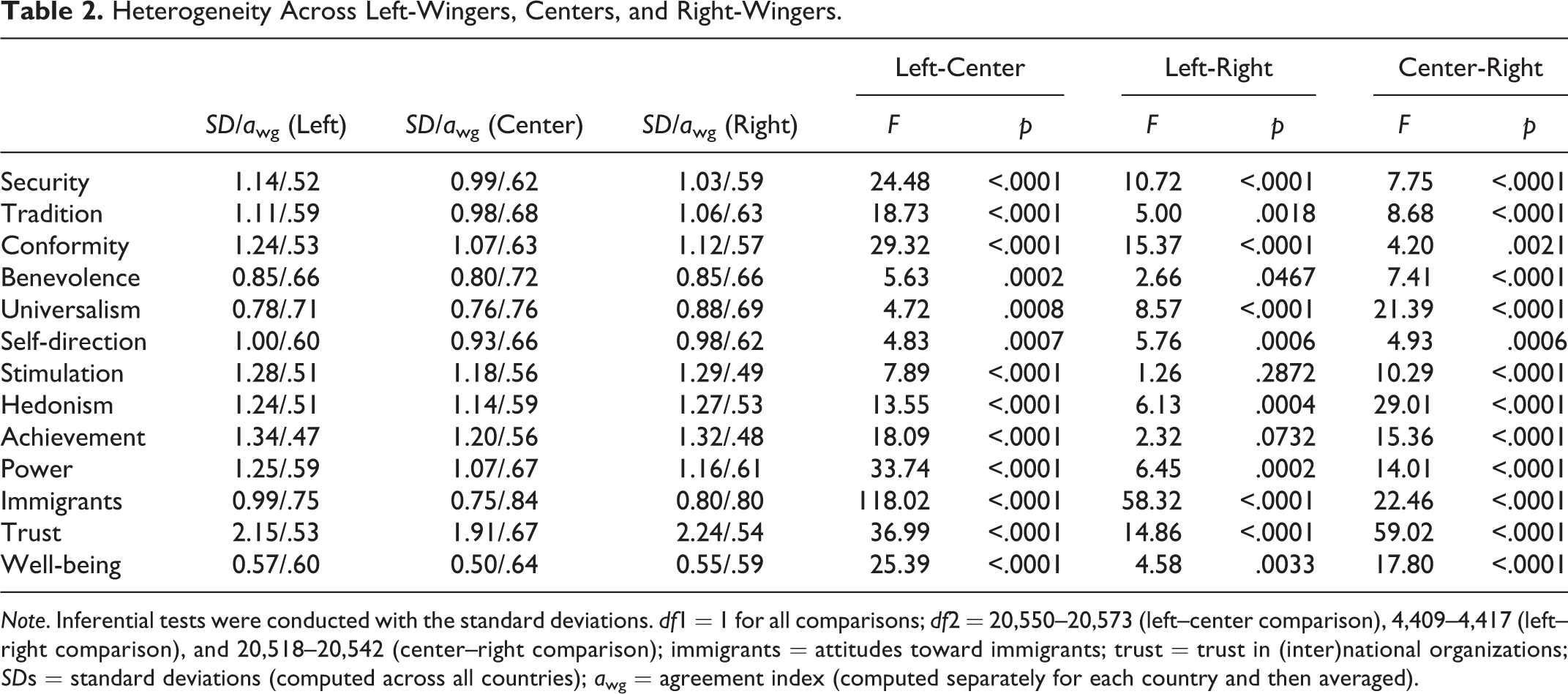
Note. Inferential tests were conducted with the standard deviations. df1 = 1 for all comparisons; df2 = 20,550–20,573 (left–center comparison), 4,409–4,417 (left–right comparison), and 20,518–20,542 (center–right comparison); immigrants = attitudes toward immigrants; trust = trust in (inter)national organizations; SDs = standard deviations (computed across all countries); awg = agreement index (computed separately for each country and then averaged).
This pattern suggests a quadratic trend: The more extreme the political attitudes, the larger the heterogeneity. To visualize this pattern, we plotted the SDs of each of political attitude groups, separately for all 13 dependent variables. Figure 2 shows a clear quadratic trend for the 13 dependent variables. A 21 (countries) × 143 (11 levels of political ideology × 13 dependent variables) matrix with the SDs in each cell can be found on osf (https://osf.io/nhsp3/?view_only=fd8f342306774694a5c536d6f118af7b).
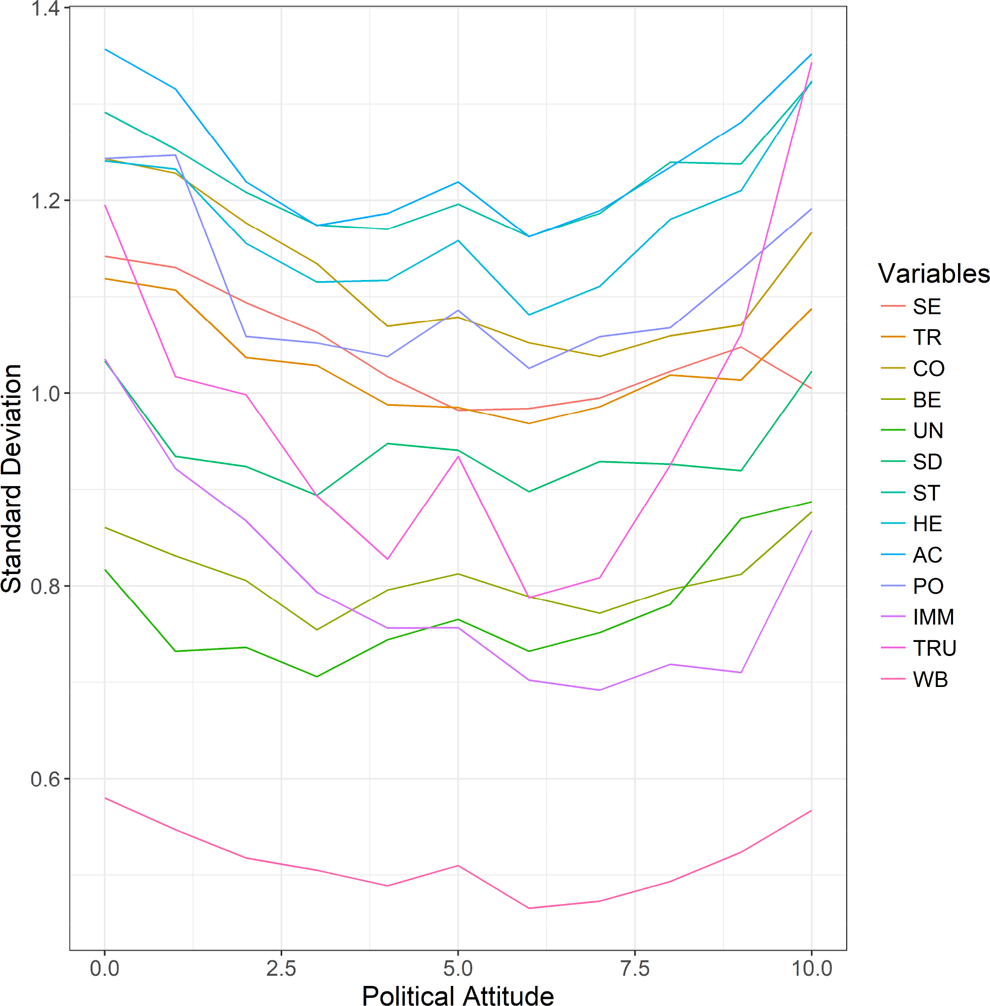
Standard deviations for all 10 political attitude groups, separately for all 13 DVs. SE = security; TR = tradition; CO = conformity; BE = benevolence; UN = universalism; SD = self-direction; ST = stimulation; HE = hedonism; AC = achievement; PO = power; IMM = attitudes toward immigrants; TRU = trust (inter)national institutions; WB = well-being. The SD of trust has been decreased by 1 for illustrational purposes.
Heterogeneity Within Countries
In a next step, we investigated whether the findings were consistent within each country. For this, we assessed how often left- or right-wingers were more homogeneous than those in the center within each country and variable, using again the SD as a measure of heterogeneity. This resulted in two sets of 21 (countries) × 13 (dependent variables [DVs]) comparisons. Left-wingers were more heterogeneous than centrists in 210 of the 273 comparisons (77%). In Belgium, Estonia, Finland, Germany, Hungary, Ireland, the Netherlands, and the United Kingdom left-wingers were more heterogeneous for at least 12 of the 13 DVs than those in the center. In contrast, in Israel, Lithuania, Norway, and Spain, left-wingers were only in 6 or 7 of the 13 DVs more heterogeneous. Right-wingers were heterogeneous than centrists in 202 of the 273 comparisons (74%). In Austria, Belgium, Germany, and Poland, right-wingers are more heterogeneous for at least 12 of the 13 DVs than those in the center. In contrast, in France, Hungary, Ireland, Lithuania, and Slovenia, right-wingers were in only 6 or 7 of the 13 DVs more heterogeneous.
Discussion
In the current article, we addressed the issue of value endorsement variability among citizens from 20 European countries and Israel. The results based on two different analysis (ICCs and Levene’s tests for differences between SDs) between and within countries largely supported our hypotheses. Specifically, we found that more extreme left- and right-wing political supporters were more heterogeneous compared to those with more moderate political attitudes. Specifically, we found that on almost 70% of all value and attitude comparisons, both left- and right-wingers were more heterogeneous than moderates, and that these effects were not moderated by a set of country-level variables. Overall, a higher proportion of variance in value endorsement was explained by country membership among more extreme political supporters compared to individuals with moderate views.
It is essential to note, however, that cross-country value/attitude variability within groups of political supporters might also partially stem from within-country variability. Indeed, Fischer and Schwartz (2011) reported that values vary the most between individuals rather than countries. This is also reflected in our findings—left-wing supporters exhibited higher heterogeneity more often than moderates in Western European countries, Estonia, and Finland. The same was true for right-wing supporters and moderates comparisons in Austria, Germany, Poland, and Belgium. At the same time, only on half of the studied variables, left- and right-wing respondents exhibited higher value/attitude variability than moderates in Lithuania, Norway, Spain, Israel, France, Hungary, Ireland, Lithuania, and Slovenia. These findings also demonstrate that the pattern of value/attitude variability within countries cannot be used to distinguish Western from Eastern European countries or Israel. It is possible that the integration of European states has contributed to a change in value endorsement in countries that had been previously dominated by communist regimes. Hence, the findings reported by Schwartz and Bardi (1997) on communist value endorsement (i.e., conservation), which would suggest a higher homogeneity of conservative values among political supporters in Eastern Europe, might not be valid anymore.
Finally, we found that the extent of heterogeneity was not explained by the country-level moderator’s parasite-stress level, religiosity, and income for any political attitude group. This replicates Hanel and Vione (2016) who investigated whether student samples and the general public are more heterogeneous in more autonomous and less embedded countries (cf. Schwartz, 2006). Across 59 countries and 7 attitudinal variables, they did not find a moderating effect of autonomy or embeddedness.
Consistency Between Citizens and Politicians in Value/Attitude Variability
We demonstrated that the heterogeneity of value endorsement among more extreme political supporters, rather than simply activists, can be partly explained by country membership. Therefore, country membership might have been a reason for value heterogeneity among left- and right-wing politicians in van Hiel’s (2012) study. We observed the same pattern of results in our study by taking into account 20 European countries and Israel and studying value differences within and across these countries. In this way, we could test for heterogeneity of values among general population. Therefore, the observed heterogeneity of values in our study was less likely influenced by group and conformity processes (Mason, 2006). Importantly, by using inferential statistics, we showed that within European countries, the heterogeneity between left- and right-wing supporters is equal.
Also, Duriez et al. (2005) provided partial evidence that there are between-country differences in personality traits related to values among left- and right-wing supporters and activists across Western and Eastern European countries. Our findings were corroborated by large heterogeneities for the political extremists across all 21 countries for attitudes toward immigrants, trust in (inter)national organizations, and well-being. This contrasts with recent findings in the United States based on the data from political supporters (Ondish & Stern, 2017), suggesting that moderates are more heterogeneous in their political attitudes locally (i.e., within their own countries) and also at a supranational level (across countries). Overall, integrating our findings with the previous literature (Duriez et al., 2005; van Hiel, 2012), it seems that political supporters and political activists exhibit similar patterns of value heterogeneity.
It is also worth noting that the larger heterogeneity among European conservatives might be due to historic reasons: European conservatism is more strongly tied to old feudalistic structures such as landed aristocracies or churches (Hartz, 1955; Schultze, Sturm, & Eberle, 2003; Viereck, 1956). As the nature of such structures varied across European states, those who still believe in them, that is, mainly conservatives or right-wing supporters, would be therefore more diverse than those who entirely reject feudalistic structures, such as moderates or left-wing supporters. However, this post hoc reasoning is somewhat speculative, as it would need to be directly tested in a cross-cultural comparison.
However, our somewhat surprising finding that right-wing supporters are also more heterogeneous regarding their attitudes toward immigrants seemingly contradicts literature, suggesting that more extreme right-wing politicians share anti-immigration and related anti-EU integration views (see Cherepnalkoski, Karpf, Mozetic, & Grear, 2016). It is believed that anti-immigration attitudes appear to be a strong unifying factor across right-wing parties, especially in the recent years (see also Ivarsflaten, 2007, for empirical support), as the popularity of such parties across many European countries has increased significantly (e.g., in Austria, France, Greece, Denmark, Finland, Hungary; Adler, 2016). Thus, our findings could hint to some potential differences among party members and citizens who endorse the right-wing ideology. A further possibility is that the two groups had different immigrant groups in mind: Many decisions in the European Parliament concern non-EU immigrants, whereas participants in our sample might have thought mainly about EU immigrants (recall that the data used in the present study were collected in 2014 and 2015, presumably before many refugees from Syria and Afghanistan were looking for shelter in the EU). We also need to acknowledge that the political ideology item consisted of a single item. Piurko, Schwartz, and Davidov (2011) claimed that the single dimension of left–right might not fully capture people’s political attitudes. It is also possible that people may have different understanding of the left–right spectrum depending on the historical and socioeconomic context of their countries of origin (Duriez et al., 2005). However, it is worth noting that previous between-country research relying on ESS data found meaningful differences between those participants who identified themselves as belonging to the political left and right wing (Aspelund, Lindeman, & Verkasalo, 2013; Ivarsflaten, 2007; Rydgren, 2008). We should note that we also found the expected mean differences. For example, left-wingers across all 21 countries valued conformity, tradition, and security less than right-wingers, replicating Caprara, Schwartz, Capanna, Vecchione, and Barbaranelli (2006).
Variability in Conservation, Self-Transcendence, and Self-Enhancement Values
Overall, the variance explained by country membership in value variability was less than 10%. Such findings are in line with Fischer and Schwartz (2011), indicating that values differ the most between individuals rather than between-country members in general. In Fischer and Schwartz’s research, the only value type that was influenced by country membership was conformity. Our results extend such findings by indicating that country membership is indeed an important determinant of conformity and tradition differences, but mainly in the case of left- and right-wing political supporters. The same pattern was true for tradition. To summarize, we show that although country membership might not account for large differences in value importance among European citizens, it plays a significant role in value variability within the political context.
In turn, we found the highest homogeneity among extremists for benevolence and universalism values, which are coincidentally the most important value types for people in general (see Barnea & Schwartz, 1998). These values can be also seen as essential for successful cooperation between people and across groups, as they refer to tolerance and welfare of others. In contrast, agreement for achievement (i.e., intellectual autonomy or independence) is relatively low. This might be because achievement values might be understood (i.e., instantiated) differently than benevolence. Some people might think about achievement as receiving good grades or earning large sums of money and dismiss it therefore more readily because it might be against their universalism values. In contrast, if people understand it more as achieving a good work life balance than some people might find it more important (Hanel et al., 2018).
The relatively lower homogeneity in terms of benevolence and universalism might be also a methodological artifact, as we obtained ceiling effects for these values. However, future experiments can build upon such findings by highlighting that not only are benevolence and universalism some of the most important values on average, but that this view is also shared by many people within political groups across European countries and Israel. At the same time, people often underestimate how important benevolence and universalism are for other people (Hanel et al., 2018). This is relevant because people who believe that others have higher self-transcendence values are also more inclined to do civic engagement (Sanderson et al., 2018). Previous research that has tried to change the perception of others’ self-transcendence values by presenting absolute percentage of people endorsing those values, has failed to highlight the relative homogeneity of these values (Hanel et al., 2018), which possibly resulted in subtyping (Richards & Hewstone, 2001). Overall, it appears that all political supporters across EU and Israel are relatively homogenous in endorsing benevolence and universalism values. Despite large cross-country heterogeneity in other values, it seems that in general self-transcendence values make it possible for various political groups to form political groups at supranational level in European Parliament.
Finally, we would like to acknowledge that the European Social Survey data did not allow us to include all EU nations in our analyses. Therefore, the heterogeneity of the values found in the present research might have been impacted. Future research should further investigate these issues. Also, for the purposes of generality, it would be worthwhile to be able to assess value heterogeneity using a sample of members of the European Parliament to assess whether their pattern of responses converges with our ESS findings.
Conclusion
To conclude, we demonstrate that European country membership is a relevant factor in explaining value heterogeneity, especially in the case of more extreme political supporters in comparison to moderate ones. Such differences were most pronounced in the case of tradition and conformity values and the least pronounced in the case of self-transcendence values and were not moderated by country-level variables. Overall, our findings suggest that speaking of “extreme left-wing values” or “extreme right-wing values” may not be meaningful, as members of both groups are heterogeneous in the values that they endorse.
Supplemental Material
Supplemental Material, SPPS803348_suppl_mat - Sharing the Same Political Ideology Yet Endorsing Different Values: Left- and Right-Wing Political Supporters Are More Heterogeneous Than Moderates
Supplemental Material, SPPS803348_suppl_mat for Sharing the Same Political Ideology Yet Endorsing Different Values: Left- and Right-Wing Political Supporters Are More Heterogeneous Than Moderates by Paul H. P. Hanel, Natalia Zarzeczna and Geoffrey Haddock in Social Psychological and Personality Science
Footnotes
Authors’ Note
Paul H. P. Hanel and Natalia Zarzeczna contributed equally to this work.
Acknowledgments
We wish to thank Gregory Maio for helpful discussions about this project at an early stage.
Declaration of Conflicting Interests
The author(s) declared no potential conflicts of interest with respect to the research, authorship, and/or publication of this article.
Funding
The author(s) disclosed receipt of the following financial support for the research, authorship, and/or publication of this article: The authors acknowledge financial support by the Economic and Social Research Council (ESRC;  ) to the second author (ES/J500197/1). The funders had no role in study design, data collection and analysis, decision to publish, or preparation of the article.
Supplemental Material
The supplemental material is available in the online version of the article.
Notes
References
Supplementary Material
Please find the following supplemental material available below.
For Open Access articles published under a Creative Commons License, all supplemental material carries the same license as the article it is associated with.
For non-Open Access articles published, all supplemental material carries a non-exclusive license, and permission requests for re-use of supplemental material or any part of supplemental material shall be sent directly to the copyright owner as specified in the copyright notice associated with the article.
