




Abstract
Stressful experiences have repeatedly been related to psychological problems. The current study extends previous work on stress and psychological problems by examining the link between stressful experiences and both internalizing (INT) and externalizing (EXT) problems. Additionally, individual differences are investigated by testing the moderating role of self-esteem. Questionnaire data of 750 adolescents aged 12–18 were collected and analyzed using multiple regression analyses. Analyses were controlled for sex and socioeconomic status. Results indicated that adolescents who report more stressful experiences are more likely to experience both INT and EXT problems, and these relationships were stronger for adolescents with low self-esteem. Post hoc analyses (e.g., different thresholds for determining stressful experiences) support the robustness of our findings. The findings on self-esteem emphasize the importance of taking individual differences into account in the relation between stressful experiences and psychological problems. The results can be seen as a next step in cross-sectional research.
The experience of stressful experiences has repeatedly been related to the development of psychological problems (Brown, Harris, & Peto, 1973; Cicchetti & Toth, 1991, 1997; Laceulle et al. 2014; Waaktaar, Borge, Fundingsrud, Christie, & Torgersen, 2004). Specifically, it has been found that people who have more stressful experiences are also more likely to report psychological problems (Haine, Ayes, Sandler, & Weyer, 2003). So far, however, much of the research in this field was conducted in adult populations, leaving it unclear whether this relationship also exists in adolescence. This is surprising, as adolescence is characterized by a peak in (the onset of) psychological problems (Dahl, 2004), as well as by many other changes (Collins, Maccoby, Steinberg, Hetherington, & Bornstein, 2000; Sarason, Johnson, & Siegel, 1978). The current study extends previous work on stress and psychological problems, by examining whether the experience of stressful experiences is related to internalizing (INT) and externalizing (EXT) problems in adolescence. Additionally, individual differences in these links are investigated by testing the moderating role of self-esteem.
Stressful Experiences and Psychological Problems During Adolescence
Psychological problems can be seen as an umbrella term for all kinds of psychopathology. Within this overarching term, research has traditionally focused on a two-dimensional structure in psychological problems (Achenbach, 1966; Achenbach & Edelbrock, 1978; Krueger, Caspi, Moffit, & Silva, 1998; Krueger, Johnson, & Kling, 2006), differentiating between INT and EXT problems. INT problems direct themselves inward toward the individual experiencing them, whereas EXT problems are those problems that direct themselves outward and toward others (Achenbach, 1991). For many of these problems, incidence rates rise steeply from early adolescence onward (Bernstein, Borchardt, & Perwien, 1996; Dahl, 2004; Hankin et al., 1998). This, together with the major biological, psychological, and social changes and intense interactions with the environment typical for the adolescent years raises the question if and to what extent adolescence is a window of vulnerability for the effects of environmental adversity.
Previous research has shown that the experience of adversity, and stressful experiences in particular, is associated with the development of psychological problems (Brown et al., 1973; Cicchetti & Toth, 1997; Laceulle et al., 2014, Waaktaar et al., 2004). This has also been framed in the context of the developmentally based life-stress model, which focuses on the interplay between child and environment in the development of psychopathology (Rudolph et al., 2000). Although the model was originally developed to understand associations between stressful experiences and depression, the model has been applied to a wide range of psychological problems. Empirical evidence has provided consistent support for the link between stressful experiences and INT problems. Although much of this research was conducted in adult samples (Osvath, Vörös, & Fekete, 2004; Paykel, 2003), more recently, interest has sparked in understanding whether and how stressful experiences are related to INT problems in adolescence (e.g., Laceulle et al., 2014; Waaktaar et al., 2004) and to depression in particular (Grant et al., 2006; Hankin, Mermelstein, & Roesch, 2007; McMahon, Grant, Compas, Thurm, & Ey, 2003).
The relationship between stressful experiences and psychopathology has also been studied for EXT problems, but to a much lesser degree. Studies in adult samples found support for links between stressful experiences and anger (Osvath et al., 2004) and conduct and oppositional behavior problems (Tiet et al., 2001). In adolescents, Suldo and Huebner (2004) found that stressful experiences may lead to psychopathological EXT behavior. Rydell (2010) found that stressful experiences were associated with higher levels of attention deficit hyperactivity disorder and oppositional defiant disorder symptoms in 10-year-old children. Together, these findings suggest the importance of stressful experiences in psychopathology, both during adolescence and beyond. So far however, research has barely examined the link between stressful experiences and both INT and EXT problems during adolescence. Whereas the link with problems in the INT domain may follow logically from theoretical models (e.g., the life-stress model), empirical findings from the last decade suggest that stress may be related to a broader range of psychological problems.
Individual Differences in the Relationship Between Stressful Experiences and Psychological Problems: The Role of Self-Esteem
The studies mentioned above provide evidence for an association between stressful experiences and psychopathology. However, it is crucial to identify factors that may explain interindividual differences in the link between stress and psychopathology. Several factors have been identified that are thought to moderate the link between stressful experiences and psychopathology, including attitudes, family environment, and coping (Grant et al., 2006). An alternative factor crucial to consider in the context of stress sensitivity during adolescence is self-esteem. Whereas self-esteem starts to develop early in life (Harter, 2006), the development as well as the correlates and consequences of self-esteem may be of particular importance during adolescence due to major personal and social changes. This vulnerability with regard to adolescent self-esteem has previously been linked to feelings of depression and suicidal ideation (Harter & Marold, 1994; Harter & Whitesell, 1996) and might explain individual differences in the association between stressful experiences and psychological problems. Previous research in adults has suggested that this may be indeed be the case, but less is known about the role of self-esteem in the link between stressful experiences and psychopathology in adolescence, and in particular in relation to EXT problems. However, some correlational work has found strong relations between low self-esteem and INT and EXT problems (Mann, Hosman, Schaalma, & De Vries, 2004), as well as between low self-esteem and stressful experiences (Wilburn & Smith, 2005) in adolescence, suggesting self-esteem may also play an important role in this life stage.
The assumption of self-esteem as a moderator is well in line with the classic psychosocial model of Brown and Harris (1978), stating that the relationship between life stress and psychopathology (i.e., depression) is moderated by an individual’s self-esteem. In an alternative model, Metalsky, Joiner, Hardin, and Abrahamson (1993) combined attributional style, self-esteem, and life stress as vulnerability to depressive symptoms. Ever since the proposition of a psychosocial model by Brown and Harris (1978) and the integrated model by Metalsky and colleagues (1993), several studies have examined the role of self-esteem in the link between stressful experiences and adult psychopathology. In many cases, researchers found evidence for the role of self-esteem as a moderator in the relation between stressful experiences and psychological problems (Abela, Webb, Wagner, Ho, & Adams, 2006; Brown, Andrews, Bifulco, & Veiel, 1990; Brown, Bifulco, & Andrews, 1990; Moksnes, Moljord, Espnes, & Byrne, 2010; Southall & Roberts, 2002). For example, in a community sample of adults with a history of major depression, Abela and colleagues (2006) found that high self-esteem acted as a buffer against depressive symptoms following the occurrence of negative experiences. Others, however, failed to find a moderating role of self-esteem (Lewinsohn, Steinmetz, Larson, & Franklin, 1981; Orth, Robins, & Meier, 2009; Robinson, Garber, & Hilsman, 1995).
Taken together, evidence for the role of self-esteem is mixed, focused almost exclusively on INT problems, and largely limited to adult samples. As such, it is unclear to what extent the findings translate to the associations between stressful experiences and both INT and EXT problems during adolescence. However, given the increasingly well-established link between stressful experiences and EXT problems, and the importance of self-esteem during adolescence more generally, it is important to disentangle the role of self-esteem in the link between stress and EXT problems as well.
Importantly, a basic assumption underlying both the psychosocial model (Brown & Harris, 1978) and the integrated model (Metalsky, Joiner, Hardin, & Abrahamson, 1993) is that the mechanisms are causal. Specifically, self-esteem is proposed to moderate the effect of stressful experiences on psychological problems. Whereas this may well be the case, the opposite might also be true. Specifically, adolescents high on psychological problems may trigger or select situations in which they are at risk of the experience of stressful events, and this link may vary as a function of self-esteem. So far, no studies seem to have examined such a moderation effect of self-esteem. However, earlier longitudinal research has found support for bidirectional associations between stressful experiences and psychological problems during childhood and adolescence (e.g., Laceulle et al., 2014). To examine the moderating role of self-esteem in the (bidirectional) associations between stress and psychological problems, large longitudinal data sets with at least three waves would be required—and even then caution would be needed regarding the interpretation of findings in terms of causality (Hamaker, Kuiper, & Grasman, 2015). In sum, it is crucial to realize that a cross-sectional study like the current project cannot address the issue of causality and that alternative theoretical models may apply instead of or in addition to the models by Brown and Harris (1978) and Metalsky and colleagues (1993). However, research on the moderating role of self-esteem in the relation between stressful experiences and EXT problems is scarce, despite indirect evidence suggesting that self-esteem is strongly linked to both INT and EXT problems (Mann et al., 2004). Moreover, as self-esteem is of crucial importance during adolescence (e.g., Harter & Marold, 1994), exposure to both mild and more severe stressful experiences is common in adolescence (e.g., Laceulle, Nederhof, Karreman, Ormel, & Van Aken, 2012), and many psychological problems have their onset during these years (e.g., Hankin et al., 1998), the interrelations between stressful experiences, self-esteem, and both INT and EXT problems may set the stage for adult life functioning. As such, although caution is needed to not overinterpret cross-sectional findings in terms of causal mechanisms, the current study provides a modest yet first step with regard to our understanding of the relation between stressful experiences, self-esteem, and both INT and EXT problems.
Current Study
Stressful experiences have repeatedly been linked to the development of psychopathology during adolescence and life in general. However, not all adolescents exposed to stressful experiences ultimately develop such problems. Previous research suggests that self-esteem may explain individual differences in the link between stressful experiences and INT problems, but studies examining self-esteem as a moderator are scarce, and nothing is known on these associations with regard to EXT problems. In the current study, we investigated the relations between stressful experiences, self-esteem, and INT and EXT problems. Specifically, we examined whether self-esteem weakens the link between stressful experiences and both INT and EXT psychological problems during adolescence. As such, the current study can be seen as the next step in cross-sectional research by differentiating between two broad domains of psychological problems and examining the moderating role of self-esteem in adolescence. Substantial links are hypothesized with regard to the association between stressful experiences and INT and are expected to be strongest in adolescents with low (compared to high) self-esteem (moderation). A modest association is hypothesized with regard to the link between stressful experiences and EXT. The possible moderating role of self-esteem in this association will be explored. The proposed relations, along with the hypotheses, are visualized in Figure 1.
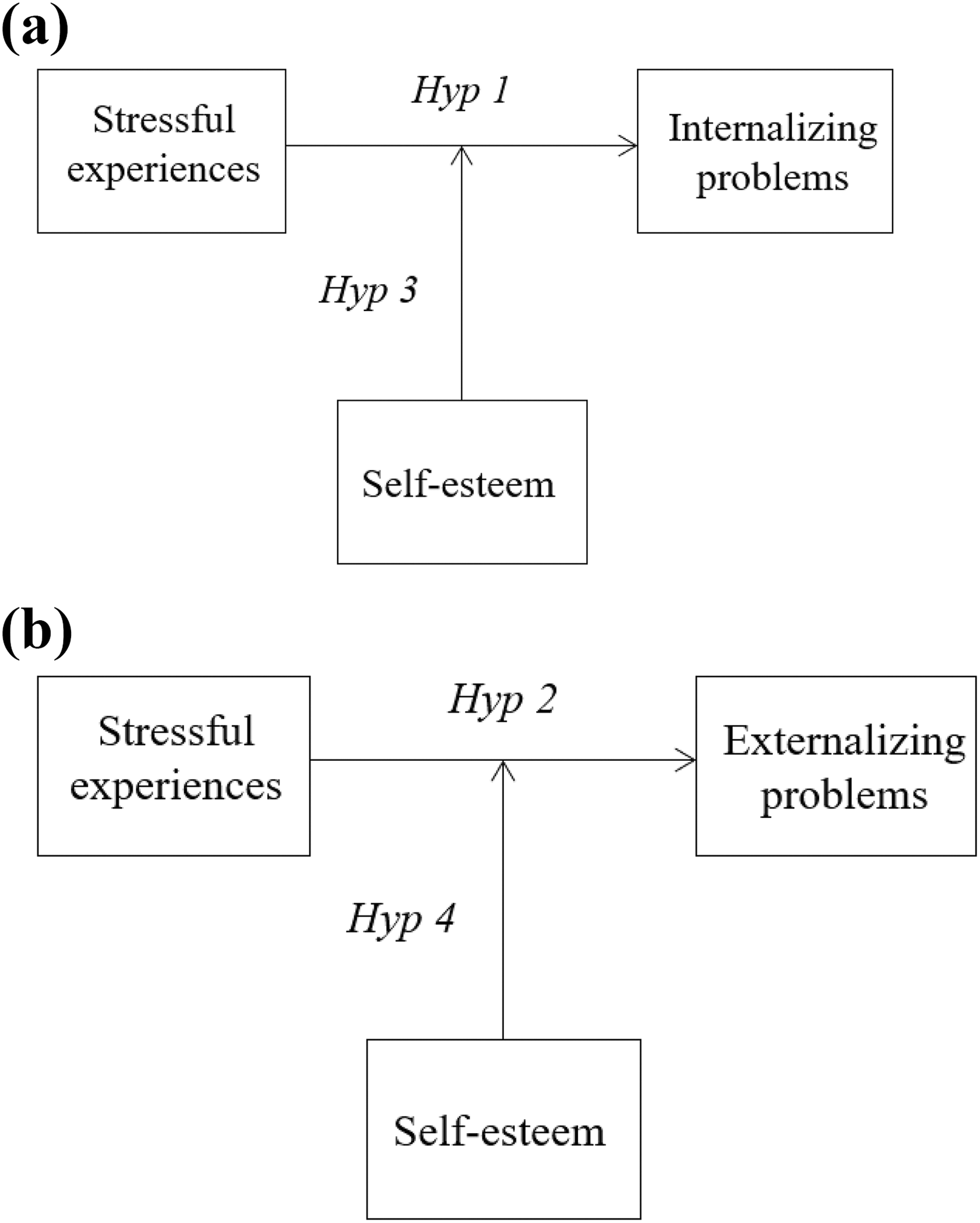
(a) Conceptual model for internalizing symptoms. (b) Conceptual model for externalizing symptoms.
Method
Sample and Data Collection
Our sample was recruited from six secondary schools throughout the Netherlands via post, telephone, and/or e-mail. In a first letter or e-mail, schools were informed concisely about the study and additionally informed via telephone within several days after receiving the letter or e-mail. In case a school agreed to participate, parents and caretakers received a letter or an e-mail about the participation of their children in the study. In line with the guidelines valid at the time of data collection, parents could inform the school or study principal investigators when they did not want their child to participate (passive consent). Adolescents were informed regarding the study goals and provided written informed consent prior to the start. They were told that they could withdraw at any time and that they could contact the principal investigators of the study both during and after the study. This resulted in a total sample of 750 adolescents. The current study was based on adolescents who had data on psychological problems, self-esteem, and stressful experiences, resulting in a sample of 743 adolescents (47.1% boys [N = 353]) with a mean age of 14.8 (SD = 1.7), which is demographically similar to the Dutch population for this age group. Social economic status, as inferred by parents’ received education, could be considered slightly above average, with 37% of fathers and mothers having received higher education (as compared to 35% of the Dutch average; Statistics Netherlands, 2013). Furthermore, the distribution of native languages closely mirrored that in the population (e.g., Arabian was the native language of 1.1% of our sample, compared to 1.3% of the total population; Statistics Netherlands, 2016). Data were collected with paper-and-pencil questionnaires in April and May 2015 by at least two undergraduate student assistants. Respondents received a small candy bar as a reward at the end.
Measures
Stressful experiences
Stressful experiences were assessed using an adapted version of the Life Experiences Survey (LES). This measure was originally developed by Sarason, Johnson, and Siegel (1978) and is especially fit to measure stressful experiences as it assesses both the occurrence and the impact of specific experiences. Test–retest reliability was found to be acceptable in prior research (Iwamitsu et al., 2008; Sarason et al., 1978). For the current project, 38 items were assessed. Of these items, we excluded 3 items to avoid potential overlap with the EXT problems items (e.g., “minor lawbreaking behavior”). All items included are experiences that are presumed to be relevant in adolescence and have been used in previous studies (e.g., Laceulle et al., 2012; McMahon et al., 2003). Included events were, among other things: the death or illness of a family member or close friend, school accomplishments or failures, and breaking up with a boy- or girlfriend. Respondents were asked to indicate which events they had experienced and when (0–6 months or 7–12 months prior), and how much of an impact this experience had had on their life. This potential impact was measured on a 7-point Likert-type scale, ranging from −3 (extremely negative) to 3 (extremely positive). Experiences that were rated by a participant as very negative (−2 or −3) were included for the analyses. Subsequently, an experience variable was constructed, indicating the number of (negative) stressful experiences the adolescent reported. Such a format combining the count of experiences and the severity has been used in several previous studies (e.g., Lüdtke, Roberts, Trautwein, & Nagy, 2011; Troy, Ford, McRae, Zarolia, & Mauss, 2017; Wilburn & Smith, 2005).
Psychological problems
Psychological problems were measured with the Youth Self-Report (YSR) measure of psychopathology (Achenbach, 1991). For this study, we used a shortened version consisting of 62 items, distinguishing between INT and EXT behavior. This adapted version measured five different problem clusters: withdrawn behavior, somatic complaints, anxiety and depression, aggressive behavior, and delinquent behavior. The first three of these clusters can be seen as INT behavior, the latter two as EXT behavior. The item “I talk about suicide” was left out from the questionnaire, as it might be too taxing for adolescents. Respondents indicated their responses on a 3-point Likert-type scale, ranging from 0 (not true) to 2 (very or often true). The YSR has been shown to have good reliability for the INT scale and the EXT scale and good validity (Achenbach, 1991; Achenbach & Rescorla, 2001). The adapted version used in the present study was shown to have good validity as well (Verhulst, van der Ende, & Koot, 1997). In the current study, α coefficients were found of .89 for INT symptoms and .85 for EXT symptoms.
Self-esteem
Self-esteem was measured with the Rosenberg Self-Esteem Scale (RSES) with 10 questions (Rosenberg, 1965). The RSES uses a 4-point Likert-type scale, ranging from 1 (doesn’t fit me at all) to 4 (fits me well). Acceptable reliability and validity were reported in earlier studies (Rosenberg, 1965; Sinclair et al., 2010). In the current study, Cronbach’s α was .85.
Statistical Analyses
Data preparation was performed in IBM SPSS Version 20.0. All regression analyses were conducted in the “lavaan” R package (Rosseel, 2012). Descriptive statistics of age, socioeconomic status (SES), self-esteem, stressful experiences, and INT and EXT problems were calculated in terms of means, standard deviations, and correlations. Frequencies were calculated for sex and stressful experiences. The regression analyses were conducted using latent variables for self-esteem and INT and EXT (Westfall & Yarkoni, 2016). Because interaction is not possible with unobserved variables, the Kenny and Judd’s (1984) approach was used to create product terms of the latent indicators, which was implemented with the semTools package (semTools Contributors, 2016). The resulting product terms were then entered as indicators of the interaction term. Appropriate constraints were added to the model syntax. All analyses were controlled for sex and SES. Given our sample size of 743, a probability level of .05, and power of .80, our analyses were able to detect effects as small as .015.
Results
Descriptive information of the study variables is reported in Table 1. Correlations between stressful experiences, INT and EXT problems, and self-esteem are reported in Table 2 and show relations in the expected directions.
Descriptive Statistics.
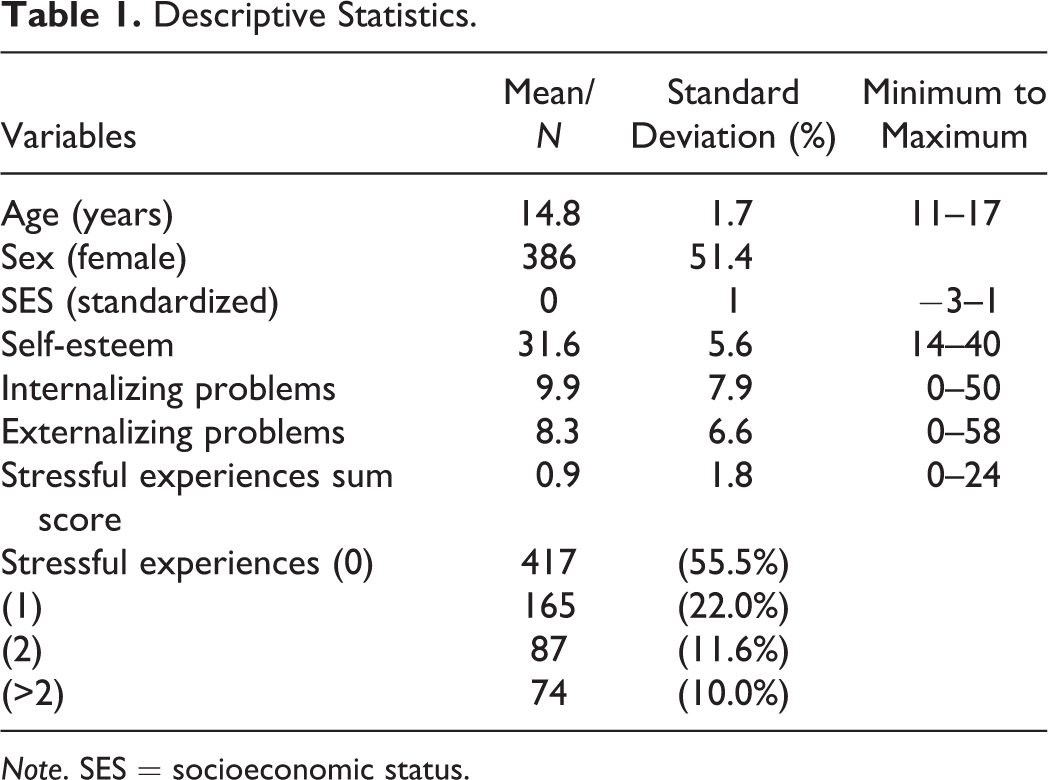
Note. SES = socioeconomic status.
Correlation Coefficients.
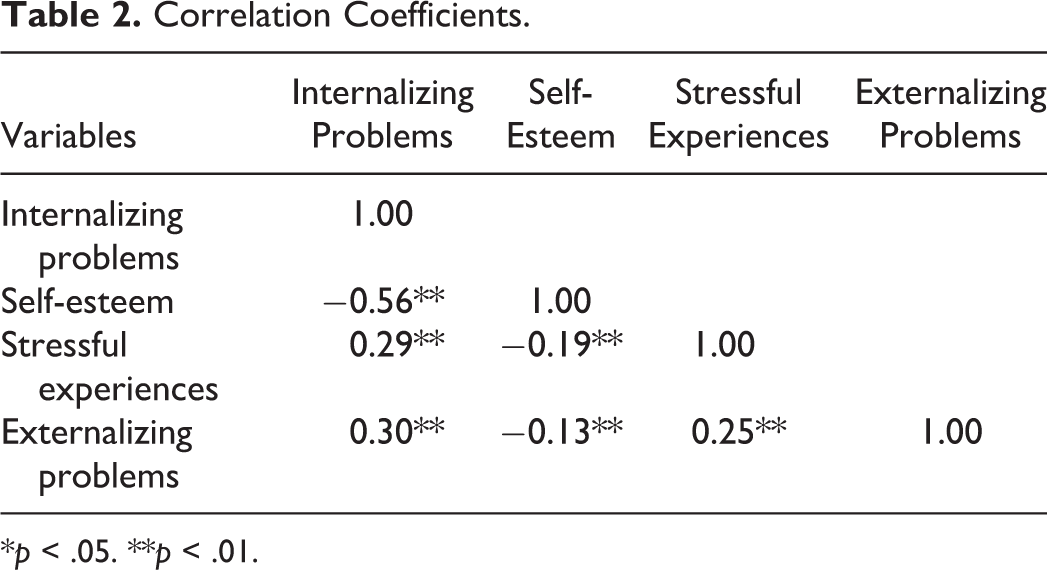
*p < .05. **p < .01.
INT Problems
All path estimates for the analyses with INT problems are reported in Table 3. A model with sex and SES was first fit to the data, explaining 5.3% of the variance in INT problems. We next fit a model including the stressful experiences, self-esteem, and an interaction term (i.e., Stressfulexperiences × Self-Esteem), which explained 42.6% of the variance in INT. In this model, stressful experiences were positively linked to INT, indicating that adolescents who reported more stressful experiences also scored higher on INT problems. Both self-esteem and the interaction term were negatively linked to INT, suggesting that adolescents who scored lower on self-esteem also reported more stressful experiences. In addition, a higher score on self-esteem weakened the relation between stressful experiences and INT problems. The interaction is illustrated in Figure 2, in which we see the relation between stressful experiences and psychological problems for adolescents with low self-esteem (M − SD) and adolescents with high self-esteem (M + SD). Note that these groups were created solely for the purpose of illustration and were not used for the analyses. Moreover, for reasons of clarity, the interaction effect is illustrated for the nonlatent scores.
Regression Analysis of Internalizing Problems on Stressful Experiences and Self-Esteem.
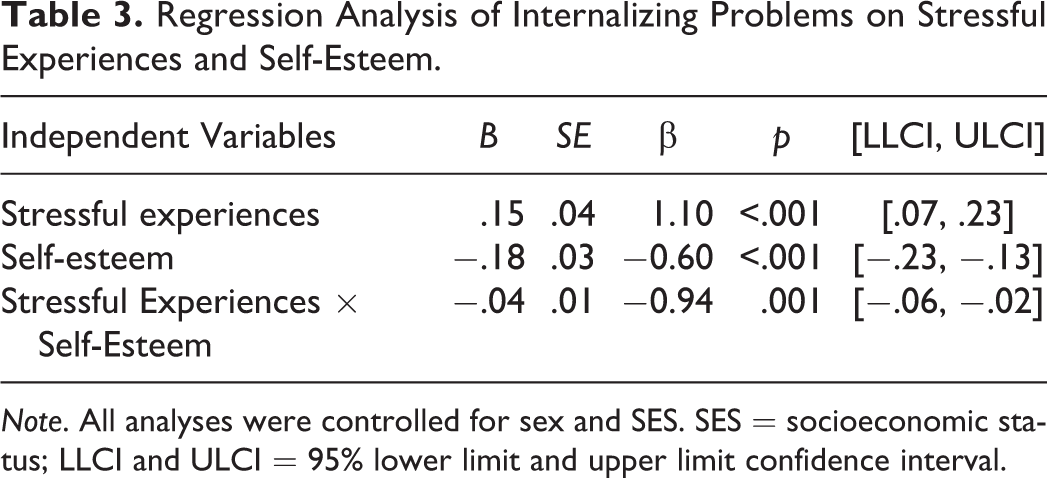
Note. All analyses were controlled for sex and SES. SES = socioeconomic status; LLCI and ULCI = 95% lower limit and upper limit confidence interval.
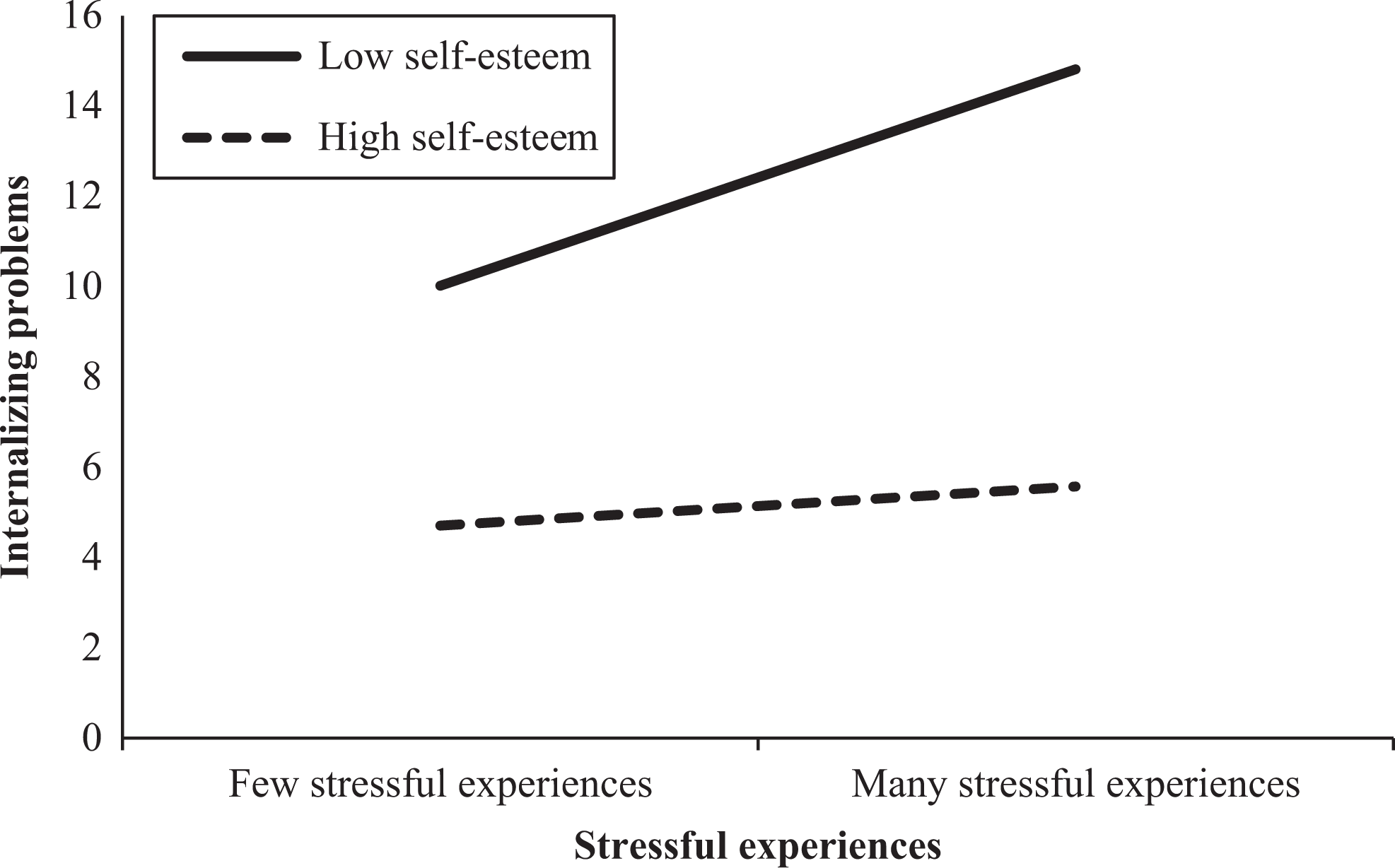
The interaction effect has been illustrated for internalizing problems in the graph for a group with few stressful experiences (M − SD) and for a group with many stressful experiences (M + SD), controlled for sex and socioeconomic status.
EXT Problems
Path estimates for the analyses with EXT problems are reported in Table 4. We first fit a model with only the control variables (i.e., sex and SES) to the data. This model explained 7.2% of the variance in EXT. Next, the model was expanded with stressful experiences, self-esteem, and an interaction term. This latter model explained 21.1% of the variance in EXT. Similar to the link with INT problems, stressful experiences were positively related to EXT, indicating that adolescents who reported more experiences also scored higher on EXT problems. Self-esteem and the interaction term were linked negatively to EXT, suggesting that adolescents with a low score on self-esteem reported more EXT problems. Additionally, a higher score on self-esteem weakened the relation between stressful experiences and EXT problems. The interaction was less strong than the interaction found for INT problems. The interaction for EXT problems is illustrated in Figure 3.
Regression Analysis of Externalizing Problems on Stressful Experiences and Self-Esteem.
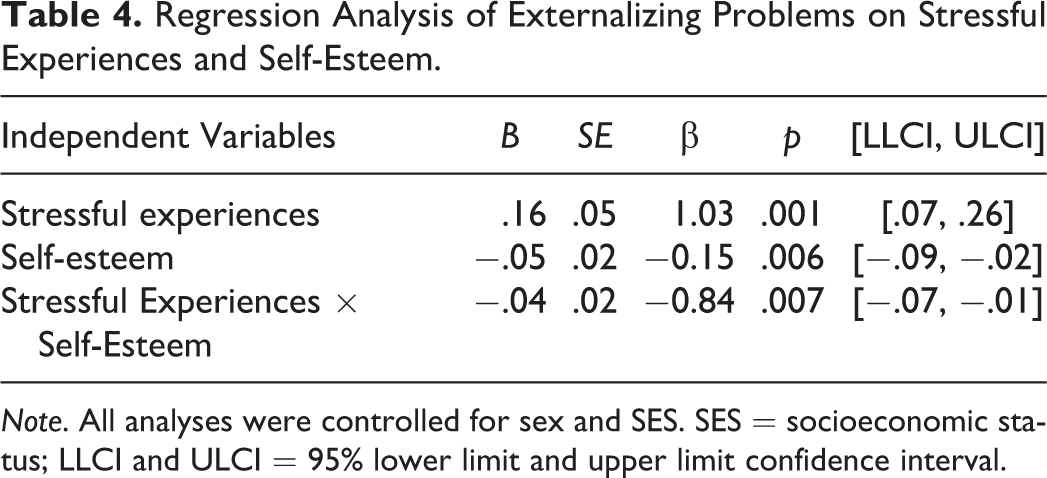
Note. All analyses were controlled for sex and SES. SES = socioeconomic status; LLCI and ULCI = 95% lower limit and upper limit confidence interval.
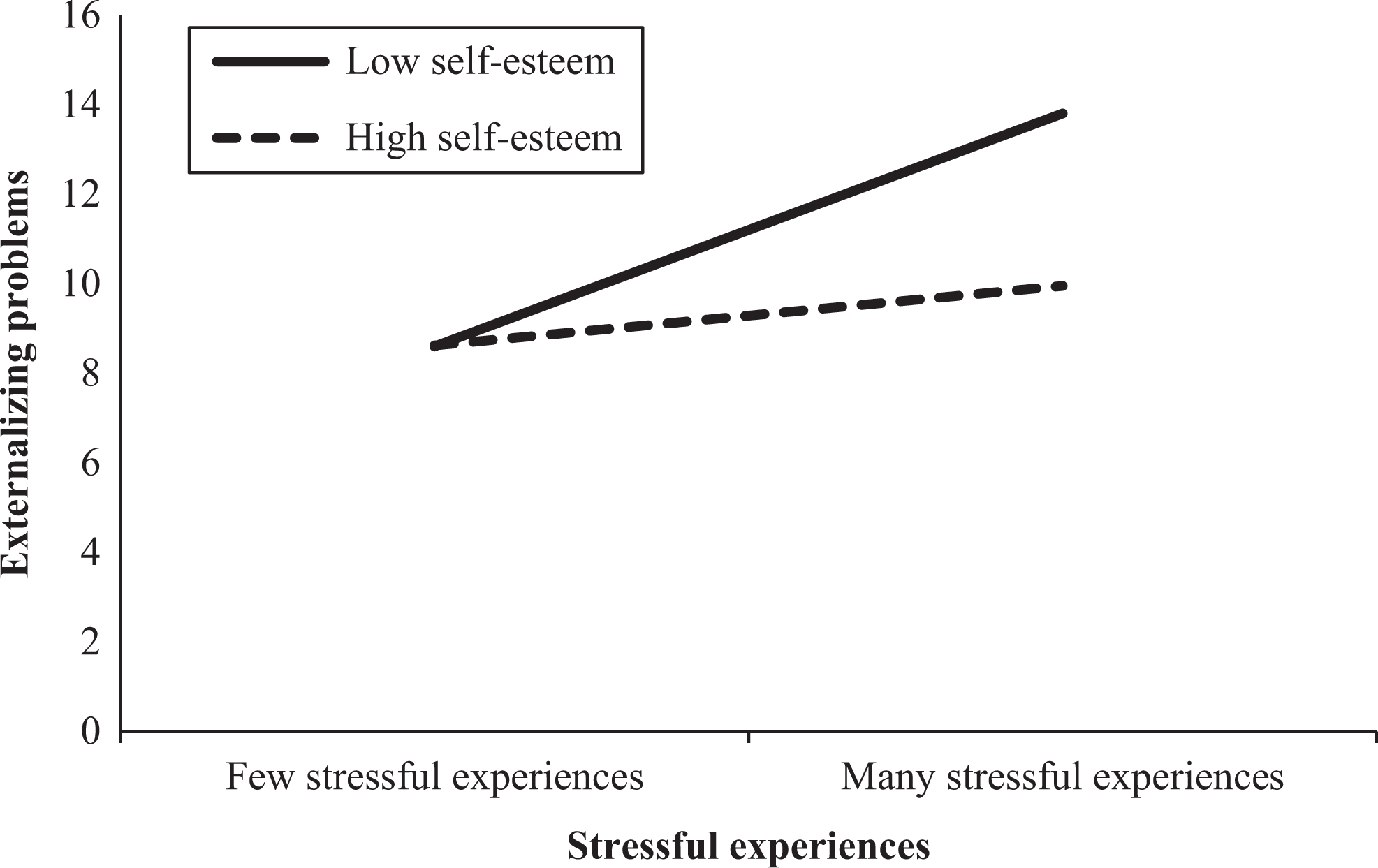
The interaction effect has been illustrated for externalizing problems in the graph for a group with few stressful experiences (M − SD) and for a group with many stressful experiences (M + SD), controlled for sex and socioeconomic status.
Post Hoc Analyses
To test the robustness of the findings, we reran our analyses with small adjustments. Specifically, we ran the following post hoc analyses: (1) including neuroticism as a covariate, (2) excluding all covariates, (3) excluding stressful experiences outliers, (4) using alternative decision rules for determining stressful experiences, and (5) excluding overlapping items between the YSR and RSES. Findings suggested that the original results of the study were generally robust to small alternations to the statistical model. However, removing covariates rendered the direct link between self-esteem and EXT problems insignificant, and using an alternative threshold for stressful experiences resulted in an insignificant moderation effect of self-esteem in the relation with EXT. The results of the analyses are reported in the Supplemental Material.
Discussion
In the current study, we examined the link between stressful experiences and psychological problems in two major domains: INT and EXT problems. In addition, we studied whether high self-esteem weakened these links.
Stressful Experiences and Psychological Problems
Adolescents who reported more stressful experiences were more likely to report INT problems. This finding supports our first hypothesis and fits well into the framework of findings of existing literature (Laceulle et al., 2014; Waaktaar et al., 2004). Secondly, we found that adolescents who reported more stressful experiences also reported more EXT problems. This confirms our second hypothesis and is also in agreement with earlier findings in the literature (Powell, Lochman, & Boxmeyer, 2007; Suldo & Huebner, 2004). In contrast to our expectations, we found the relationship to be about equally strong for INT and EXT. As most research so far has been conducted in adult populations (Kraaij, Arensman, & Spinhoven, 2002; Paykel, 2003; Tiet et al., 2001), it is possible that the similar strength of the relationship is specific to adolescence. This seems plausible, as previous research has shown that there are adolescent-specific EXT problems, which are more temporary in nature than those found in adults (Moffitt, 1993). Possibly, often temporary adolescence-specific problems are related to stressful experiences, whereas the more life-course-persistent EXT problems found in adults are not so much. Whereas research comparing an adolescent and an adult population is needed to test this empirically, it may well explain why the effect size for EXT was similar to the one for INT in the current study.
Moderating Effect of Self-Esteem
Findings revealed that the relation between stressful experiences and INT problems was weaker for adolescents with high self-esteem, which confirms our third hypothesis. Self-esteem was also found to moderate the relationship between stressful experiences and EXT problems, and contrary to our expectations, this moderation effect was not stronger for INT than for EXT problems. Since few studies have examined the relationship with EXT problems in adolescence, this finding broadens our understanding of EXT problems and their relation to stressful experiences and self-esteem.
Importantly, the moderation found might point to a buffering effect of self-esteem, as was first proposed by Brown and Harris (1978) in the context of depression and later studied by other researchers (e.g., Miller, Kreitman, Ingham, & Sashidharan, 1989; Moksnes et al., 2010; Southall & Roberts, 2002) in the broader context of INT problems. The present findings move beyond this previous work by showing that self-esteem also plays a role in explaining individual differences in the relationship between stressful experiences and EXT problems. This is intriguing, as self-esteem has often been assumed to be more strongly related to the INT domain (e.g., Deković, 1999). The present findings contest this assumption and suggest that self-esteem may play an important role in the relation between stressful experiences and EXT.
However, the buffering model assumes a specific direction of effects, and the cross-sectional nature of the current study makes it impossible to test any causal hypotheses. Future research should examine the associations described in the current study in a longitudinal setting to determine the direction of the links and rule out the possibility of alternative models underlying the results. For instance, some recent literature has argued that the relationship between stressful experiences and psychological problems might be reciprocal (Kim, Conger, Elder, & Lorenz, 2003; Laceulle et al., 2014; Timmermans, van Lier, & Koot, 2010), indicating that stressful experiences lead to more psychological problems and that psychological problems also lead to experiencing more stressful experiences. Moreover, some studies have found a mediating role of self-esteem in the relationship between stressful experiences and INT and EXT problems (Cheng & Lam, 1997; Haine et al., 2003). That is, stress may cause self-esteem to decrease, which in turn causes an increase in psychopathology. In future research, it might be interesting to see whether both roles of self-esteem can be found.
Alternatively, it is possible that a third variable can explain the reported associations. Findings from previous research suggest that neuroticism might confound the relations between stressful experiences, self-esteem, and INT and EXT problems, as neuroticism has been found to be related to both stressful experiences and psychopathology (Ormel, Rosmalen, & Farmer, 2004), as well as to low self-esteem (e.g., Robins, Hendin, Trzesniewski, 2001). In the present study, the robustness of the findings was not affected by including neuroticism in our post hoc analyses, suggesting that these relations are independent of an individual’s score on neuroticism. However, there are other factors that might play a role, such as coping mechanisms and social support (Grant et al., 2006). Future research should attempt to tease apart the constructs of stressful experiences, self-esteem, and INT and EXT problems, as well as any potential confounders, over time.
Random intercepts cross-lagged panel modeling, an elegant alternative to panel models which accounts for trait-like stability and partials out between-person variance (Hamaker et al., 2015), may for instance be used to examine these relations longitudinally. With this technique, it is possible to estimate the effects of stressful experiences, self-esteem, and INT and EXT problems over time to determine the direction of the relations and even to examine the possibility of reciprocity.
Finally, it is important to note that in contrast to the strong effects found in adversity literature (e.g., Kessler et al., 2010), the small effect sizes of common stressful experiences might accumulate and together with low self-esteem contribute to psychological problems. The small effect sizes found in this line of research are quite common (e.g., Laceulle et al., 2014; Suldo & Huebner, 2004) and, in fact, desirable, as it indicates that adolescents are relatively resilient to the negative correlates and consequences of negative experiences.
Strengths and Limitations
The current study made use of a relatively large sample that was demographically similar to the Dutch population and covered all of adolescence. This strengthens our confidence in the generalizability of the findings to other Dutch adolescents. Confidence in the study’s results is further strengthened by the addition of post hoc robustness checks (e.g., rerunning our analyses excluding all covariates, excluding overlapping items between the YSR and RSES), in which most of the studied relations remained unchanged. Moreover, the use of the LES provided not only information on whether or not an event had occurred but also on the subjective experience of the participant, making it particularly fit to test the influence of events that are experienced by the adolescent as stressful. Of course, like any questionnaire, the LES provides only a selection of experiences, but we believe the addition of examining the influence allowed us to capture the subjective experience of the participants.
In addition to the items included in the LES, some other issues need to be mentioned. In the current study, a measure of stressful experiences was used that combined the impact and number of stressful experiences reported by adolescents. Although this combined approach of impact and number of stressful experiences has been used in previous studies (Lüdtke et al., 2011; Troy et al., 2017; Wilburn & Smith, 2005), it could be argued that the way stressful experiences are measured may affect the results (e.g., Monroe, 2008). To deal with this issue, we have rerun our analyses with a different threshold (i.e., including all stressful experiences that were rated −1 or lower). Doing so resulted in smaller βs for the examined relations and rendered the association between the interaction term and EXT problems insignificant. This suggests that results are indeed somewhat dependent on the threshold chosen to indicate stressful experiences; although including mildly stressful experiences still resulted in finding significant relations between stressful experiences and INT and EXT problems, the effect sizes of these relations were larger when only taking very stressful experiences into account. Future research with a greater sample size should focus on disentangling the effects of the reported impact and number of stressful experiences, and the impact the choice of measure has on the links with self-esteem and psychological problems.
Moreover, and as discussed throughout this article, while the current study extends previous cross-sectional research by examining the role of self-esteem in the link between both INT and EXT, longitudinal research is needed to disentangle directionality. Finally, it could be argued that several of the items on the RSES and the YSR overlap, which would partly explain the relationship between self-esteem and INT symptoms. To test this possibility, we removed 2 items from the YSR that showed overlap with the RSES in a post hoc analysis. Results from this analysis did not meaningfully differ from those of the original analyses, suggesting that the relation between self-esteem and INT problems cannot be explained by overlap in items.
Conclusion
The current study confirms and extends previous cross-sectional research by showing that stressful experiences during adolescence are related to both INT and EXT problems. Moreover, the findings add to the literature by disentangling the role of self-esteem in the respective associations. Low self-esteem can strengthen the link between stressful experiences and both INT and EXT problems. Post hoc analyses supported the robustness of the various findings. Together, the results emphasize the importance of (1) addressing EXT along with INT problems in the context of stressful experiences and (2) taking individual differences into account in the study of stressful experiences and psychological problems.
Supplemental Material
SPPS_Supplementary_Material - Linking Stressful Experiences and Psychological Problems: The Role of Self-Esteem
SPPS_Supplementary_Material for Linking Stressful Experiences and Psychological Problems: The Role of Self-Esteem by Elisabeth L. de Moor, Roos Hutteman, Kees Korrelboom and Odilia M. Laceulle in Social Psychological and Personality Science
Footnotes
Declaration of Conflicting Interests
The author(s) declared no potential conflicts of interest with respect to the research, authorship, and/or publication of this article.
Funding
The author(s) received no financial support for the research, authorship, and/or publication of this article.
Supplemental Material
The supplemental material is available in the online version of the article.
References
Supplementary Material
Please find the following supplemental material available below.
For Open Access articles published under a Creative Commons License, all supplemental material carries the same license as the article it is associated with.
For non-Open Access articles published, all supplemental material carries a non-exclusive license, and permission requests for re-use of supplemental material or any part of supplemental material shall be sent directly to the copyright owner as specified in the copyright notice associated with the article.
