




Abstract
Although gratitude plays a central role in the quality of relationships, little is known about how gratitude emerges, such as in response to partners’ sacrifices. Do people need to accurately see these acts to feel grateful? In two daily experience studies of romantic couples (total N = 426), we used a quasi-signal detection paradigm to examine the prevalence and consequences of (in)accurately “seeing” and missing partners’ sacrifices. Findings consistently showed that sacrifices are equally likely to be missed as they are to be accurately detected, and about half of the time people “see” a sacrifice when the partner declares none. Importantly, “seeing” partners’ sacrifices—accurately or inaccurately—is crucial for boosting gratitude. In contrast, missed sacrifices fail to elicit gratitude, and the lack of appreciation negatively colors the partner’s satisfaction with the relationship when having sacrificed. Thus, these findings illustrate the power that perception holds in romantic couples’ daily lives.
Sacrifices come in many flavors. They can be substantial but rare, such as moving to a new city with your partner to meet their career ambitions. They can also be small and common, such as spending time with your partner’s friends rather than your own. Although these relatively common, day-to-day sacrifices are important to relationships (Impett, Gable, & Peplau, 2005), they may be easily overlooked. As a result, feelings of gratitude—which are essential to relationship well-being and stability (e.g., Gordon, Impett, Kogan, Oveis, & Keltner, 2012)—may not be triggered. Just as intriguingly, people may “see” a sacrifice when the partner declares none, but gratitude may be triggered nevertheless.
Although sacrifice and gratitude have received growing attention in recent years (e.g., Algoe, 2012; Visserman, Righetti, Impett, Keltner, & Van Lange, 2018), there is no published research on accuracy in recognizing sacrifice. The present research examines, for the first time, the level of accuracy in “seeing” partners’ kind, prosocial, but costly acts, and how seeing or failing to see such acts impacts people’s ensuing gratitude. Moreover, we examine the sacrificer’s feelings toward the relationship when their sacrifices are unrecognized and unappreciated. These questions are studied by sampling people’s daily experiences and perceptions in their natural environment (Bolger, Davis, & Rafaeli, 2003), using a quasi-signal detection paradigm to assess both partners’ perspectives on the occurrence of daily events in their relationship (e.g., Gable, Reis, & Downey, 2003). These methods provide a unique and realistic account of the detection and consequences of partners’ day-to-day sacrifices.
Detecting Sacrifice
In general, people are moderately accurate in “reading” their interaction partner’s experiences and behaviors (Nater & Zell, 2015). Within intimate relationships, many reasons, from smoother interactions to greater disclosure, may motivate partners to arrive at accurate perceptions of each other’s intentions, actions, and feelings. At the same time, partners can be challenged by various biases distorting their perception of each other. For example, partners tend to hold overly positive views of each other and their relationship (Murray, Holmes, & Griffin, 1996; Rusbult, Van Lange, Wildschut, Yovetich, & Verette, 2000) and project their own experiences onto their partner (e.g., Clark, Von Culin, Clark-Polner, & Lemay, 2017). Such biases may create room for misinterpretation and shape what people “see” (Fletcher & Kerr, 2010; Gagné & Lydon, 2004).
Previous research using quasi-signal detection analysis suggests that romantic partners quite accurately detect each other’s positive behaviors, and behaviors that express compassionate love (Finkenauer, Wijngaards-De Meij, Reis, & Rusbult, 2010; Gable et al., 2003; Reis, Maniaci, & Rogge, 2014, 2017). Negative behaviors may be recognized less accurately and, at times, are just as likely to be missed as to be detected (Finkenauer et al., 2010; Gable et al., 2003). This disconnect between partners’ “realities” seems especially pronounced for partners’ supportive and responsive acts, which are accurately detected, missed, but also wrongly inferred at an equal rate (Algoe, Gable, & Maisel, 2010; Gable et al., 2003). This is an especially intriguing trend when applied to sacrifices, which are fairly concrete behaviors, but may not simply be positive, negative, or supportive, but acts that a sacrificer may be ambivalent about due to the personal costs they incur (Righetti & Impett, 2017). Further, partners’ willingness to put their personal interests aside makes sacrifices especially important to detect, as they signal the partner’s care and commitment to the relationship (Wieselquist, Rusbult, Foster, & Agnew, 1999). Thus, sacrifices represent an important opportunity to gauge the partner’s prorelationship dedication and, in response, to feel grateful (Algoe, 2012). However, it is unclear how accurately day-to-day sacrificial acts are observed and importantly how (in)accurate detection can (fail to) boost gratitude in response to them.
Gratitude
Gratitude arises from an individual’s perception to have benefitted from another person’s intentionally rendered good deeds that are both valuable and costly (McCullough, Kilpatrick, Emmons, & Larson, 2001). Gratitude helps people to identify a responsive relationship partner and reminds them of their partner’s value to them (Algoe, 2012). Despite the well-documented benefits of gratitude for the receiver’s well-being (Emmons & McCullough, 2003; Wood, Froh, & Geraghty, 2010) and the quality and longevity of relationships (Algoe et al., 2010; Gordon, Arnette, & Smith, 2011; Gordon et al., 2012), surprisingly little is known about how people come to feel grateful in close relationships.
Prior research has shown that gratitude can be fueled by perceiving a partner to have invested in the relationship (Joel, Gordon, Impett, MacDonald, & Keltner, 2013). This finding begs the question of whether or not partners accurately perceive each other’s sacrifices in the first place. Gratitude is a response to the benefactor’s behavior, so accurately seeing a partner’s sacrifice should boost perceivers’ gratitude. “Seeing” a sacrifice that the partner did not declare should also boost gratitude since the perceiver thinks that the partner made a costly relationship investment even if this reality is not shared by both partners. In contrast, missing a partner’s sacrifice constitutes a missed opportunity to identify the partner’s behavior as beneficial, valuable, and costly (Algoe, 2012; McCullough et al., 2001) and should fail to boost gratitude.
Relationship Satisfaction
Replicating previous research (e.g., Algoe et al., 2010), we expect that this missed opportunity to feel grateful toward one’s partner also poses a missed opportunity to feel satisfied with the relationship. Perhaps more importantly, and a focus of our investigation, are the consequences for the sacrificer whose act is not recognized by the receiver. When a sacrifice is not welcomed with gratitude, and the sacrificer perceives this lack of appreciation, they may perceive their sacrifice as more harmful to themselves, which can undermine their relationship satisfaction (Whitton, Stanley, & Markman, 2007). Thus, we propose that missed sacrifices and the recipient’s lack of gratitude will translate into the sacrificer not feeling appreciated for what they have done, which may in turn leave them less satisfied with their relationship than when their sacrifice would be accurately detected (see Figure 1).
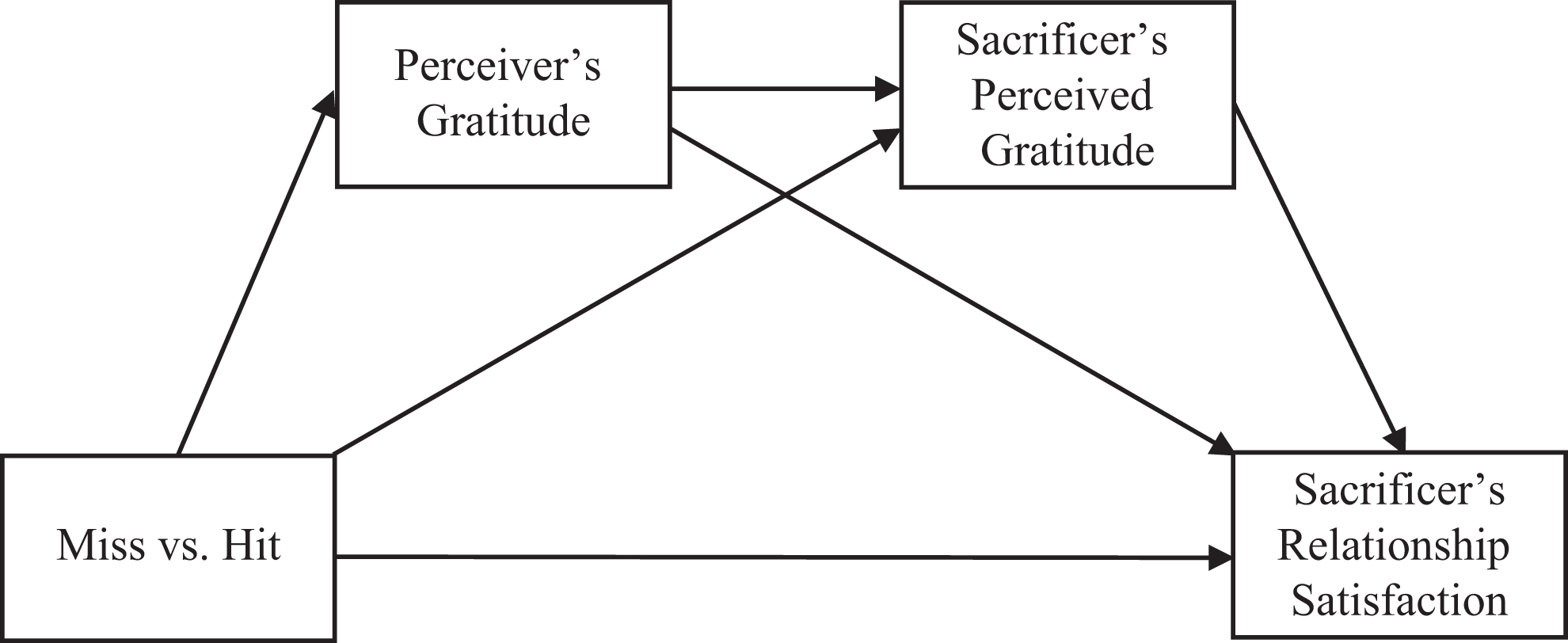
The conceptual model for the indirect effect of missed sacrifices (vs. hit) on sacrificers’ relationship satisfaction, mediated by perceivers’ gratitude and sacrificer’s perception of their gratitude.
Research Overview
In two daily experience studies of romantic couples, in the Netherlands and the United States, we used a quasi-signal detection paradigm (e.g., Gable et al., 2003) to directly map both partners’ daily reports of their own and their partner’s sacrifices onto each other. First, we examined the prevalence of (in)accurate detection of partners’ day-to-day sacrifices (i.e., hit, miss, false alarm, and correct rejection). Next, we examined the daily consequences of (in)accurate detection for boosting—or failing to boost—perceivers’ gratitude. Furthermore, we examined partners’ relationship satisfaction in response to missed sacrifices, and the lack of appreciation they may yield. Last, in auxiliary analyses, we explored predictors of sacrifice detection and long-term effects of detection on gratitude.
Study 1
Method
Participants
Participants were 125 heterosexual couples and one lesbian couple (N = 252) residing in the Netherlands. Participants’ mean age was 23.3 years (SD = 3.7), and 64% were university students. On average, couples reported being involved for 2.8 years (SD = 29 months), and 35% lived together. The data come from a larger project on romantic relationships (e.g., Righetti, Gere, Hofmann, Visserman, & Van Lange, 2016; Visserman, Righetti, Kumashiro, & Van Lange, 2017), and with an anticipated small-to-medium effect size provided sufficient power to test our hypotheses (>.80). Originally, 130 couples participated in the study, but one couple brokeup before completing the daily diary, and three couples did not follow the instructions properly.
Measures and Procedures
Couples completed an 8-day diary procedure and were contacted 1 year later to complete a follow-up survey. In a laboratory intake session, couples were carefully instructed by the experimenter on how to recognize daily sacrifices in their relationship. Sacrifices were explained as forgoing your own preference by doing something that you find unpleasant and that you would not like to do (active sacrifice; e.g., going on a boring outing with your partner’s friends) or by giving up something that you find pleasant or would like to do (passive sacrifice; e.g., not going out with your best friend; see Van Lange et al., 1997). We explained to participants that sacrifices can result from mundane differences in preferences, such as forgoing one’s first preference for dinner and going with the partner’s preference instead, as long as it involves some experience of personal cost (e.g., unpleasantness). Afterward, participants received a booklet with definitions and examples of sacrifice and instructions for completing the diary. The first Saturday after the laboratory session, participants started the daily diary procedure. They received a link to a short survey every evening on their mobile phone (using the SurveySignal application; Hofmann & Patel, 2015) for 8 days (two blocks of 4 days with 1 rest day in between on Wednesday). In general, participants responded to 87.6% of the daily surveys (M = 7.35 of 8 days).
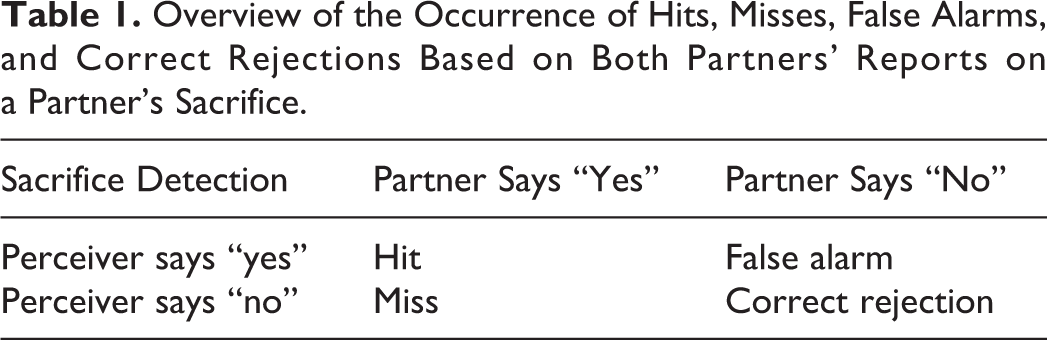
Relevant to the current investigation, both partners reported at the end of each day whether they had sacrificed—which could be more than once—and whether their partner had sacrificed (i.e., “Have you sacrificed today for your partner/relationship”). On average, participants reported to have sacrificed on 1.89 days (SD = 1.70, ranging from 0 to 8 days) and reported their partner to have sacrificed on 1.91 days (SD = 1.73, ranging from 0 to 7 days). By combining both partners’ reports, we could identify whether one of the partners had sacrificed (i.e., partner) and whether or not the other partner (i.e., perceiver) had perceived their partner to have sacrificed. Thus, both partners could—at different times—serve as “partner” or “perceiver” in our investigation. Hits occur when both the perceiver and the partner report the partner to have sacrificed, misses occur when the partner reports a sacrifice that is not detected by the perceiver, false alarms occur when the perceiver reports that their partner sacrificed, while the partner reports no sacrifice, and correct rejections occur when both the partner and the perceiver indicate that the partner did not sacrifice (see Table 1).
Overview of the Occurrence of Hits, Misses, False Alarms, and Correct Rejections Based on Both Partners’ Reports on a Partner’s Sacrifice.
Each day, both partners reported their gratitude toward their partner (“I feel very grateful to my partner”), their perception of their partner’s expression of gratitude (“My partner expressed gratitude for what I have done for him/her”), and their relationship satisfaction (“I feel satisfied with our relationship”). All daily measures were assessed on a 7-point scale (0 = not at all to 6 = very much) with a single item to minimize participant fatigue and reduce attrition (Bolger et al., 2003).
Results
Analysis Strategy
Multilevel modeling was used to take into account the occurrence of multiple measurement occasions within participants, and the nesting of participants within dyads (Kenny, Kashy, & Cook, 2006), using SPSS Version 22. We employed a two-level cross-model in which participants and the daily measurements within participants (i.e., time) were treated as crossed and nested within the dyad. Furthermore, intercepts were allowed to randomly vary, whereas slopes were treated as fixed effects. Dyads were treated as indistinguishable because gender did not consistently moderate effects 1 and because of the presence of one nonheterosexual couple (Kenny et al., 2006; access to the data and syntax on the Open Science Framework [OSF]: https://osf.io/dhmca/).
For each day of the diary, participants’ and their partners’ reports were compared and coded to reflect a hit, miss, or false alarm by assigning “1” to one of these events (i.e., did occur) and “0” to the other events (i.e., did not occur). For example, if a partner reported to have sacrificed and this was accurately perceived by the participant then “hit” was coded as “1” and all else as “0.” If hits, misses, and false alarms were all coded as “0,” this automatically reflects a “correct rejection” (i.e., no events occurred that day). Hits, misses, and false alarms were entered in one model predicting gratitude, and therefore correct rejection serves as the reference category to which hits, misses, and false alarms are contrasted in the analyses (see Gable et al., 2003). To examine whether hits, misses, and false alarms predict a boost in gratitude above and beyond the previous day, we controlled for previous day gratitude when predicting current’s day gratitude.
Because hits, misses, and false alarms are binary, they were not within-person centered to facilitate interpretation of our findings (i.e., an event did or did not occur), and because there were only few observations within participants from which to reliably draw their typical detection rates. Thus, the unstandardized estimates as reported in our key analyses can be interpreted as the increase in gratitude on days when a specific event occurred (i.e., a hit, miss, or false alarm), as compared to days when none of these events occurred (i.e., correct rejection).
To examine the indirect effects on relationship satisfaction when a sacrifice is missed, we did not test the full detection model (which contrasts hits, misses, and false alarms against correct rejections). Due to the ambivalent feelings that may arise from making or perceiving a sacrifice (Righetti & Impett, 2017), we did not expect misses or hits to affect relationship satisfaction as compared to days on which no sacrifice was reported or perceived. Indeed, we did not find consistent support for such effects across studies but present these results in a footnote for interested readers. 2 Instead, we selected only days on which hits or misses occurred, as this comparison is essential for examining the impact on relationship satisfaction in response to whether or not a sacrifice is detected, when a partner sacrificed. The “miss versus hit” variable was dummy coded into 1 reflecting missed sacrifices and 0 reflecting accurately detected sacrifices. We first examined the indirect effect of sacrifices being missed (vs. hit) on perceivers’ relationship satisfaction, mediated by gratitude. Further, we examined a sequential mediation model in which we tested the indirect effect of missed sacrifices on sacrificers’ relationship satisfaction, mediated by perceivers’ gratitude and sacrificers’ perception of their gratitude, following the steps as recommended by Taylor, MacKinnon, and Tein (2008). We used Mplus (Version 8) to test each step of these indirect effect models.
Key Analyses
Sacrifice detection
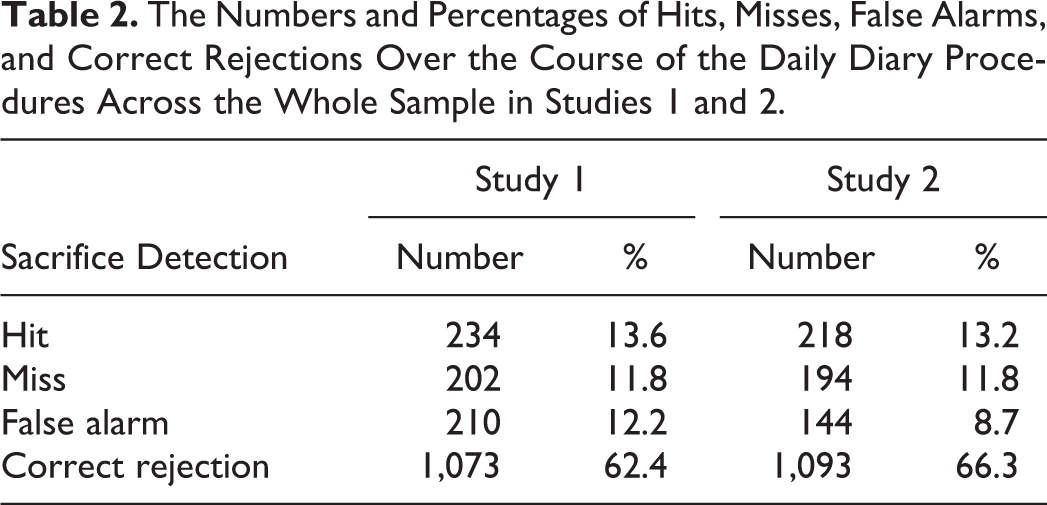
See Table 2 for the occurrence of hits, misses, false alarms, and correct rejections over the course of the daily diary procedure across the whole sample. In 38% of the diary reports, participants and/or their partners reported on a partner’s sacrifice. When a partner reported making a sacrifice, participants accurately perceived their partner’s sacrifice in about half of the cases (52.6%) and similarly missed the sacrifice the other half of the times (47.3%). In fact, the number of hits and misses did not significantly differ (Z difference = 1.53, p = .126). Furthermore, when participants reported to have perceived a partner’s sacrifice, they were accurate (53.7%) as often as inaccurate (46.3%), as false alarms were statistically just as likely as hits (Z difference = 1.14, p = .254).
The Numbers and Percentages of Hits, Misses, False Alarms, and Correct Rejections Over the Course of the Daily Diary Procedures Across the Whole Sample in Studies 1 and 2.
Perceiver’s gratitude
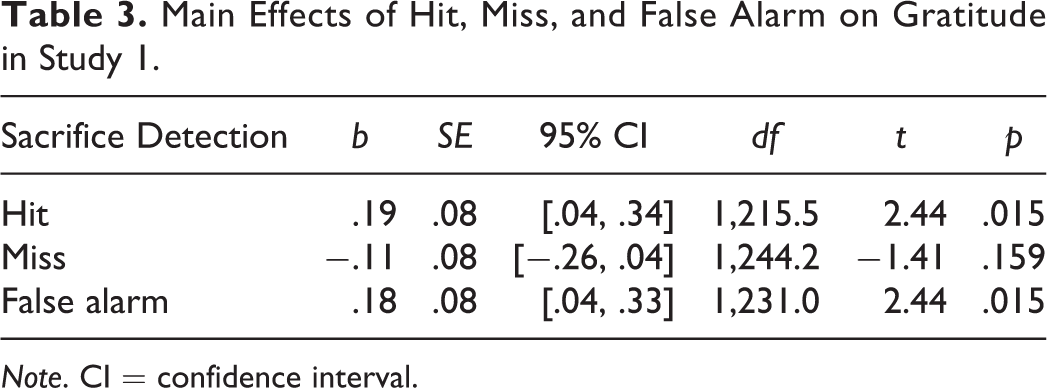
We conducted analyses in which hits, misses, and false alarms were entered simultaneously in a model predicting gratitude for the partner. As shown in Table 3, participants felt more grateful on days when they accurately perceived their partner to have sacrificed, or when they wrongly inferred their partner to have made a sacrifice, but not when they missed the partner’s sacrifice. 3
Main Effects of Hit, Miss, and False Alarm on Gratitude in Study 1.
Note. CI = confidence interval.
Relationship satisfaction
When a partner reported a sacrifice and it was missed by the perceiver (vs. hit), the perceiver reported lower relationship satisfaction, which was mediated by lower gratitude that day (see Table 4). As for the sacrificer, missed sacrifices were marginally associated with lower relationship satisfaction (b = −.16, SE = .09, 95% CI [−.34, .01], z = −1.82, p = .069). As step one of the sequential mediation model, and in accordance with our key findings, misses (vs. hits) were associated with lower gratitude in the perceiver (b = −.35, SE = .11, 95% CI [−.56, −.13], z = −3.17, p = .002). Second, perceivers’ lack of gratitude was associated with lower perception of perceivers’ gratitude in the sacrificer (b = .25, SE = .07, 95% CI [.13, .38], z = 3.91, p < .001), while controlling for miss versus hit. Last, sacrificers’ lower perceived gratitude in turn detracted from sacrificers’ relationship satisfaction (b = .09, SE = .03, 95% CI [−.15, −.04], z = −3.45, p = .001), while controlling for miss versus hit and perceivers’ reported gratitude (see Figure 2). The direct effect of misses on sacrificers’ relationship satisfaction was reduced to nonsignificance (p = .566), while the indirect effect was significant (b = −.008, SE = .004, 95% CI [−.02, .00], z = −2.00, p = .045).
Associations of Miss (vs. Hit) With Perceiver’s Relationship Satisfaction Mediated by Perceiver’s Gratitude in Study 1.
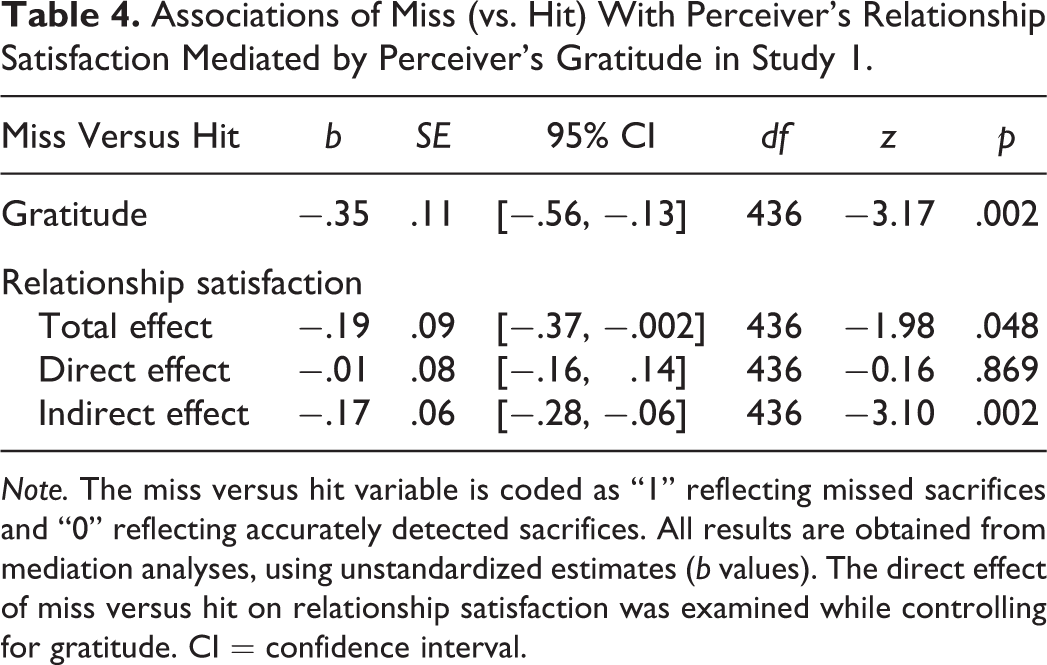
Note. The miss versus hit variable is coded as “1” reflecting missed sacrifices and “0” reflecting accurately detected sacrifices. All results are obtained from mediation analyses, using unstandardized estimates (b values). The direct effect of miss versus hit on relationship satisfaction was examined while controlling for gratitude. CI = confidence interval.
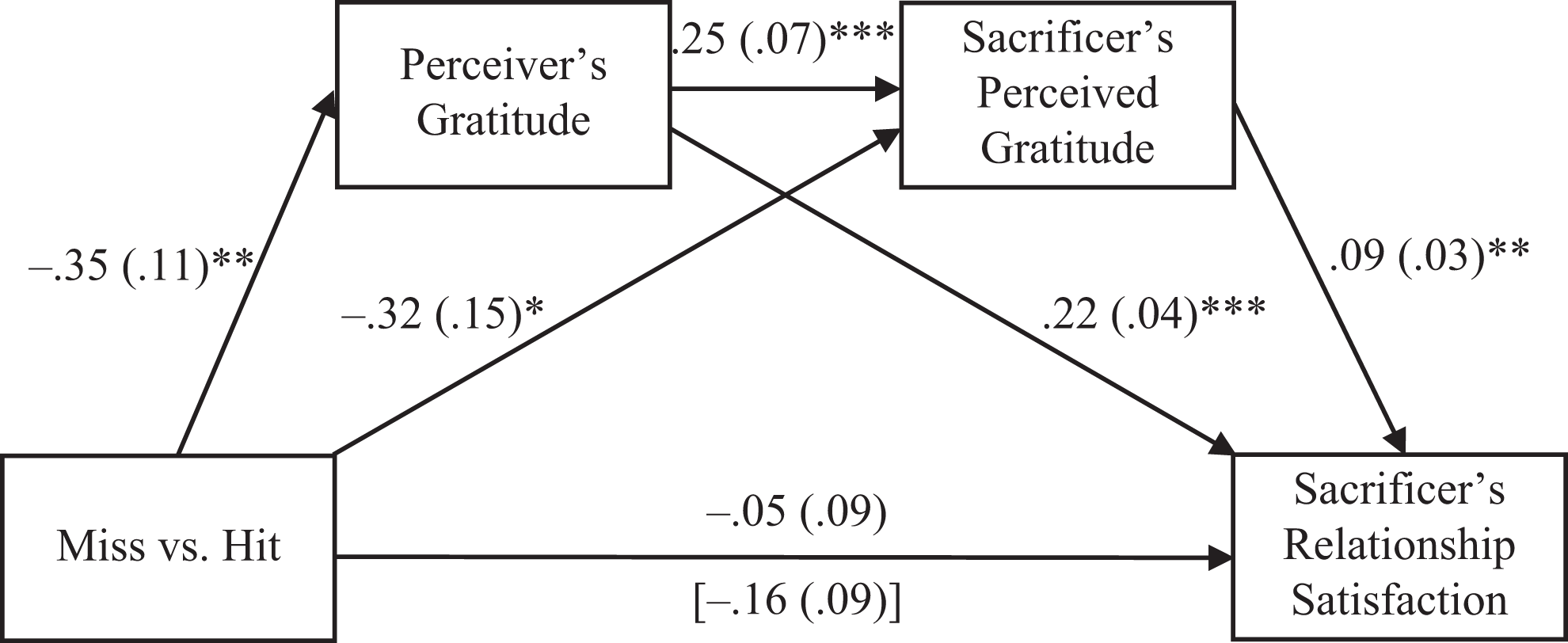
The sequential mediation model for the association between miss versus hit and sacrificer’s relationship satisfaction. The miss versus hit variable is coded as “1” reflecting missed sacrifices and “0” reflecting accurately detected sacrifices. All reported values are unstandardized estimates (b values), with their standard errors reported between parentheses. Between brackets are the values for the total effect of miss versus hit on sacrificer’s relationship satisfaction. *p < .05, **p < .01, ***p < .001.
Study 2
In this study, we sought to replicate findings of Study 1 in another daily experience study, in a different Western culture (the United States).
Method
Participants
Participants were 75 heterosexual couples, 4 lesbian couples, and one1 gay male couple (N = 160) recruited from the San Francisco Bay Area (CA, USA). Participants’ mean age was 23.9 years (SD = 6.4), and about half of the participants were university students. On average, couples reporting being involved for 1.3 years (SD = 44 months), and 48% lived together. The data come from a larger project on romantic relationships (e.g., see Impett et al., 2012) and with an anticipated small to medium effect size provided sufficient power to test our hypotheses (>.80).
Measures and Procedures
Participants went through a 14-day diary procedure and were also contacted three months later to complete a follow-up survey. As in Study 1, couples were carefully instructed on what daily sacrifices are and how to recognize them in their relationship. Each day of the diary, participants were asked whether their partner had sacrificed that day, and partners were asked whether they had made a sacrifice (i.e., “Today, did you do anything that you did not particularly want to do for your partner? Or, did you give up something that you did want to do for the sake of your partner?”). On average, participants reported to have sacrificed on 2.88 days (SD = 2.57, ranging from 0 to 11 days) and reported their partner to have sacrificed on 2.49 days (SD = 2.65, ranging from 0 to 12 days). As in Study 1, both partners’ reports were combined which, for each day, resulted in a hit, miss, false alarm, or correct rejection.
Next, we measured both partners’ general experience of how “grateful/appreciative/thankful” they felt that day, how appreciated they felt by their partner (“My partner made sure I felt appreciated today”), and the extent to which they felt “satisfaction” in their relationship that day. All daily measures were assessed on 5-point scales (1 = not at all to 5 = a lot).
Results
Analysis Strategy
The data analysis strategy was similar to Study 1 (access to the data and syntax on OSF: https://osf.io/dhmca/).
Key Analyses
Sacrifice detection
The relative occurrence of hits, misses, false alarms, and correct rejections was fairly similar to Study 1 (see Table 2). In 34% of the reports, participants and/or their partners reported on a partner’s sacrifice. As in Study 1, when a partner reported a sacrifice, participants missed their partner’s sacrifice half of the times, indicated by a nonsignificant difference between the occurrence of hits (52.9%) and misses (47.1%; Z difference = 1.18, p = .238). In contrast to Study 1, when participants reported to have “seen” a partner’s sacrifice, they were more often accurate than inaccurate, indicated by a significant difference between the occurrence of hits (60.2%) and false alarms (39.8%; Z difference = 3.89, p < .001).
Perceiver’s gratitude
As in Study 1, hits, misses, and false alarms were entered simultaneously in a model predicting participants’ gratitude. As shown in Table 5, participants felt more grateful on days when they accurately perceived their partner to have sacrificed, or when they wrongly inferred them to have sacrificed, but not when they missed a partner’s sacrifice.
Main Effects of Hit, Miss, and False Alarm on Gratitude in Study 2.
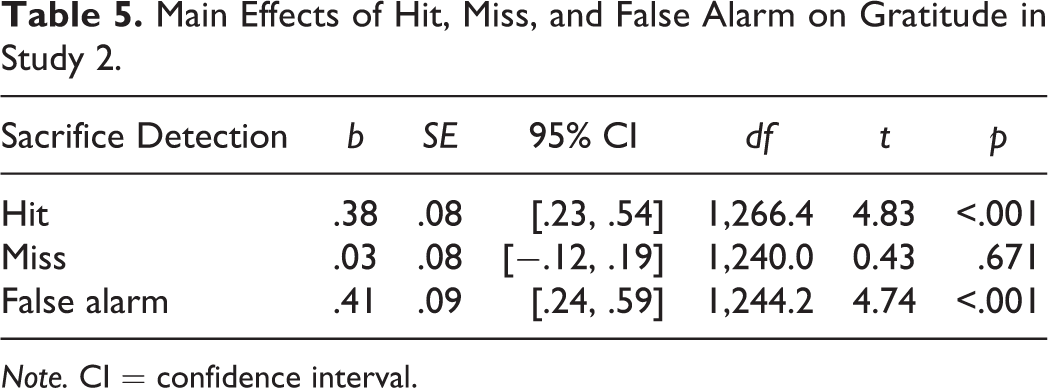
Note. CI = confidence interval.
Relationship satisfaction
As in Study 1, we specifically focused on days on which the partner sacrificed, thus whether a miss or a hit occurred.2 When perceivers missed a partner’s sacrifice (vs. hit), they reported lower relationship satisfaction, which was mediated by lower gratitude (see Table 6). As for the sacrificer, missed sacrifices were significantly associated with lower sacrificers’ relationship satisfaction (b = −.23, SE = .10, 95% CI [−.43, −.04], z = −2.39, p = .017). Firstly in examining the sequential mediation model, and in accordance with our key findings, missed sacrifices were associated with lower perceiver’s gratitude (b = −.31, SE = .12, 95% CI [−.54, −.07], z = −2.51, p = .012). Second, perceivers’ lack of gratitude was associated with sacrificers feeling less appreciated by their partner (b = .29, SE = .05, 95% CI [.20, .38], z = 6.03, p < .001), while controlling for miss versus hit. Last, the sacrificers’ lower felt appreciation detracted from their relationship satisfaction (b = .58, SE = .03, 95% CI [.52, .64], z = 18.99, p < .001), while controlling for miss versus hit and perceivers’ reported gratitude (see Figure 3). As in Study 1, the direct effect of miss versus hit reduced to nonsignificance (p = .600), while the indirect effect was significant (b = −.05, SE = .02, 95% CI [−.09, −.01.], z = −2.29, p = .022).
Associations of Miss (vs. Hit) With Perceiver’s Relationship Satisfaction Mediated by Perceiver’s Gratitude in Study 2.
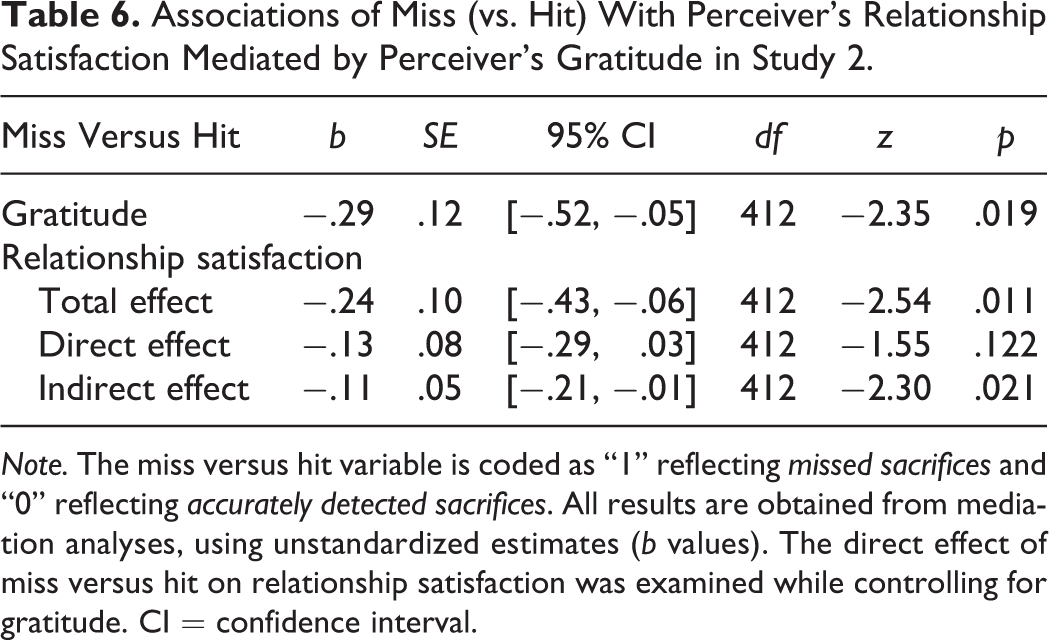
Note. The miss versus hit variable is coded as “1” reflecting missed sacrifices and “0” reflecting accurately detected sacrifices. All results are obtained from mediation analyses, using unstandardized estimates (b values). The direct effect of miss versus hit on relationship satisfaction was examined while controlling for gratitude. CI = confidence interval.
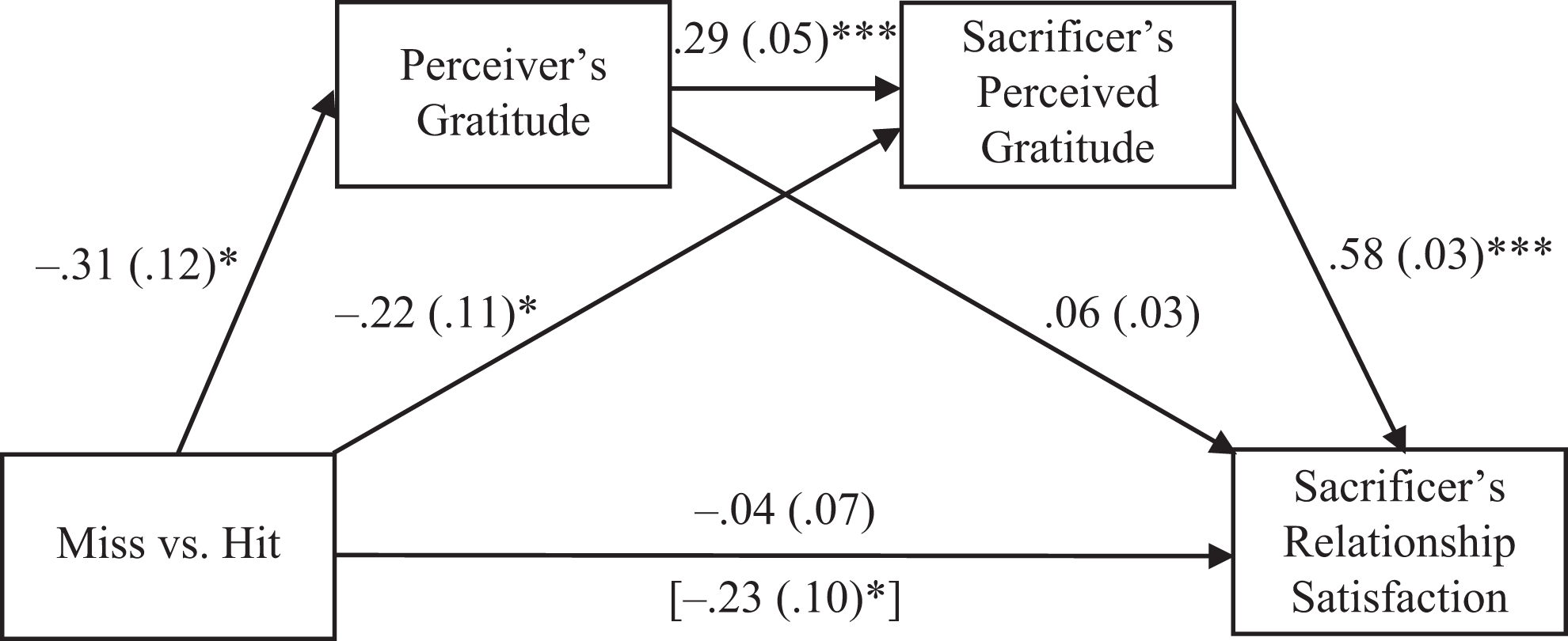
The sequential mediation model for the association between miss versus hit and sacrificer’s relationship satisfaction. The miss versus hit variable is coded as “1” reflecting missed sacrifices and “0” reflecting accurately detected sacrifices. All reported values are unstandardized estimates (b values), with their standard errors reported between parentheses. Between brackets are the values for the total effect of miss versus hit on sacrificer’s relationship satisfaction. *p < .05, **p < .01, ***p < .001.
Auxiliary Analyses
Predictors of Detection
We additionally explored whether the prevalence of hits, misses, and false alarms would be affected by sacrifice costs (in both studies), and type of sacrifice (Study 2), and explored a potential role of communication of sacrifice (Study 2). However, aside from some types of sacrifice (active sacrifices and sacrifices related to support and recreation), the likelihood of accurately detecting partners’ sacrifices seems largely independent from any of these factors (see Online Supplemental Material for details on the methods, results, and discussion of these findings).
Follow-Up
Furthermore, we explored whether the average occurrence of hits, misses, and false alarms during the daily experience study would predict gratitude 1 year (Study 1) or 3 months (Study 2) later, controlling for earlier gratitude assessed during the initial survey. In Study 1, hits were positively but nonsignificantly related to gratitude 1 year later (p = .127), but misses and false alarms were not (p = .850 and p = .400, respectively). In Study 2, hits marginally predicted gratitude 3 months later: b = .34, SE = .18, 95% CI [−.03, .70], t(99.15) = 1.84, p = .069, while misses (p = .451) and false alarms (p = .371) did not. Thus, although results for hits are positively trending, we do not observe evident support for hits, misses, or false alarms to promote gratitude over time.
General Discussion
While day-to-day sacrifices may be crucial for romantic partners to coordinate their lives together, they might be easily overlooked or misconstrued. In the current investigation, we aimed to answer a 2-fold question: How accurately do people see their partners’ sacrifices, and what are the consequences of (in)accurate detection? Two daily experience studies consistently showed that when partners reported a sacrifice, their sacrifices only had a 50% chance of being accurately detected, meaning half of the sacrifices partners reported were not recognized by the recipient of the sacrifice. At the same time, about half of the sacrifices that perceivers reported “seeing” were not actually declared by the partner. Thus, partners do not always share the realities in which they live (Fletcher & Kerr, 2010), either by not detecting partners’ costly prosocial behaviors or by overclaiming them.
These inaccuracies in perceiving partners’ sacrifices importantly affected perceivers’ gratitude in response to them. Gratitude was boosted when people had “seen” a partner’s sacrifice, irrespective of whether their partner shared this reality. In stark contrast, missing a partner’s sacrifices failed to evoke gratitude. “Seeing” a partner depart from their own self-interest to benefit the partner and relationship (Rusbult & Van Lange, 2003) signals the partner’s benevolence and relationship dedication, and thus their worthiness of gratitude (Algoe, 2012). Hence, missing partners’ sacrifices are missed opportunities for gratitude to emerge.
Moreover, consistent with previous research (Algoe et al., 2010; Gordon et al., 2011, 2012), our findings showed that a lack of gratitude in turn affected relationship satisfaction. More specifically, when a partner sacrificed, missing the sacrifice as compared to accurately detecting this act, undermined perceivers’ relationship satisfaction through their missed opportunity to feel grateful. Importantly, missed sacrifices also affected the partner who sacrificed, as the lack of appreciation they perceived from their partner negatively colored their satisfaction with the relationship when they sacrificed but their costly act was missed. Note that the receivers’ gratitude more strongly translated into the sacrificers’ satisfaction through sacrificers’ feelings of appreciation (Study 2), as compared to sacrificers’ perceptions of receivers’ appreciation (Study 1). Thus, feeling appreciated may affect relationship satisfaction more directly than merely perceiving the partner express appreciation.
Broader Considerations
Why do people miss so many of their partner’s sacrifices? Perhaps sacrifices are sometimes construed as normative relationship behaviors, not necessarily a departure from self-interest. To explain how misses and false alarms arise, future research could disentangle different motivational processes that could clarify how sacrificers’ behaviors and communication may affect distorted perceptions in the perceiver. There may be times when sacrificers are motivated to downplay their behavior (e.g., to cope with the costs they incurred), while at other times they are motivated to “play up” the behavior (e.g., to induce reciprocity in the perceiver).
Given that sacrifices so often go unnoticed, and fail to elicit gratitude, should partners more clearly communicate their sacrifices to each other? Not necessarily so. There may be, at times, benefits to not seeing partners’ sacrifices, as encountering conflicts of interests with one’s partner can be stressful (Righetti et al., 2016). Also, sacrifices may “smooth” the interaction between partners, and at times, partners may make sacrifices that perhaps are better held privately (e.g., when they avert getting involved with an attractive alternative partner). Moreover, to elicit gratitude, it may be especially important to communicate and detect sacrifices that seem free from self-interest (Visserman et al., 2018). Future research could explore how to increase accurate sacrifice detection through communication, and when communication would benefit couples or may potentially backfire.
Strengths and Limitations
Although our findings are consistent with a causal sequence in which detecting partners’ sacrifices boosts perceivers’ gratitude from the previous day, the causal direction of the associations cannot be confirmed. Also, our findings regarding relationship satisfaction in response to missed sacrifices are based on a subset of the data (i.e., misses and hits). Future research could further validate these findings in a larger sample with more missed sacrifices from which to draw. A strength of this work is that it provides an ecologically valid account of perception of sacrifice in daily life, as well as replication of these findings across two Western cultures (the United States, the Netherlands), increasing confidence in the generalizability of these findings.
Conclusion
While sacrifices are often assumed to be important to close relationships, an act of sacrifice has only a 50% chance of being accurately detected. Sacrifices are just as likely to be missed, leaving an important opportunity for eliciting gratitude unutilized, and leaving the sacrificing partner dissatisfied. On the bright side, sacrifices can be “seen” and boost perceivers’ gratitude even when partners do not declare them. These findings highlight the power that perception holds in construing reality within relationships, and the associated consequences in the daily lives of romantic couples.
Supplemental Material
Supplemental Material, SPPS757599_suppl_mat - To “See” Is to Feel Grateful? A Quasi-Signal Detection Analysis of Romantic Partners’ Sacrifices
Supplemental Material, SPPS757599_suppl_mat for To “See” Is to Feel Grateful? A Quasi-Signal Detection Analysis of Romantic Partners’ Sacrifices by Mariko L. Visserman, Emily A. Impett, Francesca Righetti, Amy Muise, Dacher Keltner and Paul A. M. Van Lange in Social Psychological and Personality Science
Footnotes
Declaration of Conflicting Interests
The author(s) declared no potential conflicts of interest with respect to the research, authorship, and/or publication of this article.
Funding
The author(s) disclosed receipt of the following financial support for the research, authorship, and/or publication of this article: This research was supported by a grant from the Netherlands Organization for Scientific Research (451-12-024) awarded to Francesca Righetti, a grant from the Social Sciences and Humanities Research Council (Canada) awarded to Emily A. Impett and Amy Muise, and a grant from the John Templeton Foundation (Advanced Research Program), sponsored by the Metanexus Institute on Religion and Science, awarded to Dacher Keltner.
Notes
Supplemental Material
The supplemental material is available in the online version of the article.
References
Supplementary Material
Please find the following supplemental material available below.
For Open Access articles published under a Creative Commons License, all supplemental material carries the same license as the article it is associated with.
For non-Open Access articles published, all supplemental material carries a non-exclusive license, and permission requests for re-use of supplemental material or any part of supplemental material shall be sent directly to the copyright owner as specified in the copyright notice associated with the article.
