




Abstract
The effects of intergroup contact on prejudice are well established. However, its effects on minority group well-being have been rarely studied. We hypothesized that contact with members of the majority culture will be related to better well-being, and that this is facilitated by majority language proficiency. We tested this hypothesis in a three-wave longitudinal study of refugees over 2 years (N = 180). Cross-lagged path modeling confirmed that intergroup contact at earlier time points was associated with increased well-being at later time points; the reverse associations (from earlier well-being to later contact) were not reliable. Self-rated earlier English language competence was positively associated with later intergroup contact (but not the reverse), suggesting that improving majority language proficiency might be the key to better well-being of refugees, with intergroup contact being the mediator between language and well-being.
Mass migration is occurring on a scale not seen since World War II. According to the United Nations High Commissioner for Refugees (UNHCR, 2016), over 65 million people are now forcibly displaced from their homes as a result of persecution, conflict, violence, or human rights violations. During 2015, an average of nearly 34,000 were displaced every day or 24 people each minute. In the course of these enormous movements of people, refugees and others inevitably come into contact with majority members of their country of resettlement, a country where the language and prevailing cultural values will often be very different from their own. A wealth of research has demonstrated that, under the right conditions, such minority–majority contact has positive effects on intergroup relations (Brown & Hewstone, 2005; Pettigrew & Tropp, 2006). However, intergroup contact is likely to have consequences beyond intergroup relations, influencing minority group members’ well-being and mental health, a matter of some importance, given the huge mental health challenges many refugees face (Burnett & Peel, 2001; Lindert, Von Ehrenstein, Priebe, Mielck, & Brähler, 2009; Vostanis, 2014). However, there have been very few empirical investigations of the effect of contact on minority group members’ well-being, let alone among refugees (Eller, Cakal, & Sirlopú, 2016). In the research reported here, we fill this gap with a rare longitudinal study of resettled refugees 1 .
Almost no research has studied the association between contact with the majority and minority group well-being. One exception is by Eller, Cakal, and Sirlopú (2016). They observed positive associations between the physical and psychological health of indigenous minority groups in Chile and Mexico and the amount of direct and extended contact they had with the majority. Although these results are encouraging, the cross-sectional design provides limited insights into the direction of these effects. Furthermore, indigenous groups in South America differ significantly from refugees and other immigrant groups in the sense that they lived in the country of settlement well before the majority did. There is some other research available on mixed-race and mixed-religion contact. For example, minority group students assigned to a majority group roommate reported significantly higher sense of university belonging (Shook & Clay, 2012) and had better academic performance compared to those assigned to a minority group roommate (Burns, Corno, & LaFerrara, 2015; Shook & Clay, 2012). In contrast, however, mixed-religion relationships Northern Ireland, that is, Catholic and Protestant, have been linked to poorer psychological (but not physical) well-being (McAloney, 2014). These mixed results could indicate that the consequences of intergroup contact differ depending on which groups are involved. This is an important point because the minority groups in the papers mentioned above confront very different situations than do refugees, suggesting the effects of contact for refugees could be very different. For example, in contrast to the groups in the above studies, refugees are rarely fluent in the majority language.
Why would intergroup contact between refugees and majority group members affect well-being? There are several plausible reasons: for example, the positive consequences of contact for cross-group friendship formation (Pettigrew & Tropp, 2006), the reduction of intergroup anxiety through contact (Jasinskaja-Lahti, Mähönen, & Liebkind, 2011; Zagefka et al., 2017), and the knowledge and information that contacts can provide (Strang & Quinn, 2014; Suter & Magnusson, 2015). One of the problems indicated by refugees in the UK (and elsewhere) is isolation or the lack of a supportive social network (Burnett & Peel, 2001; Phillimore, Ergün, Goodson, & Hennessy, 2007), which has a strong negative effect on well-being (Holt-Lunstad, Smith, Baker, Harris, & David Stephenson, 2015).
It is possible that new relationships afforded by contact with the majority group may counteract the negative effect of isolation; much research has documented the beneficial effects of friendship relations for physical and psychological well-being (George, Blazer, Hughes, & Fowler, 1989; House, 2001; House, Landis, & Umberson, 1988; Putnam, 2000), presumably because of the potential social support that such relationships provide (e.g., Cohen, 2004; Wellman & Wortley, 1990). Putnam (2000) referred to contact between heterogenous groups as “bridging social capital” and pointed out a host of benefits: for example, intergroup contact allows for sharing of information, knowledge, and ideas and can generate broader identities. That is, in addition to the psychological benefits, new acquaintances could provide refugees with access to vital cultural knowledge and resources (Strang & Quinn, 2014), which can assist their socioeconomic advancement (Suter & Magnusson, 2015).
Of course, establishing intergroup contact is not always possible or desirable. One can imagine that contact is particularly difficult in a negative intergroup climate. For example, Tropp (2007) found that Black Americans did not experience closeness in contact with White Americans if they perceived considerable discrimination against their group, and both Krahé, Abraham, Felber, and Helbig (2005) and Dixon et al. (2010) found that perceived discrimination was correlated with less positive contact with the majority. Avoidance is often even classified as a type of discrimination (e.g., Cuddy, Fiske, & Glick, 2007; Krahé, Abraham, Felber, & Helbig, 2005; Pettigrew & Tropp, 2006). In those cases, there may not be much contact, which could potentially be problematic when investigating the link between quantity of contact and well-being. Generally, we do not expect this to be an issue for the current study of resettled refugees: In 2016, a survey conducted by Amnesty International showed “overwhelming support” for refugees in the UK (Amnesty International UK, 2016) and attitudes of majority members toward refugees are more positive than their attitudes toward asylum seekers and other migrants (Hatton, 2016; Mayda, 2006; O’Rourke & Sinnott, 2006). 2
What is the likely key antecedent of intergroup contact? As just noted, refugees often come from countries where knowledge of the majority language is limited at best. It is likely that this lack of proficiency in the majority language is a major obstacle for immigrants in establishing intergroup contact. For example, Neto and Barros (2000) reported that majority language proficiency was the most important predictor of loneliness among Portuguese adolescents from immigrant backgrounds in Switzerland. Yeh and Inose (2003) did research with international students in the United States and found that self-reported fluency in English was associated with acculturative stress among international students. They explained this finding by pointing out that English language proficiency might make it easier to interact with majority members in their new cultural setting. Indeed, their study reports strong positive correlations between English fluency and social connectedness and between English fluency and social support. Furthermore, Vervoort, Dagevos, and Flap (2012) found in their study with people of Turkish, Moroccan, Surinamese, and Antillean background in the Netherlands that proficiency in majority language correlated positively with contact with Dutch people. Phillimore (2011) provides qualitative evidence about this link between language and contact among refugees in the UK: She points out that especially those refugees in the UK who were unable to speak English felt incapable of building relationships with local people and, as a consequence, experienced particularly high levels of isolation. In addition, a study with 263 (former) asylum seekers in Britain conducted by the Home Office (Carey-Wood, Duke, Karn, & Marshall, 1995) found that those who came to the UK with better English language skills were more likely to make British friends. Questionnaire data from the same study confirmed that English language proficiency was positively related to the amount of contact with British people. Altogether, this research suggests that majority language proficiency might facilitate contact with the majority. However, all the research addressing this has been either qualitative or cross-sectional, with all their usual ambiguities about establishing the direction of the effects, leaving this important question unanswered.
In this article, we present the results of the largest longitudinal research project ever conducted with resettled refugees in the UK, which we believe will help to shed light on the roles of majority language proficiency and intergroup contact in promoting well-being of refugees, and, by extension, other immigrant groups. We hypothesized that competence in the majority’s language will be associated with more intergroup contact at later time points (Hypothesis 1), and that frequent contact with members of the majority culture will be related to better well-being of refugees later in time (Hypothesis 2). If, indeed, English language proficiency is associated with more intergroup contact and, in turn, contact is positively related to well-being, then it is likely that intergroup contact will mediate the effect of English language proficiency on well-being (Hypothesis 3). We tested these hypotheses in three-wave longitudinal sample of resettled refugees in the UK.
Method
Participants
At Time 1, 280 refugees who had been resettled to the UK for between 4 and 8 years participated in the research. As is usual with longitudinal research, this sample suffered some attrition by Time 3, 2 years later. The final sample who completed all three phases of the research was 180 (64.3% of the initial sample; 84 were female, 96 were male; M age = 37.2 years, range 18–80). Considering the “hard-to-reach” and somewhat transient nature of our refugee sample, we consider this an appropriate sample size and attrition rate. To test for selective attrition in our sample, a one-way multivariate analysis of variance (MANOVA) was conducted with language proficiency, contact with British people, and well-being as dependent variables. The independent groups were those who participated at all three time points (N = 180) and those who did not (N = 100). The overall MANOVA and all univariate tests were nonsignificant (all ps > .05).
The countries of origin of the participants were varied (Ethiopia, 61; Iraq, 74; Democratic Republic of Congo, 28; Somalia, 17) and they were resettled to various locations in the UK (Greater Manchester, 108; Brighton and Hove, 32; Norwich, 23; Sheffield, 17). Their routes to the UK also differed (e.g., just less than half had lived in a refugee camp for a considerable period before being resettled). Other background variables also varied considerably: for example, their family situation (71% was married, 24% single, number of children ranged 0–11, etc.), educational background (when arriving in the UK: 22% no education or only elementary, 40% secondary, 11% college, 22% university degree), and current employment status (23% employed, 16% looking for work, 21% looking after children, 13% studying). Participants had arrived in the UK between 2006 and 2010; thus, at time of first data collection (2014), they had lived in the UK for 4–8 years.
Measures
In order to test our hypotheses, the following measures were administered 3 :
English language proficiency
This was a 5-item self-assessed measure and asked about their current level of English in terms of understanding, speaking, reading, and writing (from 1 [very bad] to 5 [very good]) and improvement since arrival (from 1 [not at all] to 5 [very much]; αT1 = .94, αT2 = .96, αT3 = .96. The measure was the mean of these 5 items.
Contact with the British majority
This was measured with the mean of 2 items, taken from Barlow, Louis, and Hewstone (2009), although shortened and simplified to make it more suitable for the target group: “How often do you interact with British people?” and “In the last month, how many times have you interacted with British people?” (αT1 = .88, αT2 = .89, αT3 = .90). Answers ranged from 1 (Never) to 5 (A lot).
Well-being
This was measured with the mean of 5 positive items from the short positive and negative affect schedule (Thompson, 2007): “Thinking about yourself and how you normally feel, to what extent do you generally feel.…alert/inspired/determined/attentive/active” (αT1 = .83, αT2 = .83, αT3 = .74). Answers ranged from 1 (Never) to 5 (Always).
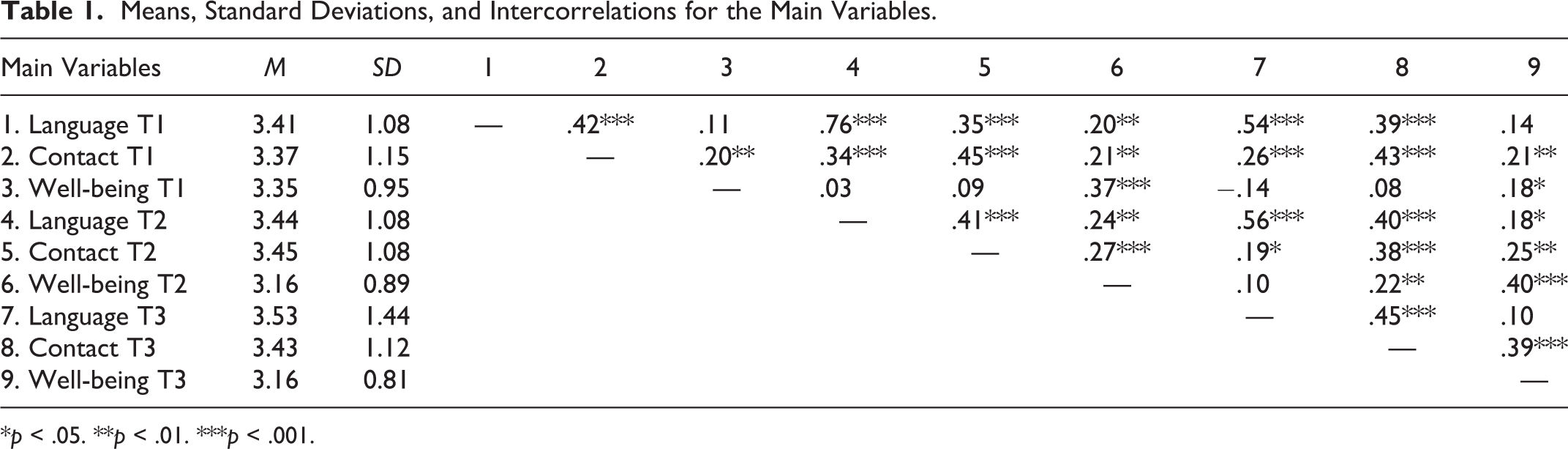
Means, standard deviations, and inter-correlations of all measures can be found in Table 1.
Means, Standard Deviations, and Intercorrelations for the Main Variables.
*p < .05. **p < .01. ***p < .001.
Design and Procedure
The study had a longitudinal design with three time points, each about 1 year apart. The first data collection (T1) took place in early 2014, the second (T2) lasted from late 2014 until early 2015, and the final data collection (T3) was from late 2015 until early 2016. Participants were approached through research assistants (RAs), who were resettled refugees themselves and thus had good connections among refugee communities in the UK. These RAs received a week-long training on research methods before starting their work, and translations of the items used in the questionnaire were extensively discussed and agreed on before commencing data collection. Opportunity samples in four British cities were recruited: RAs approached people in their own refugee network to participate and asked people from their network and people from city and county councils and civil society organizations for further contacts. Although the questionnaire was in English, RAs often had to interpret (parts of) the questionnaire for those who did not understand English well enough to fill out the questionnaire on their own. All aspects of the research were in line with ethical guidelines of the American Psychological Association (APA) and the British Psychological Society (BPS). After participants had completed the questionnaires, they were thanked and debriefed.
Results
Model Selection and Fit
Based on theory (Kearney, 2017), we specified a cross-lagged panel model, shown in Figure 1, to investigate the temporal direction of the relationships between language, contact, and well-being. We conducted bootstrapping with 1,000 samples in order to get robust parameter estimates with bias-corrected and accelerated confidence intervals. As well as the structural paths between language, contact, and well-being between the time points, we also specified autoregressive paths between adjacent time points for each variable as well as between the same variable measured at T1 and T3. We also allowed variables measured at the same time point to covary. For reasons of parsimony, we constrained the paths between T2 and T3 to be equal to the equivalent paths at T1 and T2. The specified model showed a good fit according to Kline’s (2000) criteria, χ2 (21) = 39.28, p = .009; CFI = .96; RMSEA = .07; SRMR = .07.

Cross-lagged panel model showing significant temporal relationships between language, contact, and well-being at all three time points (95% BCa CIs in square brackets). For visual clarity, we omitted autoregressive paths between the time points for the same variable, covariances between variables measured at the same time point, and all nonsignificant paths. Full results can be found in Table 2.
Model Results
Full model results are presented in Table 2. 4 As Table 2 shows, language skills positively and prospectively predicted greater contact with British people a year later (Hypothesis 1). However, the reverse pathways from contact to language skills were not significant. Furthermore, contact with British people was positively associated with well-being a year later (Hypothesis 2). However, the reverse pathways from well-being to contact were not significant, nor were the paths from well-being to language skills, nor the direct paths from language skills to well-being. Crucially, there was a positive indirect effect from language skills at T1 through contact at T2 to well-being at T3, β = .03, p = .05, SE = .01 (Hypothesis 3). No other substantive paths were significant. For a clarifying visual representation of the findings related to the hypothesized effects, please see Figure 1.
Full Model Results.
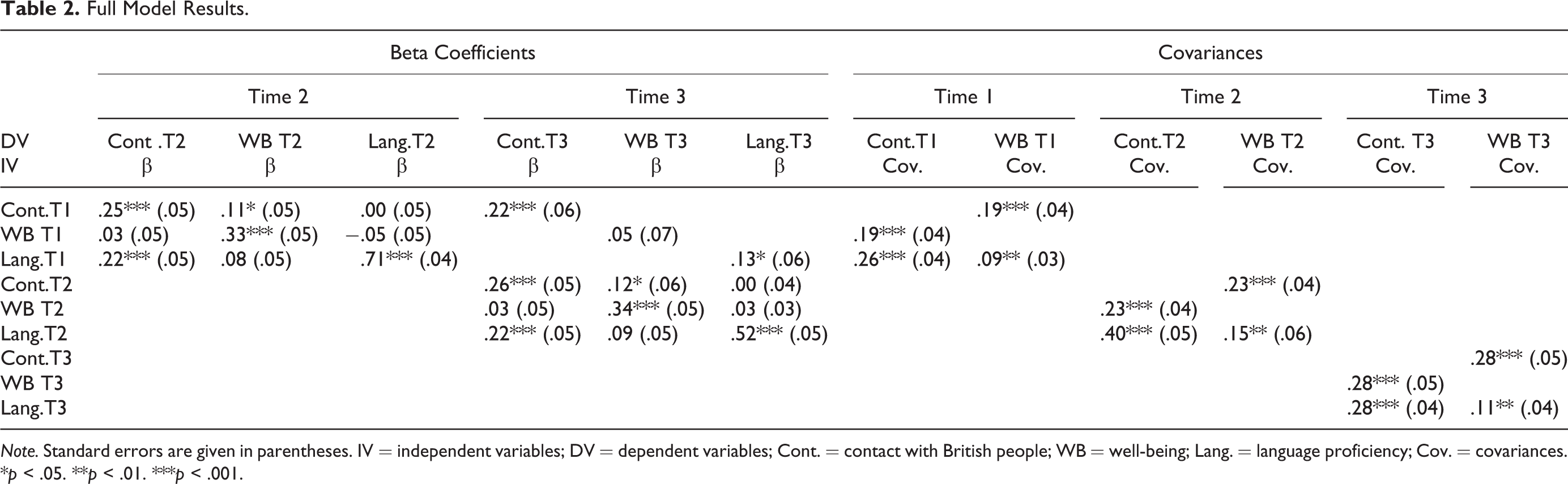
Note. Standard errors are given in parentheses. IV = independent variables; DV = dependent variables; Cont. = contact with British people; WB = well-being; Lang. = language proficiency; Cov. = covariances.
*p < .05. **p < .01. ***p < .001.
Discussion
The results of this 3-year study of resettled refugees supported our hypotheses. Firstly, proficiency in the majority language is positively associated with increases in contact with majority members 1 year later (Hypothesis 1) and not vice versa. Second, more contact with the majority is associated with increased well-being of minority members 1 year later (Hypothesis 2) and not vice versa. Finally, we found that English language proficiency was positively linked to well-being 2 years later via an increase in contact with the British majority (Hypothesis 3).
To this brief summary of our findings, we would add the following comments. First, the results underline the importance of majority language proficiency for promoting increased intergroup contact. This could explain why Neto and Barros (2000) found majority language proficiency to be the most important predictor of loneliness among Portuguese immigrants in Switzerland and why Yeh and Inose (2003) found strong positive correlations between fluency in the majority language and social connectedness among international students in the United States (see also Carey-Wood et al., 1995; Vervoort, Dagevos, & Flap, 2012). This previous research was only cross-sectional however, and our longitudinal findings are indicative of the temporal order of the observed relationships.
Second, the findings showing that intergroup contact can be linked longitudinally to increased well-being of minority members are the first of their kind. The results are consistent with Eller and colleagues’ (2016) cross-sectional findings with indigenous groups in Chile and Mexico but adds a longitudinal element: Rather than minority members high in well-being being more likely to seek out intergroup contact, it seems that intergroup contact with the majority group is associated with better well-being of minority group members at later times.
These findings are highly relevant for the integration literature. Ager and Strang (2004) propose a model of indicators of integration, which is much cited in both academic and policy literature. In this model, integration is understood as maximizing well-being for refugees. It specifies a range of indicators for integration, clustered into four groups: (1) markers and means of integration, which consist of employment, education, housing, and health; (2) social connections, comprising of social bridges, social bonds, and social links; (3) facilitators, consisting of language and cultural knowledge and safety and security; and (4) foundations: rights and citizenship. Although the labeling of the four groups suggests interdependencies, there is little understanding of the enabling and constraining linkages between the domains of integration or how progress in one domain supports progress with respect to another (Ager & Strang, 2008; Spencer, 2006). Researchers have pointed out the importance of identifying the pathways between the indicators (Phillimore & Goodson, 2008), particularly for refugees because of their unique circumstances (Strang & Ager, 2010). Our research provides longitudinal evidence from a large group of refugees regarding several pathways in Ager and Strang’s integration model: those between language, social connections, and health.
We acknowledge some limitations to this research. An attrition rate of 35.7% is not ideal. However, considering the “hard-to-reach” and somewhat transient nature of our refugee sample, a higher than usual attrition rate was to be expected. Another possible limitation is that our measure of language proficiency was self-rated language proficiency. It would have been desirable to have had an objective language measure but practical considerations meant that it would have been impossible to administer such a time consuming test, especially at all three time points. Moreover, other researchers have found that self-rated language proficiency is reasonably predictive of actual language capability (Luoma & Tarnaren, 2003; MacIntyre, Noels, & Clément, 1997; Wilson & Lindsey, 1999). Finally, our sample was ethnically quite heterogeneous, which doubtless added some complexity, not to say “noise,” to the data. However, the fact of the matter is that refugees are typically a diverse group in terms of culture, educational, and employment background; family situation; and prior life circumstances. In that sense, then, our sample is not unrepresentative of many refugee groups across the globe. Our restricted sample size meant that it was impossible to control for all of these variables in our analyses.
The findings from the present study are not only relevant for theorizing on the roles of language and intergroup contact in promoting well-being, they also are pertinent for those concerned with developing policies on refugee resettlement. Rather than refugees high in well-being being more likely to seek intergroup contact, it seems like intergroup contact is linked to an increase in well-being of refugees over time. The crucial difference between the two is that this means that majority members could possibly aid well-being of minority groups by seeking contact with them. Projects which encourage and increase contact between groups, for example, community events, sporting events, or mentoring schemes, could support well-being of refugees, but the provision of adequate language training is important as well.
Second, the results indicate that not speaking the majority language might create a barrier against forming intergroup contact. This is a very important finding for policies related to language classes for minority groups. For example, in the United States, finding employment is much higher on the list of priorities than learning English: Resettlement agencies often assume that refugees will learn English on their own, for example, through communication with English speakers at work (Chin & Villazor, 2015). Similarly, in the UK minority language speakers no longer have access to fully funded English language classes in the UK once they are in employment, and there is no government funding available for language training in the workplace (Kings & Casey, 2013). That is, it is assumed that once in employment, there is no longer a need to learn the language. Our findings suggest that this emphasis may be misplaced. Not only will lack of proficiency in the majority language prove an obstacle in refugees finding employment, but it may compromise their well-being as well, as our results show. This highlights the importance of (funding for) language classes.
In 2015, the UK government offered to resettle 20,000 Syrian refugees by May 2020 under the Syrian Vulnerable Person Resettlement Programme (VPR). For the UK, the start of the VPR meant a significant increase in resettlement: Before announcement of the VPR, under the already existing resettlement program, only up to 750 people were resettled to the UK each year and 18 local authorities were involved (Sim & Laughlin, 2014). In contrast, more than 160 local authorities had signed up to accept Syrians through the VPR (Home Office, 2016), meaning that refugees are increasingly being resettled to areas of the UK with no history or prior experience of resettlement. We hope that the present findings will inspire authorities receiving refugees to maximize well-being of these refugees by providing ample language classes upon arrival and involving the English majority living in these areas by creating plenty of opportunities for intergroup contact.
Supplemental Material
Supplemental Material, SPPS752062_suppl_mat - Improving Refugee Well-Being With Better Language Skills and More Intergroup Contact
Supplemental Material, SPPS752062_suppl_mat for Improving Refugee Well-Being With Better Language Skills and More Intergroup Contact by Linda K. Tip, Rupert Brown, Linda Morrice, Michael Collyer, and Matthew J. Easterbrook in Social Psychological and Personality Science
Footnotes
Declaration of Conflicting Interests
The author(s) declared no potential conflicts of interest with respect to the research, authorship, and/or publication of this article.
Funding

Supplemental Material
The supplemental material is available in the online version of the article.
Notes
References
Supplementary Material
Please find the following supplemental material available below.
For Open Access articles published under a Creative Commons License, all supplemental material carries the same license as the article it is associated with.
For non-Open Access articles published, all supplemental material carries a non-exclusive license, and permission requests for re-use of supplemental material or any part of supplemental material shall be sent directly to the copyright owner as specified in the copyright notice associated with the article.
