




Abstract
Scholars have recently been questioning the original premise of lie scales as measuring dishonesty for social desirability, with some even claiming that lie scales may in fact represent higher honesty (e.g., de Vries et al., 2017 commentary on Feldman, Lian, Kosinski, & Stillwell, 2017). In a preregistered experiment, I examined the relationship between lie scales and honesty by directly assessing laypersons’ perceptions of honesty reflected in lie scales. Overall, laypersons perceived higher lie scale scores as reflecting higher dishonesty and higher lie scale scorers as more intentionally dishonest and socially sensitive, endorsing a negative (and rejecting a positive) relationship between lie scales and honesty. These findings provide empirical support for lie scales as capturing dishonesty. I discuss implications and possible directions for addressing the complexity inherent in the construct of honesty and the need for an integration of the seemingly contradictory findings to advance the debate regarding lie scales and honesty.
Introduction
There is an ongoing debate regarding what lie scales measure. Lie scales, sometimes referred to as impression management, other deception, or the gamma factor scales, are associated with mixed and confusing findings that make it difficult to interpret how well they capture honesty or what aspects of personality they reflect (Uziel, 2010). Traditionally, lie scales were constructed to measure deceit for appearing more socially desirable. Later accounts interpreted high scores on lie scales as capturing aspects of response styles and personality traits. The “defensiveness approach” argued lie scales are capturing defensiveness of the self, reflecting distortions in self-evaluations and avoidance of social disapproval (Crowne, 1979). The “adjustment approach” considered high lie scale scores as reflecting healthy social functioning, and such response styles as representing individuals who emphasize social adjustment and coexistence with others in society. This evolving debate exemplifies the different interpretations regarding lie scales and lying. Do lie scales indeed capture lying, as their title suggests, or perhaps lie scales have been completely misunderstood and misinterpreted and are actually measuring something else altogether, possibly even measuring honesty?
This debate has recently reemerged with a commentary criticizing the use and interpretation of a lie scale as a measure of honesty in a study of the relationship between profanity and honesty (Feldman et al., 2017). In the first out of three studies, my colleagues and I found that two behavioral and one self-reported measures of profanity had a negative relationship with lie scale score using the Eysenck Personality Questionnaire Revised (Eysenck, Eysenck, & Barrett, 1985), and based on the original premise of these scale and a large body of supporting evidence (e.g., Davis, Thake, & Weekes, 2012) our interpretation of this evidence was that those who were higher on profanity use were more honest. De Vries et al. (2017) had strong objections to this interpretation and summarized recent evidence that suggests lie scales capture honesty, rather than dishonesty. They therefore interpreted our evidence to mean that “honest people tend to use less—not more—profanity” (commentary title). They concluded by calling for a “moratorium on the use of lie scales as measures of deception and dishonesty” (p. 5).
In Table 1, I briefly address the main points in the commentary. In the target article, we called for further debate and empirical evidence and cautioned against drawing strong conclusions, and I am happy to see further evidence on the topic. Yet, the commentary’s accompanying criticism is often misplaced or unwarranted, the evidence suggestive, and the strong conclusions premature. In this reply, I focus on the main criticism—that high lie scale scores cannot be interpreted as reflecting dishonesty. I argue that the debate on lie scales is far from conclusion, and much more needs to be clarified and examined regarding lie scales and honesty. I first review weaknesses in the arguments against interpreting lie scales as dishonesty, and I then provide strong experimental evidence showing that laypersons understand and interpret high lie scale scores as being intentionally dishonest and reflecting social sensitivity. Finally, I discuss implications for the lie scale and honesty literatures and suggest directions for integration.
Brief Responses to the de Vries et al. Commentary Critics.
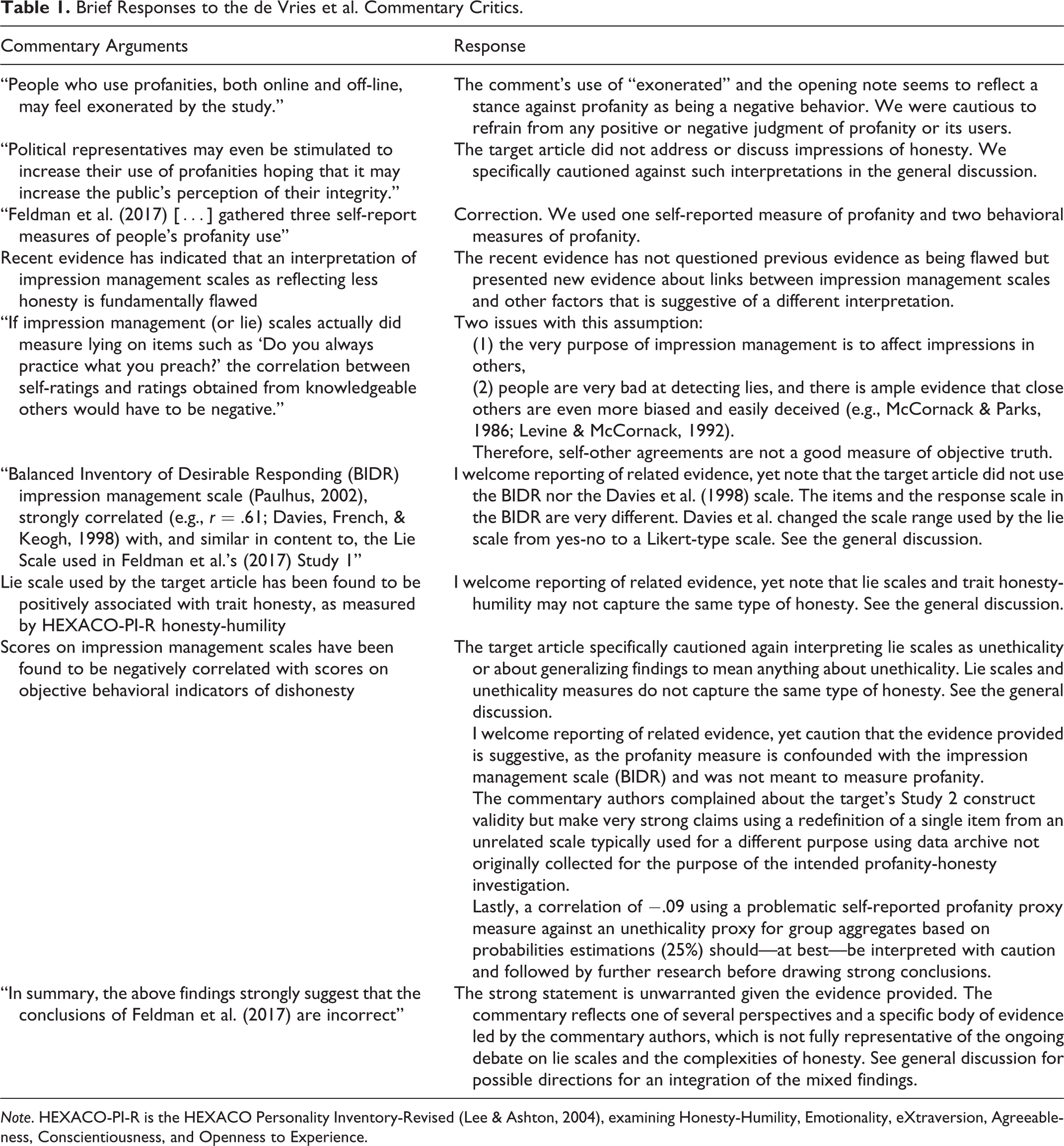
Note. HEXACO-PI-R is the HEXACO Personality Inventory-Revised (Lee & Ashton, 2004), examining Honesty-Humility, Emotionality, eXtraversion, Agreeableness, Conscientiousness, and Openness to Experience.
Lie Scales and Honesty
Lie scales measure unlikely answers to extreme statements such as in answering “yes” to “are all your habits good and desirable ones?” or answering “no” to questions such as “have you ever said anything bad or nasty about anyone?” (Eysenck & Eysenck, 1975; Eysenck et al., 1985). The premise was that those who answer yes–no to the questions above—for whatever reason—are most likely being deceitful, possibly in service of some purpose or reflecting certain traits.
There is an ongoing debate regarding the meaning of lie scales, and the question of what lie scales or impression management measures capture is still in debate (Uziel, 2010). Scholars in the “adjustment view” (e.g., de Vries, Zettler, & Hilbig, 2014; Dunlop, Morrison, Koenig, & Silcox, 2012; Zettler, Hilbig, Moshagen, & de Vries, 2015) have come to question the original premise of lie scales as measuring dishonesty and the “defensiveness view” (e.g., Davis et al., 2012) based on two types of correlational evidence. First, they demonstrated that there is a positive correlation between lie scales and various measures of honesty, such as the HEXACO (Lee & Ashton, 2004) honesty-humility personality trait and measures of unethical behavior. Second, they demonstrated high correlations between self-ratings and close others’ ratings of lie scales items. Both are important contributions, yet they are not necessarily evidence against lie scales as representing dishonesty, and I explain further below.
What Is Honesty? Discussion of Honesty Categories
Lie scales are at the intersection of two conflicting interpretations of honesty—honesty that is meant to express true self, and honesty that is meant to reflect coexistence with others in society (Erickson, 1995; see related discussion in Feldman et al., 2017). Lie scales were designed to measure the sense of being honest about and true to oneself, reflecting authenticity-honesty. However, honesty trait measures, such as the honesty-humility dimension of the HEXACO personality scale (Lee & Ashton, 2004), measure sincerity, fairness, greed-avoidance, and modesty, all socially desirable and focusing on social aspects of honesty in capturing attitudes toward manipulation of others and toward blunt unethical behavior violating social norms and laws. These types of honesty are very different from authenticity-honesty. A suggested typology of the different types of honesty and examples from related scales are provided in Table 2.
Honesty Measures Summary.
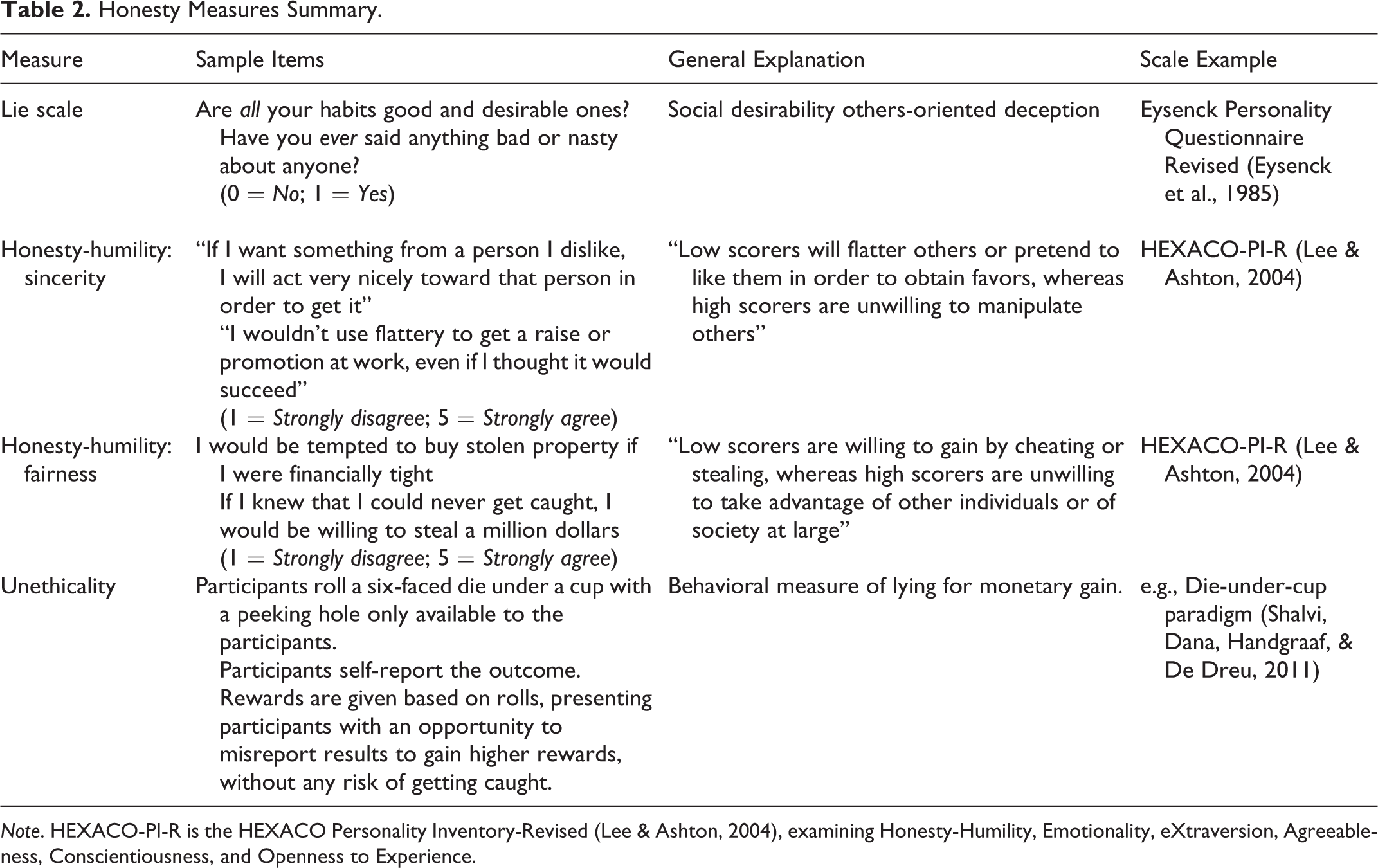
Note. HEXACO-PI-R is the HEXACO Personality Inventory-Revised (Lee & Ashton, 2004), examining Honesty-Humility, Emotionality, eXtraversion, Agreeableness, Conscientiousness, and Openness to Experience.
To give an example for a possible misalignment, authentic-honest persons could act unethically if their true selves are self-centered and deviate from the set norms. In such a case, a person may cheat but would answer more truthfully about his cheating behavior. Similarly, persons can adhere to social-moral codes, yet in doing so may present themselves dishonestly or conform by doing things that they do not wish to do and would not admit to not wanting. In such a case, a socially honest person may be insincere about own wants, needs, desires, and emotions. It is therefore possible to differentiate between at least two types of honesty, a distinction that is not clearly mentioned or addressed in the lie scales debate. Therefore, studies examining authenticity-honesty and studies examining social-honesty are not necessarily studying the same kind of honesty. Findings of lie scale showing a negative relationship with unethical behavior or positive relationship with honesty-humility traits do not necessarily mean that lie scales do not measure lying or that they may even measure honesty. It is possible that lie scales simply capture a different type of honesty.
Demonstrating self-other agreement on lie scales is also problematic as evidence against lie scales, since the very purpose of impression management is to affect impressions in others, and there is ample evidence that others are biased and easily deceived (e.g., McCornack & Parks, 1986; Levine & McCornack, 1992). I return to this point in the discussion.
The Present Investigation
It is therefore important to directly examine whether lie scales indeed capture dishonesty and specifically test authentic-dishonesty as the type of honesty they were meant to assess. I take a different approach than that taken so far regarding lie scales. Rather than making assumptions about what laypersons mean when they refer to honesty and do when answering lie scales, or indirectly interpreting lie scales based on correlates or using self-other comparisons, my approach uses experimental folk psychology methodology (Knobe et al., 2012; Knobe & Nichols, 2013; Nichols, 2011; see example regarding honesty in Turri & Turri, 2015) to more directly assess laypersons’ cognition regarding honesty and lie scales.
In a preregistered experiment, I examined laypersons’ interpretations of high and low scores and scorers in terms of honesty to test (1) whether high- versus low-score answers are perceived as more or less honest answers and (2) whether persons with high versus low scores are perceived as more or less honest people.
Experiment
Preregistration and Open Science
I preregistered the experiment on the Open Science Framework and data collection was launched later that day. Preregistration, power analyses, and all materials are available in the Online Supplementary Materials and shared along with data and code on the Open Science Framework (https://osf.io/7gnfe/).
Participants
A total of 302 American Amazon Mechanical Turk (MTurk) participants (M age = 36.79, SD age = 12.21; 150 female) were recruited online using TurkPrime.com (Litman, Robinson, & Abberbock, 2017). MTurk participants have considerable experience in taking part in surveys and experiments, and I therefore expected that some may have taken the lie scale before. To prevent any possible biases, I preregistered the exclusion of participants who indicated that they were familiar with or have taken the scale before. I excluded 40 participants in total (13.2%), leaving a sample of 262 (M age = 36.88, SD age = 12.22; 129 female), although exclusions had no effect on the results (full results reported in the Online Supplementary Material).
Procedure and Measures
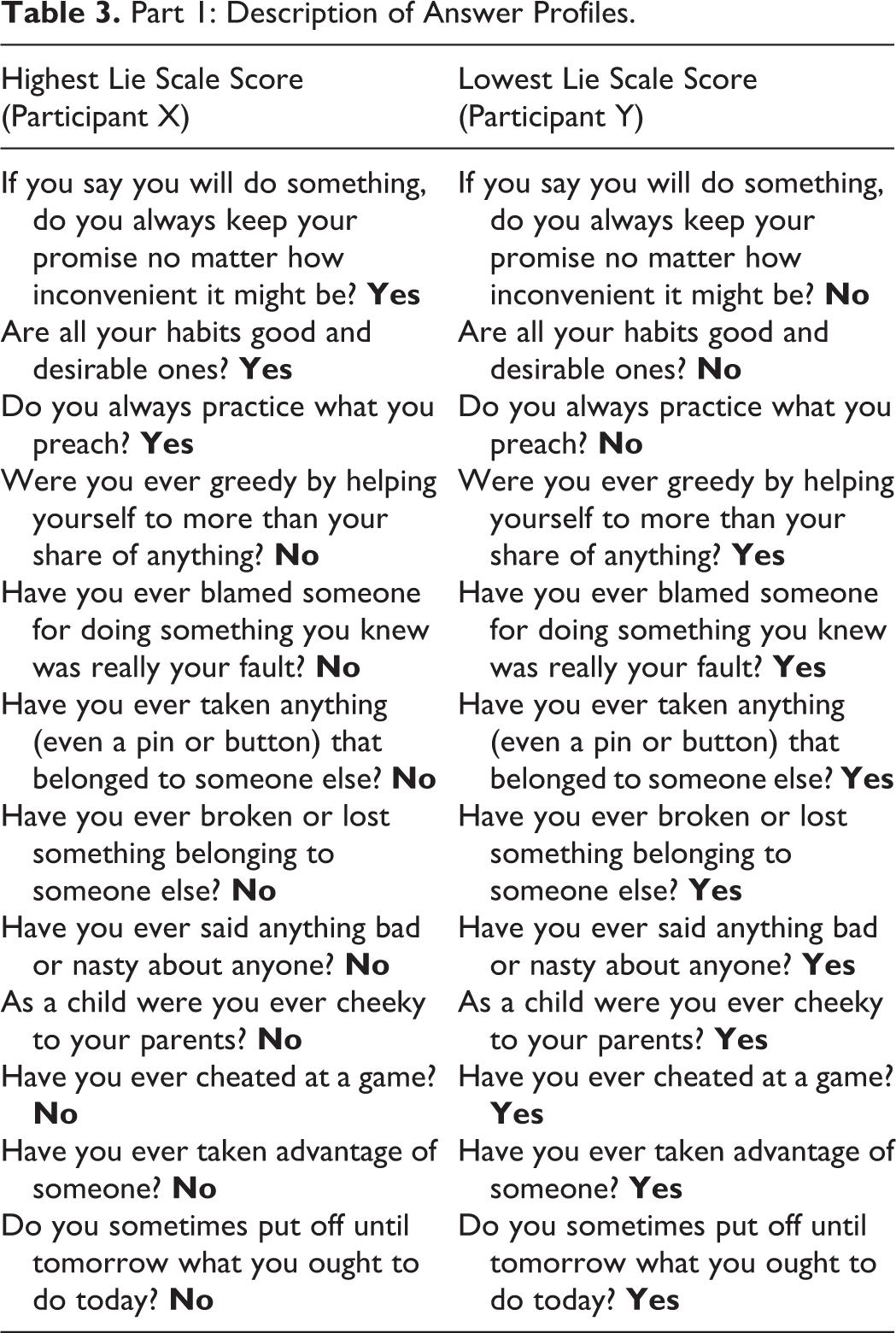
The experiment included three parts. The first part was a within-subject experiment with each participant rating two lie scale answer profiles—a high score on the lie scale and a low score on the lie scale (see Table 3). The presentation order of the two profiles was randomized. Participants were asked to rate for each of the answer profiles whether a participant who answered in such a way (1) answered truthfully, (2) is generally an honest person, (3) cares what others think of him or her, (4) understood the questions, (5) read the questions carefully, (6) believes that his or her answers reflect the truth (intentionality), (7) answered as most people would, and (8) answered randomly (1 = Extremely unlikely; 7 = Extremely likely).
Part 1: Description of Answer Profiles.
In the second part, both answer profiles were presented side by side as representing two persons. Participants were asked to compare the two and were forced to choose which of the two persons (1) is a more honest person, (2) has answered the questions more honestly, (3) cares more what others think of him or her, and (4) better represents the average person’s answers.
In the third part, I ran a between-subject design experiment and participants were randomly assigned to one of two conditions for the two conflicting interpretations of the lie scale as representing either low or high honesty. Participants were asked to rate their agreement with the interpretation presented in their assigned condition (1 = Strongly disagree; 7 = Strongly agree).
Results
Means, standard deviations, and summary statistics for Part 1 are provided in Table 4. Participants perceived persons with low lie scale score as answering more truthfully (d = 1.55), as believing their answers are truthful (d = 1.13), as being more honest (d = 0.59), and as caring less about what others think of them (d = 2.10). Both answer profiles were perceived as reflecting a good understanding of the items and as intentional nonrandom responding (understanding: M = 6.11/6.24; careful reading: M = 5.71/6.12; and random answering: M = 1.95/2.03; d = 0.05 to 0.32; on 1–7 scale; one-sample t test comparing to 4 as neutral answer: all |t| > 19.77, p < .001).
Part 1: Means, Standard Deviations, and Summary Statistics.
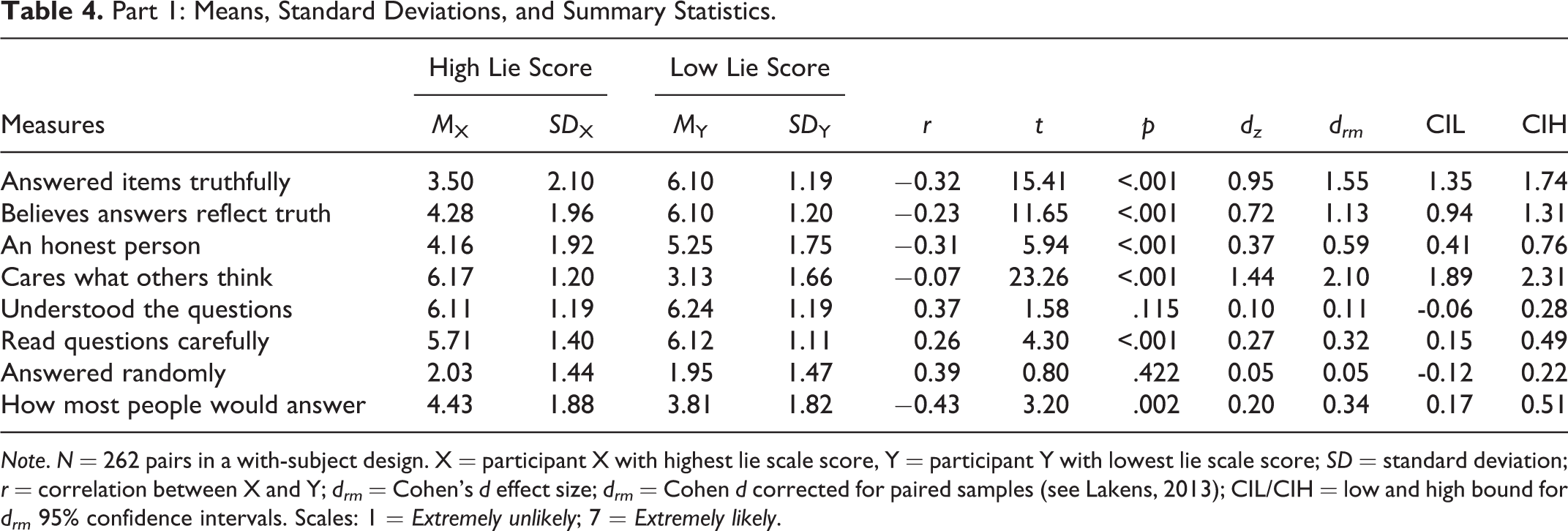
Note. N = 262 pairs in a with-subject design. X = participant X with highest lie scale score, Y = participant Y with lowest lie scale score; SD = standard deviation; r = correlation between X and Y; drm = Cohen’s d effect size; drm = Cohen d corrected for paired samples (see Lakens, 2013); CIL/CIH = low and high bound for drm 95% confidence intervals. Scales: 1 = Extremely unlikely; 7 = Extremely likely.
To examine the comparison between the two profiles in Part 2, I ran a binomial test contrasting proportions to a 50%–50% random split choice. Participants rated the low lie scale score as reflecting a more honest person (187/262, 71% CI [65%, 76%], binomial z = 6.86, p < .001), as answering items more truthfully (204/262, 78% confidence interval (CI) [72%, 82%], binomial z = 8.96, p < .001), and as caring less about what others think of them (42/262, 16% CI [12%, 50%], binomial z = −10.94, p < .001). Ratings of the two profiles as representing the average person did not significantly differ from a 50–50 split (137 vs. 125, 52% vs. 48%, binomial z = .68, p = .497).
Finally, participants showed higher agreement with the interpretation that high lie scale scores represent lower honesty (n = 131, M = 5.60, SD = 1.57 vs. n = 129, M = 3.27, SD = 2.14, t(234.12) = 10.03, p < .001, d = 1.24 CI [0.97, 1.50]; one-sample t test comparing means to 4 as neutral answer: both |t| > 3.87, p < .001).
Discussion
Laypersons perceived high lie scale scores as less honest than low lie scale scores and high lie scale scorers as less honest people than low lie scale scorers. Compared to low lie scale scores, high lie scale scorers were interpreted as intentionally deceitful and as reflecting caring more about what others think of them. These results were consistent across rating high and low lie scale scores independently and contrasts in a comparison of the two answer profiles. Finally, laypersons endorsed the interpretation that high lie scale scores reflect lower honesty and rejected the interpretation that high lie scale scores reflect higher honesty.
These findings support the original premise of lie scales as capturing dishonesty for socially desirability. These calls to question the very strong statements made about lie scales as clearly not reflecting dishonesty, mainly based on correlates with other factors and self-other agreement (de Vries et al., 2014; Uziel, 2014). At the very least, our findings exemplify the need for a more complex and nuanced understanding of lie scales than the clear-cut conclusions by de Vries et al. (2017), arguing that lie scales most definitely do not reflect dishonesty. Furthermore, laypersons viewed high lie scale scores as reflecting a clear understanding of the items, a clear strategic agenda in answering, and intentional dishonesty, contrary to the untested argument that laypersons process the “spirit or gist of the item […] rather than exact wording” (De Vries et al., 2017, Note 7).
Which raises the question—why would there be a negative relationship between lie scales and measures of honesty-humility traits and ethical behavior? There are two possible explanations, and both could be relevant. The first, as suggested in the introduction, is that lie scales capture a different type of honesty than that measured by honesty-humility traits and unethicality measures. I will not reiterate this point, but I call scholars to differentiate between the types of honesty and to clearly identify which type of honesty they aim to capture and by what measure, noting the generalizability of their findings, as we have in the target article. If we are to accept the possibility of different types of honesty, then it is likely that those with high lie scale scores are high on authenticity-honesty and possibly low on the social-honesty.
The second explanation is that the methodological approach in assessing honesty reflected by lie scales using traits and self-other agreements has limitations in evaluating authenticity-honesty that lie scales were originally meant to assess. Measuring honesty about oneself presents scholars with a unique challenge. Take, for example, the paradoxical dilemma embedded in lying self-reports (e.g., Halevy, Shalvi, & Verschuere, 2014; Peer, Acquisti, & Shalvi, 2014)—Are people who self-report themselves as liars honest about lying? Are people who self-report to being honest lying to appear honest? How, then, do we assess whether such self-reports about lying are honest? One approach taken by personality scholars was to examine correlates between such self-reports and various individual differences and behaviors. This approach would be useful to the extent that the correlated factors indeed capture the same construct, yet honesty-humility may not capture the same construct. A second approach was to assess self-other agreements. Yet again, such an approach also embeds a paradox. If the very purpose of impression management is to create more positive impressions in others, then how would asking about others’ impressions be helpful? The assumption of that approach was that close others are likely to know a person well and their opinions would therefore reflect an objective truth, yet ample research has shown that people are generally bad at detecting and correcting for deception or for impression management and that close others are even more easily deceived and are generally more biased (e.g., McCornack & Parks, 1986; Levine & McCornack, 1992). Close others are frequently lied to, even if lying is merely meant to protect them and their feelings, and are often surprised when learning that cheating or deceit has taken place (Drouin, Tobin, & Wygant, 2014; Ennis, Vrij, & Chance, 2008), most vividly exemplified by reactions to admissions of partners faking sexual interest, pleasure, or experience in close romantic relationships (e.g., Muehlenhard & Shippee, 2010).
An integration of the findings regarding lie scales is possible (1) with a typology of types of honesty with a clear and careful use of the term and (2) by recognizing and addressing the limitations of the correlates and self-other agreement approaches in understanding honesty-authenticity and lie scales. To successfully achieve such integration, further studies are needed, employing different methods and including measures for the different types of honesty.
An integration would also require an explanation of findings for a negative relationship between lie scales and honesty-humility or unethicality. Why would moral people lie about who they are? First, moral people may self-justify lies for social-moral reasons and may therefore even come to perceive such lying as acceptable or needed. Violations of morals and honesty are deemed acceptable if they can be easily justified (Shalvi, Gino, Barkan, & Ayal, 2015), especially if allegedly serving others (Gino, Ayal, & Ariely, 2013), and can help reduce ethical dissonance between the moral-self and dishonest behavior (Barkan, Ayal, & Ariely, 2015). Conformity to social moral norms may serve as a powerful reason for justifying white lies to the extent that such a lie could even be seen as moral. Second, moral people are more sensitive to others’ views, behaviors, and criticism and tend to put others’ concerns above their own. As such, they are more likely to engage in impression management to influence others’ perceptions of them as being more moral, social, and positive.
Conclusion
Those high on lie scales are perceived to be less honest about who they are and their true selves, challenging the criticism that lie scales cannot be reflective of dishonesty and that laypersons do not perceive answers reflecting high lie scale scores as lying. The debate on lie scales and honesty demonstrates the complexity of defining and examining honesty. This raises the need for (1) a typology of honesty categories (e.g., differentiating between authenticity-honesty and social-honesty), (2) a clear identification of the type of honesty assessed or referenced in empirical studies, and (3) further research to better understand honesty and the relationships between honesty categories. The novel folk psychology empirical approach used in this investigation can be used to further examine laypersons’ honesty perceptions and behavior.
Supplemental Material
Supplemental Material, SPPS737141_suppl_mat - What Is Honesty? Laypersons Interpret High Lie Scale Scores as Reflecting Intentional Dishonesty: Rejoinder to de Vries et al.’s (2017) Comment on Feldman et al. (2017)
Supplemental Material, SPPS737141_suppl_mat for What Is Honesty? Laypersons Interpret High Lie Scale Scores as Reflecting Intentional Dishonesty: Rejoinder to de Vries et al.’s (2017) Comment on Feldman et al. (2017) by Gilad Feldman in Social Psychological and Personality Science
Footnotes
Declaration of Conflicting Interests
The author(s) declared no potential conflicts of interest with respect to the research, authorship, and/or publication of this article.
Funding
The author(s) received no financial support for the research, authorship, and/or publication of this article.
Supplemental Material
The supplemental material is available in the online version of the article.
References
Supplementary Material
Please find the following supplemental material available below.
For Open Access articles published under a Creative Commons License, all supplemental material carries the same license as the article it is associated with.
For non-Open Access articles published, all supplemental material carries a non-exclusive license, and permission requests for re-use of supplemental material or any part of supplemental material shall be sent directly to the copyright owner as specified in the copyright notice associated with the article.
