



Abstract
Building on laboratory- and survey-based research probing the psychology of ideology and the experience of worldview conflict, we examined the association between worldview conflict and emotional reactions, psychological well-being, humanity esteem, and political ideology in everyday life using experience sampling. In three combined samples (total N = 328), experiencing disagreement compared to agreement was associated with experiencing more other-condemning emotions, less well-being, and less humanity esteem. There were no clear associations between experiencing disagreement and experiencing self-conscious emotions, positive emotions, and mental stress. None of the relationships were moderated by political ideology. These results both replicate and challenge findings from laboratory- and survey-based research, and we discuss possible reasons for the discrepancies. Experience sampling methods can help researchers get a glimpse into everyday worldview conflict.
To understand everyday political behavior, we need to know how people react to and interact with worldview-conflicting people and information. In our roughly 16 waking hours, we are bound to spend a fair portion of that time learning about the world around us through media or in interactions with other people. We might overhear by the coffee machine a conversation about the President’s recent executive order, or someone might comment on the politics of our social media post. How do these experiences, and the potential conflicts they engender, influence our day-to-day emotions, psychological well-being, and views of our fellow citizens?
Why Study Daily Life?
We examined how people experience worldview conflict in their day-to-day lives, how people respond to these conflicts, and if there are ideological differences in such responses. Studies have examined how people interact with worldview-conflicting information and people in survey studies (e.g., Crawford, 2014; Iyengar & Westwood, 2015; Kahan, 2013) and lab experiments (e.g., Motyl, Iyer, Oishi, Trawalter, & Nosek, 2014; Taber & Lodge, 2006), but these studies present relatively extreme information in the types of controlled settings necessary for identifying causal effects. Doing so potentially overstates the relationships, as they naturally occur. For example, studies on motivated reasoning focus on political or religious issues that are most likely to engage people’s psychological defense systems (Simons & Green, in press; Taber & Lodge, 2006), relative to what one might experience in everyday life.
Other studies have examined whether people seek out worldview-consistent or worldview-conflicting information in their social networks (e.g., Facebook, Twitter) or interact with dissimilar others within these networks (Bakshy, Messing, & Adamic, 2015; Barberá, Jost, Nagler, Tucker, & Bonneau, 2015). These data can catalog millions of interactions as people interact naturally on social networks. However, they do not capture more individualized information about participants, nor their reactions to information they are exposed to or interact with on these networks. Such studies are thus less ideal for analyzing psychological processes relative to those typically possible with lab and survey experiments.
Therefore, we followed a middle path and used experience sampling methods (Shiffman, Stone, & Hufford, 2008) to examine worldview conflict in daily life. This method combines the spontaneity and realism of the online social networks data with the precision of a survey study by contacting participants several times a day to report on their experiences and psychological states. This technique does not have the causal precision of experiments and relies on self-report data, but they do capture participants in their natural environment, and the self-report data do not suffer from the memory distortions that can obfuscate data from survey studies (Shiffman et al., 2008). To capture a breadth of worldview conflict in daily life, we focus our study on people’s experiences with and reactions to both political and religious information. We examine both simultaneously because political and religious attitudes often overlap (Haynes, 2008; Johnson et al., 2016), and some of the politically and religiously relevant experiences our participants reported were characterized as both political and religious (e.g., terrorist attacks).
Hypothesis Development
Inspired by increasing levels of elite political polarization (Fiorina & Abrams, 2008), research focuses on psychological and behavioral consequences of worldview conflict—that is, what happens when a person encounters attitudes and behaviors with which s/he disagrees? The short answer, it seems, is that people feel negative emotions, have lower well-being, have more stress and anxiety, and express more prejudice in response to worldview-conflicting people and information. The common underlying mechanism is that worldview-conflicting information is experienced as aversive (Brandt, Reyna, Chambers, Crawford, & Wetherell, 2014; Byrne, 1969; Proulx, Inzlicht, & Harmon-Jones, 2012; Simons & Green, in press). People even forgo money to avoid conflicting attitudes and information (Frimer, Skitka, & Motyl, 2017). We examine how this aversion to worldview-conflicting information plays out in people’s daily lives.
Emotional reactions
Emotions signal whether a situation is going well or not and can motivate future action (Frijda, 1988; Nelissen, Dijker, & de Vries, 2007). Worldview-conflicting and worldview-consistent information elicit strong negative and positive emotions, respectively. For example, Democrats and Republicans expressed other-condemning emotions like anger, hostility, and disgust after learning that their party was going to lose an election, and enthusiasm, hope, and pride after learning that their party was going to win an election (Huddy, Mason, & Aarøe, 2015). People also experience strong other-condemning emotions and moral outrage when moral values are violated (Hofmann, Wisneski, Brandt, & Skitka, 2014; Mullen & Skitka, 2006; Tetlock, Kristel, Beth, Green, & Lerner, 2000) and positive emotions when moral values are upheld (Hofmann et al., 2014; Skitka & Wisneski, 2011). In daily life, other-condemning emotions (e.g., anger, disgust) should follow worldview-conflicting information, and positive emotions (e.g., pride, enthusiasm) should follow worldview-consistent information.
Psychological well-being
Other work has focused on decrements in subjective well-being as an outcome of worldview conflict. Subjective well-being consists of many components (Diener, Shuh, Lucas, & Smith, 1999), including positive emotions and a lack of negative emotions (such as those above), but the type of well-being often studied in the worldview conflict literature is happiness, life satisfaction, and meaning. 1 Some studies find that conservatives report greater well-being than liberals, but more complete evidence shows that this is primarily the case in contexts that are relatively conservative (Mandel & Omorogbe, 2014; Motyl et al., 2014; Stavrova & Luhmann, 2016). This is likely the case because people experience decrements to well-being in contexts where they feel a lack of fit. For example, being in a setting (e.g., university, neighborhood) where people are likely to experience worldview conflict is associated with lower levels of belongingness (Motyl et al., 2014), a key component of psychological well-being (Baumeister & Leary, 1995). Other studies find that worldview conflict can be an active deterrent of psychological well-being—people report feeling anxiety when they encounter disagreeable political ideas (Simons & Green, in press), as well as lower levels of happiness and meaning after encountering morally objectionable behavior (Hofmann et al., 2014). These studies point to the hypothesis that worldview conflict in daily life should lead to decreases in psychological well-being and increases in stress and anxiety.
Negative reactions toward others
People derogate others in reaction to worldview conflict (Brandt et al., 2014; Crawford, 2014). We investigate how derogation manifests as lower levels of humanity esteem. Just as people can have favorable views of the self (self-esteem) and the group (collective esteem), humanity esteem is a favorable view of humanity as a whole (Luke & Maoi, 2009). Lower levels of humanity esteem may result from worldview conflict for at least two reasons. First, humanity esteem appears to develop, in part, as an extension of quality interpersonal relationships (Luke, Maio, & Carnelley, 2004). Worldview conflict may highlight how interpersonal relationships can go wrong and reduce humanity esteem. Second, experiencing worldview conflict reminds people that others do not agree with their worldview, and prompt them to reduce their evaluations of people as a whole.
Will liberals and conservatives differ?
Worldview-conflict effects may differ depending on political ideology. One example of this ideological asymmetry hypothesis is from the motivated social cognition perspective. It predicts that conservatives are motivated by a desire to maintain cognitive closure (Jost, Glaser, Kruglanski, & Sulloway, 2003; Jost & Krochik, 2014). Worldview conflict strains the ability to achieve cognitive closure, and so political conservatives should show more negative emotions, less positive emotions, poorer psychological well-being, and less humanity esteem following worldview-conflicting information than liberals. This prediction is also consistent with the finding that political conservatives are particularly bothered by negative information and stimuli (negativity bias; Hibbing, Smith, & Alford, 2014). Although this work typically uses frightening (Oxley et al., 2008) or disgusting (Smith, Oxley, Hibbing, Alford, & Hibbing, 2011) stimuli, or angry faces (McLean et al., 2014), given the negativity associated with worldview conflict (e.g., Simons & Green, in press), this perspective should also predict that conservatives will show the largest effects when confronted with worldview conflict.
An ideological symmetry hypothesis predicts that ideological differences are less likely. The idea is that ideological differences can and do emerge when using a limited range of stimuli, but when using a broader array of stimuli that are more likely to represent the range of stimuli people experience, these differences disappear (e.g., Brandt et al., 2014; Brandt & Wagemans, in press; Conway et al., 2016; Crawford, 2012; Morgan, Mullen, & Skitka, 2010). For example, sometimes it appears that conservatives are more prejudiced than liberals, but when using a broad range of groups, it’s clear that both liberals and conservatives express similar levels of prejudice toward worldview-violating groups (Brandt et al., 2014). In short, the idea is that both liberals and conservatives have a similar cognitive architecture for facing worldview-conflicting information and experiences.
The Current Study
We explored how people experience worldview-conflicting information in daily life across emotional reactions, psychological well-being, and humanity esteem. Participants from three populations were contacted several times a day to report their experience with political and religious information, along with their current psychological states. For psychological well-being and humanity esteem, we also included baseline assessments so that our analyses could test whether worldview-conflicting information is associated with changes from baseline.
Method
Participants
We collected data from three locations. Hope College (HC) and The College of New Jersey (TCNJ) are in the United States, and Tilburg University (TiU) is in the Netherlands. TCNJ and TiU are public institutions, and HC is a private, religious institution. Both HC (N = 113; 39 men, 72 women, 2 missing values, M age = 19, SD age = .96) and TCNJ (N = 100; 30 men, 66 women, 4 missing values, M age = 20, SD age = 2.49) used student samples, and TiU (N = 115; 50 men, 45 women, 20 missing, M age = 24, SD age = 9.51) used a mix of students and members of the community. 2,3
Procedure and Measures
Intake survey
After a smartphone compatibility check and informed consent, participants completed an intake survey with demographic, political, religious, and individual difference measures. 4 Here we used two measures from the intake survey. We measured political ideology with 3 items about participants’ social, economic, and foreign policy ideology on a 1–7 scale. In the U.S. samples, the scale anchors and items referred to liberal and conservative positions. In the Dutch sample, the scale anchors and items referred to left-wing and right-wing positions. The scale was reliable (α = .86). The items were averaged, rescaled to range from 0 to 1, and centered on their midpoint (i.e., “moderate”). The measure spanned the possible range of the scale, with the mean near the midpoint (M = −.03).
We measured baseline levels of humanity esteem with two face-valid items from the Humanity Esteem Scale (Luke & Maio, 2009), a construct assessing people’s positive evaluations for people in general. The 2 items were “I take a positive attitude toward humanity” and “At times, I think that human beings are no good at all” (reverse scored). In the U.S. samples, the scale ranged from 1 (strongly disagree) to 5 (strongly agree), and in the Dutch sample, the scale ranged from −3 (strongly disagree) to +3 (strongly agree). To equate the range of the items so that analyses can be combined, the items were rescaled to range from 0 to 1 and then averaged (r = .34).
Signal survey
The day after participants completed the intake survey, the experience sampling phase started. For 3 days, between 9 a.m. and 9 p.m., participants were signaled on their smartphones via Short Message Service (SMS) text message using SurveySignal (Hofmann & Patel, 2015). The SMS message included a link to an online questionnaire optimized for mobile devices. Each day, participants were signaled 5 times at random intervals, with the stipulation that no signal would be within 1 hr of the previous signal (overall response rate = 73%, SD = 24%; HC = 65%, SD = 25%; TCNJ = 78%, SD = 21%; TiU = 76%, SD = 24%; 3,593 completed signals in total). The signal was considered missed if participants did not respond within 1 hr. Responses were incentivized by treating each response as an entry into a raffle for one of three gift cards (US$50 or €50 in the HC and TiU samples, US$25 in the TCNJ sample) to a major online retailer (Amazon.com or Bol.com). Given the frequency with which signals were sent, the design necessarily required brief measures.
At each signal, participants were asked whether they discussed political/religious issues and events with a person or group (political n = 169 [4.7% of signals], religious n = 129 [3.6%]), learned about political/religious issues, and events without contributing (political n = 231 [6.4%], religious n = 90 [2.5%]), or none of the above (n = 2,974 [82.8% of signals]) in the last hour. Many participants reported just one or two relevant (i.e., not “none of the above”) events (M = 1.9, SD = 1.8, range [0, 13]). If they selected none of the above, they completed an abbreviated survey used to compute baseline levels of well-being (see below). If they selected one of the other options, the participants completed additional measures about the event. In this report, we focused on the psychological reactions surrounding perceived worldview conflict and disagreement.
Worldview conflict was operationalized as disagreement. We used 2 items to assess participants’ agreement (reverse scored) and disagreement with the event (“To what extent did you agree/disagree with what you discussed/learned about”; 0 = not at all, 100 = very much). They were correlated (r = .68), rescaled to range from 0 to 1, and averaged to create a scale. The scale ranges from complete event agreement (low scores) to event disagreement (high scores), and we call it event disagreement to highlight that higher scores represent more disagreement with a discrete event. The mean (M = .40, SD = .30) was lower than the midpoint, suggesting people reported situations characterized by more agreement than disagreement, which is consistent with selective exposure research (Freedman & Sears, 1965). Responses spanned the theoretical range of the scale and did not suffer from skewness (.51) or kurtosis (−.69).
Our investigation is centered on event disagreement, and this is our primary predictor variable. Because many participants report more than one event, we can unconfound event disagreement from the tendency for some people to be more likely to see more disagreement or agreement in general. We created a covariate that assesses overall disagreement by averaging across event disagreement (the measure described in the previous paragraph) for each participant. This allows us to estimate the effect of perceived event disagreement over and above a participant’s tendency to report more or less disagreement overall.
We measured participants’ discrete moral emotions in the moment (Haidt, 2003; Hofmann et al., 2014). Following Haidt’s (2003) categorization, we averaged anger, contempt, and disgust to represent other-condemning emotions (α = .83; cf., Huddy et al., 2015), and averaged shame and guilt to represent self-conscious negative emotions (r = .43; cf. Tangney, 2003). 5 We averaged pride, gratitude, and elevation to represent positive emotions (α = .58). Each emotion was measured on a 0 (not at all) to 4 (very much) scale and was rescaled to range from 0 to 1. Although we believe that the mental stress and well-being scales capture relevant theoretical dimensions, we recognize that others may prefer other combinations. For this reason, we also report results for each item individually.
We assessed multiple state-level indicators of psychological well-being. The measure we call well-being was measured with items (e.g., Hofmann et al., 2014) assessing happiness (“How happy do you feel at the moment?”), purpose (“Do you feel that your life has a clear sense of purpose at the moment?”), and life satisfaction (“How satisfied with life are you at the moment?”), each measured from not at all to very much. In the U.S. samples, the scale ranged from 0 to 4; and in the Dutch sample, the scale ranged from 0 to 6. To equate the range of the items so that analyses can be combined, items were all rescaled to range from 0 to 1 and then averaged to form a well-being measure (α = .75).
We called our other measure of psychological well-being mental stress, which was measured with items assessing mental exhaustion (“How mentally exhausted are you at the moment?”) and stress (“How stressed are you at the moment?”), each measured on a scale from not at all to very much. In the U.S. samples, the scale ranged from 0 to 4, and in the Dutch sample, the scale ranged from 0 to 6. Items were all rescaled to range from 0 to 1 and averaged to form a mental stress measure (r = .68). Although we believe that the mental stress and well-being scales capture relevant theoretical dimensions, we recognize that others may prefer other combinations. For this reason, we also report results for each item individually.
One item assessed humanity esteem (Luke & Maio, 2009). This item read “I have a positive attitude toward humanity” and was measured on a scale from −3 (strongly disagree) to +3 (strongly agree). The item was rescaled to range from 0 to 1.
There were also cases where participants reported no politically or religiously relevant event and instead selected “none of the above” at the beginning of the survey signals. In these instances, participants completed the items assessing psychological well-being and mental stress described above. These responses formed baseline indicators of well-being and mental stress (well-being baseline α = .81; mental stress baseline r = .63).
Results
Analysis Strategy
The observations are clustered within persons. To account for the nonindependence of the observations, data were analyzed using regression analyses with clustered standard errors in SPSS Version 22. The coefficients can be interpreted like ordinary least squares regression coefficients. Although multilevel modeling is ideal, the data are too sparse within individuals (i.e., some participants only report one relevant event) to reliably estimate these more complex models. For each outcome variable, we estimate several models. As the most basic test, Model 1 only includes mean-centered event disagreement as a predictor of the outcome variables. To isolate the estimate for a participant’s perceived event disagreement with discrete events from a participants’ overall disagreement across events, Model 2 includes mean-centered event disagreement and mean-centered overall disagreement as predictors. Model 3 is the same as Model 2 with the addition of covariates to adjust for the influence of event perspective (type contrast: discussed = .5, learned about = −.5; content contrast: politics = .5, religion = −.5; and the interaction between these two codes), sample (Contrast 1: HC = .25, TCNJ = .25, and TiU = −.5; Contrast 2: HC = .5, TCNJ = −.5, and TiU = 0), and demographics information (mean-centered age; gender contrast code: women = −.5, men = .5). The last two models test if political ideology moderates the effects of event disagreement, both with and without covariates. Model 4 is the same as Model 2 but includes midpoint-centered ideology and its interaction with mean-centered event disagreement. Model 5 is the same as Model 4 but includes the covariates.
We included baseline measures of well-being, mental stress, and humanity esteem when they were used as outcome variables. As noted in the Method section, all measures were rescaled so that their original scaling (e.g., 0–6) ranged from 0 to 1. Coefficients can be interpreted as the percent difference in the outcome variable as one goes from the theoretical minimum to the theoretical maximum of the predictor variable (see Baguley, 2009, for the benefits of unstandardized effect sizes). Means, standard deviations, and correlations for the key variables are in Tables 1 and 2.
Correlations, Means, and Standard Deviations for Event Disagreement, Ideology, and the Outcome Variables.
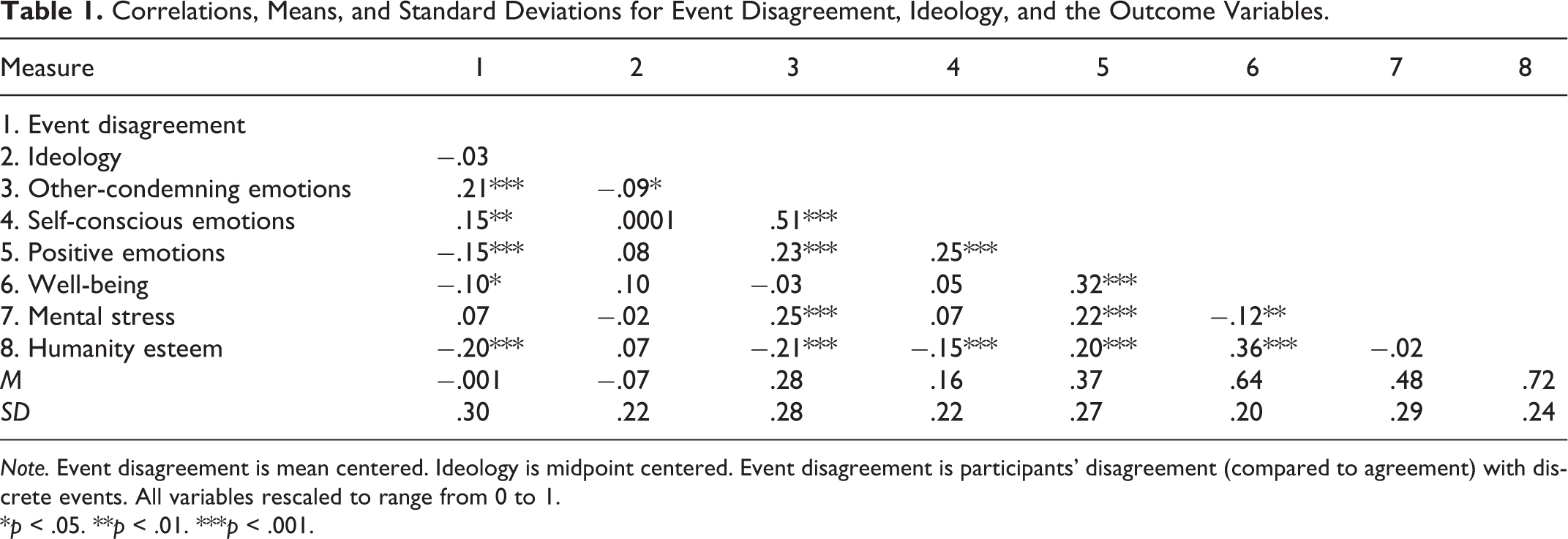
Note. Event disagreement is mean centered. Ideology is midpoint centered. Event disagreement is participants’ disagreement (compared to agreement) with discrete events. All variables rescaled to range from 0 to 1.
*p < .05. **p < .01. ***p < .001.
Correlations, Means, and Standard Deviations for Event Disagreement, Ideology, and the Individual Items.
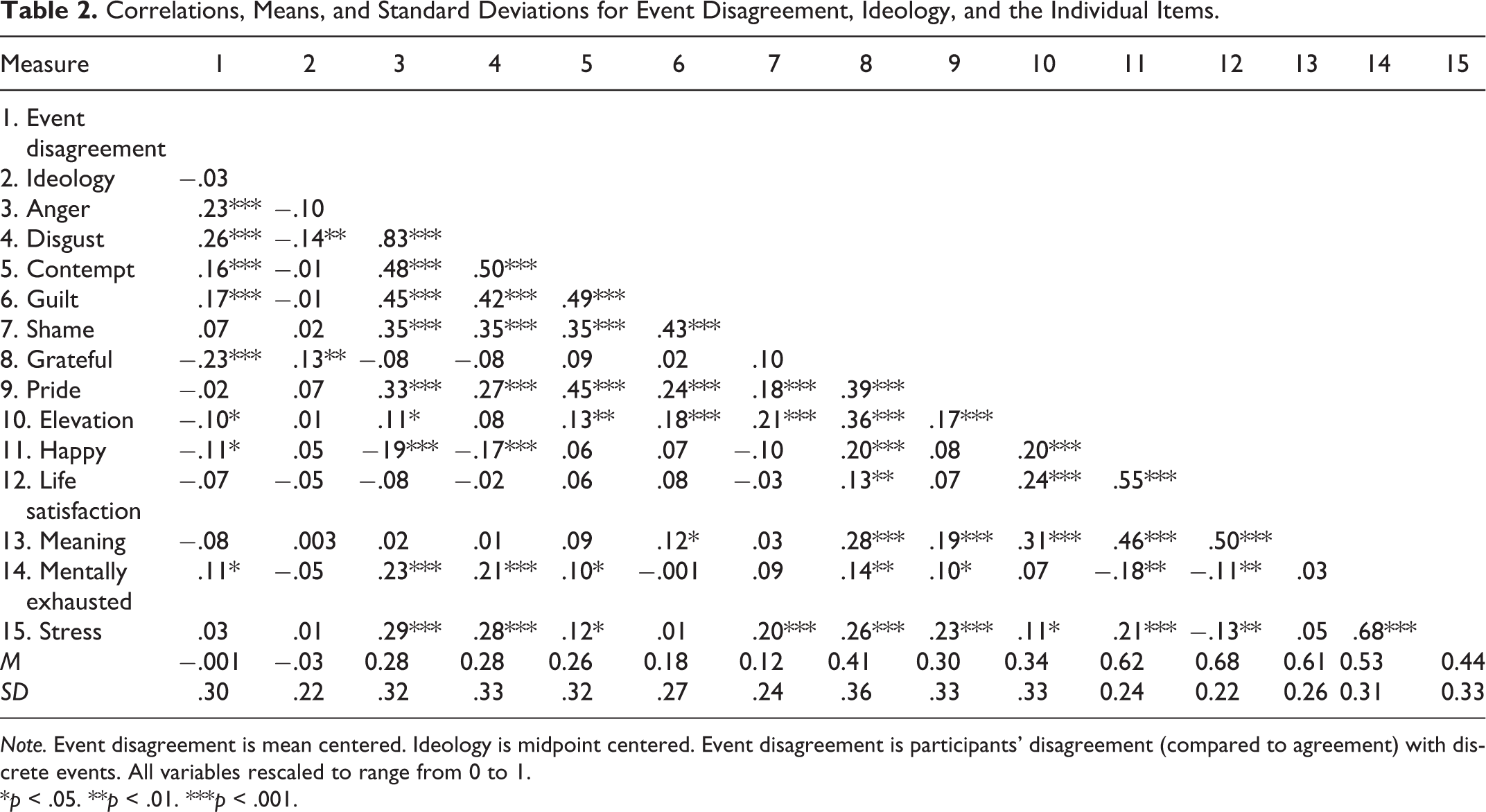
Note. Event disagreement is mean centered. Ideology is midpoint centered. Event disagreement is participants’ disagreement (compared to agreement) with discrete events. All variables rescaled to range from 0 to 1.
*p < .05. **p < .01. ***p < .001.
Hypothesis Testing
Models 1, 2, and 3 test the main effect of event disagreement on the outcome variables, after accounting for overall disagreement and other covariates. Across all three models, more event disagreement was associated with more other-condemning emotions, lower well-being, and lower humanity esteem (Table 3; Models 1–3). The effect for other-condemning emotions was the most substantial (Model 3: b = .18), and the effect for well-being was the weakest (Model 3: b = −.06), with the effect on humanity esteem falling in the middle (Model 3: b = −.12). Event disagreement was also related to more self-conscious emotions and lower positive emotions in Model 1, but the confidence intervals (CIs) for the effects encompassed zero after including the covariates in Models 2 and 3 (see Table 3). In short, the results were consistent with expectations for other-condemning emotions, well-being, and humanity esteem but were not consistent with expectations for self-conscious emotions, positive emotions, and mental stress.
Unstandardized Coefficients and 95% Confidence Intervals From Models Assessing the Link Between Event Disagreement (Models 1–3) and Event Disagreement × Ideology (Models 4 and 5) and the Outcome Variables.
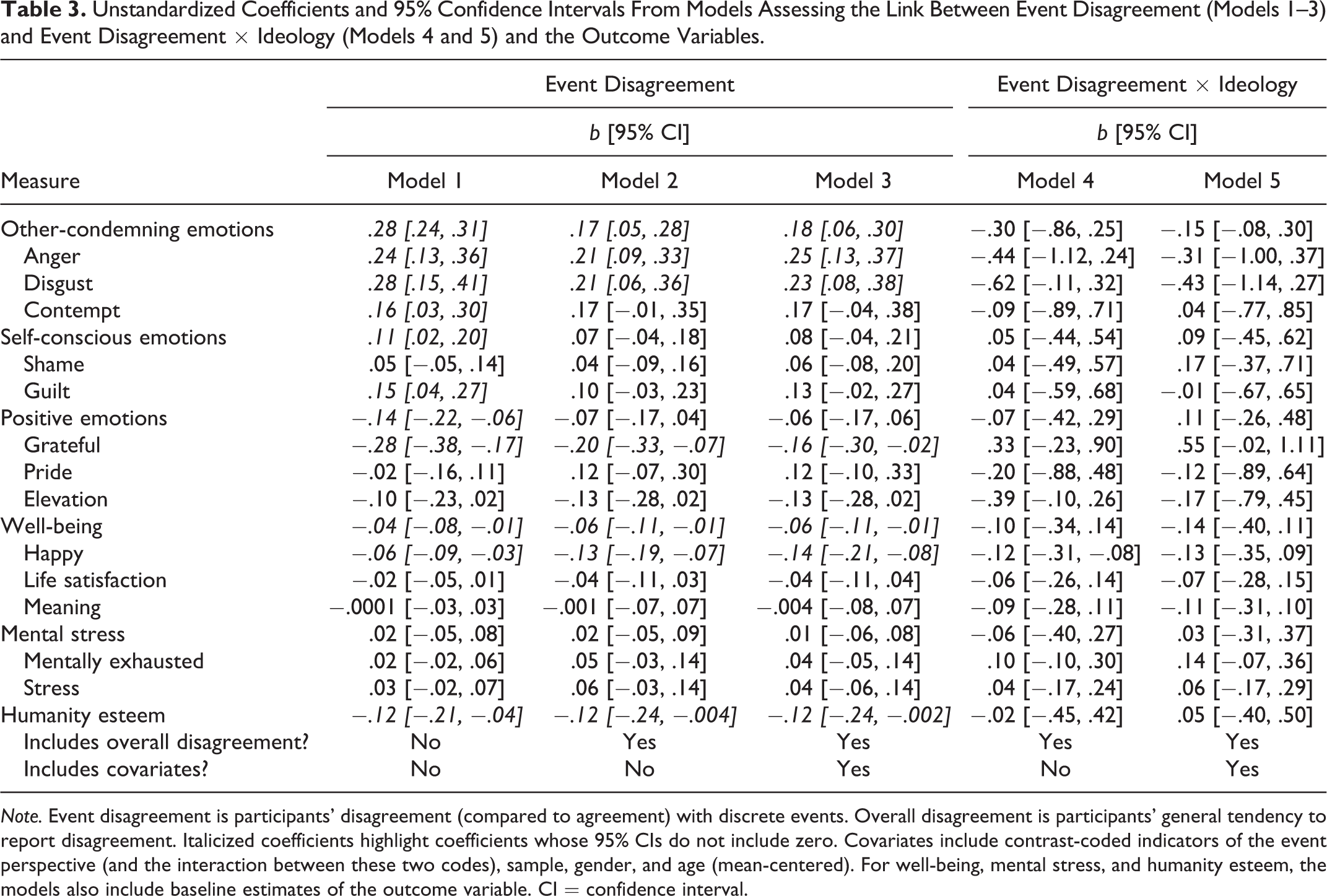
Note. Event disagreement is participants’ disagreement (compared to agreement) with discrete events. Overall disagreement is participants’ general tendency to report disagreement. Italicized coefficients highlight coefficients whose 95% CIs do not include zero. Covariates include contrast-coded indicators of the event perspective (and the interaction between these two codes), sample, gender, and age (mean-centered). For well-being, mental stress, and humanity esteem, the models also include baseline estimates of the outcome variable. CI = confidence interval.
We also examined the effect of event disagreement on individual items. The conclusions based on these single items were largely the same as for the larger scales. There are exceptions. It appears that the negative relationship between event disagreement and well-being is driven by the happiness item; event disagreement was associated with less happiness in Models 2 and 3 (the models with covariates; Model 3: b = −.14), whereas there was no clear associations between event disagreement and the remaining items measuring well-being (Life Satisfaction Model 3: b = −.04, Meaning Model 3: b = −.004). A similar exception occurred for the gratitude and elevation items: Event disagreement was associated with less gratitude and elevation in Models 1, 2, and 3 (it was not different from zero for elevation, but the size and direction of the effect were similar to gratitude), but event disagreement was not clearly associated with the overall positive emotions scale and the coefficient for the pride item was estimated in the opposite direction.
Does political ideology moderate the association between event disagreement and the outcome variables? The ideological asymmetry hypothesis predicts that the effect of event disagreement will be larger for conservatives than for liberals (an Event Disagreement × Ideology interaction), whereas the ideological symmetry hypothesis predicts that liberals and conservatives would be more alike than different (No Event Disagreement × Ideology interaction).
Models 4 and 5 tested the potential interaction between event disagreement and ideology (see last two columns of Table 3). In all 38 tests, the 95% CI included zero. This provides no evidence that political liberals and conservatives have different responses to event disagreement. Moreover, the direction of the interaction coefficient was often in the opposite direction of what would be predicted by an ideological asymmetry perspective. For example, the (nonsignificant) interaction term for other-condemning emotions suggests that for more conservative participants, the effect of event disagreement is weaker than it is for liberal participants; the coefficient does not point in the direction predicted by the ideological asymmetry hypothesis. Notably, in many cases, the CIs for the tests were quite large. This means that we also cannot draw firm conclusions about the effect being near zero as the ideological symmetry hypothesis predicts.
Discussion
We tested how worldview-consistent and worldview-conflicting experiences in daily lives, as operationalized by perceived disagreement with discrete events, are associated with emotions, psychological well-being, and humanity esteem. Perceived event disagreement was associated with stronger other-condemning emotional reactions, with less well-being, and with less humanity esteem. Perceived event disagreement was not clearly associated with indicators of self-conscious emotions, positive emotions, or mental stress. There was no evidence that participants’ political ideology moderated any of these findings. These results confirm research on other-condemning emotional reactions to worldview-conflicting information (Hofmann et al., 2014; Huddy et al., 2015), worldview-inconsistent experiences and their deleterious effects on well-being (Motyl et al., 2014), and ideological similarities in worldview conflict–related processes (Brandt et al., 2014; Taber & Lodge, 2006). It did not confirm research linking positive emotional reactions (Huddy et al., 2015) to worldview-consistent information. Nor did it confirm research on ideological differences in emotion and information processing in response to worldview-inconsistent information (Hibbing et al., 2014; Jost et al., 2003).
In the domains where our results are consistent with past work, the interpretation is straightforward: In the relative messiness of daily experiences, the effects observed in laboratory and survey studies conceptually replicate in our study of everyday worldview conflict. Although this research needs to be replicated with more representative samples and over longer periods of time, researchers should have increased confidence in the theoretical findings that we conceptually replicated.
Clear conclusions are difficult for the results that failed to conceptually replicate prior work. There are at least four explanations. First, the size and composition of our samples may not be ideal for detecting the effects of worldview conflict on positive emotions and mental stress or the moderating role of ideology. Second, our measures may not have captured the relevant aspects of positive emotions and mental stress. We did not find clear effects on positive emotions, but there was a consistent effect on the single item measuring gratitude (and to a lesser extent, elevation). Perhaps pride functions differently when it comes to worldview threat? We also did not find consistent effects on mental stress, neither on the overall measure nor on the individual items. Perhaps people are inaccurately self-reporting their own stress and that less obtrusive measures will reveal the impact of worldview conflict on mental stress?
Third, the time between the worldview-conflicting experience and the measures of mental stress was close. We examined discrete instances of worldview conflict and their impact on immediate feelings of mental stress. Although this could exacerbate the effect (e.g., due to consistency pressures), perhaps the link between worldview conflict and mental stress is a cumulative process. Future studies with longitudinal follow-up questionnaires could test if people who report more worldview conflict have increased mental stress at later times.
Fourth, our study included a variety of experiences that people encountered throughout their day. These stimuli are more representative of people’s daily experiences than typically used stimuli. Although theories of political ideology make domain general predictions (Hibbing et al., 2014; Jost & Krochik, 2014), the typical study only uses a relatively narrow range of stimuli. Findings using a narrow range of stimuli may not generalize to studies that use broader ranges of stimuli (cf. Brandt & Wagemans, in press). The lack of any ideological differences in our study casts doubt on the domain generality ideology effects. However, it is also possible that ideological differences in cognition and motivation are subtle and that these subtleties are not easily observed in daily behavior (but see Carney, Jost, Gosling, & Potter, 2008).
Limitations
Although our method has strengths, our data are limited in other ways. Our design precludes causal inferences, although the inclusion of baseline measures for some outcome variables helps to provide greater estimate precision. Future work may consider longitudinal components of greater duration. Moreover, as mentioned above, our sample was not representative of the broader population; rather, it mostly consisted of college-aged adults. Finally, we used abbreviated measures to maintain short surveys. Although we tried to choose items and measures that were used in the past and have face validity, longer measures may better capture the nuances of these constructs and might reveal equally nuanced results. The difference between gratitude, elevation, and pride—our indicators of positive emotions—speaks to this possibility.
When reflecting on our most damning results (Vazire, 2016), those that cut against our conclusions, we identified two with an approximately equal level of damnation. Damning Result #1: We make claims about worldview conflict in response to politically and religiously relevant events in daily life, but overall people reported having very few experiences with these types of events. Such a finding is consistent with political scientists’ conclusion that most citizens are not avid consumers of politics (Carpini, 2005), but it also suggests our findings will not necessarily generalize to people who do not naturally experience these types of worldview-conflicting events on their own. Damning Result #2: We make claims about the lack of a moderating effect of political ideology; however, our CIs for these effect estimates are wide. This makes it difficult to come to clear conclusion about the precise size of these effects beyond the conclusion that they are not different from zero in our study.
Conclusion
Social scientists are encouraged to seek support for lab- and survey-based research findings in daily or “real-world” settings. We studied the implications of worldview conflict on outcomes that have commanded attention in lab- and survey-based approaches: emotional reactions, psychological well-being, and negative evaluations of others (i.e., lower humanity esteem). The results suggest that the other-condemning emotional reactions, decrements in well-being, and negative reactions to others after experiencing conflict are not only experienced in the lab, but in people’s daily lives, whereas evidence for positive emotional reactions to agreement and ideological differences in any of these conflict-based outcomes are less clear in day-to-day experiences. Our findings are just one step toward understanding people’s experience of worldview conflict in daily life. We hope this article encourages others to take additional steps to explore these important experiences.
Supplemental Material
Supplemental Material, SPPS733517_suppl_mat - Worldview Conflict in Daily Life
Supplemental Material, SPPS733517_suppl_mat for Worldview Conflict in Daily Life by Mark J. Brandt, Jarret T. Crawford, and Daryl R. Van Tongeren in Social Psychological and Personality Science
Footnotes
Acknowledgments
We would like to thank Guido de Been, Thomas de Beer, Gabriele Buzzatti, Koen van Drunen, Victoria Germano, Koen Grootswagers, Rob Knipscheer, Hanna Newbound, Maarten Tuinhof, and Maryse Wessels for research assistance.
Declaration of Conflicting Interests
The author(s) declared no potential conflicts of interest with respect to the research, authorship, and/or publication of this article.
Funding
The author(s) disclosed receipt of the following financial support for the research, authorship, and/or publication of this article: The work was partially supported by a grant from the John Templeton Foundation (Grant #40136) to Daryl R. Van Tongeren.
Supplemental Material
The supplemental material is available in the online version of the article.
Notes
References
Supplementary Material
Please find the following supplemental material available below.
For Open Access articles published under a Creative Commons License, all supplemental material carries the same license as the article it is associated with.
For non-Open Access articles published, all supplemental material carries a non-exclusive license, and permission requests for re-use of supplemental material or any part of supplemental material shall be sent directly to the copyright owner as specified in the copyright notice associated with the article.
