




Abstract
In the current work, we experimentally examined the effect of exposure to a narrative of nonviolent resistance on third-party attitudes toward and support for a disempowered group involved in asymmetric conflict. Across three experiments, we found that Americans exposed to a brief video about Palestinian nonviolent resistance consistently registered more favorable attitudes toward Palestinians than people who watched a film trailer either unrelated to the Israeli–Palestinian conflict or a trailer to a Palestinian-made film about sympathetic Palestinians violently opposing Israelis. Americans’ attitudes toward Palestinians and behavior supporting Palestinian collective action persisted weeks after exposure to nonviolent resistance and were mediated by decreased perceptions that Palestinians are inherently violent. Importantly, positive attitudes toward Palestinians did not result in increased negativity toward Israelis. These data show that exposure to nonviolent resistance can have lasting effects on third-party attitudes and behavior toward an underdog/disempowered group, without driving partisanship.
Existing research on intergroup relations is mostly focused on understanding the attitudes and behaviors of the two groups involved in a particular conflict. Yet, real-world examples reveal the influence of uninvolved third parties (i.e., “bystanders”; Glasford & Pratto, 2014) in resolving many ethno-political conflicts (Simon & Klandermans, 2001). Third-party involvement can strongly influence conflict outcomes by facilitating agreement between both sides (M. H. Ross, 2000) and identifying key disagreements and offering proper concessions without either side losing face (Rubin, 1980). For conflicts involving groups with differing political, financial, or military resources (i.e., asymmetric conflicts), third parties can be particularly consequential because they have the potential to reduce power asymmetry by offering support and legitimacy to the weaker, disempowered group (Nadler & Saguy, 2004).
No country has exemplified the power of third parties to influence asymmetric conflicts in the past half century better than the United States. The American military has directly or indirectly favored either the dominant or empowered group in dozens of asymmetric conflicts, resulting in countless American military casualties and local civilian deaths (see Tirman 2011). In other cases, the United States has used its influential third-party status to support disempowered groups and advocated for their equal standing in conflict resolution proceedings. These efforts have led to the Egypt–Israel accord that demilitarized the Sinai Peninsula, the Good Friday Agreement that ended formal hostilities in Ireland, and the Dayton Accords that formally recognized the end of the conflict in Bosnia, among others (see Combs, 2015). Although the decision to intervene is ultimately made by the U.S. government, American public opinion has a long tradition of heavily influencing American policy (Zinn, 2016). For example, the views of ordinary Americans pushed the United States to drop their steadfast support of the South African government in favor of sanctions, which helped precipitate an end to the Apartheid regime (Klotz, 1995). The present research examined Americans’ third-party support of a disempowered group involved in an asymmetric conflict; in particular, we focused on American perceptions and support of Palestinians in the Israeli–Palestinian conflict.
The United States has been a prominent third-party actor in the Israeli–Palestinian conflict since its inception (Chomsky, 1999). While there are myriad views about the causes of the conflict and the players responsible for its perpetuation, there is clear evidence that Israel, an advanced industrialized nation with a gross domestic product 24 times larger than that of the Palestinian territories and one of the strongest military forces in the world, can be considered the dominant group (The World Bank, 2012)—both Israelis and Palestinians recognize this reality and report that Israel is the more powerful of the two (Bruneau & Kteily, In press; Rouhana & Fiske, 1995). The United States has historically favored the dominant Israelis, for example, by vetoing 39 United Nations (UN) resolutions aimed at rebuking Israeli aggression since 1975 (“Resolutions adopted by the UN Security Council since 1946,” 2016) and providing massive military-aid packages to the Israeli government (Dorell, 2016). However, repeated attempts by U.S. leaders to mediate an end to the conflict suggests that Americans have the potential to offer key support to disempowered Palestinians in service of a peaceful resolution to the conflict. The Israeli–Palestinian conflict therefore raises the question: What determines whether or not third-party Americans stand with disempowered Palestinians?
Psychological research suggests that humans have a general tendency to favor the less-powerful group in a competition or conflict. The disempowered group in an asymmetric conflict is not only preferred, but their actions are also seen as more moral than the powerful group (Michniewicz & Vandello, 2013; Vandello, Goldschmied, & Richards, 2007; Vandello, Michniewicz, & Goldschmied, 2011). In fact, research suggests that groups often compete for the victimhood status specifically to garner the support and allegiance of third parties (Noor, Shnabel, Halabi, & Nadler, 2012; Simon & Klandermans, 2001).
However, as U.S. support for Israel illustrates, a third party’s view of a group is determined not only by power status but also by reputation. A disempowered group’s reputation is often shaped by narratives told from the perspective of a dominant group, which often discount minority/disempowered viewpoints (Mutz & Goldman, 2010). Individuals internalize these dominant narratives, which in turn help inform their attitudes and behaviors toward other groups (Hammack, 2008, 2011). In the case of the Israeli–Palestinian conflict, a significant source of Americans’ attitudes and public policy decisions about Palestinians comes from their “vicarious contact” with them in the media (Edwards & Wood, 1999), where Palestinians are frequently portrayed as violent aggressors (Ibrahim, 2009; S. D. Ross, 2003). The perception of Palestinians as inherently violent is particularly damaging, as exposure to a disempowered group engaging in violent resistance leads third-party members to have negative views of the disempowered group, specifically (a) decreased perceptions of issue legitimacy (Thomas & Louis, 2013), (b) disbelief in the efficacy of the protesting group (Thomas & Louis, 2013), and (c) reduced sympathy toward the disempowered group (Vandello et al., 2011). Insofar as the dominant narrative does not represent the full reality of Palestinian resistance, one possibility for restoring Americans’ favorable attitudes toward Palestinians is by directly challenging the dominant narrative of Palestinian violence with a compelling counternarrative.
Counternarratives offer alternative accounts of conflicts by challenging entrenched understandings of social and political contexts that are established by the dominant narrative (Bamberg & Andrews, 2004; Hellman & Wagnsson, 2013; Saleem, Prot, Anderson, & Lemieux, 2015). However, since a third party’s sympathy of disempowered groups is compromised not just by viewing them unfavorably but by viewing them as violent (Vandello et al., 2011), restoring favorability to the disempowered group may require not merely exposure to a counternarrative featuring a sympathetic disempowered group member but rather a specific depiction of the disempowered group as nonviolent. Indeed, previous research reveals that when third parties are vicariously exposed to a protesting group engaged in nonviolent collective action (vs. violent action or no action), they are more likely to hold positive views of the group (Thomas & Louis, 2013).
Current Research
In the present research, we examined the extent to which a counternarrative of Palestinians engaging in nonviolent resistance can improve Americans’ views of Palestinians as violent and thereby improve attitudes toward and support of Palestinian nonviolent mobilization. To do this, we exposed third-party Americans to one of the three theatrical movie trailers, which constituted the experimental conditions: the trailer to “Budrus,” a film that documents an ongoing Palestinian nonviolence campaign (length 2:39; https://www.youtube.com/watch?v=2hqYR7OkqL4), which served as the counternarrative condition, the trailer to “Omar,” a Palestinian-made film that revolves around a group of Palestinian friends who are resisting the Israeli occupation violently (length 2:31; https://www.youtube.com/watch?v=OPcvn4Mtglc), which served as the dominant narrative condition, or the trailer to “Chasing Ice,” a documentary about photography and global warming (length 2:14; https://www.youtube.com/watch?v=eIZTMVNBjc4), which served as the control condition. Since the dominant narrative and counternarrative videos both presented sympathetic Palestinian protagonists, the comparison between these two conditions provided a specific test of the effect of exposure to Palestinian nonviolence on Americans’ attitudes toward Palestinians, beyond exposure to likeable Palestinian protagonists.
Experiment 1 examined the effect of exposure to the counternarrative of Palestinian nonviolent resistance on Americans’ perceptions of, and prejudice toward, Palestinians, relative to the other two conditions. Experiment 2 repeated the experiment, including a range of covariates to control for condition specific and individual differences, and Experiment 3 examined the impact of exposure to the counternarrative of Palestinian nonviolent resistance on attitudes and behavior longitudinally. Across all studies, we also assessed perceptions of control groups (e.g., Europeans and Japanese) to determine the specificity of the effect, and toward Israelis to determine whether exposure to the counternarrative resulted in a zero-sum shift in partisan allegiance.
Experiment 1
Method
Participants
Four hundred and fifty 1 American participants were recruited on Amazon’s Mechanical Turk (MTurk) and randomly assigned to view a trailer to one of three movies: Budrus, about Palestinians engaged in nonviolent resistance of Israeli occupation in the West Bank (counternarrative condition), “Omar,” about Palestinians engaged in violent resistance of Israeli occupation in the West Bank (dominant narrative condition), or Chasing Ice, about photography and global warming (control condition). Of the 311 participants who passed the screen and check question and were included in the analyses, 88 were in dominant narrative condition (M age = 35.9, SD = 10.9; 47.7% male), 93 were in the counternarrative condition (M age = 33.6, SD = 12.1; 48.4% male), and 130 were in the control condition (M age = 33.7, SD = 12.7; 58.5% male).
Measures
We controlled for several theoretically relevant individual differences variables. For example, people high in conservatism and social dominance orientation (SDO), which are both strongly associated with out-group negativity and hostility (e.g., Pratto, Sidanius, Stallworth, & Malle, 1994), may be less open to counternarratives, people high in American identification might resist being influenced by the counternarrative, since attitudes toward out-groups are often influenced by one’s in-group identification (Hewstone, Rubin, & Willis, 2002), and those with higher need for cognition (NFC) may show a greater propensity to be swayed by novel counterfactual information (Haugtvedt & Petty, 1992). Finally, we measured social desirability, which allowed us to test the potential impact of demand characteristics (Reynolds, 1982; Roese & Jamieson, 1993). All measures were completed before viewing the videos and included as covariates in analyses; results excluding covariates are also reported.
Preexperimental measures
Conservatism
Participants indicated liberalism/conservatism using a slider anchored at 0 (liberal) and 100 (conservative).
SDO
Participants rated their agreement with 16 statements from Pratto, Sidanius, Stallworth, and Malle (1994; α = .96) using sliders anchored at 0 (strongly disagree) and 100 (strongly agree).
American identification
Participants responded to 3 items (e.g., “I am proud to be American”; α = .91) using sliders anchored at 0 (not at all) and 100 (very important).
NFC
Participants rated their agreement with 18 items (Cacioppo, Petty, & Feng Kao, 1984; α = .95) using sliders anchored at 0 (not at all true for me) and 100 (very true for me).
Social desirability
Participants responded to the 13-item short-form Marlowe–Crowne Social Desirability Scale measure (Reynolds, 1982). Responses on this scale have been shown previously to be associated with succumbing to social demands (Reynolds, 1982; Roese & Jamieson, 1993).
Postexperimental measures
After watching the counternarrative or control video, participants answered a number of survey measures designed to assess their attitudes and perceptions about Palestinians. 2 All responses were made using continuous sliders.
Palestinian violence
Participants rated their agreement with 5 items adapted from Pratto et al. (1994; e.g., “Palestinians are much more violent than other groups”; α = .93) on a scale anchored at 0 (strongly disagree) and 100 (strongly agree).
Prejudice
We assessed prejudice using feeling thermometers (Haddock, Zanna, & Esses, 1993) anchored at 0 (very cold/unfavorable) and 100 (very warm/favorable), with Americans, Europeans, Muslims, Japanese, Palestinians, and Israelis as target groups. Responses were reverse scored, so higher scores reflect prejudice.
Prosocial behavior
At the end of the survey, participants were given the option to donate up to the full amount of their US$1 bonus for completing the survey to “the UN Relief and Works Agency (UNRWA) http://www.unrwa.org/donate, which is working to improve conditions for the children in Gaza.”
Procedure
After completing demographic and personality questions and an embedded check question (“This is a check question to make sure that people are paying attention. Please move the slider all the way to the right.”), participants were presented with the “screening” task, which involved watching a movie trailer and correctly answering a subsequent multiple-choice question. Participants were randomly assigned to view one of three trailers: Budrus (counternarrative), Omar (dominant narrative), or Chasing Ice (control). For each task, participants had to correctly identify all four correct responses (and not the fifth) in a multiple-choice screening task in order to qualify for the survey. Participants who correctly answered all of the questions “unlocked” and then completed the full survey, which contained all the postexperimental measures in a randomized order.
Results
We examined the effect of condition on each of the outcomes using separate analysis of variances (ANOVAs), and analysis of covariances (ANCOVAs) were also performed, using each of the preexperimental variables (including social desirability) as covariates. We performed planned t-tests between each of the conditions for each of the outcome measures to compare the results from the counternarrative condition to results from the dominant narrative and control conditions. A final set of analyses determined whether perceived Palestinian violence mediated the effect of condition on the other two outcome measures.
Preliminary Analyses
Across all three conditions, participants who successfully passed the screen and check questions were similar on age, conservatism, SDO, American ID, NFC, and social desirability (all ts < 2.0, ps > .05).
Main Analyses
We expected participants in the counternarrative condition, relative to control and dominant narrative conditions, to display more positive perceptions of Palestinians. Supporting this hypothesis, ANOVAs performed separately on each of the outcome measures associated with Palestinians indicated that condition had a significant effect on Palestinian violence and Palestinian prejudice (Table 1); results were similar when SDO, NFC, and SD were included as covariates. The behavioral outcome measure was unassociated with the other postintervention measures, and the effect of condition on behavior was not significant.
Analysis of Variance (ANOVA) for Each Outcome Measure in Experiment 1.
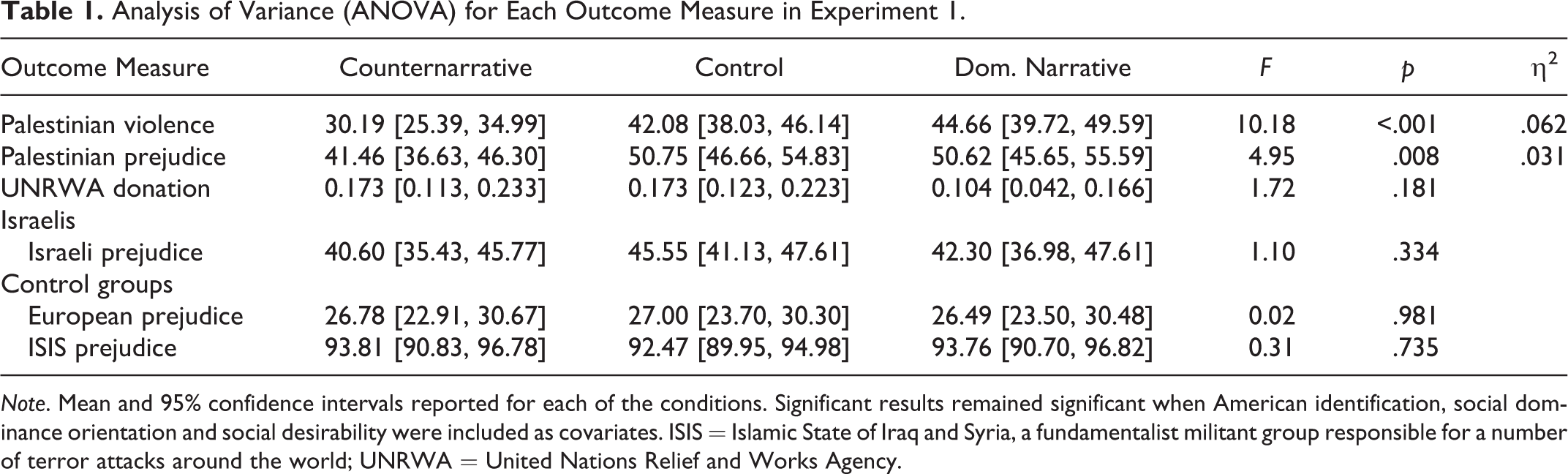
Note. Mean and 95% confidence intervals reported for each of the conditions. Significant results remained significant when American identification, social dominance orientation and social desirability were included as covariates. ISIS = Islamic State of Iraq and Syria, a fundamentalist militant group responsible for a number of terror attacks around the world; UNRWA = United Nations Relief and Works Agency.
Two important findings emerged when examining prejudice toward other groups. First, prejudice for Europeans and an extreme out-group (ISIS, the fundamentalist militant group responsible for multiple terror attacks) was similar across conditions, suggesting that the positive evaluations induced by the counternarrative were restricted to Palestinians. Second, prejudice toward Israelis was unaffected by condition, suggesting that the counternarrative did not drive partisanship (Table 1).
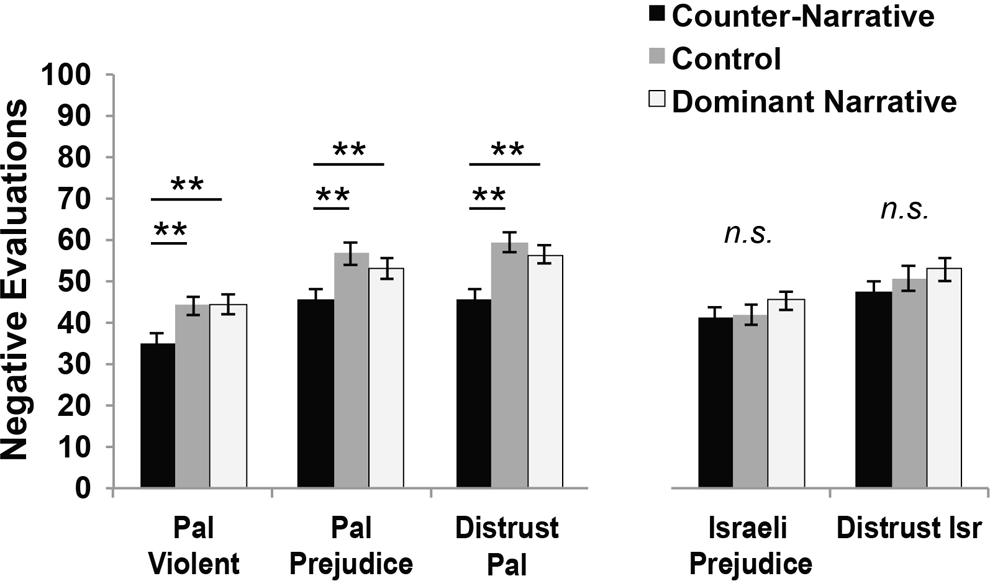
Planned t-tests found that perceived Palestinian violence and Palestinian prejudice were significantly lower in the counternarrative condition than the control condition, Palestinian violence: t(221) = 3.76, p < .001, d = .51; Palestinian prejudice: t(221) = 2.87, p = .004, d = .39, and the dominant narrative condition: Palestinian violence: t(179) = 4.27, p < .001, d = .64; Palestinian prejudice: t(179) = 2.71, p = .007, d = .41. The control and dominant narrative conditions were not significantly different from each other for either of these outcomes (ts < .80, ps > .40). These results support the view that the perception of Palestinians as inherently violent is the default dominant narrative in American society (Ibrahim, 2009; S. D. Ross, 2003) and that mere exposure to sympathetic Palestinian protagonists (in the dominant narrative) is not enough to improve perceptions of Palestinians (Figure 1).
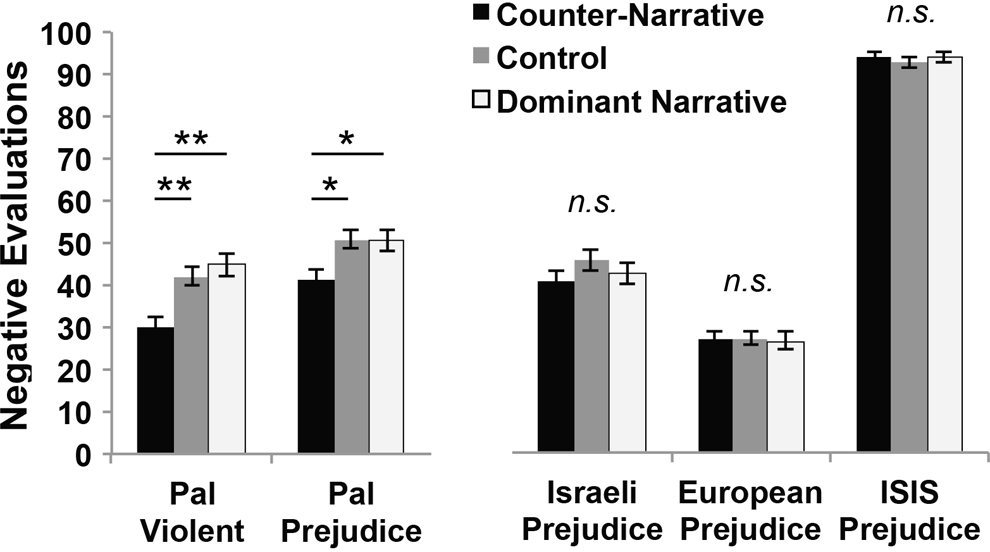
Outcome measures across conditions for Experiment 1. *p < .05. **p < .005.
Since the counternarrative trailer directly countered the dominant narrative that Palestinians are inherently violent, our specific prediction was that changing the perception of Palestinian violence would precipitate the changes in prejudice toward Palestinians. To test this prediction, we used Palestinian violence as a mediator for the effect of condition (coding counternarrative as “1” and the other conditions as “0”) on Palestinian prejudice (Hayes & Preacher, 2014). Confirming our prediction, we found that perceived Palestinian violence significantly mediated the effect of condition on Palestinian prejudice (5,000 bootstrap samples, indirect effect = 7.64, 99% confidence interval (CI) [3.32, 12.68]; Figure 2).
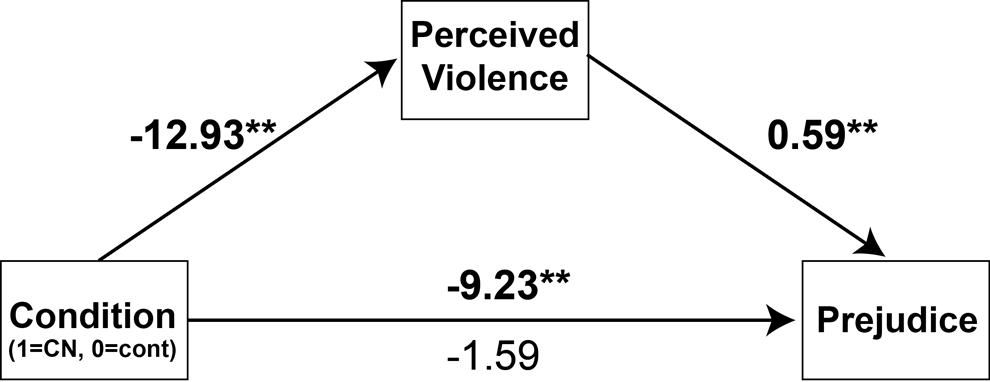
Mediation from Experiment 1: The effect of condition on Palestinian prejudice mediated by Palestinian violence. Displayed are unstandardized β values; direct effects in bold. **p < .001.
Discussion
Past work suggests that the dominant narrative in American society is of Palestinian aggression (Ibrahim, 2009; S. D. Ross, 2003). Supporting this view, evaluations of Palestinians were similar in the dominant narrative (Omar) and control (Chasing Ice) conditions. However, exposure to Palestinians engaging in nonviolent resistance in the counternarrative condition (Budrus) improved third-party perceptions of Palestinians. These effects were mediated by perceptions of Palestinians as violent. Finally, the nonviolent counternarrative did not simply tip the partisan scales toward Palestinians and away from Israelis: Condition had no effect on Israeli prejudice, indicating that improved perceptions of Palestinians through the counternarrative did not come at the expense of Israeli derogation.
Experiment 2
Although the pattern of results of Experiment 1 was consistent with the hypothesis that nonviolent depictions (and not just positive depictions of Palestinians) shifted perceptions about Palestinians, this change was achieved using video stimuli that are inherently complex and could therefore differ in meaningful ways other than the presence or absence of nonviolent collective action. Thus, in Experiment 2, we obtained evaluations of the videos from the participants and used these as covariates in the analyses. We also measured attitudes and perceptions about Palestinians and the Israeli–Palestinian conflict, which allowed us to directly test Americans’ perceptions of who holds power in this conflict.
Method
Participants
One thousand and three 3 American participants were recruited on Amazon’s MTurk; 955 passed a check question embedded in the Wave 1 survey and were sent a link to the Wave 2 survey 1 week later, which 692 completed. The 692 participants were randomly assigned to each of the three conditions: counternarrative (Budrus), control (Chasing Ice), and dominant narrative (Omar). Of the participants, 620 passed the Wave 2 check question 4 and were included in the analyses: 200 in the counternarrative condition (M age = 35.2, SD = 11.4; 48.5% male), 217 in the control (M age = 34.7, SD = 11.6; 51.2% male), 216 in the dominant narrative condition (M age = 34.2, SD = 10.9; 52.1% male).
Measures
Preexperimental measures (Wave 1)
Group perceptions
The Wave 1 survey included evaluations of seven different conflicts, and the groups involved in those conflicts: Israel versus Palestinians, India versus Pakistan, Russia versus Chechens, Russia versus Ukraine, China versus Tibet, North Korea versus South Korea, and Turkey versus Kurds. Participants were asked to rate each conflict on four different scales: (1) knowledge (“Please indicate how knowledgeable you are about each of the conflicts below”), (2) perceived power (“For each of the following conflicts, indicate how much you think each side has relatively more power over the other”), (3) U.S. favorability (“For each of the following conflicts, indicate how much you think American foreign policy favors each side relative to the other”), and (4) personal favorability (“For each of the following conflicts, indicate how much you favor each side relative to the other”). Responses were made on unmarked, bivalent sliders with each group as an anchor on either side. Group side (left or right) was randomized across conflicts, and the order of groups was randomized on each scale for each participant. Responses were converted to a 20-point scale, with the presumed disempowered group at −10 and the presumed empowered group at +10.
Violence perceptions
Participants then rated the “inherent violence” of each of the 13 groups (Russia was involved in two of the conflicts) plus the United States and Iran (“Some people are more violent than others; some cultures also use violence to resolve disputes more often than others. For each of the groups below, indicate how inherently violent you believe them to be”); answers were made on unmarked sliders anchored at 0 (not at all violent) and 100 (extremely violent).
Prejudice
A final question asked how much prejudice participants felt toward each group (using feeling thermometers, as in Experiment 1).
Note that we specifically avoided asking targeted questions about Israelis and Palestinians or the Israeli–Palestinian conflict in order to avoid creating demand or framing the study. Finally, participants provided demographic information (as in Experiment 1).
Postexperimental measures (Wave 2)
The Wave 2 survey (completed 1 week later) included the key multi-item Palestinian violence measure (α = .87), as in Experiment 1, as well as the same single item inherent violence and prejudice measures used in Wave 1 (i.e., with all 15 target groups) presented in randomized order. We also added single items assessing trust toward Palestinians and trust toward Israelis (“I trust that Palestinians/Israelis are committed to finding a peaceful and lasting solution to the conflict in the Middle East”) answered on unmarked sliders anchored at 0 (completely disagree) and 100 (completely agree). To avoid framing effects, no information was collected from participants immediately prior to viewing the videos.
Video evaluations
Experiment 1 included theoretically relevant personality variables as covariates. In Experiment 2, we focused instead on characteristics of the complex video stimuli that might provide an alternative account for the pattern of results. In particular, Experiment 2 addressed three alternative hypotheses for the effects of the counternarrative: that it was a more engaging video, that the characters were more fully developed, and that the demand characteristics were greater. To assess these perceptions, we included three evaluations of the videos at the end of the survey: a multi-item scale assessing narrative engagement (Busselle & Bilandzic, 2009; αs = .79–.85), a single item asking how well the characters were developed, and perceived experimenter demand to rate Palestinians and Israelis positively (“Sometimes you can guess the agenda of a study. How much do you think the authors of this study wanted or expected your views to change about each group after watching this film?”). We used these ratings as analysis covariates.
Procedure
Participants were recruited as in Experiment 1 and completed the preexperimental (Wave 1) measures. One week later, we recontacted the participants and provided them with the opportunity to complete a follow-up survey for extra payment. Participants who agreed were randomly assigned to view one of the videos. All participants then completed the postexperimental (Wave 2) survey.
Results and Discussion
Preliminary Analyses
We ran initial ANOVAs to see if the participants at Wave 1 who were sorted into the three conditions in Wave 2 differed across any of the 10 covariates (i.e., conservatism, perceptions about the Israeli–Palestinian conflict, perceptions about Israelis and Palestinians, video evaluations). As predicted, the effect of condition was significant for perceived experimenter demand to evaluate Palestinians positively, F(2, 630) = 66.96, p < .001, η2= .175, with the counternarrative and dominant narrative (Palestinian protagonists) both rated similarly (p = .483), and higher than the control (no Palestinian protagonists; ps < .001). Narrative engagement was also significantly different across conditions, F(2, 630) = 26.44, p < .001, η2= .077, with the counternarrative and control rated equally (p = .566), and both higher than the dominant narrative (ps < .001). There were also a few condition differences across the 30 individual t-tests—as would be expected, given the number of tests. To account for any differences across condition, all 10 variables were included as covariates in the analyses.
As expected for the bivalent evaluations of the Israeli–Palestinian conflict 5 (scaled Palestinian [−10] to Israeli [+10]), Israelis were rated to be significantly higher in power than Palestinians, M = 5.25, SD = 4.7; t(568) = 26.4, p < .001; heavily favored by U.S. policy, M = 6.02, SD = 4.5; t(572) = 32.1, p < .001; and personally more favored than Palestinians, M = 1.82, SD = 5.8; t(551) = 7.4, p < .001. Relative to the other 14 conflict groups, Palestinians were also viewed to be one of the most “inherently violent”: They ranked 4 of the 15 groups involved in conflict. Palestinians were considered significantly more violent than 10 groups (p < .02) and significantly less violent than only Iran, Russia, and North Korea (ps < .002). Finally, in support of the association between favoritism and perceived violence of disempowered groups, personal favorability toward the group was strongly correlated with perceived violence of the group r(7) = −.97. However, it should be noted that this correlation was based on a small number of conflicts. Altogether, these findings support the previously reviewed evidence that disempowered groups in general are favored as a function of their perceived violence, and that Palestinians in particular are viewed as a disempowered, inherently violent group who receive less support than Israelis.
Main Analyses
Replicating the results from Experiment 1, ANOVAs performed separately on each of the outcome measures indicated that condition had a significant effect on Palestinian violence and Palestinian prejudice and also on the “Palestinian trust” item new to Experiment 2 (Table 2). ANCOVAs controlling for all 10 covariates were also significant for each of the outcome measures (all Fs > 3.9, all ps < .02, all η2 > .015). As with Experiment 1, prejudice toward Israelis was similar across conditions; distrust toward Israelis was also similar across conditions (Table 2).
Analysis of Variance (ANOVA) for Each Outcome Measure in Experiment 2.
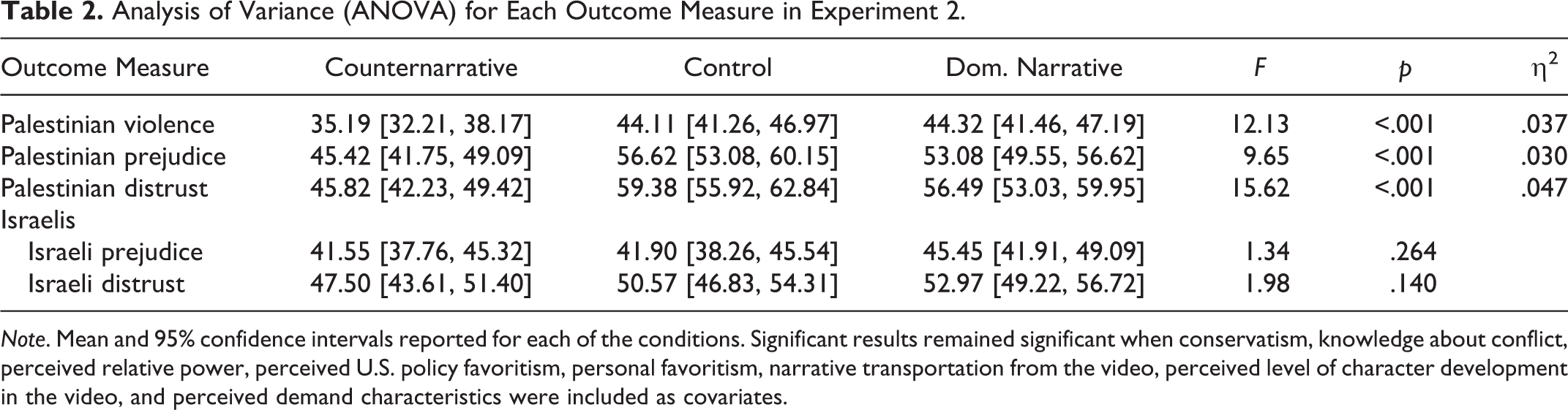
Note. Mean and 95% confidence intervals reported for each of the conditions. Significant results remained significant when conservatism, knowledge about conflict, perceived relative power, perceived U.S. policy favoritism, personal favoritism, narrative transportation from the video, perceived level of character development in the video, and perceived demand characteristics were included as covariates.
Planned t-tests found that perceived Palestinian violence, Palestinian prejudice, and Palestinian distrust were significantly lower in the counternarrative condition than both the control condition, Palestinian violence: t(415) = 4.17, p < .001, d = .41; Palestinian prejudice: t(414) = 4.23, p < .001, d = .42; Palestinian distrust: t(414) = 5.36, p < .001, d = .53 and the dominant narrative condition, Palestinian violence: t(414) = 4.39, p < .001, d = .44; Palestinian prejudice: t(414) = 2.99, p = 0.003, d = .29; Palestinian distrust: t(414) = 4.15, p < .001, d = .41 (see Figure 3). The control and dominant narrative conditions were not significantly different from each other on these two outcomes (ts < 2.0, ps > .05). As in Experiment 1, Palestinian violence mediated the effect of condition on Palestinian prejudice (5,000 bootstrap samples, indirect effect = 4.75, 99% CI [2.89, 8.87]) and Palestinian trust (5,000 bootstrap samples, indirect effect = 4.79, 99% CI [3.34, 10.78]). These results therefore replicate all the primary findings from Experiment 1, now controlling for a range of individual-level traits, and video-based differences that could serve as potential confounds.
Outcome measures across conditions for Experiment 2. *p < .05. **p < .005.
Although the results from Experiments 1 and 2 are encouraging, attitude change effects are often short lived (Althaus & Kim, 2006; Miller & Krosnick, 1996). Experiment 3 was designed to determine whether attitude change persists over time.
Experiment 3
Counternarratives have the potential to generate long-term attitude change by providing people with easily accessible alternative representations of others (Ramasubramanian, 2011; Saleem et al., 2015); this has been shown to be particularly true for video media (Glasford, 2013). The primary goal of Experiment 3 was to determine whether the counternarrative video demonstrated to cause attitude change in Experiments 1 and 2 has a long-term effect on evaluations of Palestinians (and Israelis). Experiment 3 also included other conflict-relevant attitudes and a measure of behavior directly relevant to third-party actions toward the Israeli–Palestinian conflict: On December 30, 2014, the Palestinian authority applied for membership to the International Criminal Court (ICC), a move that would give Palestinians international legitimacy and attach them to a global justice system. To determine whether exposure to the counternarrative would not only improve perceptions of Palestinians but also induce people to support Palestinian (nonviolent) collective action, we gave participants in Experiment 3 the opportunity to sign a petition urging Congress to support (or oppose) the Palestinian move to join the ICC.
Method
Participants
Of the 600 American participants recruited on Amazon’s MTurk and randomly assigned to each of the three conditions, 428 passed the screen and check question on the Wave 1 survey (similar to Experiment 1); 325 of these participants (75.9%) completed the Wave 2 survey that was provided 2 weeks later: 112 in the counternarrative condition (M age = 35.6, SD = 12.4; 58.9% male), 115 in the control condition (M age = 33.0, SD = 9.8; 50.4% male), and 98 in the dominant narrative condition (M age = 34.8, SD = 10.4; 63.3% male).
Measures
Preexperimental measures (Wave 1)
Prior research suggests that both perspective taking (PT) and empathy are associated with the efficacy of intergroup reconciliation efforts (Pettigrew, Tropp, Wagner, & Christ, 2011). Therefore, Experiment 3 included measures of empathic concern (EC) and PT.
We assessed conservatism, SDO (α = .96), and American ID (α = .89) as in Experiment 1.
Trait empathy
We included the 7-item subscales from the Interpersonal Reactivity Index (Davis, 1983) for EC (α = .92) and PT (α = .87). Participants rated their agreement with statements using continuous slider bars anchored at 0 (does not describe me) and 100 (describes me well). Since people higher in trait empathy might respond more strongly to information about out-group suffering depicted in the videos (Batson & Ahmad, 2009), we included these measures of trait empathy as covariates.
Postexperimental measures (Wave 2)
We assessed Israeli/Palestinian prejudice and Israeli/Palestinian distrust as in Experiment 2, and we included a 6th item in the Palestinian violence measure (“Palestinians commit violence against Israelis largely because they are provoked,” reverse coded; α = .93). Experiment 3 included three additional outcome measures:
Anti-Palestinian ideology
Participants rated the “rationality” of five common anti-Palestinian narratives in the context of the Israeli–Palestinian conflict, adapted from Bruneau and Saxe (2010; e.g. “Palestinians could be living next to Israel as a modern country, but instead they have chosen violence and terrorism”), using sliders anchored at 0 (totally irrational) and 100 (totally rational); α = .89.
Perceived Palestinian hatred of Jews
Participants registered their perception that Palestinians harbor a general hatred of Jewish people through a single item: “How strongly do you think Palestinians hate Jews?” using sliders anchored at 0 (no hatred) and 100 (a lot of hatred).
Pro-Palestinian behavior
We assessed positive behavior toward Palestinians by providing participants with the opportunity to sign a petition (using their MTurk ID as unique identifier) either in support of or opposition to Palestinian admittance to the ICC. Adding their signature to the supportive petition was coded as “1,” adding their signature to the oppositional petition was coded as “−1,” and no signature was coded as “0.”
Procedure
Participants were recruited for a two-part study: an initial screen and (if they passed) a survey made available 2 weeks later. The Wave 1 (screen) survey included the demographic and personality measures and the experimental manipulation. The Wave 2 survey included the outcome measures. Therefore, the procedure in Experiment 3 was identical to the procedure in Experiment 1, except that the postexperimental measures were more extensive (including a measure of behavior) and separated from the intervention by 2 weeks.
Results and Discussion
As with Experiments 1 and 2, separate ANOVAs were used to independently examine each dependent variable, and individual t-tests were performed across each condition for each outcome measure. Mediation of all outcome measures by Palestinian violence was also performed as in Experiments 1 and 2.
We found that each of the individual ANOVAs, with the exception of Palestinian prejudice, was significant—including behavioral support for Palestinian collective action (Table 3). Results were similarly significant when conservatism, SDO, trait EC, and trait PT were included as covariates in the analyses. As before, improved evaluations of Palestinians did not come at the expense of worse evaluations of Israelis (Table 3).
Analysis of Variance (ANOVA) for Each Outcome Measure in Experiment 3.
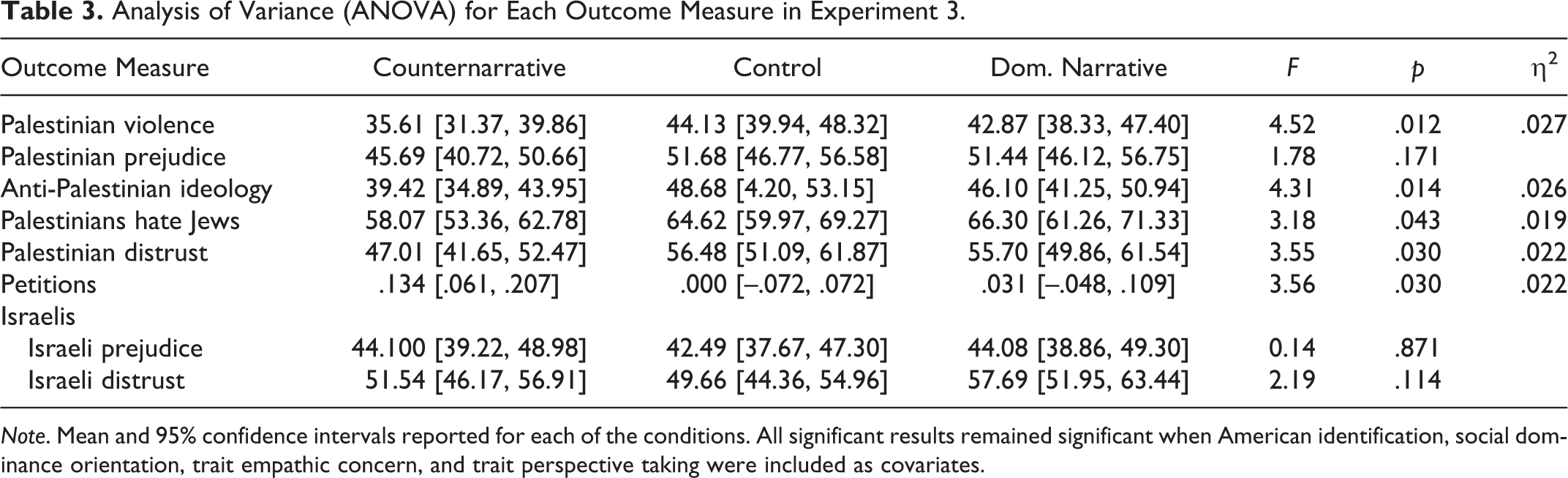
Note. Mean and 95% confidence intervals reported for each of the conditions. All significant results remained significant when American identification, social dominance orientation, trait empathic concern, and trait perspective taking were included as covariates.
As with Experiments 1 and 2, planned t-tests revealed that those who viewed the counternarrative evaluated Palestinians significantly more positively on Palestinian violence, anti-Palestinian ideology, and trust toward Palestinians than those who viewed videos in either of the other conditions (all ts > 2.4 all ps < .02, ds = .32 to 0.38), and marginally more positively on Palestinian prejudice and perceived Palestinian hatred of Jews (ts > 1.6, ps < .10; Figure 4).
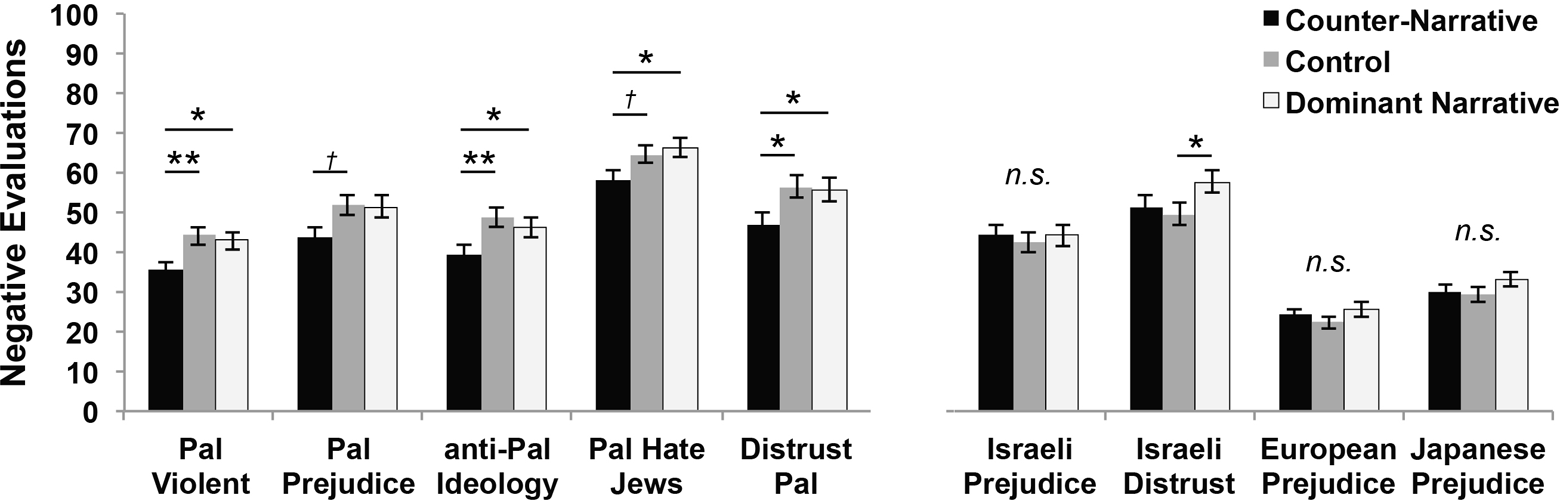
Outcome measures across conditions for Experiment 3. Outcome measures assessed 2 weeks after viewing trailers. † p < .10. *p < .05. **p < .005.
χ2 tests were used to determine whether people who signed the petitions to oppose or support Palestinian collective action were distributed equally across conditions. In the counternarrative condition, 17/19 (89%) of signatories supported Palestinian collective action, relative to 10/20 signatories (50%) in the control, and 8/13 signatories (62%) in the dominant narrative conditions. The counternarrative condition was significantly different from the control condition, χ2(1) = 7.13, p = .008, and marginally different from the dominant narrative condition, χ2(1) = 3.52, p = .06. Given that supporting or engaging in collective action on behalf of disempowered groups involved in conflict is rare (Glasford & Pratto, 2014), it is notable that a net of 15 people (nearly 15% of the sample) who watched the counternarrative trailer were willing to sign a petition on the behalf of Palestinians collective action (vs. 0 in the control and 3 in the dominant narrative condition). Together, these data illustrate that exposure to a counternarrative showing Palestinian nonviolent resistance caused lasting change in attitudes and behavior toward Palestinians.
Finally, consistent with Experiments 1 and 2, the effect of condition on each of the outcome measures (including behavior) was mediated by perceived Palestinian violence (Table 4).
Mediation of Condition on Outcome Measures by Perceived Palestinian Violence in Experiment 3.
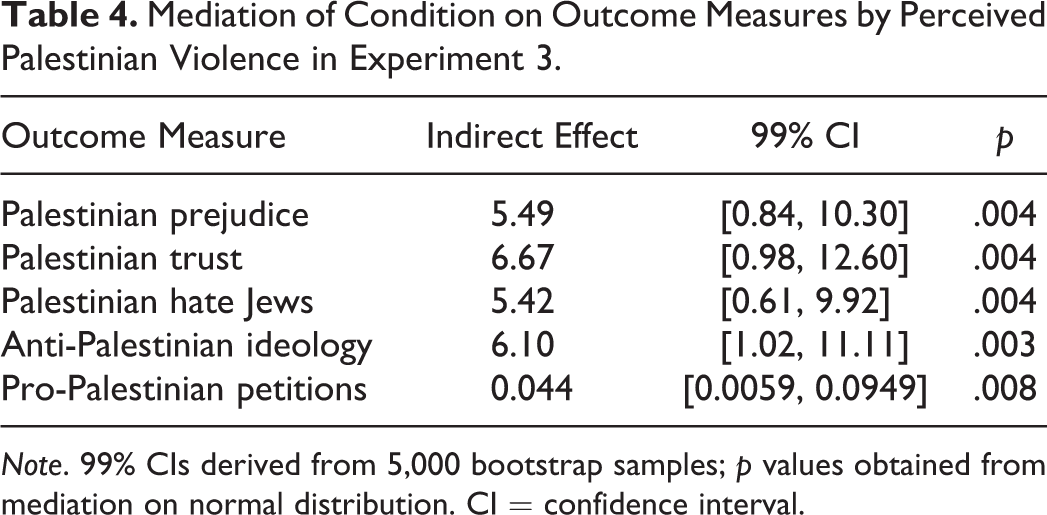
Note. 99% CIs derived from 5,000 bootstrap samples; p values obtained from mediation on normal distribution. CI = confidence interval.
General Discussion
The present study illustrates that third-party support for a disempowered group can be restored through vicarious exposure to the disempowered group engaging in nonviolent resistance. Specifically, brief exposure to a documentary trailer about a Palestinian nonviolence campaign decreased American perceptions of Palestinians as inherently violent, which mediated positive shifts in perceptions of Palestinians, and increased direct support of Palestinian nonviolent collective action.
In general, attitude change, particularly toward disliked groups, is difficult to achieve and even harder to maintain (Paluck & Green, 2009). Given that American participants are exposed to extensive media depictions of Palestinians as violent, how can a single exposure to Palestinian nonviolent resistance cause relatively strong and stable change? We argue that attitude change in this case may be facilitated by the Underdog Effect: a psychological tendency to view the disempowered group in a conflict favorably. From this perspective, Palestinian nonviolence in the counternarrative allowed people to return to a more comfortable framing of the conflict that places the disempowered group in a favorable light. Such counternarratives weaken societal adherence to conflict-supportive narratives and ultimately aid in the peacebuilding process, with the construction of new narratives (Bar-Tal, Oren, & Nets-Zehngut, 2014). Indeed, some scholars suggest that the change in dominant narratives is integral to the reconciliation process (Auerbach, 2009).
The results reported here are consistent with prior research on the Underdog Effect (Vandello et al., 2011) and extend the previous research in a number of ways. First, we examined not only perceptions but also behavior. Second, we examined change not just immediately after presentation of the narratives but longitudinally. Third, unlike past research, the current set of studies directly addressed social desirability and demand characteristic by (1) statistically controlling for individual differences in social desirability (Experiment 1), (2) providing counternarrative and dominant narrative conditions that were matched by perceived experimenter demand (Experiment 2), and (3) separating the viewing of the video from the responses toward Palestinians by weeks (Experiment 3). Finally, we examined attitudes not just toward the disempowered Palestinians but also toward the empowered Israelis. If exposure to nonviolent resistance by the disempowered group increases sympathy and support for them, but simultaneously drives animosity toward the empowered group, it might increase third-party support of violent collective action against the latter group. Importantly, we found here that exposure to Palestinian nonviolent resistance increased support for Palestinians but without an anti-Israeli backlash: Dislike and distrust of Israelis were no higher immediately after or weeks following viewing of the counternarrative versus the dominant narrative or control. Future work will have to determine which specific aspects of the counternarrative helped to elevate perceptions of Palestinians without eroding perceptions of the Israelis. It is possible, for example, that depictions of cooperation between Palestinian and Israeli peace activists in the counternarrative helped to avoid framing the conflict in zero-sum terms.
The research presented here complements historical accounts about the efficacy of nonviolent resistance. For example, a large-scale analysis of historical asymmetric conflicts found that nonviolent campaigns were successful 53% of the time—twice the success rate of violent campaigns (26%; Stephan & Chenoweth, 2008). The authors of this past work speculated that the success of nonviolent versus violent campaigns might be attributed to the inclusion in nonviolent campaigns of a broader range of in-group members and the increased potential to woo defectors from the out-group. Our results suggest another reason why nonviolent campaigns may enjoy such high success rates: They restore the psychological benefits of underdog status to the less-powerful group and thereby increase third-party support.
The present studies employed video stimuli to generate changes in out-group perceptions because visual media have been shown to elicit stronger emotional responses, greater attitude change, and stronger intentions to help than print media (Glasford, 2013; Joffe, 2008). Although video narratives are powerful stimuli, they are inherently complex, so the observed results could be due to factors other than the depiction of Palestinian nonviolent resistance. We directly tested three alternative explanations that could arise from condition differences: That the effects of the counternarrative video could be due to narrative transportation, character development, or demand characteristics. None of these variables explained the observed results. Further, across all experiments, perceived Palestinian violence mediated the effects of condition on all outcome measures (including behavior). These results suggest that the positive effects obtained in the counternarrative condition are likely due to the presentation of Palestinians as nonviolent actors.
The current research examined the impact of exposure to Palestinian nonviolent resistance on Americans’ attitudes toward and support for Palestinians. Future work can examine the same effect in other third parties (e.g., Europeans) and also in the parties directly involved in conflict in order to determine how information about nonviolent resistance can be disseminated to maximize its impact.
Overall, the current work uses experimental evidence to show that one impact of nonviolent campaigns is that they have the potential to create powerful counternarratives, which improve third-party perceptions of and support for the disempowered group. This research therefore provides experimental support for an intervention technique that has been used broadly to promote justice and peacefully resolve conflicts.
Footnotes
Acknowledgments
The authors wish to thank Nour Kteily for his helpful comments.
Declaration of Conflicting Interests
The author(s) declared no potential conflicts of interest with respect to the research, authorship, and/or publication of this article.
Funding
The author(s) disclosed receipt of the following financial support for the research, authorship, and/or publication of this article: This work was made possible by a grant from DRAPER Laboratories (EB).
Supplemental Material
The supplemental material is available in the online version of the article.
Notes
References
Supplementary Material
Please find the following supplemental material available below.
For Open Access articles published under a Creative Commons License, all supplemental material carries the same license as the article it is associated with.
For non-Open Access articles published, all supplemental material carries a non-exclusive license, and permission requests for re-use of supplemental material or any part of supplemental material shall be sent directly to the copyright owner as specified in the copyright notice associated with the article.
