




Abstract
Playing the violin demands highly skilled motor performance, including advanced bimanual coordination and controlled, independent movement of fingers. Through existing literature, the current study aims to demonstrate how young children’s motor development relates to the motor demands of violin playing, specifically the demands on the left hand, the right hand, bimanual coordination, and posture. From literature on movement patterns in skilled violinists as well as literature pertaining to motor development between the ages of 4 and 7, connections were highlighted between developmental sequences in this age group and violin-specific skills. Generally observable motor issues relevant to violin playing were found to include intra- and inter-limb motor overflow, postural changes in growing children, and the proximodistal direction of gross and fine motor development. We suggest that further research on effective and age-appropriate movement teaching has the potential to inform violin pedagogues about finding more effective solutions for motor issues encountered in this age group.
An early start in music is widely considered beneficial for children. Apart from the fact that young children often enjoy singing and listening to music, musical activities are positively associated with cognitive, linguistic, and socio-emotional development (Pastuszek-Lipinska, 2008; Schellenberg, 2011; Villodre, 2017). Furthermore, evidence indicates that musical training during a sensitive period of neuropsychological development may result in long-lasting effects on brain structure and behavior (Steele et al., 2013). These encouraging indications lead popular science articles to claim that earlier is better when it comes to learning an instrument (Bergland, 2013; Weinberger, 2006). But are there any drawbacks to starting instrumental music lessons at a very young age? Holding, fingering, and bowing the violin requires highly advanced levels of motor planning and execution (Ancillao et al., 2017), possibly beyond the development of the fine motor skills of many young children. This literature review considers what characterizes motor behavior in violinists and how these patterns relate to children’s motor development. While the motor skills used in adult violin playing have been researched extensively (Ancillao et al., 2017; Schoonderwaldt & Altenmüller, 2011), there is a gap in the literature concerning the relationship of children’s motor skills to early violin learning. The current literature review aims to provide a better understanding of the trajectory of motor development. More concretely, we will focus on how young children’s motor development relates to the motor demands of violin playing, specifically the demands on the left hand, the right hand, bimanual coordination, and posture.
Motor development may be defined as: “the study of changes in human movement across the lifespan and the processes that affect those changes” (Clark & Whitall, 1989, p. 194). An overwhelming number of developmental processes take place over the lifespan of an individual. This motivates researchers to try to apply structure by dividing development up into stages or phases. However, major disagreement exists about the value of dividing development into various stages. Although individuals generally acquire movement skills in the same sequence, the rate of development is dependent on many internal and external factors (Gallahue & Ozmun, 2006). An age-period approach can be used as an alternative to a stage approach to enable focused motor research on a specific group (Payne & Isaacs, 2016). In this article, we used an age-period approach and focused on children between 4 and 7 years old (referred to as young children), as this is when many children start violin lessons.
There have been several studies analyzing biomechanics and motor control aspects of expert violin playing in adults (Baader et al., 2005; Shan et al., 2013, 2017). It is important to point out here that as in any movement skill, individuals successfully employ a variety of motor strategies to reach their goal (Baader et al., 2005). However, previous researchers who examined violinists’ motor behavior found numerous typical, recurring motor patterns when analyzing skilled violinists that point to basic motor requirements of violin playing (Baader et al., 2005; Shan et al., 2017). This review will consider these recurring motor behaviors and the aspects of early motor development they interact with. As very young violinists do not typically start out using advanced techniques, such as vibrato or very fast string crossing, this review will focus on the skills needed to play a simple tune without vibrato on one or two strings. Aspects of motor behavior focused on in this review are enslavement and sequencing, movements of the left and the right hand, bimanual coordination, and posture. These topics were chosen because they encompass much of what is characteristic about movement in violin playing.
Enslavement and Coordination in the Left-Hand Fingers
When playing violin, the left-hand fingers are required to move in relative isolation. Yet, as our fingers are connected by muscle and tissue, moving a single finger also activates movement in other fingers, a process called “enslavement” (Zatsiorsky et al., 2000). For example, it is difficult to move the middle and the ring fingers independently because they share muscles that pull and extend them. Baader et al. (2005) obtained displacement profiles of the left-hand fingers of adult violinists that show a typical coactivation of fingers, in accordance with the process of enslavement. However, their study also discovered that while the “action” finger comes down to depress the string, the “enslaved” fingers stop moving downward before hitting the strings, as it is essential for pitch production that neighboring fingers do not touch the same string. This suggests that the movement of the enslaved fingers is under control to a certain degree. An exception to this rule of pitch production is that violinists sometimes purposefully put or leave fingers down when another finger is playing a higher pitch on the same string, because in that case, the actions of lower fingers do not have any audible consequence and they can be prepared for quick motion at a later moment (Wiesendanger et al., 2006). In sum, both the independence of the fingers and the coordination between fingers are crucial to successfully executing a series of pitches with the left hand.
While the development of manipulative grip strength and control in children are widely investigated (Burton & Dancisak, 2000; Molenaar et al., 2011), relatively little is known about finger interactions in young children. In a study on the development of finger independence of children between the ages of 6 and 10 years old, Shim et al. (2007) found a sharp age-related increase in finger independence and a decrease in enslavement of the fingers. By the age of 10, finger independence comes close to adult levels of development. In addition, young children have been found to use a “fork strategy” for inter-finger force coordination tasks, in which the force applied to each digit is highly similar—as if the fingers were prongs on a fork (Latash et al., 2002; Shaklai et al., 2017). This indicates that young children usually have not yet developed sophisticated levels of independence between their fingers. Those prior researchers only examined right-hand finger independence in right-handed children; therefore, it is possible that development of independence in the left (violin-playing) hand follows a different trajectory and it is not likely one of better or quicker development. Researchers have found that relative manual skill in children has a linear relationship to the degree of hand preference (Annett, 1970), suggesting that the performance of the right hand of right-handed children might be better than that of the left hand. Furthermore, McManus (2002) proposed that reliable hand preference for manipulative tasks cannot be assessed until children are 4 years of age, while others argued that is not until the age of 6 a clear preference emerges (Bryden et al., 2000). However, in a study on enslavement in dominant and non-dominant hands of adults, enslaving effects did not differ between hands depending on hand dominance or level of handedness (Wilhelm et al., 2014). Therefore, finger independence of the left hand, too, increases throughout the first decade of life regardless of hand dominance.
From these findings, we suggest that, though children between the ages of 5 and 7 may already possess sufficient finger strength to depress violin strings (Shaklai et al., 2017), independence of the fingers and enslaving in the left hand are issues that violin teachers must take into consideration. Children are developing independent movement abilities of the fingers throughout their early ages. Control of lifting and dropping action of the fingers is important to the development of left-hand timing. For this, left-hand pizzicato (plucking) exercises may contribute to developing of finger independence. Young children may also benefit from practicing with an added rest before each new pitch, providing time to coordinate the following finger action. Expecting young children to perform music with quick left-hand pitch changes may not be realistic and physically challenging.
Sequential Motor Skills in Fast Left-Hand Finger Motion
To play a melody with the left hand, a mature violinist relies heavily on sequential motor skills, described by Ruitenberg et al. (2013) as consisting of “a series of simpler movements that are executed in a specific order” (p. 608). Motor sequences are acquired and automated with practice. The initial performance of a sequence happens in reaction mode, in which each distinct movement receives a separate impulse. With practice, only the first movement of a sequence receives a stimulus and the following movements are automated, in what is called chunking mode. The organization of distinct movements into groups of movements, or motor chunks, allows for fast and effortless execution, for example, in playing a left-hand passage on the violin. Sequencing speed improves as a function of age, as well as with targeted practice (Ruitenberg et al., 2013).
Ruitenberg et al. (2013) suggest that young children’s slow speeds in sequence execution, even after practice, may point to enduring performance in reaction mode, while adolescents and adults switch to chunking mode. In other words, children are performing many discrete movements instead of more efficiently grouping movements together, consequently putting a limit on speed. Motor speed has been shown to be generally slower in young children, for example, in fast repetitive finger tapping tasks (Kakebeeke et al., 2018). Both the development of motor speed and improved sequence skill acquisition have been linked to maturational processes in the brain leading to greater neural efficiency (Gabbard et al., 2011). For left-hand fingering, this implies that passages with quick consecutive pitch changes may require many distinct finger impulses when performed by children, while adults can chunk these actions. When choosing repertoire for young children, teachers should therefore be aware that music with continuous quick pitch changes may pose problems for the left-hand fingers. More appropriate for this age group may be, for example, the approach Suzuki uses in his Twinkle, Twinkle, Little Star Variations, in which each individual pitch is repeated several times (Suzuki, 1978). Repeating pitches enables the left-hand motion to slow down without affecting the continuous motion of the bow. This allows the student to practice playing fast rhythms with the bow, while the left-hand fingers make slow pitch changes.
Proximodistal Development and Bowing Technique
Violin bowing is sometimes considered to be more difficult to master than violin fingering (Galamian, 1962). The bow is largely responsible for tone-production on the violin. Influential violin pedagogue Carl Flesch (1924) argued that bowing-hand technique is most complex because the hand never comes in direct contact with the string, rather guides the hair of the bow on the string to produce sound. The right hand effectuates dozens of distinct bow strokes in addition to controlling volume and many aspects of musical phrasing. This leads violin pedagogues to pay great attention to the different functions of the joints of the shoulder, arm, and the individual fingers and their role in making subtle adjustments needed to achieve the desired tone (Pyykönen, 2015). Kruta de Araújo et al. (2009) identified the following basic right-arm movements used in violin playing:
Abduction and adduction (moving away from and toward the midline) of shoulder;
Horizontal abduction and adduction of shoulder;
Flexion and extension of the elbow (lower arm moving toward or away from the upper arm);
Pronation and supination of the radioulnar articulation (turning the forearm as if turning a doorknob);
Flexion and extension of the wrist and the metacarpophalangeal and interphalangeal joints (joints of the fingers and hand flexing in and out) (Kruta de Araújo et al., 2009, p. 109).
As in the left hand, we find intra-limb coordinating behavior in the bow arm, between the fingers of the right hand and the joints of the right arm. Figure 1 shows the main joint combinations in the upper (superior) and lower (inferior) half of the bow involved in playing detaché bow strokes.
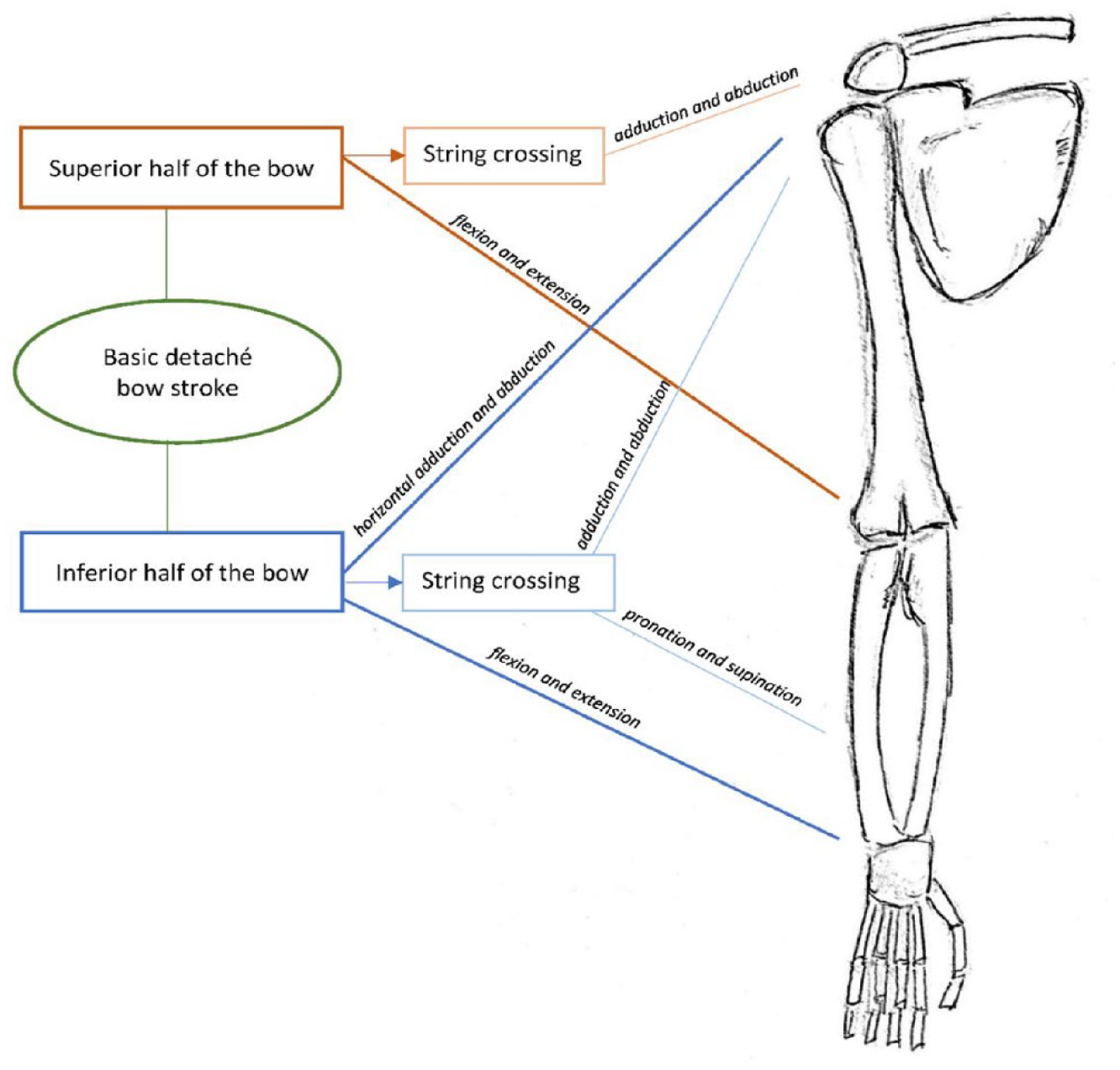
The Main Joint Combinations in the Upper (Superior) and Lower (Inferior) Half of the Bow Involved in Playing Detaché Bow Strokes.
This detailed examination of the intra-limb coordination reveals that a detaché bow stroke on a single string in the lower half of the bow requires the coordination of horizontal shoulder movement with wrist movement (dark blue and orange lines in Figure 1). Adding a string crossing to this stroke requires the additional integration of forearm movement and vertical shoulder movement, a doubling of the amount of separate joint movements (light blue and orange boxes and lines in Figure 1). Bowing in the upper half of the bow involves fewer joints, even with the addition of string crossings (orange box and lines in Figure 1).
In a study on developmentally appropriate catching techniques for young children, Drost et al. (2015) propose that the principles of proximodistal development indicate that students should be encouraged to develop motor skills involving the body and arms before those of the hands and the fingers. Proximodistal development refers to acquisition of musculature and movement skills from the center of the body toward the periphery (Gallahue & Ozmun, 2006). For example, children learn to control the muscles of their shoulders before their elbows, wrists, and fingers. Drost et al. (2015) argue that, in teaching catching skills, physical education teachers often inappropriately focus on fine motor skills of the hands first, while arm and shoulder skills are not yet appropriately developed. In violin playing, a similar phenomenon occurs, in which children learn the intricate shape of the bow-hold before learning the bowing movements of the arm and shoulder. As noted previously, bowing patterns consist of combinations of shoulder, elbow, wrist, and finger movements. Teachers of young children should be aware of directional development in assigning bowing exercises and strive to focus on gross arm movement skills in bowing before the fine hand and finger skills. For example, as all bowing movements in the lower half of the bow depend on movement patterns involving wrist movement (see Figure 1), it might be advisable to start bowing in the upper half of the bow, with or without the use of string crossings, and avoid the use of the lower half of the bow in the early stages of learning, especially in combination with string crossings.
Grip Patterns in Bow-Hold Development
In addition to gross motor movements of the arm, the fine motor movements made by the hand are essential to proper bowing technique (Kruta de Araújo et al., 2009). Wiesendanger et al. (2006) found that holding the bow requires a precise force control between the right-hand fingers, especially the thumb and the middle finger. Finger force control is crucial to the successful performance of any fine manipulative task, such as closing a button or using scissors. It requires continuous small adjustments so that the appropriate amount of force is used to complete a particular task. Impaired force control could result in, for example, excessive grip force in the bow hand. At the most basic level of bow-hold analysis, the thumb and the middle finger act as a fulcrum for the stick of the bow. As Wiesendanger et al. (2006) discovered in their analysis, the grip force between the thumb and the index finger increases when playing loudly, to keep the bow steady in the hand as the velocity of the bow and the bow pressure increase. Meanwhile, the index finger serves several functions: increasing pressure 1 on the stick to increase volume, as well as initiating the rotational movement along the bridge to move from one string to another. It also plays a role in controlling the precise trajectory of the bow. The little finger (pinky) is the only digit that rests its fingertip on top of the bow, and in many ways, it functions as a counterpoint to the index finger: it works as a lever to push the stick down to lighten the bow pressure or to push the stick down in case of a string crossing. To keep the tone consistent, the bow hand must compensate for changing leverage and effective weight of the bow, as the bow moves from the frog to the tip. As the G-string is a much thicker string than the E-string, it needs compensatory pressure of the right-hand index finger to allow it to vibrate sufficiently.
While the development of the right-hand bow-hold positions in young children has not been extensively investigated, a relevant connection can be made to the development of the pencil grasping position. In learning to use a pencil, children pass through several well-documented technical stages (Payne & Isaacs, 2016). In the first stage, the child holds the writing implement in a fist-shape, and uses the arm in a supinated manner, with the little finger facing down. In the second stage, the arm pronates in order to hold the pencil with the hand palm facing down. This grasp is gradually refined into a mature tripod grip, in which the thumb, middle finger, and index finger control the refined movements of the pencil tip. In a sequence consistent with proximodistal development, the child initiates drawing motion from the shoulder, later involves the elbow, and finally the hand and fingers. In the final stage of refinement, the pencil grip with its dynamic relationship between the thumb, middle finger, and index finger (the dynamic tripod grip) bears similarities to a mature violin bow hold. However, one could argue that the child making the bow hold has the added difficulty of the positioning of the little finger as well as the weight of the bow. While a mature pencil grip is usually present by age 7, the dynamic tripod grip continues to be refined until 14 years of age, particularly as it pertains to finger use (Payne & Isaacs, 2016). Between the ages of 5 and 7, approximately half of all children still exhibit excessive flexion of the index finger when using a pencil (Payne & Isaacs, 2016). In bow holds, flexion of fingers is an often observed problem among 4- and 5-year-old children (Macián-González & Tejada Giménez, 2018).
Interestingly, young children are widely expected to utilize immature pencil grip technique, and it is seen as appropriate to their motor development as they move through the sequence of pencil grip refinement. In contrast, in violin playing children are often expected to use a mature or semi-mature bow hold from a very young age. Attempting to make a mature bow hold materialize when a child is not developmentally ready might be an inefficient and frustrating use of time for both teacher and student. Establishing a sequence of bow-hold refinement based on evidence about developmentally appropriate motor behavior could improve current teaching practice. A violin teacher could obtain clues about a student’s fine motor development by observing certain characteristics in the student’s use of a pencil. In addition, the lack of independence of finger movement and force coordination in young children (Shaklai et al., 2017; Shim et al., 2007) may inhibit the inter-finger force control needed to perform some bow strokes and play in different parts of the bow (Wiesendanger et al., 2006). More research into this topic as well as establishing a guideline of the natural sequence of bow-hold development could be effective for achieving learning goals and preventing injury.
Effects of Overflow on Bimanual Coordination
Unlike the piano, which enables novice players to achieve the pleasurable experience of playing a recognizable tune with only one hand, the violin does not sound until both hands perform together. According to Wiesendanger et al. (2006), “A challenging problem is the asymmetry and also, to a large extent, the independence of bimanual actions in string players” (p. 111). To play even the simplest tune, violinists must coordinate the vastly different movements of the left and right hand, thus adding inter-limb coordination to the previously discussed intra-limb coordinating behaviors within the two hands. In their study on bimanual coordination, Wiesendanger and Serrien (2004) proposed that playing an instrument like the violin might be “the ultimate achievement in skillful human behavior” (p. 419).
When playing a melody with detaché bowing, the moment the bow direction reverses must match very closely the dropping/lifting action in the left-hand fingers. Anticipatory movements of the left-hand fingers need to happen before the change in direction. In case of a detaché string crossing, the change in arm level to move to the new string is added to these combined movements. In slurred legato playing, on the other hand, several pitches are played within one bow stroke. Wiesendanger et al. (2006) proposed that a different type of bimanual coordination takes place during slurred bow strokes. It is more difficult to coordinate one slow continuous bow stroke in the right hand with active pitch changes in the left hand than activating the left and the right hand simultaneously, as happens in detaché playing. In slurred legato playing, the timing of the two hands differs, in addition to the asymmetry of the movements. Shan et al. (2013) found that years of training are needed to eliminate the effects of “sympathetic cross-talk” (p. 160), that is, the unconscious and automatic mirrored movements between the left and right arm. An example of similar challenging bimanual coordination between the hands is the requirement to sometimes play forte with the left hand, while playing piano with the bow (Applebaum, 1986). This happens when playing higher up on the string: as the string becomes tighter, the bow needs less pressure to produce a good tone, while the left-hand fingers need to be strong and well-articulated to depress the string.
The difficulty in coordinating asymmetric movements as required in violin playing can thus be described as containing two basic elements: (a) executing the desired movements correctly and (b) eliminating any undesired “sympathetic cross-talk.” In motor development, children experience two related processes, as described by Kakebeeke et al. (2018): “First, there is an increase in their motor skills, and they execute movements faster and more precisely. Second, this is accompanied by a decrease in superfluous, unintentional movements, which determines the quality of the movement” (p. 95).
In studies on bimanual coordination in children, a commonly observed phenomenon is unintentional motor “overflow,” in which an intentional movement is accompanied by sympathetic movement of associated muscles, for example, in the opposite hand (Parlow, 1990). This motor overflow between the mirroring limbs on the left and right side of the body decreases as a function of age (Shim et al., 2008), similarly to the decrease of enslaving effects between different fingers of the left hand as discussed earlier in this paper (Shim et al., 2007). When the task-performing hand is the non-dominant left hand, the sympathetic movement in the other hand is most significant. This type of overflow also tends to last in the process of age-related reduction (Addamo et al., 2009; Kakebeeke et al., 2018). Addamo et al. (2009) offered the possible explanation that as the non-dominant hand relies on more effort to control movements, the associated dominant hand activation results from a compensatory stabilization technique in an effort to support the non-dominant hand.
Such overflow effects are particularly relevant to learning to play the violin, since the two hands are required to perform vastly different tasks. While the left hand performs intricate finger-stopping movements, the right-hand fingers ideally should not mirror these movements while bowing. Macián-Gonzáles and Tejada Giménez (2018) observed that 4- and 5-year-old violinists inadvertently moved the fingers of both hands when trying to play their instrument. This added challenge of inhibiting involuntary movement in addition to performing appropriate movement sequences makes the asymmetrical motor requirements of playing the violin difficult to execute for young children. There is some evidence that drawing increased attention to the non-task limb can contribute to overflow inhibition, though it is not clear that this effect carries over to long-term improvement of inhibition ability when feedback is removed (Lazarus & Todor, 1991). Largo et al. (2007) demonstrated a link between task complexity and degree of overflow, pointing to the importance of limiting task complexity when asking children to perform asymmetrical bimanual movements, in this case, violin playing.
Violin Posture and the Developing Locomotor System
Ohlendorf et al. (2017) found that to execute the movements of the right and left hands, violinists need physical strength in the muscles of the hands, arms, and shoulders, while the core muscles are responsible for holding the instrument up in a static posture. To prevent injury, regular strength exercises should be a part of violin training (Ohlendorf et al., 2017). This is particularly important because of all instrumentalists, violinists are most at risk of musculoskeletal disorders, primarily of the neck and the shoulders (Cygańska et al., 2017; Wallyn, 2013). Postural upper body problems while playing the instrument are the main reason violinists are affected by musculoskeletal disorders (Ohlendorf et al., 2017). The static muscular work of performing repetitive, intricate muscular movements while staying in violin-specific posture can result in overstress of muscles, tendons, and joints (Ohlendorf et al., 2017). However, even though the violin is played in this asymmetric and biomechanically disadvantageous manner, injuries can be prevented by adopting ergonomically sound posture and playing movements, as unfavorable playing positions are not essential to proper violin playing technique (Kruta de Araújo et al., 2009).
A neutral spinal alignment is also an important aspect of ergonomic playing position. To achieve this natural flexion of the spine, the head, thorax (or chest), and pelvis should be positioned in a straight line (Ohlendorf et al., 2017). The violin should balance on the left collar bone and be supported by the jaw, shoulder, and left hand, rather than be clamped between the head and the shoulder. By alternating the degrees of support between the jaw, shoulder, and left hand, the violinist can maintain a comfortable playing posture for long periods of time (Leder et al., 2010).
A good fit of the instrument, including accessories such as the shoulder rest, is also important to good playing posture (Kruta de Araújo et al., 2009). Standing while playing is preferable over sitting, as sitting may lead to strain on the lower back, while standing allows the lower extremities to evenly distribute the load over all joints and muscles (Howarth et al., 2013; Wallyn, 2013). The goal is to find a playing position that allows for efficient motor patterns and avoidance of unnecessary muscle activity (Kok et al., 2018). Freedom of movement with least strain possible on joints, ligaments, and muscles benefits both playing technique and the physical health of the violinist.
Ergonomic playing posture is evidently a challenge for violinists of all ages, with several studies indicating that instrument-related physical problems are as common among children studying music as among adult musicians (Cygańska et al., 2017; Ranelli et al., 2011). At a young age, the physical strain and asymmetric movement of playing the violin may lead to an overload of the locomotor system and consequent development of unhealthy postural habits, as the motor system is still developing (Cygańska et al., 2017; Nawrocka et al., 2014). In a study on body symmetry among young violinists, significantly greater shoulder and pelvic asymmetry among violinists between 7 and 12 years of age was found compared to a control group (Cygańska et al., 2017). There is evidence that following recommended levels of health-oriented physical activity based on duration and intensity, according to criteria set by the World Health Organization (WHO), can prevent or mediate physical and postural problems among young musicians, in addition to being beneficial to mental and physical development of all children (Nawrocka et al., 2014). These activities include play, games, sports, or planned exercise to enhance strength of large muscle groups and improve cardiorespiratory fitness (World Health Organization, 2010). However, in a study among Polish musicians between 10 and 18 years old, researchers found that only 7% of these young musicians met the recommended levels of physical activity (Nawrocka et al., 2014). In contrast, data on physical activity among children and adolescents in Europe indicate that 42% of the general population meets the required standard (Nawrocka et al., 2014). A co-occurrence of playing-related risk factors with a lower than recommended level of physical activity may account for the high incidence of musculoskeletal problems among young violinists. However, as the cited study on physical activity levels is focused on older children and adolescents, more research is needed on physical activity and sports participation among beginning violin students of young ages.
As discussed before, the core element of ergonomic playing posture is a neutral spine with strong base support from the legs. This allows the arms to support the violin and freely move the bow and maintain posture for a long time without muscle strain. However, young children have relatively large heads and short legs, making them top-heavy with a small base of support (Payne & Isaacs, 2016). For this reason, stability is difficult to maintain. This has significant effects on motor performance and object manipulation. Payne and Isaacs (2016) find that holding an object causes a child’s center of gravity to shift forward toward the added weight and may cause them to lose balance. This influence of object-weight on children’s stability has implications for the posture of children who learn to play the violin on a large, heavy instrument. When teachers add shoulder rests, chin rests, and other accessories to the violin in an effort to encourage good postural habits, these can increase the weight of the instrument by up to 20% (Cygańska et al., 2017). Effects of added weight on children’s stability indicate that, while widely neglected, instrument-weight is likely an important factor to consider when selecting a properly fitting instrument for a child.
As children grow, their body proportions change, and their center of gravity slowly shifts from close to the sternum toward the base of the spine (Payne & Isaacs, 2016). This poses a challenge for violin teachers, who need to be mindful of changing body proportions in continuously assessing their students’ posture, as well as when they model posture in their own playing.
Discussion
The aim of the current review was to find out how the motor requirements of violin playing relate to children’s motor development, specifically the development of children between 4 and 7 years of age—during which time many children start violin lessons. Studies of motor development in a wide range of areas suggest that, if a child of this age group starts playing the violin, the following aspects of motor development need to be considered to ensure developmentally appropriate pedagogy is used and the student develops healthy playing habits: inter- and intra-limb coordination, bow-holding, and body posture.
In general, children of this age group do not have highly sophisticated levels of inter-limb and intra-limb coordination. This results in limited control over left-hand finger enslavement and right-hand force coordination, as well as overflow effects between the right and the left arm. Available research on motor skill development of children in this age group could contribute to possible solutions for these issues applicable to violin playing. For example, there is evidence that this age group—in contrast to older children—benefits particularly from part-practice rather than whole-practice when working on complex bimanual tasks (Chan et al., 2015). On the violin, this means practicing the left-hand motion separate from the right hand and later putting the movements together. Several widely used violin methods contain extensive routines for the separate practicing of left-hand fingering and right-hand bowing. For example, the first bowing preparations Suzuki provides go vertically up and down in the air, without the violin (Starr, 1976). Rolland also provides bowing-only exercises, and these are performed on top of the left shoulder (Rolland, 1974). In Colourstrings, the children quickly put bow and fingers together, using “guided bowing,” in which the teacher guides the bow while the student focuses on the left hand (Szilvay, 2018).
Along the same lines, bow-hold development could benefit from known sequences of grip development, as young children are often expected to use a mature or semi-mature bow hold, which does not align with current knowledge on directional development and fine motor control. There is much knowledge available about pencil grip development and object control that may contribute to developing appropriate steps toward a mature bow hold. Suzuki appears to be acutely aware of the difficulty young students experience trying to form a proper bow hold. He attempts to solve this problem by developing a preliminary bow hold for young students in which the thumb is placed underneath the frog on the silver, rather than on the stick. The argument is that this bow hold allows for greater relaxation of the fingers, and it is easier for children to grasp large objects than small ones (Behrend, 1998). There is some evidence that young children indeed avoid grasping certain very small objects, but grasping behavior depends on interaction of many task constraints, including texture, weight, and size (Payne & Isaacs, 2016). In other words, the grasping task may be complicated by other factors apart from object-size. Although there is no evidence that larger objects are, as a rule, easier to grasp for children, there is evidence that object-size influences the grasping technique used by children. For example, children use more fingers for larger objects, while they choose one finger and thumb for small objects (Payne & Isaacs, 2016). This knowledge about grasping behavior, in combination with knowledge about the development of finger movement control in pencil grip technique, indicates the preliminary bow as an appropriate first step to learning a mature bow hold, comparable to the early stages of pencil grip development.
Paul Rolland (1974) does not advocate for a preliminary bow hold for young children in the same way. He writes that the bow should be held in a natural fashion. When the arm is resting at the side, the relaxed fingers are in an almost perfect position for holding the bow . . . The good bow hand does not deviate radically from the natural position. (p. 80)
Rolland instructs students to frequently practice their bow hold on a pencil, keeping the fingers free of tension. Students should tap fingers several times when they feel stiff. For young children, isolated finger tapping is difficult, as their fingers have limited independence. It is therefore questionable whether an attempt to tap the fingers independently would in fact result in more relaxed fingers. As an optional “Early Bow Hold,” Rolland (1974, p. 84) allowed students to hold the bow, with proper bow hold, further up the stick, thereby making the bow feel lighter.
Healthy posture is a particularly important issue for all violinists. Ergonomic playing posture benefits from a neutral zero spine in which thorax and pelvis are aligned with the head and body weight is evenly distributed over the joints and muscles of the lower extremities. In addition, static posture can lead to unnecessary strain on muscles and joints. Especially for children, who need to account for the shifting point of balance brought on by the added weight of the violin, flexible posture may allow for better weight distribution over their relatively small base of support. Teachers may promote freedom of movement in the upper and lower body to promote relaxation and equal weight distribution. Growing children need to continuously adjust their physical relationship to the instrument and to the space in which they move. Proper instrument size is crucial, as well as appropriate amounts of physical exercise.
Many children who start playing the violin have a successful experience and proceed to play at a high level, in large part due to their passionate violin teachers. Yet teachers use vastly different approaches to motor skill learning. Considering that children’s motor behavior is usually vastly different at age 4 than at—for example—age 8, it is probable that no single teaching approach provides solutions for all issues identified in this study. Furthermore, individual children have such different rates of development, that no method of instruction can perfectly address all issues of motor development. This brings us to the most important principle of developmentally appropriate teaching: pedagogical systems need to be suitably designed for the age group, but also appropriately applied to the individual student. This requires a flexible approach from violin teachers and an awareness of possible age-related motor issues and ways of solving these.
Footnotes
Declaration of Conflicting Interests
The author(s) declared no potential conflicts of interest with respect to the research, authorship, and/or publication of this article.
Funding
The author(s) received no financial support for the research, authorship, and/or publication of this article.
