



Abstract
The purpose of this descriptive study was to examine school string teachers’ beliefs about and practices of teaching nontraditional music courses. We surveyed middle and high school string teachers (N = 42) about what nontraditional music courses and ensembles (NMCEs) they currently offer and would like to offer to their students. In addition, we examined the educational rationales that string teachers have for offering NMCEs. Our findings indicated that the most frequently offered NMCEs were guitar class, pit orchestra, and music technology. Participants expressed strongest interest in adding fiddle club, popular music, and mariachi ensemble. The participants explained that NMCEs provide opportunities to teach content that closely may more reflect students’ cultures and possibly attract a wider range of students. The participants used NMCEs to cultivate musical skills that are often overlooked in large-group setting, including improvisation, playing by ear, and collaborative arranging and composition.
Since the 1968 Tanglewood Symposium, music education researchers and practitioners have increasingly called to diversify music education curricula beyond large ensembles (e.g., band, orchestra, and choir) to include musical practices from outside the Western classical music tradition. In recent years, researchers suggested that curricular expansion beyond the large-ensemble format could provide opportunities to teach new musical skills (Norgaard & Taylor, 2016); increase student enrollment in music programs (Williams, 2011); and meet student interests (Kelly & Veronee, 2019). In 2001, the American String Teachers Association (ASTA) established the Alternative Styles Committee (now known as Eclectic Styles Committee) to encourage the teaching of nontraditional musical styles and a broader range of skills.
Elpus and Abril (2019) examined national data on secondary school students’ enrollment in music courses and found that only 24% participated in at least 1 year of traditional large ensembles. They also reported high school orchestra membership contained significant disparities regarding gender, race, socioeconomic status (SES), and level of parental education. They concluded that orchestras disproportionately serve White and Asian/Pacific Islander students while underserving Black and Latinx students. In addition, 51% of orchestra students are from the top two SES quintiles. In another study, VanWeelden and Walters (2004) found that less than 10% of adults (N = 60) who participated in high school music programs continued to sing or play instruments after high school.
Colquhoun (2019) urged music educators to consider which students are not currently being served by their music programs and the reasons why approximately 75% of high school students do not participate in traditional large ensembles. Although many elementary students experience a variety of music-making opportunities that encourage creativity and cultural connection with music, K–12 music course offerings are often limited to large ensembles (e.g., band, choir, and orchestra) as students move into middle and high school (Abril & Gault, 2008; Elpus & Abril, 2019). These traditional large ensembles tend to focus on the performance and replication of existing works (Allsup & Benedict, 2008; Williams, 2011). Several prior researchers have suggested offering Nontraditional Music Classes and Ensembles (NMCEs) outside of traditional band, choir, and orchestra curriculum to provide learning opportunities that could attract a more diverse student population by moving beyond Eurocentric perspectives (Colquhoun, 2019; Cooper, 2013; Hess, 2015; Sarath, 2018). Kelly and Veronee (2019) observed that school music programs that offer a wider array of courses can attract a more diverse population of students and increase overall enrollment in arts programming. Music curricula that nurture originality and encourage a participatory experience might prove more meaningful to a wider range of students (Abramo, 2011; Allsup, 2008; Cooper, 2013). Offering NMCEs, in addition to traditional orchestra programs, can provide students with opportunities for greater degrees of active participation and engagement when teachers include popular music, songwriting, and other forms of nontraditional music education to the curriculum.
Kelly and Veronee (2019) surveyed high school band (n = 86), choir (n = 86), and orchestra (n = 86) students (N = 258) regarding the kinds of nontraditional music classes offered at their schools, how much they valued different nontraditional music classes, and the likelihood that they would enroll in nontraditional music classes if they were offered. Their participants indicated that a composition and arranging course had highest level of interest and was the class they would most likely enroll in if it were offered. Gamelan ensemble, recorder ensemble, and bluegrass ensemble received the lowest level of interest from the participants. The authors suggested that students tended to place higher value on courses that were more familiar and closely related to their large ensembles. For example, they noted that 51% of the orchestra students, in contrast to 31.4% of all students in their study, expressed interest in taking an Irish Fiddling Ensemble. This disparity indicates that classes like bluegrass and old-time ensembles were likely some of the least-valued nontraditional music options because they primarily include string musicians and did not appeal to band and choral students. Conversely, classes such as music composition and arranging, AP Music Theory, and music history likely received the highest overall ratings because these courses have a broad appeal to all three subgroups in the sample. This disparity indicates a need for an independent exploration of each subgroup’s interests.
Studies that examined student and teacher interest in nontraditional ensembles within specific disciplines are relatively limited. Juchniewicz (2007) surveyed band directors (N = 166) from the Florida Bandmasters Association about their preferences and attitudes toward the teaching and implementation of nontraditional music courses in their curriculum. Participants completed an online questionnaire where they (a) indicated their interest level for teaching 21 various music classes, (b) listed possible factors that could prevent the implementation of the courses into their curriculum, and (c) rated the extent to which they believe the new 2007–2008 performing fine arts graduation requirement in Florida would benefit their program. Participating band directors self-reported Jazz ensemble, music theory, and percussion ensemble as the top three preferred courses, whereas mariachi, bluegrass, and Irish fiddling ensembles were the three least preferred courses.
Garrett (2009) surveyed vocal music educators (N = 96) who were members of the Florida Music Educators Association regarding: (a) nontraditional music courses that they might like to teach; (b) factors that would motivate them to teach these music courses; (c) deterrents to offering these nontraditional music courses; and (d) the impact that community size, program size, and years of teaching experience might have on the decision to offer these courses. Vocal music educators indicated the nontraditional classes they would most like to offer were music theory, piano, and musical theater with piano and music theory receiving the strongest preference. Participants indicated that the ability to offer nontraditional music courses were largely driven by student interest, but each teacher’s personal interests and available preparation time were also determining factors. Garrett noted that the factors informing teachers decisions to offer NMCEs were unaffected by the teachers’ years of experience or the size of the community or music program.
Due to their potential for diversifying music curricula and increasing access to music education opportunities, understanding music teachers’ perspectives on and practices with NMCEs is important. This information may help other teachers understand the educational value of NMCEs and explore ways to include similar courses at their school. Music teacher preparation programs may also use this information to better prepare preservice teachers to teach NMCEs in the future. Although prior investigations provided data about nontraditional string courses, we were unable to find a study about the perceptions of K–12 string teachers regarding NMCEs after an extensive review of available research literature.
The purpose of this study was to examine the beliefs and perspectives of school string teachers’ who either expressed an interest in or were currently teaching nontraditional music courses and ensembles. The research questions that guided this study were as follows:
Method
In this descriptive study, we analyzed quantitative and qualitative data collected through an online survey. We wanted to study string teachers who either expressed an interest in or were currently teaching NMCEs to examine what courses they chose to offer and their educational rationales for doing so. Participants (N = 42) for this study were a convenience sample of secondary school string teachers drawn from the attendees of a panel session on multistyle string teaching and performing at the 2021 Virtual ASTA National Conference. The lead researcher made a verbal announcement about the study during the online panel session and provided a link to the survey in the session chat. In addition, an informational advertisement about the study, a web link to the consent information, and survey were posted on the ASTA’s online forum, ASTA Connect, so that individuals could complete the survey after the panel if needed. Of the 45 responses, three of the surveys were incomplete and excluded from our analysis.
Participants
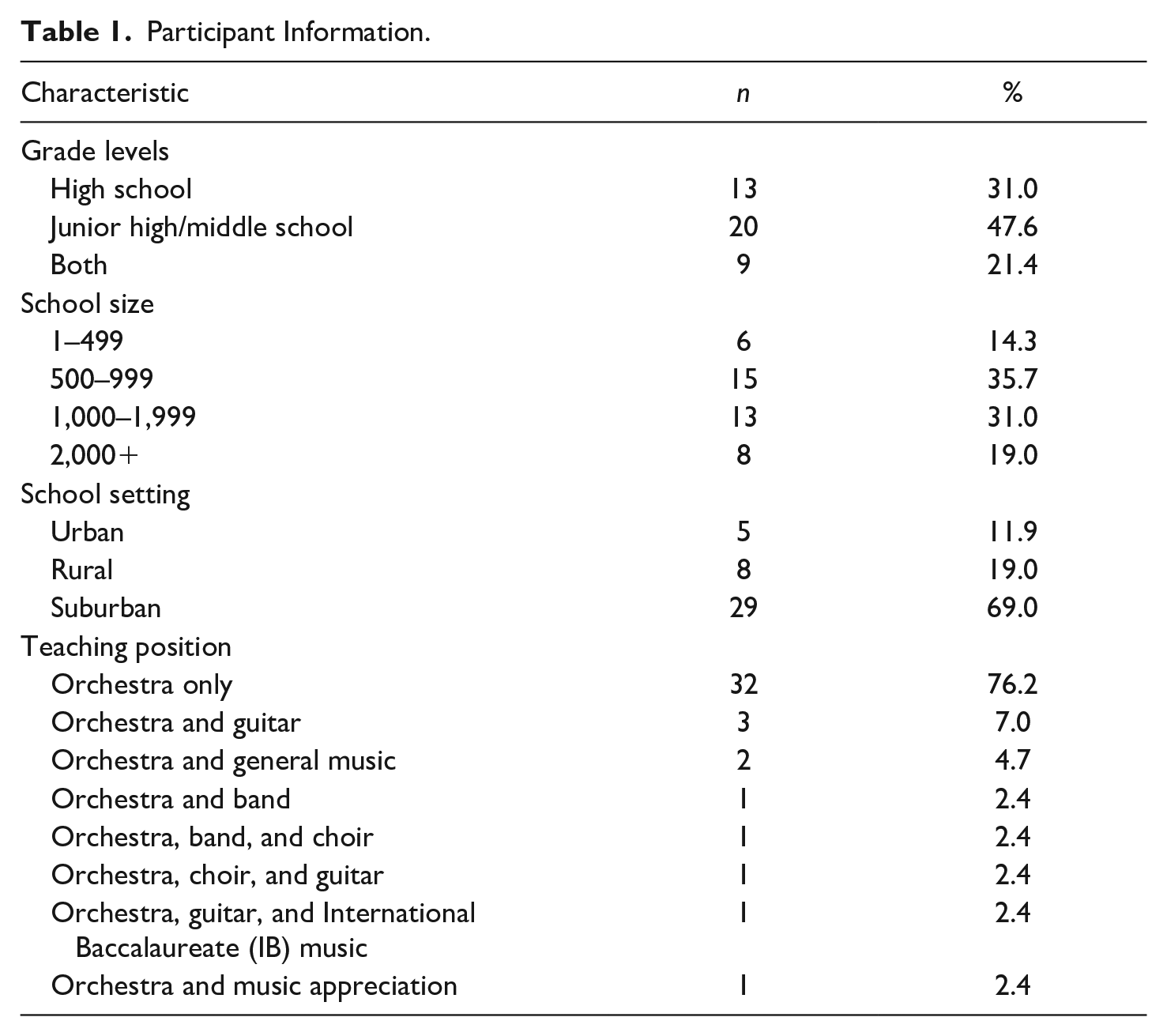
Most participants (76.2%) indicated that orchestra was their sole teaching responsibility and either taught middle school (47.6%) or both middle and high school (21.4%). Most of the participants taught in mid-sized schools between 500 and 1,999 students (66.7%) and in a suburban setting (69%). Because Garrett (2009) and Juchniewicz (2007) found that years of teaching experience did not correlate with significant differences in teachers’ perceptions of NMCEs, we did not collect this information. The sample is not randomized or large enough to draw broad generalizable conclusions and is representative participants’ perspectives in the present study (see Table 1).
Participant Information.
Data
The 16-item, online Qualtrics survey included questions regarding: (a) teacher and school background (e.g., teaching responsibilities, school setting size, and percentage of the school enrolled in music classes); (b) information about nontraditional music courses currently offered at the school (e.g., course names, prerequisites, school credit, and time of day); (c) music courses the teacher would like to offer at the school in the future; and (d) educational rationales for offering NMCEs (see Online Appendix A for the full survey). For this study, we clarified in the survey that NMCEs were defined as “any class that is not AP Music Theory, Orchestra, Band, or Choir.” We excluded music theory in our questionnaire because these courses tend to adopt similar traditional Western classical frameworks of large ensembles. In addition, Kelly and Veronee’s (2019) findings suggest that AP Music Theory (61.63%) and music theory (43.02%) courses are already relatively common in high school music programs. Questions regarding course offerings and educational rationales included closed- and open-ended items so participants could provide names and descriptions of courses that did not conform to the provided list and to give the opportunity to better explain the educational purposes of teaching nontraditional music courses. Our analysis included descriptive statistics of participants’ responses as the primary evidence. Qualitative data were subsequently examined to provide extra detail and support for the interpretation of the quantitative data.
Results
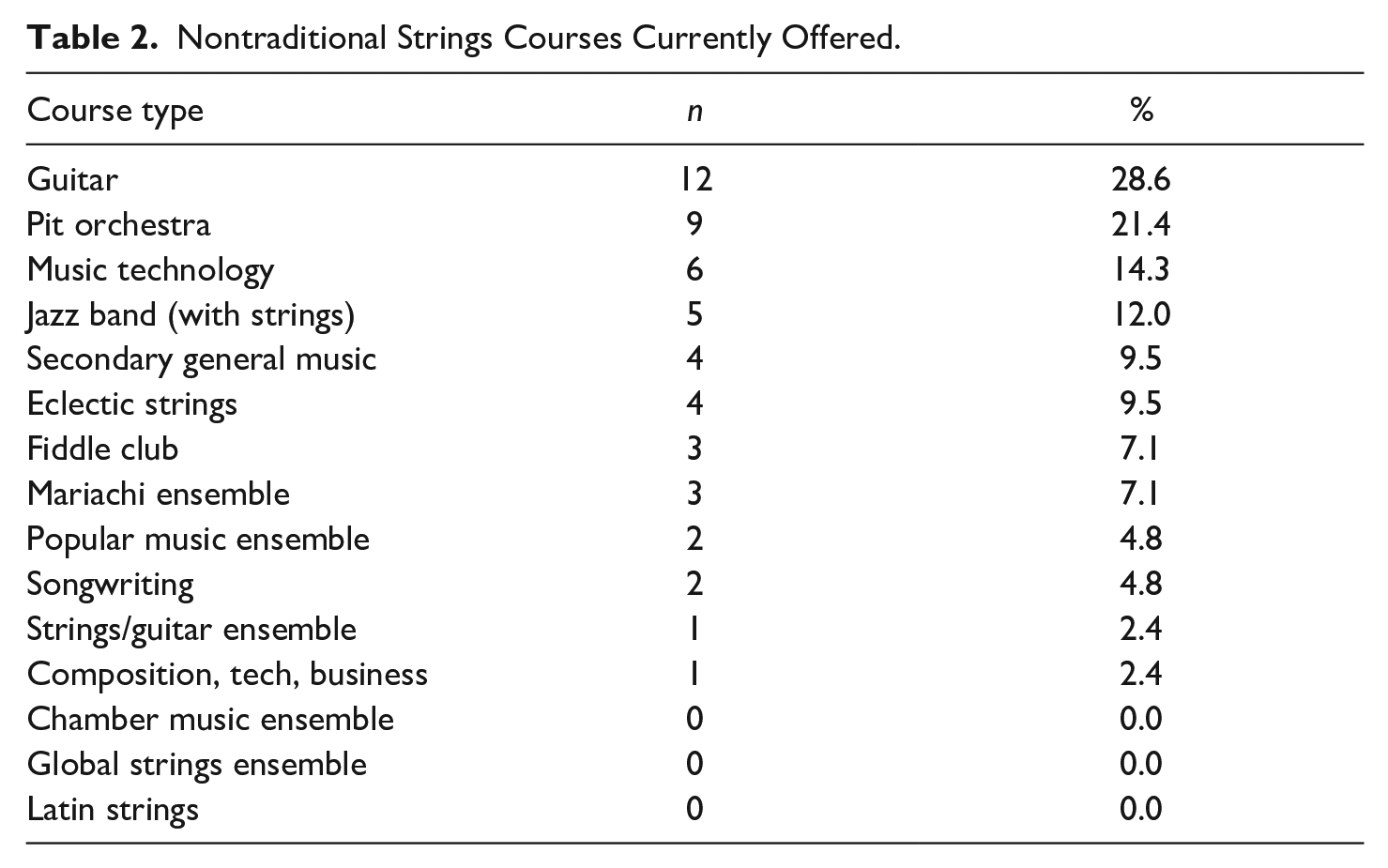
Results from this study reveal that participants offer a diverse array of NMCEs at their schools (see Table 2). The most frequently offered courses included guitar (28.6%), pit orchestra (14.3%), and music technology (14.3%). A small number (five or fewer) of teachers reported offering popular music (4.8%), songwriting (4.8%), string and guitar ensemble (2.4%), and a multidisciplinary course covering composition, technology, and music business (2.4%). No participants reported teaching chamber music ensembles or other non-Western ensembles (i.e., global or Latin strings). One participant commented in the open-ended items that they do not offer stand-alone nontraditional ensembles. Instead, they try to incorporate various styles (“mariachi, Jazz”) into their regular large-ensemble rehearsals.
Nontraditional Strings Courses Currently Offered.
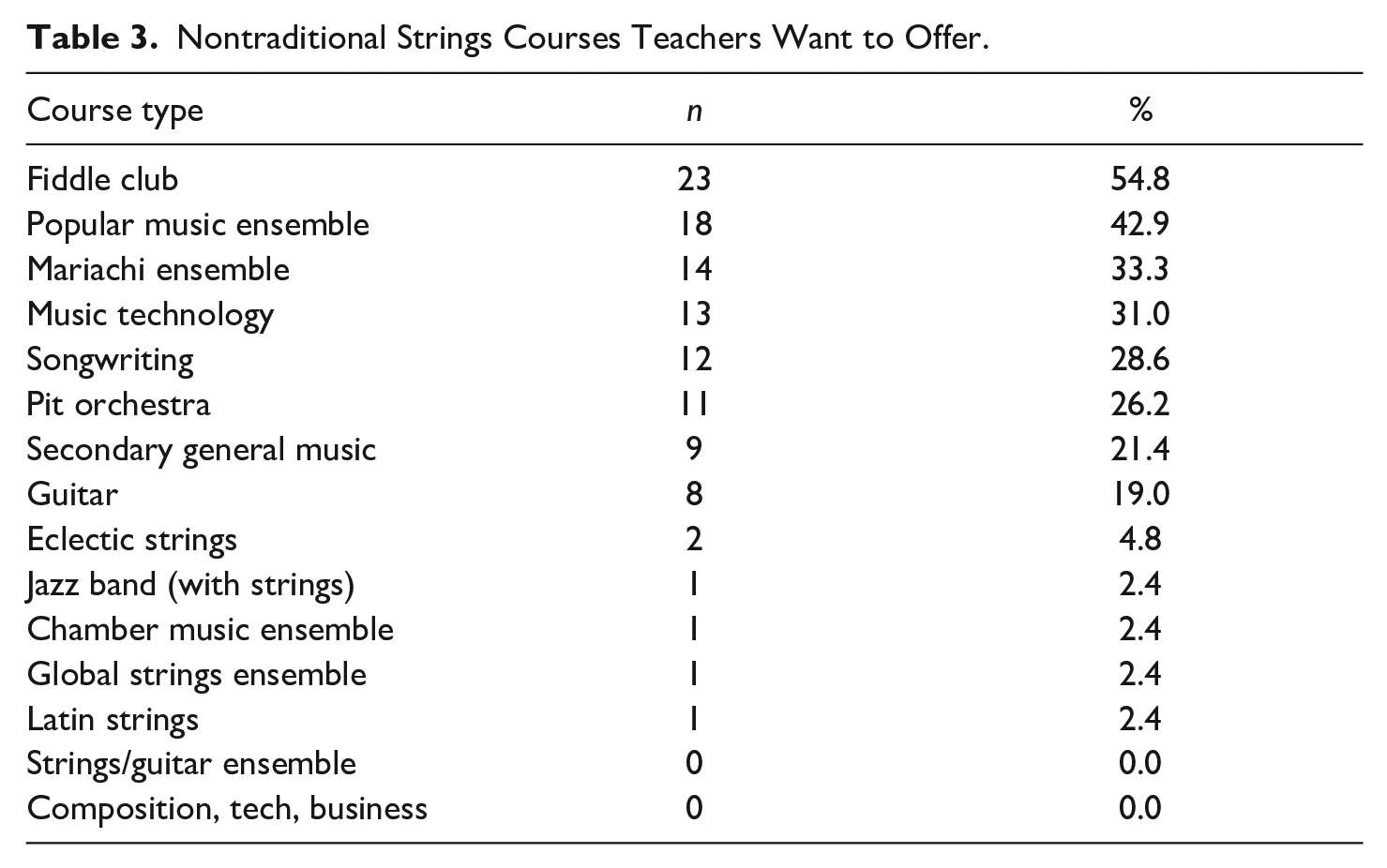
Our analysis indicates that participants also desire to offer a broader range of courses than what is currently available at their schools (see Table 3). Participants expressed the most interest in offering nontraditional music courses that are not typically available in their programs, such as fiddle club (54.6%), popular music ensemble (42.9%), mariachi ensemble (33.3%), and songwriting (28.6%). Despite already being some of the most frequently offered NMCEs, many participants expressed a strong interest in adding music technology (31%), pit orchestra (26.2%), and guitar (19%). Finally, participants expressed the least interest in adding eclectic strings (4.8%), global strings (2.4%), Latin strings (2.4%), and chamber music ensembles (2.4%).
Nontraditional Strings Courses Teachers Want to Offer.
Participants’ rationales for offering NMCEs centered on three primary issues (see Table 4). The most frequent rationale indicated by participants was that NMCEs offer opportunities for students to participate in a course or ensemble that reflects their cultural heritage (52.4%). This result is reinforced by participants’ responses to the open-ended questions. At least two participants use these smaller nontraditional ensembles for advocacy and community outreach and performances.
Rationales for Offering Nontraditional Ensembles.
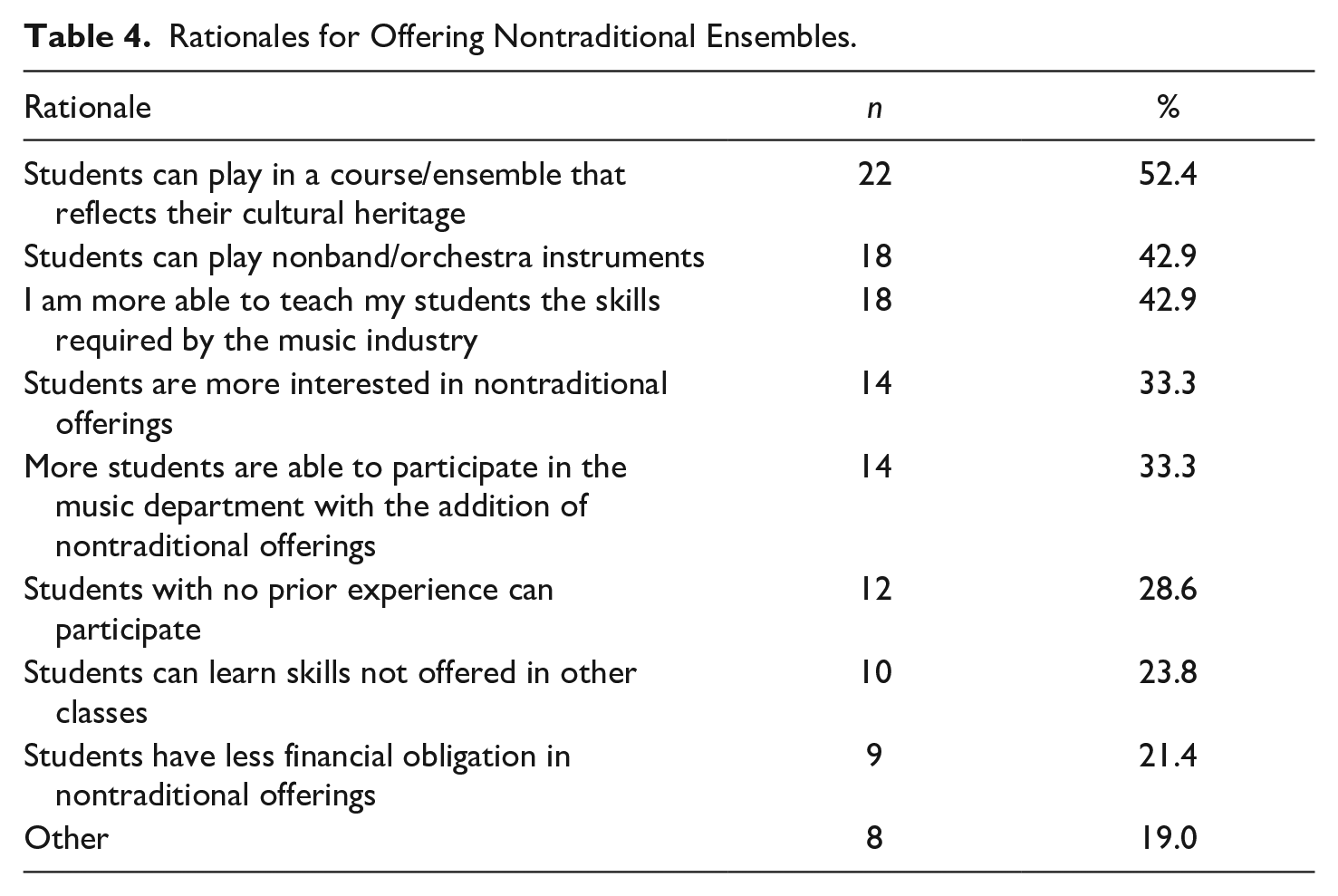
Participants also indicated that NMCEs provided opportunities for them to teach the musical skills required in music industry (42.9%) and their students to play non-band/orchestra instruments (42.9%). In the open-ended items, numerous participants commented that nontraditional music courses offer opportunities to teach improvisation, transcription, “ear-playing,” collaborative arranging, and other style-specific techniques. For example, one participant stated that they teach NMCEs for the following reasons: “Exploring improvisation and ear-playing in a safe environment; collaboration among peers in developing arrangements; resolving conflict with peers in small groups.” Another participant stated, “Students can learn style-specific music techniques and have more freedom to arrange and be creative than in orchestra.” A third participant said that NMCEs help students to develop “mastery of their instruments” because “traditionally taught students often rely on music and without it are debilitated.”
Participants’ third rationale for increasing nontraditional music courses is that students tend to be more interested in NMCEs. As a result, these additional offerings allow more students to participate in the school’s music program. Participants’ open-ended responses reveal that some of them allow students to participate in NMCEs who do not participate in traditional large ensembles. For example, one participant stated, “Students can participate without the prerequisite of previous experience.” Another commented, “Students can access music even if they can’t read it.” Many of these students can access nontraditional ensembles because participants indicated that they are typically offered for no credit as an extracurricular activity (73.8%) and scheduled outside of the school day (50%). This allows students to participate without taking up room in their daily academic schedules.
Discussion
Similar to previous studies, results from this investigation indicate that string teachers typically offer nontraditional music courses in guitar, pit orchestra (musical theater), music technology, and jazz ensembles. Our findings suggest that string teachers in the present study had an interest in offering a wider range of nontraditional music classes as a means to teach different skill sets, encourage creativity, and promote student collaboration. Some participants used NMCEs to offer students who do not have previous music experience a way to become involved in their school’s music program. Results show that participants believe NMCEs appeal to a more diverse student population and can serve as a way to engage with their communities in meaningful ways.
In contrast to those NMCEs currently offered, many participants indicated a desire to teach additional NMCEs that are not frequently offered in their schools. Fiddle club, popular music ensembles, mariachi ensemble, and songwriting were the most frequently desired courses beyond those already offered in schools (e.g., music technology and pit orchestra). Participants also indicated that one of the main rationales for offering NMCEs is to engage in community outreach and advocacy through public performances. Because participants indicated that the primary reason they wished to offer NMCEs was to reflect students’ cultural heritage, it is possible they believed these ensembles are more culturally inclusive and could serve as a method to engage a wider audience within their communities. Some participants self-reported using NMCEs, involving a smaller number of students, for community outreach and advocacy through public performances. It is also possible that students’ participation in these types of NMCEs while in school could promote future involvement in similar community-based music groups and lifelong music-making after graduation.
Several participants also articulated a desire to prepare their students for a variety of potential professional demands by teaching multiple music genres and a wider range of musical skills that are often overlooked in traditional school orchestra programs. Shaped by its Eurocentric heritage and repertoire, traditional school orchestra classes typically focus on notation-centric forms of musical literacy and learning often centers around the role of the teacher-conductor. Participants in the current study viewed NMCEs as opportunities for students to develop their creativity by learning to play by ear, improvise, compose, and arrange their own music in an intimate and collaborative learning environment. They rated playing by ear and improvising as the two skills most often taught in NMCEs.
If the goal of offering NMCEs is to appeal to a more diverse array of students than traditional bands, choirs, and orchestras, it is critical for music educators to carefully consider the requirements for participation. Requiring students to participate in a large ensemble so they can participate in NMCEs creates a barrier and restricts the ability for these courses to broaden students’ access to music education. In the current study, more than a quarter of participants (28.6%) indicated they offer NMCEs to students with no previous playing experience. In addition, a majority of participants (73.8%) indicated they offer NMCEs for no credit and half (50%) of them schedule their NMCEs outside of the regular school day. Both of these factors are important when determining students’ access to music courses and if music teachers are creating unintended barriers that hinder potential students’ participation. If NMCEs require registering for an elective, some students may not be able to fit these courses into their schedules, such as students with disabilities, English language learners who may use their electives for instructional support, and/or students who choose to take advanced placement or college-level courses.
Previous findings and our results indicate there may be barriers to adding more NMCEs in schools. A large number of participants in the current study indicated a desire to offer new courses that differed from their current offerings. Garrett (2009) and Juchniewicz (2007) concluded that external or school-level factors, such as lack of preparation time, lack of financial support, and inadequate equipment and facilities were significant deterrents for band and choral music teachers. Although these are clearly important factors that affect the possibility of offering NMCEs, Kelly and Veronee (2019) suggested the need to also research individual barriers such as teacher preparation and sense of competency. For example, Juchniewicz (2007) indicated that 15.9% of the band directors in his study felt they lacked the training and expertise to offer some NMCEs. Future research could explore whether similar barriers and deterrents affect string teachers’ efforts to broaden their curricular offerings beyond traditional large-group ensembles. In addition, future research could explore whether other teacher demographics—primary instrument, degrees held, gender, age, and years in their current teaching position—affect their perceptions of and willingness to offer NCMEs.
One limitation in this study is that our sample was relatively small and focused on string teachers who were already interested in teaching NMCEs. Future researchers could include a larger population of string teachers to assess the prevalence of NMCEs in K–12 schools. Although previous investigations and this study examined stand-alone NMCEs, one comment in our qualitative data suggested that some teachers may incorporate nontraditional music genres and skill sets within their large-ensemble rehearsals. Future researchers could also explore the prevalence and character of this practice in school orchestra programs. In addition, we did not examine the pedagogical methods and resources that participants used in their current NMCEs and this topic should be examined in future research. Many of our participants reported offering NMCEs to broaden students’ musical skills. Future researchers could examine the pedagogical methods that teachers use in NMCEs.
Music teacher education programs should consider the ways in which they can support future music teachers’ preparation in providing NMCEs to their students. Hickey and Schmidt (2019) provided professional development to music teachers specifically related to teaching improvisation and composition in the classroom and ensemble settings. Despite the music teachers’ intentions to include these skills more regularly in their pedagogy, Hickey and Schmidt found that participants in their study returned to more traditional teaching methods only 6 weeks after the workshops. These findings indicate that music teachers need prolonged exposure and training to successfully teach NMCEs and a wider range of musical skills in a consistent and sustainable way.
This study is one of the first to specifically analyze string teachers’ perspectives and practices regarding NMCEs. While large-scale investigations on this topic are needed, we are hopeful the findings from this study will encourage more string teachers to consider the ways NMCEs can create valuable educational opportunities in addition to traditional orchestras for students in their schools. For example, string teachers could extend their curriculum to include skill sets beyond reading notation by offering NMCEs that focus on the creation of music. We recommend further examination of the pedagogical practices used within NMCEs and the barriers that may prevent the string teachers from offering these courses. In the pursuit of providing music learning opportunities for all, NMCEs can be a powerful way to increase cultural relevance, creativity, and lifetime musicianship in the lives of their students.
Supplemental Material
sj-docx-1-srj-10.1177_19484992231195011 – Supplemental material for String Teachers’ Perspectives of Nontraditional Music Courses and Ensembles in Public Schools
Supplemental material, sj-docx-1-srj-10.1177_19484992231195011 for String Teachers’ Perspectives of Nontraditional Music Courses and Ensembles in Public Schools by Annie N. Savage and Adam G. Harry in String Research Journal
Footnotes
Declaration of Conflicting Interests
The author(s) declared no potential conflicts of interest with respect to the research, authorship, and/or publication of this article.
Funding
The author(s) received no financial support for the research, authorship, and/or publication of this article.

Supplemental Material
Supplemental material for this article is available online.
References
Supplementary Material
Please find the following supplemental material available below.
For Open Access articles published under a Creative Commons License, all supplemental material carries the same license as the article it is associated with.
For non-Open Access articles published, all supplemental material carries a non-exclusive license, and permission requests for re-use of supplemental material or any part of supplemental material shall be sent directly to the copyright owner as specified in the copyright notice associated with the article.
