



Abstract
The purpose of this article is to revisit the biomechanical concepts of Paul Rolland’s scholarship on bowing to provide a new framework of Rolland’s underlying bowing principles. First, we discuss how whole body movements help facilitate natural bowing, which can generate better tone efficiently from freedom of movement. Second, we attend to the movements of the bow arm, which can be conceptualized as the natural rotation of the arm. Third, we comment upon the concept of balance, concerning bow hold, leverage, and bow pressure while discussing the particulars of finger placement, its function in bowing, and balance and leverage in the bow arm. The concepts of whole body, movement, and balance should be considered in variable conditions considering the relationship between body parts and the whole. Also, the three biomechanical concepts are not independent or self-sufficient but correlated ideas. Not only do these ideas help with the acquisition of technical skills, but they also pave the way for a pleasing and natural tone quality as well as enhanced musical expression.
The celebrated American violinist and pedagogue Ivan Galamian (1999) argued that violin teachers should have a broad and flexible understanding of the foundational principles of violin playing, enabling them to address as many technical issues as possible. That is, teachers should not only have an intuition to inspire their students, but they should also know how to apply basic technical principles of violin-playing to a diverse set of playing contexts. Based on this, they can decide what, how, and when to teach techniques to their students. In this respect, continuous research on principles of violin playing techniques by string educators and scholars in this field can provide innovative teaching ideas to string music educators (e.g., Flesch, 1925; Galamian, 1999; Mozart, 1756).
Violin playing has been studied for centuries all around the world, and much of this research has focused on technical aspects of pedagogy (Rolland & Colwell, 1966). Traditionally, the investigation of technical aspects has been limited to body parts in isolation, such as fingers, wrists, or arms. While this approach contributes to an understanding of how each respective body part functions individually in violin playing, it fails to explain the coordination and relationship of the body parts and the whole body.
Frederick Polnauer (1952), one of the pioneering string pedagogues advocating for a holistic approach, asserted that violin technique should be studied with consideration of the entire body as well as its parts, as violin playing requires an understanding of “the biomechanical functions of the entire body” (p. 299). This biomechanical approach was adopted by Paul Rolland (1911-1978). Paul Rolland was one of the influential contemporary string pedagogues and was well-known for his string research and pedagogy. He intensively studied string playing and considered scientific factors such as physiology and kinesiology. His biomechanical approach explains the principles of body movements in string playing as well as its application to various playing techniques.
The purpose of this study is to revisit the biomechanical concepts of Rolland’s scholarship on bowing to provide a new framework of his underlying bowing principles. By revisiting and examining Rolland’s biomechanical ideas of violin bowing through the lens of this new framework, we intend to underscore Rolland’s invaluable contributions to string pedagogy, especially his holistic approach to understanding human body mechanics and movement. The framework we propose is intended to synthesize his extensive body of work into a few key concepts, thereby offering new ways for string teachers to engage with his invaluable pedagogical insights.
In addition, we anticipate that an examination of Rolland’s biomechanical concepts will provide an increased understanding of Rolland’s principles of whole body motion as well as the interrelationships between motion and bowing. This is because Rolland’s (1963, 1970, 1974, 1979) biomechanical studies have their significance in these following points:
Rolland explained the basic principles of bowing in a scientific way with regard to physical and physiological relationships between the player and the bow.
He suggested his own creative teaching methods, actions, and repertoires for teaching and learning related to his ideas of basic principles of bowing.
He explored the interrelationships between movements of the whole body, parts of the body, and bowing.
He proposed that the proper pedagogical hierarchy is to understand whole body principles first, and then to focus on the individual parts of the body.
In this article, we will first present an overview of Rolland’s research on biomechanics in bowing and its impact on the string pedagogy field. Second, we share our method for gathering and re-analyzing his scholarship. Following that, we will discuss our findings, ultimately offering a framework that facilitates players and teachers’ understanding of bowing principles by synthesizing Rolland’s bowing ideas and suggesting the most core concepts that will help string musicians and teachers understand the fundamentals of biomechanically informed bowing. We anticipate this framework will enhance many aspects of violin playing, including technique and musical expression.
Overview of Rolland and His Contributions
Hungarian-born Paul Rolland had a remarkable impact on the string pedagogy field. Rolland suggested a holistic approach that considers the parts of the body as not defined individually but determined by their relationship to other parts and the whole (Rolland, 1971). Rolland’s holistic approach to violin playing embraces the biomechanics of the whole body in relation to the body parts. Biomechanics is a term that refers to the mechanics of body movements “with statics, or posture; with kinematics, for example of arm motions, considering only concepts of geometry and time; and with dynamics, dealing with the effect of unbalanced external forces, or of muscle forces, in modifying the motion of bodies” (Polnauer, 1952, p. 299).
In formulating his approach, Rolland received excellent training as a violinist and was strongly influenced by his violin teachers regarding biomechanical concepts of bowing (Fanelli, 2001, 2011). For example, Rolland was influenced by his violin teacher, Dezsö Rados, on body relaxation and biomechanical principles in violin playing. Rolland also studied with Imre Waldbauer, whose own teaching methods were informed by Friedrich Steinhausen’s landmark text, The Physiology of Violin Bowing (Fanelli, 2011). Steinhausen was “the first physician who investigated important part-functions of playing from the viewpoint of motion-physiology, or biomechanics” (Polnauer & Marks, 1964, p. 81). These experiences shaped Rolland’s playing and teaching methods, which he then passed down to his own research and teaching.
While Rolland was working at the University of Illinois, he “was pursuing clinical investigations to test his ideas of string playing that encompassed biomechanics, kinesiology, physiology, physical motions, auditory and rhythmic training, and aesthetics” (Fanelli, 2011, p. 50). In 1966, Rolland conducted a government-funded research project, the Illinois String Research Project, which was based on his investigations of those scientific ideas. This project, often regarded as Rolland’s seminal work, represents a substantial understanding of biomechanics, particularly in regard to the entire body. This project design was based on his biomechanical approach to string playing that taught students free movements without unnecessary tension, ultimately to improve performance (Rolland, 1974). The final report of the research project, Development and Trial of a Two Year Program of String Instruction (Rolland, 1971), contains a detailed description of the whole process of the research. It also includes a variety of sources that were used for the research—such as the study design, evaluation forms, teacher’s manual, project evaluations, and other major string pedagogical and/or related work that the research project referred to. As this final report displays the rationale, preparation, procedure, and results of the research project, the majority of his previous research was also incorporated.
Rolland (1974) developed this final report into a teaching resource and published it under as The Teaching of Action in String Playing. In this book, he addressed many of his ideas about different subjects such as his philosophical concepts of teaching, principles of violin playing, remedial teaching, and a suggested curriculum. He also published a film series of the same title (Rolland, 1974), and this film series is also a significant resource as it displays the demonstration of Rolland’s research project and his ideas of the playing principles and applications of string teaching. Regarding bowing, Rolland demonstrated his in-depth investigation from basic to advanced bowing techniques and bow strokes. The descriptions were generally related to the concepts of whole body, movement, and balance. These biomechanical concepts were also demonstrated in Basic Principles of Violin Playing (Rolland, 1979). He specifically illustrated these concepts, especially regarding bowing.
Paul Rolland’s teaching approach was also described in Young Strings in Action (Johnson, 1985). Sheila Johnson demonstrated not only Rolland’s conceptual ideas of string playing, but also his teaching materials (including repertoires) and procedures that can be used in both group classes and private studio settings. One of the practical features of this book was that Johnson designed it for the heterogeneous string classes so that all parts of the violin, viola, cello, and double bass are included. The playing techniques of the lower string instruments were also described in detail. This supports the argument that Rolland’s technical concepts were not only limited to the violin but also applicable to the other stringed instruments (Johnson, 1985; Rolland, 1974).
In addition, Rolland demonstrated his ideas of bowing in many of his articles. Rolland (1947) described tone quality with bow pressure, speed, contact point, firm bow hold, and relaxed bowing. He also illustrated how to understand bow pressure in violin playing in relation to each part of the bow (Rolland, 1963). Regarding arm balance and movement, Rolland (1970) demonstrated many of the advantages of balance and natural movement of bowing. He specifically explained how the upper arm, forearm, and elbow work in different types of bowing and also demonstrated the directions of the movement of each part of the arm. He displayed his practical instructions on bowing specifically in different studies (Rolland, 1955, 1963, 1970, 1974).
Rolland was among the first pedagogue to take Polnauer’s charge to apply the principles of biomechanics to teaching. Rolland described Polnauer’s research as one of the significant pedagogical studies in terms of the biomechanical approach in violin playing (Polnauer & Marks, 1964). Polnauer had examined body mechanics in violin playing, and he discussed whole body, movement, and balance as he described biomechanical playing principles, concluding that the principles of biomechanics should be applied to teaching (Polnauer, 1952). According to him, teachers must study physiology, anatomy, physics, and mathematics since these can increase the efficiency of violin performance to (a) improve musical skills and music quality, (b) provide insight into skill acquisition and mastery, (c) shorten training time, (d) prevent excessive tension and disease, (e) establish anatomical and physiological methods, and (f) increase interests in musical arts.
Although an advocate of Steinhausen’s physiological approach, Polnauer observed that the bowing description was limited to the arm. Polnauer and Marks (1964) insisted that biomechanical functions of the whole body should be included, arguing that understanding of the entire body is also necessary along with the individual functions of the left and right hand. In this respect, Polnauer also argued that biomechanics should be considered in music education, and all concepts of general dynamics, including inertia, momentum, reaction, and Newton’s law of operation, should be included in music education. He also specifically mentioned that most body movements use the feet as a fixed link to the whole body from which players move their arms and hands to perform the task. Basically, Polnauer insisted bowing requires the kinematic cooperation between the bow hand, bow arm, and other parts of the body based on the feet. Rolland (1974) acknowledged Polnauer’s philosophical, theoretical, and pedagogical ideas as profoundly influencing his work, even giving rise to similar teaching methods (e.g., the Flying Pizzicato).
Rolland’s work has subsequently given rise to an entire body of scholarship which considers Rolland's pedagogy in relation to other contemporary string pedagogues. An American string teacher, Marianne M. Perkins (1995), compared Rolland, Shinich Suzuki, and Kató Havas’s pedagogical ideas of violin playing in terms of history, their method techniques, and their specific violin techniques. She discussed Rolland’s fundamental balance, large muscle usage, rotary arm movement, and bilateral motion. Similarly, Lyne (1998) compared Rolland, Carl Orff, Zoltán Kodály, and Suzuki. She pointed out Rolland’s central ideas of free movement, rhythmic sense, and singing tone production. Fischbach (1972) also compared the teaching methods of Samuel Applebaum and Rolland, noting that Rolland’s method demonstrates advantages in many technical topics, including violin hold, bow hold, tone rhythm, intonation, left-hand development, right-hand development, student comfort, and ease of playing. Fischbach specified that Rolland’s method continuously reviewed the previous techniques and used previous songs even when teaching new techniques. Burns (2013) compared the teaching approaches of Rolland and those of his contemporary Karen Tuttle. She examined Rolland and Tuttle’s historical background and teaching approaches for violin playing techniques. Burns pointed out that Rolland and Tuttle’s bowing ideas are aligned with each other, in terms of sound production, bowing actions, and natural and free bowing with holistic body movement. Although there was no direct relationship between the two pedagogues, the fact that their ideas were similar to each other can support that Rolland’s string pedagogy is also applicable to other string instruments, like viola.
Rolland’s pedagogy is not only studied for his theoretical concepts of string playing but also used as practical resources as it contains applicable systematic actions. For example, one of the renowned contemporary string pedagogues, Mimi Zweig (2011), mentioned that many of the ideas present in her string pedagogy had come from Rolland’s philosophies and teaching techniques. She even explained some of her teaching methods were adopted directly from Rolland.
In sum, Paul Rolland’s contribution to string pedagogy cannot be overstated. His pedagogical teachings have profoundly shaped and continue to influence current practice in string teaching. Rolland was one of the major scholars and string pedagogues of the 20th century, and he was one of the pioneering scholars who had the foresight to consider string playing and teaching from a biomechanical perspective. It is for these reasons that we have drawn substantially upon Rolland’s teachings for constructing a framework that describes the underlying principles of biomechanically-informed bowing.
Method: Revisiting Rolland’s Body of Work
There are many resources available for studying Rolland and his pedagogy, including his journal articles, books, and media sources, as well as the Illinois String Research Project. In addition, there is an abundance of secondary scholarship on Rolland pedagogy, which is available as dissertations, scholarly articles, and practitioner journals. To carry out our study, we selectively gathered and reviewed literature pertaining to Rolland’s biomechanical ideas of bowing. The sources were gathered in different ways. Most of the articles, dissertations, and books were gathered through library databases. In addition to this, and to ensure a dynamic and 21st-century understanding of Rolland pedagogy, we also considered the presentation handouts, teaching materials (such as scores or instructional materials), and other related documents from the Paul Rolland workshops and Paul Rolland String Pedagogy Certification Programs at the University of Illinois in 2018, 2019, 2020, and 2021. These materials were developed by faculty members of the Workshop, many of whom had worked with Rolland as a student or a coworker in the past. Thus, we were able to consider Rolland pedagogy from a plurality of perspectives, including studio teaching, public school teaching, remedial teaching, and applications of the pedagogy to violin, viola, cello, and bass contexts. We also obtained Rolland-related resources through online archives from a managing director of Paul Rolland Workshop and Paul Rolland String Camp at the University of Illinois.
To systematically review the literature, we preferentially reviewed materials produced by Paul Rolland. We also considered scholarship pertaining to Rolland string pedagogy, which was produced by others (shown in Table 1).
Sources and Descriptions.
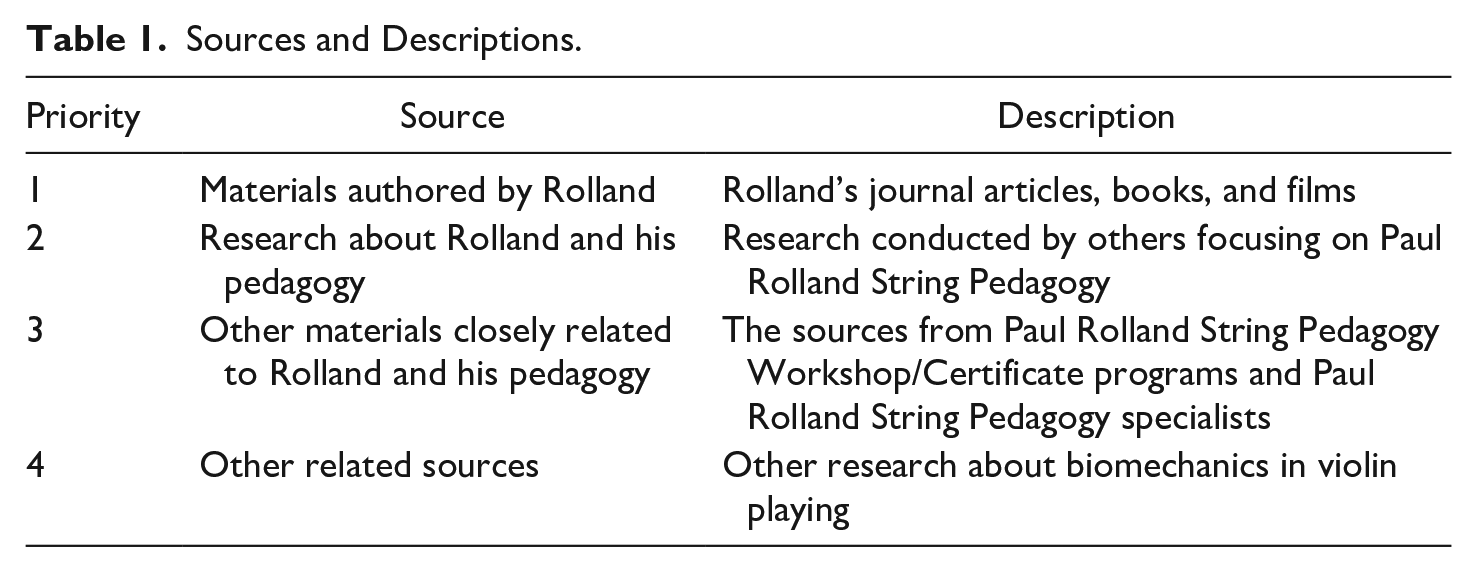
We categorized the sources into philosophical and technical topics, and within the category of technical topics, we focused more on Rolland’s bowing. We analyzed the contents and principles of Rolland’s bowing techniques and assembled them by coding the contents into three emergent themes, namely, (a) whole body, (b) movement, and (c) balance.
Findings and Discussion
Paul Rolland’s pedagogical approach is unique in that he had his particular way to describe bowing techniques, focusing on how each body part functions in relation to the other parts and the whole when considering the biomechanics of bowing. Our aim was to rediscover the underlying principles of Rolland’s bowing principles, and we found there are three fundamental concepts of Rolland’s bowing mechanics, which are: (a) whole body, (b) movement, and (c) balance. They can collaboratively explain how the whole body, whole arm, and body parts work in bowing. We argue that many of Rolland’s teaching on bowing can be synthesized into these three broad principles. These concepts were considered by Rolland when he explained various bowing techniques from basic to advanced.
Whole Body
Rolland’s holistic approach to violin playing considers the whole body and its relationship with parts of the body. His principles of motion and pedagogical ideas can be understood in relation to the principle of whole body action. Regarding this, Rolland stated that all movements should be synchronized with the balance of the body (Rolland, 1974). Based on the body’s balance, the movements in violin playing can help natural weight transfer for the whole body actions (Zweig, 2011). In relation, Rolland (1974) emphasized the importance of bilateral and unilateral movements because these movements can help the bow naturally lean onto the strings and provide anticipations for bowing movements. Bilateral movements mean the body moves in the opposite direction to the bow stroke and unilateral movements mean the body moves in the same direction as the bow stroke.
According to Rolland (1971), bilateral movement in violin playing was first recommended by Polnauer. Polnauer (1952) mentioned bilateral movement and balance, explaining the relationship between the body and the arm. He suggested the center of gravity of the body must move continuously, and by doing so, the tone quality can be improved. Polnauer also argued that static condition interferes with movements, causing tension and player’s unnecessary and inefficient pressure, so that the entire body should be allowed to flexibly move. Polnauer built his views upon the principle of physical dynamic, which pertains to the mechanics of physical characteristics or its force that occurs in relation to body. According to Polnauer, by focusing on optimal body mobility, a player can improve balance, skill, and efficiency, thereby reducing muscle tension and fatigue. Polnauer also argued that specific attention should be given to posture, ensuring the distance between feet is optimized for whole body involvement.
According to Rolland (1971), for whole body action, the feet must be balanced. This is because the position of the feet affects the player’s posture and balance. In a balanced stance, body weight shift occurs naturally, which allows relaxed playing. To be specific, the body weight should be supported by both feet, and the weight is not static but continues to move to the left or right foot. If the player is relaxed and well-balanced, this weight transfer can be instinctive and natural. As a result, body sway or weight shift helps bowing movements and relaxed playing. In addition, he emphasized the importance of dynamically shifting weight between the two legs, explaining that if one leg supports too much of the body weight (a common error in violin playing), it burdens the right arm with unnecessary motion. Likewise, the position of the feet is important in violin playing, and the weight should shift to both legs while playing with the bow.
Regarding this, Rolland mentioned the whole bow stroke as an example—the stroke needs preparation and follow-through movements in conjunction with the legs, head, and even trunk of the body (Rolland & Colwell, 1966). Specifically, Rolland (1971) argued that bilateral motion is most appropriate for medium or fast long bow strokes, while unilateral motion is more appropriate for long, slow bow strokes. In both cases, body weight transfers from one foot to the other, and body movements with weight transfer help the change of bow direction.
The benefits of whole body action in violin playing were described by Rolland in many different sources. For example, Rolland and Colwell (1966) stated that through the whole body action, players can overcome the problems of the atomistic approach or traditional methods that mainly focus on the movements of isolated body parts for specific techniques. As the atomistic approach cannot explain the body mechanics as a whole and describe the relationship between the body parts. Playing the violin with the concepts of this approach can cause tensions that hinder natural playing. On the contrary, the concepts of whole body action can provide players and teachers insight into how body parts and the whole body work correlatively. Not only can whole body action improve different types of techniques, but it can also produce a more natural tone quality because bowing, shifting, and any other technical movements are enacted more smoothly and freely (Rolland & Colwell, 1966).
Movements
Rolland used the ideas of total body action, balance and leverage, body balance, bow hold and arm, bow pressure, and different types of movements to explain the principles of movements in violin playing. He then demonstrated more practical aspects and showed how these theoretical playing principles can be taught through action. More specifically, he developed various exercises for learning different techniques, and named them “actions.” These actions involved many of his biomechanical ideas, which he taught through the concept of movement.
Rolland considered bowing in motion. He described different types of movements (such as ballistic, sequential, and bilateral/unilateral motions) when discussing different bowing techniques. Among them, many of his bowing techniques exhibited the traits of general curve/rotary motions. As mentioned earlier, Rolland (1971) stated that only rotation of the arm can create the efficient use of leverage. Regarding this, Rolland (1963) discussed pronation and supination of the bow arm and balance of the whole arm in relation to the concepts of balance and leverage. The arm rotation can either be applied as pronation and supination of the elbow joint with the forearm or applied more efficiently using a balanced motion of the entire arm swinging. The swinging of the outside of the arm is accompanied by a slight elevation in the elbow (down-bow) with a lowered forearm. In this way, slight counterclockwise arm rotation can maintain pressure without unnecessary effort. In up-bows, this process is reversed.
Rolland (1970) furthered his description of rotary movements of bowing with a specific application to the different bow strokes. First, he defined arm balance as being the rotary movement of the arm around the axis between shoulder and forearm (near the elbow). He suggested this imaginary line as a balance point and claimed this arm balance from the rotary motions helps foster natural and efficient violin playing. Rolland (1974) illustrated natural arm motions as follows: the arm acts as a balanced teeter-totter (see-saw) the hand and elbow move in opposite directions the imaginary axis of the movement crosses the forearm between the elbow and wrist the upper arm rotates around its own axis: counter-clockwise (elbow rising), or clockwise (elbow lowering). (Rolland, 1974, p. 168)
Rolland stated that those natural four movements should be employed in violin playing, and he claimed rotary motions of the bow arm can help players utilize the four natural movements in the bowing motion. By doing so, bowing can be efficient and untiring. He furthered his claim by describing the specific arm movements for the several bow strokes, such as detaché, sautillé, spiccato, down-bows, up-bows, and long bow strokes. All of these types of bow strokes were described in relation to the rotary motions of the forearm and upper arm (Rolland, 1970).
In relation to rotary motions in bowing, Rolland and Colwell (1966) insisted that a lot of research about bowing described how curved-bowing can help the follow-through action, string crossing, and change in direction and angle in a most natural and effective manner. For example, Rolland (1979) described how to keep the bow straight utilizing curved-bowing. Much research has argued that keeping the bow straight in violin playing is essential as this can help to produce a clean and consistent tone while maintaining a contact point (Fischer, 1997; Galamian, 1999). Regarding this, Rolland (1979) stated it is critical to make and maintain the right angle of the bow stick to the strings, which is similar to others’ opinions, but his approach on this topic is notably nuanced. He explained that the most common error in students’ long bow strokes, in an up or down bow, occurs when students’ mistakenly make a curve toward the fingerboard caused by the stiff arm movement without rotation of the arm and shoulder (see Figure 1). As a result of such a misguided movement of the bow, students end up playing near the bridge at the beginning of the bow stroke and away from the bridge in the middle of the bow. To rectify this error, students should practice drawing the bow opposite to the falsely drawn curved bowing that is shown in Figure 2. Thus, the erroneous bowing tendency can be corrected by intentionally focusing on complementary arm motions, leading students to draw a straight bow (Rolland, 1979).
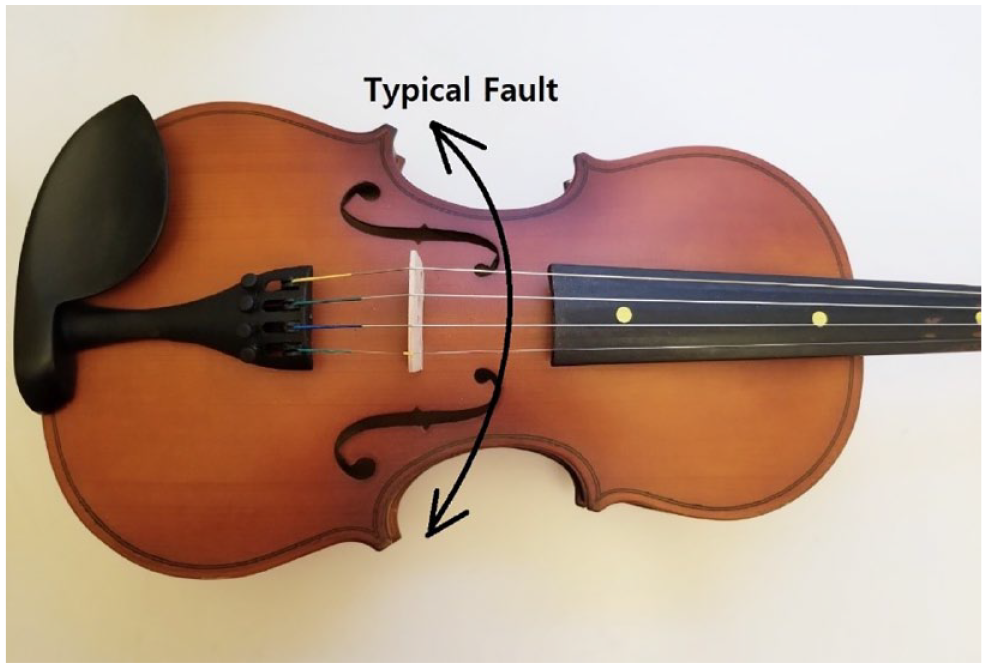
Typical fault in bowing.
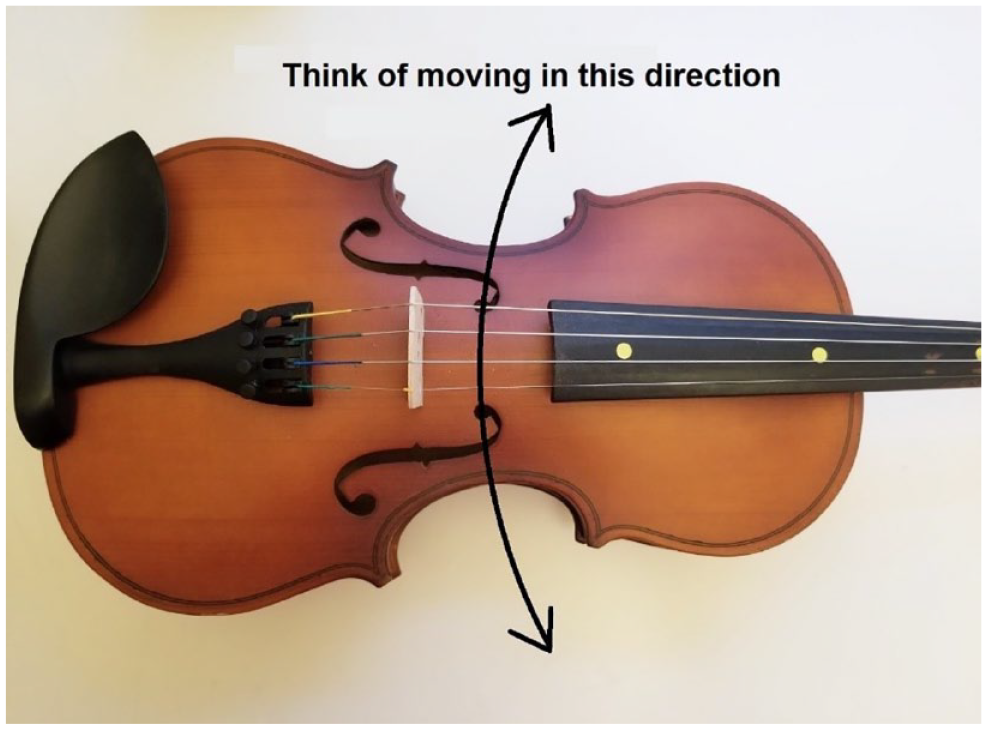
Opposite arch for straight bowing.
This intentionally drawn curved bowing for straight bowing can be created by adding the rotary motions of the arm. Without rotary motions, players should think about how to use each of the fingers, hand shapes, or elbow to avoid the wrong curve. However, with the inclusion of rotary motions, bowing naturally leads the fingers, hands, and elbow to rotate for a straight direction.
Balance
In terms of the physiological and physical aspects of violin playing, Rolland specifically discussed balance. In much of his research, he emphasized the importance of balance in violin playing and argued that balance can strongly affect performance (Rolland, 1970, 1974, 1979). According to Rolland, with a proper balance, more efficient playing and natural sound are possible. His ideas of balance in bowing can be examined by dividing the topics into two—the balance of the whole body in bowing and the balance between the bow and the body parts (shoulder, upper arm, forearm, hand, and fingers). Since the first is closely related to the whole body concept of the three, we will mainly discuss the balance between the bow and body parts in this section.
With regard to the balance between the bow and body parts, proper finger placement in the bow hold ensures the effective use of leverage, which in turn, leads to increased freedom of movement in bowing. Rolland (1979) insisted the bow hold should be properly established first, pointing out that the bow hold requires balance for the comfort and ease of playing.
More specifically, Rolland (1979) explained how each finger works in bowing regarding the principle of leverage. According to him, the thumb and the middle finger work together to form an axis of the bow hold. The rest of the fingers, which are naturally and properly spread out, control the bow in varied situations. That is to say, the thumb and middle finger form a pivot or axis of the bow hold, so the positions of the two fingers do not move—except for slight rotation or change the angles. According to Polnauer and Marks (1964), Steinhausen defined several “playing-axes” of the bow: the top edge of the frog, the position of the index finger (pronation point), and the position of the little finger (supination point; see Figures 3 and 4). In pronation, the bow hand rotates to the left, and this rotation makes the right elbow rise with the index finger conveying more weight into the bow. In supination, the bow hand rotates a little to the right, effectively lowering the right elbow and relying more on the little finger to convey weight into the bow. In both instances, Rolland (1979) stated the thumb and middle finger act as the axis, where the forces pertaining to the front and back parts of the grip are applied to the bow.
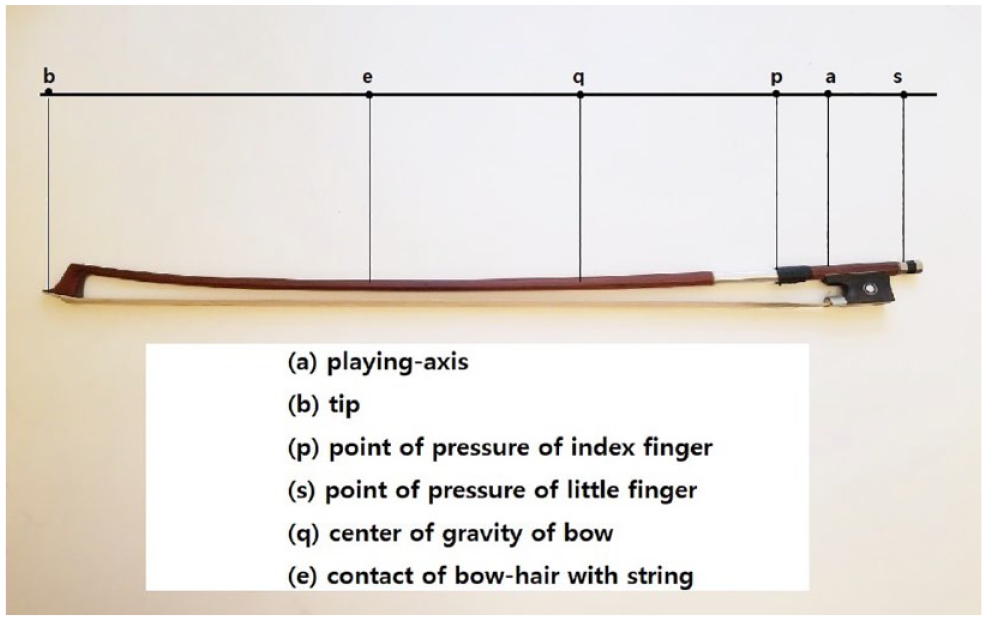
Steinhausen’s multiple levers in a bow.
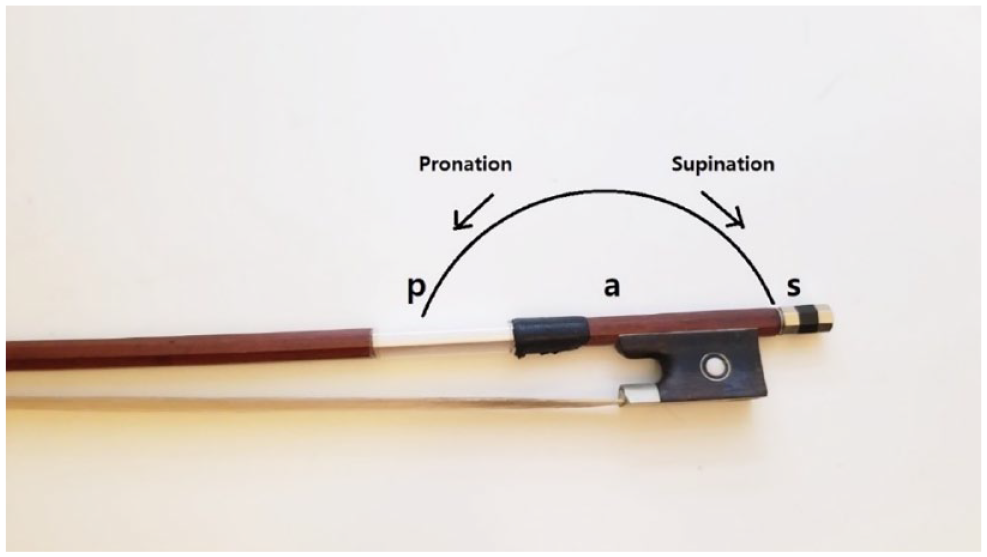
Steinhausen’s pronation and supination of bowing.
String players should consider the bow hold as dynamic and flexible, not static (Polnauer, 1952). Accordingly, the roles of the remaining fingers change depending on the different bow strokes and bowing situations. Rolland (1979) divided the bowing situations into two categories: when applying pressure and when supporting the bow. Within the category of applying pressure, down bows, crescendo, forte, and accents were included. As an example of applying pressure, in a down bow, as the bow approaches to the tip, the leverage point moves toward the index finger and the index finger conveys more weight on the bow—and the thumb supports the bow “and essential balance” (Perkins, 1995, p. 116). The roles of the third finger (ring finger) and the fourth finger (little finger) are not significant at this time, so they are just naturally placed on the bow (Rolland, 1974). On the contrary, when approaching to the frog (up bow), the third and fourth fingers conveys more weight on the bow, and the thumb enables the principle of leverage as a fulcrum. This leverage helps the player avoid excessive pressure when playing near the frog. The leverage is also applied when performing at a soft dynamic or the player lifts the bow for technical reasons (see Figure 5).
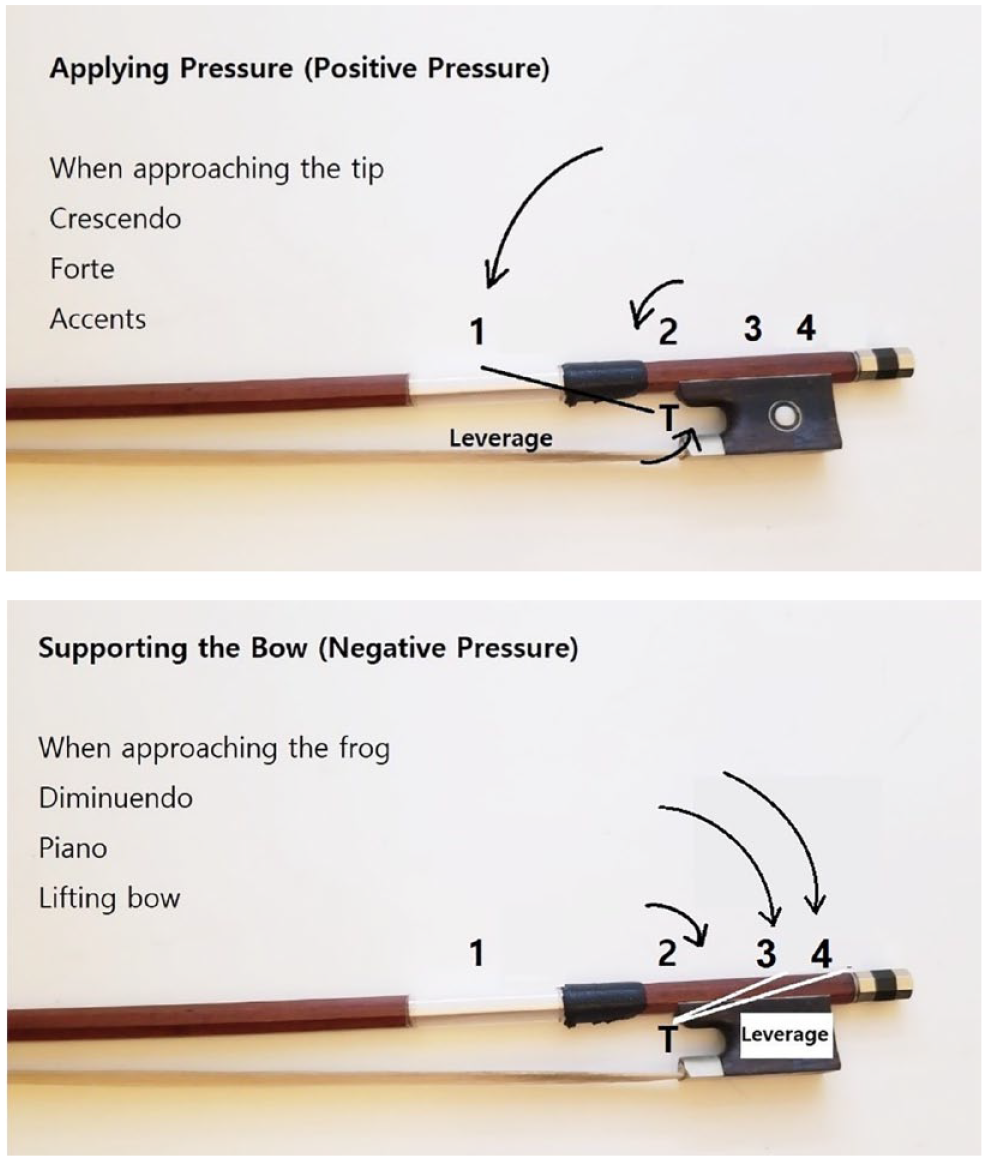
Bow hold and leverage.
The concept of bow balance and leverage was specifically discussed in relation to the bow pressure (Rolland, 1963). Rolland argued that the term “bow pressure” should be used differently from “player’s pressure.” According to him, bow pressure refers to the pressure existing at the contact point between the strings and the bow, and player’s pressure refers to the pressure applied to the bow by human efforts. Bow pressure and player’s pressure are applied differently depending on where the player is at in the bow. He also illustrated the sensation of pressure, which players can use to determine how the two different types of pressure are applied. When the entire weight of the bow in the frog is used, the sound can be very loud, so the weight should be relieved by the upward support of the thumb. On the contrary, the tip does not require the support of the thumb but needs a player’s positive pressure. In other words, the player must know where the negative pressure changes to the positive pressure considering the concept of balance. Knowing when to increase and decrease each type of pressure is the key to a smooth bowing and consistent tone color. Fingers do not need to work hard if a player acquires the skill to apply the proper leverage of the entire arm. The least effective way of bowing is to press the fingers in the opposite direction of the thumb, which interferes with the performance by making the movement rigid and tiring. In this case, players should consider the physiological aspects of balance and bowing movements with physical aspects of arm weight and bowing directions. Although Rolland (1974) emphasized the importance of each finger’s role in relation to leverage and balance, he also claimed the excessive use of the fingers should be avoided.
Regarding this, Rolland (1963) also discussed how to apply leverage to long bow strokes. According to him, there are two theories for performing long bow strokes: by using the weight of the arm and by rotating the bow arm. He disagreed with the theory of using arm weight. He argued the continuous downward pressure of the arm is impossible to maintain because the thumb continues to support the bow in the upward motion. He also stated that the pressure is limited to the fingers in this manner. On the contrary, the use of long leverage of the bow by rotating the arm is suitable for violin playing, since only the rotation of the arm can utilize both the upward pressure of the thumb and the downward motion of the other fingers to the arm in a more effective way.
Conclusions and Implications
Paul Rolland is remembered for his contributions toward the understanding of biomechanical function of the human body and how the individual body parts interact with the whole body in violin playing. Concerning this, we suggest that a focus on three areas can quickly improve bowing issues: whole body, movement, and balance. We propose that these three concepts represent the necessary components for a biomechanically informed approach to bowing.
String players must consider the concepts of whole body, movement, and balance in variable conditions, considering the relationship between body parts and the whole, and these three biomechanical concepts are not independent or self-sufficient but correlated ideas and can affect each other.
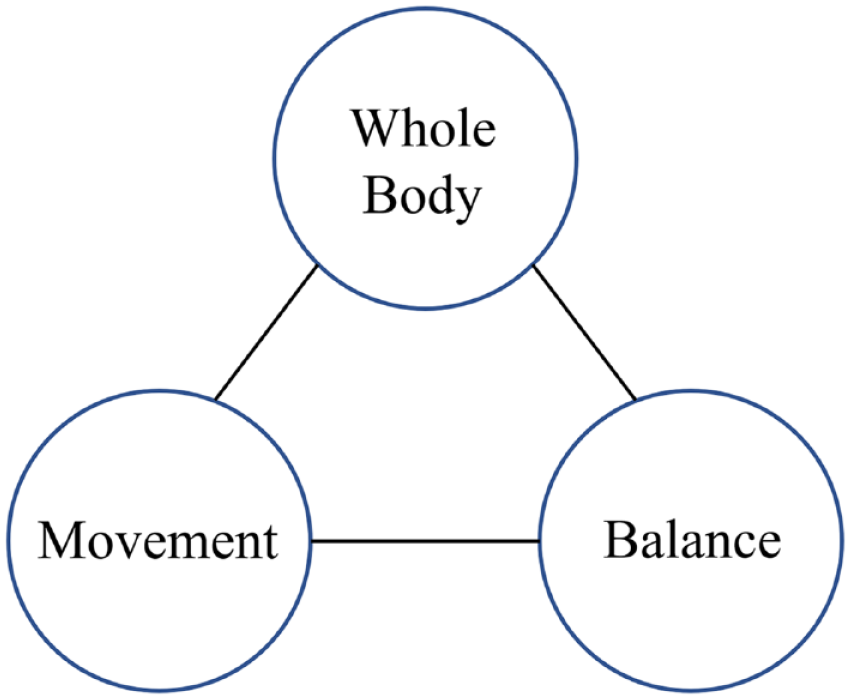
The correlation of the three biomechanical concepts.
For the purpose of clarity, we described the three concepts separately in this paper. For example, in the section on balance, we primarily attended to balance in bow hold and bow pressure while discussing the particulars of finger placement and each finger’s function in bowing. However, we argue that the three concepts all interact with each other, so the concept of balance is needed for the entire body. Regarding this, we related the concept of balance to bow arm movements and whole body action. That is, all the movements must synchronize with the balance inside the body, and with the balance, the movements in bowing should align with natural weight transfer, enabling whole body movements.
The three biomechanical concepts discussed in this study can provide string teachers and players a basis for understanding Rolland’s bowing techniques. This will help them create a more in-depth understanding of the different aspects of Rolland’s string pedagogy and provide the essential ideas of playing that will facilitate the understanding of various playing techniques and Rolland’s actions. If string teachers learn and understand these fundamental concepts of bowing, they can provide their students with a more cohesive and biomechanically-informed approach. We propose that such an approach should become a cornerstone to string pedagogy, enabling students to play their instruments in a more biomechanically-informed and tension-free manner.
Thus, Rolland’s biomechanical concepts can help teachers, players, and students of different ages, skills, and learning experiences. Regardless of the varied characteristics of the students—either in developmental or advanced stages—one of the important teaching concepts is to provide “vivid mental images and kinesthetic sensations” (Rolland, 1974, p. 182). The mental images and kinesthetic sensations are achievable with an understanding of biomechanics. Therefore, acquiring a fundamental understanding is one of the foremost tasks in violin playing. As students develop a mastery of these biomechanical concepts, they will find that they resonate across more diverse types of techniques, expressions, and repertories.
In presenting this framework, we have drawn substantially upon the teachings of Paul Rolland, which represent an entire body of invaluable scholarship. For further consideration on how biomechanics can intersect with various aspects of string playing, we would urge the reader to explore some of the works appearing in the reference list and to participate in some of the excellent workshops, trainings, and professional development activities related to Rolland pedagogy.
In summation, not only does Rolland’s biomechanical approach suggest broad and flexible principles, but it also offers new perspectives on research in violin playing. Rolland’s study of violin playing reflects a diverse understanding of physiology, biomechanics, kinesiology, and physical motions. Such interdisciplinary understandings of violin playing was visionary because it paves the way for students to develop a pleasing and natural tone quality as well as enhanced musical expression. The resultant effect is not only improved performance and tension-free playing; by focusing on performing in healthy ways, the students also gain the benefit of enhanced longevity to their performance and musical life.
Footnotes
Declaration of Conflicting Interests
The author(s) declared no potential conflicts of interest with respect to the research, authorship, and/or publication of this article.
Funding
The author(s) received no financial support for the research, authorship, and/or publication of this article.
