




Abstract
Background
Osteoarthritis (OA) of the knee is a degenerative disorder characterized by cartilage degradation, synovial inflammation, and structural remodeling. Synovial fluid (SF) biomarkers may improve diagnosis, staging, and patient stratification.
Methods
Following PRISMA guidelines, a systematic search of PubMed and Scopus (2015-2025) was conducted. Human studies analyzing SF with proteomic techniques (LC-MS/MS, SWATH-MS, ELISA) were included. Extracted data were classified by OA stage, sample type, proteomic platform, and identified biomarkers. Functional enrichment was performed with ShinyGO, and protein-protein interaction (PPI) analysis with STRING (v12.0).
Results
Seven studies met the inclusion criteria. Reported biomarkers included Cathepsin G (CTSG), angiotensinogen (AGT), periostin (POSTN), haptoglobin (HP), complement components, and matrix-related proteins such as ADAMTS4 and LYVE-1, which are involved in extracellular matrix remodeling, inflammation, and joint tissue homeostasis. Functional annotation revealed enrichment in glycosaminoglycan binding, complement cascades, and redox pathways. PPI analysis identified central nodes including COL1A1, ACAN, COMP, and POSTN, together with matrix-degrading enzymes such as MMP1, MMP3, and MMP13, highlighting tightly connected extracellular matrix remodeling processes in OA.
Conclusion
This review highlights reproducible SF biomarkers with diagnostic and prognostic potential in knee OA. Integrated proteomic and network analysis reinforces the multifactorial nature of OA and suggests key molecular targets. Translationally, a consistent biomarker signature could support early detection, more precise staging, and personalized management, enabling biomarker-guided diagnostics, targeted therapies, and the integration of precision medicine into OA care.
Introduction
Knee osteoarthritis (OA) is a leading cause of pain and disability in aging populations, affecting over 250 million people globally and representing a substantial public health and economic burden.1 -3 OA is a chronic, progressive joint disease characterized by the degeneration of articular cartilage, subchondral bone remodeling, synovial inflammation, and osteophyte formation, ultimately resulting in joint dysfunction, reduced mobility, and psychological stress.4,5 Despite its high prevalence, OA remains challenging to diagnose in its early stages and to monitor longitudinally, primarily due to the lack of reliable and sensitive molecular biomarkers. 6 Currently, OA diagnosis relies predominantly on clinical symptoms and radiographic findings, which typically reflect advanced joint damage and do not capture the molecular changes occurring in early disease. 7 Thus, there is a critical need to identify biomarkers that can detect early pathological changes, differentiate disease stages, and potentially guide personalized therapeutic strategies. 8 The synovial fluid (SF), which bathes the intra-articular structures, represents a dynamic source of molecular information and provides a window into the local joint microenvironment. 9 As such, SF is an ideal biofluid for the discovery of OA-specific protein biomarkers reflecting ongoing pathophysiological processes. Advances in proteomic technologies, including mass spectrometry (MS)-based approaches, antibody arrays, and aptamer-based assays (SOMAscan), have facilitated the large-scale, high-throughput identification and quantification of proteins in SF.10,11 These methods revealed numerous proteins involved in key OA mechanisms such as inflammation, extracellular matrix (ECM) degradation, lipid metabolism, angiogenesis, and oxidative stress.12 -15 However, reproducibility across studies remains limited, often due to differences in sample preparation, patient stratification, analytical platforms, and statistical thresholds. 16
To address these limitations, we conducted a systematic review of proteomic studies analyzing human synovial fluid in patients with knee osteoarthritis. While previous systematic reviews have summarized candidate biomarkers, few studies have attempted to integrate these findings through a systems biology framework. Therefore, beyond summarizing reported biomarkers, the present review incorporates bioinformatic analyses, including Gene Ontology (GO) enrichment and protein-protein interaction (PPI) network analysis to explore the functional relationships among repeatedly reported proteins. By integrating evidence across studies with bioinformatic interpretation, this work aims to identify reproducible molecular patterns and highlight biologically relevant pathways potentially involved in OA progression.
Materials and Methods
Search Strategy
According to the Preferred Reporting Items for Systematic Review and Meta-Analyses (PRISMA) guidelines, 17 a comprehensive and systematic search was conducted using the electronic databases: Scopus and PubMed. The search was limited to studies published over the last 10 years (2015-2025), and was designed to identify original research articles evaluating proteomic biomarkers in SF samples from patients with knee OA. Boolean logic and controlled vocabulary were applied to combine key terms related to “osteoarthritis,” “synovial fluid,” “serum,” and “proteomic techniques.” Only studies in English, conducted on humans, and applying proteomic analysis methods such as liquid chromatography-tandem mass spectrometry (LC-MS/MS), sequential window acquisition of all theoretical mass spectra (SWATH-MS), data-independent acquisition (DIA), and enzyme-linked immunosorbent assay (ELISA) were included. The detailed search strategies are provided in Suppl. “Appendix A” (Suppl. File 1).
Inclusion Criteria and Study Selection
The research question guiding this review was formulated according to the PICO model as follows 18 : (1) Population: Adult patients with a clinical and/or radiological diagnosis of knee OA. (2) Intervention: Proteomic analysis of SF samples using methods such as mass spectrometry (LC-MS/MS, SWATH-MS, DIA), two-dimensional difference gel electrophoresis (2D-DIGE), protein arrays, or ELISA (for biomarker validation). (3) Comparison: all studies were included irrespective of the presence or absence of comparator or control groups. (4) Outcome: Identification of proteomic biomarkers specific to OA, including both quantitative and qualitative data on differentially expressed proteins. Based on this framework, the inclusion criteria were defined as follows: Original studies involving human subjects with clinical and/or radiological diagnosis of knee OA; proteomic analysis specifically conducted on synovial fluid samples; use of established proteomic techniques such as mass spectrometry, 2D-DIGE, protein arrays, or ELISA.
Studies were excluded if they met any of the following criteria: Animal or in vitro studies; Studies analyzing tissue or blood samples only, without synovial fluid data; studies using only genetic or epigenetic approaches (other omics analysis); review articles, editorials, letters, technical notes, expert opinions, or case reports; studies with fewer than 10 participants. The selection process was performed in two stages. In the first phase, three reviewers independently screened the titles and abstracts of retrieved articles. In the second phase, potentially eligible full-text articles were evaluated in detail.
19
Discrepancies were resolved through discussion or by consulting a third reviewer.
20
The number of studies included and excluded at each stage is presented in the PRISMA flow diagram (

PRISMA 2020 flow diagram of study selection from PubMed and Scopus databases. PRISMA 2020 flow diagram illustrating the study selection process, including identification, screening, eligibility assessment, and final inclusion of studies.
Data Extraction and Quality Assessment
The selection and data extraction of the included studies were performed independently by three reviewers (G.L.B., M.M., and E.I.P.). For each study, the following information was collected: study title, first author, year of publication, and source of publication. Key characteristics of the study design and population were recorded, including the study type (cross-sectional, cohort, case-control), number of participants, and relevant demographic or clinical features. Detailed information on the type of biological samples analyzed (synovial fluid, plasma, or tissue specimens), the number of samples included, and the characteristics of the subjects was extracted. Proteomic techniques applied in each study such as mass spectrometry (SWATH-MS, nano-LC-MS/MS, LC-MS/MS), aptamer-based SOMA scan-assays, or ELISA were noted. Where applicable, comparator groups (healthy controls, different OA stages, clinical responders vs non-responders) were identified, along with the biomarkers reported and their expression profiles. Each study was classified according to its methodological design. All included studies were observational and non-randomized. The methodological quality of the observational studies was assessed using the Newcastle-Ottawa Scale (NOS), which evaluates selection of study groups, comparability, and outcome ascertainment. NOS scores range from 0 to 9 stars. Of the seven studies included, three were classified as moderate risk of bias, three as low risk of bias, and one as high risk of bias.
21
A detailed summary of the risk of bias assessment using NOS is presented in
Study Quality Scores and Risk of Bias Based on the Newcastle-Ottawa Scale (NOS).
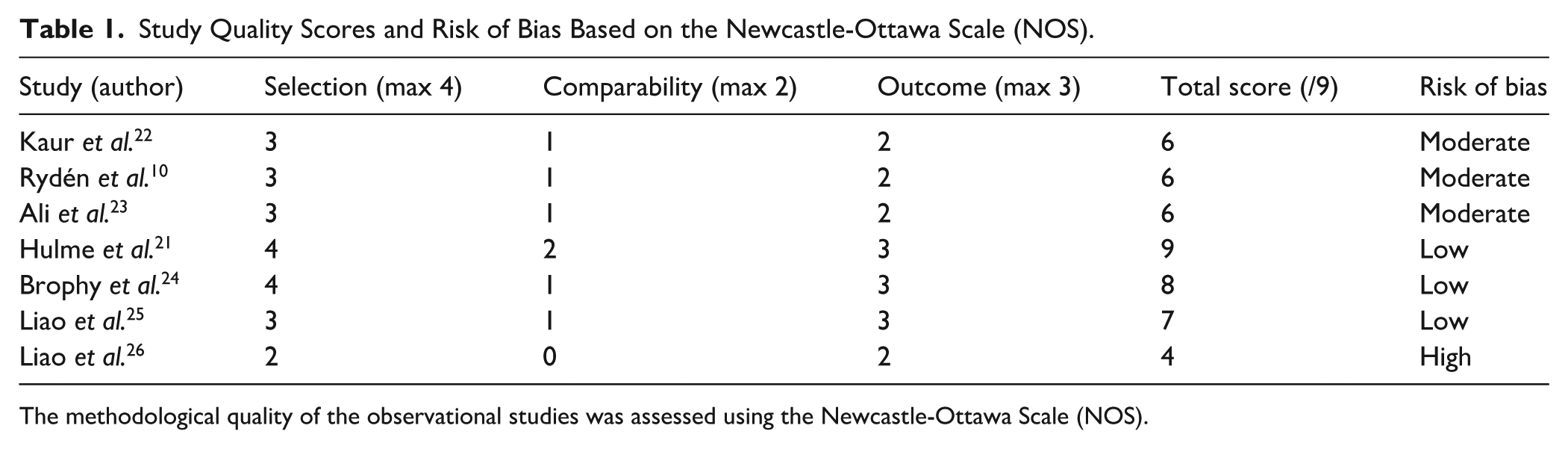
The methodological quality of the observational studies was assessed using the Newcastle-Ottawa Scale (NOS).
Data Analysis
Given the methodological heterogeneity among the included studies particularly in terms of biological sample types, proteomic techniques, and outcome parameters a qualitative synthesis of findings was conducted. Biomarkers were grouped and compared according to their biological functions, study design, and sample type (synovial fluid and serum). To identify consistent molecular patterns and shared pathways, biomarkers reported in multiple studies were examined in parallel. To explore the biological relevance of the identified biomarkers, a functional enrichment analysis was performed using ShinyGO v0.76 (http://bioinformatics.sdstate.edu/go/). This tool enabled categorization based on GO terms including biological processes, molecular functions, and cellular components and mapped biomarkers to pathways using the Kyoto Encyclopedia of Genes and Genomes (KEGG) database. Enrichment was considered significant at a false discovery rate (FDR) adjusted P-value of < 0.05 (FDR < 0.05) (Suppl. File 2). In parallel, a dataset was compiled to enable standardized comparison of biomarker expression trends across studies. For each biomarker, a discrete categorical value was assigned: +1 for upregulation, −1 for downregulation, and 0 for no significant change. Based on this dataset, a heatmap was manually generated using GraphPad Prism (version 8.0.1; GraphPad Software, Inc.) to support the visual synthesis of biomarker expression patterns across the included studies. Finally, PPI networks were constructed using the STRING database (version 12.0), enabling visualization of molecular interactions among biomarkers and highlighting potential clusters or central regulatory nodes (Suppl. File 3).
Results
Overview of Included Studies
A total of seven studies met the inclusion criteria and were included in this systematic review. The included studies encompassed a range of methodological designs, including analytical cross-sectional study,10,22,23 prospective observational cohort study,
21
descriptive cross- sectional study,
24
and a case-control study.25,26 The majority of studies focused on proteomic analysis of synovial fluid, while others examined serum. Proteomic methodologies varied considerably across the included studies (
Summary of Included Studies Evaluating Proteomic Biomarkers in Knee OA.
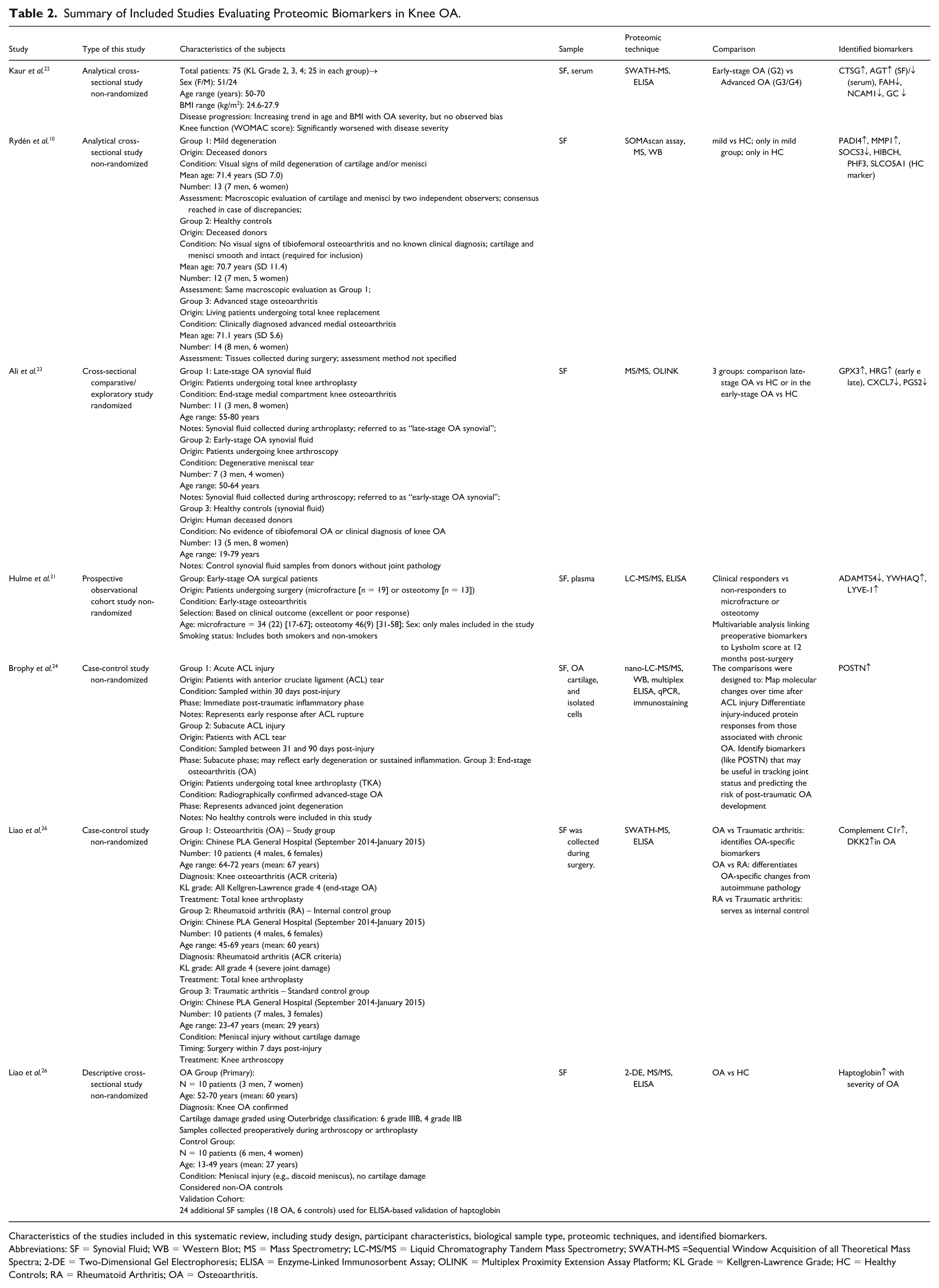
Characteristics of the studies included in this systematic review, including study design, participant characteristics, biological sample type, proteomic techniques, and identified biomarkers.
Abbreviations: SF = Synovial Fluid; WB = Western Blot; MS = Mass Spectrometry; LC-MS/MS = Liquid Chromatography Tandem Mass Spectrometry; SWATH-MS =Sequential Window Acquisition of all Theoretical Mass Spectra; 2-DE = Two-Dimensional Gel Electrophoresis; ELISA = Enzyme-Linked Immunosorbent Assay; OLINK = Multiplex Proximity Extension Assay Platform; KL Grade = Kellgren-Lawrence Grade; HC = Healthy Controls; RA = Rheumatoid Arthritis; OA = Osteoarthritis.
Identified Biomarkers
Across the included studies, a broad range of proteomic biomarkers were identified in patients with knee OA, many of which were quantitatively assessed. These biomarkers are primarily involved in inflammatory signaling, ECM degradation, oxidative stress, and cartilage or synovial tissue remodeling.27
-29 These proteins are mainly involved in extracellular matrix remodeling, inflammatory signaling, oxidative stress regulation, and cartilage or synovial tissue turnover. Examples include Cathepsin G (CTSG), angiotensinogen (AGT), periostin (POSTN), haptoglobin (HP), complement-related proteins, and matrix-associated molecules such as ADAMTS4 and LYVE-1.28,30 Quantitative comparisons between disease stages (early vs late OA), or between OA patients and healthy or disease controls, revealed distinct expression profiles across the included studies (
Comparative Quantitative Expression of Proteomic Biomarkers in OA.
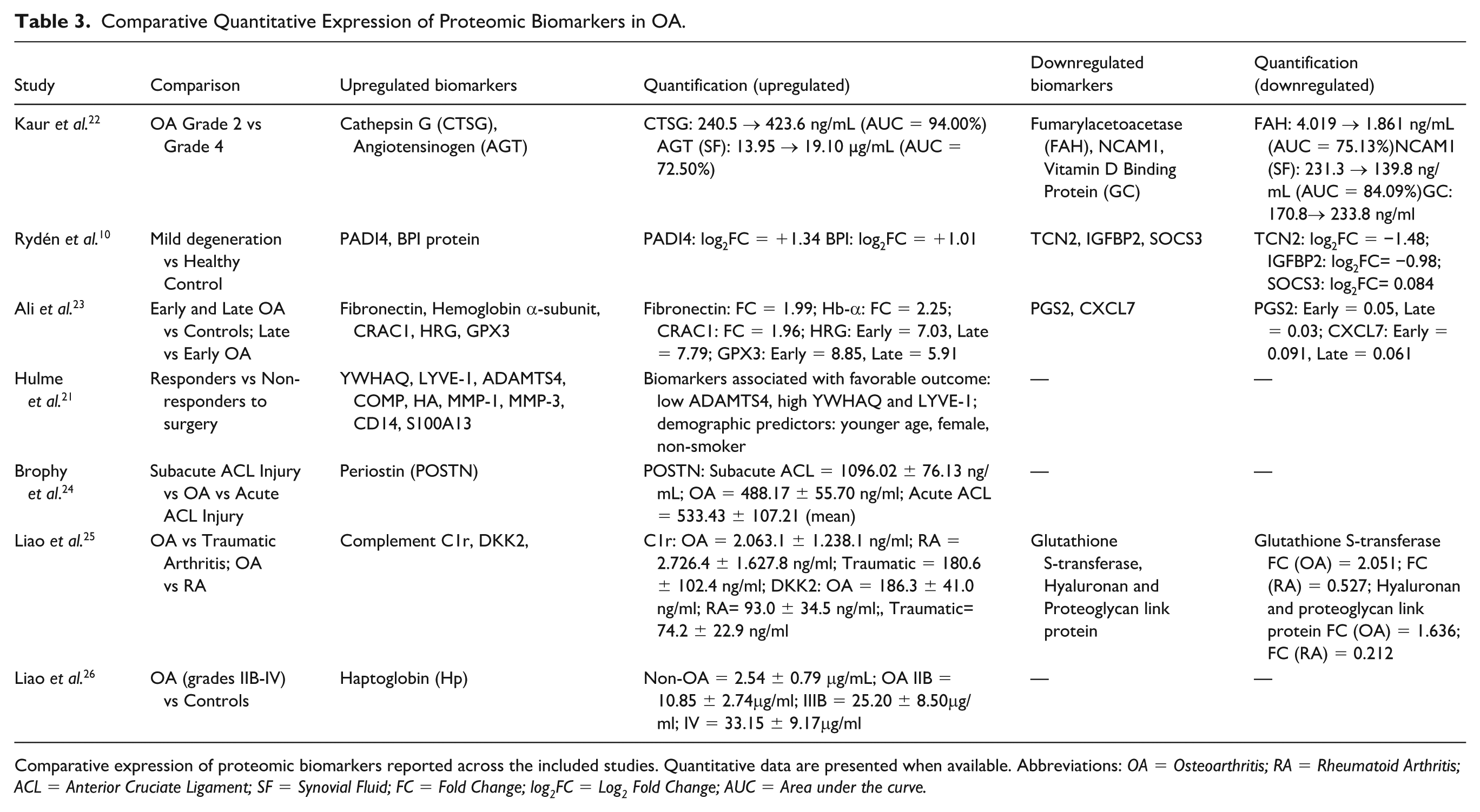
Comparative expression of proteomic biomarkers reported across the included studies. Quantitative data are presented when available. Abbreviations: OA = Osteoarthritis; RA = Rheumatoid Arthritis; ACL = Anterior Cruciate Ligament; SF = Synovial Fluid; FC = Fold Change; log2FC = Log2 Fold Change; AUC = Area under the curve.
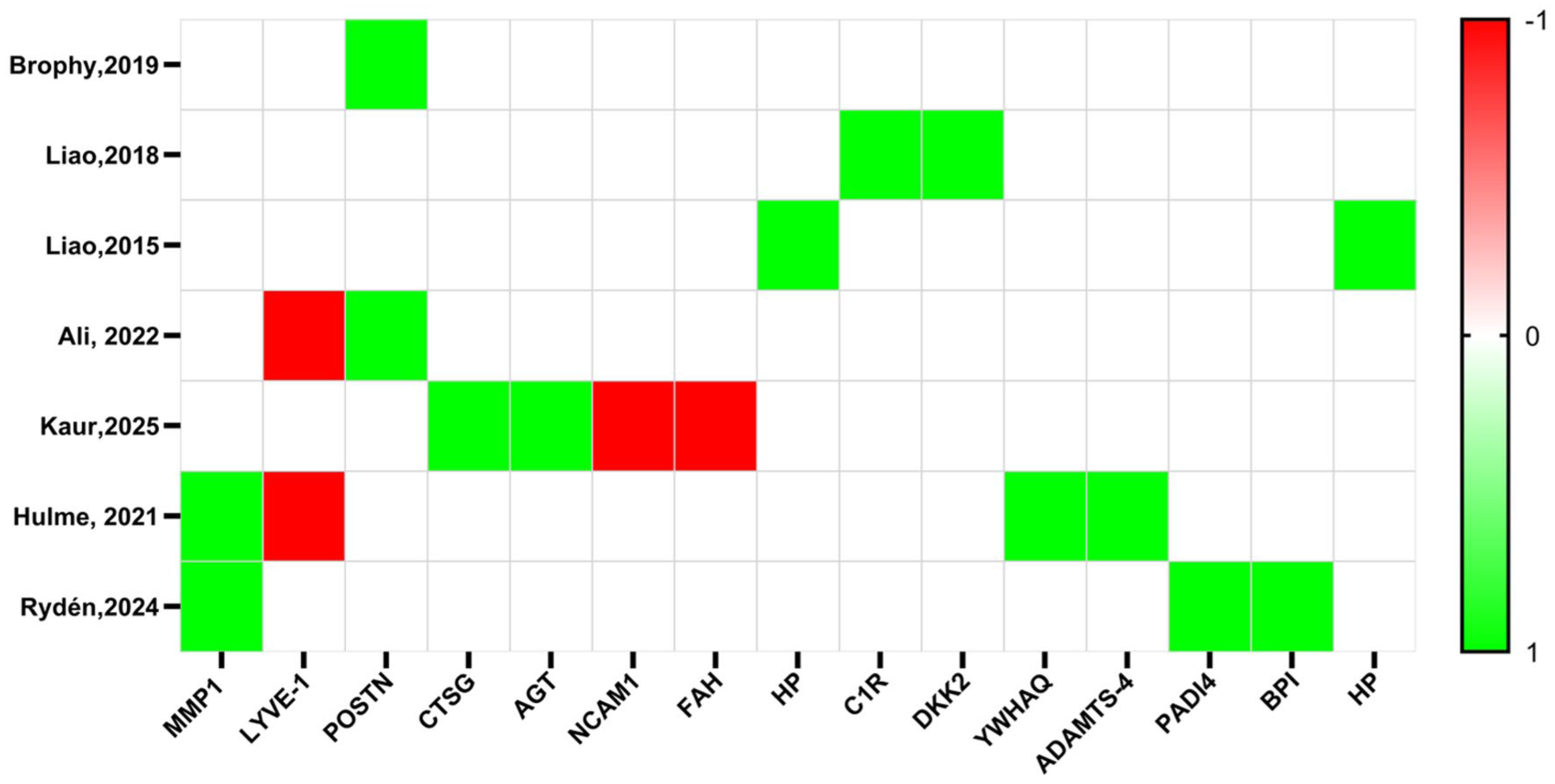
Heatmap summarizing the regulation trends of selected synovial fluid biomarkers identified across the included proteomic studies in knee OA. Upregulated proteins are shown in green (+1), downregulated proteins in red (−1), and absence of reported differential expression in white (0). Biomarkers were selected from statistically significant findings reported in the original studies and include both recurrent candidates and representative proteins identified in individual studies.
To further identify biomarkers with higher reproducibility and translational potential, we conducted a cross-study comparison to determine which proteins were more frequently reported. This approach allowed us to filter out single-study findings and focus on a set of frequently reported biomarkers that may serve as more robust candidates for future validation. Across the included studies, several candidate biomarkers were identified, including CTSG, AGT, periostin (POSTN), haptoglobin (HP), complement-related proteins, LYVE-1, YWHAQ, and ADAMTS4. However, most biomarkers were reported in only one or two studies, reflecting the exploratory nature of current proteomic research in knee OA. These molecules were associated with key OA-related processes, including inflammation,
27
cartilage breakdown,
29
oxidative defense,
33
and intracellular signaling.
28
Cross-study comparison revealed a limited overlap of identified biomarkers across the included studies. Only a small number of proteins were reported in more than one study, and in most cases these biomarkers were identified in only two studies. These markers are summarized in
Biomarkers Identified in More Than One Included Study.

Biomarkers identified in more than one included study, indicating the supporting studies, sample type, and proteomic methodologies used for their detection.
Abbreviations: OA = Osteoarthritis; SF = Synovial Fluid; MMP1 = Matrix Metalloproteinase 1; LYVE-1 = Lymphatic Vessel Endothelial Hyaluronan Receptor 1; POSTN = Periostin.
Functional Enrichment Analysis of Frequently Reported Biomarkers
To elucidate the functional landscape of the most consistently reported proteomic biomarkers in knee OA, a gene enrichment analysis was conducted using ShinyGO v0.76. The analysis included proteins reported in at least two of the included studies and encompassed three GO domains: Biological Processes (BP), Molecular Functions (MF), and Cellular Components (CC) as well as pathway-level annotation via KEGG. Within the BP category, the most enriched terms (FDR <0.05) included cartilage development and extracellular matrix organization. The most prominent processes included cartilage development involved in endochondral bone morphogenesis, extracellular matrix organization, collagen fibril organization, and skeletal system morphogenesis. These processes reflect the fundamental role of ECM remodeling and cartilage structural changes in OA pathophysiology. Key proteins contributing to these terms included structural and matrix-associated proteins such as ACAN, COL1A1, DCN, POSTN, COMP, and CILP, as well as matrix-degrading enzymes including MMP1, MMP3, MMP13, and ADAMTS4, which are well known to participate in cartilage degradation and remodeling during disease progression (

Functional enrichment analysis of frequently reported knee osteoarthritis biomarkers. (
Together, these results delineate a biologically coherent framework in which OA-related proteins are predominantly secreted, matrix-interacting molecules with key roles in immune signaling, oxidative defense, and cartilage remodeling.
Network-Based Visualization of OA-Related Biomarkers
To further investigate the molecular interactions among the identified OA-related proteins, a PPI network was generated using the STRING database (version 12.0). The resulting network (

Protein-protein interaction (PPI) network of frequently reported knee osteoarthritis biomarkers. PPI network of frequently reported osteoarthritis biomarkers. Nodes represent proteins and edges indicate predicted interactions. Key hub proteins involved in extracellular matrix remodeling, inflammation, and immune regulation are highlighted.
Discussion
This systematic review synthesizes current evidence on proteomic biomarkers identified in the synovial fluid of patients with early and late knee OA. Across the seven included studies, we identified a heterogeneous set of candidate proteins. Among the biomarkers identified there were CTSG, AGT, periostin (POSTN), haptoglobin (HP), and matrix-related proteins such as ADAMTS4 and LYVE-1. These molecules were primarily detected in synovial fluid but in some cases also in serum, suggesting their potential relevance as both local and systemic disease indicators.10,21 -26 Notably, biomarkers such as CTSG and AGT were upregulated in late-stage OA compared to early-stage disease, pointing to their association with disease progression. Several proteins involved in extracellular matrix remodeling, including MMP1, MMP3, MMP13, ADAMTS4, and COMP, were enriched in OA synovial fluid, highlighting the active degradation and remodeling of cartilage matrix during disease progression.20,23,24 Similarly, ADAMTS4 and MMP-1, both matrix-degrading enzymes, highlight the ongoing ECM turnover in the OA joint microenvironment.22,27 The consistent appearance of these proteins across multiple studies and platforms strengthens their candidacy as diagnostic or prognostic biomarkers. Functional enrichment analyses using GO and KEGG databases indicated that these biomarkers are primarily involved in extracellular matrix organization, proteolytic activity, and cell-matrix interactions, with enriched pathways including ECM-receptor interaction, IL-17 signaling, and AGE-RAGE signaling pathways.6,10 The PPI network analysis further underscored the centrality of COL1A1, ACAN, COMP, and POSTN, together with matrix-degrading enzymes such as MMP1, MMP3, and MMP13. 10 Our findings are consistent with previous systematic investigations of synovial fluid proteomics in OA. Several studies highlighted the diagnostic potential of these biomarkers. For instance, AGT and CTSG showed distinct expression profiles between early and late OA stages, with receiver operating characteristic (ROC) analyses supporting their discriminatory capacity.21,22 This aligns with previous evidence that inflammatory and ECM-related biomarkers rise with disease severity, often reflecting irreversible structural changes in the joint.39,40 In addition, oxidative markers such as GPX3 were associated with redox imbalance in the synovial fluid, a key contributor to chondrocyte apoptosis and matrix damage in OA.6,27 From a clinical perspective, these findings may support the development of biomarker panels for non-invasive disease monitoring. Future platforms may integrate synovial biomarker levels with imaging to provide a composite disease activity index. For example, quantification of AGT, MMP-1, and IL-6 in synovial fluid or serum may enhance sensitivity in detecting early inflammatory OA subtypes or predicting response to therapies. Multiplex assays or aptamer-based technologies (SOMAscan) may also provide rapid, high-throughput screening suitable for clinical settings.10,21,41 Despite these promising directions, the current body of evidence is limited by several factors. The included studies varied in sample type, analytical techniques (LC-MS/MS, SWATH-MS, ELISA), and patient stratification criteria. This methodological heterogeneity likely contributes to quantitative variability and restricts generalizability. Moreover, many studies had small sample sizes and lacked validation cohorts or longitudinal follow-up.21,24,26 Importantly, very few biomarkers were assessed across multiple biological matrices, limiting insights into tissue-specific versus systemic expression profiles. Most studies were observational and exploratory, with limited power to draw causal inferences. From a translational standpoint, the identification of synovial fluid biomarkers related to extracellular matrix remodeling, including COMP, ACAN, COL1A1, and POSTN, together with inflammatory mediators such as CTSG and IL6, highlights promising candidates for the development of integrated diagnostic panels or point-of-care assays in OA. An additional limitation relates to the heterogeneity of the patient populations included across studies. Differences in disease stage, demographic characteristics, and clinical background may influence synovial fluid composition and biomarker expression profiles. Consequently, caution is required when interpreting cross-study comparisons, as some observed differences may reflect population-specific characteristics rather than universal OA-related molecular signatures. The biomarkers identified could serve as adjuncts to imaging or clinical assessment to enhance early detection and stratify disease stages. Furthermore, combining proteomic data with transcriptomic or metabolomic profiles and machine learning models could support the development of predictive tools for OA progression or treatment efficacy.24,41,42 A relevant limitation of this review is the limited overlap of biomarkers across studies. Most proteins were identified in single studies, while only a small number of biomarkers were reported in more than one investigation. In most cases, these markers were identified in only two studies, which limits the strength of conclusions regarding their reproducibility. In the present review, biomarkers described as “common” were operationally defined as those reported in at least two independent studies. However, this definition should be interpreted with caution. Another limitation of this review is the relatively small number of eligible studies identified after applying strict inclusion criteria. While this approach ensured methodological consistency and focus on proteomic analyses of synovial fluid, it may limit the generalizability of the findings.
Future research should focus on standardizing sample collection and analytical workflows, validating biomarker panels in diverse and longitudinal cohorts, and exploring the integration of multi-omics data for a systems-level understanding of OA. These efforts are essential to bridge the gap between proteomic discovery and clinical application, ultimately advancing precision medicine in musculoskeletal disease.
Conclusion
This systematic review highlights the potential of proteomic analysis of synovial fluid to identify molecular biomarkers associated with the pathogenesis and progression of knee osteoarthritis. Several candidate biomarkers were reported, including Cathepsin G (CTSG), angiotensinogen (AGT), periostin (POSTN), haptoglobin (HP), and matrix-associated proteins such as ADAMTS4 and LYVE-1. These molecules are involved in key biological processes relevant to osteoarthritis, including inflammatory signaling, extracellular matrix remodeling, and joint tissue homeostasis. Proteomic profiling and network-based analyses provide valuable insights into the molecular pathways underlying disease development and progression. However, most biomarkers were reported in a limited number of studies, reflecting the exploratory nature of current research and highlighting the need for further validation. Although these findings highlight promising candidate biomarkers, the limited number of available studies and methodological heterogeneity currently limit their clinical translation. Future research should focus on standardized sampling and analytical protocols, larger multicenter cohorts, and integration with multi-omics and computational approaches. These efforts will be essential to validate candidate biomarkers and support the development of reliable, minimally invasive tools for early diagnosis, disease monitoring, and personalized management of knee OA. In addition, the application of artificial intelligence and machine learning algorithms may provide new opportunities for the analysis of complex proteomic datasets and for the identification of novel biomarker signatures associated with early osteoarthritis.
Supplemental Material
sj-docx-1-car-10.1177_19476035261446251 – Supplemental material for Synovial Fluid Proteomic Biomarkers in Knee Osteoarthritis: A Systematic Review and Gene Ontology Analysis
Supplemental material, sj-docx-1-car-10.1177_19476035261446251 for Synovial Fluid Proteomic Biomarkers in Knee Osteoarthritis: A Systematic Review and Gene Ontology Analysis by Elvira Immacolata Parrotta, Giorgia Lucia Benedetto, Giovanni Cuda, Raffaele Covello, Umile Giuseppe Longo, Arianna Carnevale, Olimpio Galasso, Giorgio Gasparini and Michele Mercurio in CARTILAGE
Supplemental Material
sj-ods-2-car-10.1177_19476035261446251 – Supplemental material for Synovial Fluid Proteomic Biomarkers in Knee Osteoarthritis: A Systematic Review and Gene Ontology Analysis
Supplemental material, sj-ods-2-car-10.1177_19476035261446251 for Synovial Fluid Proteomic Biomarkers in Knee Osteoarthritis: A Systematic Review and Gene Ontology Analysis by Elvira Immacolata Parrotta, Giorgia Lucia Benedetto, Giovanni Cuda, Raffaele Covello, Umile Giuseppe Longo, Arianna Carnevale, Olimpio Galasso, Giorgio Gasparini and Michele Mercurio in CARTILAGE
Supplemental Material
sj-tsv-3-car-10.1177_19476035261446251 – Supplemental material for Synovial Fluid Proteomic Biomarkers in Knee Osteoarthritis: A Systematic Review and Gene Ontology Analysis
Supplemental material, sj-tsv-3-car-10.1177_19476035261446251 for Synovial Fluid Proteomic Biomarkers in Knee Osteoarthritis: A Systematic Review and Gene Ontology Analysis by Elvira Immacolata Parrotta, Giorgia Lucia Benedetto, Giovanni Cuda, Raffaele Covello, Umile Giuseppe Longo, Arianna Carnevale, Olimpio Galasso, Giorgio Gasparini and Michele Mercurio in CARTILAGE
Footnotes
Acknowledgements
We thank the developers of the ShinyGO and STRING databases for their freely accessible analytical platforms, BioRender and GraphPad software.

Ethical Considerations
This article is a systematic review of previously published studies. Ethical approval was obtained from the original studies.
Informed Consent
This article is a systematic review of previously published studies. Participant consent was obtained from the original studies, as stated by the respective authors. No new data involving human participants were collected or analyzed by the authors of this review.
Consent for Publication
Not applicable. This review does not include identifiable individual data or images.
Author Contributions
E.I.P., G.L.B., and M.M. contributed equally to the conception and writing of the manuscript. G.C. and R.C. provided critical revisions and conceptual guidance. U.G.L. and A.C. contributed to the data analysis and interpretation. O.G., G.G., and M.M. supervised the project and provided final approval of the manuscript. All authors read and approved the final version of the manuscript.
Funding
The authors disclosed receipt of the following financial support for the research, authorship, and/or publication of this article: This work was supported by the following funding: Funded by the European Union – Next Generation EU – NRRP M6C2 – Investment 2.1 Enhancement and strengthening of biomedical research in the NHS (Project no. PNRR-MAD-2022-12376080 – CUP: F83C22002450001).
Declaration of Conflicting Interests
The authors declared no potential conflicts of interest with respect to the research, authorship, and/or publication of this article.
Data Availability Statement
All the data generated or analyzed during this study are included in this published article and its supplementary information files. Supplementary files include full enrichment results (GO, KEGG) and PPI network tables.
Declaration of Generative AI And AI-Assisted Technologies
During the preparation of this manuscript, the authors used ChatGPT to enhance language clarity and readability. Following this, the authors carefully reviewed and revised the content as necessary and took full responsibility for the accuracy and integrity of the publication.
References
Supplementary Material
Please find the following supplemental material available below.
For Open Access articles published under a Creative Commons License, all supplemental material carries the same license as the article it is associated with.
For non-Open Access articles published, all supplemental material carries a non-exclusive license, and permission requests for re-use of supplemental material or any part of supplemental material shall be sent directly to the copyright owner as specified in the copyright notice associated with the article.
