




Abstract
Objective
Pathology of the facet and sacroiliac (SI) joints contributes to 15% to 45% and 10% to 27% of lower back pain cases, respectively. Although tissue engineering may offer novel treatment options to patients suffering from cartilage degeneration in these joints, the tribological characteristics of the facet and SI joints have not been studied in either the human or relevant large animal models, which hinders the development of joint-specific cartilage implants.
Design
Cartilage was isolated from the knee, cervical facet, thoracic facet, lumbar facet, and SI joints of 6 skeletally mature Yucatan minipigs (Sus scrofa). Tribological characteristics were assessed via coefficient of friction testing, interferometry, and immunohistochemistry for lubricin organization.
Results
Compared with the knee, the coefficient of friction was higher by 43% in the cervical facet, 77% in the thoracic facet, 37% in the lumbar facet, and 28% in the SI joint. Likewise, topographical features of the facet and SI joints varied significantly, ranging from a 114% to 384% increase and a 48% to 107% increase in global and local surface roughness measures, respectively, compared with the knee. Additionally, the amount of lubricin in the SI joint was substantially greater than in the knee. Statistical correlations among the various tribological parameters revealed that there was a significant correlation between local roughness and coefficient of friction, but not global roughness or the presence of lubricin.
Conclusion
These location-specific tribological characteristics of the articular cartilages of the spine will need to be taken into consideration during the development of physiologically relevant, functional, and durable tissue-engineered replacements for these joints.
Introduction
Lower back pain afflicts approximately 59 million patients in the United States. 1 The etiology of back pain is complex and can have a multitude of causes, such as the facet joints, sacroiliac (SI) joints, and intervertebral disc (IVD). Two facet joints and an IVD make up the 3-joint complex between spinal segments. Pain originating from the facet joints of the spine and the SI joint accounts for a significant portion of this disability; pain associated with facet joint and SI joint degeneration is estimated to afflict 9 to 26 million1,2 and 6 to 16 million1,3 Americans, respectively. Similar to osteoarthritis of the knee, this pain is often caused by the degeneration of cartilage within the joint. Patients suffering from facet or SI arthrosis are most often treated by palliative methods, such as nerve blocks and neurotomies, to temporarily alleviate the pain.4-6 Most often palliative treatments, such as nerve blocks and neurotomies, are performed to temporarily alleviate the pain.4-6 Alternatively, permanent fusions can be used to immobilize the facet joint, but this disrupts the biomechanics of nearby joints causing adjacent segment disease and further degeneration within the spine.7,8 For both the facet and SI joints, there are no restorative treatment options that target the underlying joint degeneration, such as a tissue-engineered replacement of the cartilage tissue. The development of such treatments is undoubtedly needed by millions of patients but is hindered by a limited understanding of the biomechanical requirements specific to the cartilage of these spinal segments.
Articular cartilage has 2 main functions: to transmit and distribute forces during locomotion and to provide a low friction surface on which bones can articulate. 9 While the load-bearing characteristics of cartilage are often studied, the lubrication qualities of cartilage have been less commonly investigated. Tribology is the science of how 2 surfaces interact as they slide across each other and has been used within cartilage research to investigate friction and lubrication characteristics during joint articulation. 10 Several interrelated parameters are used to assess the tribological properties of cartilage tissue, including surface roughness and coefficient of friction. 10 Lubricin localization is another tribological tissue characteristic as it is a protein produced by superficial zone chondrocytes that has been shown to reduce the coefficient of friction within cartilage thereby protecting the articulating surface from wear. 11 Lubricin, along with hyaluronan, aggrecan, phospholipids, and several other proteins, make up a polymer brush border on the cartilage surface, which has been demonstrated to maintain interstitial fluid pressure and enhance cartilage lubrication. 12 To date, the vast majority of lubricin research has been conducted in the knee, 13 including the articular cartilage and meniscus, but lubricin has also been shown to be expressed by the IVD 14 and vertebral endplates. 15 While relatively few studies have been conducted to define the tribological parameters of native cartilage tissue in the knee, the tribological properties of articulating cartilages of the spine (i.e., facet and SI cartilage) have yet to be studied.
The objective of this work is to conduct a comparative study characterizing the tribological properties of the cervical facet, thoracic facet, lumbar facet, and SI joint to those of the knee. A problem that plagues tribology literature is that variable testing conditions make interlaboratory comparisons difficult. 10 Thus, the current study compares cartilage from multiple joints to establish lubrication characteristics of the joints of interest within a single study. Given the relatively static contact areas of the facet and SI joints, we employed a stationary contact area test under boundary lubrication conditions. Spinal joints with little articulation lose fluid pressurization, thus minimizing the role of interstitial lubrication. Moreover, boundary lubrication conditions are often used to evaluate cartilage.16-19 Lubrication modes and knee cartilage function have been more thoroughly reviewed elsewhere. 20 The minipig was chosen as a relevant animal model because it is an American Society for Testing and Materials (ASTM)- and Food and Drug Administration (FDA)-recommended model for spine-related indications.21,22 Also, we have previously demonstrated that minipig facet cartilage has similar functional properties to human facet cartilage. 23 In this study, we use 4 different measures to characterize surface properties (coefficient of friction, local roughness, global roughness, and lubricin localization) and determine how significantly they contribute to articulating function through correlations. We hypothesized that the tribological properties of spinal articular cartilages not only differ from knee articular cartilage but also depend on location. The results from this study will allow us to establish design criteria for the development of future tissue-engineered facet and SI joint implants as well as to elucidate structure-function relationships of the facet and SI joints. This work provides an essential contribution toward the development of future therapies to treat the underlying degeneration in facet and SI joint diseases.
Materials and Methods
Tissue Harvest
Tissue was harvested from 6 skeletally mature (18-24 months) female Yucatan minipigs that were sacrificed for reasons unrelated to the current study. Knee cartilage was taken from the condyles. Facet tissue was taken from the inferior surface of the sacral +1 level (i.e., L5-L6 or L4-L5 because minipigs have varying numbers of lumbar segments), the T4-T5 level, and the C6-C7 level. These clinically relevant locations correspond to facet joints with a high proclivity for degeneration in the human. SI joint tissue was taken from the sacral surface. Cartilage tissue was removed from the bone with a scalpel, and the orientation of the cartilage was marked with India ink. The tissue was stored at 4 °C in 25 mM HEPES in chemically defined chondrogenic medium (CHG; Dulbecco’s modified Eagle’s medium with high glucose/GlutaMAX [Life Technologies, Grand Island, NY], 1% penicillin-streptomycin-fungizone [Lonza, Basel, Switzerland], 1% nonessential amino acids [Life Technologies], 1% ITS+ Premix [BD Biosciences, San Jose, CA], 50 μg/mL ascorbate-2-phosphate [Sigma-Aldrich, St. Louis, MO], 40 μg/mL
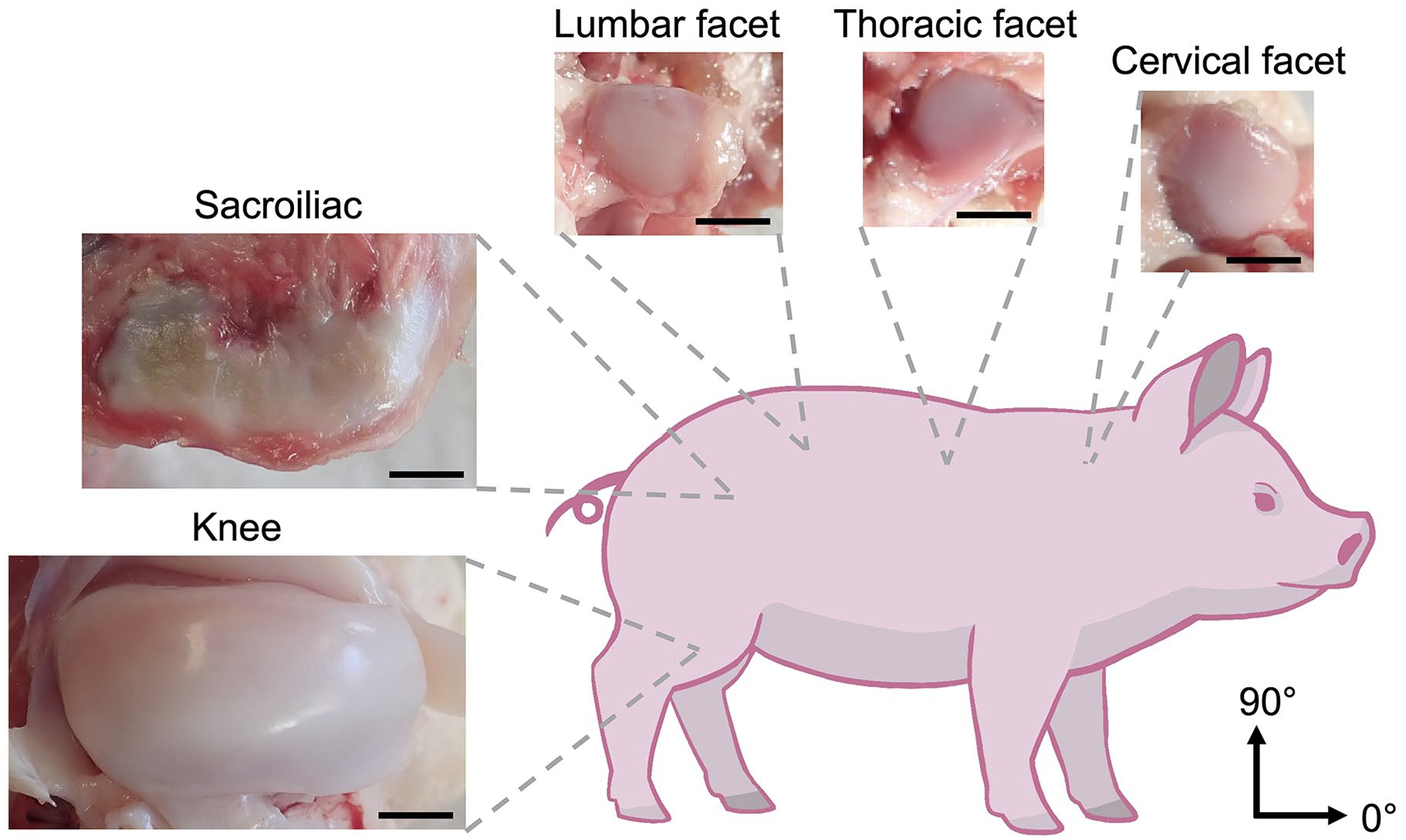
Gross appearance of cartilage in the knee, sacroiliac, lumbar facet, thoracic facet, and cervical facet joints (scale bars = 0.5 cm). All tissue was marked with the cranial/caudal axis representing 0°.
Tribological Testing
The coefficient of friction was measured with a custom pin-on-disk tribometer, which has been described previously, 24 set up to perform under boundary lubrication conditions. Tissue punches (2 mm in diameter) were taken from each sample and glued to the pin. The samples were tested in both the 0° and 90° orientations, randomizing which direction was tested first. Samples were immersed in phosphate buffered saline and tested on a glass plate. A load of 300 g was applied to the samples. The samples were allowed to equilibrate for 2 minutes before commencing a 5-minute friction test that was conducted at a speed of 0.5 mm/s. Data were collected at a rate of 10 Hz.
Interferometry
Surface topography was measured using a 20X Mirau objective on an MSA-500 Micro System Analyzer (Polytec, Waldbronn, Germany). Samples were lightly blotted to remove excess moisture. Average surface roughness (Sa) and core material volume (Vmc) are measures of the surface’s small- and large-scale features ( Fig. 2 ), respectively, and were determined using the TMS 3.8 software (Polytec). 25 Sa is an arithmetical mean of surface height deviations from a centerline. When calculated for a region of interest with no large-scale height changes, this is an excellent measure of the surface’s local roughness. Conversely, small textural surface features do little to contribute to the roughness profile integral used to calculate Vmc, which is used here to describe the surface’s global roughness. It is important to note that Vmc typically excludes points outside of the 20% to 80% height range. 26 For clarity, we will refer to Sa as local roughness and Vmc as global roughness for the remainder of the text. Surface anisotropy was quantified using the Directionality plugin in ImageJ (National Institutes of Health), which generates a histogram indicating the preferred orientation of the structures in the image. The histogram was fit to a Gaussian function. The dispersion of the Gaussian’s peak was used as a measure of anisotropy. Highly anisotropic surfaces show low dispersion.
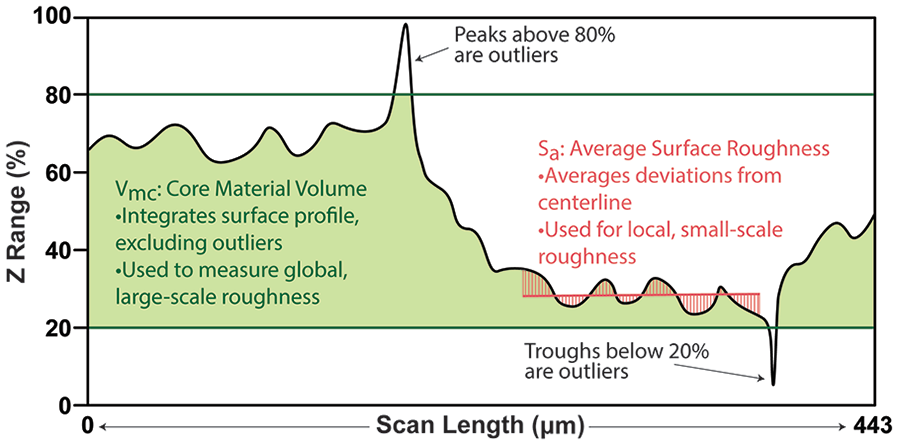
Surface parameters defined on a 2-dimensional surface profile. Core material volume (Vmc, green) is calculated across the entire scan length, capturing large-scale changes in surface height. Vmc excludes points found above 80% and below 20% of the measured range along the Z-axis. Average surface roughness (Sa, pink) is calculated within a user-defined region of interest at a stable elevation, thus describing small-scale textural roughness. Vmc and Sa are referred to as global and local roughness, respectively, throughout the text.
Lubricin IHC
The boundary lubricant found in cartilage’s superficial zone is known as either proteoglycan 4 (PRG4), superficial zone protein (SZP), or lubricin. 24 These are all isoforms of the prg4 gene. In the current study, we used the term lubricin as prescribed by the antibody manufacturer. Samples were fixed in 10% buffered formalin for 48 hours and embedded in paraffin. The samples were sectioned at a thickness of 6 μm and treated for 20 seconds on a hot plate and 3 minutes in an oven at 60 °C to increase adherence of the samples to the silanized slides. Prior to staining, slides were baked at 60 °C in 2 mL of formalin for 1 hour. Endogenous peroxidase activity was quenched with 3% hydrogen peroxide in methanol for 30 minutes. Antigen retrieval was performed in citrate buffer at 90 to 100 °C for 30 minutes. The slides were incubated overnight with a 1:500 dilution of the mouse anti-lubricin primary antibody, clone 9G3 (Sigma) at 4 °C. Secondary antibody incubation was then performed at room temperature for 30 minutes using the mouse IgG Vectastain ABC kit. Last, DAB (Vector Laboratories) was applied for 4 minutes to induce color development. All slides were stained together.
A custom-made Matlab program was made to semiquantitatively assess differences in lubricin staining. A 340 × 130 μm region of interest was defined for each micrograph, excluding areas without tissue as well as deeper regions of the tissue sections which universally lacked lubricin. These images were thresholded to isolate lubricin-positive pixels. Lubricin-positive pixels were counted and used to calculate a percentage of lubricin within the region of interest. Depth of lubricin staining was evaluated by ImageJ analysis.
Statistics
Statistics were carried out in Prism 8 (GraphPad Software, San Diego, CA). Two-way and 1-way analyses of variance (ANOVA) were used to analyze data sets with Tukey’s post hoc testing at P < 0.05. Data are presented as the average ± standard deviation. Spearman’s ρ correlations were performed between the coefficient of friction, local roughness, global roughness, and lubricin localization. Correlations were conducted on the data as a whole, rather than in a joint-specific manner. The strength and direction of the correlation are given by ρ and significance is obtained when P < 0.05.
Results
Gross Morphology of Joints
On visual inspection of the joints, the cartilage of the facet joints resembled the hyaline articular cartilage of the condyle ( Fig. 1 ). Relatively smooth articulating surfaces were observed in all facet joints while the SI joint appeared to be more textured. Moreover, the cartilage in the facet joints and the knee was translucent white, whereas the SI joint exhibited yellow coloration in some locations.
Friction
The coefficient of friction was dependent on the joint from which the cartilage was isolated ( Fig. 3 ). In a 2-way ANOVA, the effect of joint was statistically significant, but the effect of orientation was not significant. The coefficient of friction of knee cartilage was 0.28, which was significantly lower than in the cervical (P = 0.021) and thoracic (P = 0.0003) joints with coefficients of friction of 0.43 and 0.50 (i.e., 54% and 77% higher), respectively. The thoracic cartilage coefficient of friction was also significantly higher than the SI joint coefficient of friction of 0.36 (P = 0.042). While not significantly greater, the coefficient of friction in the SI joint was 28% higher than in the knee. The lumbar joint, with a coefficient of friction of 0.38, was not significantly different than any other joint but trended 37% higher than in the knee.
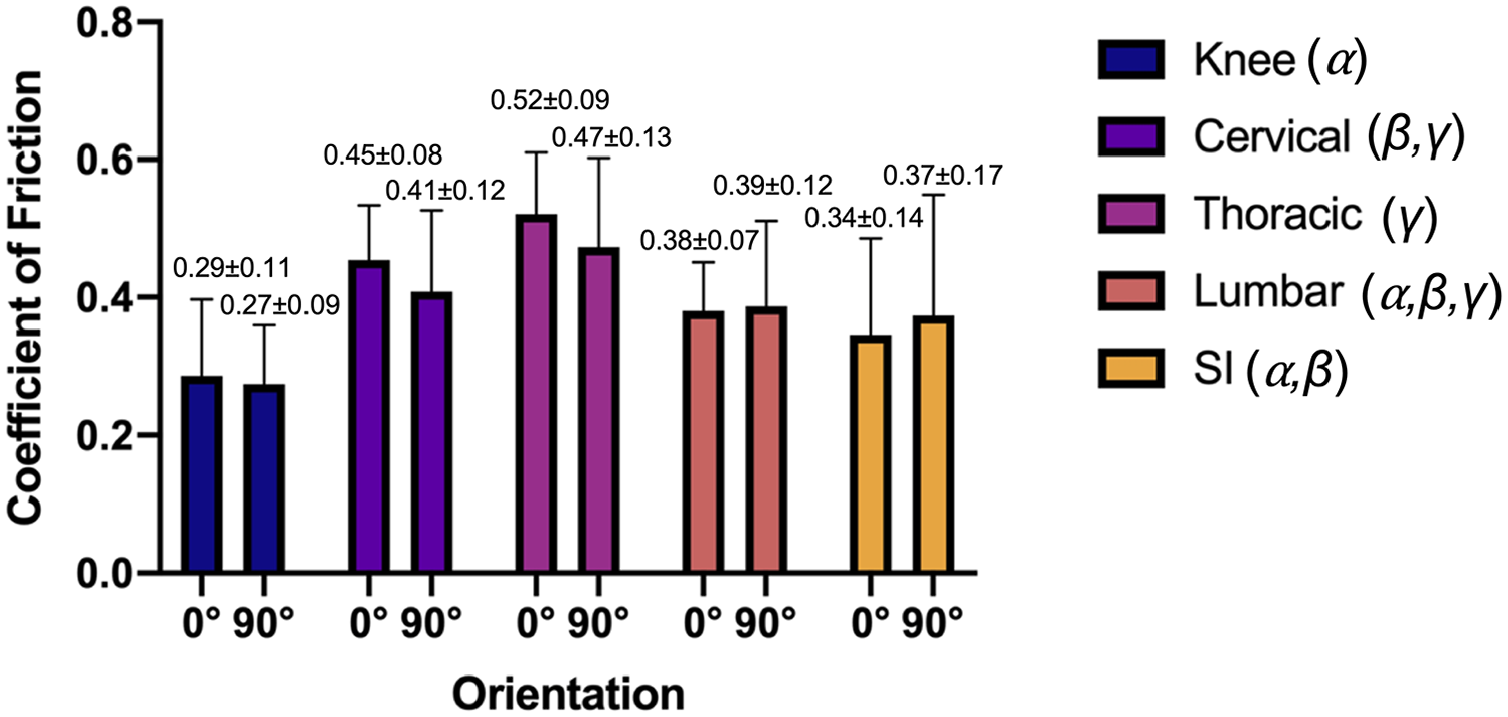
Coefficients of friction of the articulating surfaces in the knee, facet, and sacroiliac (SI) joints. A 2-way analysis of variance (ANOVA) was used to determine statistically significant differences with factors of joint and orientation. Orientation was not found to be a significant factor. Joint groups not connected by the same letter (α, β, or γ) in the legend are statistically different from each other.
Interferometry
The surface topography of the cartilage samples is qualitatively different across the various joints ( Fig. 4 ). The topographical images were used to quantify surface roughness (global and local) and anisotropy. Global roughness values, Vmc, are significantly higher in the SI joint by 384% and 126% compared with the knee (P = 0.0006) and cervical (P = 0.0200) joints, respectively ( Fig. 5A ). These data concur with the topographical images in Figure 4 . With regard to local surface roughness, the knee’s Sa is significantly lower than the thoracic (P = 0.0066), lumbar (P = 0.037), and SI (P = 0.042) joint’s values by at least 32% ( Fig. 5B ). Although surface anisotropy follows a similar trend to the roughness measures, no significant differences were found across the different joints.
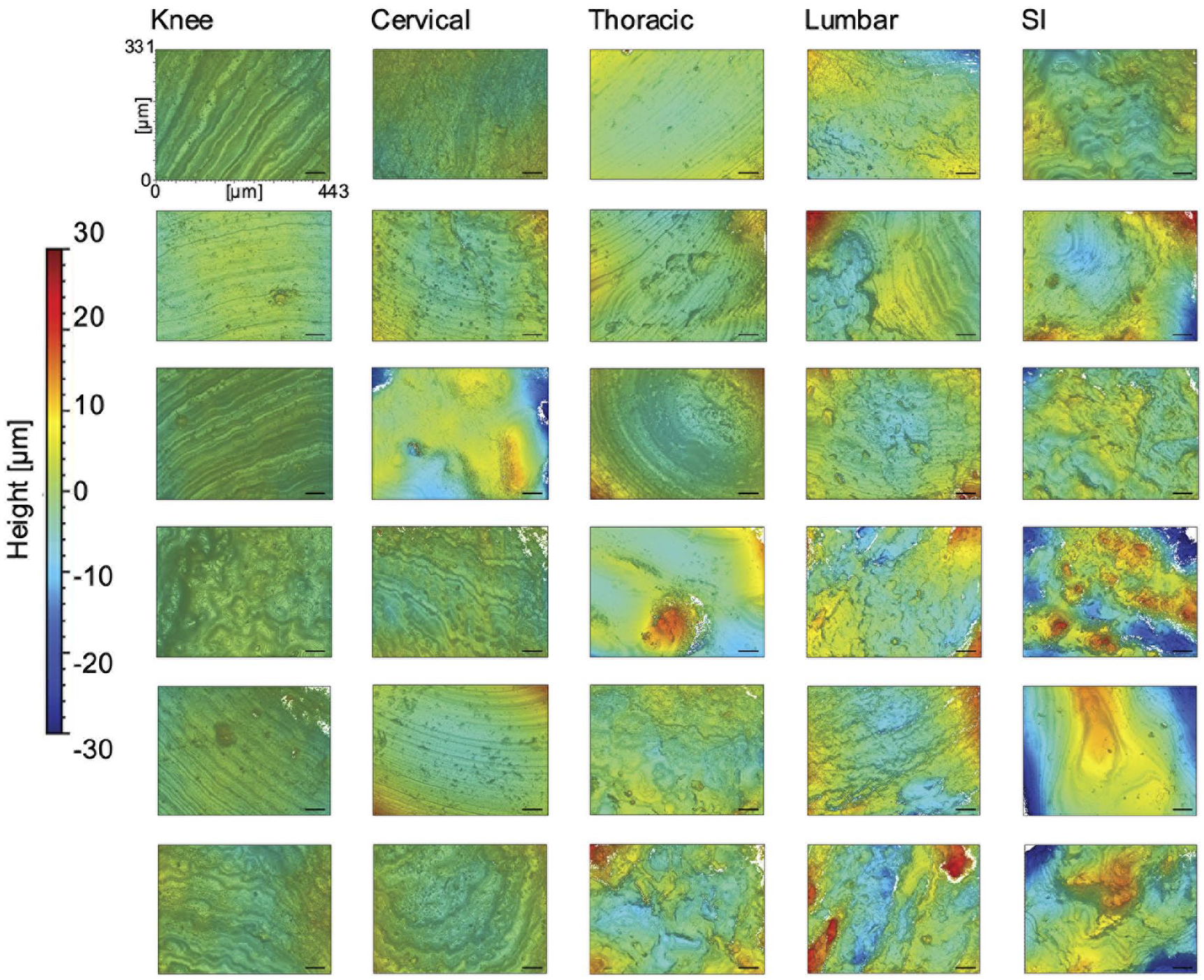
Surface topography of cartilage samples from various joints. Compared with the knee, the sacroiliac (SI) joint displays a large range of surface heights, as indicated by the color differences. Samples from the SI joint show substantial variation within their group. Striations on the cartilage surface are indicative of linear and circular topographical anisotropy, such as in the knee and cervical samples, respectively. Scale bar = 50 μm.
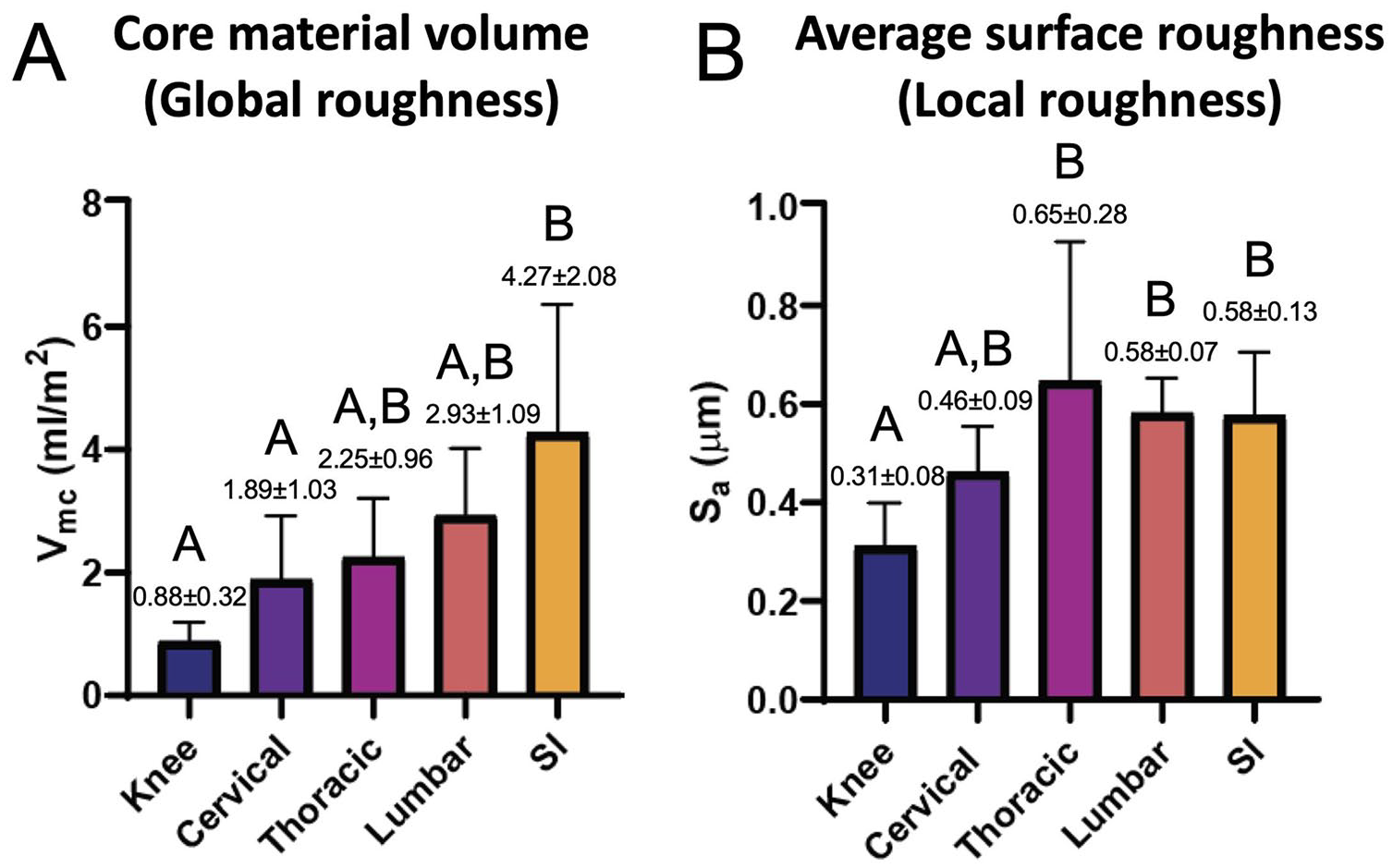
Surface parameters significantly differ across joints. The global (
Lubricin Organization
As expected, lubricin was found in the superficial zone of knee cartilage ( Fig. 6 ). Cells and lacunae within 200 μm of the knee cartilage surface were also positively stained. Cartilage from the cervical, thoracic, and lumbar facets all showed a thin layer of lubricin. Lubricin staining was not seen for the cells of the facet samples. When lubricin was assessed using our semiquantitative Matlab code, joint-specific differences were observed ( Fig. 6G ). Interestingly, the SI joint’s lubricin staining differed greatly across samples, ranging from 2.9% to 59.8% of the predefined region of interest. Lubricin quantification of all other joints was much more consistent, and no significant differences were observed. Depth of lubricin staining showed similar trends ( Fig. 6H ).
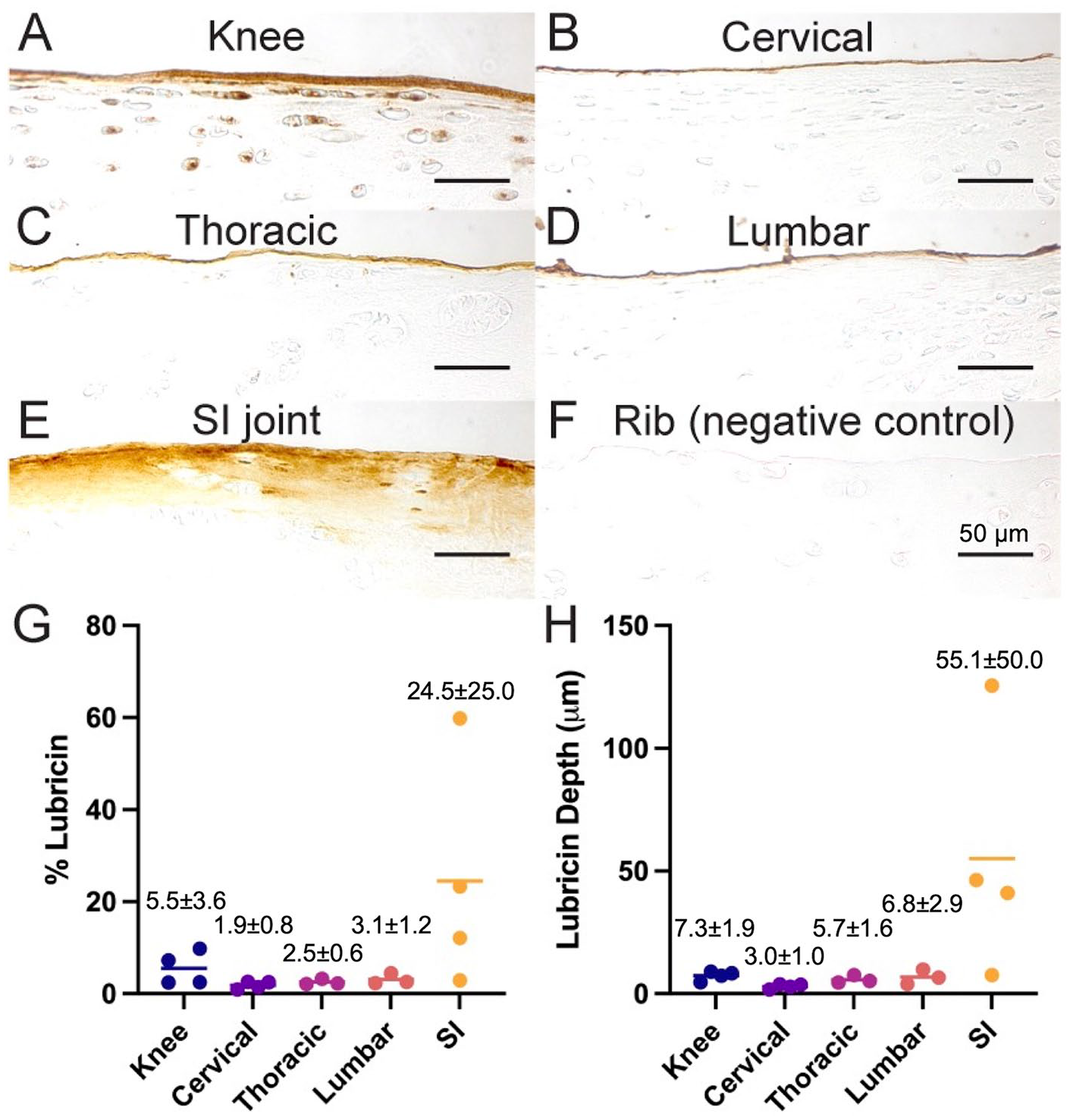
Immunohistochemistry of lubricin distribution in the (
Tribological Correlations
There was a significant (P = 0.009) correlation between Sa and coefficient of friction ( Fig. 7 ). The strength of the correlation (ρ) was moderate at 0.47. For the current data set, Vmc and the percentage of lubricin were not significantly correlated to the coefficient of friction (Supplemental Fig. 1).
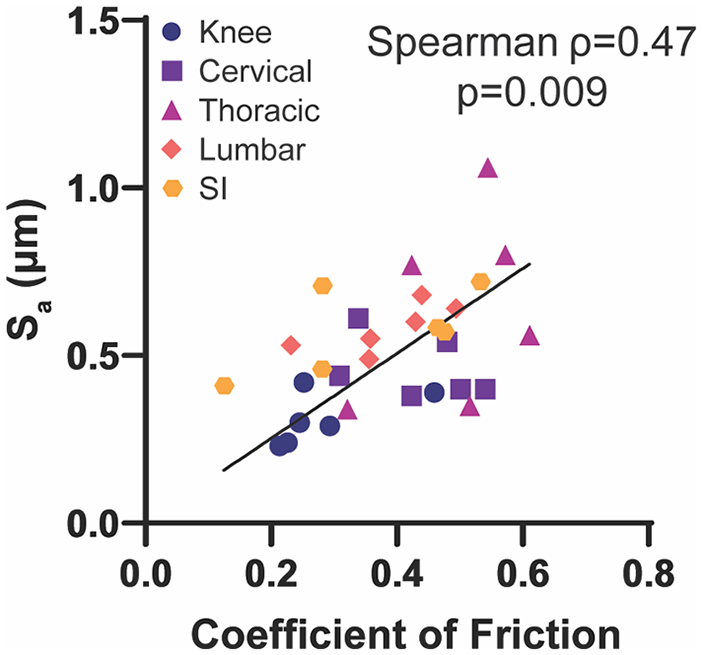
Coefficient of friction and local roughness have a moderate, yet significant, correlation (ρ = 0.47, P = 0.009). Individual data points are represented by markers, where color and shape correspond to the specified joint, and the correlation is represented by the solid black line.
Discussion
Although the facet and SI joints are increasingly implicated as frequent sources of back pain,27,28 there are still major gaps in our understanding of their function. Research on the biomechanics of these joints has traditionally focused on their kinematics29,30 and loading patterns.31,32 Additionally, load-bearing properties of the facet and SI joints’ articular cartilage, such as Young’s modulus and aggregate modulus, have been experimentally measured23,33-36 and subsequently used in computational models.37,38 However, despite the importance of low friction articulation to joint mechanics, the tribological properties (e.g., coefficient of friction, local surface roughness, global roughness, and lubricin localization) of spinal articular cartilage are severely understudied. The objective of this study was to characterize the tribology of the facet, SI, and knee joints, which we hypothesized would differ across joints. In support of this hypothesis, we found that tribological factors, such as coefficient of friction and surface topography, were joint dependent and varied across spinal levels. We also found that the cartilage surfaces displayed scale-dependent topographical features (local surface roughness, global roughness), which may provide distinct contributions to tribological function. Also, lubricin IHC varied greatly across joints, with the SI joint showing substantially more lubricin localization than the knee. These data were used to show that local surface roughness has a significant impact on the joint’s friction coefficient. This study provides a much-needed survey of facet and SI joint cartilage tribological properties in a clinically relevant animal model, not only for improved understanding of spinal joint mechanics but also for the development of targeted joint-specific therapies.
Tribological properties of the facet and SI joint vary significantly from the tribological properties of the knee, which could have important structure-function implications. The friction coefficients for knee cartilage reported here are comparable to those found in the literature under similar testing conditions.10,39 To the best of our knowledge, these data do not exist for the facet and SI joints. The friction coefficients from the present study may correlate to the greater range of motion (ROM) required in the knee than in either the facet or SI joints. Specifically, in the human, the knee has been reported to have a flexion/extension ROM of approximately 140° 40 whereas the flexion/extension ROM has been reported to be 8° to 17° in the cervical facet, 1° to 4° in the thoracic facet, 12° to 20° in the lumbar facet, 41 and 3° in the SI joint. 42 In this study, differential lubricin localization was observed. Lubricin has been shown to inhibit synovial cell overgrowth on articulating cartilage 43 and has been demonstrated to modulate the coefficient of friction between 2 surfaces. 44 In the current study, we found relatively low lubricin localization in the facet joints compared with the knee, which could be the result of lower ROM in the facets leading to a reduced need for a low coefficient of friction. Conversely, as lubricin is known to prevent cartilage degeneration, low lubricin localization in the spine could contribute to the strikingly high rates of facet arthrosis, which has been estimated to affect 57% of adults by 30 years of age and 100% of adults by 60 years of age. 45 Paradoxically, the SI joint, with a low ROM, had relatively high lubricin localization levels. In the current study, the method of evaluation was semiquantitative, but, nevertheless, this unexpected finding warrants further investigation. This could possibly be due to a larger superficial zone in the joint since lubricin is produced by superficial zone chondrocytes. While the SI joint had greater macroscopic texture than the other joints, the greater lubricin localization may have reduced the coefficient of friction in the SI joints. Overall, the differential coefficient of friction and lubricin amount among the knee, facet, and SI joints has intriguing structure-function implications, and understanding these differences will help elucidate the global biomechanics of the joints.
In addition to cartilage lubrication, low-friction joint articulation depends on surface topography. We defined two surface parameters, Sa and Vmc, to help elucidate the role of scale-dependent topographical features (local surface roughness, global roughness) on joint tribological function. These two topographical size scales may directly, but differently, affect a joint’s frictional properties. For example, interferometry ( Fig. 4 ) shows that the knee’s surface is both globally flat (low Vmc) and locally smooth (low Sa). Thus, one may attribute the knee’s low coefficient of friction to either of these topographical measures. Examination of joints with differing scale-specific topographical properties may help distinguish each parameter’s contribution. For example, in the thoracic facet joint, the surface maintains a low global roughness but has a significantly greater local roughness than the knee. Interestingly, the thoracic facet has the highest coefficient of friction in our tribological test, suggesting that, for this surface, local roughness has a greater impact on the coefficient of friction than global roughness. This is supported by examining statistical correlations of the data. Correlating both of these topographical measures to the coefficient of friction reveals that our friction measurements are significantly impacted by local roughness ( Fig. 7 ), but not global roughness. Given this correlation and the characteristics of our tribological testing, we posit that the measured coefficient of friction is specific to small-scale surface interactions. We further hypothesize that testing parameters may be modified to determine a large-scale coefficient of friction that would better correlate with global roughness. This notion of multiscale topographical and frictional properties is well known in the context of nonbiological engineering materials26,46,47 and should be considered when characterizing biological tissues. In this study, the relationship between surface topography and frictional function may be instrumental to our understanding of cartilage articulation and the development of biomimetic designs.
While this is the first study to examine the tribological properties of the facet and SI joints, there are numerous opportunities for further characterization of these often-overlooked joints. For example, future tribological characterization of spinal joints should include testing interstitial lubrication with a migrating contact area test for high frequency motion that may be experienced in injuries. Additionally, we have previously conducted an interspecies characterization of the morphological, biochemical, and biomechanical properties of the facet joint, 23 but similar characterizations should be conducted in the SI joint. While the minipig is a relevant large animal model that is recommended for spine-related preclinical research, 21 research in a quadruped cannot replace the need for characterization of human tissue. Tribological properties between quadrupeds and bipeds may vary due to different mechanical demands and loading patterns in the spine. Additionally, as the field develops, tribological properties of other animal models should be examined in the future. As described above, an in-depth characterization of lubricin distribution in the SI joint is also needed. These and other topics of facet and SI joint biology warrant greater investigation.
In the current study, we conducted the first tribological characterization of the facet and SI joints. We demonstrated that tribological characteristics of spine articular cartilages depend on the joint they originate from and are distinctly different from the tribological characteristics of the knee. Specifically, the coefficient of friction was 53%, 79%, and 36% higher in the cervical, thoracic, and lumbar facet joints, respectively, than in the knee joint. The elevated coefficients of friction in the facet joints corresponded to greater local roughness along with low lubricin localization. Surprisingly, the SI joint, which exhibited high global roughness, had a coefficient of friction that was more akin to that of the knee being only 29% higher. The local surface roughness of the SI joint was not elevated compared with the facet joints, and a high degree of lubricin was detected within the joint. Altogether, these data demonstrate that the articular cartilage of the facet and SI joints exhibits joint-specific tribological characteristics, augmenting our understanding of both spine biomechanics and cartilage tribology. This work provides a foundation from which future studies can expand to better elucidate the structure-function relationships in these joints and develop novel treatment options for patients suffering from facet or SI joint pain.
Supplemental Material
sj-pdf-1-car-10.1177_19476035211021906 – Supplemental material for A Tribological Comparison of Facet Joint, Sacroiliac Joint, and Knee Cartilage in the Yucatan Minipig
Supplemental material, sj-pdf-1-car-10.1177_19476035211021906 for A Tribological Comparison of Facet Joint, Sacroiliac Joint, and Knee Cartilage in the Yucatan Minipig by Rachel C. Nordberg, M. Gabriela Espinosa, Jerry C. Hu and Kyriacos A. Athanasiou in CARTILAGE
Footnotes
Supplemental Material

Author Contributions
RCN and MGE contributed to study design, data acquisition and analysis, and manuscript preparation. JCH contributed to data interpretation and manuscript preparation. KAA contributed to study design, data interpretation, and manuscript preparation. All authors approved the manuscript.
Acknowledgments and Funding
The author(s) disclosed receipt of the following financial support for the research, authorship, and/or publication of this article: The project described was supported by the National Center for Research Resources and the National Center for Advancing Translational Sciences, National Institutes of Health (NIH), through Grant TL1 TR001415 (RCN), the National Institutes of Health Diversity Supplement (MGE), and NIH grants R01 AR067821 and R01 AR067821 (KAA). The content is solely the responsibility of the authors and does not necessarily represent the official views of the NIH. We would like to thank Alison Fragale for assistance with the illustration.
Declaration of Conflicting Interests
The author(s) declared the following potential conflicts of interest with respect to the research, authorship, and/or publication of this article: In terms of Grant # R01 AR067821, Drs. Athanasiou and Hu have an equity interest in Cartilage, Inc. Their relationship with Cartilage, Inc. has been reviewed and approved by the University of California, Irvine in accordance with its conflict of interest policies.
Ethical Approval
Guidelines for humane animal treatment did not apply to the present study because live animals were not used (i.e., all animal tissues were obtained from animals that were sacrificed for reasons unrelated to the current study).
References
Supplementary Material
Please find the following supplemental material available below.
For Open Access articles published under a Creative Commons License, all supplemental material carries the same license as the article it is associated with.
For non-Open Access articles published, all supplemental material carries a non-exclusive license, and permission requests for re-use of supplemental material or any part of supplemental material shall be sent directly to the copyright owner as specified in the copyright notice associated with the article.
