




Abstract
Objective
Treatment of chondral injury is clinically challenging. Available chondral repair/regeneration techniques have significant shortcomings. A viable and durable tissue engineering strategy for articular cartilage repair remains an unmet need. Our objective was to systematically evaluate the published data on bioprinted articular cartilage with regards to scaffold-based, scaffold-free and in situ cartilage bioprinting.
Design
We performed a systematic review of studies using the Preferred Reporting Items for Systematic Reviews and Meta-Analyses (PRISMA) guidelines. PubMed and ScienceDirect databases were searched and all articles evaluating the use of 3-dimensional (3D) bioprinting in articular cartilage were included. Inclusion criteria included studies written in or translated to English, published in a peer-reviewed journal, and specifically discussing bioinks and/or bioprinting of living cells related to articular cartilage applications. Review papers, articles in a foreign language, and studies not involving bioprinting of living cells related to articular cartilage applications were excluded.
Results
Twenty-seven studies for articular cartilage bioprinting were identified that met inclusion and exclusion criteria. The technologies, materials, cell types used in these studies, and the biological and physical properties of the created constructs have been demonstrated.
Conclusion
These 27 studies have demonstrated 3D bioprinting of articular cartilage to be a tissue engineering strategy that has tremendous potential translational value. The unique abilities of the varied techniques allow replication of mechanical properties and advances toward zonal differentiation. This review demonstrates that bioprinting has great capacity for clinical cartilage reconstruction and future in vivo implantation.
Introduction
Clinical treatment of articular cartilage lesions remains a challenge. Several operative techniques exist for management of appropriate lesions including debridement, fixation, marrow stimulating techniques, cell-based techniques, and osteochondral auto and allografting.1,2 Despite clinical success obtained with each of these procedures, only osteochondral autograft and allograft recreate the architecture and composition of the native, mature, and architecturally formed articular hyaline cartilage. Osteochondral grafts have limitations particularly with regard to graft availability, donor site morbidity for autograft, and biological risks with allograft. A seminal study has shown that injection of cultured autologous chondrocytes was able to repair articular cartilage defects indicated by the formation of hyaline-like cartilage, 3 and a long-term follow-up study for more than 10 years has indicated that this method was effective and durable for the treatment of large cartilage and osteochondral lesions of the knee joint. 4 However, current clinical restorative technologies, as well as tissue engineering strategies, have been unable to recapitulate the structure of native hyaline cartilage, which is both heterogeneous and anisotropic, and composed of anatomic zones with specific mechanical and biologic properties.
The emergence of 3-dimensional (3D) printing, and specifically 3D bioprinting, presents an opportunity to address numerous tissue engineering (TE) challenges from the ability to print complex tissues using additive manufacturing techniques. This technique has been used for the fabrication of blood vessels, heart, liver, neural tissue, and cartilage.5,6 The self-assembly and self-organizing capabilities of cells have been delivered through applications of distinct bioprinting techniques (e.g., laser, droplet, and extrusion based).7-10 Bioprinting may provide a means for implantation of stem cells into host tissue in a very organized and complex manner. 11
Given the emergence of 3D bioprinting and its possible applications in articular cartilage restoration, we performed a systematic review of the literature to assess (1) the status of research in this emerging field with regard to scaffold-based bioprinting, scaffold-free bioprinting and in situ bioprinting and (2) how the existing bioprinted constructs address the current challenges in cartilage TE, specifically with regard to recapitulation of the zonal microarchitecture, mechanical enhancement, cell types and density, and mechanical stimuli. We hypothesized that the collective literature will demonstrate that the morphological, compositional and biomechanical biomimicry of the bioprinted cartilage constructs result in fabricated tissue grafts that demonstrate immunohistologic, microarchitectural, and biomechanical properties that closely resemble hyaline cartilage.
Selection of Studies
A written protocol was developed in adherence with the Preferred Reporting Items for Systematic Reviews and Meta-Analysis (PRISMA) guidelines to conduct a systematic review of the available literature. PubMed and ScienceDirect electronic databases were searched on June 21, 2018 using the primary search terms “bioprinting” AND “cartilage.” Articles were assessed with the following inclusion criteria: (1) written in or translated to English, (2) published in a peer-reviewed journal, and (3) specifically discussing bioinks and/or bioprinting of living cells related to articular cartilage applications. Review papers, articles in a foreign language, and studies not involving bioprinting of living cells related to articular cartilage applications were excluded. The references of each included article were also cross referenced to ensure that potential studies were not missed.
After the initial search was performed, duplicates were removed from the results of the searches and the titles and abstracts were then screened by the senior authors (AD and IO) and the aforementioned inclusion and exclusion criteria applied. Further screening was performed using the full text of each relevant study if inclusion/exclusion criteria could not be applied by the title and abstract. A diagram of the search methodology can be found in Figure 1 .
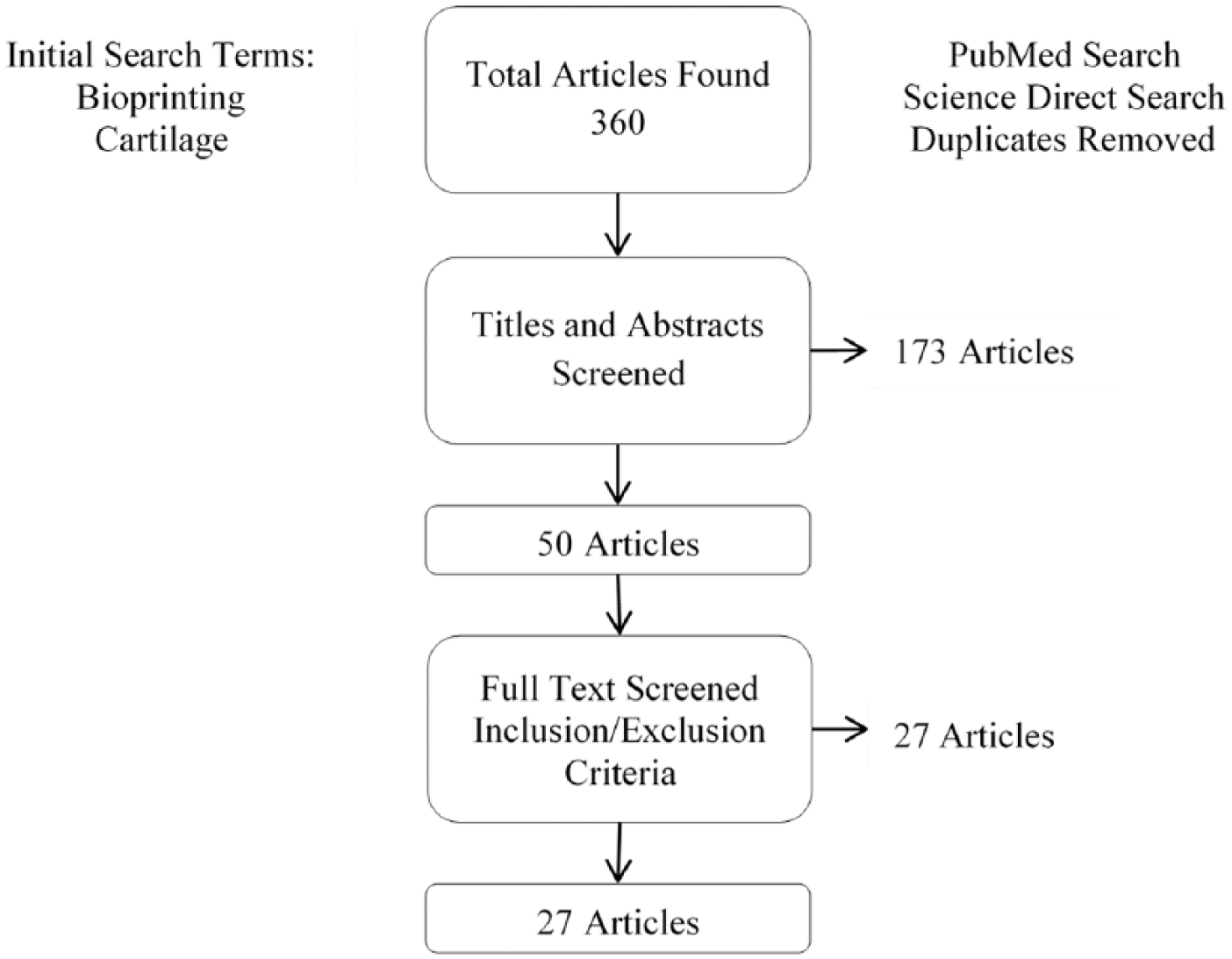
Search methodology for selection of studies.
The State-of-the-Art Techniques for Cartilage Bioprinting
The results of our primary search yielded 360 articles. Removal of duplicates and screening of titles and abstracts with the inclusion and exclusion criteria to include relevance to the study objectives resulted in 50 articles. Further screening of these 50 full text studies with application of inclusion and exclusion criteria resulted in 27 studies that were included in this review and are listed in Table 1 . We categorized them into 3 sections based on the bioprinting techniques, namely scaffold-based bioprinting, scaffold-free bioprinting, and in situ bioprinting. In the cases of scaffold-based bioprinting, studies were further classified into extrusion-based bioprinting (EBB), droplet-based bioprinting (DBB), laser-based bioprinting (LBB), and bioprinting for zonally stratified arrangement.
Summaries of the Technologies and Properties of the Bioprinted Constructs for Cartilage Tissue Engineering.
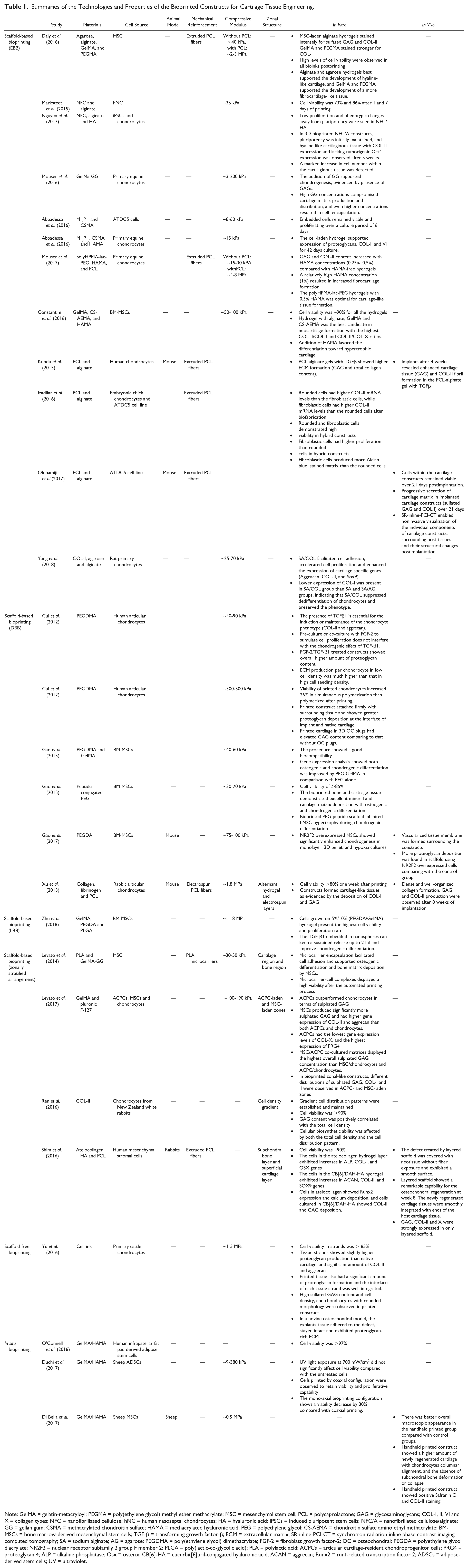
Note: GelMA = gelatin-metacryloyl; PEGMA = poly(ethylene glycol) methyl ether methacrylate; MSC = mesenchymal stem cell; PCL = polycaprolactone; GAG = glycosaminoglycans; COL-I, II, VI and X = collagen types; NFC = nanofibrillated cellulose; hNC = human nasoseptal chondrocytes; HA = hyaluronic acid; iPSCs = induced pluripotent stem cells; NFC/A = nanofibrillated cellulose/alginate; GG = gellan gum; CSMA = methacrylated chondroitin sulfate; HAMA = methacrylated hyaluronic acid; PEG = polyethylene glycol; CS-AEMA = chondroitin sulfate amino ethyl methacrylate; BM-MSCs = bone marrow-derived mesenchymal stem cells; TGF-β = transforming growth factor-β; ECM = extracellular matrix; SR-inline-PCI-CT = synchrotron radiation inline phase contrast imaging computed tomography; SA = sodium alginate; AG = agarose; PEGDMA = poly(ethylene glycol) dimethacrylate; FGF-2 = fibroblast growth factor-2; OC = osteochondral; PEGDA = polyethylene glycol diacrylate; NR2F2 = nuclear receptor subfamily 2 group F member 2; PLGA = poly(lactic-co-glycolic acid); PLA = polylactic acid; ACPCs = articular cartilage-resident chondroprogenitor cells; PRG4 = proteoglycan 4; ALP = alkaline phosphatase; Osx = osterix; CB[6]-HA = cucurbit[6]uril-conjugated hyaluronic acid; ACAN = aggrecan; Runx2 = runt-related transcription factor 2; ADSCs = adipose-derived stem cells; UV = ultraviolet.
Scaffold-Based Bioprinting
Cartilage bioprinting is currently dominated by scaffold-based techniques, and 23 out of the 27 included studies belong to this category.
Extrusion-Based Bioprinting
Among scaffold-based approaches, EBB has been the most popular one since its high economic efficiency, ease of operation and flexibility to a wide range of materials.12,13 EBB takes advantages of automated robotic system for continuous extrusion of bioinks in a filament form, in which pneumatic- or mechanical-driven dispensing systems are mostly employed ( Fig. 2A ). Daly et al. 14 evaluated the effects of various bioinks (i.e., agarose, alginate, GelMA, and BioINK) to induce mesenchymal stem cell (MSC)–laden filaments, finding that alginate and agarose bioinks supported more hyaline-like cartilage tissues while gelatin-metacryloyl (GelMA)– and poly(ethylene glycol) methyl ether methacrylate (PEGMA)–based bioinks supported more fibrocartilaginous tissue. With the assistance of polycaprolactone (PCL) filaments, mechanically reinforced scaffold with cell-laden hydrogels was obtained with bulk compressive moduli comparable to articular cartilage (2-3 MPa).
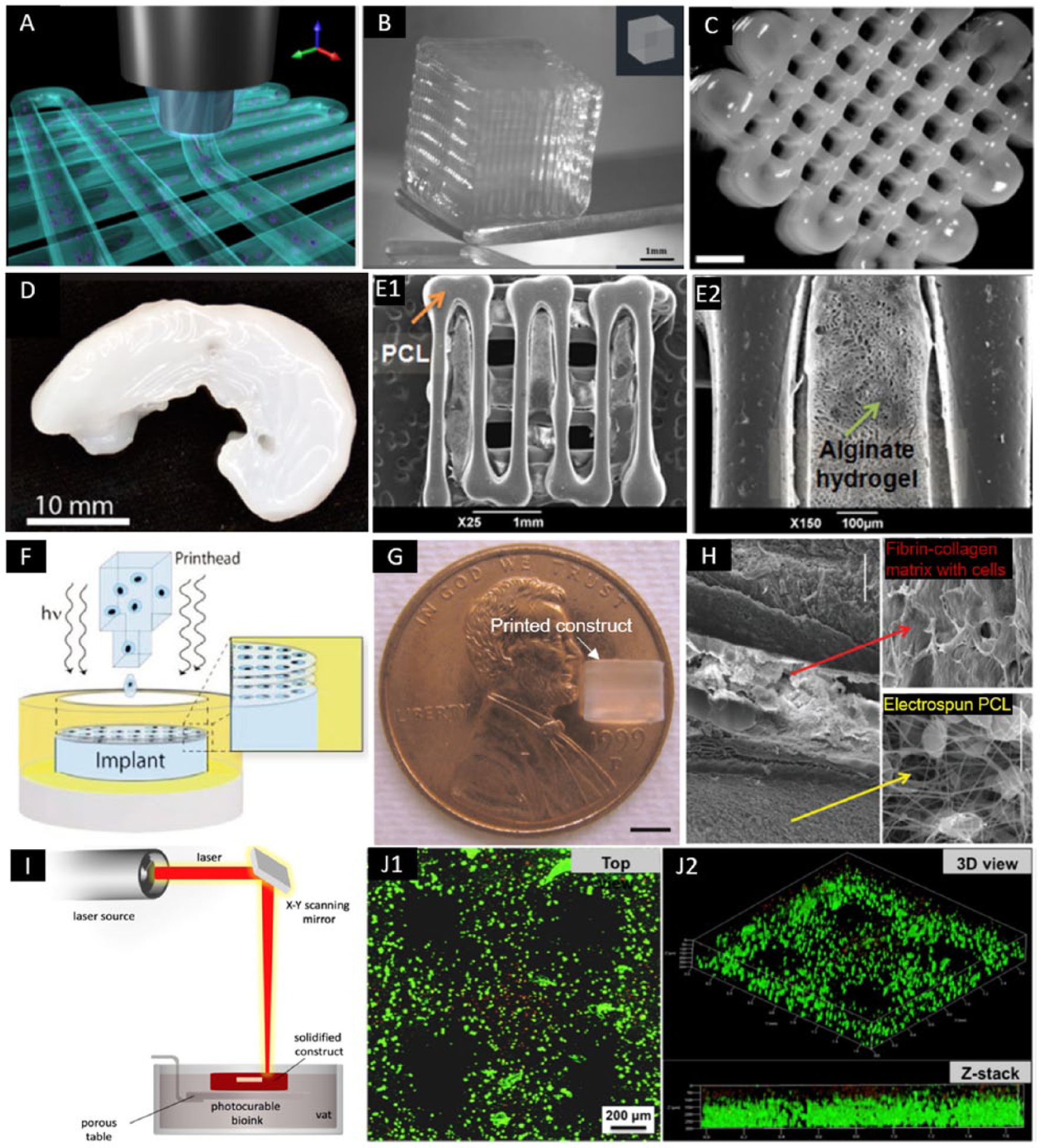
Bioprinted constructs using EBB, DBB, and LBB. (
Constantini et al. 15 assessed 3 different formulations of hydrogel for scaffold-based bioprinting of cartilage tissue, which were (1) GelMA, (2) GelMA and chondroitin sulfate amino ethyl methacrylate (CS-AEMA), and (3) GelMA, CS-AEMA, and HAMA. Each bioink also contained alginate to aid in stable fiber formation during bioprinting and was loaded with bone marrow–derived MSCs (BM-MSCs) ( Fig. 2B ). The bioink composed of alginate, GelMA, and CS-AEMA has been observed to be the best in chondrogenic formation with the highest COL-II versus COL-I and COL-X ratios. The deposition method also showed maintained shape fidelity with a layer thickness of 100 µm and interfiber distance of 300 µm.
In a more recent study, Mouser et al.
16
investigated the effect of gellan gum (GG) on GelMA bioink systematically. Various concentrations (i.e., 3%-20% GelMA with 0%-1.5% GG) were evaluated to define a bioprinting window. They found a concentration of 10/0.5% GelMA/GG balanced the bioprintability and construct stiffness that impacted cell incorporation. From the same research group, Abbadessa et al.
17
designed a hydrogel system based on triblock copolymers of polyethylene glycol (PEG, 10 kDa in molecular weight) and poly(N-(2-hydroxypropyl) methacrylamide mono/dilactate) (i.e., polyHPMA-lac-PEG) with degree of methacrylation of 15%, as bioink (i.e., M15P10) for cartilage bioprinting. With the mixture of methacrylated chondroitin sulfate (CSMA), M15P10 exhibited superior mechanical and thermal properties compared to M15P10 alone, and was able to maintain cell viability of embedded chondrogenic ATDC5 cells for 6 days in a preliminary in vitro test. In a follow-up study, Abbadessa et al.
18
blended the M10P10 with methacrylated polysaccharides including chondroitin sulfate (CS) or hyaluronic acid (HAMA) (
To exploit the cellulose in terms of mechanical strength and rheology, Markstedt et al.
20
evaluated the printability and cytotoxicity of nanofibrillated cellulose (NFC) and alginate bioink (
Kundu et al.
22
used a layer-by-layer deposition of PCL and chondrocyte-laden alginate hydrogel (
Izadifar et al. 23 cultured 2 distinct cell populations from embryonic chick cartilage (i.e., rounded and fibroblastic), and have elucidated that printed hybrid constructs of melted PCL and cell-impregnated alginate with fibroblastic cells showing higher cell numbers than the rounded cells at 14 days. Rounded cells had a significantly higher expression of COL-II, while fibroblastic cells expressed significantly higher levels of COL-I and GAG matrix. A scale-up printing has also been performed using the ATDC5 chondrogenic cell line to create six-layer constructs which demonstrated good biofunctionality. In their in vivo study, 24 bioprinted cartilage constructs with ATDC5 cells were implanted subcutaneously in mice over 21 days. The implants were characterized both noninvasively using a synchrotron radiation inline phase contrast imaging computed tomography (SR-inline-PCI-CT) approach and invasively to evaluate their cell viability (>70%) and secretion of cartilage-specific ECM. Secretion of GAG and COL-II increased progressively over time. Also, SR-inline-PCI-CT enabled visualization of the individual components of the 3D printed hybrid constructs (PCL and hydrogel), their time-dependent structural changes after implantation and their connection to surrounding host tissues in situ.
In another recently published study, Yang et al. 25 mixed COL-I or agarose (AG) with sodium alginate (SA) as bioinks. The in vitro results using chondrocytes showed that the mechanical strength was improved in both SA/COL and SA/AG groups compared with SA alone. Among the 3 scaffolds, SA/COL could distinctly facilitate cell adhesion, accelerated cell proliferation and enhanced the expression of cartilage specific genes such as aggrecan, COL-II and Sox9 than the other two groups. Lower expression of COL-I was present in SA/COL group than that in both of SA and SA/AG groups. The results indicated that SA/COL effectively suppressed dedifferentiation of chondrocytes and preserved the phenotype.
Droplet-Based Bioprinting
In DBB, the bioink made up of living cells and other biological materials (e.g., hydrogels) is deposited in a droplet form with precise noncontact positioning (
In a mouse model, Gao et al. 30 implanted bioprinted constructs with nuclear receptor subfamily 2 group F member 2 (NR2F2) overexpressed MSCs for 21 days. Vascularized tissue membranes were found to grow around the implanted constructs in vivo. The compressive modulus of scaffolds with NR2F2 were significantly stiffer than controls with more proteoglycan growth. Observations among gene expression, biochemical analysis, histological assay, and biomechanical evaluation were consistent to indicate that NR2F2 over-expressed MSCs had enhanced chondrogenic potential for cartilage regeneration.
By combining inkjet printing and electrospinning techniques, Xu et al.
31
created 5-layered constructs that consisted of alternating layers of electrospun PCL/F-127 fibers (3 layers) and inkjet-printed chondrocytes/fibrin/collagen hydrogel (2 layers) (
Laser-Based Bioprinting
LBB was operated based on the principle of a laser energy beam used for precise patterning of biomaterials.
12
Laser energy can be used in 2 different modalities, one of which involves photopolymerization (e.g., stereolithography or 2-photon polymerization) (
Bioprinting for Zonally Stratified Arrangement
To generate a bilayered osteochondral model, Levato et al. 33 used microcarriers of polylactic acid (PLA) to load MSCs via static culture or spinner flask expansion, followed by encapsulating the cell-laden microcarriers in GelMA/GG. The cartilage region was printed with GelMA-GG and the bone region was represented by GelMA-GG with encapsulated microcarriers. The application of microcarriers allowed for extensive expansion of cells within the hydrogel, resulting in a higher compressive modulus of the construct and improved cell adhesion. In 2017, Levato et al. 34 reported another strategy for zonal-like structure fabrication using a recently identified articular cartilage–resident chondroprogenitor cells (ACPCs). GelMA-based hydrogels were used to culture ACPCs, MSCs and chondrocytes as bioinks, in which ACPCs outperformed chondrocytes in terms of neo-cartilage production. Even though ACPC-laden hydrogels showed a lower production of ECM components compared with MSC-laden ones, ACPCs displayed a low expression of COL-X and a high expression of proteoglycan 4 (PRG4), suggesting a phenotype similar to superficial zone of cartilage. By bioprinting ACPC- and MSC-laden bioinks with a density of 2 × 10⁷ and Pluronic as a sacrificial ink, a bioprinted model of articular cartilage was generated, consisting of defined superficial and deep regions with distinct cellular and ECM composition ( Fig. 3A ).
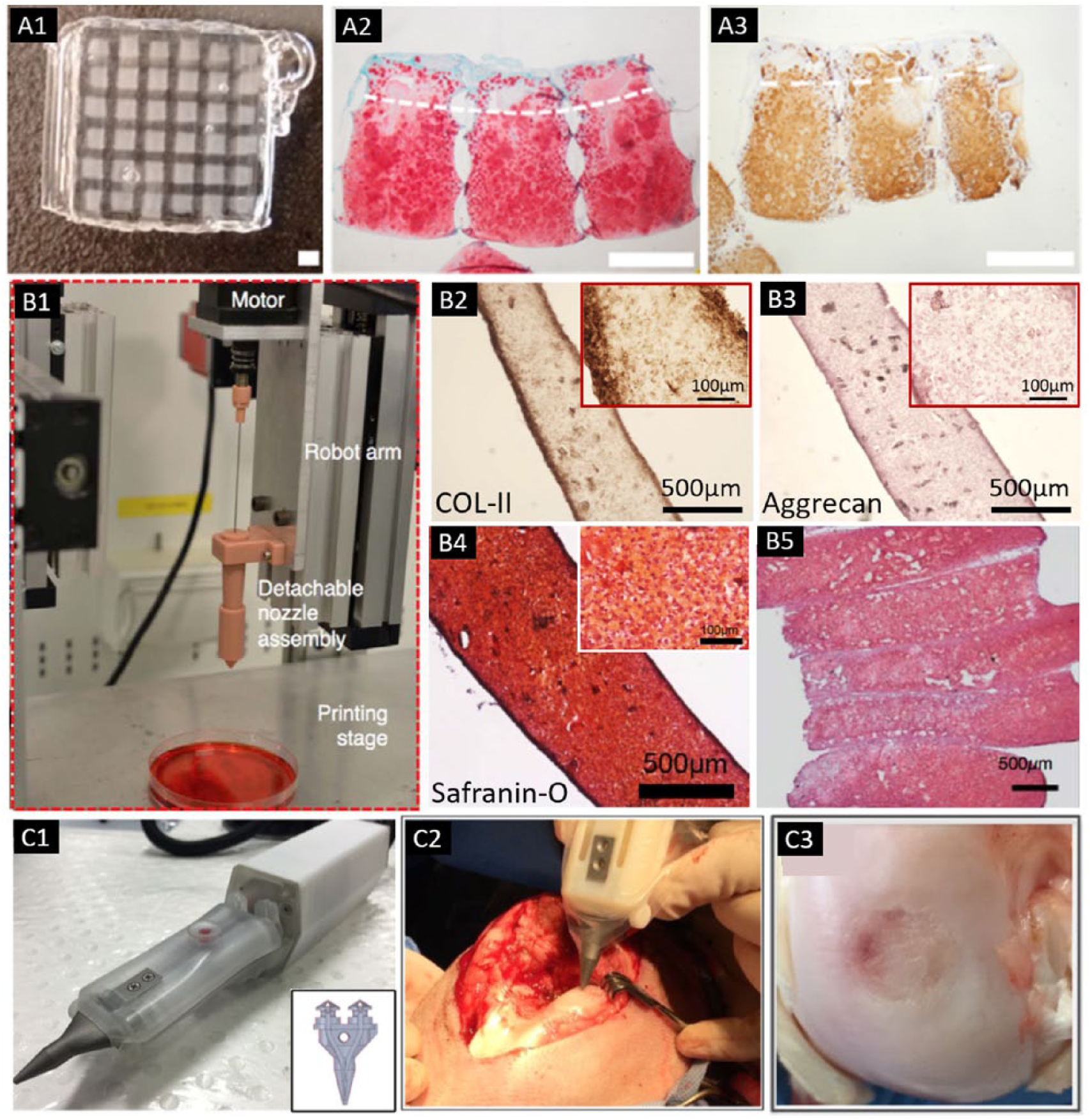
(
Ren et al. 35 used bioprinted COL-II hydrogel scaffolds to create a biomimetic cell density gradient. A construct with a 6-mm height and a 4-mm radius was bioprinted containing three layers (deep, middle, and superficial zones) with cell density gradient to imitate distribution of cell densities in native cartilage. The gradient in cell density resulted in a gradient of ECM, which further affected the biosynthetic ability of the chondrocytes.
Targeting at reconstruction of an osteochondral tissue in the knee joint, Shim et al. 36 used PCL as supporting for multilayered hydrogel extrusion with human MSCs. The construct (5 mm in height) was divided into 2 distinct layers, which were subchondral bone layer printed using atelocollagen with MSCs and recombinant human bone morphogenic protein (rhBMP)-2, and superficial cartilage layer comprised of Cucurbit[6]uril-conjugated hyaluronic acid (CB[6]-HA), 1,6-diaminohexane-conjugated HA (DAH-HA), MSCs and TGF-β. Cell viability of ~90% were observed in both layers with increased proliferation over time. The cells in the CB[6]/DAH-HA hydrogel exhibited upregulation in the expression of cartilage-related genes (aggrecan, COL-II, and SOX9) and deposition of GAG compared with those in the atelocollagen hydrogel layer, whereas atelocollagen hydrogels showed strong calcium deposition. Through implanting the bioprinted scaffold into New Zealand white rabbit knee joints, the newly regenerated cartilage tissues were smoothly integrated with ends of the host cartilage tissue at 8 weeks of implantation. They also found the lacuna structure to be similar to that of native cartilage. Immunochemical analysis also showed zonal cartilage regeneration, although COL-X was seen in the superficial layer which is abnormal in comparison to normal cartilage.
Scaffold-Free Bioprinting
Among these studies, only one pioneer study has evaluated scaffold-free bioprinting of articular cartilage. Yu et al.
37
fabricated tissue strands of bovine chondrocytes by spinning the cells down into a cell mass, and then transferred them into an alginate capsules for incubation (
In Situ Bioprinting
Among the included studies, a promising handheld device has been developed for in situ cartilage repair. O’Connell et al.
38
aimed to translate freeform biofabrication into the surgical field, and hence come up with a handheld biofabrication tool, named the “biopen,” in which GelMA/HAMA hydrogel was manually extruded and ultraviolet ()UV crosslinked during the deposition process to generate surgically sculpted 3D structures (
Table 1 summarizes properties and biological outcomes of the fabricated constructs in these 27 presented studies.
Considerations for Cartilage Bioprinting and Future Perspectives
Cartilage is a tissue that exhibits great heterogeneity and complex microarchitecture. Articular cartilage is comprised of three anatomic zones, namely the superficial zone, the middle zone and the deep zone. 41 The thin superficial zone occupies approximately 10% to 20% of articular cartilage thickness. The middle zone lies deep to the superficial zone, composing 40% to 60% of the total cartilage thickness, which contains proteoglycans and thicker collagen fibrils. The deep zone makes up approximately 30% of articular cartilage volume, in which collagen fibrils are arranged perpendicular to the articular surface. Separated by the tide mark, the deep zone is distinguished from the calcified cartilage, which plays an important role in transmitting from soft cartilage to bone. 42 Current clinical restorative technologies as well as TE strategies have been unable to recapitulate this complex microarchitecture and the resultant disorganized repair tissue is a major reason for failure of current basic science and clinical strategies. 3 Three-dimensional bioprinting has demonstrated the ability to reproduce chondral tissue with appropriate zonal structure owing to its capability of precise deposition of cells, biomaterials, growth factors, and other bioactive reagents to build cell-laden constructs. 43 This shows promise moving forward in clinical application of these 3D bioprinted constructs for in vivo articular cartilage restoration. Several of the studies included in this review demonstrate the ability to recapitulate the complex zonal microarchitecture of native hyaline cartilage as discussed in the “Bioprinting for Zonally Stratified Arrangement” section.
One of the principal functions of cartilage is to facilitate the transmission of loads. Engineered cartilage tissue ideally exhibits mechanical compressive strength which approaches to the value of native cartilage (e.g., compressive modulus: ~1.5 MPa 37 ). Bioprinted cartilage tissue constructs have fallen short, demonstrating compressive moduli usually less than 100 kPa.15,18,20,28,33 Researchers have strived to increase the mechanical properties by adjusting the concentration or chemical structure of the printed materials. Cui et al. 27 have doubled the concentration of PEGDMA (from 10% to 20%) to increase the compressive modulus nearly 10-fold (from ~40 to 400 kPa). Nevertheless, the enhanced mechanical properties remained insufficient for cartilage tissue engineering. In addition, there were concerns that the increased hydrogel concentration may hinder the cell proliferation and ECM formation.
Reinforcing the hydrogel carriers with synthetic polymers may serve as a method to reinforce their mechanical strength. PCL is one of the most popular biopolymers for engineering tissues due to its good elastomeric properties and high elasticity.44-46 In addition to mechanical enhancement, it allows for the production of large constructs with high fidelity and fiber resolution.47,48 Daly et al. 14 co-deposited hydrogel bioinks with fused PCL fibers. As compared to the hydrogel constructs with insufficient mechanical strength (~5-35 kPa), the PCL-reinforced hydrogel generated scaffolds had compressive moduli (~2 MPa) similar to that seen with native articular cartilage. PCL has shown to be a successful substrate in various heat distributions and concentrations while also having increased mechanical stability in highly stacked hydrogels.22,23,36 One major concern of printing fused PCL fibers concurrently with cell-loaded hydrogel was that high temperature (e.g., 65°C to 80°C) was required to melt the PCL, which may decrease cell viability. Izadifar et al. 23 has monitored the surface temperature of the printed PCL fibers, and found that temperature dropped significantly once printed, and reached the values (e.g., 34°C to 39°C) that were suitable for cell survival. Other strategies to reinforce the constructs have been also proposed, such as employing electrospun PCL layers 31 or imbedding PLA microcarries 33 in conjunction with cell-laden hydrogel.
Hydrogels have traditionally been used as a scaffold in bioprinting for a number of reasons including a decrease in the toxicity to the bioprinted cells as well as the increase in the biocompatibility of the constructs. 49 Scaffold-free bioprinting is a novel technique that may eliminate that need, which has been highlighted here. 37 Scaffold-free bioprinting offers relatively high initial cell density without the inclusion of biomaterials. This results in more space for ECM deposition, facilitates better cell-to-cell interactions, generates tissues with biomimicry, and preserves cell functionality with elimination of biodegradation issues.37,50
Chondrocytes and MSCs were the most common cell types used in the 27 studies. Chondrocytes are often difficult to obtain, whereas MSCs, which are more easily obtained, are capable of differentiating into both bone and cartilage cells. 42 It is well known that chondrocytes in different zones show distinct morphologies. The typical rounded shape of chondrocytes is found in the middle and deep zones, while the chondrocytes are more spread in the superficial zone. 51 Such morphological difference results in varied cellular activity in different zones of cartilage (e.g., ECM productions). Izadifar et al. 23 isolated chondrocytes with rounded and fibroblastic morphologies. A significantly higher expression of COL-II was observed within the rounded cells, while higher level of COL-I was found in the fibroblastic cells. Fibroblastic cells were similar to chondroprogenitors and act functionally like stem cells where rounded cells expressed prototypical chondrocyte morphology. These findings provide promising strategies for future bioprinted cartilage TE, which could incorporate multiple cell types into a zonal/stratified construct or guide the cells to generate proper morphologies and ECM productions. Steadily decrease of chondrocytes’ redifferentiation capacity after several passages constrains their efficacy for TE of larger defects. 34 To overcome this limitation, multipotent progenitor cells, such as MSC and ADSCs have also been applied for various TE applications.52-54 However, their tendency to undergo hypertrophic differentiation and trigger endochondral ossification remains a major concern. 55 Particularly, ACPCs were used in one of the abovementioned study, 34 which are capable of in vitro self-renewal, and can be expanded to > 60 passages while maintaining their potential in multilineage differentiation. 56 Moreover, different from MSCs, ACPCs showed resistance to formation of calcified tissue and hypertrophy, and maintained consistent production of hyaline-like cartilage.57,58
In addition to the selection of cell type, cell seeding density must also be taken into account. Ren et al. 35 printed hydrogels with different total cell density (i.e., 2, 1, and 0.5 × 10⁷ cells/mL). The group with cell density of 1 × 10⁷ cells/mL, which had a biomimetic cell density similar to native cartilage (10 million cells/mL 59 ), demonstrated upregulated total GAG production and biosynthetic ability for single cell. Similarly, Cui et al. 26 used a low cell density of 0.8 × 10⁷ cells/mL and a high cell density of 2 × 10⁷ cells/mL. They found that ECM expression for single chondrocyte in low cell density was significantly greater than that in high cell density. Higher cell density demonstrated a more robust production of ECM. However, when evaluating the comparative ECM from individual chondrocytes, they produced more total ECM in lower density scenarios. This supports utilizing moderate cell density to maximize cell number and ECM production for an effectively engineered cartilage.22,27 Constructs with elevated cell density may become metabolically quiescent due to limited nutrient supply while those with low cell density may have limitations in cell-cell interactions. Manipulation of the cell density and distribution does provide a potential outlet for the generation of the zonal distribution of cells seen in native articular cartilage.22,27
During daily activity, articular cartilage is repeatedly subjected to forces generated by joint loading with varying frequencies between 0.1 and 10 Hz.60,61 The transduction of mechanical signals stimulate changes in chondrocyte activity, such as metabolic events and structural adaptations.62,63 The mechanical forces applied in the knee distribute stress within the articular zones in an asymmetrical pattern (e.g., high strain and shear stress in the superficial zone, small strain in lower and deep zones). Different ways of providing mechanical stresses have been reported, including unconfined uniaxial compression, 64 direct shear stress, 65 and hydrostatic pressure. 66 In development of bioprinted constructs, semi-confined compression, in which load was applied axially and rest of the construct is constrained is ideal, since it could closely mimic the native mechanical environment and resemble a gradient of the zones. 67 In future studies, this could be investigated with modulated mechanical environments into the culture, to give insights of how mechanical stimuli regulate the cell activities in the bioprinted constructs. Limitations of our study include the heterogeneous nature of the selected articles. Since cartilage bioprinting is still a novel topic, innovative studies are being produced every few years with new advances. Finally, the clinical translation is not yet clear and significantly more research is warranted before the techniques can be applied in clinics.
Conclusion
Recent advances in bioprinting have granted cartilage TE the ability to assemble bioinks, cells, and signaling molecules into biologically relevant functional tissues. On screening the 360 articles based on PRISMA guidelines, the selected 27 studies have demonstrated 3D bioprinting of articular cartilage to be a TE strategy that has tremendous potential translational value. The unique abilities of the varied techniques including scaffold-based, scaffold-free and in situ bioprinting, have allowed replication of anatomical structure, biological function, and mechanical properties of the native articular cartilage, and particularly enabled the advances toward zonal differentiation, which have been proved by relatively comprehensive in vitro and in vivo studies. This review demonstrates that bioprinting has potential capacity for clinical cartilage reconstruction and future in vivo implantation as techniques are advanced.
Footnotes
Acknowledgments and Funding
The author(s) received no financial support for the research, authorship, and/or publication of this article.
Declaration of Conflicting Interests
The author(s) declared the following potential conflicts of interest with respect to the research, authorship, and/or publication of this article: Outside the submitted work NB has received money from the Pennsylvania Orthopedic Society and the American Academy of Orthopedic Surgeons. IO has stock/stock options in Biolife4D and Virtual Systems Engineering. AD has worked as a consultant and provided lectures for Smith & Nephew, has grants/grants pending for the Department of Defense, National Institute of Health, and Penn State University, and is an Arthroscopy Journal committee member/associate editor, part of AOSSM Publications Committee, Committee Member AANA Research Committee, Editorial Board OJSM, and Editorial Board SMAR.