



Abstract
The Canadian Partnership for Tomorrow’s Health (CanPath) reflects upon its original decisions around sample aliquoting strategies for its specimen inventory based on what is now commonly released to researchers. We propose an updated aliquoting strategy for new collections that balances upfront resources with volumes sought for downstream analysis. This updated aliquoting strategy will help inform teams establishing new biobanks or managing existing biobanks that are considering new collections.
The Canadian Partnership for Tomorrow’s Health (CanPath, previously named Canadian Partnership for Tomorrow Project) is a federated prospective-based population cohort study that began in 2008.1–2 CanPath is a poly-user cohort of more than 330,000 participants from across all ten provinces of Canada, and the holdings are available to researchers for the study of cancer and other chronic diseases. Today, CanPath has specimens on more than 160,000 participants, 3 corresponding to 3.3 million aliquots stored across 87 freezers in 7 local biobanks across the country.
As part of the extensive planning at the time of establishing CanPath, general operating procedures (GOPs) were developed and used by all regional cohorts that outlined the sample types and volumes to be collected, and processing details to create stored ‘daughter’ aliquots. Efforts were made to standardize all procedures, minimize storage requirements, and reduce the number of freeze/thaw cycles of the primary sample when future access requests were fulfilled; however, the GOP allowed for some flexibility in sample aliquot strategy (Table 1) to take into consideration regional operational factors.
An Overview of CanPath’s Original Planned, Stored, and Released Biosamples by Type
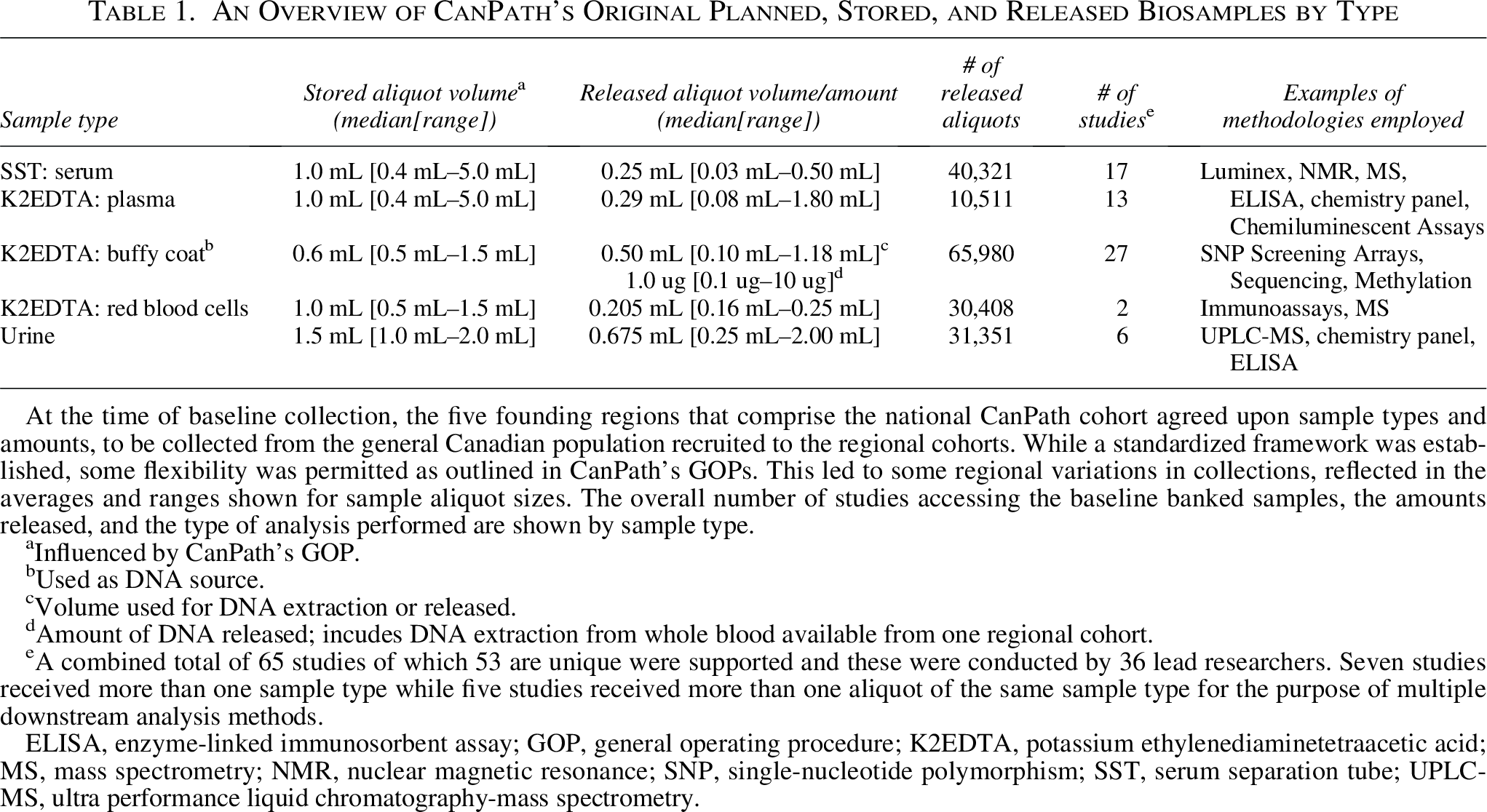
At the time of baseline collection, the five founding regions that comprise the national CanPath cohort agreed upon sample types and amounts, to be collected from the general Canadian population recruited to the regional cohorts. While a standardized framework was established, some flexibility was permitted as outlined in CanPath’s GOPs. This led to some regional variations in collections, reflected in the averages and ranges shown for sample aliquot sizes. The overall number of studies accessing the baseline banked samples, the amounts released, and the type of analysis performed are shown by sample type.
Influenced by CanPath’s GOP.
Used as DNA source.
Volume used for DNA extraction or released.
Amount of DNA released; incudes DNA extraction from whole blood available from one regional cohort.
A combined total of 65 studies of which 53 are unique were supported and these were conducted by 36 lead researchers. Seven studies received more than one sample type while five studies received more than one aliquot of the same sample type for the purpose of multiple downstream analysis methods.
ELISA, enzyme-linked immunosorbent assay; GOP, general operating procedure; K2EDTA, potassium ethylenediaminetetraacetic acid; MS, mass spectrometry; NMR, nuclear magnetic resonance; SNP, single-nucleotide polymorphism; SST, serum separation tube; UPLC-MS, ultra performance liquid chromatography-mass spectrometry.
In this report, we review the pros and cons of decisions around sample aliquoting strategies based on our experience after 15 years of operation and the actual sample volumes that have been typically released to researchers since CanPath opened for access. CanPath’s policy is to release only the amount required for each study request; this, in itself, means customizing the aliquot volume. Not surprisingly, volumes required and released 4 have varied by downstream analysis method (Table 1). In some cases, an entire aliquot was released or processed internally for DNA (i.e., buffy coat), and in others, the originally banked specimen required sub-aliquoting. Common volumes that have been released highlight that availability of multiple volume amounts would be helpful when releasing specimens.
Based on this review, we present two alternative aliquot models (Table 2) to help inform others who are either establishing a new biobank or are an existing biobank that is considering new collections or developing a sub-aliquot procedure. Within the table, aliquot volume and counts are illustrated for each model and are based on a theoretical number of 1,000 participants, from whom a total of 22 mL of whole blood is collected (2 × 5 mL—serum separation tubes [SSTs] and 2 × 6 mL—potassium ethylenediaminetetraacetic acid [K2EDTA] tubes).
Two Aliquot Models for Banking Blood Samples Based upon 15-Years of Experience Within CanPath
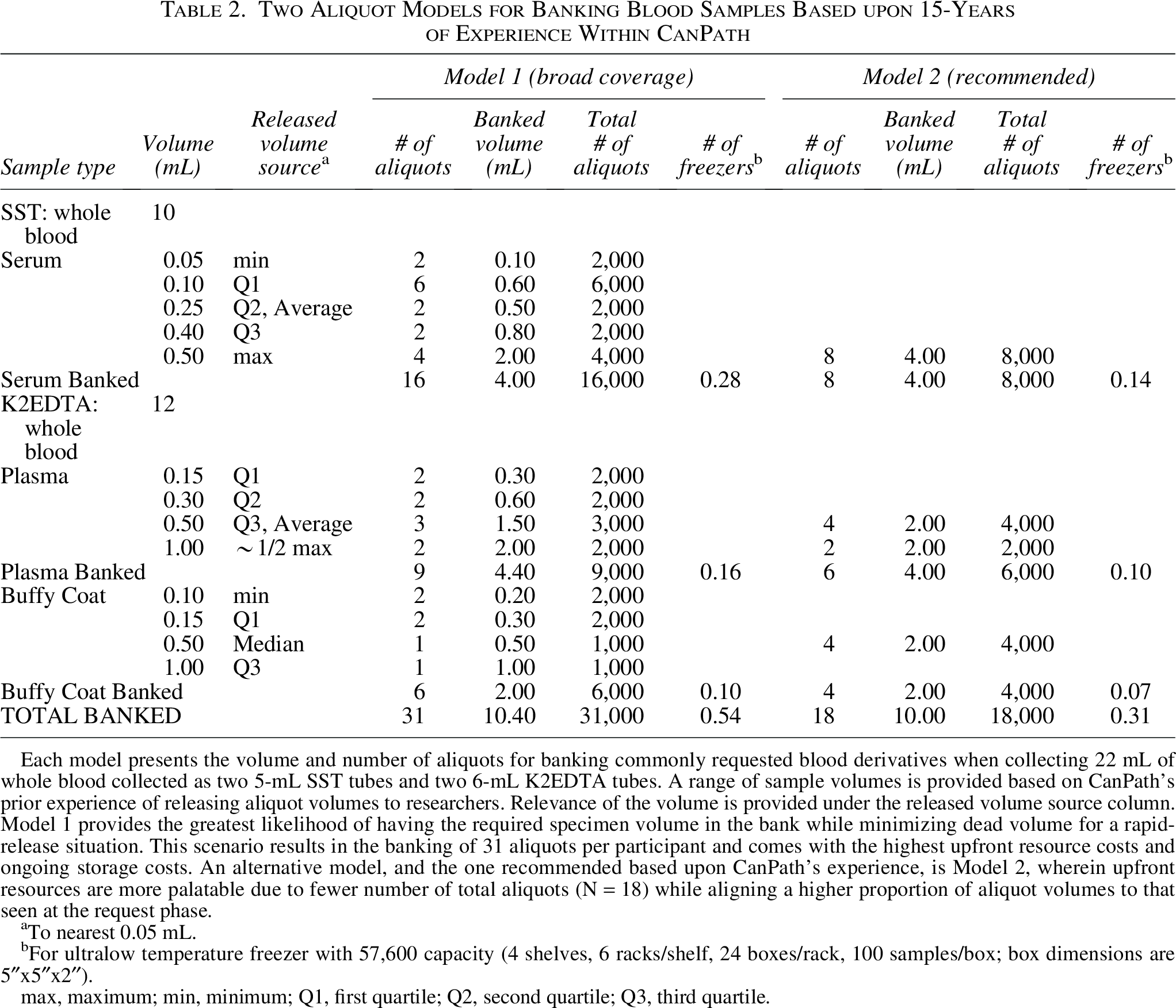
Each model presents the volume and number of aliquots for banking commonly requested blood derivatives when collecting 22 mL of whole blood collected as two 5-mL SST tubes and two 6-mL K2EDTA tubes. A range of sample volumes is provided based on CanPath’s prior experience of releasing aliquot volumes to researchers. Relevance of the volume is provided under the released volume source column. Model 1 provides the greatest likelihood of having the required specimen volume in the bank while minimizing dead volume for a rapid-release situation. This scenario results in the banking of 31 aliquots per participant and comes with the highest upfront resource costs and ongoing storage costs. An alternative model, and the one recommended based upon CanPath’s experience, is Model 2, wherein upfront resources are more palatable due to fewer number of total aliquots (N = 18) while aligning a higher proportion of aliquot volumes to that seen at the request phase.
To nearest 0.05 mL.
For ultralow temperature freezer with 57,600 capacity (4 shelves, 6 racks/shelf, 24 boxes/rack, 100 samples/box; box dimensions are 5″x5″x2″).
max, maximum; min, minimum; Q1, first quartile; Q2, second quartile; Q3, third quartile.
In both models, aliquot volumes span the spectrum of samples that have been released from CanPath’s regional biobanks; however, the models differ in the extent of consideration given to different storage and release factors. We also chose to focus only on the most commonly requested sample types: serum, plasma, and buffy coat (and its DNA).
Model 1 aims to provide the broadest aliquot volume coverage, thereby increasing the likelihood of the biobank being able to retrieve a sample as is, while maximizing the chance of the entire aliquot being required by the end user. No sub-aliquoting is required before samples are released, thereby providing advantages such as reducing the number of sample thaws 5 and the time required to prepare samples for release. The downsides, however, are the large personnel, consumable, and infrastructure requirements needed upfront. In addition, each sample type requires its own aliquoting scheme in terms of aliquot volume and numbers, contributing to additional implementation considerations. Finally, additional storage requirements and ongoing infrastructure support are needed to house the large number of created aliquots such that one may not consider this as consistent with “mindful procurement practices” associated with green biobanking. 6
Model 2 aims to improve on model 1 and to more closely align stored versus released volumes, thereby enabling the ability to more quickly retrieve an unthawed aliquot straight from the freezer. Model 2’s upfront and ongoing resource requirements (personnel, consumables, infrastructure) are significantly less compared with Model 1, as 42% fewer aliquots are created and stored. We have prioritized the volumes most commonly released to inform the model, which means recommending a volume less than our current median stored aliquot volume for serum. For plasma, the recommended 1 mL volume aligns with our median stored volume, whereas the added 0.5 mL volume provides an additional option. For sample type K2EDTA: buffy coat, most studies were supported via release of its corresponding DNA that was previously extracted by CanPath. As such, the recommended volume of buffy coat to store aligns with both the amounts used for extraction and with plasma volumes derived from the same K2EDTA source tube in order to permit a simplified aliquoting model.
Overall, Model 2 offers consistency in aliquot volume by recommending only two volumes (0.5 mL and 1.0 mL), regardless of sample type, making implementation easier. Model 2 results in storage of slightly less plasma (4 mL vs 4.4 mL in Model 1), and also requires less storage (i.e., less than half an ultralow temperature freezer with a 57,600 vial capacity, considering 4 shelves, 6 racks/shelf, 24 boxes/rack, and 100 specimens/box) for 1,000 participants. Some laboratories, including within CanPath, store specimens in a 96-well rack (8 × 12 format). For those preferring to store in multiples of eight (# of rows), the recommendation would be to store 2 instead of 4 aliquots of buffy coat, bringing the total number of banked aliquots down to 16.
In summary, reviewing and assessing CanPath’s 15 years of experience with banking and releasing specimens from a population-based cohort provides valuable information to inform future sample collection and aliquoting strategy for biobanking. Banking volumes of 0.5 mL (serum, plasma, buffy coat) and 1.0 mL (plasma) are likely to provide a good balance between the resources required upfront and the volumes sought for analysis downstream.
Authors’ Contributions
T.E.M.: Writing—original draft (lead), Writing — review & editing (equal), Validation (equal), methodology (lead), investigation (equal). N.D.F.: Writing—review and editing (equal), methodology (supportive). L.H.: Validation (equal), Writing—review and editing (equal), methodology (supportive), investigation (equal). J.H.: Validation (equal), Writing—review and editing (equal), methodology (supportive), investigation (equal). T.J.H.: Writing—review and editing (equal), methodology (supportive). C.L.: Validation (equal), Writing—review and editing (equal), methodology (supportive), investigation (equal). L.L.: Writing—review and editing (equal), methodology (supportive). G.M.: Validation (equal), Writing—review & editing (equal), methodology (supportive), investigation (equal). K.M.: Validation (equal), Writing—review and editing (equal), methodology (supportive), investigation (equal). J.V.: Validation (equal), Writing—review and editing (equal), methodology (supportive). P.H.W.: Conceptualization (lead), Writing—review and editing (lead), methodology (supportive), Supervision). J.Z.: Writing—review and editing (equal), methodology (supportive).
Footnotes
Acknowledgments
CanPath Leadership & Directors: Jennifer Brooks (Dalla Lana School of Public Health, University of Toronto, Toronto, ON, Canada), Parveen Bhatti (Population Heath Sciences, British Columbia (BC) Cancer, Vancouver, BC, Canada; School of Population and Public Health, Faculty of Medicine, University of British Columbia, Vancouver, BC, Canada), Trevor Dummer (School of Population and Public Health, Faculty of Medicine, University of British Columbia, Vancouver, BC, Canada), Simon Gravel (Department of Human Genetics, McGill University, Montreal, QC, Canada; McGill University Genome Centre, Montreal, QC, Canada), Vikki Ho (Université de Montréal Hospital Research Centre (CRCHUM), Montreal, Quebec, Canada; Department of Social and Preventive Medicine, École de santé publique de l’Université de Montréal, Montreal, Quebec, Canada), Victoria Kirsh (Ontario Institute for Cancer Research, Toronto, ON, Canada), Guillaume Lettre (Montreal Hearth Institute, Montreal, QC, Canada; Department of Medicine, Université de Montréal, Montréal, QC, Canada), Donna Turner (Population Oncology and the Paul Albrechtsen Research Institute, CancerCare Manitoba, Canada; Community Health Sciences, Rady Faculty of Health Sciences, University of Manitoba, Manitoba, Canada), Robin Urquhart (Department of Community Health and Epidemiology, Dalhousie University, Halifax, NS, Canada), Megan Vanstone (Saskatchewan Cancer Agency, Regina, SK, Canada), Philip Awadalla (Ontario Institute for Cancer Research, Toronto, ON, Canada; Department of Molecular Genetics, University of Toronto, Toronto, ON, Canada).
Author Disclosure Statement
T.E.M. reports grants from the Canadian Partnership Against Cancer during the conduct of this work. C.L.: CARTaGENE is supported by Genome Quebec (Ministere de l’Economie de l’Innovation et de l’Energie), and the Canadian Partnership Against Cancer and Health Canada. G.M.: Alberta’s Tomorrow Project is supported by Alberta Health, Alberta Cancer Foundation, the Canadian Partnership Against Cancer and Health Canada, and Alberta Health Services. J.V.: Alberta’s Tomorrow Project is supported by Alberta Health, Alberta Cancer Foundation, the Canadian Partnership Against Cancer and Health Canada, and Alberta Health Services. The remaining authors: no disclosures.
Funding Information
Funding for CanPath was provided by the Canadian Partnership Against Cancer (CPAC) (133006771:v2).