



Abstract
This article examines how scientific and artistic representations and technologies shape ocean futures. Dominant Western oceanography frequently engages mechanistic metaphors that conceptualize the ocean as a machine, pump, or carbon sponge. This way of visualizing the ocean, guided by the logics of control and quantification, shapes contemporary remote sensing, modeling, and prediction technologies. Alternative approaches to oceanographic representation, including Indigenous, anticolonial, Black feminist, and artistic approaches, offer critical counterweights to destabilize the authority granted to mechanistic oceanographic representations. Ocean simulations and scale models are infrastructures through which ocean futures are rendered and presented in multidimensional space. Through a comparative media analysis of a scientific ocean simulation tank with an immersive artistic ocean installation, I demonstrate how simulation technologies function discursively, rendering specific ocean futures credible while foreclosing others. While the scientific simulation embodies confidence in ocean datafication, surveillance, and the spectacle of dominant U.S. scientific power, the artistic multisensory exhibition explores the limits of oceanographic transparency, as well as feminist, anticolonial, and nonhuman epistemologies to imagine ocean relations beyond extraction. I draw upon STS arguments that models, simulations, and technical images of the ocean are inherently political world-making practices, not neutral mediators. I propose that future studies must cultivate a critical media literacy of scientific representations to avoid reinscribing colonial, extractive, and militarized orientations toward the ocean and support situated, relational, and non-dominant ocean futures.
Keywords
Introduction
Inside the National Oceanic and Atmospheric Administration’s (NOAA) Southwest Fisheries Science Center, in La Jolla, California, there is a simulated sea. I first encountered this ocean simulacrum, officially titled the Ocean Technology Development Tank, on August 4th, 2023, during a facilities tour as part of a summer intensive oceanographic training I was completing at Scripps Institution of Oceanography (SIO). As the only participant with a background in visual culture, film, and feminist theory, I approached the Development Tank as a media object. We snaked through the various loading decks, marine specimen processing areas, and laboratories of the center, recently redesigned and relocated in 2013 by architectural firm Multistudio (formerly Gould Evans) in sleek concrete and glass. Coastal erosion and the impending sea threatened to reclaim the previous Southwest Fisheries Center building. The Development Tank was presented as the center’s principal technological achievement. As we approached the tank, the tour guide began a cascade of impressive numerical and technical details: 2,000,000 L of seawater pumped in from the ocean; only one of its kind in the world; customizable salinity and temperature; capable of temporarily hosting living marine organisms; the forefront of ethical oceanographic research independent from older capture methods that damage and harm specimens. The Development Tank was introduced to me couched in the language of spectacle, wonder, and morality—a framing that becomes central as I consider the tank as a media object.
The Development Tank was presented as a powerhouse of data and information, distinct from other encased bodies of water that approximate the ocean, such as pools and aquariums, in its rigor and exactitude. The Development Tank, through its sheer scale and novelty, places NOAA scientists, and by extension the United States government, at the forefront of global ocean innovation, monitoring, future prediction, and management. While the Development Tank is a scientific miniaturization of the ocean, it is still massive. One of the largest of its kind in the world, the tank spans three stories. As we moved from the base of the tank to the top up a series of stairs, I glimpsed deep blue through small windows cut into its thick walls to allow direct viewing at multiple depths. At the tank’s surface, two lifted walkways and a series of pulleys were in place to aid scientists as they lower sensors and other technologies into the tank without needing to physically immerse themselves in the water. Sleek, museum-style infographic diagrams lined the walls surrounding the tank’s surface, highlighting key features and providing illustrative technical drawings. The presence of the infographics, I argue, demonstrates that the Development Tank flickers between roles depending on shifting contexts of looking. The tank is, in some contexts, a center for scientific knowledge generation. In other contexts, like the facilities tour I attended, the tank is intended to be seen as a representation of scientific power, and a manifestation of the future of remotely sensed oceanographic research dominated by the U.S. Large hydraulic models like the Development Tank exist in a complex financial zone, where their scientific usefulness must be constantly demonstrated to justify the significant construction and ongoing maintenance costs associated with these physical models (Keiner 2004).
The very existence of the Development Tank, which was completed in 2015, demonstrates the central role of visualization and representational technologies in 21st century oceanography. Here, I use representation in an expanded sense to include technologies that attempt to depict and render legible ocean processes and organisms. This includes satellites, acoustic sensors, environmental DNA measurements, temperature maps, physical 3D models, and digital simulators. I also include scientific metaphors that visualize and guide ways of viewing oceanic processes. This includes the pervasive use of mechanistic metaphors in oceanography, including the ocean as a pump, machine, conveyor belt, sponge, and so on. The Development Tank exists explicitly to develop, test, and calibrate remote sensors before they are deployed at sea (Demer et al. 2015). Whereas the earliest ocean data collection methods involved physically capturing specimens with nets and sampling by hand aboard ships, oceanographic research in the early 21st century is increasingly remote (Marlow 2019). The ocean becomes normalized as an environment of constant scientific surveillance, shaped around the qualities deemed important for resource management, military, and extractive industries. Remote sensors occupy a complex role, with histories simultaneously tethered to Cold War militarism and ecological discovery, while at the same time normalizing the vastly outsized presence of the U.S. in the world’s oceans (DeLoughrey 2014).
In this article, I develop a media theorization of ocean simulations and scale models, which play a central role in defining ocean futures, guided by feminist Science and Technology Studies (STS). I pair my encounter with the Development Tank with feminist STS theories of models, abstraction, and decontextualization. I develop a comparative reading of the Development Tank alongside artist Susanne M. Winterling’s immersive ocean exhibition, gravitational currents & the life magic (2018) (Figure 1). In her multisensory and multimedia immersive exhibition, Winterling constructs an alternate ocean simulation guided by feminist, anticolonial, and nonhuman commitments. By extending media analysis across these two examples, my work aligns with technical image discourse that dissolves the constructed divisions, and by extension hierarchies, between artistic and scientific representations (Bredekamp, Dünkel, and Schneider 2015; Elkins 1995). I seek to destabilize the authority and constructed neutrality granted to dominant Western oceanographic representations and demonstrate how ocean simulations support specific and embodied ways of “seeing” ocean futures. I argue that, through its reduction of oceanic unpredictability in the scale model, the Development Tank functions as a feedback loop that validates dominant Western mechanistic conceptualizations of the ocean and serves to further concentrate future oceanographic power to the U.S. government. Despite the authoritative command of the tank, housed in a government institution and massive in scale, the Development Tank is inherently indexical, to use Martha Lampland’s framing, and is guided by social and political commitments (Lampland 2023). Susanne M. Winterling, gravitational currents & the life magic, (2018), Empty Gallery Hong Kong. Photo courtesy of the artist.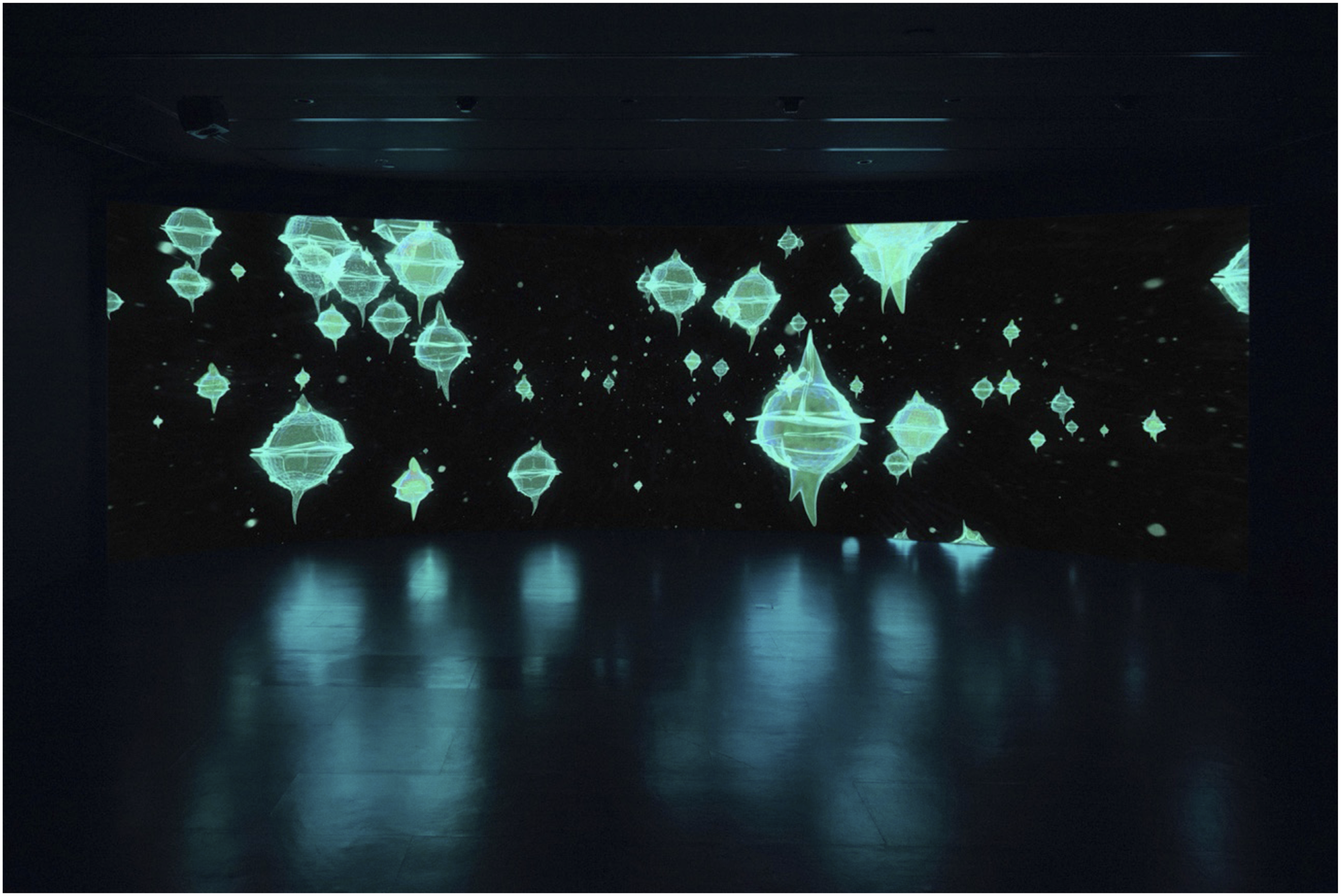
When surveying the arguments, research centers, and novel technologies that shape 21st-century oceanography, I argue that particular emphasis must be placed on representations. This is because oceanography has long been considered a visual science, dependent on representational tools as mediators between scientist and ocean (Helmreich 2022; Murray and Hjort 1912). In oceanography, ocularcentric approaches must contend with the primarily acoustic underwater environment which operates on entirely different sensory terms (Marshall 2017; McWeeny 2011; Sun, Cui, and Chen, 2021). Representation and scientific mediation technologies play a key role in how scientists conceptualize, understand, and imagine ocean futures. To quote Keith R. Benson, Helen M. Rozwadowski, and David K. Van Keuren, “To understand the human relationship with the sea, then, it is essential to look at how knowledge about the ocean has been produced: by whom, with what kinds of instruments; using what kinds of scientific practices; and in what historical contexts” (Benson, Rozwadowski, and Van Keuren 2004, xv). Foregrounding how ocean futures are produced, by whom, through what instruments, and toward which ends, reveals that representations are never neutral, and that feminist, relational, and anticolonial approaches are essential to cultivating oceanography beyond extraction.
There are arguments in future studies that call for artistic representations to offer modes of future speculation outside of dominant scientific contexts (Demos 2023; Keith R. Benson, Rozwadowski, and Van Keuren 2004; Tyszczuk and Smith 2018). However, I argue that future studies must go further to interrogate the historical, aesthetic, and social contexts that shape scientific and technical representations, which in turn visualize particular ocean futures. In this regard, future studies stands to benefit from technical image studies and STS approaches that emphasize representations (Bredekamp, Dünkel, and Schneider, 2015; Elkins 1995; Latour 1986). Future studies can develop a deeper literacy of scientific technical images through comparative readings of scientific representations alongside Art, Science, and Technology Studies (ASTS) practices. ASTS practices are well positioned to engage critically with oceanography’s relationship to representational mediation because as a field, a key pillar of ASTS inquiry is to grapple with the complexity and nuance of what is overly and covertly communicated through scientific representation (Rogers et al. 2021). ASTS practices offer counterexamples that demonstrate how environmental simulations and projections do not simply exist—they are designed, decontextualized, and political (Pritchard and Prophet 2023). Artistic projects are also able to open up and scrutinize existing speculative infrastructures that inform future environmental scenario planning, and imagine new infrastructures not ossified by the methods of corporate, scientific, and public policy research (Reeves-Evison 2021). Finally, a goal of this article is to thread together parallel discourses on models and simulations, radical environmental futures, and Indigenous, anticolonial, and Black feminist ocean theorizations (Cato 2026; Deloughrey 2010; Goodyear-Ka‘ōpua 2018; Lehman 2016). These works offer powerful critiques of oceanographic abstraction, the interconnectivity of ocean extraction and racial capitalism, and the ways in which the neutral language of resource management and security solidify dominant Western colonizer oceanic temporalities into the future.
Mechanistic technosolutionist scientific visions of ocean futures, such as the Development Tank, are often presented as cutting edge, particularly in the context of novel ocean sensing. This can be seen in the language of spectacle and wonder attached to public-facing descriptions of the Development Tank, as well as its explicit positioning as the forefront of oceanographic research. Yet the Development Tank is a contemporary amplification of a much longer Eurocentric framing of nature as machine (Merchant 1989). Within ocean contexts, the outcomes of these extractive frameworks are explicitly seen in deep-sea mining, oil leaks, the dumping of toxic waste in the ocean, and seafloor sand dredging. However, I argue that the same epistemological frameworks permeate certain approaches to ocean conservation and stewardship. It is vital to interrogate the metaphors, frameworks, and visualizations applied to the ocean to ensure these same mechanized views that led to planetary crises are not reproduced into the future. As Noelani Goodyear-Ka9pua’s observes, no oceanographic knowledge is devoid of politics; all ocean futures are political (Goodyear-Ka‘ōpua 2018). In my focus on representation, and my centering of the Development Tank as a multidimensional technology designed to support remote sensing, I advance blue humanities contributions on ocean datafication (DeLoughrey 2014; Gabrys 2016; Helmreich 2022; Lehman 2016). I first provide a close reading and historical contexts for the Development Tank. I then provide a visual analysis of Winterling’s gravitational currents. After establishing visual and sensory descriptions of each, I move to broader theoretical grounds. I interrogate longer histories of viewing the ocean as a machine embodied by the Development Tank. I then destabilize mechanistic oceanographic thinking by invoking hydrofeminist, Indigenous, anticolonial, and Black feminist approaches read through the lens of Winterling’s work.
Situating the Ocean Technology Development Tank
NOAA began construction on the Development Tank during the research center rebuild in 2009. The tank was completed in 2015. This 2,000,000-L indoor tank (10 m wide × 10 m long × 20 m deep) is designed to test and calibrate novel remote imaging and sensing technologies in a controlled ocean simulation before the sensors are deployed at sea. In the tank, salinity, temperature, and water conditions can be adjusted and controlled to gauge how particular remote technologies would perform in specific ocean conditions (Demer et al. 2015). Marine animals can temporarily be hosted in the tank in a contained mesh net. Underwater cameras, lasers, gliders, and a range of sensors are all tested in the Development Tank. Remote sensing technologies, and by extension the tank itself, aid U.S. conservation and economic interests by extending ocean ecosystem monitoring and setting guidelines for commercial and recreational fishing (Demer et al. 2015). The tank also supports a future of more economical and less labor-intensive oceanographic fieldwork; seagoing scientists are increasingly replaced with autonomous ocean sensing technologies. In December 2018, for example, NOAA swapped 20 seagoing scientists for two autonomous gliders sent on a mission to study Antarctic krill (Walsh 2019). Finally, the remote sensors, and the tank itself, are presented as aiding in developing “non-lethal” and by extension more ethical sampling methods. Whereas older methods often relied on capturing, harming, and removing organisms from their environments, the remote sensors developed in the tank allow for a study of marine organisms and phenomena in situ. Although, it should be noted that ground truth and direct observation methods like physical sampling and specimen capture remain a crucial component of calibrating and validating remotely sensed datasets (Giering et al. 2022).
Although NOAA articulates the Development Tank is one of a kind in design and construction, it exists alongside a handful of other ocean tanks. In the U.S., most are controlled by military, government, and research centers, which are often closely bound together by oceanographic funding webs (Oreskes 2021). At Scripps Institution of Oceanography, the Scripps Ocean-Atmosphere Research Simulator (SOARS) is a 32,000-gallon indoor tank designed to simulate ocean surface conditions with 60-mph winds and seawater flowing in directly from the Pacific Ocean (Simon 2021). The U.S. Navy controls its own indoor ocean to test miniaturized seagoing vessel designs before full-scale vessels before they are deployed, including autonomous vessels and submarines (Wagh 2022). The University of Maine built an indoor ocean wave simulator to develop future open-ocean energy technologies, including aquaculture, wind energy, wave energy, and oil and gas devices (Warner 2015). While the ocean simulations mentioned here are designed to support different facets of 21st century oceanographic research, some consistencies remain across them. These indoor oceans are all framed as cutting-edge simulation technologies critical to understanding future ocean conservation, defining future “technogeographical” ocean milieus, and facilitating greater ocean control and prediction (Gabrys 2016; Simondon [1958] 2017). They all invoke the language of control, spectacle, and power. Many of these simulators chimerically claim to support ocean economic, conservation, extractive, energy, and military interests simultaneously.
At their core, these ocean tanks physically manifest the scientific premise of using a smaller model as proxy to deduce information and produce prediction data about the larger, more complex referent environment. Jussi Parikka and Abelardo Gil-Fournier argue that this concept has roots in 19th and 20th century grassland studies by botanist Frederic E. Clements and is a core technique of military training. During the Cold War, the U.S. military sought to exert control over the Vietnamese jungle by selecting comparable terrains and plant formations in the U.S. and running simulated battles before implementing specific techniques on the ground in Vietnam (Gil-Fournier and Parikka 2024). Thus the conceptual underpinnings of the Development Tank share associations with military strategies, manifesting the intertwined relationship between oceanographic and military research, documented extensively by Naomi Oreskes (Oreskes 2021). Finally, the Development Tank contributes to the “datafication” of the ocean and by extension the production of digital simulations. As the ocean fills with (disproportionately U.S.-controlled) sensors, live stream ocean data are increasingly poised to create autonomous global ocean monitoring systems and emerging “digital twins” of the ocean (Bahurel et al. 2023; Tzachor, Hendel, and Richards 2023). Yet a data digital double of the ocean would not be an even reflection of the ocean as a whole; it would be warped by the uneven concentrations of oceanographic data in areas deemed important by Western nations and large swaths of data poor areas near countries without the financial and infrastructural resources to shape global ocean monitoring priorities (Helmreich 2023). The Development Tank, through its supportive role in calibrating and testing remote sensors, aids explicitly in a U.S.-centric vision of ocean futures in which, “a network of sensors will transmit a constant stream of data from the most vital parts of the ocean near the sea surface, seabed, and seashore” (Demer et al. 2015, 95). Exactly how these “most vital parts” of the ocean are identified and rendered, for whom, and in service to which goals, is of course, a political question.
Subversive Simulations: Susanne Winterling’s gravitational currents (2018)
Whereas the Development Tank presents a representation of the ocean boiled down to qualities deemed useful for testing sensing technologies in a highly observable and controllable environment, artist Susanne Winterling’s gravitational currents exhibition offers an alternative ASTS interpretation of ocean simulation undomesticated by dominant scientific commitments, to apply Jane Calvert’s approach (Calvert 2023). Gravitational currents is a multimedia immersive gallery installation comprised of a range of physical and biological ocean details rendered in a wide range of media. Winterling works with oceanographic data and technology from agricultural and fishery research centers, citizen scientists, and water collected near the exhibition’s physical location in Hong Kong. Ocean organisms appear in 3D-printed sculptures, microscopic photographs, computer generated images, and projections. Beyond visual representations, the artist engages sound and light. Soundscapes weave throughout and dramatic spotlights puncture the deliberately low-lit exhibition space. Tactility is explored as well. As visitors move through gravitational currents, they walk through a passageway of silk flags featuring different algae. The algae silks are intentionally hung low enough to brush against the visitor’s skin. Through tactile elements, Winterling evokes Laura Marks’s haptic criticism. As Marks argues, if capitalism seeks to disembody, detach, and homogenize, then a commitment to the haptic, the embodied, and the contextually specific becomes a form of critique (Marks 2002). Visitors encounter a table of organic objects such as feathers entitled “Sensors for the Commons,” inviting contemplation on what constitutes an environmental sensor, and whether sensors must inherently be human made technologies. Glittering transparent bioresin objects, a mural of looping arrows indicating ocean currents, and projections of ocean microorganisms fill the space. The soundscape is comprised of a 12-channel opera of audio recorded from a range of biological ocean life and ocean processes. These include the sounds of turtles hatching and human-induced underwater noise pollution. Suspended from the ceiling are a series of mesh nets manipulated into ocean floor landscapes with turtles sculpted from local sand and plastic resting on each, visually referencing both seafloor mapping and the significant discarded fishing net pollution that drifts through the world’s oceans.
Several works throughout the exhibition are labeled as tributes to Marie Tharp, a geologist and cartographer who, in the mid 20th century, produced the first comprehensive scientific map of the Atlantic Ocean floor. Tharp’s visual interpretations of sea-floor data, and her discovery of the Mid-Atlantic Ridge, contributed to the eventual acceptance of continental drift theory, which was at the time of Tharp’s project highly contested. Despite her work being initially dismissed by her male scientist collaborator Bruce Heezen as “girl talk” when she initially shared her findings, Tharp’s mapping was a catalyst in cementing continental drift theory (Doel, Levin, and Marker 2006; Tharp 1999). The Heezen-Tharp map was complex in its relation to the U.S. military and state cartography. While their map benefitted from military Cold War funding to collect initial data on sea-floor profiles, the Heezen-Tharp map functioned less as a precise technical rendering useful to the U.S. military, and more as “a conceptual space to work out competing theoretical interpretations” used to determine ocean floor characteristics and eventually help shift public consciousness of ocean basins as environmentally vulnerable to pollution and exploitation (Doel, Levin, and Marker 2006). Winterling’s explicit references to Tharp bring in a historical example of an early woman oceanographer whose work was at first dismissed, and whose complex ocean visualization resisted state and military pressures, instead using ocean representations to challenge established theories.
Much of dominant oceanographic work engages with the transparency ideal; that is, the European Enlightenment assumption that once phenomena can be made transparent through data, they can be known in their entirety (Ananny and Crawford 2018). Rather than presenting the ocean as an environment increasingly surveilled, datafied, and known through the proliferation of remote sensing technologies, Winterling’s work engages with the limits of transparency. Throughout gravitational currents, Winterling subverts ocularcentric experience, more closely aligning with the acoustic phenomenological experience of oceanic nonhumans and underwater environments (McWeeny 2011). Scientific data are interwoven with ocean debris, a lack of didactic signage encourages heuristic and ambiguous engagement with the ocean, and Winterling offers a non-human reclaiming of technological terms like “sensor” by stressing the embodied intelligence to ocean organisms like bioluminescent dinoflagellates. In her immersive exhibition, itself a kind of ocean simulation, Winterling explores sensorial and multimodal ways of imagining human-ocean interaction and resists overly didactic or explicit depictions of ocean futures within the exhibition space. The artist makes her feminist and anticolonial commitments explicit in supporting performance lectures of her work (Winterling 2019). The exhibition press release details Winterling’s interested in presenting an ocean future that embraces complexity and synchronicity while merging spiritual and intuitive ocean knowledge with rational and scientific. Rather than shrink a complex environment into a controllable scale model, Winterling’s ocean simulation embraces complexity, sensory entanglement, and presents ocean organisms and processes as planetary collaborators, teachers, and superior technologies. In this way, Winterling’s approach is fundamentally different from mechanistic interpretations of the ocean that permeate through dominant Western oceanography and are made explicit in the Development Tank.
Simulations and Scale Models as Manifestations of Ocean as Machine
The Development Tank is an environmental scale model: it simplifies the ocean into a manipulatable and customizable form. As the dynamic STS literature on environmental simulations and scale models demonstrates, simplification of a complex phenomenon into a scale model is a process that is inherently intertwined with practical and technological limitations, partiality, and historical specificity (Edwards 2010; Hastrup and Skrydstrup 2013; Morgan 2008, 2012). This is not to say that models are useless and untrustworthy––they are central to scientific innovation and environmental prediction––but that they must be understood as indexical. As Lampland writes, “we must not forget that they lead from somewhere. And somewheres, after all, have politics” (Lampland 2023, 22). Simon Schaffer argues that models generate and concentrate power by engendering a sense of confidence that what occurs in the model is inherently reflective of its referent. Schaffer writes, “When model-makers designed, tried, and showed their well-behaved models, they could claim the right to govern and represent the macroscopic systems these models represented” (Schaffer 2004, 72). Ludmilla Jordanova argues that while models seem verisimilitudinous, they always refer onwards. Scale models are always inherently entangled in dialogue with, rather than neutral reflection of, their referent (Jordanova 2004). Models guide specific ways of seeing and interpretation based on how they reinvent their referent, what qualities are kept, and what are discarded. This is one of the deep paradoxes of scientific scale models. In an attempt to understand the target environment through a simplified version of it, the scale model inherently introduces fundamental distortions (Black 1962). In his reflections on living and working around a wave simulator model at Oregon State University, Stefan Helmreich notes how the longer he spent with the model, the more he gained a mathematical vision of the ocean, seeing waves through numerical formulas output by the simulator (Helmreich 2023). Additionally, scale models bear a deep resemblance to artistic approaches and can by extension be approached with the language of media analysis. Scale models require design decisions, creative choices, subjective prioritization of specific details, and deliberate refinement (Black 1962).
The Development Tank’s explicit purpose is to test and refine sensors before they go out to sea. By extension, the ocean future it supports is one in which data and sensors continue to proliferate across the world’s oceans. This is a continuation of the late 20th and 21st century “datafication” of the ocean. In the 19th and 20th centuries, a primary challenge of oceanography was an absence of data, given that the majority of ocean data was painstakingly collected by hand and on ships or with rudimentary floats (Conway 2006). In the late 20th century and early 21st century, with improvements in satellites, robotic sensors, underwater cameras, and computing capabilities, oceanography effectively began experiencing the opposite problem, as the field quickly became inundated or “drowning” in data (Conway 2006). The many thousands of sensors that continually monitor ocean processes and organisms rework the ocean into a “data double” of information which can be controlled, acted upon, and optimized (Lehman 2016). While remotely sensed data are often presented as ushering in a paradigm shift in oceanography, I complicate this framing. I conceptualize newer and older collection methods as sharing Western colonial commitments to conceptualizing the ocean as a frontier to be discovered, mapped, and known in its entirety. Lisa Bloom observes how the ocean and polar regions have long been viewed as tabula rasa––blank slates upon which Western dominant nations project nationalistic and cultural fantasies of scientific knowledge and masculine heroism (Bloom 1993). Feminist STS frameworks aid in interrogating the deeper conceptualizations and epistemological frameworks that play out in mechanized views of the ocean. Adapting feminist observations of ultrasound imaging technologies that perpetuate a “panoptics of the womb,” I see the increase in oceanographic remote sensing technologies as contributing to a panoptics of the ocean (Petchesky 1987).
Ocean sensing systems work to make transparent Essential Ocean Variables like salinity, temperature, nutrient levels, and zooplankton populations to ensure successful “management of marine resources and ecosystems over decades to come” (Miloslavich et al. 2018, 2418). Yet, as Adrian Cato writes, the language of apolitical environmental stewardship and ocean resource management contributes to the ongoing conceptualization of the ocean as an empty frontier, which erases Black feminist scholarship on marine science and the legacies of colonizer violence, Black subjugation, and Black resilience, which are inseparable from ocean contexts and histories (Cato 2026). When acknowledgements of these histories are made in oceanographic contexts, the outcomes are too often performative memorialization rather than advocating deeper structural change in the ways oceans are conceptualized and approached by dominant Western scientific institutions (Cato 2026). Black and Pacific Islander feminist discourse are crucial to incorporate in discussions of ocean simulations because they demonstrate the ways in which politically neutral and historically whitewashed presentations of ocean science and resource management play a central role in perpetuating colonizer power structures into the future by way of erasure (Flannery et al. 2026a; Gumbs 2020; Sharpe 2016; Taketatni 2014; Teaiwa et al. 2017; Tinsley 2008). The ocean, as Elizabeth DeLoughrey writes, “…is not aqua nullius, circumscribed and mapped by the student oceanographer, but rather a place where the haunting of the past overtakes the present subject” (Deloughrey 2010, 703). The power inherent in technological surveillance is concentrated in the hands of the dominant U.S.-based research institutions, like NOAA, which control many of the thousands of global ocean sensors. Through its role in developing remote sensors, the Development Tank demonstrates a future-facing commitment by the U.S. to normalize itself as the dominant force in global ocean monitoring, despite the high seas being designated global commons. These frameworks are about ensuring the colonial futurity of the ocean as a “standing reserve” for dominant Western nations to access, manage, and control (Heidegger 1977; Liboiron 2021).
The Development Tank supports mechanistic conceptualizations of the ocean by rebuilding the ocean in the image of dominant Western science. The desire to shrink an unruly ocean into a controllable simulation to develop technologies that predict ocean futures is a physical manifestation into what Donna Haraway articulates as the fallacy of infinite vision, the illusion of a “god trick,” and the desire of dominant science to hover above the natural world and control it (Haraway 1988). In the Development Tank, elevated walkways across the top of the tank, observation windows, sensors, cameras, and customization options provide a sense of infinite vision and maintain a separation between scientist and ocean. The scale model, which functions as a “center of calculation,” to use Bruno Latour’s phrasing, fundamentally avoids aspects of the ocean that are deemed irrelevant, instead stripping back to just the qualities that matter for the purpose of the particular ocean simulator, in order to generate mass amounts of data about a particular topic (Latour 1987). The Development Tank provides a culturally specific, subjective interpretation of the ocean, despite its authoritative presentation. As Jane Desmond writes in her feminist analysis of aquariums, the display of bodies of water are reflections of specific situations, histories, legacies, and notions of difference (Desmond 2004). In my formulation of the Development Tank as a media object, I argue that beyond its role as a scientific instrument, the tank reflects the values and commitments core to dominant Western oceanography.
In Sylvia Wynter’s reflections on archaeo-astronomy, Wynter notes how scientific theories of the natural world contain within themselves particular moral codes, which shape scientific formulations and interpretations of the natural world (Wynter 2003). Within oceanography, this is most clearly and explicitly seen in the pervasive use of mechanistic metaphors. As Susan Leigh Star observes, in metaphors, the systems of power that shape science are made explicit (Star 1990). Within dominant Western oceanography, the ocean is often presented as a machine, a carbon pump, a heat engine, a processor, a conveyor belt, and a cooling system (Czerski 2023; Volk and Hoffert 1985). The framing of ocean as a machine with component parts to isolate, decontextualize, and simulate, is a continuation of longer scientific histories of presenting and reconfiguring the natural world through mechanical frameworks. Carolyn Merchant traces the rise of mechanized views of the natural world to Francis Bacon (1561–1626), the European “father” of modern science (Merchant 1989). While Bacon has been praised as the originator of the modern research institute, and for popularizing the use of inductive reasoning to uncover “nature’s secrets,” Bacon viewed nature as a machine that could be reduced to its individual parts, rather than as an animated and spiritually imbued entity. Mechanism guided scientific looking in new and specific ways, refocusing attention on problems that could be mathematically measured and calculated, eliminating problems outside of this scope, and supporting the self-invisibility and ostensible neutrality of the European, white, male scientist (Haraway [1997] 2018). Mechanism provided a way of seeing the world that made it appear predictable, rational, and manipulatable. This dovetails with the view that science serves to get to the “truth” of nature and to seamlessly enmesh theory and reality (Keller 1985). Technologies, visual metaphors, and scientific representations of data are not merely observational. They are discursive (Foucault [1969] 2013). Within oceanography, mechanistic ways of seeing inform the development of sensing, measurement, and representational technologies, thus producing a feedback loop of validation. Yet the environment is not a system. Applying a systemic framework can reduce necessary complexity and context, creating problems for the future of the planet (Brain 2018).
The Ocean Is Not a System
Amid Winterling’s sensory ocean immersion, the artist is careful not to present an overly didactic view of gravitational currents in the gallery. Information is available, but the overall prioritization is to produce a sensorial and aesthetic simulated experience of the ocean through an embodied and somewhat ambiguous setting. In Winterling’s words, the exhibition exists as “a sensory inversion of the dominant anthropocentric logics,” and envisions a way of still using technological and environmental media without artificially separating visitors from the entangled ocean (Empty Gallery 2018). Winterling’s work amplifies ocean-facing ASTS practices that seek to convey oceanographic information through haptic, nontraditional, and sensorial modes. Whereas the Development Tank responds to the unpredictability of the ocean through the production of an “anthropocentric sanitary zone,” to extend Eva Hayward’s theorizing of aquariums, Winterling’s exhibition provides no such sanitation and order (Hayward 2012, 165).
In her nonhuman centering of dinoflagellates, Winterling does not seek to flatten differences between humans. On the contrary, in performance lectures that accompany gravitational currents, the artist takes a clearly political and ethical stance, explaining how patriarchal colonialism is acted out in the earth sciences through new technologies and monitoring devices (Winterling 2019, 2021). Winterling articulates that within oceanography, there is so much scientists barely understand, yet contemporary dominant oceanography rapidly tries to manipulate this largely unknown environment to benefit those in power despite being unaware of long-term consequences through speculative geoengineered approaches like marine carbon dioxide removal. Rather than articulating a version of the ocean modeled around the contours of optimization, Winterling sees the ocean as a place that challenges anthropocentric desires to control and uses a multisensory ocean simulation as an opportunity to reorient ourselves around an oceanic worldview. Winterling centers bioluminescent dinoflagellates precisely because they exceed human technological abilities. They function as a more advanced digital touchscreen than scientists could create, activated through agitation and signaling planetary shifts, echoing environmental media approaches that seek to collapse which species are granted the language of technological intelligence (Winterling 2021).
By producing ocean future facing artwork with a clear ethical and political stance, Winterling occupies the position of the “connoisseur” to use Isabelle Stengers’s term. The scientific connoisseur is an intermediary between the general public and the highly specialized scientist, able to critically engage at a highly technical level and appreciate advances of science while still holding science accountable and demonstrating ways of knowledge production calibrated to different commitments (Stengers [2013] 2018). A key feature of Winterling’s work is that many different biological organisms, sensory and representational qualities are experienced simultaneously alongside each other, without definitive answers or numerical values attached to them. As such, Winterling presents the ocean as a coproducer of knowledge, an active agent, and demonstrates the value of environmentally engaged art practices in presenting heuristic rather than all-knowing encounters with the natural world (Cheetham 2018). Gravitational currents in this way echoes Black and Indigenous feminist discourse that engages the ocean as a multiplicity: a site of mourning; a container for the devastations of European colonialism; a planetary teacher; a site for imagining liberatory futures (Flannery et al. 2026b). Winterling’s performance lectures, which explicitly critique the performance of political neutrality in oceanographic research, reverberate alongside the work of Alexis Pauline Gumbs which knits Black feminist theory with marine science. As Gumbs writes, “I just wanted to know which whale was which, but I found myself confronted with the colonial, racist, sexist, heteropatriarchalizing capitalist constructs that are trying to kill me—a net I am already caught in, so to speak.” (Gumbs 2020, 6).
Indigenous ocean epistemologies, anticolonial critiques of ocean mechanization, and feminist STS offer further alternatives to and critiques of ocean as machine and resource. In her comparative reading of European Arctic governance with Inuit Arctic approaches, for example, Jackie Price describes witnessing the language of resource management flatten the Arctic’s dynamic metaphysical significance which she knew from growing up Inuk in Nunavut (Price 2013). Indigenous ocean discourse offers models for imagining ocean futures that do not rely on presenting the ocean as passive or inert. Karin Amimoto Ingersoll writes of Kanaka Maoli epistemology, or “seascape epistemology,” as a form of oceanic knowledge that privileges alternative political and ethical relationships to the physical and spiritual world (Ingersoll 2016). Ingersoll notes that colonial realities attempt to relegate Native Hawaiian knowledge as “cultural” rather than scientific, but that disciplinary lines do not apply given that seascape epistemology predates Western academic disciplinary boundaries by thousands of years. Seascape epistemology is not knowledge “of” the ocean, but knowledge with and about the ocean and all its interconnected systems without attempts to map the ocean absolutely. It is explicitly an alternative to Western mechanistic ways of seeing the ocean. Ingersoll sees the ocean through a Kanaka lens that engages people, ancestors, gods, oceans, rivers, rains, and stars. Kyle Whyte argues that colonialism and capitalism together laid the foundation for industrialization and subsequent anthropogenic climate change (Whyte 2017). As such, I argue that it is crucial in to ensure ocean futures do not reproduce the underlying epistemological structures of industrialization that can sneak in through seemingly benign technologies, ways of framing, and mechanistic metaphors. Max Liboiron demonstrates how patriarchal and colonial ontologies seep into scientific research methods, shaping the scientific knowledge produced, while simultaneously offering a roadmap for how to operate an explicitly anticolonial laboratory (Liboiron 2021). Goodyear-Ka’9pua identifies artistic practice as a site for “creative negotiation” with oceanography and as crucial for imagining ocean futures explicitly committed to demilitarization and undoing colonial settler ocean domination (Goodyear-Ka‘ōpua 2018). At the same time, the ocean is an equalizer; hydrofeminist scholar Astrida Neimanis defines water as a unifying force that flows through all human and nonhuman entities—we are all bodies of water (Neimanis 2024). The “generative openness” of the ocean is what makes it such a powerful site for reimagining scientific inquiry (Milam 2019).
Winterling works with oceanographic modeling, imaging, and simulation, yet her work recalibrates ocean futures away from optimization or geoengineering, instead elevating microscopic ocean lifeforms as the primary agents and collaborators. By engaging with many of the same datasets and technologies used by dominant Western oceanography, Winterling demonstrates the multistability of ocean representational technologies, and the ways in which they may be subverted to imagine alternate futures not guided by the specter of militarization and extraction (Ihde 1993). In this way, Winterling’s work demonstrates how oceanographic sensing technologies can play a role in encouraging greater access to ocean data, opening up oceanographic knowledge generation to those outside of well-funded institutions, and decentering dominant Western oceanographic commitments to (white, male, able-bodied) scientific perspectives, to extend Jessica Lehman’s argument (Lehman 2018).
Conclusion: Beyond Mechanistic Ocean Futures
Through a comparative media analysis of the NOAA Ocean Technology Development Tank and artist Susanne Winterling’s gravitational currents and the life magic (2018), I consider the contrasting oceanic futures that each simulation points towards. I seek to complicate the lines between artistic and scientific knowledge generation, and to extend technical image studies into oceanography to demonstrate the ideological, design-based, and aesthetic decisions that shape oceanographic representations. Ocean spectra are not neutrally observed; ocean representations are the complex products of observation, sensing technologies, ways of measuring, and subjective decisions (Irvine 2002). Further, the design of simulations, representations, and models requires imagination and decisions about hierarchy and positioning, which in turn affect how the model behaves and what scientists deduce from it. This is not to say that ocean simulations are inherently untrustworthy, but to emphasize that they are highly subjective, fundamentally incomplete, and always partial.
Feminist STS provides a critical framework for theorizing how power is generated, centralized, and presented as objective. While hydrofeminist thinking proposes bodies of water as a unifying commonality across human and nonhuman registers, feminist histories of aquariums demonstrate how the display of watery bodies plays an important role “in structuring identity categories and notions of subjectivity,” and by extension codify difference (Desmond 2004, xiii). Black feminist approaches to the ocean serve as a reminder that oceanographic science is imbricated in an environment that is simultaneously painful and liberatory, a site of human and more-than-human mobility, overlapping cosmologies, histories of racial capitalism but also new futures and possibilities (Flannery et al. 2026b; Tinsley 2008). The production of the Development Tank as an ocean simulacrum requires extensive physical supports, as pumps and pipes connect the tank through a technological umbilical cord to the ocean itself. The Development Tank functions as both a scientific spectacle of U.S. power and as a center of calculation and refinement in direct support of increasing future ocean surveillance. The Development Tank is a multidimensional manifestation of the values of a highly specific way of producing scientific knowledge predicated on dominant Western assumptions. The proliferation of U.S.-controlled sensors across the world’s oceans perpetuates a colonial assumption of a right to access of all natural spaces and normalizes constant U.S. presence across the world’s oceans (DeLoughrey 2014). The Development Tank is an embodiment of mechanized views of the ocean as resource, and the imperialism inherent in the simplified restructuring of the natural world, which reduces complexity in favor of standardization (Scott 1998).
As an ASTS practice, Winterling’s gravitational currents grapples with digitized and datafied attempts to quantify oceanic life by engaging the same representation tools, data sets, and collection methods used in dominant oceanography, including digital models, sensor data, microorganism imaging, yet Winterling merges this with feminist STS interrogations. In Winterling’s work, hierarchical relationships and binaries such as digital/physical and biological/nonliving are subverted, as the artist challenges scientific abilities to ever fully quantify the entangled ocean, interrogates the colonial assumptions beneath Western dominant science, and attempts to think through the sensorial experience of microscopic organisms. To adapt the title of Isabelle Stengers’s Another Science is Possible (2018), through ASTS practice, and by centering anticolonial and feminist scientific approaches, another oceanography is possible. ASTS practices are crucial to ocean futures because they function as critical counterweights, demonstrating the malleability of the ocean data and models, as well as the optimization-oriented arguments these often hinge upon. ASTS practices take unambiguous ethical stances on novel technologies and manifest an alternative ocean science when priorities and commitments are shifted. Whereas Winterling is primarily interested on depicting an ocean future beyond colonial anthropocentric control, the Development Tank exists to guide U.S. oceanographic innovation to further optimize and intervene with ocean systems, bolstered by confidence in the model itself.
Because of its roots in economics, resource management, and risk prediction, and historic overemphasis of Western perspectives, future studies is predisposed to becoming an instrument of colonialism (Sardar 1999). In terms of ocean futures, this looks like the wholesale incorporation of Western scientific frameworks that conceptualize the ocean as a resource to be mastered, surveilled, managed, and optimized. Critical media analysis of ocean representations, ASTS practices, and anticolonial, Indigenous, and feminist STS scholarship are avenues that can ensure future studies maintain a critical lens towards dominant environmental futures. As TJ Demos writes in his work on radical futures, artistic practices, and Black, Indigenous, and anti-capitalist practices play a central role in imagining environmental futures beyond the racialized and colonial logics of economic domination, green capitalism, and algorithmic governance (Demos 2023). This aligns with 5th wave future studies, which embraces transdisciplinary approaches in response to the exceeding complexity of planetary systems (Schultz 2015). While a number of recent future studies works have explored the role of artistic practice and arts education in imagining alternative environmental futures, I argue that the discipline must extend the same visual and media literacy to carefully inspect technical images, scientific metaphors, conceptual frameworks, and representational technologies (Aranda-Muñoz, Yams, and Carlgren 2025; Lehikoinen and Tuittila 2024; Reeves-Evison 2021; Tyszczuk and Smith 2018; Van Lente and Peters 2022). In this regard, I align with Richard A. Slaughter’s argument that future studies must interrogate deeper epistemic assumptions and paradigm commitments, Theo Reeves-Evison’s positioning of artistic practices as generative for proposing alternate environmental futures infrastructures, and Adrian Cato’s argument that future-oriented ocean policy makers must recognize the ways in which environmental extraction and racial slavery are part of the same project of ongoing resource accumulation (Cato 2026; Reeves-Evison 2021; Slaughter 1998).
Predicting Ocean Futures (2019) is a step in the right direction, as it balances a range of approaches and voices. In this edited volume, which offers ocean future projections into 2050, the authors provide a critical approach to ocean models, presenting uncertainties as large, inherent, and central to environmental modeling (Cheung 2019). Predicting Ocean Futures ends with a call for centering Indigenous priorities and interdisciplinary knowledge, and approaching extractive industries interested in distorting ocean policy for economic gains with caution (Ota 2019). Extending this emphasis on ocean policy and governance, other recent ocean futures works call for integrating interdisciplinary knowledge to move global ocean policy beyond Western military and extractive industry interests (Gaill et al. 2022; Goodyear-Ka‘ōpua 2018). Another relevant example articulates how Indigenous understandings of interconnected ocean cosmovisions can shape future ocean law and policy (Enyew, Poto, and Tsiouvalas 2021). While these offer invaluable approaches to ocean futures, I argue that because environmental futures are deeply intertwined with scientific models and representations, future studies must further adopt media, visual culture, and technical image studies. Models, simulations, and representations support ways of seeing and conceptualizing the natural world, and by extension manifest environmental futures. This analysis contributes to ocean futures by showing how representational technologies and infrastructural supports—artistic, scientific, or a mixture of the two—materially shape what kinds of ocean futures can be imagined, trusted, and acted upon. Ocean futures research must treat visualization, modeling, and representation as active, world-making practices rather than neutral mediations. Futures studies, with its historical investment in forecasting and optimization, runs the risk of inheriting mechanistic and managerial views of the natural world and embracing scientific representations as inherently truthful and neutral. ASTS, feminist STS, Black feminist, Indigenous, and anticolonial approaches offer methodological tools for unsettling these logics. The comparative method developed here, which analyzes representational infrastructures as sites where political, ethical, and epistemological commitments are enacted, is an approach that other researchers can adopt to critically assess and reimagine how environmental futures are visualized and made real.
Footnotes
Declaration of Conflicting Interests
The authors declared no potential conflicts of interest with respect to the research, authorship, and/or publication of this article.
Funding
This research recieved no external grant funding. Open access publication was supported by the University of California.
