



Abstract
“Ocean futures” is a rich field of academic inquiry which spans across disciplines and employs diverse methodologies to explore the future of human-Ocean relationships. Despite growing awareness that the pursuit of endless economic growth is the main driver of expansion and intensification of destructive practices, future scenarios for the Ocean often lack explicit critique of transnational capitalism. This paper expands the field by developing a post-growth future scenario for Ocean Areas Beyond National Jurisdiction (ABNJ). We employed Science-Fiction (SciFi) prototyping to explore how “seeds” of post-growth thinking in current legislation could disrupt traditional open Ocean governance. The scenario consists of four SciFi short stories (windows into the future, or scenario “vignettes”) concerning shipping, fishing, marine biotechnology and deep-sea mining, and a prototype Ocean treaty describing underlying governance principles. Subjecting the scenario to experts allowed us to uncover imaginaries linked to the dominant growth paradigm hindering interviewees from seeing our scenario as a plausible Ocean future and illustrated the importance of relational imagination in envisioning radically different futures. We conclude that a business-as-usual Ocean future is not inherently more plausible than a post-growth Ocean future, and that engaging with creative scenarios can improve our capabilities in critically reflecting over the stories told about our present to de-naturalise the injustices they allow for. Because the Ocean has, historically, been an arena for imaginative speculation about the conditions of human life on planet Earth, our findings hold importance beyond “Ocean futures”. Ocean futures are not only futures of the Ocean: they also represent radical environmental futures more broadly.
Keywords
Introduction
The field of “Ocean futures” is rapidly evolving. Researchers have attempted to predict the future of the Ocean since the 1980s, when modellers started including the global Ocean in earth system models (Goudriaan and Ketner 1984; Hansen et al. 1988) and climate change research (Brühl and Crutzen 1988; Flohn 1980). Since then, scenarios have grown in scope and sophistication, and today also include e.g. industry development (Costello et al. 2020; Lebreton and Andrady 2019; Smith and Stephenson 2013) and marine biodiversity (Cheung 2019; Gattuso et al. 2015; Hoegh-Guldberg et al. 2007). From the mid-2010’s, model-based studies focused on prediction have been complemented by imagination-led approaches and creative methodologies, with researchers using e.g. Science-Fiction (SciFi) prototyping and speculative futures to explore many potential future developments (Blythe et al. 2021; Merrie et al. 2018; Pereira et al. 2023). Today, Ocean futures projects are abundant, ranging from global projects like the WWF Oceans Futures work (https://www.oceansfutures.org/) and the Det Norske Veritas Ocean’s future to 2050 (https://www.dnv.com/oceansfuture/), to regional and local projects like the Ocean Futures project in South West England (https://oceanfutures.co.uk/), CSIROs Ocean Futures in Australia (https://research.csiro.au/oceanfutures/) and the Pacific Climate Futures in the Pacific Ocean (https://www.pacificclimatefutures.net/en/).
It is not just contemporary science that is interested in the Ocean; it has been the setting and subject of religion and art for centuries. The idea of a “cosmic Ocean”, primordial waters which precedes the Earth, is abundant in ancient myths of creation (Rappenglück 2014). In modern times, the open and deep Ocean has been the setting of early works of speculative fiction and SciFi, such as Jules Verne’s Twenty Thousand Leagues Under the Seas (1871) and Arthur C. Clarke’s The Deep Range (1957). The field of “Ocean futures” is one of many descendants to this tradition (Merrie et al. 2018). Today, the High Seas, or areas beyond national jurisdiction (ABNJ), provide the backdrop of much creative Ocean futures work (Lübker et al. 2023), and are oftentimes described as the “final frontier” of resource exploitation on planet Earth (Merrie et al. 2014).
The global Ocean has shaped human life and civilization for millennia, and it is thus no surprise that “Ocean futures” has become its own subfield within the “environmental futures” literature (O’Hara and Halpern 2022). The last 100 years has seen large-scale enclosures of Ocean spaces (Østhagen 2020), and the last 50 an unprecedented acceleration in Ocean use across sectors and geographies, which some researchers call a “Blue Acceleration” (Jouffray et al. 2020). Expansion and intensification occur at the expense of marine ecosystems and the humans that depend on them (Crona et al. 2021), and the question of who gets to claim maritime space, and how, is more pressing than ever (Qafisheh 2024; Rogiers 2024). Today, humans use the Ocean to ship and trade in arms, endangered species and fossil fuels (Paolo et al. 2024; Sosnowski et al. 2024). Industrial fishing covers half of the Oceans’ surface (Kroodsma et al. 2018), and 38 percent of the world’s commercially exploited fish stocks are deemed overexploited (The State of World Fisheries and Aquaculture 2024 2024). Although no commercial deep sea mining has occurred at the time of writing, the International Seabed Authority (ISA) is granting more licenses than ever (Kaikkonen and van Putten 2021; Pickens et al. 2024).
Expansion and intensification of fisheries, increased seabed mining, and general crowding of Ocean spaces is driving large-scale Ocean degradation (Crona et al. 2021; Germond-Duret et al. 2024; McCauley et al. 2015; Washburn et al. 2023; Williams et al. 2015). The ultimate cause of overexploitation is the pursuit of endless economic growth for the benefit of a small minority of wealthy countries, corporations and individuals (Andriamahefazafy et al. 2020; Brent et al. 2020; Nogué-Algueró 2020). At the same time, there is a lack of alternative imaginaries and counter narratives to challenge capitalist hegemony (Khmara and Kronenberg 2020; Otero et al. 2024). As Mark Fisher put it: “It is easier to imagine the end of the world than the end of capitalism” (Fisher 2022). This is a crisis of the imagination, an imaginative deficit which disables visioning of radically different futures (Ghosh 2017). Arts-based and narrative approaches have been suggested as a way of addressing this deficit and improving transformative capacities (Moore and Milkoreit 2020).
The creation of future scenarios for the Ocean is a response to overexploitation and consequent degradation (Cheung 2019). This is especially true for critical futures and studies employing speculative fiction (Keys and Meyer 2022; Lübker et al. 2023; Spijkers et al. 2021), where the aim is explicitly to explore nonlinear dynamics, question hegemonic narratives, and stimulate novel understandings of the possible future (Merrie et al. 2018). Previous studies have, for example, provided perspectives on the potential effects of novel technologies (Merrie et al. 2018), unfolding conflicts (Spijkers et al. 2021) and radically different human-nature relationships on the future Ocean (Pereira et al. 2023). To this day, however, transnational capitalism remains largely unchallenged and taken for granted, both within Ocean governance and in Ocean futures (Ertör and Hadjimichael 2020; Merrie et al. 2018; Otero et al. 2024).
This paper further develops the field of “Ocean futures” and expands what are considered possible futures for the Ocean by explicitly challenging capitalist hegemony. We build on previous work on “Radical Ocean Futures” (https://radicaloceanfutures.earth) and develop a disruptive future scenario for the Ocean which includes an explicit critique of, and alternative to, the growth paradigm underpinning the capitalist economy. We situate the scenario in ABNJ, and use SciFi-prototyping (Burnam-Fink 2015) to explore the scenario narratively. Although we do not claim that our short stories hold the same nuance nor depth as literary SciFi, we view our work as part of a tradition of speculative fiction that uses the open ocean to allow for radical thinking about what human life on Earth can look like.
The purpose of this paper is twofold. First, we aim to advance the field of Ocean futures by developing a disruptive and coherent post-growth future scenario which explicitly challenges transnational capitalism. Second, we use the Ocean beyond national jurisdiction as an arena for speculative exploration that expands the possibility space for environmental futures more broadly. To this aim, we seek to answer the following research questions: 1. How can potential mechanisms, dynamics and relationships of a transformation to post-growth Ocean governance be illustrated through narrative storytelling? 2. How does presenting a transformative future in the form of narrative SciFi shape how the transformation is perceived?
Using ABNJ as a case study, we employ SciFi prototyping to explore how “seeds” (Rutting et al. 2023) of post-growth thinking in current governance frameworks might spread and transform the Ocean economy beyond national jurisdiction to an Ocean economy beyond growth. We use ABNJ as the site of our scenario firstly because there is a vast amount of literature calling for a transformation of ABNJ governance. The current legislation is complex, siloed, and built on many more or less arbitrary separations of the environment (Blasiak and Claudet 2024; Tiller et al. 2019), which makes the Ocean governance landscape fragmented, hard to understand, difficult to implement, and not fit for purpose (International Relations and Defence Committee 2022; Langlet and Vadrot 2023). Furthermore, there is a long tradition of speculative fiction that uses the imagery of the open ocean to explore the limits of human-nature relationships. The stories at the heart of our research build on this tradition and expand on it by challenging capitalist hegemony. Here, we employ transformation theory to create a scenario which disrupts current trajectories, envisions radical alternatives and expands the possibility space for which futures can be seen as plausible (Rutting et al. 2023).
We hence situate our work in the intersection of Ocean futures, creative futuring, and post-growth scholarship. The scenario consists of a post-growth Ocean treaty and four SciFi short stories (or scenario “vignettes”), completed with other creative artefacts (https://radicaloceanfutures.earth/post-growth-imaginaries and Supplemental Information). After briefly presenting the scenario, we elaborate on how it relates to other creative scenarios for the Ocean and what hinders readers from perceiving it as a plausible future. We also discuss creative futuring, applied imagination and the value of the conversation as a futuring tool in the context of fostering capabilities for transformation. Finally, we conclude by reflecting on the importance of the global Ocean as a realm for speculative environmental futures and for exploring the nature of human existence on planet Earth.
Methodology
Background and Rationale
We use SciFi prototyping (Merrie et al. 2018) to explore post-growth futures for governance of ABNJ. SciFi prototypes are “short works of fiction, grounded in scientific fact and crafted for the purpose of starting a conversation about the implications, effects, or ramifications of technology and the future” (Burnam-Fink 2015). Rather than make predictions, SciFi prototypes pose questions, form hypotheses and present dilemmas or tensions that can arise given different future developments (Merrie et al. 2018). This allows for exploring the implications of future technologies, environmental changes and politics, and for explicitly embracing the complexities involved in thinking about the future (Graham et al. 2014; Merrie et al. 2018; Spijkers et al. 2021). SciFi prototyping can also question dominant imaginaries and enable the formation of new ones (Lübker et al. 2023), which is important because the hegemony of capitalist, extractivist and imperialist imaginaries and the power structures they enable are hindering just transformations (Feola et al. 2021).
In this study, we focus on the implications of innovation (rather than only technology) because our aim is to explore the potential of social and economic innovation together with technological development. We are deliberately exploring futures that can be considered desirable, positive, or utopian. Utopia refutes claims that there is no alternative to the dominant regime and thus entails refusal to accept that what is given is enough (Levitas 2007). Our prototypes are utopian because they disrupt dominant imaginaries, refuse to take them at face value, and aim to show that a radically different and more desirable future is possible. To this aim, we employ a qualitative, mixed-methods approach by combining policy analysis, SciFi prototyping, and expert interviews to explore how post-growth governance of ABNJ can be conceptualised.
Policy Analysis
The prototypes build on an analysis of ABNJ policy which, in essence, sought to assess the transformative potential of current governance frameworks. We define transformation as “radical, complex, and dynamic change in social, political, cultural, institutional, technological, and ecological sub-systems” (Rutting et al. 2023). It can stem from “seeds” of good practices already in existence; alternatives that may be marginal at present but have the potential to grow and challenge the current dominant regime (Bennett et al. 2016), or even “actively challenging (disrupting) currently dominant but unsustainable, incumbent systems and associated actors” (Rutting et al. 2023). The analysis identified (1) capitalist imaginaries within current ABNJ governance which functions to grow Ocean-based industries and (2) seeds of post-growth thinking within the same governance frameworks that could disrupt these incumbent imaginaries. We understand economic growth as the mechanism through which capitalism expands and intensifies economic production and enables capital accumulation (Schmelzer et al. 2022). Infinite economic growth is simultaneously unviable, undesirable and unnecessary in a biophysically finite world where it in many contexts has been decoupled from well-being (Bartolini and Bonatti 2008; Daly 1991; Jebb et al. 2018). Following Parrique (Parrique 2019), we understand a post-growth economy as an economy that has both decreased in size and moved beyond the growth ideology. Instead, it is underpinned by values of autonomy, sufficiency, and care. Our understanding of post-growth relates to solidarity economics and other heterodox economics, and bear similarities to well-being approaches such as doughnut economics (Raworth 2017) and a good life for all (Steinberger and Roberts 2010), and post-extractivist approaches such as Sumak Kawsay/Buen Vivir (Gudynas 2011), Ubuntu (Mugumbate and Chereni 2020) and ecological Swaraj (Shiva 2017). A description of the methodology as well as full results of the analysis can be found in Krusberg (Krusberg 2024). In essence, the governance system we explore through the prototypes is an extrapolation from the seeds which disrupt the capitalist imaginaries.
Scenario Creation through SciFi Prototyping
Instead of creating scenarios along a traditional scenario matrix (Rhydderch 2017), we chose to create one single scenario, and produced prototypes with the aim of showcasing different aspects of it. All stories thus take place in the same world and in the same post-growth future. This allowed us to develop a nuanced scenario which explores multiple aspects of post-growth open Ocean governance (Pereira et al. 2019; Vervoort et al. 2024). The prototypes are thus scenario “vignettes”, windows into our imagined future, rather than distinct scenarios (Graham et al. 2014). We created the prototypes around four specific focal areas under the three parts of the “Blue Acceleration” (Jouffray et al. 2020), namely food (fish), material (minerals and genetic resources, respectively), and space (shipping) according to the process of SciFi prototyping described by Merrie (Figure 1) (Merrie et al. 2018): we built the world based on the policy analysis, created scientific inflection points based on the “Blue Acceleration” focal areas, used scientific Ocean literature to explore impacts on humans and nature, and created human inflection points based on ideas from post-growth scholarship (see Figure 1). The prototypes were specifically written to spur thinking about what a radically different governance system for ABNJ could look like. Current governing structures and logics were actively challenged, warped, and replaced by common post-growth tropes, exaggerated to extremes, in an effort to generate reactions (Adam 2020). The format was also chosen to spur the imagination of readers, and to prime them to think creatively about the future (Adam 2020; Moore and Milkoreit 2020). Lastly, we employed design fiction to develop a post-growth treaty for ABNJ as well as a poster for each vignette to accompany the scenario. Design fiction uses design principles to create physical “artefacts from the future” to aid in reflecting over the futures in which these exist (Bleecker et al. 2022). The prototyping and design process(es) are described in Krusberg (Krusberg 2024). Graphical representation of our prototyping methodology, adapted from Merrie (Merrie et al. 2018). SciFi-prototyping begins with an implied history between the start of the story and the present (#1). We explicitly connect the present to the future by building the world on seeds of post-growth identified in the current frameworks for ABNJ governance and incorporate technological and political trends and marine social-ecological science (#2). Then, we create narratives connected to the “Blue Acceleration” focal areas (#3). Changes in the world create tensions to the story that the characters must navigate in the plot (#4). They respond through the Human Inflection Point (#5) with the actions and modes of acting enabled by post-growth governance and post-growth thinking. The iterative nature of the prototyping process is shown in #6.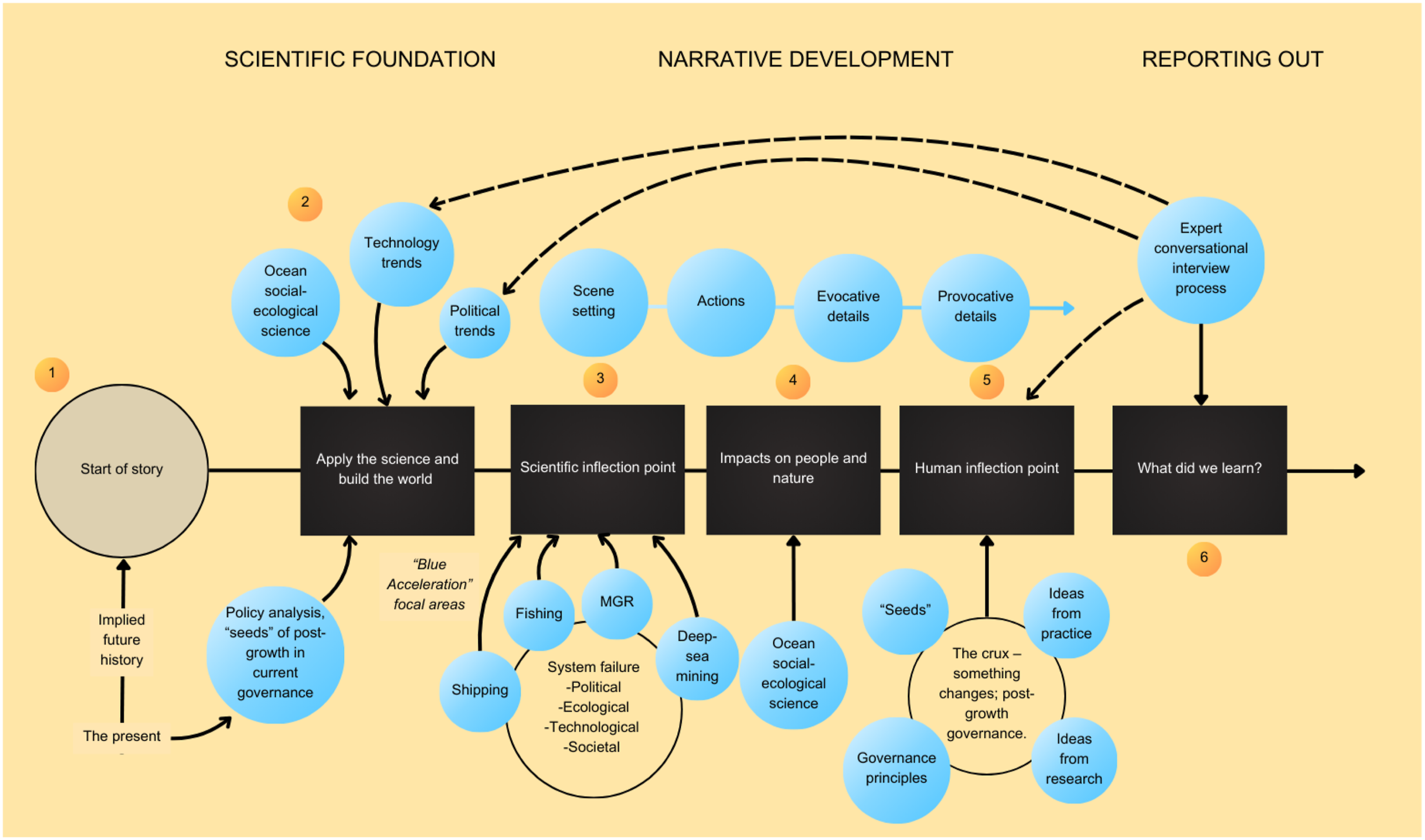
Expert Elicitation
Lastly, we conducted 12 expert interviews to (1) further ground the narratives in the stories in the knowledge of Ocean experts, (2) look further into the potentials and pitfalls of post-growth ABNJ governance, and (3) explore how experts engage with a transformative future when it is presented as SciFi. Each interview had two participants (except for one, where one participant did not show up), who had, beforehand, read one of the stories, the synopsis of all four, and the post-growth Ocean treaty. Participants had backgrounds in academia, NGOs, activism and international governance, and all had experience on working with ocean sustainability issues such as fisheries, marine mining, and marine biotechnology, as well as Ocean law, governance, economics and biology. Most interviewees were based in Europe, although participants based in Africa, Asia, North America and Oceania were also included in the study. Krusberg (Krusberg 2024) provides a full description of the interview methodology. We analysed the results from the interviews through the lens of sociotechnical imaginaries. Following Jasanoff and Kim’s definition (Jasanoff and Kim 2009), we understand an imaginary as a collectively held idea that structures social and political imagination and enables common understandings of social and political processes. Imaginaries are subtle; they “reside in the reservoir of norms and discourses, metaphors and cultural meanings out of which actors build their policy preferences” and “project visions of what is good, desirable, and worth attaining for a political community” (Jasanoff and Kim 2009). They are therefore both instrumental (they shape what can be accomplished socially and politically in the present) and futuristic (they shape what can be thought of as a plausible future).
Results
The following section presents the results of the study. First, we describe the scenario and provide shorter excerpts from all four SciFi-prototypes. The excerpts represent some of the major elements and plot points of the prototypes. We hope they give readers a first sense of the tones, narrative techniques and in-story tensions of the scenario, and that they illustrate the use of narrative storytelling in scenario development. Stories are copyright of Tilde Krusberg and reproduced with permission. The full stories and scenario can be found at https://radicaloceanfutures.earth/post-growth-imaginaries, and in the Supplemental Information. The scenario responds to the first research question, namely: 1. How can potential mechanisms, dynamics and relationships of a transformation to post-growth Ocean governance be illustrated through narrative storytelling?
Then, we present the results of the expert interviews, and address the second research question: 2. How does presenting a transformative future in the form of narrative SciFi shape how the transformation is perceived?
Here, we analyse some of the preconceived notions, or incumbent imaginaries, that hindered interviewees from perceiving our scenario as plausible. We also present how engaging with the scenario and with the other participants enabled interviewees to think more imaginatively about the future of the Ocean.
Mare Autonomia
In our scenario, the Ocean is governed as one single commons, whose inherent rights to peaceful existence are recognised and safeguarded (Figure 2). Capitalist wants are no longer considered superior to basic human and more-than-human needs. We have named this future Mare Autonomia, the autonomous Ocean. The post-growth Ocean treaty.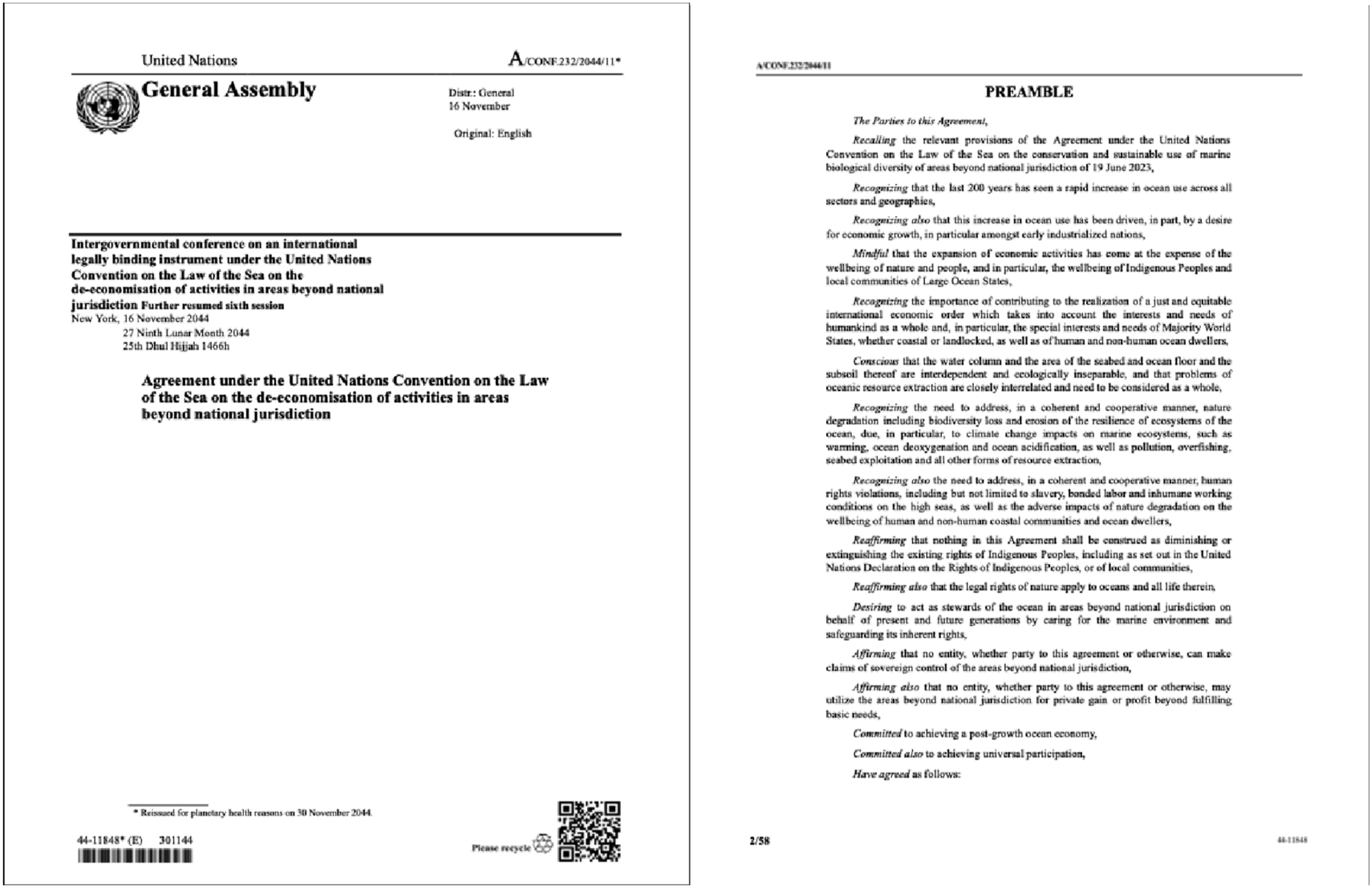
Here, policy makers have recognized the harm caused by the fossil fuelled economy and consequently banned shipping of fossil fuels on international waters. Large-scale fishing corporations have been dismantled and single-species fisheries restructured and replaced by adaptive, multi-species cooperatives, with fisherfolk collectively deciding on quotas based on local needs. Biotechnological inventions based on MGR cannot be patented nor IP-protected; they are available open access, with all benefits from them considered common to humankind. Deep-sea mining is banned completely. The scenario is illustrated through four SciFi prototypes: “Dealers of the Bane of the Earth”, “Old Wounds”, “Rotting Mangoes and the Killer Sea Snail” and “Ocean Blight”. “Dealers” follows a research vessel patrolling an open Ocean Marine Protected Area (MPA) when it encounters a suspected illegal oil tanker: WINSTON (looking down at the monitor now in his hands) We should be good. We’ll be moving into more turbulent waters soon, but we’ll definitely manage. The Captain does not respond immediately. Her face is turned towards the Rose. She looks concerned. TARJEI (to the Captain) It will power through. They would not have put her in icy waters if she was not fit to move through them. CAPTAIN (turning her concerned look to Tarjei) Even so, you are correct about the storm. It’s not certain they are equipped to manage it; what if they run into distress? What if… TARJEI (interrupting her) The ban didn’t end all fossil shipping. We see the proof of this in the Rose. But it made shipping a high-stakes business, and that requires adequate equipment. Fuel dealers would not risk this journey with a third-rate ship; they have too much to lose.
Excerpt from “Dealers of the Bane of the Earth”.
“Old Wounds” follows a fishing crew as they navigate their annual tuna season whilst climate change is impacting the fishery in unexpected ways: Entry #8068. Following a pack of dolphins. Their movements feel natural. No hiders spotted. A response: R: Yojeong? Following the same group remotely. No indications of yellowfins from our side either. Is that what you are searching for? Y: Negative. We stopped fishing yesterday. Now fulfilling monitoring duties only. Jordan said, “We should be fishing less.” Bok-Joo wondered what he felt. “It’s the way of the changes that are the problem” she responded. “We all know climatic Ocean change is creating disturbances, forcing the fish to adapt, and us to respond. But these new changes are off. It’s what we would expect from large-scale Oceanic change interacting with heavy local disturbances. And there are no such disturbances reported in the PresNet; it makes people suspicious.” “It’s most likely that we do not know the way of the water and the way of the fish as well as we think we do.” And Bok-Joo said, “Not everyone is ready to accept the limits to our knowing.”
Excerpt from “Old Wounds”.
“Rotting Mangoes” follows a deep-sea biologist who details how they, alongside a medical doctor and a little red sea snail, developed a pharmaceutical that stops metastasis in breast cancer: This is when Shawlin contacted me. She had seen my entry and wanted to know more about the snail. Shawlin was a medical doctor working on treating metastasized cancer. Like many of her peers, she was weary of the harm cancer caused her patients and their loved ones and was committed to ending it. Also a life-long eco-spiritualist, she was certain that the answer would be found in nature. Cancer is so complicated, she has often told me, that there is no way we humans can just “figure it out”. Nature is far cleverer than us, and Shawlin was eager to learn. That is why she spent her free time browsing the genomic databases of the PresNet, looking for some new teachings from the creatures of the common seas. She told me she felt “it” when she stumbled upon my note. I knew what she meant. It was the same feeling I had felt throughout my PhD. I think that is where we found each other, in that tinge of wondrous excitement that comes from learning something new, in that curiosity and thirst for knowledge that, at its core, drives all people searching for knowledge.
Excerpt from “Rotting Mangoes and the Killer Sea snail”.
“Ocean Blight” follows a community as they gather for a cultural festival commemorating the triumphs and losses of the movement against deep sea mining: Apparently, the shanty was conceived of during the anti-exploitation movement, and had started as a sort of song-to-action. Back then, the chorus had been sung by all those demonstrating against seabed mining, and as the movement grew and local clusters formed, different fractions started adding their own verses. This was why it varied between communities; everyone had their own set of disparate verses that they had decided to merge together to a fully-fledged song. But the chorus was always the same, and so was usually the first verse. And Yahya started: Farewell and adieu, to you exploitation Farewell and adieu, to you Ocean blight For we gave out orders, to leave be the deep sea And we hope that with time, life will flourish again So we will resist, all mining endeavors Resist and persist, throughout these vast seas Until we’ve put an end to this mineral madness From seamounts to smokers, let our Oceans breathe
Excerpt from “Ocean Blight”.
Incumbent Imaginaries
By exposing the SciFi prototypes of the scenario to a diverse set of experts, we were able to reveal some of the incumbent imaginaries hindering people from seeing a post-growth Ocean future as plausible and realistic. It was to this end that the prototypes deliberately challenged existing Ocean governance systems with post-growth alternatives: maximum sustainable yield was replaced with fisher-set fishing quotas (Nogué-Algueró et al. 2023; Ramesh and Namboothri 2018), flag and port state enforcement of maritime law was replaced with bottom-up enforcement of Ocean rights (Harden-Davies et al. 2020; Mégret 2021), patented and IP-protected biotech from ABNJ was replaced with global availability (Ferreira 2002), and the natural environment was given agency in the narrative development (Van Schalkwyk 2011). During the interviews, many imaginaries pointing to the incumbent regime came out. The most prominent were (1) the “homo economicus”, or the economic man, (2) that crisis is necessary for transformation, and (3) sentiments of general implausibility.
Homo Economicus
Perhaps the most common imaginary expressed by interviewees was that of the economic man, or “homo economicus”: the idea that humans are individualistic, self-serving and fully rational economic agents that will exploit a common pool resource to death if given the chance (Urbina and Ruiz-Villaverde 2019). The profit motive, the exploitation cycle and the never-ending struggle for private gain are simply human nature (Hardin 1968). One interviewee reflects over the history of European imperialism and exploitation: “Do we think that the rest of the world would have done it differently, if given the choice? (...) I mean, we are all humans. Therefore I think that we share a lot of those general underlying behaviours.”
Despite “homo economicus” receiving heavy criticism from empirical research (Urbina and Ruiz-Villaverde 2019), this imaginary is expressed in interviews on all four prototypes and by interviewees with widely differing backgrounds. It poses a problem for emerging post-growth, post-capitalist and post-extractivist imaginaries because it obstructs viewing these other futures as even remotely possible (Feola 2019; Feola et al. 2021). Related are ideas around money or profit being necessary motivators for human behaviour. These sentiments signify how deeply ingrained the incumbent regime is in the collective imagination. They make it seem as if the profit motive is intrinsic to humans rather than capitalism shaping motivations (Kozel 2012).
Crisis
Another common idea is that crisis is necessary for radical social change. It was both implicitly and explicitly expressed, for example in interviewees assuming that a catastrophe preceded the events in a story or stating that the scenario is implausible unless “a big disaster changes things”. One interviewee talked about what could spur a post-growth transformation: “Apocalypse is always [a good narrative], huh?”
Even though a crisis can be a trigger of transformation, it is not a necessity for it (Moore et al. 2023). But this crisis imaginary is not only problematic because it is not supported by evidence; it also limits our collective imagination on the plausibility of radical change and hinders us from acting on it in the present (Pigott 2018). As Amitav Ghosh puts it, this is a crisis of the imagination for how we address systemic challenges without catastrophe (Ghosh 2017).
General Implausibility
Interviewees lastly express general sentiments around the implausibility of Mare Autonomia. Higher levels of environmental care and stewardship “seems far away” or “is inconceivable”. They express that we, within the status quo, can talk about sustainability as long as we do not question capitalism or the ideology of eternal growth (Schmelzer 2015).
The abundance of sentiments around unspecified implausibility highlights the need to clearly articulate radically different alternatives and create new imaginaries (Otero et al. 2024). For transformation to be possible, we must allow ourselves to imagine that things we take for granted right now can be different in the future (Stoetzler and Yuval-Davis 2002). Recalling our definition of utopia: utopia refutes claims that there is no alternative to the dominant regime and thus entails refusal to accept that what is given is enough (Levitas 2007). What cannot be thought about cannot be acted upon, and articulating and sharing utopias is therefore necessary for sustainability transformations.
Relational Imagination
During the interviews, interviewees expressed that engaging with the stories gave inspiration. For example, two interviewees mentioned that the process of reading and engaging with the stories inspired them to create a campaign for a tabletop roleplaying game set on the open Ocean. Another said that they wanted to show the post-growth Ocean treaty and have their colleagues expand on it: “When I read [the post-growth treaty], it was at the end of the day when I had a lot of meetings and so on, and it felt very reinvigorating. I thought I should [show it around] in the office and then my colleagues could add on articles.”
Talking about the stories also generated new ideas between the interviewees. For example, in a conversation about the story “Old wounds”, one interviewee said that the choice of tuna as the target species of the story took them out of the narrative. This primed the other participant to talk about the nature of “tuna fisheries” as such, and they eventually ended up talking about how the concept of “fisheries” would need to be redefined in a post-growth future (for a detailed description of this and more conversations, see (Krusberg 2024)). In essence, one interviewees’ scepticism about a specific story element prompted a reflection in the other and eventually gave rise to a more general conclusion that neither of them would have arrived at by themselves nor without the story as a starting point. This shows that imaginative capabilities can be strengthened through applied imagination and engagement with creative artefacts. It also illustrates that imaginative ability is inherently relational, and that imagination can be spurred through human-to-human interactions (Moore and Milkoreit 2020).
Discussion
Modellers have tried to predict the future of the Ocean for almost 50 years, their attempts becoming increasingly complex and sophisticated with time. However, most predictions build on preconceived notions about what the future will look like, oftentimes based on business-as-usual trajectories and linear extrapolations from the present. History, however, shows that the future cannot be predicted with certainty; unexpected dynamics, overlooked trends and old-new ideas will impact the future in surprising ways. Creative and speculative scenarios aimed at exploration can here help us see that many different futures are possible. They can train our collective imaginative capabilities and ameliorate the imaginative deficit that makes it hard for many people to imagine radically different futures. By doing so, creative scenarios expand the possibility space of what can be considered plausible futures. By explicitly questioning, disrupting and providing an alternative to growth-centric capitalism, Mare Autonomia reminds us that the present trajectory is not the only possible one. Taking this as our starting point, in the following sections, we discuss how our study contributes to the development of the field of Ocean futures.
Methodological Contributions
As touched upon, our approach to creative scenarios differs from previous Ocean futures developed through SciFi prototyping in that our four prototypes are vignettes to one scenario rather than four distinct scenarios. One critique against scenario work is that low granularity fails to address complexity (Merrie et al. 2018; Sardar 2010) and does not allow for in-depth exploration of scenarios (Bleecker et al. 2022). Simultaneously, scenarios with higher granularity and more complexity lose explanatory power because they become too complicated to follow (Murphy and Day 2021). The added value of the vignettes is that they are themselves manageable in size, but, together, give the full scenario higher granularity and more complexity. The approach could easily be adopted to explore many different futures.
We also add methodologically to futures studies by showing how stress-testing creative scenarios through expert elicitation can lead to new insights into the transformations the scenarios showcase. Through our study, we revealed aspects of the imaginaries hindering people from perceiving post-growth Ocean futures as plausible. Previous work has used participatory approaches to create scenarios and conducted interviews to gauge perceptions of the potential of creative scenarios for transformation (Lübker et al. 2023; Pereira et al. 2023). Our work makes an added contribution by showing how interviews centred around narrative scenarios can effectively reveal incumbent imaginaries about the systems and transformations they explore, and thereby indicate fruitful pathways forward for more collaborations between transformative sustainability science, creative futuring practices and sociotechnical imaginaries scholarship.
Furthermore, the process of inviting participants to read and reflect over the prototypes and the treaty, and to then give them the opportunity to talk about their impressions, spurred new ideas and strengthened interviewees’ capacities to imagine a radically different future. The conversation is an important futuring tool. Interpretations of a piece of fiction vary widely between readers, but getting the chance to air reflections with other readers opens up space for new imaginaries (Billings and Fitzgerald 2002; Lewis 2017). Imagination is a fundamental capability for deliberate engagement in transformation processes (Moore and Milkoreit 2020). Finding ways of engaging the imagination to reflect on radically different futures is therefore necessary in a world facing a polycrisis. In these creative spaces, more disruptive visions for the future could flourish (Vervoort et al. 2024).
On the Need for Transformation
Ocean governance is a grand challenge for humanity. UNCLOS took almost 50 years to negotiate, and calling for deep and structural transformation without reflecting on its inherently difficult nature is ignorant of the complexity of Ocean governance. Therefore, the starting point of this work is that seeds of a potentially better future exist within the present (Bennett et al. 2016). Mare Autonomia is built on seeds of post-growth, ideas for governance that already exist in current frameworks for ABNJ (Krusberg 2024). During the interviews, many of these were pointed out by the participants, oftentimes as potential ways forward for transformation to happen. Because the stories formed the starting point of the discussions between interviewees, it is not surprising that they ended up talking about changes in Ocean governance related to the seeds at the base of the prototypes. But the interviewees also suggested more radical changes to Ocean governance that we had not deliberately built into the scenario. For example, they suggested getting rid of the territorial state system, new ways of thinking about open and deep Ocean stewardship, and a new UNCLOS which takes its’ starting point in the structure and processes of the ocean itself (Krusberg 2024). This finding adds to transformation scholarship by showing how thinking about transformation as stemming from good practices already in existence does not necessarily hinder the formation of more radical ideas. Rather, ideas for structural change can arise from thinking creatively about the potentials of the present.
Storytelling, Imagination and Radicality
We contend that storytelling is not just for speculating around the future, but also about rethinking the way our present is told (Galafassi et al. 2018). Storytelling is an integral part of any sustainability transformation. But it is also a tool of the powerful, often weaponized to keep the current exploitative and unsustainable system in place. The actors profiting from the capitalist system tell stories about a future of endless, bountiful economic growth to naturalise the present state and make it appear inevitable. These stories reinforce the imaginaries of the incumbent regime and contribute also to their internalisation. Take deep sea mining as an example. Lobbyists are constantly trying to sell their vision of a future world which has developed along a path where mining did happen (https://metals.co/frequently-asked-questions/), and in retelling this story and blocking out all alternative visions, they make their future seem inevitable. Then, actors on financial markets invest in and trade on these stories, and gain more wealth and influence while also working to secure them (Galaz Rodriguez and Collste 2022). This further cements their futures as the only “realistic” ones through a reinforcing feedback loop built on power (Pigott 2018).
When telling other stories than the dominant narrative, we come one step closer to realising that alternative visions of the future are not inherently less plausible than the status quo (Galafassi et al. 2018; Sardar 2010). In this paper, we have illustrated that engaging with SciFi short stories about a radically different future can lead to increased imaginative ability and generate disruptive ideas for how to achieve transformation. This further goes to show that there are pathways towards other futures. There is nothing more inherently plausible about a business-as-usual future than a post-growth future, especially not on a biophysically finite planet where economic growth in many contexts has been decoupled from human, more-than-human and planetary well-being (Jebb et al. 2018). In realising this, we might also improve our capabilities in critically reflecting over the stories told about our present and de-naturalising the injustices and unsustainability they allow for (Anderson 2016). During the interviews, we asked what participants perceived as unrealistic or implausible about the story-world. One interviewee challenged this question: “I mean, there are people that say that what we're doing now [within the current economic system] is absolutely implausible. There's people with very strong opinions that think it's crazy, quite literally mad. The other extreme end says that it's absolutely necessary, and then there's probably most of us somewhere in the middle. Yeah, so the question of what is unrealistic or realistic, I guess that depends on the strength of the stories told more than perhaps the nuts and bolts of what is or isn't there.”
Conclusions
In this paper, we developed the field of Ocean futures by creating a scenario at the forefront of radicality: a post-growth future for the Ocean beyond national jurisdiction which explicitly disrupts (and provides an alternative to) the capitalist hegemony driving Ocean exploitation and degradation today. We furthermore showed how engaging with scenarios presented in narrative and creative formats enabled people to think more imaginatively about the potential future, and how this imaginative capability is inherently relational. But we believe our findings hold true for sustainability visions and transformations more broadly. As a field, Ocean futures is a direct continuation of a millennia-long speculative tradition which uses the Ocean as a realm through which to tell stories about the conditions for human existence on Earth. Scenarios about the future Ocean are therefore not only futures of the Ocean, but they also represent radical environmental futures more broadly. Engaging with disruptive Ocean futures, such as presented in this article, can therefore be a way of fostering capabilities for transformation to socially and ecologically just futures for the global Ocean and beyond.
Supplemental Material
Supplemental Material - Disruptive Ocean Futures – The Rise of Post-growth Imaginaries
Supplemental Material for Disruptive Ocean Futures – The Rise of Post-growth Imaginaries by Tilde Krusberg, Andrew Merrie in World Futures Review.
Footnotes
Author Contributions
T.K.: Conceptualization – “Disruptive Ocean Futures”, Investigation, Visualization, Writing - original draft, Writing - narrative short stories, Writing - review and editing. A.M.: Conceptualization – “Radical Ocean Futures”, Supervision, Writing - review and editing.
Declaration of Conflicting Interests
The authors declared no potential conflicts of interest with respect to the research, authorship, and/or publication of this article.
Funding
The authors disclosed receipt of the following financial support for the research, authorship, and/or publication of this article: This work was supported by the Core grant to Stockholm Resilience Centre at Stockholm University.

Supplemental Material
Supplemental material for this article is available online.
Author Biographies
References
Supplementary Material
Please find the following supplemental material available below.
For Open Access articles published under a Creative Commons License, all supplemental material carries the same license as the article it is associated with.
For non-Open Access articles published, all supplemental material carries a non-exclusive license, and permission requests for re-use of supplemental material or any part of supplemental material shall be sent directly to the copyright owner as specified in the copyright notice associated with the article.
