




Abstract
Horizon scanning the climate-altered world in 2100 under the Shared Socio-Economic Pathways (SSP) is an important tool for the Inter-Governmental Panel on Climate Change (IPCC). However, because the SSP are apolitical there is an opportunity for drawing across political science insights to complement and enhance their narratives accounts of the future. I make a contribution here by drawing on 44 futures literatures juxtaposed against the Institute for State Effectiveness’ ten-part functional typology. This constructs five conceptual climate-altered states at the terminus of the SSP - (1) sustainability state, (2) middle-of-the-road, (3) security state, (4) unequal world of states, and (5) fossil-fuelled state. This analysis enhances the IPCC’s mapmaking for policymakers and civil society by highlighting the consequences on future state functions of contemporary climate policy decisions. I conclude by discussing the limitations of this approach and outlining future opportunities for political science to complement, enhance and critique the IPCC’s SSP.
Introduction
Theorising the future of the nation state under different climate futures is an essential contemporary conversation. There is a discord at the heart of this, however. On one hand, political theorists have over recent decades been arguing from many angles and perspectives what the future of the climate-altered nation state ‘ought’ to be. For example, Robyn Eckersley offered an important contribution to this discourse (2004) with an avowedly pro-nation state perspective for the maintenance of sovereignty within a fundamentally transformed ‘green state’. Mann and Wainwright (2018) (building on Jessop, Poulantzas, Karatani and others) have recently built on this (2018) with a neo-Marxist political economy perspective juxtaposing notions of planetary sovereignty against anti-planetary sovereignty. This constructs a four-part matrix accounting for four possible future nation state political economies. Meta discussions about sovereignty and political economy are foregrounded in these literatures theorising the future climate-altered nation state. Simultaneously, the third working group (WG3) of the Intergovernmental Panel on Climate Change (IPCC) are offering increasingly sophisticated futures models for societies and economies under the aegis of the five Shared Socio-Economic Pathways (SSP) in 2100 (Riahi et al. 2011, 2017). These five SSP and the growing futures literatures underpinning them offer a significant alternative route to imagining narrative accounts of the future of the state based on the policy decisions of coming years and decades (Riahi et al. 2017). The SSP are built on decades of complex modelling undertaken by the IPCC but are assiduously apolitical in nature.
There is a general lack of engagement between these two strands of future pacing the climate-altered state; with one strand theorising what ought to be based on what academic political science understandings about power; and the other modelling socio-economic future states devoid of any reflection on the nature, shape, and influence of power. Both, in their own ways, offer incomplete and partial vision of our climate-altered futures in the nation state. Bridging the two discourses of climate futures modelling and political science is therefore an essential effort in ensuring that the full implications of the climate decisions in coming decades are understood and taken account of in modelling our collective futures. Mindful of Jessop’s (2020) warning that “given the many member states of the United Nations …. speculating on the state’s long-term future is a fools game” I argue that theorising state assemblages is clearly an important and worthy subject if academic political science is going to leverage its specialist expertise to the challenges of the coming century of climate and ecological challenges (Beck and Oomen 2021; Javeline 2014).
To offer a contribution to the bridging effort between the IPCC’s SSP and political science, in this paper I synthesise from 43 futures-facing sources about the functions of the nation states at the end of the SSP in 2100 (similarly to: Deutsch 1986; MacTaggart 2005; Huber et al. 2015). Whilst there are many excellent typologies that could be used, I instead explore these phenomena through a state functions analytical framework drawn from the Institute for State Effectiveness’s (ISE) ten-part typology of good governance through state functions. In adopting the ISE framework, it (a) sidesteps preferencing any particular ideological or sub-disciplinary leaning from political science/state theory and (b) instead offer general political-science insights about ‘what the state does’ that might be adopted or considered by the IPCC and SSP modelling community. This contribution is of import where it starts to offer grounded and applied signposts from political science for the broadly conceived constellation of scholars, civil society actors and policymakers engaged with WG3 of the IPCC imagining our futures based on the policy and behavioural decisions of the coming decades.
The paper proceeds as follows: it first introduces and contextualises the five SSP from the IPCC, followed by an account of state functions drawn from state theory and the ISE ten-part typology. The futures literature it draws upon are next discussed in a methods and findings section, followed by an analysis section in which four of the five future nation states are presented and discussed. I conclude by discussing the value, limitations, and contributions of this work to the wider state and climate change discourse and suggesting a limited set of avenues for future research and theorisation.
The Shared Socio-Economic Pathways
The IPCC’s WG3 undertake horizon scanning and modelling the implications of current and near-term climate policy decisions on future societal trajectories. Each SSP (Annex A) is presented as a narrative account of the shape and nature of societies and economies in 2100 based upon five broadly conceived pathways or corridors of climate policy-action in the coming decades (Riahi et al. 2017; Veland et al. 2018). Each acts as a reference point-scenario for the future of society which opens-up research opportunities for exploring the impacts of each scenario as both standalone (Buhaug and Vestby 2019; Calvin et al. 2017; Chen et al. 2020; Fujimori et al. 2017; O’Neill et al. 2014; O’Neill et al. 2017) and comparative roads taken or not taken (Benveniste et al. 2022; Dellink et al. 2017; Jiang and O’Neill 2017; Riahi et al. 2017; Samir and Lutz 2020). Despite the value the SSP offer to policymakers and civil society (e.g., O’Neil et al. 2017; Riahi et al. 2017) there are still limits to the messages that the IPCC can give about the political consequences of the SSP and their destinations. This is not to ascribe blame or fault to the scientists and scholars who compile the IPCC’s assessment reports (AR); only that the institutional nature and foundation of the United nations Framework Convention on Climate Change and the IPCC limits politically charged prognostications of climate futures (Beck and Mahoney 2018), or any that are construed to interfere in or supersede sovereign governmental policy-making (a key tension in Mann & Wainwright 2018 sovereign/anti-sovereign tension). It is instead incumbent upon scholars, and political scientists in particular (Beck and Oomen 2021; Javeline 2014), to act as boundary actors translating the political implications of the horizon scanned narrative accounts of the SSP in 2100. This is what Beck and Oomen (2021) describe as the ‘politics of anticipation’. The five narrative accounts (Veland et al., 2018) of the SSP and our potential shared futures are replicated below in Figure 1. The five Shared Socio-Economic Pathways to 2100. 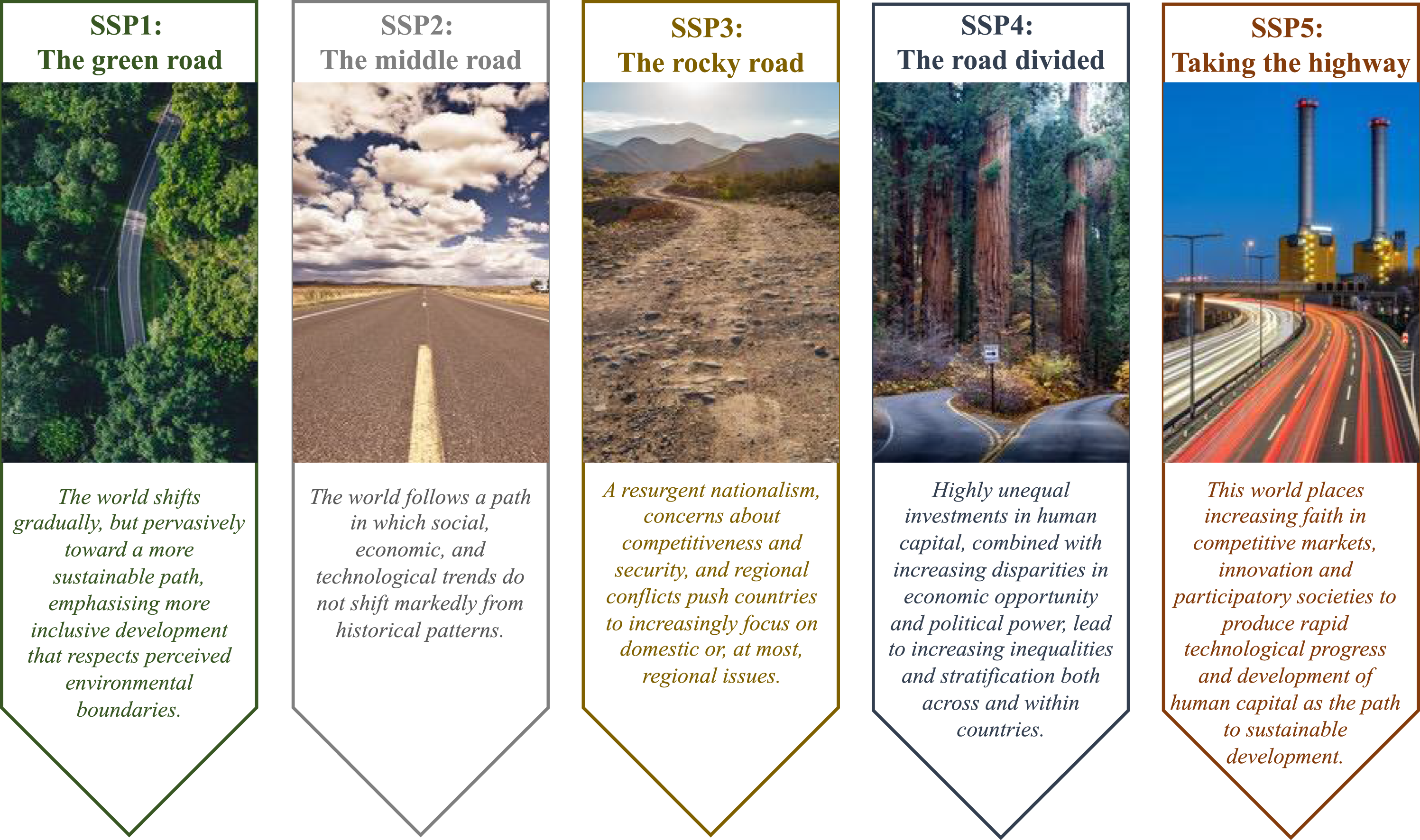
A State Functions Perspective
Echoing Mann and Wainwright (2018) who argue that ‘these political futures are “ideal types” in the Weberian sense, and not “ideal” in the “best possible” sense but roughly sketched yet identifiable types’, the nation states at the end of the SSP ‘roads’ presented in this analysis (Figure 1) are conceptual and aspatial. Despite the body of scholarly discourse around the climate-environmental future of the nation state not all scholarship agrees that ‘the state’ is an artefact worthy of study under different climate futures. Some argue that the nation state, as currently conceptualised, is poorly-suited to the coming century of climate challenges (e.g., Mann & Wainwright’s Climate X or the work of Andreas Malm). Critical state theorists (see: Mitchell 1991; Brenner 2004; Sassen 2007) argue that conceptualisations of the state a unitary and bounded institution are wrong-headed, and as such is the wrong choice of political unit of analysis for the coming century of climate-induced societal change. They instead consider the nation state as a networked and assembled structure with complex overlapping and intersecting elements unamenable to discrete analysis. Or as Mitchell considers, ‘the state as an object of analysis that appears to exist simultaneously as a material force and an ideological construct. It seems both illusory and real. This paradox presents a particular problem in any attempt to build a theory of the state” (1999: 76). That said, despite a multi-decadal discourse heralding the ‘imminent’ demise of the unitary state (e.g., Andersen 2006; Strange 1996) recent years have witnessed instead the remarkable institutional stickiness of bounded nation states (Risse 2001). Therefore, echoing much like the defence of the nation state as an analytical object of enquiry given by Eckersley (2004), Rieger and Leibfried (2003), Giddens (2009) and others (see: Habib 2015; Mann and Wainwright 2018; Lieven 2020; Beardsworth 2020), this paper aligns with the argument that (a) the nation state as a bounded institutional assemblage that does have analytical value (if the limits of this bracketing are acknowledged); and (b) that under every narrative SSP the nation state will remain the primary institution projecting legitimate power over a given geography as a social institution for the coming century at least (e.g., Huber et al. 2015).
Through this work I aim to complement and enhance the apolitical SSP with insights from political science. The paper does not adopt an overtly critical perspective and in so doing tear the SSP down. I am live to the critique that this kind of approach might attract from critical colleagues which argue that only rapid and radical change in the ordering of power within the state will offer salvation from the age of climate crisis. Whilst critical scholarship has an important role to eventually play in politicising the SSP for the initial contributions more collaborative and constructive approaches that exhibit the complementary value of political science are required. It instead offers the IPCC/WG3-orientated community an opening for account of the political consequences of near future climate policy decision-making on the conceptual functions and functioning of nation states under different SSP pathway. This in articulated through the principal research question: What will the functions of the climate-altered state be in 2100 at the conclusion of the five shared-socioeconomic pathways?
The following section sets of the analytical method I utilised based on the Institute for State Effectiveness’ ten-part typology of state functions. It then horizon scans SSP1, the sustainability state; SSP2 the middle-of-the-road scenario; SSP3 the security state; SSP4 the unequal world of states; and SSP5 the fossil-fuelled state.
Method
The process of horizon scanning and scenario building models and prognostications for policymaker and civil society audiences is a central pillar of the WG3 of the IPCC (Riahi et al. 2017; Rogelj, Meinshauen, and Knutti 2012). Beck and Oomen (2021) argue that the IPCC now considers itself the ‘map maker in chief’ in charting the unexplored territory of our collective societal futures. The IPCC is a depoliticised institution, due in part to its construction in global governance, and efforts to enforce apoliticality on its contributing scholars and researchers. Whilst WG3 can construct apolitical narrative corridors of action and consequence, the IPCC retains a blind spot for the inherent political consequences of the SSP (Mann & Wainwright 2018). It is, in part, the job of political scientists to act as boundary actors between the IPCC and the political consequences and dimensions of its SSP modelling, and associated policy implications. My work contributes to this by horizon scanning the conceptual nation state under the five SSP under a common analytical framework as part of this wider mission.
Horizon scanning is a futures-approach (UK Government Office for Science 2017). It supports the identification of emergent trends, innovations (Hines et al. 2019, risks and opportunities (Musche et al. 2019) of decisions. And supports the subsequent embedding of insights into ‘long term strategic thinking in the policy and strategy process’ (UK Government Office for Science 2017). Emerging in the 1970’s futures approaches offer both descriptive and prescriptive methods for triangulating on likely future scenarios based upon the best available evidence and expert opinions (ibid.). Futures methods can offer option analysis for policymakers, and in so doing elucidate future consequences of contemporary decision-making (Sutherland and Woodroof 2009). They are increasingly viewed as providing important and legitimate tools for planning for future policy challenges (Amanatidou et al. 2012; Bibri 2020; Cuhls 2019; NESTA 2021; Schuck et al. 2018). For example, the UK Government recently (2021) launched its intra-governmental futures-toolbox to better equip policymakers with the well-used and legitimised tools of futures research to aid contemporary decision-making. As argued by Sutherland and Woodroof (2009), and by Riahi et al. (2017) futures-approaches are well-suited to the challenge of building the narrative accounts that comprise the IPCC’s SSP, and there is a lively and thriving environmental futures literature (see also: Wabnitz, Teh, and Cheung 2019) that I associate with and within. In seeking to address the research question I do not adopt an empirical futures methodological approach (e.g., Delphi method) per se. But, similarly to Hines et al. (2019), Cuhls (2019) and Sutherland and Woodroof (2009), instead undertake a literature review and synthesis of other scholar’s futures research contributions to address the research question.
This review-based analysis draws out these expert opinions and juxtaposes them against an analytical framework derived from the ISE typology of state functions. Founded by the former President of Afghanistan, Ashraf Ghani, the ISE is perhaps best known for its ten-part ‘framework of state functions for effectiveness’ (Ghani, Lockwood, and &Carnahan 2005). This is an apolitical and technocratic framework accounting for core liberal principles of good governance in the state. Building on the previous scholarship of Biermann and Dingwerth (2004) I use the ISE framework for future modelling functionalist accounts of the 2100 climate-altered state. The ISE framework, reproduced at Annes B offers a conceptual and analytical framework for assessing good governance through specific functions within states.
There are limits to the adopted functionalist approach. The ten definitions of state functions given in Annex A offer an overtly liberal-democratic perspective on the key state functions that comprise good governance. There are literatures (e.g., Area Studies) critiquing functionalist approaches to state strength and ranking and ratings methods (e.g., Cooley and Snyder 2015) and illiberal perspectives of good governance and state functions in our climate futures. Indeed, each of the definitions of ‘state functions’ given in Annex B might be contested and contestable within the wider state and governance scholarly community. The ISE framework has value here where it avoids the critical-scholarship and discourse of what ‘ought’ to be in the future state, and instead stick to futures of what ‘might’ be from a functional perspective. We are live to the critique of functionalism which turns on the claim that functionalist analyses reify their object of study, and thus lack predictive value because they are inattentive to radical (systemic) transformation. That said, in this paper I reveal possible future states (through the lens of functions) that the SSP have us tracking, rather than the radical potentialities for transformation (historical institutionalisms ‘critical junctures’). As important as these are, they are not the topic of this work. An important critique suggests that we can’t understand the future state under contemporary categorisations that lack adaptive flexibility to future category change and error; though this is a consistent and well-worn of critique of futures approaches writ large and are unavoidable without straying too far into the realms of fictional genre (not to denigrate climate-fiction).
Results
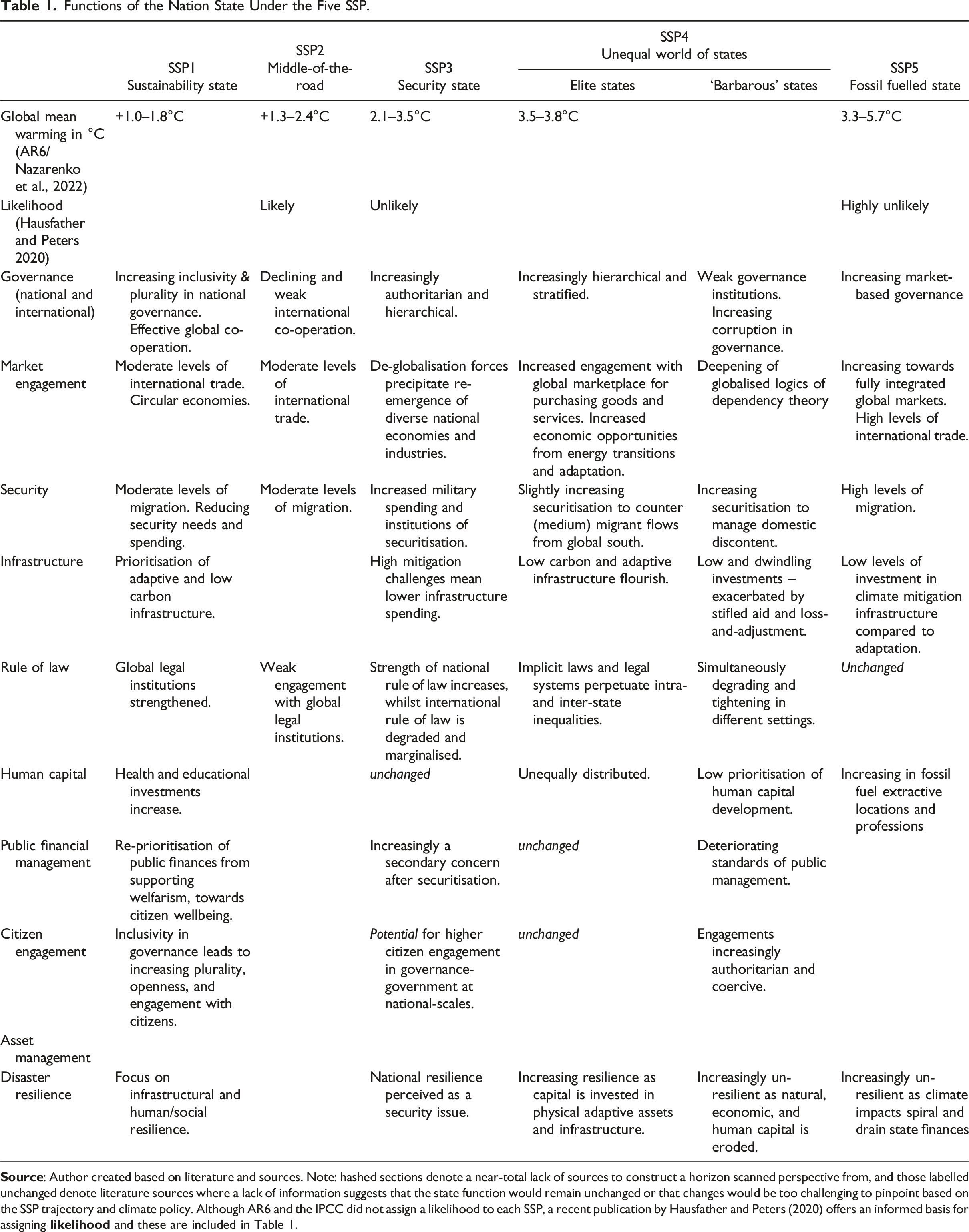
Functions of the Nation State Under the Five SSP.
Discussion
None of the analytical state functions exist in isolation. All are to greater and lesser degree reliant upon and enmeshed within each other. For example, under SSP1 a reduction in state defence spending due to a resurgent global rights-based liberal order might release state spending opportunities to re-prioritise healthcare and education as critical components of national adaptive resilience in communities. Whilst each function is explored and presented as analytically separate there are interdependencies across and between all the state functions. Only partial accounts of different state functions for each of the five nation states at the end of the SSP are discussed, based on the limited availability of horizon scanned sources to construct perspectives from. 1
SSP1: Horizon Scanning ‘Taking the Green Road’ to the Sustainability State
Transitions towards the sustainability state are based on a predicted +1.0–1.8°C global mean temperate increase (AR6 2022). AR6 and other models tend to differentiate slightly between two sub-forms of SSP1 (1–1.9 and 1–2.6) through for this analysis we will treat these and a single pathway. SSP1 represents the 2100 future in which the goal of the Paris commitments was met – what Raskin et al. (2002) (and the wider work of the Tellus Institute) described as the ‘utopian future narrative’. There is a rich and theoretically diverse eco-utopian literature surrounding sustainability transitions and transformations towards nation states that are, to a greater or lesser extent ‘sustainable’ (e.g., evidencing strong or weak sustainability characteristics) (Barry and Eckersley 2005; Duit 2014; Eckersley 2004; Huh, Yunyoung, and Kim 2018; Kronsell & Bäckstrand 2015). Actualising sustainability states by 2100 is predicated upon significant transformations in the logics, politics, institutional architectures, and governance functions of normative nation state (Eckersley 2004) and overcoming institutional barriers (Hausknost 2019; Hausknost and Hammond 2020; Huh, Yunyoung, and Kim 2018).
Governance
There is an assumption that actualising a sustainability state is predicated on growing inclusivity and openness in national governance (Nair 2018), as part of and contingent upon increasing deliberative democracies. Therefore, many excellent contributions from the collaborative (e.g., Ansell and Gash 2008), participatory (e.g., Fischer 2012) and polycentric governance (e.g., Ostrom 2010) literatures that can be used to understand at the end of SSP1: the sustainability state. It is one in which intra-nation power is diffused and governance an increasingly networked and shared endeavour. The sustainability state would likely be based on collaborative and plural governance ‘beyond the state’ in the form of resurgent international multilateralism (UNEP 2020).
Security
The Sustainability state would in all likelihood, have avoided the worst climate wars outlined in Dyer (2011). This has the potential for the emergence of global climate solidarity leading to a general de-securitisation of the state and a repurposing of defence spending towards a re-surgent international rights-based world order of states (congruent with the liberal Internal Relations tradition). These repurposed state funds might be redirected towards necessary climate adaptation and financial and technological disbursements from the global north to the global south (the ‘loss and damage’ agenda – see: Byrnes and Surminski 2019). Thus, the primary state function of ‘defence of the realm’ (Sandelius 1931) would be re-purposed as viewing the primary threat to be defended against as the climate crisis itself (Wainwright and Mann 2018) rather than other hostile states – mediated through the rights-based international order. Arguably, this transformation would be reflected in national rule of law which reflects a re-focused effort towards the rights and duties enshrined in the international rules-based order.
Market Engagement & Infrastructure
Scholars have argued that the current, contemporary political economy of nation states based on using economic growth is both a crude proxy for citizen welfare at best, and at worst a direct driver of increasing carbon emissions (e.g., Nair 2018). Whilst the evidence-base for decoupling economic growth from carbon emissions, all things being equal (inclusive of carbon leakage and offshoring) is emergent and unquantified (Haberl et al. 2020). SSP1 is predicated upon the failure of ecomodernist decoupling economic growth for carbon emissions (Haberl et al. 2020) and a refutation of perpetual and boundless economic growth as an organising principle of the state (see: Raworth 2018). Certainly, concerns of economic and development justice in the global south (Nair 2018) would necessitate that the rate at which states transform away from GDP as their raison d’etre. At the terminus of SSP1 are states where tax revenues re-purposed from defence spending are, in part, re-directed towards investments in (national) human capital in the form of education and healthcare spending (Riahi et al. 2017).
SSP2: Horizon Scanning Taking ‘the Middle of the Road’
Fricko et al. (2017) tell us how ‘The SSP2 narrative describes a middle-of-the-road development in the mitigation and adaptation challenges space’. The IPCC AR6 (2022) highlights how SSP2 is likely to witness a global mean temperature rise of +2.6°C with the world staying in or around this temperature through most of the net-zero emission pathways. There were a small number of substantive futures modelling efforts for SSP2 (Kreigler et al. 2017) based on the REMIND MAgPIE integrated assessment modelling framework. These suggest that the middle road state will see relatively stable levels of international trade relative to the baseline, coupled with weak and declining international co-operation. The middle-of-the-road leads to moderate levels of migration and migratory pressure, and a weak and declining engagement of the state with global legal institutions.
SSP3: Horizon Scanning ‘the Rocky Road’ to the Security State
SSP3 suggests a narrative future of a mean global temperature rise of 1.3–2.4°C, and a ‘rocky road’ towards the security state (Fujimori et al., 2017).
Governance
The security state is predicated upon a failure of the cosmopolitan liberal democratic world order, and a failure of the global community expressing a shared but disaggregated climate mission. Security states would be based within an increasingly failing global world order in which the IPCC process has not succeeded in galvanising a collective global effort with the values of justice, burden sharing and brotherhood/sisterhood as the guiding principles for climate action. At the terminus of SSP3 are states are increasingly moving away from the liberal and democratic state-project towards the realist conception of the nation state within the competitive world order (similar to Wainwright and Mann’s Climate Behemoth). The terminus of the SSP3 pathway is a multipolar world order dominated by state-on-state competition and rival-ness. Within this scenario there has been a shift in normative governance modalities towards increasingly hierarchical and authoritarian decision-making and power structures (Hyytiäinen et al., 2022).
Security
The increasing pressure and presence of authoritarian state power is derived from increasing state spending on police and paramilitaries and surveillance at the cost of social programmes and corruption (Buhaug and Vestby 2019). Such regional security states would maintain popular legitimacy through perpetuating populist narratives of place, cultural/ethic identity (juxtaposed with ‘othering’) and national security in response to a heating world (Feinstein & Bonikowski 2021; Hyytiäinen et al. 2022). Such populist narratives would seek to maintain legitimacy and propagate anti-climate-immigrant rhetoric and legislation and othering. The relatively high costs of maintaining the security state would precipitate a reduction in state capacities for adaptive or mitigative infrastructure spending with associated reductions in national resilience. States at the terminus of SSP3 would be trapped in vicious cycles of prioritising scarce resources of feeding inter-state rivalness at the expense of climate adaptiveness.
Market Engagement
Whilst national political economies in the security state of 2100 would remain broadly like those of the early 2020s, there would/could be escalating ‘state retreat’ (Strange 1996) from globalisation protectionism, global supply chain interconnectedness, and intra-state functions. The consequences of state economic retreat from globalisation, isolation and protectionism might lead to the proliferation and renewal of national productive capacities in the global north or the creation of smaller and more inefficient regional trade blocs which could have both positive and negative effects on global climate emissions (Eckersley 2004; Woodin and Lucas 2004).
Rule of Law
State retreat from globalisation and the international rules-based order would have dual consequences in jurisprudence. Under this scenario the international legal order would be diminished whilst, national legal systems would be revitalised where legalistic focus, legitimacy and sovereignty would re-orientate towards the nation state. Perhaps one factor that is harder to horizon scan is whether the security state would tend more towards authoritarianism coupled with a lazziez-faire national economic system (Hyytiäinen et al. 2022); or a political economy of authoritarianism combined with national planned economies. Arguably, the former could be more prevalent in states which culturally lean (or vote for) towards political ideologies and parties of the left, as opposed to the later under the ideology and philosophy of the political right. What can be suggested and argued here is that good governance through public financial management would become a secondary concern after hyper securitisation in the security state.
SSP4: Horizon Scanning ‘The Road Divided’ to the Unequal World of States
At the end of SSP4 is an unjust and ‘barbarous’ (Calvin et al. 2017; Raskin et al. 2002) world characterised best in terms of its extremes of income inequality. SSP4 is the pathway towards a world of deep inequality. Most notably between states in the global north and global south (Calvin et al. 2017; O’Neill et al. 2014), or those most able to adapt and mitigate climate change and those that are not. As Samir and Lutz (2020) suggests SSP4 would see ‘increasing stratification between a well-educated, internationally connected society on the one hand and a poorly educated society that works in labour-intensive low-tech industries’. At the terminus of the SSP4 climate pathway is a world of hyper-dependency in which states at the climate periphery exist to serve the economic and industrial interests of the core (see: Love 1980). In the many previous horizon scanned models of SSP4 we witness prognostications of ‘fortress world’ (Calvin et al. 2017) characterised by breakdown and economic collapse of some nation states (Raskin et al. 2002, 2010): the unequal world of states.
Market Engagement and Security
For nation states in the global north, much like under SSP2, state functions would likely remain broadly similar and unchanged to what might be expected otherwise. There would however likely be an increasing expenditure on security, and national cultures of securitisation in response to increasing migration from nations in the global south (Benveniste et al. 2022). Economic growth is low in states in the global south and moderate, though increasingly elite dominated, in states in the global north (O’Neill et al. 2017). Though national security spending would increase in all states in global north. Securitisation (especially policing) would increase to meet migratory and internal citizen disaffections arising from narrowing inequalities and in the global south to maintain authoritarianism and elite power (ibid.). State security functions in the global south would become an increasing drain on national revenues as corruption bites and the need for police actions in support of elite enclaves represents (Raskin, Electris, and Rosen 2010).
Governance and Market Engagement
Under the intensification of the logics of global dependency (e.g., Nair 2018) the over-riding governance modalities would orientate around autocratic, corrupt, and unequal governance forms (Haber 2008), where the institutions of governance have been subject to ongoing erosion by impoverishment and de-institutionalisation. Though as Raskin et al. (2002) note, governance will likely be a key concern in the barbarous ‘fortress world’ of SSP4 where ‘stability ….. depends on the organisational capacity of the privileged enclaves to maintain control over the disenfranchised’.
Infrastructure and Human Capital
Additional sources of (external) state revenue generation are curtailed where international aid dwindles (ibid.) and mechanisms for financial and technological sharing under the aegis of loss-and-damage remain un-forthcoming. What investments there are in infrastructure are un-strategic, based upon carbon intensive technologies, and exploitative. Similarly, state functional investments in the human capital of citizenry decline where, as Calvin et al. (2017) argue, the ‘inequality results in limited access to education, basic social services, and utilities such as clean water/sanitation for the poor’. Raskin, Electris, and Rosen (2010) go on to argue that the remorseless logics and legal arrangements of globalisation and the institutions of global international trade will continue to stifle nation states in the global south, and perpetuate income inequalities between nation states. Nation states in the global south would likely witness decreasing levels and forms of state public financial management as corruption, elite interests, and migratory pressures siphon talented public servants away. This would decrease the incentives for good governance though public management. Raskin et al. (2002; 2010) note how under these ‘fortress nations’ in the global south the relationship and covenants between states, elites and citizens become increasingly fraught and coercive as elite interests seek to hedge against risks to their interests and enclaves. The state-citizen relationship increasingly shifts towards one of coercive, securitised and propagandist. The normative state function of ‘engagement’ (as the ISE consider) becomes ordered around issues of control, authority, and coercion.
SSP5: Horizon Scanning ‘Taking the Highway’ to the Fossil-Fuelled State
At the terminus of SSP5 lies the fossil-fuelled state. Annex B evidences a number of substantive futures modelling efforts for SSP5 (Kreigler et al. 2017). The world of states at the terminus of SSP5 reflect ecomodernist and minarchic visions for the state (Sanderson, Walston, and Robinson 2018). These are based on assumed continued economic growth fuelled by growth in fossil-fuel use and continued technological innovation. Whilst Epstein (2022) suggests that the fossil fuelled state is unproblematic (and to be encouraged) Hausfather and Peters (2020) argue that it should be seen as a ‘worst case scenario’ or as a ‘no-policy’ baseline scenario (Riahi et al. 2017). At +3.3–5.7°C models for the fossil fuelled state are highly ambiguous. As Kriegler et al. (2017) argues it represents ‘the upper end of the scenario literature in fossil fuel use, food demand, energy use and greenhouse gas emissions’, and represents the most visceral example of what Jessop described where ‘speculating on the state’s long-term future is a fools game’ (2020). This is due to the complex systems interactions and properties likely triggered under a significantly warmed planet with intersecting feedbacks and tipping points (Hausfather and Peters 2020). The degree to which technology could mitigate for the rising and socio-economic impacts of life in the fossil-fuelled state are occluded and contested (Kreigler et al., 2017; Van Vureen et al. 2021). The majority of sources agree that it is a highly societally problematic future scenario.
Market Engagement and Infrastructure
At the terminus of SSP5 are high socio-economic costs for climate mitigation activities and (relatively) lower socio-economic costs to climate adaptation. As Kreigler et al. (2017) notes under the fossil-fuelled state activities have largely discontinued supporting climate mitigation due to their high socio-economic costs, instead of prioritising rapid and substantive climate adaptation activities. Van Vureen et al. (2021) allude to SSP5 being dominated by increasing resource exploitation (especially fossil fuels) driving high economic growth, tax returns, and strong state-led market engagement. Others have argued that recurrent economic shocks precipitating lower tax revenues would act as the catalyst for technology shifts from higher cost low carbon technologies to lower cost fossil fuel technologies (Cambridge Econometrics 2021). In some nations this might support greater regional equality as economies shift geographically to exploit natural resources (ibid.), though not in states currently reliant on natural resource extraction where the opposite might be likely (e.g., widening inequalities and over-reliance). These predictions are suggestive of nation states continuing to promote and be bound by the logics of operation of the globalised market economy, and the individual nation state’s place within this globalised system.
Security
It can be reasonably surmised from the sources that the security functions of the fossil fuelled state are relatively unaffected mid-century (Cambridge Econometrics 2021) but come under increasing pressures towards 2100 as climate induced migratory pressures increase. Kriegler et al. (2017) predicts that migratory inflows are not necessarily a problematic outcome for fossil-fuelled states, especially for those with negative national replacement rates (Buhaug and Vestby 2019; Chen et al. 2020).
Governance
The relatively high socio-economic costs of climate mitigation over adaptation at the terminus of SSP5 suggest multi-partner and plural governance to maximise crowding-in market actors for adaptive activities. One of the few sources here, Epstein (2021) argues that the contemporary model of collaborative market-orientated and state-facilitated governance will continue in fossil-fuelled states, though overall SSP5 was the scenario with the fewest and sparsest literature to horizon scan from (apart from SSP2).
Conclusion
There is a critical need to bridge insights and theory from political science into WG3 of the IPCC and their SSP futures approach. Whilst there is a lively discourse about what the state ought to be and might be under different climate futures (and even the future of the state at all), in this work I have sought to work alongside the framework of the SSP to complement its futures narratives with insights about the nature and shape of the state in 2100 might look like. I have attempted to show how the horizon scanning methodological toolbox is particularly well suited to this task, as the decisions made by polities and politicians in coming decade are pivotal shapers of the SSP and our collective futures. Furthermore, as a first endeavour in this space, I have shown that the ISE functions framework has value in narratively ‘painting the picture’ of what nation states will function in 2100 under the SSP futures. Above and beyond the fundamental liberal-framing of the ISE typology which somewhat constrains discourse about the appropriate functions of the state, this work has also highlighted the limitations of the SSP futures literatures and, it might be argued, further evidences this literature’s social science research deficit. There were few contributions that could be used to horizon scan future state functions for state asset management, though also their functions in public financial management and governance; let alone practical concerns such as state corruption or regulatory capacities in governance as they might pertain to the lived experiences of citizens.
This analysis has revealed a problematic deficit in the SSP futures literature. As noted by Hausfather and Peters (2020) SSP2 and taking the middle-of-the-road is increasingly seen as the most likely climate future. This makes the surprising lack of futures sources from which to build accounts of this future nations state highly problematic. As we look increasingly likely to be following the path set out in SSP2 not being to really see where this leads from a political science perspective are problematic and a subject that deserves great attention. Especially as it is not a ‘no change’ outcome at all – as AR6 argues compellingly a global mean 1.5–2C rise in temperature will likely lead to many foreseen and unforeseen impacts.
These drawbacks can instead used as a form of research gap analysis and start to delineate the edges of a future research agenda for political scientists and state theorists. Whilst the analysis I’ve undertaken here has offered an initial non-critical contribution towards this emergent and necessary space it should act as a springboard for more substantive futures research at the intersection of political science and the IPCC’s mapmaking activities. For example, future research might seek to use bigger n empirical studies based on the Delphi or future-workshops action research methods for building expert consensus on the future governance and politics under each SSP. Which is important because policy-makers, citizens and civil society are in the coming decade going to be working towards championing, promoting, or resigning themselves to different SSP and need the highest resolution maps they can get to navigate these divergent futures.
Supplemental Material
Supplemental Material - The Five Nation States of Our Socio-Economic Climate Futures
Supplemental Material for The Five Nation States of Our Socio-Economic Climate Futures by Nick Kirsop-Taylor in World Futures Review.
Footnotes
Acknowledgements
I would like to thank members of the Environmental Politics standing group of the Political Studies Association who helped review an early conference manuscript at their 2022 annual conference; and Dr John Heathershaw and Dr Karen Scott at the University of Exeter who kindly offered feedback and guidance during the writing of the manuscript.
Declaration of Conflicting Interests
The authors declared no potential conflicts of interest with respect to the research, authorship, and/or publication of this article.
Funding
The authors received no financial support for the research, authorship, and/or publication of this article.

Supplemental Material
Supplemental material for this article is available online.