



Abstract
Futures research is needed to produce environmental futures that articulate flourishing naturecultures. Most research, however, stops when the visions of the future are generated and presented to stakeholders, neglecting to use their feedback in refining the futures. This article presents the Recursive Cycle, an approach to futures research that integrates stakeholders throughout the whole process of co-creating future visions. I detail the use of the Recursive Cycle in developing environmental futures of degrowth, the Pluriverse and deurbanised cities. The Recursive Cycle offers the benefits of plurality and criticality, while also allowing researchers to integrate the stakeholders’ feedback to refine and expand the futures.
Introduction
Futures research on environmental futures has highlighted the importance of thinking beyond dominant imaginaries and rethink the relationship between the natural and the human-made (Øverland 2023). To do so, recent research has emphasised the importance of stakeholder engagement for envisioning different pathways for environmental futures, which includes integrating design tools in participatory workshops (Angheloiu et al., 2020), and developing prototypes that cultivate sensibilities at the intersections of ecology and culture (Zou and Morrison 2022). In this context, stakeholder engagement has become key in environmental futures research. Examples such as the Seeds of Good Anthropocenes project show how incorporating stakeholders with diverse profiles can bring to the fore environmental concerns of marginalised groups (Preiser et al., 2024). Similarly, the development of the Nature Futures Framework illustrates how including different stakeholder profiles in a foresight project can facilitate dialogue between different perspectives on the role of nature and its relationship to humanity (Durán et al., 2023; Pereira et al., 2020).
However, most research portrays a ‘linear’ sequence from research design to scenario development, omitting subsequent stages such as the dissemination of the results and collaborative evaluation of the project. This is expected, since budget and publishing formats place constraints on researchers. Nonetheless, research on environmental futures using science fiction prototypes underscores the relevance of addressing subsequent phases (Merrie et al., 2018). Subsequent phases can encourage the participation of stakeholders to validate and refine the scenarios and future images, which can aid in disseminating and adopting the outputs of a foresight project (Lembi, Wentworth, and Hodbod, 2024). In addition, recent studies have highlighted how scenario development can benefit from an iterative process that moves back and forth between a synthesis phase that results after developing the scenarios and earlier phases of delimiting the scope and generating data (Weh 2025). These insights highlight how foresight projects need to incorporate stakeholders iteratively and beyond an initial phase of data generation if the goal is to make the results of the project relevant in guiding decision-making and action.
In this article, I propose that envisioning environmental futures benefits from incorporating multiple methods and techniques in a Recursive Cycle that weaves engagement with key stakeholders throughout its phases. I draw on ongoing research on two projects – one that links the politics of degrowth and the Pluriverse, and one on sustainable deurbanised cities – to illustrate what a Recursive Cycle entails, inspired by previous studies (Gándara and Osorio 2017; Hamann et al., 2020; Merrie et al., 2018). In what follows, I describe the five phases of the Recursive Cycle – Horizon Scanning, visioning, scenario worldmaking, reporting out, and refining and expanding the futures – and specify the adopted methods and the form of stakeholder engagement. I suggest that the final phase – refining and expanding the futures – should link back to Horizon Scanning and continue the research process, integrating the stakeholder insights of the ‘reporting out’ phase. The final phase makes the research process a Recursive Cycle. I argue that the Recursive Cycle offers two benefits to the researcher: plurality and criticality, which favour producing environmental futures that depict radically different worlds to the present where humans and the rest of nature can flourish.
Degrowth, the Pluriverse, and Deurbanised Cities as Foundations for Environmental Futures
Degrowth is a set of ideas and a loosely-connected movement that seeks a ‘democratic transition to a society that – in order to enable ecological justice – is based on a much smaller throughput of energy and resources, that deepens democracy and guarantees a good life and social justice for all’ (Schmelzer, Vetter, and Vansintjan, 2022, 4). Degrowth ideas combine elements from political economy and ecological economics, underscoring how the economy and human society are embedded in ecosystems. For this reason, the welfare of human beings is intrinsically tied to the welfare of ecosystems and other non-human living beings. Currents of thought that inspire degrowth ideas include ecology, critiques of development, philosophical inquiries into the meaning of life and wellbeing, political deliberations on democracy, and ethical considerations of justice (Demaria et al., 2013; Schmelzer, Vetter, and Vansintjan, 2022). In turn, degrowth as a social movement represents a critical environmental political project because it repoliticises human-nature relations and economic dynamics in their goal to realign human activities with the needs of ecosystems (Hurtado Hurtado and Glynos, 2025).
The Pluriverse refers to the multiple initiatives, worldviews and practices that surface alongside the post-development agenda in a ‘collective search for an ecologically wise and socially just world’ (Demaria and Kothari 2017, 2589). The term comes from the Zapatista motto, ‘A world where many worlds fit’, and the Pluriverse initiatives seek to defend favourable socio-ecological conditions that allow them to flourish. For this reason, Pluriverse initiatives engage in decolonial political conflicts to protect the multiple worlds against the universality sought by modernity. The political goals of the Pluriverse include ‘the liberation of Mother Earth (put forward by the indigenous Nasa people of Colombia), the recommunalization of social life, and the relocalization of productive activities such as food, energy, and the economy’ (Escobar 2020, 28).
De-urban design and deurbanisation refer to the set of ideas and practices that seek to redesign cities towards regenerative conditions and away from urbanisation, which is seen as the problem of socio-ecological crises in cities. Under this perspective, deurbanisation’s goal is to eliminate the exploitation, commodification and damages that a statist and capitalist-driven form of urbanisation imposes upon people and natural environments. It aims to regenerate cities into ‘eco-communities and permanent habitats, which unify harmoniously civic aspects and humanitarian values of city life with nature’ (Sadri and Zeybekoglu 2018, 212). De-urban design and deurbanisation combine insights and techniques from urban design, ecological design, permaculture and architecture, depicting cities as lively environments that restore ecological and communal life for all human and non-human inhabitants of the city.
Despite their divergent historical and disciplinary origins, degrowth, the Pluriverse, and deurbanised cities share a common concern with sustaining and creating naturecultures that allow humans, all other living beings and natural ecosystems to flourish. They advance forms of political-economic organisation that emphasise socio-ecological justice, denouncing the exploitation under economic growth, capitalism and authoritarian forms of organisation like the state. Their ideas and practices can constitute the foundations for environmental futures because they propose radically contrasting ways of making worlds where respect for life is at their core.
The Futures Studies literature has meaningfully explored degrowth as an alternative for a socially and ecologically just future, focusing on potential pathways and policy proposals (Büchs and Koch 2019; Videira et al., 2014). In contrast, the Pluriverse remains underexplored (Sardão and Silva 2024), while de-urban design and deurbanisation remain confined to practitioner and academic niches (Sadri and Zeybekoglu 2018; Zeybekoglu and Sadri 2019). Nonetheless, degrowth, the Pluriverse initiatives and deurbanised city projects are concerned with ensuring the conditions for the flourishing of future generations while respecting the needs of ecosystems. Therefore, exploring the creation of environmental futures based on degrowth, the Pluriverse and deurbanised cities can yield critical insights on how these futures are envisioned and apprehended by stakeholders and the conditions that the stakeholders deem necessary to realise them.
The Recursive Cycle for Environmental Futures
What I call the Recursive Cycle is a methodological proposal that demarcates five phases in creating images of the future and scenarios. The Recursive Cycle integrates the perspectives of stakeholders throughout the process of envisioning environmental futures, rather than merely in an initial data generation phase or in a dissemination phase at the end of the project. The phases behind the Recursive Cycle are inspired by various studies in the Futures Studies scholarship (Gándara and Osorio 2017; Raleigh et al., 2020; Sætra 2024). The stakeholders’ in-depth insights on human-nature relations can reveal profound contrasts between the various naturecultures they envision and the ones in hegemonic systems and their futures. By integrating stakeholders, Futures Studies researchers can democratise environmental futures and add complexities to the scenarios (Barendregt, Roy, and Van Eekelen, 2024; Nikolova 2014).
The Recursive Cycle provides flexibility to researchers, allowing them to integrate any method they deem relevant in each phase insofar as the focus remains on generating rich, lively futures that depict functional naturecultures (Weh et al. 2023). For Futures Studies researchers, the goal in combining various methods and inviting stakeholders to participate should be to harness the potential of the dissemination phase – where scenarios and images of the future are presented – to obtain new insights, refine them, and identify possible challenges and opportunities. The new insights can be used to update the environmental futures. The Recursive Cycle (Figure 1) creates visions of the future while motivating engagement so that the stakeholders can make the future visions their own and act accordingly. In what follows, I describe the Recursive Cycle in developing environmental futures of degrowth, the Pluriverse and deurbanised cities. The recursive cycle for environmental futures.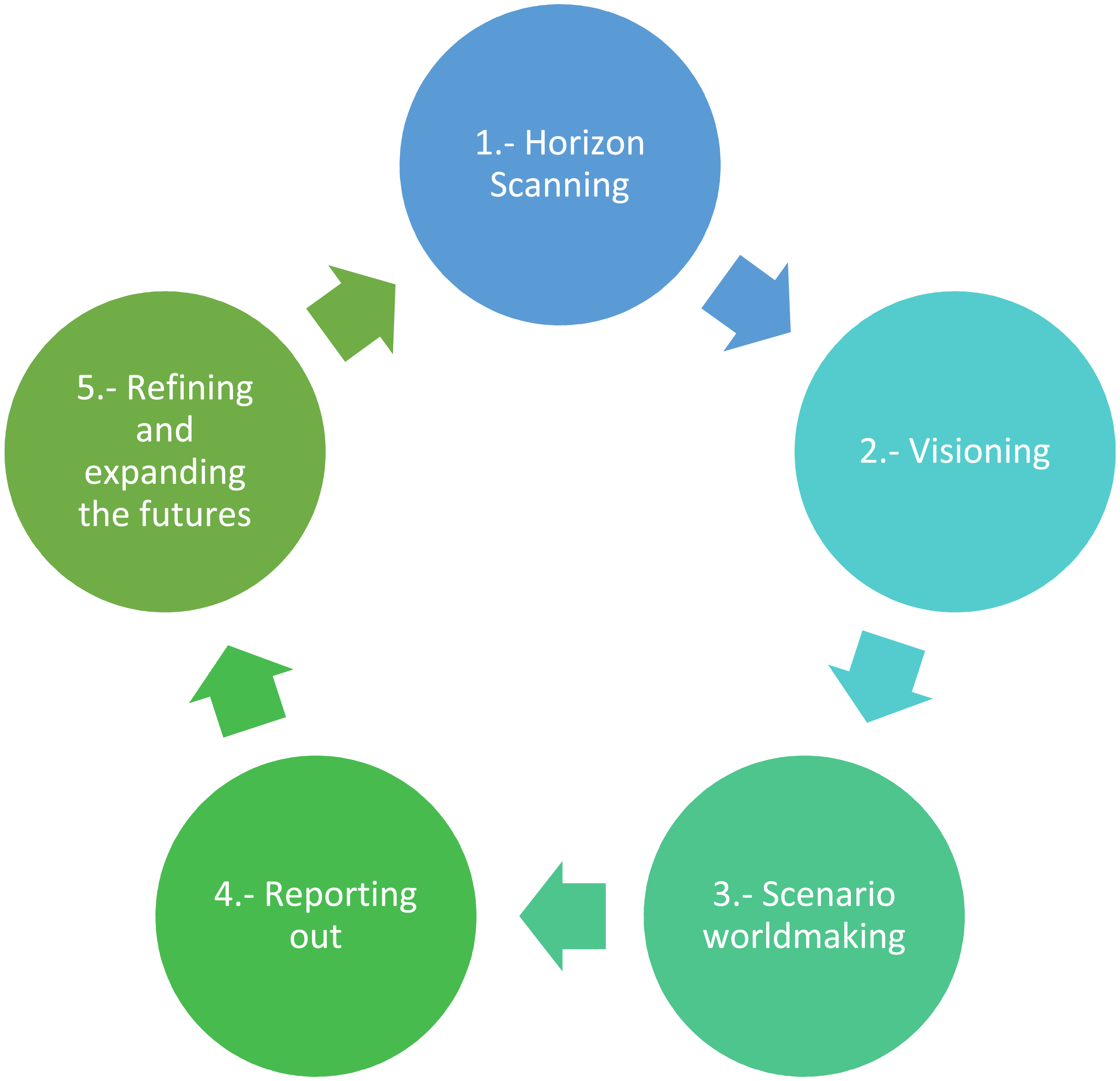
Data and Methods – An Overview
The Recursive Cycle approach was performed in two different research projects on environmental futures. The first project explored the futures of degrowth and its combination with pluriversal ideas in Latin America, aiming to craft a scenario that showed the potential crises and windows of opportunity to transform the region towards flourishing naturecultures. The project was carried out within a larger project that focused on the political and strategic dimensions of the degrowth movement, and the data obtained about the societal aspirations of members of the movement helped inform the development of this scenario (Hurtado Hurtado and Glynos, 2025). The second project explored the potential of Futures Studies methods to broaden stakeholders’ imagination of what they think is possible and desirable, and used the city of Monterrey, Mexico, as a case study. The city was chosen because it is located in a semi-arid region of the country and faces significant sustainability challenges such as air pollution, droughts and biodiversity loss (Narváez Tijerina 2025). The vision of deurbanisation was chosen as a frame to use in the futures workshops with various stakeholders from the city because it thematically aligned with degrowth research and also considered cities as sites of vibrant political and cultural life.
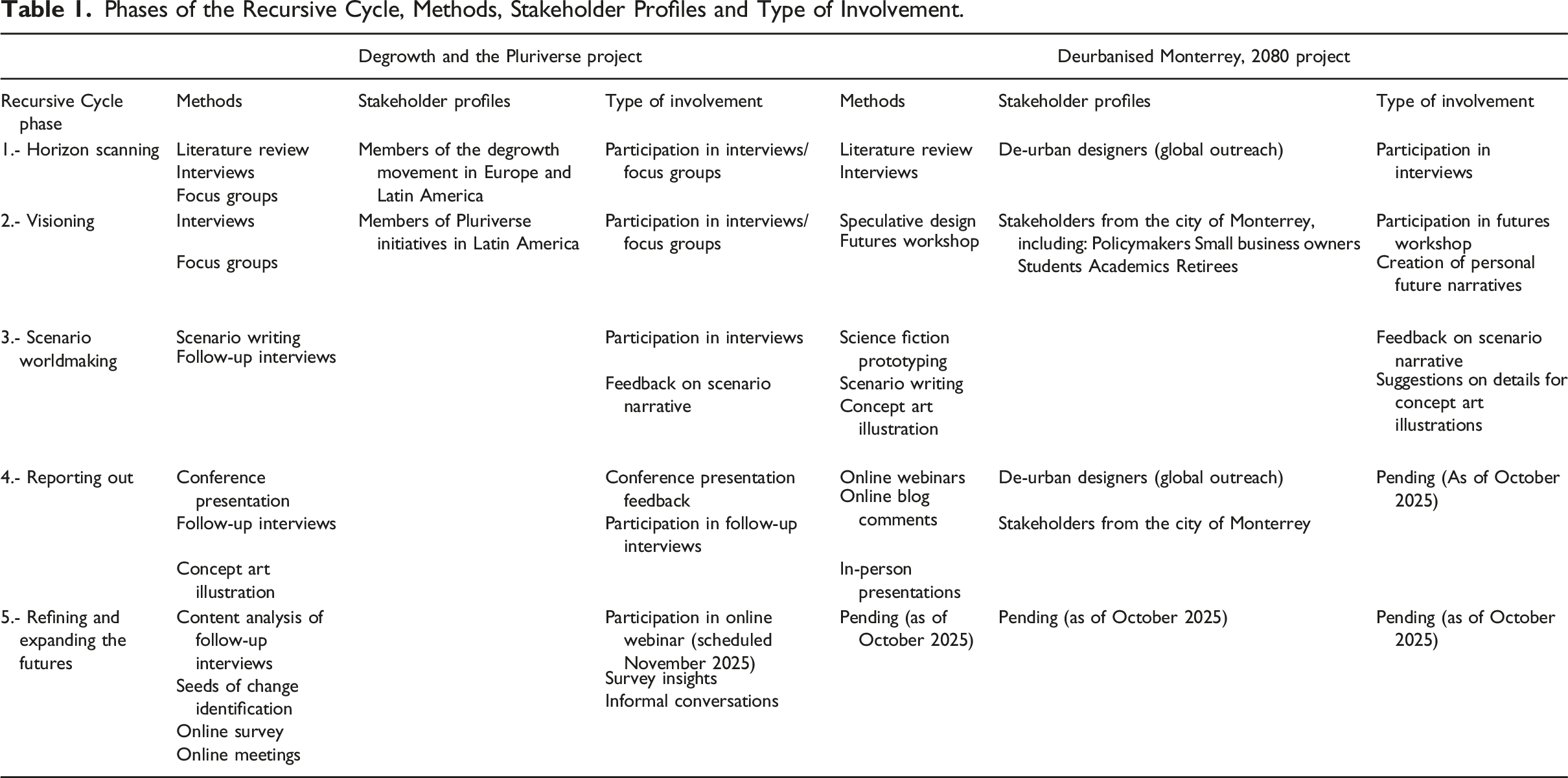
For the Degrowth and the Pluriverse project, 26 participants from the degrowth movement and 18 participants from different Pluriverse initiatives were interviewed individually or in focus groups. The interviews followed a semi-structured format inspired by psychosocial research in environmental studies, looking for affective content in the participants’ responses (Hoggett and Randall 2018). For this project, I started drafting the scenario once I had done a review of the literature and completed the first few interviews. As the interviews grew in number, I kept adding details and refining the scenario. In practice, this meant that the first three phases of the Recursive Cycle were done concurrently.
For the Deurbanised Monterrey 2080 project, each of the phases was clearly demarcated as the project was carried out. This meant, for example, that the Horizon Scanning (phase 1) was completed before starting the visioning work (phase 2). In total, 25 people participated in the project, with five de-urban designers being interviewed in the Horizon Scanning phase and 20 stakeholders of the city of Monterrey participating in two different futures workshops during the visioning and scenario worldmaking phases. The futures workshops incorporated speculative design elements through visual toolkits and science fiction illustrations (Forlano and Mathew 2014). The toolkits and illustrations allowed participants to envision the tangibility of some concepts – like direct democracy and the social and solidarity economy – as part of the social fabric of living in the city of Monterrey in 2080.
Phases of the Recursive Cycle, Methods, Stakeholder Profiles and Type of Involvement.
Phase 1 – Horizon Scanning
Horizon Scanning is an activity that scans for emerging signals of change in the present that might contain within them the seeds of possible futures. Horizon Scanning is usually located as the initial activity of a foresight project, obtaining evidence for developing the logics and narratives of the future (Cuhls 2020). Researchers have deployed Horizon Scanning to identify signals of change in environmental topics such as forestry and natural resources management (Bengston, Mauno, and Hujala, 2024). I delimited the scope of my Horizon Scanning to focus on four domains: politics, economic dynamics, human-nature relations, and visions of the cities. I chose the four domains since they are commonly discussed in academic research on degrowth, the Pluriverse and deurbanised cities. Therefore, delimiting my Horizon Scanning to these four domains allowed me to find similarities and contrasts across the different literatures that would facilitate creating structurally different scenarios.
For both projects, the Horizon Scanning involved first conducting desk research by reviewing the academic literature, and then interviewing stakeholders from the degrowth movement and Pluriverse initiatives. For degrowth, I identified academic sources that gave an overview of the degrowth field, its proposals, and its visions for the future (Dengler and Seebacher 2019; Fitzpatrick, Parrique, and Inês, 2022; Kallis et al. 2020; Liegey and Nelson 2020; Schmelzer, Vetter, and Vansintjan, 2022). I repeated the process with the Pluriverse initiatives, while also reviewing interviews and podcasts suggested to me by professional contacts linked through research or activism to various Pluriverse initiatives (Demaria and Kothari 2017; Escobar 2020; FitzGerald 2022; Kothari et al. 2019). As regards de-urban design and deurbanised cities, I read archival material and documents from my involvement during 2019-2020 with a network of professional de-urban designers, as well as a few published academic sources (Sadri and Zeybekoglu 2018; Zeybekoglu and Sadri 2019).
During the Horizon Scanning, I contacted members of the degrowth movement, Pluriverse initiatives, and the network of de-urban designers, and interviewed them. The interviews were meant to validate the Horizon Scanning desk research, but also allowed me to obtain new insights about their activities and their desired futures. As discussed in previous publications (Hurtado Hurtado and Glynos, 2025; Hurtado Hurtado et al., 2025), questions centred on the emotional responses of the participants to socio-ecological crises, strategic aspects in a transition towards just and flourishing socio-ecological futures, and elements of their desired societies (including human-nature relations). The interviews were conducted between 2022 and 2023 using videoconference software, in English or Spanish depending on the participants, and were recorded with the participants’ permission. The participants from the degrowth movement were mainly based in various European countries, the Pluriverse participants were from organisations in Chile, Peru, and Mexico, and the de-urban designers were spread globally.
Phase 2 – Visioning
Visioning is an exercise that generates desired images of the future, which often possess a transformative tone. Visioning aims to give hope to people by showing them how their preferred future would look like and what it would take to realise it (Hichert, Biggs, and De Vos, 2021; Ziegler 1991). For environmental futures, visioning has been used in the Seeds of Good Anthropocenes project to imagine flourishing relations between humans and the rest of nature (Hamann et al. 2020; Raudsepp-Hearne et al. 2020).
I performed the visioning phase in two different ways, according to each project. For the Degrowth and the Pluriverse project, I asked questions about the desired futures to the participants during the interviews. Such questions included: ‘in your vision of the future, how do you imagine people would relate to the rest of nature?’, ‘what are the main contrasts between the present and your desired future?’, and ‘what would change in your personal life if you suddenly found yourself living in your desired future?’. Responses to the questions included ‘one of the most important things is to live in a world where we can sustain ourselves and have spacious places for social interaction and for education and health. And while not exploiting nature and other people’ (Degrowth Participant, Denmark) and ‘I see [indigenous land defenders] with peace and tranquillity and living in this territory that we all respect very much, and living in harmony with biodiversity […]. And coming together to share, to help our brothers, to strengthen bonds’ (Pluriverse woman leader, Peru). The responses provided grounds to think about the foundational logics that would underpin the Degrowth and the Pluriverse scenario.
For the project on the deurbanised city of Monterrey in 2080, I organised two speculative design futures workshops to co-create radically different, sustainable cities. Speculative design and futures workshops have been combined already for thinking about more-than-human cities (Edwards and Pettersen 2023), which made this combination suitable for thinking about deurbanised cities from the perspective of key stakeholders. The workshops focused on the city of Monterrey, Mexico in 2080, and took place in June 2024 and November 2024. The participants included academics, policymakers, students, entrepreneurs, small business owners and members from civil society organisations, all of whom resided in the city of Monterrey. The workshop format involved three stages: (1) a conceptual discussion on care, nature and economic dynamics; (2) group deliberation of the structural features of their desired future city, with prompt cards that featured concept art sketches organised around the themes of water and food systems, politics and social dynamics, economic organisations, and infrastructure and built environment (Figure 2); and (3) a personal narrative of how the participants would inhabit their desired future city. Examples of prompt cards (created by the author) with concept art sketches (created with Midjourney). Note: I do not endorse the use of Midjourney for commercial purposes. The sketches were created in early 2023, before numerous reports on the environmental and social costs of generative AI were widely publicised, and at present I would not use it. The concept art is preliminary and meant to be used only for the workshop.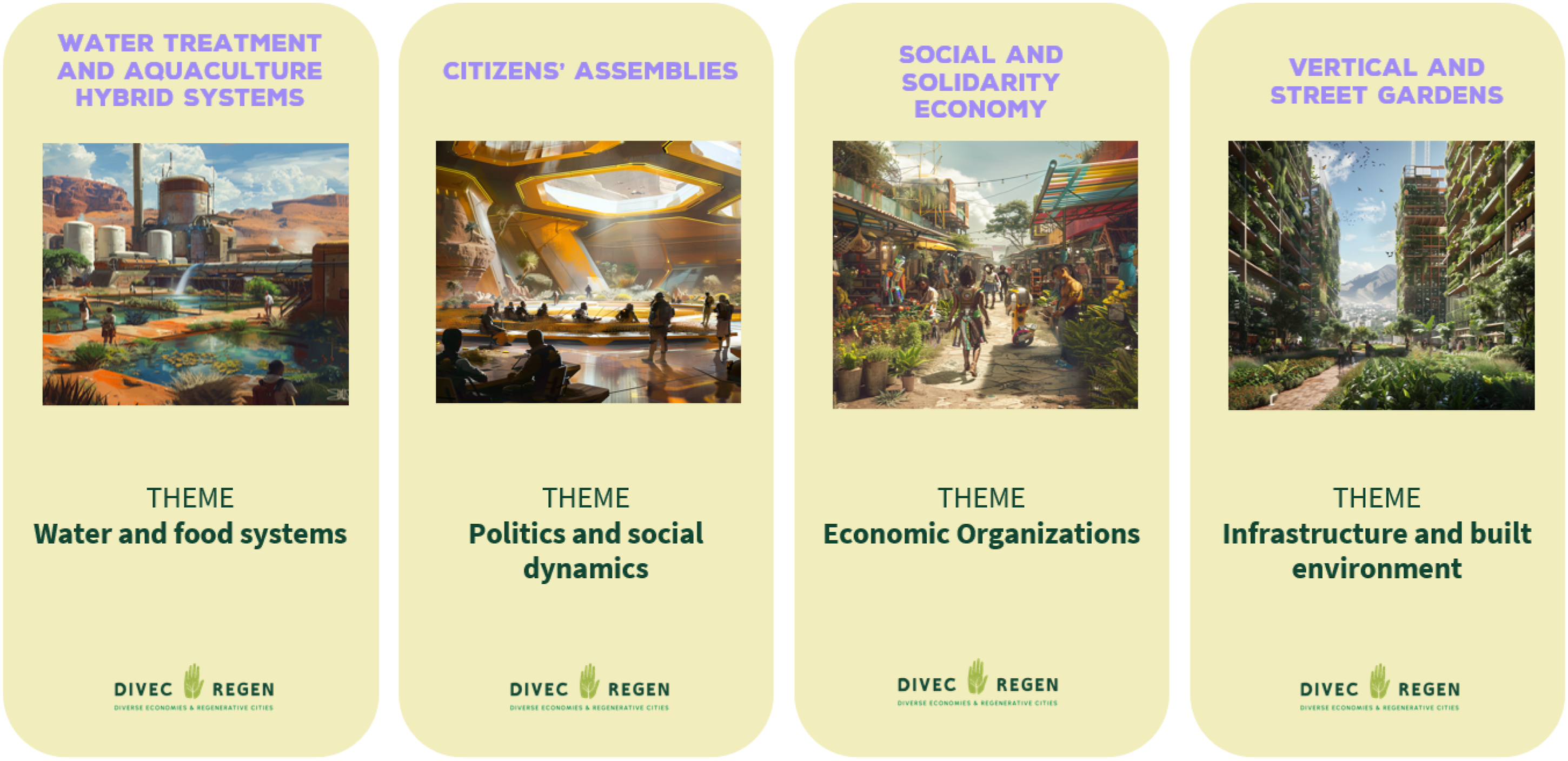
Phase 3 – Scenario Worldmaking
The results from the visioning phase were used to design scenarios and images of the future. In the Degrowth and Pluriverse project, the format of the scenario was delimited by its publication outlet, a book chapter in The Palgrave Handbook of Global Politics in the 22nd Century (Horn et al., 2023). The chapter foregrounded the international relations dynamics and responses to socio-ecological crises of the Latin American polities, and charted their evolution from the present to the year 2122. As a result, the dominant logics in the scenario, ultimately titled The Degrowth Transition in Latin America: Deurbanised Autonomous City-States in 2122 (Hurtado Hurtado, 2023), were of political nature. The scenario depicted Latin American governments attempting to address socio-ecological crises, and how various counter-hegemonic coalitions sought to obtain the power of the state to successfully respond to the crises. All attempts to manage the crises from a state-centred perspective were unsuccessful, which led to the dissolution of the states and the reorganisation of Latin America into city-states and bio-regions. This reorganisation intended to make territorial governance more manageable, and to make the population feel more connected to the natural ecosystems.
In developing the Degrowth and Pluriverse scenario, I followed the guidance of scenario worldmaking by Vervoort and colleagues (2015, 67-68), focusing on questions such as ‘who are we in this future?’, ‘how has the world been constructed like this?’, ‘where are we?’, and ‘how do we experience this world?’. I adopted a literary style with a first-person point of view as a future social scientist in 2122. I then filled the scenario with historical and experiential details. I also integrated science fiction elements as regards the governance of nature, taking as inspiration the science fiction prototypes of the Radical Ocean Futures project (Merrie et al., 2018). As the scenario writing was done concurrently with the interviews, I integrated details from the interviewees’ responses to the worldbuilding. Some of the details included the revolutionary changes entailed by degrowth and the importance of physically and spiritually connecting to non-human nature from a young age.
The process of creating the scenario for the deurbanised city of Monterrey, Mexico in 2080 is ongoing. The results from the first workshop in June 2024 were revisited in the second workshop in November 2024. With the participants, I identified the most prominent structural features of the future for the deurbanised city of Monterrey in 2080. The participants, the workshop facilitators and I as the lead researcher collaboratively charted key events from the present to the future that would yield their desired futures. This involved thinking how each prompt card selected by the participants would evolve in the following decades and become an integral part of the city of Monterrey in 2080. The logics underpinning the deurbanised city scenarios are varied: the social and political dynamics have equal weight to the ones related to water and food systems, economic organisations, and infrastructure and built environment. The aim is to give more sensory experiences to the resulting scenarios, using as input the personal narratives of the workshop participants to address the questions: ‘What does the world look, sound, feel and taste like? Are there important sensorial inputs? What are the roles of pleasure and joy in this world and how are they achieved?’ (Vervoort et al., 2015, 68).
Phase 4 – Reporting Out
Reporting out involves exposing others to the scenarios and images of the future, thinking about the lessons learned, and engaging leaders, citizens, experts and other stakeholders in thinking about how to navigate such futures (Hamann et al. 2020; Merrie et al. 2018). This phase aims to disseminate the scenarios with key stakeholders and forge collaborative arrangements so that governments, businesses and civil society dedicate time, effort and resources to transformative endeavours.
An initial dissemination moment occurred in October 2023, in Mexico City, where I presented the The Degrowth Transition in Latin America: Deurbanised Autonomous City-States in 2122 scenario (Hurtado Hurtado, 2023) at the 9th International Conference for Critical Geographies. I presented the scenario and its concept art illustration to an audience of academics from various nationalities and human rights and environmental justice groups in Mexico. The audience feedback was mixed on the format of the scenario – some praised its conciseness and focus on the future politics of Latin America from the perspective of degrowth and the Pluriverse, while others felt that narrating 100 years of future history in 6000 words was too restrictive. The audience commended the depiction of a challenging world where new socio-ecological relations nonetheless emerge, ones that are non-exploitative and view nature as inherently important. However, they also noted that the scenario downplayed the human suffering from the socio-ecological crises in favour of the desired future visions. The audience remarked that this suffering is concealed by political discourse at present but is the lived experience of many land defenders, environmental activists and populations in the Global South.
The second dissemination moment occurred in May 2024, when I presented the scenario to members of a degrowth collective in Latin America. One of its members found promising how the scenario clearly outlined the future as emerging from the seeds in the present. This made the future feel both desirable and plausible, instead of being utopian or nihilistic. The same member suggested that I add more details on the exact political-economic dynamics that a dissolution of the state would provoke, and how the reorganisation into city-states would unfold. Another member of this degrowth collective found inspiring the political reorganisation of Latin America as depicted in the scenario, but felt more fictional ‘on-the-ground’ experiences of the inhabitants of the city-states could enhance the scenario work.
Since I have not yet fully developed the environmental futures for the deurbanised city of Monterrey, Mexico, in 2080, this phase is pending. At the moment, feedback received from the workshop participants suggested that the prompt cards inspired them to think about cities in a more integrative manner than only focusing on infrastructure or economic dynamics. Similarly, the participants remarked that the workshops encouraged them to think about the design of cities in alignment with the biophysical boundaries of ecosystems. The next steps in this phase would involve presenting the resulting scenarios in online webinars, in-person presentations, and in the project website and gathering feedback from these dissemination moments. Such feedback would be critical to the fifth phase.
Phase 5 – Refining and Expanding the Futures
The final phase, which transforms a linear sequence into a Recursive Cycle, integrates the feedback of the previous phase into a process where the environmental futures are refined and expanded. The feedback can constitute a new form of interview data, revealing new signals of change and trends to look out for when developing the futures of degrowth, the Pluriverse and deurbanised cities. This final phase links back to the initial Horizon Scanning phase, where the feedback from participants can also serve as the foundation for structurally different futures that complement the existing ones, thereby increasing the plurality of the future. This phase is central for developing detailed and integrative environmental futures, since researchers could benefit from using ‘reflective processes to harness participant feedback that could enable more robust methodology development’ (Nalau and Cobb 2022, 1).
While the original scenario of Degrowth and the Pluriverse was already published (Hurtado Hurtado, 2023), the feedback led me to identify key issues that could form the basis for structurally different futures. The Latin American degrowth collective suggested that some form of nation-states could co-exist alongside the envisioned bio-regions and city-states, since their dissolution would entail much more suffering than what was depicted in the published scenario. The collective also pointed out the significance of plural local money systems that could restore the social and ecological fabric in the bio-regions (Cabaña and Linares 2022), and the more central role of care and the commons for reaching global socio-ecological and multi-species justice (Singh 2019). These examples constitute ‘seeds of change’ that can, through enabling conditions, become constitutive features of degrowth and pluriversal futures (Preiser et al. 2024). Based on this feedback, the next step would be to elaborate new scenarios and images of the future that offer structural contrasts and expand on previously underexplored issues. In addition, members of this degrowth collective suggested that I remain in touch to explore potential collaborations and advocacy action.
Discussion: Comparison to Other Frameworks, Benefits and Limitations of the Recursive Cycle
Comparison to Other Frameworks
The Recursive Cycle harnesses the stakeholder feedback and engagement with the futures to design new scenarios and establish grounds for critique of hegemonic systems and their futures. While plural and critical environmental futures can be reached through other Futures Studies approaches, such as the Six Pillars (Inayatullah 2008) or the Nature Futures Framework (Pereira et al. 2020), such approaches are usually resource-intensive and often require the presence of skilled facilitators for workshop settings and the availability of multiple stakeholders to convene during the dates and times scheduled for the workshop. The Recursive Cycle can be deployed by a single researcher interviewing stakeholders one-on-one or in focus group sessions and then weaving their insights into a consistent scenario – as done in the Degrowth and the Pluriverse project –, but it can also be conducted in a workshop setting with multiple facilitators and stakeholders – as done in the Deurbanised Monterrey, 2080 project. This gives the researcher enough flexibility to either conduct the Recursive Cycle with few resources and adapt it to the availability of individual participants, or to develop sophisticated workshops that benefit from live interaction among the participants.
In terms of methods, a Recursive Cycle based on interviews and focus groups refines the scenario as more data is generated. The concurrent development of the scenario with the interviews and focus groups allows for an iterative movement between the literature, the data, and the writing process. In consequence, the researcher can ask subsequent participants specific questions regarding the future that they can elaborate upon, and agree or disagree with the claims made by previous participants. In contrast, a Recursive Cycle based on workshops is more agile and less detailed initially, but encourages creative exploration of pathways towards the desired future. Subsequent workshop sessions can allow for a critical reflection on the pathways and the identification of strengths and weaknesses of previously-crafted strategies, similar to recent iterations of the Seeds of Good Anthropocenes approach (Preiser et al. 2024). The Recursive Cycle therefore aligns more closely with recent frameworks in environmental futures research that explicitly advocate for including stakeholders after developing the main results of a foresight project (images of the future, scenarios, strategies) and that seek iterative processes between data generation and outputs (Lembi, Wentworth, and Hodbod, 2024; Weh 2025).
Benefits: Plurality and Criticality
The final phase of the Recursive Cycle, refining and expanding the futures, brings two benefits: plurality and criticality. Plurality is important because exploring the multiplicity of futures can ‘allow us to compare our situations with those that might soon come to be, and to think of things in a plural, intersectional sense’ (Joshi 2023, 102). In the Recursive Cycle for the futures of degrowth, the Pluriverse, and deurbanised cities, plurality manifested in two ways. First, as pointed out by a member of the Latin American degrowth collective, the same signals and trends can yield different futures according to how humans act upon them. The seeds of desired or undesired futures are found in the present, but individual and collective agency can prompt the growth of the seeds in a preferred direction. Plurality, then, would be accomplished by tracking the development of the initial and new (after the feedback) signals of change and trends across the different scenarios, and developing visions of the future according to the different values adopted by each signal and trend.
Second, plurality also manifests as the diversity of experiences and lived realities of the inhabitants of the same future, which draws from insights from the sub-fields of sociologies of the future (Hurtado Hurtado, 2025). This understanding of plurality was explicitly discussed by the participants in the workshop for the deurbanised city of Monterrey, Mexico in 2080, and by members of the Latin American degrowth collective. When the workshop participants shared their personal narratives, they remarked how the same future city could be navigated in substantially different ways according to the person who inhabited it. The participants suggested that future iterations of the workshop should combine the first-person narratives into a complex story with different characters, thereby revealing how each participant understands themselves in relation to the built environment and the surrounding ecosystems. The members of the degrowth collective echoed this perspective, advising that I write more sensory experiences in new scenarios when describing how different characters relate to natural elements and whole ecosystems. In doing so, I might successfully evoke the aesthetic, sensorial and spiritual importance that some groups ascribe to nature.
Additionally, plurality can become an entry point for criticality by showcasing radically different futures to our present (Gidley 2017). In the environmental futures of degrowth, the Pluriverse, and deurbanised cities, the critical emphasis resides in showing: (1) that plural worlds exist in the present and are hidden from view by global capitalism, the drive of economic growth and the authoritarian force of the nation-state; and (2) that the clash of these plural worlds with the hegemonic systems in an ontological conflict can produce futures where humans and the rest of nature can flourish without being exploited (Escobar 2020, 20; Sardão and Silva 2024). Criticality here manifests through problematising hegemonic systems, identifying underlying assumptions driving emergent futures, and articulating counter-norms that challenge hegemonic systems and serve as the foundation for emancipatory futures (Glynos and Howarth 2007; Minkkinen 2020). An important methodological consideration for criticality to emerge is that the participants included in the original data generation and feedback phases should have diverse profiles that can question and critique the hegemonic visions of environmental futures (Barendregt, Roy, and Van Eekelen, 2024; Lembi, Wentworth, and Hodbod, 2024). For this reason, researchers should reflect on how participants are selected and how their perspectives are integrated as part of the Recursive Cycle.
The counter-norms in the future visions of degrowth, the Pluriverse and deurbanised cities can stimulate a new socio-ecological imagination ‘concerned with envisioning (and progressing) the transformation of relationships between human society and the rest of the planetary environment’ (Herbert 2021, 373). The critical thrust of the Recursive Cycle manifests in the socio-ecological imagination reflected in these future visions: humans align their activities with the needs of the ecosystems around them and feel materially and spiritually connected to nature. Importantly, these futures emanate from the seeds of degrowth, the Pluriverse and deurbanised cities that are currently marginalised by hegemonic systems, but which become foundational for the depicted future societies. In presenting these futures to different audiences, particularly the stakeholders that contributed to developing them, the final phase of the Recursive Cycle can integrate and critically examine previously omitted seeds and speculate on their needed evolution to realise the environmental futures. Similarly, it can inspire the stakeholders to keep pursuing their desired futures despite significant obstacles, since the future scenarios show them the worlds they aim to create.
Limitations: Time Commitment and Researcher Skills
The Recursive Cycle involves two main limitations. The first of them is time commitment. The final phase of the Recursive Cycle, where feedback is integrated to refine the scenarios and develop alternatives, repeats the sequence from data generation to reporting out the results, although the acquired theoretical and methodological knowledge can now expedite the process. In practice, polishing the existing scenarios and developing alternative ones requires extensive time commitment from the researchers and the stakeholders. Such commitment implies trade-offs: what other approaches such as Six Pillars, Nature Futures Framework and Seeds of Good Anthropocenes invest in organising the workshops (which costs money and physical resources), the Recursive Cycle invests in time. The time commitment from researchers and stakeholders may be difficult, as evidenced in the Deurbanised Monterrey, 2080 project, where the second workshop could only be organised months after the first one because the stakeholders had other responsibilities. Therefore, for the Recursive Cycle to work, researchers and participants should have a personal and affective interest in dedicating time to the process that encourages them to continue working on the scenarios.
The second limitation is the broad range of skills the researcher needs to conduct the Recursive Cycle effectively. If constrained by budget or physical space, the researcher should have sufficient skills in more standard qualitative methods such as interviews and focus groups using online tools and should also plan ahead for how to obtain ideas about the future from participants using these methods. Additionally, the data from the interviews and focus groups should be processed in a way that allows for the development of a consistent scenario that respects the diversity of the stakeholders’ perspectives. The iterative process of moving between the scholarly literature, the data and the writing might prove difficult for a researcher in the absence of a framework that can transform the data into a scenario, while also allowing elements of the scenario to be incorporated into the interview guide. In cases where the Recursive Cycle is conducted in workshop settings, facilitation and time-management skills, as well as extensive knowledge of the Futures Studies methods to be used, are needed from the researcher. Familiarity with the physical space (in in-person workshops) or with online tools (in virtual workshops) can also enhance the flow of the workshop.
Conclusion
The Recursive Cycle is a helpful approach to developing, refining and expanding environmental futures, in this case futures based on degrowth, the Pluriverse and deurbanisation. This approach facilitates the co-creation of futures by integrating stakeholders throughout the process and harnesses their feedback, reintegrating it into a new Horizon Scanning phase. This reintegration can multiply the identification of signals and trends that serve as the foundation for additional, structurally different futures. The Recursive Cycle offers futures researchers the benefit of plurality and criticality. Plurality here refers to the multiple futures that can emerge from the seeds of the present and the different lived realities that people can experience when inhabiting those futures, while criticality refers to advancing radically different futures based on counter-norms that challenge hegemonic systems. Nonetheless, research teams that aim to conduct foresight projects in a Recursive Cycle should be mindful of the considerable time commitment and broad range of skills needed to do so effectively.
The environmental futures of degrowth, the Pluriverse and deurbanisation can help in stimulating a new socio-ecological imagination, where humans and the rest of nature can flourish in co-existence. At the same time, these futures are not utopian in a fantastical sense, but they reveal the political-economic dynamics that facilitate or constrain their emergence. In engaging with diverse stakeholders, the environmental futures should elicit a desire for socio-ecological change and encourage people to think about their connections to ecosystems. Future research that engages with stakeholders of environmental futures should identify elements that possess broad appeal and can unite different groups in the goal of realising futures based on socio-ecological justice.
Footnotes
Acknowledgements
I would like to thank and acknowledge the kind contributions of all the participants and stakeholders involved in bringing this project to fruition. I would also like to thank Laura Horn, Ayşem Mert and Franziska Müller for their invitation to contribute my scenario to the edited collection The Palgrave Handbook of Global Politics in the 22nd Century and for their helpful feedback; and to Guillermo Gándara, whose advice on scenario writing I have followed. I also wish to acknowledge the kindness of my friend Alejandro Casar and his partner Melissa Santos for allowing me to include them as fictional characters in my scenario. My sincere thanks also go to the panel organisers and attendees at the 9th International Conference for Critical Geographies. Special thanks go to the team that helped me design and organise the workshops, including Nancy Bautista Mudd, María Fernanda Puente Castaño, Mariana Luna, Miguel Antonio Garza Vargas, and the team from Cangurú Cooperativa in Mexico.
Declaration of Conflicting Interests
The author(s) declared no potential conflicts of interest with respect to the research, authorship, and/or publication of this article.
Funding
The author(s) disclosed receipt of the following financial support for the research, authorship, and/or publication of this article: This study is supported by Maj ja Tor Nesslingin Säätiö (202200237).
