




Abstract
In recent years, scholarly attention has turned to the fracturing of global supply chains and the costs and benefits of reorienting economies to the local scale. While its real extent is debated, the term ‘deglobalisation’ has been broadly used to refer to this break from the expansionist neoliberal common-sense of previous decades. This paper conducts narrative reviews of six approaches which have emerged in this context: Hyper-localism, Open Localism, Cosmo-localism, Foundational Economy, Developmental Nationalism and Strategic Autonomy. It examines these emerging proposals for more local production, consumption and trade, and hints at relevant research directions for the uncertain era ahead. Its conceptual contribution shows that we are now faced with complex and differing processes of (de)globalisation – sometimes overlapping and sometimes competing. Grounded in a post-growth perspective, the paper concludes with an invitation for dialogue and future research around local production where capitalist political economy and organisation are not taken for granted.
Introduction
In the wake of trade wars, intensifying climate crisis, international conflict, the COVID-19 pandemic and other disruptions to global trade, scholarly attention has turned in recent years to a potential slowdown or even reversal of globalisation – referred to variously as economic deglobalisation, reshoring or ‘slowbalisation’ (Gong et al., 2022). If the late 20th century onwards was a time of self-evident expansion of global trade networks and integration – globalisation – then the cusp of a differing trend appears visible, where supply chains might shorten and production becomes more localised. While the actual reality and extent of such contemporary ‘deglobalisation’ is debated, discussion of the end of globalisation and what might come next is growing (Gong et al., 2022). There is little clarity about what ‘deglobalisation’ means, what forms it is taking, and what is at stake in its various contested forms. By exploring and elaborating on a number of distinctive forms of deglobalisation emerging in the literature, this article aims to address this lack of clarity.
Questioning the wisdom of globe-spanning capitalist supply chains has a long history. The negative implications of global economic integration were highlighted by critics around the turn of the millennium, for example, alongside a groundswell of ‘alter-globalisation’ activism (Starr and Adams, 2003). This most famously took the form of protest marches at G8 summits and other key power centres (Bello, 2008; Mander and Goldsmith, 2001), as well as World Social Forum gatherings of social justice movements in the Global South (Starr and Adams, 2003). Decades prior to this, in turn, postcolonial and socialist scholars had written of the role ‘delinking’ from global economic networks might play in facilitating autonomy for former colonies in the Global South (Amin, 1990). While not seeking autarky or exclusion, postcolonial nations were urged to remove themselves from the expansion of unjust capitalist relations and create a new order of ‘One Planet, Several Systems’ (Amin, 1990: xii).
Recently, scholars have noted a ‘big switch’ in the prevalent narratives, with questioning of globalisation recently originating from more diverse parts of the political spectrum (Bello, 2022; Herbert and Powells, 2023; Horner et al., 2018). While opposition to globalisation was originally a preserve of the so-called political left, who were concerned with its impacts on the Global South, right-wing politicians in the Global North have recently capitalised on discontent with the impact of neoliberal globalisation within their own constituencies (Horner et al., 2018). Amin (1990: 443) too had noted that his idea of delinking would not necessarily bring about liberatory systems – it could also potentially result in new exclusions and ‘the crystallization of a new class power’. Localisation is not an inevitably benign development. Rather, today, the very survival of economic power and governance patterns as we know them are said to be entwined with shortening supply chains (Ciravegna and Michailova, 2022; see also Fraňková and Johanisova, 2012).
Given this increasingly complex context, this paper returns to the question of ‘whether and to what extent (a particular narrative of) economic localization can be seen as a form of opposition to the current socio-economic system’ (Fraňková and Johanisova, 2012). Unsettling simplistic understandings of local versus global, it proceeds by viewing localisation as a ‘tendency’ (Krähmer, 2022: 20), or as a horizon of practice, rather than a pre-defined or reified container (Fraňková and Johanisova, 2012; Schmid and Smith, 2021). With this comes a need to understand the diversity of actors who shape the localisation of production, beyond just private enterprise and the state, and how they are attached to particular places (Kleibert and Horner, 2018).
In conversation with the academic literature, a diversity of competing alternatives is shown to co-exist today. The approach taken maps emergent localisation discourses, comparing and contrasting six ‘ideal typical’ conceptual approaches which emerge from a critical review of the academic literature, namely, 1. Hyper-localism; 2. Open Localism; 3. Cosmo-localism; 4. The Foundational Economy; 5. Developmental Nationalism; 6. Strategic Autonomy. Adopting a conceptual framework first proposed by Fraňková and Johanisova (2012), it examines these emerging proposals for more local production, consumption and trade, and hints at relevant research directions for the uncertain era ahead.
Discussions around these six approaches have generally developed in an isolated way, with little dialogue or cross-comparison. When viewed side-by-side, however, overlaps emerge, but also important differences and incompatibilities. With discussions around localism having increasing pertinence, it is important to be aware of the assumptions and common-sense which shape the conversations which ensue. While global integration and trade will – to a greater or lesser extent – remain (Gong et al., 2022), awareness of such assumptions allows more fruitful dialogue regarding approaches which may aid in ‘surviving well’ in turbulent times (Gibson-Graham et al., 2013), over those which replicate the eco-social harms and exclusions of the current economic paradigm.
The next section will discuss the contemporary relevance of deglobalisation in more detail. The paper’s methodology is then introduced, followed by an elaboration on the six approaches which form the main discussion. Discussions and conclusions are then drawn regarding economic localism and shifts in patterns of globalisation.
Localisation and emerging alternative production networks (APNs)
When common sense asks us to ‘start production up again as quickly as possible,’ we have to shout back, ‘Absolutely not!’ The last thing to do is repeat the exact same thing we were doing before.
Amongst economic geographers, critical geographers, management scholars and others, there has been a rapid expansion in discussion of what direction capitalist-led globalisation will take in future (Alexander et al., 2022; Barbieri et al., 2020; Gibson et al., 2021; Klepp et al., 2022). Gong et al. (2022) usefully identify four key macro-forces driving contemporary reshoring trends: geopolitical uncertainties, climate change, technological change, and crises and shocks. Given these forces, Ciravegna and Michailova (2022: 173) note that ‘growing uncertainty and higher costs in international transactions…have pushed firms to adapt by reconfiguring their global value chains (GVCs), which will ultimately lead to a more regional and less globalized world economy’.
While discussion of the potential for re-industrialisation and reshoring predate the most recent crises, it was a more marginal, at times speculative, discussion (Barbieri et al., 2018; Edwards and Taylor, 2017; Nawratek, 2017). Instead mainstream scholarship on integration into Global Production Networks (GPNs) had assumed ‘positive outcomes for economic development’, while other scholars noted the dark sides of globalised networks (Kleibert and Horner, 2018: 231). Increasingly, however, notions such as protectionism and economic autonomy are being discussed not just as a way to nurse inchoate industries and bring about some traditional form of ‘development’ (Chang, 2002), but also as a means of protecting community resilience and environmental wellbeing (Dartnell and Kish, 2021; Gibson et al., 2019; Norberg-Hodge, 2022). At a socio-political level, as Gibson et al. (2021: 197) note, ‘Brought into question [by COVID-19] were domestic industrial capacities, reliance on complex global supply chains, and the future of local manufacturing sectors’.
One pattern which emerged through 2020, for example, was for alternative production networks (APNs) to emerge, with local communities and civil society groups stepping up to meet shortfalls in key goods, such as Personal Protective Equipment (PPE) (Frazer et al., 2020). The home, as well as diverse community spaces such as maker spaces, were used to coordinate needs-oriented manufacturing for hand-sewn face masks, 3D-printed ventilator valves and other objects. Corsini et al. (2021: 295–296) noted that ‘although this is not the first time that makers and makerspaces have played a role in crisis response, this is the first time that the maker community is responding in such numbers’. Hepp and Schmitz (2022) and Dartnell and Kish (2021), however, temper expectations by asserting that the pandemic showed the limits of such a response to crisis. They show that the maker movement – at least in its current form – was unable to produce in large enough quantities or to the quality standards required.
Another pattern was for states to take a renewed prominent role in directing economic affairs. President Macron of France remarked that the COVID-19 pandemic had ‘put us face-to-face with our vulnerabilities’ (AFP, 2021). While the responses to interruptions in global trade by governments have been too many to list here, it is useful to mention a few. In 2020, for instance, the UK government unveiled Project Defend, to bolster national resilience in key supply chains. The Japanese government unveiled billions in subsidies for manufacturers who wished to reshore production to Japan from abroad (Dooley and Inoue, 2020). The United States invoked the Defense Production Act in the hopes of boosting production of key COVID-19 medical supplies. The same act has more recently been utilised by President Biden to increase mineral production and processing for electric vehicle batteries, thus reducing reliance on ‘unreliable and unsustainable foreign supply chains’ (Hunnicutt and Scheyder, 2022). The list expands across the world’s largest global economies (Gibson et al., 2021; Gong et al., 2022).
The practical reality and extent of such trends remains to be seen (Gong et al., 2022), but evident shifts include a renewed interest in industrial policy (Harris et al., 2020; Johnstone et al., 2021) and an enlarged role for the state in regulating and facilitating production and trade, as supply chains move from ‘just-in-time’ (JIT) to ‘just-in-case’ (JIC). Such developments remain within the space of capitalist political economy and growth-based economics (Schmid, 2019). This is also true of the recent discussions of a Green New Deal, proposed both in Europe and North America, to enact with the top-down ecological modernisation of advanced economies (Ajl, 2021). It cannot be ignored, however, that the focus on deglobalisation also coincides with the continued flourishing of discourse and research around post-growth or degrowth economic alternatives, in which the question of local economy has also been central, albeit frequently under-elaborated (Mocca, 2020). Recent critical interventions have argued that naïve localism is not adequate to confront the complex global challenges we face, global ecological crises in particular (Kallis, 2015; Krähmer, 2022; Mocca, 2020). It is apt, therefore, to examine the fuller range of economic alternatives which have been proposed, and to give consideration to a more plural space of economic possibility (Gibson et al., 2019).
Scholars have extensively researched the importance and potential of local food over recent decades, for instance, in the flourishing examinations of Alternative Food Networks (AFNs) (Fraňková and Johanisova, 2012; Starr and Adams, 2003) and food sovereignty movements (Holt-Gimenez et al., 2018). However, less attention has been placed on APNs relating to the wider array of global dependencies evident across other goods. Much current work on industrial sustainability assumes future developments will roughly follow the current trajectory and social forms, with ownership and production concentrated spatially and socially in the hands of a few. Industrial ecology and sustainability literatures have generally focused on technological responses to eco-social crises (Furstenau et al., 2020). However, alternatives have been proposed. APNs – while marginal in practice – continue to emerge and displace the prevailing neoliberal common-sense (Smith et al., 2022; Smith, 2023). Heterodox production movements of both the past and present show such alternatives in action, whether the Alternative Production movement of the 1970s (perhaps most prominently remembered through the Lucas Plan for alternative production, developed through a participatory process by workers at Lucas Aerospace; see Cooley, 2016; Tuckman, 2012) or the Mondragon co-operative group today (Bretos et al., 2020).
While so-called advanced economies were said to move towards ‘dematerialisation’, the knowledge economy, and post-industrialism in the era of neoliberal globalisation, the continued reliance of the global north on a steady flow of stuff has come back into view amidst recent crises. The image of decoupling from material intensity was always false (Hickel and Kallis, 2020) and the ‘post-industrial’ label was always exaggerated: the EU, for example, never lost its reliance on manufacturing, which in 2018, provided 29.9 million jobs across two million enterprises (NACE Rev. 2). The value of examining re-industrialisation and reshoring at this historical juncture is not to regurgitate debates around ‘alter-globalisation’ or to fall into the ‘local trap’ of valorising essentialised and self-contained category of ‘local’ (by now well-discussed in geographical and other literatures, for example, see Born and Purcell, 2006; Park, 2013; Russell, 2019). Instead, the aim of what follows is to map and better understand the diversity of strategies proposed for (re)localisation.
Methodology
The task of this paper is primarily conceptual: to review existing academic literature and outline a series of ideal types which are pertinent to discussions of local economy. The development of ‘ideal types’ is a typological method drawn originally from the work of Max Weber (Swedberg, 2018) and which has more recently been used, for example, to compare differing welfare regimes (Aspalter, 2021). The aim here is not to perfectly represent the world, but rather to develop – through narrative, critical literature reviews (Baumeister and Leary, 1997) – tentative heuristics which bring comprehensibility and contingent order to a complex field. Echoing a pragmatist epistemology, Aspalter (2021: 13) notes that ‘the quality of ideal types is determined by its fruitfulness, that is, usefulness, in the practical, as well as theoretical and academic, sense’.
The literature engaged with in this paper is therefore not presented as a systematic review, in the sense of systematising everything within a given period which has been written on the topics contained herein. To do so, in such a contested, sprawling and rapidly evolving area, would be an impossible task (see also Herbert and Powells, 2023). Nor is the list exhaustive of all economic approaches to localisation. Instead, through a critical narrative reading, an attempt is made to compare and contrast prominent ideal types which can be seen as emergent and particularly relevant at the present juncture. The literature was encountered using a snowballing approach, and overwhelmingly drawn from peer-reviewed journals. This synthesising approach allows for more context and broader sense-making than that normally published in isolated empirical studies alone (Baumeister and Leary, 1997).
Overview of 11 general dimensions of localisation, adapted from Fraňková and Johanisova (2012).
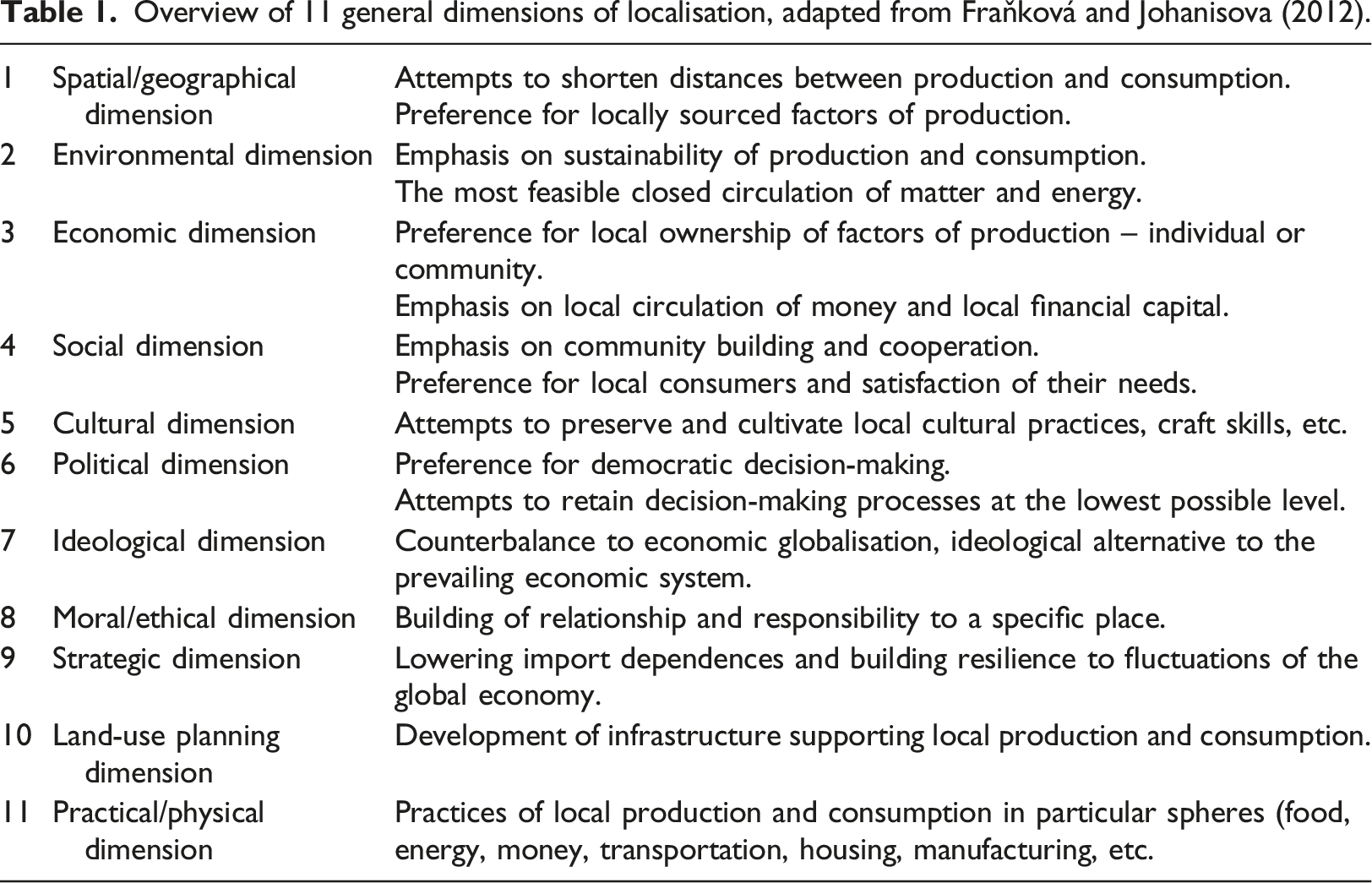
While provide a useful heuristic for cross-comparison, the exact boundaries and contents of the respective dimensions will differ according to the perspectives and assumptions taken. The result, as elaborated below, at least serves as a starting point for further discussion and research.
Introducing the six approaches
This section describes each ideal type or approach to deglobalisation in turn. While acknowledging the flexibility of such terms, and not pretending any definitive representation or comprehensiveness, it starts from those which could be perceived as most ‘local’, to those which have the most ‘global’ outlook. As the discussion below will make clear, however, such categories are complex and worthy of further research.
Hyper-localism
Oriented towards sufficiency and frugality within tightly confined localities, Hyper-localism (HL) outlines a strong discontinuity with postulates of free-market economics, such as comparative advantage. Instead, it advocates a radical shortening of supply chains for basic necessities and key provisions (Mander and Goldsmith, 2001). Inspired by ecological concerns, HL is often underpinned by an assertion of the inevitability of the shift to more local economies, whereby in the face of climate crisis and fossil energy constraints, globe-spanning systems of provision will break down and will need to be replaced by more sustainable local production (Mander and Goldsmith, 2001; Smaje 2020). The radically localised production which results should mean greater visibility of the real impacts of our economic systems, with the consequences of production and consumption (e.g. environmental pollution, social exploitation) likely to be more visible at the local level. This would reduce cost-shifting of production externalities. Furthermore, production would be adapted to local geographies, for instance, becoming more closely aligned with the food and fibre which can be grown in a particular place (Nesterova, 2022; Norberg-Hodge, 2022; Smaje, 2020). Geographically, this literature predominantly emanates from the industrialised Global North (e.g. U.S.A., Western Europe and Australia), from those concerned with the radical correction of the harms of a globalised, growth economy.
One unequivocal statement of HL comes from Trainer (2012: 594) who states that, in an energy-constrained future, ‘most needs’ will have to be met through ‘the micro-economy of town, suburb and neighbourhood’. The focus therefore falls onto social arrangements such as homesteading and village-level production. While the latter could take place in present social arrangements – for instance, urban food production in cities and suburban renewal through backyard gardening – a key assumption in this literature is that ultimately urban density would need to be lowered and some migration back to rural or peri-urban areas would take place (an ‘anti-urbanist’ tendency discussed by Mocca, 2020; Schneider and Nelson, 2018).
Decentralised craft production would take a much more prominent role in everyday life, though Trainer (2012: 595) notes ‘it would make sense to retain a few larger mass-production factories, mostly regionally, and some national enterprises, for example, steel works and railway equipment’ (a sentiment shared by Norberg-Hodge, 2022). While local markets and private enterprise would exist, shielded from global competition, the HL vision sees much more exchange occurring through gifting, gleaning and other informal, non-market interactions (Nelson, 2022).
On the political plane, hyper-localists are generally critical of representative democracy and the distance it creates between citizens and decision-making power, instead advocating its replacement with direct democratic forms. Rather than actively oppose or take over current political structures, however, the reach of the modern state is viewed as likely to falter in an energy-constrained future anyway. This reach is replaced, in Smaje’s (2020) projections, by the ‘supersedure state’: a power vacuum which HL communities step in to fill. Where broader decisions between localities are required, committees, delegates or federated assemblies could provide a decentralised pathway to decision-making.
Open localism
Open Localism (OL) is a stream of thought most closely associated with degrowth or post-growth research and activism. OL shares with HL a keen interest in ‘collective sufficiency’ (Krähmer, 2022: 19) (Nelson, 2022), as well as in the particularities of place as ‘an agentic force that shapes the creation of economic systems, cultures, environments and the daily lives of people’ (Smith et al., 2022: 149). Within this framework, a ‘proximity economy’ of regenerative local production, oriented to real social need, is to be gradually (re)built, after long-standing decimation by global logics of commodification and growth (Saave and Muraca, 2021). OL is explicitly post-capitalist in orientation, emerging ‘when the invisible hand of the global economy releases its grip on communities and ecosystems around the world, allowing local networks of mutual interdependence to thrive’ (Norberg-Hodge, 2022: 130). In contrast to advocates of HL, who assume inevitable resource constraints and civilisational decline, proponents of OL tend to emphasise self-limitation and intentional or democratic re-orientation of social patterns towards abundance (Herbert and Powells, 2023; Kallis, 2019). While the literature on OL also predominantly comes from the Global North, there is more polyvocality here, including voices from the Global South (e.g. Kothari, 2018).
For Schneider and Nelson (2018: 229), the appropriate scale for OL varies: ‘vegetable production can be done within a few kilometres, while producing steel or dentists’ chairs will happen at nodes at larger scales’. If HL, however, is focused on tight localities, OL is about cultivation of a broad pluriverse of alternatives, particularly respectful of indigenous and vernacular knowledges (Kothari, 2018; Velegrakis and Gaitanou, 2019). According to its proponents, ‘Open localism…is cosmopolitan and diversified, and consists of reorienting the organisation of human communities towards personal relationships of proximity, and reduces that distance that has grown with production for trade and related economic, social and political management’ (Schneider and Nelson, 2018: 228). This is actively and vocally differentiated from localism as being in some way reactionary or exclusionary (Klepp et al., 2022; Schneider and Nelson, 2018). Rather, Open Localists point out that the global system as we know it is itself the key driver of social division and radical inequity (Norberg-Hodge, 2022), and thus taming that system will be central to equitable socio-ecological transformation.
Mocca (2020: 86) finds it ‘questionable whether community-level initiatives as those promoted by degrowthists would be powerful enough to undermine capitalism in cities’, referring to ‘the utopian localism of…degrowth theory’ (87) (see also Marshall and O’Neill, 2018). However, with its focus on decentralised initiatives and activism, OL holds parallels to the agenda of autonomous geographies outlined by Pickerill and Chatterton (2006: 735) whereby globalisation is challenged ‘through changing everyday practices’ but simultaneously ‘Participants in autonomous place politics are acutely aware of the local’s limitations as an arena for struggle’ (see also Schmid and Smith, 2021; Velegrakis and Gaitanou, 2019). It is a key point of contention therefore, to what extent the OL approach naively reifies and universalises the ‘local’ scale, as has been recently contended (Krähmer, 2022; Mocca, 2020).
An early statement of OL comes from Andre Gorz (1982: 4–5), who inspired and influenced much subsequent degrowth scholarship. He wrote that ‘The right to autonomous production is, fundamentally, the right of each grass-roots community to produce at least part of the goods and services it consumes without having to sell its labour to the owners of means of production or to buy goods and services from third parties…The right to autonomous production presupposes the right of access to tools and their conviviality. It is incompatible with private or public industrial, commercial or professional monopolies’. In their study of wool and textile production, for instance, Klepp et al. (2022: 110) point out the huge increase in demand for local products in the face of COVID-19, with local production becoming a way to ‘find peace and meaning in new everyday life, as it has done earlier during wars and other times of acute crisis’ (see also Dartnell and Kish, 2021; Norberg-Hodge, 2022). In line with an ethos of OL, this sense of meaning and sustainability through ‘place-based textile sovereignty’ has been spreading worldwide with the rise of the Fibreshed movement for regenerative, regionally produced textiles.
One shared conceptual and practical component common to both OL and HL is an interest in convivial technologies, inspired by the work of Ivan Illich (1973). This refers to adaptable, human-scale and ecological technologies conducive to democratic use, accessibility and repairability by the user (Gorz, 1982; Kerschner et al., 2018; Vetter, 2018). A classic example would be the bicycle as a convivial tool, in contrast to the anti-social and harmful consequences of the automobile and its associated infrastructure. Furthermore, inspiration for both HL and OL thinking comes from the idea of Swadeshi promoted by Mahatma Ghandi, referring to the reduction of dependence on imported goods (mostly British cloth in the case of colonial India) and an emphasis on craft labour which utilises local resources. Potential participants in OL, however, are manifold and in its post-capitalist economic vision, there are similarities between OL and the next approach, Cosmo-localism (CL), not least the keen focus ‘on meeting everyday material needs by local commoning’ (Velegrakis and Gaitanou, 2019: 260).
Cosmo-localism
CL – a contraction of ‘cosmopolitan localism’ – represents ‘the mutualization of planetary knowledge for use in localized production, solutions and development, to support positive social and ecological goals’. (Ramos et al., 2021: 23). While having a history going back to the work of Wolfgang Sachs in the early 1990s (Schismenos et al., 2020), in practical terms today, fundamental concerns to CL are commons-based and open-source alternative modes of production.
As the use of the term ‘cosmo’ suggests (deriving from the Greek word for universe or world), CL tends to focus on cultivating global interactions more explicitly than HL and OL. CL aims to address global crises by reducing the global movement of goods (and thus the environmental effects of transport), but simultaneously facilitating the international movement of designs and ideas through a process known as ‘Design Global, Manufacture Local’ (DGML). For its advocates, CL has the potential to maintain ‘production within planetary boundaries’, to support ‘the development of localized circular economies that can transform the waste system and waste paradigm’, and support ‘cities and regions in becoming auto-productive, to form complex cosmo-local value chains for greater resilience’ (Ramos et al., 2021: 15–16). While not always explicit, as the previous quote indicates, the imaginary of CL tends to relate to the urban. One instantiation of this is the Fab City (Fabrication City) movement, which aims to radically transform how cities meet their needs and produce for themselves, while facilitating ‘a global community of designers, makers and thinkers’ (Diez, 2021: 127).
Localism is fundamental to the economic ethics of CL because ‘Local first of all is our embodiment in a place, denoting that we are always in interaction, and interdependent, with the living and nonliving in our direct proximity…whether we live in cities, towns, rural settings or places predominantly comprised of non-humans’ (Ramos et al., 2021: 19). It therefore aims to avoid universal ‘development’ solutions to local problems, instead prioritizing (with OL) ‘pluriversal autonomy and creativity’ (Ibid.). CL often has a focus on new technologies (e.g. additive manufacturing with 3D printers) which have largely fallen under the label ‘Industry 4.0’ (Barbieri et al., 2018; Priavolou et al. 2022), though this is by no means uniform (Ramos et al., 2021). In terms of its geographical relevance, like OL above, this is a literature which comes from both the Global North and South, albeit with greater predominance of the former.
In parallel with OL, CL purports to facilitate global solidarity – that is to say, just and equitable cooperation and endeavour at a global scale – through the bypassing of ‘the nation-versus-nation ethno-nationalist impasse’ (Ramos et al., 2021: 16; Schismenos et al., 2020). This could be seen during the COVID-19 pandemic with the case of the open design and production of face shields and other medical equipment by local civil society actors (Dartnell and Kish, 2021; Pazaitis et al., 2020). As such, ‘characterizations of relocalization as an inward looking movement are false; [rather] relocalization has historically been internationalist as a movement of change and invested in transnational solidarities’ (Ramos et al., 2021: 27). Examples of this are manifold, but normally relate to the open-source distribution of transformative designs and ideas across borders. Pazaitis et al. (2020: 615), for example, highlight cooperation by organic farmers across France, the USA and Greece, in order to develop appropriate agricultural machines which contribute to local autonomy, rather than eroding it. This community has ‘connected and created synergies by improving the same digital commons of designs, knowledge and software’, a knowledge practice which has been taken up by farmers in the country of Bhutan. A further example of South-North cooperation is highlighted by Pazaitis et al. (2020: 616) relating to designs for Locally Manufactured Small Wind Turbines (LMSWTs) – a ‘type of technology [that] empowers rural communities to improve their livelihoods without leaving their lands or altering them in ways that irreparably disrupt the local ecosystems’.
According to Kallis et al. (2018: 305), cosmo-localist approaches are at least ‘compatible with a degrowth trajectory’, though their actual environmental impact and influence on global infrastructures remains to be seen (Priavolou et al. 2022). What is certain for Kallis et al. (2018: 305) however is that ‘DGML technologies have the potential to be low-cost, feasible for small-scale operations, and adjustable to local needs’. They enable people to ‘become more autonomous by controlling the manufacturing of their means of production’ (Ibid.).
Critiques of a cosmo-local approach include assertions of a techno-optimism which ultimately threatens to remove us from the embodied immediacy of the local (Norberg-Hodge et al., 2021; Smith, 2021), and question marks over the political implications of CL in relation to the nation state (Schismenos et al., 2020). Furthermore, Jakob (2017: 87) criticises a ‘play with “distributed capitalism” [which] never questions the principles of capitalism…Contemporary urban re-industrialization in this form is neither a progressive socio-political and economical project, nor does it lead to an inclusive and democratic society based on cooperation and symbiosis…[It] is a profit-generating machine dressed up in the noble concepts of democracy and participation’.
Foundational economy
Interest in the Foundational Economy (FE) emerged from a collective of European researchers who use the term to refer to ‘mundane services that are consumed by all citizens and which are essential for human wellbeing’ (Hansen, 2021). In its attempt to look for diversity within and beyond the ‘formal’ economy, while also bypassing GDP growth as a policy goal, there are parallels with post-growth and DE approaches (Gibson-Graham, 1996; Smith and Dombroski, 2021). Rather than discussing the economy as a singular entity, the FE literature generally categorises sectors as follows: • The ‘Tradeable, competitive economy’, usually focused on exports and high-tech production, which tends to absorb most attention from policy makers. • The ‘Overlooked economy’ referring to more lifestyle-based, mundane and occasional purchases, such as restaurants, haircuts, furniture, etc. • The ‘Foundational economy of material and providential essentials’, which have intrinsic worth to citizens, such as healthcare, infrastructure and education. • The ‘Core economy of family and community’ (Calafati et al., 2019).
Once disaggregated in this way, FE turns its interest to industrial and regional policy which goes beyond cheerleading high-tech, ‘innovative’ and export-driven industries (the so-called ‘tradeable, competitive economy’ mentioned above). The latter contribute to social wellbeing only through an indirect (and often non-existent) trickle-down effect (Hansen, 2021). Instead, FE focuses on ‘capabilities and use-value’ (Sayer, 2019: 40) – foundational goods and services which meet real needs in realms of the economy which are overlooked, but ultimately more important to society (Leonhardt et al., 2017). 1 The competitive, tradeable stratum of the economy cannot therefore be mistaken for the economy in toto, with Heslop et al. (2019: 10) writing that ‘Focusing only on the tradeable zone assumes that economic welfare depends primarily on individual income that sustains private consumption in the market, overlooking the way that human wellbeing relies on a range of factors that the market fails to provide’. Rather, the market and private enterprise should always operate with some sort of democratic oversight or ‘social licensing’ (Sayer, 2019).
The FE stance on localism and economic scale is more ambiguous than in OL and HL, arguing that while ‘localism is politically essential’, adequate provision of things like healthcare ‘can only come from a regional and national political reinvention of taxation’ (Foundational Economy, 2018: 7; see also Hansen, 2021; Martynovich et al., 2023). That being said, FE proponents are clear that ‘foundational goods and services are always provided locally even if organized elsewhere’ (Martynovich et al., 2023: 580). This is a question of emphasis and strategic starting points for proponents. As one key statement on the FE noted, ‘While local action is our starting point, localism cannot be the principle of economic action in complex economies with long chains and regional specialization’ (Ibid.). While ecological crises have not been at the forefront of FE thinking, Sayer (2019: 45) notes, ‘in emphasising local rather than globalised economic practices, the FE has a green tinge’.
While HL, OL and CL predominantly emphasise bottom-up civil society or grass-roots community initiatives as the agents of localisation, FE advocates an approach which includes policy and power as we know it, through a ‘porous place-based polity’ (Heslop et al., 2019: 11), whether through national, regional or local government and policy. Notably, in 2019, the Welsh government launched a £4.5 million Foundational Economy Challenge Fund to support basic products and services in the FE.
While it is evolving and, for instance, has of late included more environmental perspectives, there are certain other tensions which emerge in the literature around the FE. Thus far, it is a primarily (north-western) European approach (Bärnthaler et al., 2021), at times replicating some of the assumptions of that part of the world. Rather than ‘post-growth’, it appears to seek ‘inclusive’ growth; rather than OL’s pluriverse, FE seeks ‘economic development’; and FE writings refer to the norms of ‘civilised’ life, betraying Eurocentrism and neglecting the darker history of such terms. Regarding technology, advocates of FE are openly critical of ‘low-technology’ approaches (Hansen, 2021), contradicting the preferred technological imaginary of HL and OL.
In its attempt to reduce economic leakage from the local economy, and by focusing on anchor institutions and social enterprise, FE can be seen as a cognate of the municipal ‘community wealth building’ model, most famously enacted in Cleveland, U.S.A, and Preston, England (Thompson, 2021). A well-rehearsed critique of such models, however, is that of ‘municipal protectionism’, potentially at the expense of areas in greater need (Reynolds, 2020: 91; see also Foundational Economy, 2018). Furthermore, Reynolds (2020) asserts the need to go beyond solely capturing public spending locally to boost the economy, towards economic democracy and wider economic ownership, not to mention socio-ecological transformation (Brand and Wissen, 2021).
Developmental nationalism
As noted above, state interventionism – or at least the discussion thereof – has returned to prominence in recent years, which prioritises naming and confronting real social problems through industrial and innovation policy, rather than relying on market solutions and economic growth (Eder et al., 2018). Previously, as Medve-Bálint and Šćepanović (2020: 1063) note, ‘Globalization brought a radical retreat of traditional industrial policy’ where ‘Foreign capital has taken the pride of place as more and more countries abandoned the hopes of breeding their own domestic industrial champions’ (Ibid: 1076). This non-interventionism, of course, coincided with the imposition of the Washington Consensus, which viewed ‘pushing import substitution…[as] vastly inferior to a policy of outward orientation that allowed nontraditional exports to develop’ (Williamson, 1993: 1331).
Now, the conversation has shifted ‘in favour of a debate about how rather than whether to intervene’ (Guinan and McKinley, 2020). The authors elaborate that ‘We may be on the cusp of a very different national conversation about the economy, state intervention, and active industrial strategy’ (Ibid.). This can be seen as a revival of ideas around economic nationalism and development which have been shown to strengthen durable industrial development in the case of countries like South Korea and India (Eder et al., 2018; Horner, 2014; Reinert, 2008). In contrast to the literatures described thus far, literature on Developmental Nationalism has historically been driven by non-Western scholars, for instance, by socialist scholars from the Global South (e.g. Amin [1990] writing about ‘delinking’) who saw it as a means of escaping subordination in international systems. Chang (2002) – a South Korean economist – wrote the influential text Kicking Away the Ladder to make this argument from a less radical perspective.
One high-profile form that developmental nationalism has taken in recent literatures is a keen interest among policy makers in ‘mission-oriented innovation policy’ (Harris et al., 2020; Mazzucato, 2018a; Wanzenböck et al., 2020). However, it remains an open question whether such an approach is actually appropriate for the broad, ‘wicked’ ecological problems faced today, instead running ‘the risk of providing a one-size-fits-all approach…with taken-for-granted problem definitions and too strong an emphasis on technological innovation’ (Wanzenböck et al., 2020: 475).
By focusing on production in one country, as Battistoni (2021: n.p.) writes, ‘industrial policy frequently relies on a methodological nationalism which neglects the global interdependence of contemporary production, while frequently threatening to tip into a more overtly political nationalism where convenient’ (see also Blanden, 2021; Guinan and McKinley, 2020). The latter could be seen, for instance, in President Trump’s America First rhetoric. Battistoni further points out that attempts to boost green tech through industrial policy do little to actually reduce fossil fuel use and ignores the (often harmful) global supply chains involved in such supposedly green technology. Furthermore, it tends to ‘bypass the many parts of the world which have little hope of competing with the big industrial powers on green tech’.
This tendency does, however, directly contradict decades of free-market globalisation (Kleibert and Horner, 2018). Indeed, ‘state intervention in industrial development was banished because of its distorting effects on the “natural” economic equilibrium’ (Eder et al., 2018: 4). However, this has more recently been making way for a more polycentric, regional and national trade networks, with a heightened role for the nation state – progressive or otherwise – in setting industrial agendas (Eder et al., 2018; Harris et al., 2020; Kleibert and Horner, 2018).
Strategic autonomy
The concept of strategic autonomy (SA; also ‘open strategic autonomy’) has come to the fore particularly in the European Union, in the wake of COVID-19’s impacts on the manufacturing of critical goods (Akgüç, 2021). The term originates in the defense sector, and in a report for the European Parliament, it was more broadly defined as ‘the ability to act autonomously as well as to choose when, in which area, and if, to act with like-minded partners’ (Anghel et al., 2020: 3). For the purposes of this paper, SA aligns with what Medve-Bálint and Šćepanović (2020: 1065) call ‘a novel form of transnational industrial policy’. Geographically, SA is increasingly a globally prevalent discourse mobilised by various centres of trade and power, not just the historical ‘core’ countries or Global North.
Although an expressed desire to increase manufacturing as a share of Europe’s economy goes back over a decade (Šćepanović, 2020), the urgency of this agenda has accelerated. Two recent pillars of this are the European Green Deal and the New Industrial Strategy, both unveiled in the pivotal year of 2020. The European Union also unveiled its multi-billion-euro projects ‘Factories of the Future’ and ‘Made in Europe’ ‘for realizing the next industrial revolution: materialising Factories 4.0’. Consciously describing Europe as threatened by competitors in China and the USA, Made in Europe aims to reinforce the position of European manufacturing globally, using terms like competitiveness, sustainability, and technology leadership.
SA has a very different focus to HL and OL. It is ‘not about self-sufficiency but about means and tools to reduce external dependencies in areas deemed strategic and where dependencies could compromise autonomy, whilst continuing to cooperate with partners in a multilateral setting’ (Anghel et al., 2020: 3). While remaining embedded in transnational capitalist political economy, it has been seen as a way for Europe to maintain relevance amidst international competition and geopolitical disarray (Anghel et al., 2020; Leonard and Shapiro, 2019). As the President of the European Commission, Ursula Von Der Leyen (2021), stated, ‘We import lithium for electric cars, platinum to produce clean hydrogen, silicon metal for solar panels – 98% of the rare earth elements we need come from a single supplier, China, and this is not sustainable’.
Subsumed in this agenda are ‘mission-oriented’ approaches taking place at the European level (Mazzucato, 2018b), such as the EU’s Important Projects of Common European Interest (IPCEIs). These emphasise ‘innovation-led’ and green growth, rather than re-thinking the centrality of growth in policy circles. As the EC states, ‘IPCEIs make it possible…to address important market or systemic failures or societal challenges that could not otherwise be addressed’. This includes action plans on ‘Critical Raw Materials’ and intervention to support EU-wide industrial initiatives. A prominent example of the latter is the development of a European battery value chain, to address external dependencies in meeting the growing need for batteries in the shift to electric vehicles.
Strategic Autonomy derives from a mainstream approach to political power and economics, oriented towards growth and competition. The European Commission states that IPCEIs ‘can make a very important contribution to sustainable economic growth, jobs, competitiveness and resilience for industry and the economy in the Union and strengthen its open strategic autonomy’ (European Commission, 2021: 528/10). Thus, critical voices regarding Green New Deals and the fixation on green growth have emerged to examine the real implications of this ‘greening’ on communities and ecologies (Ajl, 2021; Conde et al., 2022).
Discussion: The economic ethics of deglobalisation
Cross-comparison of economic localisation ideal types, along the localisation dimensions proposed by Fraňková and Johanisova (2012). 2
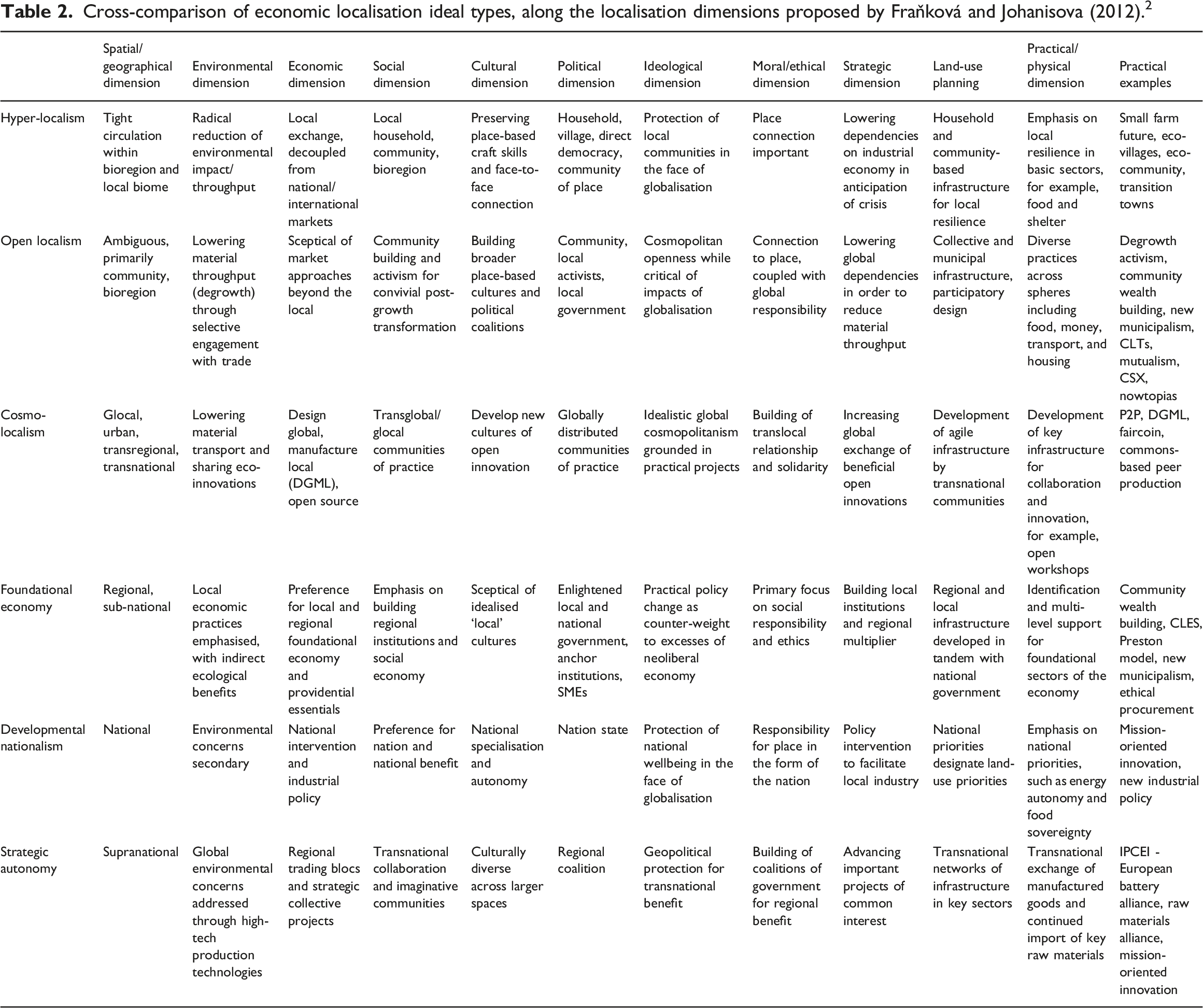
Along the various axes presented in Table 2, the diversity of approaches are often at odds, if not diametrically opposed. For instance, regarding debates around economic growth, HL, OL and CL are often explicitly growth-critical, the FE is somewhat growth agnostic, while developmental nationalism and strategic autonomy continue to centre growth as a crucial economic underpinning. There is a clear tension, also, between strategic autonomy and HL, with the latter ‘less concerned with the larger and more distant regional and (much reduced) state economies, let alone national economic realms involving large factories, trade, national railways, etc.’ (Trainer, 2012: 594). Similarly, supranational trading blocs, such as the EU, have tended to block the pursuit of the type of independent economic policies sought by developmental nationalists and regionalists alike (Medve-Bálint and Šćepanović, 2020: 1065).
If post-growth approaches (primarily taking the form of OL) can be criticised for focusing on isolated, small-scale initiatives (Mocca, 2020), neglecting the region (Savini, 2021) and underselling the imperative for global action (Kallis, 2015), then perhaps inspiration can be sought in the other ways of thinking about localisation explored here. Mocca (2020: 87) puts the challenge bluntly:
‘Even in an ideal non-capitalist scenario, where the economic competition among firms and the consumerist culture are contained, it seems unlikely that a small parcel of territory would be able to accommodate a consistent portion of the production of goods and services to satisfy societal needs’.
This is particularly the case if we disaggregate local production from raw material extraction. While there are attempts to onshore value chains (e.g. for lithium battery production in Europe), the resource itself often lies far outside national or regional boundaries. The influence of this differential distribution of raw materials on the localisation strategies pursued is one area in need of further research.
Given the contestations and debates outlined in the narrative literature reviews above, there is no guarantee that localism or reshoring leads to greater sustainability or social equity. Indeed, there are already signs that – under capitalist and growth-oriented structures – exploitation of people and nature may simply be regionalised, as supply chains shorten (Ciravegna and Michailova, 2022; Smith et al., 2022). Reshoring and local production are still primarily framed along capitalist logics (Barbieri et al., 2018; McIvor and Bals, 2021), rather than being built around diverse local ethics (Dartnell and Kish, 2021; Gibson-Graham et al., 2013; Klepp et al., 2022; Smith et al., 2022). Indeed, as Mocca (2020: 89) notes, ‘discourses of local development are often driven by the logic of economic growth’. Similarly, many ‘local economy’ initiatives, such as local currencies, are actually formed in order to kick start or protect regional growth. Despite being proposed by activists, it is clear that localisation is not a transparent, uni-directional development – rather, the survival of current structures of power appears to be entwined with shortening or changing supply chains (Ciravegna and Michailova, 2022).
Nothing can therefore be taken for granted, as diverse societies seek ways of surviving well in the much-debated Anthropocene (Gibson-Graham et al., 2013). There are, however, a few broad commonalities present across many or all of the narratives explored here – namely, the desire to produce to meet real demand or meet a perceived real need, rather than simply producing for profit. Therefore, while here are no guaranteed regenerative implications of economic localisation, nor is there an intrinsic connection between localisation and ethno-chauvinism, even if the latter is a real threat (Fraňková and Johanisova, 2012; Park, 2013).
Conclusion
In recent years, trade disruption from the COVID-19 crisis was compounded by further disturbances, whether caused by the blocking of the Suez Canal in 2021 by the Ever Given cargo ship, or fallout from the Russian invasion of Ukraine in 2022 and subsequent reconfigurations of regional trading blocs. The tumultuousness of recent years calls for a provisional form of sense-making, a process with which this paper has tried to assist. If the term localisation denotes ‘a process which reverses the trend of globalization by discriminating in favour of the local’ (Hines, 2003: 5), then this paper has shown that we are now faced with many competing localisations. Where and how we produce to meet our needs is deeply consequential, beyond the realm traditionally thought of as the ‘economic’. The remaking of geographies of production is not just a technical question, but is tied up in questions of belonging, home making and ‘ontological security’ (O’Connor, 2018; Schismenos et al., 2020). This paper has therefore approached this topic, sensitive to specific forms of local production, where capitalist political economy and organisation, and neoclassical economic assumptions are not taken for granted. This is part of what Herbert and Powells (2023: 559) describe as ‘an important and as yet under-researched aspect of the political, economic and cultural responses to major crises of the early 21st century’.
Despite decades of supposed transition to ‘dematerialised’ and ‘post-industrial’ economies, in which the factory retreated from view in western society, manufacturing and material production remain fundamental, providing livelihoods and crucial everyday goods (Gibson et al., 2019). In this context, much could be learned from possible conversations between the approaches outlined in this paper. Could hyper-localists, for instance, expand their vision beyond the village or household, to engage more with ideas of the FE? What could dialogue between developmental nationalism and CL look like? Localism, ultimately, is about ethical negotiation (Gibson-Graham, 2008) and these, and many other questions, are in need of further reflection. Whether intensifying trends towards regionalisation and deglobalisation take a form which reinforces mainstream economics and polarisation, or which enhances economic democracy and post-growth tendencies (Johanisova and Wolf, 2012), remains to be seen.
Footnotes
Declaration of conflicting interests
The author(s) declared no potential conflicts of interest with respect to the research, authorship, and/or publication of this article.
Funding
The author(s) disclosed receipt of the following financial support for the research, authorship, and/or publication of this article: This work was supported by the H2020 Marie Skłodowska-Curie Actions with grant number 101029512.
