



Abstract
This chapter explores the wild and wonderful visual world of iconic imagery including current day memes, acronyms, emojis and other common forms of visual communication. The study reviews a range of visual examples and their meanings beginning with the Renaissance through to futures and asks the questions Does imagery have an effect on reality? Can imagery be engineered to have a desired effect on futures? Data collection involves archetypal imagery that has appeared in the past, its meaning and influence on societies to the present-day explosion of optical bombardment through social media, screens and advertising, and their impact and influence on current culture. The data includes a look at conscientious, principled futures generated imagery and its possible connection to the creation of futures. Causal Layered Analysis (CLA) provides a comparative methodology for this investigation though enabling a comprehensive understanding of various possible interpretations of an image’s intention and perception based on analysis of graphic symbology. It does this in the form of a series of scenarios developed from the CLA. Analysis within the CLAs is sometimes aided by artificial intelligence. This is done by asking questions in ChatGPT and expanding/consolidating and/or chopping/changing the responses. From a surface peek at visual data to the depths of underlying meaning within the collective human psyche this analysis seeks to provide a provocative poke at our everyday overlooking of these day-to-day visual assaults. The study aims to offer refreshing insights into the power of an image and its ability to possibly affect thinking, feeling and action across the continuum of time into futures and what this may mean in this current pivotal era of consciousness.
Section 1. Visual Communication – An Ageless Odyssey
Symbolism is the language of the mysteries. By symbols men have ever sought to communicate to each other those thoughts which transcend the limitations of language. Hall, Manly (1988) “The Secret Teachings of All Ages”, n.p., Philosophical Research Society Inc. USA.
Symbols, including memes, acronyms, emojis, and archetypes are diverse forms of communication, each with unique characteristics. Symbols are visual representations imbued with cultural or contextual significance, such as flags or religious images. Memes represent cultural ideas, behaviours, or styles and are shared widely on the internet for humorous or social commentary purposes. Acronyms streamline language by condensing phrases into initials, while emojis are digital icons that add emotional agency to text-based communication, conveying feelings and tone in a visually engaging manner. And simply put, an archetype is a recurring, recognisable, universal pattern, or model with certain behavioural traits, such as the hero or victim (Araneo 2006). Despite their differences, these communication tools share a common purpose, to communicate and express information, ideas, and/or emotions. These elements can be used in addition to or in lieu of language and words, which many would consider the ultimate use of symbology. Emery et al. argue images communicate more straightforwardly and immediately than words, stating the ‘image actually impacts on us much more quickly than the word ... (which is an) abstract referent that often bears no resemblance to the thing it symbolises’ (2019, 24). They continue ‘the visual image can be direct and even though it may contain embedded symbols it is usually perceived immediately’. Further, Arnheim (1989, 26) asserts ‘the dynamics transmitted by the image resonate in the nervous system of the receiver…these actions are not just physical gymnastics, they are ways of being alive, ways of being human’. More recently ‘scientists have discovered that when we look at a smiley face (emoji) online, the same very specific parts of the brain are activated as when we look at a real human face’ (Andrade et al. 2016, 79). The authors indicate the decoding of the symbol also induces new patterns of brain activity as the symbol is ‘read’ into. Based on context, technicality, and personal brain patterning, interpreting symbols can be tricky. This means ‘that a smiling face not necessarily means friendliness or happiness. It might also stand for falseness, a hidden lie, etiquette or simply superficiality’ (2016, 80) to the interpreter.
Using symbols to communicate is not new. Balter suggests evidence exists that symbolic behaviour appeared long before cave paintings, reinforcing what researchers have long surmised, that symbolic representation may have served as a type of ‘social glue’ Balter (2009, 709). Balter asserts symbolic representation may have assisted in human survival, before possibly the ‘most sophisticated form of symbolic communication: language’ (2009, 709) evolved. Further, based on the finding of a 51,000-year-old engraved bone, Leder et al. claim ‘Neanderthals were capable of creating symbolic expressions before H. sapiens arrived in Central Europe’ Leder et al. (2021, 1237). From survival to persuasion, this chapter looks at the use of symbolic imagery and possible underlying intentions of their creators and perceptions of their audiences.
One prominent symbol that seems to have stood the test of time is Leonardo da Vinci’s Vitruvian Man (Figure 1), also known as Renaissance Man or Universal Man. Vitruvian Man presents a precise portrayal of a male human figure, employing geometrical, mathematical, and anatomical accuracy. The figure is positioned at the core of a square and circle, which are infused with symbolic and philosophical significance. The circle signifies divine perfection or uncreated thought, while the square symbolizes earthly creation or reality. In this symbolic context, the human being occupies a central position, serving as the nexus where the uncreated transcends into created reality. Notably, this interpretation of nature transcends the dualism between thought and reality, forming the foundation for a monistic understanding of the universe akin to the perspectives of Descartes and Hegel (Oranges et al. 2016). Leonardo da Vinci, “The Proportions of the Human Figure (Vitruvian Manek)”, 1490; Pen, ink, and watercolour over metal point. https://commons.wikimedia.org/wiki/File:Leonardo_da_Vinci-_Vitruvian_Man.JPG, viewed 30/11/2023.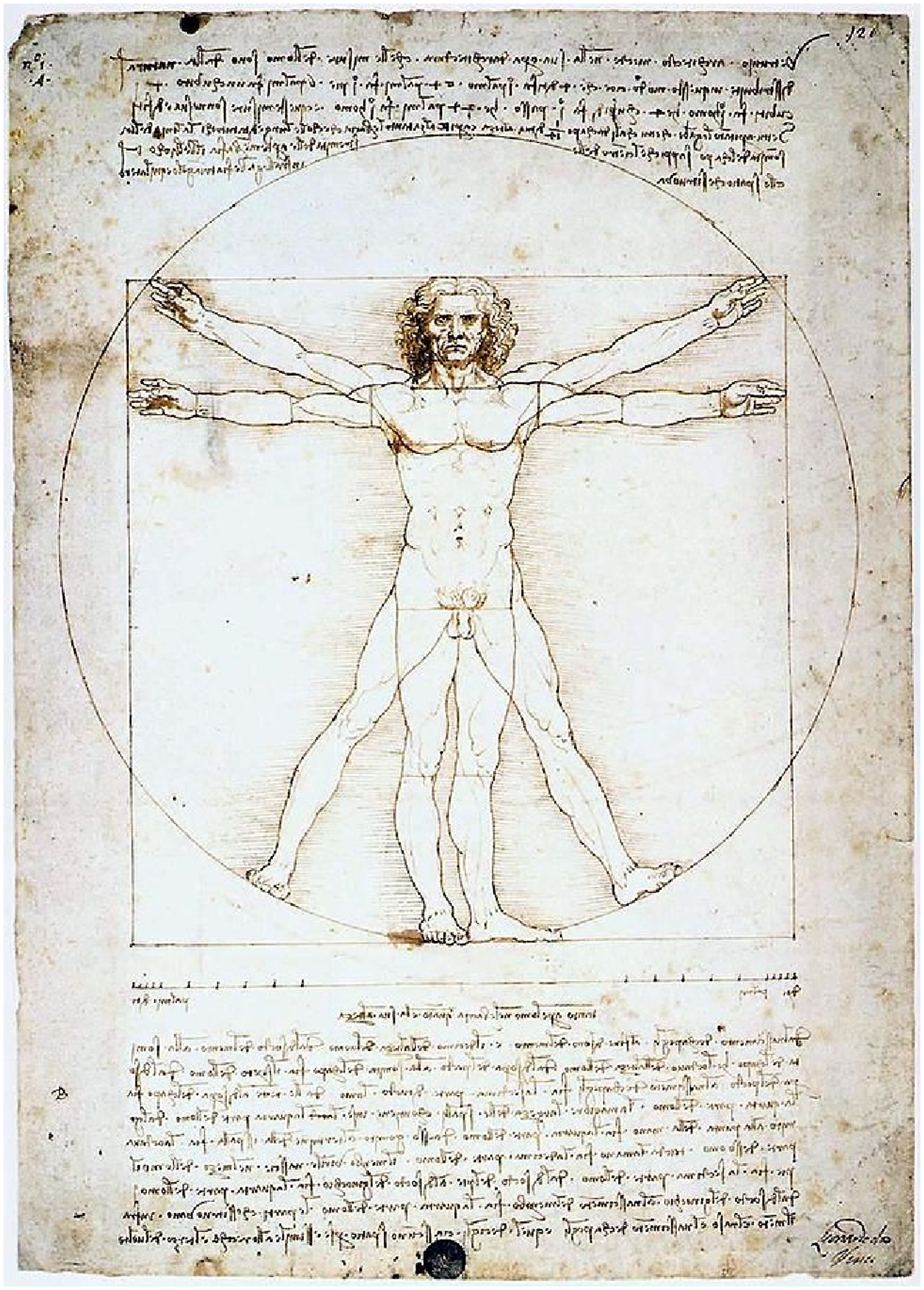
Still relevant centuries later, Murtinho acknowledges Vitruvian Man’s recurrent relevance as a symbol of ‘man as … the centre of the universe’ Murtinho (2015, 508).
ChatGPT (29/11/2023) Expands on What Vitruvian Man Symbolises Today:
It is often seen as a representation of the harmony between humanity and the natural world. Here are some modern interpretations of what the Vitruvian Man symbolizes: 1. 2. 3. 4. 5.
Although current day memes, acronyms and emojis may lack the profundity of Vitruvian Man, Mühlenbeck and Jacobsen (2020) report there is a shared characteristic amongst all symbols. That is, when embraced by multiple individuals, symbolic meaning is based on mutual information background and further, frequently captures the interest of others who possess a similar information background.
This is particularly relevant in the digital realm where widely shared memes can gain traction and momentum, spreading like viruses through the minds of viewers (Bhattacharya 2019). This could help to explain the depth of meaning assigned to Vitruvian Man throughout the ages. As well, common background could enhance the meaning and messages of acronyms and emojis where brevity and visual impact are valued.
Hamoodat et al. argue that some researchers claim, ‘acronyms are now part of our colloquial language (e.g., LOL, LMAO, OMG)’ and name emojis as a ‘new global language’ (2020, 2). They also point out that other researchers argue emojis ‘are just pictures that are naturally combined with plain text creating a new form of language’ (2020, 2). Their longitudinal study acknowledges that social media vocabulary/language is increasing in size over time in the same way as any other developing language. They also note that socio-economic and education backgrounds are contributing factors (Hamoodat et al. 2020).
Emery et al. argue ‘today we are bombarded with imagery presented in seductive ways to appeal to all of our senses…and to influence audiences to think and feel in certain ways’ (2019, 21). They note ‘any person in possession of a smart device can begin to sketch, publish, take notes, network, create works of reflection, art, science – in short, each person can be his or her own creator of knowledge’ (Gardener in Emery et al. 2019, 26).
In any case symbols, memes, acronyms, and emojis can serve as efficient and effective means of communication, contributing to the richness and diversity of expression in both online and offline interactions. Each form has its own niche, ranging from the abstract and culturally significant nature of symbols to the humorous and possibly nefarious nature of memes, the concise abbreviation of acronyms, and the emotional expressiveness of emojis. Together, they reflect the evolving landscape of communication in our digital age where anyone can create content. The next section delves into how these iconic features may work to help construct realities.
Section 2. Symbolic Imagery and Created Reality?
Though symbols empower us, they veil our oneness with the Infinite. Disconnection brings madness. Watts, Alan, “Talks on Symbolic and Real”. https://www.organism.earth/library/document/symbolic-and-real viewed 23/01/2024
Watts’ quote can be illustrated by pointing out the difference between money and wealth (https://www.organism.earth/library/document/symbolic-and-real). Considering the number of people in the world all capable of producing symbolic content that could intensify by ‘going viral’ through social media, it may never have been more important than it is now for clear communication with best intentions in mind to occur. The world/mind/space has the capacity for miscommunication, misidentification, misfortunate, and misconfiguration as well as for the magical and mystical. Hence, this section takes on the first question, Does imagery have an effect on reality?
As acknowledged by Emery et al. (2019) there is a constant stream of alluring visuals designed to capture our attention, engage our senses, and shape our thoughts and emotions to align with specific messages. Mozdeika goes as far as to state ‘the digital public sphere today increasingly resembles a cacophony of disjointed voices datafied for the gain of giant tech firms’ Mozdeika (2023, 253) and warns of the phenomenon known as ‘meme magic’. Meme magic is a concept suggesting that internet memes and their cultural impact can have an almost mystical influence on real-world events. The know your meme website (https://knowyourmeme.com/memes/meme-magic_viewed_24/11/2023) defines meme magic as a ‘slang term used to describe the hypothetical power of sorcery and voodoo supposedly derived from certain internet memes that can transcend the realm of cyberspace and result in real-life consequences’. For example, Mozdeika reminds of the symbolic power of meme characters like Pepe the Frog (Figure 2), as a cultural-political tool that does not necessarily require genuine belief for its symbolic or persuasive impact. Utilizing collective irony and scathing humour, symbols such as this, created interactively, are later perceived as having a quasi-magical quality, challenging audiences' direct and purposeful involvement in their creation. Mozdeika warns of ‘interpassivity theory’, arguing that the ‘interpassive delegation or outsourcing of affective reception, emotion, or belief to symbols now serves as interactive digital media affordances subservient to the logic of nudging or direction, as opposed to distanced reflection’ (2023, 253). Pepe the Frog as used by the ‘Proud Boys’ movement (DeCook 2018).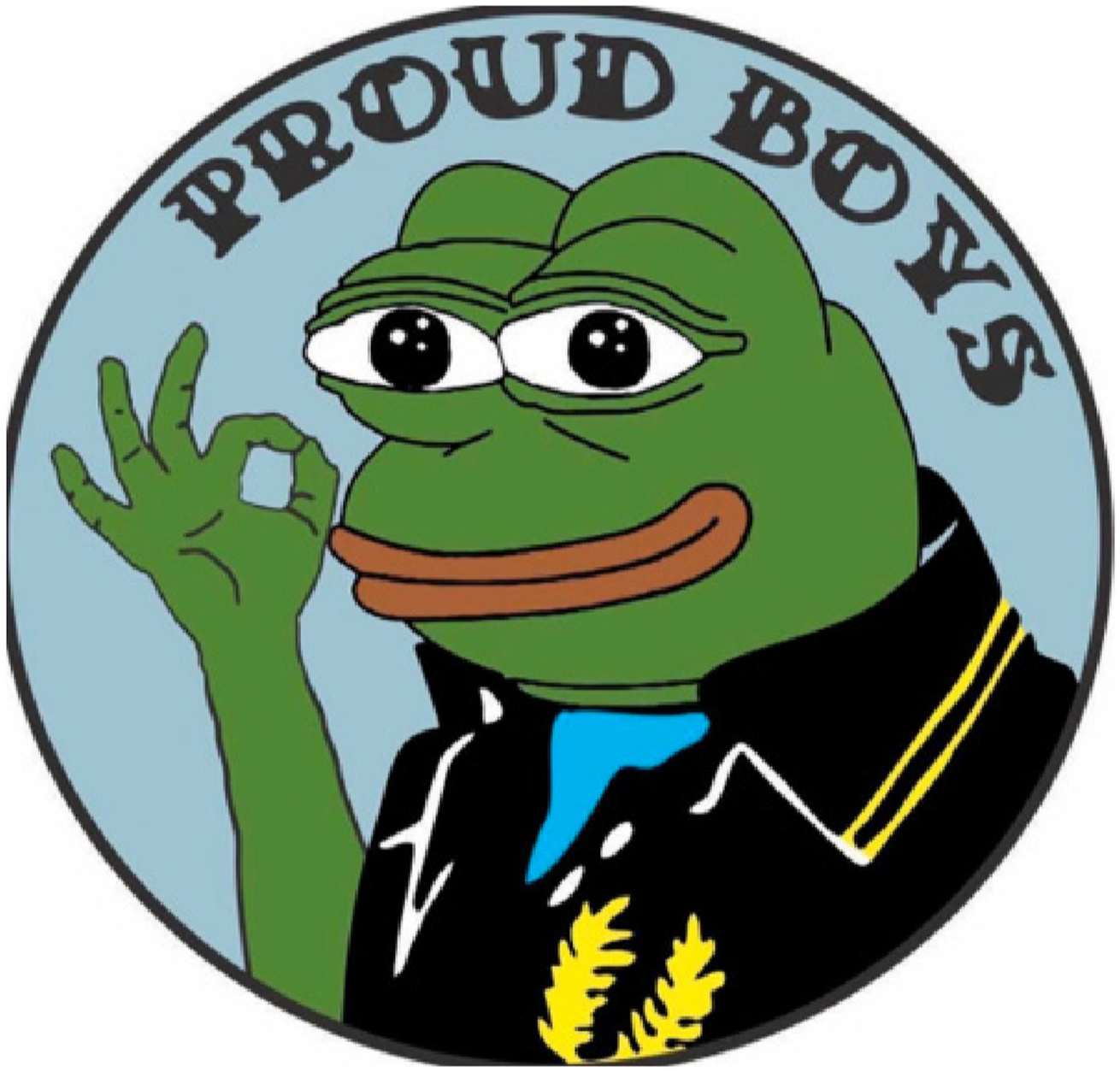
DeCook (2018) explored the Proud Boys movement activities using memes as propaganda on social media. According to DeCook, ‘Proud Boys operate on an ideology that consists of both symbolic and physical violence, and the popularity of these groups is growing (2018, 485)’. Along with the spread of the Proud Boys movement and their ideology (alt right), Pepe, their appropriated meme mascot, also gained momentous popularity. So much so, that the frog is heralded as the reason Trump got into office in 2016. Spencer writes that the Proud Boys believe ‘the frog… is imbued with a magical power to bring Trump into office — as long as devotees plaster the frog's image everywhere, like a flyer for takeout food’ Spencer (2016, n.p.).
Meanwhile, in the world of emoji use, exactly what is intended to communicate can be misperceived. While Andrade et al. (2016) assert emojis are used as indicators, amplifiers, teasers, and enhancers or stengtheners of speech acts, Kelly (2015) found 70% of the individuals surveyed interpret emoticons/emojis in varying ways based on the sender of the message. Responding to why there is a difference between intended and perceived communication, Andrade et al. state ‘theories of implicature attempt to explain the recovery of actual and intended meaning; foremost among these is Relevance Theory’ (2016, 85). This theory suggests that implicature is retrieved by maximizing understanding with minimal effort. Context, along with necessary background knowledge, is crucial for the sender or receiver to comprehend or convey a message efficiently. Interestingly, the authors also found that emoji use leads to friendlier communication overall and when used as a strengthener, emojis can influence the user to align with the current fashion or movement (2016). This seemingly adds weight to the notion of visual imagery affecting reality. As a final wow factor in the how to have a happier life through emoji use category, the authors claim ‘emojis are the ‘in thing’. Adding them to your subject line shows your brand is embracing the times. Further, Andrade et al. (2016) argue that engaging in more amiable communication is linked to a more joyful life, and that emojis can directly contribute to fostering this positive outcome.
Barberá-Tomás et al. (2019) decode the phenomenal effect of emojis naming it ‘emotion-symbolic work’. Their research involves a particular group of people, social entrepreneurs, who use images and language to provoke adverse emotions through conscience shake, and subsequently converting these emotions into energy for action. The authors define a social entrepreneur as someone aiming to inspire collaborative efforts to instigate change. Barberá-Tomás et al. explain an ‘emotional transformation process entails connecting target actors to a cause, a collective identity, and the social entrepreneurs themselves’ (2019, 1789). The authors note that emotional-symbolic images possess the capacity to evoke strong responses and reflexivity in audiences. The images establish a contextual perspective, allowing the conveyed message to become personally relevant to the viewer. The authors explain that visual symbols are frequently employed metaphorically, allowing them to convey information swiftly and elicit visceral, embodied, emotional reactions. These contribute to an immediate and potent impact that goes beyond cognitive processing, engaging audiences affectively, aesthetically, and corporeally. They are especially effective in situations where ideas or issues challenge established understandings and when the creator lacks prominence, familiarity, and legitimacy (Barberá-Tomás et al. 2019).
Bhattacharya (2019) offers a theoretical perspective on social media memes and their negative effects on society. Their research produced the following framework of undesirable outcomes: • • • • •
Bhattacharya warns of dire consequences for the human race if measures are not put in place to stop the spread of these ‘emotional contagions’, because, and it has been said before, viral memes can replicate like wildfire in dry wind on the internet causing ‘epidemic outbreaks’. In response to the research Bhattacharya names possible monitoring, controlling, and restricting ‘the publication and distribution of memes that can propagate any of the above effects mentioned in the framework’ (2019, 46).
It would seem there is a resounding
Section 3. A Look at Some Data
Life shrinks or expands in proportion to one’s courage. Nin, A, (1971) “The Diary of Anais Nin”, vol. 3
This section presents an exploration into visual communication through the multiple layers of causality and interpretation using Causal Layered Analysis (CLA). CLA is a futures studies and qualitative research method (Inayatullah 2004). It aims to provide a comprehensive understanding of complex issues and is often used to analyse and understand the deeper drivers and implications of various social, cultural, political, and technological phenomena. It is particularly useful for exploring underlying assumptions, narratives, and paradigms that shape different perspectives on a given issue making it appropriate for the purposes of this chapter. CLA’s four layers of analysis are: 1. 2. 3. 4.
Analysis of the layers aims to provide a holistic view of the dynamics at play in interpreting the images, thus enabling an informed and nuanced understanding of related challenges that may play a part, if at all, in shaping futures. Each of the 4 layers in the CLAs have two types of analysis: intention and perception. Intention is derived either by the author as creator of the image where applicable, available literature, or author assumption. Perception is obtained through author assumption, literature if available or artificial intelligence (ChatGPT). This is obviously a limitation of the analysis. However, the CLAs are meant to be provocative and insightful, hence, the reader is encouraged to make their own assumptions and/or participate in any way desired. A total of 5 images are presented and examined through the CLAs in this section. The images go from simple to more complex, beginning with a smiley face emoji and emoticon, moving to a popular cat meme, next a look at an allegorical oil portrait, then onto a somewhat related advertising campaign and finally to an author created image. The final section discusses the findings as they relate to the literature with a view towards conscientiously created futures.
Smiley Face Emoji/Emoticon
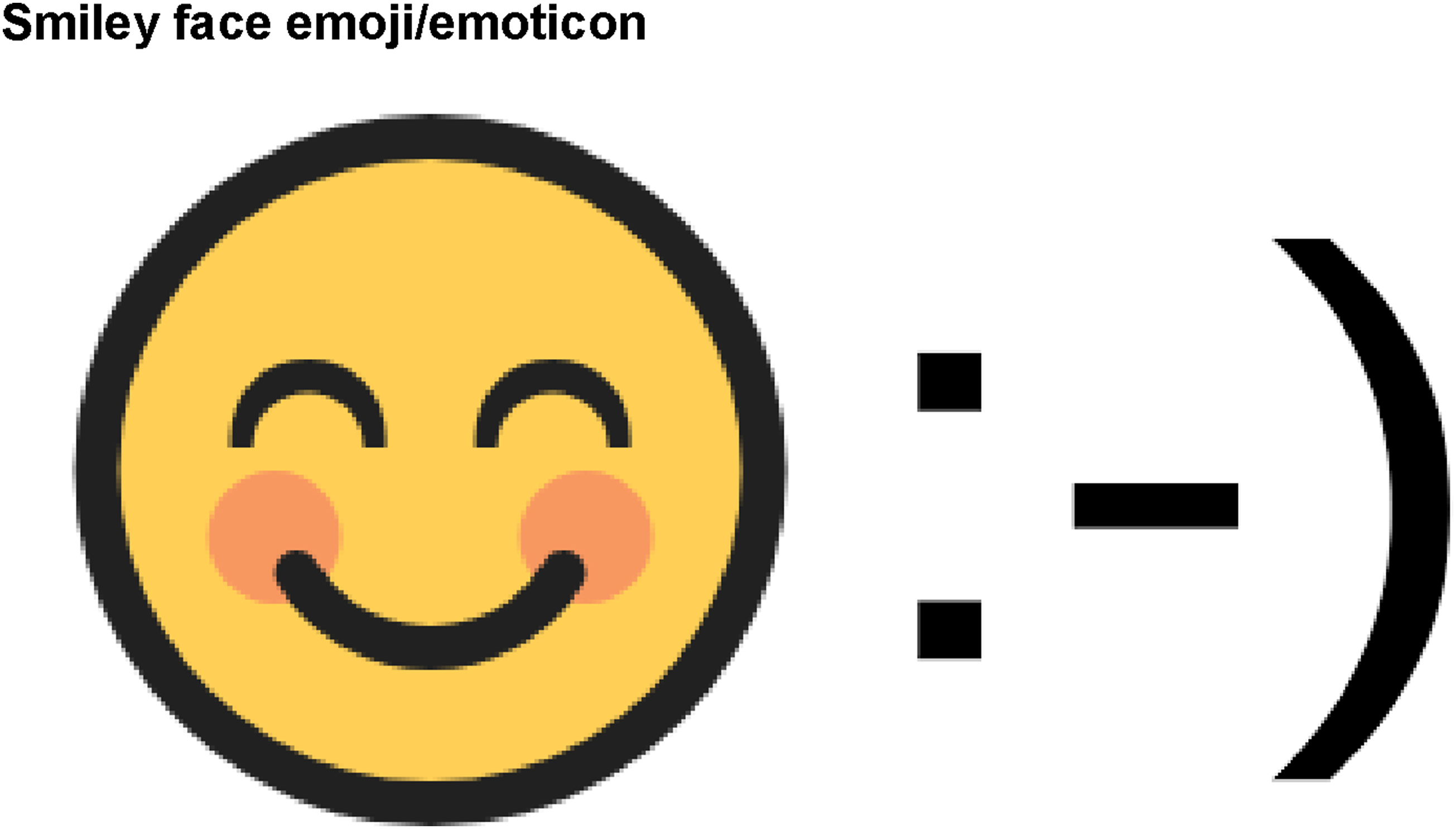
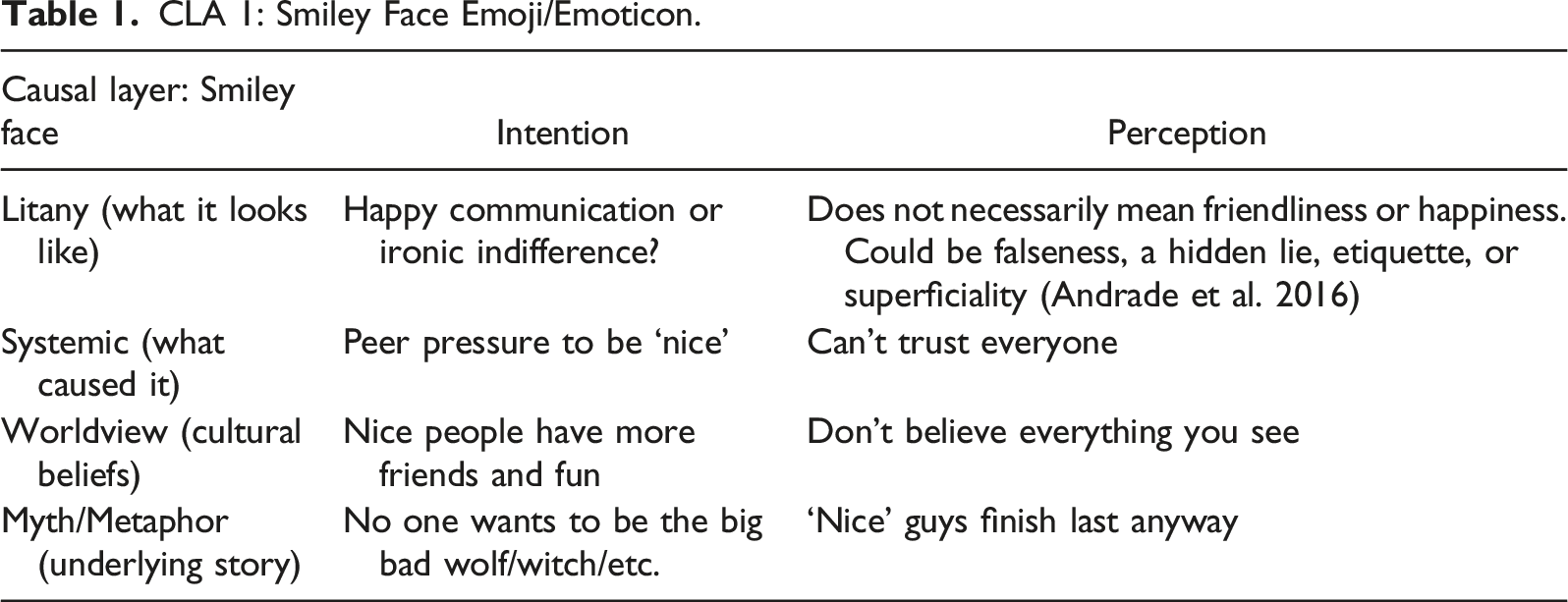
Figure 3 shows both a version of the popular smiley face emoji and the smiley face emoticon. The literature (Andrade et al. 2016) suggests both are used in similar ways so both are considered in this analysis. Smiley face CLA (Table 1) provides the layered intention/perception of one of the more simplistic communication symbols. In the litanic layer the intention of the communique can only be assumed, however in the deeper systemic layer the pressure to be nice could be at the root of the choice to use smiley face, no matter what the intention. Looking deeper below the systemic, the CLA outlines reasons why this peer pressure is all encompassing. For instance, a reason could be traced all the way back to childhood, when bedtime stories may have caused shock and horror in young minds Smiley face emoji (https://emojipedia.org/smiling-face-with-smiling-eyes, viewed 1/12/2023) and emoticon (https://en.wikipedia.org/wiki/Emoticon_viewed_5/12/2023). CLA 1: Smiley Face Emoji/Emoticon. .
.
Cat/coffee Meme
 .
.CLA 2: Cat/Coffee Meme.
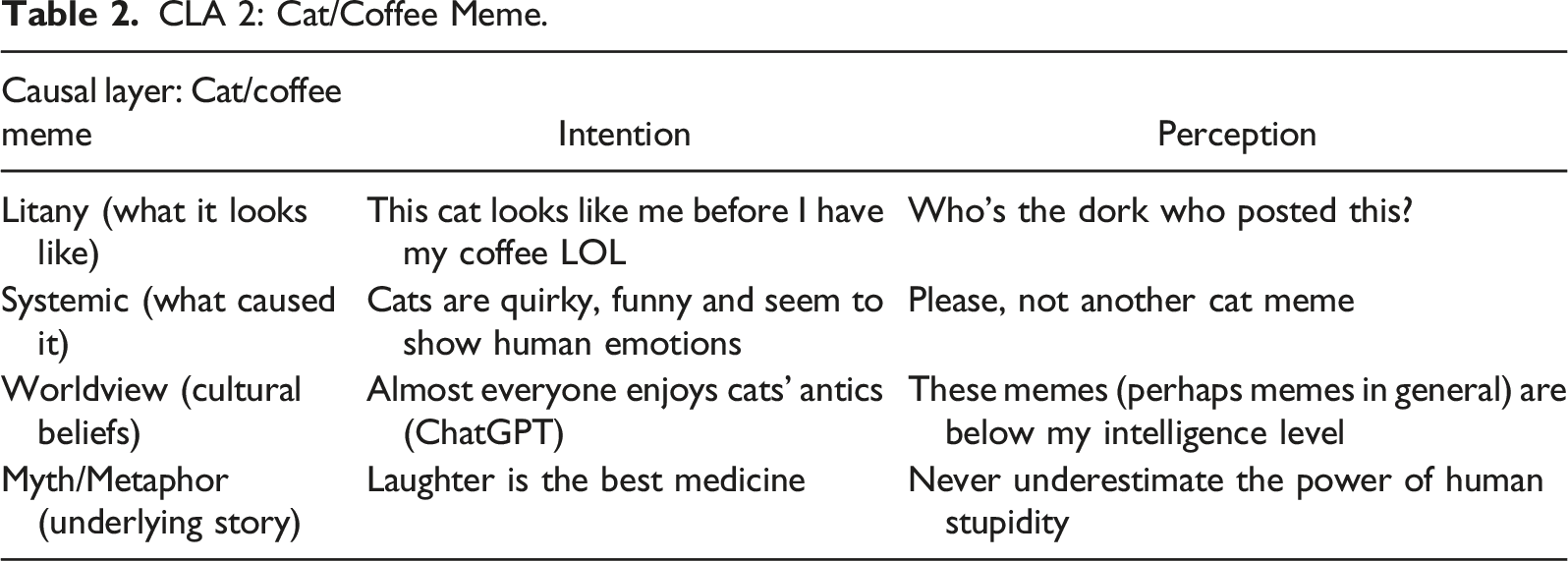
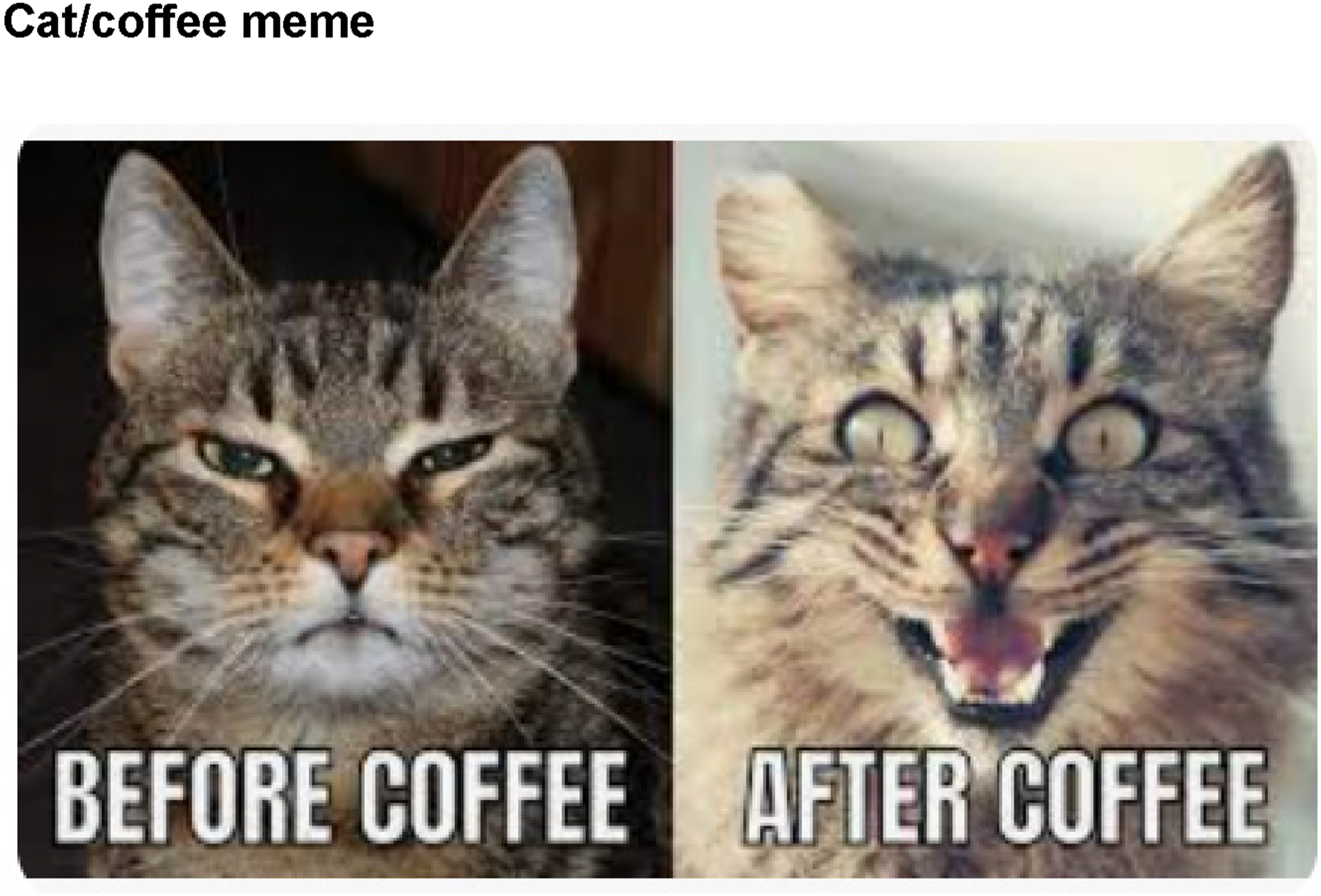
Cat/coffee meme (https://www.canva.com/memes/templates/, viewed 1/12/2023).
Allographic Portrait of Rudolf II
The third CLA (Table 3) presents an analysis of an allegorical portrait by 16th century painter, Giuseppe Arcimboldo. The painting (Figure 5) depicts the artist’s patron, Rudolf II, as the Roman God Vertumnus, in a symbolic way. In the painting, Rudolf’s head is created of fruit, vegetables, and flowers, representing the abundance of the Roman Emperor’s kingdom, notably a Green Man archetypal image (Araneo 2006). The purpose of the image is historically well known and expressed in the intention column. However, the perception column is really anyone’s guess. Hence ChatGPT was called upon to fill in the perception gaps in CLA 3. The text generator was asked: What did people of the day think of the portrait. Here is a brief summary of ChatGPT’s response: The elite and courtly circles, including Emperor Rudolf II himself, were known to appreciate the symbolic and allegorical nature of such works. They might have seen it as a unique and whimsical expression of the emperor's personality or a celebration of his connection to nature and the changing seasons. The public, on the other hand, might have had diverse opinions. Some may have found the unconventional approach intriguing and entertaining, while others might have found it perplexing. The reception would likely have been influenced by factors such as education, social standing, exposure to art, cultural background, and personal taste. In essence, while the public might not have understood all the intricacies of the allegory, they could still appreciate the artistry, creativity, and perhaps the entertaining or fantastical aspects of Arcimboldo’s work. CLA 3: Allegorical Portrait of Rudolf II by Giuseppe Arcimboldo. Allographic portrait of Rudolf II, Holy Roman Emperor as Vertumnus by Giuseppe Arcimboldo, 1590 (https://artsandculture.google.com/asset/rudolf-ii-of-habsburg-as-vertumnus-giuseppe-arcimboldo/TAGn3nhWHkbIBA?hl=en, date viewed 1/12/2023).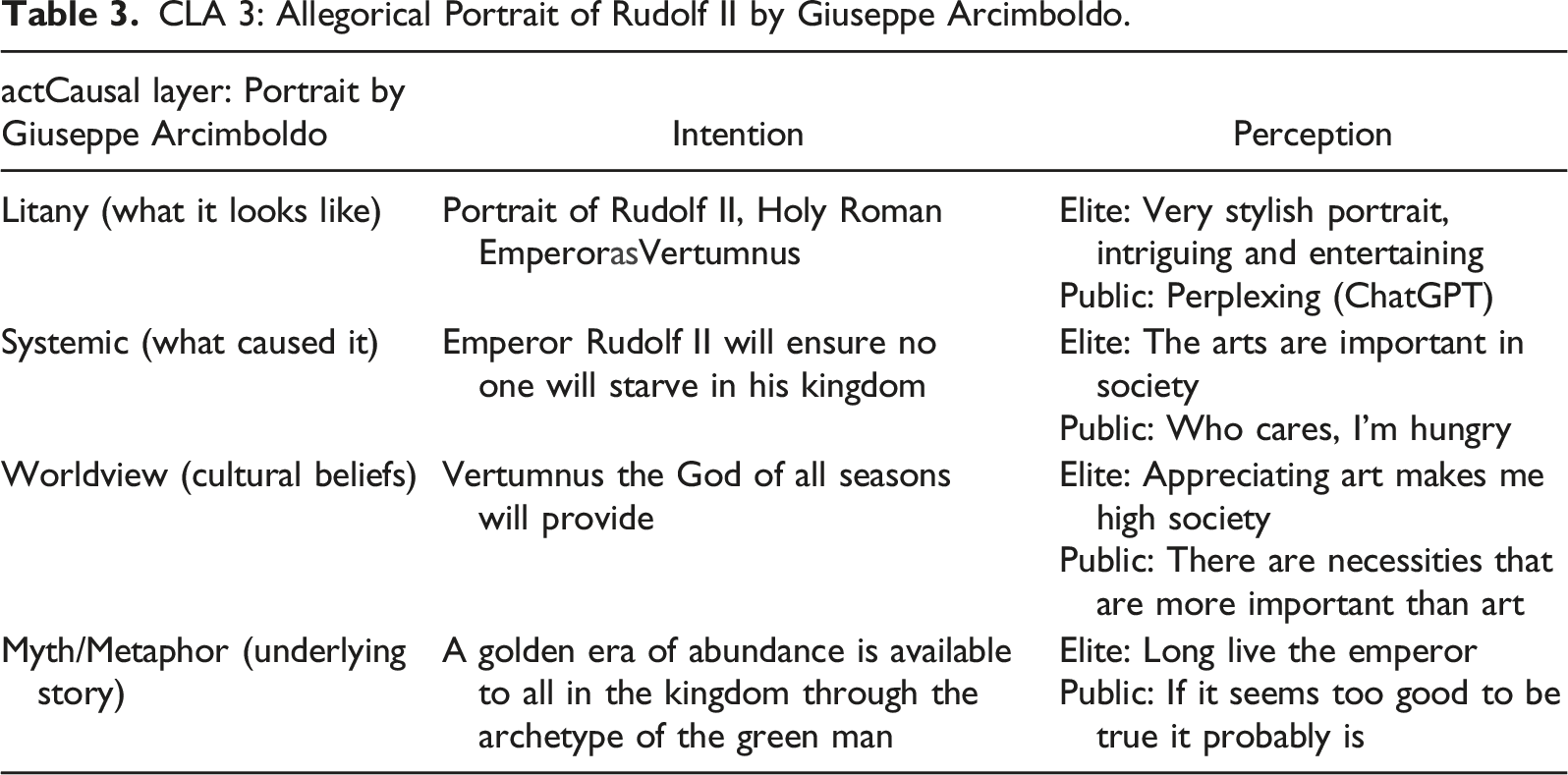
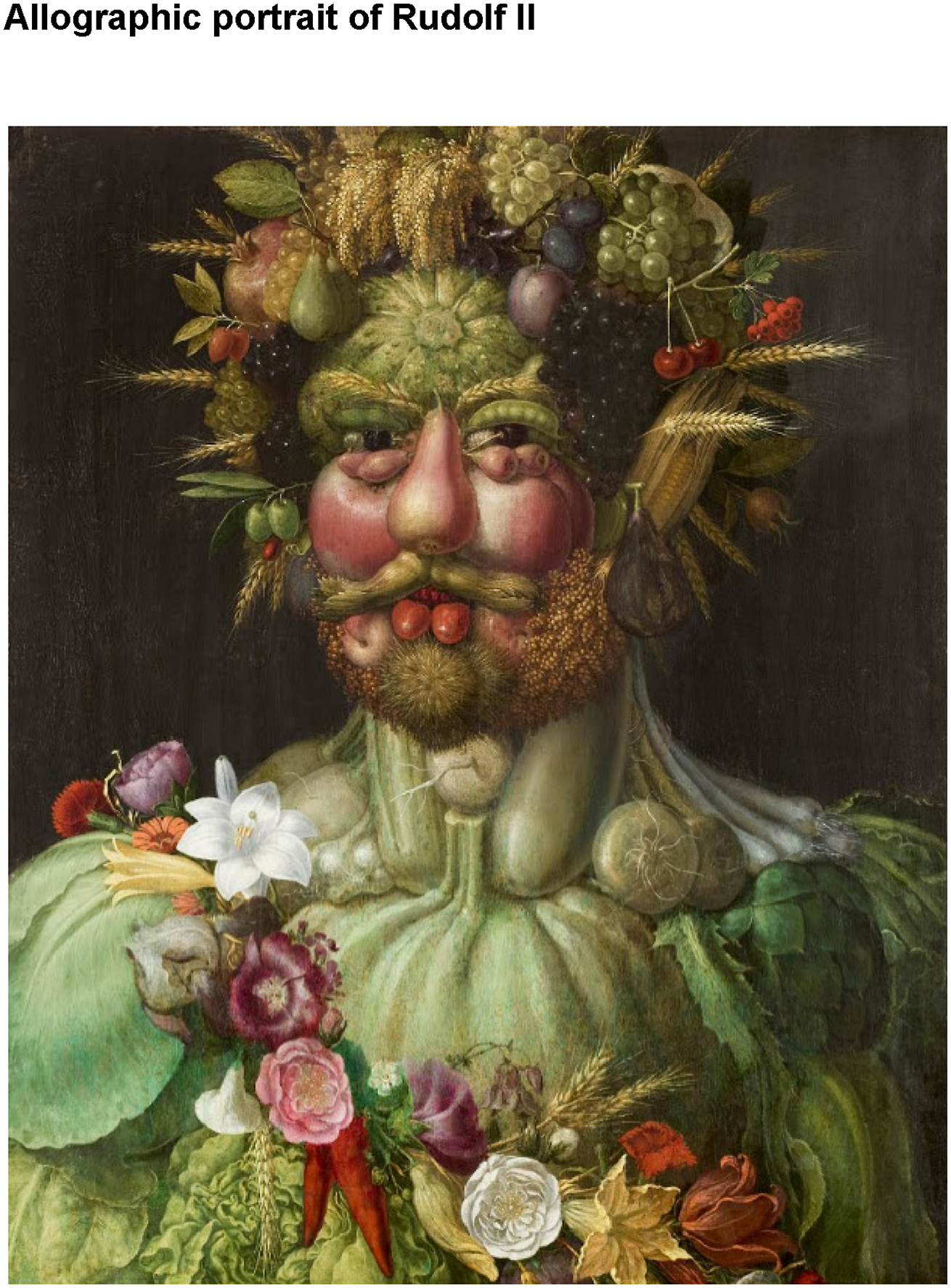
It is interesting to note that ChatGPT is actually referring to Andrade et al.’s Relevance Theory (2016). However, a reality check here, the public may never have even seen the painting:-0.
Australian Government’s Healthy Eating Campaign
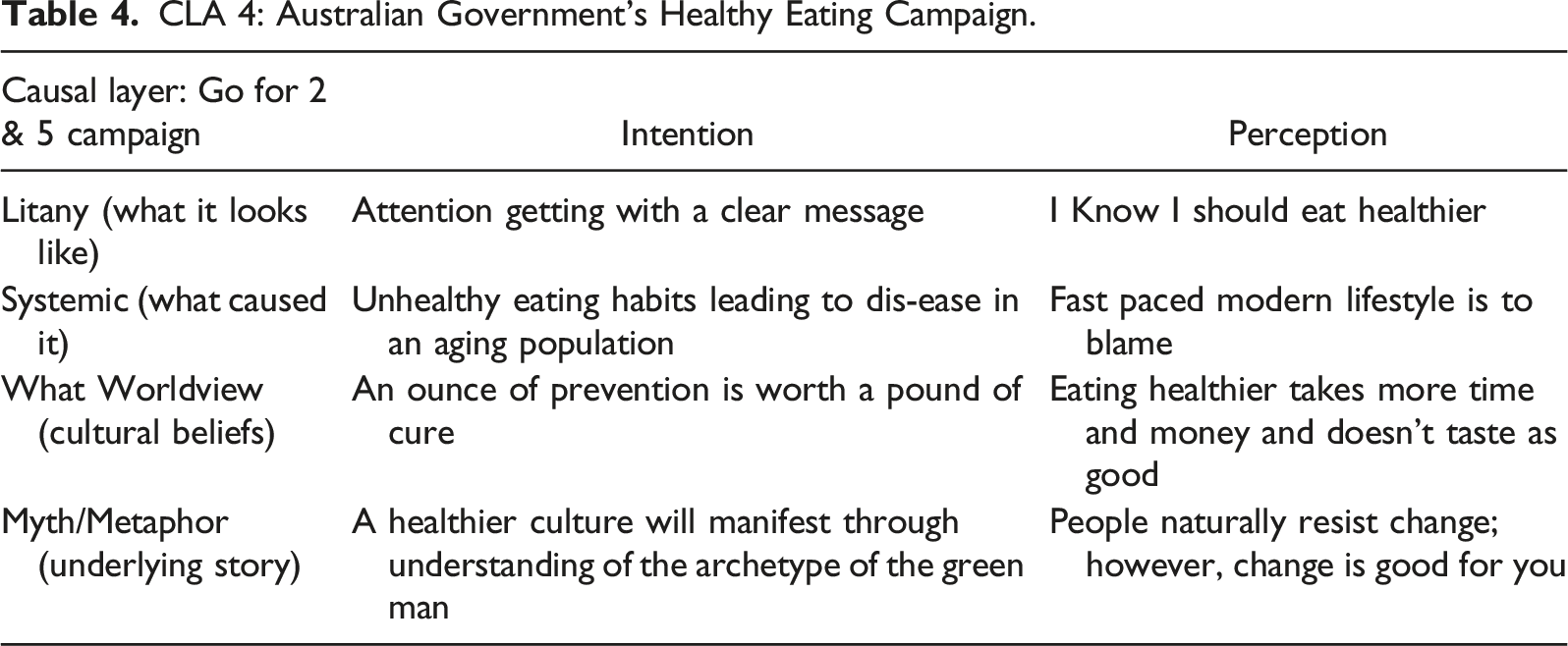
Following on from the work of Arcimboldo and employing the same technique of creating a human head with vegetation is the Australian Government’s Go for 2&5 campaign (Figure 6). In this campaign, produced for both print and television, a Green Man archetype as vegetation head emerges again, 400 years later! In this campaign, the Green Man is encouraging people to eat more fresh fruit and vegetables and less processed or fast or takeaway food. According to the Go for 2&5 website (https://www.gofor2and5.com.au/in Araneo 2006), Australians are eating too little natural produce and have lost track of how important fresh fruit and vegetables are in maintaining a healthy diet. The Go for 2&5 campaign lets people know how much fruit and vegetables they should eat and gets them to think about how much they actually do eat (Media statement, https://www.gofor2and5.com.au/ in Araneo 2006). The 4th CLA (Table 4) outlines the layered intention of the image and campaign and some possible perceptions. Print version of the Australian Government’s 2002 healthy eating campaign (https://www.health.gov.au/, date viewed 28/10/05). CLA 4: Australian Government’s Healthy Eating Campaign.
CLA 5: A Vision of ESD.
A Vision of Education for Sustainable Development (ESD)
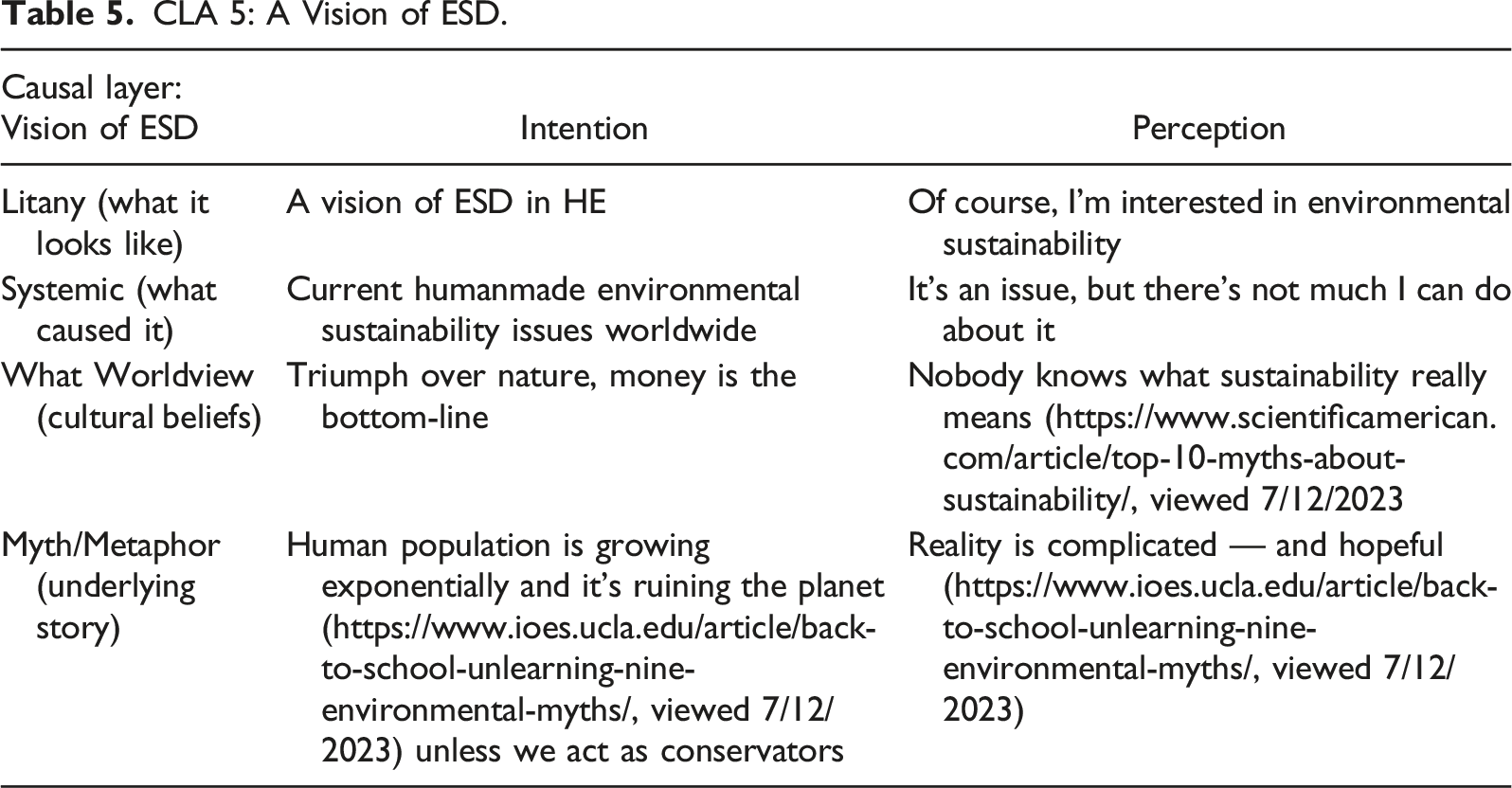
The fifth, final and most complicated image (Figure 7) is based on DaVinci’s Vitruvian Man (Figure 1). This was used as an allegoric mapping for a PhD thesis on ESD, a multidisciplinary subject about sustainable practice and systems. Its broad nature is often difficult to grasp, hence the image was created as an overall quick view of the topic. Following is a brief summary of the symbology of the image: the highly recognisable Vitruvian Man was used because of deeply rooted underlying mythology surrounding it. The horizontal axis through Leonardo da Vinci’s symbolic image represents the delineation between the hard and soft sciences, or disciplines. These disciplines are represented by arrows pointing towards the centre of the figure. The green arrows, below the midsection of the figure denote the hard, source, or quantitative sciences, which aim to explain and quantify the natural world and its systems; while the blue arrows, above the midsection, represent the humanities, or soft, qualitative disciplines—systems which have been developed by and serve humankind. These bodies of disciplines underscore ESD’s inter-multi-cross-pluri-transdisciplinary nature. Within the illustration, the bodies of knowledge (arrows) indicate the totality of understanding necessary for complete understanding of ESD for the stakeholder. The green arrows exemplify natural systems while blue arrows denote human systems. Sustainability occurs and exists when outputs of one system, nature, or human, are not toxic inputs for another (again) human or nature. Granted, this vision of ESD is complex and it could be asking a lot of stakeholders, however considering what is at stake, this understanding is imperative, moving forward towards Environmentally Responsible Behaviour (ERB). The fifth CLA is self-explanatory with clearly outlined views expressed in both the intention and the perception columns. A vision of ESD leading to Environmentally Responsible Behaviour (ERB). The image intends to highlight ESD’s inter/multi/trans/cross disciplinary nature. Courtesy of the author.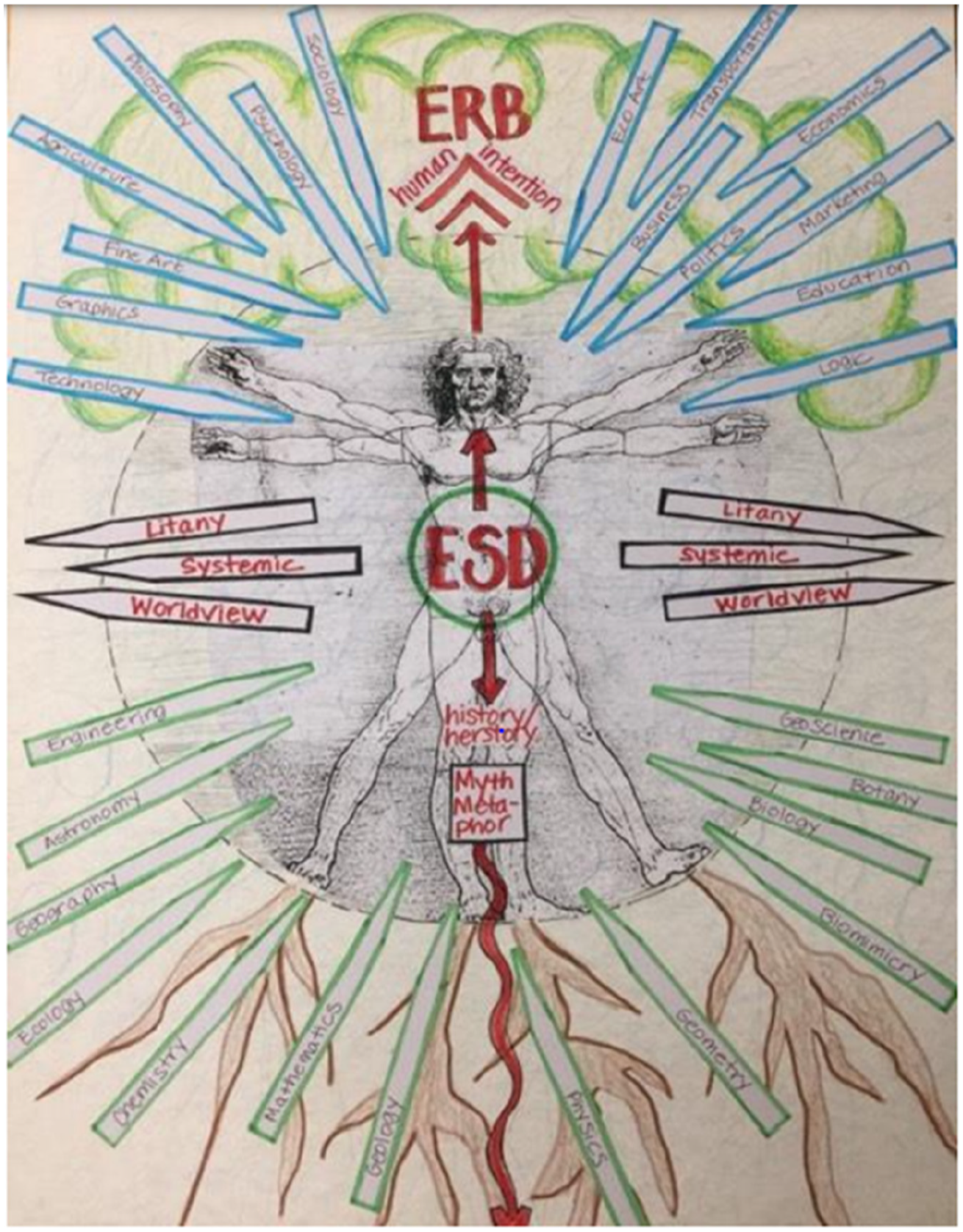
Through the CLA scenarios of the 5 images there is some understanding and awareness of image creators' intentions and audiences' perception. With this comes the capacity for possibly steering futures through engineered for purpose imagery. Hence, it is appropriate to end this section with an expansion on Nin’s opening quote. This elaboration comes from the seminal book, The Courage to Create. In the book, May (1975) outlines a theory of human development that progresses through creative impulses, that when followed through can indeed lead to manifestations of new possibilities. Further, May (1975) advocates that advancement of the individual will advance the collective whole.
Section 4. Visionary or Visionless?
The visionary starts with a clean sheet of paper and reimagines the world. Gladwell (2008) “Outliers: The Story of Success”, Penguin Press
Contextual awareness of the nature of humanity’s use of visual symbols and their significance was established in the first section of this chapter. The second section answered the chapter’s first query of Does imagery have an effect on reality? Next, section 3 presented visual data, intentions, and perceptions through the layers of CLA. Some of the intentions/perceptions were assumed, while others were based on author knowledge and/or historical information. Either way, it is evident that for every image created and intended to communicate something, there is a perception or two or three or more depending on the perceiver! Having taught visual arts for decades, the author can attest that when the creator of an image is uncertain about what the image represents or they are unclear about what they want to communicate, the perceiver is also confused. Interestingly confusion is an effect, which leads to the final section and the chapter’s second question, Can imagery be engineered to have a desired effect on futures?
Perhaps the answer is already clear as Pollard et al. point out ‘the Go for 2&5 campaign evaluation shows that well-executed social marketing campaigns are an effective method to increase awareness of dietary recommendations and to motivate dietary behaviour change’ Pollard et al. (2008, 320). Motivation to act is certainly on the top of the list when seeking behaviour change or in creating desired futures. In the case of the Go for 2&5 campaign, indeed the desired effect for a different future was certainly on the minds of the image creators. Like most advertising campaigns, conscious effort, creative skills, knowledge of the audience, ability to disseminate, and track outcomes, all contributed to the campaign’s success. However, instead of ‘selling’ the audience something to increase the creators' wallet size, they desired to raise awareness of their audiences eating habits. With this in mind, the potential power of imagery becomes comprehensible and ignites questions regarding what type of future we desire individually and as a collective whole. As noted in Section 2 of this chapter regarding the phenomenon of meme magic, the implications stretch as far as the mind can wander.
Myss (2023) states ‘we're living at a time that is particularly ripe for visionaries…they are not weighted down by the illusions of what has always been…they are not afraid of change’. She continues ‘we're in this time of change where so much of our familiar world is getting dismantled … and we're shifting to the age where it's possible to think about what's in the invisible world’. Myss' message is centred around what she refers to as moving from ‘the fossil age’ to the ‘solar age’. With this progression she reminds of the discovery of splitting the atom and our ability to annihilate each other and the planet at any given moment. Add this to the notion of interpassivity theory and powerfully persuasive imagery possibly going viral, dire negative consequences could result. Hence there is a strong takeaway here for conscious awareness in design, rather than creation by default. In light of this, nuanced visual communication and the ability to read it as intended is possibly more important than ever. Perhaps think before you create will replace think before you speak as we move forward towards desired futures.
Like any tool, whether it is used for good or bad lies in the intention of the creator and in the perception of the viewer. Much of the referenced literature in this chapter refers to the mix of image and text as a new language with each and every one of us as creators…so why not embrace it? Welcome to the new language The spirit rose above a hundred languages And the moon was there for all to see And the beat goes on across a hundred languages And the sun is the same, yeah One and the same, for you and me They had many words with the same meaning They had one voice with which they sang… Hundreds of languages speak to me A voice from the heart calling me Hundreds of languages speak to me A voice from the heart calling me (In hundreds of languages) James, Robert and Callaghan, Mark (1994) “Hundreds of Languages” (Gang Gajang, 2023).. Imagine what could be and have fun creating futures .
Footnotes
Declaration of conflicting interests
The author(s) declared no potential conflicts of interest with respect to the research, authorship, and/or publication of this article.
Funding
The author(s) received no financial support for the research, authorship, and/or publication of this article.

