




Abstract
The key aim of Open Strategy is to open up the process of strategy development to larger groups within and even outside an organization. Furthermore, Open Strategy aims to include broad groups of stakeholders in the various steps of the strategy process. The question at hand is how can Open Strategy be achieved? What approaches can be used? Scenario planning and business wargaming are approaches perceived as relevant tools in the field of strategy and strategic foresight and in the context of Open Strategy because of their participative nature. The aim of this article is to assess to what degree scenario planning and business wargaming can be used in the context of Open Strategy. While these approaches are suitable, their current application limits the number of potential participants. Further research and experimentation in practice with larger groups and/or online approaches, or a combination of both, are needed to explore the potential of scenario planning and business wargaming as tools for Open Strategy.
Introduction
While in the past, strategy processes were an activity for senior managers and their advisors, either internal or external strategy consultants, and were highly confidential, Open Strategy (OS) describes approaches that include large groups within an organization as well as external stakeholders to develop a strategy (Seidl et al. 2019b). Birkinshaw (2017) argues that the level of openness in strategy-making has considerably increased in recent years. Openness in this respect is referred to as the level of inclusiveness (who is involved) and the transparency of the process (how much information is shared).
The term “Open Strategy” with its current meaning was first introduced by Whittington et al. (2011, 532) (Seidl et al. 2019a) and defined as follows: “an openness in terms of inclusiveness, in other words, the range of people involved in making strategy; and an openness in terms of transparency, both in the strategy formulation stage and, more commonly, in the communication of strategies once they are formulated.”
The argument has been made that two branches of OS have emerged (Appleyard and Chesbrough 2017): a content branch and a process branch. While the content branch focuses on open innovation (Chesbrough 2006; Chesbrough and Appleyard 2007; von Hippel 2005), the process branch is interested in exploring the systems that enhance strategy formulation by the participation of internal or external stakeholders (Whittington et al. 2011). The benefits of OS have been summarized as follows: greater creativity, increased commitment and joint sensemaking, and favorable impression management (Hautz et al. 2017).
Seidl et al. (2019a) provide an overview of studies on practices in OS. A number of these practices are concerned with using information technology (IT), such as online crowdsourcing, strategy wiki software, and emailing lists, and collaboration in workshops in meetings. In this respect, the various practices of OS can be differentiated into analog and digital modes (Hautz et al. 2019). Here, analog modes are referred to as workshops, town halls, world cafés or surveys, and digital modes are referred to as wikis, blogs or web-based crowdsourcing.
In the context of OS, therefore, the question arises regarding which workshop formats or online tools can be applied to meet the aims of OS. At first glance, approaches such as scenario planning (SP) (Ramirez and Wilkinson 2016; Schoemaker 1993, 1995; van der Heijden 1996; van der Heijden et al. 2002) and business wargaming (BW) (Oriesek and Schwarz 2008; Schwarz 2011, 2009, 2013), at least with respect to their workshop character, appear to be useful in the context of OS. While it has been argued that SP and BW are among the oldest strategy tools around (Augier et al. 2018), scholars have called for their combination (Schwarz et al. 2018).
In both SP and BW, interactive workshop settings enable the future to be explored. While in SP, the focus is on scanning the external environment of a business or industry and exploring alternative plausible pictures of the future, BW focuses on understanding how the competitive landscape of an industry will change in the future. Van der Heijden (1996) has also referred to SP as the “art of strategic conversations,” and one can argue that at the core of both approaches, participants collectively make sense of their business environment by including the multiple perspectives of those involved.
In the context of the debate on OS, the aim of this article is to understand in particular how SP and BW could contribute, whether they could be considered useful approaches in OS and, if so, under which conditions. The focus in this paper is on OS, SP, and BW in the context of firms. However, also insights from other organizations, in particular in the public sector, will be considered. In particular in regard to the public sector we find accounts of large participative foresight processes (Cuhls 2003; Cuhls and Georghiou 2004).
The paper is organized as follows: in the following section, we will discuss OS in more detail. This discussion will lead to formulating perspectives that will guide a more detailed discussion of SP and BW in the context of OS. Then, we will identify future fields of research as well as potential developments for SP and BW.
The Practices of Open Strategy
To better understand the role of SP and BW in OS, one needs to gain a better understanding of OS in particular with respect to the potential benefits and the form of application.
Seidl et al. (2019a) describe five potential benefits that can be attributed to OS:
Greater access to information and knowledge by including a broader set of stakeholders in the process of strategy formulation.
Improved implementation because including middle managers in the process of development may enable them to better understand the strategy and therefore better communicate and implement the strategy.
Collective legitimization by top managers, middle managers, and others involved in the process.
Strong association with innovation and challenging mental models and business-as-usual or strategic conservatism through the inclusion of broader sets of perspectives.
Identification of strategic talents within and outside the organization.
Summarizing these benefits, one can argue that the core benefits of OS are linked to the active involvement of its participants and the opening of the process to participants representing diverse backgrounds, hierarchical levels or functions within an organization, which leads to the inclusion of multiple perspectives with the potential for achieving innovation or challenging mental models.
Hautz et al. (2019) identify similar motivations for applying practices of inclusion: to generate and crowdsource ideas concerning a firm’s strategic direction, improve a strategy, foster inclusion and collaboration among participants, increase transparency and offer additional insights and understanding of an organization’s strategy, support strategic decisions, and transform an organization’s strategy process.
Birkinshaw (2017) defines OS by describing a framework consisting of four aspects:
Commons-based peer production: people come together voluntarily to create information
Crowd-based input to decision making: a large number of individuals (employees of the focal firm and/or a community of external stakeholders) provide their insights and views into a process that is controlled by the firm
Generation of collective buy-in and action: achieving a shift in attitudes and/or behavior to implement a chosen way forward by means of inclusion
Collective sense-making: making sense of a firm’s chosen strategy in the capital markets (i.e., shareholders, institutional investors, banks, and analysts). This might be the case less frequently in privately owned firms but is relevant for listed companies
Based on this discussion and by referring to the literature on OS, two perspectives are derived that guide the following discussion on SP and BW in the context of OS.
Transparency and Participation
Whittington et al. (2011) use the two broad principles of inclusiveness and transparency to describe approaches to OS. According to the authors, inclusion refers to participation in an organization’s strategic conversation, meaning the exchanges of information, views, and proposals intended to shape the strategy of an organization; in the following, the term participation shall be used. Transparency refers to the visibility of information about an organization’s strategy. This transparency may be evident during the formulation of strategy but is particularly apparent in the decision-making regarding a strategy. However, with respect to this view of participation, a high degree of participation is also associated with either including external stakeholders or opening up the process to the entire organization (Figure 1).
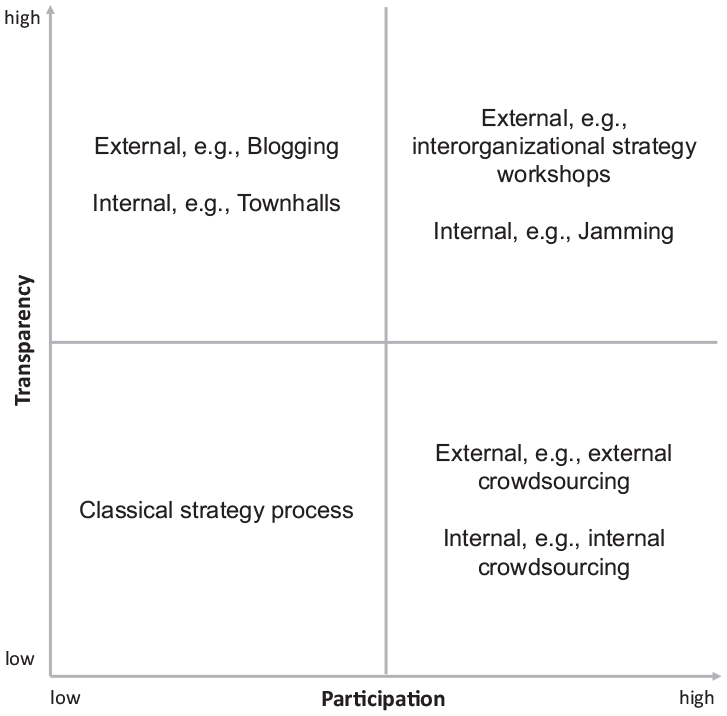
Transparency and participation perspective.
To understand in more detail the dimension of participation, it is useful to highlight various approaches to participation in OS (Vaara et al. 2019):
Open Strategy as limited participation refers to opening the process of strategy-making only partially throughout the entire process, for instance, identifying weak signals of change.
Open Strategy as co-creation of strategies: in contrast to limited participation, participation as co-creation implies that strategy making can be based on widespread participation and co-creation.
Open Strategy as “deep engagement” redefining the rules of the game, in contrast to the two other approaches, implies a process that is not predetermined or controlled by top management.
This perspective also suggests that to better understand OS, it is relevant to take a closer look at the phases of the strategy process, which will be discussed in the following section.
Strategy Process and Online Versus Offline Formats
In addition to the perspective of transparency and participation to understand the dimension of OS, another perspective is required to discuss the contribution of SP and BW to OS. In this perspective, one needs to focus not only on the phase of the strategy process but also on the formats of OS interventions. As has been discussed, IT tools play a central role in OS; therefore, it makes sense to consider the online and offline formats or face-to-face formats.
However, before taking a closer look at the strategy process and the online versus offline formats, it may be helpful to consider the aspect of openness in OS. Luedicke et al. (2017) differentiate between partial OS and radical OS with respect to the process of strategy making. The authors present a case study on a Germany-based collective of approximately 1,650 people allowing all its members to set strategy agendas, participate in strategy deliberations, and contribute to decision making. The authors identify, based on a literature review, three interrelated domains of open strategizing practices: open agenda setting, open participation, and open governance.
Open agenda setting involves the identification and prioritization of strategic issues. Open participation involves the participation of internal or external stakeholders in strategy deliberations. Open governance means that the leadership distributes decision-making rights and responsibilities to a larger group of stakeholders. This perspective allows us to understand to what degree the members of an organization are participating in an OS imitative as well as in which phases of the strategy process. This perspective on the strategy process with OS will guide the ongoing discussion.
Online formats are of particular relevance in OS. The inclusion of large groups of stakeholders, internal or external, is realized due to the application of online formats. However, face-to-face meetings in various formats also play a role in OS. Based on an analysis of empirical studies on OS, Dobusch et al. (2017b) argue that a central element of OS processes is collective sensemaking but that this collective sensemaking is performed by the participants in workshops and meetings.
de Gooyert et al. (2019) compare the digital and analog formats; they refer to face-to-face versus online formats, considering the number of participants, place and time of interaction, topic and stage of analysis, and process structure:
Number of participants: online formats can include a larger number of participants, and therefore, a larger number of ideas can be generated. Face-to-face workshops involve only five to twelve participants.
Place and time of interaction: face-to-face formats allow participants to receive verbal and nonverbal information while communicating with each other.
Topic and stage of analysis: in face-to-face formats, several ideas can be developed simultaneously, while online formats allow for brainstorming at several points in time. It is mentioned that organizations find it challenging to keep online interactions focused.
Process structure: in face-to-face workshops, participants have ample opportunities to debate the proposed agenda, air emotions, explain their input, and engage in discussions, while these opportunities are limited in online formats. However, anonymity is stated as one of the advantages of online formats.
Tavakoli et al. (2017) provided a literature review on OS that also includes a summary of case studies. The seven case studies described feature from 216 to 150,000 participants, widely aided by IT solutions. The authors summarize the observed practices of OS as transparent discourse, co-creation, and democratic decision making.
Matzler et al. (2014) argue for the following two dimensions to create a framework to describe different types of open strategizing: the “strategy phase” (development vs. implementation) and the “inclusion scope” (internal vs. external inclusion). We separate these two dimensions into the transparency and participation perspective and the strategy process and online versus offline perspective.
Two frameworks are used here to assess the role of SP and BW in OS (Figure 2). The first framework, Transparency and Participation, is derived from Whittington et al.’s (2011) seminal article on OS as a means to describe approaches to OS. While the second framework, Strategy Process and Online versus Offline, is derived from the literature on OS, it combines two perspectives that are more practice oriented in the sense that they ask the following questions: (1) in what part of OS process can either SP or BW be applied and (2) as we find evidence in the OS literature of the relevance of online formats, particularly for involving larger groups of internal or external stakeholders, we want to trigger the discussion of whether SP and BW can also be applied in such a manner.
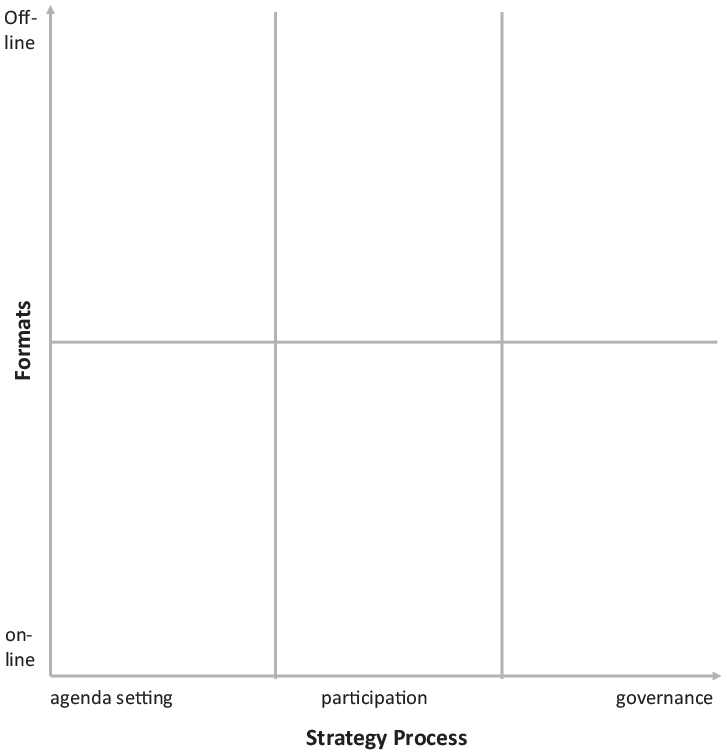
Strategy process and online versus offline perspective.
Scenario Planning and Business Wargaming as Open Strategy Tools
In the following, SP and BW are discussed in the context of the two frameworks described above. This discussion will, on the one hand, reflect the current literature on both approaches and, on the other hand, reflect practitioners’ experience in applying SP and BW. For instance, it has been argued that practitioner accounts are critical to SP research (Bowman and MacKay 2020), and this also applies to BW.
Augier et al. (2018) claim that wargaming is among the oldest tools for aiding strategy planning and formulation, having been in use for over 200 years, while SP has existed for over fifty years. While BW developed out of the military application of wargaming (Schwarz 2011), both approaches can also be understood as part of the tool box for developing foresight (Gordon et al. 2020; Rohrbeck and Schwarz 2013; Schwarz 2008); in particular, SP has gained recognition in the contexts of foresight and management alike.
Scenario Planning
SP aims at developing plausible alternative pictures of the future, not making predictions. This particular approach to developing scenarios, called SP and developed at Royal Dutch Shell (Wack 1985a, 1985b; Wilkinson and Kupers 2013), focuses on identifying key uncertainties in a business environment. The key uncertainties are characterized by (1) being relevant for the future of a particular industry and (2) being uncertain in regard to how they might evolve. The identification of these key uncertainties allows the selection of two key uncertainties that, with their polar outcomes, allow the construction of a two-by-two scenario matrix. This results in four plausible, alternative pictures of the future, which can then be considered in more detail.
While our aim here is not to go into too much detail into describing the SP approach, we want to highlight its application. Several authors (Chermack 2011; Ramirez and Wilkinson 2016; Schoemaker 1995; van der Heijden 1996; van der Heijden et al. 2002) highlight the participative nature of SP or formulate the participation and involvement of top management as a prerequisite. Van der Heijden (1996) refers to SP as the “art of strategic conversation,” highlighting that SP aims to include the members of an organization in the many phases of developing scenarios. This can be done by conducting interviews about the perceived challenges in the business environment, discussing trends and selecting key uncertainties, selecting the two key uncertainties for building a scenario matrix, describing the scenarios, and finally deriving implications from the scenarios. The key argument for the involvement in this process is to create a stronger buy-in into the results and, of course, the actions taken based upon the developed scenarios. Raford (2015) concludes that most SP methods rely on expert interviews and a small number of in-person workshops.
Furthermore, Bowman and MacKay (2020) emphasize the relevance of a facilitator in an SP workshop to manage the people and the process. The authors further argue that it takes rare skill to take a group of people from a position of perceived uncertainty concerning the future of their industry to a point where they might feel confident to take on strategic challenges. While not deliberately mentioned, the argument here is that these thoughts relate to SP as an offline activity. In a typology of SP interventions, Crawford (2019) does not differentiate between online and offline formats. Furthermore, for instance, the so-called Mont Fleur scenarios conducted in South Africa in 1991 assume face-to-face interactions among the participants (Gordon 2020). Additionally, Wright and Cairns (2019), reflecting on their practice of SP projects, make no reference to offline formats.
Business Wargaming
BW, originally developed from military wargaming, can be understood as a roleplaying simulation of a dynamic business situation (Oriesek and Schwarz 2008; Schwarz 2009, 2011, 2013). In such a simulation, a group of managers from an organization are split into several groups: one group represents the own firm with its strategy, other groups represent relevant competitors or stakeholders, and one group assumes the role of the market and customers. Usually, two to three moves are played in a BW. In each move, the competing teams create strategy and market offerings that they present to the market and customer group and that are eventually evaluated by the market and customer group. Based on the moves of the competitors and on feedback from the market and customer group, the simulation evolves into a second move. Each move describes either a situation several years into the future or describes different scenarios.
While the preparation of a BW may take several weeks or months, the BW itself is usually played over the course of one or two days. A BW is primarily an exercise that is strongly based on the engagement of its participants. One of the main objectives when designing a BW is ensuring that participants immerse themselves in their roles, “stepping into the shoes” of their competitors or customers, and that the dynamics of the simulation are high (Oriesek and Schwarz 2008).
Several authors have argued for combining SP and BW (Augier et al. 2018; Schwarz et al. 2018). Schwarz et al. (2018) argue that by combining the two approaches, the deficiencies in each can be addressed. The authors argue that while SP lacks a competitive dimension, BW lacks a clear idea on how to deal with the future by simulation. Augier et al. (2018) distinguish between endogenous uncertainties (interaction between competitors) and exogenous uncertainties (uncertainties regarding the context of competition, the business environment). If both endogenous and exogenous uncertainties are high, the authors suggest applying a BW with a shifting context, which can also be understood as a combination of BW and SP.
In the context of public organizations one can find the combination of scenarios and gaming. Bontoux et al. (2016) for instance report on how the European Commission engaged in developing a serious game, scenarios were used as the basis, in order to engage stakeholders. Sweeney (2017) reports on a foresight gaming system initially developed for the United Nations Development Programme, with the aim of serving as a tool for dialogue and exchange. The so called Polak Game (Hayward and Candy 2017) is another example of games being used in the context of foresight. However, BW in the context of firms focuses on the competitive dimension (Schwarz et al. 2018) and is in respect to its duration longer, as for instance compared with Polak Game which might only run up to thirty to sixty minutes (Hayward and Candy 2017).
The above discussion regarding the combination of SP and BW seems to justify assessing the usability of these two approaches for OS, and participants’ engagement in both approaches suggests their relevance to OS. In the following, we will use the above discussed matrixes (Transparency and Participation Perspective/Strategy Process and Online vs. Offline Perspective).
Transparency and Participation Perspective
SP and BW are approaches that are usually conducted in face-to-face workshops. This implies that SP and BW workshops alike can be run with up to thirty to forty participants. In this respect, it appears that the number of participants in SP and BW is limited and not comparable to the number of participants in online formats mentioned in the OS literature. It is therefore shown that in terms of participation, SP and BW are limited, as indicated in Figure 3. However, it must be noted that participation here is understood merely in terms of the quantitative number of participants.
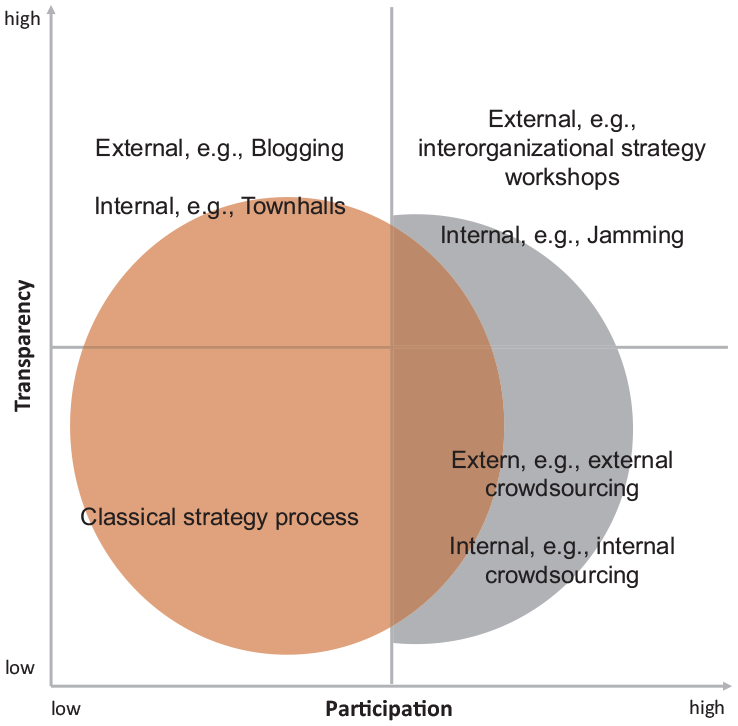
Transparency and participation perspective—assessment.
If, however, participation is also understood as the degree to which the process is opened to the contributions of external stakeholders and internal stakeholders, then we can access a high degree of participation. This means, for instance, including either external stakeholders in a workshop or internal stakeholders from different hierarchical or functional areas of an organization, as the shading indicates in Figure 3.
Strategy Process and Online Versus Offline Perspective
BW and SP are applied mainly offline. As mentioned, both approaches seek to physically bring people together to discuss the future, challenge mental models or experience the dynamics of future competition. This also implies that the number of participants is limited depending on, for instance, how large the groups working on scenarios or assuming the role of a competitor are. Reflecting on experiences of facilitating SP and BW workshops, groups or teams are usually suggested to include five to seven participants to balance the needs for diverse insights and productive discussion. Therefore, reflecting on the own experience and knowledge of the practice of SP and BW, these formats are not used online or in very large groups. This assumption will be the subject of discussion later in the article.
With respect to the strategy process, both approaches are geared toward the phases of agenda setting and participation. While the discussion and results of these two phases produce relevant output for the phase of governance, strategy decisions are not made in SP and BW workshops; instead, an awareness of change is created, and a context for further discussions is established by increasing the range of strategic options (Figure 4).
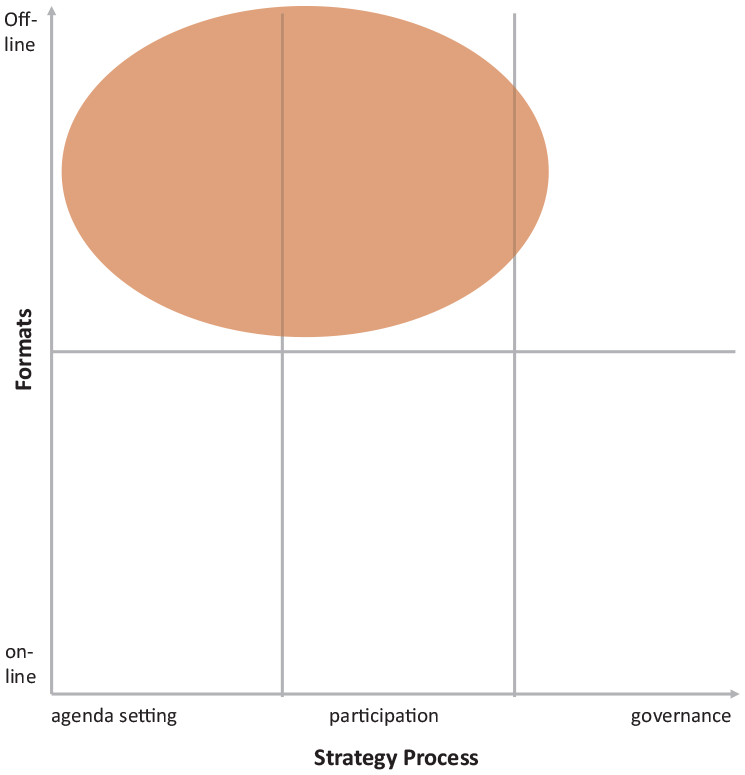
Strategy process and online versus offline perspective—assessment.
Discussion
Our assessment of the role of SP and BW in OS reveals that both approaches can be applied in the context of OS; however, the application appears to be limited in the context of firms. In the context of public organizations one can however find evidence of the usage of SP and gaming with the aim of including larger stakeholder groups (Bontoux et al. 2020). The discussion of these limitations will provide suggestions regarding potential fields for experimentation in practice as well as in research. We hereby identify a number of fields to be discussed below in more detail.
Moving to the Online Context
Technology and, in particular, software technology has been described as a key enabler in OS (Vaara et al. 2019). The usefulness of applying SP and BW online is one of the main points so far.
The US Navy is reported to have used an online war game to crowdsource ideas for its strategic planning initiative in 2013. This crowdsourcing initiative involved not only members of the Navy but also other stakeholders, such as industry partners and academia. Overall, 646 individuals provided more than 5,000 ideas through this approach (Aten and Thomas 2016). While the outcome is not clear in this example, it would certainly be worthwhile to explore how BW could be taken online.
The use of IT tools has been discussed in the context of foresight (Raford 2015; Rohrbeck et al. 2015; von der Gracht et al. 2015). The tools mentioned are the following: market prediction, online idea competition, social networks, internet-based broadcast search tools, real-time Delphi analysis, and wikis (Rohrbeck et al. 2015). With respect to SP, however, some of these tools can be used in the phase of researching trends but not in the workshop formats, to either identify key uncertainties, build scenarios or discuss the implications.
With respect to SP and its process, one could argue that parts of the SP process, for example, the phase of collecting trends and discussing their relevance and degree of uncertainty, could be opened up to broader groups. Raford (2015) describes cases in the context of foresight and SP that used social media, Web 2.0 and crowdsourcing to engage a larger number of participants. However, it appears from the case description that these cases referred more to the early phase of SP with respect to researching trends. The author suggests that further research explore, in regard to the efficacy and design of the online SP process, how to encourage more interactive socialization in both face-to-face and online settings, for instance, through blended (combination of face-to-face and online) workshops.
Steil and Gibbons-Carr (2005) report on what they label large group SP. While the large group according to the authors referred to a group of eighty to hundred participants, the process of SP was carried out mostly by a steering committee of six to twelve participants, and only the discussion on the implications of the developed scenarios was opened up to the large group. In addition to a conceptual model for “virtual scenario planning” (McWhorter and Lynham 2014), it appears overall that opening up other parts of the SP process to address the aims of OS would require experimentation with online formats and, in particular, a critical reflection on the outcomes of the process. However, one could assume that the COVID-19 pandemic and its implications with respect to fewer face-to-face interactions could trigger research as well as experimentation in this respect.
Part of the Process
With respect to the process of strategy development, it becomes apparent that SP and BW cannot be used throughout the entire process, and neither is this the intention for these concepts. Instead, these approaches can be used as part of the OS process. This, however, also implies that a different perspective of the process of OS might be helpful.
The degree of openness in an OS process needs to be discussed in the context of the organizations seeking to apply such an approach. Examples such as the German Premium Cola Collective (Luedicke et al. 2017) or the well-known Wikimedia Foundation (Dobusch et al. 2017a; Heracleous et al. 2017) refer to organizations that are established on the principles of openness and transparency. These radical forms of openness therefore might not be suitable for other organizations. The degree of openness of a strategy process therefore needs to fit the organization. Based on analyzing the OS process at Wikimedia, Dobusch et al. (2017a) argue that the purposeful combination of open and closed elements of a strategy-making process constitutes a precondition for establishing such a process. The authors argue that the strategy process at Wikimedia was characterized by a combination of openness and closure.
Further, Mack and Szulanski (2017) argue that in the context of the OS process, the distinction between participatory and inclusive practices is relevant. The argument is made that the practice of participation is about increasing stakeholders’ input for decision-making, while the practice of inclusion is about creating and sustaining a community of interacting stakeholders that are continuously engaged in the strategy process. Practices for participation therefore include surveys and interviews, while practices for inclusion include work groups or task forces that are characterized by information sharing, interactions, and joint decision-making.
This perspective argues for purposefully embedding SP (or parts of the SP process) and BW into an OS process. This could be a particularly interesting avenue if the combination of SP and BW were possible online. Birkinshaw (2017) argues that while strategy implementation has long concerned getting large numbers of people to understand a strategy and the need to change, the notion of getting people involved earlier in the process is not only highlighted in OS but also clearly speaks to SP and BW and their inclusion in OS.
Diversity Within
Hautz et al. (2019) state that while the diversity of perspectives would increase in workshops if members from all levels of an organization were included, workshops rarely involve participants beyond the manager level (Hodgkinson et al. 2006). In a large-scale survey on the practice of strategy workshops in the UK, these types of events were found to occur in 77 percent of the organizations surveyed, and strategy workshops were considered exclusive events in that 49.3 percent reported having fewer than ten attendees, mostly senior management, and only 22.6 percent reported involving employee representatives (Hodgkinson et al. 2006). The authors further list SP as one of the tools most frequently used (28.5%), after SWOT (62%) and stakeholder analysis (30%).
While OS addresses this issue of opening the strategy development process to all levels in an organization, the question of how to facilitate such openness also arises. Experience with SP and BW, however, has shown that these types of workshops allow a good integration of participants from different hierarchical levels of an organization. In SP workshops, one assessment is that discussing the future is beyond the daily politics of an organization and therefore fosters an open exchange of ideas. Additionally, in BW, the competitive element between the teams and the dynamics to win foster teamwork and weaken the perception of hierarchy. However, running workshops with diverse members of an organization might imply adjustment, for instance, in terms of language. Furthermore, it has been argued that the use of visuals might open up the opportunity to communicate and engage with much less strategically informed actors, such as shop floor workers or other stakeholders (Paroutis and Knight 2019).
Conclusion
The OS perspective is concerned with how the process of strategy development can be opened up to wider groups, or even the entire organization or outside stakeholders. This stands in stark contrast to the practice of top management teams developing strategy together with consultants and then communicating their decisions to the organization. The benefits of OS are manifold, for example, creating through participation buy-in into change that might be needed as a consequence of formulating and implementing a new strategy.
By using an existing framework (Transparency and Participation Perspective) derived from the literature on OS and combining other factors from a review of the literature on OS (Strategy Process and Online vs. Offline Perspective), two frameworks guided the analysis of how SP and BW can be used in OS. SP and BW were applied because they can be considered some of the oldest tools in strategy development and have often been used in the field of foresight. Based on the research and experience in facilitating SP and BW workshops, the potential role of SP and BW in OS was addressed.
This discussion revealed three central themes:
1. While SP and BW can be perceived as suitable approaches in an OS process, one limitation is that these workshop formats have primarily been conducted in a face-to-face mode. Further research and experimentation are needed to assess whether these approaches could be fully or partially applied online, with the aim of including more participants.
2. SP and BW can only be part of the OS process; they cannot become the process itself. This implies that SP and BW could be included in an OS effort. Thus, it could be particularly interesting to understand when radical openness or closure would be feasible and how to fit SP and BW into the OS process.
3. SP and BW workshops appear to be formats that allow the inclusion of managers from different hierarchical levels in an organization, which is also an aim of OS.
While the focus of this paper was on assessing SP and BW for OS in the context of firms, this discussion could be extended by referring in more detail to experiences in the context of public organizations, in particular since the argument can made that in theses contexts the involvement of stakeholders is even more critical. Further, other approaches to developing foresight could be investigated by referring to the here developed framework. Overall, a number of arguments suggest that SP and BW could very well be included in an OS process. In addition, a number of questions have risen to be addressed either in research or in practice by, for instance, experimenting with different formats of SP and BW.
Footnotes
Declaration of Conflicting Interests
The author(s) declared no potential conflicts of interest with respect to the research, authorship, and/or publication of this article.
Funding
The author(s) received no financial support for the research, authorship, and/or publication of this article.
