




Abstract
This article proposes that creativity and criticality not only can but should be entangled and elevated in participatory futuring engagements. Selected concepts from creativity theory and critical futures studies are applied to develop a set of futuring games through action research. We claim that participatory processes designed to entangle and elevate creativity and criticality produce more novel and varied ideas that better fit the purposes of futures studies. This article offers four arguments for combining creativity and criticality in participatory futuring engagements. First, due to complexity and uncertainty, the future is ultimately unknowable and requires tools to probe the unknown. Second, novelty is difficult to achieve in practice while creativity and criticality can help overcome these challenges. Third, discontinuities are the main sources of futures that are most radically different from the present and will have the biggest impact. Fourth, creativity and criticality support the rigorous imagining required for exploring and discovering new possible futures. This article analyzes three experimentations in entangling and elevating creativity and criticality in game-based futuring, stemming from Causal Layered Analysis. Based on these examples, we demonstrate that creativity and criticality, when combined, help people break through the limitations of current understanding, reveal approaching tipping points, and find the “unvisited cavities” through rhizomatic knowledge creation. However, there remain challenges in evaluating how well various participatory designs support creativity and criticality in practice. Context-sensitive evaluation tools and open sharing of outcomes are needed to develop participation design principles capable of supporting creativity and criticality in participatory futuring.
Keywords
Introduction
This article proposes that participatory futuring, 1 in the form of games, workshops, or other interactive processes, can be designed to support creativity and criticality. Furthermore, we make the normative claim that creativity and criticality not only can but should be combined and reinforced in participatory futures processes. This article defines creativity and criticality as theoretical concepts applicable to futures studies practice and makes four arguments for the importance of elevating both creativity and criticality in participatory futuring engagements. Evidence from three action research experimentations with futures games is presented and critically assessed in relationship to our hypothesis and its key arguments.
Background
Over a two-year period, a set of futuring games was designed, developed, and tested by Finland Futures Research Centre (FFRC). These games all stemmed from Inayatullah’s Causal Layered Analysis (CLA) Game (Inayatullah 2015). The first of these futuring game experimentations was tested at an international futures conference (Heinonen et al. 2017, 103–4; Heinonen et al. 2015). Evolving from it, a new game called Metaphor Molecule was developed over two pilots as part of a master’s thesis. These pilots explicitly sought to elevate creativity and criticality among participants during gameplay and in the participant-generated artefacts (Balcom Raleigh 2017). Metaphor Molecule was subsequently applied in a Futures Literacy Lab held as a “learning simulation” at the Finland Futures Academy 2017 Summer School (Balcom Raleigh et al. 2018). Based on these dynamically accumulated experiences of applying theory to practice, we claim that designing participatory futuring engagements to support and combine creativity and criticality produces more ideas about the future that are higher in novelty, depth, and holistically grounded normative value than if only one, or neither, of these energies or modalities are elevated.
Concepts of Creativity and Criticality in Participatory Futures Processes
Several futures studies authors emphasize the importance of creativity in foresight and futures practice, while others encourage deepening futuring practices by giving them critical dimensions. Creativity and criticality are terms that carry many meanings and conceptual models. Consequently, they require clear definitions and basis on theory before they can serve as design goals for participatory futuring engagements.
Creativity
From an organizational perspective, creativity is defined as a phenomenon by which something new and somehow valuable is generated (e.g., Amabile 1998). Creativity is characterized by perceiving the world in new ways, identifying hidden patterns, making connections between seemingly unrelated phenomena, and generating solutions. The definition of the word “create” is “to make, form, set up or bring into existence” and “to produce a work of imagination or invention; an artifact” (Oxford English Dictionary 2018a). Unexpected combinations seem to be an engine of creativity (Johansson 2004; Kim and Mauborgne 2005; Koestler 1964), both in general and in futures studies (e.g., out-of-the box thinking). Creativity is often associated with imagination, intuition, and innovation. However, these are not synonymous but relational concepts. Innovation can be manifested in the exercise of creativity, which generates imaginative ideas that can be turned into reality. In futures studies, creativity may refer to many capacities concerned with novelty and difference, such as thinking about many alternative futures, probing boundaries of plausible futures, and imagining unexpected futures.
There are many examples of an emphasis on creativity in futures studies. Bell (1996) proposes that two of the nine specific purposes of futures studies are to apply creativity and imagination to generate possible futures that break free from conventional thinking (Bell 1996, 75–76) and to study images of the future (Bell 1996, 81–86, 111). Masini (1993, 23) connects creativity with the capacity to see what is truly new in futures studies and to understand one’s “preferences, desires, and fears.” Dator (2009) recommends that groups create their own futures images, even when starting from some given material. Miller (2011a, 2011b) advocates for granting participants permission to use creative thinking and imagine varied futures. Foresight practitioners and futures researchers surveyed by Hiltunen (2008, 34; 2010, 107) identified creativity among the important requirements for being able to detect weak signals. Intuition and creativity are the basis of the futures studies method genius forecasting (Glenn 2009). While these and many other futures studies scholars emphasize the need for creativity in futures studies, few have made strong links between futures studies practices and specific theories of creativity.
Three conceptual models of creativity—the intrinsic motivation principle of creativity (Amabile 1998), flow (Csíkszentmihályi 2014), and the organizational cycle of positive affect (Amabile et al. 2005)—are selected to serve as a theoretical basis for analyzing how well elements of participatory futuring engagements support creativity.
Amabile (1998) proposes a key to supporting creativity in a workplace. Her intrinsic motivation principle of creativity claims that “people will be most creative when they feel motivated primarily by the interest, satisfaction, and challenge of the work itself—not by external pressures.” Applying this principle to participatory futuring engagements, participants can be more creative when the participation design activates the internal motivations of participants.
Csíkszentmihályi (2014) offers the concept of flow, a state in which a person becomes deeply involved in a creative process. He defines the key characteristics of flow as merging action and awareness, centering of attention, loss of ego, control of action and environment, and its autotelic nature (Csíkszentmihályi 2014, 138–45). Merging action and awareness means that one enters a state of flow when highly aware of one’s actions without tuning into that awareness itself (Csíkszentmihályi 2014, 136). Centering of attention means that one’s focus locks on the task at hand—games and their rules help make this happen until intrinsic motivation kicks in (Csíkszentmihályi 2014, 139). Loss of ego is supported by simplifications of reality, which help people set aside their self-constructs, which usually mediate between stimuli and response (Csíkszentmihályi 2014, 141). The autotelic nature of flow matches Amabile’s principle of intrinsic motivations: when in flow, external rewards are replaced by intrinsic rewards as the driving goals (Csíkszentmihályi 2014, 145). He describes how flow is connected to intrinsic rewards: “When an activity is able to limit the stimulus field so that one can act in it with total concentration, responding to greater challenges with increasing skills, and when it provides clear and unambiguous feedback, then the person will tend to enjoy the activity for its own sake” (Csíkszentmihályi 2014, 150). Applying the concept of flow to the participatory design of futuring games, rules of the game, and the way that reality is simplified in its components are key to helping participants enter a state of flow. To keep them there, the game’s tasks must be challenging, rewarding to accomplish, and fit the capabilities of the participants.
Amabile et al. (2005, 392) propose a model for positive affect supporting creativity in organizations. In this model, positive affect supports creativity, and creativity supports positive affect. Positive affect opens minds to new combinations of ideas. The resulting creative outputs in turn trigger positive emotions in the creators. When the wider response to a new idea is affirming, the creative outputs can boost positive affect in the overall environment, which keeps the cycle going. When applied to participatory futuring engagements, having individuals and groups share their creative outputs during the process can feed a valuable positive affect cycle.
The aforementioned concepts of creativity provide a theoretical basis for what kinds of factors can influence creativity in participatory contexts. To elevate creativity, participatory designs should strive to bring participants into a state of flow by activating internal motivation, providing clear structure and instructions, and challenging them with doable tasks. Attention should be paid to the positive affect by careful facilitation and allowing for naturally occurring positivity to arise from the creative process.
Criticality
While the word “criticality” can mean a state of being critical, as in taking a critical perspective, it also refers to a state of a nuclear reaction (Oxford English Dictionary 2018b). While this latter definition could provide a provocative analogy for some participatory futuring engagements, this article builds on the prior definition—the state of being critical—and adds meanings to this definition from critical theory and critical futures studies.
The field of futures studies has early formational links to critical theory and its emancipatory commitments. For instance, Ossip Flechtheim, a key figure in the emergence of the field, was closely acquainted with Adorno Horkheimer (Auffermann 2015). Horkheimer launched critical theory by calling for a new social theory that is “explanatory, practical and normative,” giving it emancipatory aims (Carr 2000, 211). Along similar lines, Flechtheim set a goal of improving the conditions of people in his first proposal for a new field he called “futurology” (Flechtheim 1949, 1972). He proposed this new academic discipline, today called futures studies, should actively work to create a better future for humanity (Flechtheim 1949, 209). These normative and emancipatory commitments of futures studies have continued, especially in the work of critical futures studies (Inayatullah 2004, 6; Dator 2002b, 4–5). Key ways critical theory and critical futures studies contribute to emancipation are by challenging the status quo and opening new possibilities for people. Amara (1981) emphasized the importance of including a normative perspective in futures research in his now-established categories of “possible, probable and preferred futures.” Bell (1996, 73–75) also argues that advocating for preferable futures is a valid pursuit in futures studies. Dator (2002a, 109–10) encourages taking people beyond passively observing possible futures toward actively describing and taking actions toward desirable futures.
Criticality in futures studies requires working with people to develop “desirable” or “preferred” futures. However, doing so raises the important question of “preferred by whom?” Just as in the present, the future will be perceived and experienced differently by different people because of their varying frames of reference, situations among complex systems, and access or lack of access to material and immaterial resources. If the normative and emancipatory functions of futures studies are to be achieved, it is essential to develop and test preferred futures through a multiplicity of perspectives. Optimally, a participatory futures process can go further by helping people explore multiple future worlds (Vervoort et al. 2015, 65).
Several concepts introduced by proponents of critical futures studies provide insight as to how to elevate criticality: decolonizing futures (Sardar 1993), skepticism toward official futures (Dator 2009), avoiding the pitfalls of used futures (Milojević and Inayatullah 2015), the poststructural futures toolbox (Inayatullah 1999, 2005, 2006), three emancipatory pathways (Ahlqvist and Rhisiart 2015), and taking a reflective stance on whether a future is opening or closing options for humanity (Slaughter and Reidy 2009).
The concept of decolonizing futures (Inayatullah 1998; Sardar 1993; Miller 2015) takes the ethical position “colonization is wrong” and applies it to futures studies. It has two angles: avoid the intended or unintended colonization of futures (Sardar 1993), and actively work to decolonize already colonized futures (Inayatullah 1998, 386). In participatory futuring engagements, this means interactive elements should encourage a holistic and empathetic view that questions how actions could affect future people and beings.
Dator, in his Alternative Futures method, encourages people to be skeptical of official futures because they are usually only Growth (or “Business as Usual”) futures. Meanwhile, the other future archetypes of Discipline, Collapse, and Transformation tend to be ignored, leaving blind spots (Dator 2009, 8, 10). Based on this concept, participatory futures processes should encourage people to explore or encounter alternative futures.
Used futures are future images and visions created by other people in the past. Dangers arise from relying on used futures, because they are usually based on old assumptions that are no longer relevant. As they age, they “become increasingly unproductive, hurtful to the individual, and barriers to change.” Instead of making decisions based on used futures, people should actively make their own visions for desirable futures. (Milojević and Inayatullah 2015, 156).
Inayatullah (2015, 20; 2005, 4–6) proposes a “post-structural futures toolbox” to open spaces for new alternative futures. These tools are deconstruction, breaking apart a given text, and asking critical questions about it; genealogy, tracing a concept through its journey through various discourses; distancing, seeing future imaginaries as critiques of the present, which open new possibilities; alternative pasts and futures, questioning both given pasts and given futures; and reordering knowledge, analyzing how the prioritizing of knowledge varies “across civilization, gender, and episteme.”
Ahlqvist and Rhisiart (2015) propose three emancipatory pathways for participatory futuring engagements. The first pathway is the “construction of futures through sociotechnical practices,” which includes the actions of identifying key future concepts, the evolution of everyday futures images, social practices creating or changing future ideas, and entities and politics that “frame, build, or change” future ideas. The second pathway, “future-oriented dialectics,” involves watching for “moments of unfurling” in which two often competing paths emerge and can be analyzed using a dialectical perspective. The third pathway involves probing the boundaries of “socio-economic imaginaries” that are advanced by actors seeking to manage and control the future by limiting possible alternatives. Ahlqvist and Rhisiart advocate for futures processes, which support “the re-politicization of policy-making, enabling meaningful critique, encouraging contestability, and revealing assumptions and power interests.”
Slaughter and Riedy (2009, 37) call for futurists and futures researchers to critically reflect on their practice and question both what interests they serve in their work and whether they are opening or closing humanity’s options. It is preferable to open the options for future generations. In participatory futuring engagements, participants can also be called to reflect on this essential question.
The previous models provide a basis for analyzing how well a participatory futures process supports criticality. In general, a participation design that elevates criticality should encourage people to take a questioning stance toward past, present, and possible futures. Criticality calls for participants to actively describe desirable futures and pathways toward their enactment, opening humanity’s options instead of closing them, seeing more than “official views of the future,” testing the limits of socio-political imaginaries, and having a realistic sense of which power dynamics and voices are in contest regarding a possible future. Criticality as a force counters determinism, the belief that the present situation locks us to only one, or very few, futures. Criticality as a characteristic of an interaction or artefact pulls apart assumptions, questions the given, and opens spaces within which new understandings and possibilities can emerge.
Theories of Creativity and Criticality in Participatory Futuring
Participation is one of the seven key characteristics of future studies according to Masini (1993). Therefore, participation is already per se a quality that distinguishes futures studies from other academic disciplines, though not all scholars agree on this (Masini 1993). Participation in futures processes can take the form of making futures and becoming an actor for futures, especially those that concern the participants themselves. In general terms, participation in futures studies can be defined as the active access and involvement of various stakeholders in futures processes, whether they be projects, workshops, seminars, policy-making, or citizen movements. In an ideal case, a futures workshop consists of participants from many different backgrounds. Participation is associated with actors, action, interaction, and sharing. Participation itself is key for creativity and criticality in futures studies. Participation supports creativity by bringing many individual minds together to work on a futures task, broadening the group’s overall “network of possible wanderings,” or range of concepts and ideas available for combination. 2 Inclusive participation supports criticality when it emphasizes inclusion and gives voice to people who are likely to experience the future plans and ideas being discussed (Dator 1993, 1; Jungk and Müllert 1987; Masini 1993, 25).
Deleuze and Guattari’s Model of Rhizomatic Knowledge Creation
Entangling and elevating criticality and creativity can help participants in finding the cavities and voids in the model of Rhizomatic Knowledge Creation proposed by Deleuze and Guattari (1987). In this model, knowledge is not disseminated systematically or logically based on a hierarchical binary tree-model. Instead, knowledge penetrates all available niches in its environment and ecosystem by following a rhizomatic model of biomimicry (i.e., following nature’s structure, patterns, and functions). Knowledge follows the organic way of rhizomes to grow in all directions, or as water to run in all cavities around it. Even though the nearest surroundings of what is seen may seem blurred, it is possible to understand how the currents flow in the whole system. Identifying such cavities may aid in producing deep transformation—the whole system, and not just its parts—of human relationships to each other as well as to nature. The rhizome model offers explanations for unexpected outcomes. Thus, a world described as a rhizome could better capture and provide insights into complex systems. Criticality locates cavities and breaks through their barriers through questioning, challenging, reframing, and seeing anew, and creativity fills these cavities with new rich details through imagination.
Hypothesis and Four Key Arguments
This article argues that participatory futuring engagements can, and should, entangle and elevate creativity and criticality—in both the participant’s experience and the outputs of the process.
Four Key Arguments
Four partly overlapping arguments are presented here for why creativity and criticality should be combined in participatory futuring engagements.
First, due to complexity, which produces epistemic uncertainty and ontological unpredictability, the future is ultimately unknowable (Tuomi 2012, 737). People are situated in complex systems with multiple levels, scales, modes, and interactions—the characteristics of these complex systems have great potential to change in unexpected ways. How people and organizations approach complexity and uncertainty can be a mix of two opposite perspectives. On one end, complexity is accepted as a permanent condition of the universe and as a source of “open creativity in our thinking” (Miller 2007, 520), and on the other end, complexity is something to be understood and managed to create “a future where we leave as little to chance as possible” (Wilenius 2017, 27). Participants have varying blends of these two attitudes toward complexity. When multiple “ways of knowing” are supported, it reduces tunnel vision that arises when relying on only one theory (Inayatullah 2009, 3). Summarizing this first argument, when creativity and criticality are entangled and elevated, contemplation of unknown and unknowable futures becomes possible.
Second, novelty is difficult to produce in participatory futuring engagements. For example, workshop participants may simply echo back information they received from the workshop organizers without adding new depth or introduce an idea from a trending headline they read recently. Groups engaged in thinking about the future can default to thinking “whatever is happening now will continue,” and such assumptions are “dangerously misleading” (Dator 2009, 4–5). The mind, based on accumulated experiences, is highly attuned to recognize patterns from which it builds models and worldviews. These models in turn lead to “inattentional blindness” to new possible futures. (Poli 2010, 11–12). In summary, combining creativity and criticality helps participants think beyond what they already know, their present-bound limitations, and create genuinely novel ideas for the future.
Third, “the future is the realm of discontinuities, possibilities, and the emergent” so it is necessary to be able to imagine possible futures that differ greatly from the present (Heinonen and Ruotsalainen 2013, 7). Possible discontinuities, wild cards, and x-events are elements that can greatly change the course and outcome of futures. These futures, radically different from what was anticipated before, often feature a total change of perspective or even paradigm. They may cause contrafactual futures to arise—worlds that at present seem contrary to the factual data, knowledge, or practices. One of Flechtheim’s (1966) presumptions of the future were antithetical forecasts. He claimed that such totally opposing and differing views can contribute to the clarification of problems. The futures most unfamiliar to us in the present are often the ones that contain high-impact, high-uncertainty ideas capable of uncovering blind spots or identifying unknowns (Ralston and Wilson 2006). Designing participatory futures processes that combine creativity and criticality help people generate depictions of unfamiliar futures and add detail to them. Creativity is needed here to break the boundaries of present-locked thinking, while criticality is needed for questioning the current concepts and practices, deconstructing them, and perhaps finding future avenues from their opposites and alternatives.
Fourth, creativity and criticality, when combined in participatory futuring engagements, help participants break through limitations of current understanding and gain distance from present-day patterns. This distance provides reframing power that opens space for participants to “rigorously imagine” new possible futures (Miller 2018, 94). These self-generated and novel future imaginaries in turn support deeper immersion into multifaceted possible future worlds, an immersion in which criticality and creativity are further entangled and activated, assumptions are revealed and questioned, and values are tested and reshaped.
Materials and Method: Three Cases of Entangling and Elevating Creativity and Criticality
Three action research cases of game-based futuring are analyzed for insights regarding how creativity and criticality can be entangled and elevated as well as what value for a futures process doing so can produce. In the first case, Heinonen and Inayatullah opened potentials for creativity and criticality as guiding design goals in a workshop intended to support participants in exploring and testing scenarios (Heinonen et al. 2017; Heinonen et al. 2015). The second case is the iterative development of the Metaphor Molecule Game for an action research master’s thesis (Balcom Raleigh 2017). The third is an experimental game applied to Phase 2 of Riel Miller’s Futures Literacy Lab, reframing anticipatory assumptions (Balcom Raleigh et al. 2018). The three cases share the CLA Game as a common root (Inayatullah 2015).
The action research approaches led by researchers in these cases took various forms, ranging from a classical iterative cycle to action learning. In all three cases, the academic rigor of the action research was taken seriously while not being so rigid as to overtake action research principles (see Melrose 2001). In other words, game play and data collection methods were planful and well-structured, yet open to new forms of insights arising in the moment. As action research, all experimentations linked theory to practice while testing how well design choices achieved various objectives, including to support criticality and creativity. Data from the cases were collected through varying means. In the first case, data included participation artifacts, audio recordings of group conversations, video recordings of plenary sessions, and written feedback from facilitators. For the second case, three forms of data were collected in addition to session recordings: pre- and postgame questionnaires, the game artifacts, and postgame group interviews. For the third case, the data gathered included the session artifacts, a postlab questionnaire, and written observations of group moderators. In this article, an analysis of these cases is made on the basis of their documentation and direct observations.
Game 1: June 2015 CLA Game
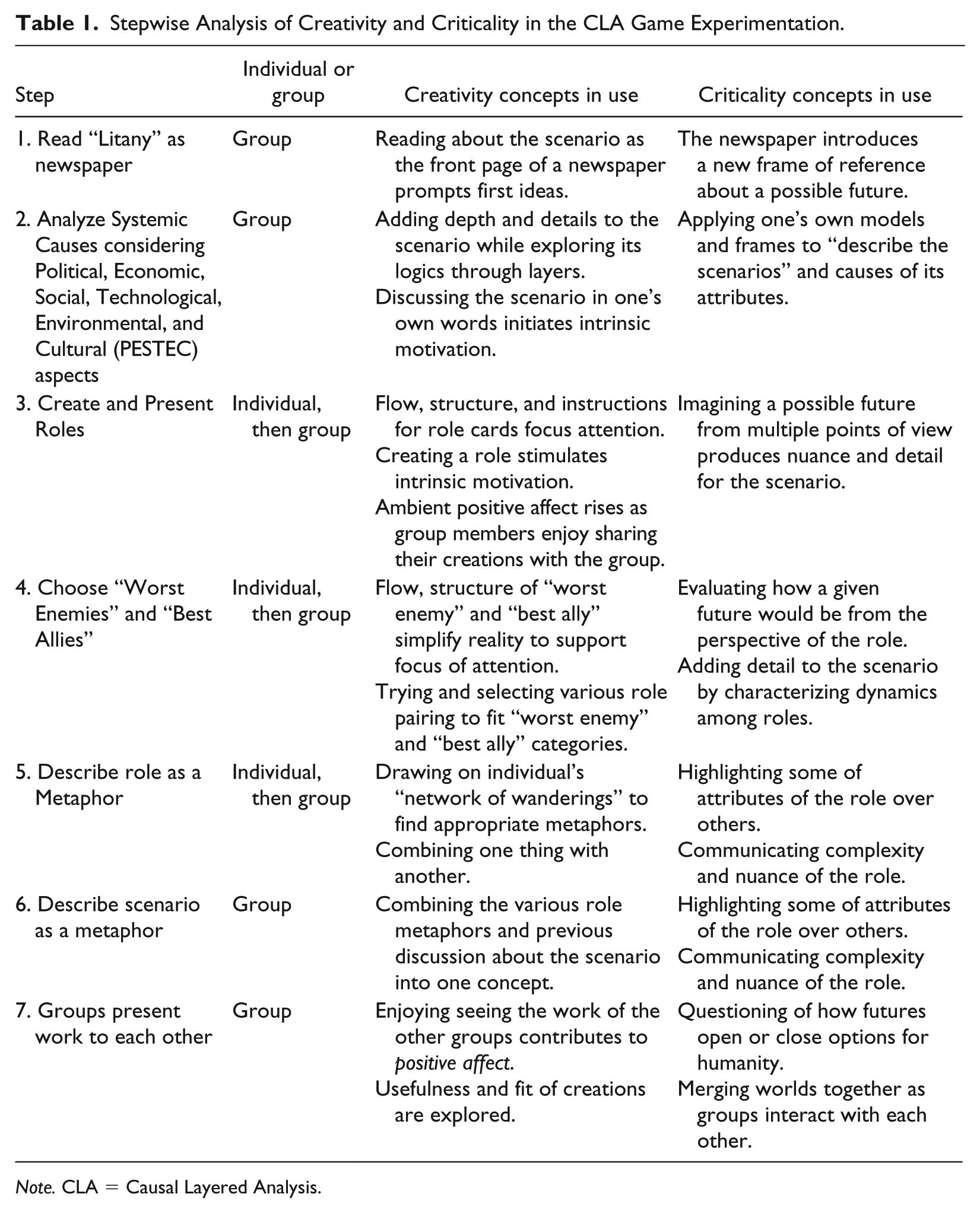
The June 2015 CLA Game experimentation was modified from the existing CLA Game model by structuring the groups according to given scenarios, not to layers. Each group considered the scenario by completing tasks linked to the four layers of CLA—litany, systemic causes, worldview, and metaphor. The first task was to read the “litany” of the scenario as a front page “future” newspaper from the scenario. The second task was to discuss systemic causes using the framing of a PESTEC futures table (rows were labeled Political, Economic, Social, Technological, Ecological, Cultural). The third task was the seed for the development of the Metaphor Molecule Game (see section “Games 2 and 3: Metaphor Molecule Pilots 1 and 2—May 2016 and September 2016”). In it, participants created roles for the scenario and gave those roles worldviews that included what was threatening and motivating in the scenario and who were enemies and allies from the other roles. The fourth task was to give the roles individual metaphors and, after discussing these metaphors, assign an overall metaphor to the scenario. Groups then presented their work to each other in the form of skits, with most groups choosing to have each role introduce themselves in character, such as the “tree of life” or a “robot cowboy.” Over the course of the presentations, the groups began to interact across their scenarios, illuminating the differences, similarities, and integration points among them (Heinonen et al. 2015). The steps of the game demanded creativity and criticality from the participants (Table 1).
Stepwise Analysis of Creativity and Criticality in the CLA Game Experimentation.
Note. CLA = Causal Layered Analysis.
While the concepts can be separated and distinctly described in this stepwise analysis, we argue that the experience of being critical and creative are often entangled and indistinguishable for the participant in the moment. At times, the creativity-supporting state of flow temporarily blinds the participant to the criticality intrinsically present in their new ideas. Rhizomatic knowledge creation (Deleuze and Guattari 1987) contributes some explanation for how the entanglement of creativity and criticality opens and makes visible alternative routes to cavities. For example, in step 7, when the groups shared their results in the plenary, creativity and criticality were tangible in groups’ presentations yet indistinguishable.
Games 2 and 3: Metaphor Molecule Pilots 1 and 2—May 2016 and September 2016
The Metaphor Molecule Game was developed across two pilots held in May 2016 and September 2016 for an action research master’s thesis (Balcom Raleigh 2017). It borrows and builds upon some of the participatory structures of the June 2015 CLA Game. For example, groups work together on one scenario and, in theory, all CLA layers. Also, individuals create roles for the scenario, give the roles metaphors, and put them in relationship to one another. Key differences include moving the role creation step to earlier in the game, introducing the “metaphor atom” and “metaphor molecule” game elements, and focusing on metaphor transformation as a “lever” for re-imagining relationships among roles.
There are eight steps to the game. First, the group selects a scenario to play out of a given set. Second, individuals create roles for the selected scenario. Third, individuals prepare “metaphor atoms” for the roles (Figure 1). Fourth, the group builds all of the possible “metaphor molecules” (Figure 2) and document them. Fifth, the group tells a story about the roles, their relationships, and the scenario. Sixth, the group transforms metaphors of the most influential role or roles. Seventh, the group retells the story, and to wrap up, the group follows instructions to produce a score. Even though the game is inspired by CLA, participants are left unaware they are applying the four layers of CLA while playing; it is nevertheless interwoven into the design.
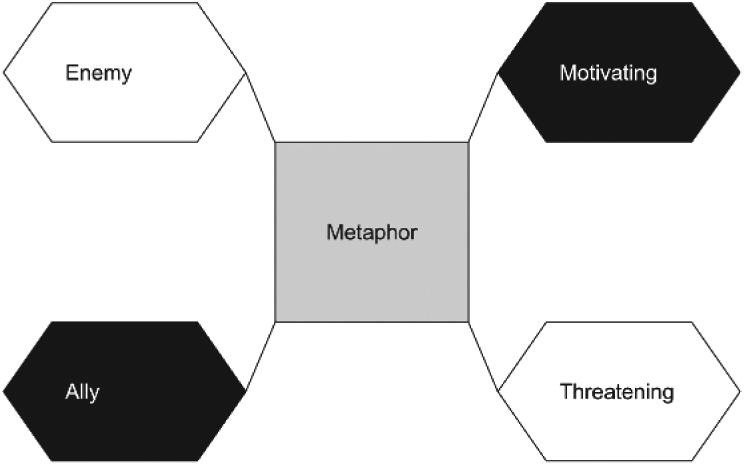
A role’s metaphor atom in the metaphor molecule game.
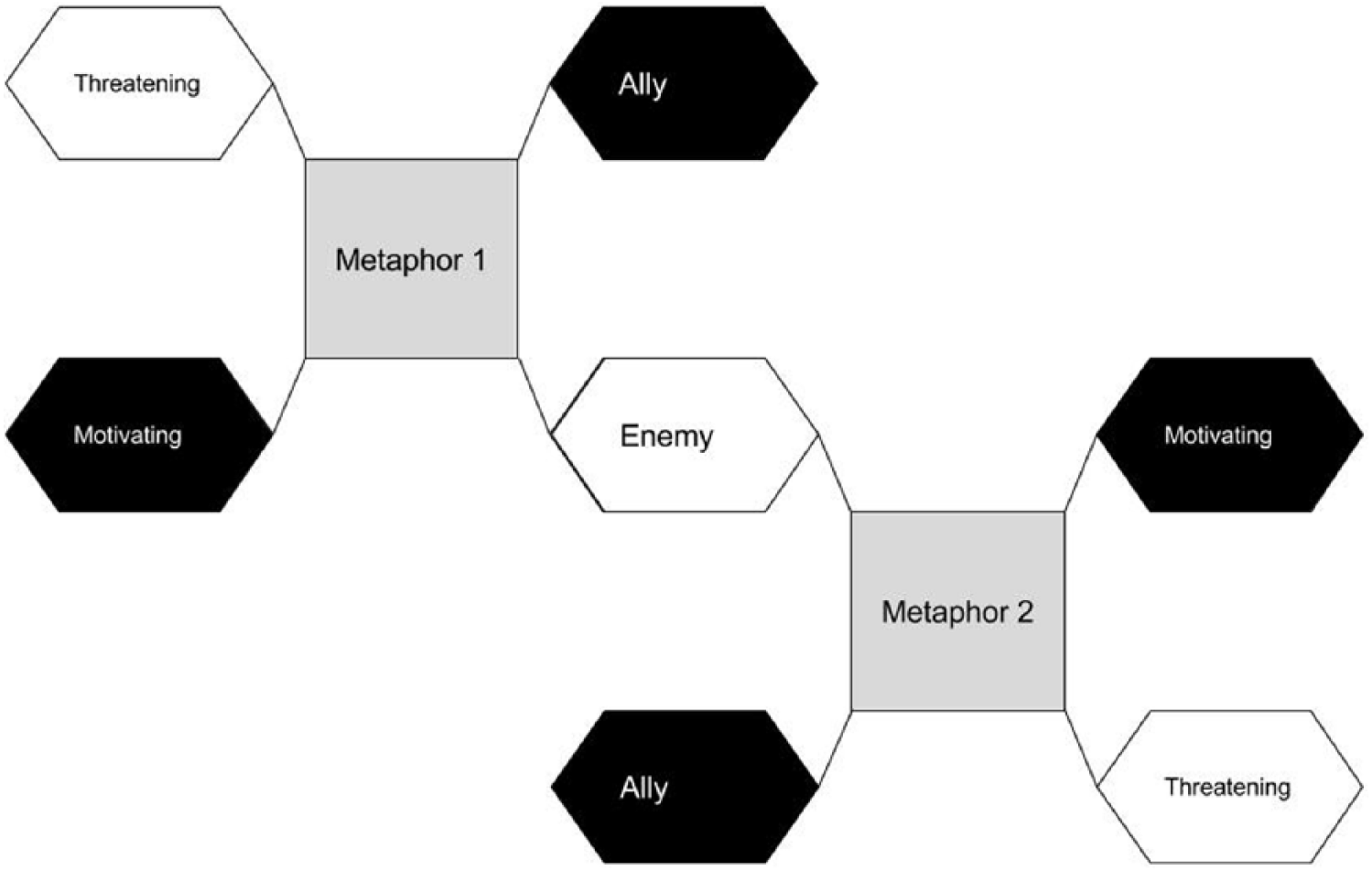
One of four kinds of metaphor molecules—Two roles sharing a common enemy.
The “metaphor molecule” game element is designed to support participants in dynamically mapping the four CLA layers onto relationships among actors. The litany layer is applied by participants as they comprehend the basic description of the scenario as well as when they invent and present the first descriptions of their roles. The systemic causes layer is applied as relationships among roles are mapped and the reasons for these relationships are shared. The worldview layer is located in both the “electrons” of the metaphor atoms (labeled motivating in scenario, threatening in scenario, helping roles, hindering roles) and in the overall picture of the relationships among the roles depicted in metaphor molecules. The metaphor layer is applied when a participant chooses a metaphor for the nucleus of a role’s “metaphor atom”—this metaphor conveying the role’s essential and complex qualities. The metaphor layer is also applied when participants transform metaphors to change a role and relationships among roles.
While Metaphor Molecule shares with the first case the earlier described applications of Inayatullah’s CLA theory and method, its design emphasizes bindings to theoretical models for creativity and criticality. Two of the key creativity models it links to are Amabile et al.’s (model for positive affect and Csíkszentmihályi’s model for flow. The key notions of criticality to which it strongly connects include questioning official futures, thinking about the future more holistically and through multiple perspectives, and actively describing futures rather than passively exploring used futures.
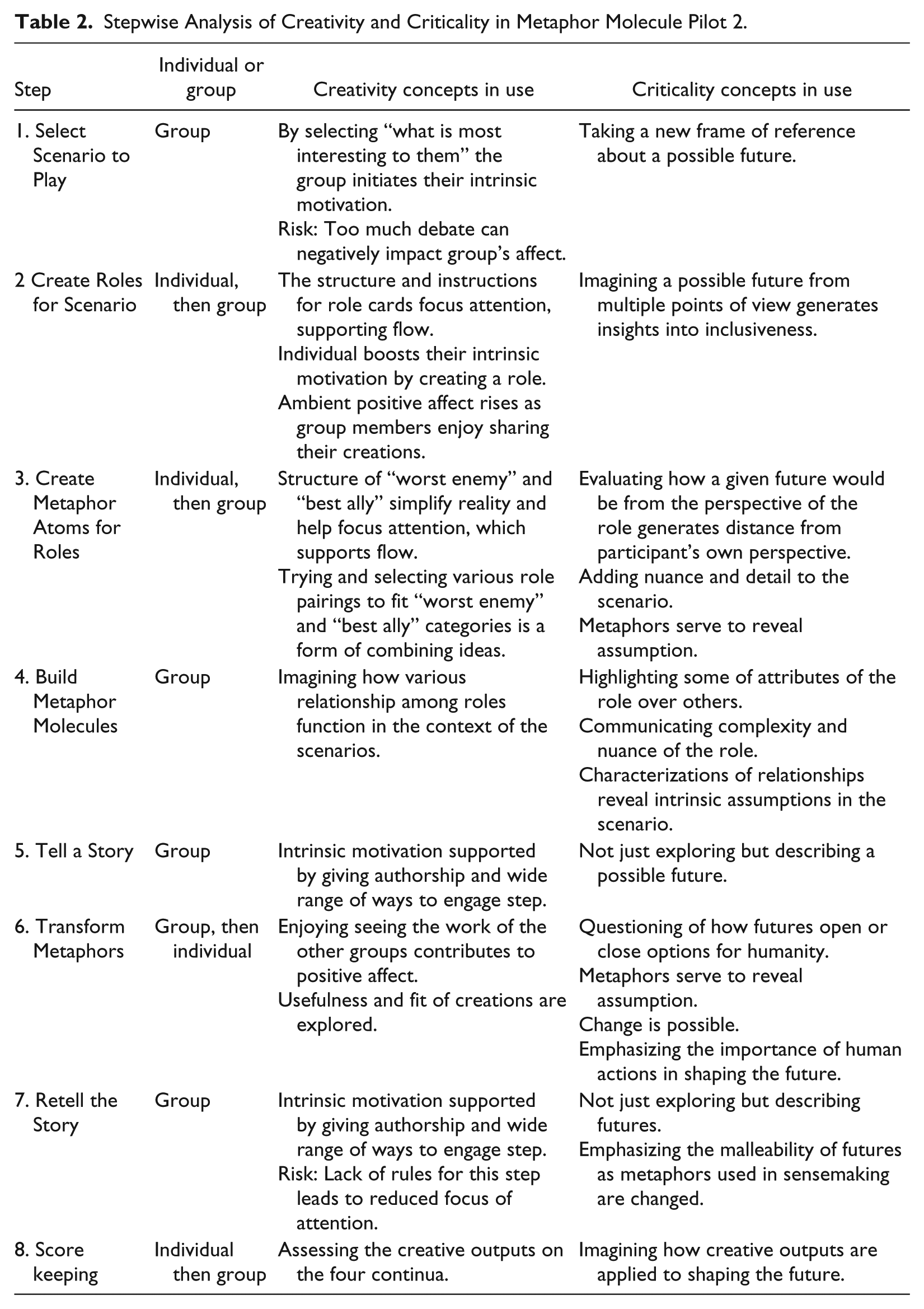
Positive affect and flow were supported by design choices that intentionally give authorship to the game players. These included selecting the scenario to play and creating their roles for it from scratch. This freedom led to a variety of roles at differing levels, from a political leader to a youth coach and from an Olympic champion to a nonchalant teenager. Flow was also supported by having game rules that help players center attention on playing the game. Criticality, on the other hand, was supported by emphasizing multiple perspectives, relationships among roles, analyses through metaphors, questioning given futures and presents, and highlighting the importance of taking action to shape desirable futures. The connections between game steps and creativity and criticality models are detailed in Table 2.
Stepwise Analysis of Creativity and Criticality in Metaphor Molecule Pilot 2.
Data from the evaluation tools—before and after questionnaires, game artefacts, and a postgame group interview—were carefully analyzed after the first pilot to improve the second pilot’s capacity to elevate creativity and criticality. Some of these changes succeeded while others only introduced new issues. A change that succeeded was the introduction of a more qualitative and meaningful scoring system based on four continua for creativity—foolish, disruptive, radical, or breakthrough (Litchfield et al. 2015). Another successful change was switching the terminology for role relationships from “best ally/worst enemy” to “helper/hinderer.” Two changes introduced new problems. The first was leaving it open to participants how to document relationships among the roles as “metaphor molecules.” The second was not making the instructions clear regarding how to tell the story about the relationships among the roles. While these changes were intended to boost the participants’ sense of authorship and intrinsic motivation in the game, the lack of clear rules instead caused the participants to become frustrated and exit the state of flow.
The pilots provided ample evidence the new game could entangle and elevate creativity and criticality and produce outcomes that were novel to the participants. Furthermore, the participants’ own reflections during postgame group interviews gave a first indication of how difficult it can be for participants to separate their experiences of creativity and criticality. In their reflections, the experience of criticality and creativity were often entangled. For example, some participants reported having new ideas about what actions could influence the future (creativity) because the game helped them see the scenario from various vantage points (criticality). Seeing a future from various vantage points can be conceptualized as a rhizomatic flow of questioning conventional stances only to find new cavities (Deleuze and Guattari 1987). One participant described starting the game with profound skepticism that anything will be done to address climate change soon enough to make a difference. Evolving from this critical stance toward the present, playing the game gradually focused this participant’s attention on local solutions and small networks of actors, revealing constructive pathways forward.
Game 4: Futures Literacy Lab—Complex Futures of Human Settlements—June 2017
Metaphor Molecule was applied within an educational instance of a Futures Literacy Lab. The lab guides participants through three phases: (1) revealing assumptions about the future, (2) reframing possible futures, and (3) reflecting on new questions and insights their new assumptions provide regarding how they use the future in the present (Miller 2018). The futuring game was customized to fit the goals of the reframing phase, while preserving the elements of the Metaphor Atom, Metaphor Molecule, and Metaphor Transformations as levers for change.
Key modifications were made from the pilots (section “Games 2 and 3: Metaphor Molecule Pilots 1 and 2—May 2016 and September 2016”). First, instead of selecting from premade scenarios, the starting input was left to the participants to create. Based on a provided reframing model that described five abstract qualities of a future radically different from the present, the groups devised a barebones description of a future human settlement. These descriptions ranged from a small pastoral ecovillage to a busy super network of cities governed under the same sustainability principles. This starting point was good for creativity in that it helped the students “buy into” further developing a future world of their own creation, but it also posed challenges for creativity as the reframing model was intentionally challenging and carried the risk of overwhelming the participants (Balcom Raleigh et al. 2018).
The second major change was to provide “role prompts.” In the original pilots of Metaphor Molecule, role creation was structured but intentionally left open to the participant’s own ideas as a way to encourage intrinsic motivations. However, while testing the game before the Futures Literacy Lab, one tester had difficulties creating an interesting role and became increasingly bored with it during the game. Based on this observation, role prompts were designed to support creativity by forcing associations among different ideas. The players randomly drew three prompts—a life situation (e.g., child or retired person), an occupation (e.g., mayor, successful startup owner), and a futuristic detail (e.g., has an artificial sense, is allergic to electricity). The third major change was to provide clearer instructions and structure for the storytelling steps to reduce their risk to flow. A stepwise analysis of creativity and criticality are presented in Table 3.
Stepwise Analysis of Creativity and Criticality in Metaphor Molecule Game in a Futures Literacy Lab.
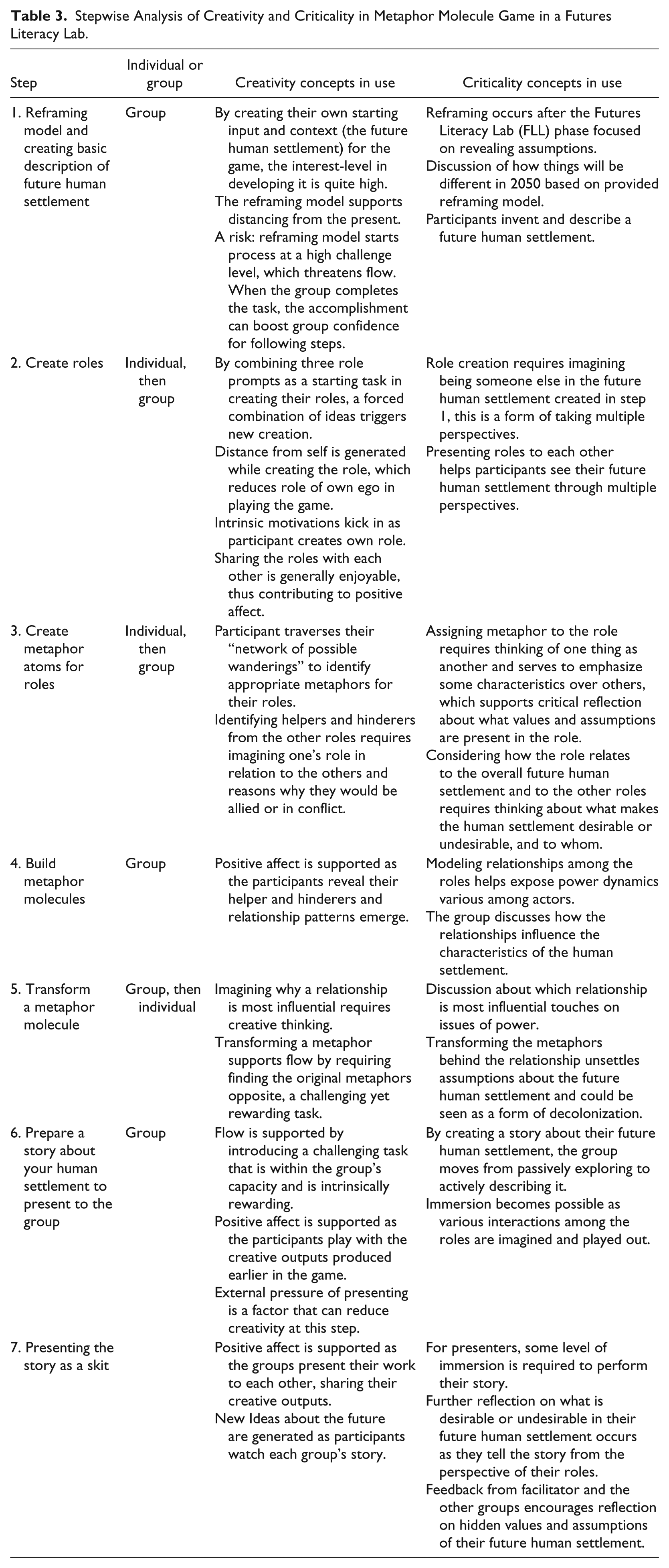
The game generally achieved its objectives for the Futures Literacy Lab. For instance, the produced future human settlements, while borrowing familiar patterns, were sufficiently varied, novel, and different from the present to introduce new anticipatory assumptions for use in lab’s reflection phase. Such novel images for future human settlements were unexpected contributions in the sense of rhizomatic futures knowledge creation (Deleuze and Guattari 1987). The metaphor transformation step—a part designed to tightly entangle and elevate creativity and criticality—pushed the groups further beyond their usual frame of reference. Engaging with the future human settlement as their role offered a path toward immersion—meshing together creativity and criticality and opening new ways of making sense of the potentials latent in the present.
Results
The cases presented in this article demonstrate the viability of our hypothesis and four key arguments. Restating them, participatory processes can and should be designed to entangle and elevate creativity and criticality because doing so (1) addresses complexity and uncertainty by supporting people in contemplating unknown and unknowable futures, (2) overcomes persistent challenges in producing novel ideas, (3) produces more high-impact, high-uncertainty, and novel future images that help identify, or fill, blind spots, and (4) provides distance from the present in support of rigorously imagining new possible futures, immersing in those future worlds, and revealing and questioning assumptions and values.
The first argument manifested in the CLA Game experimentation (section “Game 1: June 2015 CLA Game”) as the participants engaged with unknown futures via mixed methods and “ways of knowing” (ala CLA). Furthermore, by completing the tasks of developing and imagining roles and relations among those roles, the participants were able to collectively enrich the scenario with multiperspective details. In the Metaphor Molecule Game pilots (section “Games 2 and 3: Metaphor Molecule Pilots 1 and 2—May 2016 and September 2016”), the participants similarly took multiple perspectives on a future scenario through roles via which they could encounter more variables, threats, and opportunities in the unknown future. In the Metaphor Molecule Game at the Futures Literacy Lab (section “Game 4: Futures Literacy Lab—Complex Futures of Human Settlements—June 2017”), participants created future human settlements from new assumptions and inhabited roles by which they could enter, describe, revise, and respond to futures they were simultaneously immersed in. In all three cases, participatory elements and structures intended to entangle and elevate creativity and criticality broadly supported participants in contemplating unknown and unknowable futures.
The second argument regarding how entangling and elevating creativity and criticality help overcome persistent challenges in producing novel ideas was evidenced in the CLA Game (section “Game 1: June 2015 CLA Game”) in how groups were able to enter a state of flow and generate a wide range of ideas. Design choices supporting idea generation supporting flow included clear steps and instructions and mixing individuals “thinking on their own” with groups building on ideas together. This generative work was further supported by interwoven criticality emerging as participants stepped through different ways of knowing for each CLA layer. In the Metaphor Molecule pilots (section “Games 2 and 3: Metaphor Molecule Pilots 1 and 2—May 2016 and September 2016”), leveraging internal motivation, intrinsic rewards, flow, and positive affect helped participants go further with their ideas. In other words, the game tasks were explicitly designed to launch these qualities in the participant experiences, for example, choosing as a group which scenario to play or inventing one’s own role for the future scenario from scratch. Criticality entangled with these creative processes as participants developed a complex and nuanced understanding of what is motivating or threatening in the scenario from multiple perspectives. Furthermore, the introduction of metaphor transformation challenged the groups to go further with their creations. In the Futures Literacy Lab (section “Game 4: Futures Literacy Lab—Complex Futures of Human Settlements—June 2017”), many groups struggled to find the right words to describe some of their ideas because they were so new to them. This was due to a combination of the lab’s challenging reframing task and the game’s task of creating a future human settlement that fit in that new context. This combined set of tasks launched a futures process in which creativity and criticality were entangled for participants while they invented and described a somewhat unfamiliar future.
The cases also supported the third argument that creativity and criticality produce more high-impact and high-uncertainty novel future images helpful in identifying blind spots. In the CLA Game experimentation (section “Game 1: June 2015 CLA Game”), process tasks such as circling the most influential causal item for each layer of the futures table called on participants to make creative and critical choices. These selections were then used in subsequent steps to generate high-impact, high-uncertainty, and novel futures. Meanwhile, the creative and critical exercise of imagining what friend/enemy dynamics would exist among the roles revealed “the tensions” and “cracks” in the scenario, opening spaces for new ideas. Finally, assigning a metaphor to each role emphasized and deemphasized characteristics of the roles and their perception of the scenarios, offering participants additional ways to see hidden aspects of the scenario. In the Metaphor Molecule Game pilots (section “Games 2 and 3: Metaphor Molecule Pilots 1 and 2—May 2016 and September 2016”), participants created their own roles from scratch following a process that required both critical and creative thinking—filling in new perspectives the scenario writers may have overlooked. The task of identifying which role or relationship had the most impact on the dynamics among the roles revealed a key to transforming the qualities of all of the roles and relationships created for the game. When the group transformed that influential role or relationship’s metaphor(s)—new and high-impact insights into pathways for change become visible. In the Futures Literacy Lab (section “Game 4: Futures Literacy Lab—Complex Futures of Human Settlements—June 2017”), participants were launched into imagining high-impact, high-uncertainty futures by engaging with a reframing model, leading to the production of varied future human settlements with novel and futuristic characteristics. After producing roles and connecting them in helper and hinderer relationships, the groups analyzed those relationships for how they shaped the overall characteristics of their future human settlement. The entangled and elevated creativity and criticality involved in those discussions were heightened further by the act of selecting the relationship with the highest impact on the whole network of roles. Revealing such linkages between overall characteristics of the human settlement and the relationship dynamics among inhabitants exposed pathways for change. Similar to the pilots of the Metaphor Molecule Game, selecting a role or relationship with the highest impact on the human settlement and then transforming its metaphor produced system-level change within the game.
The fourth argument concerning distancing from the present to imagine new possible futures, immerse in those future worlds, and reveal and question assumptions and values is also supported by the four cases. In the CLA Game (section “Game 1: June 2015 CLA Game”), this distancing was initiated by an assigned scenario, which provoked experiences of intertwined creative imagining and critical reflection about what that given future would be like. More distance was achieved as participants explored systemic causes of the scenario, immersed it as a role different from themselves, added detail to the scenario, and described the essence of those roles and the overall scenario by giving them (and it) a new metaphor. This metaphor making was a form of questioning a given future (the scenario) by emphasizing or deemphasizing various aspects of it. The metaphor making and role creation also put on display something about the participants’ own values and assumptions regarding that possible future. For the Metaphor Molecule Game Pilots, the scenario selected by the group also initiated distancing from the present. The participants introduced even more distancing as they themselves introduced unfamiliar elements to the scenario, such as roles that do not exist today and implied needs for society communicated by those roles. The climax of the game, the transformation of metaphors generates a new framing on top of the initial new framing, placing a new and old metaphor in contrast, and calling for a reassessment of the relationships among the roles and overall values at play in the collectively imagined future.
In the game portion of the Futures Literacy Lab, the reframing model of the FLL provided a defamiliarization of a future, which pushed participants to test values and assumptions different than their own. As groups imagined a future human settlement within the context of these new assumptions, they generated detail and connective hooks that supported immersion into what those future human settlements could be like. During game play, many new assumptions about the future were activated, which participants could then compare with their previously held assumptions. The outcome, confirmed by at least a few conversations with participants, was new tools for seeing the potential in the present and self-awareness of how one’s personal values and assumptions are linked to how futures are perceived.
Based on this analysis, we conclude that our normative claim is a viable hypothesis that would benefit from further experimentation and research by futures studies practitioners and scholars.
Discussion
The three cases presented in this article show a glimpse of how participatory futuring engagements structured to boost creativity and criticality offer pathways for groups to rigorously imagine futures, even radically transformational futures. Through rigorous imaginings, participants can have rich and immersive experiences, which in turn can catalyze emotional connections to emergent potentials found in the present.
Across these cases, informing practice with theory has led to the development of several new and viable participatory methods. To varying levels, the cases demonstrated that applying theories of creativity and criticality can help participants contemplate unknowable futures laden with complexity and uncertainty, overcome challenges in producing novel futures, identify high-impact and high-uncertainty futures lurking in blind spots, and gain distance from present-day understandings. These outcomes, among others, indicate the value of informing theory by practice and practice by theory—a central tenant of action research (Somekh 2008, 5).
The cases confirm the usefulness of applying action research in complex futures processes (see Ramos 2006; Stevenson 2002 and List 2006). They also link to design-driven futures work pursued by academics and consultants. Practitioners producing participatory futures for clients are often working on tight budgets and timelines, which can compel them to push theory to the wayside. However, our findings indicate the value of consciously linking steps of any participatory futures process to theoretical concepts of creativity and criticality because doing so can contribute to the quality of the participant experience and produced content.
These cases also contribute to a larger effort to produce experiential or immersive futures through futuring games. The effort to produce futuring games reaches back at least to the 1970s (Rausch and Catanzaro 2009) and continues today with two recent examples being Thing from the Future (Candy 2015) and the European Commission Joint Research Centre Scenario Exploration System (Bontoux et al. 2016). A practical motivation for this work is the observation that too many futures processes produce outputs that die as reports on shelves. Meanwhile, it can be argued that the most valuable futures processes continue to live in people’s minds, serving as sensemaking tools in the face of uncertainty and an ever emergent present. The futuring games developed in these cases all shared a capacity to immerse participants in new futures while encouraging them to add detail and their own meaning to those futures. These self-generated experiences may be remembered by the participants more strongly and fully and be applied.
Conclusion
Participatory futures processes designed to entangle and elevate creativity and criticality help people produce ideas about the future that are higher in novelty, depth, and holistically grounded normative value. In addition, creators of participatory futuring processes should pay attention to how creativity and criticality tend to be intricately entangled in the experiences of participants. Rather than thinking “this step is for creativity and that step is for criticality,” participatory designs benefit from structures and tasks that encourage simultaneousness in participant experiences of these capacities. The degree of how much creativity and criticality in such entanglements may fluctuate in different steps of a futures process. Yet the elevation and entanglement in any particular mix widens the futures process to cover more of the “envelope of uncertainty” (Ralston and Wilson 2006, 121).
Future Developments of Criticality and Creativity in Participatory Futuring Engagements
A key way to develop design principles for entangling and elevating creativity and criticality in participatory futuring engagements is for futures studies practitioners to actively share experiment results. Open sharing requires designers of participatory futuring engagements to evaluate the strengths and weaknesses of their own designs. As creators of these designs, it can be difficult to approach them without bias. The framework for context-aware evaluation tools proposed here can help open these designs to assessment by the designers and the larger futuring community, including the participants. For example, the open sharing of successes, challenges, and failures within a community of practice could lead to greater outside verification or refutation of claims to what kinds of design choices or actions are successful in elevating creativity and criticality in participatory futuring engagements. The generated knowledge base could then be used by futures practitioners to connect theories of creativity and criticality in their own practices. Stepwise analysis of how the steps of a futuring game connect to theory, as we have done in our three cases (see Tables 1, 2, and 3), may prove valuable to others by elucidating links between theory and practice.
Proposal for Context-Aware Evaluation
For the field of futures studies to develop practice capable of supporting creativity and criticality through theory, a framework for developing context-aware evaluation tools may be needed. Tools developed within this framework would be highly tuned to the situations in which they are used and capable of meeting the challenges that arise in designing participatory exercises, workshops, and games that can support creativity and criticality. By context-aware, we mean that evaluation tools are developed alongside the participation design with attention to how they too contribute to supporting creativity and criticality.
Common tools for evaluation of participatory engagements and events include participant feedback forms and surveys. When using these types of tools, it is tempting to focus on marketing-level questions, such as “How much did you enjoy this workshop?” “What were your favorite parts?” and “What would you improve?” While these types of questions can be helpful in tuning the usability of a participatory design, they overprioritize how well participants “liked or disliked” the experience. Better evaluation questions would offer individuals opportunities to reflect on how and when criticality and creativity were present for them during the participatory futuring engagement. No matter its design, any evaluation tool will become part of the experience of the participants, and this fact can be used to further creative and critical thinking about futures.
Acknowledging this tendency, context-aware evaluation tools should be devised that not only inform researchers of the effectiveness of a specific participatory element but also enrich the self-awareness of participants regarding their own experience. Going even further, some of these context-aware evaluation tools could be embedded in a futuring engagement, generating an instant feedback loop, providing participants signals to guide how they apply creativity and criticality. Embedded context-aware evaluations tools would align well with the ideals of participatory action research such as upholding a “clear and conscious commitment to the notion that it will be a social and educational process for each person involved and for everyone involved collectively” (Kemmis et al. 2014, 19). Further work is needed to develop a framework for context-aware tools.
A key part of scientific inquiry is the continual testing and refinement of explanatory ideas. Those interested in the endeavor of developing increasingly viable ways to combine and support creativity and criticality in participatory futuring engagements can go further by working together. With demonstrated ways to link theory and practice in hand, creativity and criticality can and should be entangled and elevated into unique, enriching, socio-interactive experiences in which participants invent and immerse themselves in increasingly novel and varied possible futures. A key way to develop design principles for entangling and elevating creativity and criticality in participatory futuring engagements is for futures studies practitioners on one hand to actively share experiment results and on the other hand to let futures processes flow rhizomatically.
Footnotes
Authors’ Note
The participatory futures engagements described in this article were designed and executed by teams of co-designers, facilitators, group moderators, and participants, all of whom must be acknowledged. The June 2015 CLA Game was facilitated and co-designed by Sohail Inayatullah and Sirkka Heinonen (co-author). Group moderators were Sofi Kurki, Marjukka Parkkinen, Nicolas Balcom Raleigh (co-author), Matti Minkkinen, Joni Karjalainen, and Juho Ruotsalainen. The pilots of Metaphor Molecule game were designed and executed by co-author Balcom Raleigh with guidance from thesis supervisors Juha Kaskinen and Sirkka Heinonen. The Futures Literacy Lab was co-designed by Laura Pouru, Ellinoora Leino-Richert, Nicolas Balcom Raleigh (co-author), Riel Miller, and Markku Wilenius, and additional group moderators were Yuan Qi, Philip Roy, Laura Matero Parraga, Elina Nikula, and Marjukka Parkkinen.
Declaration of Conflicting Interests
The author(s) declared no potential conflicts of interest with respect to the research, authorship, and/or publication of this article.
Funding
The author(s) disclosed receipt of the following financial support for the research, authorship, and/or publication of this article: The authors received financial support for some of the research upon which this article is based from the Neo-Carbon Energy Project, one of the Tekes (Finnish Funding Agency for Technology and Innovation) Strategic Openings. The open access publication of this article was funded by the University of Turku.
