



Abstract
Informed by methods in Black and Indigenous studies, this article attends to interspecies relations in the Black outdoors of informal settlements in the south of Johannesburg, South Africa. We decentre anthropocentric perspectives and lean into planetary understandings of the interactions between humans, plants, animals, and the cosmos as forms of relation in interspecies life. We suggest that like humans, the natural elements within these contexts express agency, survival, and resistance in ruderal ecologies. Photographs of the natural and material environment, along with verbal accounts of space were collected and analysed using an Afro-ecofeminism framework and a Black studies and Indigenous studies reading to explore interspecies relations. We concluded that interspecies relations are characterised by co-dependence that sustains precarious environmental and spiritual ecologies. In these zones of state abandonment, relations between plant and animal life, Indigenous cosmologies and humans, offer us ways to disrupt hierarchies of being in favour of a planetary consciousness.
Introduction
In this article, our thesis is that Black people who live in the ‘Black outdoors’ maintain generative and complex relations with the natural ecological environment. By Black outdoors, a term used by Carter and Cervenak (2016), we refer to how many Black people in abandoned geographies live in the land, with water, the cosmos, and with more-than-human animal life in ways that collide with racial capitalist ethos of ownership, overlord, and conquer. 1 While the carbon footprint of impoverished people on the environment is present, we suggest that their habituation of space is not only lighter but less conflictual. Perhaps, this is a harmony that relates to indigeneity – an assertion of a lengthy familiarity that borders on what we might describe as a form of kinship.
Indigenous knowledge systems and African cosmologies often acknowledge the relationships between people and nature where they are all considered to live in an ecology of reciprocity which relies on all of the elements for co-survival. In seeking to understand issues related to environmental education, Rautio (2013) encourages us to be involved in thinking of humans as already existing as part of nature. Interspecies relations, therefore, refer to the co-dependence and collaboration between humans, non-human animals, and elements in the creation and maintenance of the conditions of their survival (Rautio, 2013). This is captured by Louie (1973) and cited by Marker (2018) in the following excerpt. The first thing that you want to remember this earth has got life. The grass has got life. The trees have life. Everything on earth has a life. If you can understand their way of life it would be wonderful, but always respect, because they are alive. They will help you and guide you to what you are seeking. If you respect them, where you walk, where your trees that go by, they respect you. Even the water that you drink is alive. Even the air that you breathe has a certain kind of life. The great mountains up there have the purpose of life that give this river here the way it flows, that keeps this here ground alive. Even the rocks have a form of life. You have to respect everything that grows. That is the way of life that we hunters have to accept from our Elders and practice it and respect it in order to accomplish our goals, what we are doing. (Louie, 1973, cited in Marker, 2018: 457)
In our conception, the Black outdoors is an illegible interspecies fugitivity from white ways of being. It evades domestication and domination. To be outdoors then, is a mode of life that refuses capture and the enclosure of state formality. It is to trouble the ideology of property (Walcott, 2021b). In studying the narratives of three interviewees from informal settlements in the south of Johannesburg, we read the participants as Black and Indigenous. While Blackness and Indigeneity are not the same (King, 2019), Ka Canham (2023) argues that on the African continent Africans are simultaneously Black and Indigenous. The intersections of Black and Indigenous studies are useful in contexts burdened by legacies of white supremacy and settler colonialism (Stewart and Thompson, 2023). In this article, we work with stories from people and other species and elements contained in these stories, as well as photographs taken in informal settlements. Our interviewees navigate the margins of informal settlements as both Black and native beings.
We write this article as scholars who work as part of a research institute located in Lenasia, in the south of Johannesburg. This is an area surrounded by some of the informal settlements that the present study engages with. Informal settlements are impoverished and often have no portable and reliable clean drinking water, electricity, and basic municipal infrastructure and services. The people who live in these settlements are generally black and mostly unemployed. While we shared racial identity with participants, as researchers we are either middle class or currently in a class transition towards the middle class. The residents of informal communities live in states of insecurity and in fear of state officials who often threaten to evict them and demolish their houses since informal settlements are designated as unlawful (Rasodi et al., 2025). As researchers, we were aware that our interviewees might have initially perceived as people who have access to resources or in cahoots with the government in their plans for demolition. We had to be mindful of our presence and were aided by two insiders who accompanied us on guided walks through the community and facilitated the introductions before the interviews.
This article is a meditation on interspecies negotiations and co-livings. We take seriously the spaces where impoverished human communities make space alongside other living species and elements. We do this by reading landscape photographs alongside verbal accounts of space by people who reside in the ruderal ecologies south of Johannesburg. While we write this paper as part of the human, we lean on our Black and Indigenous relationality with the more-than-human and what Ka Canham and Seedat (2025) theorise as a black planetary consciousness – an ethic that recognises how the human and more-than-human coconstitute each other and challenges speciest essentialism.
We begin this article by theorising zones of abandonment through interspecies ecologies. We then detail how Black and Indigenous studies ground the theory and method applied in the study, and reflect on conducting research in the context of informal settlements. Finally, we present the findings and analysis based on three main themes, extracted from the quotes provided by interviews with participants; Not everyone knows what's the purpose of trees; We used what we found in nature; and, Beneath the reeds are underwater worlds.
Theorising zones of abandonment through interspecies ecologies
The sprawl of new settlements in the south of Johannesburg is borne of a spirit of freedom of people in search of something new. Weary of being backyard renters, many of the residents of the settlements are on the run from capital and have found something resembling freedom in the marshlands of the Klip River and the vast tracts of land in the shadowy brown fields. Following Crawley (2016), this fugitive movement into the outdoors is a form of marronage – an unmooring that is always unfinished and never fully consummated since the threat of dispossession of racial capitalism is always present. In Hartman's (2008) formulation, it is a perpetual search for freedom.
Our task here is not to romanticise living in the margins of racial capitalism (Alexander et al., 2023). For those who live in informal settlements, life is lived in states of relative impoverishment and state abandonment. For instance, Ka Canham (2023) defines zones of abandonment as places from which the state has turned its back in the pretence that they do not exist. In this context, many of the communities we write about live in the shadow of the residue of mining dust and atrophy. Hecht (2023) terms this residual governance. Residual governance conceptualises the ways in which waste is governed and discarded, how and where governance tactics use simplification, ignorance, and delay tactics, and lastly, how governance treats people and places as waste and wastelands (Hecht, 2023). The very landscape is shaped by mining tunnels, burrowed in the earth, and the bowels of the earth spilled above ground so that they form hills on this relatively flat highveld.
However, to see this space as only a wasteland would be to miss what Carter and Cervenak (2016) describe as the revelling and revelation in trees, wetlands, and air that belie total capture. Together with McKittrick (2014), we ask, what else happened at the site of death? What else happens within these zones of state abandonment where the state is an absentee landlord? How is life in informal settlements conceived of when residual governance exposes the functions of capitalism that relegate Black people, places and nature as commodities to serve capitalist interests? We suggest that interspecies life finds verdant ground in the peripheries of Johannesburg. In running from enclosure, the people of the south of Johannesburg's informal settlements run towards multiple forms of relation in this ecosystem. They forge relations with rivers, hills, animals, and multiple plant species. This is ‘what else happened’ at the site of death.
In conversation with Kaiser and Thiele (2018: 123), Bracha Ettinger refers to the co-responsibility and interdependence that the human and more-than-human have for and between each other as the ‘things that silently carry us’ – the night, the ocean, and the forest. This is to suggest that even when unacknowledged, living matter is borne in a reciprocal multispecies and elemental carrying. Even as we write and conceptualise these ruderal ecologies (sites of life in hostile environments of rubble) or zones of abandonment as informal settlements, the concept of settlements is inadequate for the formulation of the Black outdoors. Settlements conjure settlers that self-appoint as overlords to often stolen land. But they also suggest modes of dominance that latch onto hierarchies of being. Philosophers characterised the chain-of-being as consisting of Man as overlord, Indigenous and Black people as subjects of Man, and the animal and natural worlds as available for extraction in the service of supreme Man (Brake, 2009).
Working with and extending Fanon's theorisations of being, Wynter (2003) provides an instructive deconstruction of the formulation of the chain-of-being, which surfaces the racialised foundations of modernity. Following Ka Canham and Seedat (2025), we suggest that imagining the inherent union of ecological and human worlds as carrying each other and as interdependent, upends this hierarchy of being and gestures to planetary interspecies relations. The very informality of the settlements that we think with points to the mobile and rhizomatic errantry of places, people, and environmental worlds (Glissant, 1997). In King's (2019) conception, it is this indeterminacy and attachment to the speculative realms of possibility that gives vitality to the Black outdoors.
Racial capitalism often means that the spaces that black people are compelled to inhabit are often ruins and rubble. Stoetzer (2018) helps us to think through rubble. This is productive for engaging with spaces that exist alongside abandoned gold mining sites in the south of Johannesburg. Reflecting on Grime's (1977) formative scholarship, she observes that the ‘term ruderal comes from rudus, the Latin term for rubble. A common term in urban ecology, it refers to communities that emerge spontaneously in disturbed environments usually considered hostile to life: the cracks of sidewalks, the spaces alongside train tracks and roads, industrial sites, waste disposal areas, or rubble fields. Neither wild nor domesticated, ruderal communities depend on what is known as an “edge effect” and the juxtaposition of contrasting environments in one ecosystem’ (Stoetzer, 2018: 297). The indeterminacy between wild and domesticated may be extended to think of the spaces as neither exclusively ‘natural’ nor human. We suggest that the spaces are shared and negotiated between the more-than-human and the human.
We adopt Tamale's (2020) Afro-ecofeminism framework for understanding interspecies relations to space. As Black and Indigenous, Tamale (2020) calls for embracing ‘Indigenous knowledge systems that see all the elements of the world as interconnected in a web-like fashion’. 2 Afro-ecofeminism, which centres the web of life, allows us to surface how interspecies relations between participants of this study and their natural ecologies inform place-making. Using this lens we illuminate how public spaces may be designed and managed by human and more-than-human inhabitants in ways that ensure multispecies survival. Moreover, this symbiotic interspecies relationship demonstrates how nature informs social identity. Thinking with Maina-Okori et al. Tamale (2020: 80) suggests that ‘Indigenous conceptions of interconnectivities go beyond human relations to include nature; they disrupt the nature/culture divide’. Importantly, Afro-ecofeminism emphasises how patriarchy intersects with other African identity markers in the exploitation of the natural environment and that as guardians of the environment, African women are adversely affected by environmental devastation (Kelleher, 2019). Overall, by centring the worldviews of African women, the Afro-ecofeminist lens allows us to theorise how people and nature rely on each other for their co-creation.
Black and Indigenous methodologies and research methods
Black studies was established to escape from the anti-Black tyranny of the academic disciplines (Walcott, 2021a). In place of rigid formulations of disciplinary knowledge, Black study leads with the lifeworlds and experiences of Black people on their own terms. Generally, Black lifeworlds insistently decentre the human and hinge on an emplaced relational frame that tethers to ancestral and spiritual worlds, geographic forms, and the more-than-human. Black study is therefore a slow meditation with this diffusion that evades boundaries and knowledge enclosures (Harney and Moten, 2013). It assumes the tenor of the Black geographic that is always in motion and driven by an errant curiosity of what else happened at the site of death (Glissant, 1997; McKittrick, 2014). To work with this agility, Black study is necessarily transdisciplinary and multi-method. For Bledsoe (2021: 1014), it assists us to track how Black people ‘find ways to create life in the crevices of power’.
Our interest in the more-than-human relates to how natural ecologies find life in putatively ‘settled’ environments. For this, we lean on Indigenous scholarship and think through Marker's (2018: 453) formulation – ‘there is no place of nature; there is only the nature of place’. Thinking with Indigenous cultures of Coast Salish territory, Marker (2018: 453) observes that landscape is more than a ‘container for human history’ and that it shapes temporality and how humans live. Landscape is sentient and has a kinship with the ancestors who inhabited and continue to inhabit it. As a method to work with landscape, Marker (2018: 456) suggests listening to the experience of being on the land and to the ‘ways that spirit, or metaphysics, appears in conjunction with land and animals’.
In this conception, land is always inclusive of the beings that inhabit it. Marker (2018) illustrates this by citing McHalsie's research with Indigenous Elders who observed that ‘they get their power from being able to be there … not interfering with it but being there … from the fact that they’re able to be there and to co-exist with it’ (2007: 137, italics in original). This calls on us to be present on land without interfering with it but rather to co-exist with its ecologies. Since Indigenous people can read the environment, they are aware of where spirit powers reside in the landscape because the place itself is ‘saturated with energy forms that exist only in the dimension of that landscape’ (Marker, 2018: 456). The two sentiences are the ‘mind of place, and the human mind that is convening and opening to it’ (2018: 456). As researchers we attend to these sentiences to both read the mind of the place and to understand those who live on the land as open to understanding the language of the landscape.
Based on the foregoing articulations of the methodologies of Black studies and those of Indigenous landscapes inflected through Afro-feminism as methods of inquiry, in this article we read stories of community members of the south of Johannesburg together with photographs that we took of features of the landscape to look beyond what Tuck (2009) has termed ‘damage centred research’. As Black researchers who work with many of the communities and places we write about, our own orientation is to read for agential forms of expression and to recognise the sentience of place and people.
In African societies, there is a deep history of community interdependence with the natural environment. Using an Afro-ecofeminist sensibility, Tamale (2020: 90) observes that traditionally, numerous African societies lived alongside nature through ‘respectful co-operation, conciliation, and containment’. This means that nature was seen as forming part of the community rather than being a separate entity from which resources could be extracted. Species and elements that formed part of nature included the land, water, plants, and animals. Many of these elements and species are understood as enchanted by being imbued with ancestral powers (Garuba, 2003). These were regarded as equal to the people and were referred to with the same dignity and respect (Pierotti, 2010). Tamale (2020) gestures to the complex relationship between Indigenous people and nature, where traditional practices and beliefs are tied to ancestral land. People make use of the resources provided by the natural environment in their everyday lives as well as in cultural rituals and ceremonies. For some African communities, these practices were disrupted by racial capitalism where Indigenous people and land are seen as resources available for commodification to advance the interests of capital accumulation. Therefore, both the people and the land were subjected to various forms of exploitation which often alienated people from nature.
Our use of Black and Indigenous methods of embodied knowing means that we turn away from grand theory. In place of analytical steps and procedures, we attend to landscape and words. In addition, recognising our own presence in the field of enquiry and the interpretative field, we apply a form of ethnographic method. The practice of ethnography required us to embed ourselves in the research context and to become immersed in the environment, using our skills as researchers and sensibilities as human to attune to the rhythms and life within the study context (McGranahan, 2018). Through ethnographic methods, our bodies were the instruments through which the environment was experienced, and it was through these human sensibilities that the interspecies relations were read in the spaces under study (Abbott, 2021). According to McGranahan (2018: 2) ethnography is a ‘culturally grounded way of being in and seeing in the world’ that is channelled through participant observations where the collection of data is directed by relationality between researchers and the community and data is translated using the field-based knowledge of the ordinary and extraordinary realties of people and, we add, other species. Knowledge is inseparable from its original context and the use of ethnography and Black and Indigenous methods emphasise the significance of place-based temporalities and connections to land and community. By conducting interviews and taking photographs, we upheld ethnographic practices informed by Black and Indigenous approaches which adopt methods in the oral tradition and observation.
To attend to the photographs, we used Campt's (2017, 2019) method of listening to images, which illuminates how, through the quiet and quotidian, they are mobilised in everyday life. Our own photographs were taken by one of us in the field with the intention of capturing quotidian scenes of quiet. Pausing with the photograph assisted in realising its analytical possibilities. Campt's (2019) method of reading images provided a useful ontological framework to analyse these images. Her framework allowed us to read how images symbolise ‘practices of refusal’ by decentralising dominant Eurocentric modalities of reading. Similarly, this philosophy was generative in enabling an analysis of the more-than-human captured in photographs. This allowed a decentralising of dominant anthropocentric modes of reading and a focus on attending to what Marker (2018) conceives of as nature of place.
The data comprised of photographs and interviews. Interviews were held in two informal settlements located in the south of Johannesburg, South Africa, Phumlamqashi and Patsieng. Notably, the photographs, taken in Phumlamqashi, Patsieng, Majazane, and Kokotela (Lakeview), were of the natural and material environments of the communities. Data collection was conducted through conversational style interviews and careful observations captured through photographs of natural spaces and field notes. Informed by the conceptual frame given by Indigenous and Black studies inflected through Afro-ecofeminism and Campt's (2017, 2019) reading of the quotidian to surface refusal, we applied a traditional thematic analysis articulated by Terry et al. (2017). The flexibility of this approach allowed us to draw out ecological content in the interface between the human and more-than-human. Using an experiential orientation to thematic analysis, through a close reading of the transcripts, we surfaced codes and then clustered these into themes, which we eventually collapsed into the three broad themes used to structure the findings and discussion parts of the article.
In the following sections, we present the stories of three residents who had been living in their communities for more than five years. The participants shared stories about how they have created life within zones of state abandonment and established communities in ruderal ecologies. Complemented by the photographs of the environment, their stories illuminate the interspecies relations that occur within informal settlements. They bring to view the collaborations between the people, the birds, plant life, and the mysterious forces of the (super)natural world.
Study context of informal settlements
While all spaces are invested in interspecies relations, we attend to informal settlements which Satterthwaite et al. (2020) define as housing units that emerge outside of legal housing and town planning authorisation. In our context, Lewi'’s (2023) characterisation of informal housing as the ‘zinc forest’ reflects the material make up of South African housing in zones of abandonment. Comprised of densely populated corrugated iron structures that look like a zinc forest, the peripheries of urban areas in Johannesburg have increasingly seen the emergence of informal settlements (Rasodi et al., 2025). The number of informal settlements and their living conditions have been a concern for the state, city planners, and those who live in them. In addition to these settlements being relegated to zones of state abandonment and subject to residual governance, the demarcation of the settlements as informal leaves them and their natural ecologies vulnerable to exploitation (Adegun, 2019). These living conditions include high rates of unemployment, food and health insecurity, as well as impoverishment (Modiba et al., 2024). Furthermore, despite making use of natural resources for survival, those living in informal settlements are at risk of natural hazards, droughts, and floods, which can result in the destruction of houses, soil erosion, poor water quality, and the spread of diseases (Williams et al., 2019).
Nyashanu et al. (2020) observe that housing precarity increased because of job losses, financial crises, and people escaping from abusive households. Consequently, large numbers of displaced people turned to informal settlements to create lives for themselves, for their families, and form part of a community established on its own terms. Because these settlements emerge outside of state regulation and planning, some of the challenges are related to inadequate services, such as deficient access to water, electricity, sanitation, and road infrastructure. This increases the reliance that shack dwellers have on the resources provided by the natural environment and further entrenches dependence and relation between residents and their local environment. The possible consequences of climate change in informal settlements and the heavy reliance on the natural ecology within these zones of abandonment can result in the degradation of natural systems and loss of species, with implications for food security, water security, biodiversity, and forests.
The study was located in the informal settlements that exist along the Klip River south of Johannesburg. Phumlamqashi and Majazane were previously used as Afrikaner and people of Indian descent farmland before the land occupation. These forms of land occupation began in the apartheid era as people were moving to the urban areas of Johannesburg in search of work on the farms. Decades later, in a democratic South Africa, the informal settlements have mushroomed, and land occupation has continued with impoverished people in search of housing and seeking freedom from the financial burden of paying rent. Patsieng was a community completely covered by trees that were cut down to create space for the incoming residents and to source firewood. Due to its aesthetically pleasing location near a wetland, Kokotela (Lakeview) was vacant land that was identified by a social housing activist to build a community and erect homes for their children and future generations of residents in the surrounding communities. Despite these ecological spaces having different histories, they all underwent drastic changes in their natural ecologies once people began claiming the land and erecting their houses in these spaces. As people settled, they cut down trees and arranged themselves in ways that enabled them to merge with the natural features of the environment.
Findings and analysis
In this section, we discuss the photographs and interviews through Black outdoors and Indigenous frameworks of analysis inflected through an Afro-ecofeminist orientation and Campt's (2017, 2019) approach of listening to images. Our approach follows Iheka (2018) to examine how we might bring the more-than-human back into dialogue with the human. The data presented here have been selected to provide a snapshot of each community that we researched. These findings form part of a larger study comprised of 14 interviews. For reasons of space constraints and analytical depth, we however, only utilise the data from three interviews. Our discussion pivots along three thematic foci: Not everyone knows the purpose of trees; We used what we found in nature; and, Beneath the reeds are underwater worlds.
Not everybody knows the purpose of trees
When we arrived at Phumlamqashi to conduct this research, deforestation was well on its way. Since the area is impoverished and trees are used as firewood, we expected conversations about the environment to focus on material consumption. However, one of our first interviews returned us to the aliveness of trees as sentient beings. This conveys an Indigenous ethic that trees are not senseless. They are not only biomechanical matter, available exclusively for economic gain and consumtption. Indeed, Abbott (2021: 1059) observes that an Indigenous orientation understands ‘the intelligent relationality of trees as agentic, conscious, innovative entities embedded in unique, community-based lifeways’. Aunt Bibi from Phumlamqashi spoke about her relationship to trees. The main thing that has been very close to my heart since we moved here was my trees. My place was surrounded by trees, and there was just something about these trees. But when these people came here, they started cutting my trees. On this side you will see, the trees are still there, I cut a few just to please a few people because they wanted the sun for the solar panels … But as you can see, even here in the front, my trees are still standing. That is the most significant thing that is still very close to my heart, my trees, and nothing else really … and the birds! Our birds, every morning without fail, then you hear our birds … There were guineafowls … We had horses here, we had rabbits … We had everything. We still have birds in our trees, but you know what, most of our children are not taught to like animals, or maybe birds because every weekend or holidays, when the schools are closed, the children are coming with their ketties (hand slings) and killing these poor birds … We fight with these children. I fight for the trees. Look, I understand not everybody knows what's the purpose of trees. Now with me, when we have storms, my house is protected; there is no way my roof is going because my trees protect my house. Other people don't realize it. And not only that, our trees give oxygen. Did you feel how hot it was these few days? My God! But now, all that comes to one thing, we need these trees. Every December the people used to all come sit under my trees. I don't chase them because I know y’all don’t have, it's fine, relax. It just teaches you what is the purpose of trees. But some of them know the purpose of trees, some of them don’t. And they say “Oh aunty Bibi, it's winter … the tree will fall onto the house”. Oh please! Only in winter the tree is going to fall on top of the house? But during summer the tree is not falling. They think they're clever. So, I cut my trees and I said, “okay no problem, and I want my wood, the wood will come to my yard”. So they saw, it's not a winning situation because she wants her wood so let's just leave it … My mother's brother had goats, sheep, cows; we had all those things. They stole all their cattle when these people came. Some of the cattle was found crossing a mountain … There was ducks and you name it. These people don’t love animals. Because it was like a farm, we had to make it feel like a farm, unfortunately, now there is nothing like a farm. (Aunt Bibi, 12 October 2023)
In this excerpt by aunt Bibi, an older woman residing in Phumlamqashi, she speaks in detail about the value of her trees. She articulates the functional value of trees as providing shade, shelter, nesting, oxygen, and protection, but also the inarticulable – that which is close to her heart, ‘something about these trees’. We offer that that which is inarticulable is the sentience of the trees, which is always in excess of human consumption. While aunt Bibi expresses this deep, sentimental connection with the trees, she is also reflecting on the disconnect that the ‘invaders’ – ‘these people’ – have with the environment as they see it primarily as a resource for fire and shelter. Functional value fails to acknowledge the aliveness of the environment and the harmony that exists between the people, the birds, and the trees. When under pressure from her neighbours, she resorts to cutting down some of the trees for firewood. This occurs under duress and signals the general and unhappy movement towards denaturing the environment and rendering it bare of rabbits, guineafowl, horses, birds, goats, sheep, and cattle.
However, the survival of the trees, the birds, and their morning song underscore the tenacious hold that they have over the landscape, aunt Bibi's memory, and the livingness of the place. McKittrick (2014) suggests that livingness is Black people's ability to live full lives even in the face of persistent threats of death. This livingness is the capacity of Black people to exert their humanity despite long histories of commodification as cheap labour and the necropolitics of racial capitalism. We extend this concept to the natural world. The trees tell us something about Black livingness and survival as the refusal of conditions of enclosure where environmental degradation and deadness become compulsory conditions of Black life and Indigenous landscapes. The trees, along with the original inhabitants of the community, have survived the ‘invasion’ and continue to play an important role in the ‘new’ Phumulamqashi.
The portrayal of trees, especially their lifespan, highlights a temporal quality that decentres humans. Heise (2022) argues that tree rings present an alternative way of disrupting the Anthropocene and a different way for people to access environmental histories that greatly outlast the brief human lifespan. As late arrivals, humans do not naturally have custodianship over nature. A more humble position, such as that assumed by aunt Bibi, illuminates ways of being in relation characterised by what Iheka (2018) describes as shared agency between humans, the land and its animals. More-than-humans are considered as ‘actant’ since they continue to participate in and produce effects on the environment.
In aunt Bibi's home, trees and people share a kincentric ecology (Salmón, 2000) in which the more-than-human and humans are part of ‘an ecological assemblage that is treated as an extended family who share ancestry and origins’ (Pierotti, 2010: 31). Therefore, while aunt Bibi now protects the trees, the trees precede her in this landscape and harken back to earlier generations. The relations between the trees and aunt Bibi might be read as a form of kinship. For those living in informal settlements such as Majazane, Patsieng, Kokotela (Lakeview), and Phumlamqashi, the relationship with nature is overt since communities claim open land, collect water from the rivers and the rains, and source firewood from trees in the local environment.
Datta (2015) argues that trees and the land should not only be understood as being materially connected to people, but spiritually bonded. Indeed, Garuba (2003) points to animism – where natural features such as trees, waters, and animals stand in for other spirit beings such as the ancestral – as pervasive in Africa. These ecological beings are actors in their environments. They too are engaged in everyday practices. Therefore, as co-constitutive, the social life of people should be studied in tandem with ecological life. As an actor in the environment, the land influences how people structure their lives and see the world. As aunt Bibi's account shows, the influence of the natural environment on the place identity of people is significant.
The following photographs from Majazane (Figure 1), Phumlamqashi (Figure 2), and Patsieng (Figure 3) tell us something of the dual forces of environmental care and consumption. In the foreground of Figure 1, taken in Majazane, is a garbage dump where litter is disposed. Behind the litter is green shrubbery nourished by the decomposed waste, followed by a road, trees, and fields in the background. In the far reaches of the photograph, is a human settlement set on the foot of a hilly rise against the skyline. To apprehend the fullness of the image is to see the dump site in the foreground but also to look beyond it at the verdant growth from the decomposing litter, and then further still to the trees that grow in the fields and mountains that yield to the sky. This expansive view resists a single story of environmental degradation and insists on nature's agential hold over the landscape of this ruderal zone of state abandonment. If the dump site tells us about municipal failures to service the community through refuse collection, the stubborn hold of the trees signals refusal against pollution and deforestation.
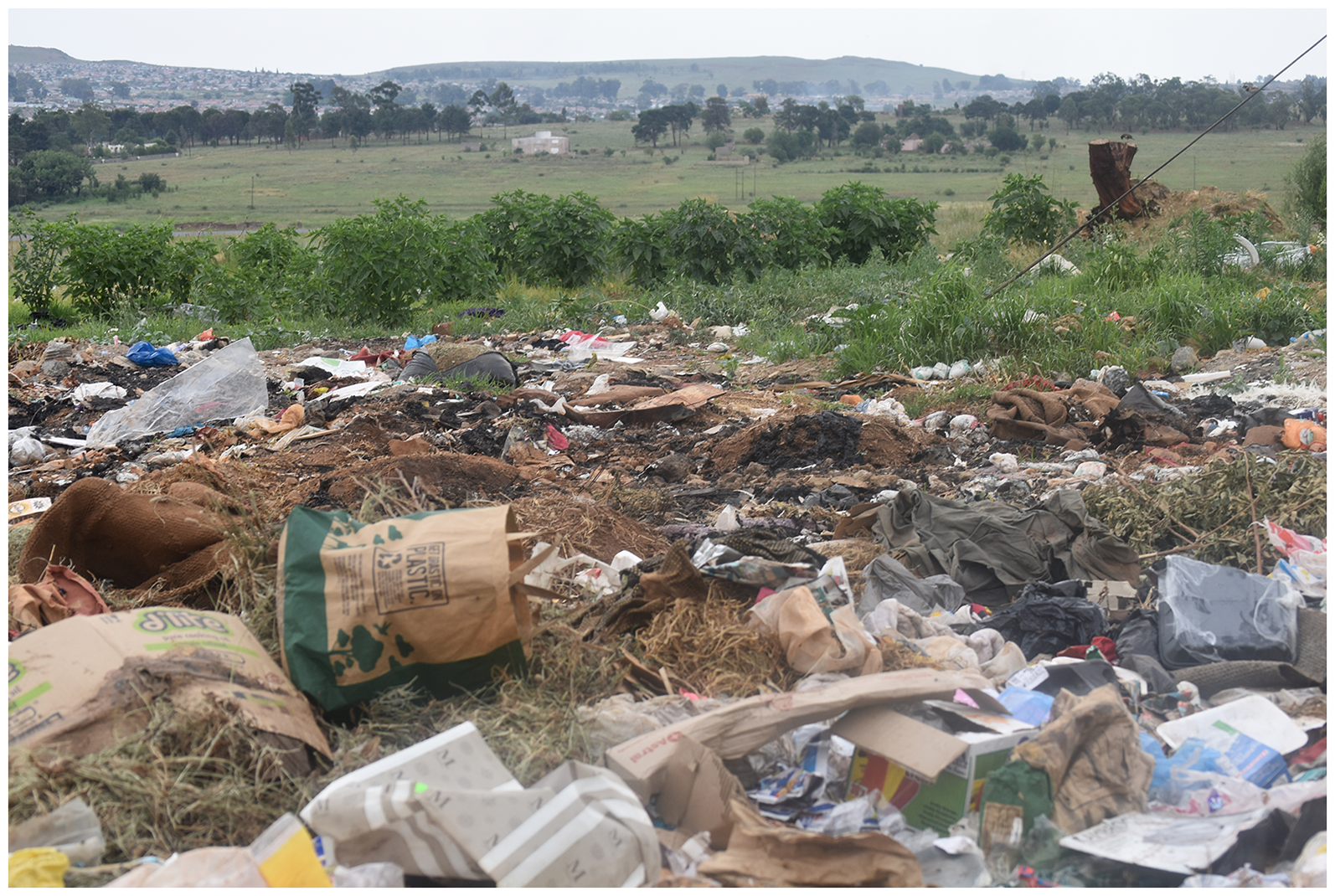
Majazane.
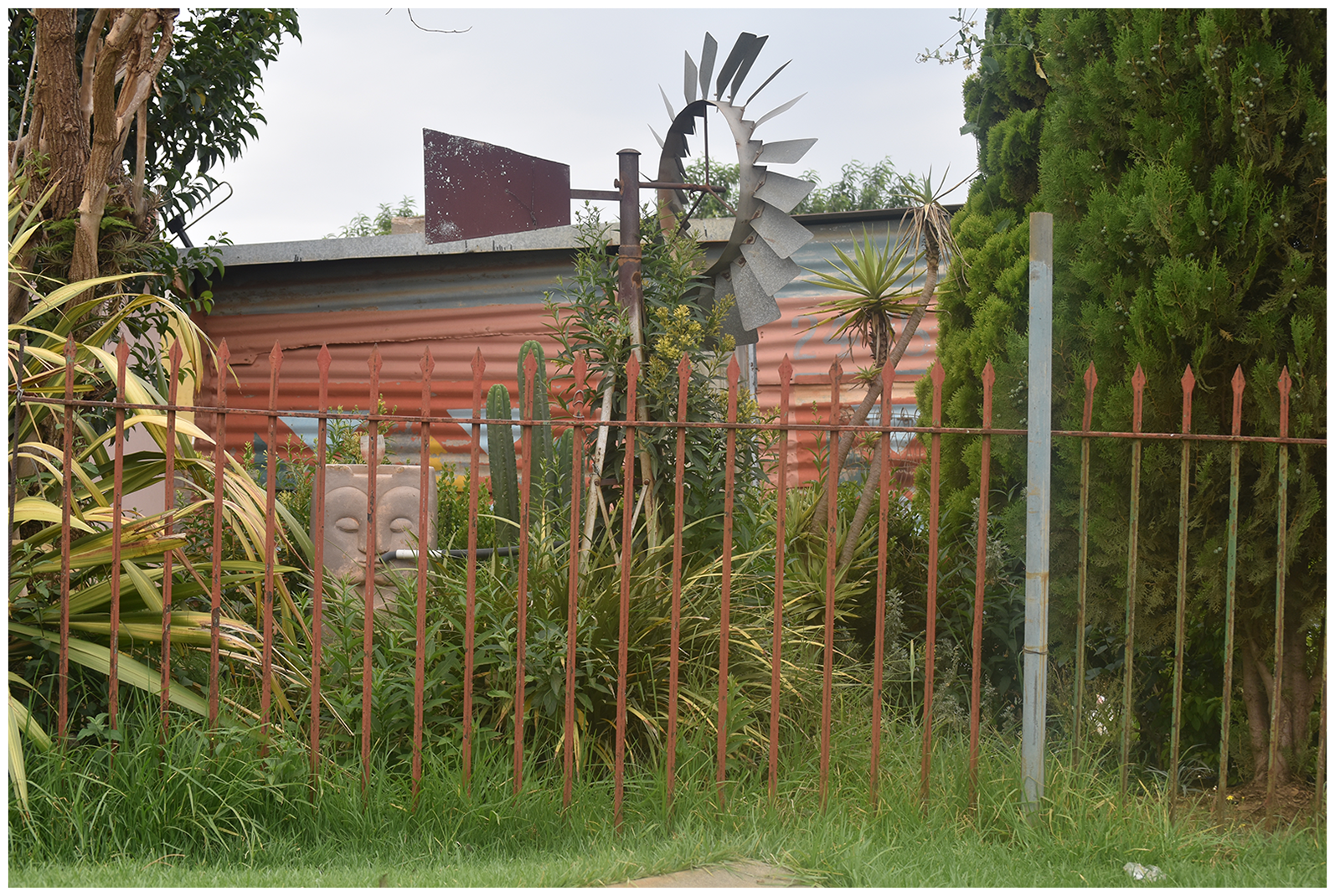
Phumlamqashi.
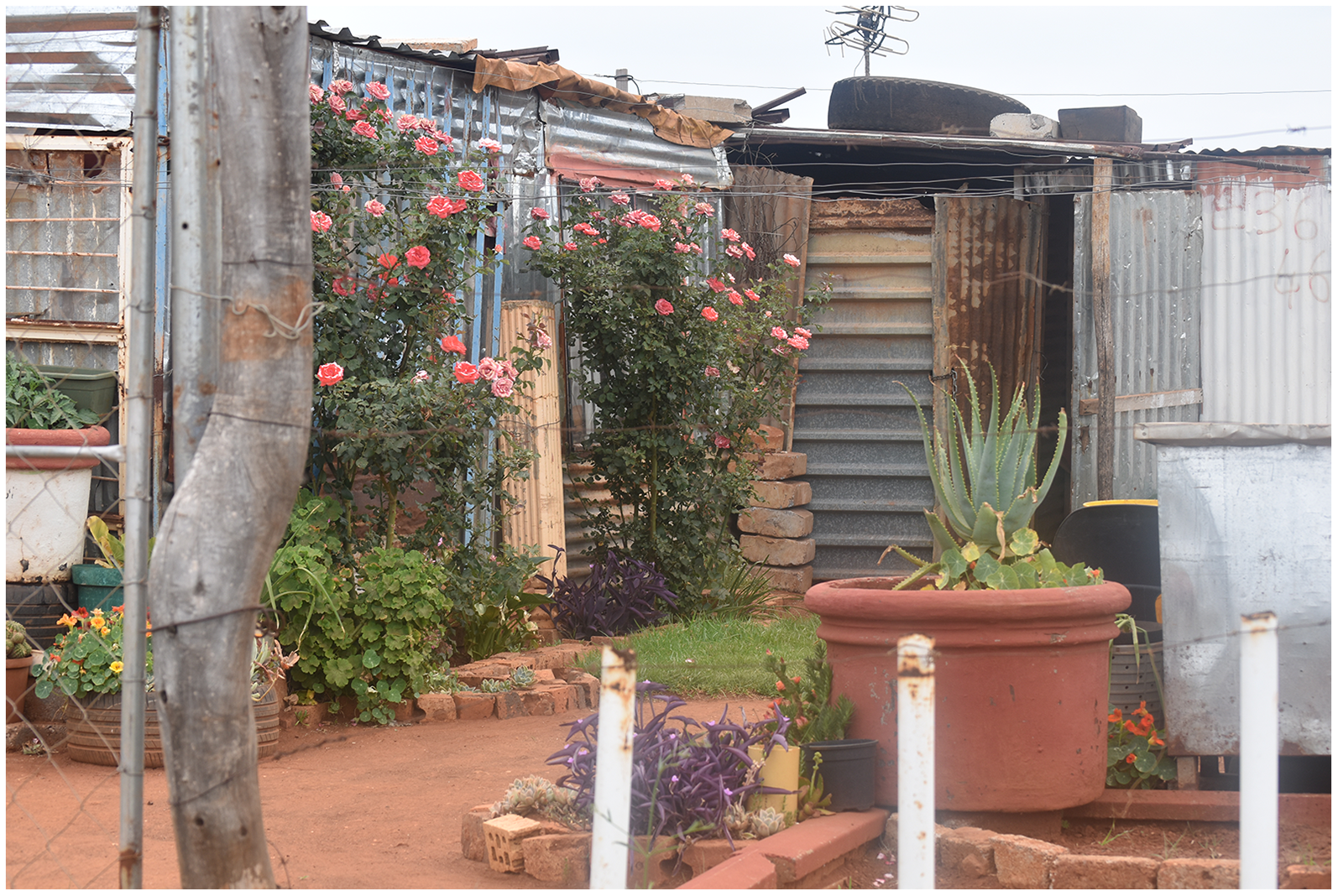
Patsieng.
Figure 2 (Phumulamqashi) and Figure 3 (Patsieng) provide partial views of two homesteads taken from the roadside. The houses are made of zinc iron sheets which index the impoverishment of the inhabitants and the community. However, we insist that the photographs demand a more complex reading than impoverishment. Both houses are decorated with trees and flowers. One of the houses is painted in red paint and has an ornate windmill and a stone sculpture. The second house has a large potted plant and rose bushes in pink blooms frame the modest doorway. We posit that the residents of these homes would be among those whom aunt Bibi would characterise as knowing the value of trees. To this, we might add, the value of beauty presented by plant life. The houses index making home with nature's beauty. In response to McKittrick's (2014) prompt, the photographs suggest that life and beauty are what else happened at the site of death and abandonment.
We used what we found in nature
Indigenous knowledge about plants and their different uses has been passed down through generations. Plant medicine and human society are interwoven through intimate kinship as the plants assume a maternal essence, healing and nurturing the human body. The Earth, as mother, provides the nourishment required to sustain human life, and in turn, Indigenous communities and environmental activists across the globe advocate for the rights of the Earth and the responsibility for humans to provide care and respect (Perdibon and McSherry, 2023). Perdibon and McSherry (2023) offer a disruption of normative, anthropocentric registers of mothering and suggest an interspecies reading of motherhood by reading Mugwart (Artemisia vulgaris) as an ancestral ‘plant mother’ in traditional European medicine. The uses of plants are plentiful, as food, as medicine, and as agents for cleansing and protection. Plants, therefore, are more than elements for human consumption, but they hold space as mothers, teachers and healers in their own right.
Elizabeth, an older woman from Patsieng, underscored the interspecies relations her community has long had with plant species. She observed: We used traditional remedies to treat ailments. For example, when you’ve got flu, there is a creeping plant called limanamana [succulent dark green creeper] that we boil and drink the concoction. It is a very effective flu remedy. We also had a plant called hlwenya [a tuber scientifically called Asteraceae] it is good for cleaning the blood and helps with circulation and colon cleansing. We never used pills. We used what we found in nature. Even things like fish oil, I only became aware of it when I started working for the Indians. We used to make a certain type of soap using cow fat. That creamy cow fat. They would put some chemicals together with it and boil it in a large pot. The soap was foamy, and we were amazed at what has been done. All these plants are no longer available. People have removed them and built their houses. Even up there, there was a lot of mhlonyane [African wormwood or artemisia afra, a traditional plant that has been widely used to treat a range of flu-related conditions]. It's all gone now. We didn’t even plan our births. You would wake up and go to work, then tomorrow you’ve given birth to a child. And people would be surprised because they saw you at work just yesterday looking fine, and not having birth pains. We are now in the modern era. Those remedies and practices have disappeared. Now we go to the clinic for every ailment and take pills. (Elizabeth, 11 October 2023)
The preceding photograph (Figure 4) of various shrubs including herbs which flourish along the Klip River wetland as well as Elizabeth's lament of the diminished herbal plant life to cure illness both reference a more-than-human and human kinship and alongness. Elizabeth reflects not just on the loss of plant life in Patsieng, but also surfaces the indigenous knowledge and practices that were embedded in everyday life in the Black outdoors. The existence of herbs captured in the photograph, however, belie Elizabeth's narrative of disappearance. After sitting with Elizabeth, we came across what was described to us as a ‘herb plantation’ belonging to an elderly man in the community. This is not to challenge her assertion of the adverse effects of modernisation on the preservation of ancestral-natural world reliance; however, it does point to the ever-present possibilities of renewal and regrowth even in the face of putative disappearance.
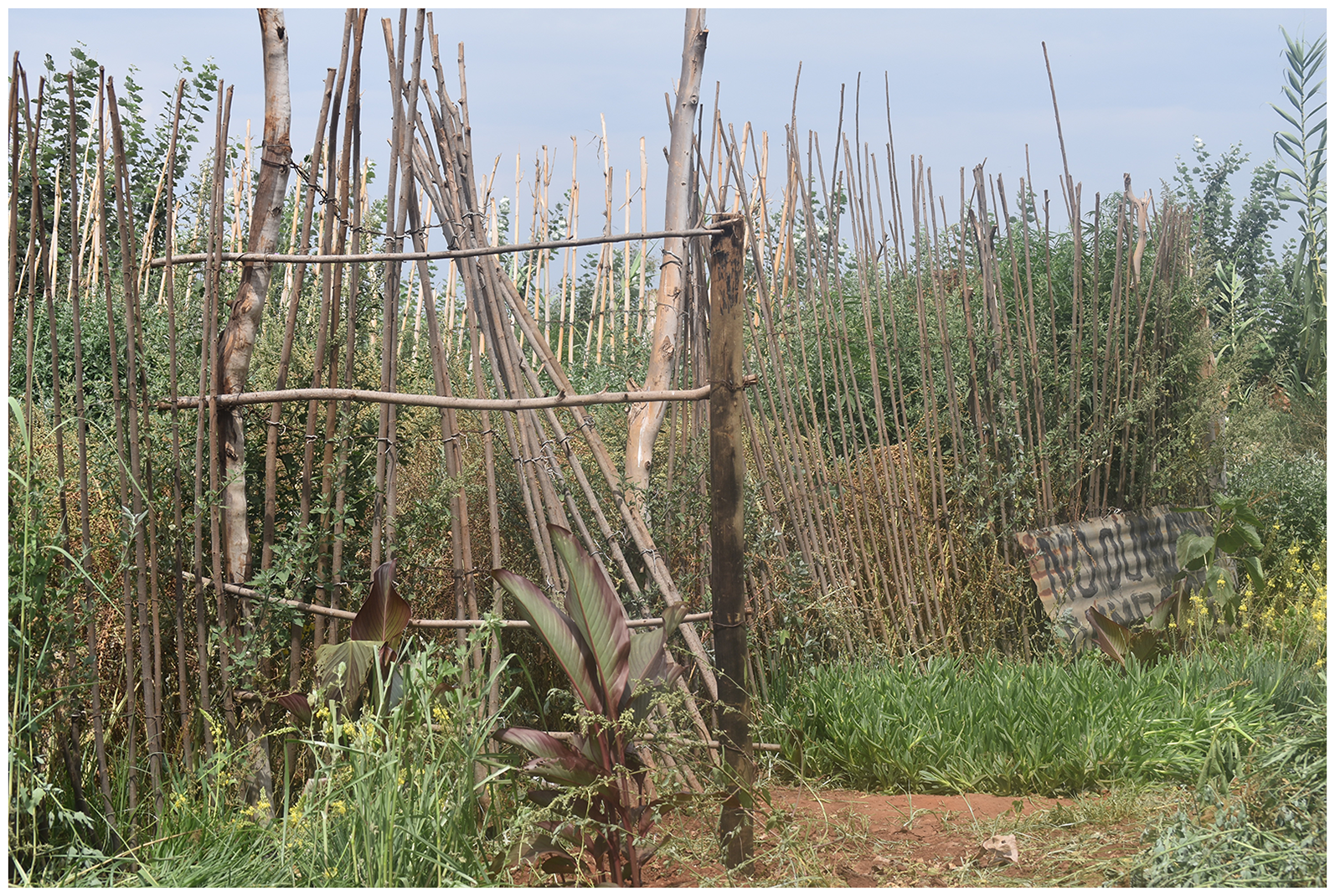
Patsieng.
In the context of a world that prioritises Western, biomedical perspectives on healing and well-being, the awareness of plants and their uses has become subjugated knowledge that is primarily shared through oral traditions. Just like Elizabeth, many African women located in these zones of abandonment grow up knowing the uses of plants, as it is part of their day-to-day living. In Tamale's (2020) view, this is an Afro-ecofeminist knowledge and practice. These knowledges and practices are held sacred by traditional healers, herbalists, and diviners who receive ancestral guidance on how to use this knowledge. Beyond the uses of plant medicine for flu remedies, Elizabeth reminisced about how community members barely made use of Western medicine. Instead, they relied on Indigenous and ancestral knowledge to care for women before and after pregnancy. Based on her work with Indigenous midwives, Motsei (2023) calls Africans to remember the power of ancestral wisdom, keeping in mind that kitso e mo mading, which is Setswana for knowledge is in the blood. This implores us to hold onto Indigenous knowledge systems and practices that have been transmitted through ancestral lineages, through the active telling of this knowledge, and the messages that we may intuit from the whispers and synchronicities communicated by the cosmos.
Across the various informal settlements, many of our interlocutors were older women. This is not coincidental since across the African continent, it is women who assume the roles of guardians of the land since farming is often dependent on them (Kelleher, 2019). The destruction of land (through deforestation) results in emotional/spiritual turmoil, and the loss of resources and status for these African women (Hunt, 2014; Njwambe et al., 2019; Olalekan et al., 2019). It is this knowledge that haunts Elizabeth when she considers the decline in reliance on plant life for healing. Her lament is an ancestral sorrow. However, even as she complains, she transmits knowledge. Our responsibility is to amplify her cry through an ethic described by Abbott. ‘Inquiring and writing honestly and openly within a framework of metaphysical relations with nature embodies and (re)news ancient ways of knowing that are vital to responsibly shifting the paradigm of human progress and anthropocentric treatment of the Earth and its inhabitants that have resulted in irrevocably dire ecocide, and climate crises’ (Abbott, 2021: 1060). In listening to the stories of older women and reading photographs of quotidian life, we surface some of the ways of knowing by attuning to the knowledge imbedded in indigenous practices, the intergenerational wisdom and transformational qualities of plant material.
Like trees, animals open vistas into deeper planetary histories. For instance, like Bennet's (2020) contention about animal–Black people relations through his reflections on once both being property during slavery, animals remind us of this kinship of exploitation. While Figure 5 of the mule-drawn cart does not tell us about the quality of the relations between those on the cart and the mule, through our human subjectivities, we might intuit that a history of shared exploitation might engender care. After all, those on the lower rungs of the chain-of-being, are structurally locked into positions of abjection. In the Black outdoors, the photograph raises possibilities of care. We suggest that this is true for the photographs of zinc-iron homes surrounded by bright rose blooms. They suggest that beauty and the creative impulse are ways of surviving and thriving in the Black outdoors.
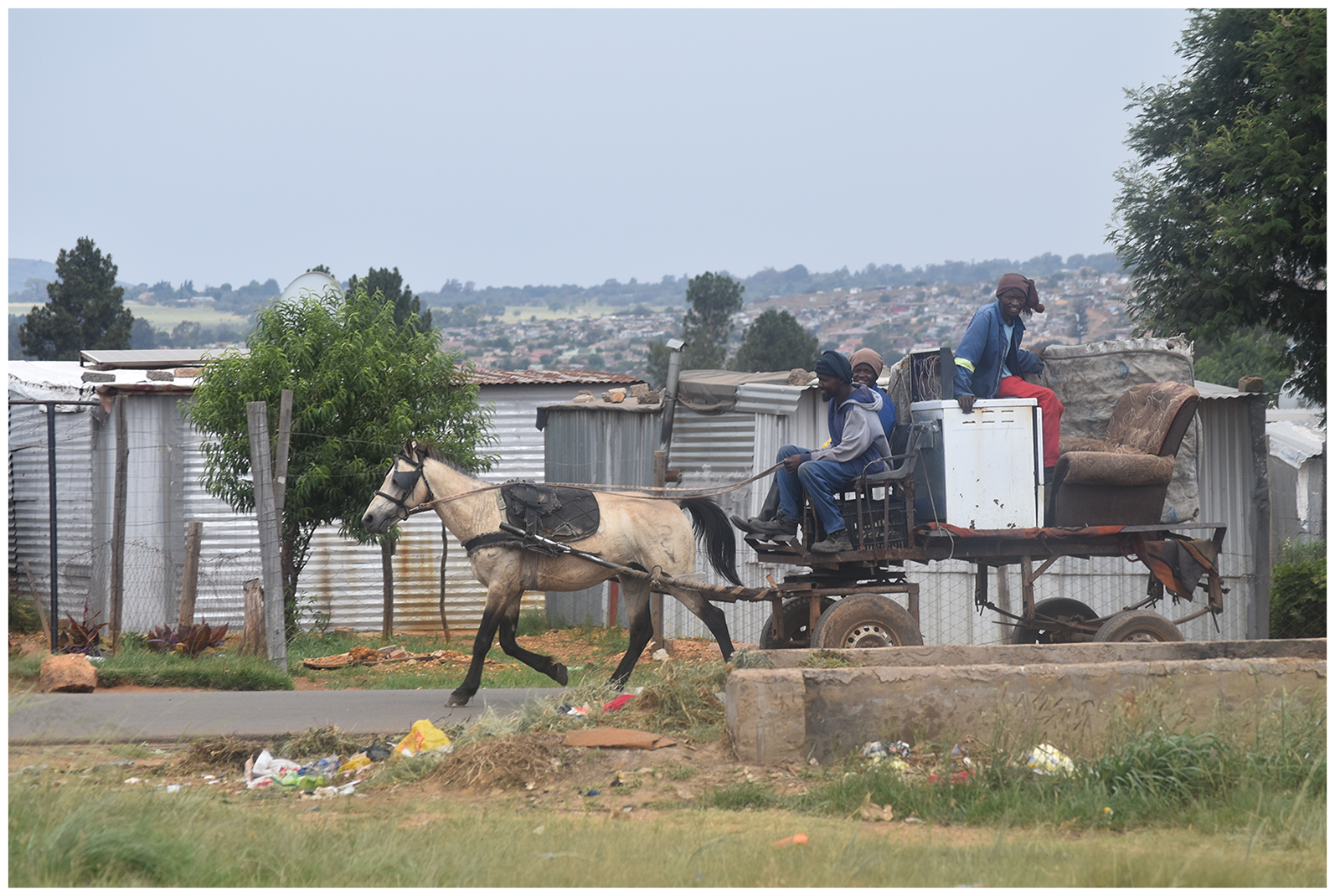
Phumlamqashi.
Beneath the reeds are underwater worlds
While many sites in the natural world are spaces of spiritual cosmologies, on the African continent, water bodies are the most common spaces of spiritual and ritual practice (Shefer et al., 2023). In addition, water bodies are generally considered to be the site where ancestral spirits reside and from where they intercede in the realm of the living (McGarry, 2023). It is here that spiritualists, diviners, and healers work. The members of the communities that we engaged, spoke powerfully about the sentience of water. Mduduzi from Phumlamqashi is an apt representative of how communities think with water and echoed the stories of residents about spiritual entities and practitioners who resided in the communities near rivers and wetlands. Speaking about his orientation to the cosmological world, he contends: I am a person who loves to communicate with the universe. When I wake up in the morning, I just look up to the sky and communicate. I do that again when I walk out and communicate with my plants and with the land because there are many spiritualists and sangomas who live around here. We can’t interfere with nature, but I can try to blend in with it … Everything is going up, things are expensive. Since I arrived here, I have been eating food from the soil. So that is one of the things I love about this place, it has given me a lot of things. As we speak, I have potatoes, some other vegetables, and a peach tree. So, I interact a lot with the environment. I pray. I meditate … And when I started meditating, I found myself shaking and my aura being cleansed. I could feel the vibe radiating out of my small shack. But my personal challenge here for me in Phumlamqashi, it's hard because I feel the universe … I am fighting the kingdom of the water here … Where we are right now, there is water underground, there are snakes [water spirits] all the way to the Vaal. This is their area. That's why the rain has stopped. It was raining just now, but it won't rain to the extent that this whole place is wet. Why won't it rain? Because the water spirits are refusing. When they want it to rain [extreme rain], you will see what will happen here… From the reeds near Majazane, there are snakes there. There is a body of water here … You must know that reeds represent something. Where there are reeds, there is an underwater world. Therefore, where there is an underwater world, there is a keeper of that place. These things can have a cultural meaning, but the way I’m speaking of it, it's a place for snakes. Not the snakes that you are thinking about, but spiritual deities. These are water spirits that can aid people in accessing their spiritual gifts. If you have an ancestral gift or if your family believes in ancestors, you must know that you are part of those snakes because they are in charge of channelling those gifts on earth. All the orders that happen, even the president, whoever is ruling, even these people who were calling the shots here, they get their power from these spirits because you cannot have power here without communicating with them … You need to connect so that they can hear you. If they want something, you do it for them and then your things will go well in this space. So those are the things we are facing. There are keepers of this land. (Mduduzi, 12 October 2023)
We pair the excerpt from Mduzuzi's account with a picture of the wetland that snakes through the Kokotela (Lakeview) settlement. In Figure 6, the mysticism of the reeds and the illuminated opening of water makes it possible to imagine an underwater world. As a sentient presence in the landscape, the water spirits give meaning to those who live in relation to the wetland and its waters. Importantly, the theoretical formulation of the Black outdoors characterised by constant strivings for freedom, resonates with the possibilities opened by alternative worlds which may be found under the water. Although living in ruderal ecologies, Mduduzi's cosmic worldview is larger than what we see. Adjacent to his home is a wetland whose reeds are a portal which signifies other worlds that control our destiny beyond racial capitalism.
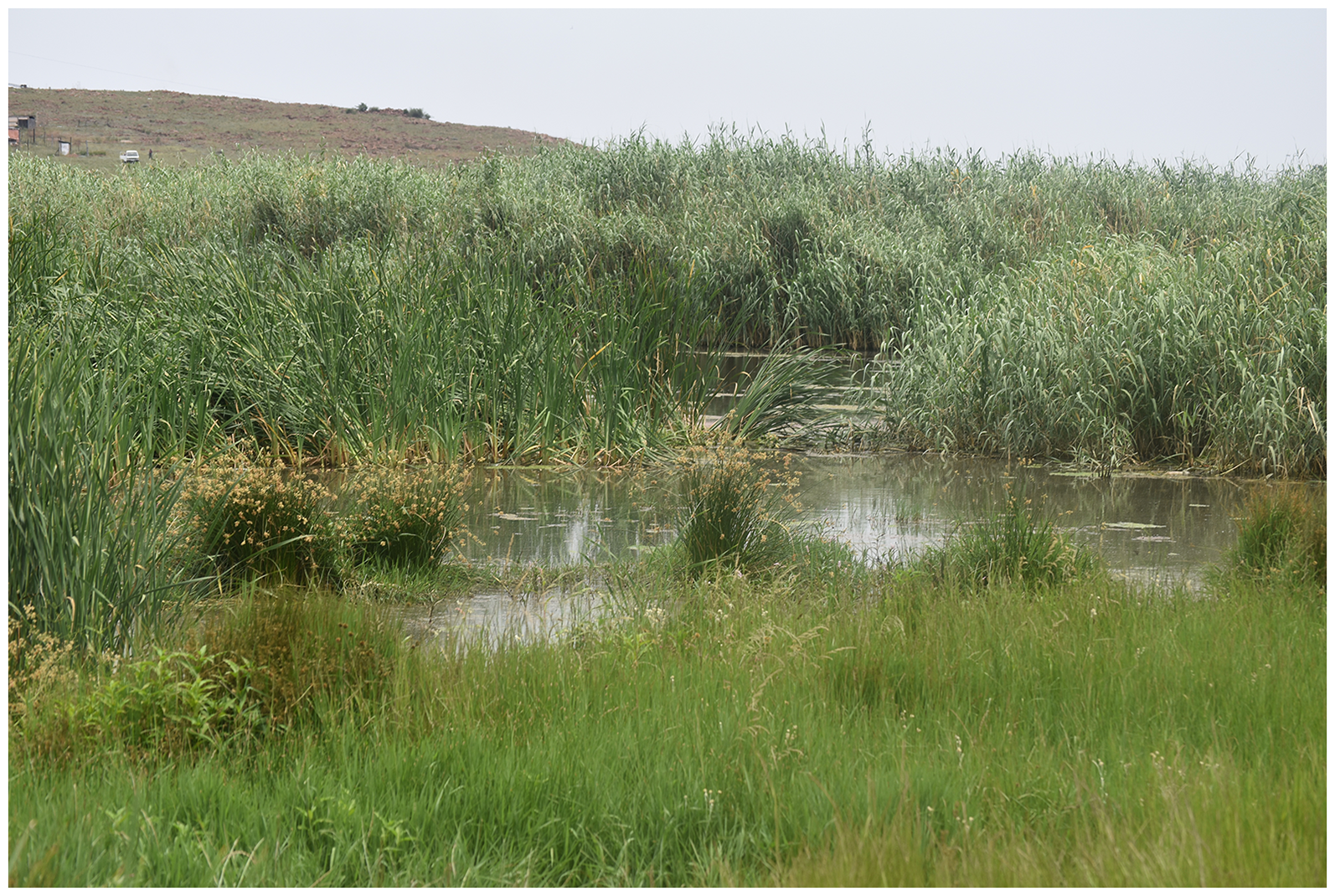
Kokotela (Lakeview).
In Figure 6 of the wetland in Kokotela (Lakeview), the wetland functions as a habitat for organisms living above the water, within the reeds, and below the water. Since it also houses cosmological worlds that may not be visible to the uninitiated human eye, the wetland does more than house the creatures of the land and the water. We come to these insights through Campt's (2017) method of attending to quiet and quotidian features of photographs. To attend this way is to see beyond the image. Even as the image appears quiet, it is not silent. It vibrates in the frequency of quiet (Campt, 2017). Therefore, looking at the photograph of the wetland, we might hear the wind rustle through the reeds. Below the still surface, we can imagine the worlds and spectres that constitute the depths of the photograph. In addition to the important work of filtering ecosystems, Austin (2007) suggests that wetlands are also gateways or portals to other worlds. As Mduduzi states in the excerpt above, reeds growing at water body signal the presence of water spirits. According to Bernard (2003), some Zulu customs see the presence of reeds as representing the presence of divine entities that reside in the water. Reeds are considered sacred and hold significance for those who have undergone initiation to become traditional healers. Diviners use reed mats because of their association with water, healing, and creation (Bernard, 2003). Other than being responsible for the training and initiation of traditional healers, Bernard (2003) states that water spirits may also aid with issues of fertility and are responsible for bringing rain.
Water is an element that can be used as a medium for meditation, as a purifier, and as a source of power (Blackstock, 2001). Therefore, numerous spiritual and cultural rituals and ceremonies are performed using water. Where bodies of water are respected and have spiritual and cultural significance, people pray by the water and leave offerings to the water as a sign of respect or appreciation. The sea, rivers, and wetlands are considered places of residence for spiritual entities such as snakes and mermaids (Mohulatsi, 2023). On one hand, spiritual entities living in water can cause distress and destruction to those who may be seen as impure or have disrespected the water and the spirits. On the other hand, the keepers of these waters can provide protection and transfer power and gifts to chosen ones who might also be called into a process of initiation to become healers, herbalists, or diviners. To read the wetland running through Kokotela this way, is to cast new light on the interspecies relations that characterise life in informal settlements. Beyond the lens of abandonment and residual waste are thriving worlds made possible by the natural ecologies of the south of Johannesburg.
Conclusion – Interspecies freedoms of the Black outdoors
Considering increasing concerns regarding climate change and environmental justice, efforts to study interspecies relations between human and more-than-human actors are significant to the sustainability of communities and local ecologies. From the field of environmental education, Iheka (2021), Nxumalo (2018), and Rautio (2013) encourage us to be involved in thinking of humans as already existing as part of nature. Proceeding from this injunction, we sought to decentre an anthropocentric view of the study of place by foregrounding ecological interspecies relationships. Our interspecies outlook illuminated the worlds of humans, animals, plant life, natural elements, and cosmic energies attached to place. Drawing on insights from Afro-ecofeminism, Black and Indigenous studies to understand interspecies worlds, we explored three residents’ accounts and read six photographs taken in their communities to surface connections between natural, social, and spiritual entities. Based on our findings, we contend that place-making among impoverished people is often not at odds with the natural ecologies of the environment. Instead, we suggested that quotidian everyday life is characterised by a collaborative multi-species investment in joint survival and reproduction. Rather than framing abandoned Black people as problems, our intervention surfaced how informal settlements are part of a natural ecology of interdependence and mutual co-creation in contexts of precarity. This expands African scholarship on planetary interspecies relations (e.g. Ka Canham and Seedat, 2025; Mhlongo and Canham, 2021; Tamale, 2020) that decentre overdetermined anthropocentric understandings of the world. Ultimately, we observed that Black freedom in ruderal ecologies is implicated in sustaining our natural environment. Multispecies thriving in the Black outdoors is thus inseparable from Black freedoms. In addition to abjection, relation and ecological thriving are ‘what else happened’ in these ruderal ecologies.
Footnotes
Acknowledgements
We would like to thank all the communities that participated in this study and our community partners, Sipho Mqoaba and Bennet Ndzoko.

Compliance with ethical standards
Ethical clearance for the research was obtained from the Unisa College of Human Science Research Ethics Committee and the reference number for this study is 90528980_CREC_CHS_2023
Author contributions
All of the authors read and approved the final manuscript. Professor Hugo ka Canham oversaw the conceptualisation and the design of the study. Relebogile Rasodi was responsible for all activities related to project administration. Relebogile Rasodi, Daniel Radebe, and Sherwyn Naidoo conducted the material preparation and data collection. Relebogile Rasodi and Sherwyn Naidoo wrote the first draft of the manuscript. All the authors were involved in the analysis of the data and the final write-up of the manuscript.
Funding
The authors disclosed receipt of the following financial support for the research, authorship, and/or publication of this article: This study was funded by the Center of Excellence for Black Planetary Studies: 825500, at the Institute for Social and Health Sciences, University of South Africa.
Declaration of conflicting interests
The authors declared no potential conflicts of interest with respect to the research, authorship, and/or publication of this article.