



Abstract
In the face of the genocidal and ecocidal trajectory of climate change and “green” climate change solutions, overcoming the coloniality embodied in energy regimes is of the utmost importance. Because energy regimes are co-constitutive of power structures, energy transitions present opportunities to challenge and transform power structures of domination into more liberatory configurations of power. Through a situated analysis of the Energía para yeknemilis project, which is executed by the Union of Cooperatives Tosepan Titataniske in the Sierra Norte de Puebla, Mexico, we argue that energy transitions can articulate decolonial praxis. Based on eight months of collaborative participatory action research involving a researcher of European descent and the project's team of investigadores comunitaries sentipensantes, we make two contributions to the literature concerned with energy transitions and decolonial praxis. First, we provide empirical evidence to substantiate decolonial critiques of environmental, climate, and energy justice. Second, we propose that the Energía para yeknemilis project challenges the coloniality present in most of the current energy transition discourses and “green” transition projects. To do so, we discuss how the project contributes to constructing an Indigenous-led and rural energy regime oriented towards achieving energy sovereignty and realizing yeknemilis / xatlaan latamaat, which are local articulations of Buen Vivir. We also analyze some of the possibilities and limits to decolonial transformations in the Sierra Norte de Puebla that the Energía para yeknemilis project illustrates to strengthen the project and provide reflections for others struggling towards energy regimes that sustain life and power Indigenous self-determination and flourishing.
Introduction
There is an acute need for decolonial critiques of environmental, climate, and energy justice in the face of the genocidal and ecocidal trajectories of climate coloniality. Most corporate and governmental actors espouse “green” and “just” “solutions” to climate change that rely on the massive deployment of low-carbon infrastructures in ways that rearticulate the colonial, capitalist, and extractivist logics that fuel climate change and underpin hegemonic power relations (Dunlap, 2021; Post, 2023a; Sultana, 2022b). Yet, energy infrastructures are not solely tools of empire and always subject to contestation and potential transformation by counter-hegemonic actors. In fact, such infrastructures are part of “the essential architecture of transition to a decolonized future” (LaDuke and Cowen, 2020: 246).
The conjuncture in the Sierra Norte de Puebla, Mexico illustrates this well. Here, Masewal, Totonac, and mestizo communities have articulated a common regional effort to successfully defend their territories from large-scale renewable and hydrocarbon energy infrastructures, which they refer to as projects of death (proyectos de muerte) (Post, 2022, 2023b). Building on 40 years of organizing a communitarian, anti-capitalist, and solidarity economy through the Unión de Cooperativas “Tosepan Titataniske” (“United we will Overcome” in Masewaltajtol; hereinafter Tosepan) and four years of discussions and dialogues, the predominantly Masewal communities in the Sierra Nororiental have developed a life plan (plan de vida) known as the Códice Masewal (Tosepan, 2021b). The Códice proposes a 40-year strategic territorial plan premised on Indigenous sovereignty, autonomy, and flourishing to realize yeknemilis / xatlaan latamaat, a particular vision of Buenos Viveres (González Rosales and Julián, 2021). Achieving “energy autonomy” and “energy sovereignty”—as distinct from energy justice—is one of the dimensions of the overall strategy laid out in the Códice. The project “Energy for yeknemilis (Buen Vivir) in the Sierra Nororiental de Puebla” (Energía para yeknemilis (Buen Vivir) en la Sierra Nororiental de Puebla; hereinafter Energía para yeknemilis) aims to power the search for yeknemilis / xatlaan latamaat and achieve energy autonomy and sovereignty.
Based on eight months of collaborative participatory action research (Fals-Borda, 1987) involving an academic researcher of European descent affiliated with a North American University and the Energía para yeknemilis project's team of “thinking-feeling” (sentipensante) community investigators (investigadores comunitaries sentipensantes), this article argues that energy transitions can embody decolonial praxis. The team of investigators is composed of Masewal, Totonac, and mestizo persons between the ages of 19 and 60 and from an equal number of men and women as well as from different sexual orientations who belong to the communities participating in the project. Through a situated analysis of the Energía para yeknemilis project, we aim to make two contributions to the academic literature concerned with energy transitions and decolonial praxis. First, we provide empirical evidence to substantiate decolonial critiques of environmental, climate, and energy justice. Second, we propose that the Energía para yeknemilis project highlights six possibilities and six limits to decolonial transformations in the Sierra Norte de Puebla. We identified these opportunities and limits through individual interviews conducted with individuals involved in the project, two afternoons of reflection and discussion sessions, as well as analysis of the sentipensante logbooks (see limit 1) and written reflections by some of the investigators. Initial results were presented during a joint presentation at the 9th International Congress of Critical Geographies Conference as part of the panel “Pluriversalities and energy transitions” (Pluriversidades y transiciones energéticas) in Mexico City, which nourished the results presented below. By bringing these two elements together, we seek to strengthen the Energía para yeknemilis project and contribute to the urgent task of constructing and supporting “autonomous, insurrectionary and postdevelopment energy systems” (Dunlap and Tornel, 2023: 1), serving as an example of a much-needed “insurrection of energy research” (Dunlap, 2023: 340).
The article proceeds by positioning our contribution within the environmental, energy, and climate justice literatures, highlighting the need for research into decolonial energy transitions. The third section briefly sketches how the political conjuncture in the Sierra Norte de Puebla transformed a defense of territory in the narrow sense into the construction of life plans, as illustrated by the Códice Masewal. The fourth section describes the genesis of the Energía para yeknemilis project and how it and its team of community sentipensante investigators fit within the Códice as a life project (proyecto de vida). The fifth section analyzes how the Energía para yeknemilis project illustrates six possibilities and six limits to decolonial transformations. The last section concludes.
Energy, extractivism, and decolonial energy transitions
Energy sustains life. As a result, the capacity to control and channel energy is central to the “domain of the anthropolitical, including biopower, capital, and all its other force clusters” (Boyer, 2019: 14). Geographers are increasingly concerned with how energy regimes are co-constitutive of power relations (Bridge et al., 2013; Bridge and Le Billon, 2017; Cederlöf, 2021; Huber and McCarthy, 2017; Tornel, 2023b). In Underdeveloping the Amazon, Bunker (1985) discusses how the social metabolism of capitalist metropolitan centers requires the continuous and increasing provision of energy, creating thermodynamic center–periphery relationships that are often violently established and maintained through colonial or imperial domination. Coordinated efforts by colonial and imperial agents in collaboration with local elites gave rise to organizing regimes known as extractivisms that enabled energy to flow from peripheries to the metropolitan centers, which proliferated and intensified as the modern colonial capitalist patriarchal world-system expanded and deepened (Brand et al., 2016; Girvan, 2014; Moore, 2017, 2018; Post, 2023a).
Extractivisms operated and continue to operate through colonial patterns of power referred to as “coloniality,” which consists of three mutually constitutive strands: the “coloniality of power” that rearticulates (neo-)colonial social relations and systems of domination; the “coloniality of knowledge” that privileges modern knowledge systems and discounts Indigenous epistemologies; and the “coloniality of being,” the insistence on ontological singularity and universality (Maldonado-Torres, 2007; Mignolo and Walsh, 2018; Quijano, 2014). These strands of coloniality operate through colonialities of nature and gender to radically devalue peoples and ecologies along racialized, gendered, and human supremacy axes of differentiation (Lang et al., 2024; Lugones, 2008), enabling the violent simplification of the complexity and interrelatedness of life in the service of capital accumulation (Alimonda, 2015; Gómez-Barris, 2017; Gudynas, 2021; Leff, 2021). During the 19th century, such violent abstraction underpinned the invention of thermodynamics, which “produced as cosmic truth” the “Western epistemology of energy” (Daggett, 2019: 5; also see, Lohmann, 2021). Wedding thermodynamics and the “discovery” of fossil fuels to imperial projects fueled “an economy of self-sustaining growth predicated on the growing consumption of fossil fuels” (Malm, 2016: 11). Because the structures causing anthropocentric climate change emerged from and co-evolved with these colonial and imperial structures, Curley (2023: 184) writes that “colonial relations begot carbon relations.”
Now that the genocidal and ecocidal consequences of this historical development are undeniable (Intergovernmental Panel on Climate Change, 2023), so-called “decarbonization” has become a priority at the highest (inter-)governmental and corporate levels. Central to “decarbonization” is the “energy transition” from fossil fuels-intensive towards so-called low-carbon energy regimes. This “socioecological fix” fails to address colonial and capitalist logic rearticulating the world-system (Dunlap and Jakobsen, 2020; Fairhead et al., 2012; McCarthy, 2015; Post and Le Billon, 2024). Bachram (2004) and has therefore decried that such “solutions” represent “a new kind of ‘carbon colonialism.’” Sultana (2022b: 3) coined “climate coloniality” to describe the parallel developments of the “hauntings of colonialism and imperialism through climate impacts in the post-colony” as well as the “climate solutions that result in resource extraction and creation of sacrifice zones.” Stressing that “renewable energy colonialism” also occurs in the so-called Global North, Batel and Küpers (2023: 890) “expose the contradictions, impossibilities, and dystopias inherent in the global rhetoric of green transitions.” Considering the structural entanglements between low-carbon energy infrastructures with extractivisms, Post (2022) proposes that these infrastructures require, expand, legitimize, and replicate extractivisms, causing infrastructure violence and rearticulating coloniality. Examples are evident in uranium mining (DeBoom, 2021; LaDuke and Cruz, 2013; Sullivan, 2013), nickel mining (Andreucci et al., 2023), cobalt mining (Deberdt and Le Billon, 2022; Sovacool et al., 2020), lithium extraction (Jerez et al., 2021; Soto Hernandez and Newell, 2022; Voskoboynik and Andreucci, 2021) as well as the construction and operation of wind, solar, and hydropower infrastructures (Alkhalili et al., 2023; Avila et al., 2022; Dunlap, 2018; Howe, 2014; Post, 2023b; Stock, 2022; Tornel, 2023b; Ulloa, 2023). Globally, Indigenous peoples are on the frontlines of this climate coloniality (Curley and Lister, 2020; Sovacool, 2021; Whyte, 2020). Temper and colleagues (2020: 14) identify 278 conflicts over low-carbon and carbon mitigation projects in 40 countries of which 55% involved Indigenous peoples, highlighting that “ongoing dispossession and displacement … is increasingly being justified on climate grounds.”
While initially reluctant to incorporate the potential destruction associated with low-carbon energy infrastructures, more recently the notions of environmental, climate, and energy justice have been deployed to criticize narrow conceptions of the energy transition (Levenda et al., 2021), drawing attention to its implications for distributive, procedural, recognition, and capability dimensions of justice (Schlosberg, 2007). However, this literature has been criticized for not sufficiently considering the intersectionality of race, class, gender, indigeneity, and other differences in the articulation of power structures as well as for not recognizing their roots in Western epistemology and ontology, such as in the notions of justice, the climate, energy, and political representation through the nation-state (Newell, 2022; Sovacool et al., 2023; Sultana, 2022a; Todd, 2016). The literature on environmental, climate, and energy justice generally does not engage with the fundamental problem posed by how energy infrastructures facilitate “infrastructural colonization” (Dunlap and Arce, 2021), which problematizes how infrastructural power is operationalized in “occupying and conquering space, which includes the ‘rolling out’ of bureaucratic and largely non-material infrastructures” of social engineering through participation and cooptation (Dunlap, 2020: 675). Dunlap and Tornel (2023: 2) argue that environmental, climate, and energy justice “dissolve into liberal or authoritarian governance projects predicated on extractivism” when they do not sufficiently engage with these questions and incorporate feminism, Indigenous and anti-racist ideas without a systemic critique of capitalism and the authoritarian use of state power. It is, therefore, crucial to bring insights from decolonial theory and praxis to these debates and place “Indigenous politics, histories, and ontologies at the center” (Dhillon, 2018: 4). Placing these at the center constitutes a form of political ontology in the sense that it “seeks to weave a different configuration of a reality that is in a state of permanent becoming” by “opening up possibilities to further the commitment to the pluriverse” (Blaser, 2013: 26–27). Rodríguez and Inturias (2018: 93) stress that this is a precondition “for more symmetrical conversations about the model of development … the type of solidary economy needed for life, and the participatory political system needed.” Because of this, we choose to center the concepts deployed by Tosepan and Indigenous Masewal and Totonac as well as mestizo communities in the Sierra Nororiental, such as yeknemilis / xatlaan latamaat. This is closely aligned with the call by Escobar (2018: 20) for a political-ontological approach to designing technologies that engages with “existing and potential rationalities and modes of being that emphasize the profound relationality and interconnectedness of all that is.” Applied to decolonial energy transitions, this implies conceptualizing what Avendaño and Bertinat (2024: 179) refer to as “community-based energy” premised on “a cultural transformation in terms of the generation, use and the very concept of energy,” involving “democratization,” popular “participation,” and “local control” so communities can “become active subjects of the energy system” and “rethink energy and associate other dimensions to it that go beyond electricity.” Unfortunately, the critical literature on energy transitions “focuses almost entirely on critique … indicating a crucial need for post-critical research” (Siamanta, 2024: 3). Where critiques of energy transition discourses “offer multiple openings for pluriversal, emancipatory, democratic, autonomous, and bottom-up approximations to energy transitions” (Tornel, 2023a: 2), it is also time to design, construct, and support “autonomous, insurrectionary and postdevelopment energy systems” (Dunlap and Tornel, 2023: 1).
To create a world in which “Indigenous peoples are leaders in energy transitions” (Whyte, 2020: 2), we take inspiration from EZLN (2016: 277) in that “theoretical and analytical work should be collective labor.” It is thus crucial to form collaborations that create and support efforts towards transitioning towards anti-hegemonic energy regimes. Instead of proposing a singular approach for the decolonial transition, we recognize the need to articulate a diversity of views and pathways towards decolonial energy transitions that depart from unique territories, modes of living, knowledge systems, and cosmologies (Escobar, 2017; Garcia-Arias et al., 2024; Kothari, 2020; Kothari et al., 2019). This also implies that due to the unique socio-territory from which the Energía para yeknemilis project was conceived and its aim of facilitating the persistence of a peasant mode of living, it does not necessarily provide insights that can be replicated or applied to other settings, such as metropolitan centers or rural areas in the Global North. Different struggles against energy extractivisms and propositions for decolonial energy transitions can nevertheless learn from and nourish one another, which is why we analyze the possibilities and limits for decolonial transformations that we identify related to the project. Before we present and analyze the project, we briefly discuss the conjuncture in the Sierra Norte de Puebla in which it was conceived in the next section.
From the defense of territory to the construction of Planes de Vida
The Vicente Fox and Felipe Calderón administrations (2000–2012) granted a series of mining and energy generation concessions in the Sierra Norte de Puebla to corporations keen on developing massive extractive infrastructures (open pit mines, fracking, and hydropower dams) that Mexican activists and academics termed megaprojects (megaproyectos) due to their scale and associated socioecological destruction. Faced with mining, hydroelectric, and hydrocarbon projects developed by foreign and Mexican transnational corporations, the predominantly Indigenous population of the region began mobilizing to stop the imposition of what they termed proyectos de muerte from mid-2012 onwards. In the same year of 2012, the first regional “mega assemblies” in “defense of territory” brought together thousands of individuals from throughout the region. Springing from the profound meaning that the Masewal and Totonac as well as the non-Indigenous population in the Sierra Norte attaches to territory, communities in the region articulated their movements in defense of territory and life against the incursion of proyectos de muerte, which together formed a megaproject of death (megaproyecto de muerte). Demonstrating the efficacy of such articulated collective action, they have succeeded in stopping most hydroelectric projects and all metallic mining projects to date (Post, 2022, 2023b) (Figure 1).
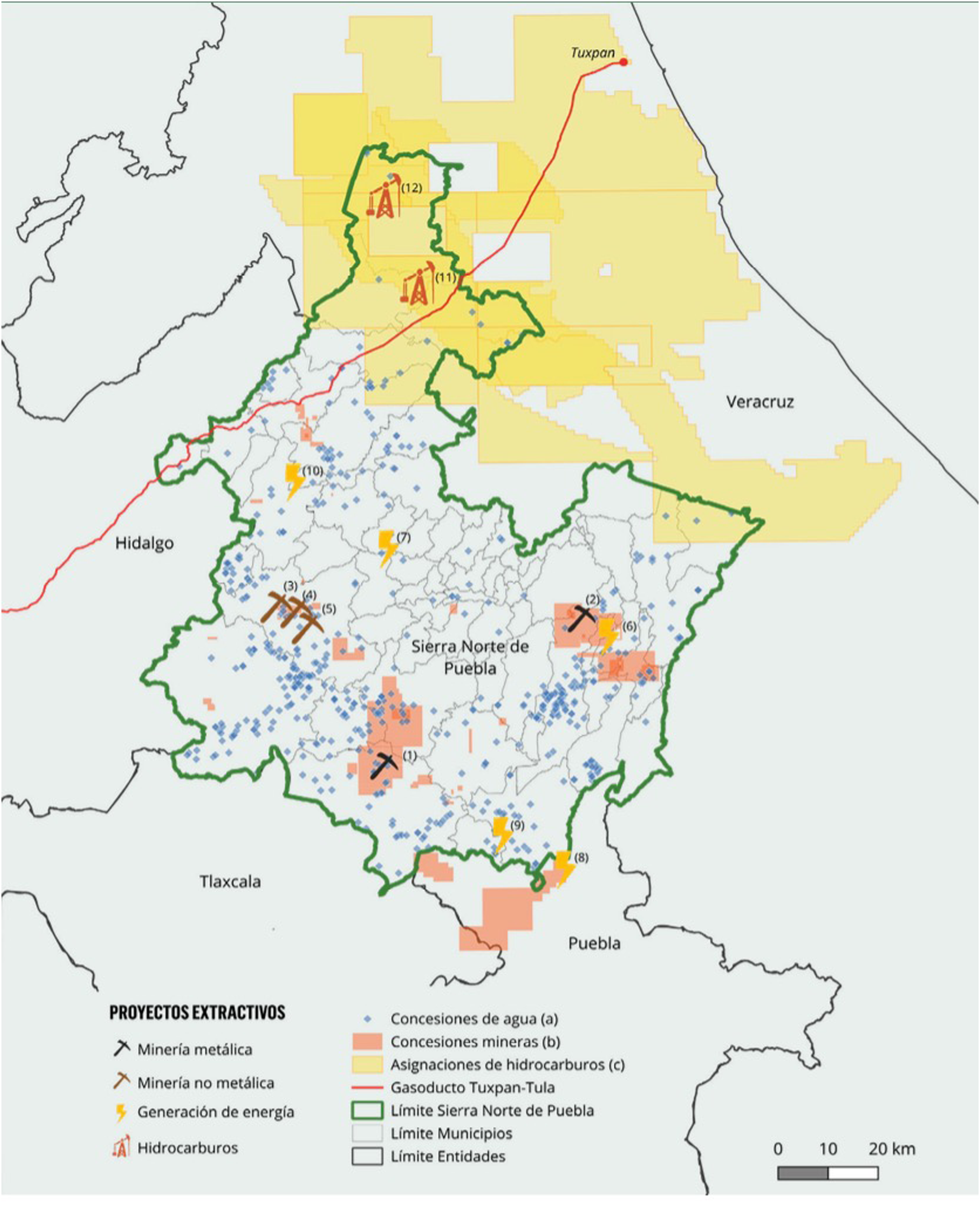
The geographical location of the Sierra Norte de Puebla is demarcated by the bold border, with extractivist projects still present in January of 2023. Mining concessions are designated in rectangular boxes and mining projects with pickaxes: (1) Ixtaca; (2) El Areton, (3) Mina Heraclio; (4) Ecominaralli 1; (5) Ranchito Velázquez; hydrocarbon concessions and 16 active oil fields with drilling rig icons: (12); energy generation projects as lightning bolts: (6) Central Hidroeléctrica Atexcaco; (7) Central Hidroeléctrica Puebla 1 (PHP1); (8) Planta Solar Fotovoltaica Pachamama II; (9) Central Fotovoltaica Cuyoaco; (10) Sistema Hidroeléctrico de Necaxa; and the Tuxpan-Tula gas pipeline in line traversing from West to East (11). Reproduced from Camacho and colleagues (2024: 12).
With the immediate threats averted, a broader agenda of territorial governance emerged in the regional mega assemblies. The declaration of the 31st Assembly mentions this transformation, noting that “we decided to focus our efforts on the construction of our life plans and demonstrate that it is possible to produce life without destruction” (Consejo Tiyat Tlali en Defensa de Nuestro Territorio et al., 2019). In line with this ambition, Tosepan decided in 2017 to draft a Ppan de vida, called the Códice Masewal. The Códice is “a plan for regional flourishing, which substantiates the constitutional right of Indigenous and comparable peoples in the Sierra Nororiental de Puebla to self-determination and autonomy” (Tosepan, 2021b: 6). It defines a strategy through which Tosepan aims to ensure a particular articulation of Buen Vivir in Masewal territories (masewalaltepet) in the coming 40 years (2017–2057). It is the result of extensive dialogues with Masewal, Totonac, and mestizo inhabitants of the territories, a series of workshops, input through assemblies, and inspired by Tosepan's 40 years of experience with cooperative organizing (Cobo et al., 2018). 1
A foundational concept orienting the Códice is yeknemilis in Masewaltajtol and xatlaan latamaat in Liikilhtotonaco—the Masewal and Totonac languages. The Códice describes yeknemilis / xatlaan latamaat as “summarizing ancestral principles and values of community solidarity, spirituality, as an integral part of nature, solidaristic social relationships and economic exchange, as well as those principles arising from the experience of cooperative organization for a non-extractivist economy.” (Tosepan, 2021b: 7). It identifies 10 strategic lines of action towards realizing yeknemilis / xatlaan latamaat, which cannot be reduced to a singular notion or plan of action but results from and through the interplay between fundamental values and the strategic lines of action (Figure 2).
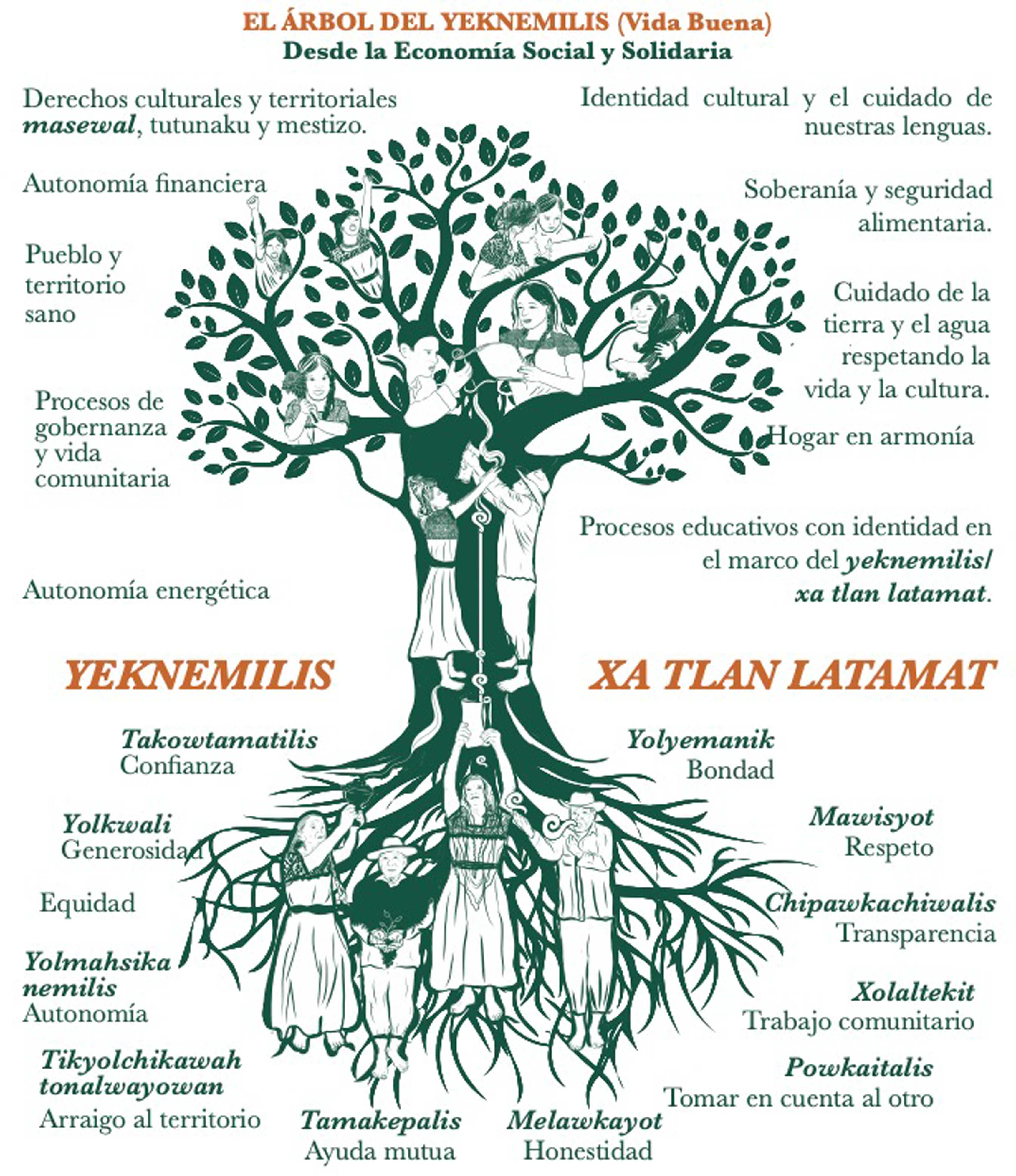
The tree of yeknemilis / xatlaan latamaat. The top half lists the 10 strategic lines of action: (1) Masewal-Totonac territorial and cultural rights; (2) Cultural identity and language conservation; (3) Education with identity and communication about yeknemilis / xatlaan latamaat; (4) good governance and Masewal governance; (5) financial autonomy and economic solidarity; (6) Care of the earth and water: biocultural territorial management; (7) food sovereignty and security; (8) a healthy people and environment: the promotion of health and communitarian food; (9) energy autonomy; (10) home and dignified housing. The bottom half lists 12 fundamental values underpinning and expressing yeknemilis / xatlaan latamaat, clockwise starting top right corner: kindness; respect; transparency; communitarian labor; taking the other into account; honesty; mutual aid; rooted in the territory; autonomy; equity; generosity; and trust. Reproduced as depicted in the Códice Masewal (Tosepan, 2021a: 47).
As part of this interplay, the Códice declares that “one of the important components of the autonomy and economy of yeknemilis is energy sovereignty in the Masewal territory … energy autonomy required for the homes and small-scale industry in our territory” (Tosepan, 2021a: 42). The next section details how the Energía para yeknemilis project and team of community sentipensante investigators contribute twards realizing energy sovereignty and autonomy.
Energía para yeknemilis as proyecto de vida
Just as the construction of planes de vida was born out of the defense of territory, so was the Energía para yeknemilis project. In 2016, the Ministry of Environment and Natural Resources (Secretaría de Medio Ambiente y Recursos Naturales: SEMARNAT) approved the construction of a high-voltage line that would run between the municipalities of Ayotoxco de Guerrero and Cuetzalan del Progreso. In the latter municipality, the Federal Electricity Commission (Comisión Federal de Electricidad: CFE) also contemplated building an electrical substation.
In response, the Assembly in Defense of the Territory and for Life expressed its opposition to these proposals in 2016 due to their entanglement with extractivist projects in the region, such as hydroelectric plants, open-pit metal mining concessions, and hydrocarbon extraction through hydraulic fracking. On the anniversary of the Mexican Revolution on 20 November 2016, the Assembly decided to begin a sit-in protest at the intended site of the substation. The protest turned into a permanent territorial occupation that lasted about 10 months, until the Cuetzalan municipal council denied the change of land use and construction licenses. During the occupation, participants reflected on the generation and use of electricity, which led to a first experience with a small-scale photovoltaic system to provide electricity to the occupation camp using photovoltaic cells. Building on this experience, Tosepan next installed nine photovoltaic cells to power its Center for Indigenous Learning Kaltaixpetaniloyan (“the house where the spirit opens” in Masewaltajtol) (Figure 3). Tosepan's credit and savings bank Tosepantomin as well as the cooperative's eco-tourism hotel Tosepan Kali were also fitted with an interconnected system of 30 panels and a hybrid system of 20 panels, respectively.
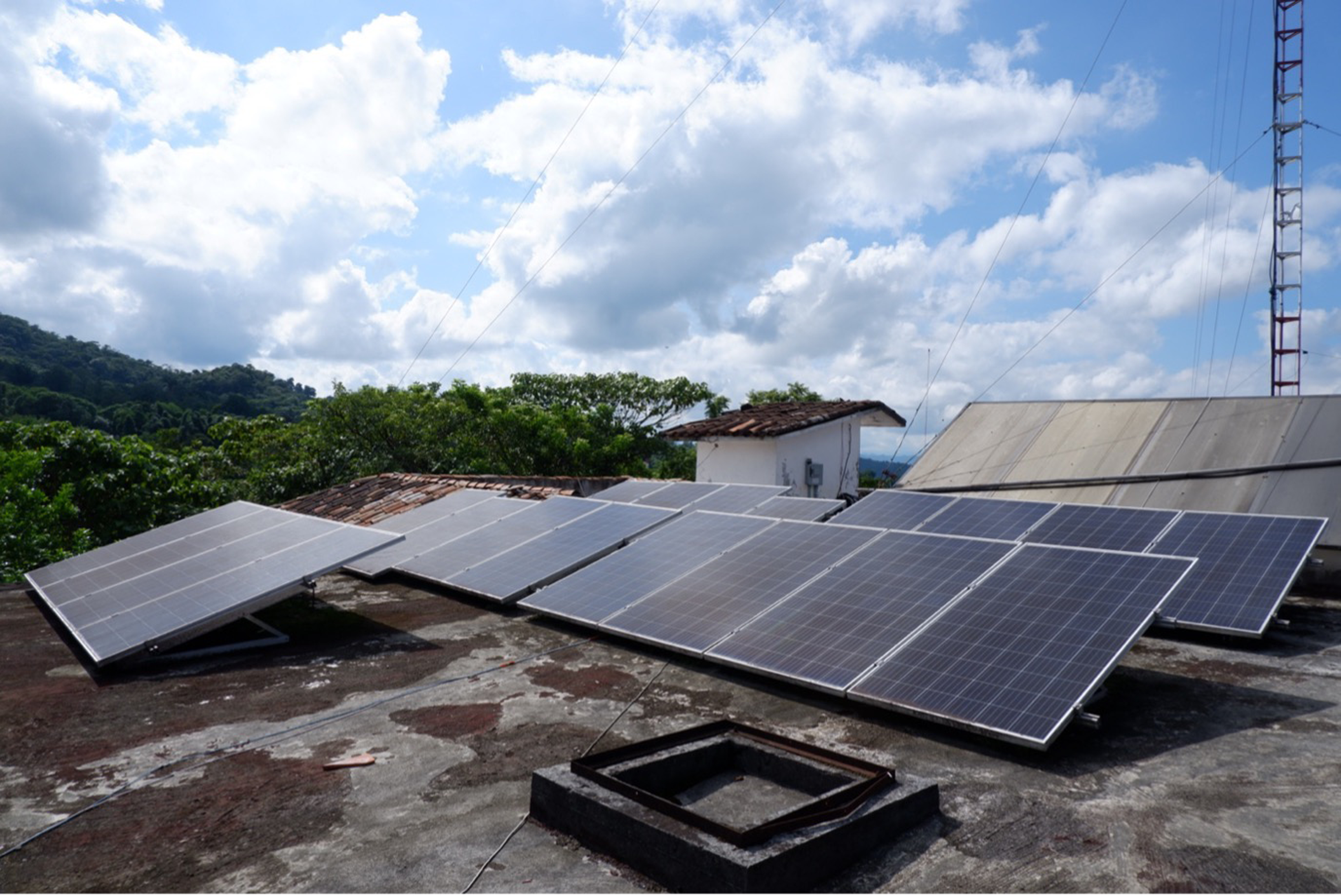
The autonomous system of nine photovoltaic cells on the roof of Tosepan's Kaltaixpetaniloyan. Photograph by authors.
The “seed phase”
In accordance with the mandate granted by the Assembly and the “energy sovereignty” strategic line of action of the Códice, Tosepan gathered a host of collectives and organizations as well as researchers and teachers who identify with the territory and whose activities are focused on energy sovereignty and autonomy. Taking as a guiding principle the horizontality between the participating communities and the researchers’ collectively, an intercultural, interinstitutional, and interdisciplinary team was formed to design and develop a research project. One of Tosepan's civil associations, the Tosepan Foundation, presented this pilot project, which was initially called “Democratization of energy,” to the National Council of Humanities, Science, and Technology (Consejo Nacional de Humanidades, Ciencia y Tecnología: CONAHCYT) for its 2021–2024 call for projects investigating “transitioning towards socially and environmentally sustainable energy systems” (CONAHCYT, 2021).
CONAHCYT awarded funding for a “seed phase,” which was executed from March to November 2021. The seed phase consisted of workshops, surveys, interviews, and ethnographic observation in Masewaltajtol and Spanish to allow for communities’ collective reflections “from a broad and integral perspective on energy in our territory” and its presence in everyday life, departing from the premise that “the earth, the sun, wind, and water are living beings, who have to be asked for permission if we wish to use them” (Tosepan, 2022: 2–3). These exercises of collective knowledge generation took place in five communities: Reyeshogpan, Yohualichan, Xocoyolo, Taxipehual, and San Antonio Rayón. It was during these discussions that “it became evident that for the community it made more sense to talk about yeknemilis or good living, instead of concepts such as democratization, sovereignty and security” (Fernández et al., 2023: 126). Because of this, the project was renamed to Energía para yeknemilis. The information provided by families from the five participating communities was used to document the five most important everyday activities for which families used energy (Figure 4).
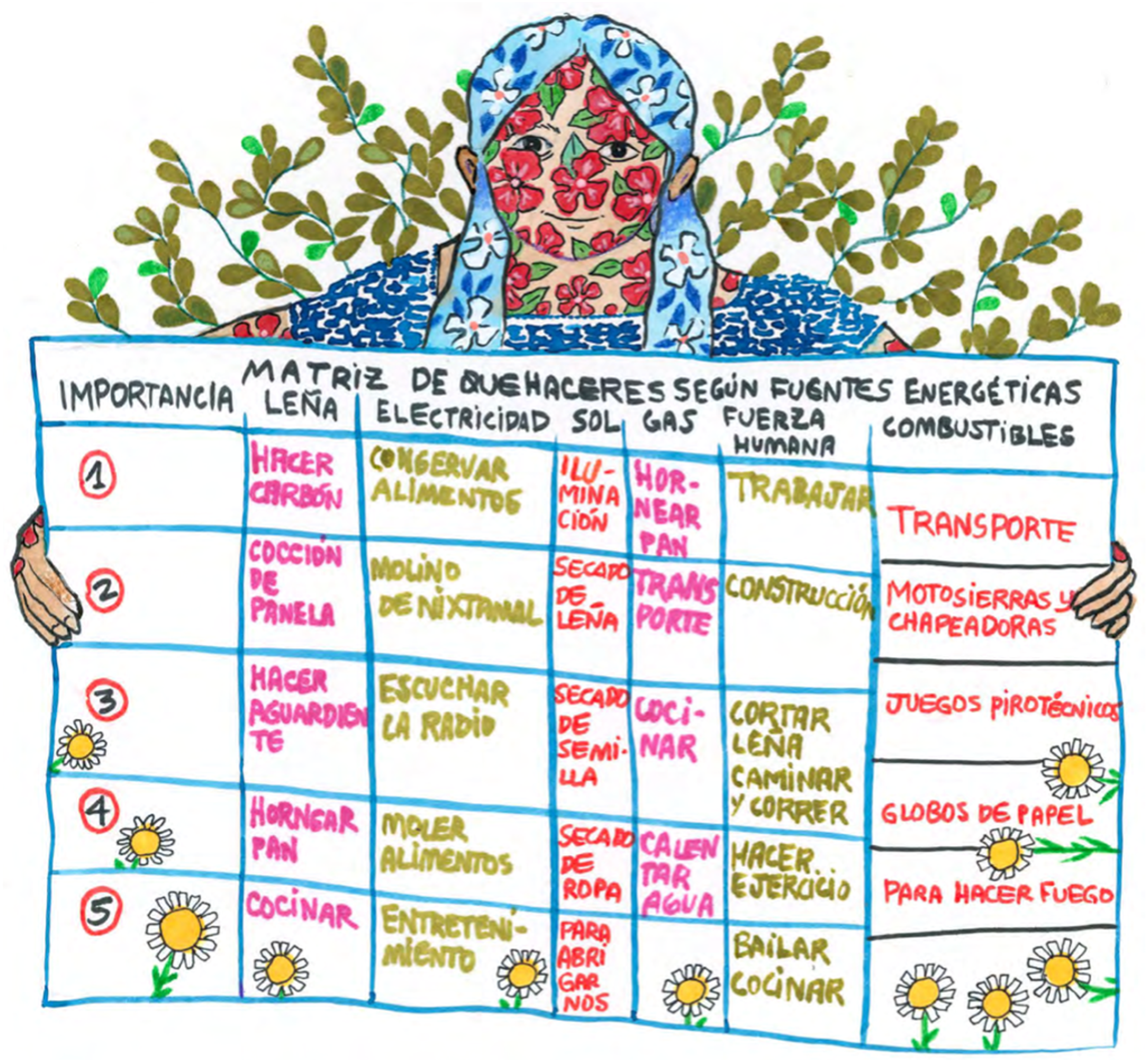
A table listing the five most important everyday uses of distinct forms of energy, which for wood are the making of carbon, baking of panela (cane sugar), distilling of aguardiente (spirit), baking bread, and cooking; for electricity are conserving of foodstuffs, milling of maize, listening to the radio, grinding and blending of foods, and entertainment; for sunlight are illumination, drying firewood, drying seeds, drying clothes, and feeling comfortable; for gas are baking bread, transport, cooking, and boiling water; and for diesel and gasoline are transport, chainsaw and bushwhacker, fireworks, paper wish balloons, and igniting fires. Image reproduced from Fernández et al. (2023: 122).
Continuation and expansion of the project
The seed phase culminated in a three-year project funded by CONAHCYT. Four of the participating communities agreed to continue with the project while two additional communities, whose population principally identifies as Totonac, were invited to join: Bibiano Hernández and San Felipe Tepatlán. The project has as its principal aim “building a different way of managing energy in our territory, in accordance with our cosmovision and ways of life as Indigenous peoples and that contributes to yeknemilis” (Tosepan, 2022: 4). To achieve this, the project has advocacy and research objectives. It seeks to advocate for the self-determination of Indigenous and comparable peoples through initiatives that depart from their cosmovisions, conceptions of energy, territoriality, and modes of living. In terms of research, the project facilitates dialogue between traditional and techno-scientific knowledge systems with an emphasis on the participation of young people and gender equality to propose an alternative energy regime that harnesses locally available forms of energy to sustain and enhance a peasant mode of living.
While the project investigates what the most adequate technologies would be for such an energy regime, the working groups developed with the communities “stress that the alternative model must respond not only to techno-economic processes, but also to social and community processes” (Fernández et al., 2023: 129). Because of this broader vision of energy transition, the project does not solely focus on a technological shift but also includes dimensions that can be summarized as follows:
Characterize the use of energy from the local level, reflecting on concepts such as energy and energy poverty. To innovate social technologies based on local experiences and knowledge. To promote local capacities to reflect on communitarian energy. Promote the creation of social enterprises and cooperatives that work on energy with a solidarity economy approach. To analyze and propose public policies on community generation. Design the Center for Learning, Technological Innovation and Local Energy Management.
Community sentipensante investigators
Tosepan formed a team of community sentipensante investigators in August 2023 (Figure 5), who after a brief education became responsible for designing the social technologies based on local experiences and knowledge as well as for the creation of the Center for Learning, Technological Innovation and Local Energy Management. It was during the educational formative phase that one of the authors entered into a collaboration with the community sentipensante investigators, contributing to their education through lectures, workshops, and dialogues.
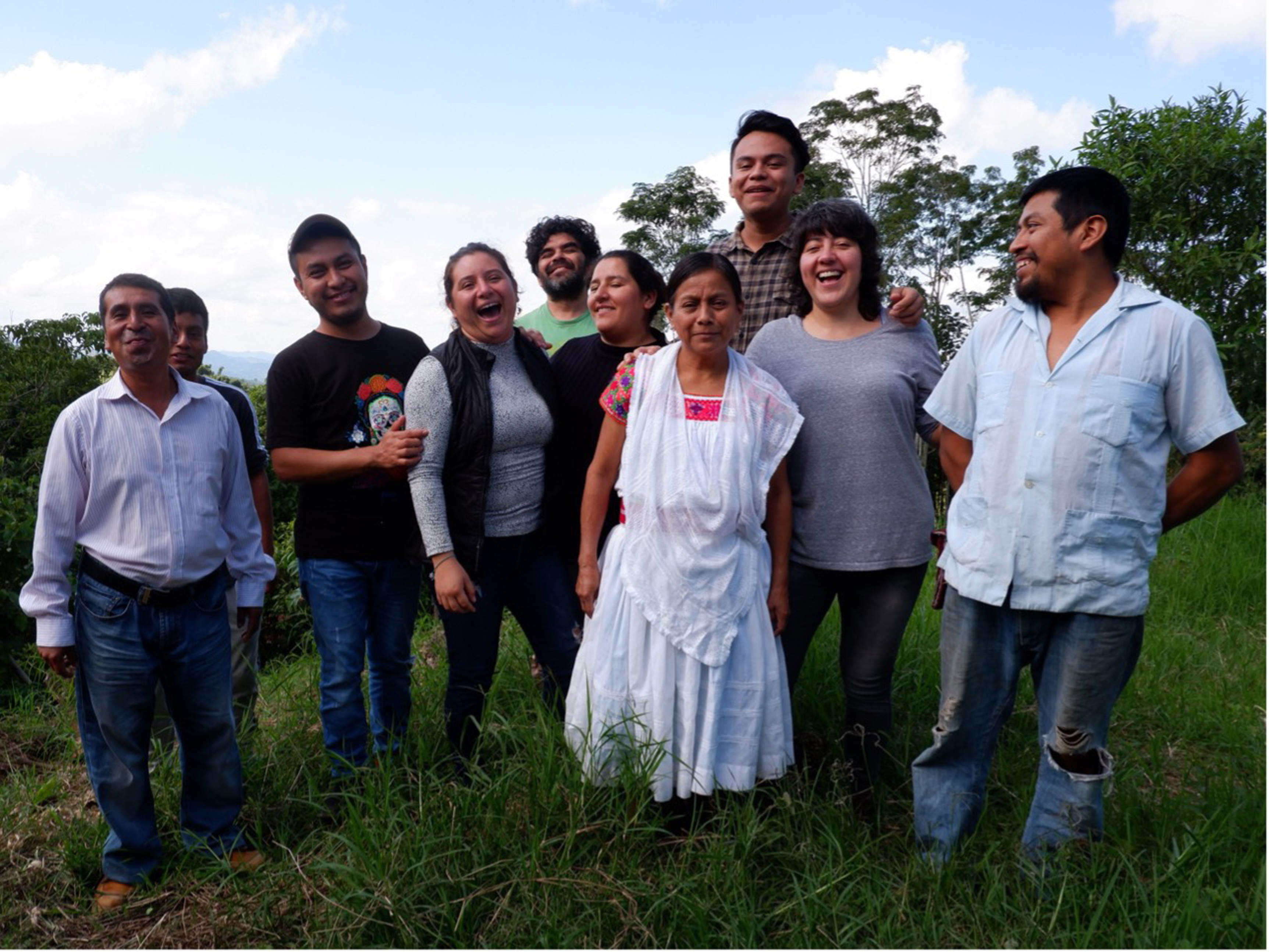
Team of community sentipensante investigators. Photograph by authors.
The team conducted technical-scientific tests and community visits during which they established collaborations with over 20 families to co-design and pilot social energy technologies. These include eco-efficient wood-saving stoves, sunlight and hot air-powered drying chambers, and so-called anthropo-machines that use human energy (Figure 6).
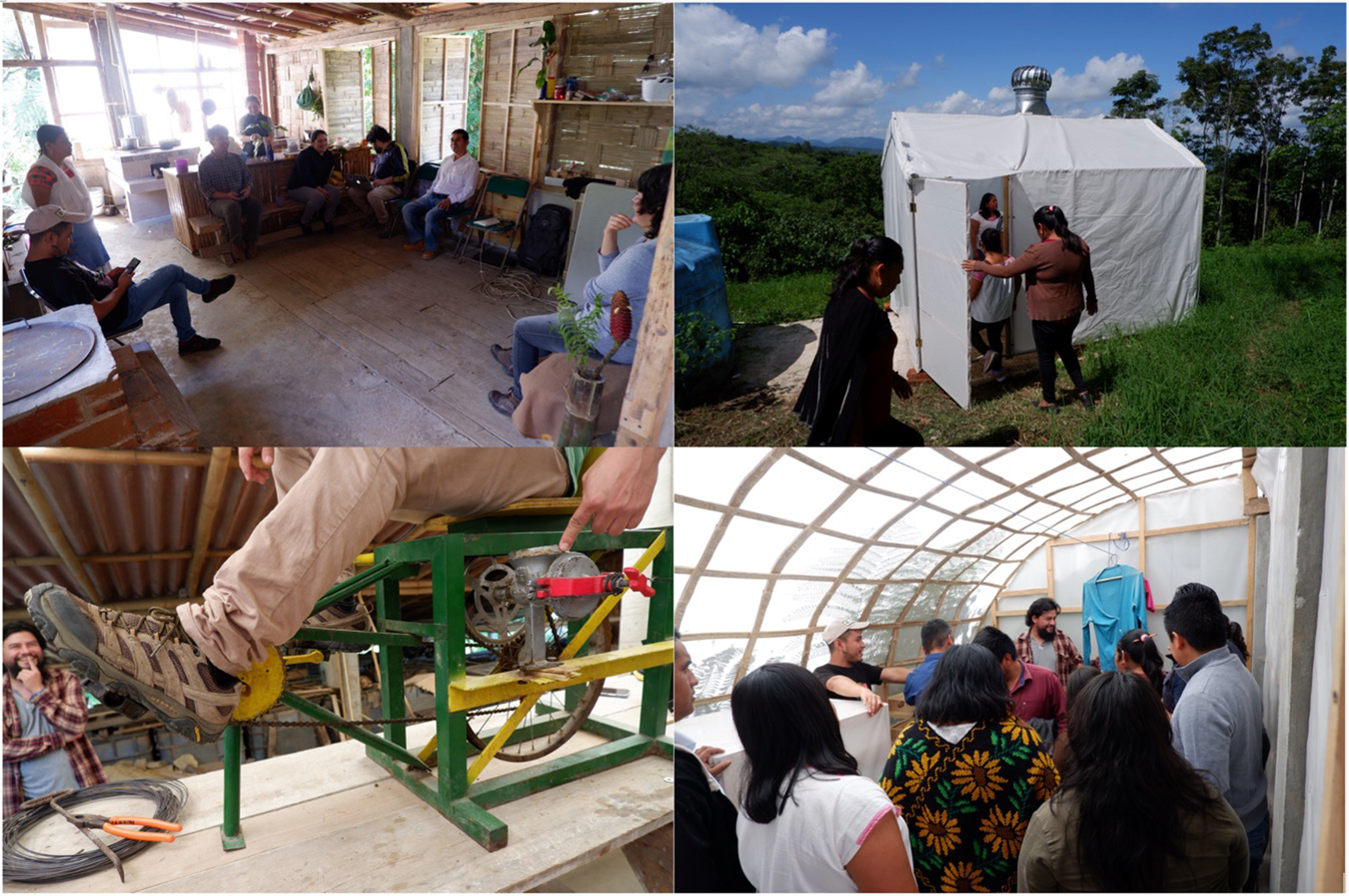
Four photographs of the center for learning, technological innovation and local energy management and social energy technologies being developed by the community sentipensante investigators. Clockwise starting top left: the main area and kitchen, which includes five wood stove prototypes; the purely sunlight-powered drying chamber; the dual-use drying chamber also occupying hot air; and the anthropo-mill.
The collaborating families were engaged as partners in this endeavor rather than as beneficiaries, clients, or customers. They substantively influenced how social technologies would work, look, and feel. For instance, families suggested that the stoves should be easy to clean but also aesthetically pleasing, which is why the prototypes are decorated with ceramic tiles even though these do not increase the stove's energy efficiency. To ensure that the social technologies would be relatively simple and affordable to maintain and repair as well as to keep the ecological footprint of their construction minimal, the prototypes use locally abundant eco-construction materials except for metalwork and plastic sheets.
In addition, the investigators invited participating families to reflect on broader topics, such as the structurally unequal distribution of everyday activities. Through a methodology known as mi cocina mi espejo (“my kitchen, my mirror”), investigators prompted collaborators to reflect on gender dynamics by comparing the state of gendered spaces, especially the kitchen, a feminine-coded space, with the state of spaces associated with masculinity, such as the storage place for agricultural tools. In households with unfloored, bare, or dilapidated kitchens, families were invited to reflect on what this denoted about the structural gender inequalities. One of the developers of the methodology recounted that We said that the kitchen is where life is generated, it is the heart of the family, of the home and that it could not be in such condition and would need to be addressed … we also provided workshops on Indigenous women's rights because we departed from the premise that Indigenous women face a triple discrimination, for being indigenous, a woman, and in conditions of poverty. So, we first had to discuss their rights before talking about gender.
2
Following the finalization of the first prototypes, the investigators constructed the first wood stoves and drying chambers in collaboration with the families piloting them, who generally helped supply building materials and labor. At the time of writing, the community sentipensante investigators continue to construct social technologies in these communities. In addition, some of the investigators are searching for other streams of funding to acquire tools and start a social technology construction cooperative. Tosepan is also still exploring the possibility of forming a cooperative dedicated to constructing and administering small-scale photovoltaic infrastructure. Tosepan is currently training people, including some former investigators, in electrical systems and the installation of photovoltaic cells to prepare for building a cooperatively managed small-scale photovoltaic cell in Reyeshogpan, which would be the first in the Sierra Norte de Puebla.
These efforts all contribute to the Códice's strategic line of action goal to “achieve energy autonomy required for the homes and small-scale industry in our territory” (Tosepan, 2021a: 42). As one of the integral dimensions of the Plan de Vida described in the Códice, the Energía para yeknemilis project and its fruits can thus catalyze decolonial transformations. Because we wish to see it realize its greatest decolonial and liberatory potential, we believe it is crucial to analyze the possibilities and limits for decolonial transformations that we discern in this project.
Possibilities and limits to decolonial energy transitions
From our perspectives, we propose that the Energía para yekenmilis project illustrates six promising possibilities for decolonial transformations. We also consider it important to also discuss six limits to decolonial transformations. They are not presented in order of importance.
Possibility 1: Conceived from below and in struggle
The project was conceived during a territorial occupation and as part of a broader struggle to defend territory against proyectos de Muerte and a megaproyecto de muerte. The project serves to demonstrate that an energy regime that requires large-scale electric infrastructures is not necessary to provide a dignified life for the Masewal, Indigenous, and Totonac inhabitants of the Sierra Norte de Puebla. Instead, the project exemplifies how low-carbon energy infrastructure can contribute to Indigenous flourishing and territorial well-being. Importantly, these life-sustaining infrastructures are not to be privately owned and operated for the purpose of capital accumulation but instead held and managed collectively through cooperative structures. In this way, the project illustrates how struggle against domination and organizing from below towards liberation can initiate decolonial energy transitions.
Possibility 2: Designed with and for Indigenous and peasant rural communities
Whereas most energy transition projects focus on industrial-urban energy regimes, this project departs from the realities of everyday rural life as it was designed with and for Indigenous and peasant communities. The relation with territory and identity captured through everyday activities could significantly alter or disappear with the introduction of a different energy regime. The introduction of gas-burning stoves throughout the region has already altered cooking practices for many, even though an often-heard complaint is that tortillas prepared with maize flour from an industrial mill and cooked on gas simply do not taste the same as tortillas made by hand from the local mill and cooked on wood-burning stoves. Many of these practices are rooted in Masewal and Totonac cosmovisions, knowledge systems, and customs and traditions, such as the centrality of maize in their cosmogonies. As such, sustaining certain everyday activities is central to Indigenous flourishing.
The participatory process through which the project was designed and executed proved invaluable in ensuring that everyday activities were properly considered. In addition, it changes a vision of energy users as consumers through the creation of active environmental and energy subjects. Whereas the project initially focused more on electricity, the importance of firewood in the local energy regimes, redirected the project's focus towards developing eco-efficient wood-saving stoves. Moreover, as one of the individuals involved in the project mentioned, this breaks with the coloniality of knowledge by “assuming ourselves as subjects conducting research and not as the objects of research.” 3 Energy transitions must be conceived with and for specific communities through a genuinely participatory process.
Possibility 3: Rethinking energy from the Sierra Norte de Puebla
In addition to mapping energy regimes, the seed phase workshops allowed for collectively (re)defining energy in Masewaltajtol and Liikilhtotonaco and from their respective cosmovisions, a critical step towards a decolonial energy transition.
In Masewal communities, most participants did not consider that such different forms of energy as sunlight, human labor, or electricity could be described as equivalent. Although workshops would take place in Masewaltajtol, facilitators and participants initially mentioned energy in Spanish (energía) because there was no adequate translation. To reflect on energy in Masewaltajtol, it was first necessary to discuss the Spanish definition from a Western, techno-scientific point of view. These discussions became anchored in everyday activities that rely on forms of energy in the territory. Subsequently, workshops searched for a consensus notion that could apply to these various forms and uses. Some definitions were discarded since they could not be generalized, such as tepoxmekat, which combines the words for metal (tepox) and cables (mekat) to generally refer to electricity. Collective reflections eventually settled on chikawalis (“force”) or tayolchikawaloni, which translates as that reflection / thought / contemplation (ta) at the source / origin (loni) that fortifies / provides force (chikawal) to the heart (yollotl). It denotes the living force manifest in all beings that inhabit the territory, including fire, water, wind, lightning, people, Mother Earth, the sun, and trees. In Totonac communities, the consensus definition of Xliitliwakga’ kilhtamakuj also arose through thinking about everyday activities. It roughly translates as a combination of the words for force (xliitliwakga’) with time / day (kilhtamakuj). Combined, Xliitliwakga’ kilhtamakuj defines energy as force of time, or force that makes possible all the activities that occur during the day. It is the force of time that allows individuals and communities to conduct their everyday activities.
These translations arose through collective reflections firmly rooted in Masewal and Totonac cosmovisions and the everyday activities that characterize a peasant mode of living. Reflections on energy from non-Indigenous mestizo communities similarly showed that fire can be conceived as a force that connects everyday activities throughout time. One of the investigators reflected on their experience of these dialogues by noting that When interacting with fire there emerge ideas and feeling, acts, and dialogues transmitted by our parents and ancestors it is the main source of power transforming and transmuting our everyday emotions, unifying space by concentrating all members of the household in the kitchen to enjoy the power of fire's transformation.
4
While reminiscent of definitions of energy as the capacity to do work, the concepts are idiosyncratic and distinct from the thermodynamic conceptualization of energy.
Possibility 4: Reconceptualization of energy justice
To define energy through collective discussions, it was first necessary to ask why and for whom energy was being harnessed, which led the shared vision that energy ought to be employed to realize yeknemilis / xatlaan latamaat. This reconceptualization implied a vision of what would constitute a just energy transition that is distinct from the distributive, procedural, and recognition dimensions discussed in the environmental, climate, and energy justice literature. Instead of measuring energy poverty from a narrow perspective as access to electricity or its affordability, for example, the project is more concerned with creating alternative routes to evaluate energetic well-being with yeknemilis / xatlaan latamaat as orientation. This also meant exploring the uses of energy and sources of energy beyond electricity, including considerations of sunlight, anthropo-energy, wood, and gas (Figure 4). This well-being entails having your energy needs for everyday activities resolved. Asking participants what this would imply allowed the project to envision an adequate energy regime for a peasant mode of living, rather than attempt to maximize the provision of electricity or minimize its monetary cost. The project also reflects this understanding of energy well-being through the attention given to firewood and the reciprocal territorial relationships that Masewal inhabitants practice through an agroforestry system known as koujtakiloyan.
Possibility 5: Non-anthropocentric territorial reciprocity
As the inclusion of territorial relationality in this redefinition of energy justice illustrates, this approach is non-anthropocentric. Indeed, yeknemilis / xatlaan latamaat covers all that is life within the communities and territories and requires that there is harmony between and within interdependent and interwoven expressions of life. This harmony is not a vision of pristine nature but embraces the relationality of human with other beings and the need to care for beings in a manner that sustains a wide variety of species in the territory. Without being able to live this relationality and experience the profoundly meaningful connection with territory and the different beings inhabiting it, there cannot be yeknemilis / xatlaan latamaat. Such non-anthropocentrism is also expressed in the conviction that energy flows can only be harnessed ethically when the non-human beings responsible for them, such as the wind, trees, and the sun, are first asked for permission and thanked through rituals and offerings. A Masewal individual involved in the project described this sense of reciprocity arising from the fact that I am a Masewal person who has the privilege to live in this territory, but this privilege also entails a responsibility to protect it, to protect in all the meanings of the word … yeknemilis can only unfold in a territory free of threats … not just external but also from our own lack of care, waste, excessive abuse, and changing cultural practices in the care for our territory … we must celebrate and give thanks to this earth and the sacred places that give us life.
5
Possibility 6: Masewal and Totonac sovereignty and autonomy
The project's liberatory and decolonial potential is enhanced by being part of a broader strategy towards sovereignty and autonomy that aims to decrease the power of state and private industry organizations in the territory and increase democratic control over energy flows and infrastructures. This demonstrates that Indigenous peoples can express self-determination and make autonomous and sovereign decisions and orient energy transitions. One Masewal individual involved in the project stressed how this was crucial to the re-valorization of indigeneity, noting that energy autonomy is not just about not depending on the other, but it is about valuing ourselves … to show it is not just up to the powerful to bring us things and say “I sell you this because only I can provide this [energy], you are just consumers, you are nothing. With this [project] we show them that we can, and that it is possible [to produce energy autonomously].
6
A member of the Tosepan Executive Board stressed this dimension of self-governance, praising the project for demonstrating that while “like everything else related to Indigenous peoples it [autonomy] has been romanticized, it seems to me that there are clear and strong proposals for how to govern ourselves.” 7 A decolonial energy transition can thus contribute to formulating the self-governance structures that will realize objectives in the other nine strategic lines of action described in the Códice and thereby spur broader decolonial transformations.
Limit 1: Dialogue between techno-scientific and sentipensante modes of knowledge creation
The initial importance attached to conducting techno-scientific tests to evaluate the social technologies represented a limit to transforming the coloniality of knowledge. Unfamiliar with formal methods and laboratory tools, the community sentipensante investigators were simultaneously being trained while already being made responsible for scientifically evaluating the performance of prototypes. The stress associated with this combination of unfamiliarity and responsibility was not always adequately addressed and generated tensions. Hierarchical relationships within the broader team aggravated a sense of frustration, resulting in last-minute unilateral decisions that modified scheduled activities and seemed to diminish the focus on evaluating social technologies in their everyday community contexts.
Two elements were decisive in partially modifying these dynamics. On the one hand, the collectively constructed “sentipensante” logbook, in which the investigators answered the following questions daily in a private and confidential manner:
What happened / what occurred? How did I feel? What did I realize? What did I learn?
The logbook allowed the inclusion and linking of feeling to thinking and doing as well as describe what investigators experienced while appropriating techno-scientific knowledge. The logbook was completely confidential. Investigators were free to include anything that contributed to the construction of the experience within the project in a free format, including the use of drawings or colors, without a predetermined length. Investigators had collectively agreed upon these questions and on that they would self-analyze their entries and draw on these during weekly collective reflection sessions for the team to discuss how everyone had felt that the previous week had gone and to make suggestions about how to improve on dynamics and elements, such as by emphasizing things that they had noted as being particularly useful or enjoyable while also addressing those things they found unnecessarily arduous or frustrating.
The content of the logbook was rarely shared aloud and, when it was done, it was done wholly voluntarily, with the aim of contributing to a deeper understanding of what was happening within the team. Keeping the logbooks was an exercise in liberation in several senses: it enabled investigators to think in a self-transparent and unfiltered manner, it allowed for the release and sense-making of emotions after they had been experienced, and it helped to process and express in idiosyncratic terms the newly acquired knowledge and remaining gaps in knowledge. Perhaps most importantly, the logbooks were a way of “touching ground,” becoming a small emancipatory tool to combat the scientific tendency towards rationalization for rationality's sake. The logbook thus helped to value knowledge springing from emotions and everyday experiences, which served a pedagogical function and provided concrete suggestions for improving the project and the dynamics within the team. In this way the logbook contributed to the goals of creating active energy subjects and ensuring that Indigenous actors, cosmovisions, and practices would be central in the designing of the alternative energy regime, breaking with the coloniality of knowledge rearticulated through conventional techno-scientific knowledge production.
On the other hand, the adaptation of the scrum methodology for the weekly planning and execution processes promoted more horizontal relationships while working hand in glove with the logbooks. Before planning activities, investigators not just mentioned what they thought had worked well earlier and what could be improved but they also defined a personal commitment to the team's progress, such as conducting a number of techno-scientific tests or learning how a tool functions that week. By setting realistic goals and reflecting on celebrating the successes rather than focusing on all the non-realized ambitions of the past week, the investigators felt more productive and able to accomplish the many different tasks they had to juggle. This was further aided and formalized by implementation agreements that only allowed for scheduled activities to be modified collectively.
Limit 2: Patriarchy
Due to the deep entrenchment of patriarchy, the project struggles with addressing gender-based inequalities and discrimination. To start with, decision-making power and ownership of lands and houses are concentrated in the hands of men and passed down patriarchally. The hierarchical relationships referred to under limit 1 intersected with patriarchal attitudes and a certain degree of invisibilization of the contributions by women in the project, which led various women involved in the initial stages of the project to leave.
Promoting gender equality has been an explicit aim of the project since its start and the project and the investigators did manage to challenge many traditional gender norms and dynamics, including internally. In the Center for Learning, Technological Innovation and Local Energy Management, investigators of all genders tested social technologies by using them. As such, male investigators participated in cooking and cleaning, activities traditionally done by women. This created a greater sense of conviviality, but also caused frictions. Some men found it difficult to engage in these activities, especially when other men would be present out of fear they might be ridiculed. Some men would also comment that “handmade tortillas taste better when they come from the hand of a woman and foul when a man makes them.” 8 During community visits or by participating families, these gendered activities would be commented on, such as when visiting women expressed surprise to see men behind the stove or preparing tortillas. They would often ask other women in Masewaltajtol or Liikilhtotonaco: “Why is there a man in the kitchen and making tortillas,” sparking longer interactions that reflected on the fact that there was nothing inherently gendered about the kitchen or making tortillas. 9 The team always invited visiting men to also participate in meal preparation, although they often refused. Meanwhile, female investigators conducted tests using techno-scientific measurement devices and participated in the construction of social technologies, including by using power tools; activities traditionally associated with masculinity. At first this caused anxiety for some female investigators (see limit 1), but with practice this translated into feeling empowered. During construction activities in communities, resident men and women would comment that these female investigators “are working with tools that only they [men] use.” 10 Because the investigators had acquired technical proficiency with these tools, they were sometimes more proficient than men, which through systemic demonstrations broke with the ossified stereotype that women are only proficient in household work.
Although the project did help to dispel patriarchal stereotypes and transformed the working relations within the project team, the contribution to dismantling patriarchy should not be overstated. Patriarchy is difficult to transform since it is so entrenched and at the core of everyday life. In addition, it intersects with other axes of differentiation, such as race, class, and age. As one young woman from a Masewal community expressed: Where they take decisions there are many gaps … they say ‘great that you are here, but you look prettier when you are silent and listen’ or they say ‘I don’t care what you have to say, you are young and don’t know, you don’t have a vote [because you are not a member of the cooperative], and you are a woman, how could you even help us?’
11
Limit 3: Racism, folklorization, and romanticization
Similar to patriarchy, racism and expressions of folklorization and romanticization constitute deeply entrenched structures of oppression that limit the project's decolonial potential. Although investigators expressed that none had personally witnessed or experienced blatant racism, some community visits could have been conducted in more culturally appropriate ways and with more care to engage in local languages, such as during earlier visits to Totonac communities. Because there is a long history of Masewal elites operating as interlocutors with colonial and state powerbrokers and thereby wielding power over Totonac populations, great care must be taken to not reproduce structures of domination between Masewal and Totonac communities. Yet, when asked about this dynamic, a Totonac individual involved in the project stated that “the times I went to Totonac communities, they did not say things like ‘it is these [expletive] Nahuas who are here to tell us what to do’ … everyone seems pleased with the results of the project so far.” 12
Folklorization of Masewal and Totonac cosmovisions, customs, and traditions also has pernicious effects. Often unintentionally reproduced, the estheticization of indigeneity relegates Masewal and Totonac peoples to a magical realm of the distant past rather than as active agents in the contemporary world, embodied in the governmental designation of predominantly Indigenous villages in the Sierra Norte de Puebla as so-called magic villages (pueblos magicos). The focus on the performance of indigeneity exoticizes communities and detracts attention away from the structural rather than esthetic realities of being Masewal and Totonac. The emphasis on customary dress in communication materials by CONAHCYT, for example, risks misrepresenting the everyday realities of many Masewal and Totonac peasants, not all of whom wear customary dress or speak an indigenous language. We do not assert that dress, dance, and food are not important elements of indigeneity, however, these elements must not detract from how coloniality (re)articulates power structures.
A closely related phenomenon concerns the romanticization of Masewal and Totonac communities by members of the Energía para yeknemilis team or those with positions of power in Tosepan. The project must avoid casting communities as expressions of radical alterity to modernity and as saviors who can show the way to other peoples out of the hegemonic energy regime and world-system. Not only does this misrepresent the complexities that make up the territories of the Sierra Norte de Puebla, which is integrated into this energy regime and world-system and where truly rupturing with these is difficult while a significant share of the population simply must earn money in order to survive and thus often migrate to cities for work, and where many also have deeply held capitalist desires and practices such as concentrating lands and hiring labor, or owning television sets, motorcycles, trucks, or other symbols of wealth. It also inhibits critical self-reflection on the project and potentially directs time and energy towards ends that do not serve the population. One person involved in the project, for example, was bemused at how some of the academic external partners of the project were blown away by the findings of the survey (see Figure 4) while when they reported this information back to the participating communities “this was not really impactful because it is what they live every day. It was just repeating to them that they used a lot of firewood. Well, how obvious!”
13
In addition, it underplays the role of mestizo persons in the project while overemphasizing the differences between Indigenous and non-Indigenous populations who self-identify as being from the mountains (serrano). A person who identifies as mestizo involved in the project responded when asked about their heritage that there is something that is shared by everyone who came to live in the Sierra. I have ancestors, Italians, Spaniards, who were also political and social exiles and self-exiles as well as those who fled hunger. All the people who came to live here but were not born here came to live in peace. This is just as with the Totonac population that fled into the mountains … rather than confront aggressors they sought refuge and peace here … this is strongly shared by all families here in the mountains, this collective memory in our body and in our minds.
14
Another individual further pointed out that the similarities between these populations go beyond having a shared history of “being displaced and discriminated against” because they “share many traditions, the same ways of caring for and living from the territory, we make the same rituals, and even have the same dances.” 15
Limit 4: Financial sustainability
A lack of reliable and predictable funding probably represents one of the biggest challenges for the project's long-term sustainability. The resources granted by CONAHCYT for the execution and fulfillment of the project's advocacy and research objectives only cover costs until the end of 2024. Different funding and financing options have been explored to provide continuity to the development of an alternative energy regime, one of which has been to form alliances with other institutions researching environmental, climate, and energy justice as well as to participate in calls for proposals from civil society actors and international awards that focus on innovative initiatives by Indigenous peoples and local communities with an emphasis on nature-based solutions. Tosepan has been aware of this limit and sees it as an opportunity for the formation of a new cooperative that could provide energy services in the region. In fact, this is one of the six specific project objectives.
Limit 5: Project scope
The project was initially quite narrowly focused on the installation, operation, and management of decentralized photovoltaic infrastructures and not concerned with (re)conceptualizing energy and promoting diverse social technologies. The expansion in scope is not a shortcoming since the inclusion of broader objectives, such as the emphasis on gender, and intercultural and intergenerational considerations, is paramount if we are to speak of a decolonial energy transition. Nevertheless, it also increased demands on the available time and energies of the Tosepan members, which at times has caused frustrations and overburdened members with excessive workloads. With limited capacities, it has been difficult to focus on all project dimensions and dedicate sufficient time to follow through. Heavy administrative duties and achieving certain metrics for CONAHCYT have caused time pressure and stress since reporting requirements do not reflect realities in the territory. Unforeseen events, delays in the reception of project funding, and a commitment to executing the project in a participative manner mean that original project timetables became difficult to follow while reporting cycles were not adapted. In addition, efforts to engage in advocacy with government agencies, such as the Energy Regulatory Commission (Comisión Reguladora de Energía: CRE) take significant effort to prepare. An expansion of the human and financial capacities available, a more generous allotment of time for activities and reporting, or a narrowing of project focus could help to prevent that execution comes at the cost of the well-being of Tosepan members. The road towards a social solidarity economy cannot be paved through self-exploitation. Similarly, Tosepan must consciously explore the implications of considering the scaling up of photovoltaic cells since this could contribute to the green extractivisms implicated in the global production networks of photovoltaic cells and thus to the climate coloniality that Tosepan is trying to transform while also jeopardizing the objective of energy sovereignty through dependence on such globalized supply chains.
Limit 6: Negotiating with the state
The last limit concerns Tosepan's relationship with the state. While critical of the human rights abuses committed by state actors, Tosepan has a long tradition of dialoguing with governmental actors. With the election of Andrés Manuel López Obrador in 2018, Tosepan gained trusted allies as members of the President's cabinet. Victor Toledo was appointed Secretary of SEMARNAT and María Louisa Albores, who has been a member of Tosepan for over two decades, was appointed Secretary of Social Development (and later SEMARNAT). During this administration, Tosepan attempted to engage with legislators and state actors such as the CRE to achieve reforms to the energy and electricity laws that would legalize and facilitate cooperative participating in electricity generation, distribution, and sale (e.g. Durán Olguín, 2023; Garrido Bonilla, 2021; Garrido Bonilla et al., 2023).
Although difficult to measure, these activities required a lot of effort while outcomes seem ambivalent at best. The CFE still provides almost all electricity to the region while the provision of gas and petrol too are regulated by the government. The current legal framework also does not allow for cooperatives to operate and manage electric infrastructures. Furthermore, one of the authors recalls a meeting with CRE officials in Mexico City to discuss regulatory proposals that would allow cooperatives to generate, distribute, and sell electricity. The simple fact of having the meeting was already considered a victory even though security personnel initially did not let our delegation enter the building. After clearing this hurdle, CRE officials politely listened, thanked us for our time, and expressed that it was impossible to move forward on this since the CRE had too many other issues to resolve.
Tosepan approaches sovereignty as the ability to autonomously negotiate with the state. A member of the Tosepan Executive Board described the role of Tosepan as changing the policies imposed upon this country … the way in which social programs are used, where the state gives and says ‘you line up, you receive and next you do what you are told because I gave you’ … instead at Tosepan we say ‘you give me in quotation marks, you give me, I distribute and I do what I want, not what you say’ … It is a right to say yes to this but no to that, accepting one things does not oblige me to accept another … we are people, human beings who demand this right, which is in the Constitution and the [International Labor Organization 169] Convention.
16
Yet, this remains an elusive goal in the case of energy. Even if state actors were to prove amenable to Tosepan's proposals for the organization of the energy regime, it is still about negotiating a relative degree of dependence on the Mexican state and risking cooptation around autonomy and sovereignty to serve state goals. Deeper reflections on how to engage with state power are needed to more fully realize the project's main objective of increasing energy autonomy and sovereignty.
Conclusions
In the face of the genocidal and ecocidal trajectory of climate change and climate change solutions, challenging and transforming the colonial, capitalist, and extractivist logic underpinning hegemonic energy regimes is of the utmost importance. Borne out of a collaboration between researchers of Indigenous Masewal and Totonac as well as mestizo and European descent, this article has argued that energy transitions can embody decolonial praxis contributing towards Indigenous self-determination and flourishing. We draw on our distinct and collective experiences with the Energía para yeknemilis project, executed by Tosepan in the Sierra Norte de Puebla, Mexico to demonstrate how this project challenges the coloniality present in most of the current energy transition discourse and “green” transition projects. To echo the words of Tosepan's former President Paulina Garrido Bonilla (2021: n.p.) in the Mexican Congress in February of 2021, “our way of understanding what they call an energy transition is different.”
We consider it indispensable that the project was cnceived from below and as part of a struggle to protect Masewal and Totonac territories from large-scale energy infrastructures. The project was designed with and for Indigenous and peasant rural communities through a community-centered participatory design process. Employing this type of process enabled the reconceptualization of “energy” from Indigenous languages, cosmovisions, traditions, and customs. As part of this reconceptualization, the notions of yeknemilis / xatlaan latamaat became central to community discussions over why, how, and for whom energy flows. Finally, the centrality of territory, multi-species harmony, and reciprocity with life gives the project a non-anthropocentric reference frame.
We also reflect on some limitations to decolonial transformations that the project must contend with. In complementing techno-scientific knowledge creation with Indigenous traditional knowledge as well as the sentipensante approach to participatory action research, we note that techno-scientific methodologies can be difficult to execute in a sentipensante manner. Confronting and transforming patriarchal relations of power in a society marked by the deep entrenchment of patriarchy constitutes another daunting challenge. Additionally, there is latent racism and a tendency towards folklorization and romanticization that must be addressed. Two other limits are related to ensuring internal organizational capacity as well as financial resources to sustain and expand the project without diminishing its decolonial potential. Finally, we note that there is that ever-looming question of how to relate to state power and caution against predominantly relying on state power to work towards Indigenous sovereignty. Concrete control over energy regimes through infrastructures seems a more secure way of substantiating sovereignty and for guaranteeing autonomy.
By analyzing these possibilities and limits to broader decolonial transformations, we have sought to enhance the project's decolonial potential while serving as reflections for other decolonial energy transitions. The opportunities and limits that we observe in the project reflect issues discussed in the literature on de/coloniality and critical environmental, energy and climate justice. Collaborations between (academic) researchers and communities constructing alternative energy projects and systems can crucially contribute to decolonial energy transitions. Such collaborations can nourish the academic literature with empirical material that sharpens and nuances theory or even leads to new insights while the literature can provide incisive suggestions for how communities can leverage opportunities for decolonial transformations as well as inform strategizing to confront challenges to decolonial transformations. Further research could compare multiple decolonial energy transition initiatives to analyze how the opportunities and limits we identify have been and can be seized and addressed to further decolonial politics; it could explore what a strategic engagement with state power entails as well as reflect on how to ensure that collaborations are ethical and efficacious. We hope to have demonstrated that an insurgency in energy research is not only needed but also possible. Energy not only flows through Proyectos de Muerte but it also vitalizes Proyectos de Vida.
Footnotes
Declaration of Conflicting Interests
The authors declared no potential conflicts of interest with respect to the research, authorship, and/or publication of this article.
Funding
The authors disclosed receipt of the following financial support for the research, authorship, and/or publication of this article: This work was supported by the University of British Columbia, including the Public Scholars Initiative.
