




Abstract
In September 2017, the strongest earthquake in the last century shook the Isthmus of Tehuantepec, Mexico, the region hosting the largest concentration of wind turbines in Mexico. In the municipalities with over 1600 wind turbines, the seismic shock affected 70% of the dwellings. After the disaster, community organisations undertook efforts to foster collective processes of territorial autonomy in towns hosting wind projects or expected to host projects in the future. Drawing on participant ethnographic methods and long-term collaboration with social movements, this article provides insights into the processes whereby disaster recovery holds the potential for territorial practices that imply a shift away from capitalist norms to alternative practices of territorial autonomy, sufficiency and rebellion. To this end, the article analyses a women-led kitchen reconstruction project implemented by the Assembly of Indigenous People of the Isthmus in Defence of Land and Territory (APIIDTT) to re-activate local economies through endemic crops and traditional crafts in six towns of the region. While emphasising broader tensions, pressures and contradictions resulting from disaster capitalism, the article argues that the project fostered collective autonomy processes against present and future extractive projects through endemic crops, traditional crafts and the identification of female leadership within and across the communities. Therefore, the article spotlights the different forms of bottom-up emancipatory politics that emerge in post-disaster contexts while interlinking them with wind power expansion.
Introduction
On 7 September 2017, at 23:34, the strongest earthquake in Mexico in the last century concentrated its destructive force in the Isthmus of Tehuantepec – one of the key areas for wind energy. A second earthquake struck the region on September 23. Dwellings and buildings affected by the first quake were brought to the brink of collapse after the second disaster. The sense of emergency resulting from the disasters interacted with local vulnerabilities, thereby marking new opportunities for wind expansion. The morning after the disaster, wind companies lent machinery and supported post-relief efforts, especially in towns with active wind farm construction processes: Juchitán, El Espinal and Unión Hidalgo. Local inhabitants recounted how machinery labelled with the wind companies’ logos cleared rubble from the roads. These companies assumed public duties that the state could not undertake to raise their public image among local populations and advance their interests in constructing wind farms in the future. For local populations, nevertheless, the intentions motivating the participation of wind power in reconstruction efforts were unclear. Some argued that companies would later charge them for renting the machinery; others argued that they would never relocate to a shelter because wind companies would install wind turbines where their dwellings were. This is symptomatic of the broader contestations around wind power in the region since the late 1990s.
Drawing on participant observation conducted since 2017, long-term collaboration with the Indigenous Assembly of the Isthmus of Tehuantepec in Defence of the Land and the Territory (APIIDTT) and semi-structured interviews with community members affected by the disaster, 1 this article analyses a women-led kitchen reconstruction project implemented by the Assembly, involving six local communities. The APPIIDT is an umbrella organisation founded more than a decade ago comprised of grassroots Isthmian social movements undertaking processes of territorial autonomy. The article contends that the rupture brought about by the tremors was an opportunity for social movements to articulate practices and imaginaries of territorial autonomy and defence, albeit with tensions and challenges arising from a broader context of disaster capitalism. In doing so, this article seeks to answer the question of what an anti-capitalist bottom-up energy transition looks like by providing ethnographic insights into the challenges and opportunities behind an attempt to materialise pluriversal alternatives of territorial autonomy. In areas like the Isthmus of Tehuantepec, historically affected by extractivism, a bottom-up transition must consider recuperating social practices disbanded by extractive infrastructures and re-linking communities through territorial practices. We are thus seconding Oslender's (2019: 1694) invitation for the reader to ‘imagine, feel, dream and smell what the pluriversal world might look like in particular places’.
The article is structured as follows. First, it depicts the differentiated impacts of seismic events. It then proposes an analytical approach to consider the ruptures brought on by the disaster and the bottom-up pluriversal politics that may arise in those spaces. In the third section, the article explores how diverse actors, under a framing of disaster capitalism, sought a territorial re-arrangement to further extractive industries. Fourth, the article provides an empirical account of the APIIDTT project, the opportunities to articulate territorial autonomy and the challenges to the project from broader national and international stakeholders. Finally, this article concludes by reflecting on post-relief efforts, pluriversal alternatives and energy transitions.
On the impacts of the 2017 September earthquakes
The seismic force severely impacted the Isthmus of Tehuantepec (see Table 1). This marked a fertile ground for both wind energy investments and for those mobilising in defence of the territory, as this article explores. The disasters impacted at least 27,700 family units (INEGI, 2019), but its effects went beyond the household level. In dwellings where kitchens collapsed, families had to be financially solvent to rent a cooking space or rely on charities. Municipal markets were also either highly affected or on the brink of collapse. This means that spaces of commercial exchange where people would go to sell and buy basic goods were not functioning. Besides, specific dietary and housing needs were disregarded by post-relief efforts. Emergency pantries, for instance, included canned and packaged food that did not meet the food habits and traditions of local populations. In other words, the shock affected not only families’ daily lives but also the social and economic dimensions of towns and villages in the region.
Number of dwellings affected by the earthquake in four municipalities in the Isthmus of Tehuantepec.
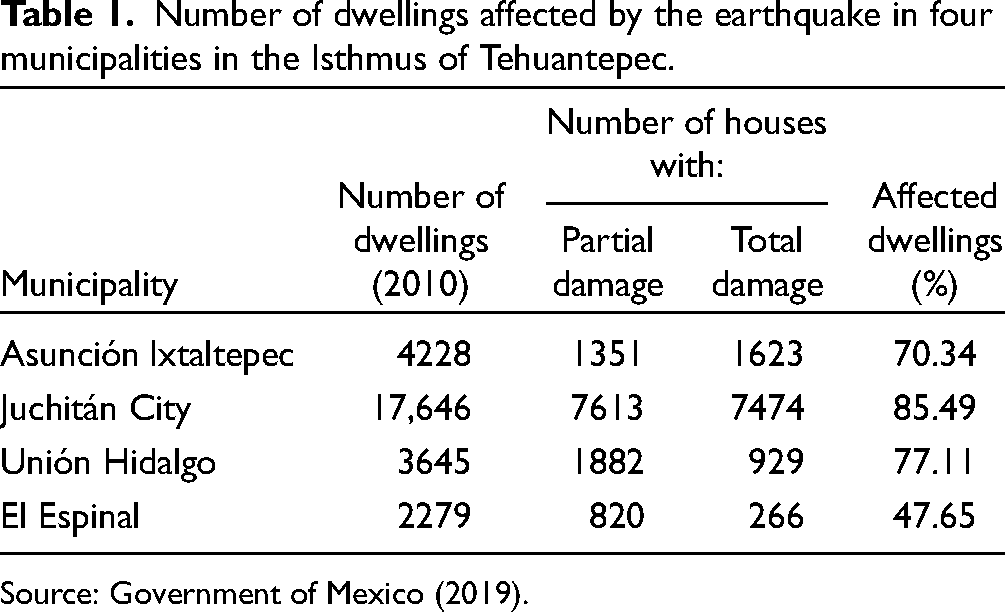
Source: Government of Mexico (2019).
Nevertheless, not all places were affected equally (see also Dunlap, 2020). Two cases are worth highlighting. First, none of the 1600 wind turbines collapsed or presented damages (Zavala, 2017). The Federal Electricity Commission (CFE in Spanish) substations equipment and structures were impacted, and thus, wind power generation had to be put on hold for 1 month. Secondly, while Juchitán and Unión Hidalgo were heavily affected, in the ejido La Venta, only two dwellings and one school were damaged. 2 The proximity of this town to the foothills and the incomes from commodity crops invested in construction materials meant that quake impacts were highly differentiated (see also Binford, 1992). 3 These two spaces show that the aftermath of the disaster was characterised by the conditions of poverty and vulnerability in the Isthmus rather than its impact on the physical environment (Oliver-Smith, 1999).
A note on wind energy expansion in the Isthmus of Tehuantepec
Owing to its geographical conditions, the Isthmus played an important role in the Mexican state's developmental plans. Since the last century, various projects have been implemented to facilitate interoceanic extraction through the construction of large-scale infrastructure: the trans-Isthmian railway, the Benito Juárez dam, and the Jaime Dovalí Refinery, among others (Glick, 1953; Grayson, 1977; Torres and Gasca Zamora, 2004; Villagómez et al., 1998). Wind power has thus played a critical role in the region since 1994, when the first wind farm was installed in the Ejido La Venta (Friede, 2016; Nahmad et al., 2014). After that, a series of colloquia in the south of the state, where the government met with transnational companies, shaped the wind rush that started in the region in 2006 (Borja Díaz et al., 2005). This process materialised in 32 wind farms and almost 1600 wind turbines by the time of writing (GEO, 2019). This territorial transformation, characterised by the lack of local consultation in a milieu of coercion and intimidation (Dunlap, 2017b, 2019), led to slow disbandment of collective property regimes (Dunlap, 2017a; Mejía-Montero et al., 2023; Torres Contreras, 2024; Torres-Mazuera and Recondo, 2022), conflicts within and across communities after the Free Prior and Informed Consent (FPIC) procedure (Torres Contreras, 2023) and enhanced processes of accumulation and social differentiation (Alonso Serna, 2024; Torres Contreras, 2022), albeit with differences between the northern and southern section of the Isthmus (Dunlap, 2018). At the same time, nevertheless, these extractive industries also shaped many facets of territorial rebellion 4 (Cruz Velázquez and Florez Cruz, 2019; Florez Cruz, 2020), following a long legacy of social mobilisation in the region (Monsiváis, 1983; Rubin, 1994). This includes the resurgence of agrarian authorities, recourse to legal challenges at national and international levels and everyday acts of rebellion (Dunlap and Arce, 2022; Lucio López, 2016; Mejía Carrasco, 2017; Rueda, 2011). As the region prepares for a new wave of wind energy expansion as a result of the 2024–2030 Energy Plan, which prioritises private investment in climate mitigation technologies (see Castillo Jiménez, 2024), the rupture brought about by the quakes is a valuable analytical moment to appraise the efforts to build a new horizon of possibility through struggle (Hesketh, 2023).
‘Every disaster is an opportunity you must seize': Rupture and relief efforts
Disasters are tragedies for many and business opportunities for some. Forbes Magazine says, ‘Every disaster is an opportunity you must seize’ (Diermeirer, 2011). The magazine underscores how, when a disaster strikes, a ‘company becomes not just an anonymous provider of goods and services, but also a community member’ (Diermeirer, 2011). Disasters are an opportunity for accumulation and gaining visibility with the general population. To the same degree, disasters also alter the status quo and offer opportunities for new ideas and change that compete with pressures to restore systems to pre-disaster conditions (Mochizuki and Chang, 2017). Therefore, disasters are messy events in which different interests are at play. The literature has mainly analysed them under disaster capitalism and disaster collectivism.
Naomi Klein (2007) coined the concept of ‘disaster capitalism’. It refers to the orchestrated raids on the public sphere after catastrophic events, compounded with the treatment of disasters as market opportunities. Following this, Loewenstein (2018) and Schuller and Maldonado (2016) identified distinctive elements of disaster, such as violence, corporate interests, and profit-seeking. Disasters open the ground for accumulation and extend social and economic policies that support the status quo through two processes. First, there is a non-profiteering dimension whereby contracts are given to third parties, both non-profit organisations and for-profit enterprises, to participate in post-disaster reconstruction. On the other hand, disaster facilitates a context for long-term liberalisation and policy reform because a sense of emergency demands quick action to provide emergency assistance. Usually, this comes at the expense of specific policy agendas seeking more profound levels of market integration and interaction with the universalisation of extractive areas on behalf of climate change mitigation targets, namely wind power expansion in this case (DeBoom, 2020; Mcneish and Shapiro, 2021; Paudel and Le Billon, 2018). Disaster capitalism, therefore, emphasises the instrumental importance of catastrophes in bolstering the political, ideological and economic interests of elite groups to produce, among others and relevant to this article, intersectional gender injustice (Luft, 2016).
On the other hand, Solnit (2009) describes disaster collectivism as a process where community help is observed after a disaster. As Solnit (2009: 5) puts it, this concept refers to the ‘sense of immersion in the moment and solidarity with others, owing to the rupture of everyday life’. This concept highlights how emancipatory politics are facilitated through practices after a disaster, notably at the grassroots level. If the vulnerabilities exacerbated by the disaster are mediated by capitalism, there is also the potential to address these elements pre-catastrophe by reshaping social organisation through emancipatory politics (Cretney, 2017). Disaster and recovery efforts are spaces where new values and practices can develop, which may ultimately antagonise the status quo. The case of kitchen reconstruction implemented by APIIDTT provides insights into territorial forms of emancipatory politics that emerge in post-disaster recovery. As Cretney (2017, 11:7) puts it: ‘The potential of these forms of disaster action through recovery lies in the potential for opening up spaces and opportunities that foster different practices, relationships and perspectives’.
Therefore, disaster and recovery politics are a rupture that brings about a period of intense polarisation through forms of reconstruction and various interests pushing for different agendas. This interacts with a situation of vulnerability and marginalisation in which communities have lived for decades (Oliver-Smith, 1999: 75). To put it another way, the humanitarian crisis declared after the tremors by international organisations is not contingent on the context of scarcity, panic and uncertainty galvanised by the disaster (OCRM, 2017). Instead, it results from structural social and economic processes affecting the Isthmus over the last century (Calhoun, 2010: 16). This is why, for the region, the most significant element is not the quake but the long legacy of extraction and its socio-environmental consequences. In this context, and as we will see in the empirical section of this article, there are power asymmetries vis-à-vis strategies, tools and networks between the government and grassroots social movements, such as the APPIDTT. However, the two interests at play contributed to the diversity of interconnected processes of reconstruction that sought to either advance or neutralise wind energy expansion and contribute to our understanding of what pluriversal alternatives look like and the different challenges they face.
By analysing reconstruction efforts, we can appraise who is in power, who is cast aside, what is prioritised in the rebuild and who is targeted by such efforts. These politics can either advance or challenge the status quo and wind power expansion in the Isthmus of Tehuantepec.
Pluriversal transformations in the wake of a disaster
How and under what circumstance the politics of relief efforts that challenge capitalist relations can offer a territorial alternative is a question worth asking. Arturo Escobar (2020) offers insights into understanding how these practices can be organised with three principles: a society re-organised based on local and regional autonomies; an economy self-managed according to communal principles; and a relationship with the state, only to contain it. Citing the Nasa indigenous people, Escobar (2020: 39) argues that it is about ‘recovering, reconstructing and revitalising the territory to reproduce life’. Tornel (2024) states that these practices approach the energy transition as a rupture with the tenets of capitalist modernity, including the centrality of accumulation, and as everyday practices that retain languages, food, rituals and beliefs.
This rupture can take the form of what Nirmal and Rocheleau (2019) call resurgence. These authors argue that dismantling and challenging economic links with capitalist systems cannot be isolated from attempts at restoring and reinventing rooted political ontologies, where communities engage in conviviality based on practices of care, 5 love, reciprocity and respect essential for social reproduction. They posit the concept of resurgence to analyse how processes of rebellion are compounded with recovery, renewal and reinvention of social relations within and across places through two main processes. First, they attest to a re-rooting process whereby roots are strengthened, created in lost or recovered places and established in new spaces. On the other hand, they advance a process of re-commoning where a sense of the commons is re-established to locate economic exchanges outside or alongside the market. Consequently, practices of re-rooting and re-commoning are critical for making and re-making territories through processes required to maintain human cultures and communities daily and intergenerationally (Di Chiro, 2008). As these two authors put it: ‘Rather than taking territory, this is ultimately about reweaving worlds and restoring relations broken and threatened by capitalist and colonial interventions’ (Nirmal and Rocheleau, 2019: 473). The territory can thus serve as a space for enacting relational worlds in the form of authority, justice and work, among others.
For Gutiérrez Aguilar (2020), these forms of organising are based on efforts to defend the material and symbolic conditions to guarantee the reproduction of collective life. While these efforts tend to be challenged and threatened by processes of capitalist reconfiguration, they are oriented toward the generation of a social relationship of interdependency and reciprocity through which communities cultivate, revitalise, regenerate and rebuild those necessary things for the reproduction of collective life, including resources, land, seeds, among others. In doing so, we follow Esteva's (2013: 177) framing of radical pluralism, positing that diversity, not the tendency to universalise, is vital to reproducing collective life. From an ecofeminist perspective, this entails pluriversal transformations rooted in the resurgence of ancient and continuing relational values and practices, their reinstatement, or the reinvention of relations and understandings (Ojeda et al., 2022). Similarly, De Onís (2021: 128) argues that: ‘efforts to transmit and, ultimately, transform require sorting through relational elements that are frayed, irreparable, and in need of dismantling and discarding; ones that can be untangled and repaired; and others that can be constructed anew and apart from the existing and constraining singular grid’.
Pluriversal transformations are thus territorial processes seeking to recover or renew collective practices of territorial autonomy and conviviality to relink communities in areas affected by extractivism or selected as potential hosts for new projects. These broader attempts, however, are not isolated from broader politics and interact with an extractivist logic. Following Oslender's (2019) insights, we provide an ethnographic account of the conflicts, tensions, contradictions and opportunities that result from the encounter of the green extractivist logic affecting the Isthmus of Tehuantepec and the project seeking to rebuild the territory through relationships of care with the land and the community. In what follows, we will analyse how the broader territorial politics of post-relief efforts from the APIIDTT collide and are challenged by broader disaster capitalist and extractivist efforts led by the national, state-level and wind energy companies.
‘I invited my friends to rebuild the Isthmus of Tehuantepec’: Peña Nieto
At the Annual Mexican Industrial Conference in October 2017, Enrique Peña Nieto invited entrepreneurs to participate in the reconstruction process in the Isthmus of Tehuantepec (Diario de Antequera, 2017). He mentioned that if the companies decided to invest in the reconstruction, they would not pay any taxes for 10 years (Bessi and Navarro, 2017). Compounded with the liberalisation of the energy sector in Mexico culminating in the energy reform of 2013, this invitation promoted a new territorial arrangement for the region while ignoring the socioecological conflicts promoted by the expansion of climate change mitigation technologies (Tornel, 2020). The federal government focused its aid actions on collecting private sector donations and public funds through the fund Fuerza México. Resources could be used to rebuild listed buildings and distributed individually to affected people through debit cards to purchase construction materials from selected vendors (Poole and Renique, 2017: 389). To this end, a group of investors and businesspeople were chosen to be responsible for the public funding, individual donations, and contributions from the private sector. However, as the Regional Council for the Reconstructions of Our Towns in the Isthmus of Tehuantepec (RCROTIT) put it, the problem with this process is that: ‘the people the government invited to participate in the reconstruction process are not local workers. Rather, they invited entrepreneurs, corporations and construction companies to do business in the Isthmus’ (Bessi and Navarro, 2017). This process neglected people's agency in the reconstruction process and posited the Isthmus as an area to be invested in in the aftermath of the September earthquakes (Figure 1).
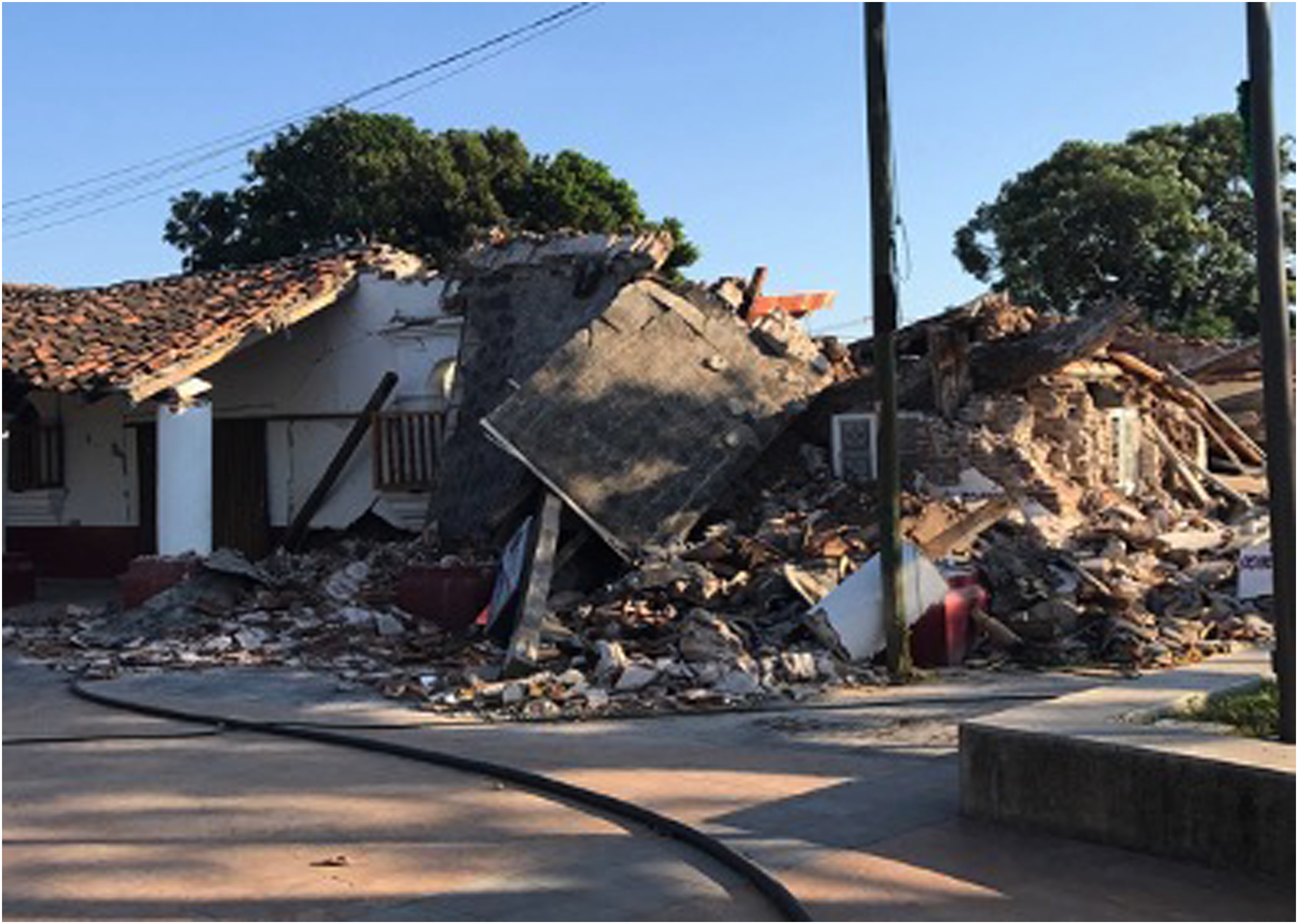
Debris in Asunción Ixtaltepec.
During field visits, we observed how actions were articulated to advance a territorial re-arrangement in the region. This process aimed to foster accumulation opportunities and promote the expansion of extractive industries, including wind expansion. It portrayed local people as subjects to be developed by underscoring their construction techniques as rudimentary and emphasising the urgent need for the region to embrace modernity. In this subsection, we analyse six processes through which this top-down reconstruction was articulated.
The first process concerned how the government allocated resources for the affected and collapsed households. To those families whose dwellings collapsed, the government provided them 120,000 Mexican pesos – around 7100 USD. On the other hand, those households that only experienced partial damage were only entitled to receive 15,000 Mexican pesos – approx. 840 USD. To identify the beneficiaries, students’ brigades visited every house in towns and villages to assess the damages. These brigades would assign a code to each dwelling, and affected families, usually mediated by a male head of household, would receive the debit bank card. Out of the 120,000 pesos designated for total loss, a quarter could be spent freely, making some families spend that money on items unrelated to reconstruction. If the quantity allocated to each household was insufficient initially, the lack of control over utilising these resources made the contingency more significant. Besides, it emphasised gendered-based inequalities as women have less access to crucial assets for survival, including land, economic resources and social networks (K.C. and Hilhorst, 2022). Similarly, the 15,000 pesos were insufficient to cope with partial damages, ranging from small cracks to collapsed walls. The asymmetries and contradictions in resource allocation were enhanced after the second tremor. Since brigades had already undertaken a damage census, those families whose houses collapsed after the second tremor were not considered programme beneficiaries under the total loss category.
The second process involved two critical elements for identifying programme beneficiaries: proof of property and allocation of resources in remote areas. Regarding the former, proof of property was mandatory if one wanted to receive the resources allocated by the government. In the aftermath of the disaster, individuals and families renting or living in someone else's dwelling were the most affected. For instance, Esperanza lived in her cousin's house before the shock. When this dwelling collapsed, she found herself without a place to live. Since she was not a landowner, she was not entitled to government help, and she could not get help from non-governmental organisations (NGOs) building houses for local populations. This provides insights into how housing, for instance, is a gendered phenomenon because women's access to a home is often mediated by men, children and a gendered housing context (K.C. and Hilhorst, 2022). Concerning the allocation of resources, it is worth mentioning that the use of resources in remote villages where local authorities carried out the census was discretional. 6 We were told that families whose households had collapsed did not receive money because they did not have a good relationship with the local authorities or municipal president. At the same time, some families received more than one total loss bank card for repairs. Resource allocation was unfair and exacerbated social asymmetries because the census was undertaken in a chaotic context without considering the local dimensions and constraints.
A third process concerned the provision of reconstruction materials in a context of scarcity and speculation. Government-provided bank cards could only be used in certain shops. Poole and Renique (2017: 390) highlight how this system brought a significant boom for the construction industry in Mexico, which had declined by almost 4% in the year before the seismic events. In these retailers, local inhabitants could not find vernacular materials, such as palm or mud, which had been used traditionally. In this context, we cannot neglect how wind power expansion has affected palm leaf trees in the region, owing to deforestation to make space for infrastructure and the reduction of underground water, which is vital for local flora (Dunlap, 2020). Rather, they would find industrial materials. Not only was material speculation so widespread that the government had to shut some shops owing to the high prices, but the waiting time for the materials was also approximately 45 working days. Besides, the costs of materials and finding builders to undertake reconstruction processes rocketed. This underscored the importance of vernacular materials and how the government overlooked the value and use that people had given to traditional materials and their associated crafts (Dunlap, 2020). Traditional materials could boost the economy by providing people with employment opportunities and by enhancing bartering within and across communities through traditional practices like tequio 7 or guenda'raacane. 8 In this vein, the idea that materials could only be acquired in established shops increased the feeling among the local population that the government was doing business at the expense of the local economy.
A fourth process involved ideas for rebuilding the houses. The federal government implemented a programme to provide families with technical assistance to avoid architectural and design flaws. Once your dwelling was included in the census, you would be sent a company representative to advise you on technical issues. These companies would also offer their services to build your dwelling in exchange for the resources from the reconstruction programme. We would often hear people say that they signed a contract with an enterprise, they gave them their bank cards, and the employees had not been back in a long time. Consequently, the reconstruction process had not started yet. We were also told that these companies would offer three house choices: one option for 90,000 Mexican pesos, a second option for 120,000 pesos, and a third option for 150,000 pesos. If the family did not have the additional 30,000 pesos or had spent the resources in the bank card, the enterprises offered credit to be repaid in the next 30 years. Only a few families could provide collateral for the credit. Even if the new dwellings addressed structural mistakes, they overlooked local needs. For instance, the blueprints for the most expensive option would offer a space of approximately 48 square metres with two bedrooms, a kitchen and a bathroom. However, for local populations, kitchens are usually outside the main house and are critical gendered spaces for households and the local economy. This shows how the solutions offered by the companies ignored women's role in local economies by marginalising their needs and concerns during the disaster response (Camillini, 2022).
Once inhabitants started building their houses, it was uncertain whether the government would monitor their expenses. This is the fifth process. We heard people saying government officials would check every family's expense notes. By the end of 2019, we were told that members of the communities were hired as external evaluators to check whether the money given to families was used correctly. This galvanised a context where collective forms of work were disarticulated because people were suspicious of their neighbours. This not only affected the social fabric of indigenous communities but also facilitated broader processes in the Isthmus, leading to a transition from collective property into private property as other scholars explore (Dunlap, 2017a; Mejía-Montero et al., 2023; Figure 2).
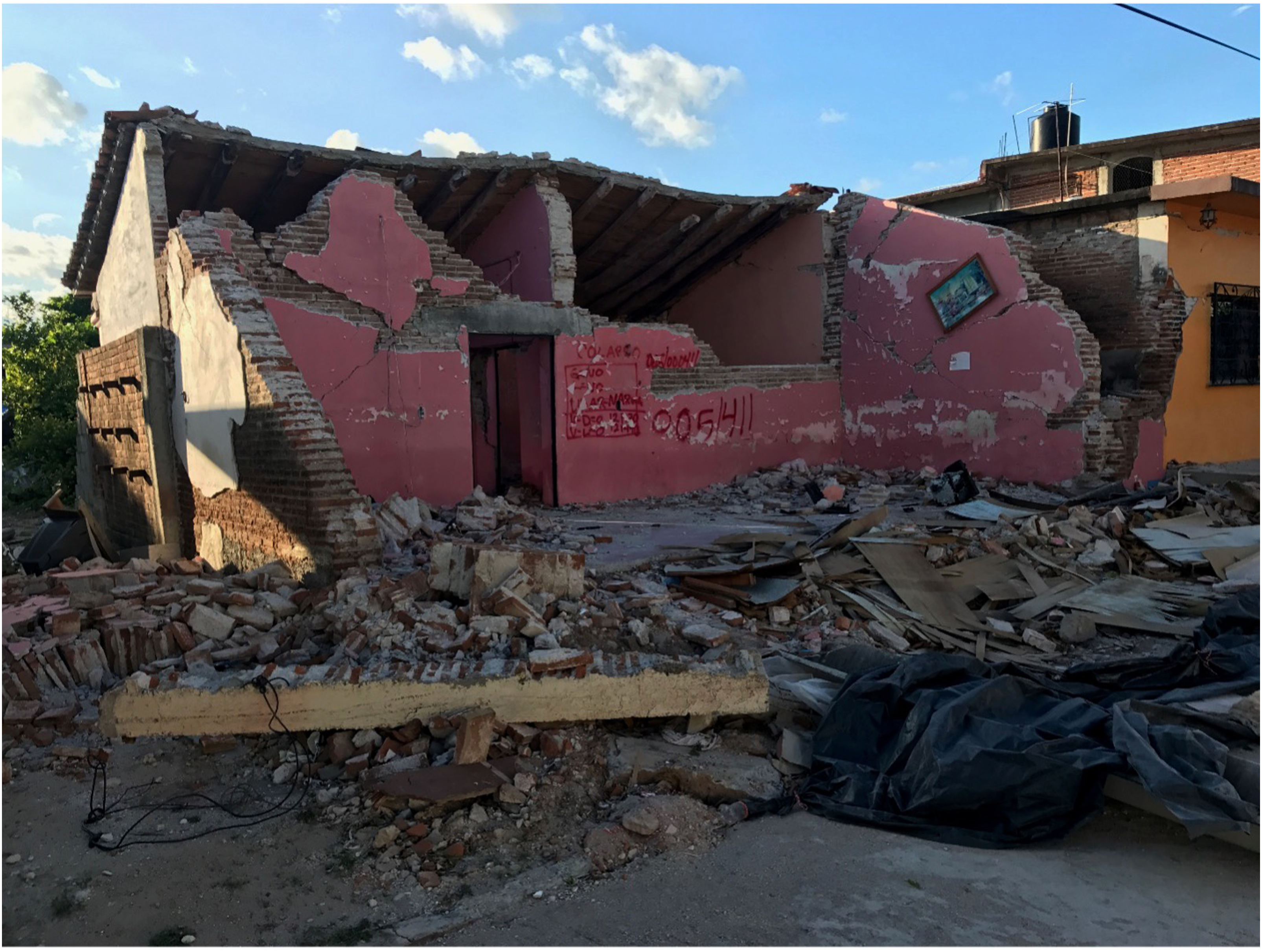
Code in collapsed dwelling in Asuncion Ixtaltepec.
Finally, the last process we elaborate upon is how relief efforts prepared and engineered the social terrain needed for the next wind farm to be built in Union Hidalgo or Ranchu Gubiña in Zapotec (see also Dunlap and Arce, 2022). While we participated in the reconstruction process, various government agencies and civil society organisations were interested in reconstruction efforts in Unión Hidalgo. It is crucial to analyse this in light of the Gunaa Sicarú
9
project and how government and enterprises meant to fabricate the social terrain needed to legitimise wind energy expansion in FPIC procedure, meant to be held in 2018, through participation in post-relief efforts. This highlights how wind energy expansion in the region has led to an increasing presence of transnational corporations in the electricity sector (Avila-Calero, 2017). By building dwellings, bakeries, and schools, among other projects, they tried to earn people's trust and took advantage of the context of scarcity to advance their interests. One inhabitant in Unión Hidalgo said that wind enterprises assumed the primary role in the relief efforts, overshadowing the government's duties. When enquired about the first days after the seismic shock, they told us that: When clearing the rubble, the enterprises and machinery would have a banner related to the wind enterprise. In this context, some people assumed, and others promoted, the wind companies’ post-relief actions for the town. Other possessors, for instance, constantly told the local inhabitants that if they accepted the project, the enterprise would rebuild the streets, build a hospital and offer jobs in the reconstruction industry.
10
As this same person puts it, the issue with this process is that reconstruction was meant to be led by the state, not the wind company. They highlighted: ‘They played with people's needs and ensured that the wind enterprise is always visible in the reconstruction process. This is deceit because they make people believe that if the project is accepted, the enterprise will build, rebuild, and bring benefits’. 11 Besides actively participating in the reconstruction process, wind companies showed interest in the FPIC procedure through two dynamics. First, they assumed a prominent role in promoting and diffusing the process by paying for the printouts, the communitarian radio, local loudspeakers and the venue. As one member of the agrarian community of Unión Hidalgo put it: ‘It is not a FPIC procedure if the enterprise is paying people. Now, there are many expectations around this project in the town’. 12 Second, during the session leading to the procedure, the enterprise paid people to heckle and undermine those opposing the wind energy project. Union Hidalgo inhabitants told us how wind energy supporters would coordinate to know when to raise their hands or make noise so that voices questioning wind expansion could not speak freely. What these people did, hence, was to silence the voices opposing wind power, contradicting the principle of freedom established in the procedure. As these quotes highlight, wind companies took advantage of the reconstruction process to become visible and establish their importance vis-à-vis post-relief efforts. 13
To sum up, relief efforts articulated by the government and wind expansion focused on three overarching elements. First, there was an uneven allocation of funds and materials through debit cards or materials that were not needed for vernacular construction techniques. This neglected traditional knowledge and undermined the local economy of towns. This crisis was compounded by the scarcity of traditional materials resulting from deforestation and environmental degradation caused by wind energy expansion. Second, the aid provided exclusively to certain households and the expense monitoring by community members galvanised conflicts and tensions within communities and eroded collective forms of work. Ultimately, this also brought gendered asymmetries, as proof of property was usually provided by male household members, leaving, for instance, single mothers or victims of domestic violence in the margins. Finally, relief efforts must be analysed considering wind energy expansion in the region. By assuming the leading role in the reconstruction process in Unión Hidalgo, wind energy companies aimed to engineer the social terrain needed for the next wave of wind projects in the region, including the latest project: Gunaa Sicarú.
‘If we work with women, we can defend our land’ articulating territorial rebellion through kitchen reconstruction
So far, we have identified processes that tried to reconfigure land arrangements and extractive projects in the region. In a context where different sectors also capitalise upon disasters and the opportunities they bring, the September earthquakes were thus utilised by certain groups as an opportunity to reconfigure citizenship and communitarian relations within and across communities. This is the case of the project entitled: ‘Rebuilding the Heart of the Isthmus of Tehuantepec’. By taking advantage of the influx of resources and aid funnelled into the region and building alliances with international and national charities, the APIIDTT put together this project in six communities (see Table 1) to help women rebuild their kitchens collectively to boost totopo 14 commercialisation and the economic and social activities articulated around this product. 15 In doing so, the project sought to emphasise the gendered dynamics behind wind power expansion and food production to promote a way beyond clientelist approaches that would exclusively provide ovens or materials for households (see Ojeda et al., 2022). This process resonates with the experience of the community of Tepito in Mexico City after the 1985 earthquake, where money donations from third entities undermined social and collective reconstruction processes (González Gómez and Tornel, 2023). The production of totopo implies bolstering agricultural activities related to endemic maize and ancillary activities such as food market activities, palm-cutting, adobe making and woodcutting. In doing so, this process highlights the inherent relationship between communities and the land (Bathke, 2014). APIIDTT worked directly with women to benefit a group left aside in negotiations with wind companies and from broader decision-making processes in extractive industries, such as the FPIC procedures, where discussing benefits and impacts for women becomes a box to be ticked (see also Ulloa, 2020). 16 As K.C. and Hilhorst (2022) argue, women's double burden of reproductive and productive labour compounds their disaster risks, including the burden of care work and elevated risks of unemployment. Along the same lines, extractivism tends to bring legal, administrative and market structures that concentrate power on men (Tran and Hanaček, 2023). In this context, the possibility for women to coordinate and evaluate the kitchen reconstruction process was a form of establishing a sense of commons through participation in reconstruction, to address patriarchal violence against indigenous women in the Isthmus of Tehuantepec and to strengthen their contribution to the local economy (Altamirano-Jiménez, 2020, 2023; see also Gay-Antaki, 2016).
The project decided to work with communities that engaged in rebellion processes against extractive projects, like San Dionisio del Mar or San Francisco del Mar, and with communities where projects have not yet arrived but have already been signalled by extractive industries (see Table 1). In doing so, the project worked with two indigenous peoples (Ikoots and Binnizá) with different histories, specific inter-ethnic relationships, and various expectations and challenges vis-à-vis the reconstruction process to recover, renew and reinvent collective practices related to territorial autonomy. By focusing on reconfiguring the connections of care within and across communities through maize, the project had a twofold objective: to repair social divisions and conflicts caused by extractive projects within and across communities and to construe new rebellion processes vis-à-vis extractive projects, similar to processes of re-rooting and re-commoning (Nirmal and Rocheleau, 2019). Concerning the latter, the social fabric had been disbanded and affected in those towns resisting the expansion of extractive projects in their territory. In San Dionisio del Mar, for instance, families accepting aid from groups opposing wind energy projects were immediately associated with taking a stance on the conflict. Restoring relationships of care, in this context, sought to rebuild collective practices necessary for the reproduction of collective life, which had been undermined because of wind industry extraction (Mejía Carrasco, 2017). Concerning the former, the construction of new rebellion processes in communities where wind energy expansion and other extractive industries had not yet arrived, the project sought to build alliances with potential leaders and exploit the lack of conflicts to foster communitarian practices and autonomy in preparation for future mobilisation process. To this end, it sought to construe new elements of care to facilitate the swift action of those groups rebuilding kitchens against the extractivist logic. In both spaces, communities affected and yet to be affected by wind power, the project tried to contest the top-down rationale imposed by the government in the reconstruction process by centring its work on women and key communities for wind investments (Figure 3).
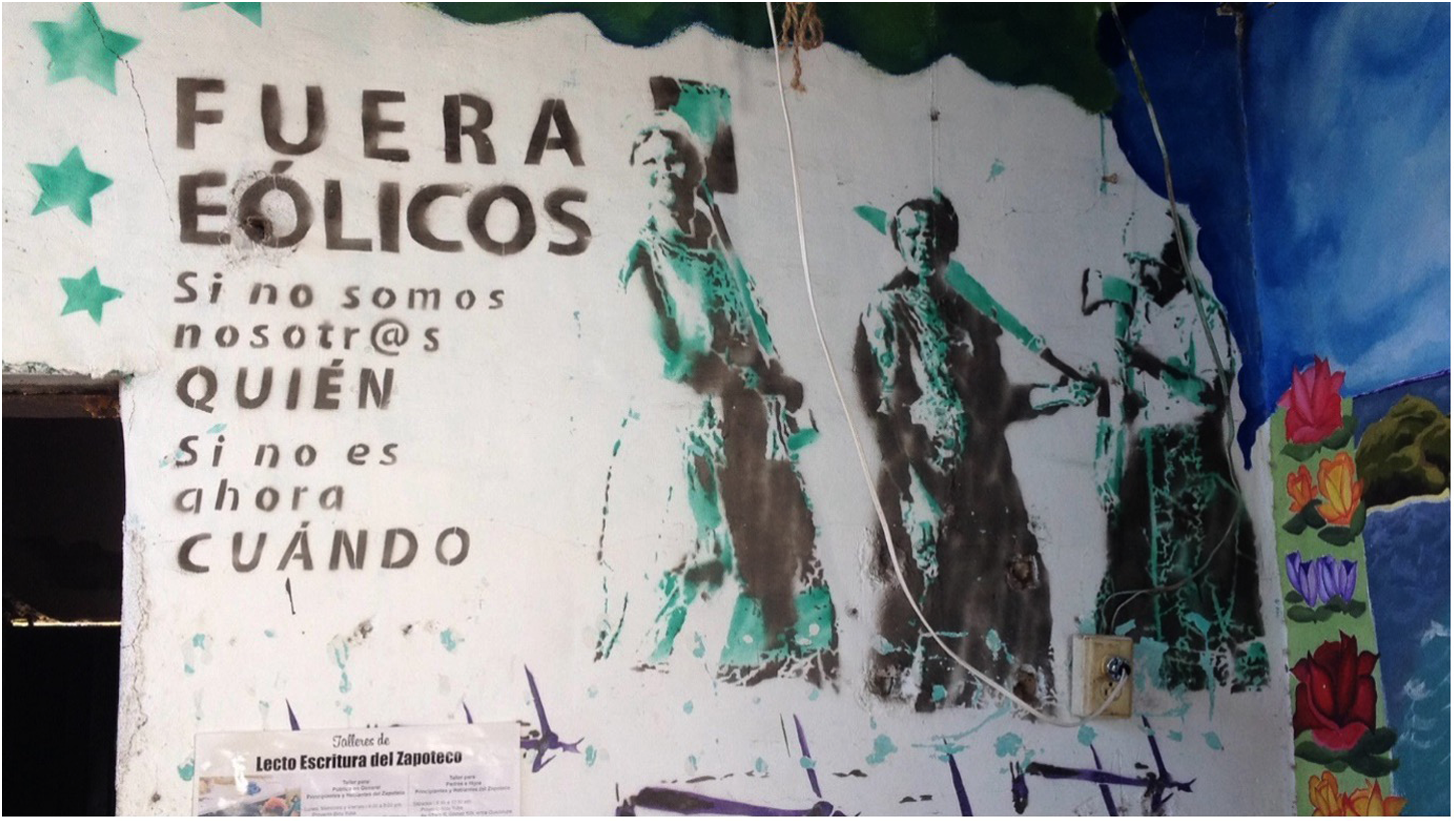
No to wind power. If not us, who? If not now, when?
In its first phase, the project liaised with local assemblies and groups in San Dionisio del Mar, San Francisco del Mar, Chicapa de Castro, Huamuchol, Juchitán and Santa Rosa de Lima (see Table 2) to diagnose a rough estimate of the number of kitchens that collapsed or presented damages after the quakes. Owing to limited organisation and financial challenges, the project aimed to build or repair kitchens for up to 50 women. The project beneficiaries were women and families without help from the government or any other organisation. In each town, the project would identify three or four women who had participated in territorial autonomy mobilisations or had sympathy towards groups resisting extractive projects. These women would oversee the project and would find more beneficiaries within the community. One of the project participants mentioned how the project provided her with insights into what men and women could do vis-à-vis post-relief efforts. In her words: ‘And here they talk about how reconstruction is a job for men, but we can do it too […] And the day our husband leaves us, what are we going to do? Wait until he comes back, or he does it? Well no, we have to do it to show we can do it ourselves’ (APPIDTT, 2019).
Communities targeted by the project and extractive projects in their territories.
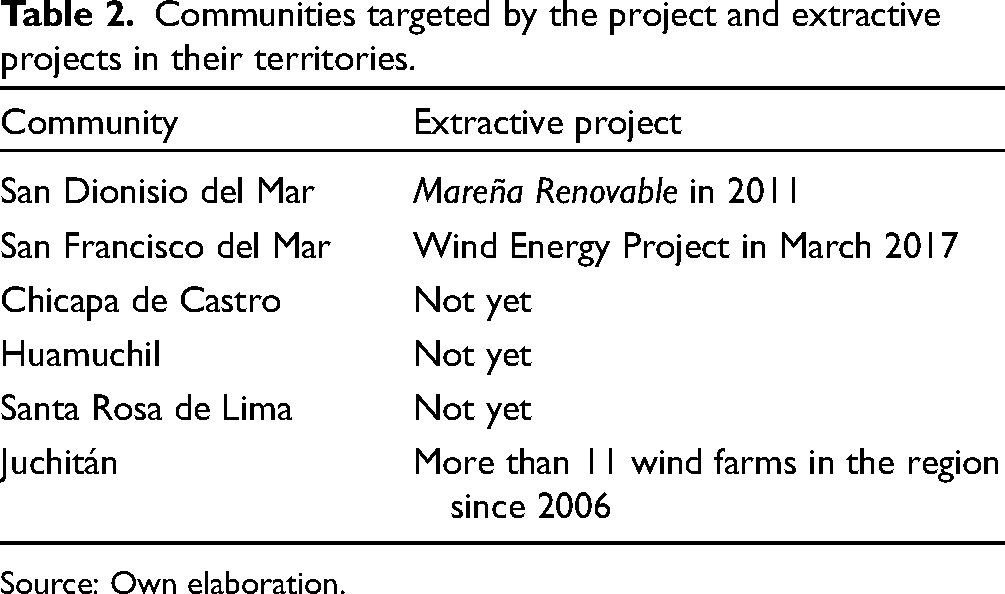
Source: Own elaboration.
Word about this project circulated quickly, and in some communities, the potential beneficiaries included more than 300 individuals. Once the list had been established, project members visited the communities to photograph the kitchens and assess the needed resources in each case. Only women who did not have a kitchen or any support from other charities were considered beneficiaries of the project. This reduced the list to those experiencing a higher level of vulnerability. After the list was polished, it was time to select the individual and household who would get the first kitchen built. This was usually done through a raffle or a show of hands after a deliberative exercise. This aimed to collectively select the first beneficiary to foster organisational capabilities among women and to avoid future complaints. After the order was decided, with different timelines in each town, 17 project members would explain the two main rules guiding the reconstruction process: the project would not seek governmental help or provide women and families with construction materials or labour following a traditional clientelist approach. Instead, beneficiaries would work under tequio with local materials and labour without the intervention of the state or any other governmental actors. By rejecting participation and intervention from external actors, the project ultimately sought to maintain, extend and reconfigure rebellion processes and pave the way for self-determination.
Some participants were naturally disappointed by the rules of operation and decided to withdraw from the project. This was either because, in a context where many third parties provided reconstruction support, they did not consider working in reconstruction worth it or because they did not have the time to participate in collective activities. However, those who decided to remain in the project were divided into 10 teams of five individuals to facilitate the movement of material and avoid a long wait to finish their kitchen. By dividing the number of beneficiaries in this fashion, there was an attempt to be more effective in the kitchen reconstruction turnaround time and to establish future rebellion cells to operate swiftly against extractive projects. This was a space where the difference between communities that had hosted extractive projects and those whose territories had not hosted these projects yet was salient. In towns like Chicapa, reconstruction processes were organised with minimal differences within and across teams to the extent that 20 kitchens were finished within less than 2 months. However, the organisation processes were different in towns like Juchitán or San Dionisio del Mar. In the former, divisions among political parties and other organisations opposing wind projects were evident in the project list of beneficiaries. For instance, in one case, a woman selected to organise the list in Juchitán suddenly stopped participating in the meetings because a local PRI politician promised help. Likewise, in San Dionisio del Mar, the division was latent. The Indigenous Assembly of San Dionisio del Mar, comprised of male members, did not fully accept the idea that women would manage the reconstruction project and attempted to take over the distribution of materials so that leaders could be associated with the reconstruction project. To put it another way, social divisions resulting from the expansion of extractive projects in the communities could be observed in the development of the project. Even if the kitchen reconstruction process would take longer and some women were unwilling to participate in collective work, an APPIDTT member argued that: ‘there are leaders in each community undertaking organisational work who coordinate the distribution of materials and the collective work. These actions were otherwise undertaken by men […] We have to show that we can go beyond pre-given assigned roles for us and that we can do so much more’ (APPIDTT, 2019). This was essential to revitalising, regenerating and rebuilding those dimensions of care necessary for the reproduction of collective life, as their role was to coordinate the project in each space and foster a small group with the potential to revitalise the local economy and defend the territory in the future. In doing so, this can be seen as an example of rebellion that seeks to challenge how the homogenising project of capital undermines the material possibility of survival and sovereignty of Indigenous communities (Hesketh, 2023). Through working with kitchens and maize, therefore, there was an engagement with the creation and maintenance of forms of organising that re-articulate and negotiate values, norms and practices of the local communities (Cretney, 2017: 6). However, even if the bottom-up reconstruction process fostered leadership and recovered local practices, it was also confronted with four broader phenomena: the interaction with political parties, gendered dynamics, engagement with external donors and ideas about how reconstruction should be undertaken.
Regarding the interaction with political parties, the project's everyday activities collided with constant aid provided by political parties and the government. This meant that various women decided to leave the project because they received help from third parties quickly by approaching a politician or a charity rather than waiting for their turn. Therefore, the number of project beneficiaries slowly decreased as external actors, including national and international NGOs, intervened in the region. Aid from political parties and other stakeholders would generally be offered under certain conditions: participation in political rallies, affiliation to groups close to certain politicians or participation in the FPIC procedure, as mentioned in the case of Unión Hidalgo.
Secondly, the idea that women would manage the project caused issues with men within and across communities. In San Dionisio, as mentioned above, women's deliberations on who would be the first to get their kitchen done were not accepted by their male counterparts. We often heard how beneficiaries interrupted their participation because their husbands would not allow them to attend specific sessions, thereby showing how access to certain assets is mediated by male household heads (K.C. and Hilhorst, 2022). To this end, Laura's case is insightful. She was the project leader in Juchitán, inviting approximately 20 to 25 women to participate. She was one of the most active members when, one day, she suddenly stopped participating in the project. She would not answer her phone or open the door when other team members went looking for her. Consequently, other project members would not know whether the kitchen reconstruction project would proceed or how other teams would organise themselves. When project members enquired, they were told Laura could no longer attend the meetings because her husband would not allow it. When he realised Laura was gaining visibility and a leadership role within the community, he was concerned about her safety and asked her not to attend the meetings anymore.
A third challenge involved the pressures brought about by project donors. Both national and international donors wanted things done according to their timelines to justify their progress to other partners. As a result, the project dynamics were put under pressure because self-organising processes obey a different logic. One of the most critical events was when donors considered that the construction process would be accelerated by providing the community with the materials without the mediation of the project team. When they dropped the materials in the community without a previous arrangement, people grabbed what they could and neglected the kitchen reconstruction order list. This ultimately galvanised conflict between groups (Figure 4).
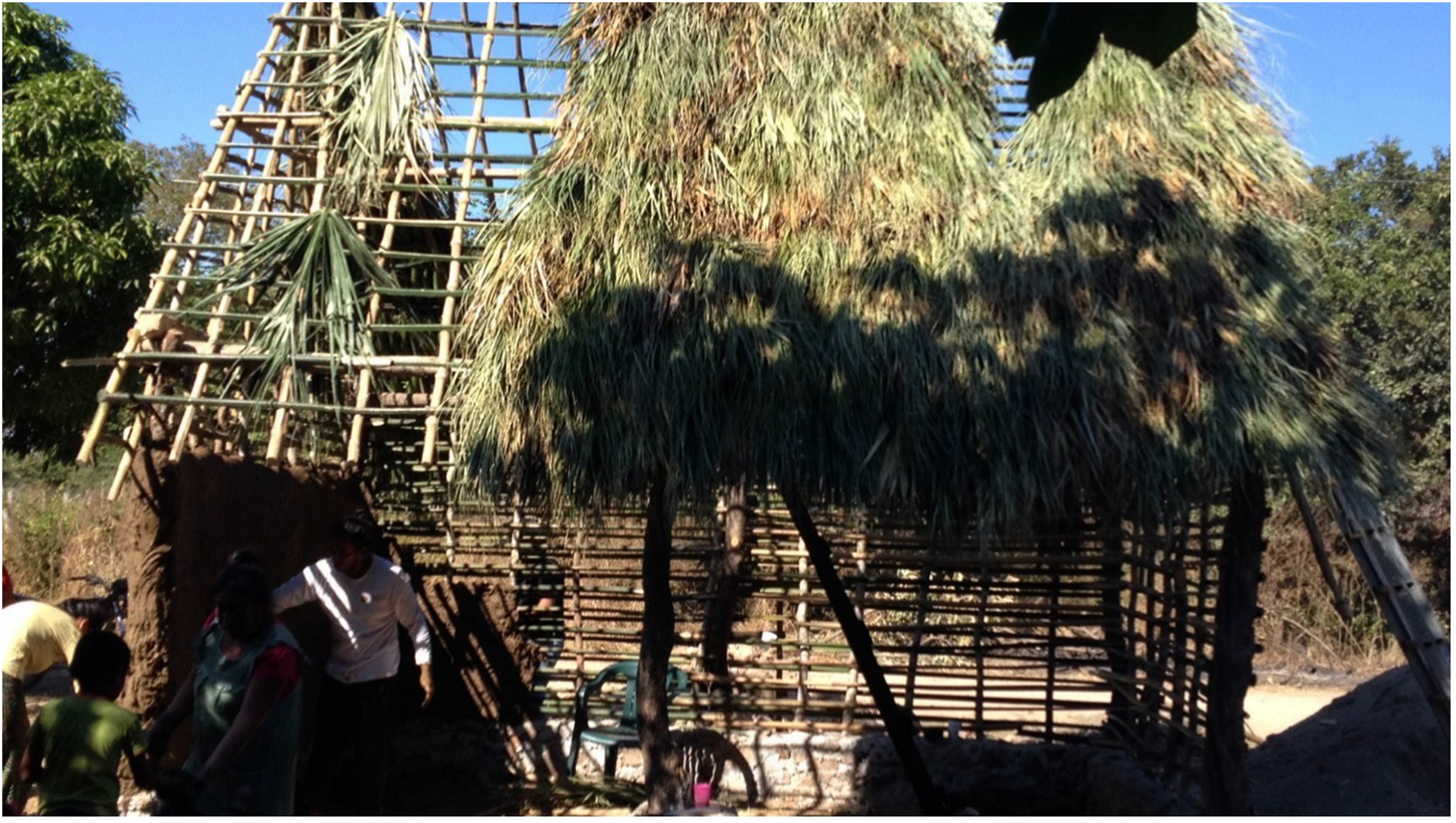
Reconstruction of a kitchen with tequio and local materials in San Francisco del Mar.
Finally, the fourth challenge concerned how they reconstruction should look like in the towns the project targeted. In a context where kitchen reconstruction used local materials and traditional knowledge to foster territorial autonomy, there was a clash of concepts – between modernity and the vernacular – within communities. This is a direct result of the expansion of infrastructure related to extractive industries and how they have brought a new way to think about life and modernity within and across communities. Vernacular materials are, therefore, inherently related to ways of being, doing and making that provide an improved livelihood and are essential for collective life (Illich, 1980). However, households would surmise that industrial materials would be more resilient against disasters in the future and that vernacular construction techniques were of inferior quality. Project team members would often hear people complaining about the decision to use palm – because it would light up quickly with fireworks –, adobe – because it washes out with the rain –, or even wood – as it rots quickly.
It is salient to mention that these challenges that undermine the social and material conditions that sustain collective life were outweighed by the opportunities brought by self-organisation, the identification of leadership within and across communities, and the chance to repair and reweave social processes in those communities affected by extractive industries. These practices, therefore, sought to resist an oppressive reconstruction process by devising alternatives and relational configurations (De Onís, 2021). This is because the project promoted the idea that communities can challenge capitalist relations by recovering, reconstructing and revitalising the territory to reproduce life. It also identified the capabilities to recuperate or renew a sense of the commons to undertake future rebellion processes against extractive projects in the region.
Renewing rebellion in the wake of a disaster
This article answered what an anti-capitalist bottom-up energy transition looks like in the aftermath of a disaster. Drawing on a kitchen reconstruction project implemented by the APIIDTT in the Isthmus of Tehuantepec, the article argues that the rupture brought about by the earthquakes was an opportunity to advance forms of conviviality through vernacular construction materials and endemic crops. Existing forms of reciprocity were strengthened through the organisation of women, usually excluded from negotiation processes with wind companies, to address patriarchal violence in the region. Similarly, the project aimed to target those populations excluded from mainstream relief efforts by offering the possibility to repair links with the territory through maize, vernacular architecture and a social economy. Most importantly, this transition also established the coordination of actions for the undertaking of rebellion against extractive industries in the future by identifying leadership in communities and exploring interlinkages with other territorial elements, thereby recovering, reconstructing and revitalising the territory. In doing so, the project paves the way for a bottom-up energy transition underlined by affect, a relational way of world-making and anti-extractivist futures (Siamanta, 2024).
At the same time, however, the attempt to bring about forms of conviviality in the communities was not exempted from broader pressures, including disaster capitalism, patriarchal relations and the intention of the government and wind companies to advance a territorial re-adjustment of the region. The sudden interest in reconstruction in Union Hidalgo, for instance, must be analysed considering the attempt from wind power stakeholders to take advantage of social vulnerabilities to advance the Gunaa Sicarú project. Similarly, the project was immersed in external pressures from political parties and traditional clientelist programmes, which prevented participation and collided with the timelines associated with bottom-up processes. Finally, patriarchal violence also challenged the project. The women's attempt to decide collectively how to distribute the material and how to go about the reconstruction processes was confronted by local organisations and external donors.
While the efforts to advance a bottom-up territorial transition cannot be compared to the challenges and tensions resulting from disaster capitalism, this project produced occasions of rebellion and territorial autonomy that will be crucial towards a radical emancipatory struggle for energy autonomy in the region.
Footnotes
Acknowledgements
We thank the reviewers and the special issue editors for their insightful comments and suggestions on previous versions of this manuscript. We also thank the people and processes that participated in the reconstruction project. A las personas y procesos que se sumaron durante la reconstrucción, por ser parte de este relato.
Declaration of conflicting interests
The authors declared no potential conflicts of interest with respect to the research, authorship, and/or publication of this article.
Funding
The authors disclosed receipt of the following financial support for the research, authorship, and/or publication of this article: This work was supported by the Consejo Nacional de Humanidades, Ciencias y Tecnologías (grant number 536510).
