



Abstract
Iranian cities have been the scene of daily antigovernment protests by young women and men since September 16, the day Mahsa Jina Amini died in the custody of the “morality police” in Tehran. Over the next weeks, the waves of protests snowballed as the often very young demonstrators poured into the streets in some 160 cities, chanting antiregime slogans. Many women removed their mandatory headscarves at street protests to call for an end to the dual life forced upon them by the state's dress code. The protesters’ anti-authoritarian outrage met with broad public sympathy, moved beyond the discontented middle classes, and engaged significant segments of working-class youth and the ethnic Kurdish and Baluchi communities. However, workers, teachers, and other sectors of organized labor, who saw no immediate victory in sight, did not join the call for a national general strike. An estimated 500 demonstrators were killed, including 67 children, and more than 15,000 people were arrested. Three months of ongoing protests in Iran have garnered more international sanctions against the Islamic Republic. Though initially shaken, regime has doubled down in its brutality to eliminate the movement. The regime's reluctance to reform has convinced many observers that new waves of protest will follow, converging to break Iran's political impasse. This article outlines an analytical lens for understanding the movement's cultural transformative power as well as its challenges in achieving its political goals. I examine four critical aspects of this protest movement to explore where it stands in Iran's recent political turmoil. These include the radicalization of politics in Iran due to rising state violence over the past decade, the growing number of forced veiling dissidents, the contribution of the youth crisis to the protests, and finally, the confluence of ethnic outrage with women's and youth anti-authoritarian politics.
Iranian cities have been the scene of daily antigovernment protests by young women and men since September 16, the day Mahsa Jina Amini, a 22-year-old woman from Kurdistan, Iran died in the custody of Tehran's so-called “morality police” (Gasht-e Ershād).
1
Two young newspaper reporters made the story public after they interviewed the family at the hospital when Mahsa was in a coma, and then at her funeral in the small town of Saqez.
2
Women at her funeral took off their headscarves in protest at the compulsory wearing of hijab and chanted “death to the dictator.” The next day protests sparked across Kurdistan, a majority Sunni province with a long history of grappling with oppressive ethnic and religious policies. Most of the women and young men who read the news sympathized with Mahsa believing such brutality might have happened to them. On September 19, a group of feminist activists posted a call on social media for a protest on Keshavarz Boulevard, around the University of Tehran (Figure 1). Their group of one to two thousand protestors found inspiration in the Kurdish revolutionary slogan Woman, Life, Freedom (zan, zendegi, azadi) first chanted by mourners in Saqez and originated in the Rojava region of Syria, where Kurdish forces, some commanded by women, drove out the Islamic State (ISIS) in late 2017. Over the next month, waves of protests snowballed, as the often very young demonstrators poured into the streets in some 120 cities, chanting antimorality police and antiregime slogans such as “Independence, Freedom, Optional Hijab”,
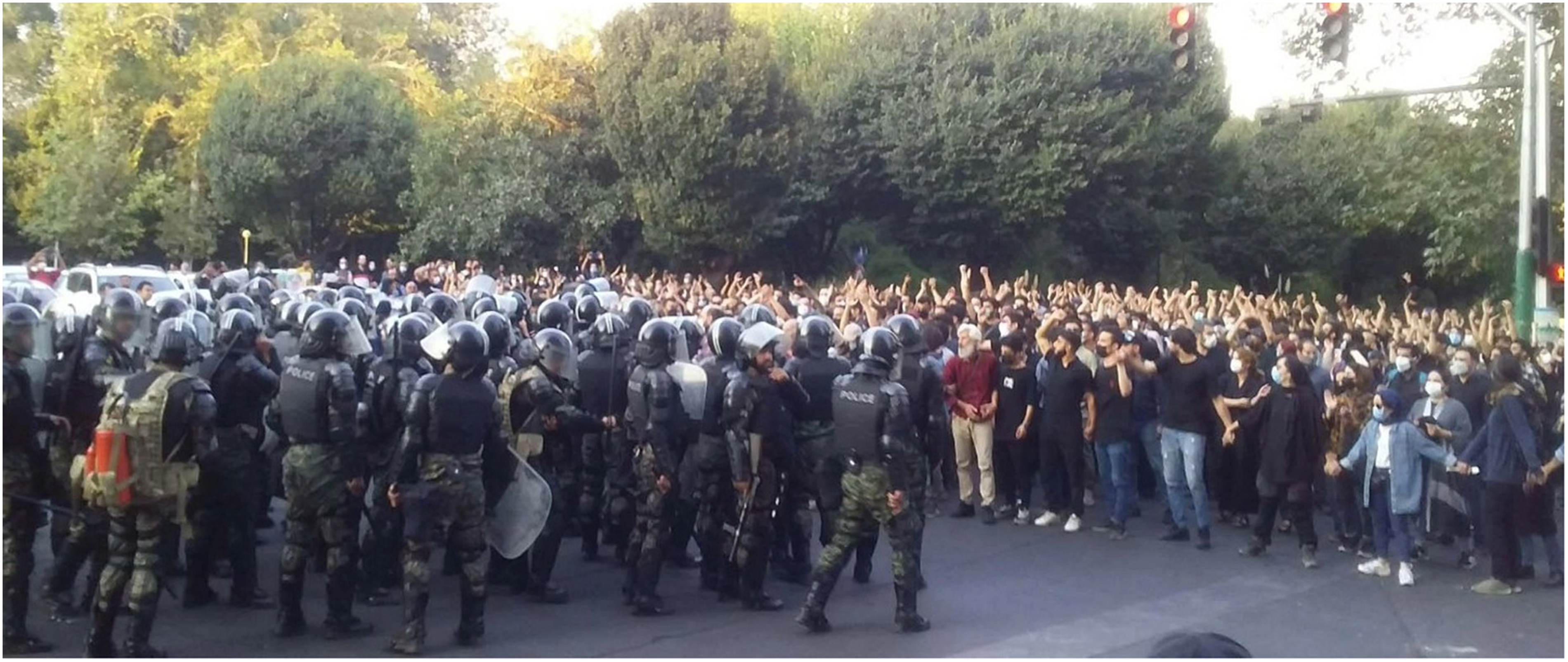
Demonstrators facing heavy police presence on Keshavarz Boulevard in central Tehran on September 19, 2022. A small feminist group started the protest—social media.
Street: State violence and radical politics
The Islamic Republic remains reluctant to recognize people's right to protest in the streets, believing that any social and political gathering not organized by the state, has the potential to oppose it. Iranian cities have never seen a massive demonstration on May Day or on Women's Day in the past four decades. The Green Movement in 2009 was an exception to the rule and has haunted the collective memory of its participants with its momentous organized street protests.
It was the fiercest challenge to the stability of the regime since the 1979 revolution. What began as a dispute over the election results evolved into a full-scale confrontation between reformist and conservative camps. For the first time since the revolution, Mir-Houssin Musavi, the presidential candidate and the leader of the movement called for demonstrations in Tehran, accusing the establishment of rigging the vote. On June 15, three million people marched from Enqelab Square to Azadi Square, shouting Where is my vote? (Khatam, 2016). The security forces were paralyzed at first, but soon began arresting all the organizers and political activists on the ground. It is estimated that five million people took part in the protests across the country (Parsa, 2015). The post-Green Movement era saw many reformist leaders criticizing Musavi for engaging in street protests. The “folk politics” of marching in the streets, they argued, distracts from the “reformist strategy” as it provokes regime's violent repressive tactics. The conventional discourse that social movements and elections operate on different terrains—outside and inside the political establishment, respectively, ignored many examples of strategic partnerships between opposition parties and social movements during electoral periods and ruined the Green Movement's potential to build long-term politics based on “bodies in the streets.”
In the 2010s, the streets became the scene of protests by workers, teachers, and retirees demanding job security, higher wages, and better working conditions, while denying any affiliation with political parties to stay within a safe margin of union activism. They were successful in a few cases, but their activists were systematically arrested and lost their jobs. Concerned about the consequences of independent protests, the reformist parties also did not support the unions, and their direct representation of the interests of the labor force. Such political dynamics reinforced the conservative culture that characterized Iran's weak street politics. Unorganized labor and unemployed youth face the most severe forms of repression, as their protests soon turned into urban riots. In December 2017 urban riots broke out in the peripheries against the lifting of subsidies, but these riots were crushed in days. Again, in November 2019, when the young poor, mostly men, took to the streets in 80 cities to protest a sudden increase in the fuel price by 50–200%, police used deadly weapons against them and 1500 people were killed (Reuters, 2019). In September 2022, the demographics of the protests changed dramatically. Young women were at the forefront of the protests, while young men and two major ethnic communities (Kurds and Baluch) have emerged as the mainstays of the movements. Gasht-e Ershad has been back on the streets since spring 2022 with more aggressive operations, and their defiant acts of resisting arrest on the streets have already made the passersby, male or female, young and old, to help them by making a fuss and objecting to their street arrests. Building solidarity and collective bonds with strangers on the street while resisting arrest by Gasht-e Ershad gave them the confidence they needed before mobilizing their efforts to organize a collective protest. While the 2017 and 2019 protests were fragmented by demands and groups of participants, the recent movement capitalized on the existing solidarity of women and youth in general against humiliating and violent acts by morality police.
Dissidents of compulsory hijab: From minority to majority women
The wearing of the headscarf and long dark attire became compulsory for all Iranian women and girls over the age of 9 from April 1983. Since then, all women, including the non-Muslims, have been required by law to wear hijab in public. 5 When women took part in a week-long demonstration in Tehran in March 1979 to protest the new Islamist regime's edict compelling women to wear hijab, they could not sustain the support of secular and left-wing revolutionaries, let alone the majority of women in the general public. The Commiteh zed-Monkart was then tasked with enforcing the dress code and other state-imposed disciplinary codes, to create a “spotless city” (Khatam, 2009). The target population of morality police has changed over time from secular Iranians doomed to conform to the culture of the previous regime in the 1980s, to middle and working-class youth born and raised under the Islamic Republic, who had supposedly eaten and breathed nothing but revolutionary Islamic ideals. They would face morality checks at schools, main street intersections, squares, the entrances to subway stations and public offices entrances, airports, intercity train stations, hotels, and sports and entertainment facilities, where police agents would decide if they adhered to the state's strict dress code. Shervin Hajipour's song “Baraye” (meaning “for” or “because of”), the anthem or soundtrack of the recent protests, describes these daily humiliations. According to police reports, some 2000 women are arrested every day in Tehran and other cities for wearing “inappropriate clothing,” pushing the number of those who only receive a warning to thousands (Women NCR, 2016).
On December 27, 2017, Vida Movahed, a young woman, stood in the crowd on a utility box on Enqelab Street in Tehran, tied her hijab, a white headscarf, to a stick, and waved it as a flag to the crowd. Five other young women re-enacted her protest in the same location over the next 2 months, and many others on other locations in different cities. These young women were called Girls of Enqelab (Dokhtarn-e enqelab) and their silent performance became an inspiration to other women, especially in middle-class and upper-class neighborhoods, who walked the streets without headscarves. Breaking growing opposition from women to the morality police was part of the cultural project of conservative President Ebrahim Raisi, who won the 2021 engineered election with a turnout of 48%. Conservative Islamists, used to blame other factions for growing secular values and attitudes in Iranian society, have made several attempts to restructure the education system, media, and cultural institutions to reverse cultural trends. According to recent surveys more than two-thirds of the population explicitly rejects state enforcement of the mandatory hijab in Iran. This includes a quarter of those who believe in the practice of veiling for religious reasons (Arab and Maleki, 2020). The “hijab and chastity” decree, introduced in July 2022, was one such effort that turned cities into battlefields. Many young women resisted street arrests and video images showing police practices becoming increasingly brutal to crush the unprecedented resistance, went viral on social media. In this context, Mahsa's death in police custody prompted many young women to make a clear break with such a “republic of piety.”
This is a youth movement across class and ethnicities
When observers describe men's support for the women's cause in this movement, they usually describe it as either the result of a dramatic change in men's cultural values, or their general awareness of the role of women in challenging the system. While each of these statements is partially true, men's active participation in this movement goes beyond their willingness to support their sisters and partners. Young men were themselves subjected to morality police investigations, for their haircuts, accompanying women outside the family circle, etc. However, they are more challenged than young women by economic conditions that make it impossible for them to start a family or live independently from their parents. “Youth”’ represents a sort of Bourdieuian habitus—or in Asef Bayat's (2022: 16) words “a series of mental and cognitive dispositions, ways of being, feeling, and carrying oneself that are associated with the sociological position of structural irresponsibility.” This is how young people experience “youthfulness.” But youth politics is about a collective challenge to defend and extend individual autonomy and security of transition to the adult world. Young people in Iran have high levels of education but many of them are unemployed and feel they have no future (Khatam, 2010) and 40% or 2 million girls aged 14 to 25 are neither studying nor working; 25% of boys of the same age are unemployed. They are deeply concerned about the state's failure to run the economy and reach an agreement with the West and hostile regional powers. Their frequent protests over the past 5 years in Iran show that they have decided to do something about it, as traditional reformist strategies have not achieved the goal.
A journal affiliated with Iran's Ministry of Science recently published the first research article on the recent uprising titled “The Anatomy of the September-October 2022 Unrest.” This article describes how state-youth relations are articulated in the minds of young protesters, who according to the article, make up the crowd on the streets. The article suggests that “dahe-hashtadi-ha” (those born in the 2000s) form the main body of the protesters and they believe that the Islamic Republic is not capable to lead the country. The report describes this generation as one that has “little faith in government bureaucracy and sees it as an inefficient body… [For them] it is an institution that cancels music concerts, imposes mandatory guidelines, and bans cultural and recreational activities…” (Ministry of Science, R & T, 2022). The article adds that “when they hear news about water shortages, environmental problems, air pollution, even the spread of addiction and street children, they blame the government and take their judgment for granted.” The government's reference to the demographics of the protests, as in this article, is usually intended to underrate the movement and deny its nationwide spread. However, the data reflecting young people's belief that the state-youth relation is structured to discipline them rather than provide them with life-development and welfare opportunities is instructive about Iran's youth crisis. It means that morality police brutality is understood by Iran's younger generation as a symptom of a failed state.
Gasht-e Ershād has disappeared from the streets since the first days of the protests and the government did not dare to return it, despite cracking down on the movement. According to the Attorney General's statement on December 3, 2022, operations of the unit are currently being suspended, but the Ministry of Interior, which is in charge of the unit has not confirmed the news. Some officials said the government may utilize facial recognition technology for hijab enforcement and women who do not comply with hijab would receive text messages, urging them to respect the law. They did not elaborate on how the unveiled women are identified in public. The judiciary has proposed a draft of new articles to be added to the penal code as a new penalty for women arrested more than once for not wearing a hijab. These include various social restrictions and deprivations such as deprivation of government service, driver's license suspension, and to be banned from leaving the country, start a business, participate in formal artistic and athletic competitions, and benefit from free government services. Despite all odds, the presence of young women not wearing headscarve in steets and private sector offices and institutes is becoming normalized in different neighborhoods and cities in Iran.
Uprising spreads beyond the large cities
The number of participants and their social and geographical spread appears as a crucial factor in theories of how social movements bring about change. By all accounts, the scale of the protests in this movement was significant, but it is important to estimate the participants and compare them to previous movements and see how they have spread across class and ethnic lines. Born out of street resistance against the morality police, the movement's demands and slogans soon articulated a radical break with formal politics. Radical protests do not usually form large, concentrated demonstrations unless security forces retreat or collapse. Tight security surveillance of the main streets in all major cities meant that, despite initial efforts to hold a protest in central Tehran, field leaders had to call for protests in local sites. These local sites, usually major intersections in each neighborhood, attracted more young women and increased their power to maneuver the protest sites, although it denied the movement an opportunity to demonstrate its mass support. The movement's local structure also made it difficult to estimate the actual number of demonstrators (official government figures have underestimated the number of participants at between 90,000 and 400,000). The methods used to estimate the number of participants in centralized protests such as the Green Movement, including the one-way flow model for mobile demonstrations and the grid/density method for assembled crowds, are not applicable to local protests. 6
With this type of movement, it is more promising to use the number of neighborhoods involved in the movement to get an estimate of the total mass. I took the number of neighborhoods involved in the October 26 protests in Tehran, the 40-day commemoration of Mahsa's death, and multiplied them by an average number of participants in each neighborhood. Tehran became the hotbed of the movement that day, with local protest sites springing up in 80 different neighborhoods. The average number of participants in each neighborhood is estimated at around 2500 people, 7 bringing the total number of protesters in Tehran to nearly 200,000 people. This number corresponds to about 10% of the city's young population (15–30 years old). Taking this average for all other cities involved in the street protests, the total estimate is over 1.5 million. 8 If another half million took part in off-streets protests, including the university and school protests, the many sit-ins and workplace protests organized by teachers, workers, artists, lawyers, and doctors, then we can increase the total number of protesters to two million people. More than three-quarters of the country's urban population live in the 120 cities that have joined the movement in its first month. 9 Some 28 cities with 100,000 to 500,000 population are missing from the map of the first month's street protests (Map 1). These are mainly located in the provinces of Fars, Khuzestan, and South Khorasan (in the south and east of the country), where the power of religious or tribal patriarchies tends to be high. The number of cities involved rose to 160 in November, meaning that out of 1100 cities with <100,000 population some have joined the protest.
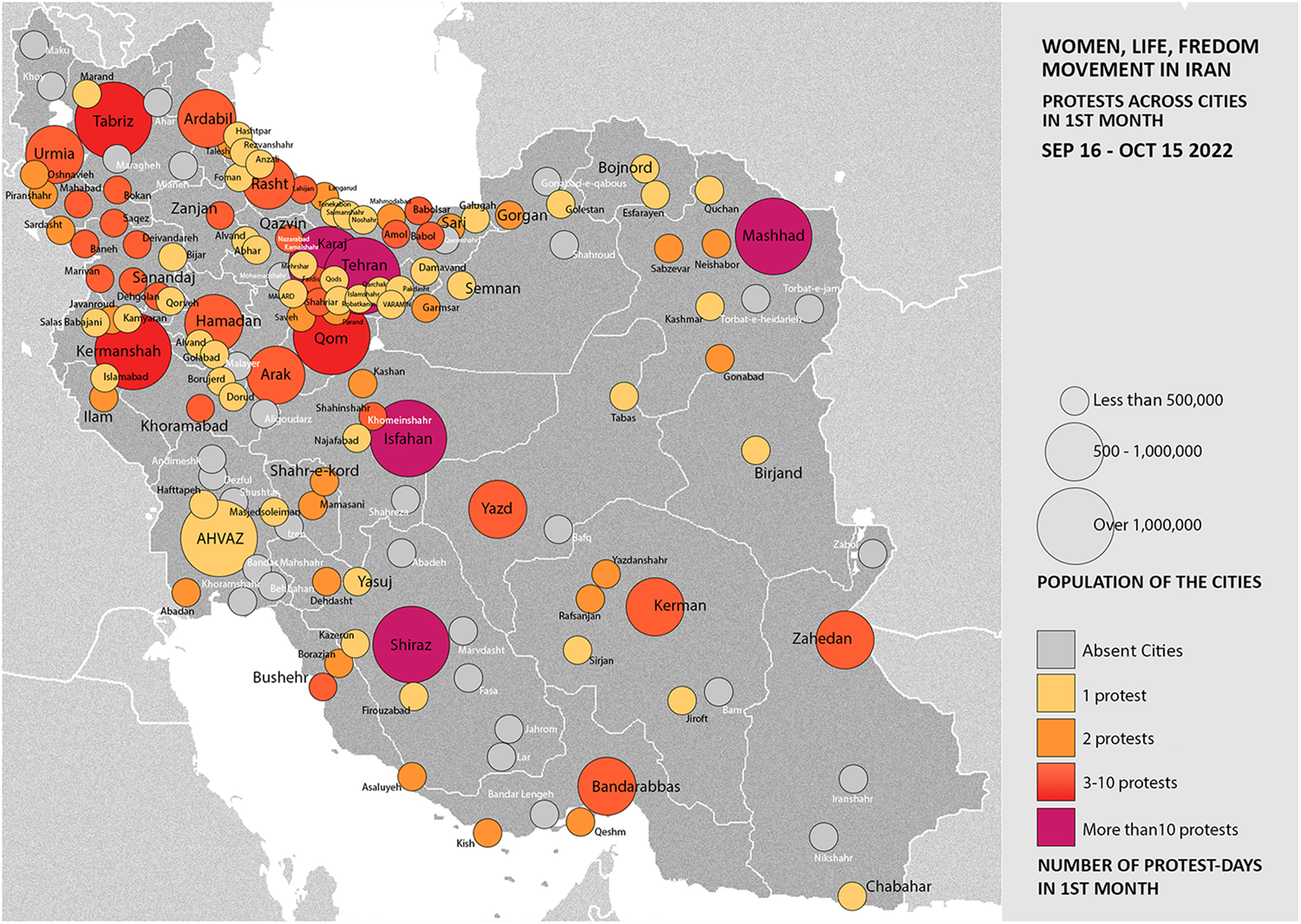
Number of protests across cities in the first month of the movement. September 16 to October 15, 2022—Khatam.
We do not have much data on the social characteristics of the participants, but protests in many small towns in metropolitan areas and remote provinces suggests that the movement has succeeded in moving beyond the discontented middle classes to engage significant segments of working-class neighborhoods and towns, regardless of ethnicity. The number of protests per city shows that Tehran and another eight provincial centers (Isfahan, Mashhad, Tabriz, Shiraz, Karaj, Sanandaj, Rasht, and Kermanshah) were the hotbeds of the youth politics, with protesters taking to the streets every 3 days (more than 10 times a month). Future research on each of these cities should examine the specific factors involved in making them sites of frequent protests in this movement, while some of them were missing from the Green Movement's map of active cities. In 56 other cities, street protests have occurred 2 to 10 times per month, and in another 42 cities only once (map 1). In working-class cities at the margins of metropolitan regions, youth were on the street 2 to 10 times in the first month. 10 Demonstrations in the highly religious cities of Qom, Mashhad and Yazd were particularly important, showing the culture of the patriarchy is shaking even in their core cities.
As police crackdowns intensified in November, street protests in most cities dwindled and the number of people on rooftops shouting “death to the dictator” at night began to outnumber those on the streets. Kurdistan and Sistan-Baluchistan continued their protests, with the intersection of tense ethnic and religious divisions providing a particular force for antiregime protests. The movement is commonly referred to as a leaderless movement, but it seems that the Baluchi protesters have found a leader in Molana Abdolhamid, the Zahedan's Shaykh al-Islam, and traditional political parties are leading the strikes and protests in Kurdistan. University students also organized protest rallies on campus from the early days of the academic year and went on strike in October and November. They clashed with student Basij over the tearing down of the walls separating female and male canteens. 11 Their movement began to lose momentum in December as many active students were arrested, and a larger group were expelled, suspended, or banned from campus.
What lies ahead?
This movement has an assertive claim to be connected to the recent history of political protests that has shaped the past 5 years in Iran, but this connection does not help us to understand the movement's claims to the social at present time. I argued that the movement has four distinct characters, it is radical in strategy, feminist in its front lines, calls for the youth rights to better life chances, and demands freedom and representation for ethnoreligious communities. We may think of these characters as parallel flows of energy and substance in the process of building a far-reaching movement or think of the protests as collective actions of diverse social groups united to overthrow their illegitimate government. Future developments will clarify how Iranian society wants to see and further develop this movement. New social groups have joined this movement, such as the grieving families of those who have lost their lives to past or current state violence, also human rights activists fighting for the rights of prisoners. Iranian journalism is taking steps to break the codes of extreme censorship that have stifled them and are engaging in debates about the movement's future. Civil society institutes and activists were radicalized by this movement; the Coordinating Council of Teachers’ Associations called for a 3-day period of public mourning for the students killed in the protests; Lawyers gathered in front of their association's building to protest police repression. Doctors, normally silent on political issues, assembled outside the Iran Medical Council to protest police raids on hospitals to arrest those injured on the streets.
The past 3 months have transformed Iranian society like a cultural upheaval. No matter how the movement may develop politically in future, many will not live the same social relationships that framed their lives before this movement. Regional and ethnic inequalities and grievances will no longer be considered as natural. Outstanding works of art, inspired by the remarkable bravery and creativity of the movement's young participants, will continue to popularize the aims, and claims of this movement. New activists, social thinkers and organizers will emerge out of the two million young participants of the movement to take it to a new level, build new awareness, solidarities, and leaderships. Unlike the Arab spring, they may succeed to build better leaderships to clear up the conflicts between the monarchists, liberals, and social democrats who are considered the regime's opposition, before the uprising ends up in building another authoritarian regime. Global support for the movement has made it difficult for the US and European countries to resume negotiations for a nuclear deal with the Islamic Republic, putting hardliners under intense pressure to derail their foreign policy which relies on military preparations to secure the regime. The Iranian diaspora, which mainly supported the renegotiation of the nuclear deal, following the Trump administration's withdrawal, is now paralyzed by the regime's brutality against its own people and its confrontational foreign policy. 12 This has aroused the desire of monarchists to be seen by Western countries as an alternative to the Islamic Republic.
Gasht-e Ershād has disappeared from the streets for the time being. This most visible face of the state violence in Iran could no longer patrol the cities, and efforts to destabilize gender segregation in public spaces continue. However, dress code enforcement has not gone away, and new rounds of struggle are on the way for women to take to the streets unveiled, as they carry the movement's claim on their bodies. The antiregime graffiti poses a vigorous challenge to state's wishing protests to disappear. The coming months will show that Iran needs another revolution or more peaceful transitions to complete the changes brought about by the Woman, Life, Freedom movement.
Footnotes
Acknowledgements
I am grateful to the anonymous reviewers of Human Geography for their insightful comments on this article. Dena Levy has helped me with drawing the “Rebel Cities Map” and Kaveh Ehsani has read and commented on the article. I thank both for their friendship and support.
Declaration of conflicting interests
The authors declared no potential conflicts of interest with respect to the research, authorship, and/or publication of this article.
Funding
The authors received no financial support for the research, authorship, and/or publication of this article.