




Abstract
Urban hen keeping is one means for local food production, allowing for control over the supply. Many Canadian cities allow urban hens, while others are opposed to this form of urban agriculture. The purpose of this research was to understand the controversy of urban hens to support communities facing challenging futures. We report on the qualitative portion of a stepwise mixed methods study of 15 urban residents. Data consisted of semi-structured interviews and thematic analysis derived from open coding and selective coding based on a system change conceptual framework. Three main discourse areas on the struggle with urban hen bylaws included education on urban agriculture, differing values and visions for city life, and tensions between individual rights and the collective good.
Urban agriculture has been a growing field of research common to both human geography and public health. Tornaghi (2014) noted in their paper “Critical geography of urban agriculture” that urban agriculture, the act of cultivating food and raising animals on urban land, was a relatively unexplored field of human geography, yet highly relevant one. Urban agriculture is shaped by sociopolitical context and history, the varying cultural meaning of urban agriculture to societies, and the interrelated issues of land struggles, food justice, and sustainability (Tornaghi, 2014). Urban agriculture is inherently a geographical topic because a land-based practice is influenced by the physical geography and the societal context and power structures surrounding the place in which it operates. Recently, geographical research has focused on these issues of urban agriculture in the context of food justice and food sovereignty to address how power structures embedded within societies affect the space and place in which urban agriculture occurs (Levkoe et al., 2020). This focus on food systems is of interdisciplinary interest, especially to scholars and practitioners working in the public health field. Public health addresses complex, non-linear problems developed from multiple sources that, without intervention, result in adverse societal outcomes (Peters, 2017). For example, community food security and food justice are complex problems where the food system comprises multiple inputs and processes. A well-functioning food system is essential to population health. This has been highlighted most recently during the early phase of the COVID-19 pandemic, during which many communities around the world saw the implications of a poorly function food system, where panic buying – to prepare for a presumed unsettled future – ranged from household goods to baby chicks (Dickson, 2020; Fowler, 2020). Urban gardening was also increasingly popular during the pandemic, with some areas reporting a shortage of vegetable seeds (Held, 2021).
Urban agriculture, including gardens and livestock, is vital to strengthening food and nutrition security, particularly in times of stress to the food system (Lal, 2020). In urban environments, micro-livestock, such as bees and hens, are growing in popularity, and the topic of urban hen keeping has been surfacing in the Canadian Media (see Snowdon, 2019; Tunney, 2020; Williamson, 2020). Contrary to the perceived popularity, many people have struggled to have urban hen keeping accepted in their municipality and faced claims of potential problems from neighbours. Many Canadian cities permit urban hens, but some municipalities are leaving homeowners waiting for some portion of their protein food supply to be within reach. This research aimed to understand the struggle to change urban hen bylaws and identify places to intervene for change. Specifically, we asked why there was a problem introducing urban hens in Saskatoon neighbourhoods’ backyards. The objectives were to: first, understand why some people supported and fought for the opportunity to raise urban hens against current bylaws; second, to explore the concerns of people who adamantly opposed urban hens; and third, to identify areas to influence systems change. We approached this research thinking that exploring extremes on both sides of this argument could provide insights to support people seeking bylaw changes towards urban hens. Cooperation in a place as close as an urban setting depends on going beyond differences (Turner and Smaldino, 2018). We exposed a deeper human problem through the research process, showing potential for the transferability of findings to a much broader field.
Background
North American cities are once again becoming sites of urban agriculture. Although growing food on municipal land was once necessary, city planners discouraged farming within city limits with the growing industrialization and development of modern sewage and sanitation systems (Voigt, 2011). Urban agriculture can include multiple types, from the backyard, balcony, and rooftop gardening to urban farms, aquaculture, and beekeeping (Pothukuchi and Kaufman, 1999; La Rosa et al., 2014). Urban agriculture is beneficial to public health through multiple avenues such as increased food security, increased physical activity, economic development, and psychological well-being (Brown and Jameton, 2000). Additionally, climate change is a known health threat (Romanello et al., 2021), and urban agriculture can be an intervention to decrease environmental impact and increase community sustainability (Langemeyer et al., 2021). Therefore, urban agriculture is a public health intervention to build resilience in a time of climate change.
Places such as Vancouver, Detroit, and Sacramento are changing regulations to permit urban farming, allowing residents to grow and sell food directly from their property (Mukherji and Morales, 2010; Stolhandske and Evans, 2017; Walker, 2016). In addition to the public health benefits of urban agriculture, such activities increase civic participation in food systems governance and contribute to food sovereignty within an urban setting. Food sovereignty refers to expanding democracy to regenerate local, autonomous, and ecologically sound food systems that respect the rights of people to decent working conditions and incomes (Blouin et al., 2009; Pimbert, 2010). The food sovereignty movement recognizes political and economic power in the food system and is a critical alternative to the neoliberal model favouring market forces (Desmarais and Wittman, 2014) and is of particular interest to recent radical geography research (Levkoe et al., 2020). Weiler et al. (2014) described how food sovereignty has an orientation to promote human thriving by equalizing access to power and the flow of goods through the food system. Urban agriculture provides citizens opportunities to participate directly in their food system through food cultivation and animal husbandry while gaining a sense of power and control. Furthermore, urban agriculture can reduce poverty and enhance livelihoods while improving urban ecosystem resources by regulating environmental processes of water filtration, nutrient reuse, biodiversity, and food production pollinators (Lwasa et al., 2014).
There are numerous studies on food cultivation in urban settings (Tornaghi, 2014; Walker, 2016), but less on animal husbandry. McClintock et al. (2014) conducted an exploratory survey to understand the regulatory challenges that some were facing with urban livestock (chickens, rabbits, bees, and goats) across the United States. Most urban livestock owners viewed their animals as pets. Therefore, the researchers suggested many restrictions under current planning codes resulted in excessive regulations that aligned more closely with rural farming (McClintock et al., 2014). McClintock et al. (2014) instead recommended that urban livestock policies regulate aspects such as housing placement in the yard, promoting high standards for animal welfare, and sale and slaughter conditions. Blecha and Leitner (2014) described how urban hen keepers were interested in the activity due to the industrial food system and the unsociable and concrete urban setting. Study participants discussed creating sustainable backyard agro-ecosystems, creating a space for improved sociability, resisting consumerism, and improving the lives of humans, animals, and the urban environment (Blecha and Leitner, 2014). Similarly, Lewis (2015) found that urban hen keepers had anxieties about the industrial food system and the world's state, including, but not limited to, climate change, food system contamination and inhumane practices, and governmental collapse and dysfunction.
Indeed, the North American food system's fragility became evident during the COVID-19 pandemic (Orden, 2020). Keeping urban hens has been described as a response to overdependence on technology, modern infrastructure, and the environmental consequences of living, providing a means for some control and a sense of happiness and well-being (Lewis, 2015). Lewis (2015) also emphasized the need for reskilling with urban hens, like other food production and preparation skills, known as food literacy (Cullen et al., 2015). Some argue that newer generations in the Western world have little experience with self-sufficiency and domestic arts, increasing food-related chronic disease (Cullen et al., 2015). In response, there is a significant body of emerging research on food environments (Cobb et al., 2015) and urban and civic agriculture to re-connect young people to agricultural roots and food systems (Ackermann et al., 2011; Blouin et al., 2009; Poulsen, 2017). However, researchers have not explored urban hens’ perceived benefits and challenges even with this increased attention.
There are some challenges of urban chickens noted in the literature. For example, Biswas et al. (2009) studied the risk factors for avian influenza A virus (H5N1) in backyard chickens in Bangladesh. In a United States Department of Agriculture study (USDA, 2012), over half of respondents from a four-city study agreed that urban chickens would lead to more human illnesses. Capoccia et al. (2018) found that study participants did not have sufficient knowledge base to reduce risks of illness from keeping urban hens, which is of concern. Still, the enjoyment of having the animals has prevailed over any risks. So, while urban hens are often used to solve numerous modern realities, there may also be real risks to engagement.
Methods
To study the problems of introducing urban hens, we used a stepwise mixed-method case study design (Cresswell, 2009) with a framework grounded in systems thinking (Foster-Fishman et al., 2007; see Figure 1). This method provided a bounded case for analysis, drawing on a small portion of a descriptive survey that led to participants who could provide a deeper explanation for the problem through interviews. The stepwise mixed-method approach allowed the research team to easily identify participants who expressed extreme views on urban hens, which would have been otherwise very difficult to achieve. The framework guided analysis and diagnosis of system functioning to recognize critical levers for change. According to Foster-Fishman et al. (2007), systems are a collection of interacting parts that function as a whole. The system of focus for this research was the civic regulation of urban agriculture, explicitly involving hens. Superficially, the problem was allowing hens in urban settings, and this framework helped clarify the underlying problems.
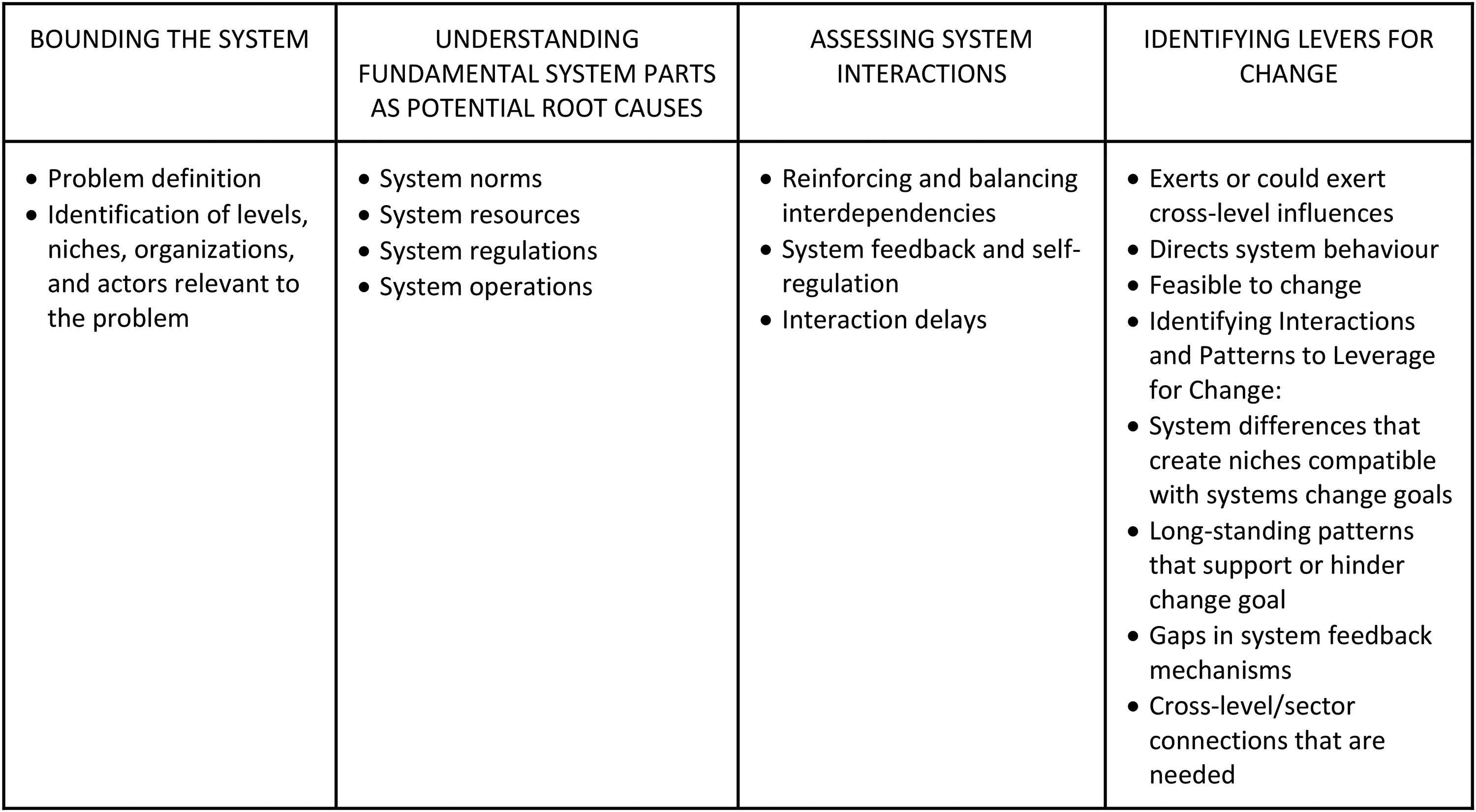
Systems change framework (Foster-Fishman et al., 2007).
This methodological approach aimed to define how we view the system, including those who were vocally for and against urban hens (objectives 1 and 2), thereby recognizing what action could change the system (objective 3). The framework was grounded in the work of Checkland and Scholes with soft systems methodology and of Forrester's work on system dynamics thinking (Foster-Fishman et al., 2007). The former emphasizes the subjective nature of systems and the political, social, and cultural aspects, while the latter focuses on the system's cause-and-effect relationships (Foster-Fishman et al., 2007). This framework was intentionally designed to be broad, assuming that not all elements in the framework are essential. Still, it guides understanding systems functions and leavers for change (Foster-Fishman et al., 2007).
Setting
Saskatoon is a Prairie Canadian city with a population of 278,500. The City of Saskatoon Animal Control Bylaw, 1999 (Bylaw No. 7860) prohibits keeping farm animals, including chickens, in Saskatoon. The penalty for keeping a prohibited animal in contravention of this bylaw can include a fine and an order to surrender the animal(s) to the city. However, Saskatoon has a strong environmentally sustainable community commitment, as seen in City of Saskatoon Council Policy #C02-036, Environmental Policy, 2006 (updated 2015), supporting urban agriculture efforts.
Previous efforts had been made to change the bylaws, and one group came together just before this research to propose a pilot project to support the feasibility and acceptability of urban hens. The pilot had the support of public health, the SPCA, eight neighbourhood associations, and the Saskatoon Food Council, along with the Veterinary Medical Center and College of Nursing at the University of Saskatchewan. The presentation was made to the Standing Policy Committee on Planning, Development and Community Services on April 3, 2017, resulting in a split decision, and therefore not accepted.
Telephone survey
In May 2017, we conducted a 10-min random-digit-dialled telephone survey with 383 adults 18 years of age or older in Saskatoon. The telephone surveys focused on urban agriculture that included questions on urban hens’ acceptability. The primary purpose was to learn how people access, understand and participate in local urban food production to help the city grow more food within city limits. This paper does not cover the full survey details, but the results can be found in a report at https://bit.ly/3q3eMcu. The survey was calculated to be a statistically representative sample of Saskatoon. Participants were drawn from telephone survey participants that agreed to be contacted for a more extended interview. This study was approved by the University of Saskatchewan Research Ethics Board file 16–87 and funded by the Saskatchewan Health Research Foundation.
Interviews
Interview participants were randomly selected from the larger telephone survey sample if they had both an extreme view and agreed to be contacted for future follow-up. These qualitative interview participants were drawn from those who identified as being for or against urban hen-keeping since understanding these two viewpoints was a study objective. After receiving ethical approval from the University of Saskatchewan Research Ethics Board, we recruited through our list of potential participants. Interviews were conducted on a rolling schedule with research team discussions throughout the interview process until the team agreed that data saturation had been met and that new interviews were not bringing in new information. Of the participants willing to engage (n = 92), we selected respondents from categories of being either in support of and would or might own hens (18) or opposed to urban hens and disagreed with having a pilot project on hens (20). Not all participants were able to be reached for follow-up based on the contact information they had provided, nor were all clients willing and able to schedule an interview after the initial expression of interest We completed 14 one-hour interviews in total; seven were with people who supported allowing urban hens, and six were opposed to urban hens. We also had one neutral community member. We included one interview with a community member who held special knowledge of how the city policy and bylaws operate. We felt there was a sufficient balance of representation of participants in people who were either for or against urban hens. Interviews resulted in hearing repeated information, so we were confident we had a sufficient dataset.
The primary qualitative data collection method was semi-structured face-to-face interviews with written informed consent. Questions were about the experience with hens, benefits and challenges, awareness of the previous proposal to the city council, and why people are passionate (for or against) about this issue. Interviews were audio-recorded, transcribed verbatim, and uploaded to NVivo software to assist with data organization. The analysis, conducted by two research team members, included open coding and constant comparison. We also used selective coding based on the systems change framework. Researcher subjectivity was a challenge because some team members kept urban hens against the bylaw. Hen ownership was not disclosed during the interview but occasionally shared post-interview with participants. During the analysis, we focused on understanding why people were passionate on both sides of this argument and not on being for or against urban hen keeping. The exercise of trying to minimize bias began to expose what we now see as a much bigger issue facing cities.
Results
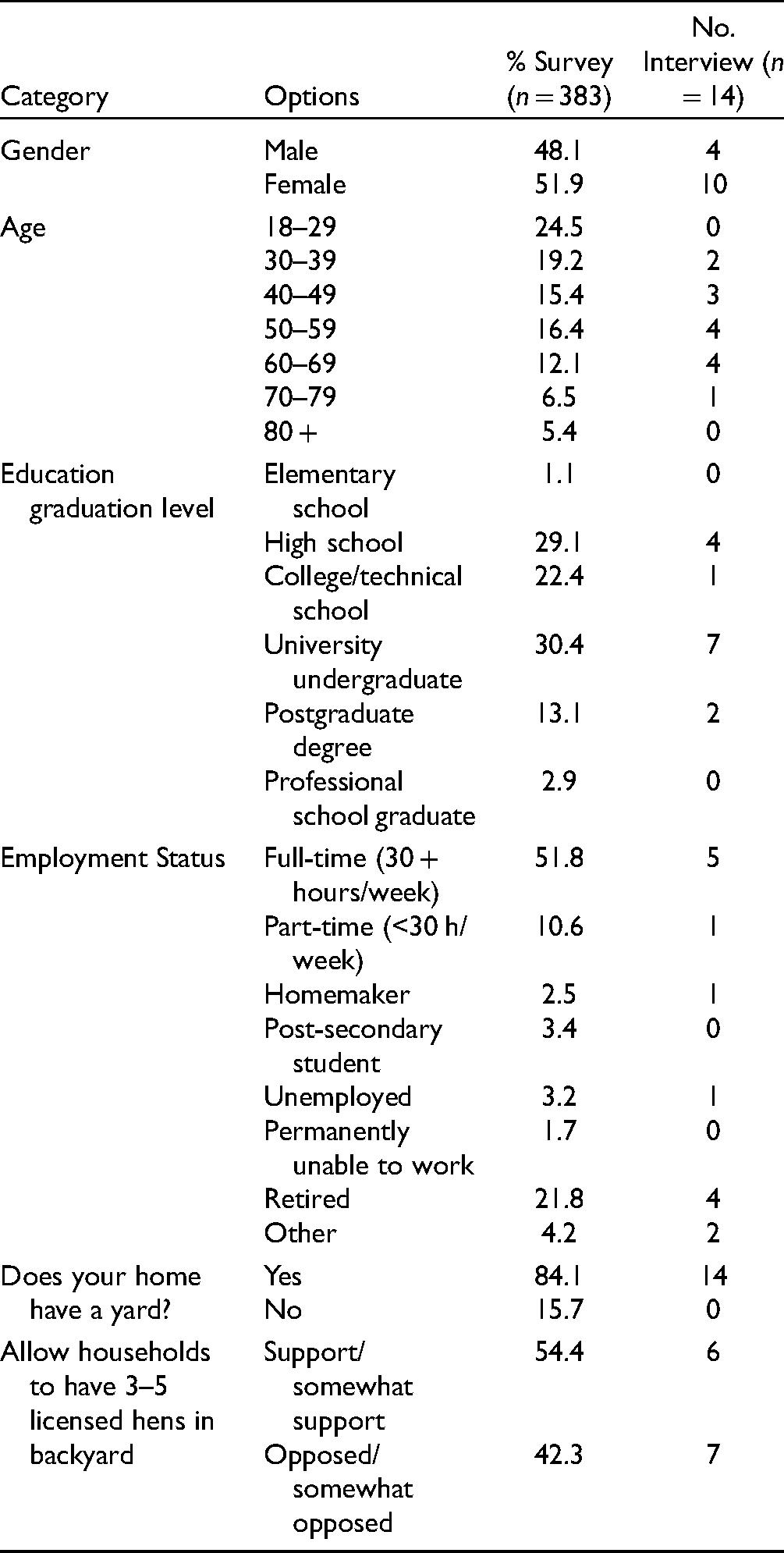
The telephone survey had 383 completed interviews and a 33.8% response rate. Even though a city bylaw prohibited urban hens, 0.4% indicated they had raised chickens in Saskatoon in the previous 12 months, and 54.4% supported or somewhat supported allowing households to have 3–5 licenced chickens in backyards. Furthermore, 11.2% expressed that they would get chickens if the City of Saskatoon permitted them as pets. The survey demographics presented in Table 1 are reasonably representative of the City of Saskatoon, except that our sample has a higher education level and lower unemployment rate. Interview participants were predominantly female, while there was a closer balance among gender for the telephone survey.
Survey and interview demographics.
Bounding the system
With the survey information as the backdrop leading to participant interviews, we began with clarifying the problem by seeking to understand the actors (human or non-human) that influenced activity in the social system (Crawford, 2020). We also considered the layers, niches, and organizations in the case. As we understood it, the problem was the introduction of urban hens to a medium-sized Canadian city. However, the results were more focused on city life values and visions than on hens.
The leading actor in this system was the urban hen, though there was some confusion on what this meant. Some participants assumed “hens” included roosters, as they thought they were necessary for egg production and that birds were for meat and, therefore, required butchering. The confusion made it clear that more education was necessary for urbanites to fully understand how eggs are produced and the overall purpose of urban hens.
Many participants recognized urban hens as pets and compared them to cats or dogs. As such, all pet animals can offer unique difficulties with neighbours, yet cities widely permit cats and dogs with little challenge or difficulty. As one participant noted about animals in the city: I like the cleanliness. I like less animals, you know? Even the neighbour across the street has cats, and they drive me bonkers. They’re always in my flower beds. Just things like that, right? And so, I just see…chickens are just another animal that you’re adding to this type of environment that I don’t really enjoy right now, already. So, I would rather just not add to it. (Participant #14 – anti-hen)
This quote speaks to a vision of a tidy and straightforward city. The participant also identifies the physical boundaries between herself and the neighbour and where cats literally cross the line.
Another aspect of urban hens’ perceived difficulty is people's experiences with rural chicken farming operations. Formally rural people had opinions of large-scale agriculture's noise and smell and were concerned not to reproduce it. Recognizing the design of sub-divisions as a contributing factor, one participant stated: I’m worried about the smell and the noise. Really about the noise. Especially because we live in [neighbourhood], and so our lots are narrow and long. And like there's no privacy anymore in these newer areas, and so my yard is pretty much my neighbour's yard too. There's no expanse. And so, I’d be worried that if he has chickens, I pretty much have chickens too. (Participant #14 – anti-hen)
Participants’ rural experience with hens was usually on farms with more than 50 chickens. This experience included roosters who would jump at them and witness butchering and headless chickens flopping about the messy, smelly yard. These encounters – often referred to as traumatic images from childhood – are hard to escape and reconcile to an urban coop. As one participant recounted: My mom was not a very tall person – she's kind of short. But full of spit and vinegar, I guess she would say. When she was going to butcher chickens, she would grab a hen and pull them down, and she never used an axe, like lots of people used. She would put a broom handle across this chicken's neck, stand on that, and yank the head off! How awful is that? (Participant #7 – anti-hen)
Such images may be hard to overcome and challenging to separate rural experiences with a desire for a clean and organized urban lifestyle.
Neighbours are another focal point in this system. Notably, there was a notion of difficult neighbours as one participant commented, “Because all it takes is one neighbour that doesn’t play well with others” (Participant #3 – pro-hen). Another contemplated the difference between neighbours’ negativity and cooperation: “I wonder about the negativity, and I wonder about the cooperation and how people would be with each other. And some people might just be really miserable with you, too” (Participant #9 – anti-hen). Four participants expressed a general lack of faith in other people. As one person said: “You think that everyone's going to do the right thing, and it turns out people don’t, right?” (Participant #13 – anti-hen).
Participants balanced general skepticism with the discussion of community building. As one person identified: It is a sense of linking us with the land in ways that many urbanites aren’t. I think it links us with our neighbours and with communities, so it builds a more intricate web of social networking within the city. And that could be friendship circles but, goodness, it could also be neighbourhood! The more ways in which we build relationships among the people who live here, the better off our city will be. I don’t know a better way to build community than to share food. This is an easy way of doing it. (Participant #1 – pro-hen)
This same participant expressed how children are interested in learning about urban hens. At the same time, another noted that “kids can go bad” and how such children might “bury them alive” (Participant #5 – anti-hen). Inherently bad children may sound like an extreme belief, but it is consistent with the idea that some people hold a pessimistic view of the other, anticipating the worst
Actors in the urban hen system included city councillors, staff who write and implement bylaws, and bylaw officers who respond to complaints and issue warnings and fines. Participants mentioned farmers for support to supply chicks and assist with hens’ disposal at the end of life. We also noted that community-based organizations could connect homeowners with hens and monitor the urban hen experience outcomes. Although the urban hens and eggs are the system's center, the individual and household were the following layers of concern. There was some mention of teaching children about food systems and responsibilities with animals, but a significant focus was on neighbours and what urban hens would mean for neighbour relationships. As one participant noted: I also think there are some potential benefits around social cohesion, which sounds funny because it's very divisive, so there are some challenges around that, too, but I’ve certainly heard people tell stories about their neighbours becoming engaged in their hen raising and that sort of thing. (Participant #17 – neutral)
Many participants mentioned the Farmer's Market along with the neighbours and community. The market is where people could purchase fresh, free-run eggs if that were the goal or purpose for keeping urban hens. There is a difference in the belief of the purpose of a hen in the Farmers’ Market system – either having urban hens as pets and a tool for food literacy or food as egg producers since there are farmers who can bring eggs into the city.
Participants were concerned about the city resources when implementing new policies and regulating the activity. City Councillors came into the discussion as well, as one participant said: “The only thing I can think of is that it basically comes down to lobbying and you know, who has a city councillor's ear” (Participant #15 – pro-hen). Another participant felt that open-minded councillors were necessary for change, suggesting: “But you know, get in some better city councillors, I guess, the more open-minded ones. We’ve got some good ones now. I notice they’re all young” (Participant #16 – pro-hen). The discourse surrounding age and open-mindedness may be a rarely challenged long-held ageist societal norm. Overall, participants who expressed concern with urban hens were generally worried about the city's time and costs of an urban hen policy change. Having younger councillors was an advantage when seeking change.
Further concerns were what other Canadian cities were doing, the norms and operations of the industrial food system, and how to support the environment. There was interest in what other cities were allowing and advice on moving forward. As one participant-directed: I know you normally approach a new administration with “The next plan,” so I think they [groups challenging the bylaw] should do their homework, bide their time, and do their due diligence. And then based on the facts, and what Edmonton or any other city they want to compare themselves to. I’m going to check with my sister in Ottawa, see what she knows. (Participant #11 – anti-hen)
Another participant suggested evaluating another city with urban hens would help provide the much-needed data to understand potential costs, nuisance calls, and if a bylaw change could contribute to food security or social cohesion.
In summary, the system is primarily at the individual and neighbourhood level, involving people, hens, and other domestic animals. There are greater metropolitan influences involving the city council and rural influences from past farm experience. Farmer's Markets come into the system as an alternative for fresh free-range eggs. Canadian cities are also part of this system, as many people look to other places for examples of what works within their version of how things should be.
Part of bounding the system is to define the problem. The problem is more profound than what the research team initially understood as tension about urban hens, and lies within differing expectations of what makes up a city and a community. For some, it includes a sense of control over their space, whereas others aim to find ways to bring community members together. The results also highlight a fear of the unknown, where neighbours assume the worst in each other regarding an event or activity that may affect them personally. There may be preconceived ideas of what urban hens would look like, based on previous rural experiences. Together these problems may form an understanding that those who oppose may fear a lack of control.
Fundamental system parts and system interactions
Fundamental system parts are the normative elements of a system, including values, beliefs, and expectations where transformative change can occur (Foster-Fishman et al., 2007). The system parts interact as part of a dynamic system. As we see it, the fundamental system parts involve the difference in how people define the cultural norm for urban living. The system includes neighbours, hens as pets or food producers, and city resources. The prospect of raising urban hens evokes emotion from people who have two very different visions of what a city should be: one is focused on community building, being connected with the environment, linked to the land, and maintaining a sense of food production. The other operational norm is maintaining order and cleanliness, where city resources are protected, expenses minimized, and interactions with neighbours are limited. As one participant put it: [It] can be frustrating, but this is one of those issues that … it just either does or doesn’t fit into your view of what cities are supposed to be, right? And especially in an agricultural province, or in a province where agriculture is such a big part of people's experience like if you’ve experienced chicken farming, you know, somewhere outside of the city, it just doesn’t fit into your view of what the city is supposed to be, right? (Participant #17 – neutral)
Participants noted several assumptions and beliefs that help define the deep structure of the urban hen system. Some participants expressed stereotypical views of the “other” with a negative slant. For example, one participant said: It's like that righteousness of the person who wishes to be the urban agriculturalist, and I only foresee more and more in the future what people really want to have. They want to have it all. They want to live in the city and have all the farm-to-table stuff in their backyard. (Participant #11 – anti-hen)
This person also noted the loud voices that are complaining and “lone wolf crying I want my chickens!” The loud voices are an example of a system feedback loop where the louder the call for change, the more marginalized the urban hen proponents become, making it more challenging to change policy. There were also broad generalizations that everyone will get chickens, and there will be “100 chickens running around because they let them loose because they didn’t want to look after ’em” (Participant #6 – anti-hen). This person assumed that hens would become a trend, and many people are irresponsible with their purchases, again drawing back to a negative view of others.
Some participants also mentioned new Canadians, suggesting that there are people in the city from countries who rely on goats. “So, are you going to stop at chickens, or are you going to have goats now?” (Participant #6 – anti-hen). And another noted that the neighbours were from the Muslim community, “and so he's got quite a big, like, garden” (Participant #14 – anti-hen) and a traditional larger family, so it would not be a surprise to see chickens as well. The views and assumptions were significant enough to suggest that there can be a negative bias towards people in general and toward those perceived as different. Accepting differences can be a challenge. However, this could also be an example of a system interaction delay as attitudes towards new Canadians may change with greater exposure. The negative view of others could indicate ideas about what constitutes a city and the expectations of neighbours. This view was not anticipated in this study and could use further exploration.
Seeing a problem from one side only was not consistent across all participants. Some identified both sides of the situation, demonstrating critical reflection. For example, one participant said: You know it's amazing how people don’t want to let people do things. But then, on the other hand, I don’t want to let people have fire pits. But if they could have their fire pit in their house, I wouldn’t care if they had it. You know what I mean? (Participant #16 – pro-hen)
This participant could draw parallels in the complexity of living in a community and reflect on the matter.
Some participants expressed fear – the potential for foodborne illness, risk of confrontation resulting from complaining about a neighbour, and impending food insecurity. As this person put it: I mean, I know in Canada we’re not really looking at, like, a food shortage immediately or anything, but there is…like, the world is never, I don’t know if it's just because of the internet and everything you hear, but I feel like the world is not getting more secure, and you get that kind of fear, like, what if one day everything just…ended…and, you know, at least I have my eggs! I know it's so silly, but honestly, I have thought that sometimes, like at least, I would have something that maybe I could keep going or have for a few days. I don’t know. Maybe it's just, you know, people want to feel secure, and they want to feel like they’re doing the right thing for raising them kindly. (Participant #2 – pro-hen)
Although this participant and another qualified their comments, knowing they may be irrational or silly, we interviewed them before the COVID-19 pandemic and the subsequent system disruption due to the global pandemic response.
As people interact with the municipal system, they express certain rights and freedoms as taxpaying citizens. In contrast, others used this same argument to dictate that they did not want their tax dollars used on bylaw enforcement for an issue they did not favour. Some felt they could do what they wanted on their property and just as they learn to tolerate the neighbour with kids and dogs, others can accept the urban hens. Having come from rural areas, many people living in the city are accustomed to having more autonomy and control over their property. As one person noted: It bothers me a lot to be told what I can and can’t do within the confines of my own home, and to me, that's my yard as well – within reason. I mean, obviously, I’m totally fine with bylaws and laws, and we’re law-abiding people, and we keep to them whether we agree with them or not. Big government, I guess…and I’m not one of those people! *laughter* I’m not one of those people like, “Ah, big government trying to run our lives! And free economy!” and all that. That's not who I am. But I do believe that in some areas, the government is definitely becoming…. um… overstepping its bounds. (Participant #15 – pro-hen)
This participant describes how the government does not need to control every detail of life and how neighbours should sort out their issues. Others saw urban hens as a right because they are very quiet and private animals confined to a coop in the backyard. In contrast, dogs and cats regularly interacted with others in the community. Therefore, they required municipal control, even though not all owners licenced their dogs and cats with the city.
When asked how to reconcile the urban hen issue, participants overwhelmingly felt it was a case of education. With proper education and support for new owners, neighbours may welcome urban hens. A few of the areas recommended by participants were 1) maintaining healthy hens in all temperatures, 2) composting manure to reduce smells and disease risk, 3) dealing with ill birds or at the end of life, 4) disposing of roosters, and 5) only having egg layers in the city. Similarly, pro-hen participants suggested that “It's going to take a lot of education for people to understand that they aren’t noisy, there shouldn’t be a smell, there won’t be flies, and that people won’t be butchering them in their backyard” (Participant #3 – pro-hen). We found that in the process of the interview, describing the pilot project to those who were against it made a difference in some participant's views: I’d just like to say that I feel different about it than I did when I came in here. Like, knowledge is definitely wealth, for sure, because I know a lot more than I did when I came in. And so I do feel… I’m definitely going to leave here and read about it because now I’m interested in it. (Participant #14 – anti-hen)
Another aspect of education is having “a sustainable community entity that is willing to be, you know, not responsible FOR, but responsive TO residents who need some support” (Participant #17 – neutral). This participant expressed how having someone with expertise to help manage potential challenges would provide confidence rather than just using the city's enforcement. Therefore, people who did not have faith in others would know they had a reliable resource, which might alleviate their neglect concerns. Furthermore, having a pilot project would allow people opposed to urban hens to see how such a system could work. As one person told us: “You’ve got to get that first group of people started and let people like myself see it in action, and see what that looks like for me, as someone who doesn’t want them, but they’re allowed” (Participant #14 – anti-hen).
Many participants took a realistic stance acknowledging two sides to this issue. While it is nice to have pets and fresh eggs, it is a responsibility that ties you down with a daily chore. While urban hens allow for access to food, not everyone is ready for the responsibility of having a pet. Also, as food prices rise, the idea of high-quality home-grown eggs may be attractive, yet there is a cost to keeping hens, which hen-keepers may overlook. One participant shared a belief: “That's how life works. Where there is gain, there should be a downside. And where there is a downside, there will be gain as well” (Participant #8 – pro-hen). This is characteristic of balancing and reinforcing loops (Foster-Fishman et al., 2007).
Overall, the fundamental system parts and system interactions consist of differing values and beliefs and the advantages and challenges of urban hens. Participants identified many advantages to urban hen keeping, including building relationships with community/neighbours and increasing household food sovereignty. Raising urban hens was seen as a learning opportunity for children, especially within a food system where consumers experience disconnection from the land and growing conditions. However, participants noted many challenges to starting urban hen keeping in Saskatoon. Challenges included a basic understanding of urban hen keeping and the association of hens with rural life, which generally involved intrusive noises and smells. There was also a concern that urban hen keeping needed to be an activity that would benefit many people versus a “lone wolf” wanting hens. The perceived cultural norm of urban living was divided between two visions. The tension was between individual rights versus collective endeavours on both sides of the urban hen-keeping spectrum. Participants also noted that urban hens could cause tensions between neighbours, including concerns about taxpayers’ rights and responsibilities.
Discussion – Identifying levers for change
The objectives of this study were to understand why people supported or were adamantly opposed urban hens and identify areas to influence systems change. There were three main discourse areas providing places to intervene for change: urban agriculture literacy and the proposed bylaw change, differing values and visions for city life, and tensions between individual rights and the collective good. There was also the recurring theme of people's trust (or lack thereof) in their fellow community members throughout these three themes. These themes provide vital learnings for how urban hen policy could be approached within North American local food systems. However, when considered in unison, they also show that the original and underestimated question of whether or not communities should allow urban hens relies on multiple other complex factors. Although the chickens and bylaws are not complex, the underlying factors are challenging. The factors include whether or not people have access to the same “knowledge,” differing values and visions for what city life should look like, individual versus collective decision making, and whether or not people can trust one another.
Urban agriculture literacy
The first theme was a lack of shared understanding about what urban hen keeping would entail. Improving this knowledge base could direct system behaviour and is feasible to change. In particular, this included what was meant by “hen” versus “rooster,” the numbers of hens allowed in a yard, and the amount of noise and waste that a small number of hens would generate. The misconception may derive from participants’ experience of chicken farming in rural environments, which would have vastly different parameters than those set out in the urban bylaws. It could also indicate a lack of agriculture literacy, which is essential for strengthening local food systems (Brune et al., 2020). It is feasible that this disconnect – having different expectations of the rules if hen-keeping would be allowed – could be addressed through educational intervention. Described through the interview process, some people who had been against urban hen keeping at the beginning of the interview became more favourable of the idea throughout the interview process as they came to know more about the proposed rules and guidelines. Therefore, it could be beneficial to have an education program with a dual purpose: 1) for the aspiring hen keeper to understand the full extent of what that means, and 2) for the general public who have not considered the possibilities of responsible hen-as-pet ownership.
There was evidence within the interviews of people changing their opinion on urban hens once misconceptions were addressed, but it is also known that education by itself often does not shape public behaviour (Williams, 1984; Fletcher-Miles et al., 2020). A lack of shared information between two sides of a contentious debate has come to light recently in high profile societal issues, including the 2016 United States election (Grinberg et al., 2019) and the Covid-19 pandemic (Roozenbeek et al., 2020). Thus, although this project's findings suggested that an educational campaign may be one step in addressing the societal misunderstanding, additional questions that would have to be asked would be how to ensure that the information is believed to be valid by both sides? What types of communication should be used to ensure the information is trusted, accepted, and acted upon? In particular, the role of trust that emerged throughout the three themes is required to ensure people are all getting the correct information. Lower trust in professionals/societal institutions (government, journalism, scientists) has been noted to predict people's belief in false information (Roozenbeek et al., 2020). Thus, although education and access to information are essential, educational campaigns alone are not the panacea once embraced by public health professionals.
Differing values and visions for city life
The second disconnect between the two viewpoints seemed to pivot on different views and goals for an urban-type environment and the inability to reconcile these views. The most significant tension was about visions for a city that pegged cleanliness against community-based food systems as competing priorities for a desirable urban environment. Western urban environments have changed drastically since the industrial revolution. Urban slums were typical in the newly industrializing world over a century ago, and urban planning became closely linked with public health to create clean and healthy environments (Hancock, 2018). At one time, agriculture was an acceptable practice within cities but eliminated through what Bouvier (2014) described as elitist regulations that favoured the privileged classes who could afford to buy, instead of growing, their food. It is essential to name and acknowledge the significant and unjust implications of power structures while working towards food justice (Reynolds et al., 2020).
However, as noted in the introduction, more cities are now moving back towards policies that allow for urban agriculture (Mukherji and Morales, 2010; Stolhandske and Evans, 2017; Walker, 2016). Based on Figueroa's (2015) food sovereignty model for sustainable cities, advocates see urban hens as part of a community-based food system to expand food production capacity, connect their family with the food system and build resilience. Although a fundamental public health approach to the urban setting, cleanliness does not preclude urban agriculture's development as a vision for a resilient, community-based food system. On the contrary, urban metabolism – the study of material flows in the urban setting – suffers from the stark separation of agricultural waste that can feed the soil, contributing to a greener and cleaner city (Bahers and Giacche, 2019). Urban agriculture, including hens, can improve urban metabolism and support the ecosystem that cleans the air and provides a healthy environment. At the same time, it also ensures access to food that is not premised on neoliberal market principles and helps promote food sovereignty.
Despite the literature showing these potential benefits of urban agriculture and that urban agriculture can improve the health of the urban ecosystem, this still does not necessarily negate people's differing visions for what an urban environment should be since it is based on a value judgement. Reconciling differences in city visions is a source of debate for many municipal councils. Along with these differences, the terminology often focused on “othering” (as theorized by Edward Said (1977)) and subsequent distrust of the “other” (to be addressed in the next section). Tolerance and understanding are necessary to reconcile differences in how people view the “other” and differences in citizens’ visions of the urban setting. There is a gap in the system's feedback mechanism of exposure to different lifestyles and views. Bannister and Kearns (2013) recommend meaningful and purposeful social interaction to build a dynamic tolerance in urban settings. Based on this, in the context of chickens, greater exposure to urban hens within a clean, urban environment could bridge the gap in understanding between those who appreciate and value cleanliness and those who value a community-based food system. Providing exposure opportunities for urban hens at local garden events or temporary demonstration projects could ease some anxiety. Exposure, as opposed to simply using an education approach, can alter people's perception of normal. However, it can go either way, and much depends on the context of the exposure (Chung and Rimal, 2016). In general, approaches to increase exposure and interaction between the two groups (be it pro-/anti-urban hen groups or other divided groups) are necessary to break down barriers and create space for increased tolerance and decrease divisions.
Tensions between individual rights and collective good
Lastly, people's views on urban hen keeping seemed to be rooted in whether people are only self-interested or can be trusted to act for the collective good. This tension, which brings individuals’ long-standing public health problem versus the collective (Childress et al., 2002), was surrounded by doubt in community members. As stated by Participant #13, “You think that everyone's going to do the right thing, and it turns out people don't, right?” Many participant statements indicating why people did not want hens did not directly target hen-keeping practices outlined by the proposed pilot project. Instead, participants directed comments at “bad owners,” alluding to a debate about human nature's real root. Authors have linked disgust to moral condemnation (Bocian et al., 2018). If someone identifies hen keeping as disgusting, especially if they already doubt the cleanliness of urban agriculture, they may also classify the hen keeper as having low moral character and not willing to comply with bylaws or animal welfare.
This pattern of disconnect between people also showed evidence of “othering” between the two groups (for and against having urban hens). As society continues to diversify and globalized capitalism makes it harder to see connections within society, it becomes challenging for some people to relate to the “collective” because a uniting common identity may be less evident (Kim, 2012). This dichotomy may be best described as the impact of “life politics.” Life politics refers to how our day-to-day actions speak to many aspects of our underlying belief systems (Kim, 2012). Life politics blend the collective and personal identities, where one's actions impact the larger collective. The act of supporting a community-based food system could be a stand against the extensive industrial food system. Politics may have become so deeply rooted in our day-to-day activities that we cannot separate ourselves from something as simple as keeping hens with more complex humanity issues, such as climate change (Kim, 2012). Some people may see hens as an idea of which they (and their tax dollars) do not want to be part. Others may view hens as contributing to the local and global community, decreasing pressure on the larger structural food systems (Kim, 2012). Bowness and Wittman (2020) identify these actions as urban agrarianism with a call for urban people, especially those with privilege, to mobilize for food sovereignty struggles. There are cross-level connections needed involving rights and responsibilities beyond changing bylaws to accommodate urban hens, which will help to work toward an ecologically and socially just food system.
It was also notable how market-based, transactional terminology was used to frame community-level decision-making power. For those against urban hen keeping, not only was there doubt that the “other” would be irresponsible and could not be trusted. This market-based thinking was then taken to another level, though, with the recurring concept that people didn’t want “[their] taxes” to pay for something that the person saw as damaging to their community. Not only does this show how taxes were seen in this way as transactional power (power being given to people paying property taxes, in this instance, as opposed to decision-making power being given to anyone resident in the community). The debate surfaces on who holds more power in decision making – the citizen or the taxpayer.
Historically, being a taxpayer was a category and status identified primarily as White and middle-class, which created a hierarchy in which the “untaxed other” should have fewer rights because they pay fewer taxes (Walsh, 2017). There was a belief that those with more taxes should have more rights and entitlements within society, often perpetuating White supremacy and racialization of privileges (Walsh, 2017). Contrarily, more people now see the concept of citizen as the great equalizer that ignores gender, race, ethnicity, and class (Merry, 2018; Kerber, 1997). However, it is also noted that the idea of citizenship as an essentialist category is highly contested. Kerber (1997) highlighted that women, Black people, Indigenous people, and people in lower-class systems experience a difference in citizenship experience. We recognized this idea of “other,” as demonstrated by a participant describing a neighbour as an immigrant family that may exceed bylaws and get goats. Such comments display xenophobia, historical categorizing of “other,” and potentially seeing one's rights as more significant than another, once again rooting this issue deeply within food justice (Levkoe et al., 2020).
Even if decision-making power is based on the egalitarian concept of citizenship, people's ideas of who was a “good citizen” differed since it is an inherently value-laden concept. Citizenship was seen as some people valuing “goodness” on cleanliness and following the rules. In contrast, others valued “goodness” on issues such as raising children to connect to the community and food systems. The literature also aligns with varying conceptualizations of what a “good citizen” might be. On the one hand, a good citizen is active in taking care of their community to maintain the status quo (Horst et al., 2020), which would preserve the current rural/urban agricultural division.
On the other hand, some view the good citizen as one that challenges that status quo, focusing on transformation (Horst et al., 2020), which, in this case, would be pushing for new bylaws. Some community members believe they are building community, decreasing food insecurity, and challenging the status quo to be a good citizen. Others believe that maintaining boundaries and keeping things clean, tidy, and presentable creates good citizens. The different beliefs may explain the viewpoints on hen keeping. It may depend on how one views themselves within their community and their underlying belief system and how they view citizenship.
Overall, this disconnect between groups (and the questions it raises surrounding community decision-making power and the need to reconcile the definition of being a “good citizen”) is still rooted in community divisions and the theme of whether or not we trust others. This broad factor, which can be seen at the root of what was referred to as “life politics,” has implications for urban agriculture policy decisions and numerous implications in other problems. Life politics appears at the root of arguments such as what human nature is, and thus what solutions people propose to complex problems, and what people's values are when solving these problems. With this, we propose that strengthening community trust is a crucial factor in directing system behaviour and pursuing divisive urban agriculture interventions and other community-building and public health interventions. In this study, a number of the proposed solutions incorporated this element – including having regulations that would allow skeptics to trust there was an oversight and by having a pilot project that would allow residents to see that a system had the potential to work before committing to bylaw change.
Interestingly, urban agriculture initiatives, in general, have been shown to improve social cohesion and trust (Audate et al., 2019). Thus, urban hen pilot projects such as the one noted here could be a potential trust-building intervention necessary for that same project to be successful, leading to a chicken-and-egg type question of which one has to come first Chickens were, after all, the question that started this study, but who's not to say that they could not also be an answer?
Limitations
There were limitations to this study. The research team members were pro-bylaw change, and two were pilot-project advocacy group members working to change the bylaws. One of the research assistants had urban hens at the time. Although this provided insider knowledge of hen keeping, it may have led the discussions towards a pro-hen bias. However, it was explicit that the research was not looking at why one should be for or against urban hens, but instead understanding the depth of passion and discord between the two sides and studying how it coincided with systems change theory.
Additionally, we were very interested in understanding the anti-hen position. Some people may consider the numbers of qualitative interviews as low and, therefore, a limitation. However, with the sampling method intended to be data collection until the point of data saturation, we had started hearing recurring information in the interviews and determined it was adequate to address the research question. Still, we were firm on balancing self-identified pro and con urban hen representation.
Conclusion
With these three discrete, yet connected, themes as potential levers for change – education, reconciling different values, and balancing the personal and collective goods – the findings indicate how deeply rooted a civic policy issue is in concepts of health and justice, even when not apparent at the surface level to the constituents charged with advocating for policy change. Allowing urban hens has food justice, food sovereignty, and public health benefits, with few public health risks. However, the decision to allow hens relies upon decision-making informed by very different visions of cities, different inferences on who should get to have a say in those decisions, and differing ideas of what to prioritize when considering policy changes. Even if decisions are clarified through a lens of justice (food justice, social justice, etc.), public policy change relies on factors impacted by public knowledge and public values. Knowledge and values must be addressed before public policy change can be successfully addressed.
All three of these central themes appeared able to be affected by addressing the issue of trust. Though this is not necessarily an easy problem, it provides a solid starting point for addressing these community challenges – whether working on food sovereignty through urban agriculture or working through other contentious community-level public health interventions. Trust is a highly complex topic with a variety of definitions. There are claims both for and against geography impacting trust in the geographical literature. Although the concept has been researched in many different fields, it has not been examined thoroughly within the human geography field (Withers, 2018). This paper provides a jumping-off point for further inquiry within the field and an opportunity to learn from other fields that have already begun such work.
Throughout these interviews, participants were reasonable and respectful, welcoming the opportunity to explore ideas of people who think differently. According to one person, the important thing was to consider, “How can I make sure that there's an element of respect there? Because it's when the respect is not there that bylaws and policy come into play.” This element of respect applies to many of the challenges raised – conversation on disputes between neighbours, differing views of what a city should be, and even differing views on human nature overall. While we began this study simply expecting to learn why urban hens were so contentious, it became clear during data collection and analysis that it was simply an extension of this much broader societal issue. Urban hens are a social endeavour, after all, and allowing hens as an acceptable part of the animal control bylaw reflects how a city embraces local food production and the level of trust and community cohesion between neighbours. Building resilience in uncertain times will become more evident as the years pass. Educating, listening, supporting, and reflecting will be essential to move this idea into action and address other broader societal level issues. Respecting and understanding neighbours and building community cohesion and trust is an excellent place to begin.
Footnotes
Declaration of Conflicting Interests
The author(s) declared no potential conflicts of interest with respect to the research, authorship, and/or publication of this article.
Funding
The author(s) disclosed receipt of the following financial support for the research, authorship, and/or publication of this article: This work was supported by the University of Saskatchewan President's SSHRC Insight Grant, 2017; 6991 CAD. The survey portion was funded by the Saskatchewan Health Research Foundation Collaborative Innovations Development Grant #3709; 39110 CAD.
