



Abstract
This qualitative study examined how practicing principals across seven Arab states experienced leadership preparation amid rapid educational change. Based on interviews with sixteen principals, the study reveals a stark misalignment between formal curricula—perceived as outdated, managerial, and theory-heavy—and the dynamic demands of school leadership today. Participants found greater relevance and growth within global virtual networks, marked by autonomy, peer exchange, and contextual responsiveness. A recurring tension emerged: universities provided credentials, while virtual spaces fostered leadership capacity. These findings challenge prevailing assumptions and urge a reimagining of preparation models that are adaptive, grounded, and digitally attuned.
Keywords
Introduction
The digital revolution—driven by rapid advancements in artificial intelligence (AI), machine learning, and automation—is transforming education systems across the globe. AI technologies are reshaping instructional processes, administrative operations, and school-wide decision-making, prompting a fundamental rethinking of what it means to teach and lead in 21st-century learning environments (Holmes et al., 2019; Luckin et al., 2016; Selwyn, 2021). Tools such as adaptive learning platforms, predictive analytics, and generative models are increasingly embedded into educational practices, generating debates about the future of schooling and the kinds of competencies leaders must possess to navigate these transformations (Facer, 2011; Knox, 2020; Williamson & Eynon, 2020). The mass shift to online learning—accelerated by global disruptions such as COVID-19—further exposed the uneven capacities of institutions to deliver equitable, engaging, and pedagogically sound digital education, revealing critical gaps in infrastructure, faculty readiness, and learner support (Alshaboul et al., 2024a, 2024b). Leadership is no longer confined to traditional domains of instructional supervision and school management—it now includes ethical decision-making, data governance, digital fluency, and innovation leadership (Sheninger, 2019; Spector, 2022).
These developments demand that leadership preparation programs evolve in tandem. Colleges of education, as institutional sites responsible for cultivating the next generation of school leaders, are expected to anticipate and respond to emerging educational realities, including the growing ubiquity of AI in schools (Aoun, 2017; Darling-Hammond et al., 2022; Fullan, 2016). However, recent critiques highlight a persistent lag in how leadership education is conceptualized and delivered. Many college programs continue to emphasize static managerial frameworks and accountability-driven paradigms, insufficiently engaging with the complexities of digital transformation (Abu-Tineh et al., 2025; Murphy & Ogawa, 2009; Normore & Lahera, 2018; Petrie et al., 2020). As schools evolve in response to technological shifts, leadership education risks becoming misaligned with the very contexts its graduates will serve.
Despite increasing scholarly interest in AI, educational change, and leadership innovation, there is a notable absence of empirical studies that examine how students themselves experience leadership education within this shifting technological landscape. Student voices—particularly those enrolled in college-based leadership programs—remain largely underrepresented in the literature. This study addresses that gap by exploring how aspiring school leaders enrolled in colleges of education experience their preparation in an era increasingly defined by AI and digital technologies. By centering student experiences, the study offers insight into the degree to which current leadership education practices are perceived as equipping future leaders for the complex, technology-mediated realities of schooling.
Accordingly, this study is guided by the following overarching research questions:
How do students enrolled in college-based leadership education programs experience their preparation for school leadership in the age of AI and digital transformation?
How do these experiences reflect a readiness to lead in future school contexts increasingly shaped by AI technologies?
Throughout this article, we use tech-mediated schooling as an umbrella term for the digitally saturated conditions shaping teaching and leadership, including devices, platforms, networks, and data infrastructures (Luckin et al., 2016; Selwyn, 2021). Within this broad category, we distinguish between digital technologies/edtech tools (e.g., LMSs, video-conferencing platforms, and classroom devices) and artificial intelligence (AI), which we define as machine-learning–based systems capable of inference, prediction, and generative output (Williamson & Eynon, 2020; Zawacki-Richter et al., 2019). We further differentiate AI-enabled tools, such as learning-analytics dashboards and large-language-model systems (e.g., ChatGPT), which embed AI capabilities into broader digital environments (Holmes et al., 2019; Knox, 2020). Throughout the manuscript, we refer to AI only when the capability involves algorithmic inference or content generation; otherwise, we use digital technologies.
Literature Review
The Changing Nature of Educational Leadership
The rapid integration of AI-enabled systems and digital technologies is transforming the structures, cultures, and practices of schooling at an unprecedented pace. AI-enabled applications—ranging from adaptive learning platforms and automated grading tools to predictive analytics and chatbots—are increasingly deployed to personalize learning, optimize instruction, and manage educational data (Holmes et al., 2019; Luckin et al., 2016; Zawacki-Richter et al., 2019). These innovations are not simply additive but catalytic, accelerating the virtualization of school environments and reconfiguring how knowledge is produced, accessed, and assessed (Knox, 2020; Selwyn, 2021). As schools adopt AI-enabled tools within tech-mediated learning ecologies, they also face new challenges related to equity, surveillance, digital ethics, and algorithmic bias (Regan & Jesse, 2019; Williamson & Eynon, 2020). Consequently, education is being recast as a socio-technical system—one that requires leadership capable of navigating both human and nonhuman actors within increasingly datafied ecosystems.
This evolving digital ecosystem has profoundly redefined the scope and function of school leadership. Beyond traditional responsibilities like instructional leadership, budgeting, and policy implementation, today’s school leaders must grapple with emerging domains such as digital governance, cybersecurity, digital tool procurement, and AI-informed decision-making (Sheninger, 2019; Spector, 2022). Leadership is increasingly framed as a distributed, adaptive, and future-oriented endeavor—requiring fluency in digital change, ethical foresight, and stakeholder collaboration (Facer, 2011; OECD, 2021). In digitally saturated, tech-mediated schooling contexts, school leaders are expected not only to manage technological infrastructure but to model innovation and cultivate school cultures that embrace uncertainty and experimentation (Fullan, 2016; Gurr & Drysdale, 2020). These shifts imply a radical reimagining of leadership knowledge, competencies, and values—one that aligns with what Selwyn (2021) describes as the “sociotechnical imaginaries” of AI-powered education.
However, while tech-mediated transformation continues to accelerate, leadership preparation programs have not evolved at the same pace, creating a widening disjuncture between the realities of AI-integrated schooling and the frameworks shaping leadership education (Fusarelli & Fusarelli, 2024; Williamson & Eynon, 2020). Scholars have begun to question whether existing leadership standards and frameworks remain relevant in an era where predictive analytics and algorithmic systems increasingly mediate school-level decisions (Knox, 2020; Regan & Jesse, 2019). Moreover, empirical research on how leaders are supported—or unsupported—in navigating these complex, tech-mediated environments remains sparse. As the technological realities of schooling continue to evolve, so too must the conceptualization of educational leadership, particularly in terms of what future-ready leadership looks like and how it should be cultivated.
Regional scholarship has further illuminated the widening gap between technological change and leadership readiness. Ghamrawi et al. (2024a) introduced the concept of School Leadership 4.0 to describe the emerging expectations of educational leaders operating in AI-enabled, tech-mediated schooling environments. Their work reveals that most current leadership practices remain rooted in outdated, hierarchical models ill-suited for navigating the adaptive, ethical, and systemic challenges introduced by AI. In a complementary analysis, Ghamrawi (2024) identifies a significant “readiness deficit” among school principals in Arab contexts, emphasizing that many lack not only the technical knowledge but also the visionary capacity required to lead in digitally infused learning systems. These findings echo global studies that similarly critique the preparedness of school leaders to confront the accelerating demands of AI integration (Arar et al., 2025; Ghamrawi et al., 2025; Kafa, 2025; Pietsch & Mah, 2024). Taken together, this literature raises a pressing question: if principals remain underprepared for AI-enabled leadership, to what extent are existing preparation programs adequately equipping them for the evolving demands of tech-mediated schooling?
The (Non)Evolution of Leadership Education in Colleges
Despite mounting technological transformation in K–12 education, the core aims and structures of leadership education in colleges remain largely unchanged (Ghamrawi & Al-Thani, 2023). Most preparation programs still prioritize managerialism, instructional supervision, and bureaucratic accountability—industrial-era paradigms rooted in hierarchical and efficiency-driven logics of leadership (Ghamrawi, 2013a, 2013b; McCray et al., 2021; Ruloff & Petko, 2025). These models prioritize compliance with policy mandates, strategic planning, and the performance management of teachers, while paying limited attention to the complexities of digital innovation, equity, and tech-mediated sociotechnical change (Al Jammal & Ghamrawi, 2013a; Al-Jammal & Ghamrawi, 2013b). Normore and Lahera (2018) critique traditional leadership preparation programs for their limited ability to develop ethically grounded, adaptive, and collaborative leaders prepared to navigate the complexities of today’s diverse educational environments (Liu et al., 2024). Although school leaders are now responsible for decisions involving AI ethics, digital privacy, and data governance, most preparation curricula still treat technology as peripheral rather than foundational.
This inertia has resulted in a growing misalignment between what leadership education offers and what schools increasingly require. Petrie et al. (2020) argue that educational preparation programs—including leadership development—have been slow to adapt to the increasing complexity and digitalization of contemporary schooling, calling instead for a critical praxis that engages directly with these transformative pressures. Likewise, Aoun (2017) critiques the inertia of higher education institutions in adapting to the demands of the AI age, emphasizing that many programs fail to scaffold learning that promotes digital fluency, interdisciplinary thinking, and the adaptability needed for future-ready leadership. Empirical studies confirm that aspiring school leaders frequently feel unprepared to lead AI-enabled, tech-mediated environments or to critically assess AI-driven solutions shaping instruction and decision-making (Ghamrawi, 2024; Kafa, 2025; Wang et al., 2018). Furthermore, leadership education programs often lack integration with industry or interdisciplinary fields such as computer science, data analytics, or educational technology—reinforcing academic silos and outdated curricular logics (Milton & Al-Busaidi, 2023). The result is a curriculum that remains largely analog, even as the schools its graduates will serve become increasingly digitally-mediated.
Recognizing this gap, a growing number of scholars are calling for a redesign of leadership education that is responsive to the technological futures of schooling. Fullan (2016) calls for a departure from technocratic leadership development, urging institutions to adopt models grounded in systems thinking, creativity, and collaborative capacity-building that can respond to the complexities of educational change. Normore and Lahera (2018) propose integrating scholar–practitioner partnerships to bridge theory and digital practice, while Arar et al. (2025) emphasize the need to reimagine leadership policy and preparation in light of AI’s systemic implications. The call is not simply to add “technology” modules, but to fundamentally reframe leadership learning through transdisciplinary, experiential, and context-responsive approaches. Fusarelli and Fusarelli (2024) similarly call for revising standards, embedding innovation into coursework, and equipping candidates to confront AI-enabled and tech-mediated challenges. Yet without deeper institutional reform, leadership education risks remaining disconnected from the realities of digitally mediated, AI-influenced schooling.
Student Perspectives in Leadership Preparation
While scholarship on leadership education has expanded in recent years to address pressing issues of equity, policy, and programmatic reform, one essential perspective remains largely absent: that of the students themselves—the aspiring school principals these programs are meant to prepare. Existing research tends to prioritize structural reforms, theoretical frameworks, and faculty-led innovations, offering limited insight into how students actually experience leadership preparation within rapidly evolving, tech-mediated schooling contexts (Ghamrawi & Al-Thani, 2023; Darling-Hammond et al., 2022; Grissom et al., 2019; Normore & Lahera, 2018). Even widely cited handbooks on leadership development tend to present students as passive recipients of predesigned content, rather than as active participants in constructing their leadership identities—particularly in digital and AI-enabled contexts (Young et al., 2020).
This omission becomes especially problematic in the current era of rapid digital transformation, where the principal’s role is increasingly shaped by AI, big data, and learning analytics. While there is growing interest in aligning preparation programs with the demands of AI-enabled schooling, most studies have focused on institutional design, standards alignment, or faculty perspectives, leaving the lived experiences of students relatively unexplored (Fusarelli & Fusarelli, 2024). When student perspectives are included, they are often restricted to post-graduation evaluations or satisfaction surveys, rarely treated as critical evidence of how well programs prepare future leaders for the complex realities of AI-integrated, tech-mediated schooling. In this expanding body of work, student voice in school principalship preparation programs remains a missing, yet crucial, element in understanding the responsiveness and relevance of leadership education today.
Method
Research Design
This study employed a qualitative research design grounded in an interpretive paradigm to explore how students enrolled in leadership education programs experience their preparation for school leadership within the context of tech-mediated schooling and AI-enabled transformation. A qualitative approach was selected to allow for an in-depth, context-sensitive exploration of how participants construct meaning from their experiences, in line with the purpose and logic of qualitative inquiry (Creswell & Poth, 2018; Merriam & Tisdell, 2016; Tisdell et al., 2025). The study was guided by a constructivist worldview, which assumes that reality is socially constructed and best understood through the perspectives of those experiencing it (Guba & Lincoln, 1994). Data were collected through semi-structured interviews, a method particularly well-suited for uncovering the depth and complexity of participants’ narratives (Seidman, 2019). Reflexivity was maintained throughout the study to account for the researchers’ positionalities and the potential influence of their assumptions and professional identities on the research process (Tisdell et al., 2025). Interview data were analyzed using Braun and Clarke’s (2021) reflexive thematic analysis, which enabled a systematic yet flexible approach to identifying patterns and constructing themes that authentically reflected participants’ lived experiences. This design was appropriate for addressing the study’s aim of centering student voice in evaluating leadership education’s responsiveness to the evolving digitally mediated and AI-enabled educational landscape.
Participants
This study sought to explore how school principals enrolled in leadership preparation programs experience their training while actively engaged in school leadership within tech-mediated schooling contexts. To generate insights grounded in both practical enactment and formal learning, we deliberately focused on individuals who had “one foot in the school and another in the program.” This dual positioning was considered critical for enabling participants to assess, in real time, whether their preparation meaningfully supported the complex demands of leading in digitally evolving and AI-influenced school environments.
The inclusion criteria for participation were intentionally specific yet promising in terms of the richness of data they could yield. Participants had to (1) currently serve in a formal capacity as a school principal; (2) be enrolled in a postgraduate program—either a master's degree or diploma—explicitly focused on school leadership preparation; and (3) have prior experience as a classroom teacher, regardless of total years of service. These criteria ensured that participants had direct leadership responsibilities, concurrent exposure to formal preparation content, and classroom-based foundations. While this profile was not common, it was theoretically ideal for the aims of the study.
To locate participants meeting these criteria, we turned to a global network for educators that primarily serves the Arab States region and Arabic-speaking educators globally, and where one member of the research team is an active contributor. This network was selected because of its broad international reach and its capacity to identify individuals situated at the intersection of leadership practice and preparation. Following a formal request, the board of the network approved the study and reached out directly to members in their database who matched the inclusion criteria. A total of 21 individuals contacted the lead author expressing interest in participating. However, five were later excluded: three were no longer serving as principals at the time of data collection, and two withdrew for personal reasons. The final sample consisted of 16 participants, representing seven different countries across varied educational systems and leadership contexts. The demographic and professional characteristics of the final sample are presented in Table 1.
Characteristics of the Sample.
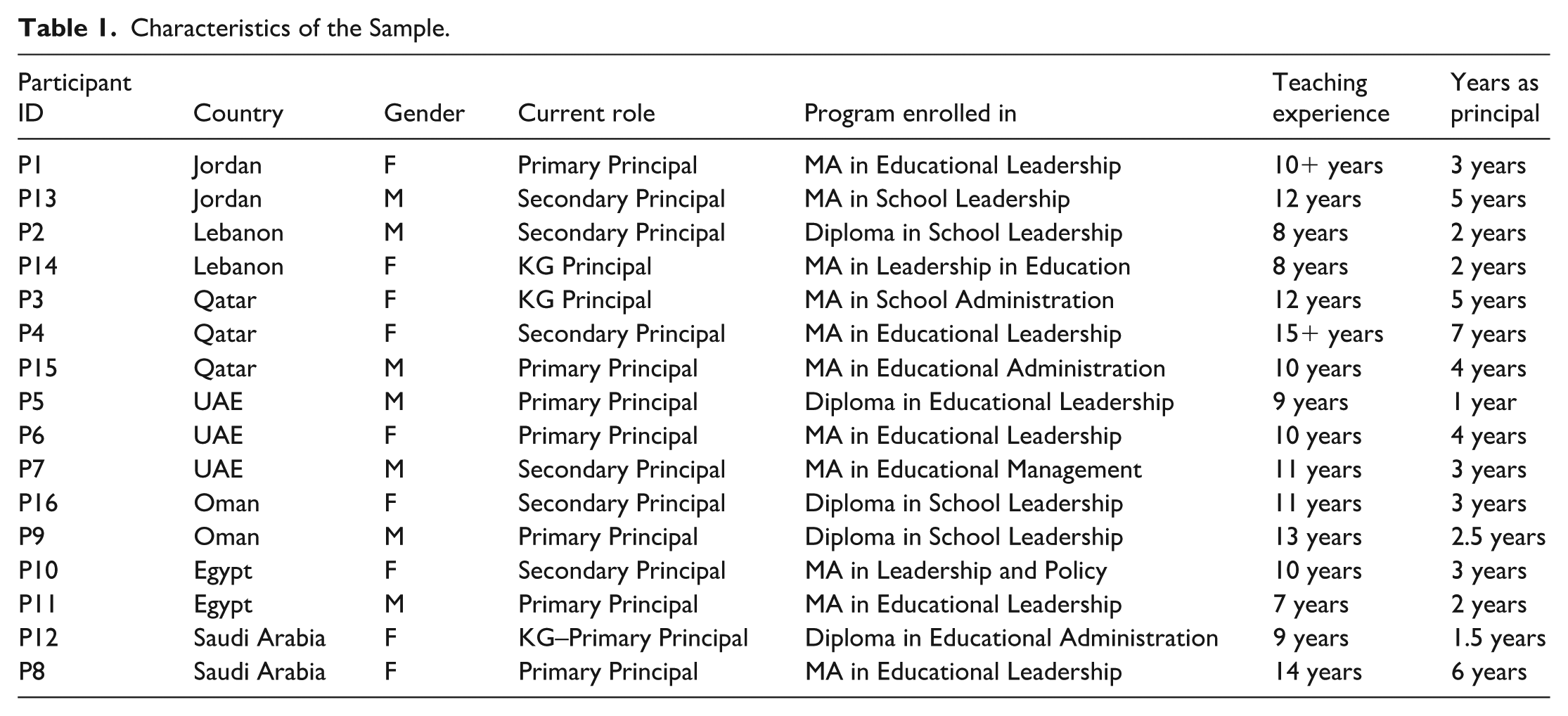
Table 1 presents the demographic and professional characteristics of the 16 participants included in the study, all of whom are currently serving as school principals in various Arab States and are concurrently enrolled in postgraduate leadership preparation programs. The sample included participants from Jordan, Lebanon, Qatar, the United Arab Emirates, Oman, Egypt, and Saudi Arabia, ensuring representation from diverse national and institutional contexts across the Arab region. The gender distribution reflects a relatively balanced composition, with nine female and seven male principals. Participants serve across different school levels, including kindergarten, primary, and secondary education, and are enrolled in a variety of programs such as master’s degrees in educational leadership, school administration, or leadership and policy, as well as post-graduate diplomas in school leadership and educational administration. All participants had prior experience as classroom teachers, with teaching experience ranging from 7 to over 15 years, and leadership tenure spanning from 1 to 7 years.
To contextualize the institutional landscape, it is important to note that principal preparation across Arab states remains highly variable and, in several cases, only partially regulated. Among the seven countries represented in this study, only Qatar and the United Arab Emirates currently operate formal licensure systems for school principals (Abu-Tineh et al., 2017; Rai & Beresford-Dey, 2023). Even within these systems, however, preparation programs remain unevenly aligned with licensure expectations and do not yet fully reflect the competencies required for tech-mediated and AI-influenced school leadership (Ghamrawi et al., 2023; Al Haj Sleiman et al., 2025). In the remaining countries—where principal appointments typically rely on ministry criteria, institutional hiring structures, or postgraduate qualifications rather than standardized certification frameworks—pathways to leadership are even more heterogeneous, reflecting broader regional patterns in school leadership governance and development (Ghamrawi, 2016). This policy variation underscores the significance of examining principals’ lived experiences: regardless of national regulatory models, participants consistently reported preparation systems that lag behind the digital, ethical, and instructional demands of contemporary school leadership.
Data Collection
Data for this study were collected through semi-structured interviews, which allowed for both consistency across participants and flexibility to probe deeply into individual experiences. This approach was well-suited to exploring how participants made sense of their concurrent engagement in school leadership practice and formal leadership education. An interview schedule was developed to align closely with the study’s two overarching research questions. The first set of questions focused on how participants experienced their preparation programs while actively serving as school principals. Prompts explored the structure, content, delivery methods, and perceived relevance of the coursework to participants’ daily leadership challenges, particularly in the context of schools undergoing tech-mediated and AI-enabled change.
The second part of the interview schedule invited participants to reflect on their sense of readiness to lead in future school contexts increasingly shaped by AI-enabled and digitally mediated schooling environments. These questions addressed perceptions of digital literacy, preparedness for decision-making in AI-informed leadership contexts, and whether their leadership education programs were equipping them with the skills, mindsets, and ethical frameworks necessary to navigate these evolving demands. All interviews were conducted via Zoom, audio-recorded with consent, and transcribed verbatim for subsequent analysis. This method ensured that rich, narrative data could be gathered from participants across geographically dispersed contexts while maintaining a consistent and rigorous data collection process.
Data Analysis
Interview data were analyzed using thematic analysis, following Braun and Clarke (2021) recommendations. This method allowed for a rich and flexible interpretation of participant narratives while remaining grounded in the data. The process began with repeated readings of each transcript to ensure familiarity, followed by inductive coding that captured meaningful segments related to participants’ experiences in leadership preparation programs and their perceptions of readiness for leadership in AI-enabled, tech-mediated school settings. NVivo 15 software was used to assist in the management of data, allowing for systematic storage, coding, and retrieval of text segments. The initial coding process was conducted by the lead researcher and then reviewed collaboratively with two other members of the research team.
Through a process of corroboration, the team met regularly to compare interpretations, discuss discrepancies, and refine emerging categories. This collaborative engagement allowed for the co-construction of themes that were both analytically robust and reflective of diverse perspectives within the data as recommended by Braun and Clarke (2021). The final themes reflected areas of both convergence and tension across participant accounts, offering insight into how school principals currently enrolled in leadership programs view the efficiency and suitability of their preparation in equipping them to lead in digitally evolving and AI-influenced school environments.
Findings
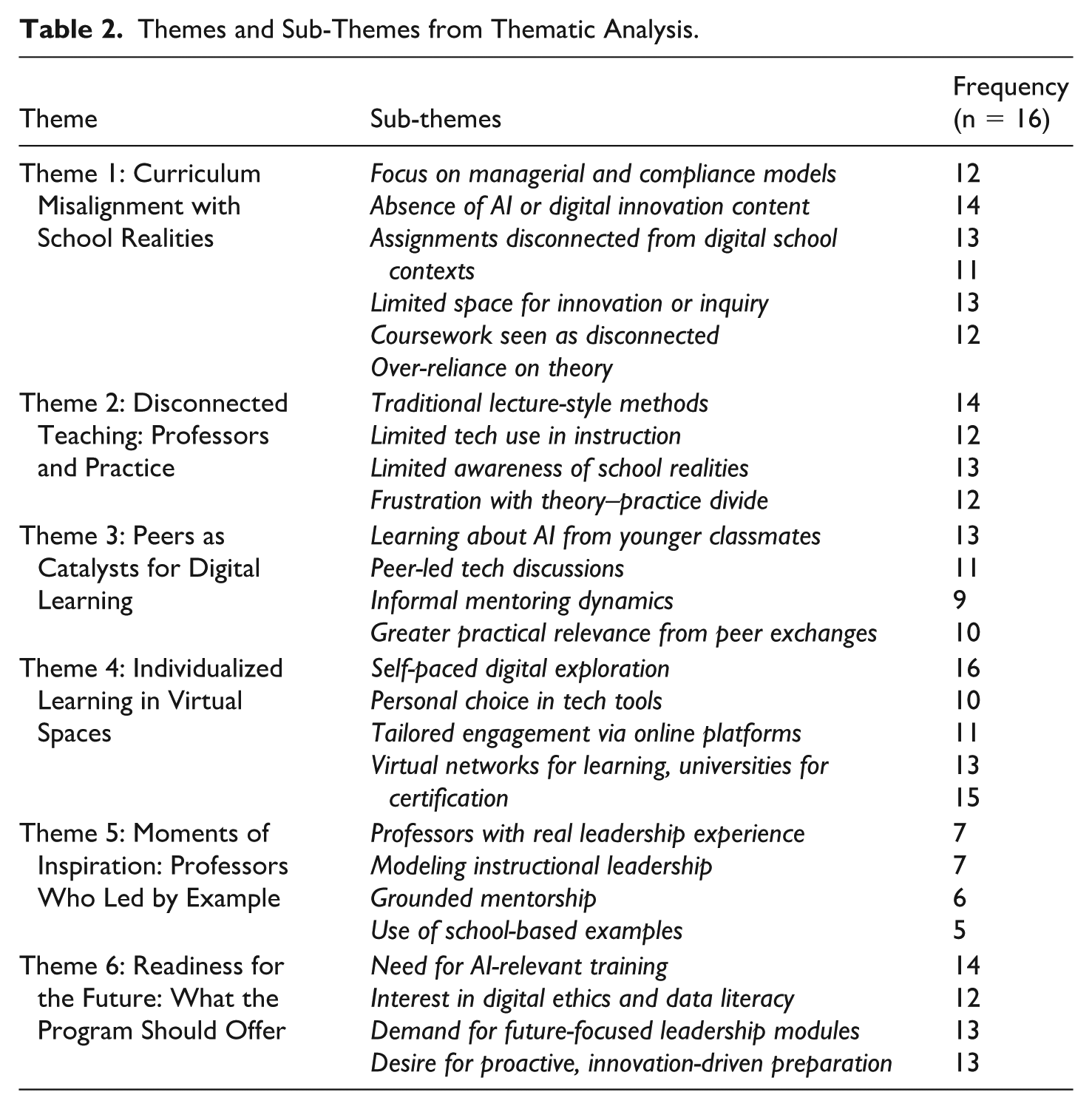
Thematic analysis of participant interviews generated six overarching themes, each comprising several sub-themes that varied in prominence across the dataset. Table 2 presents these themes, their associated sub-themes, and the number of participants who referenced each during the interviews (N = 16).
Themes and Sub-Themes from Thematic Analysis.
Theme 1: Curriculum Misalignment with School Realities
Participants described their leadership preparation programs as heavily focused on managerial and compliance-oriented approaches, with little emphasis on adaptive or transformative leadership. This first sub-theme was echoed across several accounts. “Most of our courses are about supervision checklists and writing memos. They’re not about vision, culture, or how to lead transformation,” explained P9. Similarly, P13 reflected, “It’s all top-down control—how to follow rules and procedures. We don’t talk about leading people in this complex AI-changing environments.”
Moreover, participants noted that the curriculum made little to no reference to current technological shifts affecting schools. “AI was never part of any course I took. It’s like leadership education is stuck in 2010,” said P7. P1 confirmed this disconnect, stating, “There were very few readings or lectures that spoke about digital innovation. It felt disconnected from the schools we actually work in.” Several also highlighted contradictions in institutional policies, such as the ban on using ChatGPT. As P6 expressed, “We’re banned from using ChatGPT in university where we are presumably being prepared to lead schools in which our students use it daily. Why aren’t we being trained to lead in that reality?”
Additionally, many recounted experiences where course tasks were irrelevant to their day-to-day work. P16 shared, “I was asked to evaluate a supervision policy from 2005, but I wanted to explore how to supervise in hybrid settings. There was no room for that.” In the same vein, P4 said, “The tasks don’t align with the needs of schools today—there’s no space to bring in what we’re facing on the ground.” Furthermore, participants sought more creativity and agency in their learning. “We are expected to follow a format, reference old models, and not question the relevance of what we’re learning,” stated P5. P15 similarly noted, “Everything is by the book—no space to imagine or explore what leadership might look like tomorrow.”In the same vein, coursework seen as disconnected, was underscored by the frustration participants expressed about the lack of alignment between their academic learning and leadership practice. P8 remarked, “The examples we study are outdated. We’re learning about systems that don’t exist anymore.” P12 added, “I bring up issues from my school in class, but they’re often dismissed or redirected to textbook models.”
Lastly, over-reliance on theory was a recurring concern. P10 reflected, “I’ve written so many theoretical essays, but I’m still unsure how to make leadership decisions in AI-rich environments.” P2 concluded, “It’s all academic—no one asks what’s actually happening in our schools or how theory helps us deal with it.”
Theme 2: Disconnected Teaching: Professors and Practice
Participants consistently voiced concern that many professors in their leadership preparation programs relied on outdated instructional methods and demonstrated limited familiarity with both current school contexts and digital innovations. Traditional lecture-based teaching dominated the learning experience, often with little interaction or practical engagement. P11 stated, “Almost every session was a lecture—slides and talking. No case studies, no simulations, just old-fashioned delivery.” Similarly, P7 noted, “It felt like I was back in high school. Just sit, listen, and take notes.”
Likewise, several participants observed that professors rarely used technology in their own instruction. P3 explained, “We talk about digital leadership, but the PowerPoints are emailed in advance, and there’s no tech used in class. That doesn’t make sense.” P13 added, “Even when discussing AI, it was theoretical. No tools were shown, no platforms introduced.”
Concerns were also raised about professors’ limited awareness of current school realities, particularly in relation to digital transformation and the demands of contemporary school leadership. P2 remarked, “One of our instructors hadn’t been in a school for over 15 years. He didn’t even know that our school uses AI for scheduling and several other administrative tasks.” This disconnection often led to frustration over the divide between theoretical content and practical leadership challenges. P6 explained, “There’s a lot of theory, but I don’t see how it helps me deal with real problems—like managing digital tools or leading hybrid teams.” P16 stated, “We need professors who know what it’s like to lead in this AI moment. Right now, they’re preparing us for schools that no longer exist.”
Theme 3: Peers as Catalysts for Digital Learning
Across interviews, participants consistently emphasized the role of their classmates—particularly younger peers—in introducing and supporting their learning about AI and digital technologies. Participants described learning more about technological tools and trends from fellow students than from faculty. P3 noted, “If it weren’t for my younger classmates, I would not have heard about tools like ChatGPT. They were the ones showing me what’s happening in schools now.” Similarly, P14 shared, “Honestly, the best learning I had around technology came from group work, where someone would always bring in something new—an app, a tool, or a case.”
Peer-led discussions around AI were highlighted by eleven participants as informal yet impactful learning moments. P10 stated, “We had a debate in one of our projects about how AI could support student assessment—it wasn’t part of the class, but it was the most eye-opening conversation I’ve had in the program.” P6 commented, “Sometimes the WhatsApp group was more useful than the actual lecture. That’s where we talked about what AI might mean for our schools.”
Theme 4: Individualized Learning in Virtual Spaces
Given that all participants were drawn from a global virtual network, the emergence of this theme was anticipated. Participants consistently emphasized that their engagement in virtual leadership training—facilitated through the same network—enabled personalized and flexible learning experiences that sharply contrasted with the standardized and rigid structure of their formal university-based preparation.
Many appreciated the autonomy to learn at their own pace, especially when navigating complex or unfamiliar content. “Online modules allowed me to pause, repeat, and dive deeper when something wasn’t clear,” explained P7, highlighting how self-paced exploration supported deeper understanding.
In parallel, participants described how the digital format allowed for experimentation with tools that matched their personal leadership styles and school needs. “I started using Trello and Canva during one of our projects—not because the course told me to, but because I wanted to try tools that matched my style,” shared P12. These moments of self-directed learning often filled gaps left by the formal curriculum. Additionally, the ability to tailor one’s engagement with learning materials was repeatedly cited as empowering. Participants valued the option to select resources and opportunities aligned with their unique professional contexts. “When I could pick webinars and modules based on my school’s needs, I felt seen. It wasn’t a one-size-fits-all anymore,” explained P14.
A recurring distinction made by participants was the contrasting roles of universities and virtual learning spaces in their professional development journeys. While formal programs were largely seen as pathways to degrees and certification, participants described the virtual network as their primary site for meaningful learning. “Let’s be honest,” noted P6, “the university gives us the degree, but the network is where the real learning happens.” This was echoed across interviews, positioning universities as bureaucratic institutions oriented toward credentialing, and virtual spaces as dynamic ecosystems fostering professional growth. P10 explained, “If I want to understand new leadership models or explore how AI is changing schools, I go to the network, not the college.” Such remarks reinforce a growing perception that leadership preparation, especially in digitally evolving contexts, may no longer be confined to traditional institutions.
Theme 5: Moments of Inspiration: Professors Who Led by Example
Amid concerns about outdated content and disconnected instruction, participants also shared positive experiences with a select group of professors who made a meaningful impact on their learning. These instructors were described as credible, grounded, and reflective of the leadership ideals participants hoped to embody. In fact, some participants spoke of professors who had substantial real-world leadership experience and whose insights resonated with the daily challenges faced by school leaders. P12 shared, “When our professor explained how she handled digital resistance in her own work, it felt real. She wasn’t talking from theory—she had lived it.” Similarly, P6 noted, “You could tell he was a practitioner. He understood what it means to lead in complex environments.”
Some professors were also praised for modeling instructional leadership within the course itself. P13 said, “He didn’t just talk about instructional leadership—he used it in how he taught us. His classes were active, reflective, and student-centered.” P3 added, “He pushed us to think, gave us feedback, and held us to high expectations. That’s what I try to do with my teachers.” Moreover, mentorship that extended beyond the classroom was also highlighted. P5 remarked, “She was open for discussions outside the class about a challenge I was facing in my school. That support made a difference.” P11 commented, “It felt like she cared about our development, not just our grades.”
These professors also frequently drew on school-based examples, making abstract ideas more tangible. P8 explained, “He didn’t rely on textbooks—he brought real case studies from his own leadership. That’s how I understood what strategic leadership really means.” P14 added, “Her examples came from actual schools—not imagined scenarios—which helped me apply the learning right away.”
Theme 6: Readiness for the Future: What the Program Should Offer
Participants expressed a clear and recurring desire for their leadership preparation programs to evolve in line with the realities of AI-integrated schooling. While many critiques were retrospective, this theme captured participants’ forward-looking suggestions for what effective, future-oriented leadership education should include.
Several participants called for explicit training on AI and emerging technologies. P1 stated, “We need to understand the tools our teachers and students are already using—like AI platforms, chatbots, and learning analytics.” P6 emphasized, “It’s not enough to mention technology—we need actual training on how to lead schools where AI is part of everyday teaching.” Moreover, digital ethics and data literacy were also highlighted as important but missing components. P15 shared, “We’re expected to make decisions about student data and privacy, but we’re not learning how to do that responsibly.” P10 added, “No one talks to us about ethical leadership in the digital age, and yet that’s one of our biggest challenges.”
Participants repeatedly voiced a need for leadership modules that are oriented toward the future. P4 said, “We need content that helps us think ahead—not just how to manage a school yesterday or even today, but how to shape one for tomorrow.” P13 reflected, “Schools are changing fast, and our preparation programs are yet to catch up. They should be leading us into the future, not anchoring us in the past.” Several also expressed a strong desire for a more proactive and innovation-driven approach to leadership education. P11 remarked, “We need programs that inspire us to innovate, not just follow procedures.” P8 concluded, “Being a school leader today means being ready for uncertainty and change—our programs should prepare us to lead that change, not just survive it.”
Discussion
This study offers a timely and critical interrogation of college-based leadership preparation programs in Arab states, illuminating a growing incongruity between institutional practices and the realities of educational leadership in a tech-mediated and AI-enabled educational age. While programs continue to champion managerialism and traditional pedagogical modalities, the very environments they claim to prepare leaders for are being reshaped by AI-enabled tools, digitally mediated learning models, and data-driven decision-making. This dissonance—between institutional inertia and technological dynamism—was not merely observed but deeply felt by participants, who found themselves straddling two irreconcilable worlds: one where compliance defines preparation, and another where agility defines leadership.
The findings powerfully align with longstanding critiques of leadership preparation programs as structurally conservative and epistemologically static (Grissom et al., 2019; Murphy & Ogawa, 2009). Participants’ descriptions of content anchored in supervision checklists, memo-writing, and legacy theories point to a pedagogical orientation that, while once foundational, now appears outdated in light of current demands (Fullan, 2016; Fusarelli & Fusarelli, 2024). This confirms prior research noting that many programs continue to emphasize hierarchical, compliance-oriented leadership models even as schools move toward distributed, tech-mediated ecosystems (Arar et al., 2025; Ghamrawi, 2024). The study echoes Aoun’s (2017) call for “robot-proof” education by underscoring the inadequacy of leadership curricula that ignore AI literacy, digital ethics, and the shifting nature of human–machine agency in schools.
Perhaps most paradoxically, while universities continue to resist AI-enabled tools such as large-language-model systems (e.g., ChatGPT), participants are simultaneously expected to lead schools where such tools are embedded in student learning and teacher planning. This contradiction—preparing for AI while banning its use—speaks to an epistemic lag within the academy that risks undermining the very leadership it seeks to cultivate (Selwyn, 2021; Williamson & Eynon, 2020). Rather than model responsible integration, leadership programs often avoid the technologies shaping schools, further deepening the gap between theory and practice (Ghamrawi et al., 2025; Holmes et al., 2019).
Equally troubling is the outdated pedagogical approach of many university instructors. Participants’ frustration with lecture-heavy instruction and technological disengagement points to a form of epistemological dissonance between the content and the method. While they are taught to be “instructional leaders,” few professors model such leadership themselves—a finding consistent with literature arguing for greater alignment between leadership ideals and pedagogical practices (Darling-Hammond et al., 2022; Sheninger, 2019). This affirms Ghamrawi’s (2024) observation that educational leadership must be both taught and demonstrated, particularly in a moment of digitally mediated disruption.
Yet amid this institutional rigidity, two powerful countercurrents emerged: peer learning and virtual communities of practice. Participants consistently identified their classmates—particularly younger peers—as the most vital source of learning about AI-enabled and digital tools. These findings align with research on peer-driven professional development and the value of informal learning networks in rapidly changing knowledge fields (Ghamrawi et al., 2024b; Facer, 2011). The relational and collaborative nature of these interactions also parallels findings in virtual teacher leadership literature, which emphasizes the role of peer affirmation, emotional labor, and psychological safety in digital spaces (Ghamrawi et al., 2024b; Shal et al., 2025).
Even more profoundly, participants distinguished between universities as credentialing institutions and virtual communities of practice as learning spaces—echoing a conceptual shift from institutional monopoly over professional knowledge to a decentralized, participatory model of leadership development (Liu et al., 2024; Shal et al., 2024; Luckin et al., 2016). This bifurcation of learning suggests that formal programs may be losing their epistemic authority in the face of dynamic, practitioner-led ecosystems that better reflect the needs of AI-influenced and tech-mediated schooling systems (Normore & Lahera, 2018).
Still, hope emerged in the form of “professors who led by example.” These individuals—grounded in real-world leadership and committed to mentorship—were seen as credible, relevant, and transformative. Their influence underscores the vital role that practitioner-scholars can play in bridging the theory-practice divide and cultivating authentic leadership dispositions (Gurr & Drysdale, 2020; McCray et al., 2021). Their modeling of instructional leadership in both content and method exemplifies the type of faculty that leadership programs urgently need—those who are not just informed by research, but who enact leadership in contextually responsive ways (Braun & Clarke, 2021; Guba & Lincoln, 1994).
Ultimately, this study advances the field by showing that readiness for future school leadership is not merely about updating curriculum or integrating a few technology modules. Rather, it calls for a fundamental reorientation of leadership education—one that is adaptive, inquiry-driven, digitally fluent and AI-literate, and grounded in practice. As Milton and Al-Busaidi (2023) argue, the AI era necessitates a reimagining of leadership preparation that moves beyond managerialist logic toward critical, future-forward praxis. The participants in this study are not resistant to this change—they are demanding it.
This study also contributes conceptually by foregrounding the paradoxes inherent in contemporary leadership education: training for innovation through outdated structures, preparing for AI-enabled futures through paper-based assessments, and advocating for digital transformation while resisting its tools. Until these contradictions are addressed at the systemic level, aspiring school leaders will continue to be prepared for roles that no longer exist in systems that are ill-equipped to imagine the ones that do.
Limitations and Future Research
While this study offers valuable insights into how students in leadership preparation programs across Arab states experience their learning within AI-driven educational contexts, several limitations should be acknowledged. First, the study’s focus was intentionally bounded by its research questions, which centered specifically on leadership readiness for AI-enabled and tech-mediated schooling. Consequently, the analysis does not encompass the full range of contextual or cultural variations that influence leadership preparation across all educational settings, particularly those less inclined toward digital or AI adoption. This delimited scope, though intentional, narrows generalizability to programs situated outside the digital transformation spectrum.
Second, the sample included participants from seven Arab countries, yet only Qatar and the United Arab Emirates currently operate formal licensure systems for school principals. As such, the experiences and perceptions captured here may not fully represent leadership preparation processes in nations where certification or policy frameworks differ substantially. Future research could deepen this contextual lens by systematically comparing how regulatory and institutional models across the region shape the alignment between preparation curricula and emerging digital leadership demands.
Third, data were drawn from interviews conducted within a virtual network of educators—a design that enabled rich cross-national insights but may have privileged participants already inclined toward digital engagement. Future studies could integrate multiple data sources, including document analysis of curricula and faculty perspectives, to triangulate findings and capture institutional decision-making processes around technology integration in leadership education.
Finally, while this study highlights significant gaps between current preparation models and the realities of AI-mediated schooling, its scope was limited to the Arab context. Comparative international studies—particularly across regions with differing regulatory structures or levels of digital maturity—would help illuminate global patterns and local specificities in leadership readiness for AI-integrated education systems. Such research could also examine evolving program models that successfully balance foundational leadership principles with the adaptive competencies needed for leading in the AI era.
Conclusion
The findings of this study expose a profound and urgent disconnect between leadership preparation and the lived realities of leading in tech-mediated, AI-influenced schools. While programs in the region continue to reproduce managerial, compliance-driven models rooted in past schooling paradigms, principals in this study are already navigating digitally saturated environments, ethical dilemmas around algorithmic tools, and new forms of instructional work shaped by generative AI and data infrastructures. Their voices make one truth unmistakable: leadership preparation cannot remain analog in a world where schools are increasingly digital. Genuine readiness for contemporary school leadership demands programs that cultivate AI literacy, digital ethics, inquiry-driven practice, and adaptive capacity, anchored in lived school realities rather than abstract managerial frameworks. At the same time, the prominence of peer learning and virtual communities of practice in participants’ development signals a shifting professional landscape—one where universities no longer hold exclusive authority over leadership knowledge. Preparing leaders for tomorrow’s schools therefore requires moving beyond credentialing toward cultivating future-minded, critically reflective, digitally fluent, and ethically grounded leaders. Without systemic reform, leadership preparation risks producing administrators for schools that no longer exist, while principals continue learning to lead in the schools that already have.
Footnotes

Consent to Participate
All participants in this study were informed of the purpose of the study and how data will be used. They were assured that their identities would remain anonymous across the study.
Funding
The authors disclosed receipt of the following financial support for the research, authorship, and publication of this article: Open Access funding provided by the Qatar National Library.
Declaration of Conflicting Interests
The authors declared no potential conflicts of interest with respect to the research, authorship, and/or publication of this article.
Data Availability Statement
Data associated with this study are not made available for confidentiality reasons.
Author Biographies
References
