



Abstract
In the field of educational leadership, qualitative case studies offer important insights into leadership practices and experiences within a unique context or set of contexts. Yet, not all qualitative case studies are well designed, and not all doctoral students are provided rich opportunities to engage in, learn from, and grow throughout participation in the research process. The purpose of this article is to provide guidance for doctoral students interested in conducting a qualitative case study for their dissertation.
Keywords
Introduction
In the field of educational leadership, qualitative case studies offer important insights into leadership practices and experiences within a unique context or set of contexts. For example, qualitative case studies document phenomena related to effective school leadership in urban, suburban, and rural locales that successfully increase student achievement (Cox & Mullen, 2023; Garza et al., 2011), implement culturally responsive reforms (Banwo et al., 2022; Thornton, 2025), or create more inclusive educational experiences for students with disabilities (DeMatthews, 2015; Hoppey & McLeskey, 2013; Keyes et al., 1999). While not generalizable to other settings, such studies are valuable because they offer unique insights into who leads, how leaders leverage their skills and expertise, where challenges and constraints arise, and in what ways leaders adapt or shift their practices. Researchers and policymakers benefit from qualitative case studies because their rich contextual information can be used to inform policy and practice while also guiding the development of future research questions and theories.
One of the most important but perhaps overlooked benefits of qualitative case studies is what can be learned by doctoral students engaging in dissertation research, especially if they are simultaneously in a practitioner role like school principal or principal supervisor (Ma et al., 2018). Researchers conducting case studies can develop reflexivity, deepen their understanding of complexity and context, acquire practical skills for managing ambiguity, and cultivate ethical responsibility in navigating unequal power dynamics (Merriam, 1998; Marshall & Rossman, 2016; Stake, 2013; Yin, 2018). For doctoral students, designing and conducting a qualitative case study provides many potential learning opportunities, including insights into:
Social, cultural, political, and organizational dynamics occurring in real-world settings that they may already be working within or will experience in the future.
Lived experiences of superintendents, principals, teachers, students, and families as they navigate complex issues or try innovative new practices.
Diverse perspectives of individuals from similar and different backgrounds and communities.
Leadership pitfalls and ethical dilemmas.
Another benefit of qualitative case study research for doctoral students is the opportunity to design and systematically collect and analyze data related to a problem of practice within a real-world context (Archbald, 2008; Ma et al., 2018). The learning outcomes of designing and conducting a qualitative case study, particularly under supervision from a faculty advisor and a committee of faculty, can later be applied in the doctoral student’s own school leadership work, such as when they are tasked with leading in an unfamiliar setting or evaluating and improving a struggling program or strategic plan.
Yet, not all qualitative case studies are well designed, and not all doctoral students are provided with rich opportunities to engage in, learn from, and grow throughout participation in the research process. As Kyburz-Graber (2004) noted, “Case studies [in education research topics] are sometimes used as a method of weak, superficial inquiry into specific situations and thus lack the necessary scientific rigor” which can include limited documentation, superficial data, a limited theoretical basis, a lack of data collection and interpretation that is not triangulated, and an incomplete chain of evidence (p. 63). Not surprisingly, scholars in the field have long questioned the appropriateness and relevance of dissertation research in education leadership programs, particularly for those training current and aspiring school and district leaders (Andrews & Grogan, 2005; Levine, 2005). Education leadership scholars have highlighted numerous concerns with qualitative research within the field, including low levels of rigor and quality as well as limited trustworthiness due to a lack of triangulation and member checking procedures (Brooks & Normore, 2015). Other researchers have raised additional concerns about qualitative case studies and the extent to which they are clearly defined, incorporate sufficient data from diverse sources, and are relevant to intended audiences (Hyett et al., 2014).
Concerns about the quality, relevance, and practical use of doctoral research will likely remain present for the foreseeable future, as many programs maintain a traditional five-chapter dissertation. We believe qualitative case study research can be relevant and impactful for doctoral students if the proposal and study are well-developed. The purpose of this article is to provide guidance for doctoral students interested in conducting a qualitative case study for their dissertation. As authors of this manuscript, we have experiences advising in doctoral programs and/or serving in district and school leadership positions during the doctoral process. 1 We bring these professional experiences of advising and implementing qualitative case study methodology into this Pedagogy and Practice article.
In what follows, we provide an overview to qualitative research and case studies to situate a set of recommendations for doctoral students interested in developing dissertation proposals using a qualitative case study methodology. Our recommendations focus on broad aspects of qualitative research and case study design to support doctoral students in developing a relevant and high-quality dissertation that can be impactful in real-world contexts. We conclude with some additional recommendations for completing the dissertation process and relevant resources that can support doctoral students in completing qualitative case studies for their dissertation (e.g., Savin-Baden & Major, 2023; Yin, 2018).
Overview of Qualitative Research and Case Studies
Doctoral students interested in conducting a qualitative case study first need an appreciation of qualitative research, which is a broad concept covering many different types and approaches to inquiry, including ethnography, participant observation, and case study methodologies, among others. Qualitative researchers, largely, view reality “as constructed by individuals interacting with their social worlds” (Merriam, 1998, p. 6). Qualitative research includes several common elements or characteristics such as: (a) the researcher is the primary instrument for data collection and analysis and is primarily concerned with participants’ perspectives; (b) inductive and deductive strategies are used to generate themes, categories, concepts, and sometimes theories; (c) findings richly describe context, key actors, and activities or relevant factors to the study’s topic or focus (Merriam & Tisdell, 2016; Savin-Baden & Major, 2023). While qualitative researchers do not agree on a common definition, many scholars have offered explanations of qualitative research that include common or similar characteristics:
“An umbrella term covering an array of interpretive techniques which seek to describe, decode, translate, and otherwise come to terms with the meaning, not the frequency, of certain more or less naturally occurring phenomena in the social world” (Van Maaenen, 1979, p. 520).
“The aim of such research is to investigate the meaning of social phenomena as experienced by people themselves . . . the researcher is an active participant in the development of knowledge . . . [and] investigators are prepared to achieve partial understandings and to identify new questions about their research topic, rather than definite answers” (Malterud, 2001, p. 398).
“Qualitative research is a situated activity that locates the observer in the world. Qualitative research consists of a set of interpretive, material practices that make the world visible” (Denzin & Lincoln, 2011, p. 6).
Case study is a type of qualitative research methodology with many definitions and a degree of confusion around what constitutes the process of conducting a case study to better understand a specific phenomenon. A phenomenon, or the phenomena, to be investigated using case study methodology is the subject (e.g., person, persons, event) being studied within a particular context (i.e., space, place, time). Several common elements and characteristics have been identified for case studies, which include: (a) a bounded system contextually situated in the real-world that is clearly defined in terms of time, place, and actions; (b) an in-depth examination of the system; and (c) multiple data sources that might include interviews, observations, and documents (Marshall & Rossman, 2016; Merriam, 1998; Yin, 2018). These common elements suggest that case studies are concrete and contextualized to bring the reader into the study to make their own meaning of the explored contexts and persons (Merriam, 1998). Several well-regarded and highly cited scholars have sought to define case studies, although no commonly held definition exists:
“A case study is an empirical inquiry that investigates a contemporary phenomenon (the ‘case’) in depth and within its real-world context, especially when boundaries between phenomenon and context may not be clearly evident” (Yin, 2018, p. 45).
“Qualitative understanding of cases requires experiencing the activity of the case as it occurs in its contexts and in its particular situation. The situation is expected to shape the activity, as well as the experiencing and the interpretation of the activity. In choosing a case, we almost always choose to study its situation” (Stake, 2013, p. 2).
“Case study research is a qualitative approach in which the investigator explores a real-life contemporary bounded system (a case) or multiple bounded systems (cases) over time, through detailed, in-depth data collection involving multiple sources of information” (Creswell, 2006, p. 97).
“Case studies can be defined in terms of the process of conducting the inquiry (that is, a case study research), the bounded system or unit of analysis selected for study (that is, the case), or the product, the end report of a case investigation . . . [they] can also be understood in terms of their disciplinary framework, which commonly draws from anthropology, history, psychology, and sociology” (Merriam, 1998, p. 43).
Case study research has many strengths and limitations. A strength of case study research mainly lies in the potential of the reader, as well as the researcher, to more deeply understand a given phenomenon in a naturalistic setting. The understanding gathered from consuming and/or producing case study research can offer new insights and expand a person’s thinking about their own understandings and experiences. For example, when a struggling novice principal reads a case study about a veteran principal who successfully turned around a struggling school, the reader should be able to consider how to apply what they learned within their own contexts. However, case studies also have limitations, which can include being too lengthy for practitioners to take in quickly or overly simplistic, making the results hard to adapt to other settings. Imagine the same example of the struggling novice principal reading the case study of the veteran principal. While the case study may have identified key practices that contributed to raising student achievement, perhaps the study failed to detail the veteran principal’s prolonged struggles with raising student achievement for students with disabilities. Through omission, the case study could erroneously lead the reader to believe some of the veteran principal’s actions would be beneficial for students with disabilities, even if that was not the case.
Other limitations to case studies include a lack of generalizability to other contexts and the influence of researcher subjectivity during data collection and analysis. For example, a case study of a large urban school district in Texas implementing professional learning communities (PLCs) across more than 100 campuses can provide rich insights into leadership structures and collaboration strategies. However, the district’s size, resources, and state policy context may make these findings less applicable to smaller rural districts or states with different laws governing professional development. Moreover, consider a doctoral student who serves as a principal supervisor conducting this case study. Their professional role might lead them to frame research questions around leadership practices, prioritize interviews with principals over teachers, and interpret success through the lens of administrative collaboration. While these choices may seem reasonable, they could unintentionally obscure classroom-level challenges or the experiences of students with disabilities. In this way, researcher positionality shapes what is highlighted and what remains invisible, influencing both the findings and the recommendations drawn from the study.
Developing Qualitative Case Study Research
For most doctoral students, designing and implementing a research study needs to be demystified, and good doctoral advising from faculty can be critical to student success. Every qualitative study includes a problem statement, a review of literature, a description of the theoretical framework, a clearly articulated research design and methods, a presentation of findings, and a discussion of the study’s implications (Merriam, 1998). As Yin (2018) notes, a complete case study typically includes, “an introduction, the research questions and propositions, a review of relevant literature, the case study design, data collection procedures, analysis, findings, and conclusions” (p. 66). Most dissertations in education-related doctoral programs are organized into five chapters and include similar components, including: (a) an introduction that includes an overview of the study’s topic, purpose, significance, research questions, and limitations; (b) a review of literature and theoretical or conceptual frameworks that are relevant to the study; (c) a description of the design and methodology to include data collection and analysis procedures and ethical considerations; (d) findings from the study; and (e) a discussion of the findings connected back to the literature and implications of the study.
The dissertation proposal is often the first three chapters and includes a research purpose and framing of the research case, a set of research questions, relevant literature and theoretical or conceptual framework, data collection and analysis procedures, criteria for selecting participants and sites, and ethical considerations. For doctoral students to produce a high-quality qualitative case study as their dissertation, time, careful planning, and methodological meticulousness are essential. To support doctoral students in navigating this process as novice researchers, we outline five steps to help doctoral students successfully develop a high-quality qualitative case study for their dissertations: (a) Step 1: Pre-design; (b) Step 2: Topic and Problem Statement; (c) Step 3: Research Questions and Methodology; (d) Step 4: Defining, Bounding, and Selecting a Case; (e) Step 5: Researcher Positionality and Trustworthiness. Figure 1 provides a brief description of each step. Key activities are included within each step to help the student progress in designing their study. The steps presented are not inclusive of all aspects of a dissertation proposal but instead reflect key actions in the research proposal development process that require the most thought, precision, and critical reflection.
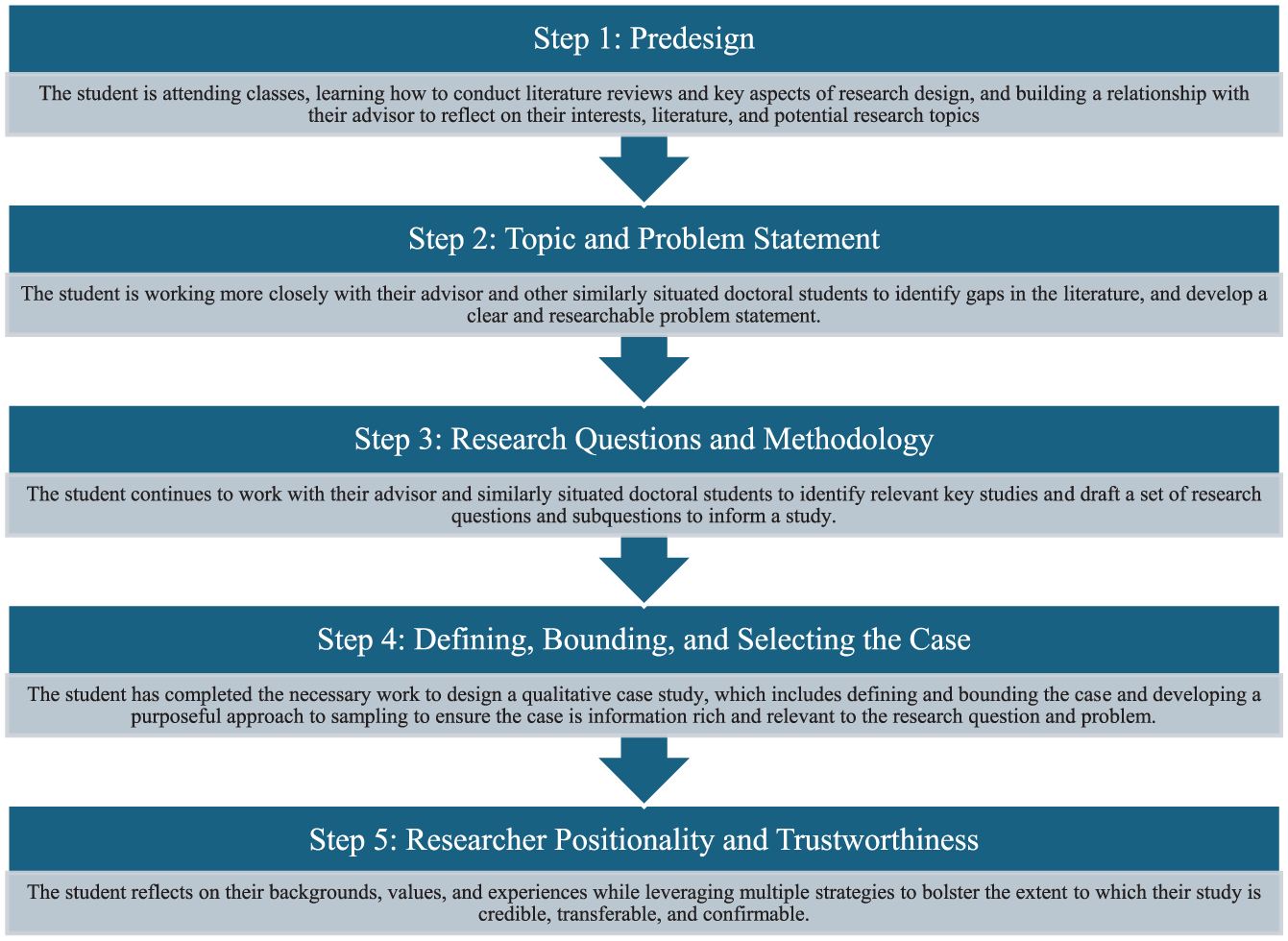
Simplified steps for doctoral students designing a qualitative case study proposal.
Step 1: Pre-Design
New doctoral students typically begin their doctoral journey with at least 2 years of academic coursework that likely includes courses on educational leadership and policy content, electives, and research methodology courses. We refer to this step in the doctoral journey as the “pre-design” phase since students will not design their study just yet, nor will they have a full grasp of the literature or a well-defined research topic. Rather, the pre-design phase is an opportunity for students to build the skills needed to move efficiently through the process of designing their dissertation study in the future. To prepare, doctoral students should take every effort to engage deeply with their coursework, strengthen their academic writing, and begin to develop critical reading skills that enable them, not only to take content away from reading research articles, but also to develop an ability to critique published research studies. We have seen doctoral students be successful in their doctoral journey when they regularly jot down ideas and questions they find interesting and bring forward those thoughts and questions in coursework (e.g., developing papers, classroom dialogue, advising conversations).
The pre-design phase is also an opportunity for doctoral students to appreciate the scope of a dissertation and the careful design and rigor it entails. To prepare for their own dissertation process, we recommend doctoral students identify and read dissertations from within their programs and from other universities so they can appreciate how dissertations are formatted, the broad topics they cover, and how literature, methods, findings, and conclusions are aligned (to get started, see: Batista, 2022; Comstock, 2023). Students might consider reading key texts on qualitative (e.g., Creswell & Poth, 2025; Lareau, 2021; Merriam & Grenier, 2019; Miles et al., 2020; Tisdell et al., 2025) and case study methodologies (e.g., Flyvbjerg, 2006; Stake, 2008; Thomas, 2021; Yin, 2018) so they can learn more about the different approaches to them (Yazan, 2015). This might include reading qualitative case studies from other academic fields and disciplines. In addition, during the pre-design phase doctoral students can learn about how they do their best academic work and develop a study schedule and organization system to ensure they are working efficiently and effectively, especially if they are balancing a full-time job.
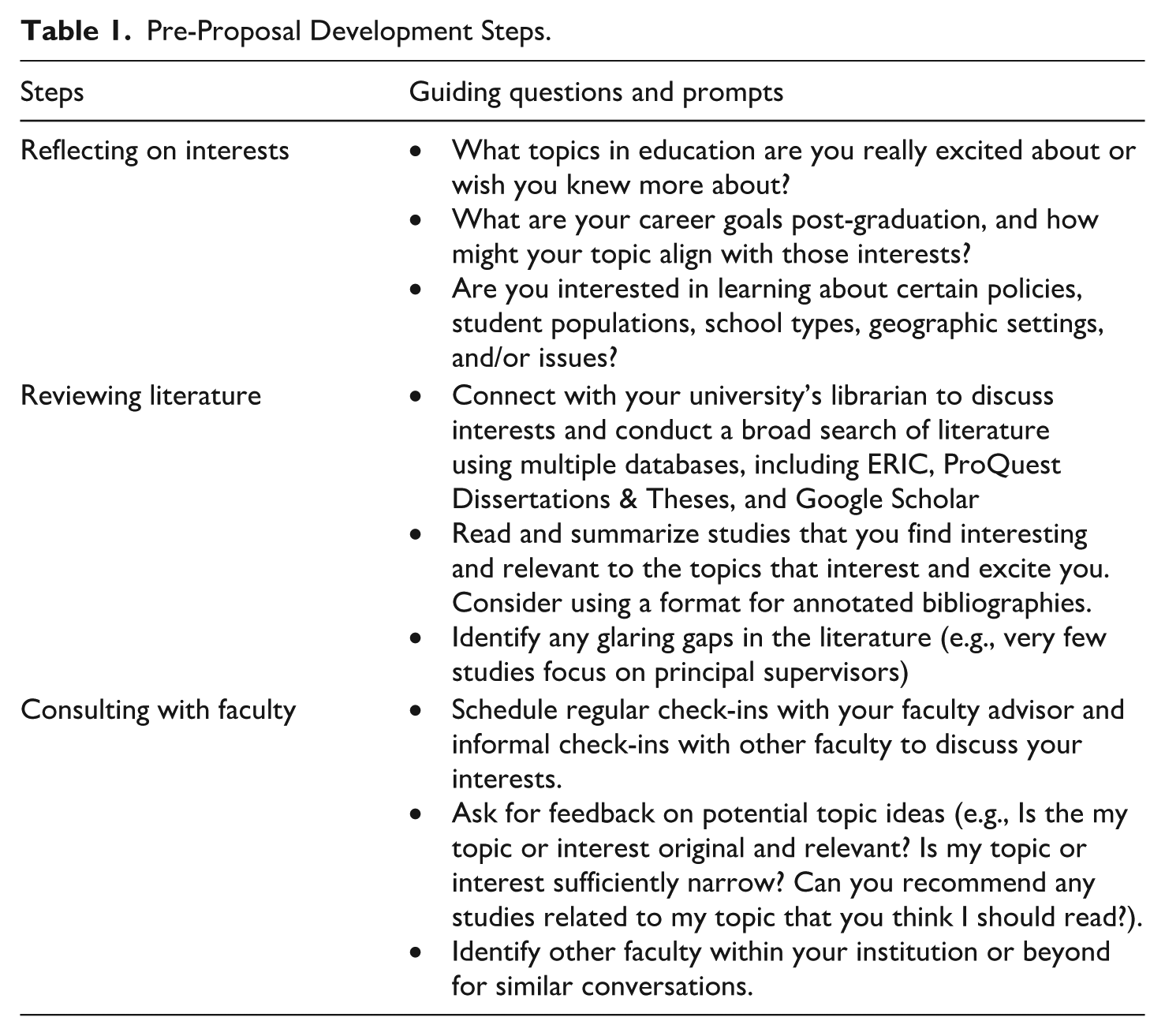
Doctoral students may benefit from structured guidance of their faculty advisor to support the development of their dissertation study. For example, within our advising group, doctoral students have regularly scheduled conversations (6–8 per semester) with their advisor in their first 2 years of coursework. Advisees also participate in semesterly small advising group convenings where students can build rapport with one another through peer review feedback sessions. With mentorship from their advisor and senior doctoral students, each first and second year doctoral student is encouraged to take four specific actions to prepare them for completing comprehensive exams and developing a dissertation proposal: (a) reflect on their interests; (b) review literature on their topic of interest; (c) read the implication sections of articles for recommendations for future research; and (d) consult regularly with faculty within their program, department, and in other colleges and universities. Table 1 highlights guiding questions and prompts for each action identified. As both advisor and doctoral student, we have found these activities, questions, and prompts useful because they provide cues for students to more quickly identify interests and move on to important next steps in developing a topic and study.
Pre-Proposal Development Steps.
Step 2: Topic and Problem Statement
The pre-design phase should create a strong foundation for identifying a dissertation topic and designing a study. By the beginning of Step 2, the doctoral student had ample time (typically 2 years) and opportunities to reflect on their coursework, cultivate a general area of interest (e.g., professional learning communities, school improvement planning, teaching evaluation), and develop a preliminary literature review and literature review skills that can lead to the further development of their study. Now, doctoral students are ready to take the following next steps to identify gaps and unexplored areas within the empirical literature to develop a clear research problem statement. These efforts can vary in time depending on the student’s focus, prior experience examine research related to their topic, and their preparedness to make important research related decisions.
To begin, we recommend a doctoral student conduct a formal literature review if they have not done so already. To start this process, the student can use the following sentence prompt to address the question their literature review will answer: What do we know, based on the empirical literature, about [student completes the question with their topic]? Alternatively, the student may write one sentence that captures the purpose of their literature review. For example, a student researching principal leadership for inclusion may write: The purpose of my literature review is to share what is known in the empirical literature about how principals lead to create inclusive schools. In reviewing either the question or purpose statement, the student may generate keywords to use for a literature search. In considering keywords, the student can reflect on the elements of their topic that are most important for their literature review. Using the prior example on principal leadership for inclusion, a few relevant keywords could be principal, principal leadership, inclusion, inclusive schools. After generating keywords, the student might contact their university librarian to learn more about conducting literature searches, identify appropriate academic databases (e.g., Google Scholar, ProQuest), and consider a systematic approach to organizing and evaluating the empirical, peer-reviewed studies they identify.
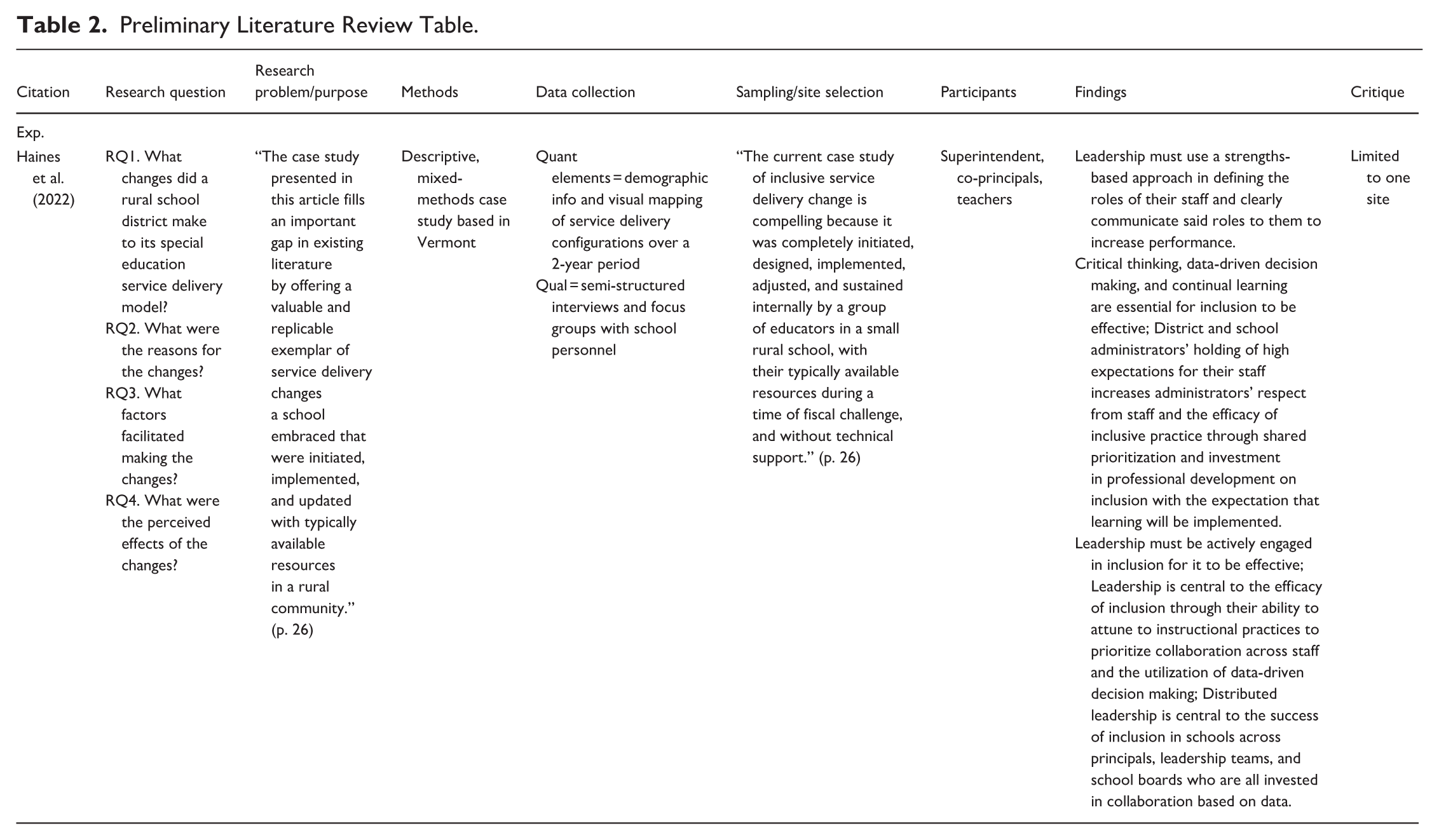
During the literature review development and writing processes, we recommend that doctoral students use a broad array of literature to frame their topic (e.g., journal articles, reports, dissertations) but structure their actual review using peer-reviewed studies published in academic journals to ensure quality and clarity. To support this work, we recommend doctoral students create a preliminary literature review table that includes the study’s APA citation, research questions, research problem or purpose statement, methods and data collection processes, approach to sampling/site selection as appropriate, demographics of site and/or participants, key findings, and the student’s critique of the study. Students may also consider including a notes or key quotes section(s) within their literature review table to take stock of their key takeaways, reactions, and information of note that may be addressed in their literature review. Doctoral students struggling with focusing or writing a literature review should review key resources (e.g., Boote & Beile, 2005) and/or read several high-quality academic literature reviews to familiarize themselves with this unique genre (see Review of Research in Education, Review of Educational Research to identify exemplars). Table 2 provides an example of the preliminary literature review table.
Preliminary Literature Review Table.
Once the preliminary literature review table is complete, students answer several main questions that can move them forward in developing a problem statement: (a) What research problems and questions have been examined in the field? (b) What methods and approaches to data collection and analysis have been used to examine your topic? (c) What sampling techniques, populations, and contexts have been examined and/or unexamined? (d) What are the key findings related to your topic of interest? These questions can help the student move toward developing a research problem statement. In our advising group, students take a multi-step process to write a research problem statement. The problem statement should be clear and concise, explain the context and significance, and identify a gap in knowledge. In addition, the problem should be specific and researchable. Below, we provide directions and examples of each step doctoral students should consider in writing a research problem:
Contextualize the topic and problem by considering the audience and the appropriate level of background information necessary to help the reader understand the setting and context for the study. ○ Example: The Individuals with Disabilities Education Act (IDEA) places important expectations on public schools that include providing a high-quality education to students with disabilities in the least restrictive environment. Principals play an important role in establishing the cultural conditions and instructional programming that ensures general and special education teachers meet the diverse needs of students with disabilities in the general education classroom.
Articulate the specific problem or research gap that the proposed study will address. ○ Example: Despite IDEA mandates, many principals report limited training and support needed to promote inclusive educational environments that meet the diverse needs of students with disabilities.
Outline why the problem is important to the field, who might be impacted by the problem, and the consequences of failing to address it. ○ Example: Without well-prepared and knowledgeable principals, general and special education teachers may lack the support, time, and resources to create instructional environments where students with disabilities can thrive academically and socially.
Identify and describe the research gap associated with the problem to justify further research. ○ Example: Much attention has been given to improving teacher preparation and instructional practices that promote inclusion, few studies have investigated how principals enact leadership practices that support serving more students with disabilities in the general education classroom.
Summarize the core focus of your study. ○ The problem this study aims to address is the lack of understanding about how principals engage in leadership to promote inclusion and increased levels of student achievement for students with disabilities.
Other examples of writing research problems or related statements can be found in a range of qualitative methods and case study method texts (e.g., Creswell & Poth, 2025; Marshall & Rossman, 2016; Merriam & Tisdell, 2016; Tisdell et al., 2025).
Step 3: Research Questions and Methodology
Research questions follow the research problem and are essential to guiding the research process. For qualitative researchers, research questions are often open-ended, exploratory, and designed to better understand human perspectives, practices, and social phenomena within a defined context. Research questions act as “conceptual infrastructure for building the study” (Stake, 2013, p. 9). Generally, qualitative research questions are open-ended, aimed at understanding the phenomena of interest, include a contextual focus, and are flexible given that qualitative studies often generate new insights during the data collection and analysis processes. At this stage, we recommend doctoral students remember the purpose of research questions are manifold and include: (a) guiding the study’s focus (e.g., what the researcher seeks to explore); (b) shaping the methodology and data collection methods (e.g., approaches to data collection and sampling strategies); (c) focusing the analysis (e.g., the lens through which data will be organized and interpreted); and (d) promoting empirical and theoretical relevance (e.g., contributions to literature and practice).
To begin, we recommend doctoral students review and re-read studies that were part of their literature review and specifically focus on identifying the research questions and open-ended question stems that other researchers used in their studies (e.g., How do . . . In what ways . . . What are the experiences of . . .). Students can refer to their preliminary literature review table, previously referenced. Engaging in this task allows students to examine how other researchers frame their research questions in ways that help elicit participants’ perspectives and experiences. We encourage doctoral students to talk with their advisor about access to research sites and participants, potential time constraints, and any ethical considerations that might shape the extent to which they can successfully collect data to complete their dissertation in a timely manner.
Next, we recommend that students begin drafting their research questions, which can be an iterative and time intensive process. To get started, we suggest that students review key readings by Yin (2018), which underscore the importance of taking three steps: (a) identifying a few key studies on the topic of interest; (b) using those studies to take a stab at drafting research questions; and (c) examining additional studies related to the research topic of interest to try and develop any new ideas or ways to sharpen or improve the drafted research questions. Through this process, students should then be ready to start drafting their main research question or questions that they may want to explore for their dissertation. Main research questions may, as appropriate, lead to the development of sub-questions that can help the student break down the main research question into more manageable parts that will guide the data collection and analysis process.
While main research questions focus on the central phenomenon under study, sub questions might focus on specific aspects of the phenomenon. For example, the main question for a case study might be, “How does a school’s principal and assistant principals enact transformational leadership in a rural elementary school?” The sub-questions might focus on perceptions (e.g., How does the principal and assistant principals perceive their role?), practices (e.g., What strategies or tools do they use?), challenges (e.g., What barriers or problems do they face in their work?), and contextual factors (e.g., How does the school environment, district, and/or community influence their leadership practices?). When reviewing and revising drafted research questions, students should consider the extent to which their questions reflect key concepts in the literature and in their conceptual or theoretical frameworks. Students should also consider whether the questions can be answered through interviews, observations, and document analysis.
Step 4: Defining, Bounding, and Selecting the Case
Doctoral students who develop a research problem and set of research questions for qualitative case study research now need to identify the “case” to be studied, which includes defining and bounding the phenomenon, or case, under study (Merriam & Tisdell, 2016; Stake, 2013; Thomas, 2021; Yin, 2018). Using case study methods, the researcher aims to understand “how and why something might have happened or why it might be the case” (Thomas, 2021, p. 5). A case can be bound in various ways to investigate a specific phenomenon. We recommend doctoral students read Yazan (2015) to better understand the varied approaches to bounding a case from three key case study methodologists, Stake, Merriam, and Yin.
The divergent approaches to defining and bounding a case, specifically for the aforementioned methodologists, rests in their epistemological perspective, or belief around knowledge – what it is and how it comes to be. We encourage doctoral students to read and review Crotty (1998) to process their own epistemological perspective, which will inform their approach to identifying phenomena and defining their case(s). In short, a case can be bound to an individual, a group of people, an organization, or a specific geographic context (e.g., a state, region, county, district) to explore a phenomenon. Depending on the number of cases a researcher identifies for the purpose of a study, they may adopt a single, multiple, or embedded case study design (Thomas, 2021; Yin, 2018). To learn more on the nuances of single case, multiple or comparative case, and embedded or nested case study designs, we recommend doctoral students read Thomas (2021), Chapter 9, “Your process: The shape, style, and manner of your case study” and Yin (2018), Chapter 2, “Designing case studies: Identifying your case(s) and establishing the logic of your case study.” Doctoral students may benefit from reading Crotty’s (1998) descriptions of post-positivist and interpretivist epistemologies to analyze Yin’s (2018) and Thomas’s (2021) approach to case study methodology. Herein, we provide some brief examples of these distinct case types to help doctoral students process their slight differences.
In some instances, an individual person can be the case or multiple individuals might represent cases as part of a multiple case study. If, for example, a person is defined as the case, the student will still need to further define the case toward the phenomenon under study because not all information about the individual will be relevant to answer the research questions. For a study focused on how a particular principal leads an academically high-achieving school for all students, the case, bound to the principal within their school-community context, might cover reasons the principal sought their leadership position, their prior experiences, and their current work but exclude the principal’s early childhood experiences or hobbies unrelated to the purpose of the study. The case of the principal would be a single case study. If the single case study of the principal were to include nested or embedded case studies, we would identify specific phenomena within the principal’s school-community context associated with their leadership to explore in greater detail. Thus, this study design may look at a specific teacher’s engagement with the principal that informs the school’s success (nested case 1); a student within the principal’s school that has demonstrated significant academic growth (nested case 2); and the principal’s experience building staff capacity through a specific professional development process (nested case 3).
Together, the three nested cases contribute to the single case of the principal’s leadership in an academically high-achieving school, establishing the nested or embedded single case study design. Lastly, if we were to design a multiple, comparative case study including this principal, we would conduct an additional, related case study on another principal of an academically high-achieving school to investigate the similarities and differences of the two principal leadership experiences. While our examples focus on an individual as the subject of the case, case studies can also be focused on families, groups, or organizations, such as schools or school districts, or specific programs operating within organizations like professional learning communities or multi-tiered systems of support. For all case study designs, the researcher must define and bound the case based on their developed research problem and purpose of the research at hand. Once the case is clearly defined and bound, the case study site must be selected.
When selecting a case study site, we recommend that doctoral students consider the type of case that best suits the purpose of their study. Identifiers for case types vary, but doctoral students may benefit from considering the following categories: (1) key case, (2) typical case, (3) outlier case. While we define three case types here for simplicity and accessibility for doctoral students approaching this work for, possibly, the first time, some methodologists, like Yin (2018), go so far as identifying five single case study types (i.e., critical, unusual, common, revelatory, longitudinal) and complex multiple case study purposes (i.e., literal replication and theoretical replication). To support doctoral students in case study design, we recommend considering whether a case is a key (i.e., a unique and ideal exemplar of the studied phenomenon), typical (i.e., a common, usual example of the studied phenomenon), or outlier (i.e., an unusual, atypical example of the studied phenomenon) case. After determining the type of case that is most appropriate for studied phenomenon, students can work toward setting the criterion for case study site selection.
To select an appropriate site for case study research, doctoral students need to set specific inclusion and exclusion criteria for site selection and participant sampling. As Yin (2018) noted, “Bounding the case in these ways will help to determine the scope of your data collection and, in particular, how you will distinguish data about the subject of your case study (the ‘phenomenon’) from data external to the case (the ‘context’)” (p. 31). For any case study, researchers might find several potential sites that could be considered. Thus, the researcher now needs to “consider where to observe, when to observe, whom to observe and what to observe” (Burgess, 1982, p. 76). Qualitative researchers rely on common approaches to purposeful sampling that includes (a) criterion sampling where each participant or case meets a certain set of criterion (e.g., principal with at least 3 years of experience on their current campus); (b) maximum variation sampling where participants or cases aim to capture a wide range of perspectives (e.g., general education and special education teachers and related service providers working across all grades); and (c) snowball sampling where the researcher asks participants to refer others for the study that may meet the study’s selection criteria (see Creswell & Poth, 2025; Marshall & Rossman, 2016). Doctoral students will need to consider their research problem, purpose of their study, research questions, and case type to develop their criterion for both site and sample (or participant) selection.
Case study site and sample selection is purposeful rather than random because of its inherent focus on contextualizing a particular phenomenon. While the processes of site and participant selection may feel daunting for doctoral students new to case study research, we find it helpful to recall that “the logic and power of purposeful sampling lies in selecting information-rich cases for study in-depth. Information-rich cases are those from which one can learn a great deal about issues of central importance to the purpose of the research” (Patton, 1990, p. 169). At the onset of this work, the doctoral student may look at some of their favorite case studies to brainstorm their own inclusion and exclusion criteria for site selection and participation. Next, the student can draft their criterion while being mindful of their own study’s purpose and research questions at hand.
Afterward, they can use their chosen favorite case studies to evaluate their drafted inclusion and exclusion criteria against those of other researchers to consider potential revisions. For example, a case study exploring effective principal leadership for increasing student achievement for students with disabilities may have inclusion criteria that requires a principal to have at least 3 years of leadership tenure on their campus with a student population where at least 10% of students are eligible for special education in at least five different disability classification areas. In addition, inclusion criteria might also include only principals working in schools where the achievement of students with disabilities is above the district average and has increased during the principal’s tenure. Exclusion criteria might be any principals with fewer than 3 years of leadership experience on their campus, those serving few students with disabilities, or working in schools that have been cited by the school district for needing to improve special education. Relatedly, doctoral students, and all qualitative researchers, must justify why they chose the inclusion and exclusion criteria, how it aligns to their research questions, and how the sample will ensure the case is rich and credible given the study’s purposes.
Step 5: Researcher Positionality and Trustworthiness
Objectivity in research has long been challenged (Lather, 1986; Smith, 2021). Researchers, including doctoral students, wield significant power in shaping knowledge creation and dissemination, particularly as they define research problems and design studies. Researcher positionality statements are a reflective declaration in which the researcher acknowledges and considers their backgrounds, values, experiences, identities, and biases particularly as it relates to the design and implementation of a study, and how these elements might create conflict or bias. Taking stock of one’s perspectives is critically important for qualitative researchers, especially since the qualitative researcher is the primary tool in the data collection and analysis process. Doctoral students should take time to reflect broadly on their personal and professional background, their epistemological stances, their relationship with their research topic, and their own assumptions and potential biases. To get started, we recommend students journal about their personal and professional background (e.g., what roles they have served in, their various identities), what they identify as their core values and beliefs, what they consider are their areas of strength and growth as an educator and researcher, and how their personal identities (e.g., race, gender, socioeconomic background) interact with their professional lives and research interests. Journaling and pondering these elements can provide the foundation for students in drafting their researcher positionality statements for their doctoral dissertation.
After an initial reflective process, we recommend that doctoral students read positionality statements in other studies and scholarly writings (e.g., Boveda & Annamma, 2023; Contreras, 2024; Haynes et al., 2020; Lambrinou, 2025; Milner, 2007; Washington, 2025) to appreciate the style and comprehensiveness of such statements. Milner (2007), in the presentation of his framework designed to help education researchers develop their racial and cultural consciousness, stated, “when researchers are not mindful of the enormous role of their own and others’ racialized positionality and cultural ways of knowing, the results can be dangerous to communities and individuals of color” (p. 388). To support researchers in developing such consciousness, Milner (2007) built his framework on three core principles that require the recognition of the historical silencing and disenfranchisement of people of color, White privilege in research, and the irrevocable presence of individual researcher’s multiple identities that inform the research process. Others have called for more intersectional approaches to positioning and how intersectional oppressions influence knowledge production (Boveda & Annamma, 2023). After engaging with works such as Milner (2007), Boveda and Annamma (2023), and positionality statements in other research articles, students can begin drafting their own positionality statements by responding to the following questions:
How do you view knowledge generation and truth?
Why did you choose your study topic and what experiences or aspects of your identity might intersect with it?
What roles and professional experiences have informed your selection of the research topic and your lens through which you come to this study?
What are ways in which your backgrounds, values, experiences, identities, and biases might influence the data collection and data analysis process?
What power dynamics might be at play when collecting and analyzing data?
How, if at all, does your role as researcher and/or practitioner reflect hierarchical structures within the organization you are conducting your study (e.g., a principal interviewing teachers)?
What strategies can you take to mitigate bias and engage in a process of continuous self-reflection?
After drafting a researcher positionality statement, we advise the student to think more about bolstering the trustworthiness of a study. Trustworthiness can be understood as the ways in which the researcher designs and writes up a study to prevent the potential effects of researcher biases. In case study research, an inherent weakness is the researcher being the main tool for data collection and analysis (Thomas, 2021; Yin, 2018). Thus, the researcher must account for their own potential biases throughout the research process. In working to bolster the trustworthiness of a case study, questions arise around the concepts of validity, generalizability, credibility, plausibility, and so on. Case study methodologists have different, sometimes contentious, perspectives on the use of these terms or concepts in relation to case study design (Thomas, 2021). To become familiar with these varied perspectives, we suggest that doctoral students read Chapter 9 of Merriam and Tisdell (2016), “Dealing with validity, reliability, and ethics” as well as Thomas (2021), Chapter 4, “Rigour and quality in your case study: What is important?” to become familiar with dialogue around these concepts in case study methodology. Doctoral students should take several important steps to strengthen the trustworthiness of their proposed studies. To get started, we recommend that doctoral students use Merriam and Tisdell’s (2016) Exhibit 9.1, “Challenging the trustworthiness of qualitative research” (p. 241) to reflect on their in-progress research designs. Specifically, doctoral students should ensure their study includes several key strategies to ensure trustworthiness (see Merriam & Tisdell, 2016; Patton, 2015; Thomas, 2021):
Triangulation: The use of multiple data collection sources to cross check and confirm findings.
Member checking: Sharing preliminary findings with participants to validate that their perspectives were accurately and fairly represented.
Thick description: Providing rich, detailed context so readers can understand the nuances of the case.
Peer debriefing: Engaging with colleagues, researchers, and practitioners who can offer alternative perspectives.
Journaling: Maintaining a research journal to document insights, self-identified biases, and emerging questions.
Prolonged engagement: Spending sufficient time to gain rapport with participants and a deep understanding of context.
Negative case analysis: Identify, where available, findings that contradict with broader themes.
Without these steps, readers may question the credibility of findings, the transferability of the study for other settings, and perceive the author as unable to check for their own biases. For a doctoral student, such assumptions can undermine their proposal and impact their progress. On the other hand, taking these important steps strengthens readers’ confidence, including committee members, in the study. By bolstering trustworthiness, the student is also able to clearly demonstrate their commitment to ethical rigor – reflecting their respect for their site, participants, and the field of educational leadership. In addition, such steps help to ensure the student is making a meaningful contribution to the literature and reflects the academic standards associated with their field of study.
Next Steps and Conclusions
Qualitative case study dissertations can play an important role in the development of doctoral students by expanding their research skills and providing them with a unique opportunity to study leadership within a naturalistic setting. As we noted, however, not all qualitative case studies are well-designed or enable the researcher to gain important insights into practice, theory, and data collection and analysis. Thus, we aimed to provide a set of recommendations from our experiences and methodological literature to aid doctoral students in developing dissertation proposals for qualitative case study research. While not inclusive of all steps and aspects of a doctoral dissertation proposal, we believe these steps can help ensure students design high-quality studies that are methodologically precise and offer rich opportunities to learn and grow. Specifically, we have found that doctoral students are more likely to efficiently and effectively move through the dissertation proposal development process when they take intentional efforts to build their knowledge and skills during coursework and when they have structured support identifying a topic, developing a problem statement, writing research questions, and clearly defining, bounding, and selecting their case. These steps, along with guidance from the student’s advisor and committee, can help ensure the student engages in a dissertation study that is generative for the student and the field.
The focus of this Pedagogy and Practice article was on dissertation proposal development. The dissertation process, from beginning to end, has many additional steps, including writing up the findings and generating meaningful conclusions and implications from the data. In addition, after completing dissertations, program graduates might consider publishing their studies in academic journals or state and national practitioner-oriented journals (e.g., Educational Leadership). They may also find it appropriate to share their findings with their participants and/or the districts and communities they serve. Although these activities are beyond the scope of our article, we encourage doctoral students to consider the different avenues where they can share their work.
Footnotes

Funding
The authors received no financial support for the research, authorship, and/or publication of this article.
Declaration of Conflicting Interests
The authors declared no potential conflicts of interest with respect to the research, authorship, and/or publication of this article.