



Abstract
This study, conducted within a Finnish teacher education program, examined student teachers’ perceptions of their skills development in a study group intervention designed to enhance their teacher leadership. Data were collected via semi-structured focus group interviews with the student teachers (n = 15) and examined using qualitative content analysis. Katzenmeyer and Moller’s leadership development for teachers model was utilized as the theoretical framework. The results indicate that through collaboration, the student teachers developed leadership skills, especially in personal assessment and influencing strategies, but need more support to be able to better recognize these skills as leadership skills.
Keywords
Introduction
Teacher leadership plays an important role in establishing effective, high-quality schools and education (Harris & Jones, 2019; Wenner & Campbell, 2017; Xu & Patmor, 2012). The foundation for continuous leadership development (Bond, 2011; Katzenmeyer & Moller, 2009; Xu & Patmor, 2012) and teachers’ preparedness for assuming leadership roles in the novice phase (Ado, 2016; Ryan, 2009; Szeto & Cheng, 2018) is laid in initial teacher education. However, previous research on teacher leadership development has mostly concerned in-service teachers, while similar research among pre-service teachers, especially outside the Anglo-Saxon setting (cf. Ado, 2016; Leonard et al., 2012; York-Barr & Duke, 2004), has been limited. Moreover, in the existing theoretical and empirical literature on teacher leadership development in the pre-service setting, scholars point out challenges in providing support for this development in teacher education. These challenges include difficulties in recognizing student teachers’ leadership potential (Bond, 2011; Rutten et al., 2022); identifying the skills they develop, such as social and classroom management skills (see, e.g., Kwok, 2023; Tynjälä et al., 2016), as leadership skills; and including a sufficient number of leadership exercises in the busy curriculum of the pre-service setting (Bond, 2011; Xu & Patmor, 2012).
In the present study, we examined teacher leadership development and the aspects that support it in initial teacher education. More precisely, we examined the development of leadership skills among student teachers in a study group intervention designed to enhance their teacher leadership. The study group was conducted as part of a Finnish class teacher education program, and it is referred to as the teacher leadership (TL) study group. The TL intervention was intended to respond to the need to increase support for teacher leadership development in initial teacher education—a challenge highlighted by many scholars (cf., e.g., Reeves & Lowenhaupt, 2016; Rutten et al., 2022; Xu & Patmor, 2012) as well as the Finnish Ministry of Education and Culture—and to develop teacher education based on research (Ministry of Education and Culture, 2022). At the time of the data collection for this research, the TL study group was convening for the first time and had not been studied previously.
The present research focuses on the student teachers’ perceptions of their own skills development in the TL study group. With the concept of “perception,” we refer to the student teachers’ subjective views on and conceptions of their (achieved) development. When conducting activities that aim to develop the skills of a certain target group (e.g., the TL student teachers), it is relevant to examine how the action and the development that is assumed to be achieved through it are conveyed to the target group members themselves (cf., e.g., Brookfield, 2017). This approach may enable us to gain insight into what kinds of skills the student teachers identify themselves as developing (cf. Brookfield, 2017), resulting in a better understanding of how they can be supported in recognizing their development and how the student teachers see the value of the action introduced for their development (Eddy et al., 2015). These factors have connections to student engagement (Meece et al., 2006) and performance (Kahu & Nelson, 2018), and they may help develop the given actions in the future (cf., e.g., Paufler et al., 2022). Moreover, previous research indicates that student teachers’ perceptions of their development tend to correspond to their real-life competence levels (see, e.g., Darling-Hammond et al., 2002; Saloviita, 2019).
The student teachers’ perceptions that we examine in this study concern, first, their development of teacher leadership skills in the TL study group, which is approached through the lens of Katzenmeyer and Moller’s (2009) leadership development for teachers (LDT) model. The LDT model has not previously been applied in the examination of teacher leadership skills development in the Finnish pre-service teacher education setting, which is why we want to investigate its applicability in this context. Second, we examine the student teachers’ perceptions of how collaboration in the TL study group supported their LDT skills development. Third, we examine which aspects of the development of their LDT skills the student teachers themselves perceived as contributing to leadership skills development.
Development Toward Teacher Leadership: The LDT Model
Katzenmeyer and Moller (2009) emphasized that building a learning community of teachers and working to improve educational practices are the central responsibilities of teacher leadership (see also Murphy, 2005; Wenner & Campbell, 2017). Their LDT model focuses on how teachers should be prepared for leadership roles (Katzenmeyer & Moller, 2009). This model acknowledges the collaborative nature of teacher leadership, both in the skill sets required and the process of becoming a leader. Katzenmeyer and Moller (2009) suggested that their model is designed to support and examine teachers’ leadership development at various career phases, including the pre-service stage. In the LDT model, teachers’ leadership development is classified into three levels: teachers coming to understand themselves, their colleagues, and their schools. The LDT model, with its four components, is presented in Figure 1.
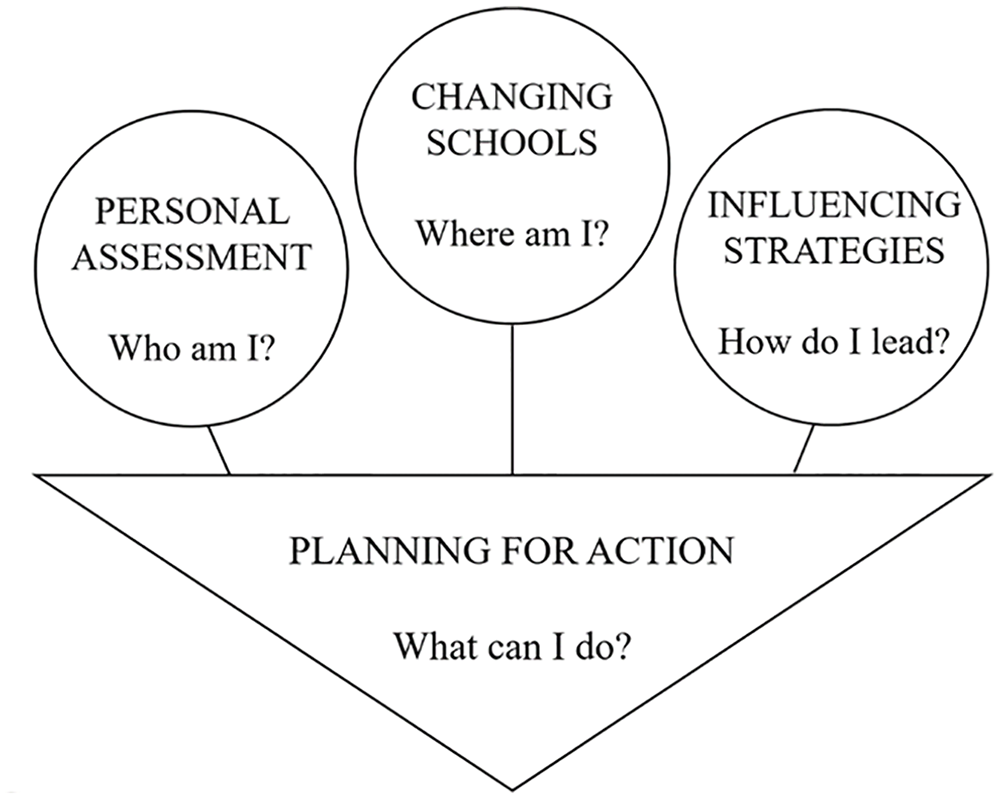
The LDT model (Katzenmeyer & Moller, 2009, p. 53).
Personal assessment (PA) development involves teachers better understanding themselves as professionals, including their beliefs and strengths. An important part of PA development is recognizing that their colleagues are different; they may think differently and have different strengths compared to themselves. Recognizing this results in acceptance of the differences among members of the professional community as an important resource to be embraced. Additionally, gaining knowledge in adult development, another aspect of PA, increases teachers’ ability to receive support and feedback targeted at their individual needs and provide such support and feedback to others (Katzenmeyer & Moller, 2009).
Development in changing schools (CS) involves teachers gaining a deeper understanding of the broader school organization beyond their own classrooms and subject areas. Teachers come to know their school’s culture better and generate their own understanding of teacher leadership—what it means to them in general and in the context of their specific school. Teachers also learn to identify the barriers to and facilitators of change in their educational organizations and to deal with conflicts and difficult situations caused by collisions of various actors’ contradictory interests (Katzenmeyer & Moller, 2009).
Development in influencing strategies (IS) involves teachers coming to recognize that effective change is not achieved by leaning on one expert leader but by doing things together as a group and community. IS development includes teachers learning skills that enable collective action, such as group facilitation skills, listening skills, and skills for dealing with differences. Teachers develop all three skill sets to prepare for the fourth component: planning for action (PfA), that is, leading and taking effective action to engender change in their schools (cf. also Fullan, 2020; Harris & Lambert, 2003). The PfA component includes recognizing necessary changes; gathering, testing, and researching related data; and setting goals and planning strategies to achieve the changes in their school. The PfA component focuses more on applying teacher leadership skills in practice than introducing another skill set. Simultaneously, competence in applying teacher leadership skills in practice is an important teacher leadership skill (Katzenmeyer & Moller, 2009).
In the LDT model, teacher leadership development is presented as a rather linear process: teachers start by coming to understand themselves better and proceed to understand the broader picture, including their colleagues and organizations. However, it is important to note, as Katzenmeyer and Moller (2009) do, that teacher leadership development is not as linear in real life as it is presented in the model.
Collaboration as a Means of Supporting Leadership Skills Development
In the LDT model, teacher leadership skills development occurs in and through a collaborative process between teachers (Katzenmeyer & Moller, 2009). This kind of collaboration often takes place in the professional learning community (PLC) of a school (Antinluoma et al., 2018; Jäppinen et al., 2016) and, thus, typically occurs in the in-service setting. However, the development described in the LDT model can also take place in the pre-service setting if student teachers are provided with opportunities to collaborate and to be members of a learning community that functions as a “pre-” PLC. We regard the TL study group as this kind of pre-PLC because its form and nature emphasize continuous professional development through collaboration between student teachers who are also peers (cf. Antinluoma et al., 2018; Jäppinen et al., 2016).
Roschelle and Teasley (1995, p. 70; see also Baker, 2015) offered a broadly accepted definition of collaboration as “a coordinated, synchronous activity that is the result of a continued attempt to construct and maintain a shared conception of a problem.” We propose that an intrinsic part of the process of collaborating is collaborative interaction, which we understand as a joint interaction between individual participants in which they aim to construct a shared understanding of a phenomenon. This process also includes the concrete actions necessary for building joint interaction, such as listening to others and expressing one’s views and opinions. Additionally, we suggest that in a collaborative process, participants not only aim to construct a shared understanding of a phenomenon but concurrently develop their individual perspectives and skills by continuously comparing their views and actions with those of others. Thus, learning and development through collaboration can be seen as drawing on social constructivism and sociocultural theory (e.g., Vygotsky, 1978).
Methods
Aim of the Study
The aim of the present study was to gain insights into the student teachers’ perceptions of their skills development in the TL study group. The research questions were as follows:
What kinds of perceptions did the student teachers have of their LDT skills development in the TL study group?
What kinds of perceptions did the student teachers have of the role of collaboration in supporting their LDT skills development in the TL study group?
Which aspects of their LDT skills development did the student teachers themselves perceive as contributing to their leadership skills development?
The Context, Participants, and Procedure
The participants in this research engaged in a TL study group intervention conducted within a Finnish class teacher education program. In Finland, class teacher education programs are master’s degree (300 ECTS) programs offered by universities (Government of Finland, 1998; Krokfors et al., 2011; Saloviita, 2019). It is worth noting that Finnish teacher education naturally supports student teachers’ leadership development by preparing them to work autonomously (Lapinoja & Heikkinen, 2010) and reflectively (Toom et al., 2010) in their profession, as well as by developing their capacity to collaborate with their colleagues and superiors (Toom & Husu, 2016).
The unique feature of the teacher education program examined in this study is that the student teachers studied in groups. In this paper, the term “study group” refers to a group of first-year student teachers (also referred to as students) jointly completing their core studies in the educational sciences (25 ECTS). These core studies aim to enhance students’ competence in understanding (1) the phenomenon of learning, (2) the relationship between education and society, (3) a scientific way of thinking, (4) collaboration and social interaction, and (5) the nature and development of expertise. These five themes are studied via lectures that are common to the whole cohort studying in the teacher education program and are analyzed more deeply in study groups in which the themes are, additionally, approached through the special lens of a given study group—for example, the theme of leadership in the TL study group. Thus, studying in these study groups is a phenomenon-based practice (e.g., Tarnanen & Kostiainen, 2020). The teacher education program includes several study groups, each of which focuses on a specific educational phenomenon. The students study in these groups during the first year of their education.
The study groups are facilitated by university instructors, and the studying is collaboration-based, meaning that teamwork is emphasized and the students are equal members of the groups, working together to achieve shared goals and construct a shared understanding (see also Baker, 2015). The phenomenon-based approach supports flexibility in study methods because the teacher educators and students decide collaboratively on, first, the specific phenomena that are focused on in a given study group (within the special theme, e.g., leadership) and, second, the most suitable methods for studying the given phenomena.
The study groups have regular meetings once a week. The length of one meeting is 1 hr and 30 min. In the TL study group, studying is highly collaboration-based and highlights the students’ reflections, experiences, and views. Typical exercises in the TL study group consist of shared discussions among the whole group and tasks pursued in small groups, such as writing reflective group essays. Additionally, the TL students who participated in this research were provided with opportunities to visit and interview an educational leader in their authentic leadership context and to attend an international conference at which the participants included professionals and leaders in the field of education in Europe. The study group’s work does not directly include the teaching practice during the first year of their studies. However, the special theme of the specific study group is used as the paradigm for observing and reflecting on what is seen and experienced during the teaching practice.
The present study was part of the DAWN project (2018–2022), which was approved by the data protection officer of their university (April 2019). The project was designed to examine the current state of and need for leadership, as well as its development, in Finland’s educational organizations. The sample for this study consisted of 15 student teachers (men: n = 6; women: n = 9) studying in the TL study group. The sample was highly representative because all the TL students participated, except one. The ages of the participants varied between 19 and 29 years. The participants were interviewed in small groups at the end of their first year of study (May 2020). They signed consent forms for the broader research project at the beginning of their studies (October 2019) and were asked for oral consent before participating in the present study. They were informed of their right to terminate their participation at any point during the study.
Data Collection
The data for the present study were collected via semi-structured focus group interviews based on open-ended interview questions (e.g., Patton, 2015; S. Tracy, 2013). The purpose of the focus group interview method is to gain insights into the participants’ perceptions, experiences, and views of a given phenomenon (Marková et al., 2007; Patton, 2015). By focus group interviews, we mean, in this study, interviews conducted in small groups in which the invitation to participate was purposefully limited to the TL group members (cf. Patton, 2015). We chose the focus group interview as the method of data collection because it can help create a casual atmosphere and interactive space in the interviews, which may, in turn, enable richer data to be gained compared to individual interviews (Patton, 2015). Creating a casual atmosphere is especially important when the participants and interviewer are not previously familiar with each other, which was the case in this study. Moreover, the focus group interview is particularly well adapted to gaining an understanding of the participants’ perceptions of a phenomenon of which they have a shared experience (Macnaghten & Myers, 2004; Patton, 2015).
We conducted four recorded focus group interviews in which the students participated in groups of three to four members. The lengths of the interviews varied from 38 to 66 min. The interviews were transcribed literally. The total length of the transcribed text was 59 pages. The specific focus group interview procedure applied in this research was designed by our research team. The interviews began with five interview questions related to the students’ backgrounds, such as their previous degrees and reasons for applying to study in the TL study group. The students responded to these questions individually in an order decided by the interviewer. The interviews continued with nine questions focusing on the students’ perceptions of the study group and their related development. In this phase, the interview was conducted through conversation, and the participants answered the questions in any order they wanted. In the data collection phase, the students were asked about their development in general and not specifically about their leadership development. This was because the researchers assumed that mentioning the latter concept could result in the students excluding relevant content due to not necessarily perceiving it as related to leadership development.
Data Analysis
The data were analyzed using qualitative, problem-driven content analysis (Krippendorff, 2013), drawing on both deductive and inductive reasoning (Patton, 2015). Problem-driven content analysis means that the analysis begins by establishing the research questions to be answered (Krippendorff, 2013). Open coding (inductive reasoning) was used at the beginning of both types of analysis (deductive and inductive) to remain open to the data and initially identify relevant content, keywords, and themes in light of the research questions (Elo & Kyngäs, 2008; Krippendorff, 2013; Patton, 2015). After the open coding, the researchers examined the literature to determine the extent to which the present study’s data supported existing theories, conceptualizations, and models (Patton, 2015). Consequently, the LDT model, introduced by Katzenmeyer and Moller (2009), was chosen to guide the theory-driven analysis. Quantification of the qualitative data was used to count the number of interview groups that mentioned a certain theme (see Grbich, 2013; Vaismoradi et al., 2013). The analysis was conducted as follows:
The first author transcribed the interview data and read the transcriptions several times. Initial notes were made, and headings and keywords concerning the relevant content of answers to the research questions were written in the margins of the transcriptions (Krippendorff, 2013; Patton, 2015).
The students’ perceptions of their teacher leadership (LDT) skills development in the TL study group (research question 1) were chosen as the first units of analysis. The interview transcriptions were read again, and the students’ perceptions of their skill development were identified in the transcriptions. Katzenmeyer and Moller’s (2009) LDT model guided the analysis (see Patton, 2015). Teacher leadership skills development was identified in the following order: development related to (1) PA, (2) IS, (3) CS, and (4) PfA components.
The students’ perceptions of the role of collaboration in supporting their LDT skills development (identified in Phase 2) were examined (research question 2). The transcriptions were read again to identify the related content. Here, data-driven content analysis was applied (Elo & Kyngäs, 2008; Patton, 2015).
This phase included an examination of which aspects of the development of their LDT skills the students themselves perceived as fostering leadership skills development (research question 3). The transcriptions were read again to identify the related content, that is, the skills development that the students themselves linked to growth in leadership skills. Data-driven content analysis was used here as well (Elo & Kyngäs, 2008; Patton, 2015).
The report includes direct student quotations to increase the credibility of the study and enable the reader to evaluate the researchers’ interpretations (Patton, 2015; S. J. Tracy, 2010). The quotations have been pseudonymized to protect the participants’ privacy.
Results
LDT Skills Development and the Related Role of Collaboration
First, we were interested in the students’ perceptions of their teacher leadership (LDT) skills development in the TL study group (research question 1). Second, we wanted to examine the students’ perceptions of the role of collaboration in supporting their LDT skills development (research question 2). We discuss the results of these two research questions together in this section because they are closely related.
Consistent with the PA component of the LDT model, students in all four interview groups reported that they had come to recognize differences between themselves and their peers. However, the students approached these differences as a resource and strength: “At least I feel that we have congenial people here, but every one of us is an individual, and we contribute to the group by bringing something our own and special to it” (Anni, Group 4). Another student highlighted the “rather strong personalities, differing significantly but complementing one another well” (Tommi, Group 3).
Related to the PA skills development, students in three interview groups also reported development in better understanding their own beliefs, views, and strengths. The students said that they had become more aware of their own beliefs and views and, additionally, reflected on, questioned, and developed them based on hearing others’ opinions and views. As one student, Essi (Group 1), stated, “. . . I have gained many new perspectives and found new ways of thinking and seeing matters, and I have, through that, learned a lot.” Another student, Tommi (Group 3), reported, “. . . I gained, about certain things which I have, perhaps, even had a strict opinion, lots of new perspectives because of hearing from the others what they think about matters.” Recognizing one’s strengths was associated with recognizing challenges to one’s development. This motivated the development of one’s skills and competencies:
I think I have always had the kind of challenge that I have not been confident enough to open my mouth. I mean, I haven’t had strong confidence that I really can and do know something about an issue. I feel that I have gained lots of courage, especially in the TL study group. It has been an important learning experience for me to become more confident in stating my opinions out loud and arguing for them. (Emma, Group 1)
Gaining experience in and seeing others acting in various roles in a group was mentioned in two interview groups: “The groups varied. I mean, they were composed of various people, so everyone had a bit of a different role every time, and it is, at least, always useful to have different experiences with various groups” (Satu, Group 3). Gaining experience in acting in various roles in a group can be identified as part of PA skills development because it is about constructing an initial understanding of oneself as a professional who has multiple dimensions and roles. Additionally, it is about coming to better understand the diverse roles of one’s peers, which is also important preparation for facing the multiple roles of colleagues in one’s future school community.
According to students in all the interview groups, the role of collaboration in supporting their PA skills development was central because in the collaborative process, they heard their peers’ opinions and views, compared their own views with those of others, and came to notice the differences in views and strengths between themselves and the others. In the following quotation, one student describes her perception of how the shared discussions in the TL group supported her PA skills development, mentioning the “. . . discussions as something that has been very useful to me—having an opportunity to hear others’ views” (Satu, Group 3). Moreover, working in small groups to gain experience assuming various roles in a group was part of the collaborative process in the TL group.
Related to the perception of the group members possessing various strengths and expertise, students in all interview groups reported that their understanding of the power of a group and of collaboration in achieving common goals had deepened. This is related to skills development in IS. The students said, “. . .also, as a group, when we start doing things, we really achieve good things” (Tuomas, Group 2); and “. . . perhaps when one hears another’s opinions and solutions to some issues, then it results in one suddenly starting to think, ‘. . . Why didn’t I think like this?’” (Emma, Group 1).
The students also reported development in the other IS skills: listening, group facilitation, and dealing with differences. Students in three interview groups mentioned that their listening and communication skills had improved in the TL study group. According to them, applying these skills in practice in the collaborative interactions of the TL study group supported the development of these skills. The students said that they had learned more about what it meant to genuinely listen to one another. Related to this, the students reported that in the TL study group, they had sincerely tried to understand their peers’ views, opinions, and intentions. They described developing their skills and attitudes in respectful and considerate interactions with others: “I believe I have become a much better conversationalist. I have learned to genuinely listen to what others have to say, and you yourself gain more ideas through listening to others” (Minna, Group 2); and “. . . that has even been surprising, how natural and good our conversations have usually been. And, especially, we give one another space; we prioritize taking everyone into account in those situations” (Jimi, Group 1).
Students in two interview groups mentioned that through participation in various activities based on collaborative interactions in the TL study group, they had started to recognize tools and activities that were effective for facilitating a group. As an example of this kind of activity, they mentioned a circle discussion exercise that had been enacted in the TL group. The circle discussion exercise usually took place at the beginning of the TL group’s regular meetings. In the circle discussions, the students’ current thoughts and moods in relation to their studies and daily lives were voluntarily shared. The following quotation presents a student’s perception of the circle discussion exercise:
. . . I think that we have pretty often had the kind of circle discussions to catch up . . . It is quite nice . . . to hear how it is going with the others and then talk a bit about one’s own concerns . . . It creates a sense of community, in my opinion, and, especially in future workplaces. . . that kind of stuff is a very good tool for creating an atmosphere. (Tuomas, Group 2)
The students in one interview group reported (in relation to IS skills development) that they had developed their skills in dealing with diverse views and opinions that may have differed rather starkly from their own. As one student recounted, “. . . then there is a very different opinion from another side compared to my opinion. But then, somehow, when they are being argued for, it is possible to better understand how others think” (Emma, Group 1).
Students in another interview group mentioned that they had become more aware of the role of values in teacher leadership: “Values of a leader . . . we have dealt a lot with the values, and . . . they are now clear. It is about recognizing what type of leader is a good leader . . .” (Iina, Group 3). Becoming more aware of the importance of values in a leader’s work and, especially, starting to recognize one’s own values as a leader is part of building one’s own understanding of teacher leadership, which is a competence related to the CS component. The students did not mention collaboration in connection with their progress toward becoming more aware of a leader’s values.
Additionally, students in one interview group said that they had become more aware of various leadership contexts in the field of education. This can be seen as an initial development of CS skills because the ability to recognize diverse leadership contexts is important for being able to understand one’s own leadership context, with its special features and demands. The students mentioned that this skill development had been supported by the exercises of interviewing an educational leader and participating in the international conference:
. . . I’d like to say about the same [exercise of interviewing an educational leader] that [I learned that] there exist various kinds of leadership, and that leadership exists in various contexts . . . and it may vary even within a specific context. (Anni, Group 4)
In relation to their progress in recognizing various leadership contexts, the students did not mention the role of collaboration. However, they mentioned that the opportunity to visit an authentic leadership context and speak with a “real-life” educational leader supported their capacity to recognize different contexts. The students did not report skill development in relation to the PfA component.
Perceiving LDT Skills Development as Leadership Development
Third, we were interested in which aspects of their LDT skills development the students themselves perceived as enhancing leadership skills (research question 3). In one interview group, the students reported on leadership skills development in relation to their progress in building teamwork skills: “. . . In a principal’s work, you need strong teamwork skills. I think it is great that we develop these skills here, and you don’t need to try to solve matters on your own . . .” (Minna, Group 2). In this interview group, the students described teamwork skills as communication skills (included in IS) that imply the ability to develop one’s own thinking further based on hearing others’ views (included in PA). In the same interview group, the students mentioned, as part of leadership development, their recognition of activities that were effective for facilitating a group (included in IS).
In another interview group, students discussed leadership skills development in relation to becoming more aware of the role of values in teacher leadership and, along the same lines, of one’s own values as a leader (identified as initial CS development in research question 1). In one interview group, students discussed leadership skills development in relation to having developed their competence in recognizing various leadership contexts in the field of education (identified as initial CS development in research question 1): “. . . I noticed that this [leadership] stuff can be well applied here, in this context” (Kalle, Group 4). The students did not link leadership skills development to their other LDT skills development. In general, the students in all interview groups reported that their (practical) leadership development had been rather limited in the TL study group: “. . . I don’t think . . . that I significantly developed my leadership competence . . . through the exercises in the TL study group . . .” (Satu, Group 3). The students mentioned the limited number of practical leadership exercises as a central factor that hindered their leadership development in the TL studies to some extent.
Discussion
The aim of the present study was to examine first-year student teachers’ perceptions of their leadership development in a study group intervention concerned with teacher leadership and conducted as part of a Finnish teacher education program. First, we wanted to examine the students’ perceptions of their teacher leadership (LDT) skills development in the study group (Katzenmeyer & Moller, 2009). The results indicate that the students, by their own accounts, developed their skills in several ways, primarily in two skill sets from the LDT model: PA and IS, that is, understanding themselves and their colleagues or peers (Katzenmeyer & Moller, 2009; see also York-Barr & Duke, 2004). Additionally, they reported very preliminary development in the CS skill set, that is, understanding the (school) context in which they lead. The skills the students reported having gained prepared them to work and lead in a collaborative way in their future PLCs (e.g., Antinluoma et al., 2018; Jäppinen et al., 2016).
This study indicates that Katzenmeyer and Moller’s (2009) LDT model is suitable for examining teacher leadership development in the (Finnish) pre-service teacher education setting with regard to the model’s PA and IS components but is not particularly helpful in illuminating the CS and PfA components, which are more closely connected to the job-embedded setting of in-service teachers. The advantage of the model is that it enables the identification of those skills that are often labeled as “just” interaction or collaboration skills as leadership skills (cf. Ado, 2016; Tynjälä et al., 2016).
Additionally, the LDT paradigm enabled initial CS skills development to be identified among the participants. This was, to some extent, surprising in a non-job-embedded setting and thus supports the use of the LDT model as a paradigm capable of identifying nuances of leadership skills development in the pre-service setting as well (cf. Katzenmeyer & Moller, 2009). However, it would be worth exploring whether the LDT model could be developed further so that it could be applied in various career stages and teacher contexts even more effectively, including the pre-service setting.
Correspondingly, the model could be referenced in designing support for teacher leadership in the initial teacher education setting. In this design process, it would be important to ponder what the model’s four components mean in the pre-service context and how the development process presented in the model could be implemented in practice in that setting.
Second, we wanted to examine the students’ perceptions of how collaborative interaction supported their LDT skills development in the study group. According to them, collaboration (see Baker, 2015; Roschelle & Teasley, 1995) played an important role in supporting their LDT skills development by providing them with a continuous interactive space in which they shared their views and contrasted them with those of others as well as using and developing their interaction skills, such as attentive listening. Because the TL study group functioned as a learning community in which professional development through collaboration between peers was emphasized, it contained features of a pre-PLC (cf. Harris & Lambert, 2003; Jäppinen et al., 2016).
Third, we were interested in which aspects of their LDT skills development the students themselves perceived as contributions to leadership skills development. Here, the students mentioned mainly the types of progress in LDT skills that seemed to have been directly framed as leadership development in the TL study group. They did not recognize the other LDT skills developed as developments in leadership competency (cf. Ball & Forzani, 2009; Bond, 2011) and, thus, considered their leadership skills development as being rather limited in the TL study group. According to the students, the main factor that hindered the development of their leadership skills in the study group was the limited number of practical leadership exercises (cf. Ball & Forzani, 2009; Xu & Patmor, 2012).
In the future, it would be important to support such students in recognizing the skills they attained as “real” teacher leadership skills (cf. Bond, 2011). It seemed that the TL study group elements the students found most beneficial for their leadership skills development were the activities and exercises generally used in the study group and were not specifically related to the “leadership content” (cf. Xu & Patmor, 2012). This may have made it challenging for the students to recognize their development as leadership development. Supporting such students in recognizing the kinds of leadership skills they learn and the situations in which they learned them, together with arguing why these skills are important for teacher leaders, could further motivate the students to study (cf. Yuan & Zhang, 2017). Similarly, the students could be supported in recognizing their leadership skills development by introducing and utilizing the TL study group more explicitly as the students’ current leadership context—a pre-PLC in which they take action as leaders and form part of a specific leadership culture (cf. Jäppinen et al., 2016; Katzenmeyer & Moller, 2009) in their daily studies. What they learn about leadership through that experience could help them better understand and embody leadership in their future PLCs.
Additionally, practical leadership exercises, such as those focused on leading peers or children, could be included in initial teacher education to a greater extent. However, previous research highlights a busy curriculum with diverse learning contents as an obstacle to adding new subject matter to teacher education (Bond, 2011; Xu & Patmor, 2012). Thus, practical leadership exercises might be added to teacher education study programs by integrating them into existing elements, such as teaching practices. Alternatively, it would be important to clarify the nature of teachers’ leadership role to the students and to help them become more aware of their beliefs about leadership in teachers’ work (cf. Xu & Patmor, 2012; see also Harris & Muijs, 2005)—that is, to invite them to challenge their—possibly somewhat stereotypical—views of teachers’ leadership role as solely something that an individual assumes in relation to their “followers.”
The TL study group examined in the present research was held only during the first year of the students’ studies. In the future, it would be worth developing the concept so that the students could continue their participation in the TL study group, even in the later stages of their studies. This would facilitate coordinated support for their leadership skills development over a longer period. Continuity is important in supporting professional development that includes, in the case of leadership, building and transforming one’s beliefs and understanding of leadership (cf., e.g., Harris & Muijs, 2005; Xu & Patmor, 2012), which are usually long-term processes.
Limitations
Both the methodology and the findings of this research have some limitations. The sample was rather small, albeit representative and sufficiently rich for qualitative research, which results in limitations on the generalization of the findings beyond the given group of participants (Patton, 2015). In focus group interviews, participants may feel pressured to provide socially desirable answers, and they may have limited time and space to answer (Patton, 2015; Stewart et al., 2007). Through qualitative interviews, it is possible to study the subjective perceptions of participants but not to measure the phenomenon in focus, that is, leadership development, externally or “objectively” (see DeRoche & DeRoche, 2010). The limitation of deductive reasoning is that the lens of the theory guides the analysis, which may result in missing findings that could have been discovered with another analysis method or guiding theory (cf. Hsieh & Shannon, 2005).
Conclusions and Practical Implications
The present study indicates that it is possible and beneficial to start supporting teachers’ leadership development from the beginning of their initial teacher education studies (cf. Ado, 2016; Bond, 2011). According to this research, collaboration-based studying that uses a (pre-professional) learning community as a resource (cf. Harris & Lambert, 2003; Katzenmeyer & Moller, 2009) can be an effective way to support pre-service teachers’ development of skills that are important for teacher leaders. Utilizing pre-PLCs consisting of student teachers who are also peers could offer one way to bring work life-related elements closer to the teacher education context and, thus, tackle the challenge identified by scholars—that is, more closely integrating the pre-service phase with elements from school organization and the authentic work lives of teachers (e.g., Ball & Forzani, 2009; Rutten et al., 2022). However, special attention should be paid to supporting student teachers in recognizing their progress toward and achievement of leadership skills development (cf. Ball & Forzani, 2009; Bond, 2011). In the future, it would be interesting to study how the TL study group students’ leadership skills, as well as their awareness of those skills, developed in the later stages of their teacher education studies. It would also be interesting to study how these student teachers applied their acquired leadership skills in their future PLCs, especially in the induction phase.
This study provides an innovative and encouraging example of how support for teacher leadership development can be integrated into initial teacher education. However, further research and development work within the teacher education setting is needed to identify methods of preparing pre-service teachers to lead in their future school organizations and not just among their peers. This could, perhaps, help prevent teacher burnout in the induction phase (cf. Elomaa et al., 2022; Rokala et al., 2022) and encourage student teachers to continue their leadership studies after the transition to working life, as well as to assume leadership roles in their school contexts (cf. Reeves & Lowenhaupt, 2016). Concurrently, it is worth pondering what the aim of leadership development is in the pre-service setting: to prepare expert teacher leaders, or to function as a catalyst for the process in which student teachers become more aware of their own leadership potential? In addition to examining a particular study group concerned with teacher leadership, this study offers insights into phenomenon- and group-based studying within teacher education. It is worth considering whether study groups that approach educational phenomena through special lenses could be applied more extensively in teacher education (see also Connolly, 2008; Ruohotie-Lyhty & Moate, 2016). This could help develop both the multifaceted and specific professional and leadership competencies of teachers, which are required for schools’ effectiveness and improvement.
Footnotes
Declaration of Conflicting Interests
The author(s) declared no potential conflicts of interest with respect to the research, authorship, and/or publication of this article.
Funding
This study was supported by the Department of Teacher Education in the Faculty of Education and Psychology, University of Jyväskylä, and financed by the Finnish Ministry of Education and Culture [OKM/99/592/2018].
