



Abstract
Background
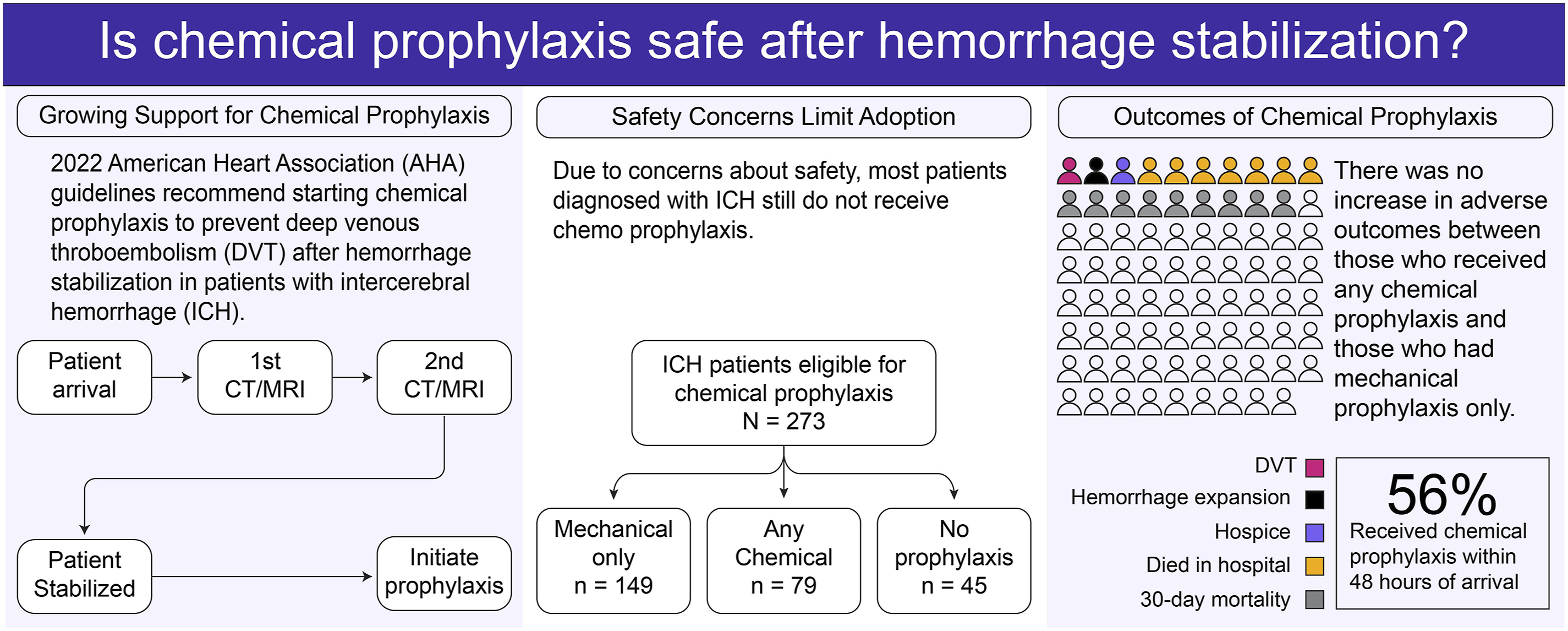
Patients with spontaneous non-traumatic intracerebral hemorrhage (ICH) have a heightened risk for venous thrombosis (VTE). The Stroke 2022 Guidelines suggest initiating pharmacologic prophylaxis after hemorrhage stabilization, as measured on repeat imaging within the first 24 hours of admission. However, pharmacologic prophylaxis is underutilized and there remain concerns that initiation of pharmacologic prophylaxis could increase hemorrhage size. This study examines the safety of initiating pharmacologic prophylaxis after hemorrhage stabilization.
Methods
This was a retrospective study of patients discharged with nontraumatic spontaneous ICH. The study population was from Providence Medical Centers in Washington, Oregon, and California. Patients, 18 years or older, presenting to a hospital between January 2018 and December 2021 with a primary diagnosis at discharge of ICH were included.
Results
Among the 228 included, 65.4% (n = 149) received mechanical prophylaxis only and 34.6% (n = 79) received any pharmacologic prophylaxis (with or without mechanical prophylaxis). Of those patients who received any pharmacologic prophylaxis, 55.7% (44) were administered pharmacologic prophylaxis within 48 hours of stabilization. There were no significant differences in age, sex, medical history, hemorrhage type, severity, or mortality in-hospital or at 30 days.
Conclusion
There were no significant differences in VTE events and hemorrhage expansion for spontaneous ICH patients who had pharmacologic with or without mechanical prophylaxis or mechanical only, consistent with previous literature. For patients who received pharmacologic prophylaxis after stabilization, none had hemorrhage expansion; our data support the 2022 guidelines that it is safe to administer pharmacologic prophylaxis after hemorrhage stabilization.
Get full access to this article
View all access options for this article.
References
Supplementary Material
Please find the following supplemental material available below.
For Open Access articles published under a Creative Commons License, all supplemental material carries the same license as the article it is associated with.
For non-Open Access articles published, all supplemental material carries a non-exclusive license, and permission requests for re-use of supplemental material or any part of supplemental material shall be sent directly to the copyright owner as specified in the copyright notice associated with the article.
