



Abstract
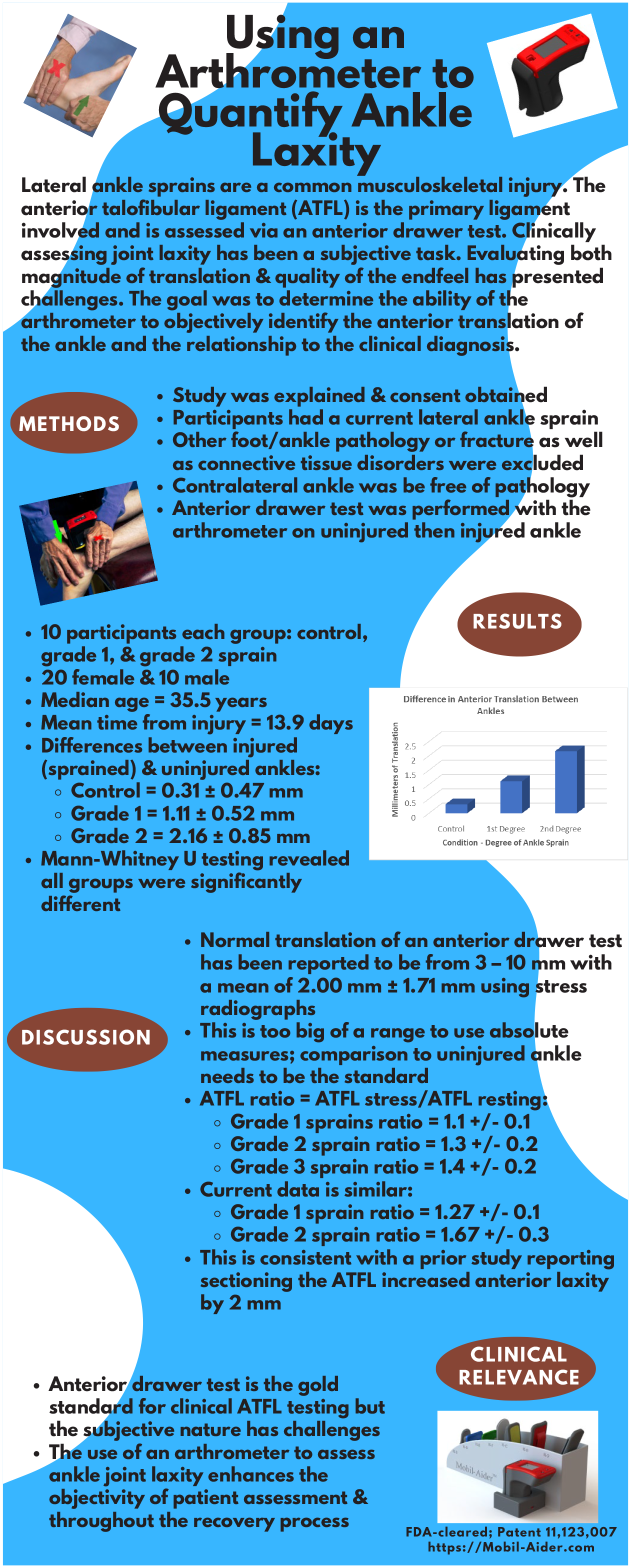
Lateral ankle sprains are a common musculoskeletal injury. The anterior talofibular ligament (ATFL) is the primary ligament involved and is assessed via an anterior drawer test. Clinically assessing joint laxity has been a subjective task. Evaluating both magnitude of translation and quality of the endfeel has presented challenges. Until recently, a reliable and valid arthrometer to test joints other than the knee has not been available. The Mobil-Aider arthrometer has undergone bench testing for validity, reliability testing in healthy persons, and most recently the testing of participants for pathology. A summary of these studies is available in the Online Supplement. The goal of this study was to determine the ability of the arthrometer to objectively identify the anterior translation of the ankle and the relationship to the clinical diagnosis. The participant was evaluated by a physician and magnitude of ankle sprain was determined. An arthrometer was used to perform an anterior drawer test (uninjured before injured, 3 measures each) in the prone position. Both clinicians were blinded to the data of the other. There were 30 participants, 10 per group (uninjured, 1° sprain, 2° sprain). Mann-Whitney U testing found significant differences between the control and grade 1 ankle sprain groups (P < .001), the control and grade 2 ankle sprain groups (P < .001), and the grade 1 and grade 2 ankle sprain groups (P = .004). There was ± 0.31 mm difference in anterior translation between healthy ankles, whereas there was 1.11 mm and 2.16 mm difference between ankles in grade 1 and grade 2 sprains, respectively. The anterior drawer test is the gold standard for clinical ATFL testing, but the subjective nature of this test poses challenges. Technology is available to assess ankle joint laxity and enhance the objectivity of patient assessment and throughout the recovery process. An arthrometer is a valuable tool in quantifying orthopaedic examination.
Supplemental Material
sj-docx-1-sph-10.1177_19417381221147511 – Supplemental material for Using an Arthrometer to Quantify Ankle Laxity: An Infographic Summary
Supplemental material, sj-docx-1-sph-10.1177_19417381221147511 for Using an Arthrometer to Quantify Ankle Laxity: An Infographic Summary by Dawn T. Gulick in Sports Health: A Multidisciplinary Approach
Footnotes
The following author declared potential conflicts of interest: D.T.G. received funding from the National Science Foundation (SBIR Phase II), and has a planned, issued or pending patent (US Patent 11-123-007).
References
Supplementary Material
Please find the following supplemental material available below.
For Open Access articles published under a Creative Commons License, all supplemental material carries the same license as the article it is associated with.
For non-Open Access articles published, all supplemental material carries a non-exclusive license, and permission requests for re-use of supplemental material or any part of supplemental material shall be sent directly to the copyright owner as specified in the copyright notice associated with the article.
