



Abstract
This paper explores amaha’s experience as a co-organizer of a community-driven process from which the Gem City Market—a community/worker-owned cooperative grocery store in Dayton, Ohio—emerged. Using a simple action research (AR) explanatory model co-developed by Alfredo, we show how by getting people involved in addressing issues that affect their everyday lives, participatory methods can help increase community ownership, hope, and power. This is a story of a community beginning to realize its power through participatory knowing and action and also a reminder that the outcome is just another starting point to leverage for continued community mobilization and change. Our purposes in doing so are to honor the community-driven process behind the Gem City story, and, now that people believe change is possible, to learn from that process so that we may continue to develop local agriculture, increase housing accessibility, and build a local just economy shaped by the community and resilient to the ups and downs of the broader economy.
Introduction
Just as multiple rivers feed into the Miami River that flows through Dayton, this is a story of multiple tributaries—actors, organizations, and processes—that came together to form a river of transformation that birthed change in our community. The cartoon in Figure 1 outlines the basic context of the process of development of what would become the Gem City Market—a community/worker-owned cooperative grocery store in Dayton, Ohio. Introductory story of the Gem City Market, developed by amaha sellassie and cartooned by Steve Kroeger
We now unpack parts of this story in more detail, beginning with an explanation as to why the organizing process began in response to the effects of structural racism due to redlining. This is important because our action research process was deeply tied to organizing, protest, and developing community power, all of which are connected not only to local action but to changing systems and structures. We then present the organizing process in more detail, followed by an interpretation using action research principles, and a final discussion that includes a broadening of the action research principles we began with.
Context
No Groceries for Half the City
Until the year 2021, the hyper-segregated city of Dayton, Ohio, had 40,000 Black residents living on the west side without a full-service grocery store. Access to quality groceries at an affordable price would be a minimum requirement for basic quality of life in any neighborhood. Without access to high quality groceries, residents are relegated to poor quality food choices, resulting in myriad health problems and an inability to enact healthy cultural food practices (Broad, 2016; Landrine & Corral, 2009; Sampson, 2013). This lack of attention to life enabling services in the Black “half” of the city was not accidental, but a consequence of Jim Crow “redlining” practices that occurred decades earlier.
Redlining is “a discriminatory practice by which banks and insurance companies, among other industries, refuse or limit loans, mortgages, and insurance coverage within specific geographic areas with high populations of people of color” (The Color of Law, 2019). Redlining began in the late 1930s, when the Home Owners’ Loan Corporation (HOLC), a US federal agency at the time, created “Residential Security” maps of 200 cities and towns across the United States (Jackson, 2021) that “document how loan officers, appraisers, and real estate professionals evaluated mortgage lending risk during the era immediately before the surge of suburbanization in the 1950s” (Mitchell & Franco, 2018). Maps were color coded into 4 main categories or “grades”, (1) green, 2) blue, 3) yellow, and 4) red) with grade 4 referring to areas that were hazardous for investment—“a sign that these neighborhoods were not worthy of inclusion in homeownership and lending programs” (Jackson, 2021). It was not a coincidence that most of the grade 4 redlined areas were neighborhoods where Black and other minority residents lived (Jackson, 2021; Mata, 2025). Rather, this was a result of an intentional process to construct “human” as Whiteness, and therefore natural, and Blackness as inferior and therefore not worthy of the same access to resources as the dominant community: “The government’s racist theory—based on popular pseudoscience of the era—was that the presence of any population of Black residents was a sign of impending property value decline” (Jackson, 2021).
As we can see in Figure 2, large swaths of West Dayton were redlined. Redlining effectively prevented Black and Brown home buyers from qualifying for secure mortgages from many mainstream banks (Jackson, 2021) and, more broadly, denied all residents “access to capital investment which could improve the housing and economic opportunity of residents” (Mitchell & Franco, 2018). Like in other areas of the United States, redlining in Dayton was a practice of structural violence that utilized race as the basis for community development and access to resources. Historical redlining map of Dayton, Ohio, from 1937 (The Ohio State University Libraries, n.d.)
Yesterday’s Redlining Affects Today’s Opportunities
In 2015, the Dayton & Montgomery County Public Health Epidemiology department presented an opportunity map of the city of Dayton in 2015 (see Figure 3). According to the Kirwan Institute, pioneers in opportunity mapping, “Opportunity is measured as conditions favorable for a goal…and is also a good position, chance, or prospect for advancement or success” (Ebron, 2015, p. 2). Per Ebron, high opportunity communities tend to have “opportunity structures” that include quality schools, low crime rates, accessible health care, employment, transportation, affordable housing, and an environment that promotes civic engagement and healthy lifestyles, with such advantages as access to parks and fresh, healthy foods (Ebron, 2015). These track closely with the social determinants of health, as “[t]he health of an individual is impacted by where they are born, live, learn, work, play, and age and the quality of life outcomes and risks that may be associated with these environments” (Ebron, 2015, p. 3). Access to affordable high-quality groceries is a bare minimum requirement for structural opportunity in a neighborhood. Montgomery County Public Health opportunity map for Dayton
Through opportunity mapping, we can see how “complex and interconnected opportunity structures … have a significant role in shaping an individual’s quality of life” [and] “can have a profound impact on an individual’s chances to succeed” (Ebron, 2015, p. 2). Yet when we look at the Dayton opportunity map in Figure 3, we can see that the darker blue zones that indicate concentrated areas of higher opportunity today are in many cases a translation of the green areas of abundant investment which characterize the redlining maps of old. Similarly, we see a connection between the areas that were marked red or hazardous to invest in, with the areas that were marked white or low opportunity in the opportunity maps in 2015. For comparison purposes, we now present the two maps side by side in Figure 4. The areas of lowest opportunity in 2015 were nearly identical to the neighborhood redlining maps from the 1930s, which helped us to understand the historical forces at play that culminated in the underdevelopment of West Dayton, including the lack of access to high quality groceries. Comparison of the two maps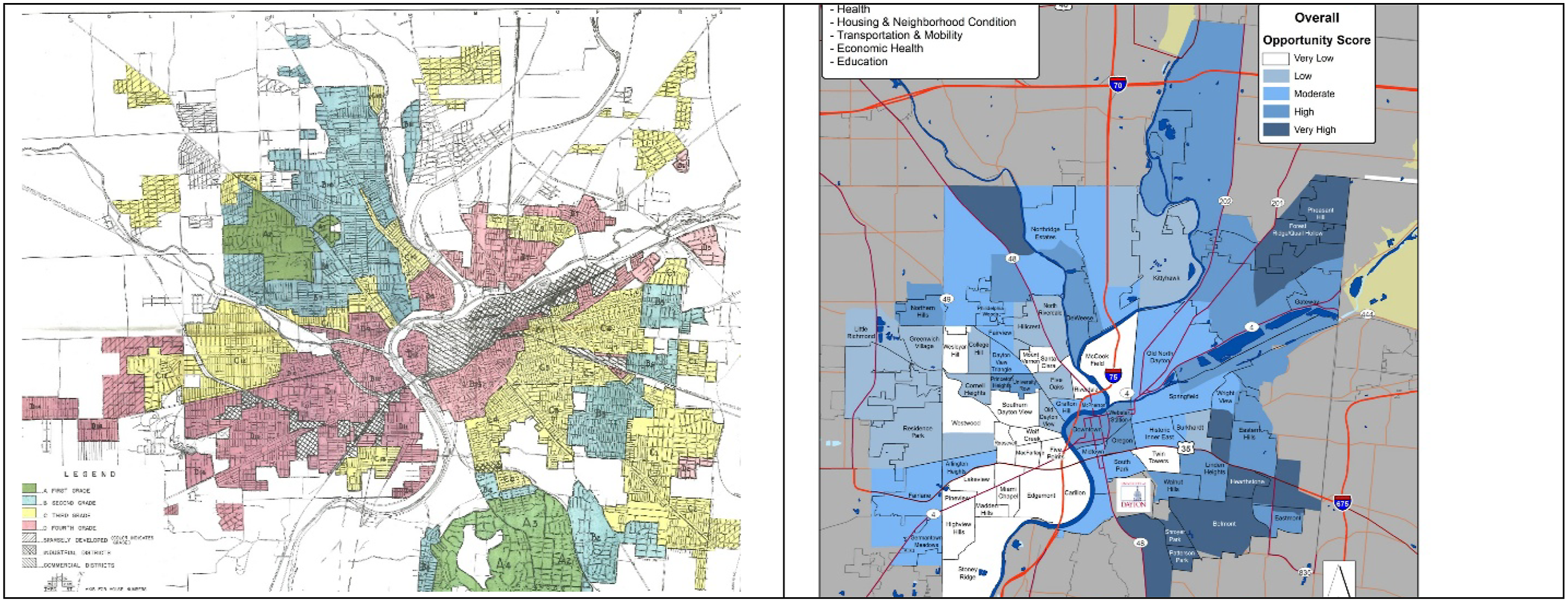
Creating Our Own Solution—a Community Owned Grocery Store
Underinvestment in West Dayton did not result in a food desert, as some like to call it. The term food desert evokes the emergence of a natural occurrence, like a desert (Brones, 2018). According to Karen Washington (in Brones, 2018), the historical negligence of West Dayton was instead an intentional act of food apartheid that in many ways continues to this day. Food apartheid is “a system of segregation that divides those with access to an abundance of nutritious food and those who have been denied that access due to systemic injustice” (Food Apartheid, n.d.).
Yet in the midst of an overabundance of food deleterious for human health, and lack of access to fresh fruits and vegetables created by practices of food apartheid, community members came together in participatory processes to create a full-service cooperative grocery store to serve our own community in Northwest Dayton. Not a corner store, not a vegetable stand, but a full-service grocery store that not only provides high quality food options at fair prices but also instills hope in our community because we can see what we were capable of through participatory action research processes. By engaging in and activating community power, we created a magnificent grocery store in the hyper-segregated community of Northwest Dayton.
Gem City Emerges Through Community-Driven Participatory Organizing
Shot in 2.3 Seconds
The horrendous murder of John Crawford III—an unarmed Black man who was shot in 2.3 seconds at a Walmart in the region (John Crawford III, 2020)—is a key part of the Gem City Market story. The organizing we did as a community in the pursuit of justice for John Crawford III helped form the initial list of people we invited to walk with us toward emerging what became the Gem City grocery store. I (amaha) am one of a small number of principle organizers of the market. One of the insights that we as organizers of the protest started to realize is that we were doing a lot of actions and acts of non-violent resistance, but we were not doing anything else toward supporting community development or directly addressing our material conditions. We began to recognize that what is necessary to build sustained power is a dance, where we as organizers create a pathway for those involved in the protests to also have opportunities to do work in the community. This serves as a means of building deeper relationships, which in turn can be activated for the next action. Instead of just fighting for justice for John—for example, acting as a thermometer—we asked ourselves how we could instead be the thermostat (Luther King Jr., 1963), to transform the conditions inside the community. The actions we took during the John Crawford protests clarified and solidified for us that our community was ready for deep mobilization.
Why Not a Grocery Store?
In June of 2015, a community meeting entitled “Opportunity? From research to action” (see Figure 5) was called by the Miami Valley Organizing Collaborative (MVOC) in partnership with Montgomery Public Health, the Ohio Students Association, and West Dayton Caravan of Churches, to discuss the recently published opportunity maps (see Figure 3). The opportunity maps were not shocking to us, as we already knew what we were experiencing in the community every day. But we now had data from an official source that validated our lived experience. Toward the end of the meeting, we broke into areas of priority that participants had identified as important to explore possibilities for action. One group that was focused on food access asked, “what if we opened up a grocery store?” So, with the audacity and naiveté that comes from having zero grocery store opening experience (but plenty of experience eating food!), we joined an emerging dialogue on building a grocery store. Over time, this group stabilized into a steering committee of about 20. From research to action convening flier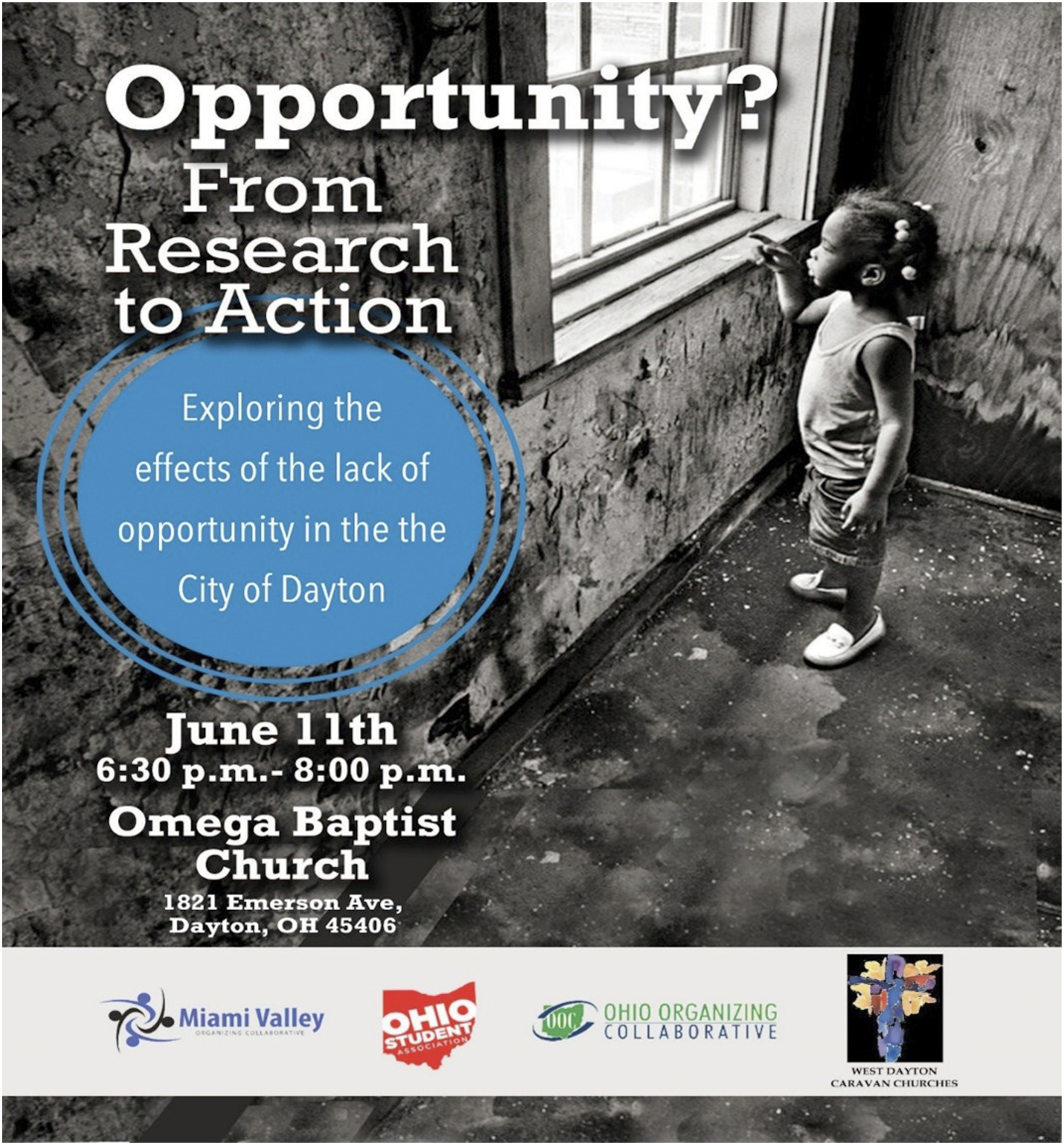
Deep Listening Campaign—Talk Through the Process
One of our tenets was building power with the community instead of doing something for the community. For this paper, I am using Alicia Garza’s (2021) description of power, “the ability to shape the environment around us.” It is in the knowing that we have power that creates the space for hope to emerge, because hope relates to our ability to transform our lived environment (Ginwright, 2016). The more hopeful we are that change is possible, the more we are willing to act and pursue change. Language then paves the way for us to use hope as a strategy for community transformation (Block, 2007).
One strategy to help us do this was a deep listening canvassing campaign in the community (see Figure 6). Deep listening—which offers deep human connection as an antidote to hatred—is about talking with strangers about hopes, fears, and aspirations in order to build connections and trust, and change hearts and minds about deep societal challenges through conversation (paraphrased from Deep Canvass Institute – People’s Action | New Conversation Initiative, nd). In our case, we wanted to hear from the residents, not just about their experience living under food apartheid or their aspirations for the Gem City Market but also about anything else they felt was important to share. Image from deep listening booklet
To create this type of space, we understood that we could not go door to door like normal political door knocking campaigns where there is a set goal of 20–30 doors an hour. Instead of being transactional, we wanted to be relational. If you were able to stay at 1 or 2 doors for an hour, Images from deep listening booklet Gem City community groundbreaking ceremony

“Everybody Gets a Shovel”
One of my proudest moments, and my favorite picture from the process, is our community groundbreaking ceremony (see Figure 8). Normally, groundbreakings consist of the Mayor and some elected officials standing with a shovel in their hands to take a picture. But we knew that we would not have even gotten to a groundbreaking if it were not for the hundreds of people who had worked together to get us to this point. So, we decided that this would be a community groundbreaking in that everyone young and old that showed up that day would get a real or plastic shovel to signify their work and participation. We were like Oprah Winfrey—“a shovel for you, a shovel for you, everybody gets a shovel!!” For me, this is a great example of community power. In the moment, it helped solidify this sense of community ownership, that we worked together to get us to this point. We wanted to acknowledge the vast number of gifts different community members offered to enable us to get to the point of groundbreaking. Without them, we would not have achieved this milestone. This moment showed that change is possible and that we have the power to shape our lived environment (literally, with shovels!). So, this picture captures a glimpse for me as to what is possible.
Understanding Our Story From an Action Research Perspective
In 2022, I was asked in a workshop to share the Gem City Market story from an action research perspective. The facilitator (Alfredo) asked me to present my story and make clear how three things occurred: participation, learning, and action. In other words, how was the Gem City AR process one in which
I now briefly interpret my version of the Gem Markey story, using this framework.
Acting to Learn
Action research involves listening and more listening to surface what the community really wants and needs. I have already shared how we used a deep listening campaign earlier in the process, which generated deep knowledge that eventually informed the creation of Gem City Market. This is a simple example of taking action for purposes of learning. We went directly to where the people were (the knowledge holders) to find out what was meaningful to them, and in the process, we created a base of evidence that informed future actions. Later in the process, Erica Bruton, one of the lead organizers of the MVOC at the time, helped facilitate a broad-based steering committee meeting to explore more deeply the possibility of pursuing a grocery store. At that moment, we had yet to receive a mandate from the community that they truly wanted a grocery market. As a steering committee, we needed to know if this was something the community was willing to work toward. So, we took action by co-creating a survey with the help of Dr. Richard Stock, director of the local University of Dayton, Business Research Group. Once the survey instrument was created, we all worked to get as much input from the community as possible. And when I say community, I mean we went to where the people were. We rode the bus, went to gas stations, laundromats, barber shops, beauty salons, etc. In a month and half or so, we had about 1500 surveys back that resoundingly said that they wanted the market and, crucially, that they would shop there.
It is important to note here that the myriad creative ways we got the survey out were not simply a means to an end. In addition to gathering “the data,” we were showing persistence, developing relationships, showing up, and showing people we cared about their voice. When combined with their survey responses, we knew we could take this as a mandate and permission to fully commit to exploring what was necessary to emerge a market. I believe this community survey process marks the moment we understood who the knowledge creators were. We centered the experience and voice of the community to shape and guide our actions.
In AR, the way we work is more than a means to an end. We enacted the world we wanted to see as we engaged in multiple other actions that generated relationship knowledge, cultural knowledge, resistance knowledge, asset-based knowledge, protest knowledge, cooperative knowledge, shovel knowledge and, ultimately, grocery knowledge!
Learning to Act
Paulo Freire teaches us that “Praxis is not blind action, deprived of intention or of finality. It is action and reflection” (Paolo Freire cited in hooks, 1994). He goes on to explain that this process of action and reflection has historically had the power to transform the world and give it meaning (Freire, 1972). Without having a deep space for reflection, on the other hand, I am missing the gems that come by creating a space to ponder and observe the fruit of my actions, which can then inform what I do in the next link of the praxis circle. When I resist the urge to press on and instead acknowledge the value of reflection, I find that my next action is not only clearer but more impactful as I press toward the desired outcome. Therefore, the pause to reflect is fundamental to generating learning that can enable more informed action, but also deeper awareness “on who we are, how we relate, how we are perceived, and how we too are being transformed” (Apgar et al., 2019, p. 283).
Reflection in action research is also a process of a community learning about their shared experience. This is because, per Freire, the more a community becomes conscious of the dynamics of their situation, the more apt they are to change it: “A deep consciousness of their situation leads people to apprehend that situation as a historical reality susceptible for transformation” (Freire, 1972). During the process of opening the grocery store, the community grew in their shared knowledge of what life was like living under food apartheid without access to fresh fruits and vegetables. They spoke of the strategies people used to acquire food. Some had to take 2 buses and spend 3 hours in travel time to get groceries. Mama Nozipo Glenn, the Queen Mother of our community, “had to catch two, sometimes three buses just to go to the grocery store. And since I couldn’t carry everything at once, I had to go multiple times or pay someone to take me. But I’m on a fixed income. So sometimes, by the time I got home, my ice cream had melted” (sellassie & Perkins, 2025). The time commitment to acquire food was enormous. If they had a big family, they had to decide if they would bring others with them to help carry the groceries, or take multiple trips. Others spoke on the high cost of convenience stores, paying $1 for one banana. This dialogue helped shift the community to no longer accept the unacceptable. As Freire notes, “[learning to] read the word is not only preceded by reading the world, but also by a certain form of writing it or rewriting it…of transforming it by means of conscious practical action” (Freire, 1985, p. 18). Our community inquiry helped us establish relationships between our material conditions and the realities that shape it (Freire, 1985). The more we learned, the more we grew in our conscious ability to change the conditions we were living in.
In these examples, our actions were not artificially separated from research, even when we used more traditional research instruments. We “acted, to learn”, and because of the constant communication that occurred throughout the process, “learning, to act” and praxis emerged. By that I mean that the knowledge generated from action was often “fresh” and immediately taken up in our conversations. But we also made the knowledge usable by creating visuals, pamphlets, and other artifacts and using them in participatory workshops and meetings. We left a trail of breadcrumbs behind that provided evidence of our action journey. But the real proof was the knowledge-laden actions that continued, as more and more people signed up to volunteer in various committees to open a community-owned and worker-owned grocery store.
Participation of Those Who Know
Participation was identified early on as an underlying goal because we knew the community had the knowledge and gifts to practice self-determination toward our collective hope. We also realized early on that we were fighting a durable narrative of letdown that was unfortunately not unfounded, because our community had experienced a lot of broken promises and money that had not been used for its intended purpose. Because of the deep trauma our community experienced from sustained underdevelopment and lack of progress, the community was wary of committing to a large-scale collaboration. People worried we might just steal the money, or that we were just talking, etc. We had to overcome an early dynamic that was infused by this deep distrust, trauma, and disbelief. To change the story, we knew we had to expand our collective WE, or go from “me to we,” as Alfredo likes to say. Throughout the process, we centered community participation to cultivate a space that could transform recipients into co-creators.
For example, the community named the market in a back and forth “dance” with the organizers, where they brainstormed many options, including words like Fresh, Gem City (Dayton is known as the Gem City), and many others. The steering committee placed all the names on large sticky note paper on the wall of our local HBCU (Historically Black Colleges and Universities), Central State University. We organized the different words into different combinations of names. We then put this out to the community to see if we were hearing correctly what was given to us (“member checking”, in formal research language). This dance of back and forth was how we landed on the name Gem City Market.
Our mission statement is another example of how we centered community participation and ownership. Etana Jacobi organized over 200 people (acting, to learn) in a basement of Omega Baptist Church to co-create our mission statement. There were multiple rooms and facilitators that leveraged the collective intelligence of the community. We then harvested and synthesized (learning, to act) what was generated with the steering committee and brought it back to the community. This dance went a few rounds until we landed on the statement: “Our mission is to serve, engage, and empower our neighborhoods by providing affordable, high-quality food in a clean and welcoming environment that is worker and community owned.” (About Gem City Market | Gem City Market, nd)
Returning to the idea of learning to act, in reflecting on our praxis, it would have been good to have developed a subcommittee focused on praxis or to have had a way for a smaller group of community members to analyze the data from the dialogues on the mission statement as we were compiling it. This would have added another layer of participation to include residents in all aspects, as we were building a learning collective for collective ownership together, which could have continued once we were open. I now understand that participation of those who know can be a developmental process that we need to continually aspire to as a means of co-ownership.
Discussion
Witnessing a community realizing its power together is knowledge that no one could ever take from me. Experiencing change together has expanded our community’s perception of what is possible. The challenge we currently face is continuing to cultivate a space of co-creation now that the market is open—now that we are navigating the complexity of co-owning and operating a grocery store. Historically, out of necessity we had developed the muscles of ownership, co-ownership, and collective courage (Gordon Nembhard, 2024). Over time as the Black community experienced desegregation, our muscle for collective ownership and for creating a solidarity economy atrophied. So, participation is important not only for co-creation but also for re-establishing a deep sense of belonging and sustainment into the future. We opened the market with over 4000 members, yet it has taken about 3 years to figure out how to build a structure to co-create and co-govern a physical store once opened. We had an association of people, but this didn’t translate into the knowledge and praxis on how to co-own and co-operate in community governance. It is such a blessing by grace, to witness the growth of this community muscle currently!!
Walking with the community is a beautiful and simultaneously messy process, because participation and democracy are not linear but emerge as ideas bounce off each other and as our collective gifts interact with, affirm, and challenge each other. This is why community is so powerful. The deeper we have a sense of belonging and trust, coupled with the hope that change is possible, the more willing and able we are to place our full gifts in the center of the circle. It is this process of standing in duty in the circle that transforms us into authors of our shared future. It is amazing to me how much I have underestimated my power to participate in change simply because of my fear and internalized inadequacy of contributing my gifts for the benefit of others. This sense of imposter syndrome is by design. It seems like this lack of participation is a byproduct of centering our society on fear and independence rather than love and interdependence. A goal of any process like this should be to generate a sense of responsibility in everyone to shape the world they want to inhabit. We now unpack 3 ideas on how we might do this looking forward.
Reimagining Ourselves as Co-creators
Our participatory process was one of our first chances to embody the practice of walking with the community, instead of the traditional doing for the community (Freire, 1972). We understood that co-creation was our pathway. This process of activating our community and transforming recipients into co-creators was the very crux of this project because we knew, as June Jordan states, “we were the ones we been waiting for” (Jordan, 1980). We had no intention of doing something for the community, but rather we were going to walk together toward the emergence of the market. This distinction is significant for people in areas that have experienced underdevelopment, because the trauma of continuously being let down, overpromising, under delivering, etc. can often lead to a feeling that community residents don’t have much power over their circumstances (Ginwright, 2016). As a result, we often become the recipients of someone else’s imagination—as was the case with redlining—instead of working toward our collective hope. Scott Momaday shares that “we are what we imagine, our very existence consists in our imagination of ourselves” (Momaday, cited in Minkler & Wallerstein, 2008). And Paulo Freire states that “submerged in reality, the oppressed cannot perceive clearly the ‘order’ which serves the interests of the oppressors whose image they have internalized” (Freire, 1972, p. 62). Through the process of participation, we wanted simultaneously to increase the level of connectivity and the strength of the connections to build a social fabric strong enough to become the protagonists of our own story—shaping the patterns in our community and our human history. So, part of our theory of change involved transforming recipients to co-creators.
To do this, we pursued being rooted in love, while utilizing an asset-based community development (ABCD) approach (McKnight & Block, 2012) to acknowledge the abundance of gifts, assets, and the full humanity of those we were walking with. We also recognized that emerging power with the community is a slow process that involves deepening the levels of trust and connection in the community through participation. Two of our maxims were “movements move at the speed of trust” (Brown, 2017) and trust the people. It was by creating a space for the voice of the community to be heard, honored, and acted on that slowly raised a sleeping giant of latent community potential. The pace, which was slower than the community development norm of the time, was important to ensure we were emerging a base of people who also saw themselves as co-creators and protagonists of history with the community.
The Emergence of Social Wind
Earlier, I mentioned the opportunity maps we utilized to explain what was happening in our community. As a public sociologist, I saw that opportunity is embedded in structure and that conditions in our lived environment cultivate the levels of agency and access to opportunity that community members have. But that was before we started organizing for the Gem City Market. I now know that opportunity is also a practice of self-determination. What do I mean by this? Part of the practice of using hope as a strategy is realizing that we have the power to act (Freire, 1972, 1985). The more we act, the more we witness what is possible. This glimpse of what is possible compels others to act, resulting in the latent gifts and talents of our community being activated. As these activated gifts connect with one another, community power is released. The greater we as a community show up and connect our gifts and authentic selves, the more power we have to co-create our own opportunity—the Light of agency piercing the darkness of objectification.
This co-creation of opportunity is what I refer to as social wind, the ability to emerge momentum toward our collective aspiration. As we continuously surface our collective hope, a moral force emerges, a social wind to shape new patterns in our community. This moral force and social wind are significant for me because the more we as community realize that we don’t have to operate under the logics of social winds that blow from an imagination that is detrimental and foreign to us (as is the case with redlining), the more we can activate our power to rearrange and reimagine the patterns in our community that will reinforce our own north star. The power to be who we want to be and to decide how we want to treat and interact with each other is within our grasp when we generate social wind through a collective and participatory process that centers our own imagination of what is possible.
The more we realize our community power to self-determine our shared future, the more we realize our ability to co-create opportunity. That opportunity is not external to us as a community but internal, ultimately based on our willingness to cooperate and connect by our gifts. Cooperation is a moral force for human development (Curry et al., 2019; sellassie, 2023)! The goal is to get our collective gifts into the center of the circle and become so clear on our north star that the community is compelled to participate in its pursuit—willing to contribute their immense gifts, talents and resources to materialize the relationships and the world we want to inhabit.
A Praxis Blueprint for the Future Praxis to Embody
I believe that a major shortcoming in academia is that there seems to be a lot of emphasis on theory without embodiment through action. Theory is not always acted on in a way that transforms our common understanding. In Teaching to Transgress, bel hooks (1994) celebrates Freire’s idea “of verifying in praxis what we know in consciousness” (hooks, 1994, p. 47). She then shares a quote by Freire that explains how we as humans can’t and don’t overcome our concrete difficult situations solely by having good intentions or by deep awareness of these realities, but by reflection and action combined—in other words, praxis (hooks, 1994). She continues her quote of Freire: “But on the other hand, the praxis is not blind action, deprived of intention or of finality. It is action and reflection. Men and women are human beings because they are historically constituted as beings of praxis, and in the process they have become capable of transforming the world—of giving it meaning” (Freire, 1972, cited in hooks, 1994, pp. 47–48).
In my case, if I am not careful, I can think that I know something simply because I have the idea or the imagination, but knowledge is in the manifestation, in the fruit. I think this gets to the core of acting, to learn and learning, to act (Ortiz Aragón & Brydon-Miller, 2021; Stringer & Ortiz Aragón, 2021). It is through action that we gain a better understanding of what works and what doesn’t work (Adelman, 1993; Lewin, 1946). And it is in acting based on the pursuit of knowledge that enables us to know that we do have power to change things. Grace Lee Boggs explains praxis as the process of ideas becoming material force to change the world (Boggs, 1972). As we shift to acceptance of our ability and responsibility to be protagonists in our own history, acting based upon our knowing has the power to transform the world around us.
Conclusion: a Version of Events to Inspire New Dialogue and Meaning Making
In Figure 9, we share a model of key ideas we have presented in this paper that reveals how participation of the community (participation of those who know) in acting, to learn, and learning, to act, is a central yet partial part of the story. We can see that Gem City also emerged by (a) stubbornly centering and celebrating community knowledge, participation, and ownership, (b) creating and utilizing structures for dialogue and co-creative action, while (c) actively paying attention to and developing other conditions for sustained action. These processes of “acting, to learn”, and “learning, to act” praxis helped (d) create a community-driven evidence base, which was (e) made useable by creating knowledge forms that could “travel” (i.e., be shared and used) easily. We also (f) generated new concepts and language that allowed us to reframe the need and generate collective movement that led to the emergence of the Gem City Market. Emerging participatory action research model from the Gem City experience
While we are proud of what we have accomplished, (g) we are just getting started and are trying to figure out how we sustain our collective wind as we continue to become our own protagonists in creating a more just and equitable economy for our deserving community. A community-driven process does not, on its own, transform the structural injustices caused by redlining. But now that people believe change is possible, we are exploring what else we can do to develop local agriculture, increase housing accessibility, and build a local just economy shaped by the community and resilient to the ups and downs of the broader economy. To do so, we need to reflect and learn from our experience so that we might understand our evolution into a more engaged and participatory community.
Moving forward, sustained community transformation will require centering our underlying assumptions and developing our own dominant narrative (Sandoval, 2000). What root assumptions are we standing on that shape how we see the world and how that governs our interactions? We are what Dr King calls a single interdependent garment of destiny “caught in an inescapable network of mutuality…[—where], …whatever affects one directly, affects all indirectly” (Luther King Jr., 1963). Fundamental to shifting the paradigm toward co-creating our shared future is the ontology of understanding the mutuality of our existence. We need to reduce our culture lag by acknowledging socially what science has already proven—that the structure of our universe is interconnected. In other words, when we know that the architecture we exist in is interdependent by nature, we can understand that our future is tied together. This is the inner logic of grounding love as the cornerstone structure of our relationships, institutions, and systems. As Joseph Drexler-Dreis alludes to, this is the process of de-ontologization, a re-understanding of the very nature of reality (Drexler-Dreis, 2019). From such understanding, a fragrance and distinction can emerge that compels us to root ourselves in love and value deeper cooperation so that the latent gifts in our community are activated toward emerging our intentionally shared future. The key seems to be knowing that change is possible, that love is possible, through reflective and collective action.
Making the road as we walked it (Horton & Freire, 1990), we found that by combining community organizing principles with action research methodology, we were able to build power with the community, as residents were transformed from recipients to co-creators. As Freire and Horton teach us, the more we are grounded in our present reality, the greater equipped we are to act (Horton & Freire, 1990). Through action, we walk into the future, shifting the dialogue from aspiration for something better to acceptance that we can shape our own reality as we begin to act on our shared knowledge. This quote sums up my learnings from this process of walking with the community to open a grocery store: To be a good [participatory researcher] means above all to have faith in people; to believe in the possibility that they can create and change things. (Freire, 1972, p. 61)
BELOVED COMMUNITY IS POSSIBLE!!
A new organization—Coop Dayton (https://www.coopdayton.org/), a social enterprise incubator and community power building hub—was birthed out of this process, which helped incubate the Gem City Market. Coop Dayton provides ongoing technical assistance along with developing a local cooperative ecosystem. Milli Smith and Central State University West campus selflessly and consistently provided us with space for our monthly meetings, member meetings, network weaving, and anything else we needed. I am not sure what would have happened without this great support. It was the wisdom of Coop Cinci, practitioners of the Mondragón model, who provided our early technical assistance, bylaw support, etc. This was a living example of the 6th principle of cooperatives—cooperation among cooperatives (Cooperative identity, values & principles | ICA, 2026). They helped us believe building a grocery store was possible!
The Hall Hunger Initiative, the brainchild of Ambassador Tony Hall, a longtime hunger advocate, rose to the occasion when Dayton was named 2nd in the nation for food insecurity for youth. They have had a presence on the board ever since! Etana Jacobi, a mastermind in organizing, contributed in multiple ways and helped connect the dots. The Food Coop Initiative, which gave us a scholarship to attend the national “Up and Coming” conference, enabled us to connect with Black and Brown cooperators around the nation, along with the food coop movement. Their technical support has been critical for us. I also want to shout out Renaissance Coop Grocery Store, Ed Whitfield, Sohnie Black, and Dr Jessica Gordan-Nembhard, author of Collective Courage, who stand as an inspiration/guiding force behind the Black coop movement along with the emergence of the 4th wave of the Freedom Movement-Black Joy Rising!
Footnotes

Funding
The authors received no financial support for the research, authorship, and/or publication of this article.
Declaration of Conflicting Interests
The authors declared no potential conflicts of interest with respect to the research, authorship, and/or publication of this article.