




Abstract
As a concept Community of Practice (CoP) is generally understood as a learning system in which a group of people within a profession, or practice field, reflect and learn together. Notions of situated learning and enculturation emphasise the socially constructed nature of these contextualized reflexive pedagogical processes. Engaging with the posthuman turn in education and the social sciences, we think with concepts from Karen Barad’s agential realism framework to reconfigure CoP as entangled affective, socio-material knowledge-making practices. Specifically, through creative-relational inquiry, this paper offers an account of three intra-active mo(ve)ments from a posthumanist reading group CoP in Aotearoa New Zealand in which we, as academics in counselling, social work, and early childhood education, experimented with arts-based inquiry and posthuman texts. We discuss the more expansive knowing made possible through our engagement with/in these differentiated, in/determinate mo(ve)ments as professional practice educators and researchers. This paper contributes to onto-ethical-relational research and teaching practices, enabling CoP to be re-configured from socially constructed reflexive processes to affirmative, affective, socio-material practices for making differences in the world.
Keywords
Introduction
Community of Practice (CoP) is a current popular mode of knowledge-making and identity shaping in academia, enabling new academics to develop expertise and groups of academics to engage in reflexive practice and share new teaching approaches and research interests. The social constructionist underpinning of CoP emphasise the social aspects of learning and knowledge-making (Farnsworth et al., 2016). Such framings do not encourage consideration of how bodies, materialities, and objects influence higher education research and teaching practices (Gravett et al., 2021).
In this article we engage with the scholarship of Karen Barad (2007) and others to attend to these embodied-material-social relations, to objects and other matter, in order to explore how we might re-conceptualize CoP as socio-material sites of meaning making and identity shaping. Additionally, this requires taking responsibility for what we do as professional practice researcher/educators—“it has to do with a scholarly engagement with care, social justice and seeing oneself as part of the world” (Bozalek & Zembylas, 2018, p. 52). This article discusses the three authors’ engagement in a collaborative CoP process of reading, art making (drawing, crafting, writing), talking, emailing, writing, and “zooming” with scholarly work that draws on posthumanist, feminist materialist, and affect theories. In this endeavour, we join with other academics who have sought to bring Barad’s theoretical concepts into play as socially just practices in higher education (Bozalek, 2022; Braidotti et al., 2018; Gravett et al., 2021; Renold et al., 2021). Shefer (2018) argues investigating the excluded bodily, affective and materiality of everyday practices in academia offers ways to disrupt the privileged “‘pursuit’ of neutral, scientific knowledge” (p. 173). Barad’s framework offers affirmative tools “to creatively repattern” knowledge creation practices (Barad in Juelskjær & Schwennesen, 2012, p. 16).
We, first, provide an outline of the literature which locates reading groups as CoP in academia. Next, we introduce our posthumanist reading CoP before elaborating on Barad’s work and their concepts of intra-action and response-ability which we deploy to reframe CoP as an affective, socio-material knowledge-making practice. We then outline the creative-relational inquiry process through which we re-turn (to) the reading group encounters in order to produce three written intra-active mo(ve)ments depicting particular creative engagements with texts and art-making. We conclude with the implications of our inquiry for reconfiguring CoP as socio-material knowledge-making and identity-shaping practices for making differences in the world of education and practice.
The Academic Reading Group as CoP
CoP has been predominantly theorised through a social learning theory frame (Wenger-Trayner, 2013), where knowing, learning, and becoming are a “socially constituted experience of meaning making” located “in the relation between the person and the social world as they constitute each other” (Farnsworth et al., 2016, p. 142). Essentially, CoP is a group of people “who share a concern or a passion for something they do and learn how to do it better as they interact regularly” (Wenger, 2011, p. 1). Etienne and Beverley Wenger–Trayner developed CoP and identify three main characteristics. First, CoP involves a domain which is a common interest or form of competence that a community shares and that distinguishes its members from other people (Wenger, 2011). Second, CoP is characterized by the relationships through which members pursue their interests and learn from each other through engaging in joint activities and discussions, helping each other, and sharing information (Wenger, 2011). Third, members are practitioners, who interact together to develop a shared repertoire of resources: experiences, stories, routines, sensibilities, artefacts, tools, vocabulary, styles, ways of addressing recurring problems (Wenger, 2011). Practice emerges from the social interactions between the members which “takes time and sustained interaction” although it may be more or less “self-conscious” (Wenger, 2011, p. 2).
In higher education, CoP reading groups have emerged most commonly as ontological processes of identity making, particularly for novice educators and researchers across disciplines such as teacher education, science, mathematics, library studies, and engineering (Cooper et al., 2022; Fitzgerald et al., 2016). Reading groups can establish a culture of inquiry enabling educators, through in-depth conversations, to reflect on and challenge their own understandings and consider other academics’ knowledge and practices (Cooper et al., 2022). Wenger (1998) emphasises being in a CoP is not just a series of events where people engage in reading and talking but “a more encompassing process of being active participants in the practices of social communities and constructing identities in relation to these communities” (p. 4). Academic reading groups include members with varying levels of professional experience and place emphasis on collectively learning about a specific form of practice (Da Rosa dos Santos et al., 2015; Rottmann et al., 2018). Collaborative discussions enable members to critically examine ideas and thoughts in an open environment that also focusses on how to transfer the knowledge created by the group into teaching (Da Rosa dos Santos et al., 2015). Barad (2007) proposes these ways of being are ethical—“it is about being response-able to the way we make the world, and to consider the effects our knowledge-making processes have on the world” (p. 381).
There is limited research of CoP which involves collaborative reading and art-making, although there are indications that such embodied-material practices can produce different forms of knowledge and identity making (Luetkemeyer et al., 2021). These facets of the CoP get overlooked with predominant emphasis on making new meanings, gaining expertise, and developing professional identities (Wenger, 2011). Human-centered perspectives do not adequately “consider how educationally engaged human relationships are entangled with the spaces, places, times, contexts and environments within which they occur, and do not take account of how objects, bodies and materialities impact upon learning, teaching and connection” (Gravett et al., 2021, p. 1). For Barad, there is no ontological separation of the human subject from the world around them; agency, and identity, is an entangled and mutually constituted force that emerges in relation with subjects, objects, and processes (Barad, 2007). In the next section we elaborate on Barad’s work and their concepts of intra-action and response-ability which we deploy to reframe CoP as affective, socio-material meaning-making processes.
The Posthumanist CoP—Reading Group Encounters
Our posthuman reading CoP has taken shape and re-shaped itself over a number of years, having existed in various forms since 2017. Group members have come and gone, leaving echoes of encounters. New members (PhD students, educators, and academics) joined the group in 2020, and over the next year we met more-or-less monthly through a combination of Zoom and face-to-face encounters, a group of around 6 to 8 members. Sometimes we were all restricted to our homes due to Covid lockdowns, and some of us were far from Christchurch (Dunedin, Nelson, and Hong Kong). We gathered literature and we gathered together; sometimes we ate and drank together. Sometimes each of us brought something we had been reading to share with the group; occasionally we discussed something that we all had read; sometimes we shared our writing. We emailed each other and replied all. We read, thought, wrote, talked, and listened. Without haste, over months, we played with ideas, and gradually and eventually entangled ourselves with materials and/as data, always engaged with/in intra-active moments of thinking-making-doing-feeling-writing.
In January 2021, Shil, one of the group members, offered a suggestion to the group: “bring whatever you have been playing/crafting/experimenting in relation to your project (does not need to be finished by then, but at least done enough to show people what you are trying to do, and how you connect/manifest/express theories and ideas you are working with).” Our reading group took up the challenge and our April 2021 encounter included two of the presentations (Raewyn and Alison) explored in this article, painting textual data and wet wool felting with data. A subsequent group encounter was dedicated to remembering scholar Lauren Berlant, following her untimely death in June, 2021, through writing and sharing of “hundreds” (Berlant & Stewart, 2019), one of which is explored in this paper (Shanee). In what follows, we introduce the concepts we think with before we re-turn to these particular group encounters to re-examine what they offered us as researcher-educators, and for thinking and doing CoP differently.
Thinking With Posthuman Concepts
Despite the proliferation of applications of the theory and practice of CoP, across and beyond education, the theory itself has received little attention, critique, or development (Farnsworth et al., 2016), since its original evolution (Lave & Wenger, 1991). A significant body of knowledge reconfiguring education through a posthumanist lens has, however, emerged in the last two decades (Gravett et al., 2021). Such a reconfiguring works to recast ontologies and epistemologies of knowing, being, and becoming, as well as the ethics of such practices (Barad, 2007), beyond the dominant social and discursive accounts emergent through the 1980s and 1990s. Our intention is to bring together the established theory-practice of CoP with posthuman concepts (Barad, 2007) in relation with a creative-relational inquiry into a posthuman CoP reading group, in order to see what more CoP might do and become.
Taking up the posthuman work of Barad (2007) entails a reinstalling of the materiality of the world as of equal significance as the socio-cultural, with a recognition not that the material hasn’t been present but that it hasn’t been accorded its due (Jackson & Mazzei, 2012). This is an onto-epistemological shift to the inseparability of nature-culture and the material-social/discursive, as equal forces in iterative, dynamic and entangled ways of knowing-in-being, where knowing emerges as part of our participation in the ongoingness of the world. Attention to the role of human and non-human forces, the material and social, natural and cultural factors, invites a rethinking of notions of knowing, identity, causality, agency, and ethics, all central to Wenger-Trayner’s (2013) social theory underpinning CoP.
For Wenger-Trayner, “knowing is an act of participation in complex ‘social learning systems’” (Wenger, 2000, p. 226); it takes place in the relation, the interplay, between the person and the social world, as they constitute each other in dynamic, and transformative ways. It is in this interplay that ongoing and everchanging identity formation occurs. Similarly, Barad’s framework enacts a knowing-in-being ontology; however, it engages a shift from interplay/interaction to the concept of intra-action. Interacting components, such as human and non-human forces, individuals and the social and material world, suggest the interaction of independent, pre-existing, separate entities. Intra-action, on the other hand, delineates the ontological inseparability of these entities, the non-dualistic nature, with the emergence of their boundaries and identities only becoming determinate through the larger socio-material entanglement. The notion of intra-action provides the conditions for the possibility of objectivity, known by Barad (2007) as the making of agential cuts. An intra-action cuts “things” together and apart. These do not stand still, however, but are merely a part of the ongoing reconfiguring of the world.
Inherent in Barad’s framework, notions of space and time are also reconfigured. For Wenger-Trayner, while space/time is a key dimension, identity formation happens in space and across time. Barad’s engagement with quantum field theory necessarily reworks space and time as intra-active forces themselves, rather than continuous containers to experience (Barad, 2010, 2012). Engaging with the concept of intra-action enables us to map intra-active, entangled processes of identity-making through and with/in the reading group CoP. It enables us to attend to all kinds of matter, spaces, and times and the ways in which scenes, encounters, and identities are made to matter in dis/continuous, in/determinate and often dis/orienting ways (Barad, 2010).
Activating a posthuman relational ethics additionally offers significant potential for enlarging considerations of responsibility, accountability, and commitment to who and what comes to matter. For Barad, our ethical obligations are ontologically inseparable from our intra-active participation in the world’s becoming. They state, “there is only the ongoing practice of being open and alive to each meeting, each intra-action, so that we might use our ability to respond, our responsibility, to help awaken, to breathe life into ever new possibilities for living justly” (2007, p. x). It is this way of being responsive in and to the ordinary and everyday stories of living, in and to the intra-active, collective making of new worlds, which breathes life into the possibilities of living more justly. It is through such practices that an ethical responsibility exists “to contest and rework what matters and what is excluded from mattering” (2007, p. 178). A posthuman ethics in this sense is located not in humanism’s self-contained, moralising individual, nor in the inter-play only of the personal and the social. Rather, an ontologically relational, posthuman ethics embodies a logic of entanglement where knowing and acting are always already an “enactment-in-relations amongst all bodies,” human, non-human, and more-than-human (Taylor, 2018, p. 91). Thus, we suggest CoP be reconfigured as an onto-ethical practice, as an enactment of response-ability, for reworking what matters and what is excluded from mattering, with/in and beyond its boundaries.
Finally, we offer an additional reorienting of the CoP, through thinking with affect. While affect itself can be thought of as socio-material, as emergent at the entangled intersections of the body, other matter, and social life (Barraclough, 2021), we highlight affect as also missing, along with the material, from Wenger-Trayner’s CoP. We draw on a relational ontology, conceptualizing affect as co-emergent with human and non-human others. “Affect is a feeling, an upwelling, contextual and embodied. It is bodily, but it can hide. It is a reverberation, a resonance, a wavering voice, a posture, a gesture,… expressing values, ethics, unconscious biases” (Duggan & Zarranz, 2022, p. 2). We seek to trace the flows of affect, as an entangled, dynamic relationality (Barraclough, 2021), in emergent mo(ve)ments with/in our posthuman reading CoP, in order to see what more we might come to know, as educators and researchers, and about the possibilities for enlarging the concept/practice of CoP.
Creative-Relational Inquiry
Aligning with the theoretical frameworks we are using in this paper, we additionally draw on Wyatt’s (2019, 2022) concept-method of creative-relational inquiry to guide our inquiry into what more CoP might be/do. Informed by, among others, Deleuze and Guattari (2004), the new materialisms (e.g., Barad, 2007), and affect theory (e.g., Gregg & Seigworth, 2010), creative-relational inquiry is “open to fluid, dynamic, force-ful, hyphenated, human, and more-than-human encounters (Wyatt, 2019); open to how we are always in the midst, in process, engaged, affected, and affecting…” (Wyatt, 2022, p. 562). This inquiry takes us back to our more-than-human, “post-human reading group” encounters, in a process of re-turn, where, rather than reflecting on what was, we engage in a turning over and over, an “iterative intra-acting, re-diffracting, diffracting anew, in the making of new temporalities” (Barad, 2014, p. 168).
In this inquiry, whilst we produce individual, written, intra-active moments of re-turn, the ‘I’ who inquires, who thinks, who writes, is always an I-in-process. This is not a fixed, self-contained, boundaried subject, but one whose voice emerges from a process of “enabling the collective to ‘give way’ to the personal—for a moment, tentatively, provisionally” (Wyatt, 2019, p. 129). A creative-relational inquiry, in this sense, enables us to tell stories of intra-active mo(ve)ments (Davies & Gannon, 2006), as we use writing-as-inquiry to simultaneously re-turn to two particular CoP encounters and reach toward the not-yet-known, to make anew.
Intra-Active Moments From/With/in CoP
Our creative-relational inquiry leads us to re-present three intra-active mo(ve)ments emergent in relation with the affective, socio-material intersections of our CoP, our research and teaching practices and subjectivities, as educators in the disciplines of social work, early childhood education and counselling. First, Raewyn discusses an affirmative approach she and Shanee took to critically engage with how wellbeing was constituted in Aotearoa New Zealand policy documents. Second, Alison discusses felt making with qualitative interview data and notions of caring in early childhood education. Third, Shanee discusses a “hundred” (Berlant & Stewart, 2019) she wrote in response to the CoP remembering Lauren Berlant. Whilst each of these accounts are written from the perspective of the individual authors, in accordance with Barad’s (2007) position, we understand these sense-making inquiries exceed “notions of human intentionality, separability, the internal and external and representationalism” (Bozalek, 2022, p. 556) offering dispersed-relational-affective re-turnings that continue to unfold.
Raewyn: Embodied, Performative Encounters With Notions of Wellbeing
I joined the reading group in 2020 with a background in poststructural theory and discourse analysis. My doctoral research utilised Michel Foucault’s (2003) insights on biopolitics and pastoral power providing a critique of the positioning of school social workers as therapeutic experts within the post-disaster context of Christchurch in Aotearoa New Zealand (Tudor, 2018). But I had begun to notice a building sense of unease with deconstructive critique. Was I perpetuating the detached academic view of the “always something inherently wrong with social work, that practice is never (quite) good enough”? (Ferguson, 2016, p. 1007) Barad claims despite its aims to deconstruct the constitutive exclusions of taken for granted forms of knowledge, critique can end up being a destructive practice that serves to “dismiss, to turn aside, to put someone or something down”—“a practice of negativity … about subtraction, distancing and othering” (Barad in Dolphijn & van der Tuin, 2012, p. 49). Spurred on by these ethical concerns and the burgeoning literature on the “affirmative turn” in affect studies, posthumanism, feminist new materialism (see Barad, 2007; Braidotti, 2019; Sedgwick, 2003), I came to the reading group with an interest in learning alternate critical methods to incorporate into my teaching/research practices.
One of the most striking ways affirmative knowledge-making practices have emerged with/in the group has been through creatively engaging with texts. For example, in one session we agreed to bring a piece of creative work we had produced in response to texts. Shanee and I decided to experiment with Balmer’s (2021) “painting with data” method to create “humuments”—sketches drawn on top of the existing, printed text of the document though creative processes of layering meaning and experience. We had initiated a research investigation into the influence of wellbeing as a governance practice and political strategy within our respective fields and social and health policy in Aotearoa New Zealand. Instead of utilizing deconstructive critique, we sought to understand wellbeing in new and generative ways through creating humuments from policy texts and diffracting with cultural affect scholar, Lauren Berlant’s (2010) writing on cruel optimism. To undertake the process, we met and each chose a different page of text from a consultation document produced by the Mental Health and Wellbeing Commission (MHWC), for developing a mental health and wellbeing outcomes framework (MHWC, 2020). We used felts and pens to draw, cross-out and write on the paper while engaging with our feelings as they emerged within the creative process. I noticed the disruption of words and structure of the prose caused by the drawing, created meanings I had not been aware of before. A whirlwind image appeared within the paper with wellbeing becoming an affective, socio-material force of nature (Figure 1). The humument produced a sense of a fast-moving, building desire for a different kind of living—a future life, untethered from the trials and tribulations of the past. Concurrent with Barad’s (2007) concept of intra-action, we came to glimpse wellbeing not merely as a personal, individual achievement but a future-oriented, “phenomenal matter,” always moving, shifting, and changing direction with/in the ongoing materialization of the world. The whirlwind of wellbeing.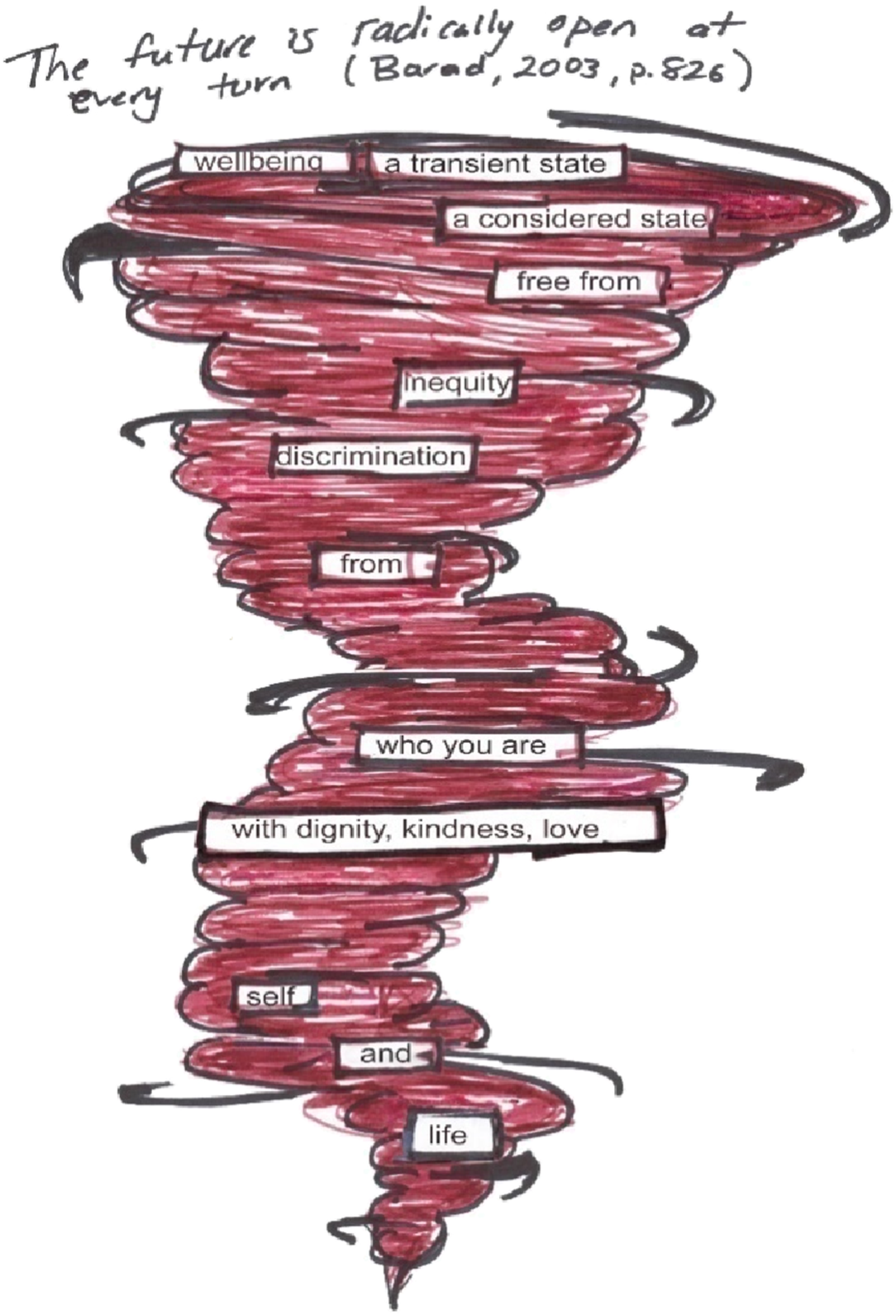
Bringing the humuments to the next CoP reading group session offered further intra-actions. On this particular day some members were in the room while others were present via zoom. Three of us (including myself and Shanee) presented creative works. I remember showing my humument and reading out the words on the text. I moved around the room bringing the humument up to the camera. I read out loud some selected lines from Berlant’s (2010) discussion of the promise of the “good life,” which she says, “for so many (is) a bad life that wears out the subjects that nonetheless, and at the same time, find their conditions of possibility within it” (p. 97). Discussion emerged in an unstructured way during the process. We noted the ways wellbeing had come to manifest in different and related ways within our research projects. The process of moving from one object to the next meant there was a lot to feel and think. The excess of the sensations created speed and excitement, as we moved and were moved with the made objects, in collaboration with the room, technology and spoken text. These processes enabled knowledge but not by way of discovery of “what is already there”; rather, new knowing emerged as effects of our intra-active engagements—our participation with/in (Barad, 2007, p. 361).
These material, embodied explorations have contributed to my teaching practices. Moving away from negative critique has enabled me to work with social work students to speculate more imaginative and innovative responses to social problems and governmental solutions than a problematizing policy analysis approach could provide. Infusing my pedagogical practices with creative writing, drawing and mapping techniques has brought forth intensities and produced different encounters with the same texts or ideas (Bozalek, 2022). Through relational, embodied modes of learning, I seek to engage as a co-inquirer with students within the continually, unfolding materiality of the world and its struggles in order to participate in changing it for the better (Fox & Alldred, 2018; Gravett et al., 2021).
Alison: Felting With Care
“Bring whatever you have been playing/crafting/experimenting”: the invitation to play, create, and share enticed exploration of what could emerge from crafting with wet wool felting and entangling concepts of felting and caring with data from research about emotions in early childhood teaching. Creations were shared in the reading group in April 2021, but that occasion was by no means the beginning or end of anything: “In a way I am starting in several middles” (my presentation notes). “I” am continually produced within thinking-making-doing-feeling-writing experiences, through experimentation with felting techniques and materials, and exploring what happens when felting meets textual data. “I” am continually produced within reading groups, online presentations, webinars, and this collaborative writing process. “I” am a posthuman relational subject, constituted with/in multiple socio-material processes. “I” am dynamic, becoming-researcher, becoming early childhood teacher educator.
The invitation to think differently through making coincided with discomfort with my tendency as researcher to rely on language and text, overlooking how materialities participate in knowledge-making. I decided to go on a learning journey through wet wool felting, entangling crafting processes, materialities, and affects with data from my doctoral research (Warren, 2019) on emotions in early childhood teaching (Figure 2). This was an opportunity to slow down research, leaving space and time to allow other ways of thinking, articulating, and expressing to emerge. I experienced bodily encounters of crafting processes of tangling wool fiberstogether with warm soapy water using hands and tools; feeling wet wool fibers against fingertips, smelling soap, aching arm muscles from rolling back and forth, sweat on warm skin as wool fibres rub and tangle. Wet wool felting meets textual data.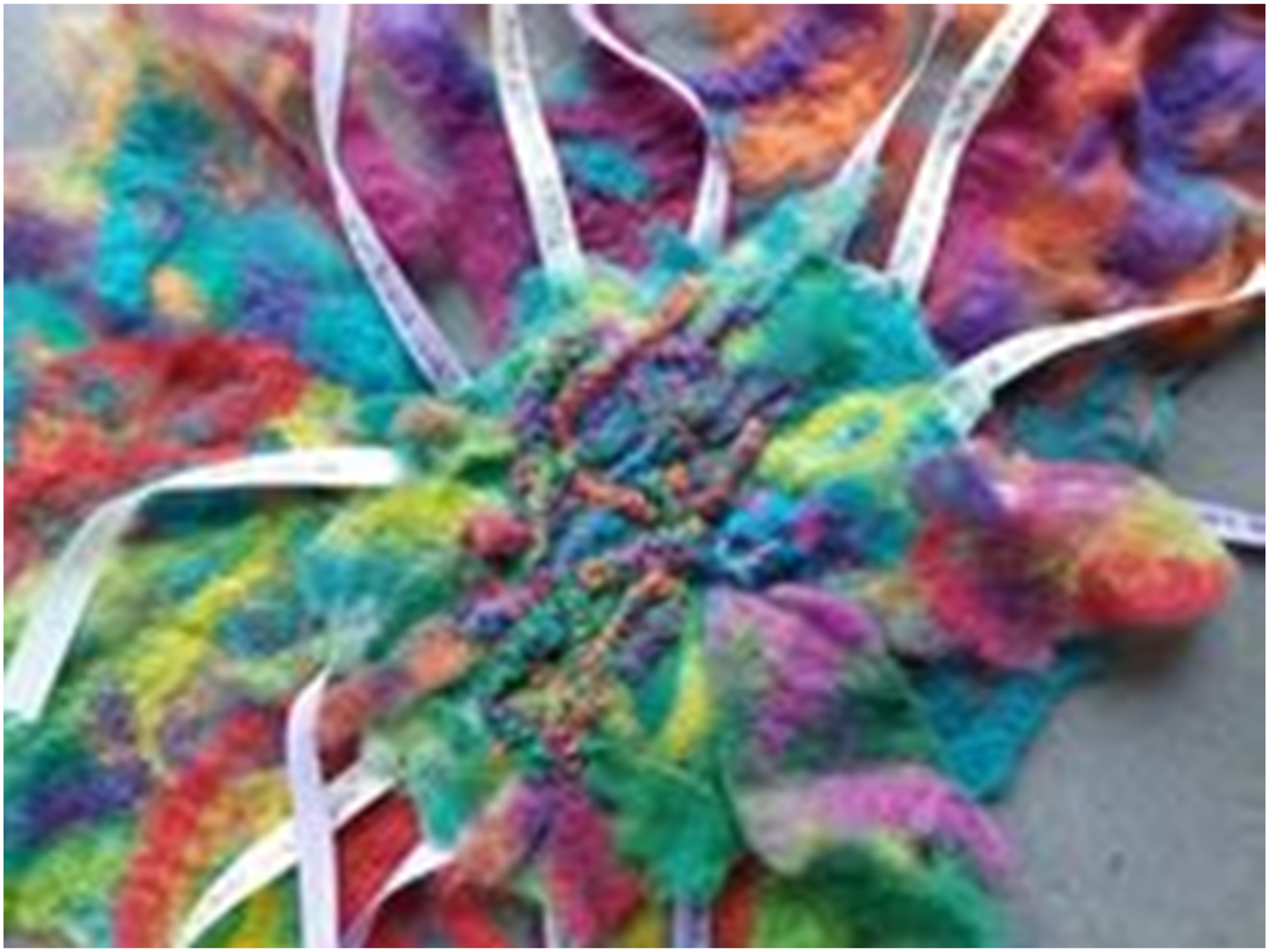
Sharing on Zoom with the group in April 2021 happened early in the making process. Images and words communicated some experiences and thoughts about what felting could do. Then the research-crafting-making-thinking process continued, embracing uncertainties, not knowing what would happen next, what would be produced, what knowledge would be made. Pieces of felt fabric were pulled and stretched, cut, arranged, and stitched; pieces of ribbon with words from data were added to eventually produce something that could be held, felt, touched, stroked, and explored. While the words on the ribbons prompt affective awareness of caring and not-caring in a particular early childhood setting, thoughts of wool as socio-material leads to histories of colonization where loss of land and subsequent impoverishment of Māori was associated with woollen blankets and sheep farming, and weaves with thoughts of how materializations of caring and not-caring reverberate through lives and worldings. Knowledge continues to be made every time someone picks it up, when the story is retold (always differently), when the words on the ribbons are read again.
This reading group is an ongoing event as our multiple interlinked relational and affective networks keep constituting us as researchers in community. The reading group processes continue to be lived through conversations, emails, reading, sharing ideas, and encouragement through community intra-actions to expand thinking. Those processes are entwined with other networks of processes and relationalities that continue to produce us intra-actively. Months later, we thought about and wrote about what happened, what was produced, and what continues to be produced in the ongoing reading group event. I recall our conversations and reading, and how my thinking was sent in new directions. I scroll through emails where articles, videoclips, images, writing, and meeting arrangements and Zoom links were shared, rich interwoven memories. In the collaborative research/thinking/making/writing event of our reading group, posthumanist theoretical ideas encounter COP methods of collective learning, mutual relationships, and communal resources, and stimulate new ways to critically orientate ourselves to material-discursive knowledge-making practices. As a tertiary educator in early childhood education, these continuing processes instigate the question of what next and what else must happen in my pedagogical practices, processes, and relationships with colleagues and with student teachers as we make knowledge in community together.
Shanee: Affective Encounters With Ghosts in Writing a “Hundred”
In June 2021 Lauren Berlant, distinguished Professor of English, cultural theorist and author of Cruel Optimism (Berlant, 2010) and The Hundreds (Berlant & Stewart, 2019), died at the young age of 63 years. Multiple threads of Berlant’s work ran through our reading group, so we decided to dedicate the July 2021 group encounter to thinking with Berlant, each of us tasked with writing a “hundred.” Originating from the Austin Public Feelings group, The Hundreds project is an experiment which “draws affect into form” (Berlant & Stewart, 2019, p. 5), each hundred, or multiple of a hundred, an exercise “in following out the impact of things (words, thoughts, people, objects, ideas, worlds)” (p. ix), with the theoretical, observational, and analytical all folded within. My hundred, (Figure 3), provided an opportunity, to “follow out” an intra-active encounter of words, people, times, spaces, events, the more-than-human… to see what might come to matter, in/with/through a hundred words. In addition, the hundred words are superimposed on an image that came to mind/matter as I wrote/thought/re-membered/re-imagined. As Berlant and Stewart (2019) note, the image that comes to mind, if one does at all, likely won’t be the same for any of us, as the words intra-act in ongoing ways, “anchoring you enough in the scene to pull in other things as you go” (p. 5). A Hundred: everything is going to be alright.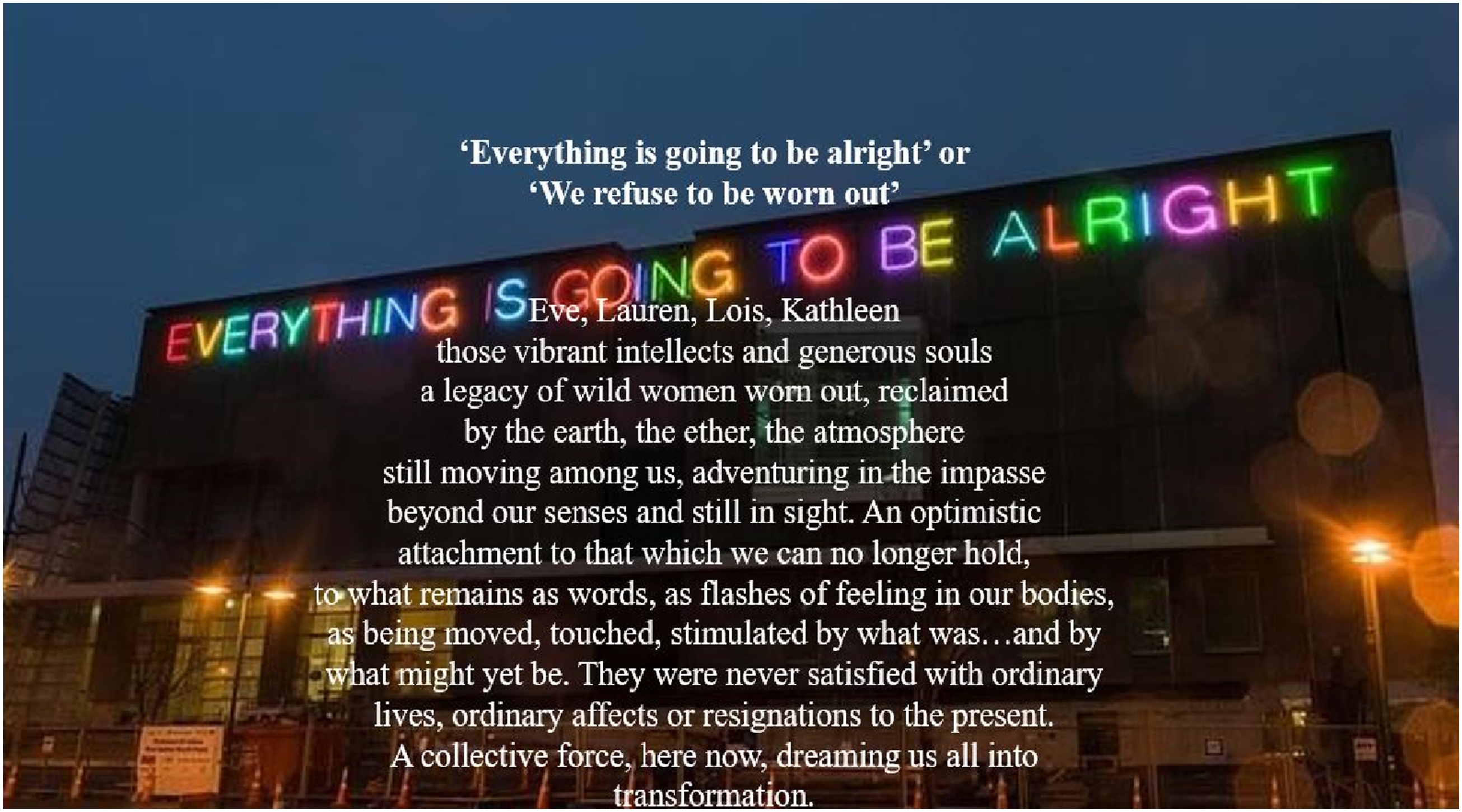
Karen Barad tells us, “each moment is alive with different possibilities for the world’s becoming and different reconfigurings of what may yet be possible” (2007, p. 182). This hundred is one iteration of multiple times, spaces and matter cut together-apart in a reading group encounter in relation with the loss of renowned scholar, Lauren Berlant. Who and what comes to matter are matters of concern in a posthumanist ethics of entanglement, where connections and commitments are inseparably formed, and im/possibilities of pasts and futures are continually reworked (Barad, 2010; Taylor, 2018). My hundred begins with ghosts, Eve Sedgwick (2003), Lauren Berlant (2010), Kathleen Quinlivan (2018) and Lois Tonkin (2019), scholars and friends who are no longer with us, yet whose words and books, bodies and vitalities, were and are inextricably entangled with/in our reading group encounters. The materiality of their being “iteratively enfolded and reworked, but never eliminated (and never fixed)” (Barad, 2007, p. 182). The words of the hundred are additionally co-constituted with an image. This 46-m long neon light message EVERYTHING IS GOING TO BE ALRIGHT (Martin Creed, artist), was switched on in September 2015 for the reopening of the Christchurch Art Gallery after almost five years of earthquake-related closure. Commentary at the time was mixed, with the art gallery criticized for their almost glib media release which suggested it would give post-earthquake city residents reassurance and hope. This stood in contrast to the artist’s more ambiguous meaning, quoted as saying, “I think you always have to kid yourself to make life bearable.” Matter and meaning entwined, but in ways that continually reconfigure with other times, spaces, and matter. This image enfolds into my hundred in multiple ways, in its relation with Berlant’s cruel optimism, and with the Canterbury earthquake sequence (2010–2012), an ongoing haunting presence in the place our reading group is situated. The local context and material environment play a role in notions of situated learning, however in a posthuman entangled ethics, such places become affective, socio-material forces, iteratively enfolded and reworked, producing ongoing effects. Such attention to ghostly matters, places, bodies, and times, which continue to exert material effects in the present also reworks the dominance of a metaphysics of presence (Barad, 2012), where instead we are compelled to attend to the absent-presences, where “(t)ime is out of joint. Dispersed. Diffracted” (Barad, 2010, p. 244). Becoming-posthuman in these relational reading group encounters has inevitably and inextricably had material, iterative effects on my becoming-researcher-counsellor-educator. Every moment matters, and each encounter is teeming with “ghostly non/existences” (Barad, 2012, p. 210), with absent-presences, with other times-spaces that now demand attention.
Reconfigured Communities of Practice
This creative-relational inquiry, depicted here through these written, intra-active mo(ve)ments, attempts to show how embodied, socio-material practices of intra-acting with texts aided our processes of learning together and our commitment to becoming response-able educator-researchers. Our writing-thinking-reading-making knowledge production practices disrupt the humanistic view of knowledge creation which is most often connected to human subjects making sense of the world. The social constructionist perspective positions meaning-making as a process of “learning from” the world, which is configured as like a vessel containing separate entities offering insights into reality (Ceder, 2018). The posthumanist, performative perspective offered in this paper suggests ways to understand how CoP can generate processes of ‘learning with’ (Ceder, 2018), which, consistent with Barad’s (2007) framework, involves “a relationality between specific material (re)configurings of the world through which boundaries, properties, and meaning are differentially enacted” (p. 139).
Through intra-acting with texts and material practices in our CoP reading group sessions, we became a performative composition of bodies incorporating non-human and human agencies, which induced affective atmospheres “created through the many contributions of every object/agent in the space” (Lucie, 2020, p. 23). Reading out loud, moving around the room and screen sharing, generated an atmosphere of trust and creativity which produced new, previously unthought forms of knowing-in-being. In Barad’s terms, an atmosphere becomes another actor itself, creating effects in a continuing stream of events (Lucie, 2020, p. 23). The creative practices and affective encounters prompted us to think differently with theoretical concepts, enabling new capacities in our research practices as we sought to enact response-able, just professional practice relations. So too through these encounters, we have come to consider anew learning spaces and the opportunities to engage with power relations, normalising processes, and resistance through embodied, material practices such as visual journaling, free writing, digital storytelling, and crafting. In line with Lenz Taguchi (2010), who reminds us “the learner and the world cannot be separated” (p. 47), we understand learning not as much a matter of the transmission of knowledge or the learner-teacher dyad but the ontological, ethical processes of engaging response-ably with/in the ongoing and dynamic becoming of the world.
Reconfiguring our posthumanist CoP as an onto-ethical site of knowledge-making has opened up and enlarged ethical matters of concern. What knowledge is, whose knowledge matters, and how knowledge is generated are ethico-onto-epistemological questions (Barad, 2007). The colonial, sovereign figure of the moral, knowing (hu)man is replaced with a human-in-relation, co-constituted with all kinds of non-human materialities, times, spaces, and places. Decentering ourselves as subjects, and opening up to other matters (art, craft, hundreds), times, sensations and relationalities enabled us to think differently about caring, well-being, and loss and concurrently about who and what matters in our own research and pedagogical practices as educators. Onto-ethical concerns of accountability are immanent to these onto-relational processes of becoming-researcher, becoming-educator, becoming-posthuman. Such an ethical accountability was not about recognizing our own obligations, intentions, or values, although of course these are contributing forces, rather “responsibility is…an incarnate relation that precedes the intentionality of consciousness” (Barad, 2010, p. 265). It is always already integral to these intra-active moments, with our response-abilities reconfigured again and again through the iterative reworking of im/possibility.
In our intra-active experiences of knowledge-making with felting, painting with data to make humuments, and shaping words into affective hundreds, we produce and are produced from within as researchers and educators in fields of social work, counselling, and early childhood teaching. Knowledge-making slows down and expands into new spaces of awareness as in when Alison’s fingers push and pull wool fibres, arrange and stitch, write words on ribbons, and then slowly explore what has been made. Research data are “simultaneously, personal, performative, and full of transformative potential” (Renold & Ivinson, 2022, p. 109). For Raewyn and Shanee, creation of humuments highlighted the transformative nature of well-being, and a reconfiguring into well-becoming, always contingent and contextual rather than a destination to be achieved. For Shanee, creation of hundreds was a means to affirmatively ask how “we” come to matter through the influences that shape us, the hauntings of those who left their mark on our lives and who shape our becomings through relationships of love.
Conclusion
CoP is a prolific concept-practice in higher education. Our aim in this paper has been to reconfigure CoP as an onto-ethical, affirmative practice, where the human is decentered and knowing, learning and becoming are affective, socio-material practices occurring with/in human-non-human relations. Engaging a process of creative-relational inquiry and re-turning (to) intra-active mo(ve)ments in our posthuman reading group has enabled us to map theory-practice, matter-meaning, and socio-material encounters and the ways these shape processes of becoming posthuman-researcher-educators. Through slow and attentive making, with materials and with each other in our posthumanist reading group and our collaborative writing, we respond to Renold and Ivinson’s (2022) call to “continue making with the trouble” (p. 123, emphasis in original). We multiply connections through networks of relations with each other, with materials, through reading, talking, thinking, and writing. We are re-produced in our intra-actions and keep each other accountable and response-able. We continue to seek new ways of becoming with/in these entangled relations of which we are all a part.
Footnotes
Declaration of Conflicting Interests
The author(s) declared no potential conflicts of interest with respect to the research, authorship, and/or publication of this article.
Funding
The author(s) received no financial support for the research, authorship, and/or publication of this article.
