




Abstract
This article chronicles the development of walking workshops through a technique of defamiliarization in order to dislodge the taken-for-granted and open up walking to experimentation and novelty. We work with these concerns to consider walking as a research-creation methodology that composes inventive connections of a relational ethics that enacts a shared ecology of living and lived practices. Walking is not just about directional movement, traveling to or from a place. Walking’s movement is also affective: emergent; sometimes imperceptible; and a performative practice of knowledge in the making that is coproduced by more than human matter. Walking is thus open to novelty. Two of the authors in this article share their participation in these workshops, experimenting with ethico-aesthetic architectures of borders, spaces, and transitions that choreograph movements in places.
Prelude for a Walk
If you were to take me on a tour of your town, where would you take me and why?
Can we walk to all of those points? Why or why not?
What stories would you tell me?
What stories might you tell if you were walking with someone from your neighborhood, a family member, a close friend?
What would we see?
What would we hear?
What would we smell?
What would we touch, and how would it feel?
What is our pace? How does the weather affect our speed?
Do you sprain your ankle, stub your toe? Do you walk in your flip-flops, with crutches, a cane, a baby stroller, a wheelchair? How do you find yourself moving?
How do we move together?
If we were to start crawling on all fours, what stories might we produce?
Do the smells from newly awoken earth, flower, and tree overwhelm you?
Do you smell coffee? Are you now thinking about the coffee you drank earlier?
Is it possible that stories are composed through smell?
Are histories composed of smells?
Is there trash along our route?
Where are the sources of water?
Where is there a shaded path? Do you wish to walk beneath the shade or walk where you can feel the sun on your face?
Are the trees native, hybrid, imported, or diseased?
What are you thinking about as we walk?
Do you find yourself reminiscing?
Do we get swept away in conversation?
If we stop in place and remain silent, what would we hear? What would we compose through our listening?
Erase the loudest sound you hear; listen again. What needs to be heard?
If we stop in place and spread out our arms and legs, what would we touch? What would we compose through our touch?
How does the sidewalk, street, dirt path, hiking trail choreograph our movements? How do they direct our flow, our pace?
Who walked this path before us?
From whom was this path, this land, taken?; Who can safely walk here, alone?
Who is forced to walk elsewhere?
Where are the borders? Are these physical, emotional, or metaphorical?
Do we cross the borders? Can we?
Where are the thresholds, the liminal spaces, the transitions from one place to another? Do we move through them? How and in what ways?
What are the felt forces of our walk?
How is a walk a more-than-human event?
How is the world storied?
In what ways does walking story the world?
As a method of inquiry, walking is pervasive across the social sciences, humanities, and the arts, albeit differently. The fields of anthropology and sociology have employed walking methods to address perceptions of place, space, knowledge, and memory that pertain to the politics of space- and place-making (e.g., Ingold, 2007; Pink, 2015). Walking is also situated within the larger methodological practice of sensory ethnography, wherein sensory methods of ethnography assist in learning about a culturally situated phenomenon or practice (e.g., Pink, 2015; Stoller, 1997).
I (Kimberly Powell) am interested in how walking and sensory methodologies foreground inquiry as a process of movement and materialization, a constant unfolding of experience. In this paper, I chronicle my development of walking workshops that incorporate sensory techniques of defamiliarization pertaining to encounters with and of place, including pedagogical approaches and experiences. In addition to my account are the experiences of two graduate students, Ilayda Altuntas and Michael Brickner, who have engaged in these workshops and discuss their engagements in this article with sensory techniques of walking. Their work reveals playful and experimental encounters with walking that are not only demonstrative of the stated purposes of this paper but productive in that they resonate as emergent, performative, and unfinished encounters with walking.
Working primarily with theories of movement from Deleuze and Guattari (1996), I conceptualize walking as physical and directional—moving from point A to B—and as absolute (e.g., Springgay & Truman, 2018). Absolute movement is immanent, a force that lies within the physical but can remain imperceptible and indeterminant to us. Movement can be perceptible and imperceptible, as a passage between time and space with varying speeds, durations, directions, and flows (Deleuze & Guattari, 1987). Movement is also vibrational, a force that lies within the physical at every scale—from the molecular to the molar (e.g., Deleuze and Guattari, 1987)—thus remaining imperceptible. In these ways, movement is affective, involving forces (e.g., vibration, speed, flows) that exceed the limits of the human as they pass within and among human and nonhuman matter. Immanent movement, then, has the potential to create new thoughts, theories, and ways of being that we might or might not ever have intentionally coordinated.
Concerning physical movement, I work with Ingold’s (2011) distinction regarding two modes of travel: transport and wayfaring. Whereas transport is destination-oriented, wayfaring is a mode of inhabiting the environments in which one dwells and moves. The wayfarer is continually on the move, yet any pause is an occasion for sites of activity. Wayfaring, Ingold argued, is the “most fundamental mode by which living beings, both human and nonhuman, inhabit the earth” (p. 80). Working with Gibson’s (1979) ecological theory of perception, in which he argued that perception was not from a fixed point but in continual movement, Ingold argues that if perception is a function of movement, then what we perceive depends partly on how we move. The inhabitant is “one who participates from within in the very process of the world’s continual coming into being, and who, in laying a trail of life, contributes to its weave and texture.” In this way, Ingold argued, knowing is “itself a path of movement through the world” (p. 89).
Whether physical or absolute, movement is inherent within all matter, continually differentiating and emergent. Walking within a specific place and time is an occasion for surprises, with changes in direction, speech, or thought. Writing about novelty inherent to walking’s movement, Massumi (2002) suggests that because continuity embraces discontinuity, walking includes falling in which the catch of a fall renews walking’s function. He argues that newness may arise from each step’s change, decisions, and immanent nature in movement navigation. Similarly, philosopher Erin Manning (2015) (James, 1996) writes about the “something-doing” of experience unfolding, in which new relational fields, as well as new modes of existence, are produced (p. 55). These new modes of existence create modes of knowledge that are not yet confined but are instead transversal, an “in-act” of unfolding experience (Manning, 2015; p. 55). Manning writes of Deleuze’s and Guattari’s (1987) “radical empiricism” that acknowledges the ever-shifting relations between the knower and the known; the experience itself composes these relations. This is “an occasion of experience” (Manning, 2015; p. 55) that produces the means to define itself. In this manner, she reorients the concept of art as a way rather than a form or object and thought as incipient to an occasion, in the act of moving.
Working with these above ideas, I have pursued the potential of walking methodologies as affective, sensorial encounters in several workshops and my walking research (Powell, 2020). I situate walking as a form of research-creation, acknowledging the relational tension and productivity between these two words. In their walking research and WalkingLab events, Springgay and Truman (2018) collaborate on and host research-creation projects, inter-related practices of art, theory, and research. My walking research and workshops emphasize the overlapping and reciprocal qualities of walking as both artistic practice and research. In what follows, I describe how a technique of defamiliarization in my workshops is a means of experimenting with an “ethico-aesthetic” paradigm (Guattari, 1995): a “thinking-space” (McCormack) open to affective encounters and creative potential with borders, spaces, limits, and transitions that choreograph, and are choreographed, by immanent more-than-human movements. Significantly, this thinking-space raises questions and insights into “inventive connection” of relational ethics (Haraway, 2016; 1) that collectively enact a shared ecology of living and lived practices.
Moving Techniques of Defamiliarization
In my research and my workshops, I engage in techniques of defamiliarization as an attempt at dislodging the taken-for-granted in walking (e.g., habitual and directional movement) so that people might experiment with movement and understand it as a material force. According to Braidotti (2013), defamiliarization occurs through experimenting with new practices that allow for multiple instances. Truman and Springgay (2016) have considered propositions for walking as a qualitative method oriented toward “speculative middles,” where research is an emergent event rather than a closed, predesigned system. They write that when walking is understood as propositional, “subjects are not given to experiencing movement, space, walking, etc. in any pre-determined or already realized way. Walking becomes stripped of its own assumptions” (Truman & Springgay, 2016; p. 259). For Truman and Springgay (2016), the concept of propositions for walking functions as both a linguistic statement regarding what walking as a research practice can do and also constitutes the proposition of walking as “a hybrid movement and lure for feeling that can pave the way along which the world advances into novelty” (pp. 259–260).
The series of questions with which I began my article is a thought exercise I have used at the beginning of workshops or presentations and are meant to defamiliarize participants' preconceptions or assumptions about walking. I ask people first to close their eyes, silence their thoughts, and take in a few deep breaths as a means of focusing their attention before I read the questions aloud, pausing between each one. The questions evoke the senses and provoke multiple possibilities inherent in walking: “If we were to start crawling on all fours, what new stories might be produced about the places we walk?” Some questions unsettle assumptions concerning voluntary movement: “From whom was this path, this land, taken? Who is forced to walk elsewhere?” Questions toward the end follow on the heels of former questions by asking participants to attend to walking as a concept: “What are the felt forces of our walk?” “In what ways does walking story the world?” All of these questions come out of my research and from the workshops themselves. An important dimension of my walking workshops and research is creating sensory “prompts” that provoke engagement in and with places in ways that work against habitual and unquestioned engagements with place: what, and how, does a movement such as crawling activate, for example? What might such a movement tell us about the given choreography of places? What are the defamiliarizing effects that methods of sensory walking have on the given order of things?
What follows are accounts of some of my walking workshops that engage walking as an artful methodology for exploring movement and the sensorial to engage with place. In addition to working with an immanent concept of movement, I work with the concept of sensory and sensation similarly. The senses are often associated with bodily organs of seeing, hearing, touching, smelling, and tasting. While many of my walks have relied on particular sensory orientations (e.g., listening), I view these primarily as frames for methodological inquiry into walking. Participants can then begin to view them as artful insofar that a sensory entry into an activity focuses new attention to the qualities of a walk and, in turn, serves to decompose everyday meanings and habits of attention (Guattari, 1995). While producing a soundwalk—a choice given in some of my workshops—might favor a certain sense, it is not the goal. Instead, it is to experiment with and query habits of listening, seeing, etc.: a technique of defamiliarization. Movement’s immanence does not necessarily involve intentional coordination or physicality. Rather, the quality of movement involves what Deleuze and Guattari (1987) refer to as affect and sensation. Affect does not concern feelings or affections, and sensation is not the property of any particular sensory organ, nor is it the property of any subject. For Deleuze, sensation is sensory experience felt as intensities that flow within and among human and nonhuman matter. They are beings themselves in that they “exceed an immediate lived experience” (Deleuze & Guattari, 1996; p. 164), moving beyond “everyday” perceptions, norms, and conventions. Moreover, sensations are not felt in a determinant way; such a becoming is indeterminant. Art, then, might open new ways of engaging with the world, but not in ways that we might be able to name, identify, or predict; art is felt as differential flows (e.g., Deleuze & Guattari, 1996).
Sensory Workshops on Walking
Over the past several years, I have given many workshops focused primarily on the task of defamiliarization. Regardless of methods, each of the workshops was designed for participants to explore walking experimentally. What follows are accounts of some of the workshops I have given that, while different in their contexts or purpose, nonetheless hinge upon defamiliarization as a central means of exploring places as ethico-aesthetic architectures and lived relational ecologies.
Play/Walk: Chance, Play, Experimentation
In these workshops, I have experimented with chance and play regarding sensory encounters of places. Working with the overarching concept of defamiliarization and its role in overturning habit for novelty, I created two workshops that focused on playful encounters with place. I was inspired by walking artist Idit Nathan’s walks through Jerusalem, Seven Walks in a Holy City (2011), in which she links “play and interminable conflict” (Nathan, 2011) through a choice of cards that define a theme and where a walk starts; the case of a die at intervals throughout the walk that dictates direction and photography. Nathan discusses how play disrupts peoples' movements and generates creativity and unexpected encounters to reclaim spaces (Stuck, 2021)
Inspired by conversations with Nathan (personal communication, 2015), I developed art walks with chance encounters as part of my walking workshops. Drawing from my teaching in performance art settings, I try to begin with movement exercises to warm up the body and mind, create attention to forms of movement, and get people comfortable with the idea of moving in novel ways. In one such workshop, PlayWalk, held on my university campus, a group of participants rolled the die at regular intervals, with each die number corresponding to a particular action: 2=Take a photo of something that engages you; 3=Experiment with movement for 1 minute (e.g., speed up, crawl, dance). Reflecting on the walk afterward, participants discussed new perceptions of place, material encounters with the landscape and builtscape, an awareness of self-concerning space and place, and ways in which the element of chance introduced a sense of openness to new encounters with place.
Participants included two science education professors, a third-grade teacher, a geography professor, a theater post-doc, and an art educator and her family. The end conversations revealed their novel encounters that produced new ways of seeing, hearing, touching, or moving through the campus, which inspired, for example, the geography and science professors to think about how such walks could be used toward scientific and geographical experiments with place. Indeed, a significant discussion revolved around place politics and walking. The Geography professor, originally from Cape Town, South Africa, where he and the science educators were currently engaged in research, took note of the contrasts in our ability to walk leisurely and for pleasure on campus and in town versus Cape Town; he noted the inability to walk for leisure or for pleasure in particular districts of Cape Town, where walking might be a health hazard due to environmental degradation or a physical hazard due to crime and bodily harm. Walking in these areas of South Africa was solely regarded as pragmatic. Who gets to walk, and where, became central to our conversation; ecologies of relation were made vivid in our discussion regarding poverty, privilege, race, and class concerning environmental hazards, highlighting the nature of what Donna Haraway (2016) frames as a relational ethics of vulnerability.
Walking As Intercultural Play
As part of a conference hosted by Building Intercultural Bridges Across Cultures and Creativities (BIBACC) in Cambridge (UK), I led a walk intended to be an intercultural practice of place-making through the historic neighborhood of King’s College neighborhood in Cambridge, England. Rather than define intercultural in the traditional sense of human cross-cultural interactions, I set out to define the term as intracultural—suggestive of Barad’s concept of intra-action—as that which emphasizes displacement, movement, and entanglement (Burnard et al., 2016; 2017). The sensorial prompts in this context were meant to emphasize material entanglements of human and nonhuman agency. Like the previously described Playwalk workshop but with this new purpose in mind, we engaged with chance that involved stopping in front of a prescheduled site and choosing a number that determined a set of prompts with which the group would work. Several key differences in this workshop attended to formal narratives of historical places in King’s College due to the focus on interculturality as the conference theme. While planning the walking event in a place unfamiliar to me, I reached out to the conference host, Pamela Burnhard, to inquire how I might incorporate the intercultural. Burnhard gave several valuable suggestions about sites to visit, and ways to coordinate the walk with a doctoral student who had familiarity with and cultural “distance” from many historic sites in the neighborhood and could thus provide some context for our workshop participants. The walk thus involved a formal history of each place along our route, as provided by the student, that one might expect if taking an official walking tour, followed by my introduction of chance-based sensory techniques of defamiliarization. In addition to an initial starting prompt, I also asked questions while they were engaged. For example, at one location where the prompt was about exploring and transgressing borders and points of transition, I asked rhetorical questions as encouragement while they were exploring: are borders physical or emotional? How might you consider transgressing a border or limit? Who and what is kept in or out? While some participants were familiar with the neighborhood, many international conference attendees were new to it.
I viewed this as an opportunity to create new narratives of walking/moving about in places to interrogate formal narratives and cultural vernacular of places—borders and walls, histories and practices of inclusion and exclusion, encouraged and discouraged sounds, and forms of movement constructed and allowed by built and landscaped environments. While I had planned the walk for 40 minutes, our walk took over an hour of engagement, with about half of the scheduled stops I had mapped for the workshop. The prompts that engaged walkers in bodily, aural, visual, and tactile explorations held their attention for long periods. Concluding at a local bakery where we could sit and talk, discussion hovered around how chance, play, and sensorial explorations informed a sense of being intercultural, wherein buildings informed culture, sounds, touch, and smells as much as people. What was vividly made clear for several participants was how transgressive movement as allowed in the prompt regarding transitions and borders allowed them to comprehend place politics of inclusion and exclusion fully. Given “permission” to transgress boundaries, participants commented on ethico-relational architectures, raising questions of belonging, of insider/outsider status, and how the formal history assigned to places within the King’s College neighborhood both informed and choreographed their movements in ways in which they were unaware.
Storying Through Movement: Walking, Sensing, and Making Places
One workshop variation built on the technique of defamiliarization hinges less on a particular place so that one might experiment with any place. This focus allows individuals to inquire more deeply about the politics inherent to the choreography in which we engage with all matter, including the built environment of any place, and how we might begin to open up and experiment with movement. In these workshops, I have introduced walking as a speculative method for storying the world. The speculative turn in contemporary research practices underscores the point that knowledge produced from thought, virtual reality, fantasy, and contemplation is as valid as traditional forms of empirical knowledge yielded from the sciences and social sciences. It also acknowledges that all entities are real insofar as they act upon each other (Bryant, et al., 2011). Nonhuman actants, in other words, such as weather, landscape, buildings, fantasies, and art, are equally capable of affecting the world. Elsewhere and in direct relation to walking, Truman and Springgay (2016) have considered propositions for walking as a qualitative method oriented toward “speculative middles,” where research is an emergent event rather than a closed, predesigned system. When walking is understood as propositional, “subjects are not given to experiencing movement, space, walking, etc. in any pre-determined or already realized way. Walking becomes stripped of its own assumptions” (Truman & Springgay, 2016; p. 259). Defamiliarizing the body is one of five propositions they suggest for walking.
In terms of story, Tim Ingold (2011) argues that knowledge, rather than something subject to discovery, classification, and application, might best be thought of as storied. He argues that a storied world is a world of movement and becoming in which anything—caught at a particular place and moment—enfolds within its constitution the history of relations that have brought it there. In such a world, we can understand the nature of things only by attending to their relations, or in other words, by telling their stories: “For the things of this world are their stories, identified not by fixed attributes but by their paths of movement in an unfolding field of relations” (Ingold, 2011; p. 160). Donna Haraway (2016) introduces the storied signifier SF, a material-semiotic signifier open for producing multiple meanings of story, endlessly entangled and in relation to each other as response-able encounters: science fact with/and speculative fiction, etc. In these ways, story and the speculative offer experimental practices for walking.
Over time, I have structured a series of provocations that consider these conceptions of the speculative and story. Participants are given several options from which to choose, each oriented toward a particular sensory theme. Either during or after the walk (depending on the activities in which they are involved as part of the provocation), I have asked participants to engage in a series of questions so that they might further compose walking as a storied event. I have also collaborated with my colleague Andrew Hieronymi, an associate professor of art whose interest is in media and games, for a few of these workshops, in which we co-developed ways of engaging play and chance encounter as/through walking.
Below is a response from Michael Bricker, a doctoral student in the Penn State Art Education program, who responded to one of the prompts that Hieronymi and I co-developed as part of a workshop that sets play and chance into motion. Bricker experimented with several of these walking prompts during a workshop. An experienced high school art teacher with an interest in artistic inquiry into place, he continued to experiment with walking beyond the workshop and over weeks and months, sketching and journaling many of his walks in relation to the workshop provocations and eventually expanding and altering them as a means of experimenting on his own. What follows is one of his walks near his home in response to a provocation regarding movement.
In response to Dr. Kimberly Powell’s Storying Through Movement
Walking, Sensing, and Making Places
Provocation: Movement | Direction | Mindfulness:
Start walking. Every time a new thought enters your mind, change direction.
Provoking Questions (post-walk):
Draw a map of where you went or where you think you went. It need not be an accurate map. Consider mapping gesturally in terms of how you moved. Is it a map of your thoughts or places? Both? At each turn that you can remember, consider what you were thinking at that moment. Can you remember? Mark that on your map.
Musical/Philosophical Influence: Mike Posner, Keep Going, Island Records, 2019
As I exited the Borland Project Space at Penn State University, the sun was shining brightly, and it was unseasonably warm for an early November day. I began thinking of where I would walk and what I would do upon my return to my native Harrisburg, asking for a sign that I would be making the right decision in terms of my potential application for doctoral studies. Passing the Zoller Gallery, a familiar voice filled the surrounding area. “For once in my life, I won’t let sorrow hurt me….” The familiar sound of Stevie Wonder soothed my soul and answered my yet unspoken question. I drove home, listening to another soundtrack that had become a bit of an obsession: Mike Posner’s concept album, “Keep Going,” which was created in conjunction with his “Walk Across America,” a journey filled with the potential of renewal and the benefits of soul searching (Posner, 2019). I had already begun to memorize chunks of his narrative lyrics, ones that would play in my head as I began my own symbolic trip several days later.
This album begins by stating that it is 52 minutes long and is meant to be listened to, front to back, with no interruptions. I opened the front door of our family’s home and began my 52-minute trek (which would actually take place over 48 minutes, with 4 minutes reserved for written sketches and reflection). I tried to make a mental note of my thoughts and immediately began documenting artifacts found along my path. There was the townhome of one of my school’s students being patched back together after a recent fire. Snap. A discarded umbrella from Schuylkill Haven, PA, the location of my first Penn State campus, where I began my higher education journey in 1994.
Snap. I noticed Birmingham Place, a road I had passed plenty of times prior but never noticed. My brother passed away in Birmingham, Alabama, 27 years prior. Snap. Next was a friend’s new home, a symbol of his fresh start. I jumped on the trampoline and took a couple of playful hops. Snap.
I began working my way back toward our neighborhood and home and was confronted by the enormous tree that had come down in the previous week’s storm, crushing the new fence that we had replaced after the previous spring’s lightning strike. I realized that this was the first time I looked at the scene from the other side of the crumbled fence. Snap. I entered the gate, which was only a gate in the traditional sense of that word, as it was neither keeping anyone out and letting everyone in. This well-fed and amply limbed tree covered a large portion of the yard, but my children’s swing set and tiny “house” were untouched, safe refuges from the storm. Snap. Snap.
After a brief swing, I headed back over to the entangled branches and destruction, only reversing direction after noting a sprig of a new tree that had forced its way through the surface to the light. Snap. Snap. Snap. I photographed my son’s old basketball hoop, which he had outgrown, now relegated to the yard, no longer of use. Snap. An animal skull, another reminder that nothing is permanent in this life, lies at its base. Snap. Finally, I nearly stumbled upon a bird’s nest that had blown out of a tree, a rented space no longer occupied by a mother and her young ones. It would become a concept I would examine with my students: “Rented Spaces,” an opportunity to appreciate what we have on loan and evaluate what consumes our thoughts and time. Snap.
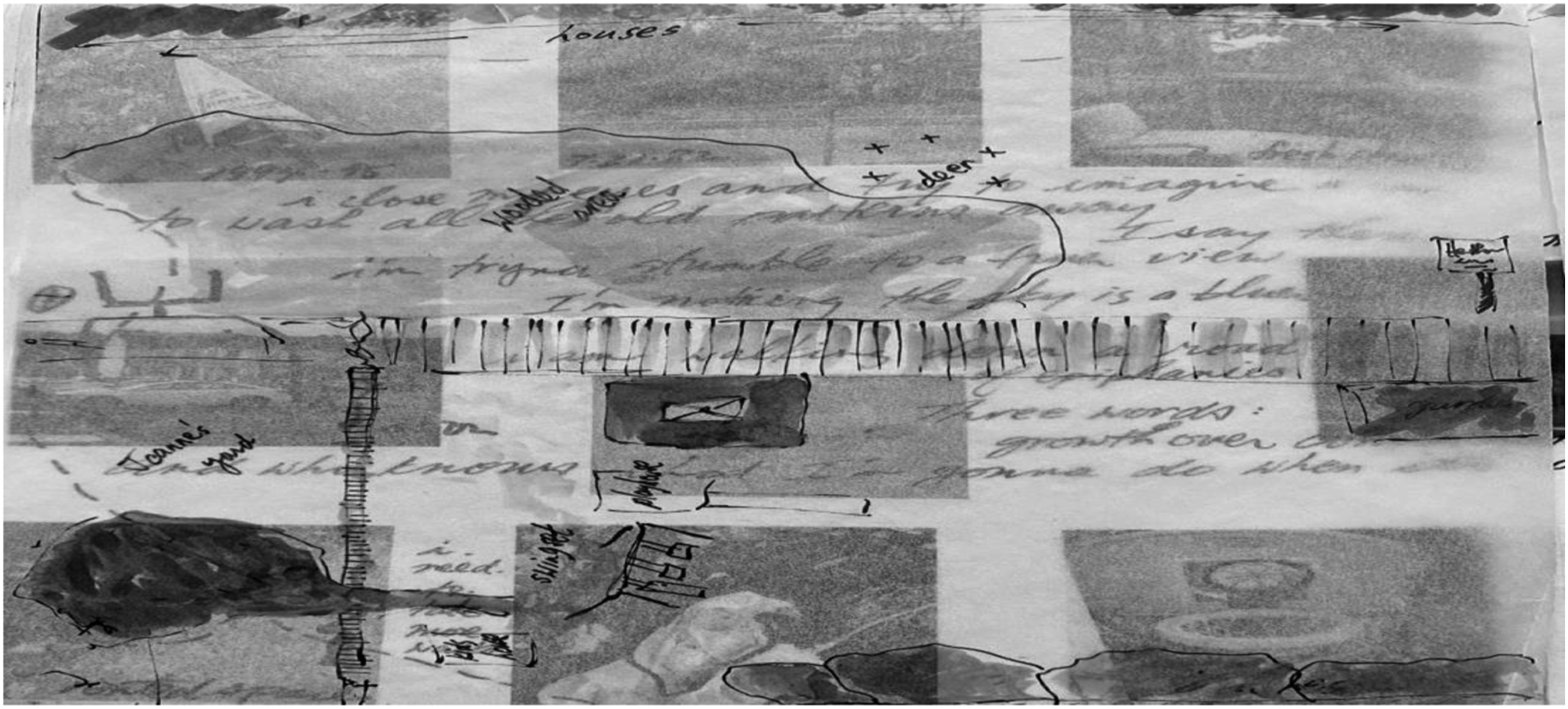
That documentation became a multi-layered map, a rough sketch (with minimal colors) of the layout of my path on tracing paper partially obscuring the photographs I had taken, juxtaposed and branded with my notes, as well as Mike Posner's (2019) lyrics and reflections upon his experience in the context of my own (Figures 1 and 2). Mind Snapping. Mind Snapping (detail). Note: The images of Mike Posner were retrieved from his website in November 2019. [Previously] Available at http://www.mikeposner.com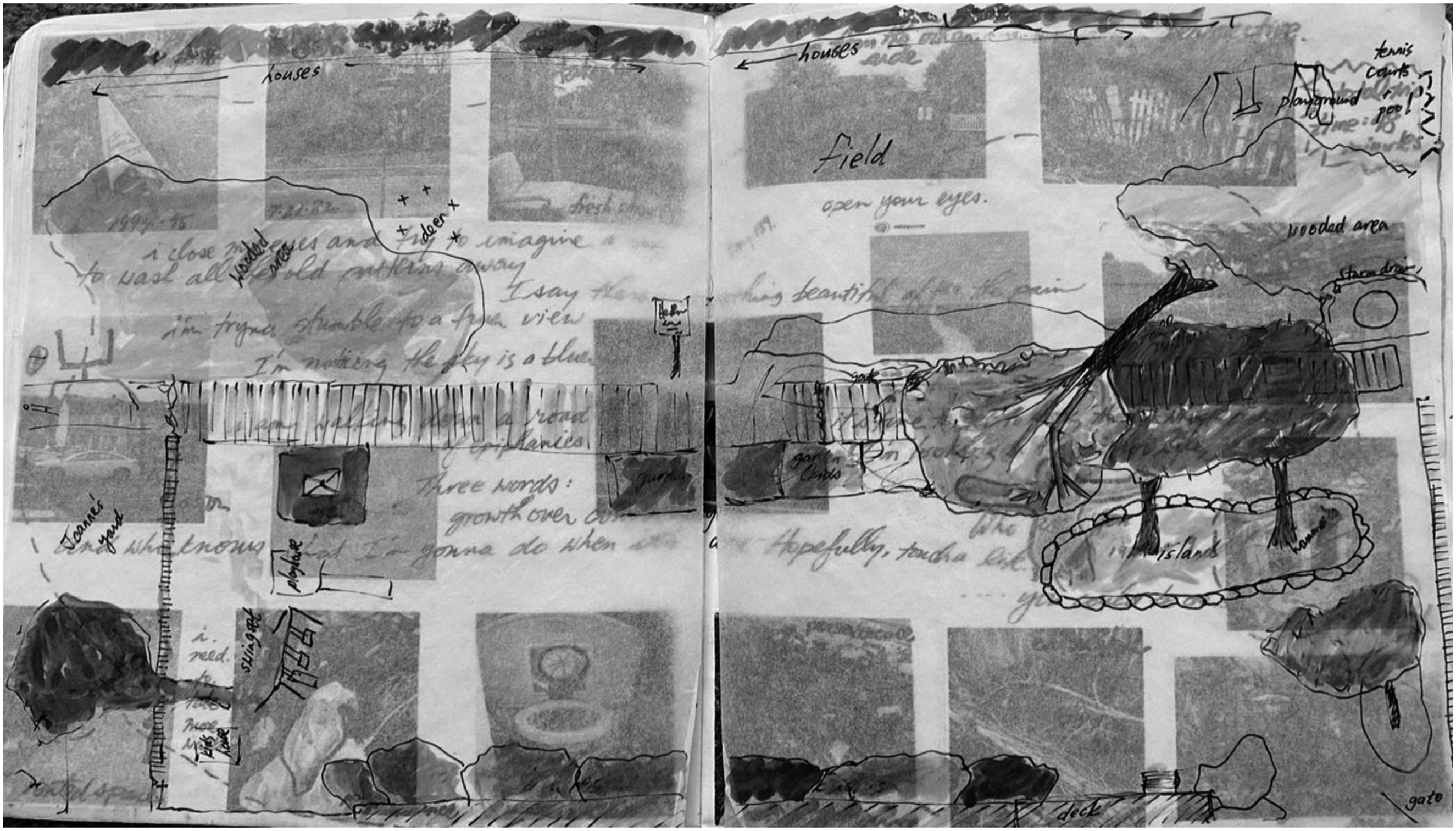
I felt a small kinship with his massive pilgrimage. I was not yet there, but I was in the act of becoming. As a result of the quarantine and pandemical circumstances, I have now taken more walks than I had taken the prior 43+ years of my life. I have found out a multitude of things that were right in front of my face in some of my favorite spaces, but I have found out much more about myself and my place in this world. It is there, embracing the unknown that you can currently find me.
Michael’s layered cartographic walking practices reveal spatiotemporal qualities of place and the ways in which novelty arises out of and in concert with movement from change and decisions that are immanent within each step. They also reveal how he both explored and created an ecology of relations through both mapping and describing his encounters with the outside world alongside his internal thoughts and personal experiences.
In the following excerpt, Dr. llayda Altuntas Nott works with a different provocation; Sound
In Response to Dr. Kimberly Powell’s Storying Through Sound
Sonic Performance of Place: Soundwalking in Istanbul
Provocation: Sound | Soundscape | Listening: As you walk, notice the sounds around you. Using your smartphone (or other recording devices), create a soundscape by recording the sounds around you. Feel free to use your smartphone to look up the history of a building, material, street, etc. Narrate and interpret as you go along, as part of your soundscape. Provocation Questions: Considering this information, how do/did you contribute to a knowledge of this place by engaging with it through sound/sounding/listening? How does your experimentation with sound entangle with what you found out through an internet search, placard, the "expected" ways of moving through space, etc.?
On the European side of the Bosphorus 1 near the mouth of the Golden Horn 2 In Istanbul, I perform a soundwalk between the two historic towns of Karaköy and Galata. After cruising across the Bosphorus on a Vapur, an old-fashioned Turkish steamboat, I start my soundwalk from the Karaköy Pier. As I disembark, I hear the sky vibrating with the blast of the Vapur’s horn: AAAAaaamm…. AAAAAaaamm…. AAAAAaaamm…. AAAAAAAMMM. Seagulls circle over the Vapur, cooing hauntingly, as I leave the ferry terminal behind me. The sounds of the waves and the birds are now fading, and I hear the patter of the rain and the clamor of the street more clearly. I walk on....
With the Bosphorus on my right and the street on my left, I hear myself think: “These are the sounds of my memories from the place I was born, raised, and have lived most of my life.” As I stroll through the Karaköy streets with an audio recorder in my pocket, I feel immersed in the city. I walk on.... It’s a windy Sunday morning, and cars drive recklessly through the puddles, splashing water on the passersby: WHOOSH…WHOOSH. Entering the narrow side alleys of Istanbul, I hear the street vendors selling all sorts of things I don't need, polyrhythmically shouting: “BEŞ LİRA, BEŞ LİRA, BEŞ LİRA,” which means five liras (the cost of their wares). They shout so loudly that I pick up my pace. I walk on… Now, away from the noise, I arrive at an abandoned metal workshop that’s been converted into a coffeehouse. To my right, I see a church across the street and the minaret of a mosque in the skyline in the distance. I pass through the steel-framed thin glass door of the coffeehouse: Creeeaak… Click… It’s early, and the sound of my footsteps fills the room, overlaying the ambient music in the background. I order a cup of Turkish coffee, sit by the window, and watch people walking in and out of the coffee shop. Each time they open the rustic steel-framed door: Creeeaak… Click…, I hear the wind blowing inside the café: Whhhhhh… Whhhhhh…, bringing the sounds of rain with it: shipir… shipir… shipir… shipir… (the Turkish version of pitter-patter). As I take the last sip of my coffee and get up from the table, speaking voices enter in my mind: "We haven't changed. We are still here." I walk on… I am now on Galata Tower street, ascending a steep hill, and the sidewalk is wider. My path is suddenly blocked by a metal worker spraying sparks in all directions: FFFSS… FFFFFFFSS…FFFF…. His shop spills out onto the street, and behind him is a sign on a red metal plate with the word Kaynakçı painted white with a brush, meaning "Welder." He wears yellow gloves and is linking metal chains on his wooden cylinder worktable. The splattering sounds of the welding fill the street as his torch sizzles with occasional pops and sparks: FFFSS… FFFFFFFSS…FFFF…. I am thinking of how the presence of sound becomes a visual sensation. The sparks dazzle my eyes. I walk on… I walk for a while in silence…walking up and up the hill. Finally, I arrive at the Galata Kulesi, a 9-story tower made of medieval stone. I stop walking. I lift my head and hear the powerful southwest wind: WHHHHHH. I visualize Hezârfen, a scientist and dreamer from the 1600s who flew with eagle wings from the very top of this tower, riding the wind and landing in a town on the other side of the Bosphorus called Üsküdar. I think of my dreams, wanting to achieve the impossible. I walk on…. I reach the top of the hill, and I hear the sounds of the underground funicular
3
I enter the train car to go back down. It’s only me and a mother and daughter who are sitting in silence at the other end of the car. In a few minutes, I hear the bell: BUZZZZzzzzzzzz. The doors close, the wheel of the funicular starts spinning, and we descend the hill. We pass one section of track after another: Phoew… Phoew… Phoew… We arrive at the bottom of the mountain, and the doors open. I walk on…
(The sounds I recorded during my soundwalk are visualized in the following Spectogram.)
My experiment performing a soundwalk in my hometown shows the sound-marks of the Karaköy and Galata neighborhoods. The sound-marks tell us that both Karaköy and Galata are historic places connected by a main walking thoroughfare. The acousmatic sources create a distinct sense of place and belonging through the environmental sounds representing culture, industry, and memory. While performing, I used three methods: listening, understanding, and giving meaning (Altuntas Nott, 2022). Through this approach to recording, I intended to use the sounds of Karaköy and Galata as a way of expressing culture and language.
Like Michael’s walks, Ilayda’s soundwalk occurred outside of a workshop space and within a familiar space of “home.” Her play of sounds as words, her visual graph, and her recorded sounds (not present in this publication) depict sound markers of the towns and the passage between them, marking sonic architectures and ecologies that are both unique to Istanbul in terms of cultural markers and yet generally recognizable as urban sonic density Figure 3. Altuntas Nott, I., 2019. Sonic Performance of Place. [Sound Visualization, Digital] Note. The spectrogram shows a 51 second worth of sound recording from Ilayda’s sound walk in Istanbul—on a dB scale.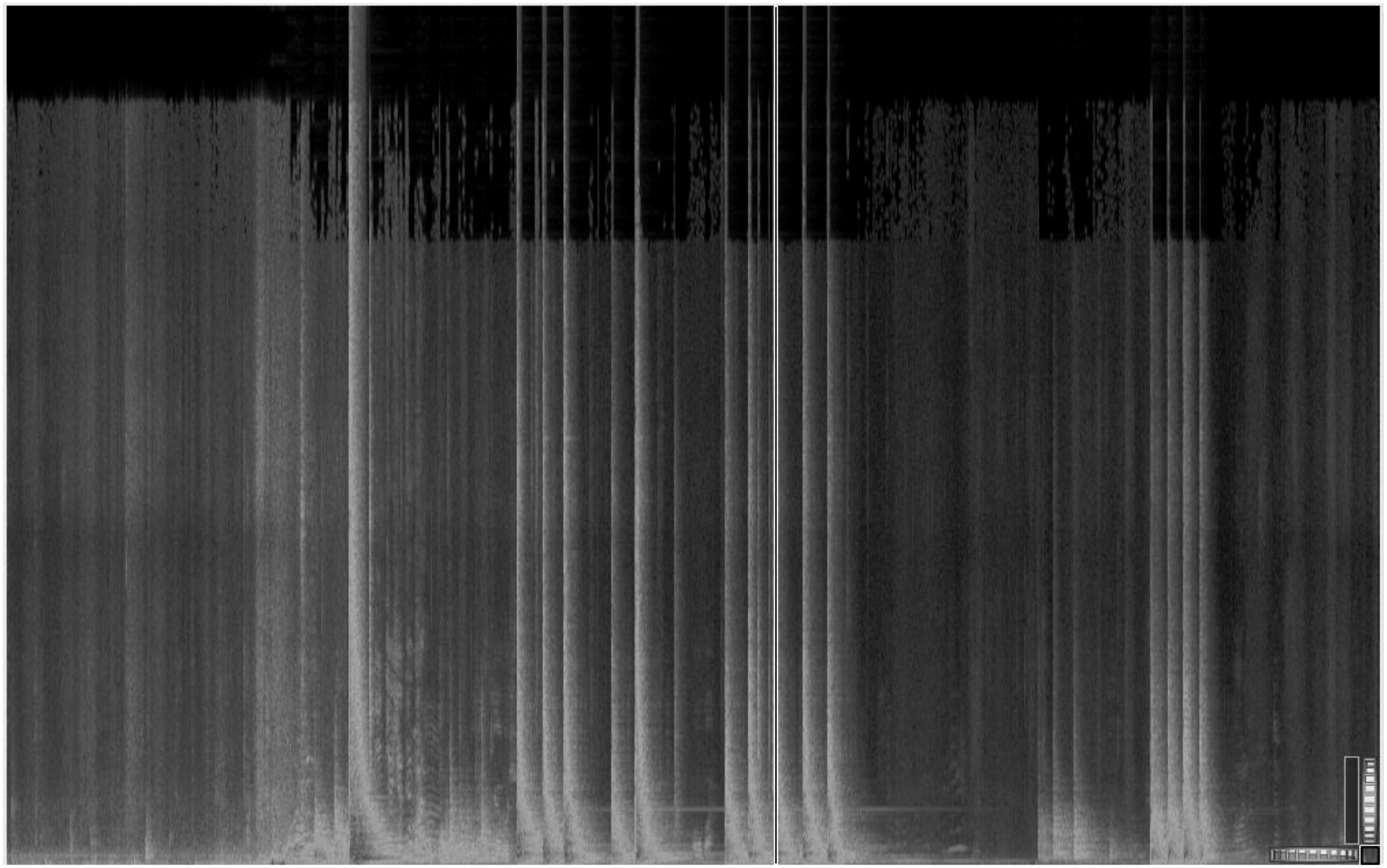
Walking as Research-Creation
In this article, I have referred to walking’s movement as always differentiating and emergent. The work of these walking workshops underscores the radical empiricism proposed by philosophers Gilles Deleuze and Félix Guattari (1987), an empiricism that begins in the middle rather than at any distinguishable beginning or end: this is movement’s immanence. It is also a way to think about an emergent quality of knowledge in the making brought forth through walking. This is research-creation, a hyphenated term suggestive of the ongoing relationality between both words (Thain, 2008), in which research begets creation and creation becomes research. Cleared of its assumptions and habits, walking becomes performative and paves the way for novelty.
The workshops and experiments depicted in the article articulate how walking as research-creation can be understood as attention to novelty that allows us to enter into durations in which we may become aware of other durations above and beyond our work at hand (e.g., Bergson 1992/1946). These durations move our immediate perception into contact with sensation, the “thinking-feeling of what happens” (Massumi, cited in Thain, 2008; p. 3). What the work becomes emerges relationally and is inherently experimental (Manning, 2009). Walking with defamiliarization techniques, which encourages experimentation and novelty, has the potential to vivify connective relations and ethico-aesthetic architectures that might sensitize us toward sustainable encounters with place.
Footnotes
Declaration of Conflicting Interests
The author(s) declared no potential conflicts of interest with respect to the research, authorship, and/or publication of this article.
Funding
The author(s) received no financial support for the research, authorship, and/or publication of this article
