




Abstract
In this paper, we explore, name, and unpack the possibilities that printmaking, as an art form, holds in visual narrative inquiry. We also explore the relationship between visual narrative inquiry and narrative inquiry, a relational qualitative research methodology that attends to experiences. Drawing on two different ongoing narrative inquiry studies, where we engage with either trans young adults or refugee families from Syria with pre-school children, we explore how printmaking practices facilitate processes of inquiry. The etymology of the word “frame” helps us understand framing as a process that is future oriented and reflects a sense of doing, making, or preforming. In this way, framing allows us to see otherwise, to respond to and with participants, and to engage with experiences in ways that open new possibilities of inquiry.
Espen, Max, Adebayo, and Vera are absorbed in their projects at the community printmaking studio. I love these quiet moments. It’s good to see everyone working together. The air is abuzz with sounds of activity that reverberate through the print-shop. I revel in the comfort of these familiar print-shop sounds—the creak of the printing press as the blankets are first engaged under pressure, the slurp of ink as it wraps around rollers at the inking tables. Vera and Max, already at the press, are absorbed in conversations about ink thickness and color. Adebayo and Espen sit across from each other, at the table, quiet and focused. Both are hunched over woodblocks engrossed in plate cutting. Carving tools sit at the ready, covering the workspace, spreading across the table. I love seeing Espen, Max, and Adebayo, take up space, and feel free to take risks to be creative. I’ve learned the ability to take up space, to occupy place, and feel safe enough, free enough, to be creative is not a given; it is not a given for young trans adults like Espen, Max, and Adebayo who lead complex lives and who continuously need to carve out spaces in which to exist—spaces to be seen, to be heard, to live with dignity, and a sense of well-being with hope for the future. Today is the first time all of us have come together in the printmaking studio. There is excitement in the air.
(Michelle, reflective note)
Situating Our Work
Over the past 3 years, we have engaged in two different narrative inquiry studies, each of which has involved printmaking practices as part of the inquiry process. In one study, Michelle engaged with three trans young adults to explore their experiences of community making across their lives. Over the same time period, Vera engaged with refugee families from Syria with preschool children to inquire into their unfolding experiences of schooling. Both narrative inquiry studies were focused on understanding experience in relation to time, place, and social context (Clandinin, 2013; Clandinin & Connelly, 2000). Much of the inquiry Michelle undertook was situated in a local print studio, where participants could reflect on and communicate their experiences visually. The printmaking studio in her work became a place in which differences were lived, shared, and explored. Art in her study was relational, and participants were using it to further relationships with selves, others, and imagined audiences. Vera joined Michelle and her participants—Max, Espen, and Adebayo—in the printmaking studio. However, instead of working alongside participants, Vera engaged in printmaking to explore resonances across the experiences of three families she worked closely with who arrived in Canada as Syrian refugees. In this article, we explore the possibilities printmaking offers us in narrative inquiry and visual narrative inquiry. We play with notions of framing as a way that allows us to see otherwise, to respond to and with participants, and to engage with experiences in ways that open new possibilities of inquiry.
Art in Narrative Inquiry
Art practices are especially generative in relation to narrative inquiry because of the unfolding and overlapping nature of each process. Michelle was intentional to conceptualize her study as a visual narrative inquiry study. When art processes unfold alongside or within narrative inquiry (Clandinin & Connelly, 2000), which seeks to understand experience through social interactions, in situational and place contexts, and over prolonged time periods, possibilities for inquiry multiply. Additionally, narrative inquiry is a relational methodology, and relational ethics is at the center of each inquiry (Clandinin et al., 2018). Clandinin et al. (2018) described relational ethics as: engaging in playfulness and improvisation; moving slowly and listening; unfolding as a process; positioning researchers in uncertainty; and embodying experiences to remain attentive to silence and contemplation. These five components of relational ethics in narrative inquiry make explicit our relational commitments. These commitments align with the art processes we engaged in. Ethics approval for both studies was obtained through the University of Alberta Ethics Board.
Emergent Potentials of Art in Research
We situate this paper in stories around the studio table to unpack the possibilities printmaking offers us in visual narrative inquiry. Art processes call forth creativity, imagination, and playfulness, while resultant artworks are imbued with “complexity, ambiguity, multilayered meanings, and richness of imagination” (Jackson, 2007, p. 181). Art practice and reflection on artwork unfolds in a myriad of multi-sensory and multidimensional ways (Dewey, 1934). In research, art practice expands and continuously opens spaces of inquiry by responding to new and emergent opportunities for participants and researchers to engage and re-engage. Others, like Bach (2007) and de Mello (2007), have explored the use of arts in narrative inquiry. Bach (2007, p. 281) was particularly drawn to work with photographs to reflect “seeing as a way of being in relation with people, nature, and self”. For de Mello (2007), the arts became another way to create and express meaning. She includes arts in the data gathering process and also as a representational form, including poetic representations. Caine and Lavoie (2011 and 2015) took up printmaking to explore the emotional and deeply personal impact of experiences alongside participants that were too difficult to be told in previous studies.
Printmaking is a unique art form that offers distinct medium specific types of engagement. In our work, we found that printmaking’s processes develop five nested and interactive forms of engagement. These spaces of inquiry and engagement include spaces of community to act within networks of support; spaces of activity to physically engage in art making; spaces of self-reflection, criticality, and self-expression to pause and inquire into narratives; spaces for play and imagination to create and reimagine possible futures; and spaces of vulnerability and risk-taking to encourage and celebrate difference and allow world-traveling (Lugones, 1987).
We have returned time and time again to the printmaking studio to work alongside each other. This community studio, with its shared space, equipment, materials, and community spirit welcomed us, while our printmaking activity in the space, carved space for our small research community to work within a broader community of artists. Our printmaking activities (carving plates, inking, and printing) alongside each other allowed us to learn in relation. Returning regularly (monthly, for 5-hour group printmaking sessions over the course of a year) to print allowed our inquiries to deepen, while remaining responsive to our relational commitments to learn alongside each other. This communal studio space and our research activities within this space, over time, and in relation created a safe community space, nested within a larger community, to explore our stories, while taking risks and remaining playful together.
(Michelle, fieldnote)
First Inquiry Space: Sharing and Shaping Community Printmaking Spaces
While the focus of our paper is on printmaking and the spaces of engagement and inquiry, it is critical to consider the physical spaces in which our work occurs. Community print-shops are grassroots, artists-run cooperatives, created by artists to support artists; they are not commercial enterprises. These artists-founded and artists-run print-shops encourage collective sharing and creative differences. Within this context, printmaking as a medium harbors a history of societal interaction and activism (Jule, 1997). A worldwide network of not-for-profit community print-shops has been developed by artists to offset expenses of specialized printmaking equipment and supplies, while offering space for print-artists to congregate, share knowledge, and make prints. A sense of comradery tends to imbue these spaces, promoting a sense of optimism and belonging to a community of artists. The community spirit of these print-shops offers the possibility of developing and deepening community connections, while setting the stage to create safe spaces for self-exploration through printmaking activities. Both Michelle and Vera have been part of these communal printshops. Max’s statement below highlights his appreciation of printmaking while building community connections and learning in community.
First of all, I think learning printmaking has been really fun for me. It’s something that I enjoy doing and exploring. I think opening-up printmaking to something like community learning for me is actually pretty nice and being able to find ways to exist in community, like even being responsive to my accessibility needs, like being able to take classes that still gives us a sense of community even on a small basis, instead of just like art openings. It is amazing! It really suits my needs a lot better, especially because it is just really fun… Again, the idea of seeing people on a regular basis with enough time to be, like, ‘Hey how have you been doing’, and even just fostering a nice creative environment to be in. It feels nice! A good little community.
(Max, in conversation with Michelle)
Adebayo also states the importance of printing within a supportive community space.
Michelle invited me to continue working on prints with her, and I’ve been making work at [the print-shop] ever since. And I don’t want to print anywhere else because of how welcoming the place is and how easy everything is. Everyone is helping you all the time and complimenting each other, like ‘that’s so good, you made that?’ and I got this idea in my head that there is no bad art, especially if you make it [here]. I connect […] because the work I make here is healing and being here releases my stress.
Situating Michelle’s research at a local community printmaking studio enabled Max, Espen, and Adebayo to feel a sense of connection to this community and experience the support of working in a creative community arts space. Michelle’s experience as a community member and organizer (volunteer, renter, and board member) have caused her to return, time and again, to reconnect with and through this community. As someone who identifies as lesbian and queer, Michelle has found community art spaces, to be welcoming spaces where she could find community and a place to be herself. Knowing the high degree of stigma and social isolation young trans adults face, which sometimes results in their withdrawal from public spaces (Scheim et al., 2014; Taylor et al., 2020; Wells et al., 2017), Michelle had hoped Max, Espen, and Adebayo might find the communal arts studio to be a safe space, a good place where they could feel free to be themselves. For Lugones (1987), being at ease is a foundational step to being creative; she suggests that being at ease, to feel at home, and be oneself in a world is a generative experience because it enables both taking up space and the ability to be creative in that space. Printmaking within the context of a communal arts studio offered us new possibilities to engage.
Second Inquiry Space: Getting Physical and Why Materiality Matters
As Michelle turns her thoughts to printmaking, her experiential and embodied knowledge comes forward; arms extending to scrape ink, shoulders hunch rolling a new palette, hands and forearms tighten in response to the resistant tug of the presses’ flywheel. She smiles, realizing how remembering her printing experience brings to present an embodied sense of comfort and connection not only to her years of printmaking, but also to so many other lived stories. She recalls some of her experiences in a note to Max.
Dear Max, following our talk on printmaking art and craft, memories of my dad teaching me bricklaying and mom teaching me crocheting came to mind; those embodied teachings I remember in my hands and movements. Printmaking is like that too, those embodied processes: the act of cutting a plate, rolling out ink, the sound of ink on glass, the tug of the printing wheel in hand as plate squeezes ink into paper, the smell of materials. There is a teaching in it too, a standing alongside, and supporting, until experience becomes embodied and is known: setting the pressure, ordering the blankets, picking the right ink, rolling ink to the right thickness, setting printing pressure on the press, printing, clean up. This was part of it all, an implicit sharing, teaching and learning alongside. I hope you carry these processes, this embodied knowing, with you, as I do. While I taught printmaking, you taught me quiet stories, how to think with them, laugh with them, cry with them, while learning how to learn alongside.
(Michelle, note to Max)
Printmaking processes (plate cutting, inking, and printing) are physical activities, which engage participants in an unfolding process of self-discovery. 1 Max’s, Adebayo’s, and Espen’s stories emerged through and throughout the process, seeming to deepen their commitment to inquire, through artmaking, into their personal stories of experience. Dewey (1934) notes that art experiences, embody thinking, imagination, and action, and concentrate and frame experience as episodes that help artists see their experiences anew. As a professional printmaker, Michelle long ago embodied these processes and finds a deep-down sense of comfort in her embodied knowledge of printmaking. Connelly and Clandinin (1990) named such embodied knowledge, stories to live by 2 ; these are touchstones that call forward past stories of experiences to help guide present actions. Stories to live by, this embodied knowing may offer a sense of continuity. For Vera, being in the print studio allows her to reach backwards and forward.
Stepping across the door frame at the print studio, the smell of ink greets me. It is a welcomed and familiar smell. I have been spending hours alongside participants and feel unsettled and restless—the experiences shared have been difficult and I long for a space to be quiet, a space that allows me to dwell within the fractures and ruptures that accompanied their experiences. The smell of the ink calls forth memories of my mother and aunt, of the long ago days spent doing crafts, spent in pottery studios, and alongside women who had arrived as refugees in Germany. I notice Michelle and the others engaged in their work and welcome their quiet presence. Soon my hands will be covered with ink and the large turning wheel of the printing press a reminder of the quest to create, to seek insights and surprise.
(Vera, fieldnote)
The smell of ink and the quietness that is part of the process for Vera make it easier for her to think with and across difficult stories (Figure 1).
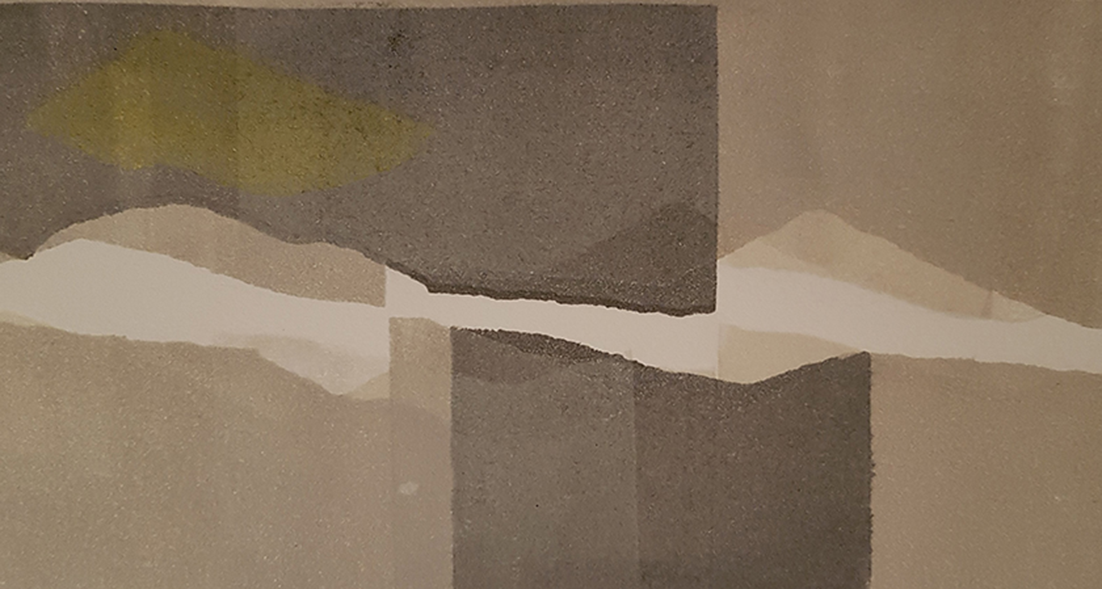
Caine, V. (2019). Disruptions and Fractures. [Linocut Print]. Collection of the Artist, Edmonton, AB, Canada.
Adebayo reminds us that the physical activities of printmaking, like plate carving, may also embody hard stories, when plates act as repositories for difficult memories, with strong emotional resonances, and printmaking becomes a form for self-expression. For Adebayo, the act of carving was therapeutic, and even cathartic at times, when the materiality of printing enabled him to physically scrape against the surface of some of his harder stories. We also have come to understand the physical act of printmaking as an embodied gesture and visible scar of memory (Caine & Lavoie, 2011, 2015). When printed materials are transformed into printed images, experiences can be transformed into tangible, tactile traces of memory, experienced through art objects (Barthes, 1980). Through art we not only see, but begin to wrap our hands, heads, and hearts around experiences, touch the surface of hard memories, and sometimes with courage and support, act to change them.
I like the physicality of carving [into a plate], like I’m carving out all the trauma in my life, like I’m making my mark on this object and it’s not going away. Even after a long day of carving, I don’t feel tired. It feels good even if you don’t print. I do a lot of carving at home.
Adebayo’s statement also highlights how embodied printmaking processes aided his exploration of his experiences, and helped Adebayo take ownership of his art practice and engage and participate as a co-inquirer in this research.
Third Inquiry Space: Self-Reflection, Criticality, and Self-Expression
It’s February 28, 2019, a cold snowy winter afternoon, and Espen, Max, Adebayo, Vera, and I have gathered for our fifth printmaking workshop. I am reminded our work is not without tensions when Adebayo arrives, coming directly from an appointment across town; he speaks his frustration with accessing supportive health care and appears agitated. After we chat, Adebayo picks a plate and carves his frustration with quick gestural marks into his plate. Seeing Adebayo work I am reminded of the complex stories Max, Espen, and Adebayo bring to studio, often negotiating challenges, like accessing gender appropriate and trans supportive health care.
(Michelle, reflective note)
The third inquiry space of self-reflection, criticality, and self-expression allows for participants to deepen their understanding of experiences through complex and powerful processes embedded in art creation and thinking in relation to their artwork. Art processes allow artists to engage in Dewey’s (1933) five-step critical reflective thought process in which, “a reflective thinker: becomes conscious of a problem, defines the scope of the problem, seeks potential solutions from experience, plans a path forward, and tests for effective solutions” (Miciak et al., in press). Adebayo describes the importance of printmaking in his reflective thought process (thinking, processing, and acting in relation to his past experiences). Adebayo’s art series named WAIT poignantly reflects Dewey’s (1993) critical reflective thought process.
My prints are related to my story, my lived experiences, things I’ve survived. I heal and survive using art. I survived a lot of things and I put it on paper so that I can talk about it, so I can look at it and own it. The community work I do is also really heavy emotionally and mentally… You have to be a safe space for 20 to 30 people at a time and take in everything they’re going through, and you have no outlet for it. Using printmaking I can work through it and process it. It doesn’t go away because it’s a part of me, but it calms me down and that helps me move on. (SNAP, 2019).
In Adebayo’s print entitled Wait (Figure 2), the mark-making (plate cutting) is gestural and expressive. The vibrant orange color jumps in contrast to the pale purple and light tan. The face seems like a mask, with sharp teeth, tears in the eyes, and the word WAIT written on the lips. Adebayo describes the story behind his artwork and how the printmaking process intervened in his thought process and self-stories, allowing him to reflect, pause, and act (to make a print, and reimagine his self-story).
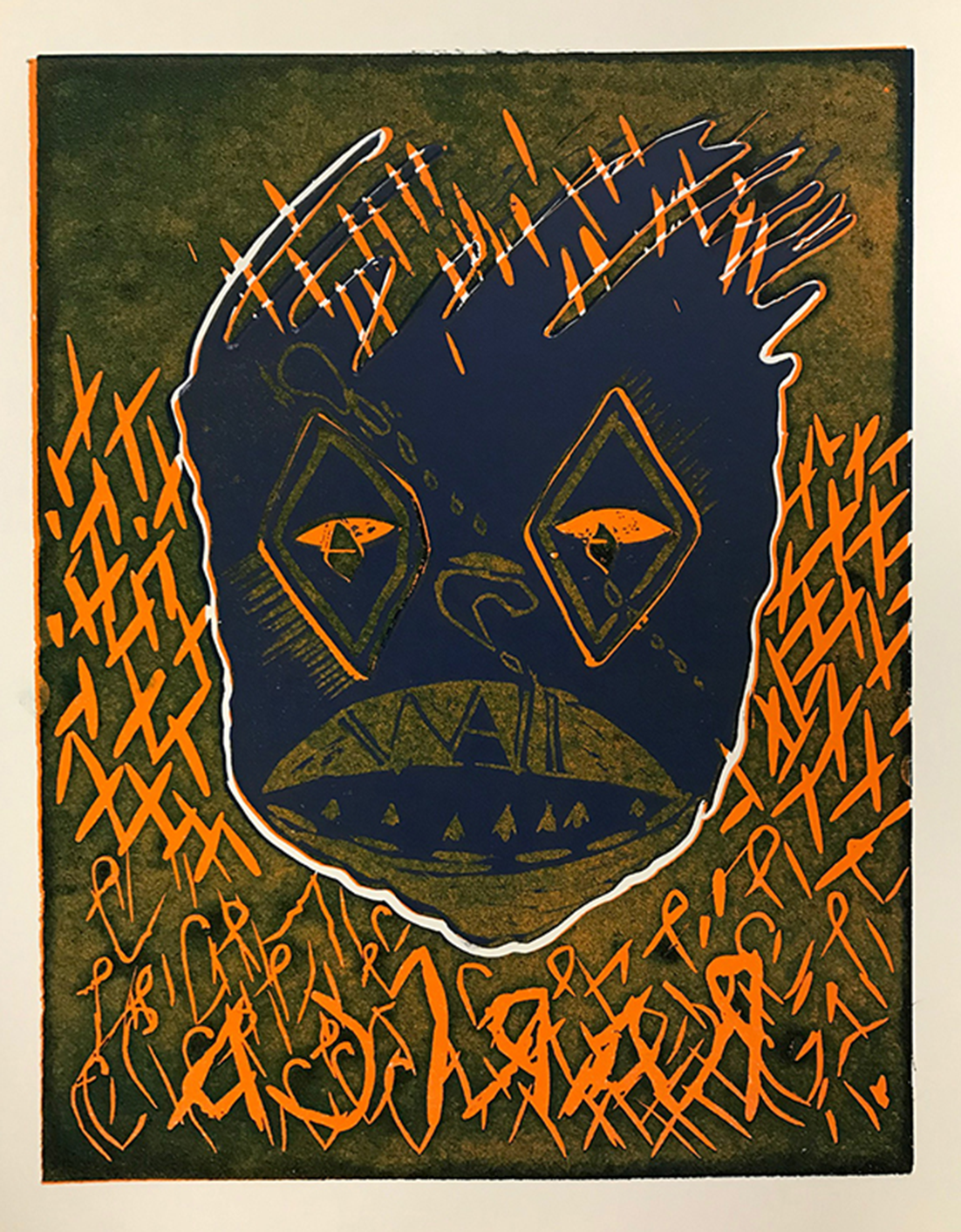
Artist: Adebayo. (2019). Please Don’t go Away - WAIT. [Linocut Print]. Collection of the Artist, Edmonton, AB, Canada.
WAIT was made at a time I was at the peak of helplessness and feeling suicidal. I was scheduled to meet Michelle for a printing session, and I started crying on the bus. There were a lot of heavy things happening in the community regarding Pride—people sending us hateful messages, hate group activity in Edmonton… And when I got to SNAP, Michelle gave me a plate and I put it all down. I was telling myself it’s okay to wait, wait to take your life, you can resist it and you can survive it, it’s okay to take a step back, you don’t have to move so fast, you don’t have to move at everyone’s pace. And that’s where the WAIT project came from.
Importantly, printmaking processes allowed Adebayo to wait, to press pause on thoughts of suicidal ideation. Its’ noteworthy that Adebayo’s process (carving, printing, reflecting) took place within the tight and supportive social network of a small research group in our now familiar studio space. We literally stood beside and worked alongside and with Adebayo as he created this artwork. Much of our support for Adebayo was lived in silence, by being there and with our care-filled quiet attention. This form of silence held open a space for Adebayo to take the risk of creating artwork that was reflective of his experiences.
Adebayo’s presence mixed with sound of the rollers soaking up ink filled the space today. As his body leaned into the plate to carry the marks left, my mind wandered to the families I worked with. Like Adebayo, they had arrived as refugees. The journeys of displacement and hard stories was palpable. The silence that was present was reassuring somehow, there was no attempt to erase or shift the experiences and the rawness of the pain was present. I remember the sense of our bodies leaning into the space … the choice of colors, the thickness of the ink, and the pressure of the press helping to create new possibilities. While I found myself amidst the stories told to me, I recall my desire to bring the families to the print studio. Would they, like Adebayo, find this space welcoming?
(Vera, reflective note)
Creating artwork together, sharing space, and helping one another as we engaged in the printmaking processes undoubtedly acted as implicit support. Because no expectations were ever placed on Max, Espen, or Adebayo to create art in a certain way or speak about the prints they created, Adebayo knew he was free to create images without a requirement or expectation to show his images or speak about them for this research. Michelle regarded Adebayo’s, Max’s, and Espen’s art practice as their exclusive experience, which was housed amidst the research, but not owned by the research. This allowed Adebayo, Max and Espen to take full credit and ownership of their artwork and individual art practices, and bring only what they wanted to share (i.e., images, text, stories) to this research as co-researchers.
Taking time to carve and print the image literally helped Adebayo pause and wait. Then seeing his printed image—the face, the tears, the marks, and the word WAIT—Adebayo stopped and reflected on his experience alongside his print. Adebayo’s process mirrors Dewey’s (1933) critical reflective thought process in that printmaking allowed him to see a problem (depression, stigma), considering the scope of this problem (these feelings are also happening with others), consider possible solutions from experience (art has acted as healing medicine), and plan a course of action (wait, press pause on suicidal ideation, and share the idea to wait by creating prints to share in community).
Adebayo took his print to his community of LGBTIQ+ 3 refugees and found that his artwork became a source of personal and community support; it created the possibility within his community to discuss mental health issues and confront suicidal ideation. Adebayo over the several next months printed hundreds of t-shirts, through which he shared his artwork and stories.
The act of printmaking and personally reflecting on his artwork as well as sharing these prints in his chosen community, gave Adebayo time to pause a narrative of helpless, and take actions: create artwork, which expressed his feelings. In this way, Adebayo began to speak his emotions. By expressing his feelings, Adebayo began to transform a feeling of helplessness into hope for the future. When Adebayo discovered he could speak his stories through his artwork, and his artwork would find an audience, his art became a resource for both himself and his community. With this realization, Adebayo started to become more prolific and more playful in studio reassembling and reimagining his stories. Through printmaking, Adebayo created multiple original prints from a single plate; this multiplicity, unique to printmaking, allowed Adebayo to share his prints with friends and community.
Creating prints did not resolve the hegemonic and systemic issues Adebayo faced daily, like discrimination based on anti-Black racism, xenophobia, or transphobia, but creating prints helped Adebayo create a safe space for himself—a space to breathe, to stand, to reflect, to speak, to be heard, and act to strengthen and build his community of LGBTIQ+ refugees. Adebayo’s beloved community (hooks, 1990; 2003), in turn, supported Adebayo as a space of refuge, to build resistance, and personal resilience within a web of social connections (Arendt, 1958).
Fourth Inquiry Space: Printmaking to Engage in Spaces of Playfulness and Imagination
The door of the printmaking studio fell closed behind me as I stepped outside. The work was intense, focused and brought so many questions to the surface for me. There were times where my responses to the experiences the families shared were inadequate and silencing. Words were unable to express my responses. Leaving the studio space, I wondered how I might engage in playfulness and imagination, to open possibilities of inquiry. It was in this moment that I turned to Michelle.
(Vera, reflective note)
Deepening into thinking about engaging in spaces of imagination and playfulness in printmaking, Michelle recalls how Max’s prints (Figure 3) often felt whimsical, like a playful invitation to participate in meaning-making. Max’s image reminds Michelle of Rodin’s artwork, The Thinker, combined with a suit of a playing cards (diamonds or hearts); it feels like a puzzle, a riddle, something to solve. Max would often make a conscious decision to hold back from explaining their artwork and bringing their stories alongside, instead preferring to offer their artwork to audiences as a thinking process. Max explains how fun and playfulness sit at the center of their art practice to engage both themselves and their actual and imagined audience.
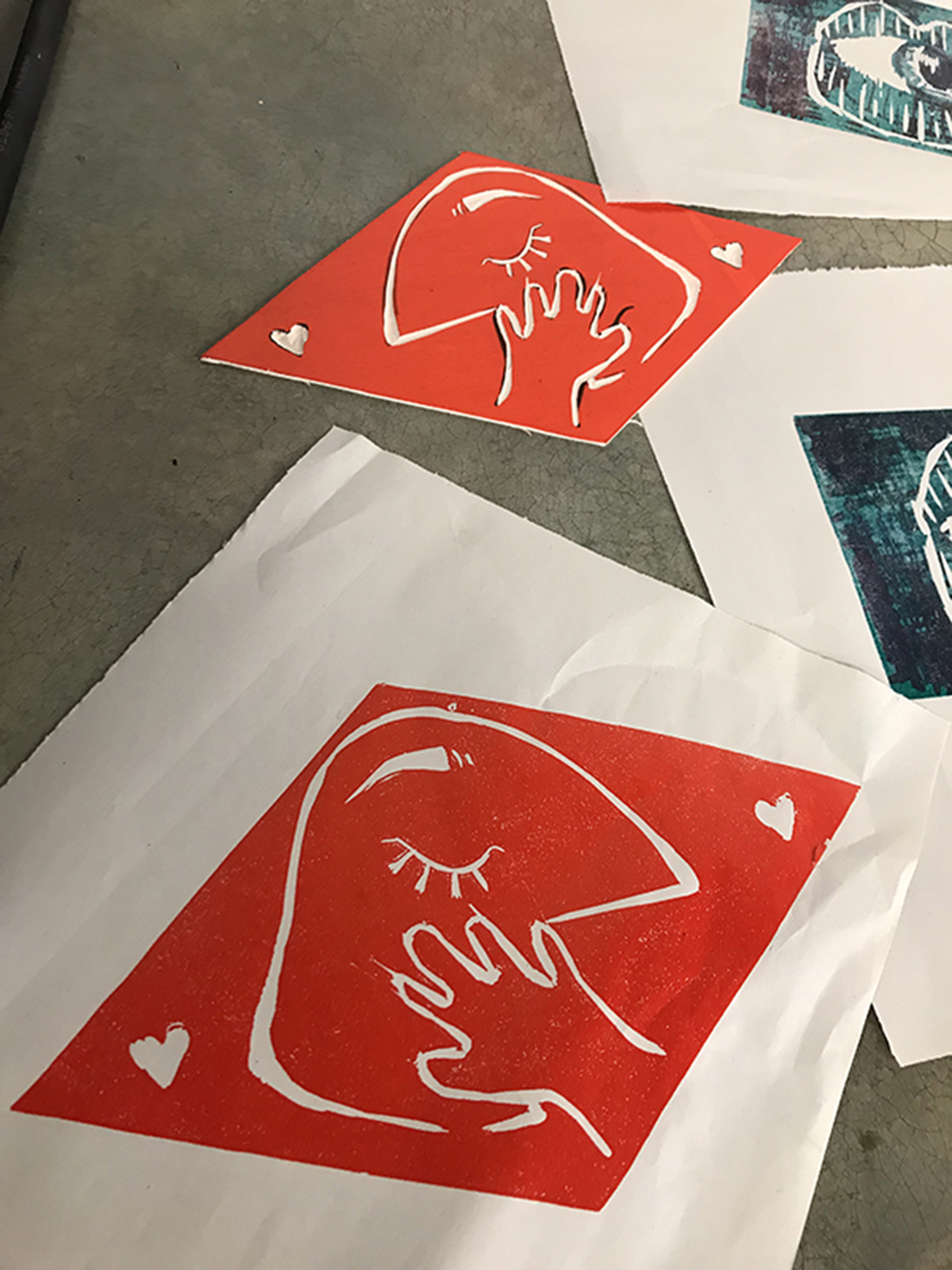
Artist: Max. (2018). Untitled (the Thinker). [Linocut Print]. Collection of the Artist, Edmonton, AB, Canada.
I think for me art is important and meaningful, but its’ also for fun. It’s for sharing really creative ideas. You can talk about really serious and important issues that are really important to you in really fun ways. And yes, sometimes serious things need a really serious tone—but in these times when the house is on fire and everything is already pretty sad, I don’t necessarily feel that way.
(Max, in conversation with Michelle)
Max made multiple prints using different techniques. Thinking with Max’s woodblock print (Figure 4), Michelle notes the content (the lip eye image), the medium (woodblock carving), and the mark-making (lively gestural graphic white marks against red ink with a woodgrain pattern). She notices the immediacy of the communication and how the gestural quick marks make the image seem almost alive, ready to blink. Michelle recall’s Dewey (1934) writing characterizing art as embodied of thoughts, feelings, and actions, imaginatively generated by an artist; the artwork conceived, communicates by eliciting imagined thoughts and feelings of the viewer. Dewey (1934) states, in art, “meanings are actually embodied in a material which, thereby becomes the medium for their expression” (p. 218), and “the formed matter of [a]esthetic experience directly expresses […] the meanings that are imaginatively evoked” (p. 219). Art experiences communicate evocatively by invoking the imagination, first of the artist through the creative process, and second of the viewer through the artwork. Furthermore, artwork holds a multiplicity of meanings because artwork gains its meaning in relation to both artists and viewers unique interpretations, which evolve continuously in relation to the artwork over time (Dewey, 1934). Michelle continues to think with Max’s image and writes:
Max because of our talks about your role as a disability activist and advocate, your print makes me think of the role of sight in communication, and literally the act of watching or reading lips as well as a general thought about watching (taking care with) words. Continuing to look at this image I recall our personal stories of hearing loss and loved ones with hearing loss come forward as meanings interwoven in stories continue to unfold.
(Michelle, reflective note)
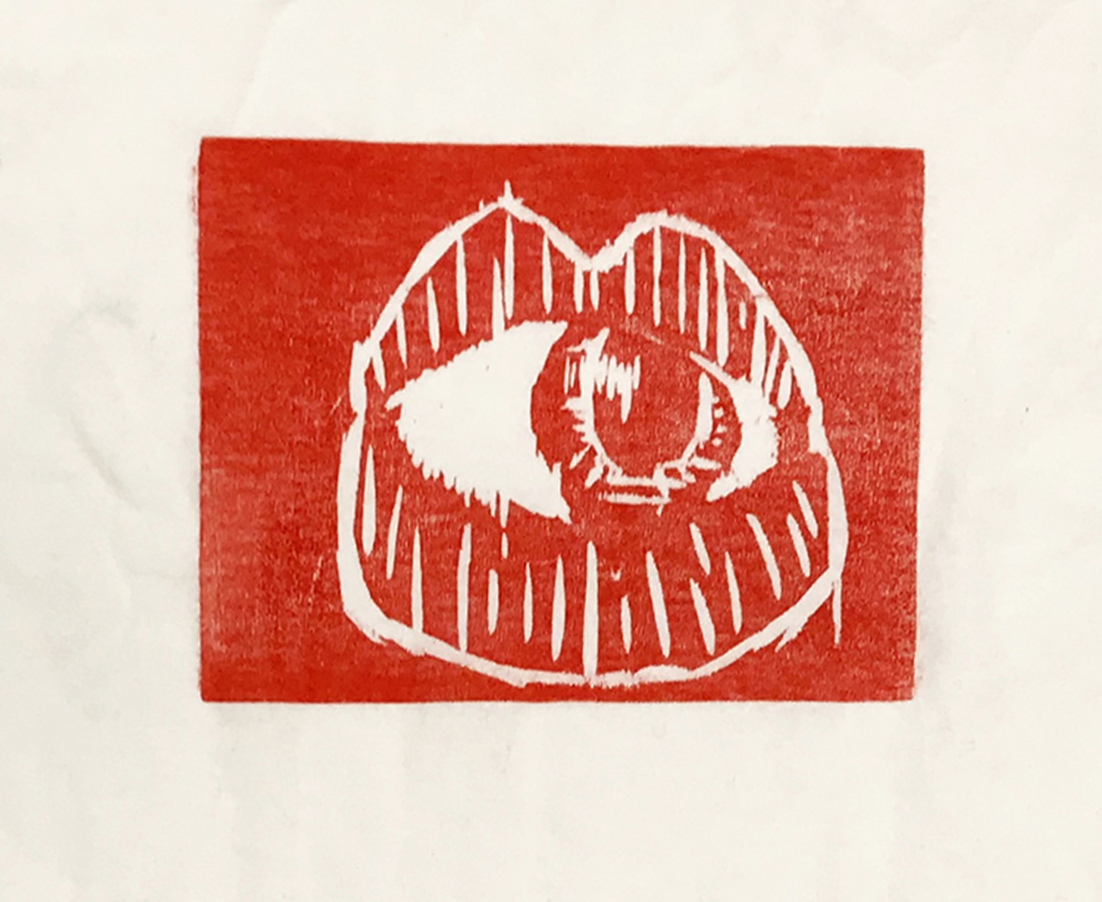
Artist: Max. (2018). Untitled (MouthEye). [Woodblock Print]. Collection of the Artist, Edmonton, AB, Canada.
As Vera and Michelle talk about the significance of meaning-making, Michelle recalls Freire (1970) writing about meaning-making as a dialogic, shared endeavor. Freire (1970), an educator and education theorist, wrote about learning as a dialogic process, which takes place in relation and is grounded in experience. Freire (1970) argued that critical consciousness could be created, through dialogue by people in relation to understand experiences. As Michelle and Vera consider printmaking in relation to Freire’s (1970) dialogic process, they realize that printmaking and prints are a touchstone from which dialog can proceed in any direction, and artwork serves as a gateway to open multiple paths for stories and imagination to follow.
I am drawn to the ideas of the dialogical and feel a sense of urgency to return to the printmaking studio. It is here that I seek conversations with difficult to tell stories, with ideas, and possibilities. I return to the studio space over and over, where the smell of ink welcomes me to try again. To try again to understand, to make visible, rather than erase the memories of hard to tell stories.
(Vera, fieldnote)
As Michelle looks at Vera’s and Max’s prints, she recalls Lugones (1987) writing about traveling worlds to engage and learn alongside others in playful ways. As she considers the role of art and printmaking to allow world-traveling, Michelle recalls her discussions with Max about the importance of sharing handmade gifts with friends and family, as a way to extend the possibility to world travel.
I would say art is something that has helped me engage with my brother, who is autistic, [and] engage with my community, in a lot of different ways and in a way and I think that kind of speaks to the communicative power of art. Just in the sense that it connects people so easily. It’s like even with language barriers and you can make things together and that’s very cool.
(Max, in conversation with Michelle)
Thinking with Max about the importance of visual art as a thinking process, Michelle realizes that visual thinking sometimes creates spaces for words to come later. Dewey (1934) called art an evocative language because the immediacy of art as visual communication, means art engages and communicates on multiple levels (tacit, sensory, emotive) simultaneously. By engaging thought, sense, and imagination, through art practices the groundwork may be laid for new thoughts and thought ordering to emerge, resulting in new forms of sense-making and understanding. Max speaks of a process of visual thinking they learned as a child, which enabled Max to work with language and meaning making through artmaking.
I think for me growing up art was like a main way of communicating about a bunch of different things, before I was able to, because I was someone who was diagnosed with childhood mental illness. So, art was a main way for me to communicate, a bunch of different things before I was able to. Because for me, I was like someone who was diagnosed with childhood mental illness, I was someone who went to art therapy for a number of years. Which is what got me into art in the first place. Most people think that I just liked drawing a lot as a kid. I was like mandated a one hour drawing session every week. So, I think, in that sense art is really important to how I communicate things about how I understand the world in some ways. I think the art I make speaks a bit more to how I think, than sometimes I do verbally – just like what my experience of existing is more conveyed in my art than it is through my talking.
(Max, in conversation with Michelle)
Fifth Inquiry Space: Printmaking Engages Shared Spaces of Vulnerability and Risk-Taking
Spaces of vulnerability are ever present in research particularly in relational research methodologies, such as narrative inquiry (Clandinin & Connelly, 2000), where research is nested amidst relationships and grounded in relational ethics. Co-creating spaces of research to maintain and develop ethical relational research commitments means walking alongside participants amid the complexity of their lives, over prolonged periods and across diverse situational and social contexts (Clandinin et al., 2018). This also mean participants come alongside us in the midst of our complex, often messy, lives.
Rushing out my office door to catch the bus to the printmaking studio, I felt unfocused. My mind was preoccupied, I could feel my heart racing and wonder if I should just stay on the bus, rather than stop to join Michelle, Adebayo, Max, and Espen. My presence, I was certain, would disrupt the generative space. As I passed the familiar streets and walkways, I wondered if anyone would notice my absence. Did it matter that I attended the printmaking sessions Michelle had organized? Did I matter? Questions about who I was and was becoming surfaced as I wondered how I could shift the difficult stories of the families I worked with. Stories of racism, of poverty, and of disruption. As I passed the usual stop for the printmaking studio, I stayed on the bus. I saw everyone gathered around the table through the window as the bus passed the printmaking studio. This sense of the table suddenly called me to get off the bus. The cool air cleared my head and the few minutes of walking grounded me as a backtracked my way to the print studio. Opening the door to the studio, I could hear Max’s gentle ‘hello’.
(Vera, reflective note)
March and April 2019 were full of tensions in Edmonton’s LGBTIQ+ communities, and these tensions reverberated into Michelle’s research. The tensions were present as we gathered around the studio table. Some of these tensions were caused by racial remarks and racially motivated actions, others were marked by the precariousness of political decisions. April was a bitter month for Adebayo and his community. First, a beloved member of the Adebayo’s community, a LGBTIQ refugee, was refused the right to stay in Canada and returned to a country where it is illegal and dangerous to be queer. Second, Edmonton Pride 2019 was canceled and demands from BIPOC LGBTIQ+ groups were cited by event organizers as reasons, amongst others, for the event’s cancelation. The cancelation created a social media firestorm, which deepened rifts between LGB and TIQ+ communities and between racialized and nonracialized LGBTIQ+ individuals and communities.
I really was at a loss, I didn’t know what to do. I didn’t know how to reach out and make things better. I grieved alongside Adebayo’s community, as they mourned the loss of a friend deported. I also sensed the deep disappointment and grief Adebayo and his community felt with the lack of support and blame the community was fielding around Pride’s cancellation. The sense of isolation of the BIPOC LGBTIQ+ communities seemed very profound, and I didn’t know how to bridge these divides. I also tried to hold a space to allow myself to feel disappointed with the Pride cancellation, and sense the deep rifts in Edmonton’s LGBTIQ+ communities, and hold the space for needed changes to come. I tried to hold open a space of support for Adebayo, and for his community who were grieving, and for me to grieve as well. I needed a way to reach out to Adebayo at this time, so I returned to what I know best, art and printmaking to try to span a divide of grief, sorrow, and loss, that I was feeling, that Adebayo and his community were experiencing, and that many were experiencing in Edmonton’s LGBTIQ+ communities at that time.
(Michelle, fieldnote)
Over time, it became evident that spaces of vulnerability are shared spaces where trust is negotiated and renegotiated in relationship and within shifting, sometimes turbulent, contexts. Artmaking helped to build important bridges to understand silent and sometimes hard to speak stories.
Adebayo had missed studio in April. He hadn’t had much time to cut plates since we last printed in March. When he entered the studio, he looked tired and asked to talk. I asked if he wanted to grab some lunch, but he wanted to stay at SNAP, as it was quiet with no one around. 4 When I pulled out the plates and proofs I had made as a gift for him, he lit up (Figure 5). We started printing with the Map of Africa plate. When Adebayo asked what color, I wondered if we should print the colors of the trans flag to imagine trans inclusion. Adebayo lit up with the suggestion. We must have printed about thirty t-shirts that day. It was lovely to see his mood lift as we worked. As he cranked plates through the press, he said, “this is really meditative, isn’t it?” I replied “Yes…yes it is,” just doing this work—those physical repetitive movements. I thought, how wonderful we get to do this, just be here, just print the next shirt, and be surprised how inks sits on fabric.
(Michelle, fieldnote)
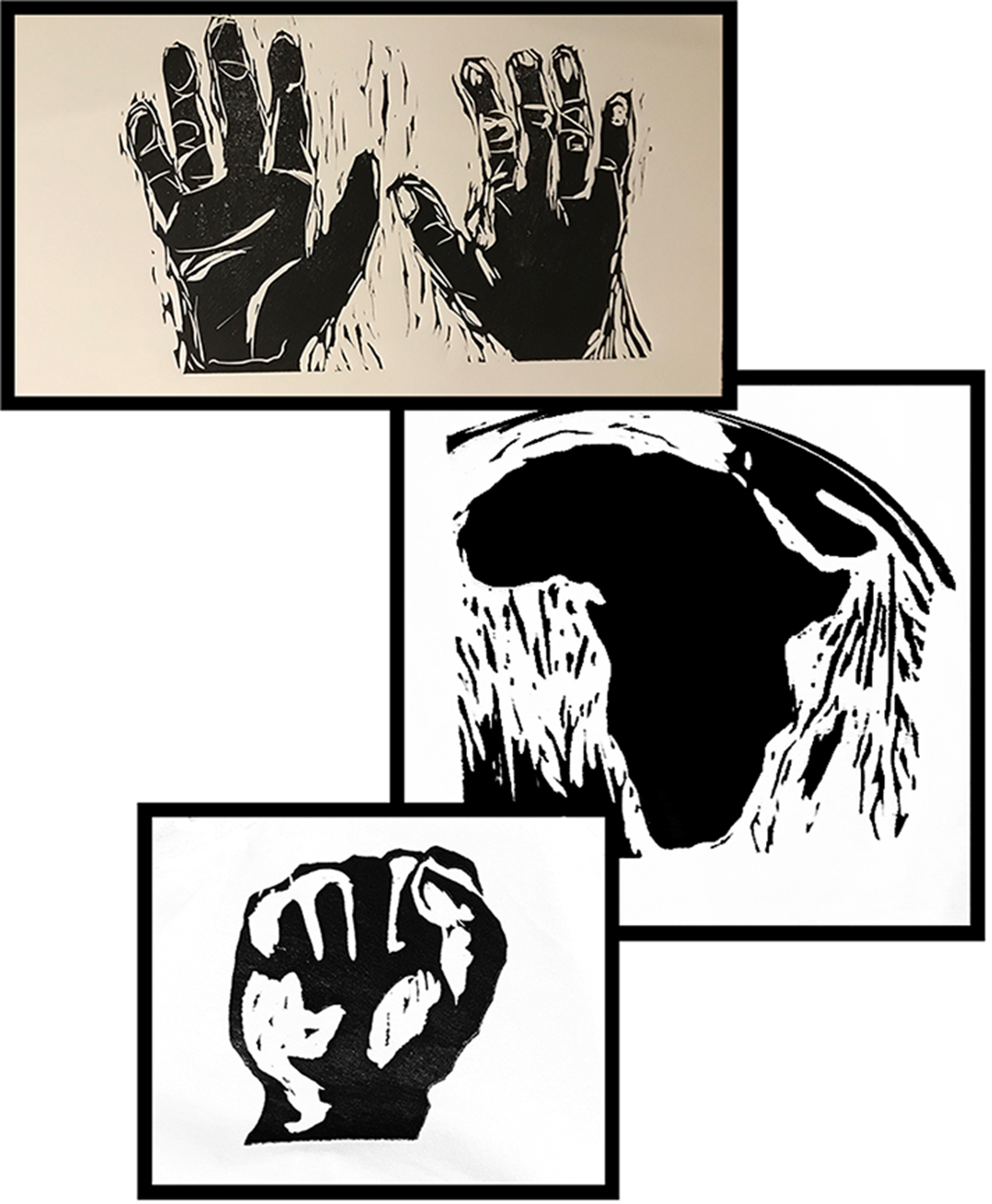
Printmaking plates Michelle gifted to Adebayo from top to bottom: Two Sides of the Same Hand referencing a statement Adebayo made about differences in the LGBTIQ+ communities being like two sides the same hand, but people not being able to see that connection; Map of Africa to imagine possibilities of LGBTIQ+ inclusion; and Mandela’s Solidarity Symbol to pay homage to one of Adebayo’s heroes and imagine a world without racism
Printmaking’s Unique Promise to Deepen Spaces of Inquiry and Engagement
We found that printmaking offers possibilities within each of the five aforementioned spaces of inquiry to deepen and expand opportunities for participants and researchers to engage research together as co-inquirers. Printmaking specifically helps create safe spaces to think through and tell stories in community settings; engages participants as co-researchers in unfolding, emergent activities; embodies experience and communicates embodied ways of thinking and knowing; may temporarily press pause on narratives; disrupts, interrupts, disassembles, reassembles, and helps reimagines narratives; creates space to reveal silent and silenced stories; and acts as an asset and resource created in relation to connect individuals to themselves and to their chosen communities.
Conclusion
Printmaking opens new possibilities in narrative inquiry and visual narrative inquiry. Forefronting the visual and creative aspect of our work shifted how we told, retold, lived, and relived experiences alongside participants, as well as during moments when we tried to make sense of the stories shared. Participants in Michelle’s study, were able to engage and participate in research as co-inquirers working within five interconnected spaces of inquiry, which opened a multitude of emergent possibilities within relational research. We were able to attend to complex experiences in new ways, in ways that embraced silences, diverse ways of knowing, and stories yet to be lived and told. Printmaking in this way allowed us to frame and reframe how we understand and inquire into experiences over time, in diverse contexts, and places. The etymology of the word “frame” helps us understand framing as a process that is future oriented and reflects a sense of doing, making, or preforming. In this way, framing allowed us to see otherwise, to respond to and with participants and ourselves. This sense of response that was present in the printmaking was marked by a relational ethics, which called us to attend to and engage with participants in ways that open new possibilities of inquiry.
Footnotes
Declaration of Conflicting Interests
The author(s) declared no potential conflicts of interest with respect to the research, authorship, and/or publication of this article.
Funding
The author(s) disclosed receipt of the following financial support for the research, authorship, and/or publication of this article: Michelle gratefully acknowledges The Social Sciences and Humanities Council of Canada (SSHRC) for funding her research through a Joseph-Armand Bombardier Canada Graduate Scholarship – Doctoral: # 767-2017-2084. Vera gratefully acknowledges The Social Sciences and Humanities Council of Canada (SSHRC) for funding her research. Vera and Michelle also wish to gratefully acknowledge the Canadian Research Knowledge Network (CRKN) for open publication support of this article through the CRKN-SAGE Publishing agreement.
