




Abstract
Walking alongside is a phrase used in narrative inquiry to describe relational commitments that shape how we attend to the complexity of lives, unfolding over time, and within a web of social relations. The space of inquiry requires researchers to attend to participants’ lives and stories of experience across various social situations, places, and times. In this paper, I explicate and unpack my intimate, and sometimes complex, journey and unfolding research process. In this study, walking alongside was a process of embodying the relational ethics of narrative inquiry, which attended to silences, remained playful, and responded to and through uncertainty. I provide insight into building relational spaces in visual narrative inquiry by combining art-making with Lugones’ theories on world travelling to creatively and nimbly respond to stories and walk alongside participants. As a narrative inquirer, I walked alongside three trans young adults, to co-create, re-imagine, and transform research in relation to participants. This process is undergirded by attention to and a deepening awareness of relational ethics, and by creating spaces that allow for emergent possibilities of being in relation to honor diverse and multiple ways of knowing.
Keywords
Introduction
The print-shop is abuzz with activity. Everyone is busy carving plates, rolling ink, and putting plates through printing presses. Laughter reverberates through the space. It is beautiful to see such ease amongst strangers. But then again, we are all part of the SGM 1 community, and this, unlike many public spaces, is a safe and supported space. (Michelle, reflective note) 2 .
Walking Alongside and Why it Matters
This paper demonstrates and explicates my process of walking alongside Max, Espen, and Adebayo, three trans young adults, as a visual narrative inquirer. Walking alongside, a term used in narrative inquiry (Clandinin & Connelly, 2000), refers to negotiated relational commitments between participants and researchers. Far from being a methodological technique, walking alongside embodies the relational ontology, epistemology, and ethics of this relational methodology (Clandinin et al., 2018). For narrative inquirers, walking alongside participants requires us to: live research in relation, learn and think relationally, and continuously attend to and negotiate relational ethics. Walking alongside is a thoughtful response to participants’ experiences, ground in living beside participants amid their unfolding lives (Clandinin, 2013). Because walking alongside is primarily a relational response to participants, relational ethics is key to guide researchers’ engagement with participants throughout research. Attending to relational ethics requires narrative inquirers to embrace unfolding processes, embody experiences, engage in playfulness and improvisation, attend to silences, and position themselves in uncertainty (Clandinin et al., 2018). In this paper, I show how visual narrative inquiry embodied relational ethics as walking alongside participants. To foreground relational ethics, I highlight how Lugones’ theories (1987, 1992, 2003) combined with artmaking in visual narrative inquiry allowed us walk alongside each other by: remaining playful in response to Max’s playfulness; attending to the silences surrounding Espen’s experiences of mental health; and living within uncertainty to create outreach opportunities to respond to Adebayo’s stories of isolation and racism. Although Max, Espen, Adebayo, and I are part of the SGM community and have some common experiences (i.e., homophobia and transphobia), our experiences are diverse. Max, Espen, and Adebayo are three very different trans young adults and I am lesbian and queer. Relational ethics was critical to negotiate similarities and differences in research; walking alongside enabled me to think and act ethically in relation.
The Focus of Research
In my doctoral dissertation, I inquired into mentorship as co-created relational learning alongside trans young adults (Lavoie, 2021). I employed a visual narrative inquiry design (Bach, 2007; Caine, 2007; de Mello, 2007), a relational methodology to study mentorship, because relational learning is tacit to both. My research objectives were to: understand mentorship as a collaborative learning experience; attend to mentorship as a co-created identity formation and asset-building process; and better understand how practical applications of theory may be used to inform concrete actions in relational research. Because narrative inquiry is grounded in Dewey’s (1938) concept of experience, I attended to mentorship as a life-making experience that happens in dynamic interactions and often conflicting constructions of identity, agency, and resistance. As part of this study, I engaged in multiple conversation with each participant. We also engaged as a group in monthly opportunities to create artwork at SNAP, a well-supported community art studio, to deepen reflections on experience. I facilitated these studio sessions drawing on my work as a professional artist and post-secondary studio art instructor.
Initially, some of my wonders were influenced by narrow definitions of mentorship in relation to support for trans youth; these understandings broadened over time. Reflecting on earlier experiences, I realized mentorship comprised a piece of a much larger “research puzzle” 3 (Clandinin & Connelly, 2000, p. 124), such as how relational learning situated in community arts spaces and artmaking experiences might support trans young adults’ experiences of identity and world making.
In this paper, participants’ stories exemplify complex challenges trans young adults negotiated and how walking alongside made space for us to creatively and ethically respond to support each other. Findings from my dissertation are published elsewhere (Lavoie, 2021; Lavoie & Caine, 2021), in this paper, I focus on my relational learning alongside participants. Elsewhere (Lavoie & Caine, 2021), I have focused on participants’ stories and artwork and how this methodology provided a generative, transgressive, and transformative space to support participants’ lives. This paper unpacks Lugones’ theories of world travelling that enabled all of us to walk alongside each other.
Methods
This study took place over a three-year period in informal settings in Edmonton, Alberta, Canada. I used purposive sampling to recruit three trans young adults, age 18–25, who had engaged in SGM programs and could speak to mentorship experiences. This sample size is typical of a narrative inquiry, as narrative inquirers are interested in continuous engagement and prolonged research interactions (Caine et al., 2013). The time commitment required was a significant factor in recruitment, as participants needed to be able to commit to prolonged research engagements. I met participants two years before they agreed to participate in this study in informal arts-related group activities. I believed each person’s stories might bring important perspectives to this research. Field texts were diverse and included transcripts, meeting notes, conversations, found poetry, creative writing, photographs, and artwork. Overall, 16 (5-hour) group artmaking sessions and 6–12 individual participant meetings were held. Narrative accounts were written and negotiated with participants. Metaphorically speaking, I laid the narrative accounts side by side to discern resonant threads across participants’ accounts (Clandinin & Connelly, 2000) to compose final research texts. Participants formally agreed to be part of the study in 2018 through written consent. Ethics approval for this study (Pro00079772) was obtained through the University of Alberta Ethics Board on March 21st, 2018.
Fast Failure: Learning the Necessity of Walking Alongside SGM Youth
My learning to walk alongside to respond to complex stories was a complicated, evolving process. Nothing was straightforward—I was learning along the way. Packing up after Camp fYrefly, so many supplies had been left untouched, so much had been left on the shelf. I felt left on the shelf. I arrived at Camp excited to learn what arts-based mentorship might mean for SGM youth. I came in with my head full of ideas, a list of activities and expectations how these should roll out. It all landed flat. In retrospect, I came in head first, when heart first might have worked better. My plans got in the way of my being able to know the youths, relate to them, hang out with them, and allow them to know me, and guide the unfolding processes.
4
(Michelle, reflective note).
In this, my first experience working exclusively with SGM youth as Artist-in-Residence at Camp fYrefly, I began to understand the importance of co-creating spaces with youth. Hoping to creatively respond to their voices and needs, I centered my subsequent work with SGM youth in community spaces.
Situating the Work in a Community Printmaking Studio
Grounding my learning in community, I created a series of free printmaking workshops for SGM youth at SNAP community print-shop, following Camp fYrefly. Here, I began working more closely with Espen and Max, a trans man and a non-binary trans person respectively. At SNAP, I was also introduced to Adebayo, a trans Black man and recent newcomer to Canada. It was within these nested SGM and community arts spaces that Espen, Max, Adebayo and I began working side-by-side.
5
(Michelle, reflective note).
As I entered fieldwork, I was reminded of my earlier experiences at Camp fYrefly and SNAP studio, and the desire to co-compose research with Adebayo, Espen, and Max. Walking alongside would be important to keep spaces open and to negotiate boundaries, expectations, and possibilities. My initial research conversations with Adebayo, Espen, and Max were amazing. Then nothing. Eventually two participants got in touch to say their lives had become complicated, and they were unsure when we could meet again. I was concerned both about the wellbeing of participants and how research might proceed. After 2 months, and considerable fretting on my part, an email arrived from Adebayo asking to return to the printmaking studio to make art. In their email, they told me they had gone through a tough time and wanted to return to studio because they needed art at their back. This became the stimulus to situate research in regular group artmaking sessions–it was not something I had initially planned.
6
(Michelle, reflective note).
Evolving Research Puzzles
Before my experience at Camp fYrefly, I would have framed my research wonders within the context of finding solutions to a set of problems, such as understanding SGM 7 intergenerational mentorship to combat social isolation of SGM young adults. I had studied literature pointing to dire consequences springing from social isolation, stigmatization, and marginalization of this population (Meyer et al., 2011; Taylor et al., 2011, 2020). While these issues are critical, my experience learning alongside SGM youth at Camp fYrefly helped me wonder who my participants are as individuals and what complexities they negotiate in their daily lives. Because research puzzles, used to frame inquiry within narrative inquiry (Clandinin & Connelly, 2000), evolve in relation to participants’ unfolding experience, they hold the possibility to frame generative spaces for relational learning.
Relational Inquiry: Methodology, Theory, and Approaches
Narrative inquiry is informed by a relational ontology (Clandinin et al., 2018), which posits knowledge is co-composed through interactions between researchers and participants over time, in multiple contexts, places, and situations. Narrative inquiry enables us to understand life as experienced and understood relationally, and to think with story (Morris, 2002). Thinking with story, rather than thinking about story, facilitates the use of tacit and embodied knowledges in meaning-making (Caine & Lavoie, 2015), allowing insight into the nature of experience and relational learning. Visual narrative inquiry is a form of narrative inquiry. This type of research is rooted in narrative inquiry’s (Clandinin & Connelly, 2000) theory, methodology, and methods, but emphasizes art creation by participants and researchers as a key component of relational research to elicit storytelling, respond to, and tell stories (Bach, 2007; Caine, 2007; Caine & Lavoie, 2011, 2015; de Mello, 2007; Lavoie, 2021; Lavoie & Caine, 2021). Narrative inquiry is theoretically ground in Dewey’s (1938) pragmatist philosophy. For Dewey (1938), experience consists of social exchanges (interactions), which take place in distinct events (situations), and over time (continuously). Clandinin and Connelly (2000) reflect Dewey’s (1938) principles in narrative inquiry to understand the social, place, and temporal qualities of experience; they name these qualities of experience the three-dimensional space of narrative inquiry.
Dewey’s (1934) writing on the importance and uniqueness of art experiences—as imaginative, playful, evocative, reflective and critically thoughtful—is important to visual narrative inquiry. This work is undergirded by writing which emphasizes the contributions of artmaking and the arts in qualitative research (Lavoie, 2021; Lavoie & Caine, 2021). In this study, I specifically attend to relationships between visual arts and reflexivity (de Freitas, 2008), imagination (Greene, 1995), and multiplicities of meaning (Eisner, 2008). Critical to the relational aspect of this work was my ability to world travel (Lugones, 1987, 1992, 2003).
World Travelling: Theorizing and Artmaking to Walk Alongside
In this paper, I unpack how I used Lugones’ (1987, 1992, 2003) theories of world travelling and artmaking to think with and creatively respond to participants’ stories. I specifically drew on Lugones’ (1987, 1992, 2003) ideas about world travelling to explicate how generative spaces of co-inquiry were developed alongside Adebayo, Espen, and Max. These spaces of co-inquiry are marked by: engaging in playfulness and creative activities; negotiating borderlands, which demand new ways of seeing and responding to complexity; and, navigating liminality through plural selves, which offers relational responses springing from new “resistant logics” (Lugones, 2003, p. 161). Because Lugones’ (1987, 1992, 2003) theories reflect the relational principles inherent to this methodology (Clandinin et al., 2018), I turned to Lugones’ ideas to explicate relational ways of being, thinking, and acting. Thinking with Lugones within visual narrative inquiry enabled my theorizing to inform creative responses (i.e., art-making) to embody walking alongside.
Living Relational Research Alongside Participant Co-inquirers
Adebayo, Espen, Max, and I engaged in printmaking activities at a small communal printmaking studio. The shared activities of printmaking shaped how each of us experienced walking alongside. These experiences reflected an action-oriented process. Visual narrative inquiry, like narrative inquiry, seeks to understand experience (Connelly & Clandinin, 2006) and begins in the process of living experiences or through telling stories (Clandinin & Connelly, 2000). Grounding research in living means the “researcher and participants live the experience that is being studied” (de Mello, 2007, p. 214). In this study, participants created artwork to reflect their interests, unguided by research questions, projects, or preordained plans. Living relational research allowed participants and researchers to experience research as a means of coming to story, reflecting on, and expressing long silent stories. In this way, living research may facilitate storytelling by participants, enabling them to make sense of experiences and find words to tell their stories over time (Lavoie & Caine, 2021). By engaging participants to inquire into their experiences through living research processes, they may come to see themselves as authorities on their own lives within research (Clandinin et al., 2018), and develop greater agency as co-inquirers (de Mello, 2007, p. 215).
Turning to World Travelling
Attending to the complexities of world travelling (Lugones, 1987) was essential, theoretically and practically, to enable a process of walking alongside Adebayo, Espen, and Max with humility and compassion. Particularly helpful was Lugones’ writing on world travelling through playfulness to deepen understanding of self and others (Lugones, 1987); borderlands as sites of generative space making (Lugones, 1992); and, responses to multiple oppressions through theories of multiple selves, multiple positionalities, and her concept of liminality (Lugones, 2003). According to Lugones (1987) we live in multiple worlds and we are different within each of the worlds we inhabit; we may also travel to other worlds to learn alongside and understand others. Lugones (1987) stresses world travelling to know another is a necessity because, “[w]ithout knowing the other’s “world,” one does not know the other, and without knowing the other one is really alone in the other’s presence because the other is only dimly present” (p. 18). Defining worlds, Lugones (1987) stresses “for something to be a ‘world’ … it has to be inhabited by some flesh and blood people” (p. 9). Describing Lugones’ (1987) world travelling, Dewart et al. (2020) suggest that world travelling “depends on context, setting, shared history, shared language, and understanding of the social norms” (p. 2). For those who do not exist comfortably within hegemonic norms (e.g., hetero- or cisnormativity), Lugones’ (1987, 2003) argues world travelling is an essential survival strategy 8 . Further highlighting the significance of world travelling, hooks reminds us that “counterhegemonic discourses” (hooks, 1990, p. 149) can be created in liminal spaces between worlds, initiating “ways to speak that decolonize[s] our minds” (hooks, 1990, p. 150) to generate new ways of thinking and being.
Walking Alongside by Learning Along the Way
Dear Max, Thinking about self-definition and the challenge it is for me, I think of names I have chosen and how I have been named. As I consider notions of binary oppositions, I think these ideas are becoming brittle and worn out over time. (Michelle, note to Max).
This image (Figure 1) represents my memories of being named and how artmaking helped me think alongside Max’s stories about identity, stigma, and erasure. Recalling relational ethics (Clandinin et al., 2018), which asks us to embody stories and experiences, artmaking, in this instance, enabled me to feel through and reflect on my experiences as I walked alongside Max. Michelle Lavoie (2019). Names I Have Been Called. [Digital Print]. Collection of the Artist, Edmonton, AB, Canada.
When I came alongside participants I began wayfinding—literally finding my way, amid lives being lived (Clandinin & Connelly, 2000). Together through conversation and artmaking, we co-created spaces to learn along the way (Bateson, 1994). The research spaces we co-created were developed through a series of nested supports. Adebayo, Max, and Espen requested to engage in printmaking at SNAP as part of our research. Because SNAP was a known space to Adebayo, Max and Espen, they knew it to be a safe and inclusive space, and a place where they could express themselves openly and freely.
To facilitate our group printmaking sessions, I consulted with Adebayo, Max, and Espen every month to find a time and date that would work best for their schedules. I also scheduled solo printmaking sessions with each one of them when they were having difficulty attending group printmaking sessions. In these sessions, I supported Adebayo’s, Max’s, and Espen’s developing agency as artist-researchers and co-inquirers. For each printmaking session, I rented the studio space from SNAP so that we had full access to printing presses and equipment and were not interrupted in our work. To support their developing art practice, I also gifted Adebayo, Max, and Espen with supplies, plates, and lino-cutting tools, so they could have access to materials outside of our studio times and between group printing sessions.
When, we began this research there was only a determination to learn in relation. In our printmaking sessions at studio, I did not assign projects, ask participants to consider themes, or direct their art-making in any way. I worked alongside Adebayo, Max, and Espen as they created their artwork, offering printmaking technical assistance. Because I wanted Adebayo, Max, and Espen to be able to focus on and pursue their artistic aspirations, I did not ask them to tell stories about their artwork when we worked in studio. If they wished to tell stories in relation to their artwork later, it was welcomed, but never required. The creative space of printmaking was a sanctuary in a way. When Adebayo came into studio, he told me that he had been up most of the night supporting a friend who was going through a tough time. He told me he hadn’t gotten his sleep. I asked if he wanted to reschedule printing, but he told me he wanted to stay because printing relieved his stress. (Michelle, field note)
Later, speaking about the research and the importance of artmaking to him, Adebayo said this: You don’t know how much this means… doing this, being part of this…. Art is a good way to communicate. It’s a good way to tell my story without actually explaining it a lot. And it is medicine. It has helped me heal a lot of trauma. Yes, the more I put it on paper and the more I talk about it, is the more I own it, and is the more I’m confident and is the more it is not going to traumatize me. Because I’m now sharing it with people and seeing it in the art. (Adebayo in conversation with Michelle, Michelle’s field note)
In this research, I was learning to see with different eyes. Adebayo, Max, and Espen acted as my teachers and guides. Thinking about this idea of learning to see with different eyes, I am reminded of Bateson’s (1994) writing. She asserts that until we learn to see in new ways, in ways that reflect tenderness and grace, our learning alongside difference may remain begrudging and uninformed (Bateson, 1994). Learning alongside others, Bateson (1994) suggests, is an unfolding process of adaption and learning along the way, which requires a “new kind of openness and responsiveness… [and a] need to disconnect the notion of difference from superiority and inferiority” (234-235). Max’s words below hint at what is required to learn alongside with a new kind of openness and responsiveness. I feel very grateful for the fact that my mom sort of raised me under the guise of “you don’t know everything” – because we all have different experiences. And I think my brother’s having – like my brother being autistic, is something that definitely contributed to that too. Because I can literally see firsthand that even though we both are in the same family, we have different life experiences in like school and in general, just because of my ability to communicate. (Max in conversation with Michelle, Michelle’s field note)
In this work, relationship building was key when stories became hard to hear and walking alongside meant responding with great care-filled attention. To respond to Max’s stories, I created two linocut prints and gifted the plates to Max. I intended these images to be touchstones for my personal reflection (de Freitas, 2008) and a spark for dialogue between Max and myself. I created Figure 2 to reflect what I saw as Max’s seamless ability to travel between worlds. Then I created Figure 3, writing the word CARE in sign language to reflect how Max’s caring seemed to facilitate their ability to world travel. Because Max is learning to sign, I learned a little sign language to carve a plate and speak with Max. Recalling Eisner’s (2008) writing on the way artwork offers a multiplicity of meanings, I remember this artwork was also created to respond to shared stories. Dear Max, I remember being totally surprised when you told me that you wear hearing aids and you too struggle to hear in crowded venues. (Michelle, note to Max) Michelle Lavoie. (2019). Seeing with Many Eyes, Hearing with Many Ears, and Speaking in Many Tongues. [Linocut Print]. Collection of the Artist, Edmonton, AB, Canada. Michelle Lavoie. (2019). CARE. [Linocut Print]. Collection of the Artist, Edmonton, AB, Canada.

Travelling to Another’s World and Becoming Playful
Lugones’ theory of world travelling (1987) originated to understand how to be in relation and come to know another. Specifically, Lugones (1987) developed the theory of world travelling to respond to and better understand her mother. Lugones (1987) writes, “[o]nly through this travelling to her “world” could I identify with her because only then could I cease to ignore her and to be excluded and separate from her” (p. 8) By drawing on Frye (1983), Lugones asks the question: How is it possible to understand and know another? From Frye (1983), who posits we look at others through either “loving eyes” or “arrogant eyes” (p. 75), Lugones (1987) developed her concepts of loving and arrogant perception. Looking at others through the filter of arrogant perception, Lugones (1987) asserts we see only ourselves and our own reflections; while it is only through loving perception that we might travel to others’ worlds to see and better understand another. Lugones’ (1987) world travelling responds to Frye’s (1983) assertion, “that to know the seen, one must consult something other than one’s own will and interests and fears and imagination” (p. 75). Without world travelling Lugones (1987) suggests that it is not possible to know another; and without travelling playfully, one may not travel at all.
Walking Playfully Alongside Max
I think for me art is important and meaningful, but its’ also for fun. It’s for sharing really creative ideas. And yes, sometimes serious things need a really serious tone – but in these times when the house is on fire and everything is already pretty sad, I don’t necessarily feel that way... It can still be something enjoyable. With this one [art performance], I’m talking about language barriers and how sometimes people don’t have access to the type of communication that suits them best. But I’m dressed like a giant Muppet because that’s still fun. (Max in conversation with Michelle, Michelle’s field note)
As they spoke, Max unstitched the red hands from their red furry Muppet-like costume for the critique of their performance that was to follow our lunch. Remembering Max working on their Muppet-suit that morning, I am reminded of the playfulness Max always brought to their studio practice. Our yearlong process of printmaking at SNAP studio had ended a few months before this talk, so it was wonderful to catch-up. Turning to think with Lugones (1987) thoughts on playfulness to world travel, she writes when we are playful: We are not self-important, we are not fixed in particular constructions of ourselves… we are open to self-construction… While playful we have not abandoned ourselves to, nor are we stuck in, any particular “world”. We are there creatively. (p. 16)
My thoughts skip back in time and I recall working alongside Max, Adebayo, and Espen in our group printmaking sessions at SNAP studio. Between them they must have printed three hundred prints. They were prolific as each developed their unique artmaking practice. One afternoon printing session alongside Max comes to mind. Max and I were just finishing our printing for the day. I was a little tired. The work was physical and we were going on 5 hours of printing. We were working away, in sync, without much talk. We had settled into a rhythm of doing. (Michelle, field note)
Working alongside Max in a printmaking studio was second nature to me. As a professional printmaker and post-secondary and community-based studio art instructor, I had learned through experience to guide technical printmaking process, from beginning to end, so emerging artists could work independently on their ideas. Coming to this research, I followed my practice of teaching artmaking techniques, but not directing ideas, because I did not want my stories or artmaking expertise to supersede, limit, or in any way silence Max’s, Adebayo’s, and Espen’s developing art practice and their emergent images or stories. I agree with Finley’s (2008) assertion that ‘expertism’ may act as a barrier to inclusivity, diversity, and the generative potentials of artmaking practice within research (p. 76). Researchers should instead facilitate artmaking processes, “without taking the stance of either expert researcher or expert artist” (Finley, 2008, p. 76). Recalling my experience of Camp fYrefly, I realized the need to attend to Max’s, Adebayo’s, and Espen’s stories in a more responsive way.
The planned, but aborted, art projects and the unopened boxes of art supplies were clues that there was a need for me to attend differently, perhaps in a more responsive way. (Michelle, reflective note)
Working alongside Max, Adebayo, and Espen in studio in this research, I put my expertise aside, or rather, I focused it to facilitate their artmaking experiences. Thinking about our working alongside, I return to Lugones’ (1987) writing on the necessity of playfulness to world travelling. Lugones states: loving playfulness… is a combination of not worrying about competence, not being self-important, not taking norms as sacred and finding ambiguity and double edges as a source of wisdom and delight. (p. 17)
By supporting Max’s playful experiences in studio, stories came forward later, which may have remained unspoken. Because as Max, so eloquently states, artmaking enables creative thinking and working through complex ideas before forming these ideas into words, sentences, or stories. I think for me growing up art was a main way of communicating about a bunch of different things, before I was able to, because I was someone who was diagnosed with childhood mental illness. So, art was a main way for me to communicate, a bunch of different things before I was able to. (Max in conversation with Michelle, Michelle’s field note)
Max’s story recalls Eisner’s (2008) writing on artmaking as a form of visual thinking, a process for creating and communicating novel ideas.
Travelling to the Borderlands Alongside Espen
Dear Espen, It was a nice surprise to see you last week on the steps of the Legislature at the Trans Day of Remembrance Rally – even if it was just for a few minutes. After we met, I realized although we’ve been in touch via text since May, we haven’t sat down to visit since then. After the Rally, I asked if we could meet, and you said you would like to, but it’s complicated right now. Your answer made me worry a little because I have a sense what complicated can mean alongside your stories. (Michelle, note to Espen)
I recall first meeting Espen in the Artist-in-Residence cabin at Camp fYrefly in 2016. Espen was always joking, always laughing. Thinking of Espen, I remember his bright blue eyes, and his infectious laugh. Early in our conversations he told me his stories of being a mental health advocate, but I never imagined the complexity of his health and mental health stories. Those stories came after many silences and absences; they came alongside artwork I began to create to respond to snippets of Espen’s stories, often in his absence. I never understood until I walked alongside Espen for years, the deep chasm of silence that surrounds the telling and hearing of mental health stories. I recall Espen and my talk on the silence and stigma surrounding mental health that arose as we looked at images I had created to respond to Espen’s still quieter stories. These images (Figure 4 and 5) were my attempt to respond to Espen’s stories about tactile impressions and how perceptions shift becoming clearer or less distinct over time. I recently started my ADHD meds again because my executive functioning was so bad that it was affecting my visual perception. My eyes would see something but my brain would want to overcompensate for the lack of executive functioning. So, I would get a lot of static in my vision. (Espen in conversation with Michelle, Michelle’s field note) Dear Espen, Thinking back, I am amazed how our conversations on mental health began in response to this artwork, which began in response to your stories. I am amazed too how artwork disrupted long held silences and held open spaces for us to begin to speak about silences and stigma surrounding mental health. There is so much fear around speaking about mental health that communication, which is so needed, gets shut down, leading in turn to further stigma and isolation for those experiencing these issues. (Michelle, note to Espen) Michelle Lavoie. (2019). Tactile Expressions 1. [Digital Print]. Collection of the Artist, Edmonton, AB, Canada. Michelle Lavoie. (2019). Tactile Expressions 2. [Digital Print]. Collection of the Artist, Edmonton, AB, Canada.
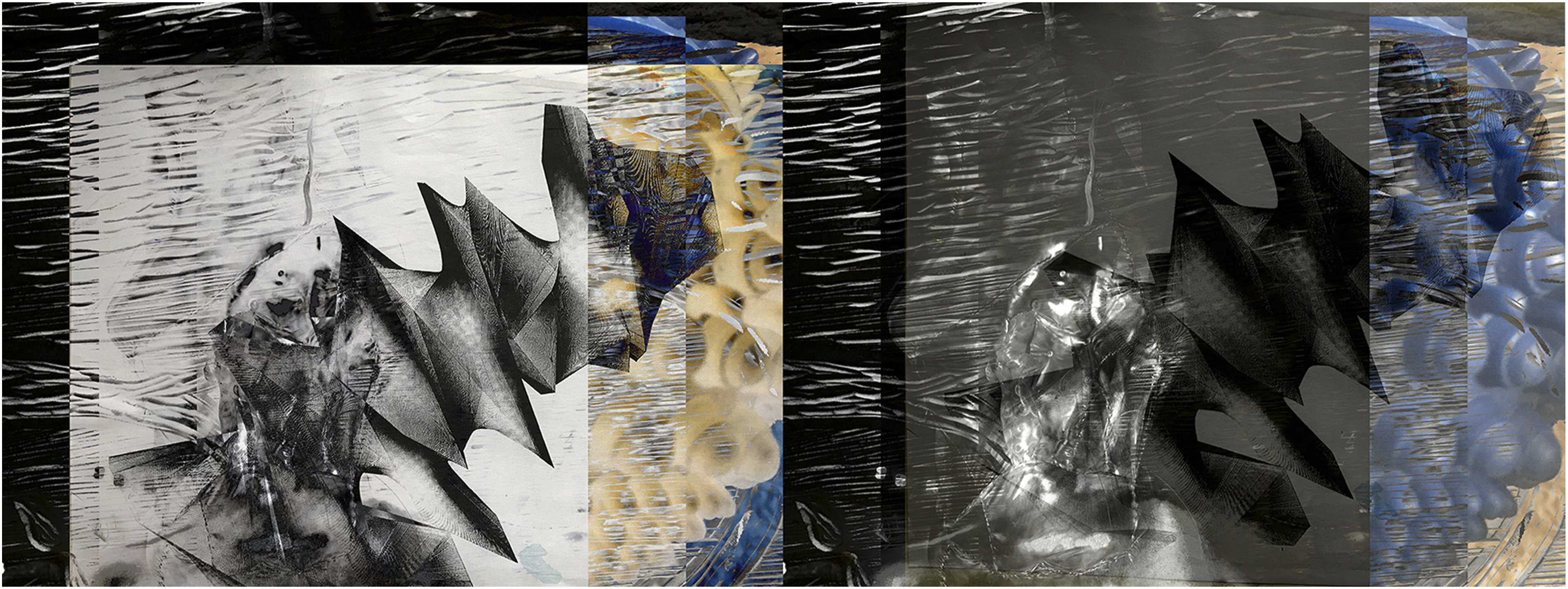
To travel to Espen’s world, I needed to acknowledge and allow myself to traverse what Lugones (1992) calls the borderlands. Lugones (1992) describes borderlands as stuck places; places between mainstream narratives and our lived experiences and embodied knowledges. These borderland places may be metaphoric, or they be literal places and spaces (Lugones, 1992). As suggested in relational ethics (Clandinin et al., 2018), I had to negotiate from a place of uncertainty to respond to the silences in Espen’s stories, so we might begin a conversation. Without working relationally, I do not think these stories would have emerged.
In the borderlands, Lugones (1992) argues we are caught between two dualities – the self-oppressed, by dominant sociocultural forces and the self-becoming. The latter state Lugones (1992) calls the “self-in-between” (p. 32), this is a self that is stuck. Anzaldúa (1987) explains this terrorized state inhibits the ability to respond and be creative, because the self is “petrified […] caught between […] the different worlds” (p. 20). Even though, Lugones (1992) explains, the borderlands are stifling and silencing places, they have potential to be generative and to call forth resourcefulness, adaptations, and creative solutions to survive and thrive in relation.
Artmaking and discussions around artwork allowed me to think and imagine with Espen’s stories, and to share my imaginings with Espen. Thinking momentarily with Greene (1995), artmaking here seemed to have played a crucial role in opening my imagination to enable multiple perspectives and interpretations to be lived and told. It was artmaking in response to fragments of Espen’s stories, and often in Espen’s absences, that allowed me to learn to walk alongside Espen. Lugones (1992) explains, even though borderlands are stuck places, the self may transform in relation because resistance, “depend[s] on this creation of a new identity, a new world of sense, in the borders” (p. 33). Lugones (1992), drawing on Anzaldúa, calls this state of new self-creation, the Coatlicue state. This state, born in the borderlands, offers a way “to make new sense” (p. 33). I needed to travel to Espen’s world to imagine his experiences. By creating artwork that shifted before my eyes, as Espen described how images sometimes dance before his eyes, I caught a glimpse of Espen’s experiences and he began to speak his stories.
Walking alongside helped me hold space for Espen to return to our conversations, after months of silences. Thinking alongside Espen, I began to consider how artmaking holds the potential to recreate borderlands as workable, creative, and generative spaces. Working with art while walking alongside Espen enabled me to attend to silences and find ways to bridge absences and gaps in our communication and mutual understanding. The complexity of both Espen’s stories and his silences laid the groundwork for me to attend to and respond to complexity.
Negotiating Multiple Oppressions Alongside Adebayo through Liminality and Plurality
Adebayo and I met 2 years before this research conversation just a month after he had arrived in Canada where he claimed refugee status. This is small piece of his story:
Adebayo, a trans Black man and refugee from Uganda, since arriving in Canada he has become a prominent advocate and activist on issues of race and citizenship for Trans and Queer, Black, Indigenous, People of Colour (TQBIPOC), and LGBTIQ+ refugees. To walk alongside Adebayo, I needed to attend to Adebayo’s public facing stories, to his TQBIPOC and refugee advocacy and activism, and to his quieter stories of personal triumph and struggle. Responding to an invitation from Adebayo, I attended the film screening of Adebayo’s documentary on the experiences of LGBTIQ+ refugees to Canada. While watching Adebayo’s film, as refugees gave testament to their stories, my heart sank, as I realized I had never heard such hard stories. I remember thinking, how can I walk alongside Adebayo when our lived experiences are so different; how can I hope to respond to and understand such stories.
9
(Michelle, reflective note)
I found the complexity of Adebayo’s experiences daunting because his experiences with anti-Black racism, xenophobia, and transphobia differed greatly from mine, as a white lesbian and queer Canadian. Adebayo continues to face many struggles that I can only understand as an ally, by learning alongside. I wondered how I could check my implicit biases and emotional reactions, hone my ability to share power, and remain conscious of my dominant and non-dominant personal and group identities (Choudhury, 2015). I wondered how I could negotiate these complexities as I walked alongside Adebayo. In our walking, eventually we began to write together, to begin to communicate Adebayo’s experiences to other audiences. This is an excerpt:
Thinking alongside Adebayo, I returned to Lugones' (1987) theory of world travelling because it explicates the necessity of world travelling to understand the complexities in another’s experience. Importantly, Lugones' (1987) world travelling emphasizes how we need to see differences in another’s experience, rather than reduce or erase them. For Lugones (1987) to see another, we need to see beyond your own experiences, reflections, and expectations, otherwise we are only seeing our own arrogant perceptions mirrored back to us. Spelman (1988) named these “boomerang perception[s]” and described them his way, “I look at you and come right back to myself” (p. 12). Lugones (1987) suggests it is care and what she calls “loving perception” (1987, p. 3), that allows us to travel to another’s world with care-filled attention. April had been filled with tensions. I didn’t know what to say and how I could reach out to Adebayo to support him during this stressful and sad time. I knew that Adebayo wanted to return to SNAP to continue printing and he would be returning in a month. I didn’t know if he would have time to carve new plates for this upcoming session, so I created some plates and gifted them to Adebayo to reach out to him when I couldn’t find words. When he returned to studio, Adebayo took up these plates and I assisted him as he printed. (Michelle, reflective note)
The plate
13
with the map of Africa (Figure 6), I created thinking about Adebayo’s friend who had recently been deported to a place where it is not safe to be queer. Adebayo printed this plate with the colors of the trans flag (Figure 6 and 7) to imagine acceptance, inclusion, and freedom from persecution for LGBTIQ citizens of countries with anti-LGBTIQ laws. Adebayo, as a refugee and newcomer to Canada, walks between multiple worlds, conscious and caring about all these worlds, and how they are interconnected. Walking alongside Adebayo, shifted my first world perspective, opening my eyes to hard stories within and beyond these borders. Lugones (2003) suggests complex learning alongside another becomes possible when we become conscious that we are all multiple and negotiate multiple worlds. There is space, Lugones (2003) suggests, between worlds, where we may begin to understand our plurality and realize we are free to move in any direction. In the limen, hierarchies are destabilized, concepts of self are disrupted, and personal and collective identities become porous and malleable (Lugones, 2003). The plate, showing the front and back of a hand Figure 8, I created to respond to Adebayo’s comments on race and how the tension in the Edmonton’s queer communities were like two sides of the same hand. Adebayo had stated that we were not seeing each other, even though we are all so interconnected. I printed the plates once (Figures 6 and 8) before gifting the plates to Adebayo. He then printed these plates multiple times in a variety of colors to share with friends and members of the TQBIPOC communities. He also gifted a shirt to me. Adebayo. (2019). Trans Africa. [Linocut Print]. Collection of the Artist, Edmonton, AB, Canada. Michelle Lavoie. (2019). Printing. [Photograph]. Collection of the Artist, Edmonton, AB, Canada. Michelle Lavoie. (2019). Two Sides of the Same Hand. [Linocut Print]. Collection of the Artist, Edmonton, AB, Canada.


I cut this plate (Figure 8) looking at my hand and thinking with Adebayo’s words—one hand shown from different perspectives. Cutting this plate helped me think with Adebayo’s words about interconnection and the importance of multiple perspectives. After plate cutting, I returned to think with Lugones’ (2003) writing on liminality. She describes that when we become conscious of our multiplicity, we can begin to decentralize our own binary subject positions, and conceive of differences as multiplicities, rather than polarities or binary oppositions (Lugones, 2003). Looking at my hand, plate cutting, and thinking with Adebayo’s words helped me complicate my thinking about who I am and am becoming in relation. In so doing, I glimpse Adebayo’s experiences negotiating complexities, living within and between multiple worlds.
Conclusion
Walking alongside Adebayo, Espen and Max as a researcher meant living relational ethics (Clandinin et al., 2018) by responding to unfolding lives, embodying experiences through artmaking, engaging playfully in research, listening through silences, and learning to live within uncertainties. My walking alongside was facilitated by artmaking which allowed me to creatively respond with reflection, imagination, and to multiple meanings. Lugones’ (1987, 1992, 2003) theories of world travelling enabled relational ethics to be embodied throughout research. This paper highlights how research can be built, negotiated, and held open to walk alongside complex, unfolding lives throughout research. By walking alongside Max, Espen, and Adebayo this research begins to make visible complexities these trans young adults negotiate daily. Walking alongside made space for the telling of Max’s stories of invisibility surrounding non-binary identities and hearing challenges, Espen’s silent stories around mental health, and Adebayo’s stories of confronting racism, xenophobia, and transphobia. Responding through artmaking, allowed diverse stories to be seen, told, and heard. Walking alongside also revealed a diversity of trans’ experiences and identities that complicates and undermines assumptions and expectations (e.g., of homogeneous trans’ experiences and identities). As a researcher walking alongside was key to ethically respond to Adebayo, Espen, and Max. Turning to artmaking in response to Adebayo’s, Espen’s, and Max’s stories, we found pathways to extend our care for each other. This too allowed us to walk alongside each other and support our developing senses of agencies, identities, and world making.
Footnotes
Declaration of Conflicting Interests
The author(s) declared no potential conflicts of interest with respect to the research, authorship, and/or publication of this article.
Funding
The author(s) disclosed receipt of the following financial support for the research, authorship, and/or publication of this article: Michelle Lavoie gratefully acknowledges and thanks The Social Sciences and Humanities Research Council of Canada (SSHRC) for funding her doctoral research through a Joseph-Armand Bombardier Canada Graduate Scholarship—Doctoral (# 767-2017-2084).
Ethical Approval
University of Alberta Research Ethics Board approval was obtained prior to the study. Research participants Adebayo, Espen, and Max agreed to use their first names, as well as, all their stories and artwork in any publicly accessible research texts.
